RSS
 

Posts Tagged ‘Part’

Learning to See, Part VIII

14 Mar

Consulting the rules of composition before taking a photograph, is like consulting the laws of gravity before going for a walk.  –Edward Weston


To some photographers composition is an innate process, whereas to others it is a life-long learned challenge laden with frustration. Regardless of which category you find yourself, good composition is a learned skill that will enhance the overall aesthetic appeal of the end result.  While I subscribe to Weston’s notion, I also believe we first learn to crawl before walking.

Our challenge is to learn how to use diagonal lines, contrast, simplicity, point of interest, and so on to allow us to translate the three-dimensional scene being photographed onto a one-dimensional plane while retaining the original perception of depth and movement.

The first rule that we must accept is that there is no right way to take a picture. Regardless of the subject matter, you should always analyze your picture to ensure it answers the question: Does this picture satisfy my reasons for having made the exposure in the first place?  Should your answer be yes —congratulations.  If not — why not?

The art of making a photograph can be broken down to its most basic and elementary form: Placing the point of interest in the most satisfying position within the frame to achieve the desired result. It really is that simple; everything from this point forward will evolve by way of personal technique.

The first photographic rule that must be learned, and adhered to from this day forward, is the use of a tripod. It is unquestionably the most valuable piece of ancillary equipment you can have at your disposal. Only when your camera is firmly grounded with the flexibility and advantage of controlled movement can you then start to accurately study the scene in the viewfinder, thus ensuring all elements are properly placed in the scene prior to making the exposure. There have been many articles and reviews written on the multitude of tripod models available, please defer to those that are easily located by doing a web search.

By recognizing that we want to photograph a particular scene or subject, we have also admitted to having identified the point of impact within that scene. Perhaps it is a lazy fox in big landscape, a detail of some mammal, a grey wolf peering from behind a tree, or perhaps the snow-capped mountains in some distant vista. Where we place that identifying feature within the viewfinder will unquestionably enhance the final impact of the image.

One of the very first rules of thumb to be learned in composition is the utilization of the ‘Rule of Thirds.’ Essentially the viewfinder is divided into nine equal spaces by placing two equally spaced horizontal lines and two equally spaced vertical lines. Where these lines dissect each other will create the four ‘Points of Impact’ within the frame.
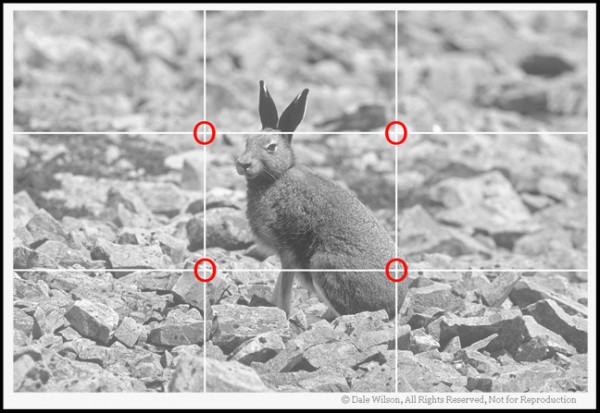
Canada’s easternmost province of Newfoundland has the southernmost population of arctic hare in the world.  This fellow was located atop Gros Morne Mountain, and the photo was captured with little regard for composition. With uncontrolled animals (non-zoo setting) just get the shot first,and then concentrate on refining the image with the next frame. With gained experience you will soon find yourself intuitively placing the subject at the correct ‘Point of Impact’ as indicated here with red circles.

Canada’s easternmost province of Newfoundland has the southernmost population of arctic hare in the world. This fellow was located atop Gros Morne Mountain, and the photo was captured with little regard for composition. With uncontrolled animals (non-zoo setting) just get the shot first,and then concentrate on refining the image with the next frame. With gained experience you will soon find yourself intuitively placing the subject at the correct ‘Point of Impact’ as indicated here with red circles.

Regardless of subject matter, by placing our primary point of interest in one of the four ‘point of impact’ locations within the frame we will dramatically improve the dynamic and aesthetic appeal of the picture.

What I would like you to do now is locate simple subjects in your backyard or neighbourhood park. Do not try to make complex pictures, but just a single subject on a plain background – perhaps a solitary tree against a sky background. While employing the “Rule of Thirds” place that tree, or other chosen subject, in each of the four “point of impact” locations. For the fifth photo of the tree, place it in the centre of the viewfinder. Which photo do you prefer and why?
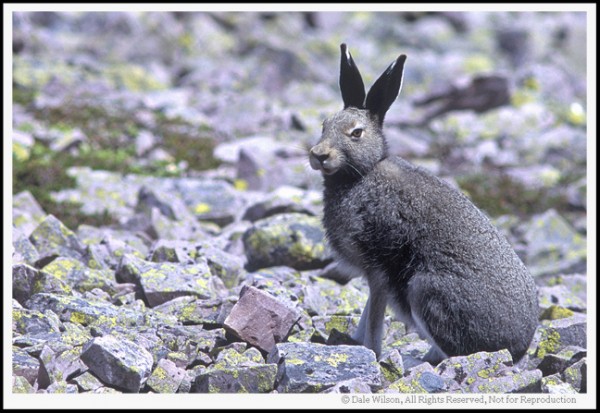
Once this hare heard the mirror-slap on my medium format camera (Pentax 67) he was gone faster than a … well, shot at rabbit. Fortunately, due to the large film size I am able to crop the image and place the ‘Point of Interest’ (the hare) in the most pleasing ‘Point of Impact’ within the frame. When we are working with “living critters, including people” we will usually want to focus on the eyes and frame the animal in such a fashion to leave room for them to “look into the frame.”

Once this hare heard the mirror-slap on my medium format camera (Pentax 67) he was gone faster than a … well, shot at rabbit. Fortunately, due to the large film size I am able to crop the image and place the ‘Point of Interest’ (the hare) in the most pleasing ‘Point of Impact’ within the frame. When we are working with “living critters, including people” we will usually want to focus on the eyes and frame the animal in such a fashion to leave room for them to “look into the frame.”


As you go through this exercise, remember the most important rule in photography: Have fun. If, after all, you are having fun then you are doing it right.

Post originally from: Digital Photography Tips.

Check out our more Photography Tips at Photography Tips for Beginners, Portrait Photography Tips and Wedding Photography Tips.

Learning to See, Part VIII

Digital Photography School

 
Comments Off on Learning to See, Part VIII

Posted in Photography


Retouching with Cloning Tools: Part 3

11 Mar

In Part 1 and Part 2 of the Retouching with Cloning Tools series, you learned what cloning tools are used for and the differences between each tool. In this part of the series, you will follow a step-by-step tutorial to learn how to remove power lines (or other unwanted objects) from an otherwise beautiful photograph. This particular image contains distracting Continue Reading

The post Retouching with Cloning Tools: Part 3 appeared first on Photodoto.


Photodoto

 
Comments Off on Retouching with Cloning Tools: Part 3

Posted in Photography


Making Sharper Wildlife Photographs – [Part 2 of 2]

06 Mar
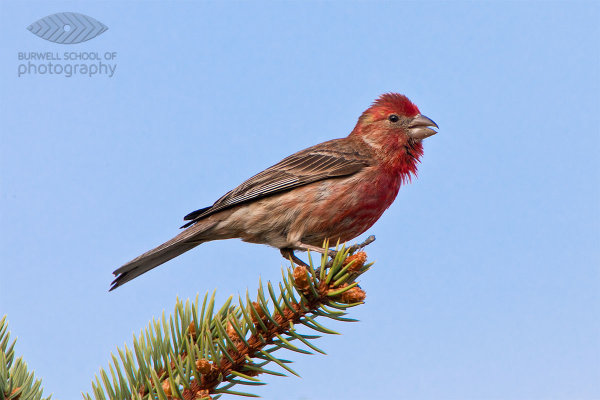
House Finch perched on a spruce tree branch: Canon 5D Mark II, Canon 500mm F4L IS lens, 1.4x Extender II and 2.0x Extender II @1400mm, 1/400th of a second at F10, ISO 800, Gitzo 3541 Tripod with Jobu Design BWG-Pro gimbal head

House Finch perched on a spruce tree branch: Canon 5D Mark II, Canon 500mm F4L IS lens, 1.4x Extender II and 2.0x Extender II @1400mm, 1/400th of a second at F10, ISO 800, Gitzo 3541 Tripod with Jobu Design BWG-Pro gimbal head

A contribution by Paul Burwell from Burwell School of Photography

In my last article I discussed the sort of equipment the average person might afford and use for wildlife photography. We discussed lenses and teleconverters along with tripods and monopods. This time, we’re going to look at how you use that equipment to come away with the sharpest possible images.

Tripod Heads

My first piece of advice is to learn how to use your tripod along with whichever type of tripod head you have. My recommendation for wildlife photography is to use some sort of Gimbal head like the excellent models sold by Canadian company Jobu Design.

These heads allow you to balance the lens/camera over top of the tripod while providing finger tip control. If you’re using a monopod, I’d mount the lens either directly to the monopod or use a quick release plate. At the risk of sounding like a children’s piano tacher, and not meaning to pester, but you do need to practice with this gear to become proficient. Photographic opportunities in the wild are often fleeting and you’ll need to rehearse so that when the time comes you’re making great images and not fumbling with knobs and latches.

Shutter Speeds

Another aspect of making sharp images is using a fast enough shutter speed. As a rule-of-thumb when photographing off of a tripod or monopod, you’ll want your shutter speed to come close to matching 1/2 of your focal length. This rule means that if I’m photographing at a focal length of 400mm, I’ll want to make sure that I’ve got a shutter speed of at least 1/200th of a second to make a sharp image of a stationary critter. If there’s a lot of action going on and you want to freeze the motion, shutter speeds of 1/500th of a second or quicker may be required. I’m also not afraid to use my camera’s higher ISO settings to get a higher shutter speed if required.

There is little doubt that today’s lenses with their built-in gyroscopes to help stabilize the image go a long way in letting photographers get away with slower shutter speeds than the one over the focal length rule of thumb would allow for.

Many of today’s stabilized lenses claim that they can save three or even four stops of shutter speed and still return sharp results. My experience has been that these lenses (IS for Canon users, VR for Nikon shooters, OS or some variation thereof for the rest) do make a tremendous difference and are especially useful in low light shooting conditions. Look at many of my pictures and you’ll see I’m a big beneficiary of this new technology.

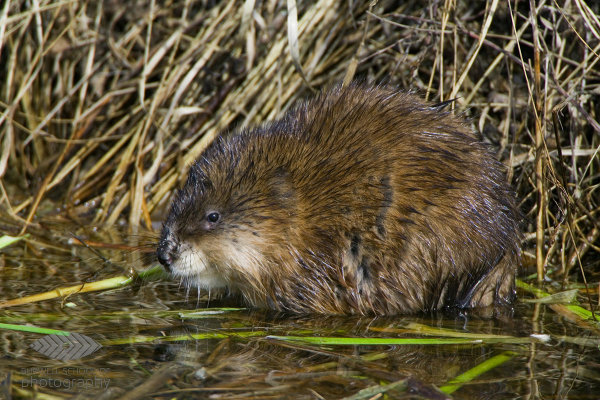
Muskrat pauses while eating: Canon 1Ds Mark II, Canon 500mm F4L IS lens, 1.4x Extender II and 2.0x Extender II @1400mm, 1/500th of a second at F10, ISO 640, Saddle-shaped bean bag from vehicle window

Muskrat pauses while eating: Canon 1Ds Mark II, Canon 500mm F4L IS lens, 1.4x Extender II and 2.0x Extender II @1400mm, 1/500th of a second at F10, ISO 640, Saddle-shaped bean bag from vehicle window

The Eyes Have It…

Another trick for making sharper images comes down to the connection between the camera and your body. While it might seem to make sense to just lightly rest your eye against the camera’s viewfinder, I suggest you do the opposite. When I’m photographing using telephoto lenses, I physically push my eye as firmly as possible against the viewfinder (or in my case glasses which leaves them very greasy at the end of a photo session).

This technique allows the mass of my body to help dampen vibrations the camera might be experiencing. Next, I hold the camera with my right hand positioned to press the shutter release and make adjustments to the camera’s settings. My left hand gets draped over top of the lens. Again, we’re trying to use our body’s weight to help dampen vibrations and steady the rig as much as possible.

Now that I’ve got my camera equipment mounted on a suitably weight-rated tripod or monopod, I’ve chosen a suitable shutter speed AND I’ve positioned my body against and on the camera to ensure steadiness, all I’ve got to do is shoot away and I’m good, right?

Squeeze the Shutter Release

Not quite. The next trick is to learn how to press the shutter release. If you were a casual observer watching just my finger on the shutter release, I’d wager you’d never be able to accurately guess when I’d made a photograph. And that’s because I’ve practiced my technique to the point where, much like the way a sniper squeezes the trigger on a rifle, I can release the shutter on my camera with the same controlled almost indiscernible action.

While I’m photographing, my shutter finger never loses contact with the shutter button and I’m not so much pressing it as I am squeezing it. Remember to squeeze and never stab the shutter button. When photographing wildlife at the longer telephoto lengths, you need to keep all of your actions as smooth as possible and the way you press the shutter is a huge factor in making sharp images.

To summarize these techniques, get your camera gear supported in the best way possible, choose an appropriate shutter speed, brace your body against the equipment so that you almost become part of it and finally squeeze the shutter button with the most subtle of movements. Remember to utilize the three P’s of wildlife photograph (Practice, Practice, Practice) and you have my guarantee that you’ll be well on your way to producing sharper images.

Paul Burwell is the owner Burwell School of Photography

Post originally from: Digital Photography Tips.

Check out our more Photography Tips at Photography Tips for Beginners, Portrait Photography Tips and Wedding Photography Tips.

Making Sharper Wildlife Photographs – [Part 2 of 2]


Digital Photography School

 
Comments Off on Making Sharper Wildlife Photographs – [Part 2 of 2]

Posted in Photography


Making Sharper Wildlife Photographs – [Part 1 of 2]

03 Mar
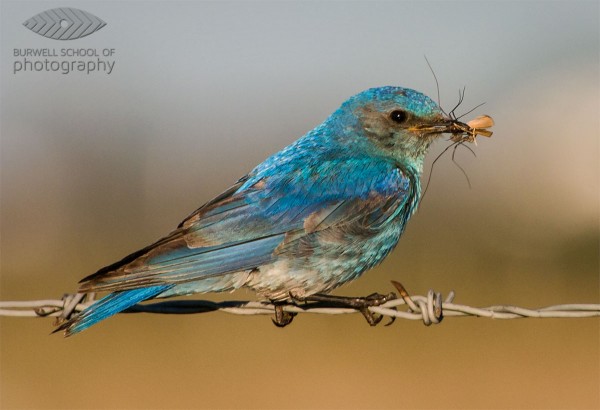
Canon EOS Digital Rebel, Canon 100-400 F4.5-5.6L IS lens @400mm, 1/800th of a second at F8, ISO 400 - Hand held

Mountain Bluebird with prey: Canon EOS Digital Rebel, Canon 100-400 F4.5-5.6L IS lens @400mm, 1/800th of a second at F8, ISO 400 – Hand held

A contribution by Paul Burwell from Burwell School of Photography

If there is one area that seems to flummox more aspiring wildlife photographers it is the subject of making sharp images. You’d think that with today’s modern cameras and equipment that there’d be no problem going home with sharp images after each wildlife encounter. Un fortunately, that isn’t the case and I’m going to provide you with some tips and tricks to make sure you’ve got the best possible chance of making sharp images.

Lenses

One of the truisms in wildlife photography is that it is virtually impossible to have too much lens. This means it is extremely rare that the wildlife critter you are trying to photograph is too big in your viewfinder and in fact the opposite is much more common. Not everyone can afford one of the prime super-telephoto lenses that the major manufacturers produce. These lenses in the range of 300mm to 800mm can set you back anywhere between $ 5,000 and $ 11,000 respectively. Unless you’re a pro or a serious amateur with a healthy bank balance, these lenses aren’t feasible for the average user.

So, what’s a person to do? My recommendation is to purchase the largest telephoto lens you can afford. And when you’re looking at telephoto lenses, you want the biggest number of millimetres that you can afford. Common lens lengths include 200mm, 300mm and 400mm.

If you end up purchasing a zoom lens, look for one that has the shortest range possible. Why? Because in general, the more extreme the range the lens covers, the lower the quality at all those ranges. Therefore, I’d choose a lens that gives a range of 70-300mm over a lens that gives a 35-3500mm range every time. You also want to purchase the fastest lens you can afford. All lenses have a maximum aperture they can photograph at.

A lens rated at F2.8 is two stops faster than a lens rated at F5.6 and allows four times as much light to reach the camera’s sensor. Because wildlife is often photographed under challenging lighting conditions, a faster lens allows for faster shutter speeds which equals sharper images.

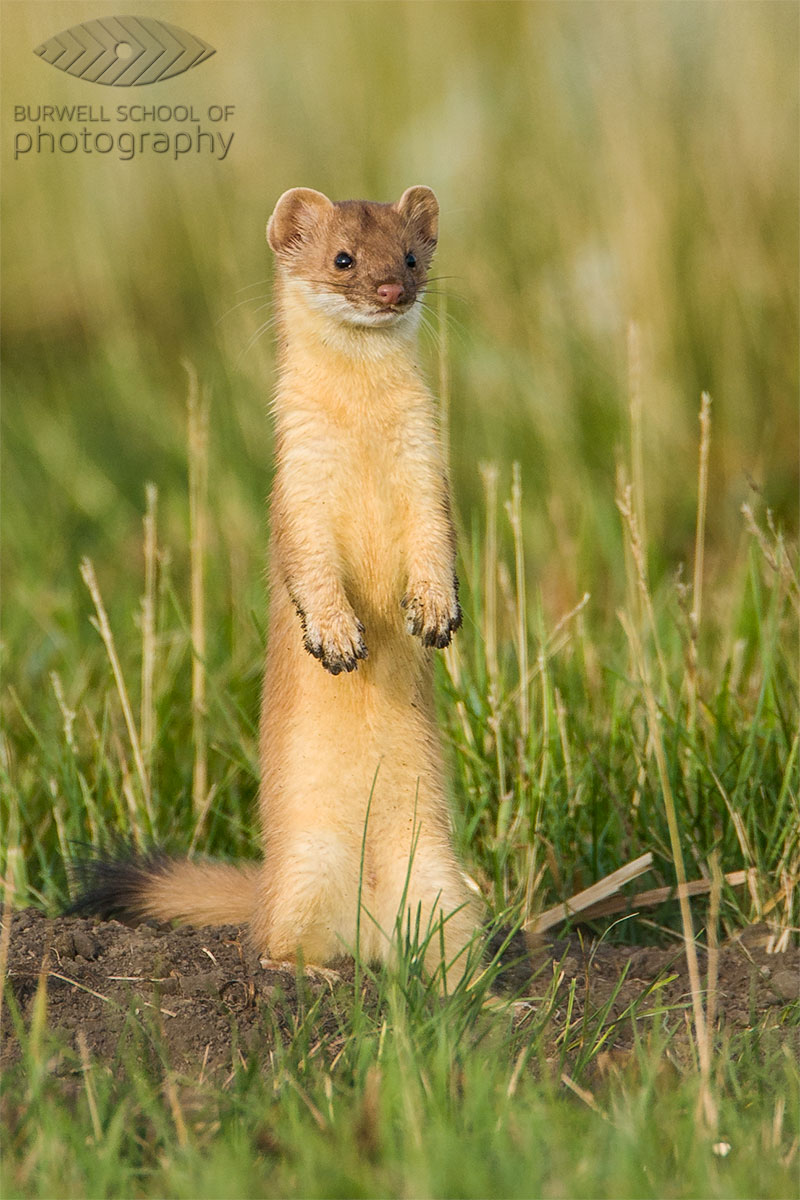
Long-tailed Weasel pauses outside of ground squirrel burrow: Canon EOS Digital Rebel,  Canon 500mm F4L IS, 1.4x Extender II @ 700mm, 1/500th of a second at F7.1, ISO 200 - Hand held

Long-tailed Weasel pauses outside of ground squirrel burrow: Canon EOS Digital Rebel, Canon 500mm F4L IS, 1.4x Extender II @ 700mm, 1/500th of a second at F7.1, ISO 200 – Hand held

Teleconverters/Extenders

I also recommend purchasing a teleconverter (or extender). Teleconverters are rated by the number of times they magnify your lenses range. So, if you’re using a 1.4x teleconverter on a 300mm lens, you’ve now got yourself a 420mm lens. Unfortunately, this comes at the cost of some light and so if your 300mm lens was rated at F2.8, a 1.4x teleconverter will cost you one stop of light and it will effectively become a 420mm F4.0 lens. Stay away from the two-times (2.0x) teleconverters unless you happen to own one of those multi-thousand dollar prime super-telephoto lenses we were discussing earlier.

You’ll often hear that teleconverters degrade the quality of the image and this is true, but there is a trick for overcoming this problem. The solution? Stopping down up to a full stop. If you’re not familiar with the terminology, stopping down means using a smaller aperture setting (smaller aperture == larger f-stop number).

While it is a general practice to photograph wildlife wide open (at the lenses largest opening or smallest f-stop) to separate the subject from the background, I recommend practicing with your lens/teleconverter combination to see how much you need to stop down to make sharper images. Depending on the lens I’m using, I find I need to stop down between 1/3 of a stop up to a full stop.

Support

What else can you do to get sharper images? Use some sort of support. I’ve met a few photographers who have no problem making sharp images hand-holding over 6.5kg (14 pounds) but the majority of people will make sharper images using support. Buy the highest quality tripod you can afford. Make sure the tripod is rated to support at least the amount of weight you’re going to put on it. High quality tripods can be pretty pricey but another alternative to consider that will also give your camera/lens combinations great support is a monopod.

These handy devices also provide excellent support for even the heaviest equipment and they are a lot easier to pack and move about. If you want to save some money, (and who doesn’t), consider purchasing aluminum tripods and monopods over carbon fibre. They aren’t quite as light and they get cold as heck in the winter, but they are strong and a whole lot more affordable.

So, now that you’ve got yourself the best wildlife photography equipment your pocket book will allow, stay tuned for my next column (next week) where I’ll give you the tips and tricks you’ll need to make the sharpest photographs possible.

Until then, get out there and practice, practice, practice!. Photograph ducks at the local pond or go to a dog park and capture some of the action there. Regardless of whether you are in a remote location or on your own back deck, the more familiar you are with your equipment, the better chance you’ll have of making an award winning shot.

Paul Burwell is the owner Burwell School of Photography

Post originally from: Digital Photography Tips.

Check out our more Photography Tips at Photography Tips for Beginners, Portrait Photography Tips and Wedding Photography Tips.

Making Sharper Wildlife Photographs – [Part 1 of 2]


Digital Photography School

 
Comments Off on Making Sharper Wildlife Photographs – [Part 1 of 2]

Posted in Photography


Learning to See, Part VII

01 Mar

Whereas photography is about vision, composition is about aesthetics.

In our previous readings in this series we learned how colour,  contrast and tonal range have a dramatic effect on the overall result.  Some teachers may say the first important rule in making successful pictures is composition, and indeed that may be so.  However,  I also like my intrepid readers to be unique and true to themselves.  Therefore, let’s argue that colour impact is more important than composition  ( remember folks, this series is for the novice and beginner  so please let’s not start a raging debate and muddle the waters. I want our beginners to have fun and explore for themselves – they will figure it out.) 

              I had the good fortune of being raised in the country, on a twisting gravel road that followed a meandering river. Not far from the family farm was one of those old-styled triangular framed bridges that crossed the river, and just beyond that was a drumlin where one could sit and breathe in the unfolding landscape below.  It was idyllic, and a magnet for artists’ easels.

When my daily chores were finished I would often climb aboard the 28-inch hand-me-down bicycle, with worms in pocket and alder fishing pole, and peddle to my secret fishing hole. Sometimes I would arrive at my destination, other times I would be sidetracked by an artist standing atop the Lloyd Hill (as we called the drumlin), adorned in beret with brushes in hand.

Invariably each artist would add the S-curve of the river leading in from the bottom right corner of the blank canvas following a diagonal until it exited in the upper left corner. The triangular bridge was always in the bottom right-hand corner of the canvas, our farm in the upper right hand corner.  The distant pine forests would create the far-off horizon line. One artist who often visited the same location would place an elm tree in the left foreground of the scene to add balance and colour, reflecting the season. Ironically, the elm was not in the vista lying before her eyes, but was a creation of her imagination.


Many of the elements of good composition can be found in this image. Can you locate the diagonal lines, the various "C" and "S" curves, and triangle forms in this image?
Many of the elements of good composition can be found in this image. Can you locate the diagonal lines, the various “C” and “S” curves, and triangle forms in this image?

I liked this artists work best; she was not only painting the scene as it lay before her, but she was also adding her own elements —the elm tree— and expressing her mood and thoughts at that particular time. By breaking the realist rules of the day, she was making a statement with her art.

Some twenty-five years later I would often reflect on those early lessons that had registered by way of an artist tolerating the relentless gawking of a kid with worms escaping his shirt pocket.

What I found particularly intriguing, however, was how the artist would start with a blank canvas and then add elements as their imagination desired. By comparison the photographer starts with a full canvas and eliminates those elements that are undesirable.  Consequently we can say that a painter’s art form is an additive one, whereas a photographer’s is subtractive.

Over the next few issues let us explore some of the basic rules of composition by identifying the elements of pleasing aesthetics: the S-curve, the C-curve, how to create motion by using diagonals, forcing the viewer into the scene by way of using contrast and selective focus, how the use of triangles keep the eye moving within, and of course the time-honoured favourite of teachers everywhere … the Rule of Thirds.

Once we have explored the possibilities these guidelines can bring to our photography, we will then become rebels and toss them aside. Only by understanding the “rules” can we then effectively break them.

A newly hatched Blanding's Turtle, identified as a species-at-risk, is only about the size of the largest coin you have in your pocket. When taking portraits of just about all living creatures, a good rule-of-thumb is to position the camera at eye level of the subject.

A newly hatched Blanding’s Turtle, identified as a species-at-risk, is only about the size of the largest coin you have in your pocket. When taking portraits of just about all living creatures, a good rule-of-thumb is to position the camera at eye level of the subject.


In the interim, what I want you to do is start making pictures with an awareness of where you are placing your subject, and objectively pondering why you made that decision. There is no substitute for actually being out there enjoying the craft that made us acquire a camera in the first place. As you study your results ask if the image translates the message you were trying to make in the first place. This is not philosophical rhetoric – there really was a reason you made that picture in the first place.

What was it?

Study and analyse your picture, and learn from your exercises. First and foremost, keep your picture making fun.

And remember, if you are having fun  you are doing it right.

Post originally from: Digital Photography Tips.

Check out our more Photography Tips at Photography Tips for Beginners, Portrait Photography Tips and Wedding Photography Tips.

Learning to See, Part VII


Digital Photography School

 
Comments Off on Learning to See, Part VII

Posted in Photography


Learning to See, Part VI

24 Feb

No Contrast – No Problem

The most beautiful composition can be dashed by improper use of color and contrast.  –CJ Rider

As we learned in our last entry, harsh light can work well with bold and dramatic colours, yet blow-out the subtle and delicate tones. The colour red supported by black, or gold surrounded by blue provide the photographer with easy choices in creating a pleasing composition. 

But what shall we do if there is no colour or light contrast, but only a monotone or duotone with which to work?

 Any photographer who has worked along Canada’s Atlantic coast learns very quickly that coastal fog can make a colourful scenic harbour appear flatter than a day old pancake. Likewise for the photographer who travels through Canada’s north where naturally ignited wildfires are permitted to burn themselves out, ultimately filling the sky with smoke as far as the eye can see.

 What we are beginning to recognize is that in bright sunlight that yellow dory on a Newfoundland beach or a MacKenzie Delta birch tree in autumn foliage will fairly jump out of the landscape. Conversely, if we were to remove the direct sunlight that same composition would turn those bright yellows into a muddy eyesore.

 As an experiment to reinforce this thought locate a window that you can easily peer out at any given time of day, perhaps the home kitchen or at the office. Next find a subject that appeals to you, but make sure it is only one element such as a tree or a building. Every time you walk past that window have a glance at the referenced subject and note how the colour and form of the subject will change depending upon the lighting conditions.

It should stand to reason that as we study the scene from our vantage the bark on the targeted tree or texture of a brick wall will take on a whole new meaning if viewed in overcast light as opposed to a bright sunny day.

 Now we have a eureka moment: If high contrast light emphasises boldness and will force us to search for scenes requiring these sharp edges, then by comparison we should be seeking scenes that are soft and delicate on non-sunny days.

 For the landscape photographer it is generally accepted that on those poor-light days it is best to keep the bland grey sky out of the scene. Instead, point the camera down and adjust the composition to showcase the colour, patterns and texture that is best seen under this soft light. Generally, when the sky is blue think of making big sky pictures; when the sky grey look to your feet.

Image-1

Photo 1

Photo no. 1 is an example that breaks the general rule “if there is no definition in the sky leave it be.” In other words, on overcast days the clouds will usually be a bland and woefully white or grey. From our earlier readings, we have learned that the viewer will subconsciously be drawn to the lightest part of a picture. If there is no detail to the sky, then we usually wouldn’t include it in the photo.  In this case, however, the sky is the lightest part of the photo and an integral component to the story. There was a huge forest fire in Quebec and the smoke had blown east to Gros Morne National Park in Newfoundland and Labrador. What the sky does, in this case, is complete the gradation of tonal range from dark to light, and allows your eye to move up and down the picture without distraction.  The side bar to any rule-of-thumb is that once you know the rules, then find a way to successfully break from that mold.

Image-2

Photo 2

Garden photographers long for days of no wind with a very light moisture in the air. Such conditions allow a flower to purely come to life by allowing the vibrancy, subtleness, texture and detail to shine through. By having no shadow details, or very soft and indistinguishable shadow lines at most, we can then concentrate on the nuances and softness that such conditions allow.  In photo number 2, the lack of shadows allows the viewers eye to wonder right into the mix of a really nice stand of Showy Lady Slippers.    

And remember, if you are having fun you are doing it right.

Post originally from: Digital Photography Tips.

Check out our more Photography Tips at Photography Tips for Beginners, Portrait Photography Tips and Wedding Photography Tips.

Learning to See, Part VI


Digital Photography School

 
Comments Off on Learning to See, Part VI

Posted in Photography


Learning to See, Part V

20 Feb

The colour of the object illuminated partakes of the colour of that which illuminates it. – Leonardo da Vinci

In our past columns (see links below) we have discussed such topics as how one colour can complement or distract from a bordering colour. We have also learned that to truly see colour one has to understand how shades of grey are comprised of mere percentages of black ranging from pure white to pure black. A primary objective coming from these discussions should be an understanding of how contrast plays a primary role and is an integral component of the final image.

Let’s look a little deeper into this concept and how we might apply this knowledge in our own picture making.

For the nature photographer there are essentially two core subject matters upon which we will concentrate our efforts, those being critters and where critters live. How each is approached and photographed will depend on a litany of variables, but essentially the one constant is that we will have little control over the lighting. The quality of that light, however, will often decide how we have to approach the image and what type of photograph to make.

Generally speaking, where I live on the Tropic of Cancer, the light will be best up to about two hours after sunrise, and from two hours before sunset. It can also be safely assumed the closer you get to the equator, the more quickly the light will become harsh with contrast and hard edges shadows after sunrise. Conversely, the closer you are to the poles the longer the “golden hours” of nice warm coloured light.  When the sun is high in the sky at noon it is often too harsh and creates far too much contrast to provide good photo opportunities, unless we adjust our approach.

Photo-1

Photo 1

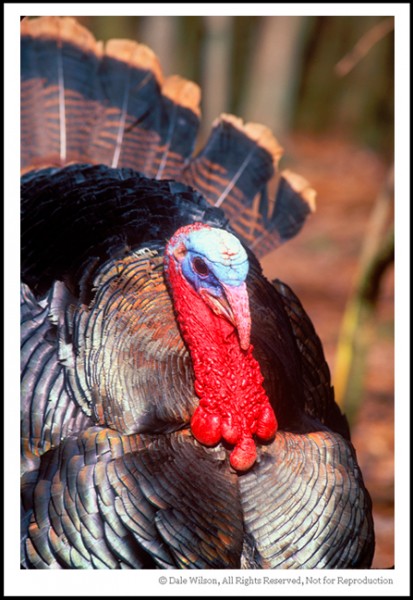
 It has been said that beauty is in the eye of the beholder.  This old gobbler, in photo 1, was having a difficult time locating a mate — evidently it wasn’t just me who thought he was butt ugly. His temperament wasn’t stellar either as I recall, let’s just say this was the last image of the sequence. With that having been said, the photograph was made around high noon and in lighting conditions that had far too much contrast for a pleasing image. By selecting a tight composition to take advantage of the contrasting colour it becomes possible to shoot throughout the entire day. Should this composition not be so tight, the image would have been far less effective. Identify the complementary colours in the scene and allow those to be the focal point while being somewhat oblivious to the subject.  In this case the red is the focal point and is accentuated by the blacks.

Photo-2Photo 2

 If one is driving down a country road around lunch time, some great tunes rockin’ on the radio, a cloudless blue sky overhead, the arm thrust out the window ala truck driver style … well, what could be better?  Why a field full of beautiful sunflowers appearing over the next hill of course.

Should one compare the golden colour of the sunflower to the deep blue sky in image 2, you would soon realize that gold and blue are opposite on the colour wheel. As a consequence of being complementary colours (or very close to) they will immediately create a colour contrast that will work even when the light is harsh. All that remains is to get permission from the farmer to enter his field and compose the image so there are no competing colours in the viewfinder. Voila, you now have a successful photo taken at a time of day when most photographers are having a noonday nap.

If you think of the colour wheel and how colours complement each other you will soon intuitively be making photographs without even thinking of colour theory. When the scene looks good in the viewfinder it usually is, capture the image and analyse it at home.

And remember, if you are having fun you are doing it right.

Read the Full ‘Learning to See Series’ at:

  • Learning to See Part 1
  • Learning to See Part 2
  • Learning to See Part 3
  • Learning to See Part 4

Post originally from: Digital Photography Tips.

Check out our more Photography Tips at Photography Tips for Beginners, Portrait Photography Tips and Wedding Photography Tips.

Learning to See, Part V


Digital Photography School

 
Comments Off on Learning to See, Part V

Posted in Photography


Retouching with Cloning Tools: Part 2

16 Feb

  Welcome back to the Retouching with Cloning Tools series! In Part 1, you learned about how cloning tools are used to retouch and remove imperfections from images. In this part of the series, you will learn more about the specific differences between each cloning tool, what kind of jobs they work best for, and how to use them. By the end Continue Reading

The post Retouching with Cloning Tools: Part 2 appeared first on Photodoto.


Photodoto

 
Comments Off on Retouching with Cloning Tools: Part 2

Posted in Photography


RED camera lens mount swap part 2

14 Feb

Douglas Underdahl of Long Valley Equipment www.longvalleyequip.com shows you how to swap the PL mount on the RED camera to Nikon mount; part 2 of 2
Video Rating: 4 / 5

This was filmed on the south side of Redondo Pier on Sunday, March 18, 2012. It was windy and very cold. The video was shot with a Nikon D3x at about 1 frame per second. Over 800 frames were taken than exported into a video using Photoshop 5 set to about 6 frames a second.
Video Rating: 0 / 5


DAMU ON DRUMS, Part 2 (MPC Version) – Damu The Fudgemunk / Redefinition Records

13 Feb

www.wonkabeats.com Damu on Drums, PART 2 – Filmed at Funkadelic Studios in New York. Music by Damu The Fudgemunk, Filmed by JNOTA (Nikon D5000) Damu’s latest LP is called “Supply For Demand” and is NOW AVAILABLE worldwide on Redefinition Records. www.redefinitionrecords.com

Adorama Photography TV presents Digital Photography One on One with Mark Wallace. In this week’s episode Mark answers a question about combining multiple images in Photoshop to create a unique special effect. Watch as Mark walks through studio set up and then moves on to the tips in tricks in Photoshop that can create a great composite image. To learn more about compositing and working with Adobe Photoshop Layers, go here: www.adorama.com Visit www.adorama.com for more photography videos! Send your questions to: AskMark@Adorama.com
Video Rating: 4 / 5