RSS
 

Posts Tagged ‘Landscape’

Neal Rantoul shares his aerial photography with Luminous Landscape

05 Apr

neil2.jpg

Aerial photographer Neal Rantoul has written an article for The Luminous Landscape, explaining how he got started in air-to-ground photography, and sharing some interesting advice. Click through for extracts from the article, and selection of Neal’s impressive abstract aerial landscapes.  

News: Digital Photography Review (dpreview.com)

 
Comments Off on Neal Rantoul shares his aerial photography with Luminous Landscape

Posted in Uncategorized


OPINION: Why Photoshop is Ruining Landscape Photography

06 Mar

This opinion piece was contributed by Declan O’Neill from www.newzealandscape.com.

The winner of one of Britain’s most prestigious photographic competitions was stripped of his title recently because of excessive use of Photoshop. David Byrne was the winner of the Landscape Photographer of The Year award and a £10,000 ($ 16000) prize but has now had his title and prize money taken away in a surprise move by the organisers of the competition which is supported by Epson, The Sunday Times Magazine and The National Theatre.

607589 landscalandscape photographer of the yearpe photographer of the year

The dramatic reversal came about after other photographers pointed out that the image had been photoshoped to include clouds not in the original image. Other photographers pointed to the impossibility of the sun casting shadows in different directions.

Mr. Byrne defended his manipulation of the image by pointing out that altering images is hardly new. He was quoted by The Daily Mail as saying, ‘The purists out there were not happy. Messing about with pictures has been done for over 100 years. I treat my photography as art and I try to make the best looking picture.’

Those three sentences neatly define the battle lines which have been drawn over the digital manipulation of photographs.

First of all he seems to suggest that anyone who objects to manipulating images is a ‘purist’. It seems clear that ‘purist’ is not a compliment in this context. What this veiled insult fails to acknowledge is that many photographers do not object to using Photoshop to enhance photographs but they do object to its use in altering photographs.

The problem comes in defining when enhancement crosses a boundary into alteration. Removing power lines from a landscape is one thing. Changing the colour of the sky from grey to orange quite another. It isn’t as if there is any shortage of sunsets around to photograph and the joy of landscape photography is capturing the elusive, not manufacturing it with software. It’s no crime to create a sunset sky, it’s just rather sad that someone would need to do it when there is so much natural colour to photograph. How many times have you looked at a super saturated landscape photograph and known instinctively that it’s false? Yet we see these photographs constantly win awards in club and national competitions. Anyone who has studied the way sunlight paints the landscape from different angles knows how to capture the best colour without needing Photoshop. That’s what being out in the field teaches you. You learn how to use the light to maximum effect.

The second defence that Mr. Byrne advances is that photographers have been ‘messing about’ with photographs for a long time. His choice of words is both unfortunate and revealing. Photographers should respect their subject matter. You do not have to go very far to capture truly beautiful natural photographs and the idea that it’s ok to mess about with the captured image is a depressing comment on the craft of photography. This attitude tells us that the photographer has no qualms about creating a vision of what they wish they had captured, but failed.

Finally Mr. Byrne tells us that he treats his photography as ‘art’ and tries to make ‘the best looking picture’. Here is the real problem with the software tools that allow us to create our own photographs. Photography has always been a craft. Ansel Adams had no need to add clouds or alter tree shapes because his images were honest and beautiful. There is nothing wrong with painting new images with Photoshop, just don’t call it photography. It is something entirely different when a photographer wants to be an artist. An artist creates images from their imagination and that is a wonderful thing. Just leave photography to record what the camera sees not what the photographer wishes it had seen.

What is extraordinary is that Mr. Byrne should have won such a prestigious title as Landscape Photographer of the Year. Luckily, his alterations were brought to the attention of the judges who had been unable to detect them for themselves. But for the ‘purists’ his accolade would have reinforced the idea that we can alter images in the name of ‘art’ and still claim they are photographs. If something good can come out of this sorry debacle it is the lesson that landscape does not need our interference. The true joy of landscape photography lies in capturing its pristine beauty. Painting it in the crude lipstick of Photoshop is both unnecessary and an admission that we cannot leave it to speak for itself through our lenses.

Declan O’Neill is a photographer who lives in Nelson New Zealand. He specialises in landscape photography and runs photographic tours of the South Island. His website can be found at www.newzealandscape.com.

Post originally from: Digital Photography Tips.

Check out our more Photography Tips at Photography Tips for Beginners, Portrait Photography Tips and Wedding Photography Tips.

OPINION: Why Photoshop is Ruining Landscape Photography


Digital Photography School

 
Comments Off on OPINION: Why Photoshop is Ruining Landscape Photography

Posted in Photography


Photography Tutorials – Landscape Photography Tips – Learn How To Use Your Camera In Manual Mode

19 Jan

Hi Everyone. Welcome to another landscape and seascape photography tip. Heaps of people when they are starting out are unsure how to find correct exposure when taking photos. This little trick should help you get correct exposure when taking your landscape photographs. Its easy and takes about 10 seconds to do. Let me know what you think! Jamie Paterson


Top Ten Destinations in the World for Landscape Photography

16 Jan

With so many beautiful and inspirational locations all over the world just waiting to be captured, knowing where to take your camera next can be a battle. From the breathtaking British Isles to the peaks of the picturesque Peruvian mountains, we’ve compiled a list of the top ten destinations in the world that every landscape photographer should add to their Continue Reading

The post Top Ten Destinations in the World for Landscape Photography appeared first on Photodoto.


Photodoto

 
Comments Off on Top Ten Destinations in the World for Landscape Photography

Posted in Photography


14 January, 2013 – Architecture of a New Landscape

14 Jan

Many observers (myself included) see the mainstream of photography as somewhat constipated, endlessly self-referential, and boringly repetitious.

Today, one of our finest contemporary photographers, Eric Meola, looks at the use of colour in photography and explores The Architecture of a New Landscape.


 "Every time I go back to a module I had already seen, I learn additional things.  I have never seen tutorials that have the excellent mix of what the features are, 
how to use them, enough of the under-the-hood information 
and concepts so that I can utilize the features creatively and efficiently, 
and just enough humor to keep the motivation level high.  Wow!"


The Luminous Landscape – What’s New

 
Comments Off on 14 January, 2013 – Architecture of a New Landscape

Posted in News


Combining Rules of Composition to Improve Your Landscape Images

04 Jan

One of the most elusive and frustrating elements of photography is finding the right composition. Many otherwise good images are often derailed by poor compositional choices. There are several primary rules of composition to be aware of, and by being aware of them, and then combining them, you can give your landscape photos a real boost in terms of interest.

In this image, I had a flat gray mist killing any interest in the sky. But when this lone sailboat began sailing right at the edge of the mist, I began to see possibilities. By placing the sailboat at the intersection of the rule of thirds, and placing the horizon line at the bottom third of the image, I allowed the negative space to take up a lot of room. That negative space gives the boat a place to go, and keeps the interest squarely on the sailboat.

The first and most basic rule is the Rule of Thirds.  This rule states simply that elements of interest in your photos should be positioned one third of the way in from top, bottom, left or right of the image.  Elements of primary importance should be positioned at the intersection of those thirds.  The rule of thirds tends to be the first rule I look to when composing my images.  But I find my strongest images happen when I am able to combine the rule of thirds with other rules.  These rules include using leading lines, using negative space, and using framing.  Of course, there are always times to break these “rules”- they are actually more guidelines than rules. But that’s another article altogether.

Use negative space to help your subject stand out. Too often photographers try to eliminate negative space, simply because there’s nothing of interest in that space. Negative space is simply an area of the image with nothing in it- a blank sky, a dark shadow area, a flat expanse of land.  However, that negative space can be used to contrast against your subject, ensuring the viewer’s eye goes right where you want it to.  Ideally, your subject should be heading or pointing IN to the negative space, to lead your eye into the composition.
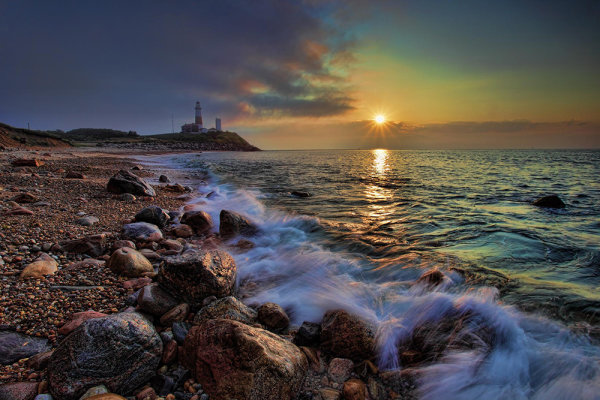
The shoreline in this image leads the viewer's eye right to the lighthouse. The lighthouse is positioned right at the intersection of the rule of thirds, with the water on the right creating some nice negative space in contrast with the rocky shore. The horizon line is roughly at the top third of the image.

Leading lines are another excellent tool to use to help draw attention to your subject. Ideally these lines are created by other elements in your composition and help lead the viewer’s eye right to your subject.  Leading lines help create depth when used to lead the eye into the frame, giving a more three dimensional feel to the image.

A very effective way to draw attention to your subject is to use other elements to frame it within the image. Framing can be used to help keep interest where it belongs, and keep the eye from wandering aimlessly through the image.  Framing can add context to an image.  For instance, trees at the edges of an image, framing off a lake, or mountain peak, give a sense of where the photographer is when taking the image.  Eliminating those elements removes the context. This is not necessarily bad, but another variation to consider when photographing at a location. I’ve often found myself frustrated that a tree was in the way, or I couldn’t get the view I wanted because a building was in the way. Then I realize that I can use the trees, or use the building (by shooting through an open window), to add that context that gives an added layer of interest to a photo.

By keeping these four simple compositional guidelines in mind when shooting, you can create a variety of images from the same subject, increasing your keeper ratio finding images you may not have found otherwise.
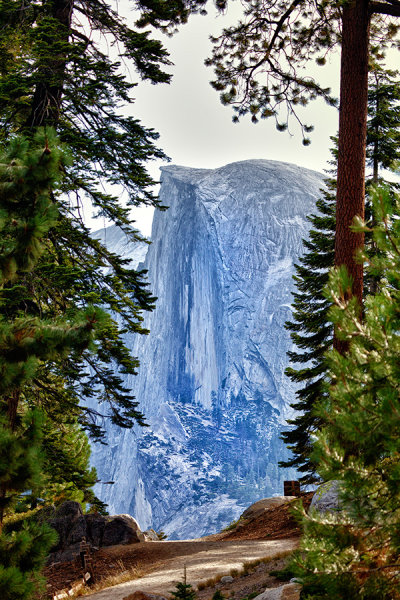
In this image of Half Dome, foreground trees are used to set apart Half Dome and make it stand out, while providing a context. In addition, note that the trees are roughly at one third on each side of the image. This need not be exact, but it helps create a space within the image that the eye finds pleasing.

Post originally from: Digital Photography Tips.

Check out our more Photography Tips at Photography Tips for Beginners, Portrait Photography Tips and Wedding Photography Tips.

Combining Rules of Composition to Improve Your Landscape Images


Digital Photography School

 
Comments Off on Combining Rules of Composition to Improve Your Landscape Images

Posted in Photography


Editing a River Landscape Photograph in Adobe Lightroom

31 Dec

Doing an edit of a photograph I took, trying out different things eeing what I can come up with. We use graduated filters, Black and White, Saturation, Luminance, Distortion correction and more. www.photoix.co.uk Follow me on Twitter for the latest news and updates! http
Video Rating: 4 / 5

Testing video with nikon J1 and lens nikkor VR 10-30. Video 1280×720 60p
Video Rating: 4 / 5


What Everybody Ought to Know About Landscape Photography [Best of dPS 2012]

26 Dec

Some of the most popular posts on dPS this year have been those covering the topic of Landscape photography.

From the post ‘Composing Dynamic Landscape Images’ by Todd Sisson

So as part of our ‘best of 2012′ series I thought I’d look back on the hottest landscape tutorials for the year gone by.

Here they are – in no particular order.

  1. Composing Dynamic Landscape Images
  2. 5 Tips for Shooting Landscapes with Greater Impact
  3. Seascape Photography Tips
  4. 10 Tips for Landscape Photographers
  5. 8 Tips for Long Exposure Photography
  6. Aspect Ratios in Landscape Photography
  7. Tips for Great HDR Sunsets
  8. 15 Tips for Low Light Landscape Photography
  9. How to Photograph Reflections in Water
  10. 4 Tips for Shooting Drop Dead Gorgeous Waterfalls

Post originally from: Digital Photography Tips.

Check out our more Photography Tips at Photography Tips for Beginners, Portrait Photography Tips and Wedding Photography Tips.

What Everybody Ought to Know About Landscape Photography [Best of dPS 2012]


Digital Photography School

 
Comments Off on What Everybody Ought to Know About Landscape Photography [Best of dPS 2012]

Posted in Photography


How to Process Landscape Photos in Lightroom 4

24 Dec

Lightroom is a powerful editor with a huge set of tools, though we usually need a limited set for specific photo types. So I’d like to go through editing of a landscape photo to see what cool things Lightroom 4 offers us. Let’s see what we can do on the example of one of my photos I took in the Continue Reading

The post How to Process Landscape Photos in Lightroom 4 appeared first on Photodoto.


Photodoto

 
Comments Off on How to Process Landscape Photos in Lightroom 4

Posted in Photography


24 December, 2012 – The Synthesis of Chinese Landscape Painting and Photography

24 Dec

Traditional Chinese Landscape Painting has endured for almost 1500 years, longer than any genre in Western culture. What perceptual qualities (that we can see for ourselves) lie behind this? How can we adopt these to the medium of digital photography? Looking at the visual structure of paintings began for us as a way to analyze what makes a an image “work,” and it has grown into a fascination with a very different way of seeing – that of the classical Chinese Landscape painters.

George DeWolfe and Lydia Goetze explore this subject in their new essay The Synthesis of Chinese Landscape Painting and Photography. 


The Luminous Landscape – What’s New

 
Comments Off on 24 December, 2012 – The Synthesis of Chinese Landscape Painting and Photography

Posted in News