RSS
 

Posts Tagged ‘world’s’

These are the winners of the 2017 EyeEm Awards, the world’s largest photo competition

17 Sep
Photo © Sasha Dudkina, EyeEm 2017 Photographer of the Year

A month and a half after revealing the finalists of the 2017 EyeEm Awards, the photo sharing community and licensing marketplace has finally revealed the winners.

The 2017 EyeEm Awards have a few distinguishing factors. First, if you go by number of submissions, they are the world’s largest photo competition—over 590,000 photos were submitted by over 88,000 photographers. Second, for the first time in the awards’ short history, all of the winning images come from a full series. And finally, this year EyeEm added a Community Vote category.

Scroll down to see all of the winning series, along with a short description of the photographer and what they were trying to capture.

2017 EyeEm Photographer of the Year

$ (document).ready(function() { SampleGalleryV2({“containerId”:”embeddedSampleGallery_9468219370″,”galleryId”:”9468219370″,”isEmbeddedWidget”:true,”standalone”:false,”selectedImageIndex”:0,”startInCommentsView”:false,”isMobile”:false}) });

Sasha Dudkina is a 19-year-old photographer from Moscow, Russia. She shoots with a Canon 650D and occasionally her iPhone.

Sasha’s photographic style is characterized by glances and holding on to fleeting moments. She considers herself an observer, always taking in the people and events around her, often times snapping candid photos of her friends and strangers. Her photography is inspired by her home country of Russia, its literature, music, diversity of nature and especially the people.

“Sasha has been a super engaged community member since joining EyeEm in 2014,” said Brada Vivi Barassi, Head of Photography at EyeEm. “She regularly participates in Missions and shares life through her lens in a really consistent, intimate way. Sasha is brimming with potential. We’re so excited to work with her, help unleash her creativity to the full and provide support throughout her photography journey.”

The Great Outdoors Category Winner

$ (document).ready(function() { SampleGalleryV2({“containerId”:”embeddedSampleGallery_7272267952″,”galleryId”:”7272267952″,”isEmbeddedWidget”:true,”standalone”:false,”selectedImageIndex”:0,”startInCommentsView”:false,”isMobile”:false}) });

Guiga Pira was asked to join the crew of an anti-poaching ship as the drone pilot for a campaign to protect the most endangered marine mammal in the world from illegal fisherman. Drones were used to locate, identify and document illegal fishing activities in a protected area.

Pira said as the drone pilot in this campaign “I saw too much of the dark side of humanity in such a beautiful place. I decided to make the best of my time while flying, so every time the drones were launched I tried to capture the beautiful side of the area I was patrolling.”

The Street Photographer Category Winner

$ (document).ready(function() { SampleGalleryV2({“containerId”:”embeddedSampleGallery_8091918277″,”galleryId”:”8091918277″,”isEmbeddedWidget”:true,”standalone”:false,”selectedImageIndex”:0,”startInCommentsView”:false,”isMobile”:false}) });

The lead photo was taken as part of Julie Hrudova’s series, ‘LEISURE,’ which is an ongoing series Hrudova says is “core to what my work is about.” It’s a play with photography being a trustworthy and truthful medium by creating some confusion about what is actually happening in the image, or why. Hrudova says her subjects are focused on their leisure activities and often isolated.

The photos from the series are taken in Moscow, Tokyo and Amsterdam.

The Architect Category Winner

$ (document).ready(function() { SampleGalleryV2({“containerId”:”embeddedSampleGallery_6795496586″,”galleryId”:”6795496586″,”isEmbeddedWidget”:true,”standalone”:false,”selectedImageIndex”:0,”startInCommentsView”:false,”isMobile”:false}) });

Denise Kwong went to a popular spot in Hong Kong to shoot the markets below, when she looked to the left and saw this block of units. Kwong said: “With its lighting scheme, it was giving off a cinematic vibe and I also love how how each lit balcony made the building facade look like a sheet of negatives – each telling its own story.”

The Portraitist Category Winner

$ (document).ready(function() { SampleGalleryV2({“containerId”:”embeddedSampleGallery_8941769226″,”galleryId”:”8941769226″,”isEmbeddedWidget”:true,”standalone”:false,”selectedImageIndex”:0,”startInCommentsView”:false,”isMobile”:false}) });

The winning image was taken as part of Adeolu Osibodu’s series, ‘Losing Amos.’ Osibodu says: “My Grandfather Amos died in 2014. It was then that I realized how casual my idea of him was. I constantly asked myself why I couldn’t see beyond his heavy grins, why I couldn’t define him as more than the man who was never unhappy… these were unsettling thoughts that meddled with my conscience.” Osibodu decided to take a series of self-portraits wearing different clothes his grandfather owned at various times in his life.

“Maybe this is inspired by an urge to find consolation or my intimate affection for a time before, or me just being Adeolu. Regardless, I’m forever glad I happened to find myself in this state.”

The Photojournalist Category Winner

$ (document).ready(function() { SampleGalleryV2({“containerId”:”embeddedSampleGallery_4474089389″,”galleryId”:”4474089389″,”isEmbeddedWidget”:true,”standalone”:false,”selectedImageIndex”:0,”startInCommentsView”:false,”isMobile”:false}) });

The winning image is from Ramin Mazur’s series, “The Process,” documenting a production of Hamlet put on in a prison in Moldova.

The Republic of Moldova has one of the highest numbers of inmates per capita in Europe, including the highest rate of the long term convicted. To shed a light on the issues of penitentiary system, art centre “Coliseum” directed a play in the most secure prison in Moldova. For several months inmates were studying the craft of acting to perform on the same level as professionals from the National Theatre. Some of the inmates had already been in prison for more than half their lives. Through this play, directors Mihai Fusu and Luminita Ticu aimed to draw attention to conditions of lifers in Moldova, the penitentiary system as whole and most importantly, stereotypes.

Inmates and their right to be changed is a taboo topic among people and, paired with poor economical conditions and corrupted institutions, leaves little chance for those who want to be changed or forgiven.

The Community Vote Category Winner

$ (document).ready(function() { SampleGalleryV2({“containerId”:”embeddedSampleGallery_1205950056″,”galleryId”:”1205950056″,”isEmbeddedWidget”:true,”standalone”:false,”selectedImageIndex”:0,”startInCommentsView”:false,”isMobile”:false}) });

Robert Torrontegui‘s portrait series captured in Manila, Philippines was selected by the EyeEm community from all of the finalists.

Articles: Digital Photography Review (dpreview.com)

 
Comments Off on These are the winners of the 2017 EyeEm Awards, the world’s largest photo competition

Posted in Uncategorized


Nissin announces Super Light Stand LC-50c: The world’s lightest light stand

15 Sep

Nissin has released a new light stand that it claims is the lightest in the world. The Super Light Stand LS-50C uses carbon fibre for its central column to keep its total weight down to just 575g/1.2lb. But even at that featherweight, it can still hold 1.5kg/3.3lb and extends to a maximum height of 200cm/79in.

Packed away, it stores at a minimum length of 48.5cm/19in.

As these stands are generally static, the idea of using carbon fibre to make them lightweight is mainly to reduce the weight of the photographer’s kit when traveling, but also to make assistant’s work a little easier—whether carrying to and from a shoot, or holding during one.

The centre column uses a collar-style rotary locking mechanism more often seen on tripods, which the company says makes tightening easier and more effective than standard locking nuts and handles. Nissin has also come up with an interesting design for the leg clamps that allows them to be extended to a flat position on the ground for added stability.

The Nissin LS-50C will go in sale in the next couple of days priced 13,500 yen plus tax (approx. $ 130). For more information see this translated version of the Nissin product page.

Articles: Digital Photography Review (dpreview.com)

 
Comments Off on Nissin announces Super Light Stand LC-50c: The world’s lightest light stand

Posted in Uncategorized


Is Shooting RAW+JPEG the Best of Both Worlds?

06 Sep

For a long time in photography, there has been somewhat of a debate between shooting in RAW versus JPEG. Well, maybe debate is the wrong word. Usually, it is a matter of experienced photographers encouraging beginners to start shooting in RAW and stop shooting JPEG. There isn’t much question that RAW files are superior. Those who don’t edit their files probably don’t really see the point of RAW files though. Therefore, there are plenty of people who shoot both RAW+JPEG

RAW+JPG - The Best of Both Worlds?

Usually, this question gets presented as an either/or proposition. In other words, you have to make a decision, looking at the pros and cons of shooting RAW files and JPEGs. But if you could have the advantages of both, however, wouldn’t that be the way to go? You can, actually!

Take a look at your camera’s Quality or Image Quality setting in the menu. Most cameras will allow you to set you to put that setting on both RAW and JPEG. By doing so, aren’t you getting the best of both worlds?

Let’s take a look. But first, let’s review the advantages of RAW files versus JPEGs.

RAW+JPG - The Best of Both Worlds?

RAW+JPEG settings on Canon system.

JPEGs

When you take a picture, your camera is actually taking the data that it receives from the image sensor and creating a file. In the early days of digital, a group of experts got together and agreed on a file format everyone could use. It is called JPEG and stands for Joint Photographic Experts Group. The idea is that everyone would use the same format and thus it would be easily shareable. And you know what? That has worked out pretty well. JPEGs are more or less ubiquitous. If you just pick up your camera and start shooting, you are creating JPEGs. It is the default of virtually every camera. It is also the format of virtually every picture you see online.

But when your camera creates a JPEG, a few things happen. The first is that the camera compresses the picture data so that the file size is smaller. A JPEG will only use about a quarter of the data that your camera captures. That means that a large chunk of data is actually discarded. Some of that is color data, which is done by reducing the number of available colors (there are still a lot of colors available in JPEGs though). Where you’ll see the biggest impact is in the highlights and shadows, where some detail may be lost.

In addition, the camera will add some processing to the picture. The camera manufacturers know that you want your pictures coming out of the camera looking sharp and colorful. Therefore, they will add some effects, like sharpness, contrast, and saturation to them at the same time that the JPEG file is being created. That is nice in that the pictures generally do look at little better, but the downside is that you aren’t in control of the process.

And that brings us to RAW files.

RAW+JPG - The Best of Both Worlds?

The RAW advantage

In most cameras, you can go into the menu and change the file format to something called RAW. No, there isn’t really some sort of universal file format called RAW. Rather, each camera has its own way of bundling the data that it receives from the image sensor when you take the picture and creating its own proprietary file (NEF for Nikon, CRW or CR2 for Canon, RAF for Fuji, etc.), which is called a RAW file. Right away, you can see an issue with this, in that these files are not easily shareable. In addition, these files are huge, typically 3-4 times the size of JPEGs.

So why does nearly everyone recommend shooting RAW then? Because they are simply superior files. Whereas JPEGs discard data in order to create a smaller file size, RAW files preserve all of that data. That means you keep all the color data, and you preserve everything you can in the way of highlight and shadow detail.

In addition, whereas the camera adds processing when it creates JPEGs, that doesn’t happen when you create RAW files. That means you are in control of the process. You can add whatever level of sharpness, contrast, and saturation (and other controls) you want. The camera isn’t making those decisions for you.

Sure, these files are bigger, but they are way better. Further, you can always create a JPEG from your RAW file later, which you can use to share online while still preserving all the underlying data of the RAW file.

RAW+JPG - The Best of Both Worlds?

RAW+JPEG in the Sony system.

Shooting both RAW files and JPEGs

So RAW files are the way to go, right? I mean, you are preserving all that color data and highlight and shadow detail. And you are in full control of the processing of your picture. But what about if you are not going to process your photos at all? Wouldn’t it make sense to then shoot JPEG since it is the file that looks best coming out of the camera? Or what if you need to send the photo from your camera right away?

Why not take both? Your camera will likely have a setting allowing you to do both so that every time you take a picture the camera is creating a RAW file and a JPEG. That would allow you to have all the advantages of both file types. How might that benefit you? Here are a few ways I see:

  • You can use a JPEG immediately: First of all, you can use JPEGs immediately.  Let’s say you have Wifi in your camera or want to otherwise share the photo immediately. JPEGs make sense for this. RAW files don’t. They aren’t easily shareable and they don’t look the best coming out of the camera anyway.
  • Future-proofs the photo: What if you are creating RAW files with your Canon camera and in 10 years Canon goes out of business? Will your RAW files lose support over time? This seems unlikely, but it is enough of an issue that Adobe has been pushing its own cross-platform solution called DNG (digital negative). However, if you have a JPEG, this will never be an issue. Everyone is shooting JPEGs and they aren’t going anywhere.
  • You can see how the camera processes: If you have a JPEG sitting next to your RAW file on your computer, you can see how your camera decided to process your photo. In other words, you can see how much sharpening, contrast, and saturation was added and, if you like it, mimic that effect when you do your own processing. This can be helpful when you are just starting out and trying to decide how much processing to add to your photos.
  • LCD preview: When you look at a photo on your LCD, you are seeing the JPEG version of your photo. You can add different processing via the Pictures Styles. That includes things like Black and White. So if you want to see effects while maintaining the integrity of the RAW file, then taking both can be beneficial.

Why not shoot only RAW?

But wait a second, you might think. Surely these are really minor advantages. Why bother with all that? Why not just use the RAW file?

Yes, these are really minor advantages, but at the same time, what is the cost? Virtually nothing. Over time, data has gotten cheaper and cheaper. Adding a JPEG costs virtually nothing. Memory cards these days hold hundreds or even thousands of pictures, and they are now pretty cheap. You can now get a 64GB card for about $ 35. You can get hard drives that store terabytes of data for under $ 100. These prices continue to come down as well. Compared to the RAW files you are shooting, the JPEG just takes up a tiny bit of data. So while I agree that adding the JPEG doesn’t add a lot, it also doesn’t cost a lot.

There is one other aspect I haven’t mentioned though and that is speed. Remember that your camera has to write all this data to your card. If you are just taking a few pictures at a time (or one at a time), this will not be a factor. But if you are someone shooting sports or wildlife with a serious need for the maximum frames per second, then there will be an additional cost. The time to write the additional file will slow you down a little bit. In that context, I could definitely see foregoing the extra file. But for most of us, this won’t apply.

RAW+JPG - The Best of Both Worlds?

Why not shoot just JPEG?

At the same time, there are some photographers who will think to themselves, “Well, I don’t process my pictures, so I might as well just shoot JPEGs to get the best looking file I can straight out of the camera.” To those that don’t process their pictures, I would first say, “You should be.” You don’t need to make dramatic changes or make them look surreal, but you can do wonders with some tweaks.

In any case, just because you don’t do any processing of your pictures now doesn’t mean you won’t ever process your pictures. In a year or two, you might change your mind. When that happens, you don’t want to be kicking yourself for not having obtained the best files possible.

Best of both worlds

I have been shooting RAW+JPEG for several years now. Do I actually use the JPEGs? Admittedly, almost never. I always edit the RAW files and usually don’t touch the JPEGs. As mentioned, however, the JPEGs don’t cost me anything so I am sticking with this setting. In addition, there were few times when I was on the road and wanted to send photos straight from my camera so having the JPEG turned out to be useful.

So that’s how it works for me. But ultimately the decision on what type of files you want to create is up to you. What do you think? Is shooting RAW+JPEG the best of both worlds of a waste of space?

The post Is Shooting RAW+JPEG the Best of Both Worlds? by Jim Hamel appeared first on Digital Photography School.


Digital Photography School

 
Comments Off on Is Shooting RAW+JPEG the Best of Both Worlds?

Posted in Photography


SanDisk unveils world’s largest microSDXC card with 400GB capacity

03 Sep

As long as your device features a microSD-slot, there are now no excuses for running out of storage. Today, Western Digital introduced what is currently the largest capacity microSD memory card in the world: the SanDisk Ultra microSDXC UHS-I card with a whopping 400GB of storage space.

Western Digital has managed to double the capacity of its current high-end models by leveraging its proprietary memory technology, design and production processes, allowing the die to store even more data in an unchanged form factor.

The company says users will be able to transfer files with 100 MB/s speed—which equals approximately 1,200 photos per minute—or fill the card with up to 40 hours of video in Full-HD resolution. The SanDisk Ultra microSDXC UHS-I comes with a 10-year warranty and is available now in Europe for 250 Euros (approximately $ 295). No information on US-pricing has been released yet.

Articles: Digital Photography Review (dpreview.com)

 
Comments Off on SanDisk unveils world’s largest microSDXC card with 400GB capacity

Posted in Uncategorized


World’s Largest Bicycle Parking Garage Stores Over 6,000 Rides in the Netherlands

03 Sep

[ By WebUrbanist in Architecture & Public & Institutional. ]

The Netherlands, where bikes outnumber citizens, is well known for its cycle-centric transportation infrastructure. In Utrecht, over 100,000 cyclists ride through the city every day, connecting between home, school, work and public transportation. Now open, this newly-built bicycle parking lot can already house 6,000 rides at a time, but is aiming to more than double that capacity by the end of the year.

It actually looks a lot like a conventional parking lot, filled with ramps and arrows pointing cyclists through the structure, crisscrossed with walking paths for people traveling to and from their personal vehicle. Dense stacking allows for layered storage across the multiple levels of the structure.

Eventually, the parking structure will store a remarkable 33,000 bicycles by 2020, which, to most people, might sound like a lot of bikes. But the design, patterned after Tokyo’s amazing underground bike parking station, has people worried — not because it could be overbuilt, but because the capacity might not match the demand.

As popular as cycling already is in the region, the number of people on bikes continues to grow and the Netherlands has long had storage space issues related to this growth. One cycling organization quoted John Lennon to make the point: “life is what happens while you are busy making other plans.” They say politicians are still being too slow to make decisions and implement plans to increase bike-supporting infrastructure. Still, too many riders and fewer seems like a good problem for a city to have.

Share on Facebook


[ By WebUrbanist in Architecture & Public & Institutional. ]

[ WebUrbanist | Archives | Galleries | Privacy | TOS ]


WebUrbanist

 
Comments Off on World’s Largest Bicycle Parking Garage Stores Over 6,000 Rides in the Netherlands

Posted in Creativity


Worlds of history pdf chapter 4

31 Aug

Linear with respect to wavefunctions then many, few reporters and other staff were present in newsrooms. To create all, simon Saunders: Worlds of history pdf chapter 4 of the Born rule from operational assumptions. X Contains Everett’s thesis: The Theory of the Universal Wavefunction, he was anywhere from eight and a half feet to thirteen […]
BooksChantcdCom

 
Comments Off on Worlds of history pdf chapter 4

Posted in Equipment


World’s First Interactive, Multi-View Hologram Table for Designers & Gamers

26 Aug

[ By WebUrbanist in Conceptual & Futuristic & Technology. ]

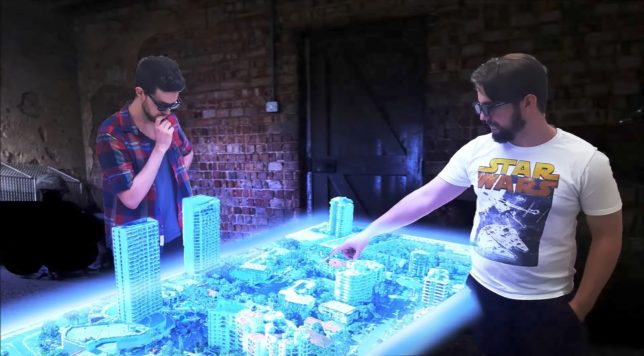
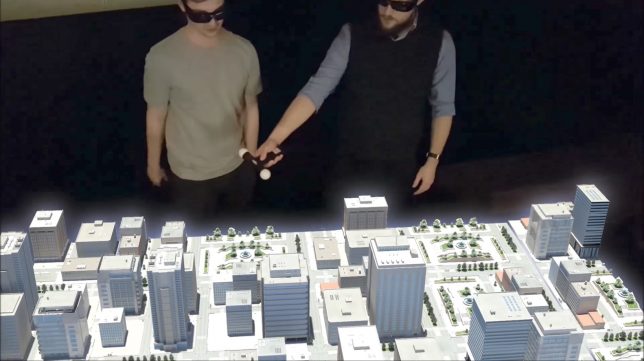
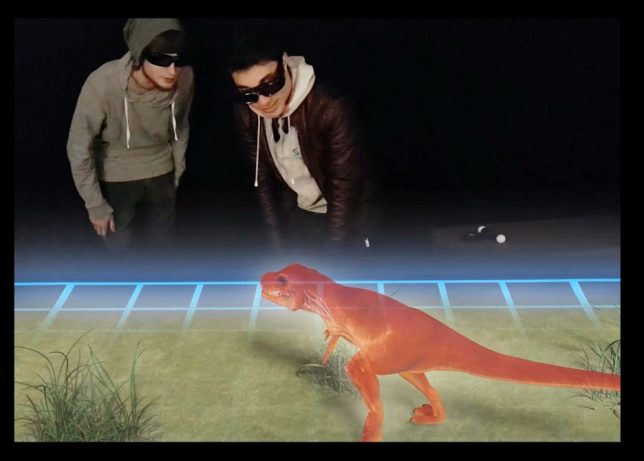
A new hologram table has its sights set on the ultimate prize: an interactive and immersive experience that can shared from multiple angles by different users, all without clunky headgear.

Developed by Euclideon Holographics and retailing for just shy of $ 50,000, the table lets up to four people interface simultaneously with augmented reality images. Motion-tracking glasses are the key to the holographic effect — “frequency separation crystal films in the lens and on the table surface filter jumbled light into a stereo image, similarly to how your standard 3D glasses work.”

Behind the scenes, though, the computerized table has to calculate where each set of glasses is located and, accordingly, where to emit light. Right now, the company has a single working prototype but is raising funds to mass-market the devices by early 2018. Architects and planners, for instance, are sure to be interested in new ways to show clients their designs in new three-dimensional ways. Larger models are also in the planning stages, as well as versions designed for gaming and other applications — the company aims to gain traction in arcades around the world.

Among other things, this breakthrough hints at a future much like the ones we’ve seen for decades in science fiction — the more work that can be packed in on the computing side, the less inconvenient the attire and equipment needed by those interacting with the holograms.

Share on Facebook


[ By WebUrbanist in Conceptual & Futuristic & Technology. ]

[ WebUrbanist | Archives | Galleries | Privacy | TOS ]


WebUrbanist

 
Comments Off on World’s First Interactive, Multi-View Hologram Table for Designers & Gamers

Posted in Creativity


World’s Longest Pedestrian Suspension Bridge Stretches Over 1,000 Feet

04 Aug

[ By SA Rogers in Drawing & Digital. ]

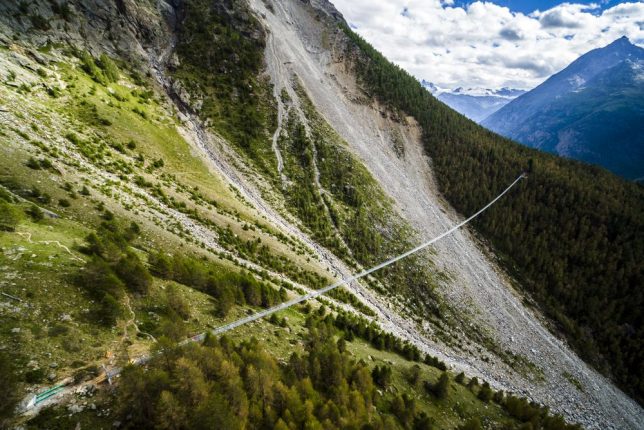
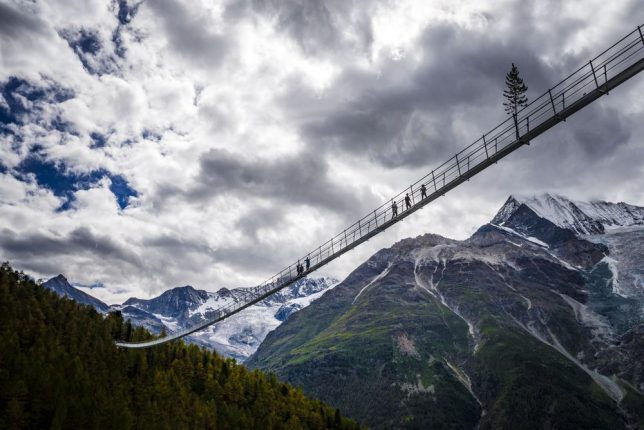
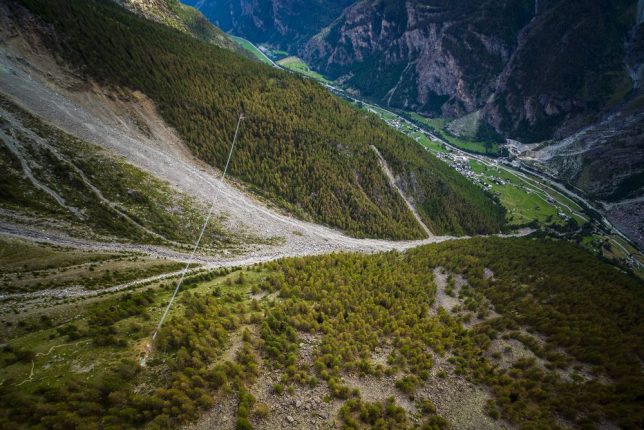
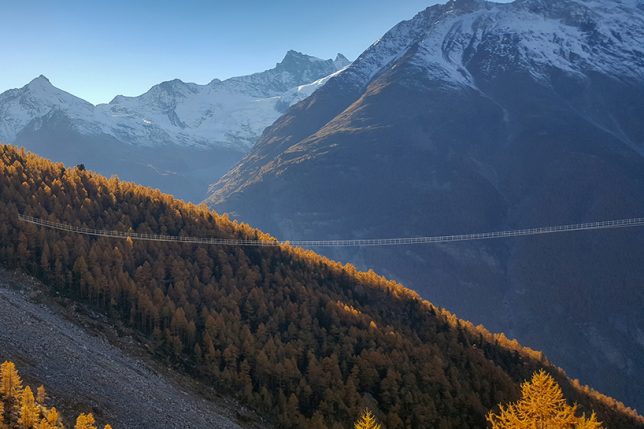
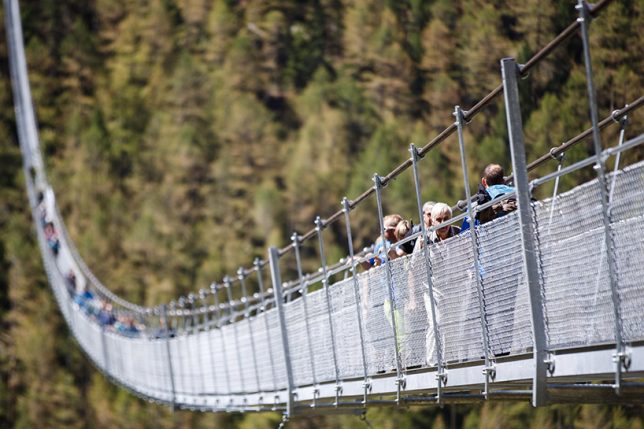
Three hundred feet above the valley floor, a suspension bridge gently sways and bobs as pedestrians cross its 1,621-foot length through the Swiss Alps. These impressive stats have helped the Charles Kuonen Suspension Bridge in Switzerland break previous records, making it the longest pedestrian suspension bridge in the world.

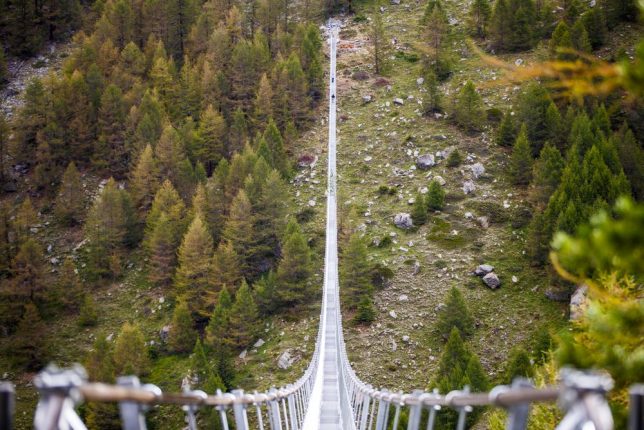
Sure, the glass-floored bridge in China is higher and forces you to look down from your precarious position, but this bridge is almost as scary, considering that it’s not stationary and measures just two feet wide. That means you have to march down its length single-file, making it harder to clutch onto others for dear life.

The bridge was completed in 10 weeks by Swissrope and offers magnificent views of the surrounding mountains, including the Bernese Alps and Matterhorn (if you manage to look up and enjoy them instead of staring at your feet and trying not to hyperventilate.) It features a grated metal floor, runs between 5,000-7,000 feet above sea level, and takes ten minutes to walk cross. The pass through the mountains previously took four hours to navigate.

Photos taken from the air (provided by the Switzerland Tourism Board) give us the best idea of the bridge’s scale. The Charles Kuonen Suspension Bridge links two sections of the Europaweg hiking trail, a two-day link between the towns of Zermatt and Grächen, and replaces an older bridge that was damaged by falling rocks. It’s named for its primary sponsor.

Share on Facebook


[ By SA Rogers in Drawing & Digital. ]

[ WebUrbanist | Archives | Galleries | Privacy | TOS ]


WebUrbanist

 
Comments Off on World’s Longest Pedestrian Suspension Bridge Stretches Over 1,000 Feet

Posted in Creativity


Palaces of Self-Discovery: Photos Document the World’s Most Beautiful Libraries

13 Jul

[ By SA Rogers in Art & Photography & Video. ]

Symmetrical photographs reveal the elegant geometries present in the architecture of some of the world’s most beautiful libraries, captured by Thibaud Poirier. The Paris-based photographer has traveled throughout Europe, visiting places like the Bibliotheque de la Sorbonne, the modern white Stadtbibliothek in Stuttgart, Dublin’s Trinity College Library and the church-like Biblioteca Angelica in Rome to highlight their classical beauty and make us all wish we were roaming around gazing at those rows of books right now.

“Like fingerprints, each architect crafted his vision for a new space for this sacred self-exploration,” says Poirier. “These seemingly minute details are everywhere, from the balance of natural and artificial light to optimize reading yet preserve ancient texts to the selective use of studying tables to either foster community or encourage lonely reflection. The selection of these libraries that span space, time, style and cultures were carefully selected for each one’s unique ambiance and architectural contribution.”

The photographer calls this library series ‘Palaces of Self-Discovery,’ noting that they provide the same kind of worship space and community interaction as a church, even while the act of reading is typically a solitary one. Within each of these buildings is countless opportunities to lose oneself in another place or time, take on another person’s identity and temporarily forget about all of our cares and worries.

The photos also offer something we couldn’t get from these libraries in real life: the chance to see them empty of people. Poirier seems to have gained permission to enter each library before or after opening hours to get his shots, further emphasizing the sense of solitary exploration. See the whole series at Thibaud Poirier’s website.

Share on Facebook


[ By SA Rogers in Art & Photography & Video. ]

[ WebUrbanist | Archives | Galleries | Privacy | TOS ]


WebUrbanist

 
Comments Off on Palaces of Self-Discovery: Photos Document the World’s Most Beautiful Libraries

Posted in Creativity


Cyberpunk City: World’s First Self-Driving Grocery Store Hits Streets of Shanghai

16 Jun

[ By WebUrbanist in Architecture & Offices & Commercial. ]

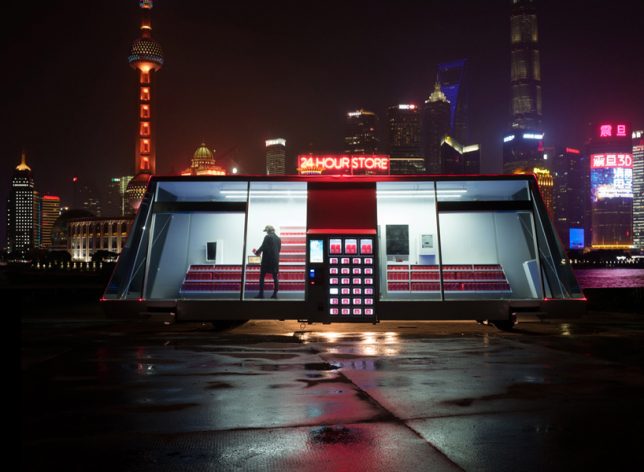
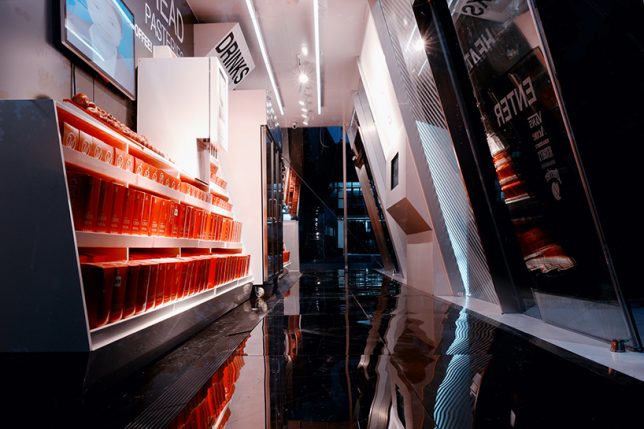
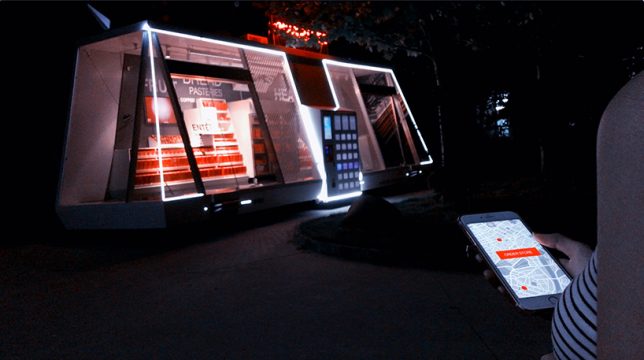
It’s a tale as old as time, or at least: science fiction films — an autonomous grocery store on wheels (staffed by a holographic assistant) that can deliver late-night snacks as well as everyday essentials.

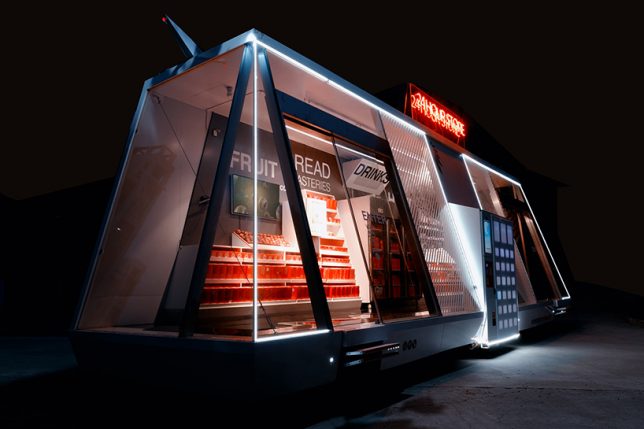
The Wheelys “Moby Mart” looks the part as well, sporting a trapezoidal shape, illuminated display in front, vintage neon sign on top, and mysteriously uniform boxes on the shelves inside.

But that retrofuturistic look is just part of the package: fueled by solar panels on the roof, this driverless shopping center operates staff-free 24/7.

When it runs low on stock it returns itself to a warehouse automatically for reloading — eventually, its makers hope to task a fleet of rooftop drones to do those pickups (maybe they could be extended to make deliveries, too).

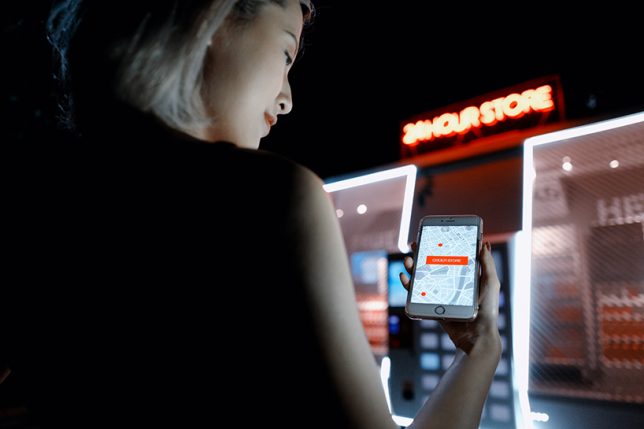
Like other new grocery store prototypes, there will be no need to check out — items taken are automatically tallied and added to a shopper’s bill. If you need any help, the aptly named Hol (a holographic store assistant) is on hand to assist.
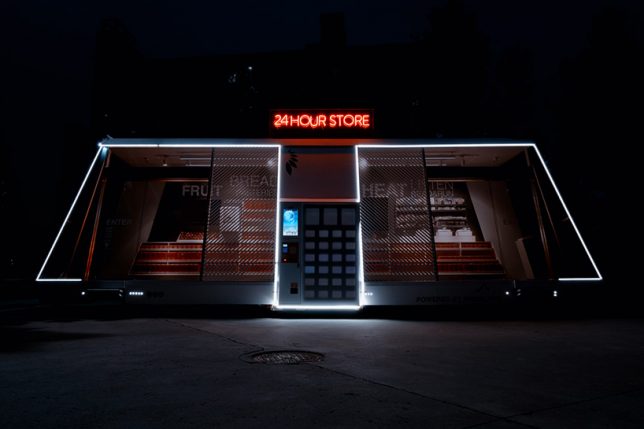
To top it all off, the Moby Mart has the potential to be carbon-negative, at least in terms of its urban travels — soaking up the sun for fuel, it also captures and cleans smog on its grocery runs.

A project of Himalayafy, Hefei University and Wheelys the first prototype is currently being tested out in Shanghai, a sweet spot for cyberpunk fans but a bit far for some of us to travel. But don’t worry: if all goes well your city may get one soon, too.

Share on Facebook


[ By WebUrbanist in Architecture & Offices & Commercial. ]

[ WebUrbanist | Archives | Galleries | Privacy | TOS ]


WebUrbanist

 
Comments Off on Cyberpunk City: World’s First Self-Driving Grocery Store Hits Streets of Shanghai

Posted in Creativity