RSS
 

Posts Tagged ‘world’s’

Western Digital reveals world’s smallest 1TB USB-C flash drive at CES

10 Jan

At CES 2018, Western Digital has introduced what it calls the world’s smallest 1TB flash drive, a tiny USB-C model sporting the SanDisk brand. This flash drive isn’t yet available on the market; instead, it’s acting as a demonstration of Western Digital’s latest advances in storage innovation.

The SanDisk 1TB USB-C model has a “classic” long flash drive form factor—not the newer form factor that fits almost entirely within a USB port—but the company managed to squeeze a full terabyte of storage into this still-tiny size, though it hasn’t provided additional details such as speed, cost, or anticipated launch date.

In addition to showcasing the 1TB USB-C drive, Western Digital has launched the SanDisk Ultra Fit USB 3.1 Flash Drive, a model it calls the smallest 256GB USB drive in the world. This drive features a low-profile form factor and a read speed up to 130MB/s.

The flash drive is currently listed on the SanDisk website for $ 150 USD, but is still shown as not-in-stock.

Articles: Digital Photography Review (dpreview.com)

 
Comments Off on Western Digital reveals world’s smallest 1TB USB-C flash drive at CES

Posted in Uncategorized


VESA establishes world’s first open standard for HDR displays

07 Jan

HDR is a term increasingly causing confusion amongst both photographers and the masses. ‘Isn’t it that thing that makes my images look flat and less contrasty by including all the shadows and highlights in my final image?’ many of our friends and forum members ask.

Well, yes, if it’s not done right. But when it comes to displays, the ironic thing is that ‘HDR’ is meant to make imagery look less flat, by taking the wide dynamic range encompassed in HDR images and stretching it back out on the display to no longer look flat but, instead, encompass nearly as much punch as the scene had in the real world.

Whenever a new display technology comes along, and particularly when it falls into that gap before it’s well defined or understood, monitor manufacturers LOVE to throw the spec all over their products. That, in a nutshell, is what has happened with the ‘HDR’ moniker and computer displays, making it very difficult for someone to know what is and isn’t a “real” HDR monitor.

What kind of brightness and contrast ratio should you be looking for? What’s the actual static contrast ratio, not the stupidly high (and irrelevant) dynamic contrast ratio often quoted? What kind of color output should you expect out of an HDR monitor? And what the heck is local dimming?

These are the questions that manufacturers tend to not answer, at least for now, and it’s why VESA has created the world’s first open standard for HDR displays: DisplayHDR.

Targeted largely at LCD-based computer monitors (not OLED), the purpose of DisplayHDR is to establish an open standard with fully transparent testing methodology, so you can “rate” your display and see where it falls on the HDR scales. Is it really just an SDR monitor, or does it rank as DisplayHDR-400 (low-tier), DisplayHDR-600 (mid-tier), or DisplayHDR-1000 (top-tier)?

Here’s how those tiers break down, and the performance metrics they have to hit:

A breakdown of the VESA standard. Click to enlarge

‘Corner Maximum Limit’ is aimed to ensure local dimming implementations can effectively keep black levels low even when small non-central portions are illuminated brightly. ‘Tunnel Maximum Limit’ ensures good overall contrast with varied content all over the screen but with nothing hitting pure white. Many of these targets cannot be met without some sort of local dimming capability, which most computer displays don’t have. Consider these targets a ‘push’ to get manufacturers to embrace the future of HDR display.

Up until now, there was no open standard for HDR displays. The closest thing we had is the UHD Alliance Premium Standard, which is essentially just a stamp that you’ll see on TVs, Blu-ray players, discs, and the like that ensures your device hits 4K resolution, BT.2020 color space, 10-bit encoding, and a few key contrast and brightness specs. But unlike the VESA standard, there’s no gradation: you either have the UHD Alliance Premium Standard badge or you don’t.

VESA’s standard, on the other hand, aims to grade LCD-based computer monitor displays or grading monitors. It establishes tiers that manufacturers can shoot for when designing computer monitors. And since most if not all of these manufacturers are members of VESA, they have access to the documentation outlining the specifications and testing methodologies.

The hope is that the standard becomes widely accepted. That way, you can look for the VESA badge on your next monitor purchase to make sure the manufacturer isn’t just throwing the term “HDR” onto an IPS monitor that can only hit 350 nits brightness and a 1000:1 static contrast ratio (many otherwise highly-rated IPS monitors aimed at photographers from manufacturers like Dell, BenQ, Eizo and the like).

A DisplayHDR-400 rated display would be guaranteed to hit peak brightness of 400 nits, a black level of no more than 0.4 nits for a largely black scene (or 0.1 nits for a more varied scene only hitting 50% white at any point), 10-bit encoding, and 95% sRGB coverage. This would be considered the “first genuine entry point for HDR” by VESA. Funny enough, the otherwise excellent IPS displays many photographers choose might hit this standard, but we’d argue you shouldn’t consider such a display ‘HDR’. In other words, we here at DPReview don’t really consider monitors with the ‘DisplayHDR 400’ truly ‘HDR’. Grading or processing your images on these displays aren’t going to guarantee your images will look proper on future, truly ‘HDR’ displays.

A DisplayHDR-600 rated display would be guaranteed to hit a peak brightness of 600 nits, a black level of no more than 0.1nits, 10-bit encoding, 99% sRGB, and at least 90% DCI-P3 coverage. These specs, according to VESA, describe “professional/enthusiast-level laptops and high-performance monitors.” This rating, in our opinion, is far more stringent and is better indicative or a truly ‘HDR’ display. If you want your images and video to be future-proof, pick a display rated no lower than this.

Finally, a DisplayHDR-1000 rated display would guarantee peak brightness of 1000 nits, a black level of no more than 0.05 nits, 10-bit encoding, 99% sRGB, and at least 90% DCI-P3 coverage. This final tier describes, “professional/enthusiast/content-creator PC monitors.” This is the stamp of approval we’d be looking at were we to be grading video or photos that will look good on displays of the future. Monitors with the DisplayHDR-1000 badge will be far more representative of the displays of the future, so if you want to make sure your content is ready to be displayed on future devices, this is the badge you’ll want to look for when shopping for monitors.

This new 5K UltraWide monitor from LG earned the VESA DisplayHDR-600 badge, meaning it hits at least 600 nits peak brightness, 10-bit encoding, and 99% sRGB and 90% DCI-P3 coverage.

These new standards are also more stringent about color gamut coverage: the 600 and 1000 standards require what we’d call ‘wide gamut’ color coverage, capable of displaying colors well outside of the old (can we say ‘boring’) sRGB standard of yesteryear. That means they can display colors well outside of old photochemical printing devices, so you can edit far more saturated and interesting colors into your image that will be displayed by monitors and printers of the future (and current).

Furthermore, these new standards set stringent requirements on bit-depth: while 8-bit monitors with dithering are allowed, each one of these standards require you hit 10-bit color reproduction with or without 2-bit temporal dithering (many monitors of the past would only hit 8-bit by 6-bit panels with 2-bit dithering: a big no-no for HDR content capable of displaying a wider range of luminances and colors that might otherwise band or posterize with 6-bit panels).

To learn more about the new VESA standards, head over to the DisplayHDR website. There, you’ll find a simple breakdown of what constitutes an HDR display, why the standard was set up, and a link to download the DisplayHDR CTS (Compliance Test Specification) for free.

Articles: Digital Photography Review (dpreview.com)

 
Comments Off on VESA establishes world’s first open standard for HDR displays

Posted in Uncategorized


Toshiba unveils world’s first 14TB conventional magnetic hard drive

12 Dec

Toshiba has unveiled what it claims is the first ever Conventional Magnetic Recording (CMR) Hard Drive (HDD) with a massive 14TB capacity. This drive, which is billed as a model for enterprise use, boasts nine disks and a helium-sealed design, 3.5in form factor, 7200rpm speed, and a 6Gbit/s SATA interface.

Toshiba announced the new drive, which is part of the new MG07ACA series, last week alongside a smaller 12TB 8-disk model. Both hard drives boast a lower operating power profile than the previously launched MG06ACA series, according to Toshiba, as well as better storage density.

The 14TB drive in particular offers a greater than 50% improvement in power efficiency versus the 10TB MG06ACA version. Conventional magnetic recording drives such as these are faster than similar models that use shingled magnetic recording tech.

Talking about the new MG07ACA series, IDC’s HDD Research VP John Rydning said:

Toshiba’s new helium-sealed enterprise HDD is the world’s first 14TB of storage capacity using conventional rather than shingled magnetic recording technology, giving enterprise customers the highest capacity HDD available in the market today for existing server and storage system architectures.

Consumers interested in this new enterprise series will need to contact Toshiba directly for purchase information, but as 4K and even 8K video becomes standard, ultra-high capacity enterprise drives like this might not be limited to traditional ‘enterprise’ users for long…

Press Release

Toshiba Launches World’s First 14TB HDD with Conventional Magnetic Recording

The 14TB models use an innovative 9-disk, helium-sealed design to deliver massive capacity that fits into standard 3.5 inch SATA drive bays

Irvine, CA – December 7, 2017 – Toshiba Electronic Devices & Storage Corporation today announced the launch of the MG07ACA Series, the world’s first enterprise 14TB Conventional Magnetic Recording (CMR) HDD. Using a 9-disk, helium-sealed design, the new MG07ACA Series provides the power-efficient capacity and storage density needed by cloud-scale and enterprise storage solution providers to achieve their TCO objectives.

“We have raised the bar with the new MG07ACA Series 9-disk helium-sealed design,” said Akitoshi Iwata, Vice President of Storage Products Division, Toshiba Electronic Devices and Storage Corporation. “By utilizing an innovative design, we continue to improve the benefits that high-capacity disk storage can deliver to our broad global customer base.”

The MG07ACA Series features both 14TB 9-disk and 12TB 8-disk models. The helium-sealed 3.5-inch mechanical design realizes better storage density and a lower HDD operating power profile than the previous MG06ACA Series for optimal TCO in cloud-scale infrastructures. The series also utilizes Toshiba Group’s laser welding technology to ensure the helium remains securely sealed inside the drive enclosure. The drives support a SATA 6Gbit/s interface and 7,200rpm access performance. The 9-disk 14TB models achieve a 40% increase in maximum capacity over previous MG06ACA 10TB models. Additionally, the 14TB models improve power efficiency by over 50% (W/GB).

“Toshiba’s first helium-sealed nearline drive intercepts the market at a class-leading 14 TB capacity with CMR,” said John Chen, industry analyst at Trend Focus. “Its early time-to-market for this capacity positions the company well to meet the storage needs of large hyperscale and cloud companies. Additionally, the company’s choice of a 9-disk platform paves the way to achieving higher capacities in future product generations.”

“While enterprise server and storage customers realize that shingled magnetic recording (SMR) technology can improve HDD capacity, the adoption of SMR HDD products into server and storage systems is a transition that will take several years,” said John Rydning, Research Vice President for hard disk drives at IDC. “Toshiba’s new helium-sealed enterprise HDD is the world’s first 14TB of storage capacity using conventional rather than shingled magnetic recording technology, giving enterprise customers the highest capacity HDD available in the market today for existing server and storage system architectures.”

Sample deliveries of MG07ACA Series drives to customers sequentially begin today. For more information on our full line of HDD storage products, please visit: https://toshiba.semicon-storage.com/us/product/storage-products/enterprise-hdd/mg07acaxxx.html.

Articles: Digital Photography Review (dpreview.com)

 
Comments Off on Toshiba unveils world’s first 14TB conventional magnetic hard drive

Posted in Uncategorized


Retrographic: The world’s most iconic black & white images brought to life in color

19 Nov

There’s an incredibly talented online community of colorization enthusiasts and professional retouchers who spend their free time bringing iconic black-and-white photography to life in color. You typically find their work on Facebook, Reddit, or occasionally featured on photo blogs, but we’ve never seen it published in any official printed capacity we’d want to display on a coffee table… until now.

Retrographic: History’s Most Exciting Images Transformed Into Living Color is a photo book released in September that any photo lover would be proud to own and display. A labor of love created alongside the aforementioned colorization enthusiasts and professional retouchers, the book is the brain-child of author, photo-curator, and Royal Photographic Society member Michael D. Carroll.

“Through the careful selection of striking images and dedicated colorization research, Retrographic takes the reader on a visual tour of the distant past,” explains Carroll. “Many of these moments are already burned into our collective memory through the power of photography as shared by people across the 190-year long Age of the Image. And now, these visual time capsules are collected together for the first time and presented in living color.”

The book contains 120 images in all, including some of the most iconic and influential in history—The Burning Monk, V-J Day in Times Square, The Wright Brothers’ First Flight, and many many more. As Carroll explained to us over email, the idea was to present people with a photographic history they could more easily relate to:

There is a tendency for people of the present to look back at history in black and white, which can be highly aesthetic in that black and white makes the subject look pleasing to many people. However, black and white can make the viewer feel detached from the subject. We hope that adding color breathes life into historical images and reconnects people to those who went before and helps us to understand and empathize with them.

And if the colorized photos aren’t enough, the book’s remaining 73 pages are filled will “informational gems” and narrative, including a forward by Royal Photographic Society Ambassador Jeff Vickers.

You can browse through a sampling of the images included in the book below, and if you want to learn more about Retrographic, visit the book’s Facebook page, or pick it up for yourself on Amazon.

$ (document).ready(function() { SampleGalleryV2({“containerId”:”embeddedSampleGallery_8897698142″,”galleryId”:”8897698142″,”isEmbeddedWidget”:true,”standalone”:false,”selectedImageIndex”:0,”startInCommentsView”:false,”isMobile”:false}) });
Articles: Digital Photography Review (dpreview.com)

 
Comments Off on Retrographic: The world’s most iconic black & white images brought to life in color

Posted in Uncategorized


Vixari is the world’s most portable tripod, but it can still handle DSLRs

10 Nov

A new tripod called Vixari is attempting to launch on Kickstarter, where it is billed as “the world’s most portable tripod.” Vixari has an ultra-portable foldable design that’s only a little bigger than a smartphone, but despite its ultra-compact size, Vixari is still able to handle large cameras, including DSLRs that weigh up to 2kg / 4.4lbs.

Vixari isn’t the first portable tripod, but the team behind it claims that it is the most compact. The tripod features extendable legs that fold into the unit’s body, which itself doubles as a folding case. Each of the three legs have a maximum length of 105cm / 41in, while the body has three mounting options: a slot for smartphones between 6mm and 9mm in thickness, a mount screw, and GoPro tripod mount adapter. And since it can be used to trigger smartphones, it includes a Bluetooth remote shutter that supports Android and iOS.

The tripod body is made from polycarbonate, while the legs are made from aluminum alloy, the combination of which makes it durable and lightweight. The tripod will be offered in black, white, and dark blue colors, assuming it successfully makes it to market. Overall, Vixari measures 19cm x 6.5cm x 3.4cm / 7.4in x 2.5in x 1.33in and weighs 600g / 1.32lbs.

Kickstarter backers are offered the tripod, plus mount screw, mount adapter, remote shutter, and charging cable for pledges of at least £49 / $ 65. Shipping to these early bird backers is expected to start in February 2018.

To learn more or put down a pledge, head over to the Kickstarter campaign.

Articles: Digital Photography Review (dpreview.com)

 
Comments Off on Vixari is the world’s most portable tripod, but it can still handle DSLRs

Posted in Uncategorized


iPhone X is the world’s best smartphone for photos, second best overall on DxOMark

08 Nov

The past few months have been a ratings-palooza for DxOMark Mobile, as flagship after flagship has come out raised the bar on smartphone sensor quality. From the Samsung Galaxy Note 8 and its 100 photo score, to the iPhone 8 Plus’ week-long stint at the top of the charts, to the Google Pixel 2’s highest ever score of 98, we’ve had plenty to keep an eye on.

But there was one major flagship phone conspicuously absent from the rankings… until now that is. DxOMark has officially released its Apple iPhone X test results.

As always, you can dive into the detailed results and side-by-side comparisons on DxOMark, but the TL;DR version is this: the iPhone X is the best smartphone DxO has ever tested in the photo category (earning a score of 101) and the second best smartphone camera overall, tying the Huawei Mate 10 Pro with a score of 97. You can see the score and category breakdown below:

More impressive than the numbers is DxO’s conclusion, which stresses how well the iPhone X performs in real-world shooting situations:

For portraits, the improved telephoto lens delivers sharp results even indoors, and the bokeh simulation produces a natural and pleasing background blur. Outdoors, exposures are outstanding, with great dynamic range, impressive skies, good fine detail, and punchy color rendering. Add to all that the extra features on the front-facing camera, including a Portrait mode for blurred-background selfies, and the iPhone X delivers one hell of a smartphone camera.

To see the full test results for yourself, head over to the DxOMark website. And keep an eye on DPReview in the next few weeks because we’ll be getting our own iPhone X to test very soon!

Articles: Digital Photography Review (dpreview.com)

 
Comments Off on iPhone X is the world’s best smartphone for photos, second best overall on DxOMark

Posted in Uncategorized


HP reveals the ZBook x2: The ‘world’s most powerful detachable PC workstation’

18 Oct

$ (document).ready(function() { SampleGalleryV2({“containerId”:”embeddedSampleGallery_9365668628″,”galleryId”:”9365668628″,”isEmbeddedWidget”:true,”standalone”:false,”selectedImageIndex”:0,”startInCommentsView”:false,”isMobile”:false}) });

Step aside Microsoft, because HP just released a monstrous ‘detachable PC workstation’ that can compete with powerful laptops like the Surface Book 2 released yesterday… but in a form factor that looks more like a Surface Pro. Meet the HP ZBook x2: the so-called “world’s most powerful and first detachable PC workstation.”

In HP’s own words, this computer “was designed to solve the performance and mobility needs of artists, designers and digital imaging professionals who need to push Adobe Creative Cloud and other professional applications to the limit.” So what makes this computer more capable than HPs other two-in one solutions: the HP Spectre x2 and HP Elite x2. In a word: performance.

While previous two-in-one iterations with these kinds of specs put most of the components—the main CPU, GPU, etc—into the base unit, the HP ZBook x2 flips the script. The bluetooth keyboard is basically just that: a bluetooth keyboard; even when the tablet is detached completely it maintains the full performance from its CPU and GPUs. Think of it like a Surface Pro dressed up to star in the next Iron Man movie.

Spec-wise, the HP ZBook x2 can be configured with 8th Gen Intel Core i7 graphics, a discreet NVIDIA Quadro M620 graphics card with 2GB of dedicated GDDR5 memory, up to 2TB of local PCIe SSD storage, and up to 32GB of RAM. All of this sits behind a 14-inch 4K multi-touch screen with optional 10- bit, one-billion color HP DreamColor display that’s been calibrated 100 percent of Adobe RGB.

The computer can be used in four different modes:

  • Laptop Mode: attached to the bluetooth keyboard.

  • Detached Mode: Use the tablet with the new HP pen, while still having full access to your Bluetooth keyboard shortcuts off to the side.

  • Docked Mode: Using the ZBook Dock, the x2 can power two additional 4K displays or five total displays.

  • Tablet Mode: totally detached and disconnected from the keyboard, the x2 maintains full graphics performance.

In most modes, you’ll want to use the ZBook x2 with the new battery-free HP pen, which is based on Wacom EMR technology and offers 4,096 levels of pressure sensitivity with multi-directional tilt capabilities and a dedicated eraser. And when it’s docked and powering two 4K displays, the setup can look pretty … intense:

In short, the ZBook x2 is trying to be all things to professional creatives and designers. Instead of using some combination of laptop, iPad, and Wacom tablet, you can replace all of them (ostensibly) with one ZBook x2. And since it was designed in collaboration with Adobe, you can bet Photoshop, Lightroom, Illustrator, Premiere, and other powerful CC apps will work exceptionally well.

To learn more about the HP ZBook x2, head over to HP’s website. The new ‘detachable workstation’ will go on sale in December and starts at $ 1,750 for the base model with a dual core 7th generation Intel Core i7 CPU—no word yet on how much more expensive it’ll be to fully spec out one of these.

Press Release

HP Unveils World’s Most Powerful and First Detachable PC Workstation

HP ZBook x2 PC Allows Designers to Unleash the Power of Adobe Creative Cloud and Other Professional Applications

LAS VEGAS, NV – October 18, 2017 — Today at Adobe® MAX, HP will showcase the world’s most powerful detachable PC1 designed to solve the performance and mobility needs of artists, designers and digital imaging professionals who need to push Adobe Creative Cloud® and other professional applications to the limit. The performance of the HP ZBook x2, the world’s first detachable workstation,15 increases productivity and allows digital creators and storytellers the freedom to work when and where inspiration strikes.

HP’s reinvention of detachable PCs began earlier this year with the introduction of the HP Spectre x2 and the HP Elite x2. Today’s introduction of the HP ZBook x2 completes HP’s trifecta with its most powerful detachable solution targeted for the creative community. With this new offering, HP is extending its PC leadership by pioneering a new era for detachable PCs that offer superb performance, elegance and efficiency.

“As the world’s most powerful and first detachable PC workstation, there is no device better suited to turn the vision of artists and designers into reality,” said Xavier Garcia, vice president and general manager, HP Z Workstations, HP Inc. “With the HP ZBook x2, we are delivering the perfect tool to accelerate the creative process – with unprecedented power, performance and natural ease-of-use. This device will make it easier than ever for creators to do what they do best – bring inspiring new ideas to life and enrich the world around us.”

Liberating Digital Creativity

The HP ZBook x2 allows designers to effortlessly create with quad-core Intel® CoreTM processors2, twice the memory of any other detachable PC3 and NVIDIA® Quadro® Graphics that deliver 73 percent higher graphics performance compared to the Surface Pro4. A quiet, dual-fan active cooling system is designed to dissipate heat from the powerful graphics card and processor. To better meet the needs of the creative community, including Adobe users, HP also developed customizable, application-aware HP Quick Keys, to provide artists with 18 time-saving shortcuts.

“At Adobe, our goal is to accelerate creativity. Creative Cloud is the platform that enables us to deliver powerful innovation in our apps and cloud-based services supported by Adobe Sensei with artificial intelligence at the heart of every customer experience,” said Mala Sharma, vice president and general manager, Creative Cloud Product, Marketing and Community. “Adobe is thrilled with our collaboration with HP, which we know will further fuel creativity and give Creative Cloud members more power and freedom to create wherever inspiration strikes.”

Today, many creative professionals use multiple devices such as a MacBook Pro plus an iPad to accomplish the same tasks that can be done on the HP ZBook x2. Knowing that ultimate mobility is important, HP created a single device that delivers the same performance capabilities from inking to docked mode.

HP’s most versatile detachable to date, the HP ZBook x2 operates in four modes: laptop, detached, docked and tablet.

  • In laptop mode, the HP ZBook x2 is a powerful mobile workstation with a keyboard leveraged from the HP ZBook Studio.

  • In detached mode, it allows users to create on the tablet with HP’s most accurate and expressive pen while still having full access to all of their shortcut keys with the Bluetooth®-enabled keyboard off to the side.

  • In docked mode, the HP ZBook x2 can power two additional 4K displays or five total displays.

  • In tablet mode, it maintains full graphics performance allowing users to capture ideas with powerful NVIDIA 3D graphics.

Using HP’s most natural pen with the HP ZBook x2, users can create without interruption as the pen never needs to be charged. The battery-less, HP-designed pen based on Wacom EMR technology, responds instantly to every nuance of the artist’s hand for natural motion. The HP ZBook x2 offers 4,096 levels of pressure sensitivity with multi-directional tilt capabilities and includes a dedicated eraser.

As a member of the world’s most secure and manageable mobile workstation family10, the HP ZBook x2 features HP Sure Start Gen311 for BIOS protection, TPM 2.0 for hardware-based encryption to secure credentials, secure authentication methods through the Smart Card Reader and HP’s Client Security Suite Gen312 to protect data, device and identity, including facial recognition and fingerprint reader.

HP ZBook x2 Highlights

The HP ZBook x2 embodies the intersection of mobility and performance in a fully-machined, aluminum and die-cast magnesium body starting at just 3.64 pounds5 and 14.6 mm thin when in tablet mode, and 4.78 pounds5 and 20.3 mm in laptop mode. The HP ZBook x2 has a stunning 14-inch diagonal, 4K multi-touch display with an optional 10- bit, one-billion color6 HP DreamColor display calibrated to 100 percent of Adobe RGB. The HP ZBook x2 has the world’s most advanced detachable PC display16 and includes an anti-glare touchscreen allowing users to immerse themselves while working in any lighting condition. At the desk, it can power dual 4K displays from the HP ZBook Dock with ThunderboltTM 37.

This detachable PC has up to 10 hours of battery life13 for maximum productivity and ultra-fast recharge (50 percent in just 30 minutes8). The HP ZBook x2 offers up to 4.2 GHz of Intel®Turbo Boost, 32 GB RAM over dual channels for more responsiveness under heavier workloads like complex layering in Photoshop. The model’s HP Z Turbo Drive storage is up to 6X faster than SATA SSD and up to 21X faster than traditional HDD storage. The HP ZBook x2 offers up to 2 TB9 of local PCIe storage and incorporates a full-sized SD card slot, perfect for professional photographers. Using the dock or Thunderbolt 3 ports on the HP ZBook x2, it can transfer large files from cameras, external storage, phones and other peripherals.

Designed to go anywhere and handle the toughest workloads, the HP ZBook x2 mobile workstation is designed to pass MIL-STD 810G testing14. The HP ZBook x2 also undergoes dozens of tests for certification and optimized performance with the industry’s leading software providers like Adobe and Autodesk.

HP ZBook x2 Pricing and Availability

HP ZBook x2 is scheduled for availability in December starting at $ 1,749. The datasheet is available here.

Articles: Digital Photography Review (dpreview.com)

 
Comments Off on HP reveals the ZBook x2: The ‘world’s most powerful detachable PC workstation’

Posted in Uncategorized


Video: Meet the world’s fastest camera slider

12 Oct

Photographer, filmmaker, and ultra-creative YouTuber Daniel DeArco recently put together something really interesting: the world’s fastest camera slider. At least, he *thinks* it’s the world’s fastest camera slider. But even if it isn’t, the practical effects he’s able to get by shooting with this slider are really interesting.

In the two videos embedded here, he (above) shows off some of his experiments with his new toy—including regular motion shots and some interesting slow motion panning and zooming movements—before diving into a behind the scenes look and outtakes (below).

According to DeArco, one of his main goals is to create a faux bullet time or ‘Matrix’ effect by shooting slow motion while moving the camera at high speed.

I shoot a lot of movement and action, and wanted to shoot high speed, WITH the camera in high speed––since you can’t fake gravity. My goal was to achieve a similar effect to what you see in, “The Matrix”, when Neo is dodging bullets.

Check out the results for yourself in the two videos embedded here, and then head over to DeArco’s YouTube channel or Instagram account to see more of his creative work.

Outtakes

Articles: Digital Photography Review (dpreview.com)

 
Comments Off on Video: Meet the world’s fastest camera slider

Posted in Uncategorized


Prefab Plyscraper: World’s Tallest Timber Building Tops Out at 173 Feet

27 Sep

[ By WebUrbanist in Architecture & Public & Institutional. ]

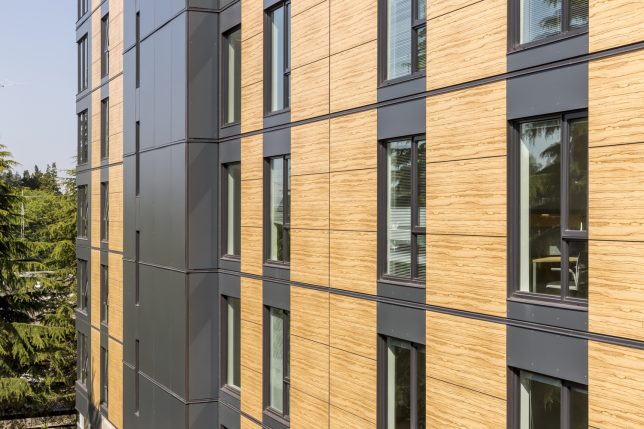
On the University of British Columbia’s campus in Vancouver, a new record-setting wood structures highlights the many advantages of a growing trend: vertical timber construction. Brock Commons Tallwood house is the highest of its kind to date, providing housing for over 400 students.

The Canadian firm behind its construction, Acton Ostry Architects Inc, says that using wood allowed for a much faster building process. Offsite testing of wood-to-wood connections and structural stability meant less time onsite spent figuring things out. Combined with prefabrication techniques, these approaches helped the builders finish the tower in just 70 days.

In addition to cost and time savings, wooden structures like this one are lighter weight, requiring less energy input during construction while also making them more flexible and resistant to earthquakes.

Sustainable forestry also enables them to sequester carbon while using a renewable resource — wood buildings like this open the door to carbon-neutral or even carbon-negative projects. Use of glue-laminated beams and columns also allows thinner trees and offcuts to be used in the construction process, reducing waste and growth time for harvested plants.

Some concrete was still required for the elevator cores, metal was needed for connections, and windows, of course, required glass. Still, compared to steel-framed structures, the amount of these materials used was dramatically reduced. And this project is not alone — around the world, forward-thinking architects and developers are beginning to realize that wood is a useful material for building tall.

Share on Facebook


[ By WebUrbanist in Architecture & Public & Institutional. ]

[ WebUrbanist | Archives | Galleries | Privacy | TOS ]


WebUrbanist

 
Comments Off on Prefab Plyscraper: World’s Tallest Timber Building Tops Out at 173 Feet

Posted in Creativity


The Profoto A1 is the ‘world’s smallest studio flash’ and Profoto’s first on-camera flash

20 Sep

$ (document).ready(function() { SampleGalleryV2({“containerId”:”embeddedSampleGallery_4235413921″,”galleryId”:”4235413921″,”isEmbeddedWidget”:true,”standalone”:false,”selectedImageIndex”:0,”startInCommentsView”:false,”isMobile”:false}) });

As expected after last week’s photo and specs leak, lighting manufacturer Profoto has launched an on/off camera flash unit called the Profoto A1. But if you were expecting a simple speedlight, Profoto is definitely branding this as more powerful than that. In fact, they’re calling it “the world’s smallest studio flash.”

The new A1 is styled much like most on-camera flash units, but is equipped with the powerful features of a Profoto studio head. The 76Ws unit uses a lithium ion battery that is claimed to be good for up to 350 full power bursts and which charges in under 80 minutes. Profoto also says that the A1 recycles “four times faster than other on-camera solutions,” as it can emit a full power pop every 1.2 seconds.

A stand-out feature of the A1 is its circular lens, which is said to produce light that is “natural and beautiful with a pleasing soft-smooth fall-off.” The rim of that circular lens housing is also magnetic, and accepts a range of clip-on modifiers that can be changed quickly and easily. The head offers a manually operated zoom function and the rear display is large and easy to read.

The A1 heads are equipped with Profoto’s Air Remote TTL system so they can work in groups alongside other A1 heads or any other Air Remote studio heads from the Profoto studio head range. Finally, the A1 offers variable power over 9 stops in both standard and HSS modes, and includes an LED modeling light for previewing the effect of the flash or using on its own as a light source.

The A1 is currently compatible with Nikon and Canon systems, and will be with Sony models in the future… but it doesn’t come cheap. As previously reported, the Profoto A1 will cost you $ 995 USD… quite the pretty penny when you compare it to some of the full-featured speedlights other options out there from brands like Godox.

For more information on the Profoto A1, visit the Profoto website or watch the introductory video below.

Press Release

The world’s smallest studio light

The Profoto A1 might be the smallest flash we’ve ever made, but it’s still built to the same impossibly high standards we’ve set ourselves over the last fifty years.

Our focus with the A1 was to create a flash that delivers a truly high quality of light, which is why it features a round head which delivers light that’s both natural and beautiful with a pleasing soft-smooth fall-off, that blends seamlessly with the ambient light.

Thanks to a smart magnetic mount built into the head, light shaping tools and modifiers can be clicked on and off quickly and easily. Within seconds you’re being creative with light, shaping it. It also has a zoom function that allows you to make fine adjustments to the spread of light by simply twisting the zoom ring on the head, and for accuracy it has a modeling light built-in to the head – so you can see what you’re going to get before you press the shutter.

We made it our mission to make A1 the first on-camera flash that’s easy to use from the box. The user interface is simple and intuitive with a large high-contrast display at its center. The less time you spend learning and fiddling, the more time you’ll spend shooting. And that’s ultimately what counts. Despite its size, or lack of it, the A1 punches above its weight in a good number of key areas.

Battery life is key when a photographer is right in the thick of the action, because the last thing they need to have to stop mid flow to change the batteries. The A1 has its own Li-ion high capacity battery built-in which lasts up to four times longer than AA batteries with no performance fade. So, you can shoot for longer with confidence.

And this is a flash that can keep up with you because it recycles four times faster than other on-camera solutions – that’s every 1.2 seconds at full power. Put simply, you’ll never miss a shot.

And while it’s true to say the Profoto A1 is our very first on-camera solution it’s also just as effective off-camera as a standalone unit, and integrated into a larger system of lights. That level of versatility is possible because Air Remote is built-in, which means the A1 offers seamless connectivity with freestanding lights like another A1 or bigger Profoto lights like the B1X.

And with AirTTL you’ll get a perfect exposure super-fast. Better still, you can lock the exposure with a single ‘click’ while still being free to fine tune that exposure in manual, giving you even greater control.

So, this is so much more than our smallest flash yet. This is shooting on the move, shooting with confidence and shooting with light shaping excellence. This is shooting off-camera and for the first time with Profoto, on-camera. This is the Profoto A1 – the world’s smallest studio light.

Articles: Digital Photography Review (dpreview.com)

 
Comments Off on The Profoto A1 is the ‘world’s smallest studio flash’ and Profoto’s first on-camera flash

Posted in Uncategorized