RSS
 

Posts Tagged ‘wireless’

Sony announces development of wireless flash control system

08 Mar

To kick off WPPI in Las Vegas, Sony has announced that it’s developing a wireless radio flash control system for its range of flashguns. Consisting of the FA-WRC1M radio commander and FA-WRR1 receiver, the system will provide control over 15 flashes in 5 groups up to 30m away. It will offer sync speeds up to 1/250th sec as well as a high sync speed. No pricing has been given, but Sony estimates the system will be available this summer in the US and Canada.

Press release:

Sony Announces Development of New Wireless Lighting Control System at WPPI 2016

LAS VEGAS, Mar. 7, 2016 – Sony Electronics, a worldwide leader in digital imaging and the world’s largest image sensor manufacturer, has today announced plans to release a new wireless lighting control system to meet the growing demands of professional Sony photographers.  

Designed for compatibility with their ? interchangeable cameras and external flash units, the new lighting system will include the FA-WRC1M wireless radio commander as well as the FA-WRR1 wireless radio receiver.  A prototype of the new system will be on display in Sony’s booth at WPPI 2016.  

With a maximum range of 30m (approx. 98 feet), the new radio controlled system will allow for an extremely flexible wireless flash shooting experience with exceptional performance in all types of shooting conditions. In total, the system can control a maximum of 15 separate flash units in up to 5 groups of flashes.   While using the system, photographers have the ability to control the exposure of connected flash units either manually or automatically depending on preference.   Additionally, the new lighting control system will be capable of flash sync speeds of up to 1/250th of a second with high speed sync (HSS) available as well.  

The new Wireless Lighting Control system will be available this summer at authorized retailers throughout the US and Canadian markets.  Pricing and detailed specifications will be released at a later date.

Articles: Digital Photography Review (dpreview.com)

 
Comments Off on Sony announces development of wireless flash control system

Posted in Uncategorized


Sekonic expands LiteMaster Pro meter series for wireless control of Elinchrom and Phottix flashes

10 Feb

Japanese light and color meter manufacturer Sekonic has introduced a pair of new ambient and flash light meters to the L-478 series that are dedicated to use with Elinchrom and Phottix flash units. The Sekonic LiteMaster Pro L-478DR-U-EL is designed to be used with Skyport-equipped Elinchrom heads, while the LiteMaster Pro L-478DR-U-PX is aimed at users of Phottix Indra studio heads, Mitros+ hotshoe flash guns, the Strato and Strato II receivers and the Atlas II transceiver.

From the new meters Elinchrom users will be able to adjust flash output in 1/10th stops across four lighting groups, and the meter is capable of triggering and measuring individual groups as well as all the flashes as a whole. Photographers using the Phottix system will be able to make adjustments in 1/3rd stop steps, and can trigger individual or collections of groups at one time. Although the meters are primarily intended for wireless radio triggering they also support standard flash cables. 

The LiteMaster Pro L-478 meters use a color touch-screen interface, and are designed to be used for still and motion picture work. These new models include an ISO 850 setting to suit users of the Canon cinema cameras, and have had their filter compensation factor increased from 5EV to 12EV for people using high-value neutral density filters. These features will be added to the current L-478D-U and L-478DR-U (PocketWizard) models via a firmware update in the near future. 

An interesting feature of the series is the ability to store the dynamic range profile of ten camera/lens combinations so that you can ensure that your lighting set-ups don’t create burnt-out highlights or blocked shadows. 

The new LiteMaster Pro L-478 meters will cost $ 400/£400. For more information visit the Sekonic website.

Articles: Digital Photography Review (dpreview.com)

 
Comments Off on Sekonic expands LiteMaster Pro meter series for wireless control of Elinchrom and Phottix flashes

Posted in Uncategorized


CamFi is an alternative wireless controller for your Nikon or Canon DSLR

05 Jan

CamFi is a new option for those photographers looking to control their Nikon or Canon DSLR wirelessly. The device mounts on the hot shoe of compatible DSLRs and creates a Wi-Fi network that you can connect to using a PC or Mac as well as Android and iOS mobile devices. At $ 130 CamFi is priced well below manufacturer-provided options for high-end DSLRs. Read more

Articles: Digital Photography Review (dpreview.com)

 
Comments Off on CamFi is an alternative wireless controller for your Nikon or Canon DSLR

Posted in Uncategorized


Pulse aims to bring advanced wireless control to your DSLR

04 Dec

Pulse, a project currently seeking funding on Kickstarter, aims to bring wireless control to many Nikon and Canon DSLRs. The device consists of a wireless controller that attaches to a camera’s hot shoe and plugs into its USB port, connecting to Android and iOS smartphones over Bluetooth. Read more

Articles: Digital Photography Review (dpreview.com)

 
Comments Off on Pulse aims to bring advanced wireless control to your DSLR

Posted in Uncategorized


Canon’s new Connect Station will feature wireless charging, support 4k video

16 Sep

Canon unveiled its next generation Connection Station this week at Canon Expo 2015 in New York. The new model is similar to the original CS100, first introduced at CES earlier this year, but with the addition of two new big features: wireless charging and support for 4K playback. Read more

Articles: Digital Photography Review (dpreview.com)

 
Comments Off on Canon’s new Connect Station will feature wireless charging, support 4k video

Posted in Uncategorized


Toshiba brings TransferJet wireless SD cards to Europe

05 Sep

Toshiba has announced that it will bring its wireless transfer memory cards to Europe, after having sold them in the Japanese market since the beginning of summer. The Class 10 16GB SDHC card uses TransferJet technology to communicate with compatible devices or devices fitted with TransferJet adapters that are brought into close proximity with the card’s host. Read more

Articles: Digital Photography Review (dpreview.com)

 
Comments Off on Toshiba brings TransferJet wireless SD cards to Europe

Posted in Uncategorized


Elinchrom, Phottix and Sekonic form wireless common standard partnership

13 Aug

Lighting manufacturers Elinchrom and Phottix are collaborating with the light meter brand Sekonic to establish a common standard for communication between wireless lighting devices. Read more

Articles: Digital Photography Review (dpreview.com)

 
Comments Off on Elinchrom, Phottix and Sekonic form wireless common standard partnership

Posted in Uncategorized


Hands-on Review – Nissin Di700A Speedlight and Wireless Trigger Kit

09 Aug

Following the big bang that introduced capable and affordable digital cameras, the digital photography universe has been expanding at an astounding rate. So much amazing imagery is being produced, and equipment manufacturers are working tirelessly to develop, and improve upon, the products you use to create those images.

Despite the tendency of some photographers to not even consider third party brands, that market exists and is flourishing. It seems that there are more players in it than ever before, and the competition is stiff.
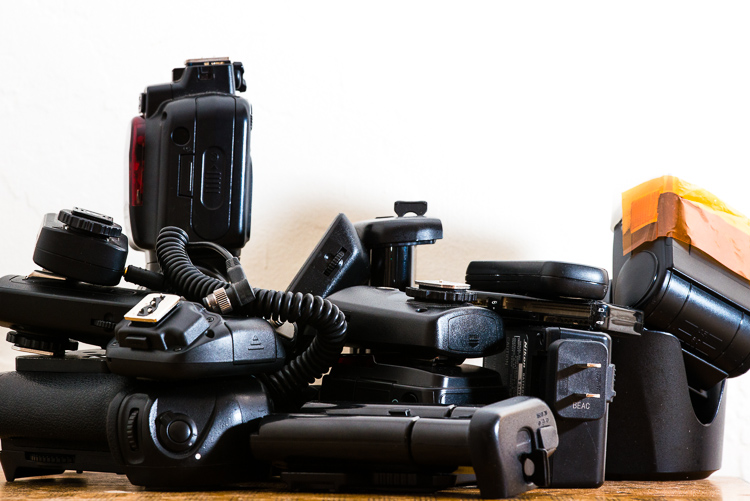
Photography accessories

The market for third party photography equipment and accessories is bustling.

If you are considering adding a speedlight to your arsenal of gadgets, it’s definitely worth having a look at third party brands. Don’t make the mistake of assuming that a product is inferior because it’s not the same brand as your camera.

Although the industry dominators (Nikon and Canon) have a large array of speedlights to choose from, you just might find that you have to pay for features which you will never use, or their products may not have the features you need.

One company that has gained some ground, making a name for themselves in the third party sector, is Japan-based Nissin. They are a dedicated photographic lighting company who just released a new flash system for Nikon and Canon (Sony version coming in September) and one just showed up on my doorstep.
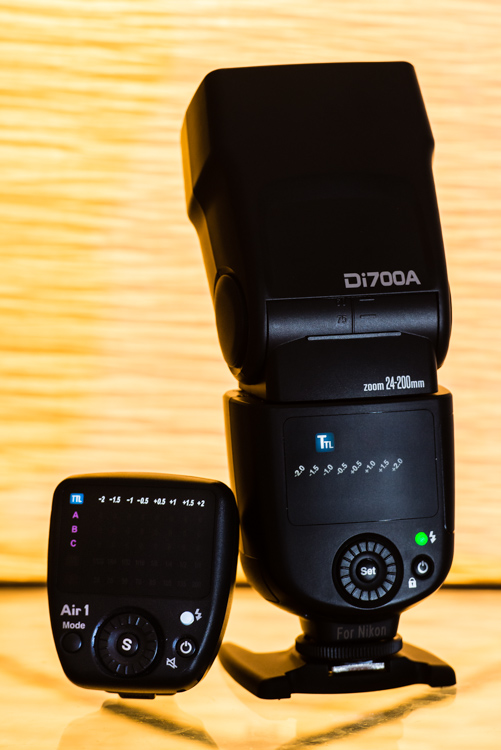
The Nissin Di700A speedlight shown with the Air 1 wireless commander.

The Nissin Di700A speedlight shown with the Air 1 wireless commander.

I shoot Nikon so they sent me the dedicated Nikon system but don’t worry, the Canon and Sony versions are similar, so this review is still worth reading even if you’re not a Nikon shooter.

First of all, this is exciting for us Nikon shooters. Unlike Canon, Nikon doesn’t have any flashes with radio triggers built-in, only optical. Why? Good question. Get it together Nikon.

First Impressions

Excavating the Nissin Di700A out of its packaging – yes, that’s the alphabet soup name they gave this unit – it was instantly apparent that it is meant to rival the SB-900/910, at least in size and weight.
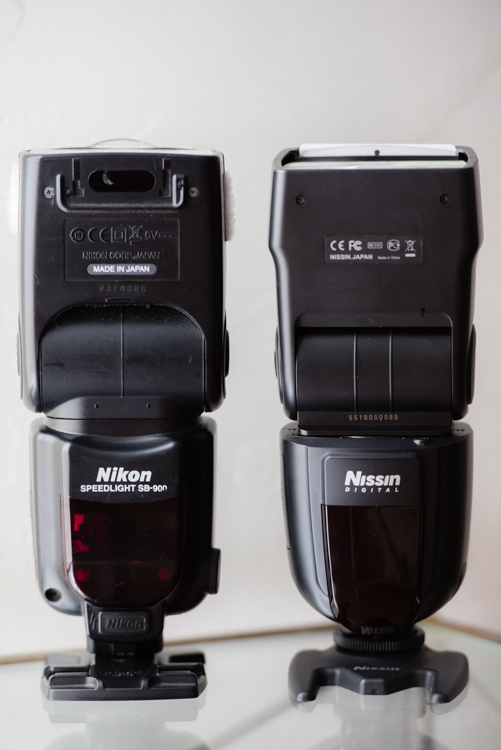
Side by side comparison of the Nissin Di700A and the Nikon SB-900

The Nissin is in many ways comparable to the Nikon SB-900.

A quick inspection of the unit shows it to be sleek, simple, and solid. The plastic seems heavy-duty and I suspect it would survive some abuse. The locking head swivels and swings into the same positions as its Nikon counterpart – 7-degrees down, 90-degrees up and 180-degrees left and right (as every flash should).

On the back, below the matte-finish LED screen, is a dial with a Select button in the middle, a flash test button, and the power button. They went for the minimalist approach which I applaud. It has a small rubber cover on each side; one with a socket for a battery pack hiding behind it, and the other with a PC cable and auxiliary sync inputs.

The metal hot shoe mount is a welcome sight but the circular threaded disc for tightening the flash onto the hot shoe seems a bit archaic. A slide-out diffuser and reflector panel are also familiar features.

You may have noticed that earlier I called this a camera system. The kit they sent me comes with a radio trigger called the Air 1 Commander. The hot-shoe-mount Air 1 matches the flash in most respects, but has an extra Mode button. It automatically locks into place when slid onto the hot shoe, and has a button which is held in to release it. Personally, I would have preferred the same button on the speedlight instead of the threaded disc.

Firing it up

I popped in four AA batteries, hit the power button, and a kaleidoscope of colorful lights sprung to life on the rear panel. However, the flash was effectively frozen and would not work at all. Come to find out, the Eneloop XX rechargeable batteries that I prefer to use for all of my speedlights do not work in this unit. I swapped them out for the regular Eneloops which work fine. The only difference that I’m aware of is the XX are 2,500 mAh compared to the regular’s 2,000 mAh (any electrical engineers out there please chime in).

Following the thread of simplicity that Nissin has going, I just tightened that baby down onto my hot shoe and it did what it is supposed to do, fired away in TTL metering mode.

I instantly fell in love with the rear display. Various bright, vivid colors, clearly visible in any lighting conditions, indicate the six different menu settings:

  1. A (automatic)
  2. TTL (through the lens metering)
  3. M (manual)
  4. SD (slave digital)
  5. SF (slave film)
  6. And the wireless setting identified by a little radio tower symbol

A few things I liked immediately were: a quick press of the power switch locks all functions of the flash so you don’t inadvertently change settings, the tactile feel of the buttons and wheel are soft but feel very sturdy, and changing modes and adjusting exposure compensation is quick and easy.

Another issue I encountered was that the zooming flash head feature didn’t work. It zooms all the way out when deploying the small diffusion panel but did not respond when changing the zoom on any of my lenses as the manual says it should, nor does it respond to the manual zoom control feature of the Air 1. We’ll assume I got sent a defective unit. To play devil’s advocate, this can happen to any brand so I’m not going to throw them under the bus just yet.

The controls on the Di700a are intuitive and very easy to adjust to get the exposure just how you want it.

The controls on the Di700A are intuitive and make it quick and easy to adjust and get the exposure just how you want it.

A detail that could prove handy is the standalone battery magazine. Spares can be purchased which can be pre-loaded for easy swapping. This can save you time and prevents fumbling around for batteries in the heat of the moment.

Perusing the instruction manual divulged that the flash has an overheating circuit which supposedly shuts it down for 15 minutes, to recover after firing 20 to 30 times (presumably at full power). This is a significant detail as 15 minutes might as well be an eternity for professional shooters. I immediately had flashbacks of the SB-900 which would overheat and shutdown often, and at the most inopportune times.

The system supports all of the nifty features found on the camera body: high-speed sync (FP for Nikon and HSS for Canon) to 1/8,000th of a second, red-eye reduction, slow and rear -curtain shutter, and on-camera exposure compensation which is added onto the unit’s own exposure compensation, covering two stops in both directions.

The Nissin Di700A not only has a built-in wireless receiver, but can also be optically triggered by the camera’s built-in flash. This is cool because you can mix and match flashes that have optical receivers. The Di700A and the Air 1 can be purchased separately. The Air 1 wireless commander claims a 100 foot effective range. Although this may seem generous, and plenty for most applications, the Cactus transmitters I use boast three times the range but do not support TTL metering, so it’s a trade off.

Using the Air 1 with the Di700A proved undependable. My first attempt at about 50 feet, with the flash behind a motorcycle for backlighting, was met with intermittent results. The signal seemed weak, and I had to move around to get the flash to finally fire.

Testing the Nissin Di700a and Air 1 commander.

I had mixed results using the Air 1 to trigger the Di700A. The system struggled having the motorcycle between the flash and transmitter at about 50 feet.

The Air 1 can also support three groups of flashes, on eight separate channels, with exposure compensation for each group in half stop increments.

I would certainly recommend the kit to beginning through intermediate shooters, but despite Nissin’s efforts to offer some pro-level features, it falls a little short to meet the demanding needs of working photographers.

All in all, for a sub $ 300 kit, that is sleek and easy to use, versatile, and capable of wireless TTL shooting, the Nissin kit is definitely a strong contender.

googletag.cmd.push(function() {
tablet_slots.push( googletag.defineSlot( “/1005424/_dPSv4_tab-all-article-bottom_(300×250)”, [300, 250], “pb-ad-78623” ).addService( googletag.pubads() ) ); } );

googletag.cmd.push(function() {
mobile_slots.push( googletag.defineSlot( “/1005424/_dPSv4_mob-all-article-bottom_(300×250)”, [300, 250], “pb-ad-78158” ).addService( googletag.pubads() ) ); } );

The post Hands-on Review – Nissin Di700A Speedlight and Wireless Trigger Kit by Jeremie Schatz appeared first on Digital Photography School.


Digital Photography School

 
Comments Off on Hands-on Review – Nissin Di700A Speedlight and Wireless Trigger Kit

Posted in Photography


Tric is a wireless flash trigger for the iPhone

09 Jun

The LED flash units in smartphones are usually poor performers compared to the Xenon flashes in dedicated cameras or even external flashguns. If you feel your iPhone photography has been held back by your Apple device’s underpowered LED light, Tric’s new Kickstarter project might just be what you’ve been waiting for. The team behind Tric is looking to fund the final development and mass production of a wireless trigger unit for the iPhone. Read more

Articles: Digital Photography Review (dpreview.com)

 
Comments Off on Tric is a wireless flash trigger for the iPhone

Posted in Uncategorized


Accessory Review: Western Digital My Passport Wireless

21 Apr

Western Digital’s Wi-Fi enabled My Passport Wireless is a hard drive that features a built-in SD card reader. Alongside the drive, it offers a My Cloud app, allowing photo, video and audio files on the drive to be viewed wirelessly from a phone or tablet. With Wi-Fi hotspot capabilities it could be a very tempting device for roaming photographers who want photo backup without the burden of a laptop. Is it a travel photographer’s new best friend? Read review

Articles: Digital Photography Review (dpreview.com)

 
Comments Off on Accessory Review: Western Digital My Passport Wireless

Posted in Uncategorized