RSS
 

Posts Tagged ‘View’

Cambo introduces Canon EOS lens plate with aperture control for Actus view camera system

12 Feb

$ (document).ready(function() { SampleGalleryV2({“containerId”:”embeddedSampleGallery_4644059846″,”galleryId”:”4644059846″,”isEmbeddedWidget”:true,”standalone”:false,”selectedImageIndex”:0,”startInCommentsView”:false,”isMobile”:false}) });

Cambo has devised a new Canon EF/EF-S lens plate for its Actus view camera system that allows users to control aperture settings on Canon EOS lenses. The Cambo Actus system is designed to deliver a view camera style of shooting to some mirrorless camera bodies, consisting of a lens plate and a body plate with bellows and a monorail in between.

As EOS lenses have no manual aperture control, a plain mounting plate will only allow the lenses to be used at their widest aperture setting. The new ACB-CA plate however has electronic contacts that allow it to communicate with the lens, and a finger wheel so the photographer can dial in required aperture settings. An OLED display shows aperture values as well as the focal length in use, even when a zoom is mounted. 

The ACB-CA adapter will provide tilt, shift, swing, rise and fall movements between the front and rear standards with an EOS lens and a mirrorless camera mounted, though other lens systems allow movements with Nikon and Canon DSLR bodies. The Actus-DB system allows digital backs to be used.

The new ACB-CA plate for Canon EOS lenses costs £950 / $ 1299, while the Actus body costs £1400 / $ 1900. For more information visit the Cambo website.


Press release: 

NEW Cambo Actus Canon Auto Lens Mount

Cambo has released the NEW ACB-CA adapter for Canon EF lenses for use on the ACTUS mini view camera. The adapter has built-in electronic controls for setting and operating the aperture of Canon EF lenses.

Normally when a Canon auto iris lens is removed from the camera body the lens aperture is wide open. The ACB-CA communicates with the lens and enables the user to adjust the aperture, giving you full control.

This adapter has an internal battery for continuous use and features an OLED display which shows the preset or set aperture together with the focal length of the lens. The communication is accurate, such that the display will also show the focal length of zoom lenses.

The adapter accepts lenses fitted with Canon EOS bayonet, in combination with the ACTUS view camera. The ACB-CA adapter is finished in black to match the ACTUS-B camera version.

This ACB-CA lens adapter is designed to work with mirrorless* camera bodies, such as the Sony A7 series, Fujifilm X series and Canon M series. When mounted on the Actus the adapter will tilt and swing within the lens image circle that is being used. The rear rise/fall and left/right shift will operate as normal, again within the lens’s image circle.

*Mirrorless camera bodies have the imaging sensor further forward enabling the lens to focus at infinity or closer.

Check via the Cambo Configurator the compatibility between cameras, lenses and adapter when using the Cambo Actus.

The ACB-CA adapter is available now from stock £790.00 excluding VAT and shipment. For further information contact CamboUK on 07863 116150 or cambouk@gmail.com .

Articles: Digital Photography Review (dpreview.com)

 
Comments Off on Cambo introduces Canon EOS lens plate with aperture control for Actus view camera system

Posted in Uncategorized


Oh, wow… Sony announces 24MP a6300 with incredible AF and 8 fps live view bursts

04 Feb

$ (document).ready(function() { SampleGalleryV2({“containerId”:”embeddedSampleGallery_3250592731″,”galleryId”:”3250592731″,”isEmbeddedWidget”:true,”selectedImageIndex”:0,”startInCommentsView”:false,”isMobile”:false}) });

Sony has introduced the long-awaited update to its popular a6000 mirrorless camera: the a6300. Featuring a newly developed 24 Megapixel APS-C sensor and a completely revamped ‘4D’ AF system with 425 phase-detection AF points, the a6300 sits at the top of Sony’s APS-C mirrorless lineup. It also appears poised to break down one of the last remaining strongholds of DSLR by a live feed of the action in between frames, with minimal blackout, at a respectable 8 fps shooting rate, with AF.

Key Features:

  • 24MP CMOS APS-C sensor with copper wiring
  • 425-point on-sensor phase-detection AF system
  • 11 fps continuous shooting (8fps continuous live view)
  • Silent shooting 
  • Max ISO of 51200
  • 4K video capture up to 100 Mbps
  • Phase-detect AF compatible with A-mount lenses via LA-EA3 adapter

Capable of continuous shooting at up to 11 fps with AF, the a6300’s 425-point hybrid AF system features ‘high-density’ tracking, which dynamically activated AF points around a subject and adjusts them depending on the motion of the subject itself. The 425 phase-detect points, impressively, reach all the way out to the corners of the frame.

Perhaps the biggest news is that the a6300 is capable of uninterrupted live view at up to 8 fps, potentially addressing one of the biggest shortcomings of mirrorless cameras when it comes to fast action shooting. Traditionally, mirrorless cameras tend to show only a stop-motion sequence of last-shot images at the highest shooting frame-rate, which makes it hard to follow a subject and keep an AF point over it. Live view in between short blackouts at 8 fps brings the a6300 much closer to the experience of a DSLR with optical viewfinder. At the launch event in New York this morning, Sony showed a video reminiscent of Nikon’s recent DSLR vs. mirrorless comparison for fast action shooting at CES, albeit comparing the a6300 to a <$ 1000 DSLR. Results looked impressive.

Notably, the a6300 can use all of its 425 phase-detect points to quickly focus A-mount lenses using a LA-EA3 adapter, which indicates this is now a standard feature that will be available across future E-mount cameras. We also expect phase-detect AF to work with other 3rd party lenses using adapters like the Metabones Smart Adapter.

The a6300 is capable of 4K video capture at up to 100 Mbps. The camera uses a 20MP (6K) region of the sensor to offer 2.4x oversampled 4K video with full pixel readout, and no pixel binning. Videographers should be able to expect sharp, low noise footage, even in low light since almost the entire sensor is sampled.

While the progress in technology is impressive, lack of true weather sealing, a touchscreen, or direct AF point selection with a dedicated joystick or control will continue to be problematic for some. The a6300 will be available in March for $ 1000 body only.

Press Release:

Sony Introduces New ?6300 Camera with World’s Fastest Autofocus 

New Mirrorless Camera Features World’s Fastest AF speed1 and Highest Number of AF points2 plus Newly Developed 24.2 MP APS-C Sensor, High Resolution 4K video recording and more 

NEW YORK, Feb. 3, 2016 – Sony Electronics, a worldwide leader in digital imaging and the world’s largest image sensor manufacturer, has today introduced the latest addition to their award winning lineup of mirrorless cameras, the ?6300 model. 

The camera boasts an unrivaled 4D FOCUS™ system that can lock focus on a subject in as little as 0.05 seconds, the world’s fastest AF acquisition time1.  Additionally, the ?6300 has an incredible 425 phase detection AF points that are densely positioned over the entire image area – the world’s highest number of AF points on any interchangeable lens camera2, and can shoot images at up to 11 frames per second with continuous autofocus and exposure tracking,

The impressive new mirrorless model also has the ability to  support full live-view continuous shooting on the Tru-finder or LCD screen at up to 8 frames per second, ultimately producing a real-time shooting experience that combines all the benefits of an electronic viewfinder with the immediacy of a through-the-lens optical viewfinder. 

The versatile ?6300 is equipped with a newly developed 24.2 MP (approx.. effective) APS-C sized Exmor CMOS sensor that works together with a BIONZ X image processing engine to produce outstanding image quality throughout the entire ISO sensitivity range ISO 100 – 51200 3.  It can also shoot and record high resolution 4K video with full pixel readout and no pixel binning in the popular Super 35mm format.

 “The ?6300 is yet another example of the dominant innovation that Sony continues to bring to the industry, especially from the mirrorless space,” said Neal Manowitz, Vice President of Digital Imaging at Sony Electronics.  “With this new model, we’ve combined the world’s fastest and most extensive AF system with a superb image sensor and many of our most advanced imaging and video technologies, creating a package that can far exceed the performance of any DSLR in its class.   This camera connects you with the action like never before.” 

Unrivaled AF Performance

Sony’s new ?6300 camera builds upon the acclaimed 4D FOCUS performance of the ?6000 model, utilizing a Fast Hybrid AF system that combines high-speed phase detection AF with extremely accurate contrast AF and allows it to capture and lock on to moving subjects in as little as 0.05 seconds1.  The camera’s High-density Tracking AF technology positions 425 phase detection AF points over nearly the entire field of view, allowing it  to accurately focus throughout a wide area – even on small, fast objects that other cameras would fail to recognize. 

In addition to the extensive AF coverage, the ?6300 debuts a new High-density tracking AF technology that significantly improves subject detection and tracking performance.  This new technology can quickly activate a large number of AF points surrounding a subject – approximately 7.5 times more density than the ?6000 – and intelligently adjust them in accordance with the subject’s motion.  This is a particularly powerful feature when used with high-speed 11 fps continuous shooting or the new 8 fps continuous live-view mode, which provides 100% accurate framing for fast moving subjects on the LCD screen or viewfinder.

Of note is the fact that the camera’s 425 phase detection AF points, enhanced tracking and focus accuracy are all available on the ?6300 when using A-mount lenses4 with a mount adaptor like the Sony LA-EA3.  This is a first for Sony E-mount interchangeable lens cameras with an APS-C sized sensor, as the only other cameras to feature this capability are the full-frame ?7R II and ?7 II models.

Other enhancements to the ?6300 include silent shooting functionality the ability to use AF in focus magnifier mode, expanded flexible spot AF, Eye AF in AF-C mode and more. 

Powerful 24.2 MP Exmor CMOS Sensor and BIONZ X Processor

In order to maximize efficiency and overall camera performance, the ?6300 features a new 24.2 MP sensor that is an ideal match for its BIONZ X image processing engine. 

The new image sensor employs copper wiring in its structure, which improves light collection efficiency and significantly accelerates readout speed. The BIONZ X processor features an upgraded image processing algorithm designed to maximize the sensor’s overall capabilities.  Together, the two key components work together to produce images with low noise and exceptional resolution in sensitivity settings up to ISO512003, in particular in the mid-to-high sensitivity range. 

Ultimate 4K Resolution and Other Professional Video Capabilities

In another first for non-full-frame Sony interchangeable lens camera, the new ?6300 offers internal 4K movie recording in Super 35mm format.  When shooting in 4K, the camera uses full pixel readout without pixel binning to collect 20 megapixels of information – approximately 2.4x5 (6K equivalent) as many pixels as 4K UHD and then oversamples the information to produce high quality  footage with exceptional detail and depth.   

The camera utilizes the XAVC S codec6 during video shooting, which records at a high bit rate of 100 Mbps7 during 4K recording and 50 Mbps during standard Full HD shooting, ensuring maximum detail and clarity in both video formats.  Additionally, the camera will focus approximately twice as fast as its predecessor during movie shooting thanks to its new and improved AF system.  AF speed and AF tracking sensitivity are also adjustable for expanded creativity.  

Other professional caliber video features include the ability to record Full HD at 120 fps at 100 Mbps7, another first for ? interchangeable lens cameras with APS-C sized sensors.  This mode allows footage to be reviewed and eventually edited into 4x or 5x slow motion video files in Full HD8 (24p or 30p) resolution with AF tracking.   The new ?6300 also offers S-Log gamma recording9 for wide dynamic range shooting – approximately 14-stop latitude in S-Log3 gamma setting – and supports S-Gamut for a wider color space.  Both options allow for greater creativity for processing video post-production.

Also included on the new camera is a microphone line input that accepts external microphones and also supports XLR input with Sony’s XLR adapter kit, as well as Gamma Display Assist, a new function that allows users to monitor images or check focus when recording S-Log movies. The new model has enhanced Zebra functionality for greater exposure control.  Picture profile settings are available, as well as Time Code / User Bit and much more. 

Enhanced Operability and Ergonomics

The ?6300 camera is equipped with a high contrast, high-resolution XGA OLED Tru-Finder with approximately 2.4 million dots that offers exceptional corner-to-corner visibility.  There is also a new mode available for the viewfinder that allows display of images at 120 fps, ensuring that action is displayed smoothly with very few afterimages, making subject tracking through the Tru-finder easier than ever.    

Aesthetically, the new ?6300 camera features an extremely solid feel in hand thanks to its robust, magnesium alloy design.  It can be customized to fit nearly any shooting style or preferences, with 9 customizable buttons that one of 64 different functions can be assigned to.  The camera adds a digital level gauge as well as upgraded dust and moisture resistance10, a reinforced lens mount structure and a new shutter release button and mode dial with improved operability and grip.

The new ?6300 camera is Wi-Fi® and NFC compatible and fully functional with Sony’s PlayMemories Mobile™ application available for Android™ and iOS platforms, as well as Sony’s growing range of PlayMemories Camera Apps™, which add a variety of creative capabilities to the camera.  It also supports QR code for easy connection to non-NFC smart phones.

Pricing and Availability

The Sony ?6300 interchangeable lens camera will be available in March for about $ 1,000 for the camera body or for about $ 1,150 paired with a 16-50mm F3.5 – F5.6 kit lens (model SELP1650).  Prices for the Canadian market will be about $ 1,350 CA for the body and about $ 1,500 CA for the camera kit.  It will be sold at a variety of Sony authorized dealers throughout each region.   

1.      Among interchangeable lens cameras equipped with an APS-C sized sensor as of February 2016, based on Sony research.  Measured using CIPA-compliant guidelines and internal method with an E PZ 16-50 F3.5-5.6 OSS lens mounted.  Pre-AF off and viewfinder in use.

2.      Among interchangeable lens cameras as of February 2016, based on Sony research

3.      Expandable up to ISO 51200 for stills and up to ISO 25600 for movies

4.      A-mount lenses with SSM or SAM only. Users can choose phase-detection AF or contrast-detection AF in AF System menu.

5.      1.6x in 30p setting

6.      An SDHC/SDXC memory card with a Class 10 or higher speed rating is required for XAVC S recording

7.      UHS Class 3 memory card is required for recording at 100Mbps

8.      Number of pixels required for Full HD movie recording is readout from the image sensor

9.      S-Log2 and S-Log3 are based on processing pictures.

10.   This camera is designed for optimal dust and moisture resistance, but is not waterproof or splashproof. For FE lens only


Sony Alpha a6300 specifications

Price
MSRP $ 1000 (body only), $ 1150 (w/16-50mm lens)
Body type
Body type Rangefinder-style mirrorless
Body material Magnesium-alloy
Sensor
Max resolution 6000 x 4000
Other resolutions 3:2 (4240 x 2832, 3008 x 2000), 16:9 (6000 x 3376, 4240 x 2400, 3008 x 1688)
Image ratio w:h 3:2, 16:9
Effective pixels 24 megapixels
Sensor photo detectors 25 megapixels
Sensor size APS-C (23.5 x 15.6 mm)
Sensor type CMOS
Processor BIONZ X
Color space sRGB, Adobe RGB
Color filter array Primary color filter
Image
ISO Auto, 100-25600, expandable to 51200
Boosted ISO (maximum) 51200
White balance presets 10
Custom white balance Yes
Image stabilization No
Uncompressed format RAW
JPEG quality levels Extra fine, fine, normal
File format
  • JPEG (Exif v2.3)
  • Raw (Sony ARW v2.3, 14-bit)
Optics & Focus
Autofocus
  • Contrast Detect (sensor)
  • Phase Detect
  • Multi-area
  • Center
  • Selective single-point
  • Tracking
  • Single
  • Continuous
  • Face Detection
  • Live View
Autofocus assist lamp Yes
Digital zoom Yes (2x-8x)
Manual focus Yes
Number of focus points 425
Lens mount Sony E (NEX)
Focal length multiplier 1.5×
Screen / viewfinder
Articulated LCD Tilting
Screen size 3
Screen dots 921,600
Touch screen No
Screen type TFT LCD
Live view Yes
Viewfinder type Electronic
Viewfinder coverage 100%
Viewfinder magnification 0.7×
Viewfinder resolution 2,359,296
Photography features
Minimum shutter speed 30 sec
Maximum shutter speed 1/4000 sec
Exposure modes
  • Auto
  • Program
  • Aperture Priority
  • Shutter Priority
  • Manual
Scene modes
  • Portrait
  • Landscape
  • Macro
  • Sports Action
  • Sunset
  • Night Portrait
  • Night Scene
  • Handheld Twilight
  • Anti Motion Blur
Built-in flash Yes
Flash range 6.00 m (at ISO 100)
External flash Yes
Flash modes Flash off, Autoflash, Fill-flash, Rear Sync., Slow Sync., Red-eye reduction, Hi-speed sync, Wireless
Flash X sync speed 1/160 sec
Drive modes
  • Single
  • Continuous (Hi+ / Hi / Mid / Low)
  • Self-timer
  • Bracketing
Continuous drive 11.0 fps
Self-timer Yes
Metering modes
  • Multi
  • Center-weighted
  • Spot
Exposure compensation ±5 (at 1/3 EV, 1/2 EV steps)
AE Bracketing ±5 (3, 5 frames at 1/3 EV, 1/2 EV, 2/3 EV, 1 EV, 2 EV steps)
WB Bracketing Yes
Videography features
Resolutions 4K (3840 x 2160 @ 30p/24p), 1920 x 1080 (120p, 60p, 60i, 30p, 24p), 1280 x 720 (24p)
Format MPEG-4, AVCHD, XAVC S, H.264
Videography notes Supports X-AVC S up t0 100 Mbps, ACHD to 28Mbps
Microphone Stereo
Speaker Mono
Storage
Storage types SD/SDHC/SDXC
Connectivity
USB USB 2.0 (480 Mbit/sec)
HDMI Yes (micro-HDMI)
Microphone port Yes
Headphone port No
Wireless Built-In
Wireless notes 802.11b/g/n with NFC
Remote control Yes (via smartphone)
Physical
Environmentally sealed Yes
Battery Battery Pack
Battery description NP-FW50 lithium-ion battery & charger
Battery Life (CIPA) 400
Weight (inc. batteries) 404 g (0.89 lb / 14.25 oz)
Dimensions 120 x 67 x 49 mm (4.72 x 2.64 x 1.93)
Other features
Orientation sensor Yes
Timelapse recording Yes (downloadable app)
GPS None

Articles: Digital Photography Review (dpreview.com)

 
Comments Off on Oh, wow… Sony announces 24MP a6300 with incredible AF and 8 fps live view bursts

Posted in Uncategorized


Sony releases a6300 videos showing AF tracking and 8 fps live view burst performance

04 Feb

Sony has released a video showing the AF tracking and 8 fps live view burst of the newly announced a6300, as well as a video demonstrating AF with subject tracking in 4K video.

The camera appears to have impressive AF subject tracking accuracy, following not just the dog but the dog’s face in the demo. We’ll reserve judgement until we get our hands on one, but previous Sony cameras had a tendency to wander off to other areas of the subject when using general subject tracking, so these results indeed appear impressive. The expansive 425-point array also mean the camera can track the subject to almost any point in the frame, and all of these points purportedly work with A-mount lenses mounted via a LA-EA3 adapter (we expect Canon mount lenses to work as well, with appropriate adapters).* Have a look below.


Sony a6300 ‘4D Focus’ demo


The a6300 also potentially addresses one of the largest shortcomings of mirrorless cameras for action shooting: the often stop-motion playback of last-shot images, as opposed to a live feed, when shooting continuous bursts. We recently reported on Nikon’s calling out of this particular weak point of mirrorless cameras, so Sony’s response in the a6300 today seems timely. Essentially, the a6300 offers a live feed in the EVF or on the LCD during 8 fps continuous shooting, in between what seem to be very short blackouts. This should make it much easier to both pan the camera and still keep your subject in the frame, or keep your selected AF point(s) over your subject. 

The video above, in addition to one Sony presented at the press event earlier today, demonstrate a promising live feed during 8 fps bursts, but ultimately its utility will be largely dependent on the length of those blackouts between shots. Sony claims that the length of blackouts is competitive when compared to a <$ 1000 DSLR.

While that might seem like a relatively low bar, the fact that Sony is getting a live feed off the sensor at all in between shots at 8 fps represents significant progress in the realm of mirrorless cameras. In comparison, a DSLR doesn’t have to do anything but return the mirror to get you this ‘live feed’ through the optical viewfinder between shots.


Autofocus in video


Sony has also released a video demonstrating impressive AF in 4K video recording with native mount lenses. There appears to be little hunting, with fast refocusing and even subject tracking available during movie recording. Have a look above.

This should be a boon for videographers, assuming Sony now allows one to easily specify the subject before tracking it. On the note of specifying a subject, it’s a huge shame that a touchscreen isn’t paired with this capable video AF system for focus point selection.

At least on paper, we think that these advances mark some significant progress for mirrorless (it’s too bad we can’t say the same for the a6300’s ergonomics), and we’ll be curious to see how the systems perform when we get our hands on a production a6300.


* It remains to be seen if subject tracking is available in any mode save for ‘Wide’ with 3rd party lenses though: subject tracking has been severely limited with 3rd party glass on the a7 II and a7R II due to the inability of the photographer to specify the subject, since it’s only available in Wide area mode.

Articles: Digital Photography Review (dpreview.com)

 
Comments Off on Sony releases a6300 videos showing AF tracking and 8 fps live view burst performance

Posted in Uncategorized


Shooting with a point of view: Anna Mia Davidson in Cuba

24 Jan

In 1999, Anna Mia Davidson packed up 100 rolls of Tri-X film, an old Leica M4-P, two lenses and headed to Cuba to photograph the grittier reality of Cuban life that lurked beneath its colorful surface. Davidson expresses the importance of having a unique point of view to guide her as she made multiple trips over several years, documenting the island nation through some of its most turbulent times.

In this PIX 2015 talk, Davidson’s photos guide you through a Cuba you’ve not likely seen. She purposely eschewed the temptation of color film to ‘focus on finding the essence of the culture in quiet moments; the emotions unimpaired by the appeal of color.’ Davidson’s work spans the entirety of the culture, from the homes, families and streets of Havana to the fields, valleys and farmers of the countryside. Woven in amongst her photographs are hints to the looming presence of the Castro regime and the stark contrasts of Cuban and American culture.

Watch the talk and visit Davidson’s website to see more of her work in Cuba and beyond.

Articles: Digital Photography Review (dpreview.com)

 
Comments Off on Shooting with a point of view: Anna Mia Davidson in Cuba

Posted in Uncategorized


Samsung launches enormous 18.4-inch Galaxy View tablet

29 Oct

With smartphone screens growing larger and nearing what used to be tablet territory, it’s probably natural that the latter are increasing screen size as well. Apple launched the 12.9-inch iPad Pro in September and now Samsung, which already has the 12.2-inch Galaxy Tab Pro in its line-up, has gone one step further and launched the gigantic Galaxy View with an 18.4-inch display. Read more

Articles: Digital Photography Review (dpreview.com)

 
Comments Off on Samsung launches enormous 18.4-inch Galaxy View tablet

Posted in Uncategorized


6 Ways to Use Live View to Get Sharper Images

27 Oct

The LED monitor on the back of a camera is most often used to review captured images. But here’s a tip: Live View can also be a useful tool, helping you to focus your camera before taking the shot. In fact, Live View may be the most accurate means of focusing a camera. Let’s take a look at six ways you might use Live View to focus.

1 – Focus Stacking

Use live view to focus on different depths of field to use for focus stacking

Use Live View to focus at different distances for focus stacking.

Focus Stacking is similar in principle to HDR. However, when doing Focus Stacking, images are captured with different parts of the image in focus, then combined in Photoshop to create an image with more depth of field than would be possible with a single exposure. This method is a useful tool when doing macro photography. Calm winds are a must to capture focus stacking images. Use Live View to accurately focus each image. Here is the step-by-step outline of the process:

  1. Set up your camera on a sturdy tripod (a must!)
  2. Frame or compose the image
  3. Turn on Live View
  4. Zoom the Live View in so you can adjust the focus of each image to different distances
  5. Use Photoshop to process and blend the stacked images

2 – Manual Trap Focus for Macro Photography

Use live view to manually trap focus a macro photography subject.

Use Live View to manually trap focus a macro photography subject.

Manual Trap Focus can also be useful in macro photography. Set your camera to manual focus, and using Live View move the camera until the subject is in focus. Used in conjunction with a focusing rail on a tripod, or hand held, move the camera to focus the image. Another benefit of this method is that it also gives you a Live View of the depth of field for the image you plan to capture. See steps below to give this method a try:

  1. Set camera to manual focus
  2. Turn the focus ring on your lens to the closest focus distance
  3. Turn on Live View
  4. Move your camera closer to your subject until it is in focus. (Using a focusing rail can help you master this method.)

To fine-tune the focus, use the zoom feature in Live View to get the most accurate focus point possible.

3 – Focus on any point in your scene

Live View is not restricted to the usual focusing points in your camera’s main focusing system. Most newer camera models will have 51 or more focusing points. However, these points are clustered around the center of the image. In Live View, you can move your focusing point all the way out to the edge of the image.

4 – More Accurate Focus

Use live focus to zoom in for a more accurate focus on waterfalls.

Use Live View focus to zoom-in for a more accurate focus on waterfalls.

Live View also provides a more accurate focus than a camera’s main auto focusing system. The Live View system is based on the contrast of the image actually captured by the camera’s sensor. It is slower-focusing than your camera’s regular phase detection autofocus system, but it is more accurate. This works great for focusing in on subjects within landscape, and portraiture where a slower-focusing method doesn’t affect the ability to capture the shot.

5 – Manual Focus in Low Light

When photographing in low light situations, such as astrophotography, auto focusing often fails to provide a desirable result. Using Live View, in conjunction with manual focusing, can help obtain a sharp image. While in Live View, use the zoom to enlarge the subject’s image and then use manual focus to tweak the photo’s sharpness.

Use live view to focus when capturing low light images.

Use live view to focus when capturing low light images.

6 – Focusing on the Eyes

For the most compelling portraiture and wildlife photography, the most important focus is on the eye(s) of the subject. Using Live View, it is possible to isolate the eye for either auto focus or a manual focus. This method is limited to images that are posed, or with little movement.

Use live view to focus on the eye to fine-tune the focus in select wildlife images.

Use Live View to focus on the eye to fine-tune the focus in select wildlife images.

Conclusion

These are just a few ways that you can use Live View mode to focus your camera. Remember that using these methods will be much harder on your battery life. Always keep a spare, fully charged, battery with you when you are shooting. If you have any other ideas for using Live View for focusing, please leave them in the comments below.

googletag.cmd.push(function() {
tablet_slots.push( googletag.defineSlot( “/1005424/_dPSv4_tab-all-article-bottom_(300×250)”, [300, 250], “pb-ad-78623” ).addService( googletag.pubads() ) ); } );

googletag.cmd.push(function() {
mobile_slots.push( googletag.defineSlot( “/1005424/_dPSv4_mob-all-article-bottom_(300×250)”, [300, 250], “pb-ad-78158” ).addService( googletag.pubads() ) ); } );

The post 6 Ways to Use Live View to Get Sharper Images by Bruce Wunderlich appeared first on Digital Photography School.


Digital Photography School

 
Comments Off on 6 Ways to Use Live View to Get Sharper Images

Posted in Photography


Rooftop View: World’s Largest Mural Takes Up Entire Building

08 Sep

[ By Steph in Art & Street Art & Graffiti. ]

world's largest mural 6

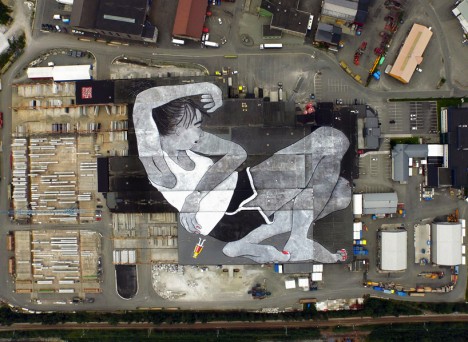
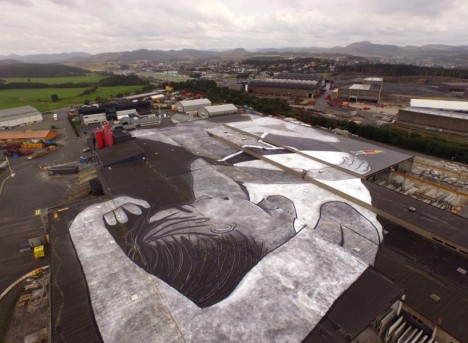
Spanning the massive multi-building rooftop of a construction company, this black-and-white mural of a lounging girl might just be the largest ever painted. Commissioned by French duo Ella & Pitr for Norway’s Nuart Street Festival, the painting takes up an incredible 21,000 square meters, and in overhead photos, nearby cars look like toys.

world's largest mural 1

world's largest mural 4

world's largest mural 5

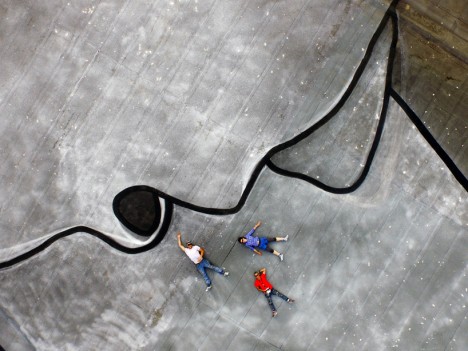
Entitled ‘Lilith and Olaf,’ the mural depicts a girl lying on her side with the figure of a crowned man by her side, representing King Olaf I of Norway, who ruled the nation from 995-1000 and was born just a few meters away from the site. Her red toenails and the king figurine are the only spots of color in the scene, unless you count the three living people that can be seen near her mouth in the photos.

world's larest mural 3

world's largest mural 2

world's largest mural 7

Though it was created for the festival, most attendees will never see it, as it can only be viewed from above. This might seem limiting, but thanks to the building’ location adjacent to the Sola airport, thousands of people traveling to and from the area can glimpse it from their airplane windows.

Share on Facebook


[ By Steph in Art & Street Art & Graffiti. ]

[ WebUrbanist | Archives | Galleries | Privacy | TOS ]


WebUrbanist

 
Comments Off on Rooftop View: World’s Largest Mural Takes Up Entire Building

Posted in Creativity


Ricoh Theta S boosts resolution, introduces Google Street View integration

03 Sep

Ricoh has unveiled the latest version of its 360-degree camera, the Theta S. Thanks to two 12MP 1/2.3″ sensors, the S is capable of 14MP 360-degree still image capture, up from the previous model’s 6MP images. Brighter lenses, 1080/30p video and integration with Google’s new Street View app are all onboard. Read more

Articles: Digital Photography Review (dpreview.com)

 
Comments Off on Ricoh Theta S boosts resolution, introduces Google Street View integration

Posted in Uncategorized


Parallax View: Apple patent hints at 3D effect in photos

22 Aug

Patent spotting site Patentlyaple has discovered an Apple patent application titled “Parallax Depth Rendering” which describes a methodology for rendering images and video that, when viewed on a standard 2D display, give the impression of showing a 3D view. Click through for more details

Articles: Digital Photography Review (dpreview.com)

 
Comments Off on Parallax View: Apple patent hints at 3D effect in photos

Posted in Uncategorized


Blog View

12 Aug
Formerly a traditional blog, Strobist is now organized as a knowledge bank with occasional content updates. For those who prefer the traditional, last-in first-out blog format, this is the place to see the most recent entries. (Or, switch back to the Knowledge Bank view.)

Please note that some housekeeping posts are omitted from this view. As always, you can search by month and year on the Monthly Archives drop-down on the sidebar at right.

__________

QA | Shooting Events Without TTL Flash

Reader Christopher Wharton has a flash-camera combo that will not work in TTL mode, so how he can shoot run-and-gun events?
Long forgotten in the age of TTL, this post explains hot to use your flash’s “automatic” mode.

Read full post

Kinda Genius: The LP742 LightSwitch

See that? That’s the high water mark to date for my dual-purpose creativity with a speedlight case. Being padded, I use it as a thermos for my station-purchased beverage when home-bound from New York City on the train.

(Works totally ace, BTW.)

But that bar just got seriously upped today by the LumoPro LP742 “LightSwitch” speedlight case.

Read full post

On Assignment: The Light You Don’t See

This photo is 100% flash, 0% ambient. But it almost looks like the reverse. And for this portrait of soprano Robin Steitz, a timeless available-light look was what we were going for.

But when you are working with flash (a single speedlight) and controlling your light (a scrounged “fill blanket” from the couch) you can keep the best of both worlds of strobe and ambient.

Read full post

GPP PopUP Seattle: What to Expect

Several folks have asked for more specifics on the Seattle GPP Pop-Up. So here’s the long version.

Read full post

On the Road? Backup Without the Bulk-Up

I seldom review gadgets these days, but sometimes something is so useful that it’s worth telling people about. Such is the case with the SD card-enabled Western Digital My Passport Wireless hard drive.

Read full post

Your Basic Lighting Kit: A Spin Around the Block

So the UPS guy just dropped your very first lighting kit at your front door. WHAT DO YOU DO NOW?

Read full post

On Assignment: I Got Rhythm

A cool little trick that forever changed the way I photograph dancers.

Read full post

On Assignment: Lighting Like Leo

In which we travel to London to serve as a lighting tech for a documentary. Our goal? Lighting for a photographic reproduction of the Mona Lisa.

Read full post

Inspiration: Atbin Eslami’s Video Bio

Such a simple idea, and not so difficult to do—unless you count all of the self-inspection it will require. Iranian-born (now in Dubai) photographer Atbin Eslami’s video-bio of herself first made me think, “that’s really cool.”

And second, “Why haven’t I done that?”

Read full post

On Assignment: Ben Lurye

Who needs a studio when you have a bridge abutment? Today, we’ll explore a few of its facades while making an actor’s portrait.

Read full post

On Assignment: Choosing a Tripod

Little? Big? Aluminum? Carbon fiber? New? Used?

Three legs, many choices.

Read full post

__________

For older posts, please see the Monthly Archives dropdown menu on the right sidebar.


Strobist

 
Comments Off on Blog View

Posted in Photography