RSS
 

Posts Tagged ‘Tips’

5 Tips for More Professional-Looking Food Photography

01 May

In an age where iPhones are shooting stellar images and high quality DSLRs are coming down in price, it’s becoming increasingly challenging for food photographers to make a living as professionals. As a food photographer in Seattle, I’ve noticed that many of my clients have become opinionated about what makes a good photo, and in many cases are shooting right next to me with their iPhones. I take it as a positive sign that clients, and most people with smartphones, are becoming more informed and educated about photography, but there is of course the notion that this could very soon make professional photography even more undervalued.

So, what’s a professional food photographer to do? Here are some tips to help make sure you capture quality food photography images that attest to the value of paying you, a professional, to do the job.

Tip #1: Don’t use natural lighting

Food photography tips

Natural lighting is fantastic, and I still try to use it as often as possible. However, many of my clients have realized the value of using natural lighting and tend to shoot their iPhone photos in naturally lit areas. Taking into account the quality of iPhone photos these days, it’s not unusual that their cell phone photos look pretty darn good, even compared to my DSLR shots. To make sure your photos always look unquestionably better than those taken with a cell phone, use natural lighting less and do some experimenting with strobes and off-camera flash.

Tip #2: Shoot in dark spaces

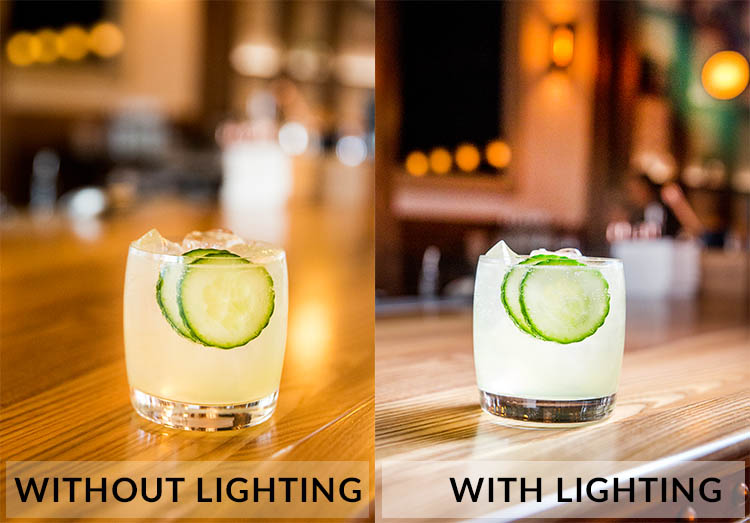
Taking tip #1 into consideration, take full advantage of your professional-grade camera’s low lighting capabilities, and/or your strobe lighting knowledge, by shooting dishes of food in spaces where iPhones have a slim chance of performing well. This is also a good opportunity to incorporate some of the unique features of the restaurant’s interior spaces, into your main shot.

Food photography tips

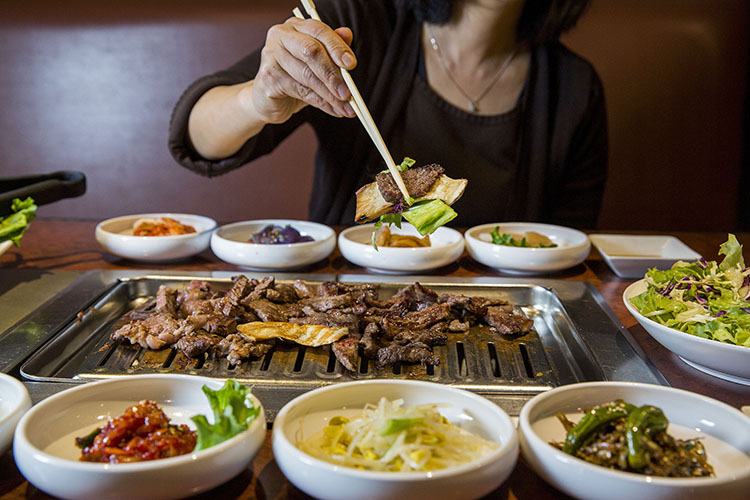
Photographed in an extremely dark space, this photo wouldn’t have been possible without a DSLR and strobe.

Tip #3: Use a macro lens

While cell phone cameras are becoming equipped with better features with every new release, many still can’t shoot quality macro photos the way that DSLRs can. Use this fact to your advantage and make a macro lens your best friend when shooting food photos. Don’t be afraid to get up close and personal, and capture the details of the dishes you’re shooting. These photos may not be exactly what your clients have in mind, but at the very least it’s always a good thing to show them an alternative perspective that reminds them why they hired you.

Food photography tips

Tip #4: Be a creative director and/or food stylist

Most amateurs approach food photos very statically, opting to shoot dishes from a seated position or overhead. Very few will get creative and incorporate people, props, or activity in their shots. This is your opportunity to shine as a food photographer. Move beyond standalone food photos and use your creativity to make a more dynamic shot. Ways to do this might be capturing action shots, adding a beverage or extra silverware in the shot, or even working with chefs to help them plate dishes in ways that will be photographically appealing. These skills are also part of the reason your client is hiring you, so don’t be afraid to exert your creative authority.

Food photography tips

Tip #5: Shoot tethered

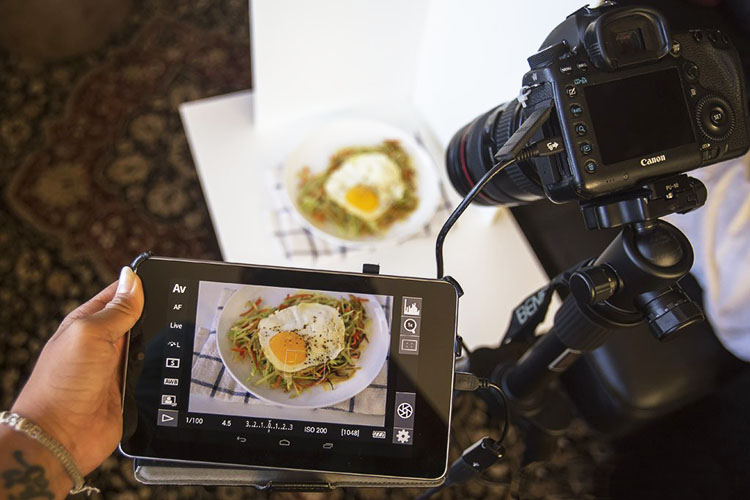
A very simple, yet highly effective, way to come off as a polished, professional photographer is to shoot tethered. If you’re unfamiliar with tethered shooting, it is basically the act of connecting your camera to a computer or tablet, which allows your clients to see your shots on a screen just seconds after you’ve pressed the shutter. This might sound intimidating, but it’s a very simple way to make sure that you and your client are on the same page throughout the photo shoot. It also invites your client to actively participate in the shoot and give you feedback and their own ideas. Tethered shooting is very easy to do using a USB cord or even Wi-Fi technology if your camera has this capability. If you have the means to shoot tethered, definitely consider offering this service to your clients.

Food photography tips

Tip #6: Transmit photos via Wi-Fi

If you have a client who is shooting alongside you with their iPhone, chances are it’s because they want access to photos for immediate posting on social media. Do yourself and your client a favor and offer to send them images on the spot using in-camera Wi-Fi, or do a few quick edits and transmit some shots directly from your computer if you’re shooting tethered. Depending on your agreement with your client, you could even charge a little extra for these services.

Over to you

Do you have other tips for offering more professional-looking food photography that outperforms iPhones and other amateur cameras? Let me know in the comments below!

googletag.cmd.push(function() {
tablet_slots.push( googletag.defineSlot( “/1005424/_dPSv4_tab-all-article-bottom_(300×250)”, [300, 250], “pb-ad-78623” ).addService( googletag.pubads() ) ); } );

googletag.cmd.push(function() {
mobile_slots.push( googletag.defineSlot( “/1005424/_dPSv4_mob-all-article-bottom_(300×250)”, [300, 250], “pb-ad-78158” ).addService( googletag.pubads() ) ); } );

The post 5 Tips for More Professional-Looking Food Photography by Suzi Pratt appeared first on Digital Photography School.


Digital Photography School

 
Comments Off on 5 Tips for More Professional-Looking Food Photography

Posted in Photography


3 Tips for Photographing Children Without Losing Your Mind

27 Apr

photographing-children-9

Photographing children is one of my favorite things to do, but at times it can also be one of the most difficult. Sometimes with kiddos, there is a very thin line between capturing memories that will last a lifetime, and capturing tears, tantrums, and meltdowns. After years of photographing nieces, nephews, friends, and my own girls, I’ve made a whole lot of mistakes. But, I’ve also picked up a few tips and tricks that help things go a little more smoothly when it comes to photographing children, that will hopefully make your life a little easier as well.

1. Choose your location thoughtfully

photographing-children-8

When photographing children, heading to a park is a no-brainer, right? Well, maybe. Parks can be really great, free resources for photographers, but it’s important to think about them through the eyes of a child as well. As a photographer, if you take a young child to a park with a playground and then attempt to have them sit still on the grass directly across from the playground for a portrait, chances are that you’re creating an scenario that may not end well. If there’s a playground in view, you’d better be prepared that the kids will want to play on it.

photographing-children-7

Sometimes, letting kids play on the playground is a great way to capture some more candid moments, and other times it is a big distraction. More and more, I find myself scheduling sessions at hiking trail heads, covered bridges, and open fields, which still allow for plenty of room to run and play, but in a location that provides fewer distractions. In addition, I find these sorts of locations to be more aesthetically pleasing for capturing those candid moments, than playgrounds often are.

2. Find ways to make them laugh

photographing-children-6

Anyone who has photographed kids knows that most kids have a fake smile, that makes an appearance any time someone asks them to smile. That fake smile is fine, and may be unavoidable to some extent, but it is always better to get a real smile or laugh whenever possible. There are so many ways to do this, but I’ll share just a couple that I’ve found to be effective with lots of different children.

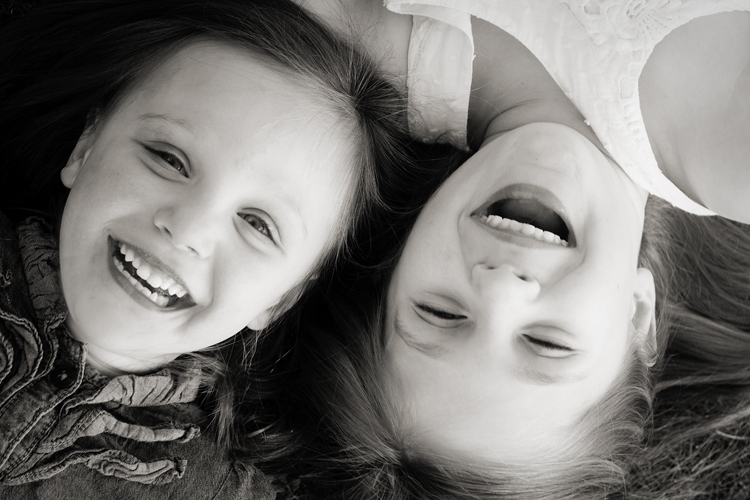
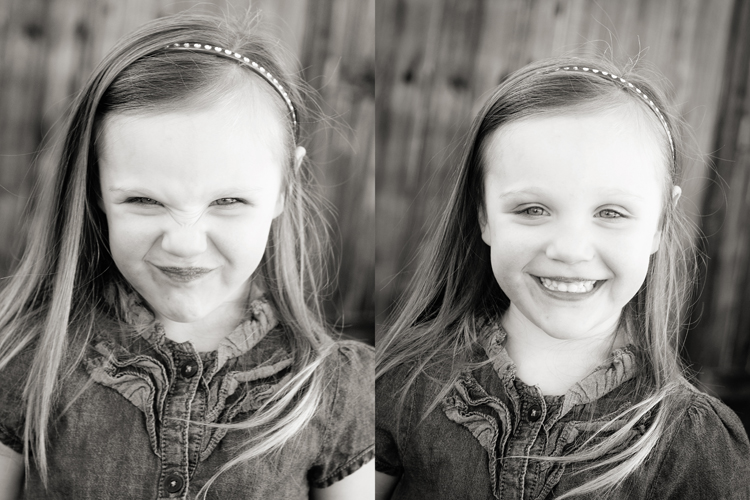
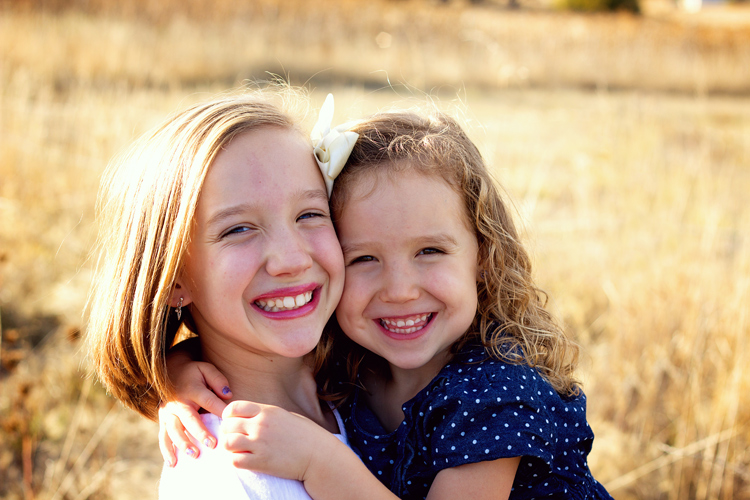
The first is simply to ask them to show you a variety of different faces. It’s fun to capture the silly faces that they make, but the point is really to capture their genuine smiles and laughs at your reaction to their silly faces. In the photo above, I asked my daughter if she would show me her angry face (left), and while I absolutely love that photo, and think it actually captures her slightly mischievous personality very well, my goal was really the more natural smile (right) that came after my laughter and exclamations that her angry face was absolutely terrifying.

In my experience, most kids think it’s hilarious to run through a whole string of different faces: angry, silly, dinosaur face, prince/princess face, hungry face, tired face, surprised face, and happy face all tend to be fun, and often result in lots of genuine smiles and laughs.

photographing-children-3

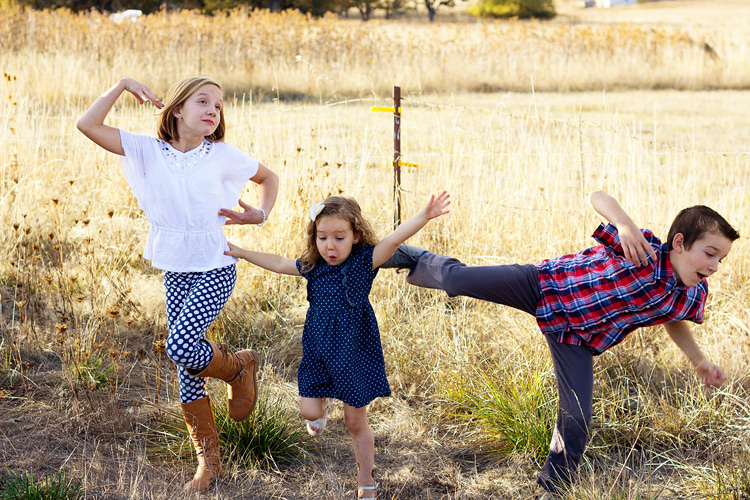
Another thing that seems to work well for most kids is to simply ask them to give you a funny pose. Be ready, because you may get anything from a stuck out tongue, to much more hysterical shenanigans. I truly never know what to expect, but always be ready to capture whatever it is. I often include a few of the most silly photos in the final images, because even if they aren’t 100% perfect or they don’t fit my normal aesthetic, they just plain make everyone happy, and I think there’s value in that. There’s also a practical value during the session as well, in that once again, being silly results in genuine smiles and laughs. Time and time again, my favorite images in a session are often the ones that come directly after the silliest images.

photographing-children-4

3. Be sensitive, and keep a sense of humor

My oldest daughter once cried for a half an hour because I made blackberry cobbler for breakfast, and she wanted toast instead. My youngest daughter laid on the floor, cried real tears, and screamed that I was ruining her whole life because I asked her to put on her shoes this morning. Moments like those are rarely funny at the time, but sometimes an hour or a day later, you find yourself laughing at the absurdity of the situation.

photographing-children-2

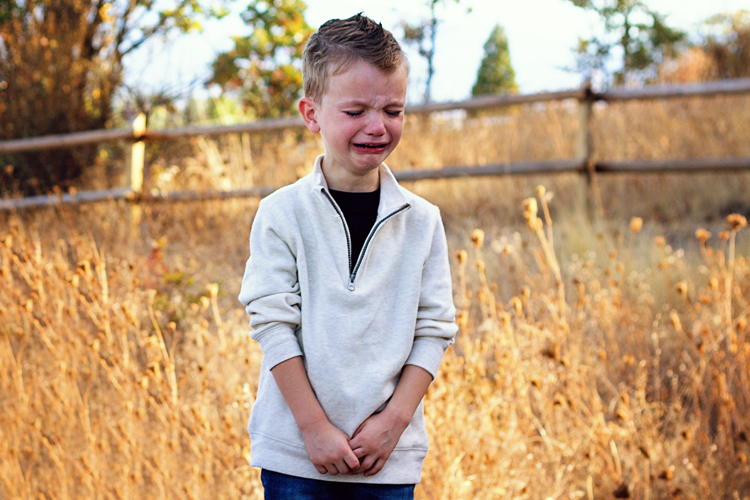
When it comes to kids, the reality is that even if you’ve been thoughtful about the timing and location of a session, sometimes meltdowns happen for no identifiable reason, and come from out of nowhere (sometimes they even happen mid-photo, as above). Photo sessions can be kind of stressful, and feel really high pressure for both kids and their parents. Sometimes with a little humor, distraction, or quick change of plans, everyone can get through a tantrum or minor meltdown just fine, and you’ll all laugh about it years later.  Sometimes, it’s more than that, and a child may be having a meltdown because of sensory issues that you are unaware of, or because they’ve been battling a cold or they’re teething and they just don’t feel good.

Regardless of the reason, sometimes it’s clear that the kiddo is genuinely upset, and isn’t going to calm down any time soon. If a child is genuinely upset, don’t force things. If it’s possible, offering to try again on a different day can be a really meaningful good-will gesture. After all, a parent saying, “Stop crying and smile” rarely (if ever) results in those genuine smiles that we so desperately try to achieve as photographers. It’s a fine line to walk sometimes, between being sensitive to the really legitimate feelings that kids may be having, and to also recognize that sometimes kids cry and get hysterical about really silly things, and then get over them equally as fast.  If things go south, just do your best to be sensitive, while also keeping a sense of humor about things. Life is messy sometimes.

photographing-children-5

Do you have any other tips that make photographing children just a little bit easier? Please share in the comments below, and I’d love to see your kid photos too.

People photography week

This week on dPS we’re featuring articles all about different kinds of people photography including portrait, event and travel photography. See all the previous ones below, and watch for more people photography articles over the next few days.

  • How to Take Low Key Head-shots
  • How to Do a One Light Portrait Setup and Use it as Your Back-up Plan
  • Travel People Photography – Tips and Pitfalls
  • 8 Tips for Photographing Men
  • 24 Diverse Images That Showcase People Photography
  • Weekly Photography Challenge – People Photography
  • Tips for Getting Yourself to Relax as a Photographer and Have More Successful Portrait Sessions
  • 5 Good Reasons to Add People into Your Landscape Photography
  • 6 Must-Have People Shots to Capture When Photographing Corporate Events
  • 4 Tips to Help You Get Started Doing Lifestyle Photography

googletag.cmd.push(function() {
tablet_slots.push( googletag.defineSlot( “/1005424/_dPSv4_tab-all-article-bottom_(300×250)”, [300, 250], “pb-ad-78623” ).addService( googletag.pubads() ) ); } );

googletag.cmd.push(function() {
mobile_slots.push( googletag.defineSlot( “/1005424/_dPSv4_mob-all-article-bottom_(300×250)”, [300, 250], “pb-ad-78158” ).addService( googletag.pubads() ) ); } );

The post 3 Tips for Photographing Children Without Losing Your Mind by Meredith Clark appeared first on Digital Photography School.


Digital Photography School

 
Comments Off on 3 Tips for Photographing Children Without Losing Your Mind

Posted in Photography


4 Tips to Help You Get Started Doing Lifestyle Photography

27 Apr

135

People are my favorite subject to photograph, and one of my favorite ways to capture them is through lifestyle photography. I love documenting a day in the life of a family, student, or child. I love making beautiful photos out of real life happenings; the everyday stuff that we forget to treasure. Some moments are perfect and gorgeous, and other moments are more ordinary, and sometimes even unattractive; but I love every one of those moments, and I find joy in looking for the beauty in everything.

If you would like to get started with lifestyle portraiture, maybe these tips and photos will inspire you to jump right in. These photos are from a day in the life session with a sweet family. I wanted to document what a normal, ordinary day is like for them, and give them photos that they would treasure forever. We had a lot of fun together, and not only do they love the photos, but I ended up being inspired by them as I spent a little time getting to know who they are.

1 – Set yourself up for success

160

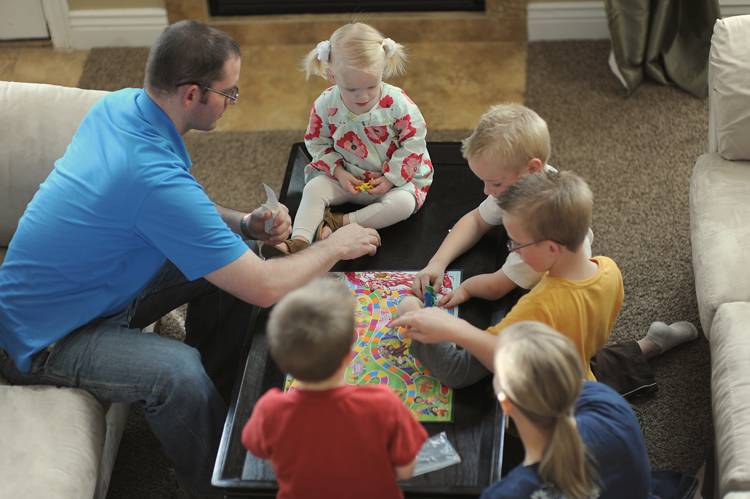
If you decide to do a lifestyle session and just show up without a plan, you may get exactly what you planned for – nothing. I asked the B family to tell me some of the things they enjoy doing together as a group, and we chose some that would photograph well, and represent their life right now.

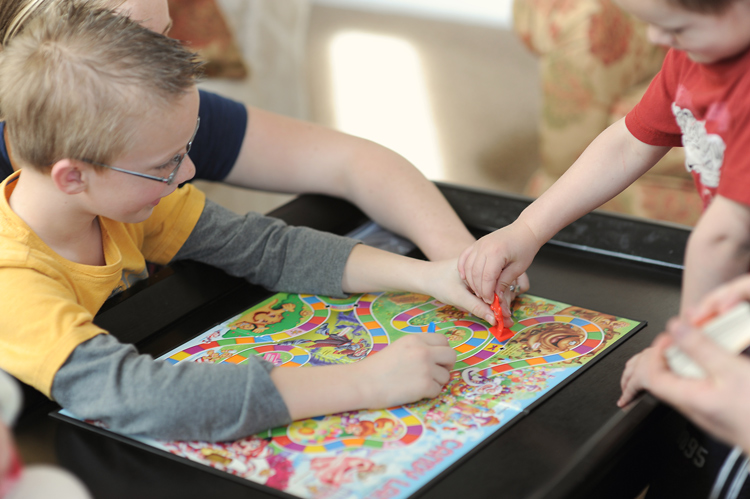
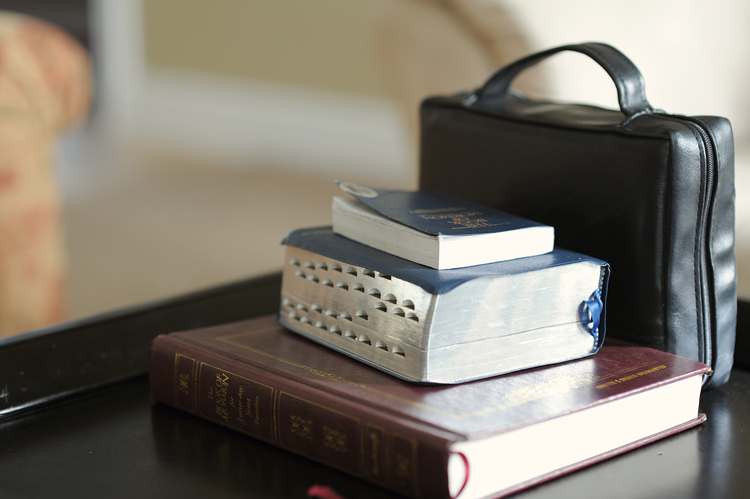
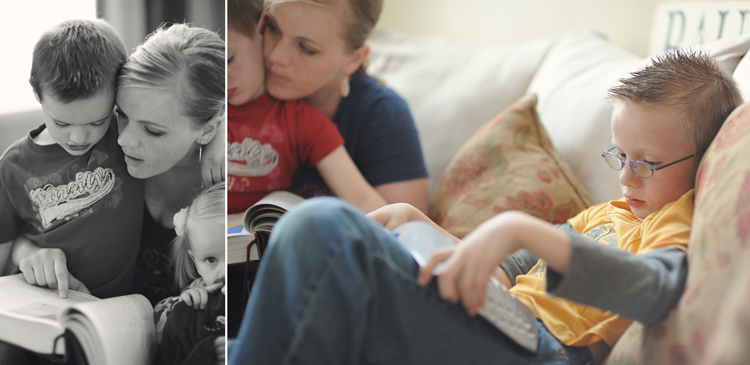
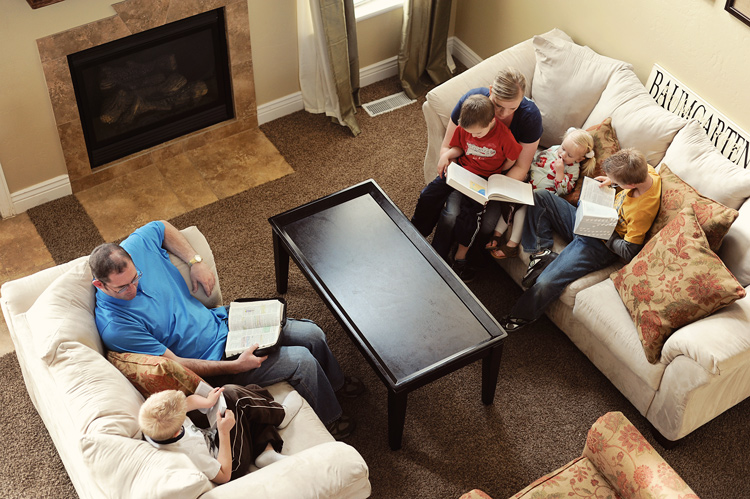
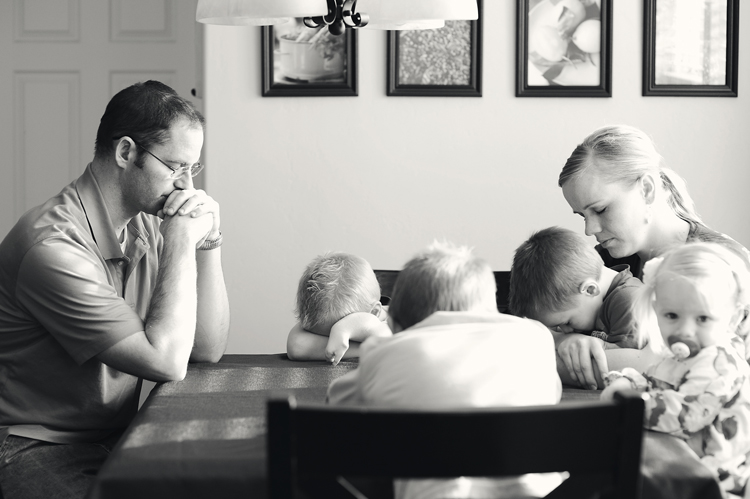
We took photographs of snack time, with kids helping prepare and eat the peanut butter and apples. We took a few photographs of them jumping on the trampoline, and then we came inside while they played games together. We ended the session with something that they do every single day, and is a huge part of the fabric of their family. They read scriptures together, and prayed as a family. It was important to me to capture the essence of their family, so we planned, ahead of time, the things that would best show who they are.

There are so many scenarios that could be planned and prepared. Families are fun, because there is a lot of interaction. You could have them bake cookies together, or go for a picnic in the park. A family hike might be the perfect thing to photograph if they love the outdoors. It’s so much fun to do sessions on the lake with the family’s boat, or at home with their pets.

168

Although families are fun, they’re definitely not the only group of people who lifestyle photography lends itself to. A group of tweens painting fingernails together, or some kids playing a game of basketball could make great lifestyle sessions. A day in the life of a college student, or a documentary style session with an elementary school teacher could also be amazing. People are involved in so many great things, whether it be their hobbies, work, or recreation. It’s a wonderful experience to capture them in action, doing the things that they love.

As long as you don’t get too attached to it, it can be helpful to create a shot list. This could be a list of all the photos that you are hoping to capture during your session together. If all the things on your list don’t happen, don’t fret about it, but it can give you some ideas to get going.

2 – Be ready for the unexpected

180Now that you’ve planned and prepared, and set yourself up for success, loosen up and go with the flow. If you try to manage every moment, or even direct too much, you lose the realness of a lifestyle session. Things just happen during your time together, and sometimes those things are what make your most memorable photos.

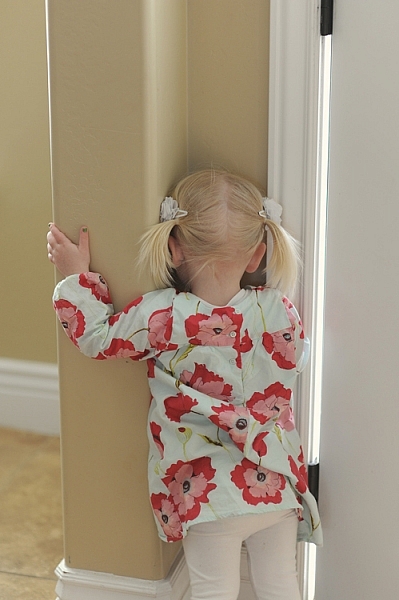
In the photo to the right, the little one got quite upset over something that happened in the game, and she knew right where she had to go, and exactly what she had to do; standing with her nose in the corner was the standard procedure in her family. Although it wasn’t her finest moment, and she probably wasn’t enjoying it very much, I’m pretty sure this photo will be one that she will love when she grows up, and her parents will cherish forever.

These moments are the ones that aren’t on your shot list, because you can’t foresee them happening, but you need to be ready to capture them and include them as part of the story you are telling. You may even have days where you don’t capture one thing that you had planned, and nothing on your shot list is even available to shoot. If that happens, just go with it, and know that you may create something even better than you could have planned. If you have a calm mindset, knowing that you are prepared, but you are ready to roll with the punches, you’ll be just fine.

3 – Capture the story details

181

Some of your photos may not even have your human subjects in them. A lot of your photos might not show any faces or expressions. These detail shots can create interest in the group of photos chosen to represent their story, and tell the story even more deeply than if all the photos were of their faces.

For each scene you are photographing, you might consider taking the “big picture” with lots of the surroundings, and all of the participants visible in the photo. This will provide context, and help your viewer understand the setting, and exactly what is going on. Then you might want to break it down a little further, showing a close up of one or two of the people, or a close up of their hands, or the activity. You could then break it down even further, and take detail shots of what is going on, and the objects that are part of your subject’s story.

100

As you break down these little details, you’ll enrich your story by showing emotions, interactions, and the things that are most important to your subject. Be careful not to get too sidetracked. If you start photographing anything and everything that is in the room, your story becomes muddied, and it won’t be clear what you are trying to portray. Have a clear vision of the story you are telling, and keep that focus as you shoot.

4 – Consider different perspectives

200

Be creative as you figure out how to best tell the story you are trying to portray. Perspective is a great way to add interest to your photos, and show a unique point of view. There are two different types of perspective to consider.

Your perspective

Where are you located when you are taking the photograph? Try shooting from above, or below. Try shooting from behind curtains, or stair railings. Sometimes having something in the foreground makes the viewer feel like they are really seeing into the heart of someone’s life, and seeing something they wouldn’t normally see. Move closer, move back, move around. Be creative.

Their perspective

How does your subject view this activity? What might the little girl be feeling? How could you portray that in a photograph? What does the mother see when she looks at her family? Can you capture her feelings and perspective? When you are creating lifestyle portraits, your vision will definitely be part of the process, but trying to capture your subject’s perspective can add a whole new dimension to your photographs.

196

One of the best things about lifestyle portraiture is that there really are no rules. This opens up so much more room for fun and creativity, and takes a lot of stress off of you as a photographer. Have fun with it, and get you and your camera out there to tell a really great story. I’d love to see your lifestyle photographs in the comments below!

People photography week

This week on dPS we’re featuring articles all about different kinds of people photography including portrait, event and travel photography. See all the previous ones below, and watch for more people photography articles over the next few days.

  • How to Take Low Key Head-shots
  • How to Do a One Light Portrait Setup and Use it as Your Back-up Plan
  • Travel People Photography – Tips and Pitfalls
  • 8 Tips for Photographing Men
  • 24 Diverse Images That Showcase People Photography
  • Weekly Photography Challenge – People Photography
  • Tips for Getting Yourself to Relax as a Photographer and Have More Successful Portrait Sessions
  • 5 Good Reasons to Add People into Your Landscape Photography
  • 6 Must-Have People Shots to Capture When Photographing Corporate Events

googletag.cmd.push(function() {
tablet_slots.push( googletag.defineSlot( “/1005424/_dPSv4_tab-all-article-bottom_(300×250)”, [300, 250], “pb-ad-78623” ).addService( googletag.pubads() ) ); } );

googletag.cmd.push(function() {
mobile_slots.push( googletag.defineSlot( “/1005424/_dPSv4_mob-all-article-bottom_(300×250)”, [300, 250], “pb-ad-78158” ).addService( googletag.pubads() ) ); } );

The post 4 Tips to Help You Get Started Doing Lifestyle Photography by Melinda Smith appeared first on Digital Photography School.


Digital Photography School

 
Comments Off on 4 Tips to Help You Get Started Doing Lifestyle Photography

Posted in Photography


Tips for Getting Yourself to Relax as a Photographer and Have More Successful Portrait Sessions

24 Apr

When I first got started in photography I thought I had things all figured out regarding cameras, lenses, exposure, and even some post-processing. However, the first time I greeted a client on location for an actual photo shoot, I realized just how clueless and ill-prepared I really was, and found myself nervous to the point of almost being nonfunctional. I was so uptight and anxious about the whole photo session, that I’m still not sure how I managed to get any good pictures, but thankfully things have gotten much better in the subsequent years.

Even though I have greatly expanded my knowledge and experience, I still get a little nervous when meeting with clients. I have found several tips that work well to calm the butterflies in my stomach and help make for much more enjoyable and productive portrait sessions, both for me and my clients. I’m going to share them with you.

relaxing-for-portrait-session-couple-farm

Even after doing this type of work for years, I can still get nervous going into a photo session.

The Three Phases of Portrait Anxiety

While this triad of temporal distinctions is entirely nonscientific in nature, I have found that my stress and anxiety regarding a given portrait session generally can be divided into three discrete phases:

  • Phase 1 – The days or weeks leading up to a photo session. This lasts the longest, but thankfully doesn’t require impromptu decisions and instead gives you time to be thoughtful, analytical, and reflective. The downside is it lasts the longest! This unfortunately means you have way too much time to over-think and over-analyze everything.
  • Phase 2 – The short time before you start the session. This is usually five or ten minutes, interacting with the client at the session but before you start taking pictures. This period is brief but critical, as it can set the tone for the entire photo session and if you’re not properly relaxed things can go downhill quickly.
  • Phase 3 – The photo photo session itself, which usually lasts about an hour, unless you are doing a wedding or other type of protracted engagement. Things can get very tricky here, but if you have taken the time to properly relax during Phases 1 and 2 you will probably find Phase 3 to be smooth sailing.

Here are my tips for helping yourself relax, take things easy, and get mentally prepared for the photo session. While not all of these may apply to you, I do hope they are general enough to be useful to you in similar situations.

relaxing-for-portrait-session-child-looking-up

If you aren’t relaxed the kids won’t chill out either, and neither will their parents.

Phase 1: Preparing for the Session

Adele, one of the most popular singers in the world, recently told Rolling Stone that she gets stage fright. “I’m scared of audiences,” she said. “I don’t like touring. I have anxiety attacks a lot.” As a photographer this gives me some degree of comfort knowing that my nervousness leading up to a photo session is not all that different than world-famous singers and actor,s who perform in front of thousands of people every day. Even though I have done many portrait sessions, I still get nervous beforehand, but have found a few tips and tricks to help calm myself down and relax in order to clear my head and do the best job I can.

Talk to someone supportive

Whether it’s a friend, a coworker, a family member, or even a former client, spending time talking about the upcoming session is one of the best ways to clear my head and get some reassurance. For me it’s my wife, who is a solid rock and a constant reminder that I can do the job. She and I discuss my goals for the session, look at examples from other photographers, and talk about what has worked and not worked in past sessions. These conversations always help me calm down, while also giving me a big boost of confidence that goes a long way towards a successful photo session.

relaxing-for-portrait-session-baby-sister

In the days leading up to this session, my wife and I spent a long time discussing the shoot and planning things out. This did wonders to calm my nerves and helped me do a better job at the session.

Look at your own successful images

Look at your own past images as a reminder that you are fully capable of doing the job. Sometimes in the days leading up to a photo session I start to wonder if I really have what it takes to get the shots I want, but looking through my own portfolio always offers enough reassurance to bring me out of that funk and back to reality. Yes, each session has its own unique challenges, but reminding myself of what I have done before, is a great way to relax and prepare for what is about to come.

Have a plan

Have a plan for the session and make a list of poses and shots you want to get. It can be a mental list, but a physical list will help you be sure to get everything you want, and will allow your clients see that you are prepared if you cross items off it during the shoot. One of the last things you want is to get back to your computer and realize you forgot to get a shot of grandma holding her new grandbaby, the happy couple underneath their special tree, or little Timmy in his special new cowboy boots that his mother emailed you about the day before. Making a list will help you avoid this scenario while also helping you to de-stress before the session.

relaxing-for-portrait-session-couple-downtown

This couple sent me a few ideas for different shots, and since the location was 60 miles away I used Google Maps Street View to investigate things beforehand.

Scout the location ahead of time

Visit the location to make sure you know what it’s like, and how you can use it to frame your shots. Ideally this would be at the same time of day as your photo session, so you can make sure you know what the lighting will look like on the day of the shoot. This will help you see all sorts of things you might miss if you just show up the day of the session, and it will make you look like a confident professional as you direct your clients.

Know your gear

Know your gear inside and out. It sounds silly but you don’t want to freeze up in the middle of a session because you can’t find the menu that lets you change white balance, or you forgot which dial changes the shutter speed. If you find that you need a quick refresher re-read the manual, watch online tutorials, or just spend 15 minutes poring through the menus and buttons. When it comes time to do the photo session, you can rest assured that these planning efforts will have been put to good use.

You don't want to scramble trying to locate menu options and camera buttons. Make sure you know your gear beforehand so you can focus on your clients when you're on the job.

You don’t want to scramble trying to locate menu options and camera buttons. Make sure you know your gear beforehand, so you can focus on your clients when you’re on the job.

Practice with test subjects

If you’re going to do a newborn session, practice with stuffed animals. If you’re on location, get a friend or family member to go out with you a week beforehand and do some test shots, so there are as few surprises as possible when you go out there with the client.

Make a gear packing list

Make a list of all the gear you need and check it off one-by-one as you pack up for the session. You don’t want to get to the location and realize you forgot something at home, or left a battery on the charger. I once did an outdoor shoot and realized all too late that I forgot my lens hoods, and almost immediately started hyperventilating into my camera bag when the clients asked for some shots with the sun behind them, just out of the frame. Things ended up working out, but a simple list would have prevented a great deal of stress during the shoot.

Phase 2: On your mark, get set…

relaxing-for-portrait-session-couple-barn

Chatting with this couple as I set up my gear helped put everyone at ease, including myself.

One of the weirdest parts about a portrait session can be the few minutes when you are visiting with the client before you start actually taking pictures. What do you do? What do you talk about? How do you strike a balance between friendly and professional? It’s enough to send even the most seasoned photographer’s blood pressure to the top of the charts, and messing up this brief pre-session period can send the rest of the gig into a tail spin.

In my experience one of the best ways to help you and the client relax is to go on the offence instead of playing defence. Don’t stand around waiting for people to talk to you, as they are probably feeling just as awkward, and are likely waiting for you, the person in charge, to take the lead. Even if smalltalk is not your forté, you need to be willing to strike up a conversation and have a few things ready to talk about as you are getting set up. In a nutshell, make this time all about the client, and helping them feel comfortable.

As you are getting ready to start taking pictures talk to your clients about their life outside of the photo session, and find out what hobbies they have, what they like doing in their spare time, or even what they are doing over the coming weekend. Ask questions to show you are interested, and use this time to also run some ideas past the client in terms of what you will be doing. This helps build a sense of rapport and respect, and can go a long way towards putting everyone at ease. Your clients might be just as nervous as you, but getting the chance to get to know each other will help put everyone at ease and also help them feel comfortable if you have lots of lighting, lenses, or other gear. If there are kids involved, bring some toys or snacks (nothing crumbly as it will get on their clothes) to win them over. At my most recent family session I gave the two-year-old a fake toy camera and asked if he could help me get some photos. This not only won him over but his parents too, and a week later, before they had even seen their photos, they were telling some friends about how much they enjoyed the picture session.

relaxing-for-portrait-session-family

A few minutes chatting sports with the grandparents and playing with the kids went a long way towards a more successful photo session.

Phase 3: Here we go!

Even though you have done everything in your power to chill out, relax, and put your mind at ease leading up to the photo session, things can still be a little nerve-wracking as you go about the process of actually taking pictures. At any moment there are a thousand decisions to be made, and trying to balance everything can be enough to make your palms sweat. My favorite trick for relaxing during a photo session is to simply make things fun. Don’t bark out orders, but instead have your clients do silly things like make faces or try just-for-fun poses. This will help you loosen up, and also give you a chance to build on the rapport you have already established at the beginning. Clients can tell if their photographer is wound up tight and needs to chill out, and if you make things more fun and lighthearted as opposed to all business, you will find yourself loosening up, relaxing, and getting much better results.

These are just a few of my favorite tips and tricks to help me calm my nerves before and during a photo session, but what about you? How do you approach your portrait sessions and what do you do to help yourself relax? Share your thoughts in the comments section below!

People photography week

This week on dPS we’re featuring articles all about different kinds of people photography including portrait, event and travel photography. See all the previous ones below, and watch for more people photography articles over the next few days.

  • How to Take Low Key Head-shots
  • How to Do a One Light Portrait Setup and Use it as Your Back-up Plan
  • Travel People Photography – Tips and Pitfalls
  • 8 Tips for Photographing Men
  • 24 Diverse Images That Showcase People Photography
  • Weekly Photography Challenge – People Photography

googletag.cmd.push(function() {
tablet_slots.push( googletag.defineSlot( “/1005424/_dPSv4_tab-all-article-bottom_(300×250)”, [300, 250], “pb-ad-78623” ).addService( googletag.pubads() ) ); } );

googletag.cmd.push(function() {
mobile_slots.push( googletag.defineSlot( “/1005424/_dPSv4_mob-all-article-bottom_(300×250)”, [300, 250], “pb-ad-78158” ).addService( googletag.pubads() ) ); } );

The post Tips for Getting Yourself to Relax as a Photographer and Have More Successful Portrait Sessions by Simon Ringsmuth appeared first on Digital Photography School.


Digital Photography School

 
Comments Off on Tips for Getting Yourself to Relax as a Photographer and Have More Successful Portrait Sessions

Posted in Photography


8 Tips for Photographing Men

22 Apr

When I put my hand up to write an article about photographing men, it didn’t occur to me (until I sat down in front of a blank screen) just how big a topic it actually is. While much could be written about photographing men, from lighting ratios to posing, post-processing and more, there seems to be a drastic imbalance in the amount of material devoted solely to photographing men, as compared to women.

A guide to how lighting ratios can differ for men, women and children are covered in the article Lighting Ratios to Make or Break your Portrait, and  Tips for Posing Men offers suggestions, along with Posing Guide: 21 Sample Poses to get you Started with Photographing Men.

Image showing tips for photographing men

When it comes to context, men are photographed within the genres of photojournalism, fashion, sports, travel, wedding and family photography, and corporate portraiture to name a few. My primary genre is family photography, and I also shoot corporate portraits. There is a growing demand for more relaxed professional portraits for clients to use on their LinkedIn profiles, professional Facebook pages – even online dating sites. Clients want a portrait that flatters, showcases their personality or perhaps the type of work they do, without looking too corporate. For the purpose of this article, I’ll be talking about photographing men mostly within these two contexts.

Tip #1: Include him in the consultation process

This tips sits at number one with good reason. One of the most common complaints I hear in portrait photographers’ forums is that of the reluctant father/husband – the guy who turns up to the family portrait session, looking like it’s the last place on earth he wants to be. His crankiness is infectious, and makes your job of capturing all those joyful family connections close to impossible.

I confess, it was one of my bugbears also until I realized how often I’d been leaving male partners out of the consultation process altogether. In every grumpy dad case I encountered, I had mistakenly assumed that the women I spoke to during consultation would communicate everything to their partners, and in turn, share with me any concerns their partners had.

Following a major light-bulb moment, I started to include men in the process, and it made a world of difference. Turns out, they just want to be heard. The more you engage with a man before the shoot, the more comfortable he will be when you are wielding a camera, and the better the photos you will get. This applies whether you’re photographing a paying client, the guy next door, or your brother.

Ask him if he has any features he’s sensitive about. A prominent nose, a double chin, acne scarring and a bit of a tummy are common sensitivities. Allow him to express his insecurities without feeling silly, and reassure him that you can work around these with posing, camera angles, lighting, and post-processing.

Ask him what kind of clothes he feels good in, and make sure he understands how these may work for or against him in photographs. Tread gently; if it’s a family session, there’s a good chance his partner is already on his case.

Image showing tips for photographing men

If he has made the effort to look good, do him justice in the photographs by paying attention to detail.

If he makes the effort to dress well for your photo shoot, as most men will, show him the same respect by paying attention to detail in the editing process. Zoom in close and check for stray hairs the razor may have missed, a loose thread, or a smudge left by a child’s fingers.

Tip #2: Find purpose and meaning

Following on from tip#1, find out why he wants these photos taken. If it is an individual portrait, what is he using it for? If it’s for professional use, what kind of work does he do? What kind of look does he want? If he is a passionate kite-surfing instructor, he may not appreciate your moody black and whites – he is more likely to want something full of colour and action. However, a budding author may love them.

If it’s a family shoot, ask questions about his family. It sounds like a no-brainer, but you’d be surprised how often this important step is missed. What does the family like to do together? What is special about his partner? What does he love most about his child or grandchild? Dig deep, and listen to his answers. You’ll be surprised at what he reveals.

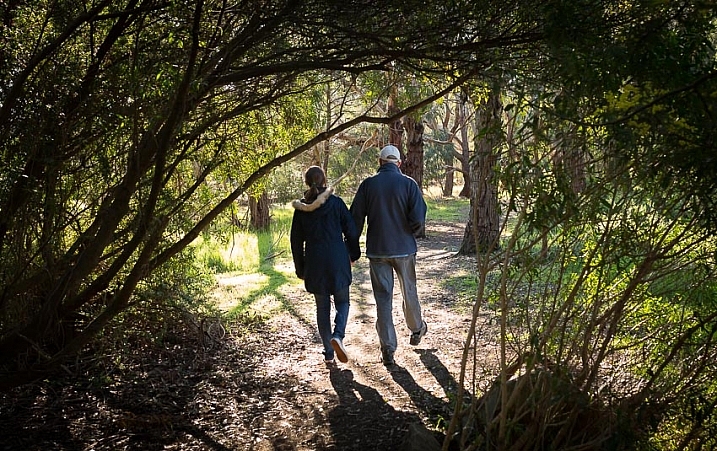
The photo below of my dad with my eldest daughter is one of my personal favourites. He told me he loves the fact that, even though she is a teenager, she still takes his hand or his arm, when they go for walks together through the forest near his home. I love how the arch of the trees frames them. To me, it suggests they are walking towards the future together.

Image showing tips for photographing men

Photograph the connections that are meaningful.

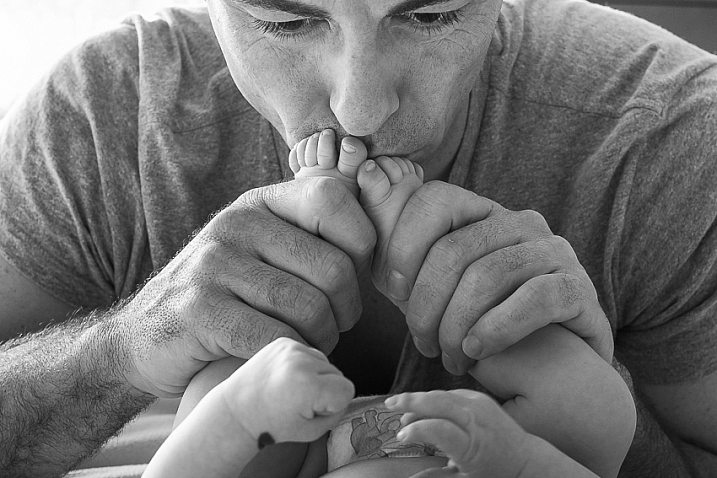
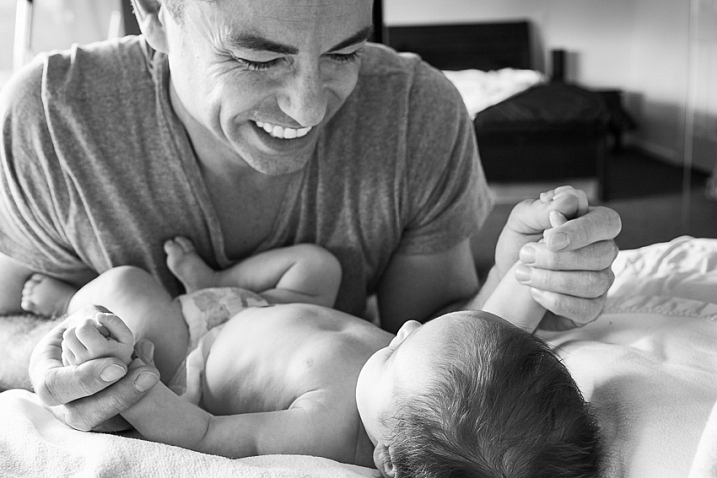
The man in the photos below told me how he marvels at the smallness of his new daughter’s hands and feet. Like many young dads, he is at a very busy stage in his professional life, securing a future for his family. Often his baby is asleep by the time he gets home at night, and so he cherishes the quiet moments they get to spend together.

Image showing tips for photographing men

Image showing tips for photographing men

Busy dads cherish those quiet moments with their little ones.

The photo below is of two male cousins. They played together as children, but have lived on separate continents since their families emigrated from their native country when they were young. Remarkable to me was how similar their gestures and body language were, despite having lived apart for most of their lives, and I wanted to capture that in a photograph. The ocean is symbolic in this photo, as it usually separates them. At this moment, they were both on the same side of it.

image showing tips for photographing men

I wanted to capture the similarity between these two cousins who have lived on separate continents most of their lives. The ocean is meaningful in this context: usually it separates them but, at the moment when this photo was taken, they were both on the same side of it.

Tip #3: Give him something to lean against or sit on

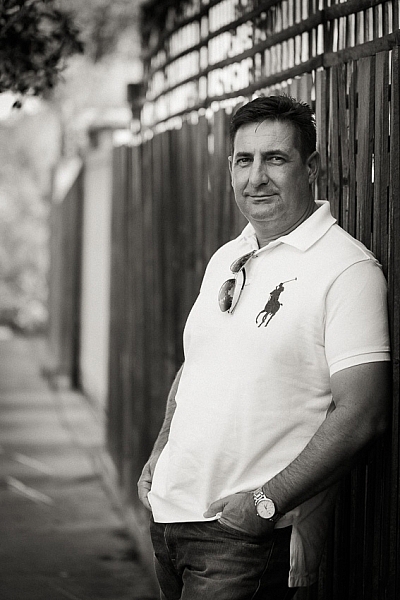
Regardless of how much prepping you’ve done, many people are profoundly uncomfortable in front of a camera, especially at the start of a shoot. If your subject feels awkward standing in front of the camera, ask him to lean against a vertical surface such as a wall, fence, lamppost, or car. It will help him feel anchored, and will allow him to angle his body without looking unnatural. If he is seated, you’ll be ready for the next tip.

Image showing tips for photographing men

Find a vertical surface for him to lean against.

Tip #4: Minimize a double chin, prominent nose, or heavy jowls

One way to minimize a double chin is to shoot from above eye level, with your subject leaning slightly forward. If he is seated, ask him to rest his forearms on his thighs, and angle his knees 45° away from you.

You can also use lighting to your advantage. Strong, directional light can visually slim a face, or a torso.

The photo below left was shot from below eye level (the subject was taller than me and was standing) and with light falling on both sides of his face. The photo on the right is more flattering. The subject is seated, leaning forward and angled away from the camera. Strong light reflected off a wall in the late afternoon casts his neck and left hand side of his face into shadow.

Image showing tips for photographing men

The use of shadow and angle in the photo on the right create a more flattering portrait.

Tip #5: If it bends, bend it

Bent arms and legs make your subject appear more natural and relaxed, and have the added advantage of making the body more compact for the sake of composition.

Tip #6: give him something to do with his hands

“What should I do with my hands?” is a question I am often asked during a session. People become suddenly self-conscious about their hands when they are facing a camera, and arms hanging straight down at the sides look awkward.

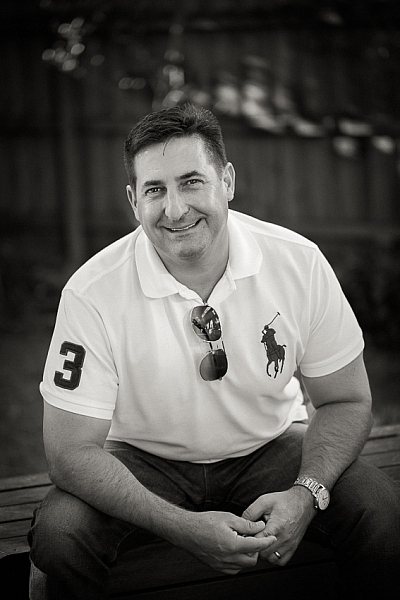
If he is standing, ask him to put one or both hands in his pocket(s), or loop his thumb over a belt. If he is sitting, he can interlink his fingers or clasp his hands together. In the case of a family photo, have him hold a baby, or a child’s hand.

Image showing tips for photographing men

Give him something to do with his hands.

Tip #7: Detail and contrast

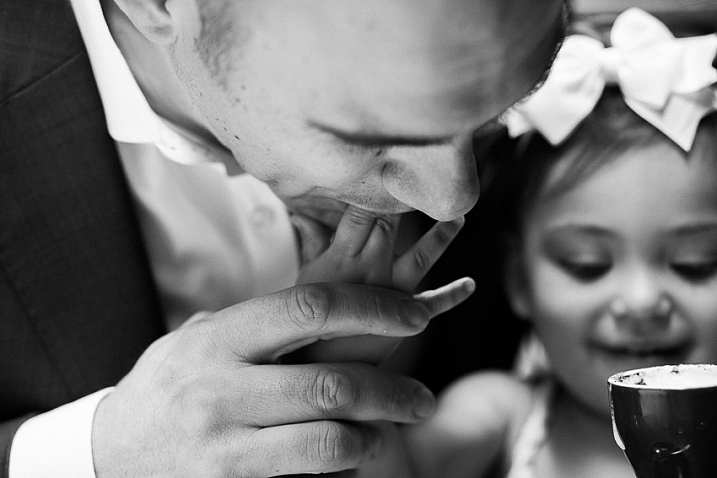
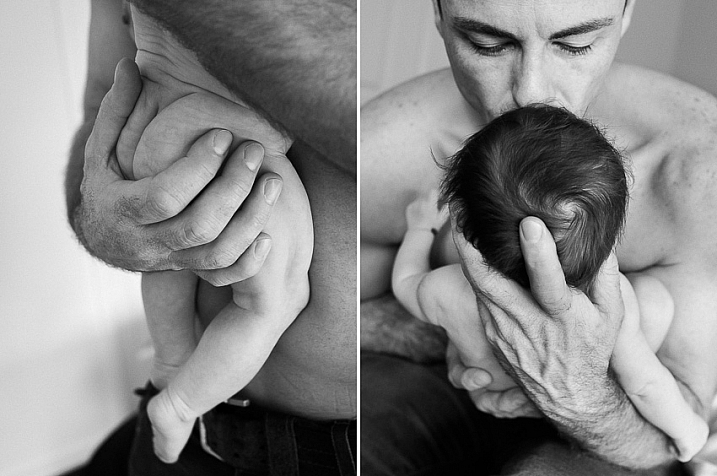
Details such as eyes, lips, and hands help tell a story, and depict the connections between people. Of all these details, hands are my favourite. Hands are a powerful expression of emotional connection and tenderness. Because of their size, men’s hands are visually striking to photograph in contrast to women’s and children’s hands.

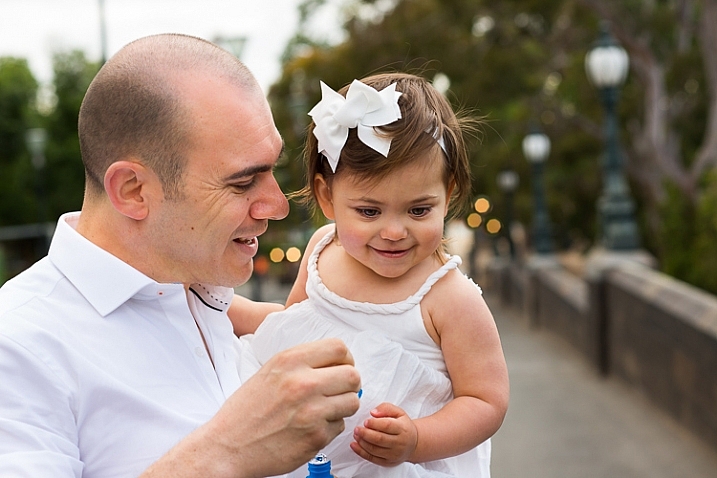
The portrait below shows a tender and playful moment between father and daughter. His hand is large and strong next to hers, and she smiles as he kisses milk froth from her fingertips.

Image showing tips for photographing men

A father playfully kisses milk froth from his daughter’s fingertips.

In the photos below of a man with his baby daughter, the size and strength of his hands contrast against the baby’s soft skin and her tiny body. They show how small and vulnerable she is, and depict tenderness and trust.

Image showing tips for photographing men

The size of the man’s hands contrast against the baby, depicting protectiveness and care.

Tip #8: Post-processing

Let’s face it, digital cameras can be brutal. They capture in minute detail all those little imperfections the naked eye doesn’t see, and hold it in a static image for the eye to gaze over.

In some styles of portraiture, this is desirable. Elderly men with craggy faces are popular subjects for travel photographers and photojournalists. However, wrinkles and blemishes are not something you want to draw attention to in family photos or professional head shots, so be kind!

Men will give you clues during the consultation and the shoot. If he cracks jokes such as, “Can you Photoshop me to make me look 10 years younger?” or, “Can you make me look like George Clooney?”, he’s probably only half-kidding. Just because he’s a man doesn’t mean he’s okay with the zit that reared its head yesterday morning, or the hair poking out of his nostril that he missed with the trimmers.

When it comes to editing, much will depend on your personal style. While I’m not a fan of heavily edited portraits, I’ll still follow my basic Lightroom workflow as explained in my article 11 Steps for Basic Portrait Editing in Lightroom. With men, I use the brush tool sparingly to soften skin. The effect should be subtle, and his skin should never appear softer than a woman’s or child’s in the same photo.

When it comes to blemishes, my rule-of-thumb is to remove any blemish that is temporary. Pimples, scratches, stray hairs – if it’s going to be gone from his face in a fortnight (two weeks for you non-Aussies), I’ll remove it from his face in the post-processing stage. I wouldn’t remove a mole or birth mark unless the client specifically asked me to do so.

image showing tips for photographing men

In this casual portrait of my father, I have removed some temporary blemishes, but the portrait retains its authenticity.

Over to you!

This article has only scratched the surface of what is a very broad subject. Tell us about your experiences photographing men. What are some of your triumphs or frustrations, your favourite tips and techniques?

People photography week

This week on dPS we’re featuring articles all about different kinds of people photography including portrait, event and travel photography. See all the previous ones below, and watch for more people photography articles over the next few days.

  • How to Take Low Key Head-shots
  • How to Do a One Light Portrait Setup and Use it as Your Back-up Plan
  • Travel People Photography – Tips and Pitfalls

googletag.cmd.push(function() {
tablet_slots.push( googletag.defineSlot( “/1005424/_dPSv4_tab-all-article-bottom_(300×250)”, [300, 250], “pb-ad-78623” ).addService( googletag.pubads() ) ); } );

googletag.cmd.push(function() {
mobile_slots.push( googletag.defineSlot( “/1005424/_dPSv4_mob-all-article-bottom_(300×250)”, [300, 250], “pb-ad-78158” ).addService( googletag.pubads() ) ); } );

The post 8 Tips for Photographing Men by Karen Quist appeared first on Digital Photography School.


Digital Photography School

 
Comments Off on 8 Tips for Photographing Men

Posted in Photography


Travel People Photography – Tips and Pitfalls

21 Apr

“Oh the people you will meet!” goes one of Dr. Seuss’ famous lines, speaking to a particular joy of travel. We don’t just travel to see new places, we travel to experience new cultures full of new people – and as photographers, we’re intrigued to take their photo.

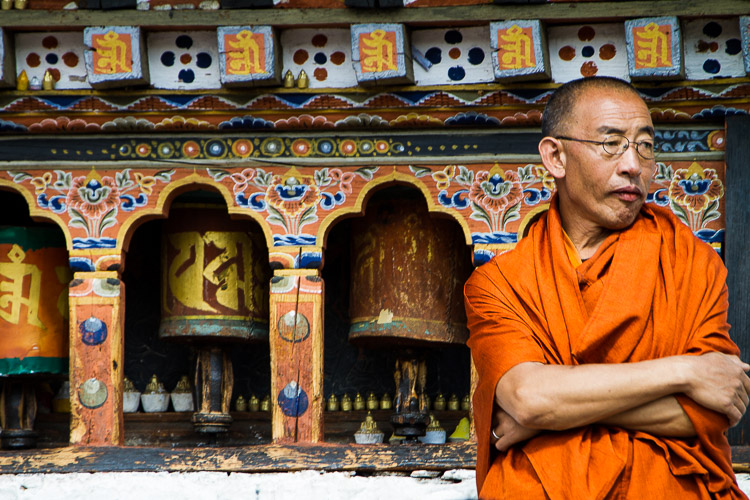
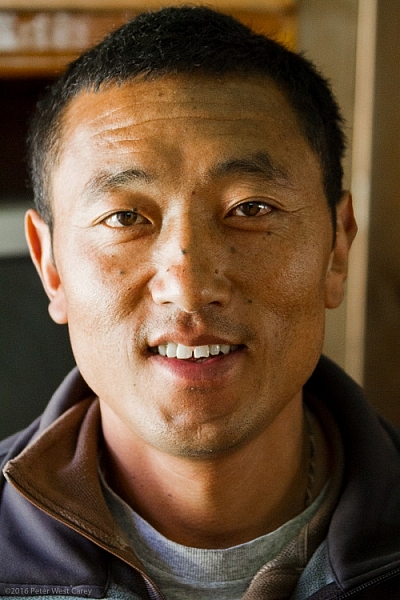
Monk, Paro, Bhutan

Yet it’s not as easy as taking photos of foreign mountains or cityscapes. because, gasp!, those people are full of life and feelings and opinions. They might be speaking a language we don’t understand. We are left wondering what they are thinking as we start to bring our camera up to our eye.

I’ve been photographing for 26 years, and traveling regularly for the last eight. I don’t know it all, but I have learned, through trial and error and research, what helps and what hinders travel portrait photography.

The Tips

Watch the light

Photography is about light. You’ve likely heard it a hundred times before. Sometimes we forget that when out of our comfort zone, but it’s important to remember that great photos need great subjects, and great use of light.

PWC-Nepal100509-093652-4565-b

Before raising your camera, know your light. Know what light will be available, and how best to use it. This article: Understanding Natural Light Part 3: Direction of Light – has a wealth of knowledge to get you thinking about the natural light at your location. Of course, you can use a flash as well, but most of us rely on natural light for our travel portraits.

Connect

Hot Button Topic: To connect before or after you take a photo? This decades-old discussion will not be settled here, but I will give my opinion as fuel to the fire.

I believe in give and take. If I’m always taking photos when I travel, I feel more the part of an interloper than a welcome guest. There are irresistible times when someone is doing something soooooo perfect, we have to have a photo, we think. Introducing ourselves will ruin the moment and break the magic we are witnessing.

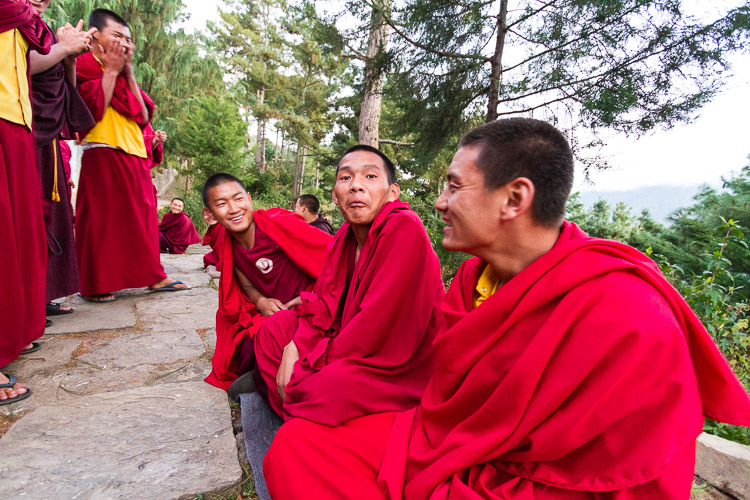
Monk Debates, Jakar, Bhutan

My advice is to take those photos, but give something back. Approach your subject after the fact and introduce yourself. Smile, make eye contact, promote goodwill, and be nice.

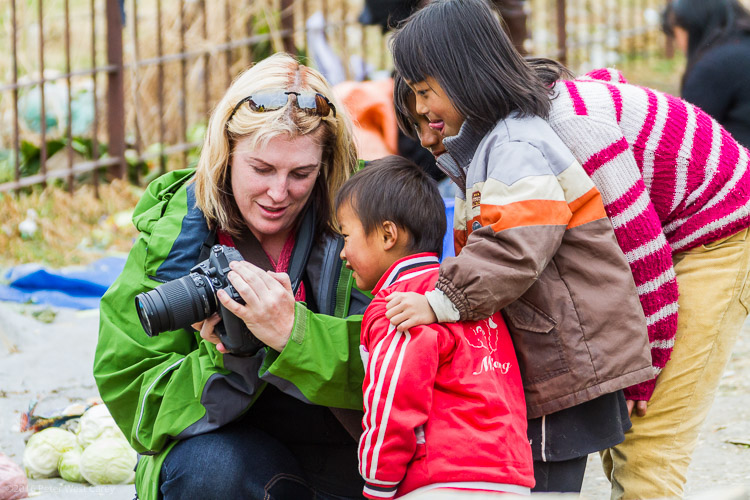
If they are a vendor, buy something they are selling, or at least take a look. Canon, Sony and others now have portable printers you can bring with you, and what better way for give and take than to hand over a printed copy of the portrait you now treasure. It’s more work than just taking photos and continuing on your way, but it is also more rewarding.

PWC-Nepal2011-1001-0530

Get their feedback

Building on the point above, show your subject their portrait. It’s part of giving back. Get their feedback on how they think they look.

You might hear good things or bad, because everyone tends to be their own worst critic. Ask their friends as well, if they are around, to know if you have captured an accurate representation of your new friend.

PWC-Bhutan2013-0317-4766

They may have an idealized portrait they want you to take. What’s the harm in taking the photo they would like and the one you like? The more interaction, the better the portrait.

To smile or not to smile

This argument goes both ways. Some photographers want all smiles, especially if they believe there are in a happy place. Others abhor a grin. What a different story Steve McCurry’s Afghan Girl photo would tell if he was playing the ham and got her to smile!

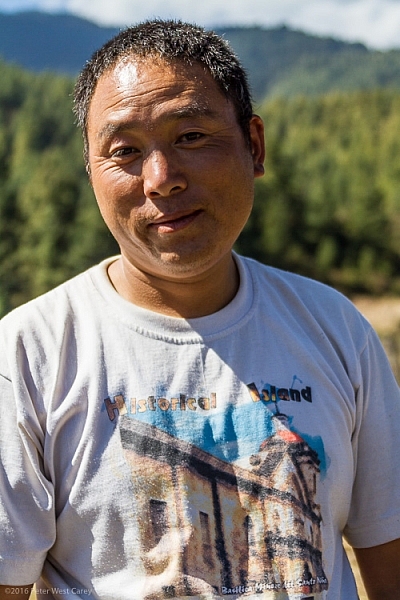
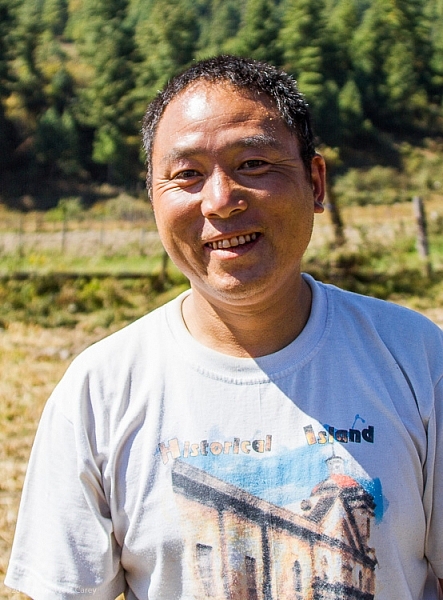
As artists, we always instill our own bias into our art, that is okay. Sometimes your subject will also instill their bias. For instance, in Bhutan I encountered mostly stern faces when I took portraits, even if the subjects were lively, happy and smiling while I talked to them for a few minutes beforehand. I didn’t feel the stoic portraits the subjects wanted to portray accurately, reflected the warmth I felt while walking the countryside. So, what to do?

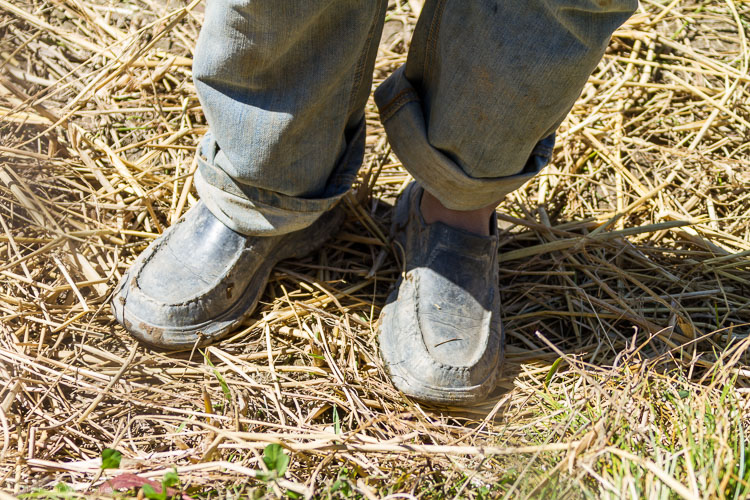
I developed a technique on that trip of taking pictures of people’s shoes. This served two purposes; I got images that tell their own story (footwear can tell you a lot about the wearer) and, in that moment when the subject was wondering why the heck is this guy taking pictures of my shoes, they let their guard down and returned to the smile I had encountered until the portrait was taken.

PWC-Bhutan2011-1024-9664

Before shoe photo

PWC-Bhutan2011-1024-9666

PWC-Bhutan2011-1024-9667

After shoe photo

My suggestion is to get to know your subject before taking their portrait. Then find a way to help that personality shine in their portrait.

Let them do their thing

To tell a better story of an individual is to put them in their environment. It helps travel portraits if there is context of the individual, in relation to the space around them.

Interact with your subject, take their posed portrait to your liking, then let them return to what they were doing. This is probably what drew you to them in the first place. Sit, observe, and be patient with your next photos.

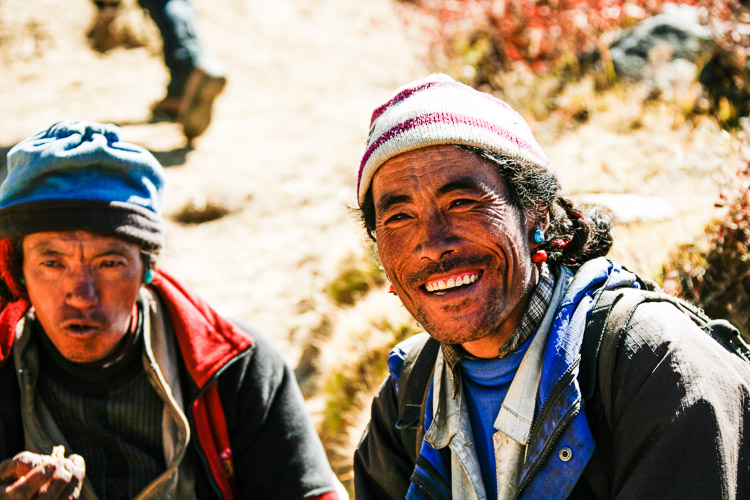
Tibetan Shepherds

They might not be classic portraits, subject’s eyes on the lens. To tell the story of the individual in the digital age is to have the ability to show more than one side, more than one image of your subject. You’re not a National Geographic photographer who will only get one image of the person in the magazine. You’re someone with a Facebook or other online account, and you can share both the portrait and the person in their element.

The Pitfalls

The Death Stare

You can probably feel the chill down your spine right now when I mention the Death Stare. Every street photographer has felt it at one point, and most every travel photographer as well.

PWC-Nepal2008-1010-3229

The Death Stare comes when someone sees your camera pointed their way, and fully disapproves of being the object of your desire. It’s important to realize the Death Stare is usually not so much about you, it’s about the situation, and empathy goes a long way to avoiding it. So does the tip above about connecting.

Recovery from the Death Stare can be hard. It chips at your confidence while you are in a foreign environment, already feeling out of place. Now you are unwelcome?

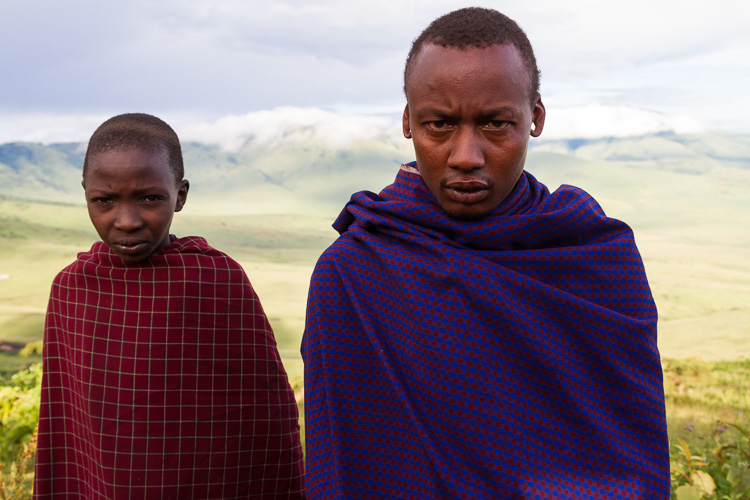
Maasi On The Rim

When I receive the Death Stare, I take a few mental steps backward, and put my camera away for just a bit – maybe 10 minutes, maybe an hour. I spend that time soaking in my surroundings and trying to connect with locals instead of capturing them.

Super posers

Kids are famous posers, but the disease travels across every age range. Some societies are more prone than others to super posing. By super posing I mean the tendency to totally ham it up for the camera. We all like to put on our best face, but the super poser makes almost a 180 degree change from what you first saw in them and wanted to photograph.

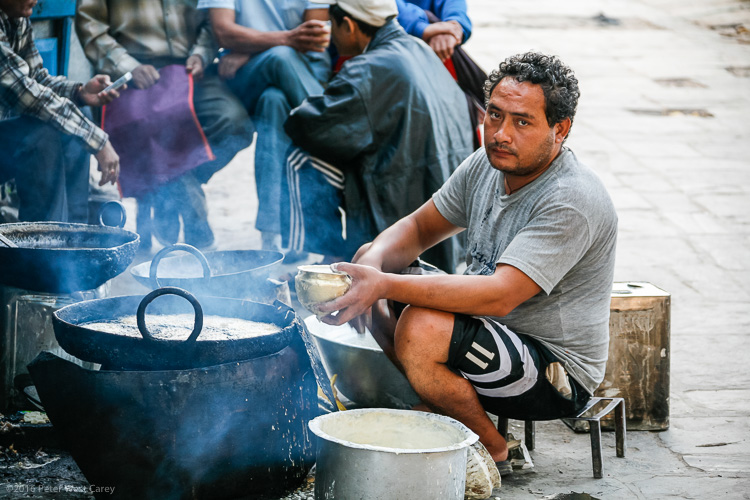
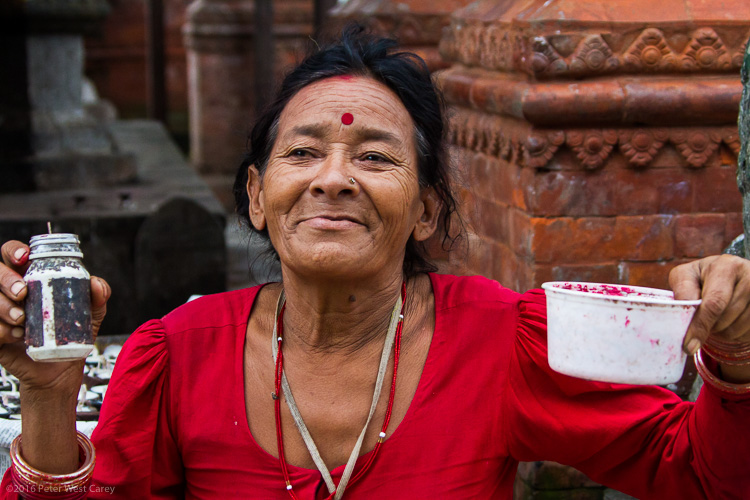
Pay Me For Paint, Kathmandu, Nepal

I have watched enough parents try to get their kids to, “smile normally, please?” and spend tens of minutes in frustration at their children being children. My suggestion with travel photos is to not fight the super poser. Accept that the moment you saw in them has passed, and move on.

Only telephoto

Afraid of the Death Stare, or an imaginary worse reaction, the telephoto-only portrait becomes the easy out. If I can shoot from 100 feet away, in obscurity, why get closer?

Because your images will lack intimacy, that’s why. I’m not saying don’t shoot with a telephoto from a distance – but don’t only shoot from a distance. If I peruse your gallery of images from Egypt and only see telephoto attempts at portraits, I’m going to feel as distant as you physically were from your subject.

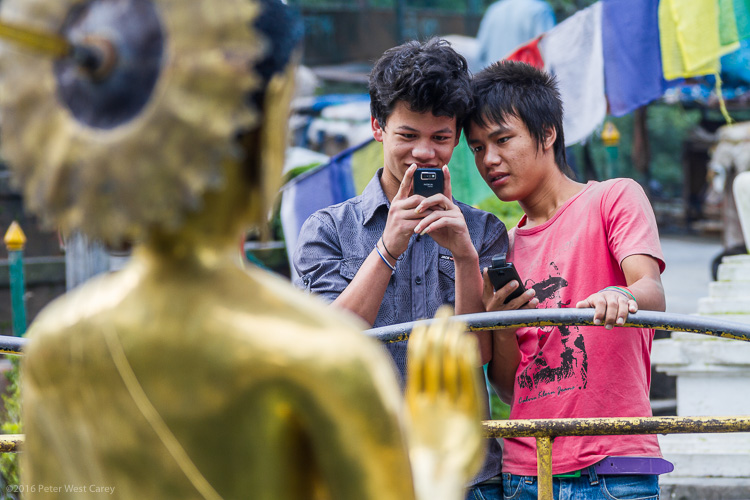
Boys photographing statue of buddha - Nepal

In my mind, connecting with strangers and only obtaining a few mostly-posed portraits is better than 100 shots from across the street. To me it says, “I traveled to this land, but didn’t really get into it.”

“Please don’t use that”

Following the advice above, you show some shots to your subject. They reply, “Oh, please don’t use any of those. I look horrible!” Now what?

If there is a chance, reshoot the images. If you must move on with your travels, I suggest you take the high road and respect the individual’s wishes. You may think they look perfect. Yet being respectful is more important than impressing your Facebook friends or Instagram followers.

This makes my original advice a bit of a double edged sword. Maybe you shouldn’t show them if there is a chance they will say no? The problem is face recognition software is getting more and more powerful, and Facebook’s (and other companies’) database is getting larger and more accurate. I live of the virtue it is better karma to error on the side of not potentially ticking people off.

Use of the photos after the fact

Ghombu

This brings up a good point about use. What are you going to do with those images?

Again, street photographers know this argument well. “You can’t take my photo!” they have had shouted at them if they have been in the game long enough. While this may be true in certain countries or situations, in most public spaces, especially in the US, you are free to photograph individuals.

What you do with the images after is the key point. Your own personal, artistic use is okay – included in a gallery on Facebook or a post on Twitter, a slideshow presentation at the local social club, or a gallery showing. Commercial use, where a model release is needed (think: ad campaigns, brochures, catalogs, stock), is not. Editorial use in a magazine or newspaper generally is okay.

DPS has some excellent resources, including our article Model Releases: What You Need To Know (with samples).

Conclusion

PWC-Tanzania100321-105740-2967

PWC-Nepal2011-0929-8494

Travel portrait photography can be a tricky world to navigate. You’re out of your comfort zone, you may not speak the language or know the customs, but you want to bring home photos of not just the pretty sites, but the interesting people, too.

Be kind. Treat people as people, not objects. Share your images and take time to connect.

Speaking of sharing, what other advice would you give those wishing to bring back travel portraits?

People photography week

This week on dPS we’re featuring articles all about different kinds of people photography including portrait, event and travel photography. See all the previous ones below, and watch for more people photography articles over the next few days.

  • How to Take Low Key Head-shots
  • How to Do a One Light Portrait Setup and Use it as Your Back-up Plan

googletag.cmd.push(function() {
tablet_slots.push( googletag.defineSlot( “/1005424/_dPSv4_tab-all-article-bottom_(300×250)”, [300, 250], “pb-ad-78623” ).addService( googletag.pubads() ) ); } );

googletag.cmd.push(function() {
mobile_slots.push( googletag.defineSlot( “/1005424/_dPSv4_mob-all-article-bottom_(300×250)”, [300, 250], “pb-ad-78158” ).addService( googletag.pubads() ) ); } );

The post Travel People Photography – Tips and Pitfalls by Peter West Carey appeared first on Digital Photography School.


Digital Photography School

 
Comments Off on Travel People Photography – Tips and Pitfalls

Posted in Photography


Tips for Processing Winter Landscapes in Lightroom

20 Apr

I see a lot of winter. The interior of Alaska, where I live, gets a solid six months, often seven, of the white stuff. Essentially anytime from October to mid-April, we are likely to have snow on the ground. Unless I put the camera down for most of the year (which I don’t), I end up with a lot of photos on my computer of snowy mountains, forest, and tundra. Come the early-spring, brown season, I have a lot of computer work to take care of.
Kelly DONE-1

Though the method of processing winter images is largely the same as many other types of outdoor images, you’ve got to approach snowy images with cold focus (insert laughter here). I jest, but actually the cold, and bright blue tones of winter, are elements that should not be forgotten (or overdone).

My Approach

When I come at an image in Lightroom, I don’t tackle it with a standard formula. Rather, I consider the time and place I made it, what the landscape looked like, and just as importantly, how it felt. Those memories play an important role in my vision for the final image.

With that in mind let’s dive into the first of the three winter images I want to walk you through my processing steps.

Brooks Range, Alaska – Early winter
Kelly 1

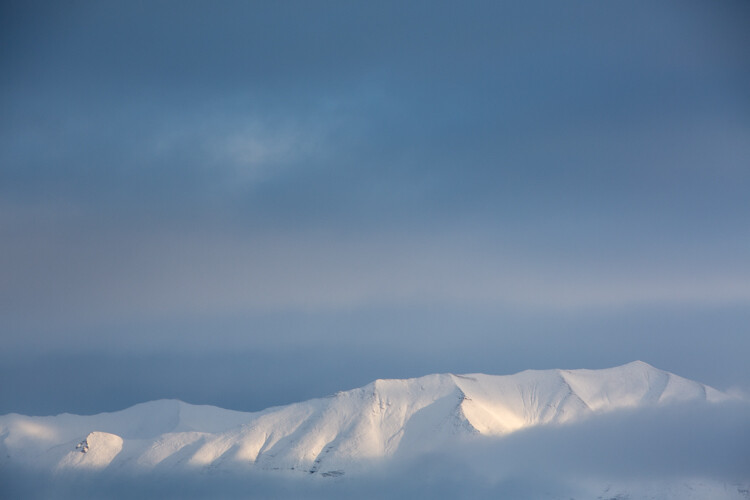
On a river trip in early September, down the remote Kelly River of the western Brooks Range, my clients and I were hit by the first snowfall of winter. It started the evening before I made this image, with a few big, wet flakes falling from the overcast sky. By the following morning, my tent, the gravel bar on which we were camped, and the entire landscape, was covered in six inches of fresh snow. The snow was tapering off, and I could see breaks in the clouds where patches of blue sky shone through. It didn’t take long before those patches were turned into beams of sunlight on the mountains. I walked down to the river with my camera, and started making images of the shifting light on the land. This shot came out of that session.

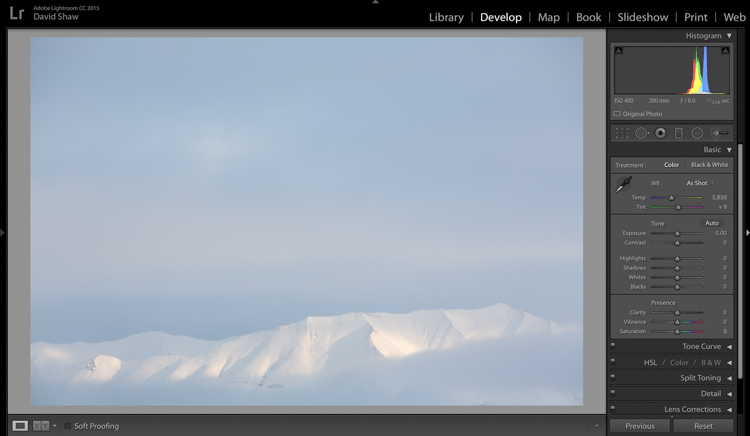
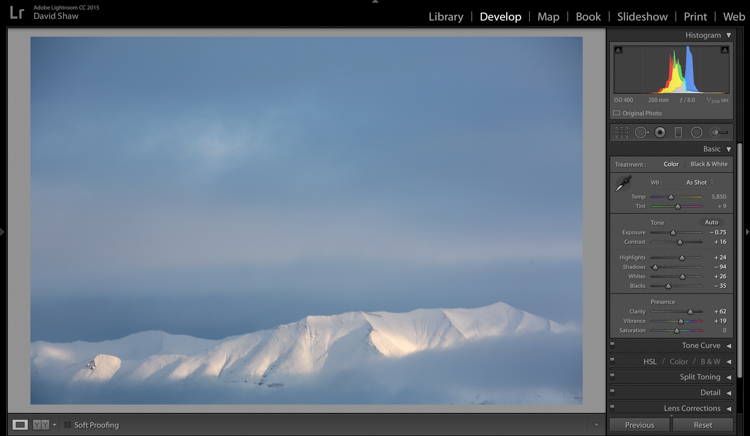
The light and color is typical of many winter images, bright, with lots of blue. Take a look at the histogram in the upper right, and you can see how it’s pushed to the right, meaning the image is on the bright side (but no blown-out highlights), exactly what I want with an out-of-camera winter shot.

Step One – White Balance

The first thing to consider is the white balance. Cloudy days tend to cause warmer tones, and snow, particularly under-exposed snow, can take on a yellowish hue. This can be off-putting, so pushing your white balance toward the blues can help provide a more pleasing, and accurate tonality. In this case, my camera selected an appropriate White Balance in the field, and didn’t need any adjustment in Lightroom. But keep this in mind when processing your own images.

Step Two – Exposure
Kelly 2

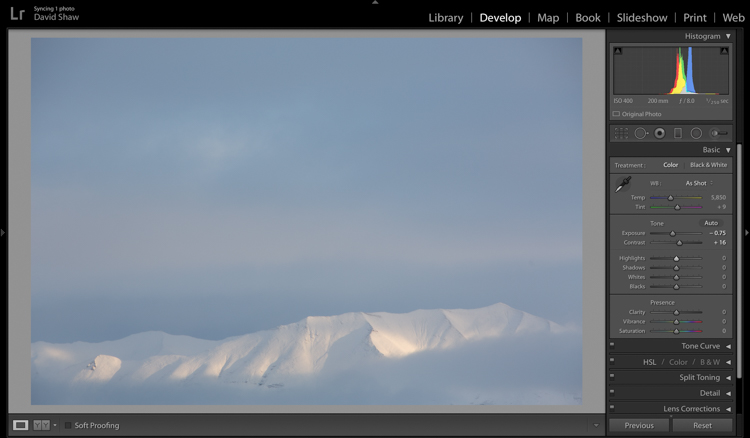
The next step was to bring down the exposure by 0.75 stops, making the image a bit moodier, and less bright. I then bumped the contrast a hair to +16 just to make those highlights more clear before I dove into the more important contrast adjustments.

As a quick note, I bet I do 85% of my Lightroom edits in the Basic panel. This very effective section of the program is one you should know intimately, before you go exploring too much of the huge variety of other tools provided by the software.
Kelly 3

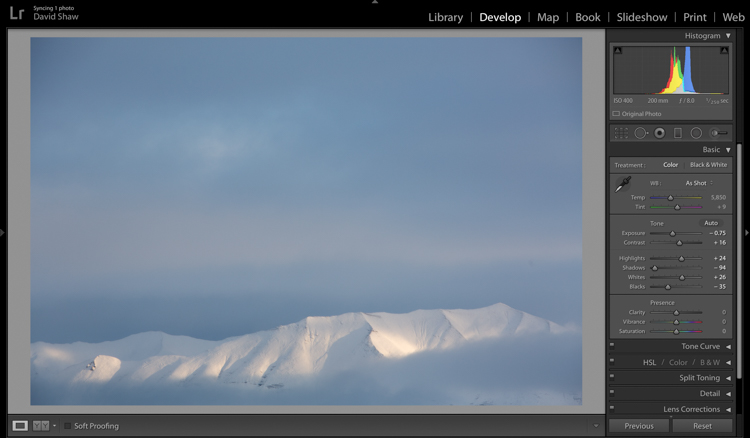
The next four sliders provide a more specific modification of lighting in the image. In this case, I wanted to recollect some of the feeling of the dissipating storm by emphasizing the dark clouds. To do so, I pulled the Shadows slider down nearly all the way, making the dark blues and grays of the clouds appear more menacing. The Highlights, I bumped just a notch, adding some pop to the bright patch on the mountains. Whites and Blacks each got a nudge up (Whites) and down (Blacks) respectively, finishing the job I started with the first two sliders.

Step Three – Clarity
Kelly 4

The first of the next three sliders is Clarity. This nifty tool, increases the contrast where dark and bright edges meet, and adds apparent sharpness to the image. On the morning I made the image, the clear morning light made the mountains very sharp to the eye. Wanting to emulate that effect in the image, I gave the Clarity a substantial boost to +62. That’s about as high as you can go on most images without appearing artificial.

Step Four – Vibrance and Saturation

The Vibrance and Saturation sliders are dangerous. Photographers tend to believe that bright colors mean a good image. I want to say this very clearly: Do NOT over-saturate your images. It doesn’t look as good as you think it does, so, you know, just don’t.

Vibrance increases the intensity of the less saturated tones. When used in moderation it adds pop. In this image, I left the saturation slider completely alone.
Kelly 5

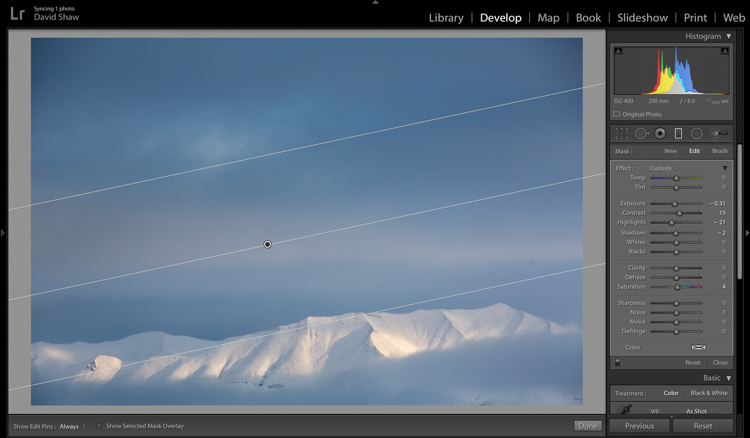
The rectangular icon in the row below the histogram is the Graduated Filter. This useful tool allows you to adjust a portion of the frame, without affecting the other areas. Just as importantly, you can adjust the edge softness (transition area) as hard or soft as you like. In this case, I wanted my changes to taper naturally into the frame so made the filter edge fairly wide (set feather to a high number). Using this tool, I chose to darken the sky, and draw attention to the mountains at the bottom of the frame. After adjusting the placement, I lowered the exposure in the sky. This allowed me to subtly darken the sky, without affecting the brighter tones of the mountains.
Kelly 6

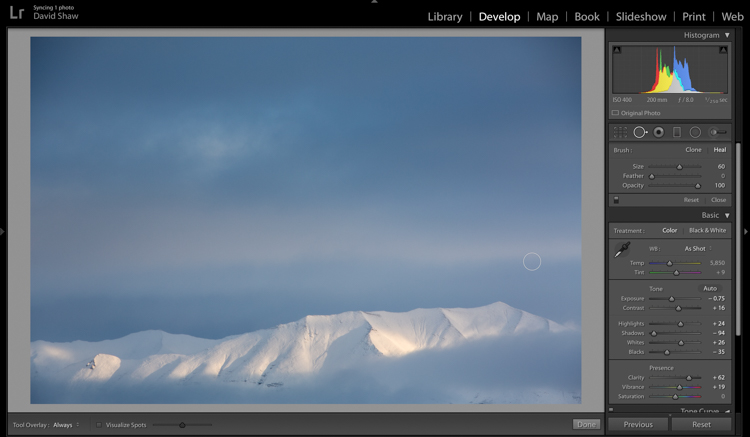
Adjusting contrast can cause previously invisible imperfections to appear. In this case, it was a dust spot on my sensor, which I cloned out using the “Heal” tool.

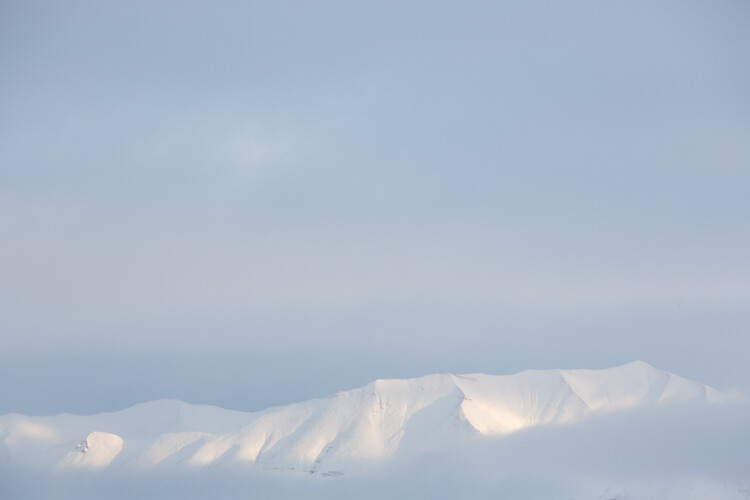
The final image, as you can see, is a substantial improvement over the original, and holds true to the scene as I remember it.
Before

Before processing

Kelly DONE-1

After processing

Color in the Cold

Not all images of the winter rely on cool tones for their success. At times, it is the juxtaposition of those cool tones and bright warm colors that make an image.
Beams 1

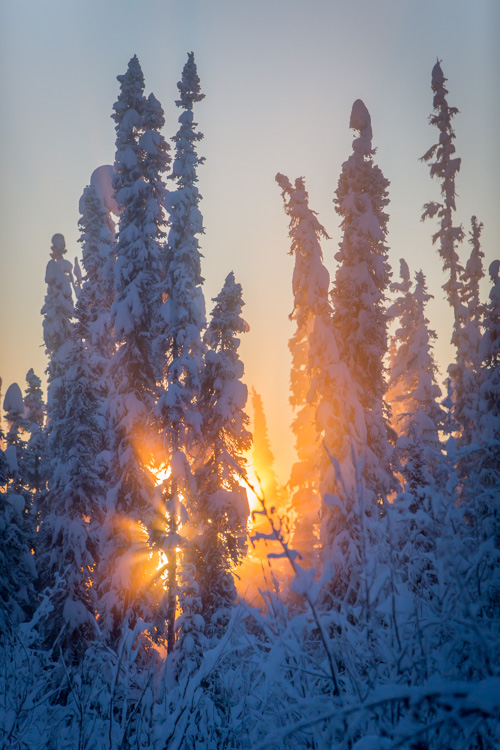
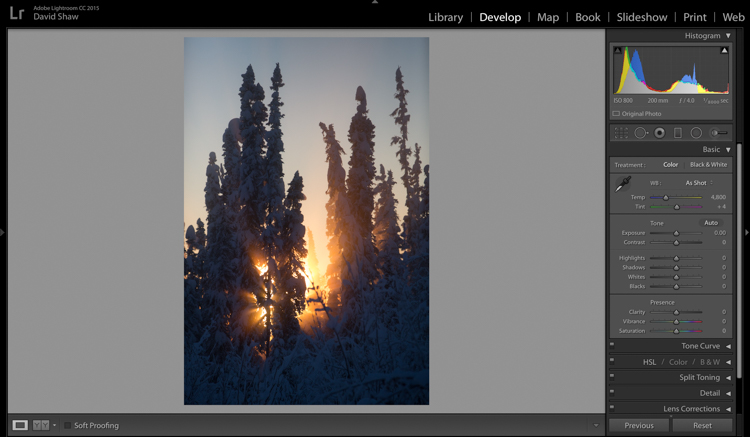
This is one such image. I made it on an extremely cold mid-winter day, on the ice of the small creek that flows on the lower part of my property north of Fairbanks, Alaska. It was about -35f (-37c), and water, pushed up from the bottom of the creek by the pressure of the ice, was trickling out onto the surface where it steamed into the frigid air, before freezing. It was midday, and the sun, just a few ticks above the horizon to the south, was throwing orange beams through the branches of the snow-colored spruces. Fortunately, I had my camera, and managed this photo before the sun slipped away.
Beams 2

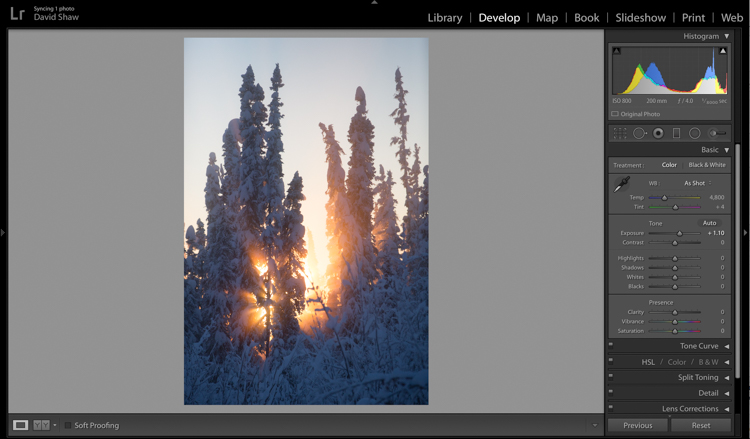
On that cold day, I was forced to underexpose the image to keep the beams of sunlight and the sky from blowing out. My first step was to return some of that brightness to the image by raising the Exposure +1.10 stops.
Beams 3

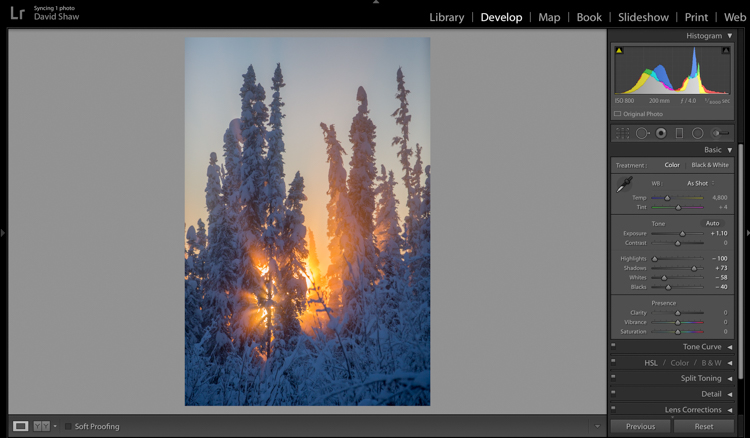
In general, I dislike High Dynamic Range (HDR) images, particularly the over-processed ones that appear regularly on Facebook and Instagram feeds. That said, HDR, or my Lightroom version of it, can be helpful in highly contrasted images like this one. Here, I pulled the highlights all the way down, bringing the beams and the sky back to more appealing levels. The Shadows I brought up, which revealed details in the trees and shrubs which were previously too dark to see. The effect, when used appropriately, does not look artificial.
Beams 4

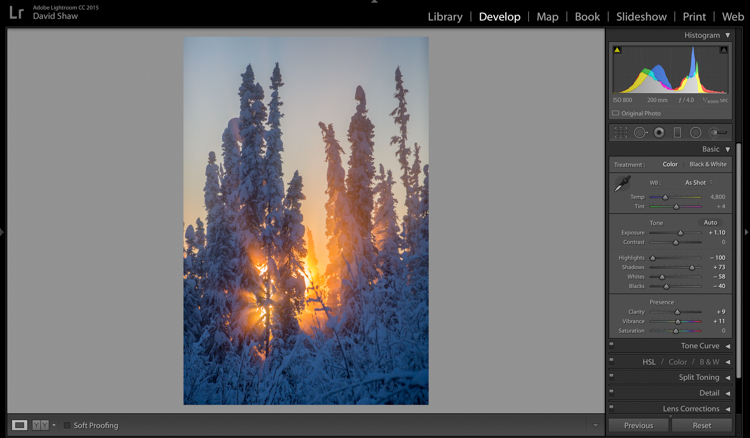
The image was already colorful and sharp so required very little in the way of Clarity, Vibrance or Saturation. A small boost (+9) to Clarity, +11 to Vibrance, and no change in Saturation was all the image needed.
Beams 6

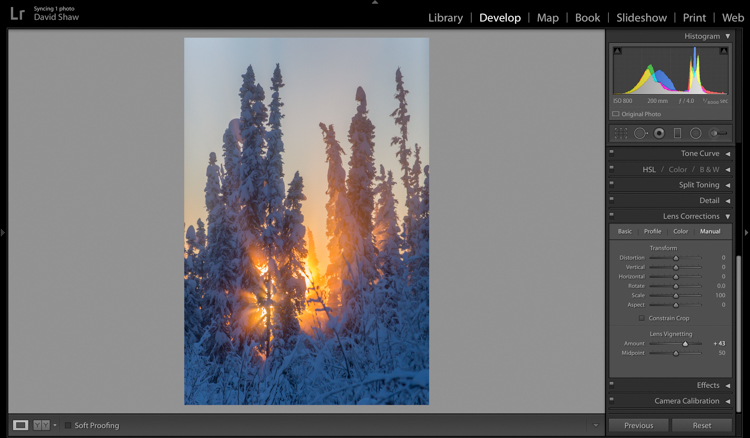
The lens I used to make the image has a hood, which I realized after the fact, was slightly mis-aligned and threw a vignette over the corners of the photo. If I want a vignette (see next), it needs to be purposeful, not the accident of a poorly fitted hood. So, using the Lens Corrections module, I made a single adjustment, sliding the Lens Vignetting slider to the right, brightening the corners, and almost entirely eliminating the ugly dark area in the top right.
Beams 7

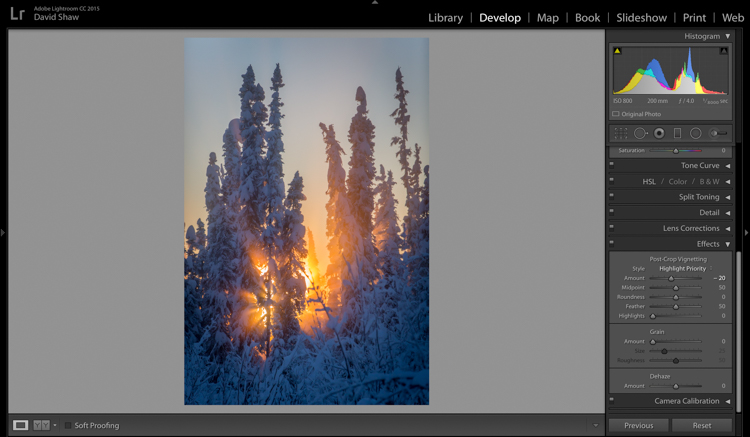
The last thing I wanted to do was darken the sky a touch more, and bring further attention to the starburst of sunbeams coming through the trees. So, using the Effects Module, I added a -20 Post-crop Vignette, which effectively darkened the sky and lower corners.

With that final change, the image was complete, a starburst of color on a brutal winter day.
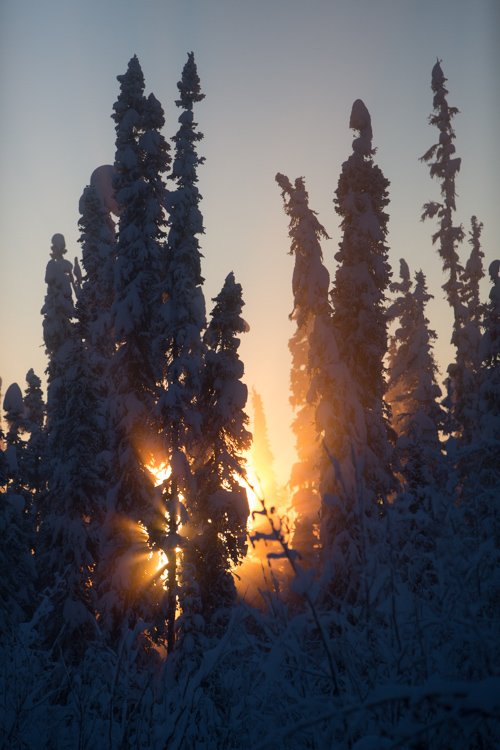
Before processing

Before processing

Beams Done-1

After processing

The Storm

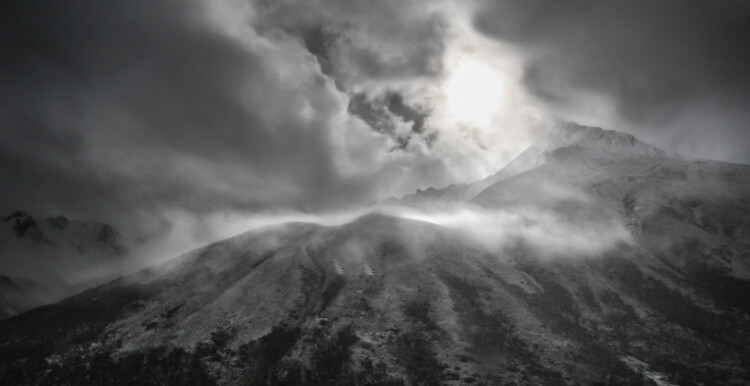
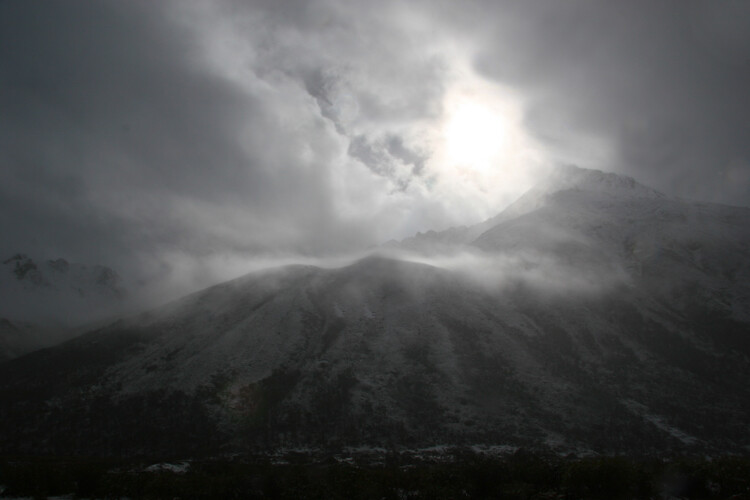
A number of years ago, I spent 10 days trekking through the Himalayas of Bhutan. It was October, the tail end of the trekking season for the little mountain kingdom. My group and I hiked up from the lowlands, to a high camp at over 13,000 feet, where we planned to cross over two 15,000 foot passes before making a long descent back to the city of Thimpu. It didn’t work out as planned. We’d scheduled two nights at the high camp to acclimatize before crossing the passes. Just before bed on the second night, a storm rolled in, and by the time we woke up the following morning, there were eight inches of snow on the ground. Any hopes of penetrating higher into the mountains were dashed. Making the best of it, I rose and made photos of the dark mountains and falling snow.
Bhutan 1

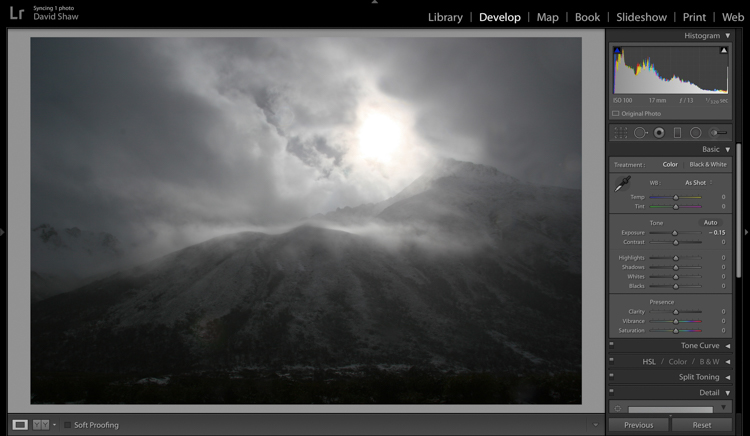
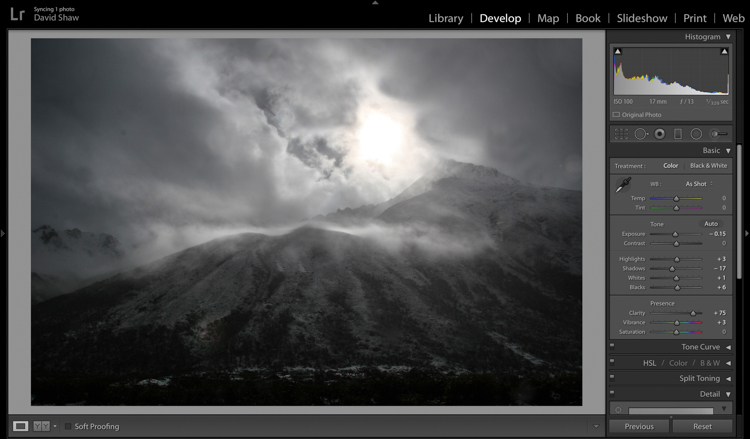
In the field, I purposely underexposed to keep the small patch of bright sky surrounding the sun from blowing out entirely. The mountains ended up nearly black, and the sky dark gray. Though consistent with my desire to make a moody, foreboding image, I wanted to emphasize that feeling even more.
Bhutan 2

In the Basic Module, you can see that I darkened the image a bit more, left the highlights more or less alone, darkened the shadows a hair, and bumped the blacks just a bit to bring some texture into the dark lower corners. The Clarity slider I pushed notably to the right, which made the textures in the sky and mountain pop against the otherwise soft grays. I left the color adjustments mostly alone.
Bhutan 3

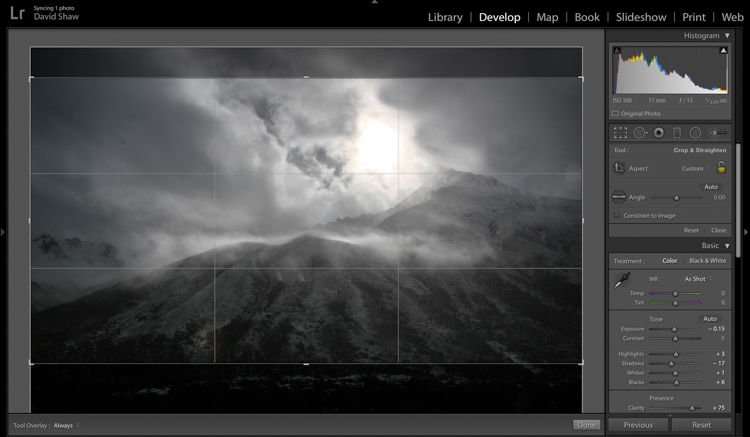
The more I looked a the photo, the more I realized the top and bottom edges added nothing to the image. Using the crop tool, I nipped them off, bringing all the attention to the action in the central part of the frame.
Bhutan 4

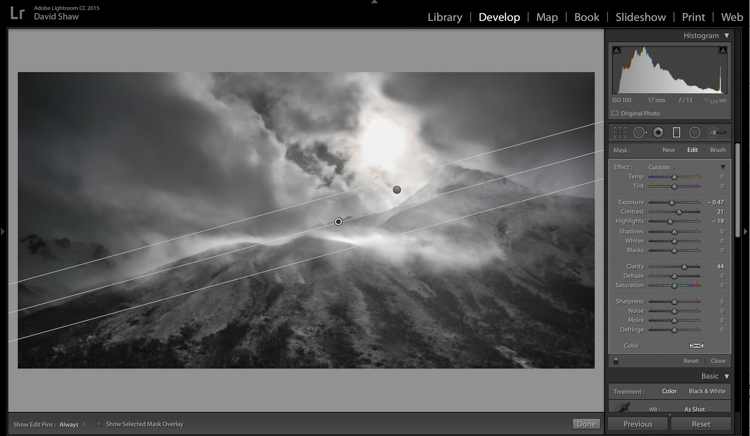
At this point, the processing got a bit complicated. I wanted to deal with the sky and mountains separately. One I wanted to brighten, the other darken. There were two ways to deal with this:

  1. Use the Adjustment Brush tool to select and develop the two areas
  2. Use Graduated filters to accomplish the same thing. Because the Graduated filter allows more flexibility to change the softness of the adjustment edge, I decided to use that.

The filter that adjusted the sky I darkened, and increased the clarity. The one for the mountains, I brightened, boosted the highlights, to make the scudding clouds pop, and added some clarity.
Bhutan 5

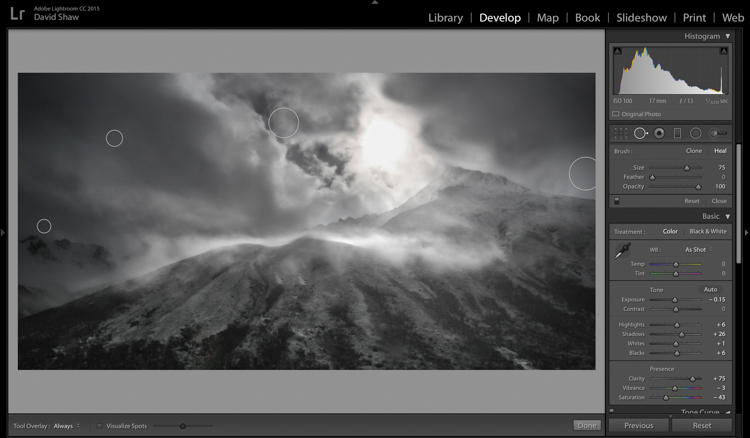
As noted earlier, the changes in contrast can emphasize imperfections, and I took a moment to remove lens flares and dust spots.

Last, I did a second pass of the Vibrance and Saturation. The yellowish patch around the sun was annoying me, so I dropped both the color sliders down reducing the image to a near black-and-white.
Bhutan-Jangothang-snowstorm-04

Before processing

Bhutan Done-1

Finished image after processing

I really like the final image. It provides a sense of the storm and the foreboding nature of mountain weather. Looking back, I can easily remember my nervousness that snowy morning, the uncertainty, and eventually, our retreat back the way we’d come.

Conclusion

Great images can come from snow. Many photographers put their cameras away during a winter storm, but I strongly recommend you don’t because there is great stuff out there if you’ve got the perseverance to suffer through some cold days. The images you gather, like these, can be optimized in your computer. Remember to take a moment before you begin, to recall how the scene looked and felt when you made the image, then use those memories as your guide.

Do you have any winter images on your computer that are begging to be processed? Now’s the time to do it, please share your images and comments below.

googletag.cmd.push(function() {
tablet_slots.push( googletag.defineSlot( “/1005424/_dPSv4_tab-all-article-bottom_(300×250)”, [300, 250], “pb-ad-78623” ).addService( googletag.pubads() ) ); } );

googletag.cmd.push(function() {
mobile_slots.push( googletag.defineSlot( “/1005424/_dPSv4_mob-all-article-bottom_(300×250)”, [300, 250], “pb-ad-78158” ).addService( googletag.pubads() ) ); } );

The post Tips for Processing Winter Landscapes in Lightroom by David Shaw appeared first on Digital Photography School.


Digital Photography School
 
Comments Off on Tips for Processing Winter Landscapes in Lightroom

Posted in Photography


10 Tips for Photographing Wide-Angle Landscapes

17 Apr

A wide-angle lens is considered an essential piece of gear for any landscape photographer because it gives you a perspective that you cannot achieve with any other lens. You’ll not only be able to photograph grand vistas, but you’ll see lines in a different way, and emphasize subjects by getting super close.

So if you haven’t tried one yet, borrow or rent a wide angle lens and get ready to make images with a different flavour using these tips.

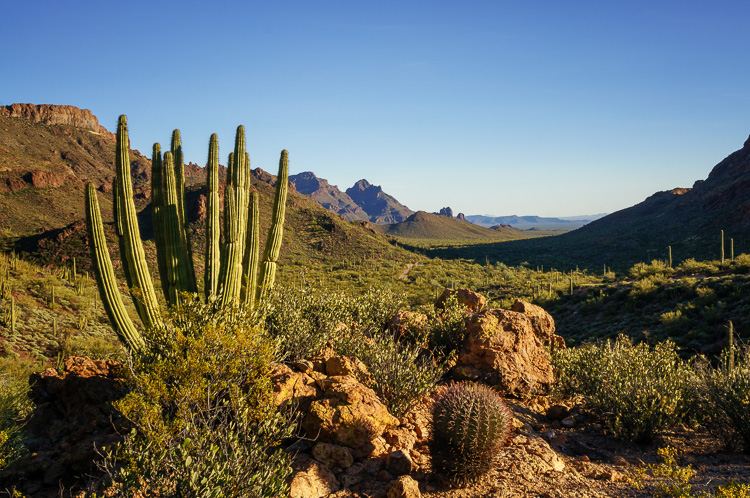
Organ Pipe Cactus National Monument, Arizona

21mm, ISO 100, f/18, 1/15 second

What is a wide-angle lens?

Camera lenses are defined by comparison to the field of view that the eye naturally sees – which is 50mm on a full frame camera or 35mm on a crop sensor camera. This is known as a normal focal length. Any wider than that is a considered wide-angle.

My favourite wide-angle lens is in the 10-20mm range on my crop sensor camera, or 16-35mm on a full frame camera.

When to use a wide-angle lens

Many people think the purpose of a wide-angle lens is to photograph grand vistas and get a lot in the frame. While that is one purpose for a wide-angle lens, its real power is in using its perspective to emphasize objects that are very close to you and de-emphasizing objects that are farther away.

1. Emphasize a foreground element

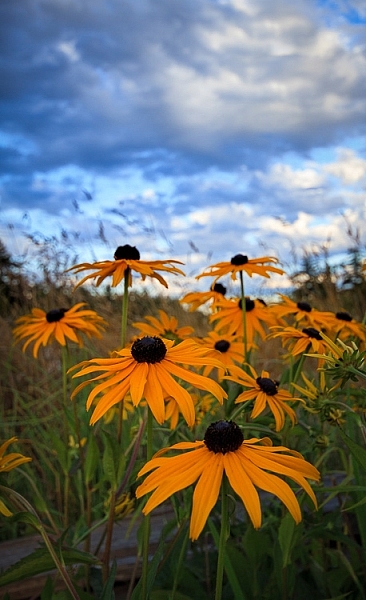
Wide-angle lenses allow you to get really close to something in the foreground, which will emphasize it and make it look larger and more important than the background elements. A wide lens has a way of changing the relative size of the objects in the frame, so that things that are closer to the lens appear larger, and things in the background appear smaller proportionally.

Black Eyed Susan by Anne McKinnell

20mm, ISO 200. f/5.6, 1/160 second

Try using a low angle and getting very close to your main subject. By close, I mean inches away. You’ll be surprised when you look through the viewfinder and discover that objects don’t appear quite so close through the lens.

2. Photograph your subject and its environment

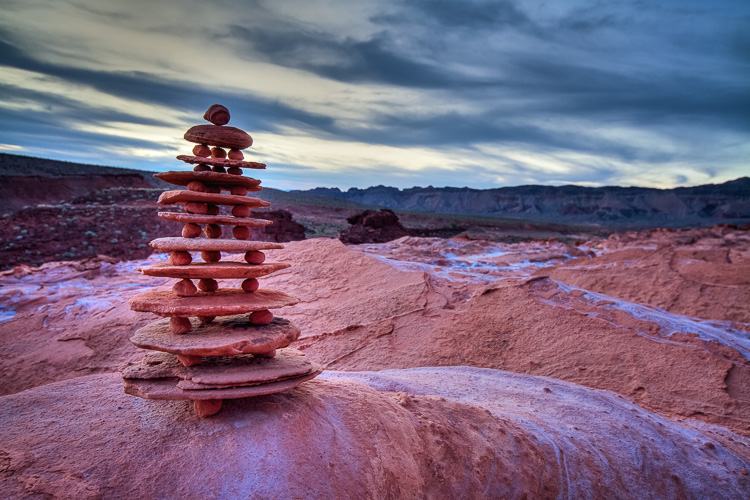
My favourite way to use the lens is to get very close to my main subject so it is large in the frame, as mentioned above, but also include other elements in its environment in the frame. This is a great way to create a story-telling image that provides context for the main subject.

Balancing Rocks at Little Finland, Nevada by Anne McKinnell

16mm, ISO 200, f/8, 1.3 seconds

3. Get everything in focus

Another great power of a wide-angle lens is its ability to have incredible depth of field. You can get everything from two feet away to infinity in focus. Of course, this depends on the exact lens and the aperture you choose, but all wide-angle lenses have a greater ability to get more in focus than a telephoto lens (which is excellent at shallow depth of field by blurring the background). You’d be hard pressed to blur the background with a wide-angle lens.

Whitney Pockets, Nevada by Anne McKinnell

19mm, ISO 100, f/20, 1/20 second

You can use a hyperfocal distance calculator to figure out exactly what will be in focus for your lens at the aperture you choose. But generally speaking, if you focus on something close to you and use a small aperture like f/18, everything from front to back will be in focus.

4. Watch out for distractions

Since wide-angle lenses include a lot in the frame, you’ll need to be extra vigilant to make sure there are no distractions. Everything that is in the frame should have a purpose.

Check your composition to make sure there is nothing in the foreground that you didn’t notice, since objects just inches away from you will be in the frame. As well, check the background to make sure there you haven’t included something unintentional.

Ideally, your composition should clearly show what the main subject is, what the supporting elements are using an interesting graphic design, and not include anything else. Simplify the composition as much as possible.

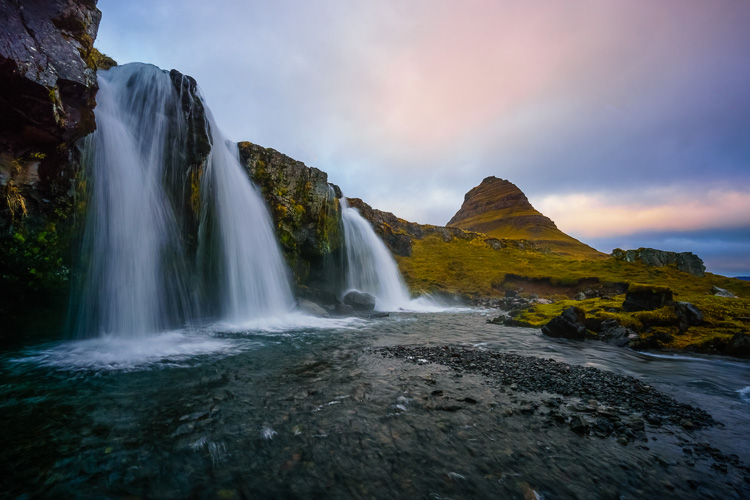
Kirkjufellsfoss, Iceland by Anne McKinnell

11mm, ISO 100, f/20, 1/6 second

Because the frame contains such a wide field of view, it will have a lot in it, so it is especially important that the main subject is obvious.

5. Keep the camera level

Wide-angle lenses are notorious for displaying distortion around the edges. Anything with straight lines at the edges of the frame will appear to lean inwards. To avoid or minimize distortion, keep the camera level with the ground and don’t angle it up or down.

6. Angle your camera upwards

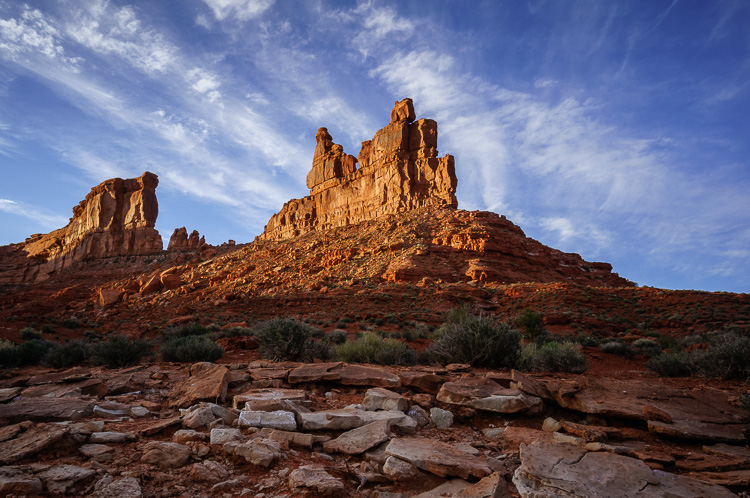
On the other hand, you can use this distortion to your advantage! Just make sure it is intentional and you are using it to emphasize something. For example, by angling the camera upwards you can emphasize the sky, and any clouds in it will appear to point towards the center of the frame.

Valley of the Gods, Utah by Anne McKinnell

15mm, ISO 100, f/11, 1/60 second

7. Angle your camera downwards

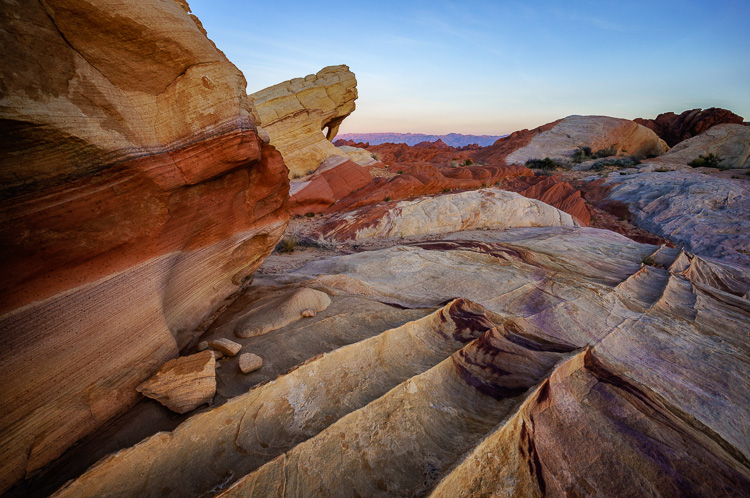
Similarly, if you angle your camera downwards you can emphasize leading lines on the ground and create a perspective that really draws the viewer in.

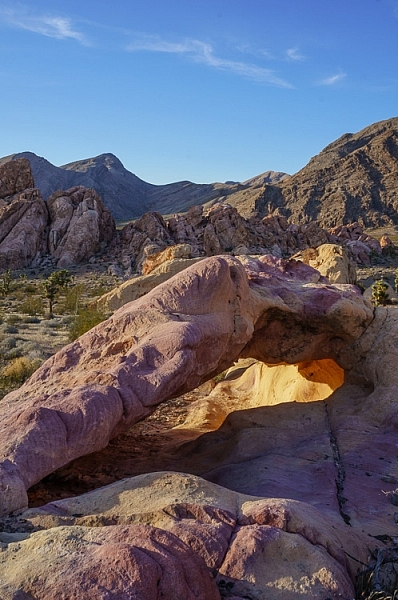
Fire Canyon Arch in the Valley of Fire State Park, Nevada by Anne McKinnell

10mm, ISO 200, f/11, 1/20 second

8. Make images in close quarters

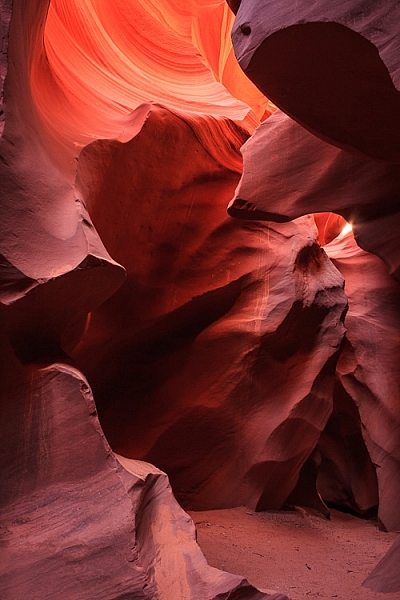
Whenever you are in an enclosed space, making images with impact can become difficult, since you cannot get far enough away from your subject. If you are in a tight situation, a wide-angle lens is a necessity!

Antelope Canyon, Arizona by Anne McKinnell

21mm, ISO 100, f/11, 5.0 seconds

9. Beware of polarizing filters

You may already know that polarizing filters can darken skies, emphasize clouds, and saturate colours when you are photographing in a 90 degree angle to the sun. If you are photographing with the sun directly in front of you or behind you, the filter does not have this affect.

With a wide-angle lens, you may find that part of the scene in the frame is at a 90 degree angle and is affected by the polarizing filter, and the other side is not. When this happens, it is better not to use the polarizing filter at all (it will give you an uneven sky which is darker on one side).

10. Manage uneven light

When photographing landscapes with a wide-angle lens you’ll frequently encounter varying amounts of light in the frame. Often the sky in the background is much brighter than your foreground. When this happens, you can use a graduated neutral density filter to darken the top portion of your image and even out the exposure.

Wildflowers in Big Bend Ranch State Park, Texas by Anne McKinnell

10mm, ISO 200, f/11, 1/100 second

A wide-angle lens is often the favourite lens in the kit for landscape photographers and with these tips it may become your favourite lens too.

What do you like to shoot with your wide lens? Please share your tips and images below.

googletag.cmd.push(function() {
tablet_slots.push( googletag.defineSlot( “/1005424/_dPSv4_tab-all-article-bottom_(300×250)”, [300, 250], “pb-ad-78623” ).addService( googletag.pubads() ) ); } );

googletag.cmd.push(function() {
mobile_slots.push( googletag.defineSlot( “/1005424/_dPSv4_mob-all-article-bottom_(300×250)”, [300, 250], “pb-ad-78158” ).addService( googletag.pubads() ) ); } );

The post 10 Tips for Photographing Wide-Angle Landscapes by Anne McKinnell appeared first on Digital Photography School.


Digital Photography School

 
Comments Off on 10 Tips for Photographing Wide-Angle Landscapes

Posted in Photography


14 Essential Rain Photography Tips for Creating Dramatic Images

16 Apr

Wherever you travel, you are always free to take that perfect shot from the best angle. Not when it’s pouring down heavily, though. Winter is not always the best climate for comfortable outdoor photography. But guess what, if you are a clever photographer, you can take even better photos in the rain than on sunny days. Cold and stormy weather Continue Reading

The post 14 Essential Rain Photography Tips for Creating Dramatic Images appeared first on Photodoto.


Photodoto

 
Comments Off on 14 Essential Rain Photography Tips for Creating Dramatic Images

Posted in Photography


6 Tips for How to be a Culturally Sensitive Travel Photographer

14 Apr

There is a little wanderlust in all of us. Everyone, at some point in their lives, wants to travel the world and experience all its beauty for themselves. Travel opens the mind to many different possibilities, and makes us more tolerant and conscious as humans. What might be simple, normal, and mundane to some, might be unique, challenging and exciting to another. In the words of Gustave Flaubert, “Travel makes one modest. You see what a tiny space you occupy in the world.”

Memorable Jaunts Ethical Travel Photography Article for Digital Photography School-5

On a particular assignment in Chennai, India last year, the whole community came out to see what I was doing and soon I found 20+ willing subjects to photograph!

As photographers, travel and photography are very much intwined. Photography is a way to capture and communicate the sense of place and people. Our images help immortalize our experiences in travel. This is particularly important when we travel to places outside of our cultural comfort zones. Every moment and every experience is new, and the need to document and preserve them sometimes takes over simple basic common sense. I admit that there have been times when all I’ve done is experienced a place or an event through the back of my viewfinder. My camera has been strapped to my person like my life depended on it, and I have always come back feeling less than happy. The fact that I missed all the little nuances outside the line of vision of my viewfinder, weighs quite heavily on my mind.

Even beyond the obvious need to really experience a place, is the question on when is it okay to take photos of people and places, especially when traveling to other countries? Many times there are major cultural, social and economic differences between the photographer and the subject being photographed. Perhaps the best way to answer that question is that responsible photography is very much like responsible travel. Armed with a thorough knowledge of the place, an interest in cultural enrichment, an open mind, a pleasant attitude, some common sense and a smile, photography abroad—just like travel itself—can be a very fulfilling experience.

Here are some basic guidelines on how to be a culturally sensitive photographer when traveling

1) Knowledge is key

Invest time before traveling to research the customs, and photography norms of the place you will visit. Customs vary not only by country, but by region and religion as well. Understand and appreciate the diverse cultural context, and be respectful of these differences. A little research prior to your journey, goes a long way in avoiding disappointment and despair when you find out that certain photography restrictions exist in the places where you are traveling.

Memorable Jaunts Ethical Travel Photography Article for Digital Photography School-10

I stumbled upon a religious ceremony on a recent trip and soon found myself to be the official photographer of the ceremony – the cultural enrichment was unlike anything found in any guidebook!

2) Be personable and communicate your needs

Self confidence, an open attitude, and a genuine smile, are important wherever you travel. People will generally respond to you with the same attitude that you show them. Be open and honest about your need to photograph something or someone, and more often than not, people will respond positively to you. I have found that most people love to have their picture taken. If you are uncomfortable or nervous about something or someone, it’s best to just leave the camera in your bag.

Memorable Jaunts Ethical Travel Photography Article for Digital Photography School-9

I let my camera do the talking and was rewarded with one of the most genuine portraits I have ever taken.

Memorable Jaunts Ethical Travel Photography Article for Digital Photography School-14

I was grabbing a quick meal before going to the airport in Jaipur, India and this lady was very curious about me and my gear. I promised her a photograph in exchange for a smile and I absolutely adore this image!

3) Get permission

Almost everyone around the world knows what a camera is, and what it can do. Even if you don’t know the language, simple hand gestures and pointing to the camera, can take you far in terms of communicating what is it that you are seeking.

Not understanding the language should never be an excuse to photograph an unwilling person. As a photographer, the responsibility of asking for permission before you click the shutter rests solely on you. If you have time, learn some simple phrases, related to photography, in the language of the country in which you are traveling. This will not only allow you to communicate more directly with your subject, explaining why you want to take a photograph, it shows your interest in learning at least some of the local language.

Sometimes use your camera as an ice-breaker. Take a picture and show people the photos you’ve taken of them, and you will find that photography instantly becomes more fun and less intimidating. More than anything, respect the fact that “No” really does mean NO. Yes, I understand that there is another school of thought of whether asking for permission will ruin the composition of an image. And while a lot of photographers will argue one way or the other, I am of the opinion that if you are taking a picture of a person, you should make every effort to ask permission – either before or after.

Memorable Jaunts Ethical Travel Photography Article for Digital Photography School-13

I made the mistake of not asking this lady before photographing her and as she walked by me, she yelled at me for being rude and taking her picture – lesson learnt!

4) Travel without taking pictures

Take the time to really travel without obsessing over capturing every minute of every day with your camera. Spend time exploring your surroundings, and your body and mind will thank you for it. Even if you are on assignment, build in some down time to your schedule. Not only does it help you relax, but also recharges those creative juices so you are more productive when you do get back to work!

5) Know your gear

This one is one of the basics of photography, no matter what your genre. You should know the workings of your camera inside and out. When you are traveling and have strangers pose for you, that is not the time to start trying out different settings and fidgeting with your gear. People begin to loose patience and often get leery of you and your abilities. They are more likely to simply walk away, rather than waste their time with a stranger who does not know how to operate his/her camera.

Memorable Jaunts Ethical Travel Photography Article for Digital Photography School-8

These men were intently discussing the price of wholesale fruits and vegetables at the Chennai Flower market and I had exactly two seconds to take this image – this image is literally SOOC (Straight out of the camera).

6) To pay or not to pay

Perhaps, one of the most controversial situations while traveling abroad, is the question of giving money to people you photograph. There is always that one uneducated, desperate tourist who gives money to get what they think is an award-winning prized photograph, and soon it becomes a lucrative business in the local community. This can get quite uncomfortable and unsafe for other photographers traveling through the same places.

I prefer engaging people openly, and sharing my story and my need for a picture. I find that in most cases people are more than happy to share their story, and to be heard. I too, walk away more culturally and emotionally enriched with the experience. However, if someone expects money for a photograph, then the decision becomes less of whether to pay and more of whether to take the photo. That is a judgement call that each of us needs to make on a case-by-case basis, while being mindful of the example we are setting for future travellers and photographers.

Memorable Jaunts Ethical Travel Photography Article for Digital Photography School-4 Memorable Jaunts Ethical Travel Photography Article for Digital Photography School-12

I remember one instance last year when I was traveling in India with my kids. We were visiting a temple in Southern India, and for some reason a lot of teenagers starting taking pictures of my five year old son. They would come and ask me if they could take a selfie with my son. Initially it seemed innocent enough, and my son posed with them. Soon it was getting to the point of being creepy, and I had to refuse. As a parent, I was extremely uncomfortable with having strangers take pictures of my kids. This experience taught me a very valuable lesson – value and respect people’s personal space and personal preferences.

What are your thoughts on this topic? Do you ask for permission before taking photographs of strangers when you travel? Or do you just take the picture and move on? What other things to you take into consideration to be a culturally sensitive travel photographer?

googletag.cmd.push(function() {
tablet_slots.push( googletag.defineSlot( “/1005424/_dPSv4_tab-all-article-bottom_(300×250)”, [300, 250], “pb-ad-78623” ).addService( googletag.pubads() ) ); } );

googletag.cmd.push(function() {
mobile_slots.push( googletag.defineSlot( “/1005424/_dPSv4_mob-all-article-bottom_(300×250)”, [300, 250], “pb-ad-78158” ).addService( googletag.pubads() ) ); } );

The post 6 Tips for How to be a Culturally Sensitive Travel Photographer by Karthika Gupta appeared first on Digital Photography School.


Digital Photography School
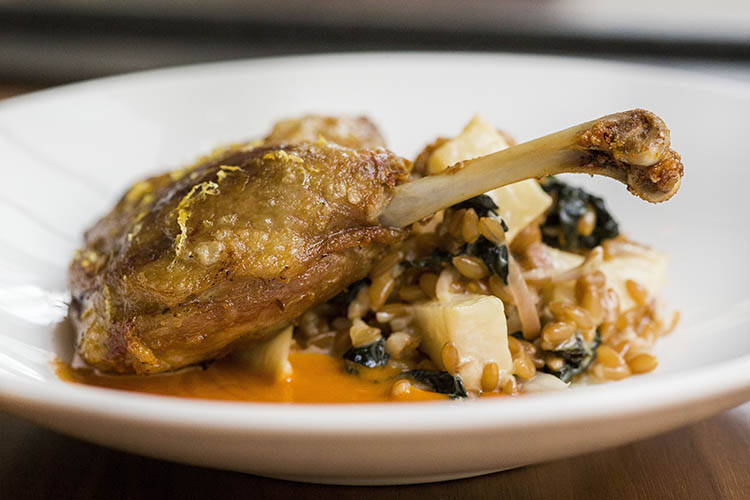
 
Comments Off on 6 Tips for How to be a Culturally Sensitive Travel Photographer

Posted in Photography