RSS
 

Posts Tagged ‘Tips’

5 Tips for Taking and Caring for Your Camera Equipment in Far Away Places

06 Oct

If the thought of being away from all your camera equipment stresses you out, this article is exactly what you need! I can safely say that being on the road for over two and a half months teaches you a thing or two about need and necessity versus wants.

Road trip

For the longest time, one of my dreams has been to live away from home and travel with my family for an extended period of time. I used to dream about all the places I could travel to, and how much fun I would have living a nomadic life. Of course, then I would wake up and the realities of my responsibilities would take over.

However, earlier this year after suffering a big life setback with the loss of my mom to cancer, I decided that my life was too short to not make my dreams come true. After several months of discussion and planning, my husband and I decided that our little family would spend our summer in India – traveling and visiting family. Somewhere along the way a trip to Ladakh, London, Zurich and Rome got added to my roster and pretty soon I was in charge of planning and packing for a life on the road for two and a half months living out of just four suitcases – one for each one of us. Being a photographer, I knew that somewhere in there I had to pack my camera equipment along with my essentials.

Taking and Caring for Your Camera Equipment in Far Away Places

Sunsets along Lake Zurich were magical – one of my favorite cities that I have ever visited!

Here are a few things that really helped me make the most of my time away from home. It is very likely that I have missed some key photographic opportunities but overall I am very happy with my time away, the opportunities that my family has experienced, and the images that I have created. And as an added bonus, all the camera equipment I did take made it back without any major mishaps along the way.

#1 – Gear Choices

Let’s face the reality of life as a photographer – we all love and want all the gear that we think we need wherever we go. When I was packing I realized that as a photographer I had so many things I wanted to bring, but as a mom, the need for gear was quickly overruled by the need for practical things like clothes, shoes, books, toys, etc. I had to make some very hard choices on the camera equipment that I could take, versus the gear I wanted to take. I narrowed down my list based on where my travels would take me and what gear I could realistically carry and transport safely without any damage.

So, in the end, I settled for this kit:

  • A wide zoom lens – Canon EF 24-70mm f/2.8.
  • A simple point and shoot camera (yes, this was my backup as weight was a concern when flying to and from Asia with layovers on the way there and back).
  • One telephoto lens – Canon 70-200mm f/2.8L.
  • One camera body – Canon 5D MK III.
  • Four camera batteries.
  • One battery charger.
  • A small travel tripod – just a generic brand – mine fits in my carry-on bag.
  • A remote trigger.
  • Five camera CF cards ranging from 8GB to 32GB.
  • Two 2TB External Hard drives ( primary photo storage and a backup photo storage).
  • Two generic lens and camera cleaner kits.

All of these things comfortably fit into my REI brand hiking backpack. I use this bag for everything and store my gear in individual soft-cover bags inside the pack. This is what I have done since day one and something that has worked well for me.

The one thing I wish I had taken with me was a rain cover for my camera. My backpack had its own rain cover which I used numerous times during the trip because we got caught in sudden downpours in the mountains. But without a separate rain over my camera, I was not able to use my gear in the rain.

#2 – Be Prepared and Organized

For me, being prepared and organized included having a rough idea of where I was going and the kind of environment I was going to expose myself and my gear to. Before I left, I jotted down all the serial numbers, make, and brand for my camera equipment and stored them in a document on my cloud-based Dropbox account. All my external hard drives were stored off-site at a friend’s place as well as the remainder of my gear.

Now, obviously, this is a friend I trust. But another option would be to lock it in off-site storage facility. As part of your research, another good thing to keep in your back pocket is the name, address, and contact information of authorized service dealers for your gear in the country you are visiting. Sometimes things just go wrong no matter how prepared you are. Being prepared with this information about services centers and authorized dealers for your gear is a time saver especially when you are traveling in areas where the internet connection is not very reliable.

Taking and Caring for Your Camera Equipment in Far Away Places

An hour’s hike from our campsite in the Himalayas got us to this beautiful alpine lake. But by the time I could get the camera and tripod out, the fog set it…and it was magical!

During my travels, my gear choices on the road would depend on the activities that were planned for the day and the fact that this was a family travel trip, not just a photography expedition. In Rome and Zurich we traveled everywhere either on foot or used public transportation. So I just carried my camera body and the 24-70mm lens among other daily necessities in my backpack. The rest of my camera equipment was either packed away in the hotel room safe or locked away in my suitcase.

When we hiked and camped in the Himalayas, my camera along with both my lenses were always on my person, and the tripod was handed off to the porters that were carrying our camping gear. For my camping trip, I just carried all my CF cards and ditched the charger and external hard drive at the house where we were staying because it was highly unlikely I’d find a charging port on that journey.

All these choices were possible because of the research I had done ahead of time.

Taking and Caring for Your Camera Equipment in Far Away Places

Much of Ladakh is dry and barren and upwards of 10,000 feet above sea level. Altitude sickness is very real and sometimes your gear also acts up. Of course, these dramatic views almost make up for any hardships.

Additionally, a good mindset to have when you travel to far-off exotic locations is one of acceptance of physical and mental limitations – both for yourself and your camera gear. I experienced some altitude sickness in Ladakh as we were traveling on roads at almost 17,000 feet above sea level. I also found my gear did not function as efficiently at that altitude. My batteries did not last as long and the camera also did not shoot as fast. The first few times it happened I freaked out. But then I just accepted it as something beyond my control and gave myself some extra time to be patient in getting the shot that I wanted.

#3 – Know Your Gear

This one is too basic to include here but it is amazing how many of us don’t follow this simple tip. We are so enamored with the latest and greatest gear available, but yet don’t quite know how to use the stuff that we do own.

The best way to get over this is to really limit yourself to a few key pieces of camera equipment for an extended period of time. One of my goals for this trip was to try and capture star trails and The Milky Way when I traveled to Ladakh. After all, I was going to be in a remote part of the country at an altitude of almost 15,000-17,000 feet above sea level. Barring any bad weather, I should be able to get relatively clear shots of The Milky Way and star trails.

Now astrophotography is not my thing. I always limited myself from trying it out because I don’t usually travel with a tripod, nor do I own an intervalometer. So this time I actually downloaded the camera manual on my phone and studied it before I left. With that information, I was able to comfortably and confidently use the B (a.k.a Bulb mode) on my camera to capture star trails in Ladahk. It was quite a thrilling experience for my maiden attempt.

Taking and Caring for Your Camera Equipment in Far Away Places

A 26-minute exposure while sleeping in the car near Jisp along the drive to Leh was one of the highlights of my trip. This is one of my first star trails shot and now I find myself looking out for stars every night! This would have been impossible without a tripod and proper remote trigger.

Another good thing to practice before you head out is gear maintenance. I had to routinely clean my lens and camera throughout this trip. I made the decision to carry two camera cleaning kits just because I knew my gear would get a lot of use. Before every major outing, I spent the time to clean out the dirt and dust from the camera and the lens. The dust pen was kept in my camera bag just in case I needed it while I was out and about photographing.

#4 – Be Local and Think Like a Local

I have to include this one in any travel photography related article because it does relate indirectly to taking care of yourself and your gear. Often times I find photographers I meet along my journeys have a fake sense of entitlement. When you are a guest in someone’s house, are you not on your best behavior? Why is it that when you are a guest in another country, common sense and basic manners seem to fly out the window.

Locals are still people who deserve the same amount of respect and courtesy as anyone. Put yourself in their shoes and try to imagine what they experience when someone shoves a camera in their face without so much as a hello or a smile.

While in Ladhak, we visited a lot of beautiful monasteries. Most of them are still in use and we saw many temples where the monks were in prayer. Even if there is no sign discouraging photography, please use common sense to not invade their private space especially when they are chanting. I cannot tell you how many times I came across tourists that almost jumped over each other or hanging out of moving cars just to take pictures of them chanting and praying. Seeing this rude behavior almost made me embarrassed to take my camera out.

Taking and Caring for Your Camera Equipment in Far Away Places

The infamous cable cars in Lucern, Switzerland…the clouds adds a certain mystery and aura to these engineering marvels!

Additionally flashing your fancy gear around is almost begging for the wrong kind of attention. I remember this one evening in Rome, I was out with my kids taking photos around some of the beautiful horse-drawn carriages. We lost track of time and soon found ourselves in a fairly deserted alley. I quickly put my gear away in my backpack, stuffed it with our jackets, grabbed my kids, and sprinted towards a more crowded piazza.

#5 – Make Friends with Local Photographers

The internet is an amazing tool for almost anything. It is such a great resource to find and connect with other photographers, especially if you are traveling to areas that are new and foreign to you. I was able to connect with some photographers in India as well as in Rome this summer. We chatted on the phone, met for dinner and just became friends.

They even gave me advice on some of the local, non-touristy spots to photograph as well as offered to lend me gear if I needed it. We tried to plan a shoot in India but the timing was not right, I know that the next time around we are going to create some magic, though.

Taking and Caring for Your Camera Equipment in Far Away Places

I met up with another photographer and we attempted to do night photography in Mumbai. But the moisture in the air because of the monsoons was causing some weird light trails against all the lights. So we went for ice cream instead! But it was a cool experience none the less.

Conclusion

I hope these tips are helpful as you plan your next vacation in a far-off destination. If you have other tips and tricks that worked for you, please share them with the community so we may all learn new ways to have an exciting and creatively satisfying vacation.

The post 5 Tips for Taking and Caring for Your Camera Equipment in Far Away Places by Karthika Gupta appeared first on Digital Photography School.


Digital Photography School

 
Comments Off on 5 Tips for Taking and Caring for Your Camera Equipment in Far Away Places

Posted in Photography


From Mundane to Magical: Tips on Taking Your Photos to the Next Level

05 Oct

You may be at a point with your photography where you are comfortable operating your camera and are capable of taking a good picture. You can work with exposure, you understand composition, and can even enhance your photos in post-processing. You should be pleased with this, as this puts you ahead of the vast majority of other photographers. But at the same time, perhaps you are not seeing the elevation in your results that you expect. You are beginning to wonder why you aren’t getting more stunning pictures. Are you doing something wrong? Is there some part of this you’re not getting?

From Mundane to Magical: Tips on Taking Your Photos to the Next Level

We all go through a phase where we feel like we know what we’re doing but are frustrated by a lack of great results. In fact, for some of us, it always feels like this. You’ll never go through a time where you’re hitting magical shot after magical shot. It just doesn’t work like that. You are after something extraordinary, and by definition that is rare.

How do you maximize your chances of finding these great shots? The short version is, “through a lot of effort,” and – while true – that isn’t very helpful. So here are some areas where I focus my efforts and perhaps they will help you too.

1. It Starts with Location

We all seem to want to take our cameras down to the local park or take a stroll around a nearby lake and then come home with stunning pictures. For the most part, it just doesn’t work like that. You typically need a great location in order to end up with a great picture.

You have likely heard that “you can take a great picture anywhere” – and that is true. But just because it is possible doesn’t mean it is probable. Magical lighting or sheer genius may allow some to get great shots in ordinary places, but it is extremely unlikely. To put the odds in your favor, you need to start with an extraordinary location.

How to Scout Your Photography Locations

From Mundane to Magical: Tips on Taking Your Photos to the Next Level

Everyone from tourists to photographers, to the producers of the Game of Thrones use this location as the background for their shots. Dark Hedges, County Antrim, Northern Ireland.

How do you find such a location? There are lots of ways. If you are going to a well-traveled place such as a large city or a national park, some enterprising photographer has likely done the work for you. They will have written a book on how to photograph that particular place. These guides are invaluable and often all you will ever need. Beyond that, there are a plethora of online resources. I personally start with the 500px World Map and look at where great shots have been taken. I also like to check out the work of photographers who specialize in whatever I am going.

These resources will help you pick out good places to go. But they will also help you pinpoint specific spots to head to once you are in the area. None of this is to say you should slavishly copy any of these people, but rather that you should let their work inspire you and give you an idea of great locations that might serve as a backdrop for your upcoming stunning picture.

2. Getting that Magical Lighting

A great location alone will not result in a stunning picture. I’ve been to countless areas of great natural beauty or stunning urban environments only to walk away empty-handed. To create the stunning picture you are after, you are also going to need great lighting.

Some of you will create your own lighting through the use of flash. In that case, you’ll be able to create your own stunning lighting – and the whole thing is up to you. But that doesn’t work for me since I am always out and about photographing scenes, which aren’t as conducive to using flash.

Assuming you are like me and are relying on natural lighting, you just cannot guarantee great lighting. We all have to deal with bad weather and occasionally things don’t work out. That said, you can put the odds more in your favor.

Photograph at Sunrise and Sunset

From Mundane to Magical: Tips on Taking Your Photos to the Next Level

When you are photographing the outdoors, the sky is often a big part of the picture. A great sunrise or sunset, therefore, goes a long way toward helping you create a great picture.

The first thing to do is make sure you are photographing around sunrise or sunset. I cannot tell you the number of times people have asked me how to elevate their photography and when I look at their pictures I find that they were all taken in the middle of the day. Usually, that’s just not going to work.

Photographing at sunrise or sunset has a myriad of advantages. The sky will often be very colorful. You will also not have to deal with the extreme contrast created by bright light and dark shadows. The diffuse rays of the sun are more pleasing as well. Think about it this way: there is a reason people sit outside and watch the sun come up or go down. Take advantage of that.

Don’t Overlook Bad Weather

Keep in mind that bad weather can often lead to the best shot. It is very much a risk/reward situation. Most of the time, cloudy hazy conditions result in failure. Sometimes, however, the sun might peek through or do something interesting such that you get magical rays in your photo. Typically, nice weather will result in nice pictures. Dramatic weather can result in dramatic pictures, and that is what you are going for.

From Mundane to Magical: Tips on Taking Your Photos to the Next Level

Even an average marina can become a great shot when there is a storm approaching.

3. Creating the Composition

A great scene does not necessarily make a great photo. You’re probably familiar with rules of composition such as the rule of thirds. That is great, but this alone won’t result in the stunning photos you are after. To get there, you need something more. Here are some ideas to think about.

Start with a Center of Interest

The first thing you need is a subject or center of interest. Again, simply capturing a scene in front of you might create a nice picture, but not the shot that will cause people to say “wow” that you are after. You need something to hold the picture together. I cannot tell you exactly what that is since there are so many different things to use in this world, just be on the lookout for that.

Lead the Viewer’s Eye

Another thing that will help you is if you think about leading the viewer’s eye. You might immediately leap to the concept of leading lines, but it goes further than that. Think about where you want the viewer’s eye to start in your picture and then the route you want them to travel around it. Many times this is done in the post-processing phase. Remember that the eye is attracted to areas of brightness and sharpness. You might darken areas where you don’t want the viewer to concentrate while sharpening areas where you do want their eyes to go.

From Mundane to Magical: Tips on Taking Your Photos to the Next Level

A nice view made more interesting by the path leading the viewer’s eye into the picture.

Concentrate on the Foreground

While you’re setting up your picture, be sure to think hard about the foreground. Think of your pictures as consisting of a background, subject, and foreground. The background is already largely set by your choice of location and lighting. The subject might be the thing that caused you to raise your camera to your eye in the first place (or in any event, you will already have thought about it). That leaves the foreground as the final variable. Don’t give it short shrift. Very often, getting low to the ground gives a sense that the viewer can walk into the picture and really enhances the image.

Add Mood and Emotion

Finally, be sure to think about the mood of your picture. A great picture stirs some emotion in your viewer. Therefore you’ll need to think about the emotion or mood as you are creating it. In the field, you might underexpose a bit to add some drama to your shot. Later, when you are on your computer, you will have time to consider this further and tweak your photo with an eye towards setting this mood.

4. Enhancing the Shot with Post Processing

There are photographers who shun the use of post-processing and devote all their time and energy to getting the shot right in the field. I’m not one of them. I have never taken a shot that I didn’t think could be improved with the use of post-processing.

From Mundane to Magical: Tips on Taking Your Photos to the Next Level

Of course, there are a million things you can do to enhance your photos in post-processing. It is not my intent to walk through them all here. Rather, I just want to stress the importance of taking your time and thinking about what you want to accomplish with your picture when you sit down with it at your computer. When you are sitting down in front of your computer, you have time to think it through and work on it. In the field, you may have been rushed – dealing with a moving subject or fleeting light. Now you have as much time as you want.

Think about what your picture is about. If a part of your image does not support that idea, crop it out. Use some selective sharpening and brightening/darkening to lead the viewer’s eye. Set the mood of your picture using brightness values.

The point is not to take a mundane picture and try to post-process it into some masterpiece. Rather, selectively take a few shots and enhance them with an eye towards both (a) what you were trying to accomplish and (b) what you want the viewer to think/feel when they are looking at your photo.

From Mundane to Magical: Tips on Taking Your Photos to the Next Level

5.  Have Realistic Expectations

Finally, it is important to have realistic expectations. You aren’t going to go out and come home with a stunning picture every time. I fail all the time, and to avoid getting frustrated about it, I think about the words of Ansel Adams. He once said that he got about one great picture a month. Only one a month! If this master of photography was forced to settle for that kind of hit rate, then who am I to think I can do better? I ought to be happy with one shot a year.

From Mundane to Magical: Tips on Taking Your Photos to the Next Level

Creating the Magic

This all takes time and effort. In a lot of ways, it is like waiting for the stars to come together. There is no magic formula for going out and getting a stunning picture every time. If there were, we would all do it. Again, the whole idea is that you are looking for the extraordinary – and that doesn’t happen all the time.

Of course, these factors all work together somewhat. You can have magical lighting at a mundane location and end up with a stunning picture. Or the right post-processing can take a B+ picture and turn it into a winner.  The point is not to get you to wait around for perfect conditions. Rather just to keep moving forward with the mindset that it isn’t always going to work, but when it does it is magic.

These are the things I look for in trying to create a great photo. But that’s not to say there aren’t other – even better – ways to go about it. What do you look for in trying to elevate your photos from the mundane into something magical? Please let us know in the comments below.

The post From Mundane to Magical: Tips on Taking Your Photos to the Next Level by Jim Hamel appeared first on Digital Photography School.


Digital Photography School

 
Comments Off on From Mundane to Magical: Tips on Taking Your Photos to the Next Level

Posted in Photography


6 Tips for Getting Consistent Results Shooting in Low Light

05 Oct

It’s often challenging for photographers to get consistent results in low light. Problems encountered may include camera shake, out of focus photos, and noisy images. There are three main reasons that these things happen.

How to Get Consistent Results Shooting in Low Light

  1. You may not be using shutter speeds fast enough to hand-hold your camera without getting camera shake.
  2. Your camera may struggle to focus properly in low light.
  3. Your photos might be noisy because of high ISO settings, underexposure, or a combination of both.

With this in mind, let’s look at some steps you can take to get consistent results when shooting in low light conditions.

1. Take your camera off full automatic

If you’re using your camera in a fully automatic exposure mode, such as portrait or night scene, it’s time to stop. You have little or no control over your camera’s settings by using these modes. That stops you from getting the best results in low light.

The only modes I recommend that you ever use are Aperture Priority, Shutter Priority, Program Auto or Manual (the last one only if you really know what you’re doing).

How to Get Consistent Results Shooting in Low Light

For best results in low light avoid your camera’s fully automatic exposure modes!

2. Avoid using the built-in flash

Fully automatic exposure modes may also engage the camera’s built-in flash in low light. The problem is that built-in flash doesn’t provide high-quality light.

Don’t get me wrong. There will always be circumstances where it’s more important to get the photo than to worry about its aesthetic qualities. If you’re photographing a friend or loved one in the dark, it’s better to use the flash and capture the moment, however ugly the light, than not capture it all. But if you want to create beautiful photos, then you will want to either learn to use off-camera flash or make the most of the available light.

I made this photo at dusk using an off-camera flash with a softbox. There’s no way you can replicate this quality of the light in this image without the right equipment.

How to Get Consistent Results Shooting in Low Light

3. Use Image Stabilization

Image Stabilization lets you take sharp photos using longer shutter speeds than you could with a non-stabilized lens. This is useful to know if your photos tend to suffer from camera shake in low light.

There are two types of Image Stabilization. Canon and Nikon build it into their lenses. That means the technology only works if you have the right lens. As most kit lenses are image stabilized it is likely you own at least one image such lens you can use in low light.

Other manufacturers, like Olympus and Panasonic, place the image stabilization mechanism in the camera body. The advantage of this system is that it works with any lens. If you’re not sure how image stabilization works with your camera then check your manual for the details.

Most image stabilization systems give you a four-stop advantage. Let’s look at what that means in practice.

Let’s say you’re using an 18-55mm kit lens on an APS-C camera. Ideally, without image stabilization, you need a shutter speed of around 1/125 second to achieve a sharp image with a hand-held camera (some photographers may argue you could use a slower shutter speed). An image stabilization system that gives you a 4 stop advantage means you can drop the shutter speed to 1/8th of a second and still get a sharp image. That’s very helpful in low light.

For example, I made this photo in a dimly lit museum with a non-stabilized 18-55mm lens at 1/160 second, f5.6, ISO 1600. If the lens was image stabilized I would have had the option of using ISO 100 and 1/10th of a second, giving me a much cleaner image with less noise.

How to Get Consistent Results Shooting in Low Light

4. Don’t be afraid of high ISO

Most modern digital cameras give you excellent performance at high ISOs. It’s quite possible your camera is capable of giving great results at ISO 3200, 6400, or even higher. You won’t know until you try. This is another good reason for taking your camera off fully automatic. Now you can decide what ISO to use, rather than leaving it up to your camera.

The best thing to do is test your camera at all its high ISO levels to find your noise tolerance level. For example, you might find that ISO 6400 is the highest setting you’re comfortable using. Once you’ve decided this, you know the ISO range you can work with for your camera.

This photo is taken at ISO 6400, the highest ISO I’m comfortable using on my camera. I had to use the high ISO setting because the photo was taken indoors in low light.

Low light

5. Use a prime lens

If you don’t have one already then it’s worth considering buying a prime lens. For example, most 18-55mm kit lenses have a maximum aperture of f/5.6 at the 55mm end. But on a 50mm prime lens that maximum aperture could be f/1.8 (or even wider). That’s a difference of over three stops (eight times more light), which means that you can take photos in much lower light conditions.

The only caveat is that there is much less depth of field at wide apertures. But you can use this to your advantage by exploring the use of bokeh in your low light photos. I made this photo of a Chinese lantern, taken at night, using an 85mm lens set to f/2.

Low light

6. Use a tripod

A tripod comes in really handy for taking photos of landscapes and cityscapes in low light. All the methods listed so far, such as using a high ISO, Image Stabilization, prime lenses and so on, have disadvantages. Noise increases at high ISOs, wide apertures don’t give much depth of field, and even Image Stabilization has its limits.

The benefit of a tripod is that you can use your camera at its lowest ISO setting (giving good image quality), and a small aperture such as f/8 or f/11 (allowing for a greater depth of field).

Shutter speeds will slow right down at these settings. Again, use this to your advantage. Slow shutter speeds are great for landscape photography because moving parts of the landscape, like water, become a silky blur. With cityscapes, the light from passing traffic becomes long streaks of light.

A tripod also opens up techniques like long exposure photography (photos taken with shutter speeds between a minute and eight minutes long) and painting with light (using flash or torchlight to illuminate the scene during a long exposure).

Low light

I used a tripod to create this landscape photo, which needed an exposure of 30 seconds at f/8 and ISO 100. The water blurred during the exposure, which helps add mood and atmosphere to the photo.

Conclusion

The key to getting consistent results shooting in low light is understanding the limitations of your equipment and taking control of your camera to make it do what you need, rather than what it wants. With a bit of work and patience, you can learn to take great photos in low light. The benefit is that low light conditions are often beautiful. Most places and landscapes look beautiful at dusk. Shooting at these times will help you take moody photos.

Do you have any ideas for shooting in low light? Let us know in the comments!


If you enjoyed this article and would like to learn more about the creative side of photography then please check out my ebook Mastering Photography. It shows you how to take control of and be creative with your digital camera, no matter what your skill level!

The post 6 Tips for Getting Consistent Results Shooting in Low Light by Andrew S. Gibson appeared first on Digital Photography School.


Digital Photography School

 
Comments Off on 6 Tips for Getting Consistent Results Shooting in Low Light

Posted in Photography


Benefits of Using a Large Aperture and Tips for Shooting Wide Open

04 Oct

Upon first glance of one of my most prized lenses, the Canon 50mm f/1.2L USM, a bewildered remark typically arises from professionals and hobbyists alike. Though absolutely spectacular photographers in the industry love working with a wide open aperture, there are equally as many who wouldn’t touch anything lower than a f/4.0 with a ten foot pole.

I’d never shoot as wide as f/1.2” is a common comment I’ve encountered over the years of working as a professional photographer.

Stylistic choices aside, upon further inquiry as to why the response to a f/1.2, f/1.8, or f/ 2.0 f-stop yielded such results the truth came out. There are common misunderstandings of how to use and work with a wide open aperture! If your artistic aesthetic drools over soft, dreamy photographs and creamy bokeh, then you better get ready to play with some low, low, low numbers.

Tips for Overcoming Common Misunderstanding of Shooting Wide Open

Before we get to the “how”, let’s discuss the “why”. There are several beneficial reasons to shoot with a wide open aperture, aside from simply liking the result.

Benefit #1 – Working with a Difficult Location

Depending on the type of photography that you do, you may not always have the option of utilizing an ideal location. Maybe your client is only able to commute to one place? Maybe the location of a shoot that was booked months prior has changed for the worse upon your arrival on site? Or maybe you just have to get a specific photo done pronto and you aren’t able to find a new spot?

Whatever the reason for your woes, a wide open aperture is here to help! With the depth-of-field being so shallow, whatever troubles you about the background can easily melt into a beautiful creamy bokeh. Utilizing an f-stop of f/2.0 or lower helps you work with a less than immaculate location, as the extremely shallow depth of field allows you to mask the flaws.

Tips for Overcoming Common Misunderstanding of Shooting Wide Open

Benefit #2 – Excellent for Detail Shots

A shallow depth of field can make for very beautiful detail shots. If you look through current wedding photography trends, you may find that several heavy-hitters in the industry are turning to wide open apertures to capture photographs of the bouquets, rings, and table settings. This is because photographs taken with a large aperture allow all of the focus to lie on the subject, and the background ceases to remain a distraction.

With events such as weddings, where the arrangements can appear cluttered if you only want to focus on one little aspect of the set-up, a shallow depth of field will keep the interest solely on your single subject. Music photography adores wide apertures for the same exact reason. If you want to bring out a detail while photographing behind-the-scenes of a recording session, f/1.2 is wonderful.

Tips for Overcoming Common Misunderstanding of Shooting Wide Open

Benefit #3 – Create a Dreamy Photographs without Post-Processing

With all of the technology available for photo editing, almost anything is possible with the right knowledge. However, rather than spending countless hours in the editing room creating a specific look artificially, why not get it right in the camera?

For those who adore dreamy, ethereal, or soft photographs, a wide aperture will quickly become your most trusted friend. Filmmakers consistently utilize wide open apertures in order to create a soft focus with a shallow depth of field to give the viewer the illusion of a dream-like state. When we dream, it is often hard to clearly and sharply recollect some of those thoughts when we wake. So the idea of soft and not perfectly in focus images came to mind.

We can replicate this using an aperture of f/1.2 easily, especially if you have objects in the foreground which are just as out of focus as the objects in the background.

Tips for Overcoming Common Misunderstanding of Shooting Wide Open

Benefit #4 – Makes Low Light Photography a Breeze

Possibly one of the most dreaded phrases in photography is “low light”. Two very short, simple words that cause some of the biggest photographer headaches. This is because there isn’t a lot of available light to play with, and as such, getting the right exposure can be hard.

However, if you want to take a well exposed photo in low light, you need a lens with a wide enough aperture to let in more light. Using a lens that goes down to f/1.8, for example, is a great way to let enough light in and make the frame bright. Remember, the aperture is the hole the light passes through in your lens. The wider the aperture, the more light that enters the camera.

Tips for Overcoming Common Misunderstanding of Shooting Wide Open

Now that we’ve covered some of the “why”, let’s have a nice chat about the “how.” Many of the challenges associated with a wide aperture revolve around the focus and photographing in bright light. From a recent poll I took, here are the primary issues troubling photographers about low f-stops, and some solutions to help you solve them.

Tip #1 – Shooting in Bright Sunlight Without Overexposing

With the aperture being the opening that lets light in through the lens, and a wide aperture which lets in a lot of light, one may think that shooting in the bright sunlight is off-limits. The solution to this dilemma is taking advantage of tinted filters that darken your lens, such as a neutral-density (or ND) filter. The purpose (and benefit) of an ND filter is to reduce the amount of light entering the lens. Doing so allows you to utilize a wide aperture that would otherwise produce overexposed pictures.

Benefits of Using a Large Aperture and Tips for Shooting Wide Open

Tip #2 – Getting Critical Focus

To quickly refresh you of the basics, when you focus your camera on a subject, it establishes a focal plane. To get your subject in focus, it has to be on the focal plane. Focal planes happen on an x (horizontal) and y (vertical) axis. This means anything along either of those axes will be in focus, and anything not on them will be out of focus.

Simple, right? Well, the difficulty with a wide open aperture is that your focal plane is quite small. As you decrease your aperture number and make the opening wider, the invisible area in front and behind the plane of focus will get smaller and smaller, leaving you with much less wiggle-room. As such, distance from the subject plays a key role in your focus.

When shooting wide open, even the smallest diversion from either of the focal plane axes will cause your subject to be out-of-focus photo. You cannot take a step forward or back without the need to refocus when shooting at a wide aperture. But by keeping this in mind, you can adjust your photography technique to better accommodate the small focal plane.

Benefits of Using a Large Aperture and Tips for Shooting Wide Open
A trick to help make sure that what you want in focus is indeed sharp, is to use single point autofocus. By default, your camera will probably select either the object that’s closest to the camera or what’s in the center of the frame. By using single point autofocus, you tell the camera exactly where to focus, which is extremely helpful with low aperture numbers. Refer to your camera model’s manual to find how to change the focus setting!

Benefits of Using a Large Aperture and Tips for Shooting Wide Open

Tip #3 – Getting Multiple Subjects Sharp

Keeping in mind how the focal plane works, there are several things you can do to ensure your multiple subjects are all in focus. First, try to set up all of your subjects on the same axis. Keep everything you want perfectly in focus the same distance from the camera.

Secondly, the farther away you are from the subject, the easier it is to get the subjects all in focus. If you have a large group of subjects you’d like in focus, move further away from them!

Benefits of Using a Large Aperture and Tips for Shooting Wide Open

Tip #4 – Getting Sharp Images Generally

Sharpness is an interesting concept. How sharp a subject appears is a matter of two things: the focus the camera captures and the amount of contrast on your subject. The term “sharpness” is, in fact, an illusion. You see, for an image to be considered sharp, it needs to have contrast. If the there is little contrast in the image, the subject will not look three-dimensional regardless of whether the focus is perfect or not.

Biologically, the way that our eyes work, our vision naturally detects edges to register sharpness, and shadows and highlights in order to record the depth in a subject. This is a very important concept to understand when answering the question of how to make images look sharp.

With this now in your knowledge arsenal, proper lighting aids significantly in making your images look sharp. The other factor in an image being sharp is, of course, the focus. Ensuring that your subject is in focus using the aforementioned techniques, combined with great lighting, will make certain that your images come out sharp.

Benefits of Using a Large Aperture and Tips for Shooting Wide Open

Now that you know how to take advantage of those low numbers and wide openings, go forth, and create!

Benefits of Using a Large Aperture and Tips for Shooting Wide Open

The post Benefits of Using a Large Aperture and Tips for Shooting Wide Open by Anabel DFlux appeared first on Digital Photography School.


Digital Photography School

 
Comments Off on Benefits of Using a Large Aperture and Tips for Shooting Wide Open

Posted in Photography


10 macro photography tips for beginners

03 Oct

1. The Lens

There are several good lens options out there for macro photography. You could use extension tubes combined with a normal lens, which gives you some magnification; or, even better, you could reverse a normal lens which, when combined with extension tubes, gives even more magnification.

The most convenient and flexible option though, especially for a beginner within macro photography, is to get a dedicated macro lens.

The most popular models come in focal lengths between 90-105 mm, and have a 1:1 magnification ratio. There are also shorter focal lengths such as 50 or 60mm, but these have shorter working distances, which means you have to get very close to your subject and risk scaring it away. 1:1 magnification means that, when you focus as closely as possible, your subject is as big on the sensor as it is in real life. So if you have a full frame sensor of 36×24 mm, it means that any insect you want to shoot that is 36mm long just about fits in your picture.

If you use an APS-C or Micro Four Thirds camera, you will get your subject magnified even more at 1x, as the sensor is smaller. These normal, 1:1 macro lenses are made by most major brands, such as Sigma’s 105mm, Canon’s 100 mm, Nikon’s 105mm, Samyang’s 100mm, Tamron’s legendary 90mm, Sony’s 90mm and Tokina’s 100mm. They cost around $ 400-$ 1,000, and they are all sharp and a great value for the money.

Many of these lenses have image stabilization, which is a good thing, as it makes composition a lot easier. Have a look at reviews and buy one that you like. You can’t go wrong with a ~100mm 1:1 macro lens—image quality wise, most of them produce comparable results.

2. Location and weather

Some of the most interesting subjects to photograph with a macro lens are small bugs and insects. Flowers and various plants are also fun, and can often make interesting abstract images. The locations that offer the most to a macro photographer are, in my experience, places with lots of flowers and plants. Botanical gardens are especially great.

The best time to go out if you want to shoot bugs and insects is whenever the outside temperature is about 17°C (63°F) or warmer, as insects tend to be more active when it is warm outside. On the other hand, if you are good at finding insects where they rest (I have personally found this very hard), they hold still longer when it is cold. Some macro photographers like to go out on early summer mornings to catch the insects when they’re not quite so active.

Overcast weather is usually better than sunny weather, as it gives a softer light.

3. Flash

If you are shooting very small subjects, such as insects, the focal plane will be extremely narrow—a couple of millimeters or so. Thus, you will have to set your aperture to at least F16 to have a chance of having most of an insect in focus.

With a small aperture like that, and the need for a high shutter speed due to the shaking of the lens and the subject, a flash is a must. You can use any flash for macro photography, in most cases even the built in pop-up flash of cheaper DSLRs can work well, but my personal favorite is the cheap, compact and lightweight Meike MK-300.

There are some macro photography situations in which a flash is not strictly needed. One situation is if you are okay with shooting at F2.8 or F4, and there is plenty of sunlight. This could be the case if you are not going all the way to 1:1 magnification, and thus can get a good depth of field with a large aperture (when you move away from your subject, the depth of field will increase).

The upside with not using a flash is that you get more natural looking photos with natural light. But if you are going to shoot insects up close, and want to have more than a small part of them in focus, you will have to use a flash.

4. Diffusor

If you are using a flash for your macro photography, I highly recommend using a diffusor as well. A diffusor is simply any white, translucent material you can find, which you can put between the flash and your subject.

The larger the light source, the smoother and softer the shadows in your photos become. This is why huge octaboxes are popular in portrait photography. And this is why you should use a diffusor in macro photography: it makes the size of the light from the flash much larger, and thus the light in your photos will look less harsh, and the colors will come out better.

In the beginning, I used a normal white piece of paper that I cut a hole in and stuck the lens through. It was a bit flimsy though, and would get crumpled during transport. My next diffusor was a filter for a vaacuum cleaner, which I also cut a hole through and put around the lens. This was a great diffusor as well.

Currently I use a purpose-built soft diffusor, which can conveniently be folded together when not in use.

5. Shutter speed

In macro photography, you will find that the small vibrations from your hands when holding the camera will be enough to make the whole picture jump around like crazy. Combine this with trying to photograph an insect sitting on a plant that is swaying in the wind, and you have a real challenge on your hands. See the video at the top of this article to understand what I mean.

A high shutter speed is therefore to recommend, especially for beginners. Begin with a shutter speed of 1/250 or faster.

However, the light duration from a speedlight is usually extremely short, and can alone freeze your subject, even combined with a slower shutter speed such as 1/100 s. The reason is that the flash will stand for the majority of the light in the photo, so even if you happen to shake your camera, it will be barely noticeable in the exposure. With a short focal length macro lens, you can take nice looking photos even at 1/40 s shutter speed.

The benefit of using a slow shutter speed is that you can avoid the black background that you otherwise often get in macro photos taken with a flash. Instead, you can get some color into your background, making the photo look a bit better (at least in my opinion).

In summary: start out with a fast shutter speed. When you have practiced a bit, try gradually lowering the shutter speed, combined with a flash.

6. Focusing

First of all, you can forget about autofocus right away. Most macro lenses’ autofocus is not fast enough to keep up with the jitters and shaking that comes with 1:1 magnification. It is helpful to just give up the thought of autofocus from the very beginning, and learn to focus manually instead.

Second of all, forget about tripods. Unless you are shooting something completely static, such as a product in a studio, tripods will be very impractical to use in macro photography.

For shooting insects or flowers outside, you will be disappointed to spend time setting up the tripod, only to discover that the small vibrations of the flower in the wind makes the photo blurry anyway. Not to mention that any insect will have flown away during the first 10 seconds of your 1 minute tripod setup.

Over time I have developed the following method of focusing, which I think gives the best results: Hold the camera with both hands, and preferably anchor your elbows against your sides or legs to give even more stability. Next, turn your focusing ring to approximately the magnification you want to get. Then focus, not by touching the focusing ring, but by slowly rocking towards the subject, while trying to snap the photo exactly at the right moment. See the video for a visualization of this technique.

If you can get one out of 5 photos focused and sharp in the right place, consider that a good ratio. Expect to throw away a lot of photos when doing macro photography, especially at the beginning.

7. Focal plane

As I already mentioned, a close focusing distance will mean an extremely narrow focal plane. And since we’re not talking about advanced techniques like focus stacking, you will find that the best macro photos come when you utilize the narrow focal plane in clever ways.

Try to find subjects that are flat, and put them in the focal plane. Examples are small, flat flowers, or butterflies photographed from the side, or beetles with fairly flat backs.

Another example of utilizing the narrow focal plane in a creative way is to make an insect’s head “stick out” of the blurry bokeh. This makes for an interesting and aesthetically pleasing effect.

8. Angles

A common newbie mistake is to conveniently snap the photo from where you stand, at a 45 degree angle towards the insect or flower. This will make your photo look like every other newbie macro photo out there—in other words: it will be boring.

Try to find uncommon angles, such as shooting the insect from the side, from the front, or from below. Make use of your flip out screen if you don’t want to crawl on the ground. If the insect sits on a plant or a leaf, try pulling up that plant to hold it against the sky—it gives you an interesting angle and a more beautiful background.

9. Magnification

Something I did a lot as a beginner in macro photography was to always go for maximum magnification. I thought, “the bigger the insect in the frame, the cooler the photo.” But the truth is that you can often find a more beautiful or interesting photo if you back off a little, and let the insect look just as small as it actually is, depicted in its surroundings.

10. Sharp objects

And lastly, never put sharp objects such as knives or drills against your expensive macro lens. Despite what some YouTubers seem to suggest in their thumbnails, also avoid cigarette lighters and toothpaste. Putting stuff like this against your lens is only useful for clickbait thumbnails on Youtube!


Micael Widell is a photography enthusiast based in Stockholm, Sweden. He loves photography, and runs a YouTube channel with tutorials, lens reviews and photography inspiration. You can also find him as @mwroll on Instagram and 500px.

This article was originally published on Micael’s blog, and is being republished in full on DPReview with express permission.

Articles: Digital Photography Review (dpreview.com)

 
Comments Off on 10 macro photography tips for beginners

Posted in Uncategorized


11 Quick Tips to Improve Your Drone Photography

30 Sep

In this short video from the people over at COOPH, they bring you 11 tips to help improve your drone photography,

If you enjoy drone photography check out these dPS articles as well:

  • Tips for Getting Started Doing Photography with Drones
  • How to Use Drones to do Stunning Aerial Photography
  • Side by Side Drone Comparison – DJI Mavic Pro Versus the Phantom Pro 4
  • Review of the Epson Moverio BT-300FPV Smart Glasses for Drones
  • Overview of the ThinkTank Airport Helipak V2.0: More Than Just a Drone Case

Drone photography?

So we’re curious here at dPS, how many of you are using drones now or getting one soon? Tell us in this quick poll.

Note: There is a poll embedded within this post, please visit the site to participate in this post’s poll.

The post 11 Quick Tips to Improve Your Drone Photography by Darlene Hildebrandt appeared first on Digital Photography School.


Digital Photography School

 
Comments Off on 11 Quick Tips to Improve Your Drone Photography

Posted in Photography


6 Tips for Overcoming Self-Doubt and Building Confidence in Your Photography

28 Sep

Let’s all agree that photography is one of the most frustrating yet creatively satisfying art forms out there. We all remember the passion we felt when we first started out on our photography journey. The thrill of clicking the shutter and excitedly looking at the back of the camera (if you started with digital photography) and that feeling like opening gifts on Christmas morning when you got your prints back from the developing lab (if you started with film). You know you couldn’t get enough of capturing life through a lens. Nothing quite beats the rush of knowing that you have created something cool! Right?

6 Tips for Overcoming Self-Doubt and Building Confidence in Your Photography

My lovely clients – they have been with me for through many of their most important moments, and I love them for trusting me and my creativity.

Why is it, then, that most of us eventually fall into the comparison trap and start to lose confidence in our skills? Our creativity, authenticity, and confidence get shaded in our own eyes by self-manifested doubts and shortcomings. It leaves us dejected, uninspired, and sometimes even angry. We all seem to judge ourselves against someone else’s successes – be it money, opportunities or even social media fame (yes, that seems to be quite the rage these days).

So how does one overcome those self-doubts? Here are some tips I’ve found helpful when the ugly head of self-doubt cripples my creativity.

#1 Take a break from it all

Stop obsessing about photography and go do something else you really enjoy. It could be something big like taking a trip without your camera to something small and simple like going to the movies, cooking your favorite meal, meeting up with friends, or even dancing with your kids.

No matter what you choose, find something that you really enjoy and do it just for the sake of enjoyment. It will help clear your head and allow happiness based endorphins to flow through your body leading to more positive thoughts and feelings. Personally, I pack away my gear and read a book – old romance novels from the 1970s always manages to help me bounce back and feel happy. Other times, we load up the car and head out to the mountains. So my books and hiking shoes are two of my most prized possessions.

K6 Tips for Overcoming Self-Doubt and Building Confidence in Your Photography - Olympic National Park Backcountry Hiking

There is just something about photographing tiny humans among big landscapes that seems to put the whole world and all my personal problems into perspective.

#2 Play on your strengths

When I used to work in Corporate America, we were encouraged to create yearly goals based on our strengths and weaknesses. Try and apply similar principles when you think about what you want to accomplish from a photographic perspective. Think about what multiple people or clients have complimented you on. Focusing on strengths will help you set realistic goals with achievable results and give you that boost of confidence you need.

I have been told that I am good at natural posing. Helping my clients get comfortable in front of the camera is one of my skills. I am good at making the photographic experience easy, comfortable, and convenient for my clients. These are some of my personal strengths. I know that I don’t do high fashion and in-studio sessions well. I am much happier and progress faster when I focus on what I am good at rather than trying to be someone or something I’m not.

6 Tips for Overcoming Self-Doubt and Building Confidence in Your Photography

Happy clients always makes for great pictures. These are the ones that will get shared and hung on walls for years to come – the best compliment for any photographer.

#3 Tackle your weaknesses one at a time

This goes in line with working on your strengths. Now that you have documented both – strengths as well as weaknesses – pick one weakness and really focus on that one area to prevent getting overwhelmed and discouraged.

Do you lack any technical photography skills? There are numerous workshops, articles, and YouTube videos that you can watch to try and get up to speed. Digital Photography School is also a great learning resource.

Do you struggle when interacting with clients? Stand in front of a mirror and practice your introduction pitch. Round up your friends and ask them to help you practice your interaction skills. Do you struggle with building your portfolio? Volunteer your services to organizations that need help.

Apply and practice the things you learn even if it is just with your family, kids, or the family pet. Remember, also, to be patient with yourself. As you improve, take time to appreciate your growth and celebrate your accomplishments. The best morale booster is your own internal vote of confidence. Remember accomplished photographers have all been where you are at some point in their lives. Success takes a lot of hard work and time.

6 Tips for Overcoming Self-Doubt and Building Confidence in Your Photography

I have my own share of weakness that are a mile long but to keep my perspective and love for the art of photography I chose positively over negativity and so far that has worked in my favor.

#4 Have a competitive spirit for the right reasons

A little bit of competition is healthy. As humans, it is what keeps us going at times. But be careful not to confuse competition with jealousy. And never try to compete with other industry peers on price. That is a battle that can quickly go south. You have to just understand that there will always be someone who is willing to work longer hours, for cheaper rates. That’s just the reality of life in any field.

Understand what you bring to the table is unique and there are clients who want to work with you because of the experience and end product that you (and you alone) provide. Focus all your energy on finding those clients and not the ones that pick price over quality.

6 Tips for Overcoming Self-Doubt and Building Confidence in Your Photography

A couple of weeks ago, I set up a styled shoot seminar at my local camera shop with a few of my favorite vendors. All the photographers in attendance shot the same setup, but we each put our own spin to the images based on our shooting as well as editing style. – Community over competition is a very powerful thing.

6 Tips for Overcoming Self-Doubt and Building Confidence in Your Photography

My favorite images from the styled shoot reflect my brand and style. Plus this gave me more confidence in working with studio lighting – one of the areas I am not super confident.

#5 Health is the best kind of wealth

Nothing is worth sacrificing your health – both mental and physical. I have learned that lesson the hard way. Now I don’t overwork myself to the point of exhaustion nor do I sacrifice my sanity over difficult clients.

I always take a day off after photographing a wedding because it is physically exhausting and mentally draining. I avoid scheduling photography gigs one after the other because I know I get mentally exhausted and cannot produce my best creative work. We have to all acknowledge that sometimes self-doubt arises due to our poor health (either mental or physical) and the only way to overcome it is to get our mind, body, and soul in a much better space.

6 Tips for Overcoming Self-Doubt and Building Confidence in Your Photography

Weddings are emotionally and physically draining but are so creatively satisfying for me. I love photographing them but would never do a tripleheader weekend, that would just about kill me.

#6 Remember your why

Why do you love photography? What is it about this art form that has you up at night trying to make it work? What’s your story? Is it the money? Is it the glory? Take the time to figure out your why and write it down.

Then when you start doubting yourself, go read your story. It will help you get things in perspective and ground you. I learned photography so I could:

  1. Document my own family and their crazy and unique personalities.
  2. Spend time at home with a more flexible schedule.
  3. Explore my creativity.
  4. Run my own business and work for myself

Hence my mission as a photographer is to provide my clients with creative images that are a true and authentic reflection of their own individual personalities while running a profitable business.

6 Tips for Overcoming Self-Doubt and Building Confidence in Your Photography

I find that I produce my best work when I am creatively fresh and mentally refreshed.

Remember that your why will be specific and unique to you and it is what will push you to overcome your setbacks and mental roadblocks as you continue on your photography journey.

Conclusion

I hope some of these tactics help you navigate the choppy photography waters. Remember there is nothing like a free lunch! Success in any shape or form takes time and hard work – lots of it. Roll up your sleeves, work your hardest, and you will get there. I look forward to hearing your successes and cheering you on.

The post 6 Tips for Overcoming Self-Doubt and Building Confidence in Your Photography by Karthika Gupta appeared first on Digital Photography School.


Digital Photography School

 
Comments Off on 6 Tips for Overcoming Self-Doubt and Building Confidence in Your Photography

Posted in Photography


Video: 10 Hot Tips for Better Landscape Photography

19 Sep

Do you enjoy landscape photography and want to take your work to the next level? Here are 10 hot tips to help you do that.

10 Landscape Photography Tips

Recap of the tips

  1. Planning is key – How to Find the Best Locations for Landscape Photography
  2. Location – arrive early to be prepared.
  3. Composition – try the rule of thirds or advanced techniques.
  4. Use a tripod.
  5. Prepare your camera gear – take care of it when on location.
  6. Focus using the hyperfocal distance.
  7. Set your exposure – use the histogram, exposure compensation, or even bracket if necessary.
  8. Aperture – set it to get a wide depth of field.
  9. Avoid camera shake by using a remote or the self-timer in your camera.
  10. Filters – using a polarizer and/or ND graduated filters can enhance your landscape photography.

Do you have any other landscape tips you could add to this list for any newbies? Please share in the comments below.

The post Video: 10 Hot Tips for Better Landscape Photography by Darlene Hildebrandt appeared first on Digital Photography School.


Digital Photography School

 
Comments Off on Video: 10 Hot Tips for Better Landscape Photography

Posted in Photography


Tips for Why and How to do Wildlife Photography at Eye-Level

18 Sep

Wildlife photography is all about creating a connection with the subject and with your audience. One of the key components of your wildlife images is how well they capture the audience’s attention. One of the most effective ways to do that is to try and get down and shoot at eye-level with the subject. Please note that eye-level need not necessarily mean ground-level always. You could have a subject on a tree, rock, etc., so it’s not always essential to be at the ground-level but being at eye-level really helps.

What’s the difference?

Let’s see what difference is in an image when you shot from eye-level of the subject.

Taken from a car.

Taken at eye level on the ground.

Purely from an attention grabbing perspective, this renders the background totally blurred thus restricting the number of points vying for attention. As is seen in the image above, the image when taken from eye-level helps in drawing attention directly to the bird. Why does this happen, though? What causes the background to blur out?

The background is affected

Often in my workshops and tours, I suggest people that they should ask “Why?” for all concepts and tips. For the eye-level approach to wildlife photography, I again ask, “Why does this result in getting a cleaner background?” The answer might be obvious to a lot of you but for those others who are just starting their journey as photographers, the following question might help.

Ever you ever searched for a tiny thing like an earring or a needle on the floor?

The obvious approach is to immediately get down to ground level and rest your head on the floor. But why does that help? It helps simply because by changing your perspective you change the distance between the subject and the background. The greater this distance, the greater the chance there is of the shallower depth of field coming into play and that of the subject standing out.

Take the images above for example. The following illustration will show the difference in terms of background for both..

Tips for Why and How to do Wildlife Photography at Eye-Level

In the illustration where the photographer is standing up, the background consists of the ground immediately behind the bird. The less the distance between subject and background, the lesser the blur of the background is achieved.

Where the photographer is lying down, the background is almost infinity (a significant distance away from the bird). The greater the distance between subject and background, the more blur of the background can be achieved.

With that rule understood, you will be able to apply it in the field that much better. Here are a few more examples of eye-level wildlife photography.

Tips for Why and How to do Wildlife Photography at Eye-Level

Tips for Why and How to do Wildlife Photography at Eye-Level

Tips for Why and How to do Wildlife Photography at Eye-Level

Tips for shooting wildlife photography at eye-level

Now that we have established the advantage of going to the eye-level of the subject, let’s take a look at a few ways to go about doing that.

Getting to the eye-level

#1 Get yourself flat on the ground

This is the easiest to do, as you just have to lie down, right? Well, I wish it was just that. If you are in a vehicle and are close enough to the subject, then try to get down on the ground with minimal to no noise and generally very slowly. Try and make moves only when the subject is looking away. Once you are flat on the ground, try not to make a lot of burst shots immediately. Let the subject get accustomed to you first.

#2 Get the vehicle at eye-level

Take a look at the image below. It is a pair of lions in the African savannah.

Tips for Why and How to do Wildlife Photography at Eye-Level

Quite often, wildlife photography is done in reserves or national parks, where getting down from the vehicle is not allowed. So what can you do in such scenarios? This is where your field-craft comes in handy. Know your subject and you will be able to predict its movement.

For example, take a scenario where you have a big cat walking on a road (they seem to like doing that don’t they?). You could either stop where you are and fire-off a few shots. OR you could take a moment to evaluate the animal’s potential path and wait at a location where the road is slightly lower than where you are currently situated. A lower elevation for the vehicle would ensure a better connection with the subject when it walks towards you. Take a look at the simple sketch below to give you an idea.

Tips for Why and How to do Wildlife Photography at Eye-Level

#3 Crawl

This one has to do mostly with shooting on the beach. If you are into shorebird photography quite often you will find yourself on a sandy beach because those are the areas where your subjects are found. It is generally not very easy to get up-close to these guys using your vehicle so you have to start crawling from a safe distance.

I have noticed that shorebirds allow you to get really close-up as long as you are willing to put in that effort to crawl and not rush in on them. Here is an example of the result of a 50-foot crawl.

Tips for Why and How to do Wildlife Photography at Eye-Level

Yes, get those elbow and knee guards ready because it isn’t the easiest thing to do. Especially if you are carrying a big lens around. A contraption like the ground pod helps a lot in this situation to push the gear easily.

#4 Standing up

Sometimes, when you are in a vehicle, getting to eye-level might simply mean standing up. Look at the following two images. Both clicked at the same spot, one while I was sitting down and the other when I decided to get up to eye-level.

Tips for Why and How to do Wildlife Photography at Eye-Level

Tips for Why and How to do Wildlife Photography at Eye-Level

It makes a world of a difference right? Now please remember that even when you are doing a simple thing like standing up, you need to be very cautious and slow in your approach. Wildlife does not like sudden movements, it spooks them.

Getting ready for eye-level

As with everything in photography, practice makes life much easier in the field, so here is my advice for the eye-level approach. Initially just try it without the camera. See if you can understand the mood of the subject. Remember, make no alarming or sudden movements and be as quiet and slow as possible.

Once you are able to do this with a certain degree of success, you are ready to then bring out the camera gear and give it a go. Remember, this is quite a lot like being a predator. You will not have a 100% success rate. Just make sure that when you succeed, you make full use of it. What I mean is, make sure that before you get down on the ground, you have chosen the spot well for a good background and you have taken into account the light on the subject.

So get out there, and practice and share your wildlife photography eye-level images.

The post Tips for Why and How to do Wildlife Photography at Eye-Level by Rahul Sachdev appeared first on Digital Photography School.


Digital Photography School

 
Comments Off on Tips for Why and How to do Wildlife Photography at Eye-Level

Posted in Photography


Tips for Minimalist Photography in an Urban Environment

15 Sep

Minimalism gained traction in America in the 1960s with links to the Japanese traditional culture of Zen Philosophy. As a reaction against the whims of abstract expressionism, artists like Sol LeWitt, Frank Stella, and Mark Rothko experimented with stripped back processes and imagery, exposing the bare bones of visual art.

The history of the minimalist photography movement is not dissimilar to that of their contemporaries. The scientific photography of Bernice Abbott is referred to as a marked pivot towards minimalism. Photographers like Robert Adams and Lewis Baltz also used reductionist techniques to explore composition in the natural and urban landscape.

Tips for Minimalist Photography in an Urban Environment

Like all visual art, minimalism is founded on the basic elements of design; line, shape, color, texture, form, and composition. The scope of interpretation within minimalist art is vast, with its proponents yielding a diversity of results and reasoning. Overall, however, minimalist art can be surmised within a single principle, the old adage of “keep it simple”.

Keeping it simple

Minimalism is about how little you can say without compromising meaning. Minimalist photography is a great opportunity to slow down and reevaluate your photographic process. Before taking a shot, take a breath. Think about your desired outcome. How does your knowledge of composition apply to the subject at hand? How would you like to approach exposure? Minimalism is a very meditative process, sort of like yoga, but for your photography.

Composing minimalist photography in an urban landscape

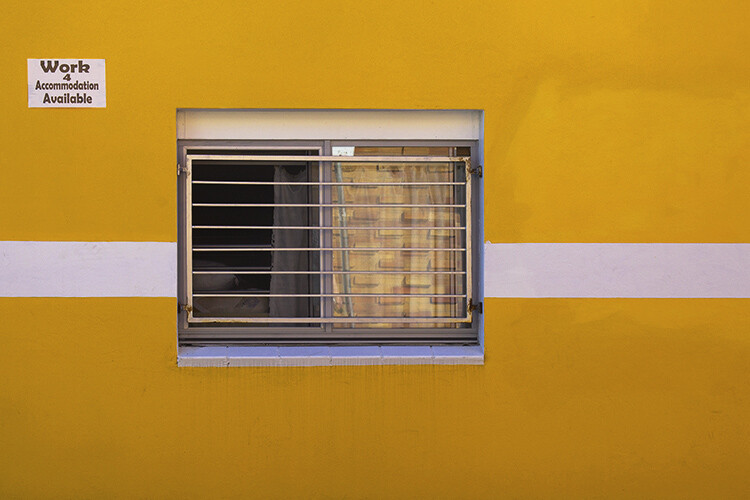
Often, the utilitarian components that make up an urban landscape are the same that serve as the best minimalist subjects. Minimalist depictions of nature tend to rely on the soft flow of organic structures. However, urban minimalist photography capitalizes on the bold lines of old buildings, fresh apartments, and upturned car parks.

Intermixed with bolts of color, texture, and juxtaposition, minimalist photography can be both subtle and loud at the same time. Photographers of minimalism capitalize on strong, stripped back elements to create both subtle and high-impact imagery. That’s why moving forward in minimalist photography often requires you to steep yourself in the very basics of photographic composition first.

Rule of thirds

The rule of thirds is a trick to help determine the overall composition of a photograph. Mentally divide an image up evenly into thirds both horizontally and vertically. The lines that intersect around the central rectangle indicate the points that capture the majority of a viewer’s attention. By offsetting important points in a photograph from the center rectangle, an image will feel more naturally appealing to your audience.

Minimalist photography relies equally on what has been included and excluded from an image. Composing a visually harmonious photograph with tools like the rule of thirds maximizes the short time a viewer has to engage with a photograph.

Tips for Minimalist Photography in an Urban Environment

This image is sectioned off into 9 even rectangles. The four central intersecting points indicate the focal points of the photograph.

Tips for Minimalist Photography in an Urban Environment

This image is an example of the rule-of-thirds in practice. No single component of the photograph lies directly within the center, guiding the viewer’s eye around the image rather directly to the center.

Color

Color has a language that establishes the atmosphere and emotional range of an image. Where traditional black and white highlights the form of an image, two or three highly contrasting colors can bring the facade of the urban environment to life.

Blocks of color convey vitality and hardness in an image, whereas a gradient is softer and more accommodating. Pastel color schemes depicted by many contemporary minimalist photographers deliver a surreal, dream-like quality to a photograph, while also alluding to childhood, disassociation and new-media aesthetics.

Tips for Minimalist Photography in an Urban Environment - color

Tips for Minimalist Photography in an Urban Environment

Isolated colors can add depth to an image and draw attention to details often overlooked in the urban landscape.

Tips for Minimalist Photography in an Urban Environment

Lines

Strong lines in minimalist photography carry the integrity of an image. Conveying depth and presence, bold lines leading in from the perimeter of an image grab a viewer’s attention and guide their eye through the artwork. Lines delineate the boundaries of different bodies within a space and can denote unrest at sharp angles or quiet emotion with organic ripples.

Horizontal lines are used as a device to indicate the horizon, perspective, or to completely upend a viewer’s sense of space altogether! When composing an image, follow each line through with your eyes. Adjusting the integrity of a line later in post-production can be extremely time-consuming. And the success of a minimalist photograph could (and probably will) count on it being exact.

Tips for Minimalist Photography in an Urban Environment

Leading lines reach the perimeter of the physical photograph and provide the viewer with a visual trail to follow into the interior of the image.

Shape

The compositional elements of line and shape often cross over in a visual plane. For example, the perimeter of a shape can be defined by its outer line, sectioning the interior of the shape off from the background of the image.

Sharp, inorganic shapes create unrest and action in an image, whereas smooth, organic shapes create a scene of peace, nature, and evenness. The urban environment consists of an inexhaustible array of sharp and smooth lines. Trying to bring the two spectra together creates a dynamic juxtaposition of design and emotion.

Tips for Minimalist Photography in an Urban Environment

Pattern and texture

Pattern and texture lift the image from the page. Texture is the physicality of an image, which engages with an audience by appealing to their sense of touch. Pattern, often combined with texture, adds detail to a photograph, revealing beauty the repetition of otherwise unobserved subject matter.

Minimalism and pattern can combine to emphasize size and number, delivering a feeling of sensory overload simply by the repetition of a single design. When limited to concentrated areas in an image, a pattern can serve as a disruption to the remaining landscape or as a contrast to emphasize negative space.

Tips for Minimalist Photography in an Urban Environment - texture

Textural images often depict the wear and tear of the urban environment in delightfully intricate detail.

Negative space

Negative space is what is not there which can be kind of confusing. It lends breathing room to an image. It allows the immediate subject matter to exist with little or no intrusion elsewhere in the frame.

As an example, an image of a single cloud, framed by blue sky neither intrudes nor detracts from the other, but the two exchange meaning nonetheless. The sharp contrast between vacant and overflowing environments means that urban landscapes are great for incorporating negative space into minimalist photography.

Tips for Minimalist Photography in an Urban Environment - negative space

The geometric pattern on the right of this image is offset by the negative space on the left. The relationship balances out the image overall and enhances the bold yellow streak down the middle.

Tips for Minimalist Photography in an Urban Environment

Conclusion

Minimalism has seen a considerable resurgence in recent years, especially in interior design and photography. A wealth of online curatorship means that tags like #minimal and #minimal_perfection unearth fresh, reductionist imagery by the second. Although the overwhelming volume of images may seem contrary to the principals of minimalism itself, the evolution of the modern landscape continues to create a wealth of opportunity for photographic artists looking to branch out or hone their skills in composition.

How do you use minimalist photography with your images? Please share in the comments below.

The post Tips for Minimalist Photography in an Urban Environment by Megan Kennedy appeared first on Digital Photography School.


Digital Photography School

 
Comments Off on Tips for Minimalist Photography in an Urban Environment

Posted in Photography