RSS
 

Posts Tagged ‘Tips’

Video Tutorials – Tips for Better Street Photography

10 Nov

Street photography is a great way to get out taking pictures, even in your own city. There is always something interesting you can find doing this kind of photography. Here are some videos to help you out with your street photography and taking better photos.

Street Photography for Beginners

In this video, Josh Katz gives some very practical tips on doing street photography including camera settings, and how to find good subjects. Even if you’re not new to street photography there are some good nuggets in here – give it a watch.

10 Simple Street Photography Tips

Here is a video from a photographer from Mumbai, India. You’ll see that his images may be more exotic than your locale, but the 10 tips are applicable wherever you live.

Now it’s your turn to get out there and do some shooting. Both videos mentioned the same tip – that photography is about experimenting, trying things and just doing it.

Happy shooting.

The post Video Tutorials – Tips for Better Street Photography by Darlene Hildebrandt appeared first on Digital Photography School.


Digital Photography School

 
Comments Off on Video Tutorials – Tips for Better Street Photography

Posted in Photography


Tips for Shooting Cityscapes Through a Window at Blue Hour

10 Nov

Shooting cityscape photos from inside a building (such as an observation deck of a tower, hotel room, etc.) pose a different set of challenges that you won’t experience shooting outdoors. Here are a few easy-to-follow tips for shooting the city at blue hour, with a focus on how to eliminate unwanted reflections from the glass.

Japan - Tips for Shooting Through a Glass Window of an Observation Deck at Blue Hour

Shanghai - Tips for Shooting Through a Glass Window of an Observation Deck at Blue Hour

Vietnam - Tips for Shooting Through a Glass Window of an Observation Deck at Blue Hour

The reflection-free shots above of Fukuoka skyline (Japan, top), Shanghai skyline (China, center) and Ho Chi Minh City skyline (Vietnam, bottom) were shot through glass windows of Fukuoka Tower, Shanghai World Financial Center Observatory and Bitexco Financial Tower respectively – following the methods described in this tutorial.

Bring a mini-tripod

In order to shoot at blue hour, a tripod is essential whether you’re shooting indoors or outdoors. But some observation decks don’t allow tripods because they are seen as a hindrance for other visitors. In that case, you may try to bring in a mini-tripod like a Gorillapod, as it’s unlikely to disturb other non-photography visitors.

Even if tripods are allowed, you may as well bring a mini tripod just in case, as it comes in handy when there is no suitable space to set up a regular tripod.

Gorillapod - Tips for Shooting Through a Glass Window of an Observation Deck at Blue Hour

Wipe the glass with a cloth

Glass windows of an observation deck aren’t always clean. Make sure to keep a cloth in your camera bag so that you can wipe an area to shoot through if it’s dirty. Obviously, you can’t wipe the other side of the window, though, so choose an area that has no stains, etc.

How to eliminate reflections off the window

This is the biggest challenge when taking photos through a glass window. The window works much like a mirror and it’s hard to completely prevent reflections (e.g. such as yourself, room lights) from showing up.

Typical tips to follow are shooting in close and as straight as possible to the glass (i.e. leaving a little gap between the glass and the lens so as not to let indoor lights creep in) and using a polarizing filter which helps cut reflections to some extent. Aside from these tips, I’d recommend the following “tools”.

Reflections - Tips for Shooting Through the Glass Window of an Observation Deck at Blue Hour

Ho Chi Minh City skyline (Vietnam) shot through the window of Bitexco Financial Tower. I tried my best by getting the lens really close to the window (almost touching it) and using a polarizing filter, but the room interior and stray lights still got reflected in the glass.

Using a DIY blackout curtain

This might be an old-school method, but I recently came across a photographer doing this on the observation deck of Shanghai World Financial Center (see below). Not advisable to use such a large curtain, though, as it blocks the view for other visitors and you’ll run the risk of being asked to leave by floor staff.

Blackout curtain Tips for Shooting Through the Glass Window of an Observation Deck at Blue Hour

Using a black jacket

I used to rely on this method and it worked relatively well. Set up a tripod very close to the window, and cover the whole rig (camera and tripod) with a black jacket to create a closed-in area around the camera so that no indoor lights get inside the jacket. Make sure to use a “black” jacket to reduce reflections, as a lighter-colored jacket does more harm than good and causes even more reflections.

Using black neck gaiter

This used to be my favourite method, as it doesn’t really catch the unwanted attention of other visitors (compared to using the jacket, etc.). The concept here is the same as using a jacket. To block any stray lights from getting in, wrap the black neck gaiter (neck warmer or scarf) around the lens and push the whole setup (camera and tripod) onto the window to completely shade the front element of the lens.

Jacket neck gaiter - Tips for Shooting Through the Glass Window of an Observation Deck at Blue Hour

Using a black jacket (left) and a black neck gaiter (right) to shade the front element of the lens and cut reflections from the window.

Using a lenskirt

A lenskirt is a tool specifically created to cut out reflections. This is what I’ve been using for the past few years with great success. By attaching a lenskirt to the front of your lens and the pushing suction cups onto the window, it shades the front element of the lens. This helps cut reflections from the window, leaving no chance for any stray light to get in.

With a black neck gaiter, I always had to make sure not to have vignetting (dark corners) by checking through the viewfinder (due to the edges of the neck gaiter getting too close to the lens). But the window-facing end of a lenskirt opens up like a softbox, so there is no worry of any edge vignetting being introduced.

Lenskirt - Tips for Shooting Through the Glass Window of an Observation Deck at Blue Hour

Conclusion

I hope these tips help you take reflection-free cityscape photos through glass windows of an observation deck on your next visit.

Lastly, you may wonder why I didn’t mention a rubber lens hood (which is said to work well for shooting through glass). I’ve tried it before but found it prone to vignetting, especially at a wide angle like 18mm or wider. And, when shooting cityscape photos from high above like an observation deck, you’re very likely to shoot wide, therefore I’ve excluded it from the list.

If you have any other tips or experiences using these suggested tools in this post, please share them in the comments below.

The post Tips for Shooting Cityscapes Through a Window at Blue Hour by Joey J appeared first on Digital Photography School.


Digital Photography School

 
Comments Off on Tips for Shooting Cityscapes Through a Window at Blue Hour

Posted in Photography


3 Tips for Experimenting with Shutter Speed Creatively

08 Nov

So what exactly is shutter speed? In its simplest form, shutter speed refers to the length of time that your camera sensor is exposed to light (the shutter stays open) while taking a photo. A faster shutter speed thus lets in less light and a slower shutter speed lets in more light.

3 Tips for Experimenting with Shutter Speed Creatively

You may already be aware that shutter speed is one of the three elements of the Exposure Triangle that work in tandem. Thus changing your shutter speed leads to changing one of the two other elements (aperture and ISO) to compensate for your exposure.

Of the three, shutter speed is the one that allows you the most creative versatility. If you want to use shutter speed to make more artistic choices, let’s start with some basics.

1) Freezing Motion

Freezing action or motion happens at faster shutter speeds and literally captures a moment in time. If the shutter is open for a long time and your subject is moving, it looks blurred. On the converse side, when you have a faster shutter speed, any movement (blur) is less noticeable as it’s more frozen.

3 Tips for Experimenting with Shutter Speed Creatively

Sports photographers especially, take advantage of freezing motion techniques. Capturing that moment a player strikes a ball, crossing a finish line or just as that knockout punch is delivered is important in that genre of photography.

2) Panning

Panning is a technique where your moving object appears in focus, but the background appears to be moving at a higher speed. When using this technique, pick a subject that moves across your field of vision from side to side and not coming toward or moving away from you.

3 Tips for Experimenting with Shutter Speed Creatively

Pre-focusing at the distance where the subject will be when you shoot is a good habit. This is because autofocus can easily switch your camera focus to the background, instead of keeping it on the subject.

Lastly, your follow-through is a very important aspect of panning.

3 Tips for Experimenting with Shutter Speed Creatively

For example, if you are shooting a car, pre-focus on the road or area where the car will be. Then aim your camera in the direction that the car is coming from, and when it is almost in front of you, hold down the shutter button (make sure to set it to high-speed burst mode) and move your camera with the car’s movements.

Note: Pre-focusing helps you minimize shutter lag.

3 Tips for Experimenting with Shutter Speed Creatively

This technique takes some practice but is a lot of fun. If you find that your background is still sharp, use a slower shutter speed and retry. For best results, try and match the speed at which you pan with the speed of the object.

3) Slowing it down

Slow shutter times are when you leave the camera shutter open for much longer than normal. This is a highly creative effect and helps you show motion like movement in a crowd, light trails or fast flowing water. With slower shutter speeds, a tripod is an essential asset to avoid camera shake. You can also invest in a remote trigger or cable release to minimize shake even more.

3 Tips for Experimenting with Shutter Speed Creatively

When your shutter is open for long periods of time, you risk having too much light enter your camera. To help with this, you can use a smaller aperture (higher f-number), shoot at a low ISO, or cut the amount of light using filters.

Neutral Density (ND) filters are a landscape photographer’s best friend when it comes to shooting long exposures during the day. Slower shutter shooting is more widely known as long exposure photography.

3 Tips for Experimenting with Shutter Speed Creatively

An extremely long exposure here has made the water smooth and dreamy.

3 Tips for Experimenting with Shutter Speed Creatively

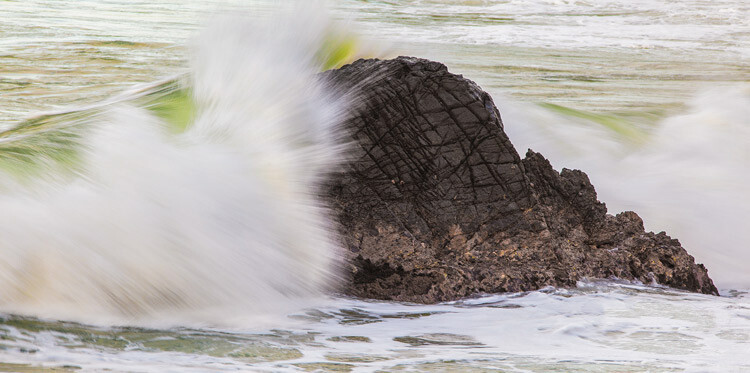
A faster shutter speed here has partially frozen the crashing wave.

Bonus: light painting with the shutter opened

This technique, also called light painting, is where you make images in a dark place (usually) by moving a hand-held light source (or by moving the camera), while your shutter is open. If you are moving the light source, you need the camera to be steady.

3 Tips for Experimenting with Shutter Speed Creatively

As in the previous tip, a tripod is recommended, but nothing is wrong with embracing blur as part of your creative technique. Once you are ready, dial in a slow shutter speed and set up a timer. Now use any handheld light source (e.g. torch, flashlight, light-stick or cellphone) to “paint” in your scene. It’s a cool approach you can use when storytelling.

Conclusion

Do you have a favorite way to use shutter speed creatively? Are you a fan of freezing motion or do you prefer long exposures? Have you ever tried panning or light painting? Share some of your work with us in the comments below.

The post 3 Tips for Experimenting with Shutter Speed Creatively by Nisha Ramroop appeared first on Digital Photography School.


Digital Photography School

 
Comments Off on 3 Tips for Experimenting with Shutter Speed Creatively

Posted in Photography


Simple Tips for Positioning Your Portrait Subject to Leverage Natural Light

06 Nov

When I’m on a photo shoot, I always carry two flash guns with me. However, when it’s a family outing or holiday, the flash guns are left behind in favor of kiddie stuff I need to lug around and I shoot using purely natural light, without even a reflector to help. It does help that I carry a prime lens that opens up to f/1.4 should I need or want to shoot indoors.

Here are my tips for making portraits using purely natural light.

On a sunny day, there is so much light that it makes it quite hard to take portraits, contrary to what many would think. I generally don’t like taking portraits with the sun directly hitting the face of my subject, so that makes the job even harder on such a bright day.

Simple Tips for Positioning Your Portrait Subject to Leverage Natural Light

The first thing to be mindful of is the direction of light – is it coming from overhead, at an angle of 45 degrees or higher or lower? As you cannot physically move the sun, you are going to have to move your subject instead. Think of positioning your subject as leveraging natural light to make a pleasing portrait.

Outdoors

Here are some outdoor scenarios where you can position your subject and avoid direct bright sunlight.

In the shade

My go-to (and easiest) spot is a shaded or sheltered area. Ideally, find a large enough shaded area so that your entire subject is covered in shade. You don’t want dappled light or parts of the body overexposed by being in the sun while the rest of the person is in the shade.

Areas of shade could be under a tree or in the shadow of a tall structure such as the wall of a building as in the photo on the left below. This gives you even lighting over a large area and even exposure too with no hard shadows.

Compare the left photo to the right one where the subject is wearing a hat. I metered on her face and because she was furthered shadowed by the hat, the exposure increased a tad and the rest of the image then got brighter. This can be evened out quite easily in post-production by adding a soft vignette.

Simple Tips for Positioning Your Portrait Subject to Leverage Natural Light

With a very bright backlight

Sometimes you find yourself at a location that doesn’t offer enough shade or there is a lack of large structures to provide shelter. You would end up shooting in a bright wide-open space and your only option is to shoot backlit or at least provide shade to your subject’s face.

The difficulty with shooting backlit is that you would need to have ample fill light to compensate for the very strong backlight. You can either use your camera’s built-in flash or use some kind of reflector. That could be a light-colored piece of cardboard or a natural reflector in the vicinity, such as a bright path or wall that reflects strong sunlight back onto your subject’s face.

Shooting in an open or semi-open space, like the black and white photo above, where the backlight is a lot stronger than the light illuminating the subject it gets complicated. Unless you are using a flash to counteract the backlight, the background will be blown out. Even if you shoot with a small aperture, the difference in the amount of light between the subject and the background will be too great to get an even exposure without using a fill flash.

Natural reflectors

In the photo below, this was not taken in a fully open space but the shade there was weaker. The hat provided more shade to her face and you can see the left side is a little darker than the right. That makes for a nice gradation of light and shadow as opposed to a flatly-lit portrait.

I leveraged a natural reflector here which was just to camera right – a light colored parasol which reflected the sun onto the girl’s face. You can also see that the background was a lot brighter and more washed out compared to the first photo above left. But it is showing some foliage compared to the photo above right, hence there is more detail rather than just a white blown out sky.

When I find myself in situations like these, I make sure my main focus is the subject’s face and I don’t mind the background being blown or washed out. After all, I am after a portrait of the subject.

Simple Tips for Positioning Your Portrait Subject to Leverage Natural Light

Light from above

Compare the two photos below. The left photo is shot with fairly flat lighting on the face. I made sure the subject was in full shade and the light coming from both the right and left sides was even.

The photo on the right is different in that I asked her to look up a little, thus using the light coming from above and creating a slight gradation of shadow on the right side of her face. Simple positioning of the face in relation to the light source makes a big difference in how your photos look.

Simple Tips for Positioning Your Portrait Subject to Leverage Natural Light

Indoor lighting

In comparison to outdoors, there is usually only a fraction of the amount of light indoors, even with a window present. However, this works to your advantage. The light source is usually one-directional unless you have many windows, and therefore you can use this it to sculpt your subject’s face as it were, choosing where the shadows will fall and creating a moody portrait.

The light in the photo below left was coming from a big window, high up at about 30 – 45 degrees to the subject. You can see the shadow falling on the opposite side of her nose and cheeks creating a darker, moodier feel to the image compared to the photo on the right shot outdoors. Even with just a single light source indoors, you have enough light to play with and create the ambiance you want to portray.

Simple Tips for Positioning Your Portrait Subject to Leverage Natural Light

Over to you

Whether indoors or outdoors, it is always important to be mindful of where the light is coming from, how much light there is, and if there is any contrast of light and shade in the space. Knowing how to leverage the natural light allows you to create the type of mood you are after in your portrait.

Understanding this and practicing how to use available light will make you a better photographer.

The post Simple Tips for Positioning Your Portrait Subject to Leverage Natural Light by Lily Sawyer appeared first on Digital Photography School.


Digital Photography School

 
Comments Off on Simple Tips for Positioning Your Portrait Subject to Leverage Natural Light

Posted in Photography


Video Tips for Better Food Photography

03 Nov

Food photography has become more and more popular. In fact, many restaurants complain that their patrons don’t eat the food before it starts to get cold because they’re too busy taking photos of it for Instagram and Facebook.

Whatever you’re eating, and wherever you’re sharing your food photos – here are some tips to help you take better, more appetizing food shots.

#1 – Lighting tips with Andrew Scrivani

In this video, you will get some really good tips for creating good lighting for food photography. Then see how he applies it in an example photo shoot.

#2 – 5 tips for better food photography composition

Composition is just as important in food photography as lighting. In this video, see 5 different ways to do food composition. Notice his first tip is to use a tripod!

#3 – Tips from a food blogger

Food blogger and author, Izy, has some really practical tips you can use for your food photography in this short video.

Learn about:

  • Light: Using natural light for food and diffusion
  • Camera angles: Which are the best for food
  • Styling: Tips for props and how to make the photo interesting
  • Camera settings: What are the optimal settings for food and why
  • Editing: Why you want to shoot raw file format

Give those a try when you’re doing your next food photography shoot.

The post Video Tips for Better Food Photography by Darlene Hildebrandt appeared first on Digital Photography School.


Digital Photography School

 
Comments Off on Video Tips for Better Food Photography

Posted in Photography


7 Tips to Get More Creative Photos of Well-Known Landmarks

02 Nov

Photographing landmark buildings when you visit a new place, or even places closer to home is a great way to get stand out photos. Often the architectural beauty of the natural or man-made landmark will make the image dramatic, you simply need to compose the photo well.

In this article, you’re going to see the standard photo, and then how to make more creative images of well-known landmarks. You’ll see a case study of how to shoot one particular landmark in many different ways.

7 Tips to Get More Creative Photos of Well-Known Landmarks

This photo was taken from the Trader’s Hotel in Kuala Lumpur. It shows the Petronas Twin Towers.

1 – The standard photo

Ahead of photographing more creative images of landmarks the aim is to make the best standard photograph you can. Chances are that a quick search on a photo sharing site like 500px.com will reveal this, so there is no need to re-invent the wheel here.

Once you know which landmark you want to photograph, the next step is to find out where that photo was taken from, if the same image has been taken many times there will likely be a viewing platform.

Once you are in position it’s time to compose your photo. It’s better if you can use a slightly different composition to those used before, perhaps try a vertical shot.

The last step is to ensure you have good images to process once you return home. Bracketing your images when the sky is brighter than the foreground will allow you to use creative post-processing techniques like digital blending. Alternatively, you can use graduated neutral density filters, and get your photograph exposed correctly in camera, with a single frame.

2 – Paint with light for creative images of landmarks

7 Tips to Get More Creative Photos of Well-Known Landmarks

This photo shows how light painting can be used to create your own image.

One of the most creative things you can do in photography is light painting. There are several forms of this technique and each can give you dramatic results.

This is innovative in that the results will be your own, and difficult for someone else to replicate. Let’s take a look at the different forms of light painting that you could try.

  • Light painting – Most people know light painting as writing their name with a torch (flashlight) in front of the camera. How about light painting around a landmark to add a creative edge? Those really interested in should look into buying the pixelstick.
  • Kinetic light painting – This refers to moving the camera, as opposed to moving the light source. Examples of kinetic light painting are camera rotation and zoom bursts.
  • Lighting up an object – You can light up a landmark using a strong flashlight, providing it’s not too far away. Using lights to brighten a landmark can make it stand out even more in the frame.
7 Tips to Get More Creative Photos of Well-Known Landmarks

Camera rotation is a good way to make a creative image of a landmark.

3 – Infrared photos of landmarks

Make creative images of landmarks by using infrared photography! There are several avenues to achieving this look, and you have a choice of in-camera or post-processing.

The classic infrared photos show lots of foliage, sky, and usually a water element. The effect creates a dreamscape image by turning the sky black, and the foliage white. Infrared photography is best done on a clear sunny day, with a few clouds to create more interest.

The following are the three avenues open to you to create these photos when shooting with a digital camera.

  • Take a normal photo, and use post-processing to give the image the look of an infrared photo.
  • Add an infrared filter to the front of your lens. To get the infrared look you will need to take your file and process it on the computer.
  • Convert your camera body so that it’s usable for infrared photography, again further processing will be required.
7 Tips to Get More Creative Photos of Well-Known Landmarks

Though this photo uses the same composition of a previous one above, the mood is changed by using an infrared technique.

4 – Get those detail photos!

It’s always a good idea to take some detail photos of a landmark, these are texture images that often use repeating patterns. When photographing a landmark building, whether it’s old or new, you can use bricks or glass windows to create these texture photos.

Photos of natural formations will also have good details. Cliff faces may, for instance, have good lines and textures in them. The aim with this type of photo is to show detail, but at the same time make it obvious which landmark you are photographing. This could be structures that are unique to that particular landmark.

When shooting glass windows, is there a reflection in those windows that will give the photo context? When photographing landmarks always try to get detail photos to add more variety to the set of photos.

7 Tips to Get More Creative Photos of Well-Known Landmarks

Creative images of landscapes can be achieved using detail photos. The metallic structure of the tower and the Malaysian flag lend context.

5 – See another world with refraction

An alternative way of producing a unique landscape image is through using refraction. A transparent spherical object will be needed for this, there are several options available. The best objects for producing this effect are a wine glass filled with water, a crystal ball, or perhaps a clear marble.

This is a great way of capturing a large area of your scene, with the effect in the refracting object being similar to a fish-eye lens. The image inside the ball will be upside down, so managing this aspect of the photo is important. This technique is a lot of fun, though the need to carry around a heavy glass ball can be taxing.

7 Tips to Get More Creative Photos of Well-Known Landmarks

Refraction is a great method of producing a unique image, this one also shows a reflection.

6 – Long exposure for artistic effect

A great way to produce creative images of landmarks is to play around with long exposures. This is a variable that can be used in different ways to great artistic effect. It’s more common to carry out long exposure at dusk, or during the night; however using an ND filter will allow you to take long exposures during the day.

Here are three ways you can use long exposures:

  • Car light trails – This is a form of light painting. In this case, the car headlights will paint their way through your frame, along the road you’re photographing.
  • Cloud movement – If there are clouds in the sky, and they’re moving fast enough, you can use a long exposure to capture this motion.
  • Moving water – Similar to the above cloud movement, but with water! The main subject is, of course, your landmark, but if that landmark has water near it, then use that to your advantage.

All good landscape photographers carry a tripod, and anyone planning this type of photo will need one. Your exposures will be anywhere from one second to several minutes long.

7 Tips to Get More Creative Photos of Well-Known Landmarks

Long exposure photos of car light trails are a staple of photography. Here the road leads up to the Petronas towers on the horizon.

7 – Change your vantage point

The angle that you photograph a landmark at can have a dramatic effect on the type of photo taken. Today the sky literally is the limit, as drones allow for the overhead photos that were previously out of reach.

But a drone is not the only way to achieve a good photo by changing your vantage point. The standard photo is that at street (eye) level, so any variant on that changes the type of photo.

  • Bird’s eye view – This type of photo is taken from a high vantage point, where you will photograph downwards. The most extreme example would be a drone, or perhaps an airplane.
  • Worm’s eye view – The opposite of a bird’s eye view, this is taken from street level looking upwards. You will need to be close to the landmark you are photographing.

The challenge with this is finding a good location that allows a view of your landmark. In the city, this will mean getting access to a rooftop, or viewing platform. In a more rural setting, it means climbing a mountain!

7 Tips to Get More Creative Photos of Well-Known Landmarks

A worm’s eye view can give you a different style of photo.

How will you make creative images of landmarks?

There are many ways to photograph a famous landmark in your own unique way. How do you go about putting your own stamp on a location that has been photographed many times before?

Have you tried any of the above suggestions? Can you revisit one of your previous photo locations, and photograph it totally differently? We’d love to see the results of your work past and present, please share with the community in the comments area below.

7 Tips to Get More Creative Photos of Well-Known Landmarks

The Petronas Towers in Kuala Lumpur has been photographed many times. It can be a challenge to find a unique photo.

The post 7 Tips to Get More Creative Photos of Well-Known Landmarks by Simon Bond appeared first on Digital Photography School.


Digital Photography School

 
Comments Off on 7 Tips to Get More Creative Photos of Well-Known Landmarks

Posted in Photography


6 Tips To Help You Shoot In Low Light Without a Tripod

31 Oct

Most photographers will tell you that a tripod is invaluable and is usually the favorite accessory that they carry with them. While a tripod remains an essential piece of equipment, especially for low light photography, it is also usually the one piece of camera equipment that draws the most amount of attention.

In some scenarios and places, you won’t be allowed to use a tripod so you have to find other ways of utilizing your camera to take the photo you want. Here are six tips to help you capture photos in low light without a tripod.

6 Tips To Help You Shoot In Low Light Without a Tripod

#1 – Raise the ISO

The first option that most people will turn to is to raise the ISO setting in the camera. Principally, the ISO is the sensitivity of the camera’s sensor to light. The higher the ISO the more “sensitive” the sensor becomes to light which in turn means you can capture more detail in low light conditions. In simple terms, the darker your scene is, the higher you need your ISO. But before you start whacking your ISO up to 25,600, beware that raising the ISO also has a detrimental effect on the image.

The higher your ISO setting, the more noise you’ll see in your photo. Too much noise and your photo will begin to start looking soft. The key to being able to use ISO effectively is to balance it with other elements such as shutter speed and depth of field to be able to capture the shot you want.

Always aim to have your ISO as low as possible. Also, make sure you test your camera at different ISO settings before you use it for an actual photograph you intend to take.

Taken at ISO 4000. It was the only way that I was able to capture a photo in this dark tunnel.

#2 – Use Mirror Lock-Up and Live View Mode

Have you ever taken a photo with a tripod, with good depth of field, at a slow shutter speed only to see the final photo on your computer is slightly blurred? This is one question that has often baffled novice photographers but there is a simple solution.

When you press the button to take a photo, the mirror inside the camera flips up out of the way. This mechanical process can mean that there is a slight movement in the camera, which in turn causes a small shake, hence the blurred photo. To get around this problem, you can set your camera to Live View mode (when you get a live picture on the display of your camera) which essentially flips the mirror up permanently (until you switch off Live View mode) and means that when you take the photo you don’t get the movement the camera. Some cameras also allow you to “lock the mirror” without using the live view mode (so using your viewfinder).

This issue would be the same when photographing without a tripod in low light conditions. So in this scenario, set your camera to Live View mode/mirror lock-up to avoid that small, unwanted camera shake.

6 Tips To Help You Shoot In Low Light Without a Tripod

#3 – Use High-Speed Burst Mode

One of the great innovations of modern DSLR cameras is how much faster you can now take photos in burst mode. Using a high-speed burst mode is a really good trick to capturing decent photos in low light. But this only works when your shutter speed is just below the threshold of you shooting handheld.

For example, if you can hold your camera steady enough to take a sharp photo at 1/60th, you may be able to get away with using high-speed burst mode and using 1/45th or even 1/30th of a second. This is because with high-speed burst mode you have less time in between photos for the camera to move and often you’ll find one or two photos sharp enough for use in the middle of the burst.

Just remember to use high-speed burst as some cameras also offer low-speed burst option and aim for a good number of photos. You’ll also be well advised to try out this trick a few times to find out what your threshold is before you use it in a real-life situation.

6 Tips To Help You Shoot In Low Light Without a Tripod

#4 – Find a Ledge or Wall

Often your best bet for capturing photos in low light is to find a ledge or wall that you can rest your camera on. Not only does this mean you can have your settings at pretty much exactly what you would with a tripod, but you can also often find interesting camera angles which are different to traditional photos you’d see taken with a tripod.

One thing to be aware of is that you may need to raise your lens up slightly. Otherwise, you may see the ledge/wall in the foreground of your photo. You can use anything you can find or have with you to slightly tilt the lens upward.

6 Tips To Help You Shoot In Low Light Without a Tripod

I found a small ledge in this old church that I was able to rest the camera on to take this photo.

#5 – Use Your Bag

Over time you’ll begin to pick up tricks and techniques that you will use in your photography. One of the most useful that I have found has been to simply use my backpack. Put it on the floor and put your camera on top and you have a quick tripod without all the attention that a tripod brings.

This trick has been really useful in buildings and places where tripods are not allowed like museums or galleries. You can put your bag on benches and even rest it on a branch of a tree (as I did once).

6 Tips To Help You Shoot In Low Light Without a Tripod

#6 – Train Yourself

Like anything else photography is something that you can improve your skills. This is also true of actually being able to hold the camera steady. So start by practicing your stance and make sure that you are holding the camera as securely and comfortably as you can.

Work on your composure and try to teach yourself to relax when you are going to take the photo. By practicing over and over again you may find that you actually can hold the camera at slightly slower speeds than you were able to before.

6 Tips To Help You Shoot In Low Light Without a Tripod

Conclusion

There’s no question that if you want to capture the best possible photos at the best quality in low light conditions, then a tripod will give you the best results. But in situations when that might not be possible, using the tips and tricks above might help you capture the shots you need.

Anything else? What tricks do you use to capture photos in low light conditions without a tripod?

The post 6 Tips To Help You Shoot In Low Light Without a Tripod by Kav Dadfar appeared first on Digital Photography School.


Digital Photography School

 
Comments Off on 6 Tips To Help You Shoot In Low Light Without a Tripod

Posted in Photography


4 Tips for Beginners to Food Photography

27 Oct

Food photography is everywhere – restaurants, bars, advertisements, shop windows, billboards, blogs, menus, books – the list is endless. Interestingly enough, when done right these images not only catch your attention but may have an impact long after you’ve seen them.

4 Tips for Approaching Food Photography

The work that goes into food photography is no small feat and usually starts with a story. Is it something you are trying to sell? Is it food you created and want to convey that it is your best recipe yet? Does your food story have a cultural side or is it a moody, artistic piece? Food photography is a vast intricate topic, but if you are just starting out, here are a few things to keep in mind:

1) Light to accent the food’s character

Controlling light can elevate your food photography easily as it helps you take charge of your end result. A good starting place to set up is near a window with lots of natural light – a look that is often simulated when shooting food in a studio – with light skimming across at an angle.

4 Tips for Approaching Food Photography

This scene evokes feelings of food just made and laid out, waiting to be consumed. No matter what light source you use, keep the subject in mind and modify the light if needed. Modifications can be as simple as changing color temperatures to be more flattering or diffusing your light.

Back or side lighting usually works well for food, so try them both and see what works best for your subject.

2) Textures and Layers

While textures and layers are two different aspects of food photography, they sometimes have a symbiotic relationship.

Textures are an easy way to add personality and character to your image and layering helps you tell the story. Textures range from using your work surfaces, contrasts in the food itself or even by bringing in a prop or two.

4 Tips for Approaching Food Photography

Your composition can benefit from layering elements in the photo that portrays your food – props and ingredients for example. Further, introduce textures and layers by using contrasting backgrounds on your work surfaces, e.g., a metal baking tray on a tiled counter top or wooden table.

By building up layers you give the final image interest and depth. You want the food to look delicious and interesting, not lifeless or unappetizing.

4 Tips for Approaching Food Photography

A nice rule is to keep layering and styling your subject until you want to eat it.

3) The power of neutral backgrounds

Keeping the previous tips in mind, a good starting place is a neutral background to build on. It can be plain or even textured, but when you start neutral you can create many different looks with a few simple changes.

Use the food and layers to introduce color, shapes, lines and more texture. The background is not intended to be the main focus but is used to add interest and enhance your final image.

4 Tips for Approaching Food Photography

If you are creating food image for stock photography, you will see many images done on solid white or black backgrounds. This is done intentionally so that the food is the focus and not the storytelling element.

4 Tips for Approaching Food Photography

4) All about the angles

The most recommended angles for food photography are directly above, straight on, or at a forty-five degree/three-quarter angle (can vary slightly). Determine how close you want to get to the food. Do you want to show something specific or an entire scene?

Keep the subject in mind – some food looks very good close-up, while others benefit from the environment and story.

4 Tips for Approaching Food Photography

Bonus Tip

When you start doing food photography, it will not take you long to realize that it is not as easy as it looks. Many food photographers use a food stylist to help them materialize their vision, as styling is a skill in its own right.

If you are just starting out, by all means, experiment. But if you can use a food stylist, there is a great deal you can learn from the way they work and develop your own style and technique.

Conclusion

4 Tips for Approaching Food Photography

Food photography is an extremely satisfying genre because of all the attention to detail it requires. It is an expansive topic with many tips and tricks needed to create that perfect delectable shot. These are just a few to consider as you start your journey. Feel free to share any tips you have come across or used in this delicious genre in the comments below.

Check out some of our food photography video tutorials tips as well.

The post 4 Tips for Beginners to Food Photography by Nisha Ramroop appeared first on Digital Photography School.


Digital Photography School

 
Comments Off on 4 Tips for Beginners to Food Photography

Posted in Photography


4 Tips for Low Light Photography During the Winter

26 Oct

With fall here and winter fast approaching as well, the sun sets earlier in the day and most of us will be confined to shooting indoors. Whether you are shooting during the day or in the evening after the sunset, adapting and embracing shooting in low light will be beneficial to help you continue working on your photography skills and other personal photo projects.

If you are like me and work all day and come home in the evening to pick up your camera, you may be further limited to shooting right around sunset or utilizing artificial light sources only.

Low light indoors winter 10

There was a time not long ago when I used to hate photographing my kids in low light. I was nervous about increasing the ISO and adding noise in my images or worried about reducing the shutter speed and causing camera shake. But slowly over time, I started to get used to working with various light sources around me creatively and utilizing them in my images.

If you are new to shooting in low light, here are some simple tips that could be helpful without the fear of shooting indoors in low light or using artificial light.

1. Shoot wide open and/or use a slow shutter speed

Although this may not be the best solution all the time with multiple people in the image indoors; but shooting wide open (as much as your camera allows) helps you get more light in the image. Making sure your focal points are aligned on the subject where they need to be, this could help you with that low light shooting you are struggling with.

Low light indoors winter 1

Low light indoors winter 2

Another option would be to consider using a slow shutter speed. A shutter speed of 1/200th or slower to 1/100th doesn’t always produce camera shake when handheld and lets more light in as well. There’s always the option of using a tripod, however, keep in mind that this may not be feasible when photographing kids in action.

Low light indoors winter 3

2. Crank up that ISO and embrace noise

Having a camera with low light capabilities sounds great. However, if you are on a budget and need to work with what you have, consider cranking up your ISO as high as you can after adjusting your shutter speed and aperture.

Consider embracing the noise or grain produced and using it in your images creatively. Converting an image to black and white during post-processing also helps hide any yellow light indoors you may have from artificial sources after hours.

Low light indoors winter 4

Low light indoors winter 5

Low light indoors winter 6

Low light indoors winter 7

Consider using alternate artificial light sources such as an iPad light, refrigerator light, desk lamp, etc., for extra creativity.

Low light indoors winter 8

Low light indoors winter 9

3. Find pockets of light

Open up windows, blinds, and curtains. Pockets of light and shadows add to the drama and create depth.

Once you get home from work in the evening, look around to find any little pockets of light that you can use. This may be right around the golden hour (one hour prior to sunset) and you will find some amazing light peeking through the windows if you time it just right. Utilizing this light will produce some amazing shadows and you can create some moody images as well.

Low light indoors winter 11

Low light indoors winter 12

Low light indoors winter 13

4. Dust off your flash and practice using it

When all else fails and I need to turn my lights on after hours, I rely on my Yongnuo flash unit and simply bounce it off the nearby walls. A lot of times I hear from other photographers (who limit themselves from shooting indoors during evening hours) that using flash is really complicated. I set my flash unit on ETTL and power it accordingly to get more or less light in the image based on how many artificial light sources I have turned on in the room.

Low light indoors winter 14

Low light indoors winter 15

Conclusion

In conclusion, all of the tips above are not always an either/or situation. Most of them can be used together such as combining a slow shutter speed along with increasing the ISO while shooting in a pocket of light with the blinds open when you really have those corner rooms with less light!

While doing the above and balancing your exposure creatively, you can create moody images with some drama. In summary, shooting in low light or the use of artificial light doesn’t have to be that intimidating. Give it a trying show us what you come up with in the comments below.

The post 4 Tips for Low Light Photography During the Winter by Jyotsna Bhamidipati appeared first on Digital Photography School.


Digital Photography School

 
Comments Off on 4 Tips for Low Light Photography During the Winter

Posted in Photography


12 Tips for Better Nighttime Event Photography

25 Oct

There’s no way around it: doing nighttime event photography is tricky. Festivals, ceremonies, parties, and parades involve fast action, difficult lighting conditions, and hectic environments. It’s no wonder that first attempts at nighttime event photography often result in blurry and unusable images. Fear not – this article will help you get up to speed.

12 Tips for Better Nighttime Event Photography

1.  Know the pros and cons of different lens types

Instead of telling you, “use a fixed focal length lens with a wide aperture,” I want you to maintain an open mind to zoom lenses. Prime lenses are my first choice for shooting nighttime events where I’m free to move and get close to my subjects. However, for events where I’m confined to the audience or press section, I need the ability to zoom, frame, and isolate subjects without moving all that much.

In this article, the example images are a 50/50 mix of fixed focal length and zoom lenses. Through this, you’ll see what is possible with each type. Although zoom lenses with wide apertures (i.e., a Nikon 24-70mm f/2.8) are often said to be ideal for nighttime events, they are extremely expensive pieces of equipment.

12 Tips for Better Nighttime Event Photography

A scene from the Keelung Ghost Festival parade on September 4th, 2017 – Taiwan. This is a solid example of a nighttime event for which I chose a zoom lens over a prime. I was shooting from the press sectionthe edge of a wide boulevard on the action side of the crowd barrierand I could only move from side to side, not towards the action. Therefore, the ability to frame shots using a zoom lens was crucial to me.

2. Focus on the interplay of shutter speed, aperture, and ISO

Because creating a correct exposure is a balancing act between various settings, the next step is to focus on the interplay between shutter speed, aperture, and ISO. Generally, you want your nighttime event images to be sharp; therefore, make a fast shutter speed your priority.

With a prime lens, select a wide aperture (try f/2.8) and increase the ISO until your test shots register a shutter speed of 1/125th or preferably higher. Shooting wide open (i.e., f/1.4 or f/1.8) will result in slow autofocusing and you missing your shot. Go higher to avoid these problems.

With a zoom lens, select the widest available aperture available (i.e., f/4.0) and crank the ISO up high. I usually select ISO 3200 and fire off some test shots of a moving subject. Using these settings in aperture priority mode, I was able to achieve a shutter speed of 1/640th for the image below.

12 Tips for Better Nighttime Event Photography

A costumed performer dressed as a Chinese god runs straight towards me – Keelung, Taiwan. 1/640th | f/4.0 | ISO 3200 | Canon 24-105mm f/4 L.

3. Utilize available light

For my style of travel photography, I rarely use a flash; I prefer the results from utilizing available light. It takes a great deal of skill to use a flash in a way that compliments your images rather than detracts from them. Therefore, I recommend saving it for a later, more advanced stage of your photography journey.

12 Tips for Better Nighttime Event Photography

Pirouetting gypsy-style dancers amaze the crowd – Keelung, Taiwan. 1/250th | f/4.0 | ISO 3200 | Canon 24-105mm f/4 L. I waited until these dancers were beneath a spotlight to utilize this light source and achieve a faster shutter speed.

4. Get close to the action

Get as close as possible without disturbing the event’s participants. For the image below, I was in Manipur, a remote Indian state on the border with Myanmar. I sat cross-legged just as the boys opposite me were doing, which was fine until the real fighting began. This martial arts demonstration took place after dark in a poorly lit pagoda. It was hard enough to focus my eyes, let alone my camera. I had to push my ISO to the limits, even though I was using a prime lens.

The ancient Manipuri martial art of Thang Ta. This was the most challenging lighting condition I have ever shot in.  1/80th | f/1.4 | ISO 25,600 | Sigma 35mm 1.4 Art. You read that right – ISO 25,600! Note the noise.

5. Ask your subjects to move

At nighttime events, I am always on the lookout for well-lit spots. I want a place with bright artificial light that I can utilize to increase my shutter speed. Once I’ve found both the spot and my willing portrait subject, I ask them if they would be kind enough to step into the light. This is the best method for capturing beautiful portraits at nighttime events without a flash.

12 Tips for Better Nighttime Event Photography

Girl of the Meitei ethnic group at the Lai Haraoba festival – Manipur. The temple where the festival was taking place was dimly lit; however, one corner had the light I was looking for. She agreed to move, which allowed me to achieve a shutter speed of 1/200th.

6. Use continuous shooting mode

Once you have nailed your settings in combination with the available light, I recommend that you set your camera to continuous shooting mode. Take a look at the image below. I took five similar shots within fractions of a second of each other, and could then select the image with the best composition, facial expressions, and lighting when I was back at home.

Children’s rollerblade display team at the Ghost Festival parade – Keelung, Taiwan. 1/250th | f/4.0 | ISO 3200 | Canon 24-105mm f/4 L

7. Observe, anticipate, and shoot

Another technique is to spend time observing the event. Look for patterns in movement and people that would make the best subjects. Try to compose the shot you want to take in your head. Next, get into position and select your settings. Anticipate what is likely to happen and be ready when it does. Finally, shoot away.

12 Tips for Better Nighttime Event Photography

Ladies performing a dance for the Lai Haraoba festival – Manipur, India. The dance involved moving slowly in a circle for one hour or longer. I was able to observe full rotations, anticipate exactly where to stand for the best view and light, and then shoot when the ladies came back around.

8. Frame using the environment and set the scene with the background

This is a valuable technique for increasing the visual interest and storytelling elements in your nighttime event shots. Be on the lookout for environmental features, which could also take the form of other people, to frame your shots. Take a look at the example below.

The younger Manipuri ladies watched their elders’ intricate hand movements to check if their own were correct. To communicate this detail, I framed the shot from behind the two oldest women and used their heads to frame the younger ladies looking back at them.

9. Move and use your feet

Your legs are your zoom when you’re using a fixed focal length lens. Throw yourself into the action. Crouch, climb and run your way to finding interesting angles and available light. In the image below, I left my seated position among the crowd, stood below the stage looking up at the priest, and composed the shot.

12 Tips for Better Nighttime Event Photography

Hindu priest performing the Ganga Aarti ceremony – Varanasi, India. 1/125th | f/1.4 | ISO 1250 | Sigma 35mm 1.4 Art

10. Interact with your subjects

Get the attention of your subjects and make eye contact before raising your camera. I remember waving, smiling, and shouting “Ni hao!” to the performer in the image below, which led to a series of interactions and photo opportunities.

12 Tips for Better Nighttime Event Photography

A performer at the September 4th Ghost Festival parade in Keelung, Taiwan interacted with me directly after I initiated contact. 1/125th | f/4.0 | ISO 3200 | Canon 24-105mm f/4 L

11. People expect to be photographed. Don’t hold back.

This isn’t street photography. The protagonists and guests at your event, particularly festivals and parades, probably expect to be photographed. An exception to this would be religious ceremonies, which require extra sensitivity on your part. Ask permission from someone in charge, and if someone asks you not to photograph them you should absolutely respect their wishes.

12 Tips for Better Nighttime Event Photography

Taiwanese lady marching with members of her organization in the Keelung parade. 1/400th | f/4.0 | ISO 3200 | Canon 24-105mm f/4 L

12. Research your location ahead of time

Finally, pick an event ahead of time and research it. Consider attending on two different nights with two different sets of objectives. This is what I did when I attended the Ganga Aarti ceremony in Varanasi, India. The first night, I used a 35mm prime lens and focused on close-up action shots and portraits. The second night, I shot the ceremony from a boat on the Ganges using a 24-105mm zoom lens.

12 Tips for Better Nighttime Event Photography

Walking across tightly-packed boats on the Ganges, this boy used his thumb to brush colored powder onto the forehead of anyone with 10 rupees to offer – Varanasi, India. 1/50th | f/4.0 | ISO 3200 | Canon 24-105mm f/4 L. Note the lower shutter speed, which ended up not really mattering. Through spot metering off the flames and utilizing available light, I was able to come away with not only a usable image but also one of my favorite shots from two months in India.

Conclusion

Put these 12 tips for better nighttime event photography into practice soon. Why not look in your local newspaper and check for events that you could attend this week? Don’t forget to share your comments and images below.

The post 12 Tips for Better Nighttime Event Photography by Ben McKechnie appeared first on Digital Photography School.


Digital Photography School

 
Comments Off on 12 Tips for Better Nighttime Event Photography

Posted in Photography