RSS
 

Posts Tagged ‘Tips’

10 Tips for Photographing Moms and Their Kids

05 Dec

Creating gorgeous photographs of moms with their kids can be a daunting task. But with a little planning, responding well to the family dynamic, and paying attention to whether or not you’re selecting flattering angles you can create lovely portraits that they’ll treasure for years.

Women can be harsh critics of themselves, so it’s well worth spending some time thinking about how to make moms happy with their portraits. Both in terms of helping moms relax beforehand and on the day, and paying attention to choosing flattering angles as you photograph them. I’ve learned lots through my experience over the years – here are 10 tips to help you photograph moms.

Clothing

Suggest avoiding sleeveless tops so underarms aren’t exposed, as well as avoiding graphics on clothing so that the focus is on faces and not on clothing. For new moms, a loose t-shirt or a shirt is more flattering than tightly fitted breastfeeding tops.

Clothing 10 Tips for Photographing moms and Their Kids

Makeup

Here you can suggest using a face powder to minimize shine, an under eye concealer to minimize shadows, and a pale eye shadow to brighten the face.

Relaxing Mom

Spend some time chatting to Mom before you meet her, and before you start photographing. The more relaxed she feels, the better your photographs of her will be.

Find flattering angles

If you’re providing any posing guidance, suggest Mom leans her weight on her back foot for the most flattering angle. Suggest she thinks about bringing her forehead in space to minimize any double chins – Peter Hurley has a great video demonstrating this technique (see below). The best place to hold a toddler is generally on Mom’s hip, rather than holding them squashed across or into her body.

Angles for new moms

Be careful that the weight of their baby isn’t creating bulges, as new moms are often sensitive about remaining baby weight and won’t want it emphasized. Holding the baby in the crook of their arm works well to minimize this. Or if Mom is very conscious of baby weight, have Dad hold the baby and encourage Mom to snuggle in from behind, bringing her arm round Dad’s so everyone’s involved.

Another good option is to have Mom lie on her side, near her baby. This brings her head nice and close to the baby for an intimate portrait, and is also a flattering angle for those conscious of baby weight.

New mums - 10 Tips for Photographing moms and Their Kids

Games and laughter

Find out which games the children are particularly enjoying at the Moment, and have Mom instigate those games. Peek-a-boo, spinning on the spot, aeroplanes, lifting babies up in the air (safely!) and tickles are surefire hits for some lovely giggles.

Games - 10 Tips for Photographing moms and Their Kids

Games air - 10 Tips for Photographing moms and Their Kids

Cuddles and kisses

This is one of the most highly prized photographs for moms, so encourage the children to give Mom a lovely cuddle. If they’re not feeling like dispensing kisses on demand, ask them if they know how to kiss Mom’s nose. Often the challenge of proving they can will get the kids to oblige!

With newborns, encourage Mom to place a gentle kiss on the newborn’s face – you may need to point to the spot that you’ll be able to see in shot.

Newborn kiss - 10 Tips for Photographing moms and Their Kids

On the move

moms will want to remember the feeling of holding a little hand in theirs. So remember to photograph moms walking with their children, hand in hand. Having Mom run towards the camera with her children can also be a great way of helping more camera shy mothers to relax and have fun.

On the move - 10 Tips for Photographing moms and Their Kids

Quiet moments

Keep an eye out for the tender moments between moms and their children – these are very emotive and can be very powerful photographs for mothers. Capturing the strength of that bond is such a privilege, and the gentle oments of calming a baby or young child can be a great opportunity to do just that.

Quiet moments - 10 Tips for Photographing moms and Their Kids

Shy moms

For shy moms, try to incorporate details such as their arms holding the baby – you don’t need a face-on portrait if it makes her feel uncomfortable. Having these kind of details will mean a lot to the baby when he/she is grown up, to see themselves lying in their mother’s arms.

And if their mom is camera shy, all the more reason to make sure the child gets some photographs with Mom in shot!

Arms - 10 Tips for Photographing moms and Their Kids

Conclusion

For one reason or another, it so often ends up being the mother who takes snaps at home and on holidays – with the unfortunate result that moms are often absent from most home photographs.

Making sure to incorporate beautiful photographs of Mom with her kids is a lovely gift to level the playing field here and make sure that Mom features in their photo albums too!

Do you have any other tips for photos of moms with their kids? Please share them and your images of moms and kids below.

The post 10 Tips for Photographing Moms and Their Kids by Louise Downham appeared first on Digital Photography School.


Digital Photography School

 
Comments Off on 10 Tips for Photographing Moms and Their Kids

Posted in Photography


Video Tips: Composition Dos and Don’ts For Creating Better Images

01 Dec

How you compose or arrange your frame is one of the keys to creating interesting and compelling images. So learning some composition rules, and when to break them is essential.

Here are three short videos to help you see what to do and what to avoid in your composition.

Composition Mistakes to Avoid

Learn what not to do in this video including:

  • Double subjects
  • Looking out of the frame
  • Tangents (lines cutting through the subject)
  • Lazy composition

Beginner’s guide to composition

In this second video, Jordan from Sleeklens gives you four tips you can use to help elevate your photography composition.

?

The four tips covered include:

  1. Rule of thirds
  2. Balance
  3. Symmetry
  4. Leading Lines

9 Composition Tips

Finally, in this last video from COOPH you will see nine more composition tips based on the images of master photographer, Steve McCurry.

?

Do you have any other composition tips you would like to share? Please do so in the comments section below.

The post Video Tips: Composition Dos and Don’ts For Creating Better Images by Darlene Hildebrandt appeared first on Digital Photography School.


Digital Photography School

 
Comments Off on Video Tips: Composition Dos and Don’ts For Creating Better Images

Posted in Photography


4 Tips for Better Nightscape Photography

29 Nov

4 Tips for Better Nightscape Photography

A nightscape is a representation of any place or scene at night. If you are venturing into this area of photography, you will quickly realize that there are some other things to consider along with getting your exposure right. Here are a few tips to help you.

1. Settings and Gear

Shooting nightscapes is a very cool way to teach yourself shooting in low-light conditions. The location and conditions will vary your settings, but there are a few things you can keep in mind. For example, digital noise is detected easily in darker areas. So, while newer cameras are handling noise better, it is a good practice to keep your ISO setting as low as possible.

4 Tips for Better Nightscape Photography
Since light is at a premium at night, it is a good time as any to work with more open apertures (smaller f-number), to let in more light. At night, sometimes your background details are lost anyway, so there are few added benefits of having a large depth of field. Star effects are a nice exception to this (created when shooting point light sources with a smaller aperture like f/11).

It’s also a great time to experiment with longer shutter speeds. During the day, keeping your shutter open means you need to add filters to cut the light. At night you need to add light and can use shutter speed to be more creative.

4 Tips for Better Nightscape Photography

Before you frown on High Dynamic Range (HDR) images, consider what value it adds. Bracketing is a good way to deal with the very contrasty reality of night photography.

Note: Long exposures also add noise as your sensor heats up (known as thermal noise). This makes it a good time to check that Long Exposure Noise Reduction box on your camera menu.

2. Location Scouting

As with other genres of photography, your location is important. Start with a plan of what you want to capture. Maybe it’s the city at night, that elusive Milky Way; exciting light trails left by cars or some sort of nightlife action. While some of these coexist, most times they are independent of each other and require their own unique conditions.

4 Tips for Better Nightscape Photography

Since photography means thinking about your light source(s) at all time, night photography needs added consideration for obvious reasons. What are the light sources in your location? Is it a street lamp, the moon, building lights, traffic or do you have to walk into the scene with your own light (light painting)?

When shooting landscape images at night, you could get there before nightfall and observe how the light changes. If you do not have the luxury of time, there are phone apps that help you figure out the light direction of your location. Scouting for a location can be as simple as a google search, someone’s recommendation or making an actual trip to understand the environment. Familiarizing yourself with your destination in advance gives you a photographic advantage and even keeps you safer.

Bonus Tip: Water can be an asset to night photography especially where there are light reflections.

4 Tips for Better Nightscape Photography

3. Moonwatching

The moon is a fascinating subject. Since it is a light source, you need to take it into consideration when scouting and planning your nightscape shots.

If it is your subject, then you may want it at its peak for drama (full moon, supermoon, or harvest moon) and shoot on a clear night to capture as much detail as possible. After you have worked out the correct exposure for shooting the moon, try composing it into a scene.

4 Tips for Better Nightscape Photography
On the other hand, if you are shooting other celestial objects (e.g. the Milky Way, meteors, or star trails), it might be preferable if the moon is barely there or not so dominant (new moon to the first quarter). Like sunrise and tides, there are many apps that can help you figure out moon phases and direction in relation to your location.

4 Tips for Better Nightscape Photography

4. Other Environmental Notes

Condition your gear!

Since temperatures usually drop at night, you need to be aware of moving your camera from warmer to colder conditions (the reverse is also true). Any seasoned night photographer can attest that “lens fog” is a nuisance as it blocks/cuts the light passing through your lens. Lens hoods help a little with reducing moisture build-up on your glass.

So another bonus of arriving at your location a little earlier is giving your gear time to acclimate to your shooting conditions.

4 Tips for Better Nightscape Photography

Walk with a flashlight

A flashlight is an asset for several reasons. You can use it to ensure proper footing for yourself or your tripod. It also helps when you need to make changes to your camera settings (knowing your controls off-hand is very useful in the dark).

More than these practical uses, it can play a part in your night photography as well. Use it to light paint areas in your image or even create a light spot to help with focusing.

4 Tips for Better Nightscape Photography

Conclusion

Night photography provides a great learning environment and gives you the opportunity to play around with your settings. Depends on what you are shooting, your available light is not changing quickly (if at all) and this gives you more time to experiment and get it right. You can take advantage of less traffic around or use it to your advantage (shooting nightlife).

Be safe while you’re out there and scout beforehand if possible. If you are an avid night photographer, share with us some of your night photography tips in the comments below.

The post 4 Tips for Better Nightscape Photography by Nisha Ramroop appeared first on Digital Photography School.


Digital Photography School

 
Comments Off on 4 Tips for Better Nightscape Photography

Posted in Photography


7 Tips for Business Cards for Photographers

29 Nov

Having a proper business card is the first step towards establishing branding as well as earning potential customers, regardless of whether you are a freelance photographer or engaged within photography agencies. Not only do they serve to boost the reputation of an individual or corporation, they are also an opportunity to showcase the many good qualities one has to offer. Continue Reading

The post 7 Tips for Business Cards for Photographers appeared first on Photodoto.


Photodoto

 
Comments Off on 7 Tips for Business Cards for Photographers

Posted in Photography


5 Tips for How to Photograph in Any Kind of Weather

23 Nov

If you live anywhere in the northern hemisphere, you must have realized by now that fall is over and winter is slowly but surely creeping up on us. The days are getting shorter, the leaves are changing color (or gone) and here in Chicago, the rain is your constant companion until it gets replaced by snow!

Now if you are primarily an outdoor natural light photographer, you quickly understand that one of the most challenging aspects of your work is the fact that you are so dependent on the weather. You have very little control over it in spite of what the weather man says!

Photographing landscapes in any weather - fog

The weather can change almost instantly and ruin some of the best-laid plans for photography excursions and photoshoots. One of the best things you can do is to be prepared to photograph in any kind of weather. With these few simple tips and prep-work, you can continue working in the natural outdoor light as opposed to indoor studio light.

#1 – Full Sun / Bright Light

The sun in all its glory is a beautiful light source and can make any subject pop. Regarded by some as the ideal photographing conditions, bright sun can create a scenario where you have beautiful light and the ability to experiment with shadows.

Sure, some people may think that bright light is bad for portraits, but it all comes down to how you use the light. A great tip for photographing in the bright midday sun is taking pictures in open shade. This is when you position your subject in a shady part of the frame that’s closer to the light. You can also use a reflector if needed to bounce light from the sun onto the subject.

Add a fill light

You can also choose to use a flash to light your subject. In a pinch, use a natural reflector like a bright sidewalk or light color building to do the same if a flash or reflector is not handy. When you are photographing landscapes, it is likely that the whole scene is evenly fit. Here you can try exposing for the whole scene or even underexpose a tad in order to not blow out the sky and retain some detail in the clouds.

Of course, if you are photographing in raw these edits can be done in post-processing also.

Photographing portraits in any weather - full sun

This image was taken at the brightest time of day during a visit to the Coliseum in Rome. There was no open shade and I just couldn’t place the subject in any other spot because it was so crowded. Plus the intent of this image was to showcase my daughter in Rome for her class project that was all about ancient Rome. So this is the best I could do given my limitations. You can see the shadows on her face and on her shoulder!

Photographing landscapes in any weather - bright sun

I wanted to capture the essence of the Tuscan countryside – rolling hills, vineyards and tiny villages. There was no real shade or even too many clouds in the sky so I just took this wide angle shot to showcase the expanse of the countryside and the hills that make up the beauty of Tuscany.

#2 – Cloudy / Overcast skies

Photographers love overcast skies. Here the clouds act as a large natural diffuser and spread the light from the sun evenly all over the surface area. Overcast days are known for their diffused light. For some photographers, these are ideal conditions for shooting portraits as your subject will be evenly lit and there are no undesirable shadows or harsh lighting. If you find this type of light too flat and lacking dimension, you can always add an external flash to add some drama to your images.

Photographing in any weather - cloudy skies

The day was cloudy and overcast with rain predicted in the forecast for this family photo shoot. I had to add some warmth in post-production because everyone was looking a little washed out. The positive to the overcast sky is that there were no harsh shadows to deal with.

If you’re shooting landscapes in this type of weather, you will soon realize that a gray sky doesn’t add much to the scene. This is not to say that these types of images are bad. I try and photograph architecture shots with some creative negative space when dealing with overcast skies. I find that this sort of weather is great for bringing focus to the subject alone without any distraction from a blue sky and puffy clouds.

If you want to add some drama to a landscape shot during overcast conditions, perhaps you can wait for some dark, stormy could to roll on in and capture the weather-related drama in your landscape shot.

Photographing landscapes in any weather - cloudy skies

It had just rained in Vrindhavan, India and the dark clouds were slowly moving out. The day was overcast and since I did not have too much time at the banks of the river, I chose to showcase the temple with a reflection in the water to add some interest and drama.

#3 – Rain

A rainy day presents its own challenge in terms of keeping expensive gear and your subject dry and comfortable. You can always use an umbrella to protect your gear and as a creative prop in your portrait shots by simply using it as part of the shoot. As an alternative, look for areas that are shielded from the rain, such as alleyways, tree canopies, building overhangs, and other such elements.

Try taking a wide-angle shot that takes in the area, subject, and the atmosphere to tell your story and make it a little bit more interesting. The biggest challenge you face is the need to protect your gear as well as be creative in your shots. There are many options out there to protect your gear but sometimes just a simple grocery bag over the camera will do the trick!

Photographing landscapes in any weather - rain

Driving through Theodore National Park just after the rain rendered the landscape such a vibrant array of green and yellow.

Photographing portraits in any weather - rain

Photographing in the rain or snow for that matter presents another challenge in that the rain/snow may cause your autofocus to change mid-shoot. A good tip would be to focus on the subject and then lock it. Also, try using a lens hood so no rain/snow falls on the actual lens surface. My feathered friend was either having a bath in the rain or waiting patiently for me to leave so he could get back to his hunting! I lost focus a couple of time but then used the focus lock (or you can use back button focus) and the lens hood to eliminate that problem.

Photographing portraits in any weather - rain

I absolutely love photographing these birds and luckily for me, they come often to the pond behind my house. My lens was well protected but I got drenched during this shoot.

#4 – Fog

I don’t know about you, but the fog is probably my favorite kind of weather in which to photograph. I love the way fog adds an element of mystique and interest without doing much. In technical terms, on a foggy day, the water particles in the air redirect the light rays, spreading them out more evenly. This almost acts like a giant softbox along the area in the fog giving you beautiful diffused light.

Experiment in the fog to find the camera settings that best suit your needs but I have found that foggy conditions require longer exposures than normal since you are essentially dealing with overall less light. You can use a tripod to help reduce any camera shake. Keep in mind that like snow, fog is reflective, and it can fool your camera’s meter into thinking that there’s more light in the scene there actually is. Use exposure compensation just as you would when shooting a snowy landscape and even overexpose by a few stops if needed.

Other considerations

Again, if you photograph in RAW you can always edit to taste in post-processing. But I have found that when your image is underexposed, increasing the exposure in post-production adds noise in the shadows.

Another thing to note is that on foggy days finding focus might be an issue because everything around you is hazy and not quite clear. Here you can use manual focusing if your camera is having trouble focusing on the subject among all the fog.

Photographing landscapes in any weather - fog

Fog adds just the right kind of magic to any landscape in my opinion. I have been known to stop the car, stand in the middle of the road to document landscapes such as these….don’t judge!

bad weather - fog

The best kind of fog is when you have a deserted beach, sea stacks and tiny humans having fun exploring the tidal pools!

#5 – Snow

If you’re taking pictures as it’s snowing, be sure to cover your camera as it is essentially the same as shooting in rain. If you are out and about after it has snowed, keep in mind that the road conditions and walkways can be treacherous.

I have slipped and fallen a couple of times in the snow with my gear and it always makes me very nervous. The worse was when I fell in Yellowstone National Park right before attending a Winter Landscapes workshop. My wide angle lens suffered some damage and I was unable to use it during the class because let’s face it, Yellowstone is in the middle of nowhere so no chance of an urgent repair!

Another thing to ensure is adequate protection for yourself from the elements. Being outside in the snow can get quite uncomfortable especially if you are outdoors for an extended period of time. Make sure you cover your extremities from overexposure to the elements. Hand warmers and foot warmers are great for keeping fingers and toes warm and cozy when out photographing in the cold.

Also, keep in mind that camera batteries tend to drain faster in colder weather, so ensure that you have fully charged spare batteries handy. From a technical standpoint, snow is a very reflective surface, so ensure that your camera is metering effectively and not blowing out the snow if it is part of your frame.

Photographing portraits in any weather - snow

My biggest tip for photographing in the snow – wear layers and thermals. Then the sky is the limit in terms of the amount of fun you can have! I tend to underexpose just a tiny bit so that I don’t lose all detail in the snow.

Conclusion

I hope you have realized by now that mastering photography in any weather conditions really boils down to being prepared and knowing exactly what to expect. Go out and practice in each of these situations so that you know all the things that you need to be aware of. Then the next time the weather gods decide to have a little fun at your expense, you will be well prepared.

Do you have any other tips to help master photography in any weather, feel free to let the community know in the comments section below.

The post 5 Tips for How to Photograph in Any Kind of Weather by Karthika Gupta appeared first on Digital Photography School.


Digital Photography School

 
Comments Off on 5 Tips for How to Photograph in Any Kind of Weather

Posted in Photography


Tips for Aerial Photography from Small Planes and Drones

20 Nov

At its heart, good photography is about showing people views of the world they would not otherwise see. That might be; places your viewers have not visited, impossible ways of seeing to the human eye such as long exposures and night photography, but most often this novelty comes in the form of a different perspective. Even familiar scenes and objects can make compelling photographic subjects if we are willing to explore them from new angles.

Tips for Aerial Photography from Small Planes and Drones

Aerial photography is one of my favorite ways to provide that novel perspective. I’m fortunate to spend a lot of time in small planes. My life in Alaska is full of flights in bush planes to remote places in the state. While only occasionally do I fly specifically to make aerial images, I find simply going to and from different locations provides ample opportunity.

The second way I frequently use to access an aerial perspective is by flying drones. While both techniques get me the elevation I want, the photographic experience is very, very different. The two methods, planes and drones, require very different ways of thinking about image-making.

Tips for Aerial Photography from Small Planes and Drones

Here are a few tips to improve your aerial photography images, whether you are shooting from a plane or using a remote drone.

Airplanes

While big passenger jets are great for getting us from one place to another quickly, they are lousy photography platforms. Sure, I’ve made some images from jet windows, but they inevitably follow the same formula. There’s an airplane wing in the foreground with some sunset or mountain beyond. It gets old. Plus the perpetually fogged or scratched windows will destroy your image quality. Except for the occasional phone snap, I rarely bother with it anymore.

Small, single-engine planes, however, are a different story and can be an amazing platform for creative aerial photography.

Tips for Aerial Photography from Small Planes and Drones

Sharpness

Attaining a sharp image is a major challenge because airplanes are vibration-filled nightmares. Here are four things to help you improve sharpness:

  1. Use a fast shutter speed. I like anything over 1/1000th of a second.
  2. Don’t brace your lens or arms on the plane. Hold your camera and elbows free of the window. If you touch the plane, the vibrations will be transmitted straight into your camera. I tuck my arms against my sides and hold the lens an inch or so away from the window glass.
  3. Focus at infinity. I often shoot manual focus from the air and pre-set my focus point to infinity. Everything you are seeing from the air will be in focus when the lens is set to infinity, so don’t even bother with autofocus.
  4. Shoot wide open. The depth of field is not a problem from a 1000 or meters from your subject. So a take advantage of the extra shutter speed provided by your fastest f-stop.

Lens Choices

Tips for Aerial Photography from Small Planes and Drones

When flying 100+ mph at low altitude, the landscape passes very quickly. If you don’t act quickly, you’ll miss the shot. That’s why I like zoom lenses for aerial photography. I can quickly compose with different focal lengths, without having to change lenses or cameras. I favor a wide to moderate zoom. A 24-105mm or similar lens is about right.

Communication

Usually, in a small plane, you’ll be in direct communication with your pilot, who might be willing to help you out with your photography. When I’m flying over something interesting, but a wing or strut is in the way, I’ll often simply ask the pilot to tip a wing one way or another. Pilots are often happy to accommodate you.

Tips for Aerial Photography from Small Planes and Drones

You can also ask them to make slight turns, or even circle if there is something particularly compelling. If you’ve chartered a flight for photographic purposes, feel free to ask for what you want.

I recommend talking to your pilot ahead of your trip to discuss what kind of images you want, and how he or she might be able to help you. If it is a photography-specific flight, you may even be able to remove windows or doors from the plane.

Tips for Aerial Photography from Small Planes and Drones

Remember your pilot is the final judge of what is acceptable in terms of safety and time. If they say they can’t do something, they can’t. Don’t push them into something with which they aren’t comfortable.

Composition

There are almost as many ways to shoot from an airplane as there are from the ground so any discussion of composition runs the risk of leading us deep into the photographic weeds. However, the general rules of landscape photography still apply. Remember depth, foregrounds, and the way lines connect the image.

Tips for Aerial Photography from Small Planes and Drones

Some shots from the air could be details of the landscape below, but more often they will be sweeping landscapes. I like to place elements in the frame that guide the eye through; a river, a mountain valley, or a highlight like a lake or patch of colorful ground.

The altitude at which you are flying will also dictate your options. When making aerial images of mountain environments (my usual subject) I prefer the plane to be below the level of the surrounding peaks. This perspective still provides a sense of grandeur, while maintaining the unique aerial perspective. Ask your pilot if you can fly lower or higher, and they may be able to help you out if conditions are safe.

Tips for Aerial Photography from Small Planes and Drones

Drones

Flying a remote copter or drone is a very different experience from being up high yourself. There are advantages, but also some drawbacks.

First the drawbacks. Most consumer grade drones limit you to one focal length. Without the ability to zoom or change lenses, most drone shots tend to have the same wide-angle look. To change the scene, you’ve got to move the drone. Drones also have limited ranges, elevation capabilities, and at times, limiting regulations.

Tips for Aerial Photography from Small Planes and Drones

Some locations, like national parks in the United States (and many other countries) are off-limits for drones. Range limitations also mean that you have to get yourself close to your desired subject. So if you want to make images of some remote, or difficult to access location, you’ll still have to do it on the ground.

The advantages, however, are many. Cost is a big one. For the price of a couple hours charter of a small plane, you can buy a decent drone, literally. Flexibility is another. If you want to go make some aerial photos, you simply do it, no waiting around for a pilot or plane charter. If the light is right, you just go fly.

The biggest advantage for me, though, is composition flexibility. You can create an image from a few meters off the ground, to a couple hundred. You can also spend the time necessary to get the composition right. The drone sits still when you want it to, or you can adjust to your heart’s desire.

Composition

I like to fly my drone fairly low. I find the combination of altitude and wide angle lenses make everything look less dramatic and smaller if I’m flying too high. 20-30 meters off the ground is probably my favorite height, but of course, it varies on where I’m flying and the image I’m creating.

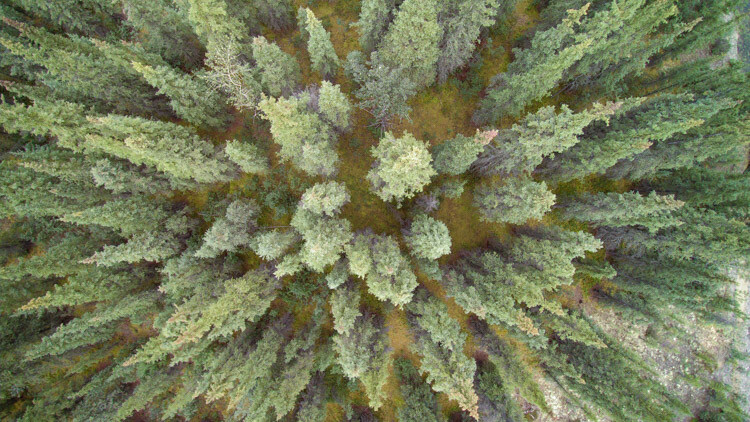
Remember to take advantage of the many camera angles drones allow. Shooting straight down is almost impossible from a plane. But with a drone, it’s as easy as angling your camera.

Playing with lines and patterns is a drone specialty, so take advantage of the way the world looks from above. Play with dividing your images into parts using the natural variations in the landscape. Trees from above, for example, create a starburst pattern, not a typical way humans see a forest!

Tips for Aerial Photography from Small Planes and Drones

The flexibility provided by drones is extraordinary. Don’t be afraid to experiment with aerial images of places a plane could never fly.

Drone Warning

Follow the rules! Flying a drone in a dangerous area like around airports, or at the scene of an emergency is not only irresponsible it can be life-threatening. Be aware of the laws surrounding drones, and fly only in areas where it is allowed, and at permitted elevations.

Lastly, be respectful of others. Don’t fly over private property if you don’t have permission, and be aware of how your flight is impacting the experience of others. Simply put, don’t be a jerk.

Tips for Aerial Photography from Small Planes and Drones

Conclusion

Aerial photography is a gateway to new ways of seeing. Whether you are shooting from the passenger seat of a Cessna or from your phone screen using a drone, there are abundant opportunities to make new and exciting images. Explore it and share with me what you make!

The post Tips for Aerial Photography from Small Planes and Drones by David Shaw appeared first on Digital Photography School.


Digital Photography School

 
Comments Off on Tips for Aerial Photography from Small Planes and Drones

Posted in Photography


Video Tutorials and Tips for Shooting Blue Hour

18 Nov

Blue hour is a fantastic time to get out and do some night photography. Yes, you read that right – night photography is best done before it’s actually night time.

To help you out with blue hour photography here are three videos with examples and tips.

How to shoot at blue hour with filters

Ray Salisbury takes you on location at blue hour and demonstrates how he scouts a location for the best spot, finds a good composition and uses filters.

Get the timing right for blue hour

In this next video photography education guru Brian Peterson gives you tips for getting the timing just right when shooting blue hour. He’s on location in Las Vegas.

Blue hour photography examples

Finally, Brendan Van Son is shooting blue hour in Leiden, Netherlands. In this video, you can see how the length of blue hour varies greatly depending on your geographic location.

The farther away from the equator you are, the long blue hour will last. Where I live it’s usually about an hour, so it’s frustrating for me that it’s so quick in more tropical locations I like to visit. So you really have to plan ahead and be prepared when that is the case.

I hope that gives you some good blue hour shooting tips. Now get out there and give it a try.

The post Video Tutorials and Tips for Shooting Blue Hour by Darlene Hildebrandt appeared first on Digital Photography School.


Digital Photography School

 
Comments Off on Video Tutorials and Tips for Shooting Blue Hour

Posted in Photography


3 Simple Photography Tips for Parents – How to Take Better Pictures of Your Kids

15 Nov

One of the most frequently asked questions I receive as a writer here at Digital Photography School is, “How do I take better pictures of my kids?”. There’s just something about becoming a parent that helps you understand exactly how fleeting childhood is, as well as how important it is to capture it. Whether you’re using a pro-level DSLR camera, a point-and-shoot, or your phone’s camera, here are a few quick and easy tips that will help you take your momtography or dadtography to the next level and take better pictures of your kids.

3 Simple Photography Tips for Parents - How to Take Better Pictures of Your Kids

1. Emotion Trumps Perfection

It’s never a bad idea to learn about the technical aspects of photography. But when it comes to photographing your own kids, the truth is that the photos you’ll treasure the most are the ones that capture genuine emotion. When you pull your camera out, don’t just look for the perfect smiles. Look for genuine expression and emotion, which tends to happen most often when your kids don’t realize you’re watching them.

Similarly, when you’re culling images, don’t automatically trash every image with soft focus or strange cropping. Sometimes, those technically imperfect photos may capture genuine emotion so perfectly that it would be a shame to delete them just because they’re not perfect. You may not want to blow those imperfect images up onto a giant canvas, but definitely keep them for your own records!

3 Simple Photography Tips for Parents - How to Take Better Pictures of Your Kids

Let go of perfection

Technically speaking, there are a few things about the above image that I don’t like. I wish I hadn’t cropped off some of one daughter’s fingers, and I wish the other daughter was in focus. I was super tempted to delete this photo right away because it’s not quite up to my standards. However, every time I look at this image it makes me smile to see the absolute joy on their faces. I remember their excitement at seeing the cherry blossoms covering the ground like snow, scooping them up by the handful, and throwing them up into the air while laughing and squealing with delight.

As family and friends flip through photo albums, they don’t comment on the other image I took that day of the girls standing perfectly still while looking at the camera and smiling, they comment on this photo. They mention how happy the girls look, and how much they love this photo. This image is beloved not because it’s technically sound, but because emotion always trumps perfection when it comes to photography.

3 Simple Photography Tips for Parents - How to Take Better Pictures of Your Kids

2. Find Beauty in the Ordinary

When it comes to photographing your kids, don’t wait for the moments when everyone is perfectly dressed in coordinating outfits at golden hour. Those moments are beautiful, but they’re few and far between. Instead, look for ways to capture the beauty in the ordinary everyday moments.

Snap a photo of your kids reading a bedtime story every once in awhile. Take a quick snapshot of their messy faces after spaghetti night. Capture the mismatched crazy outfits that they put together when they dress themselves. Quietly sneak out your camera as they’re practicing writing their name at the kitchen table.

3 Simple Photography Tips for Parents - How to Take Better Pictures of Your Kids

Life isn’t always perfectly styled, it’s messy and full of mundane, repetitive moments. It’s really tempting to wait to pick up your camera until your house is cleaner, or the kids are dressed in something that isn’t stained, or until the flowers in the backyard have bloomed. Don’t wait.

Take the opportunity to photograph your kids just as they are right at this moment, and see if you can’t find some beauty in the ordinary.

3 Simple Photography Tips for Parents - How to Take Better Pictures of Your Kids

3. Capture What Your Kids Love

At any given point in time, your kids are likely to have at least one thing that they’re absolutely obsessed with. It may be a stuffed dinosaur, their favorite book, a hat that they want to wear every single day or a best friend.

Regardless of what their current favorite thing is, taking photos of your childen with the things that they absolutely love is a really sweet way to remember them at the different stages of their lives.

3 Simple Photography Tips for Parents - How to Take Better Pictures of Your Kids

Chances are that in a year or two, your child will move on to a new favorite thing. You’ll forget all about that stuffed dinosaur or favorite blanket much more quickly than you’d probably think. It’s fun for both you and them to be able to look back and say “Remember when you used to….”

3 Simple Photography Tips for Parents - How to Take Better Pictures of Your Kids

Bonus Tip: Get the Photos Off Your Computer!

How many of us are guilty of taking hundreds of photos of our kids, maybe uploading a few to social media, and then letting them hang out on our hard drives in perpetuity? In all honesty, one of the most important parts of photographing your kids is to actually print the photos you take of your kids.

There are so many great resources out there now, whether you want to send prints off to a professional lab or print a photo book right from your Instagram feed, there truly is something for everyone. You don’t have to do it all, but just pick something, and get those images off your computer and into your lives!

3 Simple Photography Tips for Parents - How to Take Better Pictures of Your Kids

Do you have any non-technical tips that you’d share with moms and dads just trying to take great photos of their kids? If so, please chime in below in the comments.

The post 3 Simple Photography Tips for Parents – How to Take Better Pictures of Your Kids by Meredith Clark appeared first on Digital Photography School.


Digital Photography School

 
Comments Off on 3 Simple Photography Tips for Parents – How to Take Better Pictures of Your Kids

Posted in Photography


5 Tips for Mastering Shadows in Your Photography

14 Nov

Walking into a dimly lit room can be a photographer’s worse nightmare. Dark walls, low lighting, and weird shadows are enough to give even the calmest photographer a case of anxiety. Does this sound familiar? It did to me when I was first starting out and claimed to be a natural light photographer.

Because let’s face it, I did not know how to use my flash and more importantly did not know how to read light. Yes, I said that right. As a photographer, you not only see light but also need to learn the art of reading light – the type of light, the quality of light and also how the light will affect your final image.

The more I started to photograph people and places, the more I realized that but finding light among the shadows wasn’t really that scary or daunting.

How to Embrace Shadows in Your Photography

Master the shadows

Imagine for a moment the confidence you would feel if you can walk into any indoor lighting situation and think to yourself, “Yes, I got this”. And I don’t mean using your off-camera flash or strobes to light up the whole scene like the fourth of July fireworks display. I mean using only available light to create some magical photos.

Now don’t get me wrong, I still love images taken in natural light as they feel really light, airy, and inviting to me. But shooting in a low-key style, embracing shadows to create some dramatic portraits is just as fun and exciting.

For the past few years, I have felt a little limited in my photography in terms of only photographing in bright, open, natural light conditions. Living in Chicago, our summers are quite short and fall is usually a mix of rain, thunderstorms and more rain. I learned very quickly that I needed to get out of my comfort zone and figure out how to photograph indoors and do it confidently and creatively.

A less I quickly learned is that shadows play such an important role in shaping light, setting the mood, rendering depth, and creating drama. In the absence of floor-to-ceiling multi-windowed, light-filled rooms to photograph in, embracing shadows may be the perfect solution for unleashing your creativity.

#1 Gear choices

Dark and Moody Lifestyle Portraits - How to Embrace Shadows in Your Photography

If you have a choice between prime and zoom lenses, choose the former. Primes are generally considered fast lenses with an aperture of f/1.8 or larger and allow what light there is to reach the camera’s sensor. My Canon 50mm f/1.2 is on my camera 80% of the time I am photographing indoors.

Make sure to also meter appropriately. I use spot metering most of the time and have my center spot set to the brightest area on my subject’s face/skin. This, in itself, will help to get a dramatically lit image. It will expose the highlights properly and allow the rest of the scene to have shadows for a range of tones.

Ensure you expose properly as well. If the capture is underexposed, attempting to correct it in post-processing only adds noise. In general, I tend to overexposure my photos by at least 1/3 stop no matter where I am photographing. I have found that this allows me to minimize noise and retain as much detail as possible in the shadows.

My White Balance is set to Auto. You can choose to set White Balance via the custom Kelvin function so that it can cut down processing time later. I find that being in Auto works really well in most cases and I am okay with minor adjustments in post-processing if required. Learn to embrace a bit of noise by increasing the ISO especially if the room is really dark.

Dark and Moody Lifestye Portraits in Shadows - How to Embrace Shadows in Your Photography

#2 Single light source

A single light source such as a small window or open door can work wonders for your image. When you are working with dark spaces and limited light, you’ll be surprised how little light you actually need.

If you have north-facing windows, they tend to bring in a softer and more directional light as opposed to east or west facing. Those tend to bring strong light depending on where the sun is in the sky at the time you are photographing.

Dark and Moody Wedding Portraits in Shadows - 5 Tips for Mastering Shadows in Your Photography

Backlight magic.

Dark and Moody Wedding Portraits in Shadows - 5 Tips for Mastering Shadows in Your Photography

The bride is facing the window and her profile is evenly lit. But the dark drapes behind her render the background almost black – I quite love the drama of light and dark happening in this photo – achieved by just placing the subject in a specific spot.

#3 Direction and quality of light

Both the direction and the quality of light play significant roles in the mood of an image. So understanding the variety, nature, and use of each will help you make informed decisions about how to achieve your end goal.

Hard, focused light tends to amp up the overall drama of the image, emphasizing texture and detail, and producing contrasty shadows with sharp, defined edges. Soft, diffused light gives shadows soft, feathered edges that recede gently (dither away), making it flattering and versatile for human subjects for the way it minimizes texture and detail (i.e., flaws).

The angle and direction of the light you choose depend on your shooting style and your intent for the image or session. Typically, I do not position the subject facing the light source because it gives a flat, one-dimensional look to the subject’s features. I prefer lighting my subjects from the side for the depth and dimension the shadows give the subject’s features and the rest of the frame.

Backlighting the subject has its uses, particularly if your intent is to somewhat abstract the subject to get an airy, dreamlike feel.

Dark and Moody Wedding Portraits in Shadows - 5 Tips for Mastering Shadows in Your Photography

On the left, the bride is facing the window straight on, so the light on her face is even and soft. On the right, the bride is facing the window but at a 45-degree angle. So her portrait is a mix of more dramatic light as well as darker shadows.

#4 Mathematics in photography

The mathematical law of the Inverse Square describes how the illumination from a light source diminishes over distances.

Imagine the beam of a spotlight as it widens and grows dimmer in the distance. Now center a subject in the beam close to spotlight itself and the light will be harsh. But if you move the subject in a straight line to stand about 6 feet from the light, how much less light is hitting the subject them? With the distance doubled, the light hitting the subject is diminished by three quarters.

In a real-world context, let’s say you’ve got a background to work with and maybe a surface to bounce light into the scene. Plus all kinds of diffusers and filters to modify the light source, and a choice of where to place the subject in relation to the background and the light source as well as placing yourself and the camera.

Generally, you can add drama to the image by positioning your subject close to the light source and away from the background. The light will illuminate the subject and everything behind her will dwindle into shadow. That’s a quick and easy way to create a dark background in-camera. Conversely, placing the subject further from the light source and closer to the background will create a more evenly lit scene with a more gradual shift between light and shadow (the background will be lighter as well).

Dark and Moody Wedding Portraits in Shadows - 5 Tips for Mastering Shadows in Your Photography

On the left, the bride is farther away from the light source and hence she is more in the shadows as compared to the image on the right where she is facing the window light and is closer to the light source. So more of her face is being illuminated with the light coming from the window.

#5 Modify or mold your light source

If you find yourself with an over-abundance of natural/available light, using modifiers is an easy way to control the amount and intensity of the lighting on your subject.

Sheer curtains and blinds can be used to reduce or diffuse light, making it softer and subtler. You can decrease the size of the light source to increase shadows and increase drama with the use of blackout curtains or by partially shutting doors. Remember, the more light you let in, the less intense the shadows.

I hope these examples motivate you to look differently at shadows. There are no photography monsters hiding in them! They are, in fact, quite useful in adding some drama and interest in your photographs.

The post 5 Tips for Mastering Shadows in Your Photography by Karthika Gupta appeared first on Digital Photography School.


Digital Photography School

 
Comments Off on 5 Tips for Mastering Shadows in Your Photography

Posted in Photography


6 Tips for Mastering Your Lenses

13 Nov

Most photographers have a favorite lens (you can read about mine here), maybe even two or three. But do you know how to get the best out of that lens? I’ve used lots of lenses over the years. As a result, I know that it takes time to get to know a lens, and longer still to master it. These tips will help you work your way through that process.

Mastering camera lenses

1. Use the lens exclusively for a month

In his book Outliers, author Malcolm Gladwell put forward the now-famous idea that true mastery of a skill takes 10,000 hours of practice. The idea of putting in your 10,000 hours applies to photography as a whole rather than using a single lens. But there’s no doubt that by using the same lens, and no other, for an extended period of time it will help you get to know that lens really well.

You can put this idea into practice in a small way by taking just one camera and one lens out on a shoot. For example, if you have a portrait shoot then take along a short telephoto prime lens. If you’re shooting landscapes, take a wide-angle lens.

Mastering camera lenses

I often take just a single lens on a portrait shoot. The only lens I had on me for this one was an 85mm short telephoto.

You can take it further and extend the exercise for a week, a month, or even longer. It’s up to you.

This exercise is easiest with a prime lens. If you do it with a zoom I suggest that you pick one focal length and stick to that. The idea is to get familiar with how a specific focal length behaves. You can’t do that if you are zooming from one to the other.

2. Test your lenses at all apertures

Part of mastering your lenses is getting to know how they each perform at various apertures. There are two things to consider here – technical performance and aesthetic quality.

No lens gives consistent image quality across its aperture range. All lenses are softer at their widest and narrowest aperture settings than the middle ones.

If you tend to use small apertures when you take photos (perhaps you are a landscape photographer) then you need to be aware of an effect called diffraction that creates a softening effect as you stop down. Yes, you get more depth of field at f/22, but photos taken at f/11 or f/16 may be sharper overall.

Test your lenses to see where the visible effects of diffraction kick in. That way you know the smallest aperture you are happy using, in relation to sharpness for each lens in your kit.

At the other end of the scale, a lens is always softer at its widest aperture. If your favorite lens is a prime then you probably open the aperture to create bokeh. As you stop down the depth of field increases, there is less bokeh, and the image gets sharper.

The key is to find the balance between bokeh and image quality. For example, I find that when I make portraits with a short telephoto lens I get the best results at f/2.8. More of the model’s face is in focus and the bokeh still has a beautiful quality. You can see the difference in the two portraits below.

Mastering camera lenses

3. Zoom lenses – test at different focal lengths

The situation becomes a little more complicated with zoom lenses. This is because you have an extra variable – focal length. Not only does sharpness vary according to the aperture, but focal length has an effect too. Very few zoom lenses give equal optical quality across their entire focal length range.

When it comes to zoom lenses I prefer to think of them as several prime lenses in one. For example, when I owned a 17-40mm zoom I tended to set it to 24 or 35mm for most of my shoots (these focal lengths were conveniently marked on the barrel). At other times I would use 17mm if I wanted a real ultra wide-angle effect or 40mm. So, to me, it was four lenses in one – a 17mm, 24mm, 35mm and 40mm lens.

These photos show the difference between the 17mm and 40mm focal lengths on this lens.

Mastering camera lenses

Mastering camera lenses

This approach simplifies the task of getting to know your zoom lens because you are getting to know it at three or four focal lengths rather than across the entire range.

4. Zoom with your feet

Regardless of whether your favorite lens is a prime or a zoom it is helpful to zoom with your feet rather than use the zoom ring (of course, if you have a prime lens you have no choice in the matter!) Zooming with your feet is an expression used to describe the process of moving physically closer to or farther away from your subject to change its size in the frame, rather than using the zoom ring on a zoom lens.

For zoom lens owners, this comes back to the earlier idea of a zoom lens being three or four prime lenses in one. For example, if you have an 18-55mm kit lens then your lens behaves very differently at different focal lengths. At 18mm it’s a wide-angle lens ideal for subjects like landscapes. At 55mm it’s a short telephoto lens that you can use for portraits.

In terms of perspective, both focal lengths are very different. You will only learn about perspective and the way it changes as you move closer to or further from your subject if you stick to using your zoom lens at a single focal length. If you use the zoom ring to change subject size, you won’t learn about perspective.

For example, with an 18-55mm lens set to 18mm, you need to get fairly close to the subject to obtain the dramatic perspective associated with wide-angle lenses.

Mastering camera lenses

If you are further away from the subject the perspective is much less dramatic.

Mastering camera lenses

5. Try different subjects

We tend to think of lenses as associated with specific subjects. For example, wide-angle lenses are ideal for landscapes, and short telephoto lenses are brilliant for portraiture.

But what if you mix it up a little? What happens if you use a short telephoto for landscape photography or a wide-angle for portraiture? The idea is to take yourself out of your comfort zone and find creative ways to use your favorite lenses. Ways that perhaps hadn’t occurred to you before.

If you use a wide-angle lens for portraiture you will soon find that if you get too close to your model then it’s going to create some very unflattering effects. But what if you step back and include more of your environment? Suddenly you’re taking a very different approach than you would with a short telephoto lens. Experiments like these can add new skills and new ways of working to your repertoire.

I made this portrait with my 17-40mm zoom set to 17mm.

Mastering camera lenses

6. Push your composition to the limit

The final tip is to push your composition to the limit. It’s all about taking various techniques to the extreme and seeing what you can do with them.

If you have a wide-angle lens, what happens if you get as close to your subject (whatever it is) as you can? What happens if you use the widest aperture setting instead of a smaller one?

If you have a telephoto lens how can you maximize the compressed perspective that those lenses give you? What subjects can you shoot to make the most of the layered effect you can get with a longer lens?

This is a process of experimentation. Not all of your experiments will work. But when they do, just as with the previous tip, you’ll be adding new skills to your repertoire.

Here is a landscape photo that was taken with a telephoto lens.

Mastering camera lenses

Next steps

Hopefully, these tips have given you some ideas for working with and getting to know your favorite lenses. Instead of fantasizing about the next lens you are going to buy (dreams are nice, but new lenses are expensive!) how about learning to make the most out of the ones you already own?

You may find that true creativity lays as much in pushing the lenses you already own to their limits as it does with buying new gear.


You can learn more about lenses, and how to get the most out of them, in my ebook Mastering Lenses. It also contains a buying guide to help you make wise choices when you buy your next lens!

The post 6 Tips for Mastering Your Lenses by Andrew S. Gibson appeared first on Digital Photography School.


Digital Photography School

 
Comments Off on 6 Tips for Mastering Your Lenses

Posted in Photography