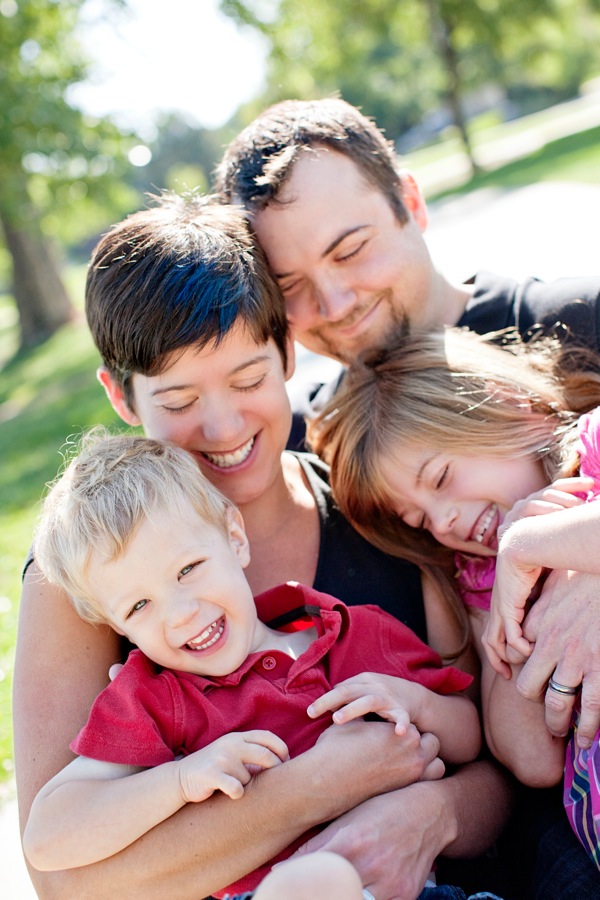
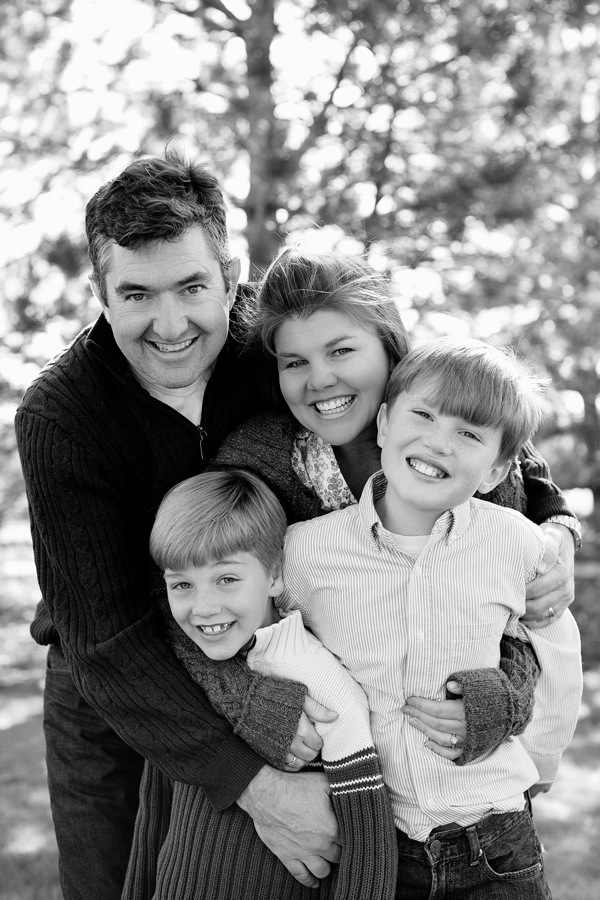
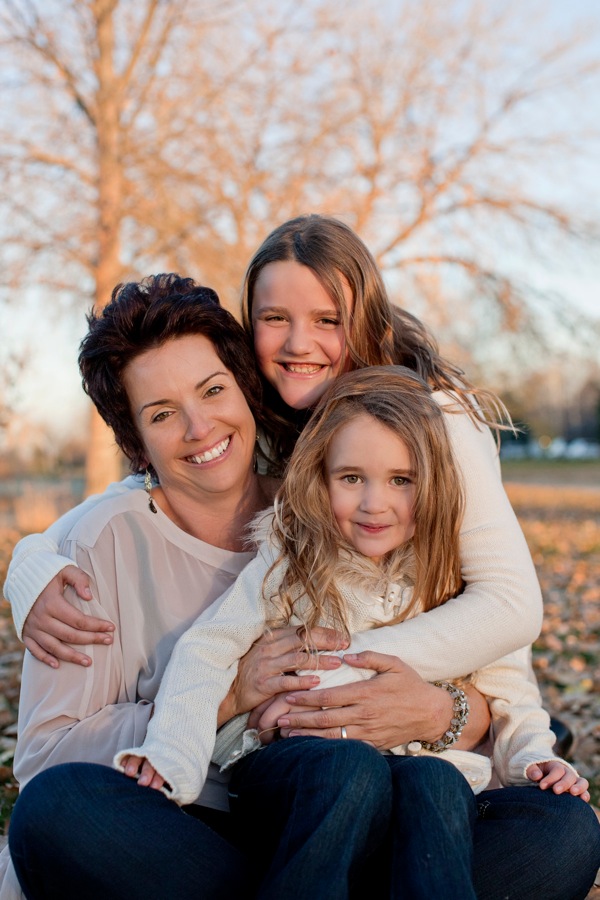
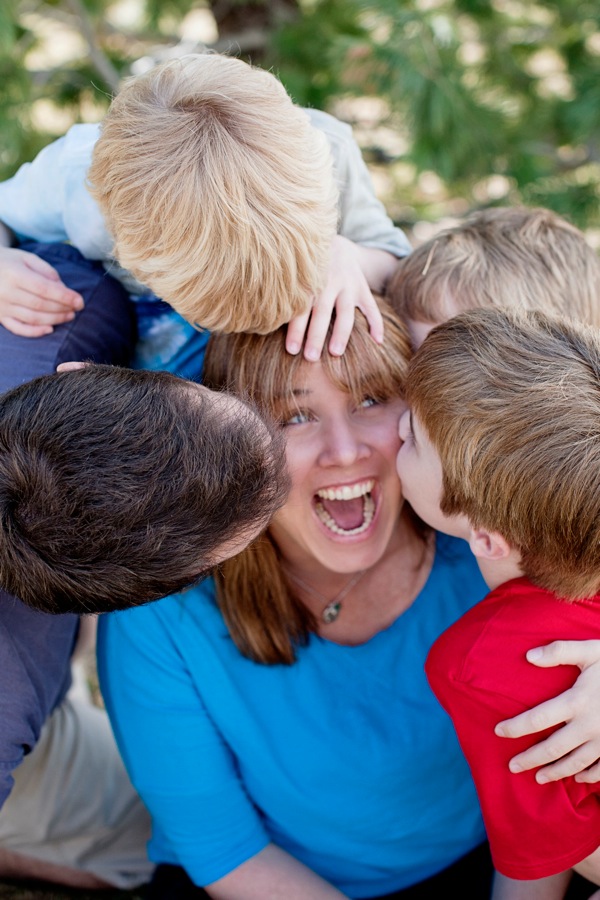
RSS
 

Posts Tagged ‘Tips’

7 Tips for Photographing Newborns without Becoming Clichéd, Derivative or Boring

11 Jun

by Lynsey Peterson.

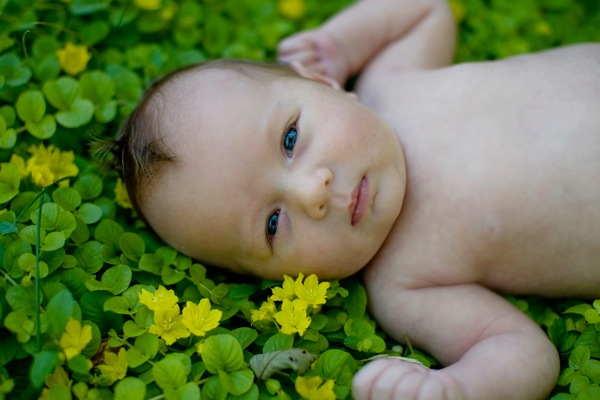
When I first started doing professional photography, newborn babies were the coveted prize. An adorable sleeping creature that would look cute no matter what? Sign me up! Let’s put that baby in a stockpot! In a basket! Wait! –A headband that looks like a flower! In a field of flowers! With butterflies! And maybe a big gift box bow!

Then I realized that Anne Geddes is the landlord of that entire market. And that it’s rare for a portrait client to actually want a picture of their baby in a stockpot. What people do want is a picture of their baby, that looks like their baby. Because in about 5 minutes their baby isn’t going to look like this anymore.
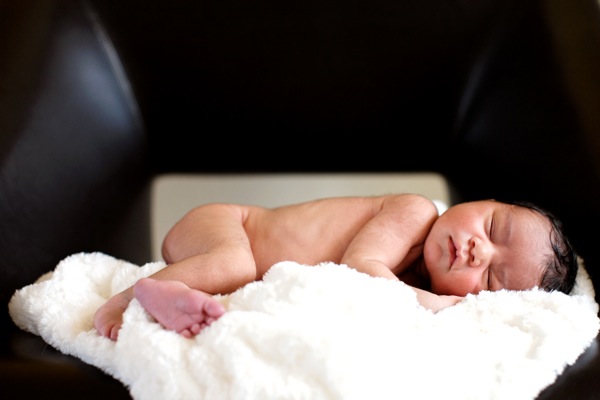
BABY1

Set the Scene

In an ideal situation, you are photographing a newborn that is less than two weeks old (when they tend to be more “mold-able”), in the morning (when they tend to be a more willing participant), just after being fed (when they tend to be a little more tolerant), and in a warm room (where they tend to be a little more comfortable).

Having everything ready to go before shooting a single shot is taken will serve you well: various blankets for background and warmth, cloth diapers for when someone pees on you (let’s hope it’s the baby), any clothing you plan to use and back-ups of every possible thing. I prefer minimal clothing on newborns, but this is just personal preference. Amble natural light is important because even if you do usually shoot flash, it’s often disruptive enough to wake a newborn and rule number one in photography, parenting, and life is: Never wake a sleeping baby. If there is anything I’ve learned, it’s that.

Be prepared to work fast because babies can be ticking time bombs, but slowly because they are delicate ticking time bombs. You are methodical. You are confident. You are patient. You are the baby whisperer. Because we are speaking in ideals. And if you’re me and we are still speaking in ideals, you also have on your cute jeans and are having a great hair day. Because, why not?
BABY2

Find the Purpose

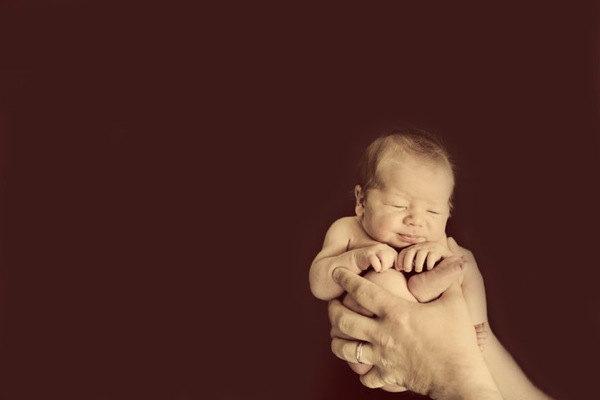
Photographing newborns is one of the few times I make a point of asking clients what they are planning on doing with the end result. Often it’s for use in a baby announcement or just as “baby pictures” documenting this time. But if it’s going to end-up as a 24″x36″ canvas above a fireplace, I want to know beforehand. Or if I’m going to need negative space to create an announcement card, I’d rather shoot with that in mind then trying to backtrack later in post.

Another thing to think about is the ratio of images of the baby alone and the baby with parents or siblings; there is no right or wrong answer here but knowing what you or your client is wanting in advance is key. Newborn shoots are not (usually) guided by a free-spirited toddler and therefore require more of a plan from you than shoots with older children. And you never know when a baby will decide that pictures are just not what he wants to do today and let’s you know this in a very unsubtle and loud way.
  
BABY3

It’s all about the Baby

The only thing I always bring to a newborn shoot is a large piece of black cloth. I have had it for nearly a decade and more babies have peed on it than I wish to think about. I have hung it on walls and used it on floors and beds as a back-drop. I use it every single time because it simplifies everything and allows the focus to be completely on the baby. Lots of photographers do a version of a black background of some sort and I’ve found that there is no need to get fancy.

Many photographers use a velvet, but mine is about 2 yards of a stretchy thick cloth that I bought at a fabric store for ten dollars. It washes well (luckily) and the light sheen of it makes editing out any wrinkles in post extremely easy. I carry thumbtacks and painters tape to hang it with if I need to and it’s thick enough to hang over about anything and not have backlight shine through. I cannot stress having a way to simplify a newborn shoot enough. If a black background isn’t your style, find what is that will clean-up everything and let the newborn to be the focus, and allow it to become your key piece for baby photography.

BABY4 1

It’s in the Details

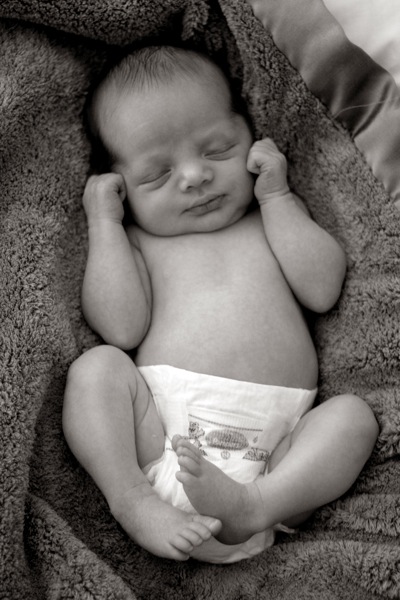
And why shouldn’t it be? Baby details are sorta amazing. I mean have you seen a baby toe recently? Talk about something I’d like to dip in butter and call a snack. We have all seen baby parts photographed in the same boring ways: wedding rings on toes, close-ups of belly buttons and umbilical cords (ew), tops of bald heads in big grown-up hands. I am guilty of doing every one of these, multiple times over. I now see that the shots that will stand the test of time will be very simple close-ups that highlight just how small newborns are: tiny hands holding a parent’s finger, brand new feet that have yet to see wear, yawns and other adorable expressions that only look adorable on a baby.
BABY5

As Cute as they are Awkward

Oh sure, we all know they are adorable, but what are you supposed to do with them? They are flimsy and tiny and often naked. This is where I think we get into trouble and put them in baskets and stockpots. Because we can. Instead of creating scenes, it’s better to just think of “positions”. Babies can only do about two positions unassisted—laying down this way or that way. Work with that.

They may just lay there, but the beauty in this is that they often let you adjust them however you want. Tuck legs up under bodies, pull flailing arms into blankets, curl them up into someone’s hands. The baby is the star of this show and is plenty cute to pull off this role without a big supporting cast of props. A key to getting the position you want and having it stay that way long enough to get the shot you want is to keep your hands on the baby longer than needed after positioning them.

Think of it as long hug—you don’t need that extra ten seconds at the end, but it feels nice. Get the baby settled and then stay there for a bit longer. The warmth of your hands and the consistency and reassurance is often exactly what the baby needs to “hold” the position you are seeking.
BABY6 1

Got Extra Arms? Use them

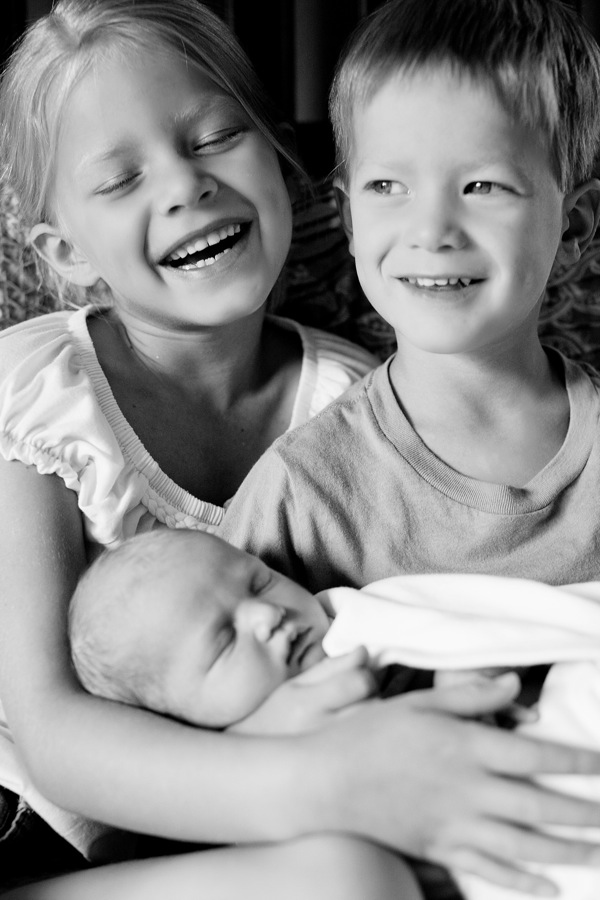
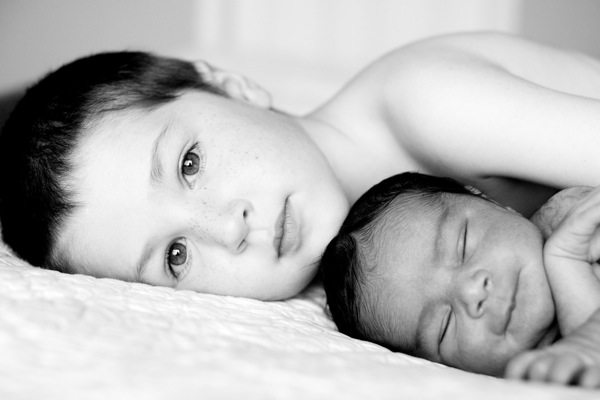
I like to include siblings as often as I can, no matter the age. This gets tricky because the very definition of tricky is a two year old holding a newborn while exhausted parents watch the situation go down. Enough pillows and promises of lollipops though will get you a shot or two and a little variation in the final images. Interaction is the name of the game here—look for whatever the emotion is that’s happening and play on it. If it’s pride, comment on it to instill confidence and document a sweet moment in sibling history. If it’s indifference, engage the older child so they forget there is even a new addition in the photograph and are happy to be your star for a moment.
BABY7

Stop Worrying

I love a good worry and consider myself to be quite good at it. But as jobs go, photographing newborns is about as close to shooting fish in a barrel as you are likely to get. It’s easy to feel the pressure given that babies are so fragile and grow every single second. The truth is any picture you take of a newborn is a gift. Just as any time spent getting to photograph a newborn. I don’t get sappy often, but newborn babies are pretty special. Enjoy it.

Especially if the newborn belongs to someone else and you get to walk out of there without a crying baby and go home to a bed where you’re permitted to sleep through the night.

Check out more of Lynsey Peterson’s work on her website.

Post originally from: Digital Photography Tips.

Check out our more Photography Tips at Photography Tips for Beginners, Portrait Photography Tips and Wedding Photography Tips.

7 Tips for Photographing Newborns without Becoming Clichéd, Derivative or Boring


Digital Photography School

 
Comments Off on 7 Tips for Photographing Newborns without Becoming Clichéd, Derivative or Boring
Posted in Photography


15 Tips for Successful Fireworks Photography

10 Jun

fireworks-tips-dps-08

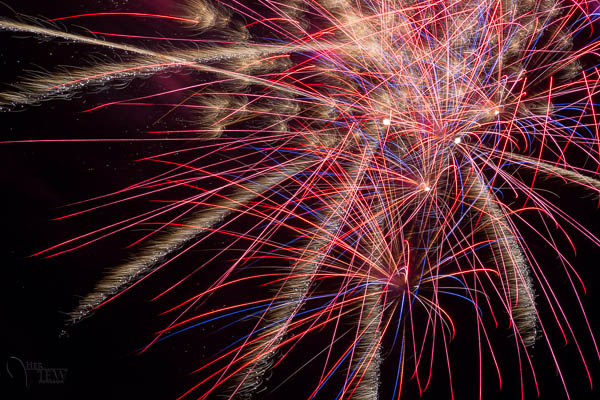
With the summer coming up and different celebrations you may have the opportunity to photograph some fireworks.  If you’re in the USA you have the 4th of July, in Canada July 1st.  In many other places you can find fireworks festivals or competitions even, or special occasions when fireworks may be set off including weddings, New Years Day or course and of course at Disneyland!

So here’s a few tips to help you photograph fireworks. The biggest thing to remember is that it’s all about practice, experimentation, and the following mantra (say it with me!)

SHOOT – REVIEW – ADJUST – REPEAT

Please remember that if you’ve never tried fireworks before it’s all trial and error and I’ve made a lot of mistakes myself before I got any images that I was happy to show anyone.  Each time I photograph fireworks there’s always some element that’s unpredictable so you have to learn to adapt and learn from your own mistakes, correct for next time and do it again. So take these tips to help you get started.

15 tips for fireworks photography

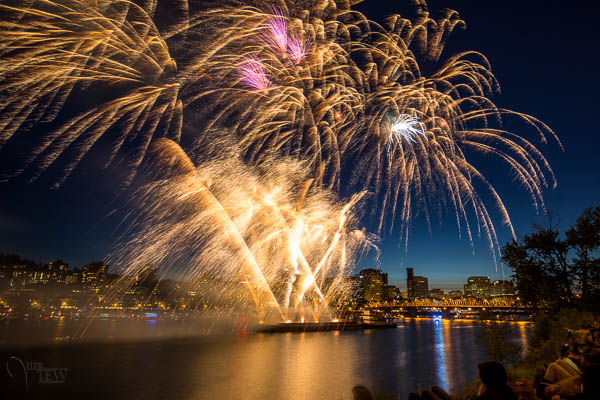
#1 Use the right equipment: use a sturdy tripod and remote to fire the camera  and bring an extra battery as long exposures tend to use them up quickly.  I say STURDY tripod because it needs to hold your camera steady for several seconds without sinking, tipping, or wobbling. I wrote an article on my site on Tips for buying a tripod of you need more info on what to get.

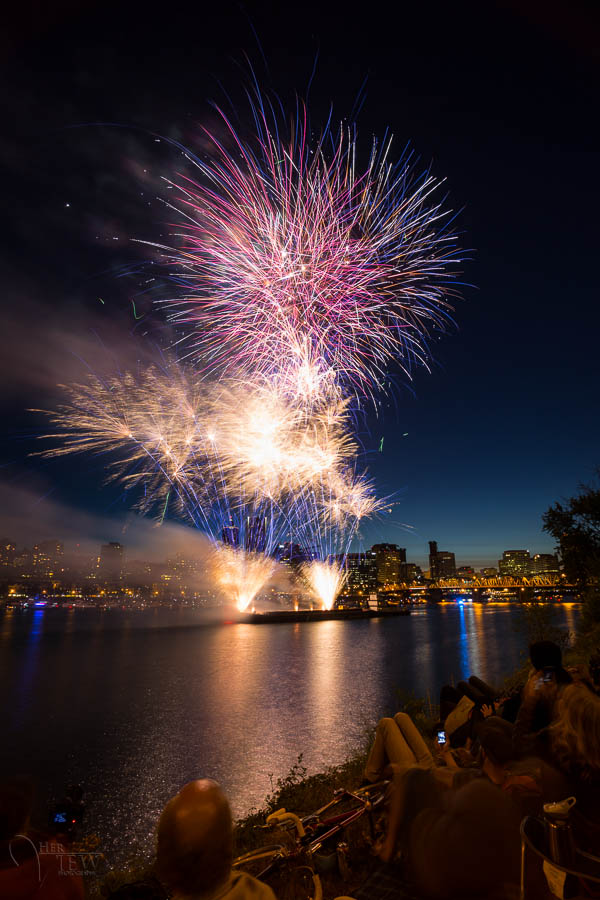
This image was actually purchased by the company that put on the fireworks show in Portland.

This image was actually purchased by the company that put on the fireworks show in Portland.

#2 Set your ISO low like 100 or 200, for a couple reasons. First the higher the ISO you use the more noise you’ll introduce into your images, so keep it low to prevent that. Noise also lives in blue areas of images and nighttime has a lot of blue so that compounds the issue.  Long exposures also tend to increase noise so if you add it all up you get a lot of noise so keep the ISO low to eliminate that variable.

#3 Turn OFF long exposure noise reduction.  This setting, while it does a really good job of noise reduction, adds an extra complication you don’t need when doing photography of fireworks.  The way it works is that if you take say a 10 second exposure, it takes a second one of equal length but just black (the shutter doesn’t open). Then it merges the two together and blends the blank one into the shadow areas of the first one which is where noise typically shows the most. The problem is that fireworks happen so fast you don’t want to have to wait 10 seconds to be able to see your image, make any adjustments and shoot again. I did this once my accident and it was very frustrating and I missed most of the show and did not get the results I wanted because I couldn’t review and correct.

#4 Do NOT use live view if your camera has it. This will eat up your battery really fast. Live view is really for shooting video and using the display screen so much uses a lot of power, as does making long exposures.  Save your battery for actually shooting and set up your shot using the eyecup viewfinder.
fireworks-tips-dps-09#5 set your camera on Manual mode for exposure and set your aperture to f5.6 or f8.  Those apertures are pretty optimal for fireworks as the light streaks are controlled by the size of the aperture.  Closing down more will make the light trails thinner, opening up more will make them wider and possible too over exposed.  Do some tests but all the times I’ve done fireworks I keep coming back to f8 as my preference.
#6 Set your shutter speed to between two and ten seconds.  Do a test shot before the show starts and see if the sky is too dark or too bright and adjust the exposure time accordingly. As long as you’re under 30 seconds you can let the camera time the shots for you.  Or you can switch to Bulb and just open and close manually when you feel you’ve captured enough bursts in one image.

#7 Focus your lens ahead of time, and then turn off AF otherwise the camera will keep trying to refocus every shot and you may end up with missed images or blurry fireworks if the camera misses. Assuming you’re a fair distance away from the fireworks you shouldn’t have to refocus at all unless you change your angle of view or want to focus somewhere else, like the people in front of you.

#8 Use a neutral density filter to get a longer exposure if need be.   If it’s not 100% dark out yet it (the sky still has some light) this will allow you to get a longer exposure and make sure the fireworks bursts have a nice arch.  If your exposure is too short you’ll end up with short stubby looking bursts, not the nice umbrella shaped ones. If yours are too short, just make the exposure time longer. If you are getting too many bursts in one shot and it’s coming out over exposed, shorten the exposure time.  Using the ND filter if it IS dark will also allow you to shoot longer exposures and capture more bursts per image.  Play with that and try it with and without the filter if you have one.  A polarizing filter will work to a lesser degree also.

ISO 100, f/10, 1 second

ISO 100, f/10, 1 second – notice the bursts don’t really make a nice arch? A longer exposure will make your trails longer. You choose how you want them to appear and adjust accordingly.

#9 Shoot most of your shots at the start of the show to avoid the smoke/haze that appears a bit later. Eventually the sky will be filled with smoke and it’s not as pretty looking.  That’s when I’ll try some close ups or abstracts (keep reading for more on that later)

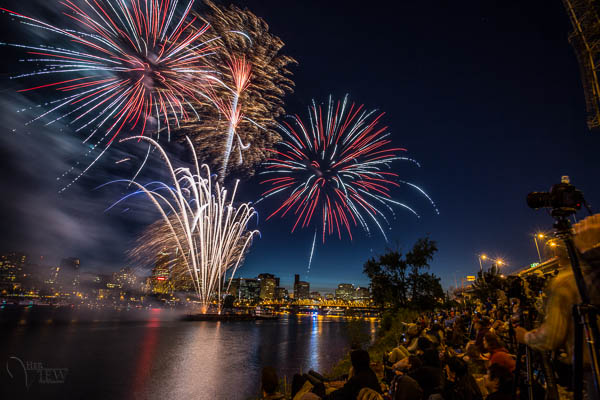
#10 Scout your location ahead of time and get there early to get a good spot, think about background (what’s behind the show) and if you want the people around and in front of you as part of the shot. In general the good viewing areas fill up sometimes 1-2 hours prior to the fireworks show. If you want a good spot with enough room for you and your tripod, go early and take a good book or something to entertain you while you wait.

Notice I've included the crowd to show perspective.

Notice I’ve included the crowd to show perspective.

#11 Make sure you leave enough room in your frame to anticipate the height of the opened bursts. Adjust as necessary if you miss on the first shot – it’s a lot of trial and error and correcting. It’s often hard to tell where the highest fireworks will end up in the sky, you may want to try both horizontal and vertical compositions.

Try a vertical composition for an added sense of power, especially if you can get a reflection like this one.

Try a vertical composition for an added sense of power, especially if you can get a reflection like this.

#12 It takes a bit of practice to time your shots when you hear the fireworks being released, so ideally you capture a few bursts.  Do some testing to see how many bursts is just right for your taste.  Try some with more, and some with less. Having too many may overexpose the overall image, so keep that in mind.

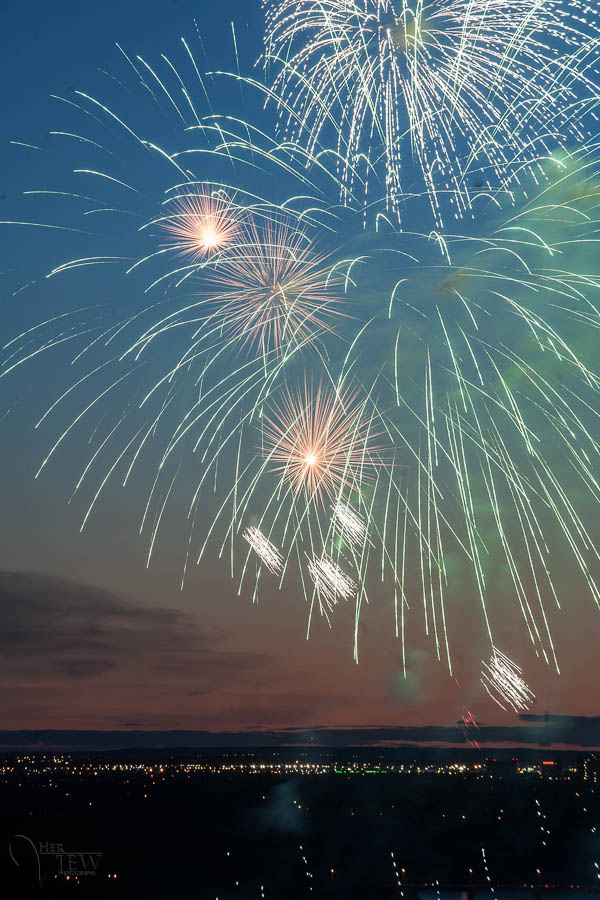
#13 Shoot into the eastern sky not facing west, if you want a darker sky. Here in Edmonton we are quite far north and even by 10:30pm in the summer the sky is not fully dark yet.  I’ve found that when I shoot into the sunset my sky gets too blown out and the lights of the fireworks don’t show up as well as they do against a darker sky.  So try and find a vantage point that has you facing east when possible if that’s an issue for you as well.

Western facing, notice the sky isn't dark enough and the fireworks seem lost against it.

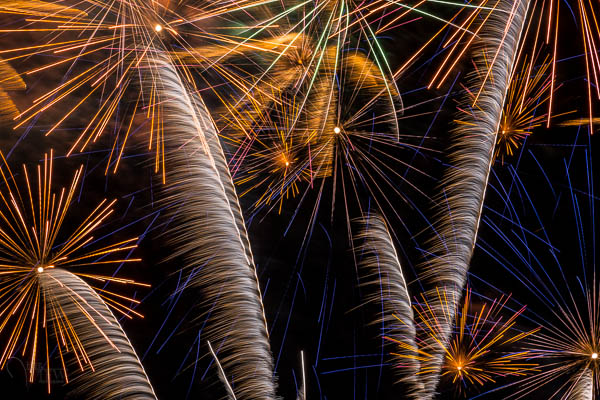
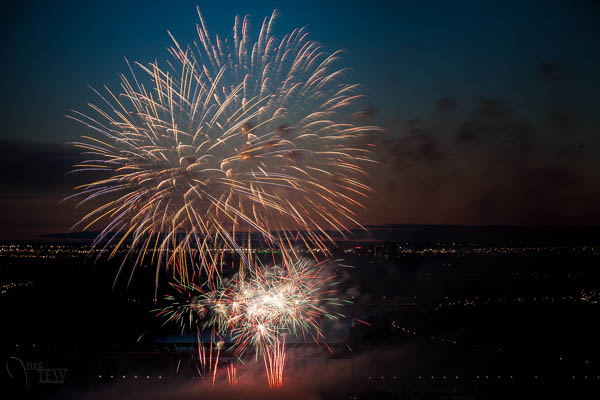
#14 Try some telephoto shots as well as the usual wide, try some close ups zoomed in tighter for something a bit more abstract. For this you will need to aim basically into thin air and try to anticipate where the bursts will open

Abstracted using a longer lens, I think they look like palm trees.

Abstracted using a longer lens, I think they look like palm trees.

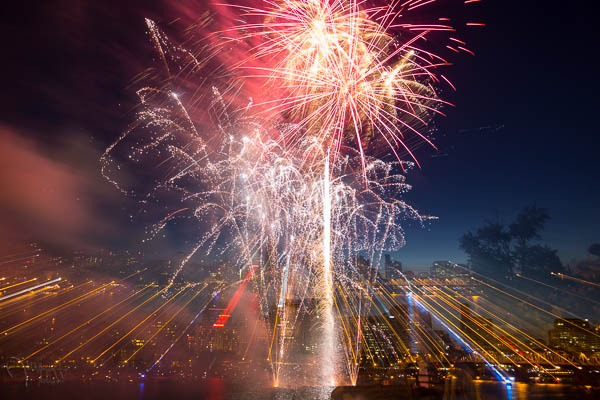
#15 if you have a zoom lens try zooming during the exposure and see what you get!  If you’re going to try this make sure you have focused at the most zoomed in point of the lens.  Try different technique including counting 1/2 the exposure before you zoom, or zooming right away and the last 1/2 is zoomed out. Try zooming fast, then slow. Try more bursts, or less. Get some city lights in the shot too.

ISO 100, f/6.3, 6 seconds - zoomed during exposure.

ISO 100, f/6.3, 6 seconds – lens zoomed during the exposure.

Summary

The biggest tip I can give you overal is experiment with your settings to get the look you want. Use my settings above as a starting point, adapt to your situation and your camera equipment until you’re happy with the results.

Have a great time this summer trying these out and don’t forget to share your images of fireworks, and any additional tips you’d like to add.

Post originally from: Digital Photography Tips.

Check out our more Photography Tips at Photography Tips for Beginners, Portrait Photography Tips and Wedding Photography Tips.

15 Tips for Successful Fireworks Photography


Digital Photography School

 
Comments Off on 15 Tips for Successful Fireworks Photography

Posted in Photography


Minimalist Photography ~ 4 Tips To Keep It Simple With A Maximum Impact

08 Jun

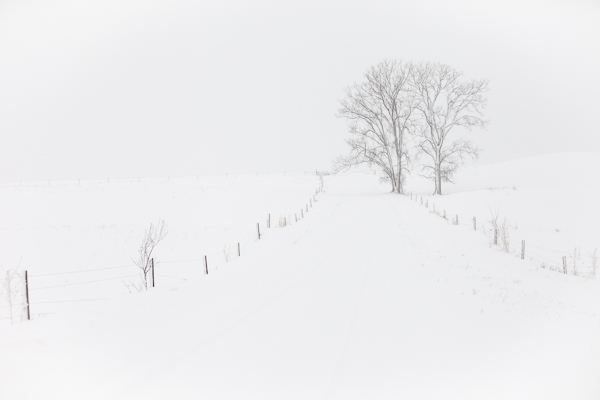
Minimalism is a very subjective concept in the art world. The Webster dictionary defines it as follows: A style or technique that is characterized by extreme spareness and simplicity. Some love it, others hate it, but no one seems to be indifferent. Many artists thrive in the openness of the concept, others have a problem with the lack of definition and direction. Many of us are drawn to ‘less is more’ with simple lines, geometric patterns, strong shadows, contrasting colors, lone subjects, etc. For others, deciding what to leave out of the frame to make a stronger image is a difficult exercise. Here are a few tips and examples to get you started in your quest for minimalist imagery.

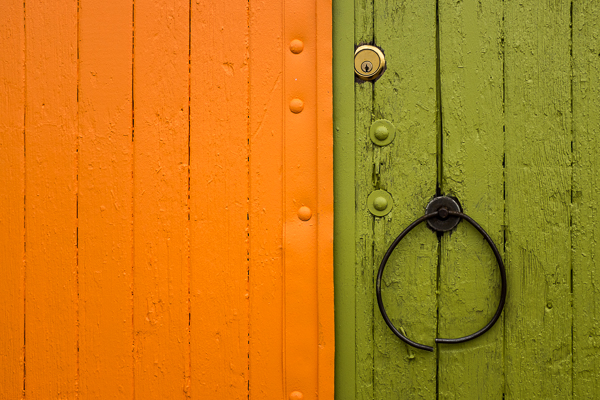
©Valerie Jardin ~ Contrasting colors make for great minimalist subjects.

©Valerie Jardin ~ Bright colors make great minimalist subjects.

1. Composition

“Keep it simple” doesn’t mean “keep it boring”. Contrary to what you may think, a minimalist approach requires a lot of creativity. The use of negative space is an integral part of minimalist photography.  A well placed subject doesn’t have to be large to have a big impact.  Deciding what to leave out of the frame and create a stronger image can be challenging and often requires a lot of practice until it becomes the way you see. I recommend training yourself to make those decisions in camera instead of cropping unwanted distractions in post processing. A clever use of depth of field will also isolate your subject from the background by shooting with an aperture as wide (smallest number) as your lens will allow.

2. Textures and colors

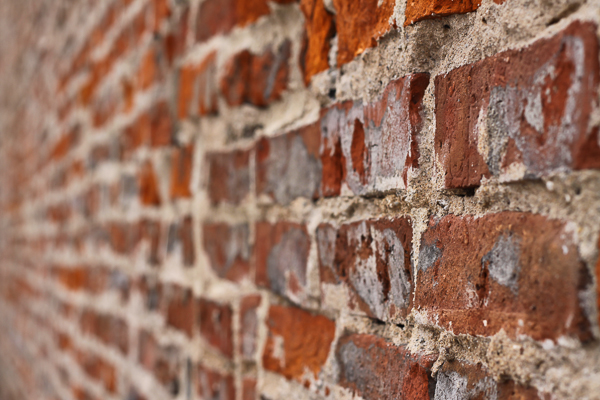
A bright color or contrasting colors make great minimalist subjects. The same applies to textures. The viewer should be able to almost feel the texture. Sometimes it’s all about finding a creative angle to make the photograph. Don’t be afraid the experiment. Shoot straight on, shoot high or  low, work your frame until you get the shot that will speak to you.

3. Lines and geometric patterns

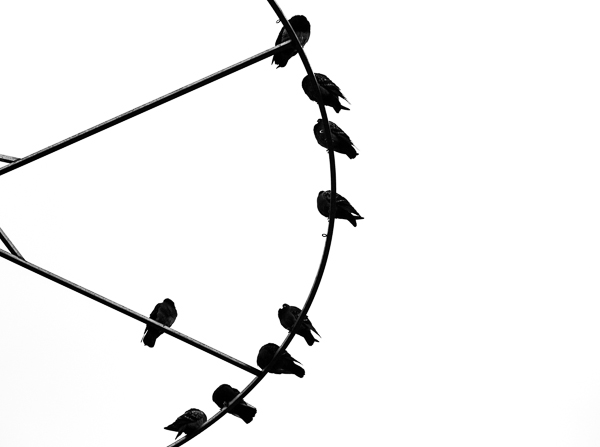
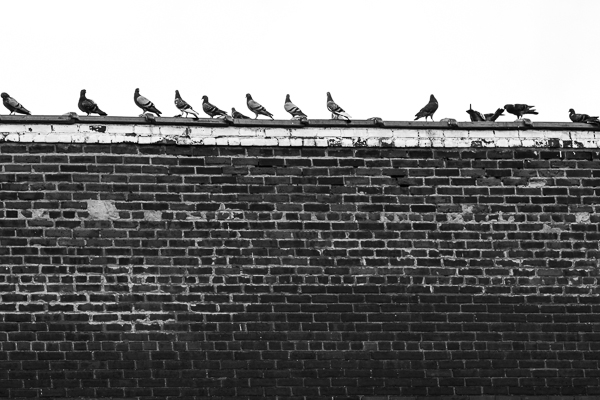
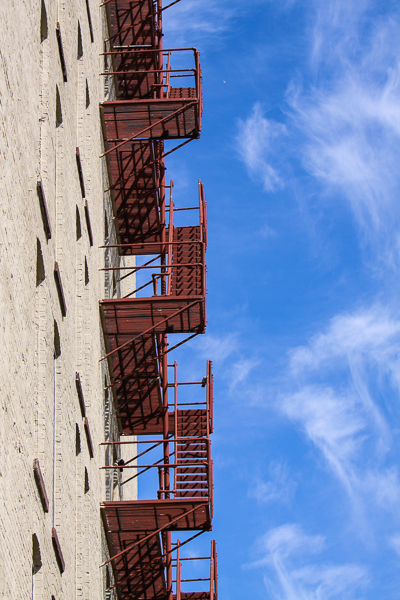
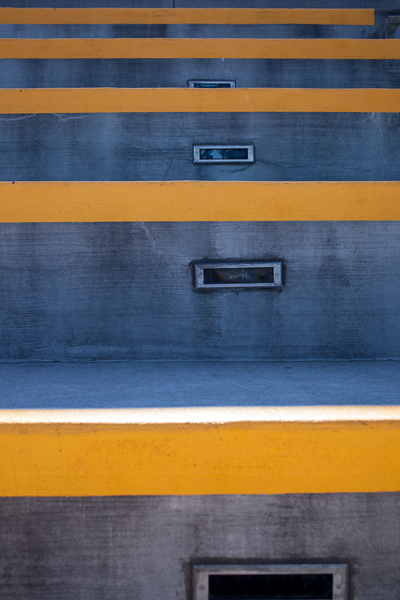
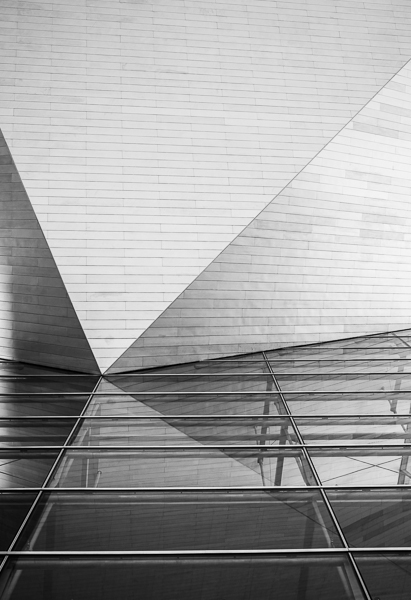
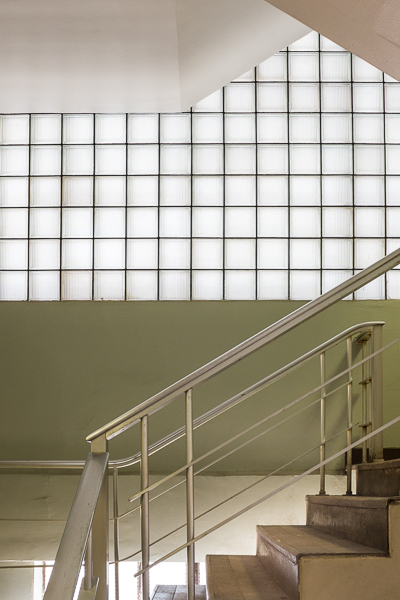
Strong lines make strong images. A good place to get started with minimalist photography is by paying attention to modern architecture around you. Leading lines, and other geometric shapes, can make great backdrops for minimalist pictures. Isolating a bird on a power line, if done well, can make a great minimalist shot. There are great opportunities around you all the time, you just have to learn to see them and that requires practice.

4. Telling a story

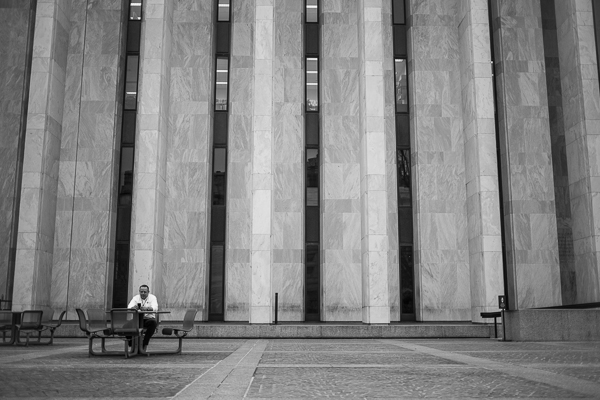
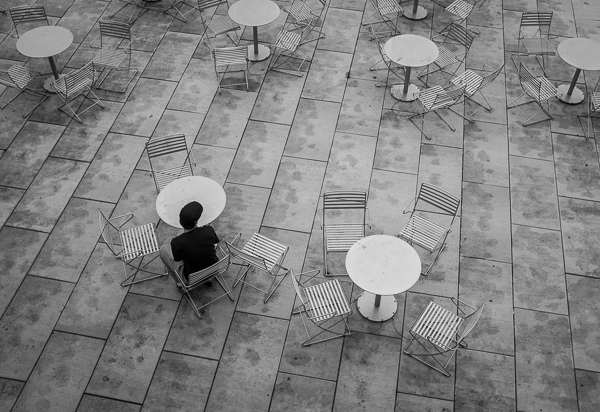
Push your minimalist photography to the next level by telling a story. Minimalist street photography showcases an interesting urban landscape with a human element. The human element, however small, becomes the focal point of the image. Yet, it’s the interesting background that draws the photographer to make the shot. Symmetry, lines, curves, shadows all play a vital part in making the photograph. Sometimes the story and the environment come together spontaneously and it’s the photographer’s job to see it and respond quickly. Other times it require a bit of patience for the right subject to walk through the frame. A minimalist approach to photography can be applied in nature as well as in an urban environment. You can practice anywhere, so get out there and open yourself to a different way of seeing with your camera!

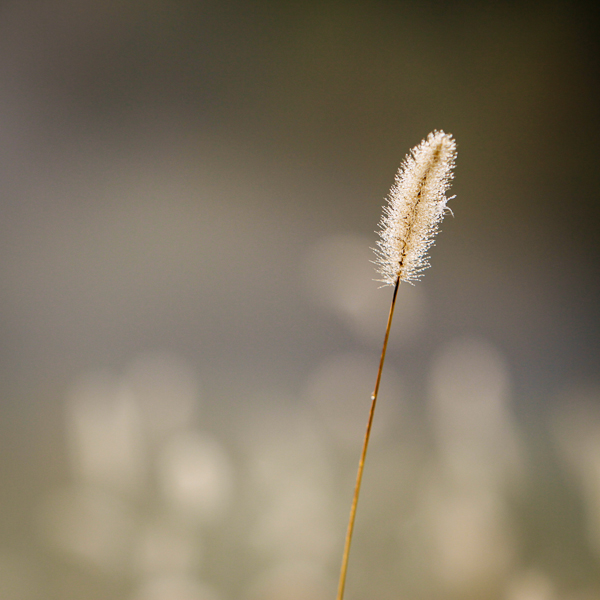
©Valerie Jardin ~  The use of negative space is an integral part of minimalist photography.

©Valerie Jardin ~ The use of negative space is an integral part of minimalist photography.

©Valerie Jardin

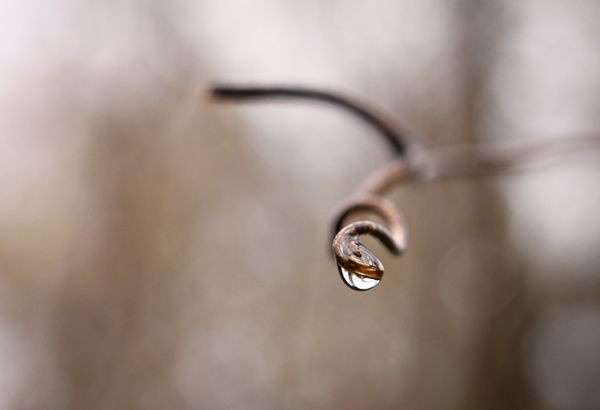
©Valerie Jardin ~ Using a shallow depth of field will allow you to isolate your subject from a distracting background.

©Valerie Jardin ~ You can use a minimalist approach in nature as well as in an urban environment.

©Valerie Jardin ~ You can use a minimalist approach in nature as well as in an urban environment.

©Valerie Jardin

©Valerie Jardin

©Valerie Jardin

©Valerie Jardin

©Valerie Jardin

©Valerie Jardin

©Valerie Jardin ~ Strong lines make strong images.

©Valerie Jardin ~ Strong lines make strong images.

©Valerie Jardin

©Valerie Jardin

©Valerie Jardin

©Valerie Jardin

©Valerie Jardin ~  The viewer should be able to almost feel the texture. Sometimes it’s all about finding a creative angle to make the photograph.

©Valerie Jardin ~ The viewer should be able to almost feel the texture. Sometimes it’s all about finding a creative angle to make the photograph.

©Valerie Jardin ~ In minimalist street photography The human element, however small, becomes the focal point of the image.

©Valerie Jardin ~ Minimalist street photography showcases an interesting urban landscape with a human element.

©Valerie Jardin ~ The human element, however small, becomes the focal point of the image.

©Valerie Jardin ~ The human element, however small, becomes the focal point of the image.

Post originally from: Digital Photography Tips.

Check out our more Photography Tips at Photography Tips for Beginners, Portrait Photography Tips and Wedding Photography Tips.

Minimalist Photography ~ 4 Tips To Keep It Simple With A Maximum Impact


Digital Photography School

 
Comments Off on Minimalist Photography ~ 4 Tips To Keep It Simple With A Maximum Impact

Posted in Photography


The Best Tips & Tools for Freelance Photographers

06 Jun

[Today’s guide comes from awesome photographer and Photojojo pal, Helena Price!]

Being a photographer is regarded as one of the coolest jobs on the planet.

That said, there’s a lot that goes into running a successful photography biz. Making good photos is just the beginning.

This year, I made the jump from my office job to becoming a full-time freelance photo-taker, and I’ve been lucky enough to do some really fun photo work for brands that I love (including Photojojo!).

These jobs don’t just fall into your lap. There’s an endless amount of helpful tools and resources out there for freelance photographers – you’ve just gotta go out there and find them.

After spending hours digging through the interwebs, asking freelance friends and compiling everything I’ve learned, I’ve put together this great beginners’ list of things to read/use/do if you’re making the jump into freelance photography.

Great Tips & Tools for Freelance Photogs

p.s. WE ARE HIRING AN EVANGELIST/BIZ DEV HERO. Creative deal-maker types, APPLY HERE.

Building Your Portfolio

beforeVirb: Virb is by far the easiest way to build a beeeeautiful portfolio website for your photography. They have tons of sleek, pre-designed website themes to choose from (my favorites are York, Grace and Copenhagen)—just add your photos, and voila! Your portfolio is ready.

Squarespace: Like Virb, Squarespace has everything you need to build a fresh new fully-customizable website with your name on it. Check out the themes on both and see what’s your favorite!

Tumblr: Want to set up a photoblog in just minutes? Tumblr’s got you covered. These days, Tumblr has plenty of themes that have the look and feel of a photography website, like this one by Pixel Union. Best yet, Tumblr is full of tons of photography blogs to get inspired by! For starters, check out their photographers directory.

Soaking in Knowledge

beforeA Photo Editor: Founded by Rob Haggart, the former Director of Photography for Men’s Journal and Outside Magazine, this blog is chock-full of inspiration, interviews, and practical advice that you can apply to your budding career.

Freelance Switch: A blog by freelancers, for freelancers. A couple of good articles to start with include 30 Inherently Useful Tools for Freelancers and 25+ Resources for Starting a Freelance Photography Business

Creative Boom: Creative Boom is a UK-based blog for freelance creatives. In their “Tips” section, blog founder Katy shares her top tips for creative freelancers, startups, graduates, artists and small businesses. Topics range from “How to win your first freelance gig” to “How to get tough with problem clients.” Go soak in her knowledge!

Keeping Your Books / Gettin’ Paid

beforeOneReceipt: This handy tool lets you store and organize all of your receipts, both paper and digital, so you can track and manage all of your freelance expenses.

Harvest: Harvest helps you you track all of the time you put into your freelance work, which is super important when it’s time to invoice folks for payment. Time is money!

Google Drive: Never send a Word document again! Google Docs lets you build docs, spreadsheets and more right in your Internet browser. You can send them as attachments or simply store them in the cloud as long as you need them.

Freshbooks: Freshbooks is another great tool for time tracking, billing, and keeping track of everything related to your photo biz. You can take a free trial for 30 days to test it out for yourself!

Preview: This app is great for reading PDFs—but did you know that it’s the BEST for signing documents too? All you have to do is write your signature on a piece of paper, Preview will let you scan it in using your webcam, and voila! You’ll be signing and sending documents in no time.

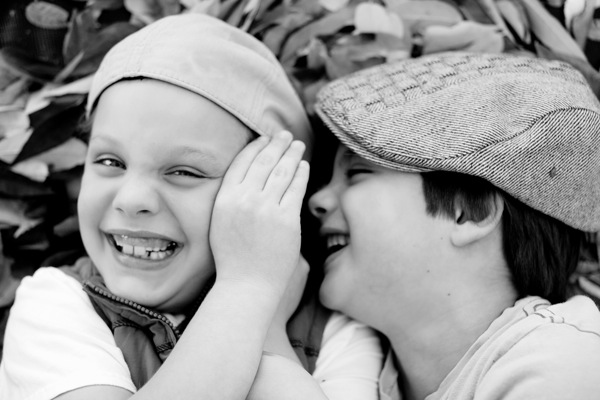
Other Helpful Things

beforePreview: This app is great for reading PDFs—but did you know that it’s the BEST for signing documents too? All you have to do is write your signature on a piece of paper, Preview will let you scan it in using your webcam, and voila! You’ll be signing and sending documents in no time.
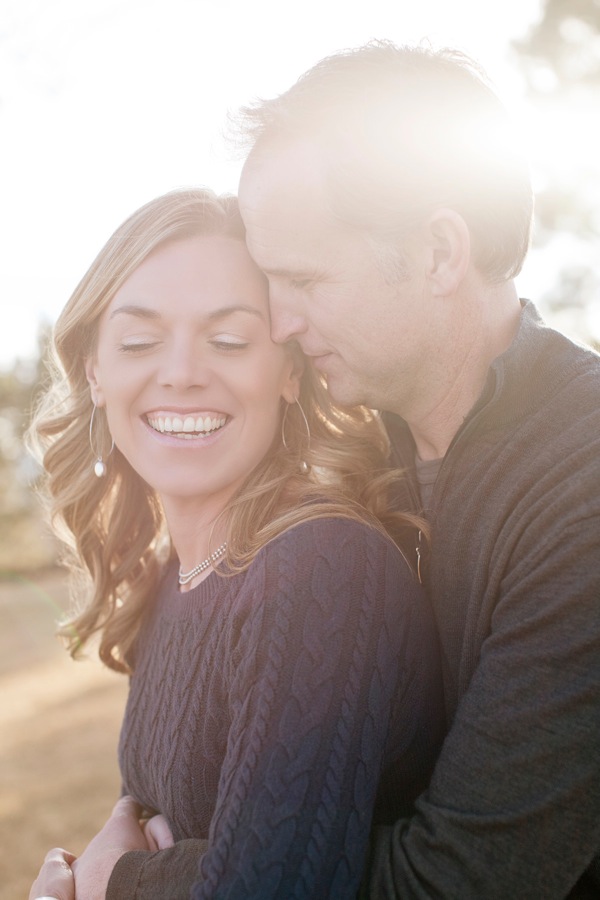
Freelancers Union: The Freelancers Union is the best option for health insurance for freelancers. In addition, they have a Freelancers Yellow Pages where you can list your services, as well as a supportive community you can learn from.

Munawar Ahmed’s Blog: For those really getting into the nitty gritty of setting up your business, taxes, insurance and more, Munawar has tons of advice and knowledge to share. One click on his blog and you’ll realize this guy KNOWS his taxes!

Related posts:

  1. 9 Tips for Breaking into Photojournalism New in the Photojojo forum: One of you kids is…
  2. People in Motion — Two Quick Tips for More Interesting Shots Capturing motion well is one of the most difficult photographic…
  3. Top 10 Tips from Our Fave Kid Photographer! Holiday. Photo. Time. Three innocent little words that when strung…


Photojojo

 
Comments Off on The Best Tips & Tools for Freelance Photographers

Posted in Equipment


Studio Lighting Tips For Beginners

04 Jun

Even as a new photographer you’ll no doubt be aware of the not-so-secret ingredient to creating stunning photographs – lighting. But there are so many things to consider so where do you start? This article will hopefully ‘shed some light’ on some basic but important techniques to improve your shots.

Choose the best light source

Remember that your lighting setup should depend on the purpose of your shoot, the time of day (if you want natural light), and what you’re capturing. Your first task therefore is to choose the right type for the job. So without further ado here’s a breakdown of the main lighting sources and what they’re best for:

  • Continuous light sources, as the name implies, stay lit continuously much like a lightbulb or tube. They’re a great option for beginners on a budget as they’re generally much cheaper than flash lights. A big benefit is that they immediately show you where shadows will appear in the studio. Be wary that such lighting tends to release a lot of heat – not ideal for photographing human subjects for long periods.
  • Flash lighting tends to be a lot more powerful than continuous equipment and is great for capturing quick-moving subjects – for instance when you’re shooting a family session in your studio with energetic children running about.
  • Natural light isn’t for everyone. It can boost portraiture shots with a realistic, natural quality when there’s plenty of it (and vastly reduces the strength of catch light in the eyes). However, if there isn’t enough, it can have an adverse effect on your subjects – giving them a dull, dark look. If your studio allows for a good amount of natural light though, I do recommend you at least give it a try.

Portrait photography ideas

An excellent way of brightening up your portraits without using harsh lighting is by utilising a reflector. Simply sit your subject near a window and place a reflector up to a metre from their face – the natural light bounces off, illuminating the portrait and filling up unwanted shadows. Don’t want to spend lots on a reflector? Make your own! Simply use a sheet of card covered in tin foil. You’ll be surprised how effective it is.

studio-lighting-tips-beginners

Also, try experimenting with the angles of the light source in relation to your subject. Small angle adjustments can make big differences to the look of your photos. As a general guide, lighting from a person’s side produces more of a shadow-heavy yet dramatic style, whilst placing the light behind creates a silhouette. To emphasise your subject even more, or to highlight a particular aspect (such as their hair), try experimenting with a second flash light. We do of course recommend you master a one-flash set up first before taking on two.

Photographing children

As we suggested before, using continuous light sources near people can sometimes cause discomfort due to the high amount of heat they emit, and is even more of a concern for young children. If there’s sufficient natural light available, it’s best to use that. Otherwise, opt for a softbox attachment. For movement-heavy shoots, go for flash.

lisa2

For older children I suggest utilising both flash and continuous. Softboxes help brighten children’s already cute faces and you may want to try large umbrellas to really enhance the catch lights.

Lisa Gill is a professional photographer who also teaches a range of courses from her studio in Buckinghamshire, UK.
http://www.lisagillphotography.co.uk

dslrBlog

 
Comments Off on Studio Lighting Tips For Beginners

Posted in Photography


Unposed Posing: A few Tried and True Tips for Photographing Families in Natural and Fun Ways

03 Jun

by Lynsey Peterson.

Pose

verb: to present oneself insincerely
noun: a deliberate pretense or exaggerated display

I’m not a fan of posed portraits. I’m not even a fan of the word. Insincere exaggerated pretense is not how I want my images to look. I want honest responses, full-body laughter, and spills of emotion. A posed portrait maybe has a place in this world, but I am banking on my client’s children and my own children wanting to look back at pictures from their childhood and see their real reactions and meaningful expressions. You can’t get that in a pose. But you can get it in a set-up.

I use a couple tried and true set-ups every time I do a family shoot. I used to worry that all of my work would start looking the same and I would be known as the photographer that always takes pictures that look like this or that and nothing more. What I have realized though is when the ingredients are different, the end result never looks the same. Families bring their own energy to a shoot and even if I do the same “pose”, if I do it well and give it my all, it will never look the same as another family doing the same thing. To best illustrate this I am showing three different families doing the very same set-up.

Secrets don’t make Friends

SECRETS1 1

SECRETS2 1

SECRETS3  

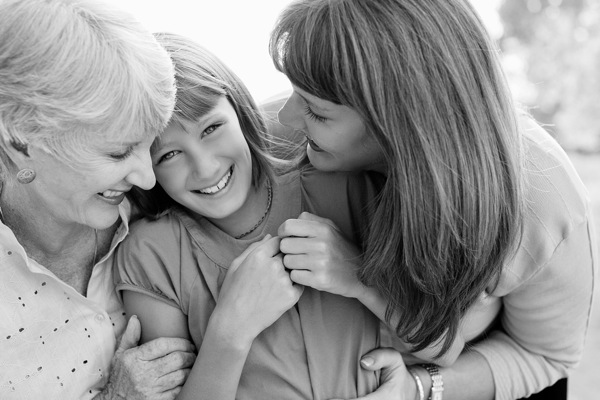
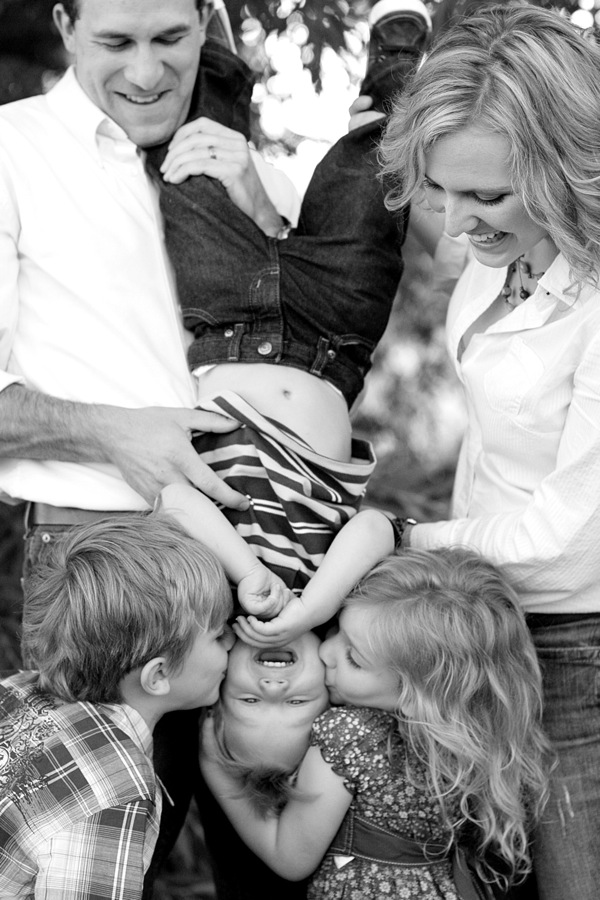
But they do make for good pictures. The Set-Up: ask anyone in the picture to tell anyone else a secret. Honestly it doesn’t matter who because often it isn’t the secret shot itself that you are going for, but rather the reaction of said secret. Every once in a while I get a kiddo that doesn’t understand what a secret is or how to do it and when this happens I just tell them to lick their brother/sister/moms ear. Which would totally gross me out personally, but usually gets met with fits of hysterical laughter and there ain’t nothing bad about photographing that instead.

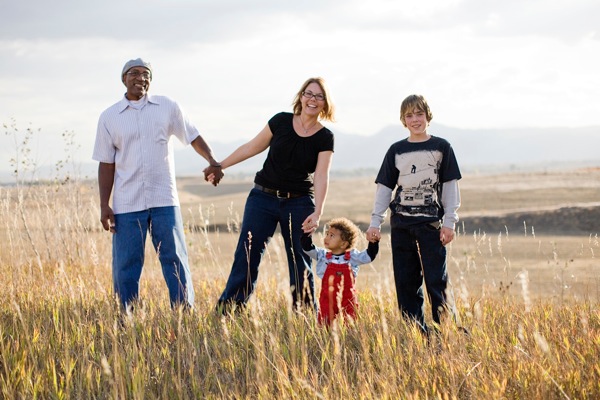
Line ‘Em Up

LINE1 1

LINE2

LINE3 1[LINE1]

Like crows on a clothesline. The Set-Up: with a younger family, I get away with asking everyone to hold hands. Once kids get a little older, I just have everyone get on the same level. This takes on a different direction every time: a running contest, a stadium-style wave, a monkey swing. The goal is always interaction. And if that isn’t happening on it’s own, I find it’s never a bad idea to bust into song. Everyone likes a serenade. 

Surprise Attack

SURPRISE1 1

SURPRISE2 1

SURPRISE3 1

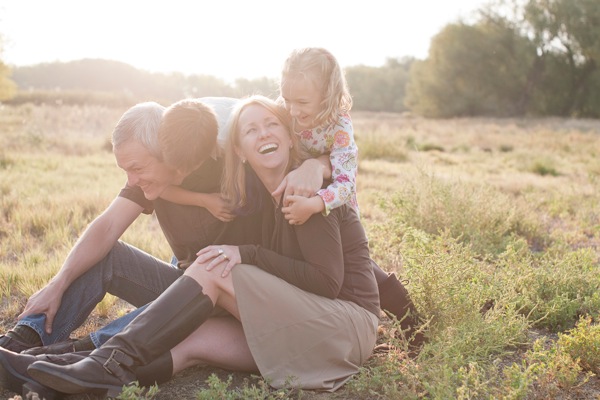
Kids take great delight in getting to run up behind their unknowing big people and surprise hug/tackle them. The Set-Up: if kids are too young to understand this or too old for it to work without being awkward, reverse it and have parents do the sneak attack. I usually save this for the end of a shoot because sometimes it can get a little crazy. Though my photography business has still never caused an emergency room visit. That I know of.

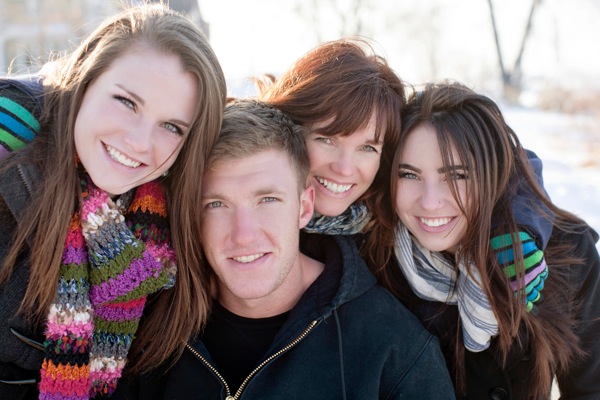
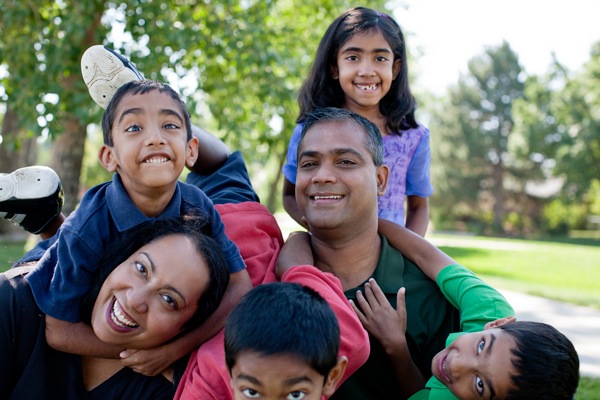
Kid Sandwich

SANDWICH1 1

SANDWICH2 1

SANDWICH3 1

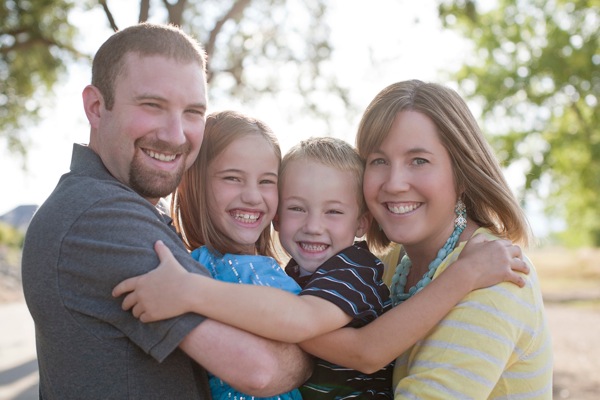
Grown-ups are bread, kids are peanut butter and jelly. Or, pickles and prosciutto. (I’ve photographed some very sophisticated young folks.) The Set-Up: Depending on size and age of kids, have parents bookend the little people and either pick-up kids and smash everyone together, or just get low enough to make it work. If there are more kids than adults, this can get really funny but it’s quick. Be ready and consider being a bit lower than you usually would, as the pull of gravity is heavy here because the kids likely are too.

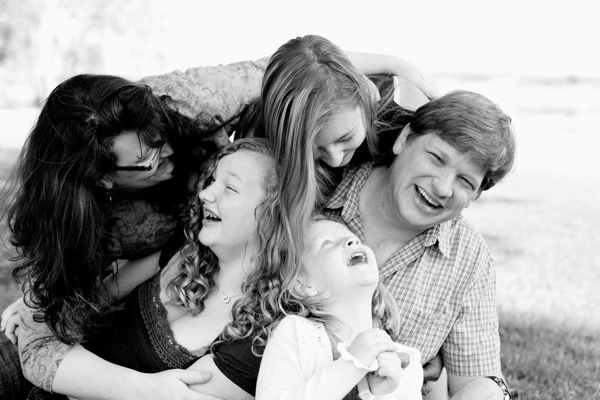
Giant Hug

HUG1 1

HUG2 1

HUG3 1

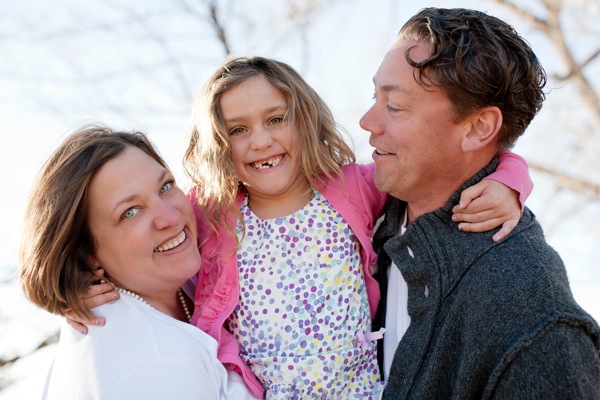
Now is probably a good time to mention that I get laughed at a lot. Usually 95% of what I ask people to do for photos is met with a sweet but certain: “I absolutely will not do that.” I just ignore that. Because they always do in the end. No one has ever flat-out refused and told me no when it comes down to it. Which may be something I should factor into my personal relationship issues, but that’s a different article. The Set-Up: This typically works best when you ask a grown-up to have REALLY BIG ARMS and hug everyone at the same time. Sometimes this requires encouragement and you have to think of yourself as a little hugging cheerleader. When I have to do this, I am just grateful that there is no one videoing my crazy hand motions and the way my voice gets squeaky.

Randomness

RANDOM1 1

RANDOM2

RANDOM3

My goal for each shoot is to do something random that I have never done before. When doing this, don’t over think it. It will work or it won’t; those are the only two options. If it works, great! You have a new idea. If it doesn’t work, great!

Now you know to never try that again and hopefully no one was sent to the emergency room in the process. The Set-Up: This is a good time to really shoot for the moon, knowing that it’s nothing more than a bonus. It honestly could be anything. Be brave and ask for something new—you’ll know pretty quickly if it’s going to work and there is nothing wrong with it not working—just know to move on.

These ideas, as with any type of lifestyle photography posing are about the reaction, not the concept itself. Shooting digitally allows us the ability to shoot constantly; keep the expectation open and allow the moment to play for itself. And have a funny song in your back pocket just in case.

Check out more of Lynsey Peterson’s work on her website.

Post originally from: Digital Photography Tips.

Check out our more Photography Tips at Photography Tips for Beginners, Portrait Photography Tips and Wedding Photography Tips.

Unposed Posing: A few Tried and True Tips for Photographing Families in Natural and Fun Ways


Digital Photography School

 
Comments Off on Unposed Posing: A few Tried and True Tips for Photographing Families in Natural and Fun Ways

Posted in Photography


Gear Bag: Five Great Tips for Dealing with Cables

30 May

If your lighting gear includes sync cords, power cables and/or extension cords, this could happen to you. Don't laugh, pictured is my actual Ancient Sync Cord Burial Ground from the past 20+ years.

But over that time I have also gotten a lot better at dealing with cords, and picked up a few cool tips along the way. Keep reading for my favorite five.

Read more »
Strobist

 
Comments Off on Gear Bag: Five Great Tips for Dealing with Cables

Posted in Photography


5 Tips For Capturing Great Street Portraits

27 May

A Guest Post by Desmond Louw

I just love street photography and with this comes street portraiture.

DPS post 02.jpg

It can be a bit daunting to go up to a stranger and ask them to take their photo, but after a day or two it becomes addictive!  Here are some tricks that might make it a bit easier for you:

Trick number 1

?Always have your camera with you, don’t lug your whole photo bag or a tripod around like a tourist in your own town, just have your camera body and one lens handy. It sucks walking in the street and seeing something awesome and not having my camera with me!

DPS post 13.jpg

Trick number 2

?Have a good lens, this makes a huge impact. I like the 50mm F1.4/F1.8 and the 85mm F1.4/ F1.8, they are also small and relatively lightweight.

DPS post 01.jpg

The wide aperture isolates your subject nicely with a shallow depth of field.

Trick number 3

?Don’t use a flash! Remember you want to maintain a low profile. Rather push your ISO up if you have to. I personaly think an onboard flash could spoil a photo.

DPS post 07.jpg

Trick number 4

?Before approaching a person to ask him or her if you can take a photo, have your settings spot on. When they say yes, lift your arms and snap snap snap, say thank you, and walk away. Easy.

DPS post 09.jpg

Trick number 5

?If you are taking a shot of someone without them knowing, keep the auto focus assist light off, otherwise they will see it and spoil the mood.

DPS post 14.jpg

Connect with Desmnd Louw at his website and on instagram where his id is – desmond_in_capetown

Post originally from: Digital Photography Tips.

Check out our more Photography Tips at Photography Tips for Beginners, Portrait Photography Tips and Wedding Photography Tips.

5 Tips For Capturing Great Street Portraits


Digital Photography School

 
Comments Off on 5 Tips For Capturing Great Street Portraits

Posted in Photography


3 Tips for Taking Portraits that Reflect the Character and Spirit of your Subject

23 May

A Guest contribution by Hailey Bartholomew from You Can’t Be Serious.

1. Do Something

Who are you photographing? If you don’t know them well, find out what they love to do and where they relax the most.

Maybe they love to row boats or take picnics at their favourite park every Sunday.

Maybe you are photographing your grandmother who loves to be out in her garden. Go and do that with them.

Whatever they love to do to relax, tag along with your camera.

But don’t sit back on the sidelines hoping to catch a moment from far away – get down and into whatever they are doing. You need to be in IN that row boat and if your nana is kneeling in the dirt, you should be too. Get into the action and photograph your loved one or client doing what they love.

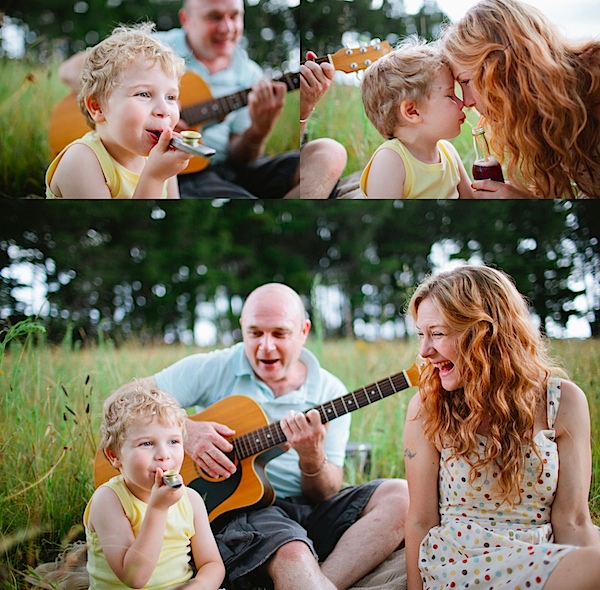
The family below loved playing music together and going on picnics… We did that!

Katie-6.jpg

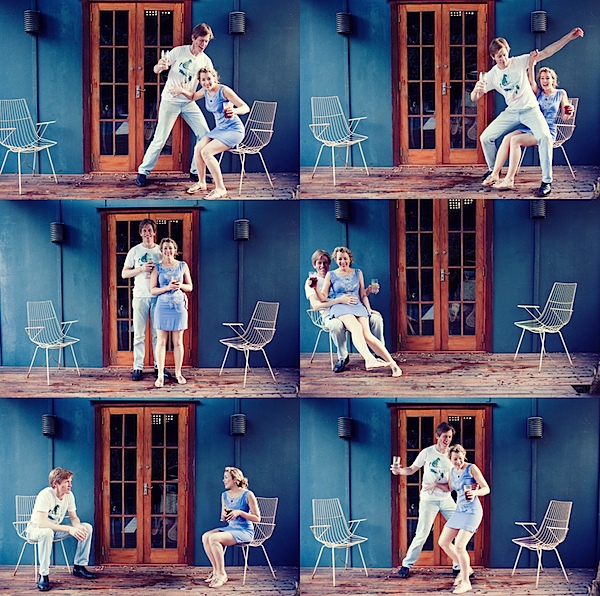
This couple love drinks by the pool….

Ali+Chris_12.jpg

2. MOVE!

Set your camera settings to multiple shots so you can shoot lots of frames quickly. Then, either get your subject to move around, or YOU move with them.

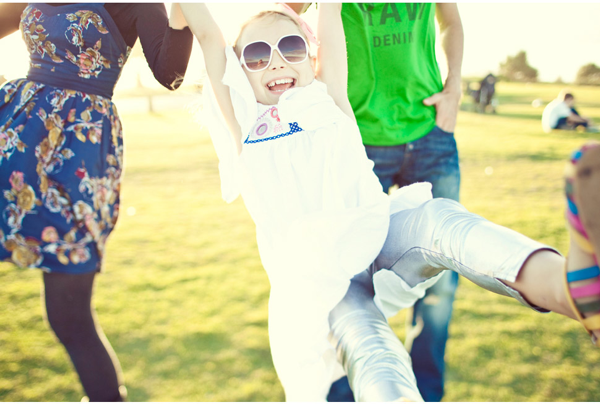
If you have little kids and they keep wanting to run around, hold their hand and say pull me along! Select follow focus and start shooting. You will create natural moments but also fun energetic photos.

Your subject will forget it is about being formal and ‘looking’ good’ if you are moving and having fun. Same if they are moving around.

I love to get my subjects to piggyback each other or walk in a row or play around. Be there to catch the action and you will find your subjects are relaxed. Maybe play some music and dance!

NewImage

NewImage

NewImage

3. Have your Camera Handy

The perfect photo opportunity occurs when a real perfect moment is actually happening!

The best way to get someone being real is to capture a real moment of joy or happiness or reflection. If I have my camera way upstairs and in it’s case I am much less likely to capture everyday perfect moments with my kids.

So I keep my camera handy. It sits out of the case on a bench or is in a bag I take everywhere. Then when the right something happens I am ready to go!

Try a week long challenge and have you camera handy all week long. Keep it on your shoulder or on the bench in the lounge – somewhere you can grab it quickly. See what perfect and REAL moments you can capture!

Below is a moment with my daughter… after hanging out the washing she came to show me her rockstar outfit… ;) So glad I caught this moment. So perfectly her!
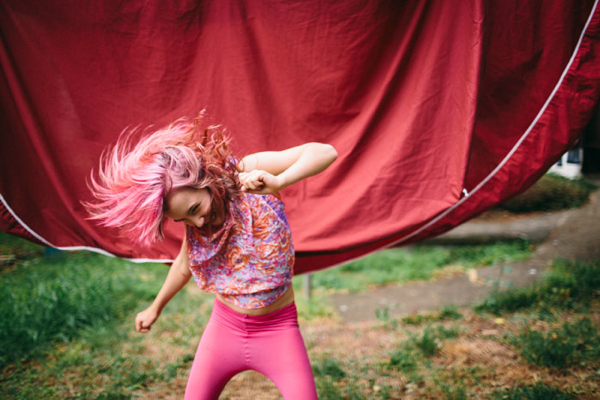
NewImage

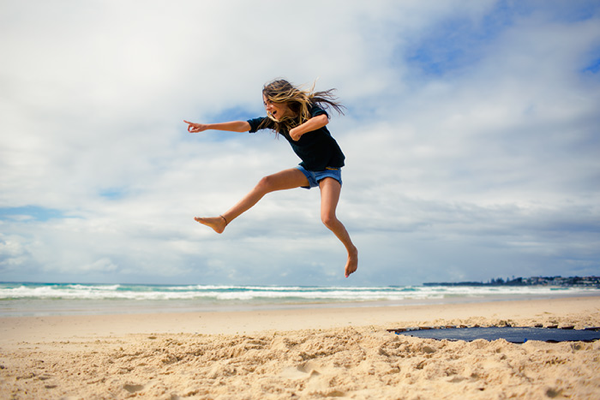
And another great ‘real’ moment was this recently on the beach we found an old trampoline and dug a hole for it. My daughter had the best time leaping off and onto the sand!! Lucky I had my camera with me!

NewImage

Lastly.. keep it real by being real yourself. Be honest and true to who you are. Don’t try to be all professional and formal and knowing everything rather relax, explore photography and be yourself. This keeps things not too formal. Have fun!

Hailey Bartholomew is an award winning film-maker & photographer who is in love with real and fun work that hopefully either makes you smile or makes you think. Hailey works for international aid organisations, shoots TV commercials, documentaries, family portraits and promo videos. You can see some of her work at her site You Can’t Be Serious.

Post originally from: Digital Photography Tips.

Check out our more Photography Tips at Photography Tips for Beginners, Portrait Photography Tips and Wedding Photography Tips.

3 Tips for Taking Portraits that Reflect the Character and Spirit of your Subject


Digital Photography School

 
Comments Off on 3 Tips for Taking Portraits that Reflect the Character and Spirit of your Subject

Posted in Photography


20 Photography Tips Every Travel Photographer Must Know

17 May

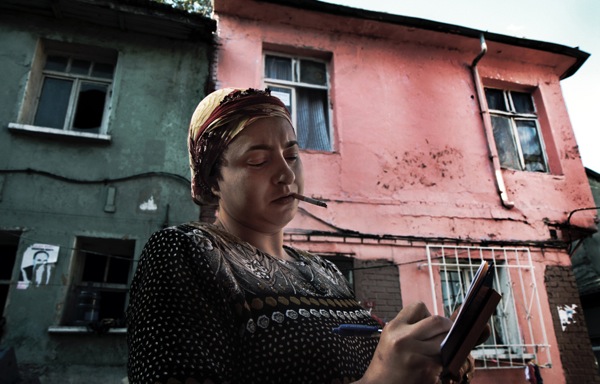
1

1. Get up Early

The best light to capture most kinds of subjects is in the golden hours- one hour after sunrise and one hour before sunset (depend off course on where you are on the glove). So get up early to get that amazing photo opportunities, while all the other tourists are still asleep.

2. Do your research

Don’t leave it to chance and learn as much as you can about the place you are about to travel. The more you know, the more “intelligent” your images will be.

2

3. Learn your Craft

Don’t waste your expensive traveling time on learning how to operate that new camera, lens or flash. Do your homework at home.

4. Choice the Right Lodging

Staying on the center of town, or having a room with wonderful views can create a lot of great photo opportunities.

3

5. Say Hello

Learn how to say “Hello” in the local Language, and greet the locals when taking their photo.

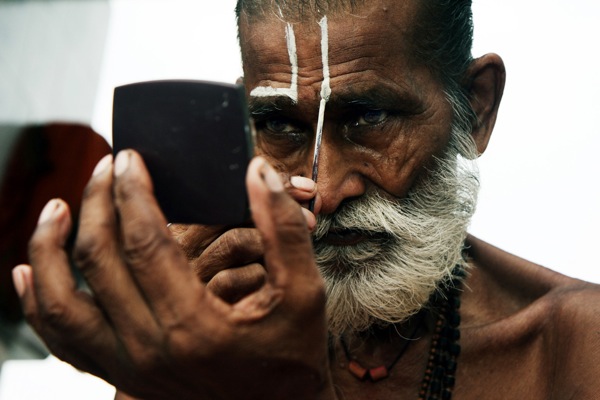
6. Get Inspired

Watch the portfolio of other photographers in order to get new ideas and get inspiration. You can read the interview I did with Steve McCurry, the photographer of the “Afghan girl”, to get few great tips for a true master.Also, If you perceive yourself as an artist, you must acknowledge the work of other artists. Do not underestimate inspiration: visit art galleries, attend some photography lectures, listen to classical music, read good books.

4

7. Feel the Place

Photography is not only about visual inspiration. Try the local food, smell local markets and hear local music, this will help you to better understand the story of the place.

8. Find a Fixer

Talk to locals and seek their advice on great photo opportunities in their own country.

5

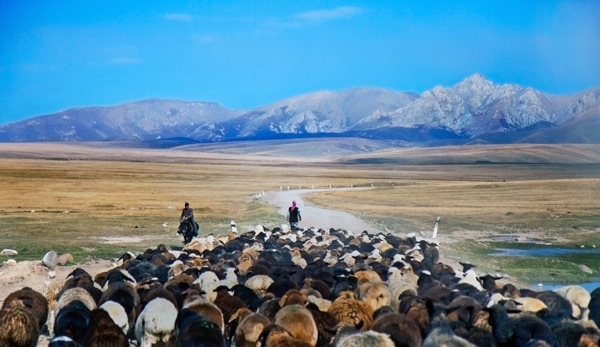
9. Travel Light

Don’t take your entire house with you. When I travel I take with me only two lenses: One zoom and one prime lens. This is extremely important tip if you plan to do some hiking or trekking.

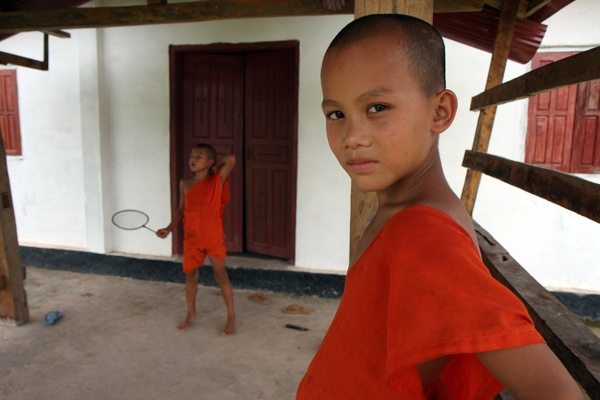
10. Get off the Beaten Path

Yes I know that in Cuba they smoke cigars and that in Thailand they have monks. Tell your viewers something fresh and new. Share your own point of view of the place. You will be able to do so, only after following tip number 2 and 6.

6

11. Don’t try to get it all in once

Don’t try to see everything on your limited time. It is much smarter to get a better understanding about each place you visit on your journey. Slow things down, and your images will get better.

12. Travel Slow

If time allows you, always choice to travel by train or bus over flying. As it will allow you to have better Interactions with the locals.

7

13. Leave the Camera Behind Sometimes

Don’t spend your entire trip looking through the lens. Enjoy your time just traveling and enjoying the ride.

14. Keep it Natural

One of the most important and influential photographers of all time, Henri Cartier Bresson- Never ever used flash in his photography. A practice he saw as “impolite…like going to a concert with a pistol in your hand.” Try to learn how to use and enjoy the benefits of natural light before you buy that expensive flash or reflector.

15. Get Higher

Every good travel photo series must have at list is one bird’s eye view of the place (Being referred sometimes as the “establish shot”). Find yourself a vintage point overlooking the entire city or town.

8

16. Stop with the Excuses

“Well, if I had an expensive camera and lenses like you have” or “If someone would pay me to travel”, or “but, you have so much time on each destination”.

All of those, are excuses I often hear from my travel photography students. Excuses they tell themselves to answer the question of “Why cant I get Strong images?”
So, A. My first newspaper published cover image, was taken using a pocket camera.
yes, equipment is important and it certainly makes life easier. But don’t forget the camera is just an instrument. A “pipe” which captures your vision and thoughts. Do not cry over the equipment you don’t own. spend the time and money to learn photography, reading books about it and travel as much as you can.

And B. For my first 8 journeys, no one paid me anything. I worked very-very hard at my day job for a whole year, and then I spend my money on traveling. I slept in some shitty places got bus rides from hell. This lifestyle requires commitment. And today, even as I get paid for traveling somtimes. The lengths are usually one to two weeks per assignment. Two weeks to come back with an amazing results. Not excuses like “but it was raining and I was sick” are accepted.

So, stop the excuses, and get back to work.

17. Find Yourself a Master

: the best way to learn (anything) is by watching a master working on his craft. Try to find a photographer which you can accompany as his assistant. It is true that most travel photographers like to travel alone. But it doesn’t have to be a travel photographer. Most of my knowledge about using light, I learned from a great fashion photographer, which I served him as an assistant for a while.

18. Stop Using Excuses

“Well, if I had the time \ money to travel the world or if I had the money to buy that new camera \ new lens … I’d probably be an excellent photographer”. Excuses are just our way to explain ourselves why our photography doesn’t get any better. No matter where you live in the world: New York, the Middle East or a small village in France. Try to see the beauty of the place you live in. if you will find the beauty of that place and bring within your images, people will follow.

9

19. Don’t stop Traveling

A good travel photographer must keep is portfolio alive. Keep on traveling, and as the last tip mentioned: you don’t have to travel to far and exotic places to do so. As it is very easy to travel to India and get “good” travel photography. Try to bring the beauty of your own local town. Travel to the nearest market or attend the next festival as a way to keep your craft improving.

20. Be Human

Treat your subject as well as you can. Don’t shoot people for a far distance, don’t shot people who don’t want to get snapped. If you promise to send their photos, please do so. This will ensure that the photographer that will come after you will be received with a smile. And don’t forget, sometimes it is best to just leave the camera behind and enjoy the ride.

Oded Wagenstein is a Travel photographer and writer. He is a regular contributor to the National Geographic Traveler magazine (Israeli Edition) and his images have appeared in many national and international publications and websites.
He is known for his intimate culture portraits. In his works he put the emphasis on understanding the culture and achieving good relationship with the person being photographed pre-shooting.

You can join his Travel photography group on Travel photography group on Facebook and continue to discuss on travel and people photography.

Post originally from: Digital Photography Tips.

Check out our more Photography Tips at Photography Tips for Beginners, Portrait Photography Tips and Wedding Photography Tips.

20 Photography Tips Every Travel Photographer Must Know


Digital Photography School

 
Comments Off on 20 Photography Tips Every Travel Photographer Must Know

Posted in Photography