RSS
 

Posts Tagged ‘Social’

Ads on Social Networks Suck. ello.co — San Francisco, CA

03 Jul

Ads on Social Networks Suck

Are you on Ello yet? If not you are missing out on the best photography community on the web right now. It’s a wonderful ad-free social network where your photos are published *BIG* like they are meant to be seen. Some truly amazing photographers are publishing some truly amazing work there right now.

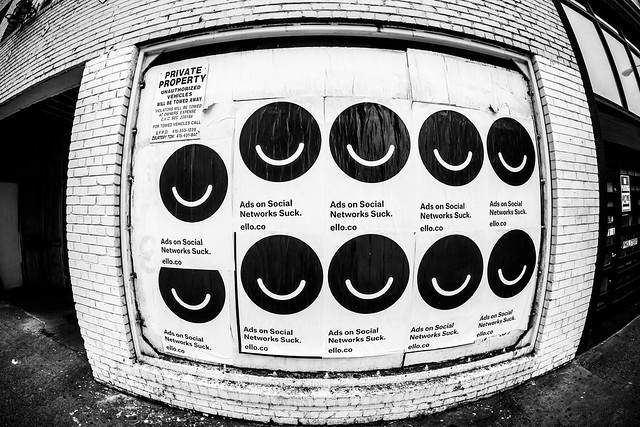
This is some Ello street art I photographed out on 7th street earlier today.

Come check it out and let’s be friends there too. You can find me at Ello here: http://ello.co/thomashawk

:)


Thomas Hawk Digital Connection

 
Comments Off on Ads on Social Networks Suck. ello.co — San Francisco, CA

Posted in Photography


Social Dance Photography Tips

23 Mar

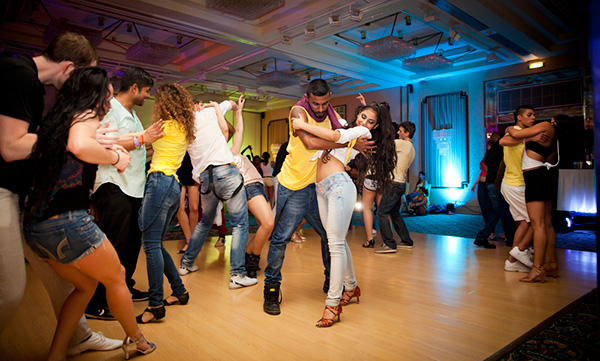
Nowadays it is very popular to have social dancing as hobby; people go dancing to the themed parties, special events, and travel to the international dance congresses. So definitely the subject of social dance photography is getting more interest worldwide. Doesn’t matter what kind of dance you enjoy the most – the challenges of capturing a great dance moment are very similar.

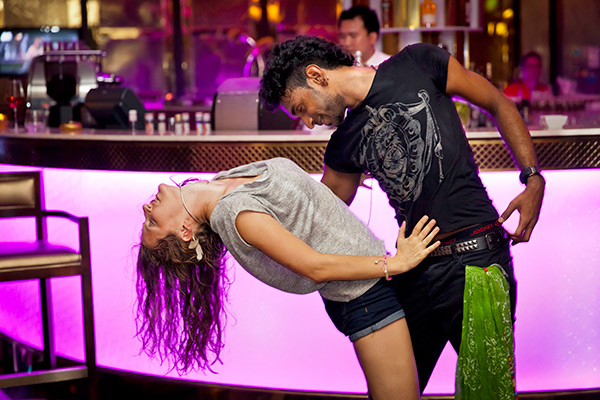
Photo1

Have you ever seen dark, blurry photos, taken from a weird angle of yourself on the dance floor? I bet your answer is yes. Being a dancer myself I could relate to such matters too, which made me realize that it’s not an easy task to get great dance shots. So I started practicing.

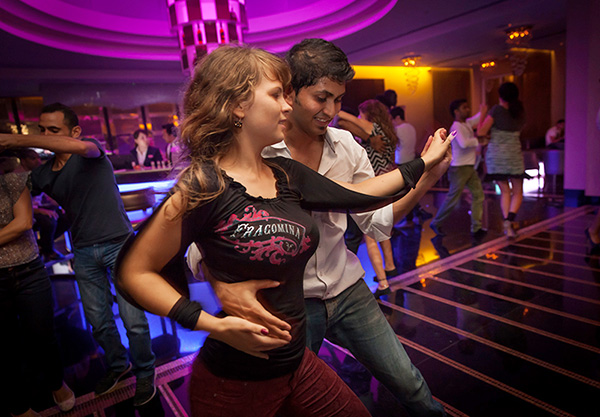
Photo2

Gladly I had a lot of opportunities to do so due my active role in growing Zouk community in Abu Dhabi, capital of United Arab Emirates.

Zouk is a Brazilian dance; very sensual and addictive. It is known as the dance of the 21st century, and is becoming viral all over the world. The rhythm of Zouk gives dancers a lot of flexibility and freedom to experiment and adapt their style to the music. It offers a lot of beautiful poses for photographer to capture (head flicks, body rolls, spins, twirls, dips and various hip movements).

Let’s look at the challenges of capturing beautiful dance movements and how to overcome them:

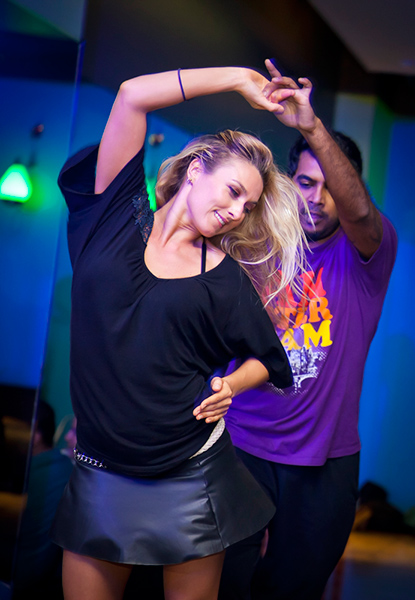
Photo3

A dark environment

Social parties are usually happening in bars, restaurants, or ballrooms where the lights are dimmed. The trick is to expose for the ambient light (use a slower shutter speed, open your aperture as much as possible, increase ISO – up to 1600 worked fine with a Canon 5D Mark II), and use second curtain shutter sync for your flash. For Canon 5D Mark II users that option is located under External Speedlite control>Flash function settings>Shutter sync – check your camera’s manual if you have a different body. Not a problem if your shutter speed gets really low – you still will get last part of the frame frozen, thanks to those flash settings. You can get really creative if the ambient lights include lasers and rotating heads. By moving your camera sideways when the shutter is open you will get strikes and lines which will make your photos even more interesting. Sometimes it is hard to get focus right in a dark environment, so I usually have small pocket laser with me to light the dancers at the moment of focusing.

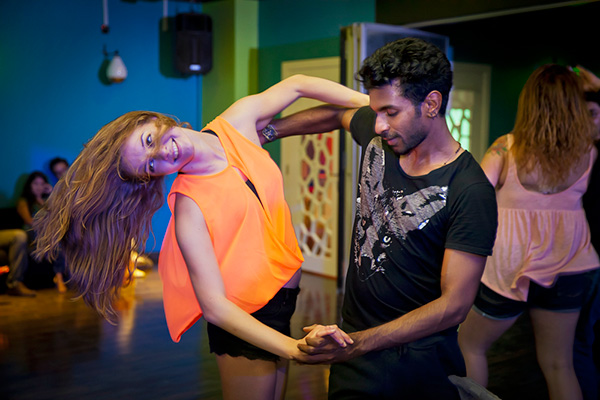
Photo4

Direct flash

Often with this option you get overexposed figures of dancers and a dark, underexposed background. If possible, scout the environment before the dance event. Search for white walls and ceiling, which can work as a large soft box to reflect light, and use bounce flash instead of direct flash. Another alternative is to use a portable speedlight softbox off-camera to diffuse, and soften strong light.

Photo5

Shutter delay

Have you ever pressed the shutter release button and the slight delay gets you a photo of dancers with their backs to the camera, instead of what you imagined? Try to study movements (if you are not dancer yourself) to oversee what move comes next and press the shutter just before that so you catch the right moment. Each camera is slightly different, so test yours to understand.

Photo6

Camera angle

If your camera angle is too high the dancers’ heads will look bigger and their legs shorter – not always pretty to look at. I usually shoot at the chest level, or in some situations – waist level. Sometimes experimenting with getting really low works well too. Decide on the go what works for you – judge the available space between you and the dancers, and keep in mind how you’re using your flash (if you are bouncing it – you need some distance).

Photo7

Lens choice

My favorite social dance photography lens is 24-70mm f/2.8. It serves me well most of the time, though it depends on size of the party. If the crowd is big and you would like to show that, you might switch to a wide angle lens from time to time, for example, a 16-35mm f/2.8.

Photo8

Full-body shots or close-ups?

This is up to you again, depending on dance aesthetics. One note: do not cut off hands or fingers and include a little space around the subject, so photo can breathe. Although this is very subjective, sometimes it can create a different mood when you fill the frame really tight.

Photo9

Lastly – keep practicing

Apply the general rule of photographers; the more you practice – the better shots you get!

Photo10

I wish you happy social dance photography; hope you will make dancers look beautiful and graceful! Catch your moments!

Please share your experiments in comments below and ask any questions there as well.

googletag.cmd.push(function() {
tablet_slots.push( googletag.defineSlot( “/1005424/_dPSv4_tab-all-article-bottom_(300×250)”, [300, 250], “pb-ad-78623” ).addService( googletag.pubads() ) ); } );

googletag.cmd.push(function() {
mobile_slots.push( googletag.defineSlot( “/1005424/_dPSv4_mob-all-article-bottom_(300×250)”, [300, 250], “pb-ad-78158” ).addService( googletag.pubads() ) ); } );

The post Social Dance Photography Tips by Viktoryia Vinnikava appeared first on Digital Photography School.


Digital Photography School

 
Comments Off on Social Dance Photography Tips

Posted in Photography


Social Media + Street Graffiti = Stenciled Signs of Our Times

09 Mar

[ By WebUrbanist in Art & Street Art & Graffiti. ]

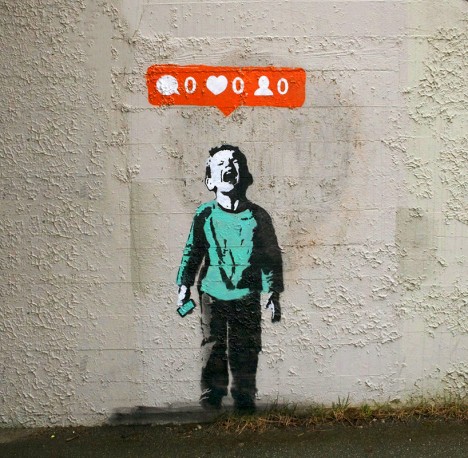
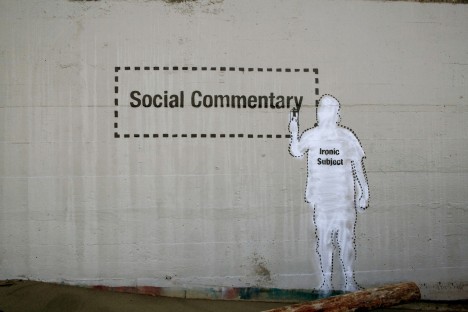
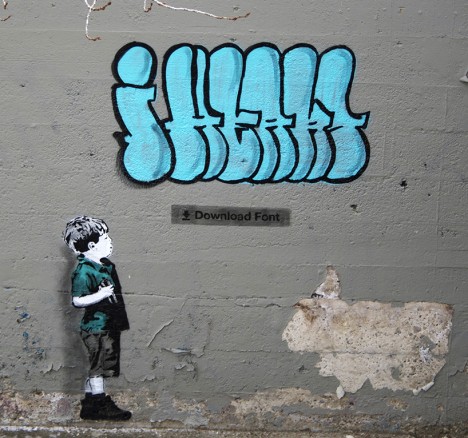
social media child art

For better and worse, self-reflection and meta-art is an inevitable facet of the digital age – this artist recognizes the blurred lines between physical walls and their Facebook equivalents, commenting on our relationship to social media while making light of it as well.

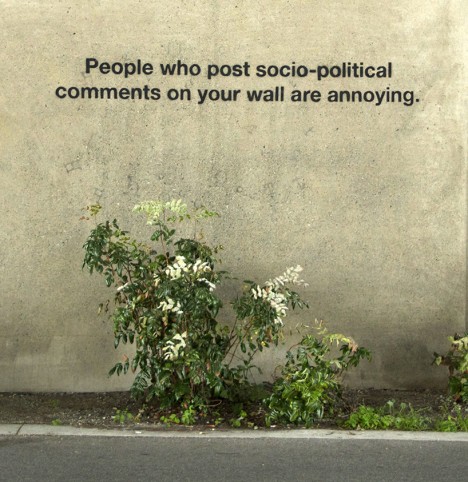
social media text graffiti

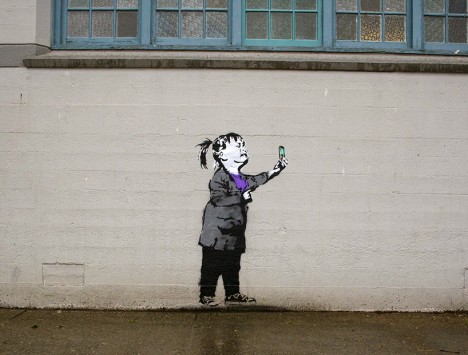
social media selfie girl

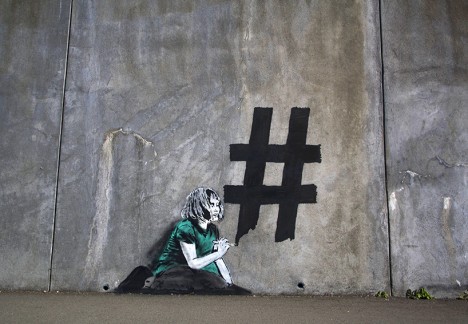
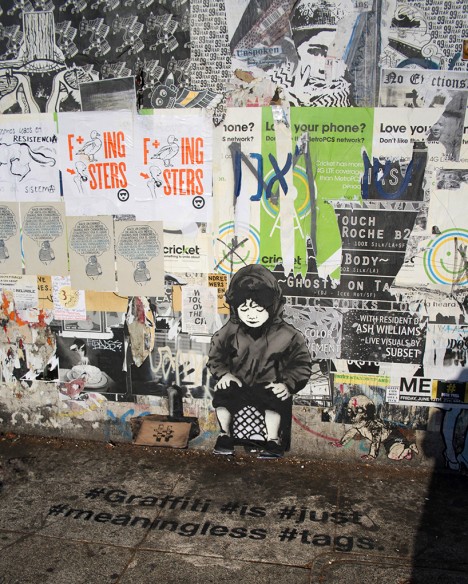
social media hashtag reality

iHeart(StreetArt) is a street artist based in Vancouver whose creations span the spectrum from traditional tags and stencils to this series of works reflecting on our virtual lives and interactions, particularly how young people are raised in this strange new culture of communication.

social media wall post

social commentary ironic subject

social media download font

He variously uses, abuses, twists and repurposes elements of our wireless language, giving hashtags and message bubbles new meaning. While he is not alone in this pursuit of geek graffiti or in using street art for social commentary, his dark humor and unique style set him apart.

social stencil art design

social media blank fill

social media hashtag art

This is also only a smaller sampling of a much larger body of work by iHeart which spans various street art styles as well as gallery and installation works on topics beyond contemporary digital interaction.

Share on Facebook


[ By WebUrbanist in Art & Street Art & Graffiti. ]

[ WebUrbanist | Archives | Galleries | Privacy | TOS ]


WebUrbanist

 
Comments Off on Social Media + Street Graffiti = Stenciled Signs of Our Times

Posted in Creativity


Upload Your Photos to Multiple Social Media Websites with Expojure

19 Feb

How many social media websites do you upload photos to regularly? I have five – a Facebook page, my personal Facebook profile, Google+, Flickr and 500px. Some people have more. For photographers who want to get their work out there, this seems like a must. Yet it’s time consuming and, truth be told, an inefficient way of working.

If this is you, then you’ll be interested in new photo sharing website, Expojure. A startup based in Mumbai, it lets you upload the photos you want to share to a central Expojure account, arrange them in Collections, add keywords, titles, tags and descriptions, then upload them to as many as six photo sharing websites (the five listed above plus SmugMug).

Expojure review

I’ve been using Expojure for a few weeks now and I’m very impressed with the setup. The website is well-designed and easy to use. The layout is simple, doing exactly what most people will need it to, without adding unnecessary extras.

There’s also a plug-in for uploading photos to your Expojure account directly from Lightroom.

How Expojure works

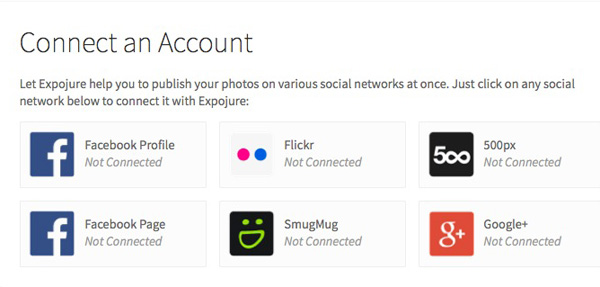
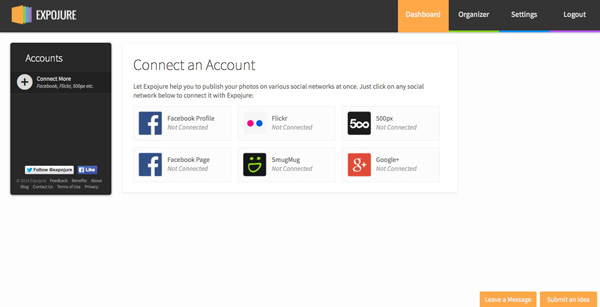
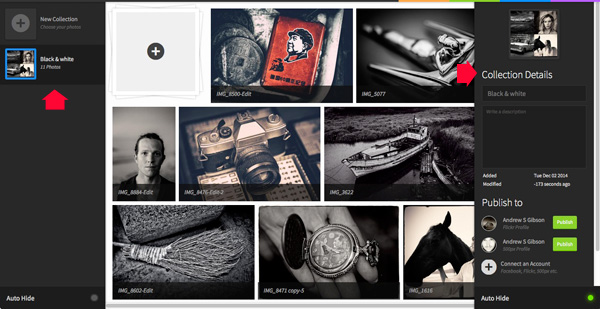
When you sign in to Expojure you’ll see a page that looks something like this – it is your Dashboard. If you’ve uploaded any photos to Expojure already, you will see them here. If not, you’re presented with the option to sign into the photo sharing accounts you wish to use. Just click the buttons to do so. Connected accounts are shown afterwards on the left.

Expojure review

Once you’ve connected to some photo sharing websites, it’s time to go to the Organizer and add photos. Uploaded photos are automatically placed in a new Collection. You can rename the Collection and add a description using the panel on the right. You can also move photos around between Collections.

Expojure review

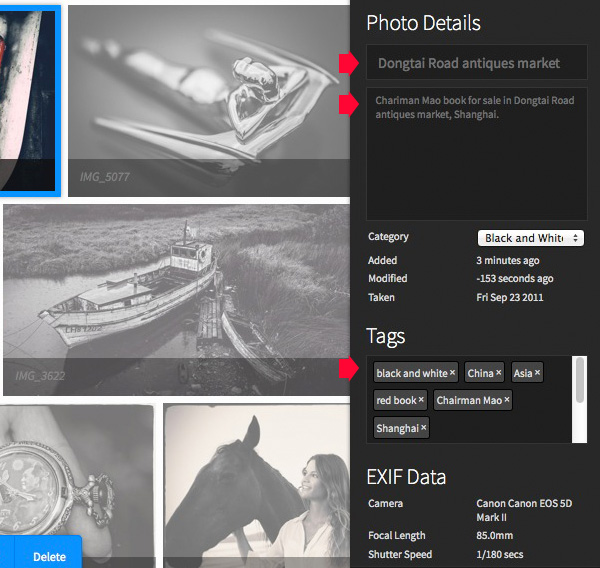
You can add or amend details of individual photos by clicking on them and entering the new information on the right. If you haven’t already added a title, description, or tags now is your chance to do so.

Expojure review

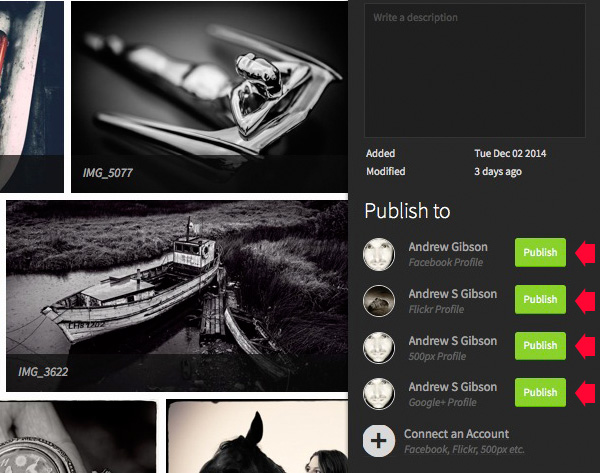
Click the green Publish buttons in the bottom right corner to upload the photos. Expojure places all the photos in the Collection into a new Set on your selected website.

Expojure review

Every photo in the Collection is sent to the chosen website. If you want to upload a single image, you need to create a new Collection and add the chosen photo to that first.

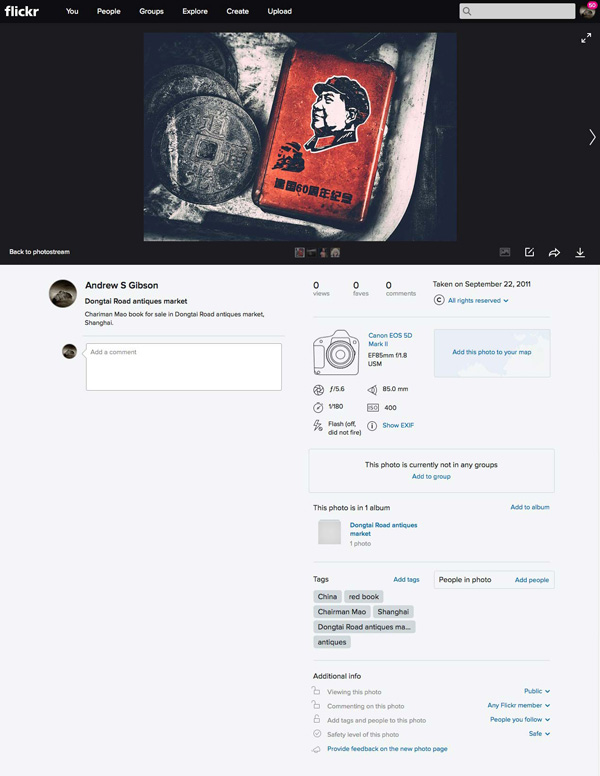
Here’s a photo that I uploaded to Flickr. The title, description, EXIF data and tags have been successfully added. The only thing left to do is add the photo to any Groups or mark the location on the map.

Expojure review

Expojure Lightroom plug-in

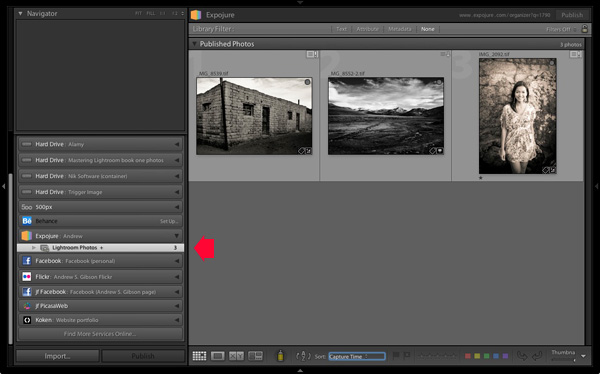
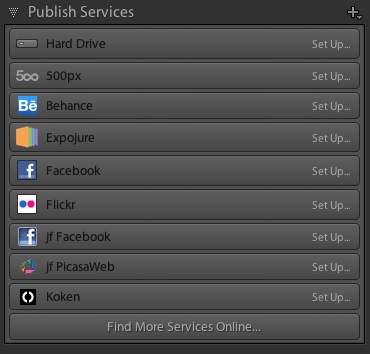
If you click on the Settings tab at the top of the Expojure website page you can download a free plug-in for Lightroom. Use Plug-in manager to add it. It shows up in Lightroom’s Publish Services.

Once installed, you can create new Publish Collections containing photos to upload to your Expojure account. Lightroom uploads them when you press the Publish button. The images are held there until you log in and distribute them to your photo sharing websites.

Expojure review

Notes about Expojure

At the time of writing Expojure is free to use, and has been since the service went live. However, at some point (most likely after this article has been written, but before it is published) Expojure is switching to a subscription model. There will still be a free account, which limits you to uploading 20 photos a week and connection to two social media accounts. Paid accounts retain unlimited photo uploads and unlimited social media accounts.

If you have a free 500px account, you will receive an error message when you upload photos to it. This is because free accounts don’t support Sets. However, your photos are still successfully uploaded to 500px, despite the error message.

Expojure will add more features, and more services to its supported photo sharing websites over the next few weeks. Some of these may be active by the time you read this article.

Alternatives to Expojure

The only alternative to Expojure that I’m aware of is Lightroom’s Publish Services (please let us know in the comments if you know of any others). The benefit of Lightroom’s Publish Services is that it is free (once you own Lightroom). However it’s not as efficient or easy to use as Expojure and doesn’t support websites like Google+ out of the box (plug-ins are available for many photo sharing websites).

Expojure review

Conclusion

Expojure is a well thought out service that greatly simplifies the task of uploading photos to social media websites. If you find the process of adding images to multiple websites frustrating, then please take a look at Expojure’s website, you’ll be glad you did. The video posted at the top of the article gives you a good overview of how it works.

Which photo sharing accounts do you use and how do you manage them? Please let us know in the comments.


The Mastering Lightroom Collection

Mastering Lightroom ebooksMy Mastering Lightroom ebooks will help you get the most out of Lightroom 4 and Lightroom 5. They cover every aspect of the software from the Library module through to creating beautiful images in the Develop module. Click the link to learn more or buy.

googletag.cmd.push(function() {
tablet_slots.push( googletag.defineSlot( “/1005424/_dPSv4_tab-all-article-bottom_(300×250)”, [300, 250], “pb-ad-78623” ).addService( googletag.pubads() ) ); } );

googletag.cmd.push(function() {
mobile_slots.push( googletag.defineSlot( “/1005424/_dPSv4_mob-all-article-bottom_(300×250)”, [300, 250], “pb-ad-78158” ).addService( googletag.pubads() ) ); } );

The post Upload Your Photos to Multiple Social Media Websites with Expojure by Andrew S. Gibson appeared first on Digital Photography School.


Digital Photography School

 
Comments Off on Upload Your Photos to Multiple Social Media Websites with Expojure

Posted in Photography


Ello, My New Favorite Social Network

21 Nov

ello-40715fdd-0669-4999-bedd-419b07886886

I just spent $ 40 on a t-shirt.

I don’t think I’ve ever spent $ 40 on a t-shirt in my life. The t-shirt is a limited edition threadless Ello t-shirt designed by @nopattern.

I’ve been given t-shirts in the past by many social networks and sites. I have a Google+ t-shirt, I have a Facebook t-shirt, I have a Flickr t-shirt, I have a friendfeed t-shirt from back in the day. Twitter never gave me one, but that’s ok. The Ello one I bought for myself though. I like to think that this is some small way that I can help contribute towards the ad-free social experience that quickly has become my favorite of all the networks.

Over at the Atlantic Alexis Madrigal has an article out today titled “The Fall of Facebook.” In the article he describes a certain “soullessness” of Facebook and writes about the unease that people increasingly have with Facebook’s advertising network.

A few weeks ago, when the San Francisco Giants clinched the World Series, my wife took a photograph of our children and family celebrating the win. Not being particularly privacy conscious when it comes to social media, she added a name for the location, “Hawkville” without realizing that through this process she was creating a new permanent “place” on Facebook that was geotagging our home.

Friends quickly liked both the post and the new “place” and in a matter of hours we were much more public on Facebook than I wanted to be. After realizing that she’d made this mistake, my wife removed the location tag from the photo – but what she couldn’t remove was the new permanent “place” on Facebook, “Hawkville,” which geotagged our home’s exact and precise location against our wishes.

Because I’ve had issues with impersonation on Facebook in the past and I suppose because I have a larger than average social media following, previously I’d been given a link to a special sort of VIP customer service area at Facebook.

Although I was disturbed that there seemed to be no way to remove my geotagged home from Facebook, I figured it would just take reaching out to this VIP customer service group to get the geotag deleted — unfortunately this turned out not to be the case. The Facebook employee who responded to me told me that she was unable to delete the page “Hawkville” or remove the geotag of my personal and private residence.

I next made a post on Facebook about the unfairness of this. Just because my wife made a mistake and geotagged our home, why should that mistake be irreversible? Shouldn’t I have more control over my personal residence on Facebook? Does Facebook believe in doxing? Why were my wife and I locked out of this page, unable to control this personal data? Why had Facebook created a “place” of a personal residence in the first place and why wasn’t my wife warned at the time that by geotagging our home she was permanently and irrevocably adding our location data to Facebook with no way to remove it?

After several posts and further attempts to contact the Facebook VIP customer service department, about a week later I went to a group of Facebook employees who I know personally and I was able to get the geotag removed (although not the place). I really appreciate the personal help that I was given to get this done (I really do), but the fact of the matter is that I shouldn’t have had to go that route to have my personal information removed from Facebook.

I’ve been increasingly disappointed with my experience on Facebook. I find that fewer and fewer of my friends are seeing what I post and engagement is increasingly going down.

I’m seeing more and more “sponsored” posts and advertising crowding out organic content, which probably plays a part in this… or maybe my photography just sucks and is way less interesting to the people who follow me there.

Sponsored posts are the worst as far as I’m concerned. At least with an ad over in the right hand column, I can try to ignore it. A sponsored post shoves itself right into your face though. Time and again I’ve caught myself reading the first few lines of a sponsored post before realizing I’m reading one and then have that terrible feeling I get when I realize I’ve just been suckered for few seconds into an ad.

More than this though, I feel like Facebook doesn’t really care about me. I feel like I’m being targeted and manipulated and probed and studied. I don’t feel like my content there is valued. There *is* a certain soullessness to the place. I’m not sure what can be done about that, it’s just what it feels like to me.

I also feel like photography doesn’t really matter at Facebook. Photos are super small and optimized for mobile, rather than big and glorious and optimized for the web. I get that Facebook has to pay for storage for our photos, but with all of the advertising and personal data they collect to target us, don’t they have even just a few nickels or dimes to make the photos just a tiny bit larger in the feed? Yes, I know that someone can click through and see it larger, but most people don’t and won’t and so your art is presented in an unfavorable small way to the 0.1% of your followers who might actually see it in their feed.

My experience so far at Ello has been the opposite.

At Ello I’ve found an idealistic group of artists, photographers and thinkers who dare to imagine a different, better way. I’ve found some of the freshest, most creative and most interesting art that I’ve seen in years online. There are no ads. Ello is not tracking my information to try and sell it to advertisers.

The founders and operators of Ello come across as creative, innovative, accessible, enthusiastic and engaged. I feel respect for my content on Ello, which is shown large in full high res glory. This is why I put more of myself into my art and photography on Ello than any other site. The respect feels greater.

I’ve met so many new and interesting friends on Ello. I’m settling in there realizing that this will be the place that I will share and communicate online with people going forward more than anywhere else. It feels like I’m hanging out with some really interesting artists in a nice cozy little café in Marfa, Texas with amazing coffee and music — rather than being lost, wandering aimlessly around the world’s largest Walmart, being told not to take photos in the store by some security guard.

Forbes says that the number one social media marketing trend that will dominate 2015 will be the rise of Ello. Rather than rely on crappy paid advertisements on Facebook going forward, Fashionista writes about how brands will actually have to create interesting, creative content to be seen on social networks like Ello in the future.

So is this new network worth $ 40? You’d better believe it is. Plus I get an awesome new t-shirt to go with the Marfa Public Radio one I bought just last week.

Do you like art and photography and architecture and design and creative thinking? Then come hangout on ello. You’ll find me most days online over there at http://ello.co/thomashawk


Thomas Hawk Digital Connection
 
Comments Off on Ello, My New Favorite Social Network

Posted in Photography


Social Structure: Apartment Tower Fosters Community Creation

24 Aug

[ By WebUrbanist in Architecture & Houses & Residential. ]

social apartment complex balconies

Tall residential complexes often share very little common space, leading to a relatively solitary living experience despite the density of dwellings – this design aims to change that paradigm dramatically.

social interaction building

Indeed, helping people get to know their neighbors the driving concept behind this building in Antwerp, Belgium, where similar units are clustered around shared balconies and gardens.

social structure community interactions

Communal dining, rooftop deck, bike repair and indoor green spaces also encourage further interaction, increasing opportunities for chance encounters. As Black Swan author Nassim Nicholas Taleb writes, “This makes living in big cities invaluable because you increase the odds of serendipitous encounters — you gain exposure to the envelope of serendipity”

social housing site plan

Designed by C.F. Møller Architects and Brut Architecture and Urban Design, the idea is to increase interactions both within smaller sets of apartments and throughout the complex.

social building site section

All of this is meant to help residents form bonds more quickly, beyond the one-off greetings in elevators and periodic meetings in one-per-building community rooms.

social urban design strategy

The conceptual intent is also cleverly legible on the exterior of the building, with a facade that is broken down into different sections to create a series of scales showing small individual units and collections thereof within the framework of the larger structure.

Share on Facebook


[ By WebUrbanist in Architecture & Houses & Residential. ]

[ WebUrbanist | Archives | Galleries | Privacy | TOS ]


WebUrbanist

 
Comments Off on Social Structure: Apartment Tower Fosters Community Creation

Posted in Creativity


Social Seating: 14 Public Benches Foster Urban Interactions

22 Jun

[ By WebUrbanist in Art & Installation & Sound. ]

social bench curved center

Breaking, bending, twisting and warping wood, this ongoing series of installations fosters new forms of interaction within cities, challenging that most iconic piece civic furniture: the public bench.

social bench v shape

social bench facing seats

social bench lounge chair

Award-winning artist Jeppe Hein from Copenhagen (currently working in Berlin) has installed his Modified Social Benches at indoor galleries and outside in cities around the world.

social bench street series

social bench interaction examples

social bench dual seats

To their creator, these are about more than just sculptural expression – on their origins: “Out of investigating architecture, communication, and social behavior in the urban space, a series of bench designs was born.”

social bench pillow roll

social bench city park

social bench skate boarder

Some engender specific and calculated responses, like sitting and facing your seatmate or climbing to reach an elevated seat suspended above. Others are more like puzzles or mysteries – it is up to the user to figure out what to do with them.

Next Page – Click Below to Read More:
Social Seating 14 Public Benches Foster Urban Interactions

Share on Facebook


[ By WebUrbanist in Art & Installation & Sound. ]

[ WebUrbanist | Archives | Galleries | Privacy | TOS ]


WebUrbanist

 
Comments Off on Social Seating: 14 Public Benches Foster Urban Interactions

Posted in Creativity


The Most Valuable Photography Tips Ever – Results of a Social Media Survey

10 Jun

I recently asked the following question on social media: “What was the most valuable photography tip you ever received?” Needless to say, I received a plethora of really useful tips from the audience. Some were spot on, others were debatable. I thought it would be fun to post a few here and expand on them briefly.  Let’s get started with the most valuable photography tips ever.

The best zoom lens is your own feet

That is often true but please don’t try it if you are photographing a polar bear and her cubs or a bulky football player running for touch down. Get the right tool for the job! On the other hand, I must say that on any given photography workshop, the day my students do their best work is when they use a fixed focal length lens. I really believe in the power of limitations.

Look for the light

The day I understood how to see the light and how to harness it, is the day my photography took a leap forward. There is no bad light, learn to assess the quality and quantity of light and work with. It’s all about learning to use it to your advantage.

See the light and use it to your advantage. ©Valerie Jardin

See the light and use it to your advantage.
©Valerie Jardin

Get close. Then Get Closer

Okay, I had to smile because this one came from one of my former students. I could hear myself say that exact same sentence. Learn to see photographically and make stronger images. Photographers tend to leave too much ‘stuff’ around their subject. The viewer gets lost in the chaos and doesn’t know where to look. Less is often more. It’s important to learn to crop in camera and using a prime lens is a great way to learn to see photographically. Learning to remove distracting elements from your frame before your press the shutter is essential to improving your photography.

Get close. Then get closer! ©Valerie Jardin

Get close. Then get closer!
©Valerie Jardin

Stop thinking and shoot

Before you press that shutter you should know why you composed the way you did. Using the ‘spray and pray’ approach will certainly get you some lucky shots but not much satisfaction. You obviously stopped because you saw something that grabbed your attention, work the scene and follow your instinct. Don’t over analyze at the risk of making a technically perfect image with no story or feeling. Perfection is not always the goal.

Never stop practicing

There is no better way to improve your craft than by exercising those ‘visual push-ups’ daily. You don’t even need to leave the house. Experiment with anything, make an ordinary object look extraordinary. Go ahead and use your camera phone even. The tool doesn’t matter, your vision does.

Don’t use the flash

Okay, I have to use a ‘Sammonism‘* here and remind you to “Turn the darn flash off!” This tip applies to your camera or your phone.

After you’ve taken the shot, look behind you.

For sure! If you are photographing another sunset, the scene lit by the golden light behind you may be even more spectacular.

Look behind you! Everyone was looking at the sun setting over the river Seine in Paris, I looked back and was struck by the beautiful golden light hitting the bridge posts.  ©Valerie Jardin

Look behind you! Everyone was looking at the sun setting over the river Seine in Paris, I looked back and was struck by the beautiful golden light hitting the bridge posts. – ©Valerie Jardin

Shoot in manual mode

That may not always be your best choice. If you are shooting landscape then I would say yes, by all means, shoot in manual and take full control. If you are shooting street photography for example, shutter priority or aperture priority may be better choices. There is no coming back to get the shot again, so let the camera do some of the thinking for you or you’ll miss the moment.

Lighten your load and expand you creativity

A comfortable photographer is a happier photographer. Take one camera, one lens and let those creative juices flow.  It will save your back too.

Shoot for yourself. Don’t try to get approval of others.

So true, unless you need to please a client, of course. If photography is a hobby, why should you care what other people think of your pictures, as long as you like them? That said, having a critique of your work in order to improve on it is one thing, and I would highly recommend it. But, the need for gratification via ‘likes’ on social media is something you should try to learn to live without. If that is the goal then I would recommend posting a daily kitten picture to get your fix. Then just shoot what you love (if it’s kittens, then it’s a win-win). In all seriousness, not every genre of photography will get ‘Oohs and Aahs’ on social media. For example, street photography is not understood and appreciated by the general public like landscape photography. Is that a reason to shoot landscape if your heart is in street photography? I hope not or you’re a photographer for the wrong reasons. Follow your heart and your work will shine!

Stop reading and start clicking

It’s good to read about photography and get inspiration online and in books but that should not replace your time behind the camera. You are not going to get instantly better after reading an article or watching a tutorial. You are only going to get better if you shoot often. Period.

Slow Down

Having unlimited shutter clicks without a cost factor attached is both good and bad. Good for the learning curve. Bad because it tends to make us lazy. Start shooting as if you were shooting film, make every shot count and you will have more keepers at the end of the day. Slow down and know why you are about to press the shutter.

Practice, practice, practice. Any ordinary object can be a great learning subject to exercise those 'visual push-ups' ©Valerie Jardin

Practice, practice, practice. Any ordinary object can be a great learning subject to exercise those ‘visual push-ups’  ©Valerie Jardin

Never pack your camera away until you are back home

You never know what is going to cross your path. Keep that camera handy, and always on.

Take the lens cap off

Better yet: Leave it at home.

Happy shooting!

Please share some tips that made a difference in your photography in the comment section below.

*In reference to our friend and photographer extraordinaire Rick Sammon

The post The Most Valuable Photography Tips Ever – Results of a Social Media Survey by Valerie Jardin appeared first on Digital Photography School.


Digital Photography School

 
Comments Off on The Most Valuable Photography Tips Ever – Results of a Social Media Survey

Posted in Photography


Live Google+ Hangout at 10AM PST This Morning About How to Maximize Your Photos Through Social Media

11 May

Daniel Krieger
The Smoothest Dude Alive, Daniel Krieger.

My good friend Daniel Krieger (aka smoothdude), along with MacPhun’s Laurie Rubin, and I will host a live G+ hangout this morning talking about ways to promote your photography through social media. We’ll record the episode to my youtube account as well in case you can’t make it live and want to watch later.

Come join the show here if you can make it.


Thomas Hawk Digital Connection
 
Comments Off on Live Google+ Hangout at 10AM PST This Morning About How to Maximize Your Photos Through Social Media

Posted in Photography


7 Years of Data: How Social Media Has Impacted JMG-Galleries Web Traffic

01 Jan

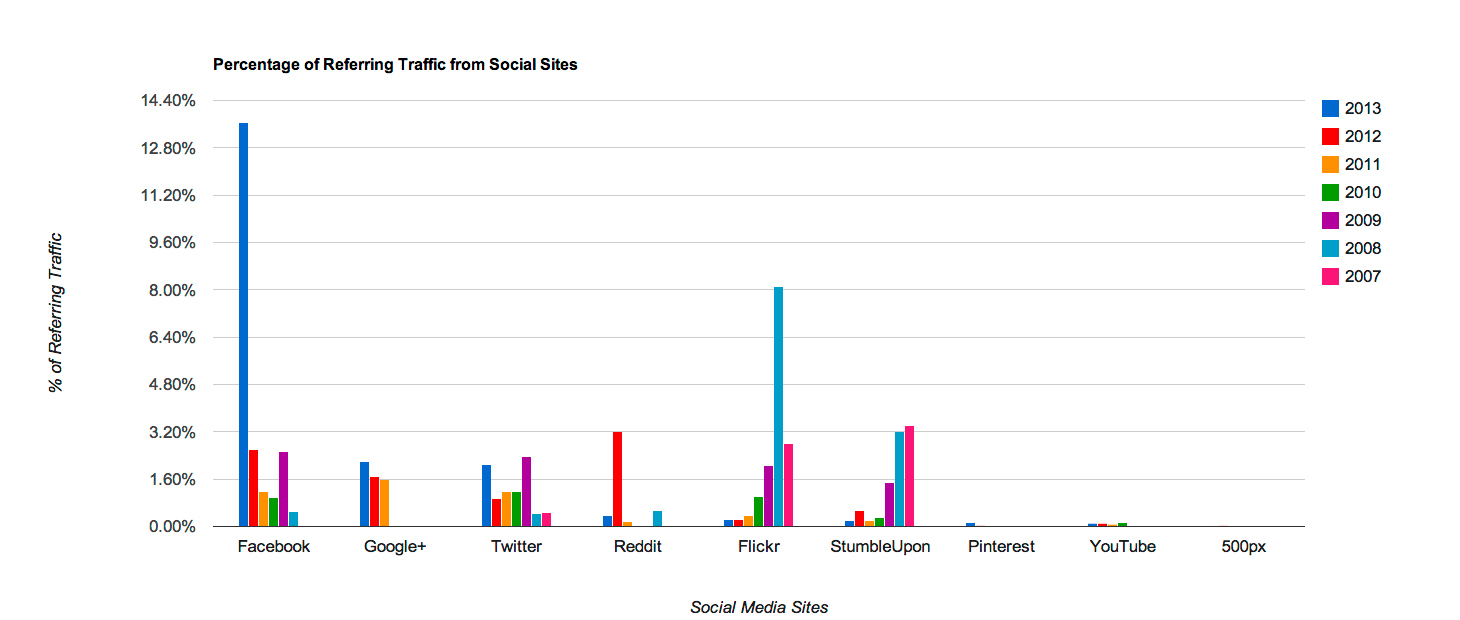
At the close of every year I like to take a look at the web metric trends on my web site via Google Analytics and forecast how I might need to adapt over the coming year(s). Yesterday I reviewed the trends of mobile web traffic and today I’ll dive into the larger trends of referring traffic from social media web sites. If you’re familiar with my past writing on social media trends and strategies you’ll know I’ve always been a big proponent of social media and it’s potential to help photographers. In the time I’ve been writing on social media and it’s benefits there has always been the lingering question, “What is the real impact of taking part in Social Media?”. That’s a multi-dimensional question that can be answered in relation to revenue, web traffic, brand awareness, time, mental health, etc. For the sake of simplicity let’s take a look at referring web traffic to my web site JMG-Galleries over the course of 7 years and across 9 social media sites.

First I learned a few things that were not so obvious in the process of evaluating the referring traffic from social media web sites:

  1. Trends were equally determined by my use of a particular site, as it was about the popularity of that site. (i.e. A site is only as good as you make use of it, no matter how popular/unpopular it may be.)
  2. Social media sites have a life span and are subject to fluctuations in popularity that may impact traffic to your site.
  3. The most talked about social media sites (those with great PR) are not always the best performers.
  4. Honing in on a social media site with the right audience (even if smaller) that is active can often be more important than focusing on a sites total audience size.


All Social Media Sites Compared

Percentage of Referring Traffic from 9 Social Media Web Sites

The first thing you’ll likely notice is that the big standouts are Facebook and Flickr, but take note of the year difference (2013 vs 2008). What fascinated me when taking in this data the first time was the rise and decline of certain social media web sites. Part of the fluctuation was a reflection a web sites overall trending popularity by its users and on the flip side my personal increase/lack of interest in a site.  The other telling thing about this graph is being able to size up the potential impact of competitor sites (ex. Flickr vs 500px). There’s a lot more to this graph when you dive into each site so let’s get a little more granular…
“Content is King” Sites

Reddit over the lifespan of my web site has always been the source of unexpected and pleasant surprises generating healthy bumps in traffic. I’ve never seeded an article there and only created an account there a few months ago. The community there can be brutal on people that pimp themselves so I advise against trying it. What ultimately caught the eye of Reddit users and generated traffic to my site was informative and thought provoking content. The same is true of  YouTube even though I’ve never been a big video creator. What’s cool about YouTube is that it is essentially the 2nd largest search engine (if you lump it in to the search category), so if you create good content there it’s highly likely it will eventually be found. If it’s the right content you might see a delayed impact to referring traffic. Case in point is a review I did of a Canon 800mm f/5.6 lens from BorrowLenses.com.  The first 2 months it fell flat but it’s since picked up interest garnering nearly 200K views.

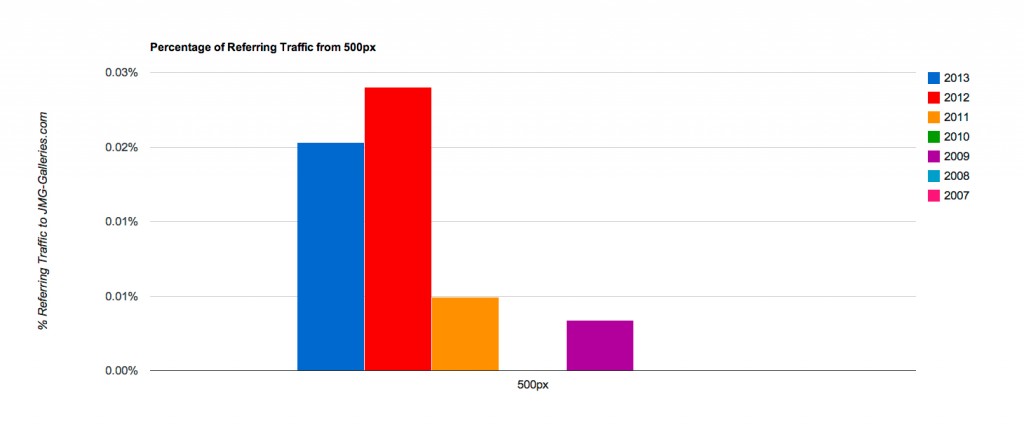
Flickr vs 500px

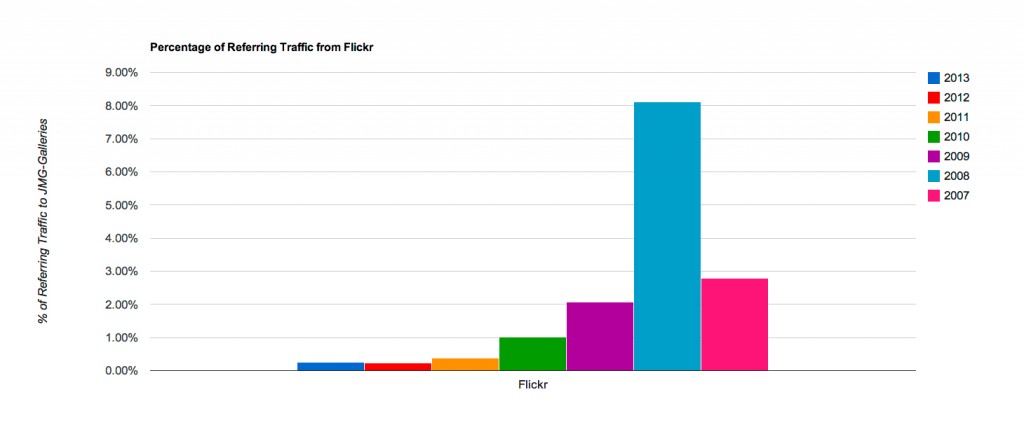
Referring Traffic from Flickr to JMG-Galleries.com

First and foremost I’m not taking a stand on which site is better. While both Flickr and 500px are photo sharing sites I’ve used them differently. I used to plug my web site a lot in image descriptions on Flickr particularly when I was running my podcast EXIF and Beyond. While I still plug my web site in image descriptions on 500px I’ve cut down on my photo sharing on 500px and Flickr. This has been mostly a reflection of my dwindling free time since having my son.
Referring Traffic from 500px to JMG-Galleries.com

To date I have 63 images on my 500px account and on my Flickr account I have 1038 photos. Given that Flickr performs very well as an image search engine I still receive decent referral traffic from the site even though I’m not very active there. We’ll see how 500px performs over time. One dimension of these two sites that I can’t escape mentioning is that even though Flickr has it’s flaws it still has a robust audience. I nearly wrote it off, but after posting a few photos there this year I’ll continue posting photos there. Both Flickr and 500px have ways of highlighting photos to their larger audience through Explore (Flickr) and Pulse (500px) which can boost traffic to your site. Having your images surface in these algorithm driven highlight systems can be hit or miss and an easy sink hole to get sucked into if you’re big on gaming systems. That said systems that can be gamed are always being changed as was the case with 500px’s Pulse in November.

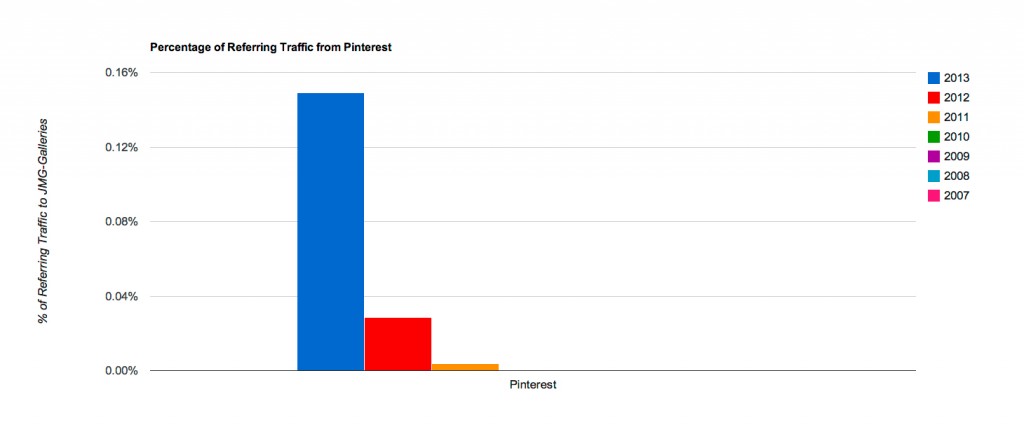
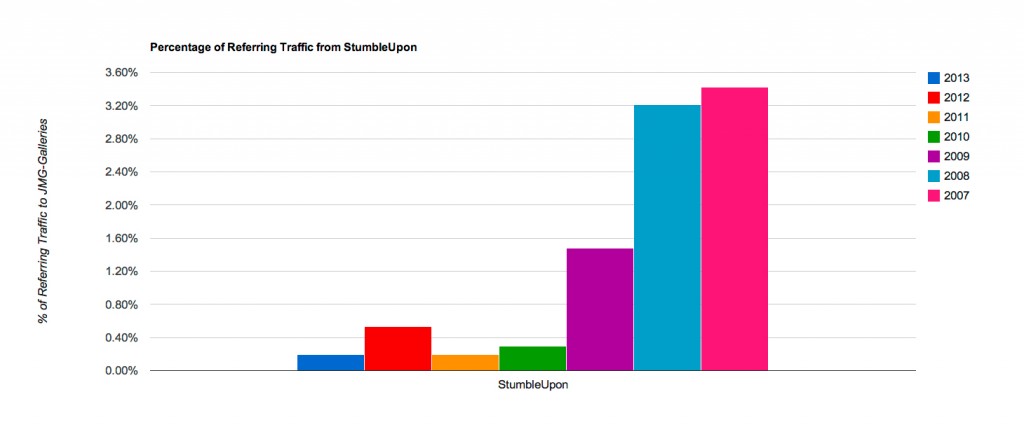
Hyped Sites Then & Now – StumbleUpon vs Pinterest

Referring Traffic Trends from Pinterest

Pinterest took the photography community by storm, albeit more so because of copyright concerns. That never scared me off, but what did was its poor performance. While other photographers hailed it as the biggest thing since sliced bread I’ve never seen it generate great referral traffic. My Pinterest account is still active,  I’ll pin my blog posts and announcements there from time to time and I’ll monitor what of my work is being pinned. Other than that I’ve backed off aggressively courting Pinterest users/traffic. One caveat that I will add to this is that Pinterest has the potential to be great for certain types of photography/photographers. The demographic is heavily weighted toward young females, a perfect target audience for wedding photographers.

Referring Traffic Trends from StumbleUpon

StumbleUpon on the other hand not only received hype it actually performed. I never was an active Stumbler, but my site benefited from the activity of Stumblers that followed my blog. One thing that is obvious from the chart above is that the activity of people coming from StumbleUpon has dropped sharply. My educated guess here is that StumbleUpon has been supplanted by Facebook and/or StumbleUpon users that followed my blog have dropped off for one reason or another. My money is on the Facebook effect.

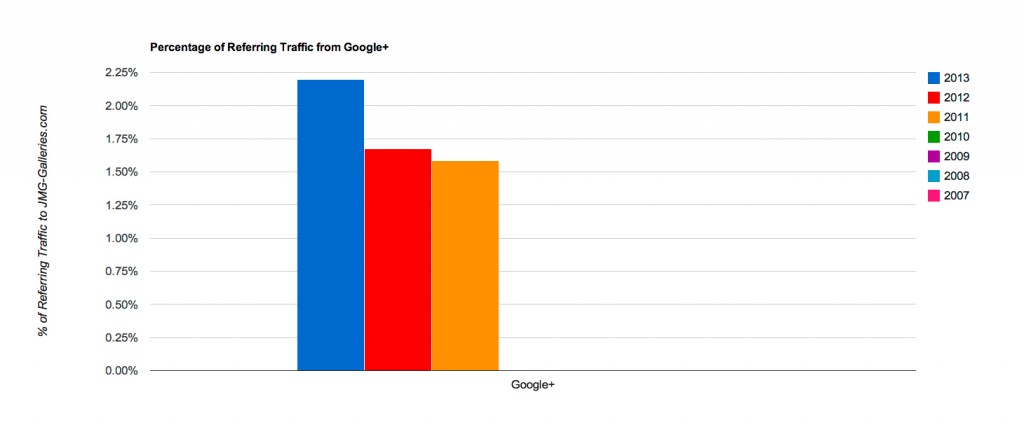
 The Giants – Facebook vs Google+

Referring Traffic from Google+ to JMG-Galleries.com

Like many photographers I have a love-hate relationship with Google+ and Facebook. Google+ is very photographer friendly, but it’s a bit all over the place with a semi-scattered feature set (communities, pages, auto-this&that, Picassa integration, circles, etc.)  Facebook is the king of social activity, but has shot itself in the foot repeatedly with photographers regarding their terms of use and privacy policies. Google+ is interesting because I have a very large following there, but over time I’ve tried to minimize self-promotion unless something special is happening like an eBook discount, giveaway or blog project. Due to my busy schedule the past year, I have not been posting my photos with the same frequency as when I first started my account. Still my referral traffic is on the rise even with fewer photos shared, but I attribute this to being a bit more focused on my self-promotion amid sharing interesting content from other sources and even other photographers.
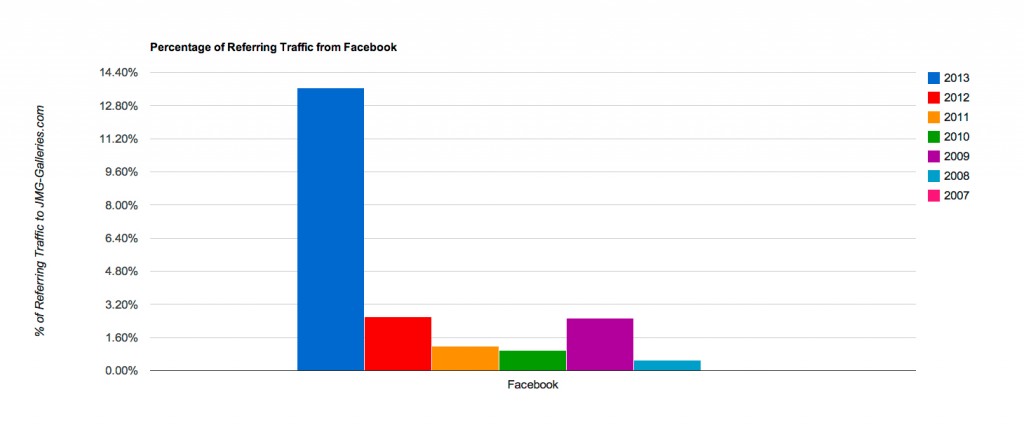
Referring Traffic from Facebook to JMG-Galleries.com

I was quick to create a personal Facebook page when Facebook opened its doors to non-college students (2006), but slow to launch a business page (2010). I was never super active on my personal page, but active enough it would seem. What helped in the early days was connecting my blog to my Facebook page so that new blog posts would display in my timeline automatically. Now I’m less fond of the automatic updates and am leaning toward killing this in 2014. One thing that Facebook deserves a lot of credit for is creating a feature rich business page that has an “easy” time making its way into my fans’s timeline. Google+ could learn a lesson or two on that front.  I don’t post a lot on my business page and share photos conservatively. This shows in the lower numbers in the chart above (2011/2010), but the jump in 2013 can be attributed to my sharing photos on my fan page and in groups where some of my updates have gone viral. I also have been experimenting with promoted posts, but those have been directing people to another domain and should have no impact to these numbers. One thing about Facebook that has me on edge is how their timeline algorithm has recently changed and Facebook’s increasing slant toward paid promotion. A publicly traded company has to create earnings, but I don’t have to like it nor take part. We’ll see how things play out.
Twitter

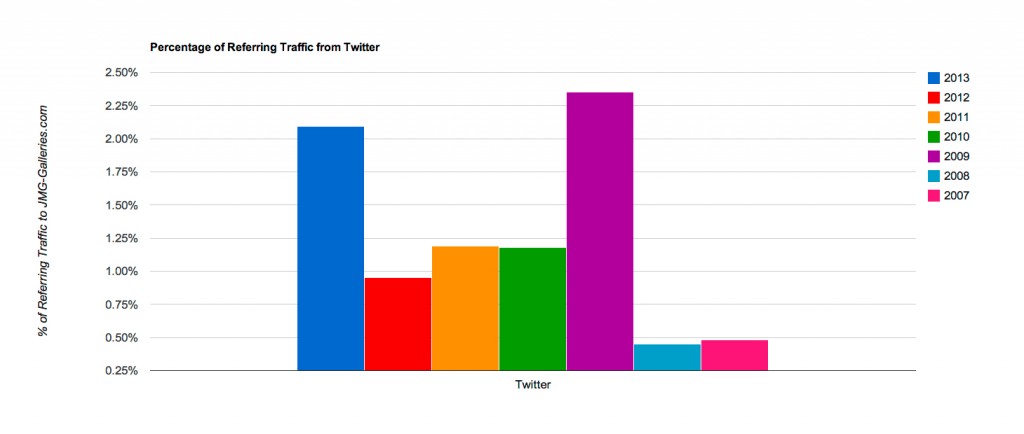
Percentage of Referring Traffic from Twitter to JMG-Galleries.com

I still love Twitter, but that’s because it compliments my incessant reading and news junkie tendencies. I was rather surprised that the referral traffic wasn’t higher for Twitter, but it’s still decent. 2013 and 2009 were good years for traffic, but I don’t recall doing anything drastically different. I thought posting frequency might be behind the higher referral traffic numbers, but I’ve posted less in 2013 than in years prior and I likely was posting a lot in 2009.  Seeing the stark differences in posting behavior I doubt frequency has anything to do with it. Twitter to me also falls under the category of “Content is King” especially if you’re a content creator.  If anything I’m guessing great content begets referral traffic especially if your great content is being retweeted and shared.

Concluding Thoughts

As it relates to referring traffic I have no regrets in taking part in Social Media and my prior enthusiasm for it still holds. I think it is still a worthy use of time, resources and money.  I’m still digesting this data so I will certainly be taking it into consideration as I plan out and ramp up my social media activity in 2014.

Copyright Jim M. Goldstein, All Rights Reserved

7 Years of Data: How Social Media Has Impacted JMG-Galleries Web Traffic

The post 7 Years of Data: How Social Media Has Impacted JMG-Galleries Web Traffic appeared first on JMG-Galleries – Landscape, Nature & Travel Photography.


Related Stories

  • 7 Years of Data: How Social Media Has Impacted JMG-Galleries Web Traffic – Enclosure
  • Recommended Reading: Make Use Of Instagram
  • Recommended Reading: Make Use Of Instagram – Enclosure
Feed Ads by FeedBlitz
powered by ad choices


JMG-Galleries

 
Comments Off on 7 Years of Data: How Social Media Has Impacted JMG-Galleries Web Traffic

Posted in Equipment