RSS
 

Posts Tagged ‘Should’

Which Filters Should You Use for Landscape Photography

19 May

Which filter should you use – if any – for Landscape Photography? It’s a question we hear all the time and one we’ve written about in our archives (we’ll link to some of our posts below) but today we came across this short video from Joshua Cripps where he tackles the question and shows some shots of images taken with the filters – to show what impact they have.

Find more from Joshua at his site here.

Further Reading on How to Use Filters in Your Landscape Photography

  • How to do Dreamy Landscape Photography with a Neutral Density Filter
  • Beginner’s Guide to Buying Filters
  • Polarizing and Neutral Density Filters: Essentials for Landscape Photography
  • Using Graduated Neutral Density filters for Landscape Photography
  • How to Use a 10 Stop Neutral Density Filter to add Drama to the Sky

Check out our Brand New Landscape Lightroom Presets

NewImage

googletag.cmd.push(function() {
tablet_slots.push( googletag.defineSlot( “/1005424/_dPSv4_tab-all-article-bottom_(300×250)”, [300, 250], “pb-ad-78623” ).addService( googletag.pubads() ) ); } );

googletag.cmd.push(function() {
mobile_slots.push( googletag.defineSlot( “/1005424/_dPSv4_mob-all-article-bottom_(300×250)”, [300, 250], “pb-ad-78158” ).addService( googletag.pubads() ) ); } );

The post Which Filters Should You Use for Landscape Photography by Darren Rowse appeared first on Digital Photography School.


Digital Photography School

 
Comments Off on Which Filters Should You Use for Landscape Photography

Posted in Photography


Primer: What is VR, and why should photographers care?

18 May
VR was everywhere at NAB, and at CES this year.

Virtual reality is an immersive experience that involves multiple senses, and, most importantly, responds to the intentional interaction of the viewer. From the earliest days of synchronized film and sound playback, the illusion of being in a different place or time, and generating an emotional response to the experience, has been the goal of most modern communication and entertainment mediums.

In VR, this illusion is referred to as ‘presence,’ where not only the sights and sounds (and other sensory input) are believable, but the ‘show’ itself reacts to the participant’s actions in a plausible way.

It isn’t hard to imagine how different the experience of browsing through a gallery of images can be when they are not just thumbnails on a tight grid, but rather ‘virtually’ hung by the artist in a spacious VR room that mimics a physical gallery space. VR video adds the active immersion of being in the middle of a busy plaza, or riding inside a rally car during a nighttime ice race. The opportunities to share even simple, daily events become less about what was in the frame at the time, and more about what the whole location felt like.

VR differs from flat, 2D photos by requiring at least a seamless 360-degree view, and eventually full freedom of 3D motion.

Semantics

First, let’s get some semantics out of the way. ‘Virtual reality,’ or VR, has generally been applied to 3D computer-generated graphics. There are some who say that anything that starts with a camera pointed at the real world is not VR. This ignores some of the history of VR (see below), as well as the coincidence that interactive panoramic images and videos on the web are displayed as textures on the inside of a 3D cube (or sphere, in some cases). There are also ways to create realistic 3D data from photographs, and from spherical panoramas in particular, both of which currently offer greater realism than 3D graphics created without the aid of photography.

While we could separate photography from 3D graphics by dogmatically referring to 360 x 180-degree images as ‘spherical panoramas,’ and try to demarcate 2D/3D hybrid technologies as ‘not photography,’ this would be unfair. Therefore, this article will still refer to VR as both an immersive experience, and something that a camera can capture. 

This primer will touch on the various technologies and companies involved in VR, but the underlying theme is on how conventional photography and cinematography influence VR, and how VR will influenced them in return. 

History of VR

(Clockwise from upper left) Sensorama, Battlezone, Virtuality arcade, USAF virtual cockpit, UIC CAVE, Telepresence HMD.

The term ‘virtual reality’ was originally coined (in French) by Antonin Artaud in his 1938 essays on the nature of theatrical performances, so it’s rather fitting that the first functional VR experience, Sensorama, was conceived and patented (in 1957) by cinematographer Morton Heilig. In 1961, Heilig also patented a head-mounted, stereoscopic display system. While these inventions relied on pre-recorded films with very limited interaction, they introduced the concept of a viewer being immersed in a different environment; including the sights, sounds, smells and even windspeed of the environment being represented.

Though the entirely analog Sensorama never really took off, the concept of immersion was a core aim for early computer-generated 3D graphics. Most pioneering modern VR development was focused on military and aerospace training, where it is much safer, easier, and ultimately cheaper, to teach someone how to react to difficult situations in a virtual environment. The first 3D VR displays showed only glowing wireframes against a black screen (a la Battlezone), while the physical surroundings mimicked a real cockpit or driver’s seat, complete with hydraulics to pitch the cabin during the experience.

In the 1980’s and early 90’s, the increasing visual fidelity of real-time computer graphics (driven both by industrial and entertainment uses) promised more realistic virtual environments, and the first wave of hype for consumer VR built up, entering popular culture with arcade entertainment like the Virtuality systems, and creative works like Neuromancer and The Lawnmower Man.

Recent times

Once this wave of hype broke on the shores of limited computing power, minimal content, and vaporware consumer displays (anyone remember SegaVR?), the relevant technology continued to advance in a consistent, but much quieter, fashion. Real-time 3D computer graphics progressed from plasticky representations on expensive workstations, to the increasing visual realism of PC and console games. In 1994, Apple introduced QuickTime VR as a very simple, portable way to display panoramic content with the freedom to look around, and this extension of QuickTime quickly became known for real estate ‘virtual tours’ and other early forms of photography-based VR on a computer.

Loading…

This content requires HTML5 with CSS3 3D Transforms or WebGL.

//

HTML5 static 360 VR sample – click this link for the VR headset version. (Made with Pano2VR)

In 2003, Linden Labs created Second Life, an entirely virtual ‘social world’ in which users could interact using human-looking avatars within an entirely synthetic, and user expandable, 3D world. Connecting people via the internet was not new, nor did Second Life initially support VR headsets with stereoscopic rendering, but this remains a good example of a successful shared ‘virtual reality’, in the original theatrical sense.

The 2007 introduction of Google Street View democratized the idea of spherical panoramic imagery (360 x 180 degrees of coverage) to immerse a viewer in various locations in the real world. This blending of photographic content with geographic data has broadened consumer acceptance of photographic VR, while the 2014 introduction of Google Cardboard (an inexpensive way to turn a modern smartphone into a VR headset) allows this vast amount of panoramic data to be viewed in a more natural, immersive way. 

The new hype of modern VR

Recent advancements in consumer electronics have reinvigorated virtual reality and given it new vigor, as well as inspiring new generations of researchers, entrepreneurs, and content creators. The ever-increasing computing power and screen resolutions of smartphones, combined with their built-in gyroscopes and accelerometers (useful for head tracking), have made these ubiquitous devices almost ideal for repurposing as a viewer for VR games, images, and video. 

Combining a phone with the simple mechanics of a Google Cardboard-type viewer, VR photos, apps and games (as well as New York Times articles)  means that VR content can be appreciated by a wider audience.

Google Cardboard – a $ 15 immersive display for anyone to try out.

Prior to Cardboard, most attempts at making a smartphone into a viewing platform were limited to stereographic toys, without enough software and hardware polish to make it a good experience. Samsung changed this by partnering with Oculus to produce the (currently $ 99) Gear VR headset, which is more than just a pair of lenses and a phone holder. Gear VR has its own accelerometers and gyroscope, as well as a USB connected control-pad, while Oculus provides a content store and software to enhance the experience. All of this pushes accessibility up from the bottom.

The same technology from smartphones has driven down the component cost of higher-end systems for virtual reality and augmented reality (AR), leading to consumer-level, dedicated, head-mounted displays like the Oculus Rift and HTC Vive, and extensions to game consoles like Playstation VR. While the initial adoption of these systems may be mainly with hard-core gamers and technophiles, the experiences and content being developed for these systems can be more ambitious and immersive, which in turn will draw more users to the hardware. The VR ecosystem is spreading rapidly, and spherical VR photos and videos are frequently the first experience most consumers will have.

Follow the money

Recent years have seen explosive growth in terms of business investments into VR, from the display systems (Facebook buying Oculus for $ 2 billion in 2014), to content creation (Nikon and Samsung have recently announced consumer 360 cameras, and Ricoh is on v.3 of theirs), while various VR startups raised over $ 658 million in funding just in the past year. The established games industry has already spent millions of dollars preparing for the 3D VR gaming revolution, which many analysts now say is no longer an ‘if’ proposition, but rather a ‘when.’

Consulting and auditing firm Deloitte has predicted that the VR market (for content and devices) will hit $ 1 billion in sales during 2016 alone. Meanwhile, the games and VR consulting firm Digi-Capital goes even further to say that by 2020, the virtual reality and augmented reality markets will be worth around $ 120 billion. These market predictions are not based on advances in research labs and high-end applications, but rather from the groundswell of video game and mobile technology, along with increasingly diverse content.

As Alexandre Jenny, the Senior Director of Immersive Media at GoPro, puts it; “We are no longer wondering ‘will VR change the world,’ we are in the stage of ‘how will VR change the world?’ VR is certainly the best way to give someone an immersive experience, and that fact is really disruptive in many industries.”

Commercial applications

Aside from research and purely artistic uses of VR (both of which have a long and fruitful history), there are numerous commercial applications for virtual reality, and many more are being developed as the tech progresses. Below are just a few examples.

$ (document).ready(function() { SampleGalleryV2({“containerId”:”embeddedSampleGallery_1396140511″,”galleryId”:”1396140511″,”isEmbeddedWidget”:true,”standalone”:false,”selectedImageIndex”:0,”startInCommentsView”:false,”isMobile”:false}) });
Articles: Digital Photography Review (dpreview.com)

 
Comments Off on Primer: What is VR, and why should photographers care?

Posted in Uncategorized


Should you Study Photography at College or are There Better Options Now?

30 Jan

If someone were to ask me whether it’s worth going to college or university to study for a degree in photography I would find that a difficult question to answer. I don’t think there is much value in studying photography at college, yet I don’t want to destroy anyone’s dreams (the good news is that there are plenty of other less expensive paths to a photography career).

If you are thinking about studying photography at tertiary level, these are the two most important questions to ask:

  1. What will you learn during your course?
  2. How much will it cost you?
photography education

You can learn a lot about photography by going to Amazon and spending a few hundred dollars on photography books, or purchase ebooks like on offer here on dPS. I’ve learned far more from books than I ever did from my photography degree.

What will you learn?

The first is important because, incredible as it may seem, you may not actually learn much while taking a photography degree. I know this is true because I studied photography at what was supposedly the UK’s top photography college, only to find that the level of teaching was so low, that I made my way through the three year degree learning next to nothing.

Let me give you an example. In our third year, the tutor gave a single one hour class per week. After a few weeks he gave up on doing that because only five or six students (out of a total of around 30) were turning up. The reason for the low turnout? Most of the others were so worried about writing the required thesis that they couldn’t concentrate on photography. And the reason they were so worried? The same tutor had spent weeks explaining how the thesis would be one of the most difficult things they had ever done, without giving any practical support or solutions to us.

Another example (bear in mind that I took my course between 1996 and 1999). We had one computer between 90 students, with an out of date version of Photoshop installed on it. The college had identified digital photography as an important trend – yet didn’t support the students enough to learn it.

GotCredit

By GotCredit

The truth is that degree courses are a tremendously inefficient way to learn. Whereas a typical working week is filled with 40 odd hours of work, a typical week in our course only had a few hours work. The rest of the time was wasted.

Plus, you may have the additional living costs of moving to another part of the country to study, and the loss of income from not being able to work a full time job while you are at college.

My theory is that our course was caught in bit of a time warp – the tutors probably came from an era when it was normal for arts courses to take a relaxed approach to education. University education was free in the UK at that time, and there was little concept of students paying for an education and expecting to receive value for money in return. Whether that has changed since then I have no way of knowing – I hope so.

The world of education has changed tremendously since I was at college. You can go online and learn by reading the blogs of some of the top names in the business. You can buy books, ebooks and video courses for just about any aspect of photography you care to learn about. Computers are much cheaper, and almost every student would have one.

You can also learn by taking workshops with some of the best photographers in your field. They may seem expensive, but it is a pittance in relation to the cost of obtaining a degree.

photography education

dPS writer Valerie Jardin runs photography workshops in the United States, Australia and Europe.

If you were going to study a photography degree today, the main question you have to ask is, what value does it give you over and above what you can learn from books, online resources, and workshops? Here are some ideas.

Interaction with other photography students: If you struggle to find like-minded people to talk about photography with, then this may be an attraction.

Industry experience: Does your course give you actual experience working in the area of photography that you want to get into?

Industry contacts: Very important, as these contacts will help you when you leave college to embark on your career.

Solid business training: Most photographers are self-employed, so it is essential to know the basics of self-employment and running a business. If your chosen course doesn’t teach these, then don’t even consider it. You won’t be prepared for the practical side of a career in photography.

An understanding of the newer ways of earning money from photography: Do the tutors on your course understand the emerging world of the business of workshops, and creating ebooks and video courses to sell online? This is important because these are all ways you can bring income into your business. One day there may be more money to be made from teaching photography, than from doing commercial photography assignments, and you need to be ready for that possibility.

The quality of your tutor:. Is there a highly regarded tutor at your college who can help you get started on your journey as a professional?

Another important factor is that drive and determination, combined with some innate creative talent, good business sense, and a willingness to learn are the primary characteristics you need for a successful career in photography. How many of these are taught at college?

photography education

Digital Photography School has a fine selection of photography ebooks for you to learn from.

How much will your course cost?

How much will your photography course cost you to study? The answer varies widely because it depends on where you live, and where you’d like to study. Bear in mind that graduating from college with lots of debt is a financial handicap that may hold you back for many years to come. Don’t forget to factor in living costs, and loss of income, as well as the cost of the course itself.

A good exercise is to calculate how much your course is going to cost you each week. Then, once you know how much you will learn during each week, you get a true idea of value.

In my opinion, the only reason that you should get into debt for an education is if you are studying something such as medicine, engineering or law which holds the promise of a lucrative career path at the end of it.

GotCredit

By GotCredit

Photography doesn’t have that lucrative career path. Some photographers make lots of money, some don’t. Lots of photography students (including some from my course) end up in careers other than photography. There are no guarantees in this business, and you need to be aware of that.

In the book The Millionaire Next Door the authors take in-depth look at the characteristics of the typical American millionaire. Most of them leave school early, start a successful business, and build it up. Very few millionaires have a college education. Why? The years spent studying (and therefore not working or building up a business) and the debt built up during that time prevents most people, regardless of qualifications or earning potential, from building up enough income or assets to become millionaires.

The solution

If you have a burning desire to make a living from photography, then look at these learning opportunities first.

  • Books and ebooks
  • Video courses provided by photographers and organizations like Lynda.com

    photography education

    DPS has two video courses for photographers. There are countless others available online.

  • Workshops (half-day and full-day)
  • Longer workshops (two days to a fortnight)
  • Part-time courses provided by local schools and colleges
  • Online courses provided by organizations like the New York Institute of Photography (I have no experience of these courses and no idea whether they are any good, so do your research).

All of these will be significantly less expensive than a photography degree, and can be carried out in your spare time while you have a full-time job.

Another approach is to look for a job in the industry. While you might not immediately be able to get a position that you really want (such as an assistant for a prestigious advertising photographer) you may be able to work in a related position.

For example, you might get a job working for a picture agency, a job as a receptionist in a portrait studio, a position working for a photography magazine, a job as a picture editor somewhere – you get the idea. There are lots of possibilities, and working as closely as you can to the area you want to end up will give you the opportunity to learn from established professionals and make the contacts you need to develop your career.

Given my experiences I would never advise anyone to study photography at college or university. However, I appreciate that there must be courses that are far better than the one I took. If you had a positive experience studying photography at college I’d love to hear about it, please post your comments below and let’s discuss it.


Mastering Photography

Mastering Photography ebook by Andrew S Gibson

My ebook Mastering Photography: A Beginner’s Guide to Using Digital Cameras introduces you to photography and helps you make the most out of your digital camera. It’s aimed at beginners and will teach you how to take your camera off automatic and start creating the photos you see in your mind’s eye. Click the link to learn more or buy.

googletag.cmd.push(function() {
tablet_slots.push( googletag.defineSlot( “/1005424/_dPSv4_tab-all-article-bottom_(300×250)”, [300, 250], “pb-ad-78623” ).addService( googletag.pubads() ) ); } );

googletag.cmd.push(function() {
mobile_slots.push( googletag.defineSlot( “/1005424/_dPSv4_mob-all-article-bottom_(300×250)”, [300, 250], “pb-ad-78158” ).addService( googletag.pubads() ) ); } );

The post Should you Study Photography at College or are There Better Options Now? by Andrew S. Gibson appeared first on Digital Photography School.


Digital Photography School

 
Comments Off on Should you Study Photography at College or are There Better Options Now?

Posted in Photography


6 Photoshop Tools Every Newbie Should Learn

13 Dec

In the days before digital imaging, if you truly wanted to elevate your photography to the level of art, you learned how to process your images in the darkroom. You learned dodging, burning, masking, sandwiching negatives, flashing and fogging – all designed to get the most out of your images, and deliver your artistic vision to your viewers.
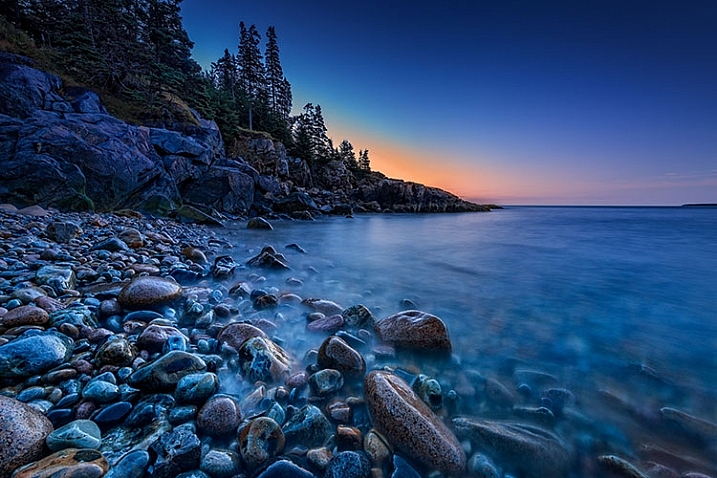
Photoshop-tools

The finished image after Photoshop, using the tools discussed below.

With the advent of digital imaging, photographers have a new way to bring their artistic vision to life, known as the digital darkroom. While there are several different applications available for photographers, one has become synonymous with photo editing, and that is Adobe Photoshop.

Many of the tools in Photoshop can trace their origins to the wet darkroom of yesteryear. If you’re new to Photoshop, it can seem overwhelming the first time you open an image in the program. I’ve created this list of six must-know Photoshop tools to help you get started editing your images. These aren’t by any means the only tools needed, and there are of course tools within the tools to figure out, but this list should give you some idea of where to start. The great thing about most tools in Photoshop is that there are a lot of sliders, meaning you can experiment and see what each tool does, then undo it if you don’t like it.

1 – Adobe Camera Raw
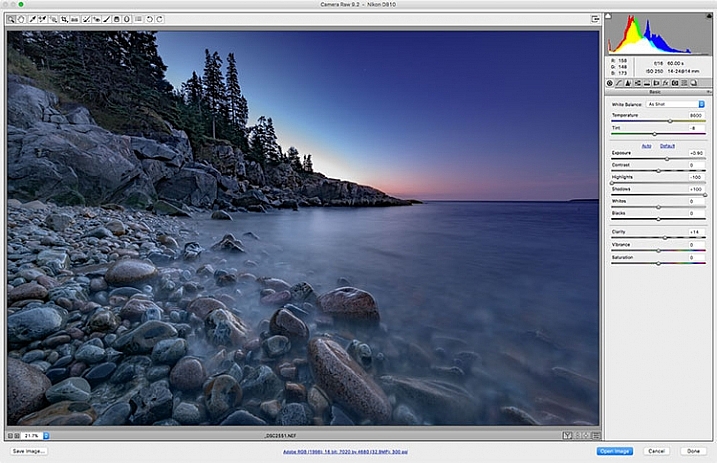
Adobe Camera Raw is a series of sliders and tabs used for processing RAW files. The beauty of the RAW file is you can make changes to the file non-destructively and change them again later if you choose.

Adobe Camera Raw is a series of sliders and tabs used for processing RAW files. The beauty of the RAW file is you can make changes to the file non-destructively and change them again later if you choose.

It is my personal belief that if you aren’t photographing RAW images, you are doing yourself a disservice as a photographer. When you allow your camera to process your image into a JPEG, you are throwing out potentially critical information from your image. You are trusting your camera to make creative decisions for you about the color, contrast, tone, and more, with regards to your image.

To get the most out of your image, you’ll want to set your camera to capture the image as a RAW file. A RAW file contains unprocessed, uncompressed, grayscale data from your camera’s image sensor, as well as metadata about how the image was captured. Adobe Camera RAW is the plugin for Adobe PhotoShop that can take this information and process a color image.

When you open a RAW image in Adobe Camera RAW, you’ll be presented with a toolbar across the top, and a tool palette on the right side. The tool palette is divided into 10 tabs: Basic, Tone Curve, Detail, HSL/Grayscale, Split Toning, Lens Corrections, Effects, Camera Calibration, Presets, and Snapshots.  The tabs I use most in my workflow are Basic, Lens Corrections, Effects, and Camera Calibration.

The beauty of a RAW file is that you can change the settings using the sliders, and other tools, as often as you like. If you don’t like what you’ve done, or you want to try something different, you can always revert the image back to the original settings, and the file is the same as it was when you downloaded it from your camera. Don’t be afraid to play with the sliders and see what they do. You can’t ruin the RAW file, so you might as well see what everything does. For more on using Adobe Camera Raw, check out Understanding the Basic Sliders In Adobe Camera Raw.

2 – Layers and Layer Masks
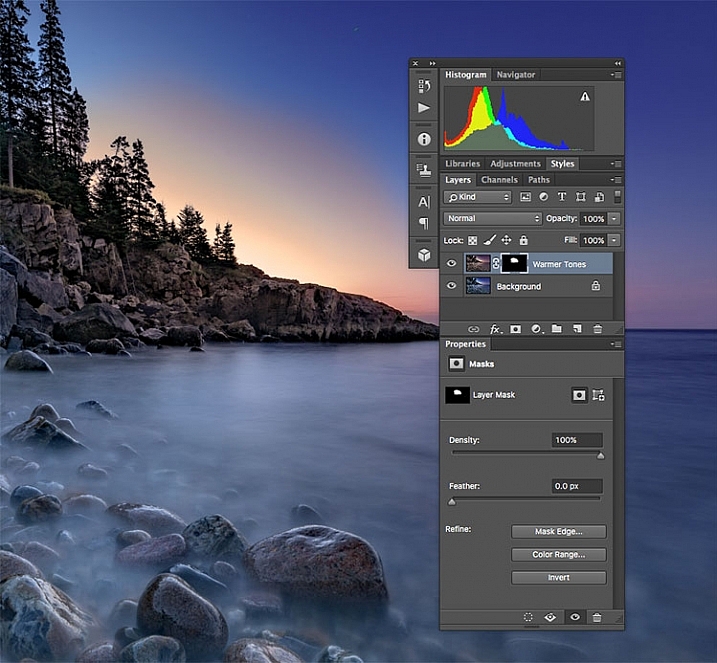
I created a duplicate layer to warm up the sunrise a bit and look more like it appeared when I was there. But since I still wanted the cooler tones on the rocks, water, and the rest of the sky, I used a layer mask to show only the warmer tones where I wanted them.

I created a duplicate layer to warm up the sunrise a bit and make it look more like it appeared when I was there. But since I still wanted the cooler tones on the rocks, water, and the rest of the sky, I used a layer mask to show only the warmer tones where I wanted them. The white area of the mask for the layer called, “Warmer Tones” shows the area of that layer that is showing through.

I consider this number 2a and 2b. If you’re going to learn layers, you’re going to have to learn layer masks as well. In Photoshop, one of the first things you’ll notice when you open an image is the Layers Palette on the right side of the screen. Initially, it will likely only have one layer called “Background” which contains your image.  You can add new layers as needed. You can also add empty layers which will allow you paint, draw, or copy portions of the image below onto them, and you can use layers to create a composite from multiple images. Layers can be adjusted to different opacities using the opacity slider at the top of the palette, so they can be made partially translucent which allows the layers underneath to show through.

In addition, you can create layer masks, which allow you show or hide portions of a layer, and allow you to see the layer or layers beneath. You do this simply by painting with black on the layer mask to hide that part of the layer, or painting white to show that part of the layer.

Layers give you room for quite a bit of creativity, allowing you to edit areas of an image non-destructively. If you don’t like what you did, simply delete the layer and start over. You can sandwich together two separate images, much the way you’d sandwich negatives in a wet darkroom, and create photo composites. For more on using layers, read A Beginner’s Introduction to Using Layers.

3 – Blend Modes
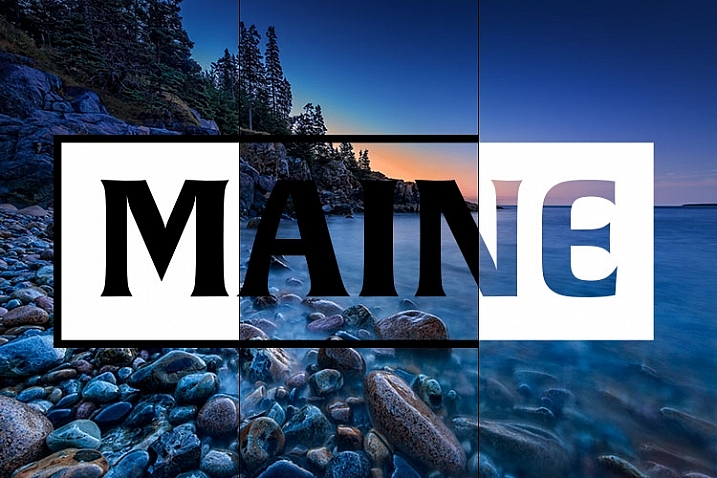
This image shows two different blend modes. On the left, Normal is selected, so the white box with the black text appear as I drew it. In the center, the blend mode is set to Multiply, so the white disappears and the black remains. On the right, Screen is selected, which shows the white area and shows the black.

This image shows three different blend modes. On the left, Normal is selected, so the white box with the black text appear as I drew it. In the center, the blend mode is set to Multiply, so the white disappears and the black remains. On the right, Screen is selected, which shows the white area and hides the black.

As mentioned above, the Opacity Slider allows you to blend the active layer with the layers beneath. The Blend Modes, found in a drop-down menu to the left of the Opacity Slider, work in a similar fashion, but use different mathematical calculations to change the appearance of the layer being blended for different things. For instance, if you simply duplicate the image on a new layer and set the Blend Mode to: Multiply it will darken the image by about a stop, and Screen Blend Mode will lighten the image by a stop. If you create a layer on top of your image with black text inside a white box, using Multiply will eliminate the white box, and allow the layer below to show through. Screen will do the opposite (see image above).

As of Adobe Photoshop CC 2015, there are 27 Blend Modes. The two modes I noted above are ones I use often, usually adjusting the opacity slider as well to get to my final look. Knowing what each mode does will help in choosing which one to use for your particular purpose. Darren Rowse put together a great tutorial, An Introduction To Blend Modes In Photoshop to give you a more in depth look at Blend Modes. You can also check out The First 3 Blend Modes You Need to Understand.

4 – Adjustment Layers
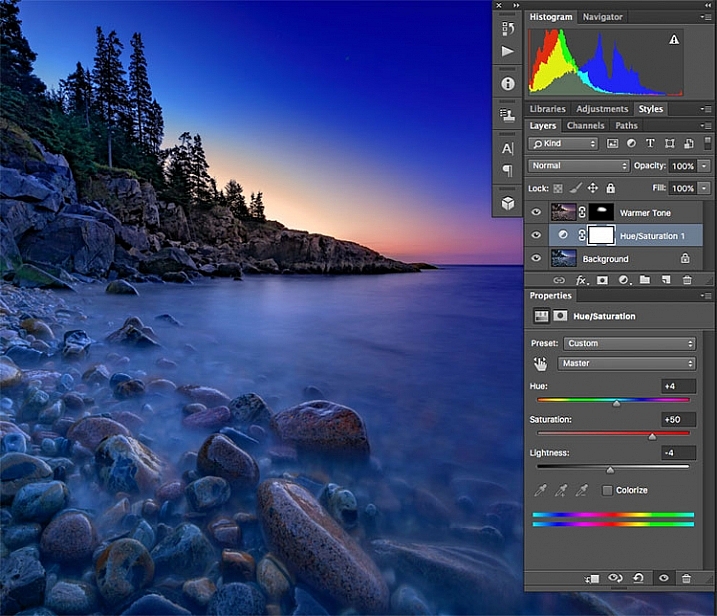
I used an Adjustment Layer on the cooler layer to bump up the color saturation a bit.

I used an Adjustment Layer on the cooler layer to bump up the color saturation a bit.

Photoshop Adjustment Layers are a great way make changes to an image, without actually changing the original file. It’s an easy way to try things, such as adjusting contrast or saturation, so that you can go back and change it again later – as long as you’ve kept the layers in tact by saving as a PSD or a TIFF file, formats that both support layers.

There are 19 different adjustment layers, which can be combined to create different effects on your image. Some basic uses are color adjustment, contrast adjustment, saturation, and black and white conversion. In addition, you can use Layer Masks to apply the effects in specific areas only, rather than the entire image, if you so choose.  You can also adjust the Opacity of an adjustment layer to reduce the effect of the adjustment on your image.

Adjustment layers provide a ton of flexibility when editing an image, without forcing you into a change that can’t be undone easily. For more on Adjustment Layers, check out Photoshop: Applying Fixes using Adjustment Layers and Masks and Burning and Dodging with Adjustment Layers and Layer Masks.

5 – The Spot Healing Brush
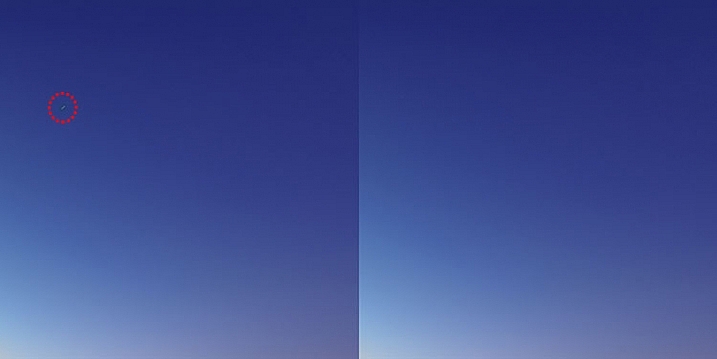
There were a few stray star streaks in the sky that I wanted to eliminate, so I used the Spot Healing Brush to quickly remove them.

There were a few stray star streaks in the sky that I wanted to eliminate, so I used the Spot Healing Brush to quickly remove them.

The Spot Healing Brush is one of the primary retouching tools in Photoshop, allowing you to remove blemishes and errors, or other parts of your photos. In the digital age, the bane of all photographers’ existence is dust on the imaging sensor, and the Spot Healing Brush provides a quick and easy way of removing those fromyour images.  The Spot Healing brush works similarly to the Cloning Stamp tool, in that it samples from one area of the image to correct other areas.

The Spot Healing Brush automatically detects the content or texture of the surrounding area, and attempts to replicate it wherever you click in the image. There are several options to work with which appear at the top of the screen. These include brush size and hardness, Blending Mode, and the type of fix you want to use, such as Content Aware, Create Texture, or Proximity Match. Each image will have different needs, depending on the content, so it’s best to experiment with the various settings if you find you’re not happy with the results you’re getting.

The Clone Stamp Tool
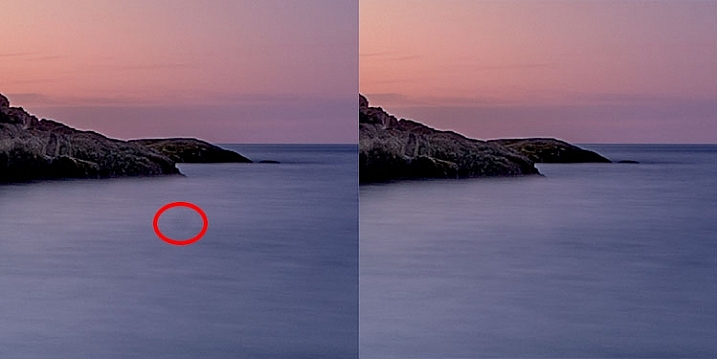
I had a few dust spots on my sensor. This one in the water, circled in red, did not respond well to the Spot Healing Brush, so I used the Cloning Stamp to sample and area of the water and stamp it over the dust spot.

I had a few dust spots on my sensor. This one in the water, circled in red, did not respond well to the Spot Healing Brush, so I used the Cloning Stamp to sample an area of the water and stamp it over the dust spot.

As I mentioned above, the Clone Stamp Tool and the Spot Healing Brush are similar in that they are both used for retouching images, and both use sampled areas of the existing image. The Clone Stamp, however, allows you to select the area from which to sample by holding the Command key and clicking (on Mac) or CTRL and click (on Windows), and creates an exact copy of the area you sample. Then you simply click on the area you want clone out and a copy of the area you sampled appears.

Again you have some options at the top of your screen, including Blend Modes, Opacity, and whether or not to sample a specific layer, or use all layers. You can also change the edge hardness and size of the stamp. The clone stamp works well when you have a well-defined edge to maintain, such as the wall of a building. The Healing Brush tries to blend edges, which can cause a blurred mess when you really need a clean edge. For more on using the Clone Stamp, head over to 12 Tips for Mastering the Clone Stamp Tool in Photoshop

These six tools in Photoshop are my go-to tools for editing my images. I would estimate that about 90% of my image editing is done using these tools. What are some of your tried and true Photoshop tools?

googletag.cmd.push(function() {
tablet_slots.push( googletag.defineSlot( “/1005424/_dPSv4_tab-all-article-bottom_(300×250)”, [300, 250], “pb-ad-78623” ).addService( googletag.pubads() ) ); } );

googletag.cmd.push(function() {
mobile_slots.push( googletag.defineSlot( “/1005424/_dPSv4_mob-all-article-bottom_(300×250)”, [300, 250], “pb-ad-78158” ).addService( googletag.pubads() ) ); } );

The post 6 Photoshop Tools Every Newbie Should Learn by Rick Berk appeared first on Digital Photography School.


Digital Photography School
 
Comments Off on 6 Photoshop Tools Every Newbie Should Learn

Posted in Photography


4 Things You Should Know About Focal Length and Composition

13 Nov

Lenses are the eye of your camera. The focal length of a lens (and your point of view) determine how much of the subject your camera sees.

You may already be familiar with the basics, and understand the difference between, say, wide-angle and telephoto lenses, but let’s dive into the the topic a little deeper to see what’s really going on.

focal length and composition

There are four fundamental things to know and understand about the focal length and composition.

1. Focal length is not as important as field-of-view

There are two factors that determine the field-of-view of a lens:

  1. The focal length.
  2. The digital sensor or film size

Field-of-view (sometimes called angle-of-view) is far more important than focal length, because it tells you how much of the scene the lens sees. However, as field-of-view changes according to sensor size, manufacturers tell us the focal length instead. Focal length is a fixed measurement that doesn’t change (it is literally the distance from the middle of the lens to the focal plane, which is the sensor).

Here are some practical examples.

Example #1 – 50mm prime lens

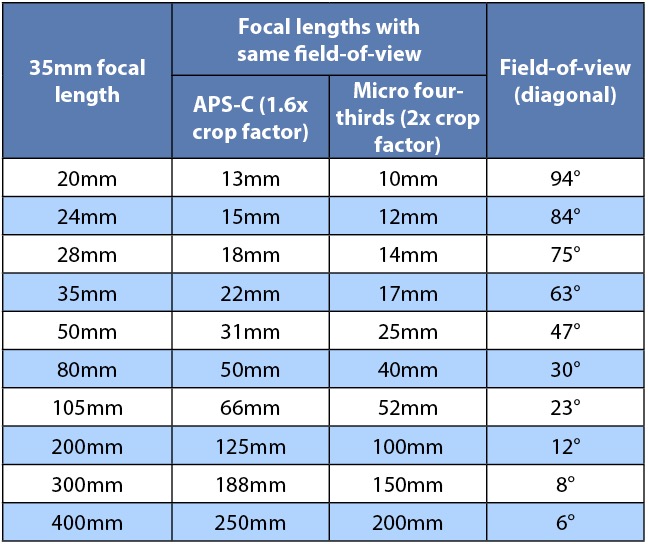
A 50mm prime lens has a field-of-view of 47 degrees on a full-frame camera. This field-of-view approximates what we see with our own eyes. But what happens when you put the 50mm lens on an APS-C camera (crop factor of 1.6x)? The crop factor of the smaller sensor means that the lens now has a field-of-view of around 30 degrees, making it a short telephoto lens.

This change in field-of-view means that you have to move further away from your subject in order to fit it in the frame, which also changes the perspective (giving the compressed effect that characterizes short telephoto lenses).

If you want the equivalent of a 50mm lens on an APS-C camera you need to use a focal length of around 31mm, as it has the same field-of-view (47 degrees).

A prime lens with that focal length doesn’t exist (you could choose between a 28mm or a 35mm depending on whether you wanted a slightly wider or a tighter field-of-view), but you can set that focal length if you have a zoom.

focal length and composition

50mm lens, full-frame camera. The lens has a field-of-view of 47 degrees.

focal length and composition

50mm lens, APS-C camera. The same lens has a field of view of 30 degrees with this camera.

Example #2 – 21mm lens

The same applies to wide-angle lenses. A 21mm prime lens has a field-of-view of around 92 degrees. That’s a nice wide field-of-view ideal for landscape photography, or creating images with dramatic perspective.

But put it on an APS-C camera the field of view narrows to around 65 degrees. It’s still a wide-angle, but the effect is much more moderate. It now has nearly the same field-of-view as a 35mm lens does on a full-frame camera

To get the same field-of-view as the 21mm lens (on a full frame) you would use a 14mm lens (on an APS-C camera).

focal length and composition

This photo was taken with a 14mm lens on an APS-C camera. It has the same field-of-view as a 21mm lens does on a full-frame camera.

Example #3 – 16mm lenses

It’s even possible to have two lenses with the same focal length, but different fields-of-view (on the same camera).

A 16mm wide-angle lens has a field-of-view of 107 degrees – but a 16mm fisheye has a field-of-view of 180 degrees.

They have the same focal length but each one is designed for a different purpose. The 16mm wide-angle is designed to keep straight lines straight. The fisheye doesn’t try to do that, and as a result has a much wider field-of-view.

This table shows the field-of-view of common focal lengths with full-frame, APS-C and micro four-thirds cameras.

focal length and composition

The next points explore the relationship between field-of-view and composition.

2. Wide-angle lenses are lenses of inclusion

You can think of any lens with a field-of-view wider than around 63 degrees as being a wide-angle. That’s 35mm or shorter on a full-frame camera, 20mm on APS-C, and around 18mm on micro four-thirds.

Wide-angle lenses have two characteristics that affect composition:

  1. The wide field-of-view means that you have to move in close to your subject to fill the frame. But, at the same time wide-angle lenses also include quite a bit of the background. The shorter the focal length, the closer you need to get, and the more background is included.
  2. Wide-angle lenses also appear to have more depth-of-field at any given aperture setting than longer focal lengths (they actually don’t, it has to do with lens to subject distance which also changes with focal length).

These two factors combine to make wide-angle lenses, ones of inclusion. You can always fit more into the frame with a wide-angle lens, no matter how close you get to your subject. The background is also more likely to appear more in focus, than it is with longer focal lengths. Getting in close, creates the dramatic perspective that some photographers love. It emphasizes line, and creates a sense of depth, that images taken with longer focal lengths can lack.

The slightest change in your point of view makes a dramatic difference to the composition of the photo. The shorter the focal length, the more this applies. As wide-angle lenses include so much background it can be difficult to simplify the composition and remove all distractions. There’s no way around it, it’s just a characteristic you have to embrace.

focal length and composition

This photo, taken with an 18mm lens (APS-C), includes the buildings, the city wall, the reflection in the water, the city trees disappearing into the distance, and keeps everything in sharp focus.

3. Telephoto lenses are lenses of exclusion

A telephoto lens is one that has a field-of-view of around 30 degrees or less. That’s around 85mm or longer on a full-frame camera, 50mm on an APS-C camera, and 40mm on micro four-thirds.

Telephoto lenses are ones of exclusion. They have a narrow field-of-view. Fill the frame with your subject, and you won’t get much background in at all. It is also easy to throw the background out of focus by using a wide aperture, and making sure there is sufficient distance between your subject and the background.

focal length and composition

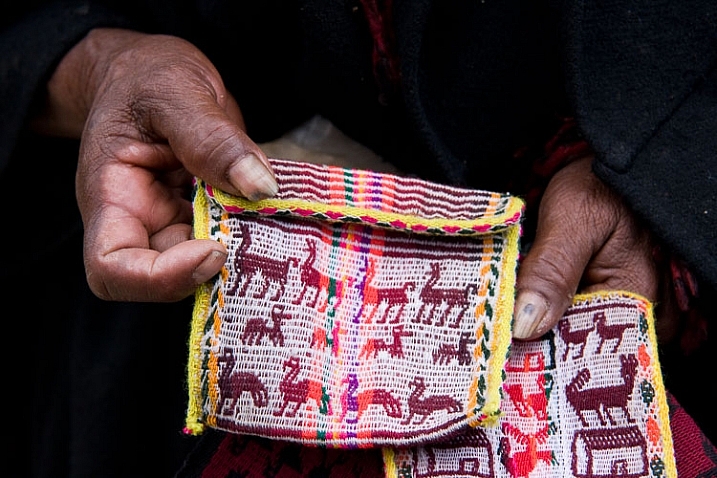
This photo, taken with a 50-150mm lens set to 72 mm (APS-C), shows the woman’s hands and the textiles she is selling. There is not much in the background at all.

4. Normal lenses occupy the middle ground

Normal lenses, those with a field-of-view somewhere around 55 degrees, occupy the middle ground between wide-angle and telephoto. They don’t create images with the dramatic perspective that you can obtain with a wide-angle, nor do they exclude the background to the same extent as telephotos.

If you have a normal prime lens you can open the aperture up to defocus the background, sometimes quite dramatically if you get close enough to the subject. But, you can also often stop down enough to get everything within the frame in focus.

focal length and composition

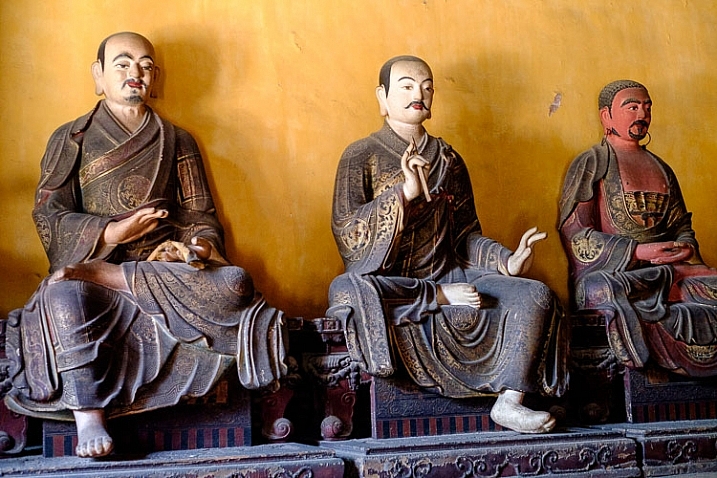
I took this photo with a 35mm lens, a normal lens on an APS-C camera. It lacks the dramatic perspective, and wide field-of-view of the photos taken with wide-angle lenses. But it includes more of the background and shows less compression than the photos taken with telephoto lenses.

Your turn

Can you think of anything else that photographers ought to know about focal length, field-of-view, and composition? If so, please let us know in the comments. I’d like to hear your thoughts.

Note: this is the second in a series of articles on dPS this week talking about composition. See: Using Framing for More Effective Compositions and look for more over the next few days.


Mastering Composition ebookMastering Composition

My new ebook Mastering Composition will help you learn to see and compose photos better. It takes you on a journey beyond the rule of thirds, exploring the principles of composition you need to understand in order to make beautiful imag

googletag.cmd.push(function() {
tablet_slots.push( googletag.defineSlot( “/1005424/_dPSv4_tab-all-article-bottom_(300×250)”, [300, 250], “pb-ad-78623” ).addService( googletag.pubads() ) ); } );

googletag.cmd.push(function() {
mobile_slots.push( googletag.defineSlot( “/1005424/_dPSv4_mob-all-article-bottom_(300×250)”, [300, 250], “pb-ad-78158” ).addService( googletag.pubads() ) ); } );

The post 4 Things You Should Know About Focal Length and Composition by Andrew S. Gibson appeared first on Digital Photography School.


Digital Photography School

 
Comments Off on 4 Things You Should Know About Focal Length and Composition

Posted in Photography


5 Good Reasons You Should Get the Latest Lightroom Upgrade

02 Nov

If you’re a photo-fanatic, there is a lot to keep up with. New camera models are being announced way too often, firmware updates, fancy new lenses keep popping up, and on and on.

Lightroom_icon

I didn’t even mention software yet but now that I have, let’s see what’s new with our old pal Lightroom (LR) and its latest upgrade.

Since this is the default program that you’re likely to find running on almost every photographer’s computer, it’s worth discussing what you might be missing (or not if you’re a minimalist post-processor) if you haven’t upgraded to the latest version – LR 6 or the Adobe Creative Cloud (CC).

If you are like me, you will be happy to hear that the general interface has survived untouched in the latest versions. That is to say, in many respects the program has retained the same look and features, and the tasks which you are accustomed to doing, are the same.

So what do you get for your $ 79 (that’s the price of upgrading from an earlier version) or what more do you get for your $ 149 if you haven’t yet jumped on the LR bandwagon? Let’s take a peek at some of the added features that may prove most useful.

If you are still clicking away on LR 4, the long list of reasons to upgrade is even more compelling than the jump from LR 5 to LR 6 – here are some good reasons to get the latest Lightroom upgrade.

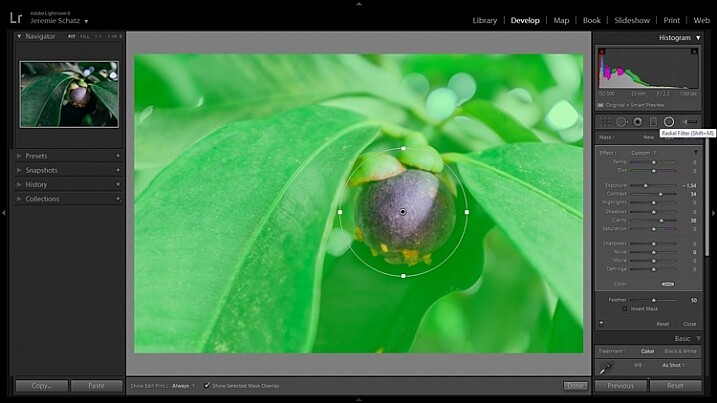
Radial Filter

Lightroom's radial filter

The Radial Filter reveals a new level of editing control.

Probably one of the most welcome features that LR users are grateful for (I know I am), is the Radial Filter (shift+m). This filter allows you a higher degree of flexibility in masking for dodging, burning, and the other adjustments available within the Adjustment Brush.

One handy way to increase the effectiveness of the Radial Filter is after making your initial adjustments, right click on the pin and duplicate the filter. Once it is duplicated you can then choose Invert Mask from the adjustment panel and make another set of changes – perhaps making opposing changes to further the effects you applied with the first filter (this invert selection feature is lusted after for LR’s adjustment brush).

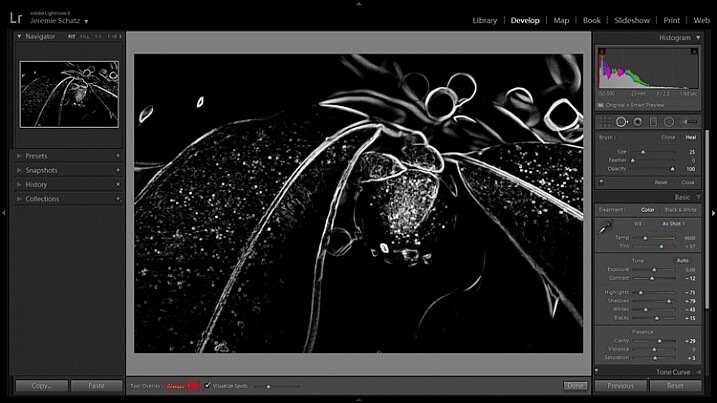
Visualize Spots

Lightroom's visualize spots tool

The Visualize Spots filter helps you catch dust spots and other blemishes that you may otherwise overlook.

If you are a user of the Spot Removal tool, you are going to be psyched for a handy little addition called Visualize Spots. This little check box toggles between the normal view and an inverted black and white image which clearly highlights sensor dust or skin blemishes which you may want to eliminate (if you don’t see that option hit the T key to show the toolbar).

I find this feature quite handy when editing on my laptop, as it can be easy to overlook spots on the small screen, or because of glare. It may save you the hassle of having to toss out a big print because you overlooked spots.

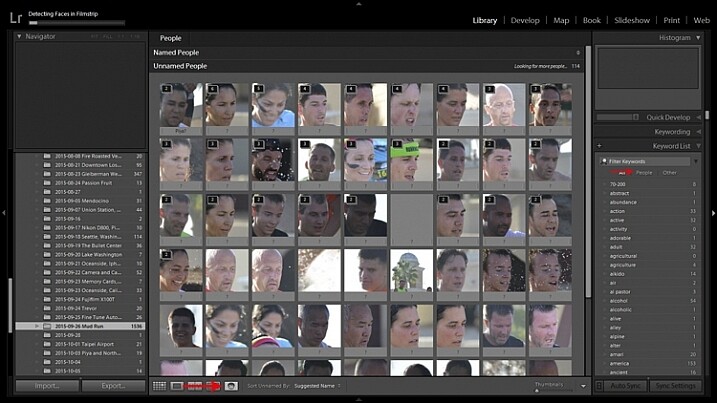
Facial Recognition

Lightroom's facial recognition feature

LR’s new Facial Recognition feature can locate people throughout your entire collection.

Facial recognition has also been added to LR’s suite of updates. This is a feature that has existed in other software for some time (such as Picasa all the way back to 2009) so LR was a little behind the curve on this one – better late than never though.

Certainly this addition made many people happy, as it means one less keyword to have to enter into metadata. When activating this mode (keyboard shortcut O) LR searches selected photos for all recognizable faces and compiles a list. You can then plug in names for the different faces which LR can then use to search for in your entire catalog.

Furthermore, LR adds these names as a keyword in metadata and has created a new sub-menu for people within the Keywords panel.

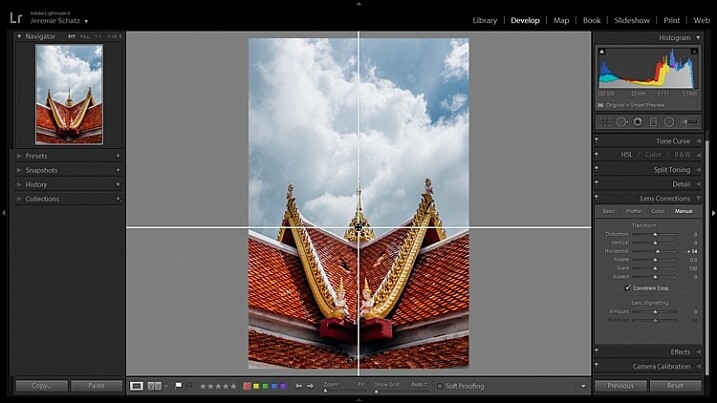
Overlay Guide

Lightroom's guide overlay feature

The Overlay Guide is more flexible and less cluttered than the grid overlay.

A simple addition that I find handy is a new movable overlay guide.

All it does is give you a vertical and horizontal line, that create a sort of crosshairs, which you can move around for composition and alignment purposes. It is useful as a less cluttered guide, used in conjunction with transform lens corrections.

It would have been nice to just have this nested in with the crop overlays, instead you have to access it through: View>Loupe Overlay>Guides.

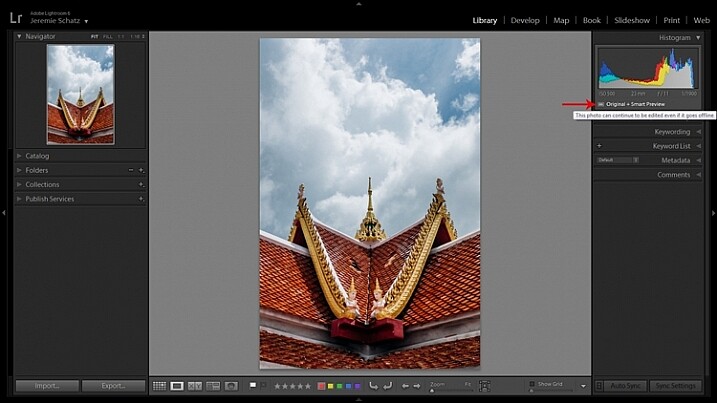
Smart Previews

Lightroom's Smart Preview feature

Smart Previews allow you to make edits to offline photos.

Smart Previews are one of those features that I always wished LR had, and my wish finally came true.

This feature enables you to create compressed copies of images which can then be used to make offline edits. This works great if, like me, you store your original images on an external drive but want to be able to make edits on the go.

If edits are made to Smart Previews in LR, your original image will be updated with those new changes when it comes back online (when the external hard drive is reconnected).

You can set LR to automatically create Smart Previews for images upon import, otherwise you can create them manually for any images, folders or collections that you wish. To create Smart Previews, go to: Library>Preview>Build Smart Previews.

Conclusion

Naturally, this is not an exhaustive list of all of LR’s newer features. There are quite a few other sensational new additions such as HDR and Panorama Merge, Cure Pet Eye Effect, Slideshow improvements, new auto-cropping features, not to mention increased performance.

Have you recently upgraded? What are your favorite new features?

googletag.cmd.push(function() {
tablet_slots.push( googletag.defineSlot( “/1005424/_dPSv4_tab-all-article-bottom_(300×250)”, [300, 250], “pb-ad-78623” ).addService( googletag.pubads() ) ); } );

googletag.cmd.push(function() {
mobile_slots.push( googletag.defineSlot( “/1005424/_dPSv4_mob-all-article-bottom_(300×250)”, [300, 250], “pb-ad-78158” ).addService( googletag.pubads() ) ); } );

The post 5 Good Reasons You Should Get the Latest Lightroom Upgrade by Jeremie Schatz appeared first on Digital Photography School.


Digital Photography School

 
Comments Off on 5 Good Reasons You Should Get the Latest Lightroom Upgrade

Posted in Photography


5 Reasons To Should Shoot Your Landscape Images in RAW

20 Sep
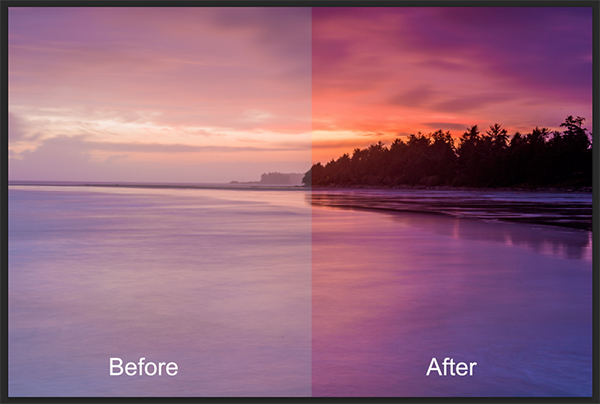
Detail recovered from a RAW file, before and after

Detail recovered from a RAW file, before and after.

There is often a debate among photographers about shooting in RAW. Try it out – next time you are with a group of photographers, ask them who shoots in RAW. Better still, ask them why they don’t shoot in RAW. The conversation will become pretty interesting. When I first started photography, I was told that shooting in RAW was a waste of time and that I won’t need all that “information”. I was told it was better to shoot on JPEG as it saves space. Yes, RAW files are bigger, especially on a high-resolution camera, but is it true that we don’t need all that “information”? Over the past few years, I have done a fair amount of research into the RAW vs JPEG debate and I now shoot completely in RAW. Yes, my image files are MUCH bigger; yes, I need more space to store my images; yes, it does impact my image editing workflow. Is it worth it? A categorical yes. Here are five reasons why you should shoot your landscape images in RAW.

1. Details

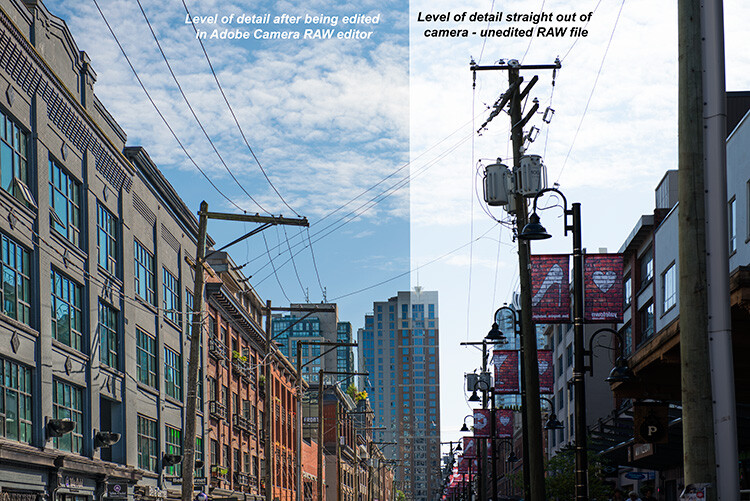
RAW files are big because they don’t discard any image information that is captured in the scene. When you shoot on JPEG, the algorithm for JPEG determines which information is discarded and which is kept without changing the way the image looks. That is great for saving space on your memory card, but not so good if you intend to edit your images in Photoshop.

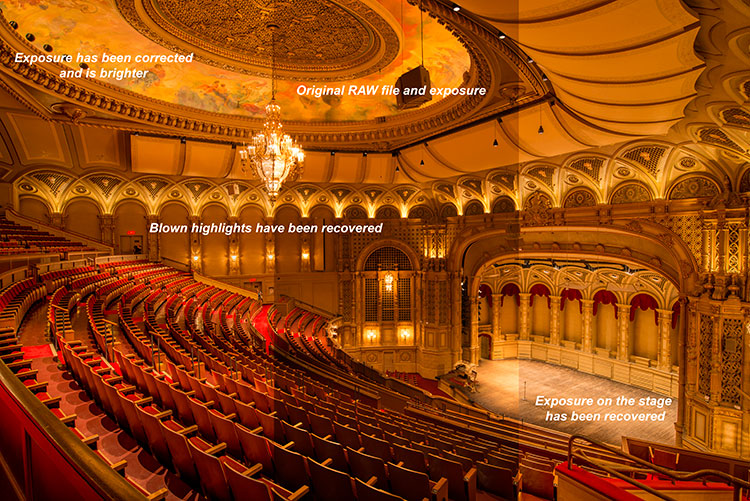
The reality is that your camera can capture a significant amount of data if you shoot in RAW, which in turn gives you much more flexibility in Photoshop later. On average, a normal JPEG file will be between four and six megs per image. The same image shot on the same camera in 14-bit lossless RAW format will be 25 – 30mb, five times bigger. The reason is that there is much more information in a RAW file. That information is critical in post-production. You can get so much detail out of a RAW image, such as pulling back blown-out highlights and bringing back detail in the shadows that would be impossible to recover in JPEG format. This doesn’t mean you should be sloppy and not pay attention to your exposure. What it does mean is that in tricky lighting conditions, you will be able to get a shot that’s usable.

Recovered details in a street scene, overall much more detail can be seen.

Recovered details in a street scene, overall much more detail can be seen.

2. Color

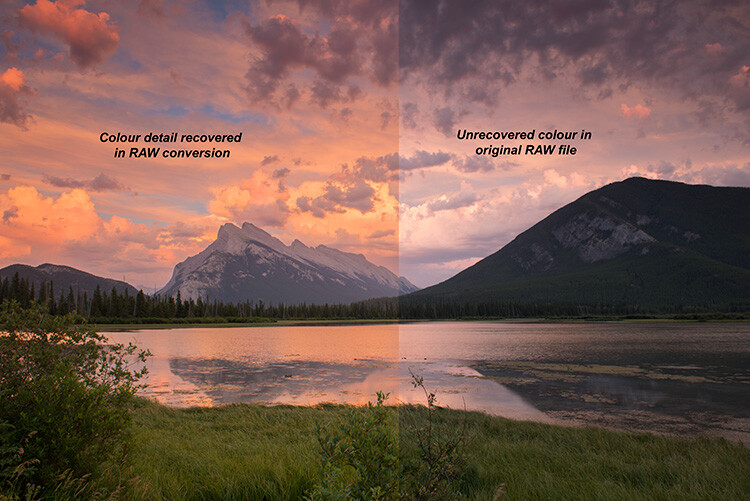
We all shoot on color nowadays. If you don’t, you should, even if you are going to convert to black and white – but that’s for another post. Shooting in RAW means that you are saving as much color information as possible from the scene. This is really important in landscape photography, portrait photography, food photography and even street photography. The color in your scene can make the difference between a good image and a great image. By shooting in RAW, you will have all the color information possible. The important part of that is the subtle color. For example, the gradation in the sky will look better than it would on JPEG, even if you think that JPEG will be fine from a color perspective.  If you are shooting a landscape scene, you want to get as much color information as you can. RAW would be the format to do this. In Photoshop, the vibrance function will saturate the colors in your scene which are undersaturated and this can give your RAW file that subtle boost to make the image pop.

Much more colour can be rendered from a RAW file

Much more color can be rendered from a RAW file.

3. Exposure

The exposure in your scene should always be as good as you can get it in camera. In the past, most photographers would underexpose a little to make sure they didn’t blow out the highlights. In recent years, most photographers shooting in RAW have been exposing to the right (ETTR). The new generation of cameras have a really good dynamic range and are able to render details in the shadows and the highlights in one shot. This was not possible a few years ago. ETTR means that when you look at your photograph’s histogram, try and push it over to the right a little – in other words, overexpose it a little. The reason is because RAW can handle highlights in a scene really well and if your shadows are a little brighter there won’t be as much noise in the shadows. This is really a good technique to use in landscape photography and architectural photography. Your images will be cleaner and have very little noise in them. Once you adjust the image in Photoshop, you will have a well-exposed image across the dynamic range.

Blown out highlights in this scene were brought down, but the overall exposure was brightened.

Blown out highlights in this scene were brought down, but the overall exposure was brightened.

4. Flexibility

The best part about RAW files are that they give you flexibility. If you shoot landscape images or street photography, you have a lot of information to work with and you can use that information to create the best possible image. Also, Photoshop is always improving their tools and functions. I have gone back and reworked older images: the RAW file had all the information and the new functions brought out the best of that scene. This has happened quite a few times, so don’t delete “throwaway” images so quickly. For this reason, I am also not a fan of chimping too much. Wait until you download the images to see what is worth keeping. Use RAW to give you as much flexibility as you can, even on older images.

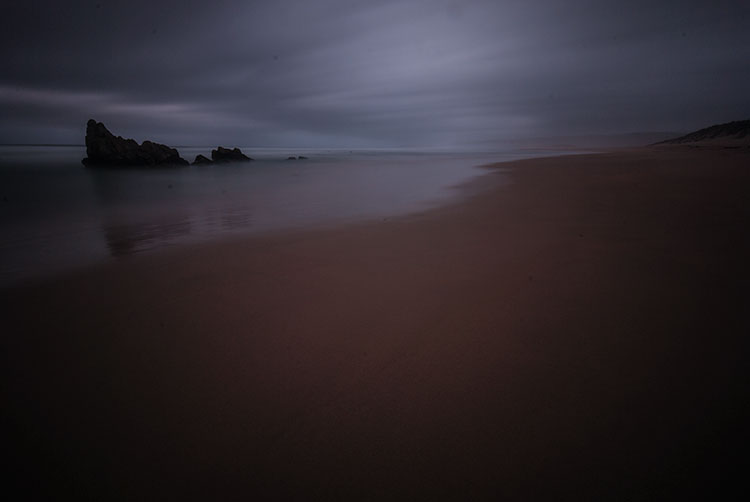
Original RAW file, the image was really dark from the use of an ND filter

Original RAW file, the image was really dark from the use of an ND filter.


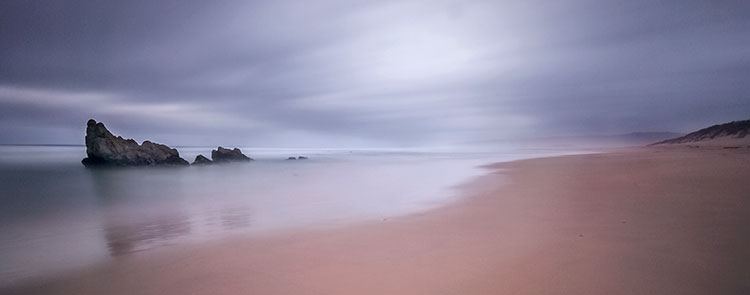
The result of the above image after being edited in Adobe RAW converter

The result of the above image after being edited in Adobe RAW converter.

5. Quality

Editing your RAW image is a two-step process. The first step is converting it in a RAW converter. (Lightroom converts RAW images, as does Photoshop and many other image editing products.) Once you have made the corrections and subtle adjustments in the RAW converter, then you can open the converted image in Lightroom or Photoshop. You will then be editing on the best quality image possible. Image quality is almost the “holy grail” of photography. If you ask any photographer what the most important thing is for any image, it will most likely boil down to image quality. To be clear, when I say image quality I include sharpness, noise, dynamic range, color, tone, chromatic aberration and so on. Anything that adds to the overall look and feel of the image. Your image quality will be fantastic if you work carefully in your RAW converter and edit well in Photoshop. You can get good image quality in JPEG too, but you will be able to squeeze that much more out of the image if you shot in RAW.


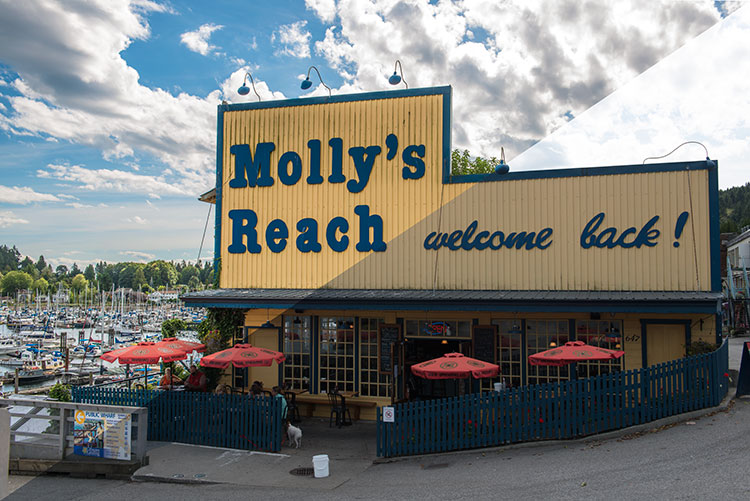
Look at the quality and detail of the scene after being edited in Adobe Camera Raw converter

Look at the quality and detail of the scene after being edited in Adobe Camera Raw converter.

RAW is a great format to use if you plan on editing your images. If you shoot landscapes, fashion, food, architecture and even weddings you should be considering shooting in RAW. One caveat on using RAW for weddings – you don’t have to shoot the whole wedding in RAW, but shoot the important images or images where the light is tricky in RAW. That way you can be confident you have the shot and information you will need for editing later.

RAW requires a different workflow for your image processing. If you don’t want to spend too much time editing, then maybe RAW will not work for you. The reality is RAW files are bigger, but that’s because they capture so much more information. If you are skeptical, give it a try. Shoot some scenes in RAW and try the Adobe RAW converter. Lightroom also works with RAW files. You might find that you have more details and information in your image than you thought.

googletag.cmd.push(function() {
tablet_slots.push( googletag.defineSlot( “/1005424/_dPSv4_tab-all-article-bottom_(300×250)”, [300, 250], “pb-ad-78623” ).addService( googletag.pubads() ) ); } );

googletag.cmd.push(function() {
mobile_slots.push( googletag.defineSlot( “/1005424/_dPSv4_mob-all-article-bottom_(300×250)”, [300, 250], “pb-ad-78158” ).addService( googletag.pubads() ) ); } );

The post 5 Reasons To Should Shoot Your Landscape Images in RAW by Barry J Brady appeared first on Digital Photography School.


Digital Photography School

 
Comments Off on 5 Reasons To Should Shoot Your Landscape Images in RAW

Posted in Photography


Why Every Photographer Should Use a Manual Focus Lens

27 Aug

Your camera is smart. It has processors that are able to run algorithms, for near instantaneous adjustments to compensate for lighting conditions and changing environments. I’m a professional lens reviewer, and tend to complain if a lens/camera combination takes more than a split second to achieve accurate autofocus. But the reality is that most modern camera/lens combinations achieve accurate autofocus remarkably fast. Modern DSLRs can pretty much see in the dark, and still focus reasonably well with a near absence of light, and their performance at extremely high ISO settings is phenomenal.

Yes, your camera is most certainly smarter than your father’s, but the question is, are you a smarter photographer than your father?

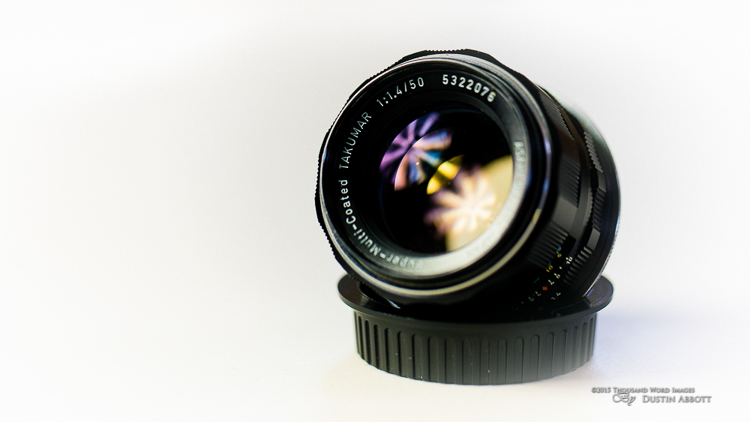
Dustin Abbott DPS MF 15

Could it be that the wizardry of modern processors, sensors, and autofocus motors (AF) cocoon modern photographers from what actually happens in the process of taking photos? And, in doing so keep us from having to learn some of the essential basics of photography that could make us better? Here is why I think every photographer should spend some time with a manual focus only lens.

Aperture

A press release for a modern lens will say something like, “Nine rounded aperture blades.” That means next to nothing to most modern photographers for one simple reason – they will never see those blades. All they will ever see is the glass within the barrel of their lens. The reason for this is simple: lenses with an automatic iris aperture (the camera sets the aperture electronically), focus with the lens wide open (aperture blades withdrawn), and only stop down to the chosen aperture in the split second when that the shot is taken. It is pretty amazing how quickly this all happens, when you stop and think about it.

Most lenses produced for Canon EF mounts (excluding Samyang/Rokinon lenses along with a few non-mainstream models) have an auto iris aperture control. Even Zeiss manual focus lenses in Canon (ZE) mounts have automatic irises, and Samyang/Rokinon is retooling many of their lenses with AE versions with auto aperture control. Put simply, very few modern lenses in a Canon mount have an actual aperture ring. Nikon shooters get a few lenses with manual aperture rings (for some reason Zeiss lenses include one on Nikon [ZF] mounts.)

Auto aperture iris control is great for convenience. Just twist the dial on your camera (often in third stop increments) and select the aperture you want, or even let the camera choose it for you in an auto mode. It’s quick and painless.

The downside, of course, is that the actual significance of what is happening when that iris is opened wide or closed down is often lost upon modern photographers. We can talk about “stopping down” a lens or the advantage of a wide aperture prime, but until you have actually seen the difference in an aperture iris you won’t have a full sense of what that really means. Take a look at this series from the new Rokinon 50mm f/1.4.

When you actually see that aperture closing down you really get a sense of the difference between the f-stops and how much more light gathering there actually is at wide apertures. This series starts at f/1.4 and goes to f/8 – see how much difference the aperture size makes in the amount of light entering the camera?

Dustin Abbott DPS MF 8

Dustin Abbott DPS MF 9

Dustin Abbott DPS MF 10

Dustin Abbott DPS MF 11

Dustin Abbott DPS MF 12

Dustin Abbott DPS MF 13

Dustin Abbott DPS MF 14

My wife is an intelligent woman. She even has a pretty decent eye as a photographer, and has taken some great photos. But despite having been married to a gear guy since 1997, and having a hundred or so lenses going in and out of our house, she still to this day often gets confused about aperture. It can be confusing, as the logic (due to the way that f-stops often get reported) is backwards. Bigger numbers mean smaller apertures -and that seems backwards. There is no mistaking this with a manual focus lens with a manual aperture ring – you can physically see the aperture iris shrinking as you stop the lens down (choose a smaller aperture size – larger f-stop, like f/11 etc).

More photographers would get what aperture numbers really mean in terms of light gathering, if they physically saw the aperture blades close down or open in their lenses.

Light Gathering

Most cameras have a standard focusing screen, that does not show the true depth of field. This, added with the fact that the camera typically focuses with the lens wide opened, means that you often don’t get a sense of how much less light is available when the lens is stopped down (f/4-f/16, for example) or how much more is available at large apertures (f/1.2-f/2.8). Most DSLRs have a DOF (depth of field) preview button somewhere, but it is often in an obscure location and rarely gets used by many people. For this reason many photographers have never seen the true depth of field of any of their wide aperture lenses, or any other lens for that matters. This changes when you use a manual focus lens (particularly with a focus screen that shows true depth of field). More on this in a moment.

Yes, it is a pain when the viewfinder is quite dark when you have a manual aperture lens mounted and stopped down to, say, f/8. That’s the reason that modern lenses and cameras don’t show you this in your viewfinder. But it also means that you aren’t being forced to learn what f/8 really means in terms of light gathering. You also don’t see how much more light is available, or how much more shallow the depth of field is with a large aperture. You don’t really think about your aperture setting at the time of capture, resulting in a loss of creativity because your mind isn’t forced to visualize what aperture means to the shot.

But beyond this, manually selecting your aperture really helps you to mentally dial in the relationship between aperture and depth of field. The fact that you have to think about selecting the aperture, and see a difference in the viewfinder, in both the depth of field and the amount of light, helps you to realize how shallow depth of field shots (with a large aperture) and large depth of field shots (with a small aperture) are going to turn out. I have learned how to mentally visualize how depth of field is going to affect a scene so much more because of using manual aperture lenses. Here is a series from the Zeiss Planar T* 50mm f/1.4 lens. It starts at f/1.4, f/2, f/2.8, and then finally shows f/4. Notice the huge difference this makes to the degree in which the background is blurred.

Dustin Abbott DPS MF 1

Dustin Abbott DPS MF 2

Dustin Abbott DPS MF 3

Dustin Abbott DPS MF 4

The large aperture shots are much more attractive, and give a better three dimensional effect to the image. You probably won’t always shoot with manual focus lenses, but using one will help train your brain to visualize your shots more effectively and artistically.

Depth of Field and Focus

It is quite a revelation to use a wide aperture, manual focus prime, with a focusing screen like an EG-S that shows true depth of field. At close to medium distances you can actually watch focus travel from one thing to another, and subjects pop into focus. It really helps you think about storytelling as a part of your imagery. When you think about what you want in focus, it means that you have become intentional about what you want your viewer to see.

Many cameras have AF point spreads that are not wide enough to reach the edges of the frame. Manual focus lenses remove that limitation, and I am more likely to take an image with my subject in focus in an extreme corner when I use one. The rule of thirds for composition is a great starting tool, but sometimes rules are made to be broken. Take a look at this shot of a family games night. The cards are in the extreme bottom corner. Your eye goes there first, but then considers the whole out of focus scene beyond. Your brain allows you to mentally fill in the blanks, and image possibilities, rather than just a looking at a scene.

Dustin Abbott DPS MF 7

Many macro photographers have learned to choose to use manual focus at those very fine distances. It is often challenging to place an AF focus point right where you need it (particularly when using a tripod), but manually focusing allows you to simply focus until what you need to be in focus is sharp. I’ve heard a lot of people fuss over the focus speed of some macro lenses, including the amazing EF 100mm f/2.8L IS. All I can say is that you need to use a manual focus macro lens sometime. Using the Zeiss Makro-Planar in either a 50mm or 100mm focal length helps you to realize how much the macro range adds to the focus possibilities of such a lens. There are so many extra focus points! Using a manual focus macro lens will certainly help you appreciate the AF on macro lenses, and will also help you understand why the AF focus (distance) limiter switch is there and how to properly use it.

Dustin Abbott DPS MF 6

Dustin Abbott DPS MF 5

Learning to focus with a manual focus lens will help your mind to understand how to better use autofocus lenses (particularly those with focus limiters).

In Conclusion

We live in a high-paced world. We want everything to be faster and easier. But great art is rarely created is rarely created in a rush. When I am shooting professional event work and weddings, I tend to use image stabilized, wide aperture, zoom lenses. They are big and heavy, but they are extremely flexible and deliver great results. I need speed in those situations, but some of my most creative shots in my catalogue have been taken with manual focus lenses. I slow down and become more creative. Some of my most critically acclaimed images have been taken with manual focus lenses, both inexpensive and expensive ones.

If you have been guilty of doing most of your photography in a rush, do yourself a favor a get yourself a manual focus lens (even a cheap one). If you want a cheap option, grab yourself an SMC Takumar 55mm f/1.8, and an adapter to your mount of choice. You can probably get a lens and an adapter for under $ 100. It takes some amazing pictures, and will open a world of appreciation for some of the lenses from another era. It will probably also make you a better photographer.

Even better is the SMC Takumar 50mm f/1.4, or if you want to use a value oriented modern manual focus lens, try one in your favorite focal length from Rokinon or Samyang (same thing, just rebranded lenses). You’ll find a number of reviews of different ones on my website. If you are willing to spend more and want the finest optics and image quality available, Carl Zeiss makes some of the best lenses period. They tend to be mostly manual focus, and I’ve had the privilege of using and reviewing many of them.

Once you learn how to take good pictures with a manual lens, shooting with your modern gear will seem easier than ever, and you might even use it more creatively. These are just a few reasons why every photographer should spend some time with a manual focus only lens.

googletag.cmd.push(function() {
tablet_slots.push( googletag.defineSlot( “/1005424/_dPSv4_tab-all-article-bottom_(300×250)”, [300, 250], “pb-ad-78623” ).addService( googletag.pubads() ) ); } );

googletag.cmd.push(function() {
mobile_slots.push( googletag.defineSlot( “/1005424/_dPSv4_mob-all-article-bottom_(300×250)”, [300, 250], “pb-ad-78158” ).addService( googletag.pubads() ) ); } );

The post Why Every Photographer Should Use a Manual Focus Lens by Dustin Abbott appeared first on Digital Photography School.


Digital Photography School

 
Comments Off on Why Every Photographer Should Use a Manual Focus Lens

Posted in Photography


7 Street Photography Rules That Should Be Broken

07 Jul

There is an all-too-common path that many people follow when they begin to practice street photography. They grab their camera, go to the busiest place they can find, and capture people head-on over and over again.

While this is certainly something that you should do, it is not the only thing. I want to dispel a few myths about street photography to help broaden the content that you photograph. There is a wide range of ways to capture interesting street photographs for you to try.

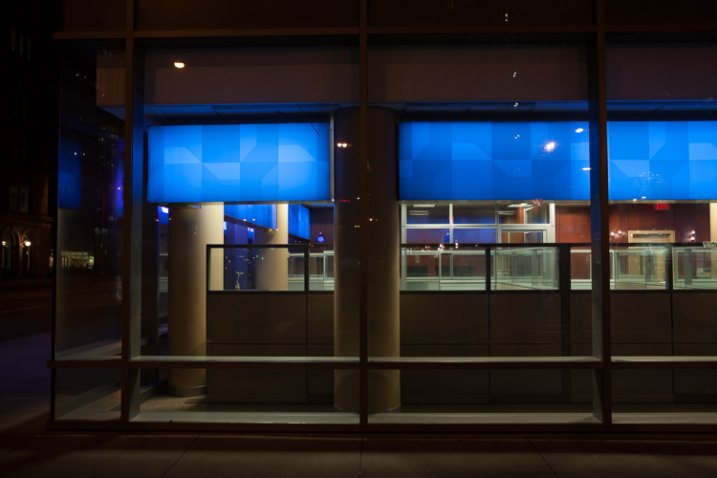
Plant, Chase Bank

Plant, Chase Bank

1. People need to be present in the image

Street photography is about people, but it does not have to include them. This type of photography is about life, and you do not need to smack a person in the middle of a frame to have it be a street shot.

The goal for this type of photography is to capture unique and interesting moments that mean something to you. There is no rule for how to do this without people in the frame, but the goal is to go beyond the typical pretty landscape shot, and foster some sort of meaning and uniqueness within the image.

No matter where you live, but particularly if you live in a less populated area, it can be good to focus on this idea. Explore your surroundings and try to explain it through your imagery. Include people when you can, and when it furthers your aim, but look for unique shots of your surroundings at the same time.

If you find a great area with beautiful light, then capture it like it is. It is a typical mistake for photographers to mess up a really interesting scene by including any random passerby. Often people seem to think that this passerby is what makes the image a street image, but that could not be further from the truth. If you find a good background and want a person to be in the shot, that person needs to be able to add to the photograph. Otherwise, try to just capture the scene as it is.

2. You can only photograph on busy city streets

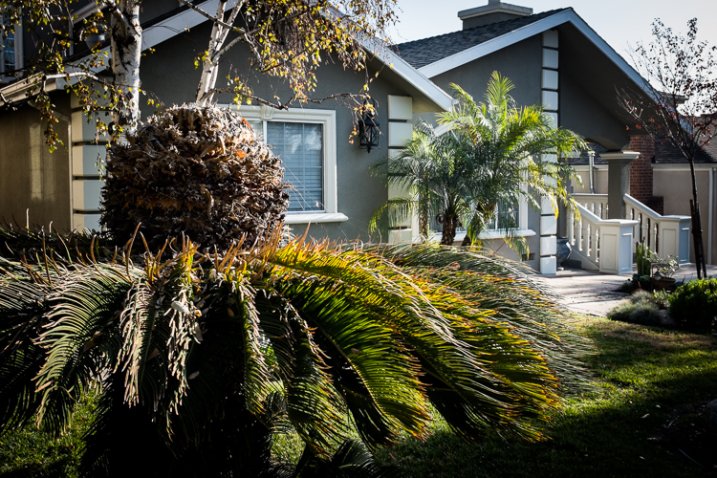
Front Yard, Burbank, California

Front Yard, Burbank, California

Explore the work of Martin Parr, Lee Friedlander, William Eggleston, Stephen Shore, Robert Frank, and Trent Parke, among others. Some of these photographers have photographed prolifically in very busy places, but all of them photographed, at some point or another, in areas devoid of people. Whether it is a shot of a busy beach/resort scene or a shot of a British pastry, you can still identify an image that was created by Martin Parr. Lee Friedlander’s images all have an eerie and dark quality to them (at least that’s how they make me feel) no matter if they were taken on a New York street corner, in a hotel room, or on an empty street in the suburbs. Study the works of these photographers taken in less populated areas and figure out which images appeal to you the most and why.

Street Photography can be done almost anywhere. Great photographers have a knack for learning how to take strong photographs in areas that others may think of as lacking content. Go to areas that you think would be terrible for photography, and try to figure out how to take a good photograph there. This is a very powerful exercise for your growth.

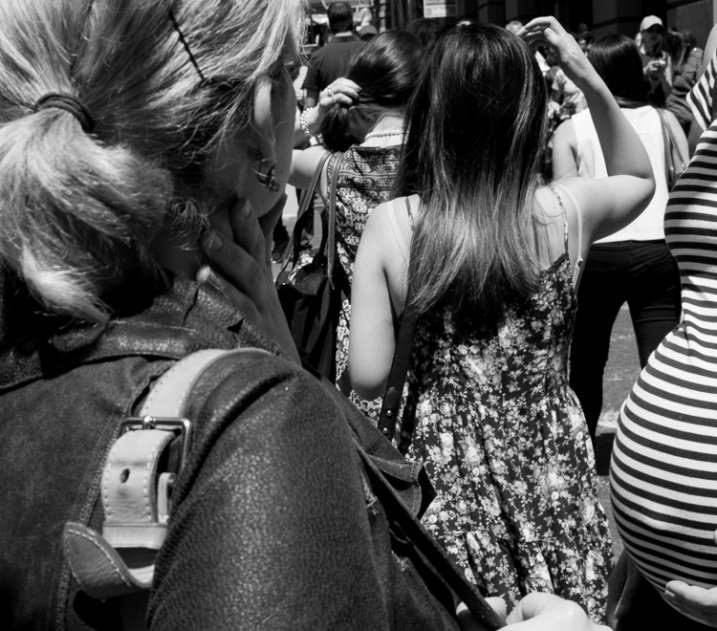
3. Never photograph a person’s back / You must always include the face

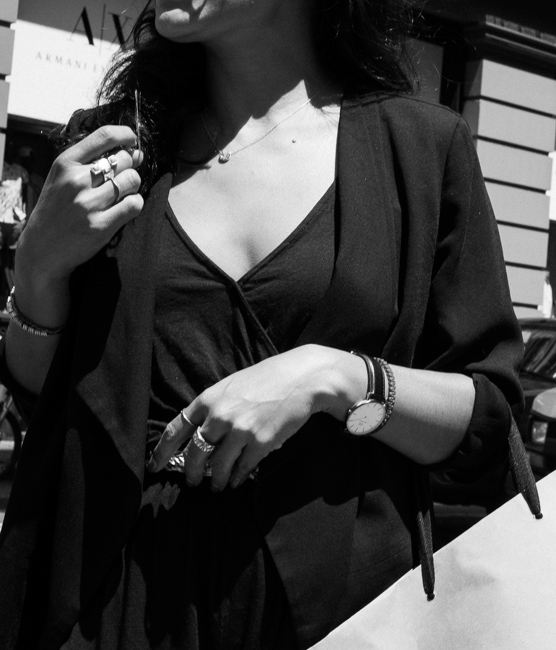
Hands, SoHo, NYC.

Hands, SoHo, NYC.

While the face is one of the most powerful ways to show emotion in an image, it is not always necessary to include it, particularly if it has a boring expression. Missing a person’s face because of bad technique or fear is one thing; if the face is good, you should capture it. But gestures, hands, a pose, clothing, or a specific element on a person can all be the most interesting part of an image. In these cases, it might be best to get close and capture just that interesting element. Doing that, and getting in close to the details, can also give an image a graphic quality that makes shapes, lines, and colors stand out.

4. You need a lot of depth and many different things happening in the scene for it to be effective

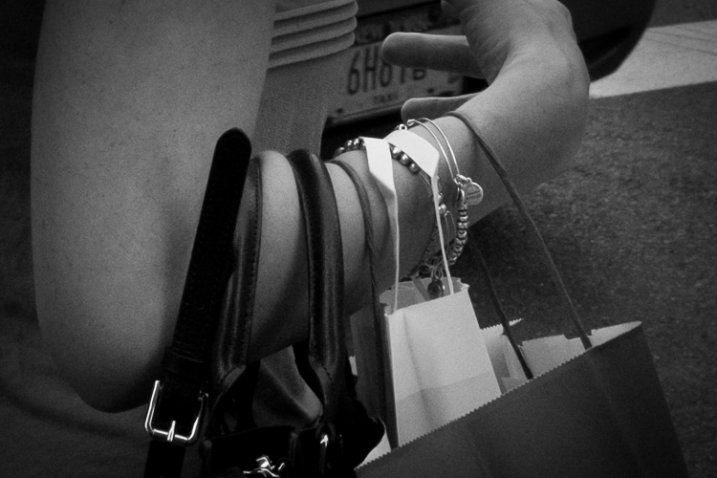
Bags, SoHo, NYC.

Bags, SoHo, NYC.

I very much like shooting this way and if you are a fan of Alex Webb’s work, you probably already understand the allure of a complex image that shows multiple levels of interest, all put together in a single frame. When done well these images can be incredible. They are wow images. These are situations that you should seek out.

However, compositions like this do not make the photograph good. What makes a photograph good is what is happening in it. Search for that first, and then you can figure out whether it will be better to create a complex image with a lot of supporting elements, or whether it will be better to just focus on the main element. It will be counterproductive if you walk out the door looking to create only images like Alex Webb. Look for interesting things and then figure out the best way to frame them.

5. Great street photographs are all about luck

As photographers we create our own luck. There is an element of randomness to every candid photograph, but the reality is that thousands of these “lucky” moments occur around us everyday that we don’t see.

Photography is both about waiting for these moments and about seeking them out. If you put in the time to shoot, you will come across many moments, no matter where you are. As you improve as a photographer, more moments will not occur around you, you will just get better at noticing them.

6. Street photography is about being bold

Hair Tug, SoHo, NYC.

Hair Tug, SoHo, NYC.

Some street photographers are very extroverted and bold. Some are quiet and timid. Some get in your face with a flash, and some wait carefully for something to happen in front of them. Work around whatever personality you have. If you are an introvert, then there is a good chance that getting a running start as you pounce on a person with a flash like Bruce Gilden will be tougher for you to pull off. It’s important to create a strategy of shooting that feels comfortable for you. Otherwise, if you are not having fun out there, then you are not going to want to put in the time necessary to get good images.

No matter what, you are going to have to bring yourself out of your comfort zone. You are going to have to figure out what you want your images to look like, and what you need to do to pull that off. If you want to use a zoom lens, use it because you like the look of a telephoto image, not because you are afraid to get close. If you are afraid to get close, use a light wide-angle lens, pick a spot, and let people come to you. Inch a little closer each time. You do not have to jump in there with cameras blazing to capture a good image. Figure out how to locate moments that are interesting and then develop your way of being able to put yourself in the right spot to capture them. Over time you will improve and feel like you belong there.

7. Street photography is about the extraordinary

There is a typical moment that I come across when teaching. I will be photographing with a student and suddenly a person with red, blue, or green hair, or covered in tattoos, will pass by. The student will take that shot faster than any shot they’ve taken the whole day. That hair or the tattoos just clicked as an interesting street image in their minds. Red hair can be interesting, but it is just one element. While it stands out and feels extraordinary and different, it’s not actually that unique.

Street photography can focus on anything. It can be colorful, mundane, ordinary, or something overt. A lot of the most incredible street photography actually captures ordinary moments in ways that feel extraordinary. Street photography is about finding the extraordinary in all types of moments. Do not just sit there looking for red hair. Seek out people and scenes that fly below the radar, and capture what makes them interesting.

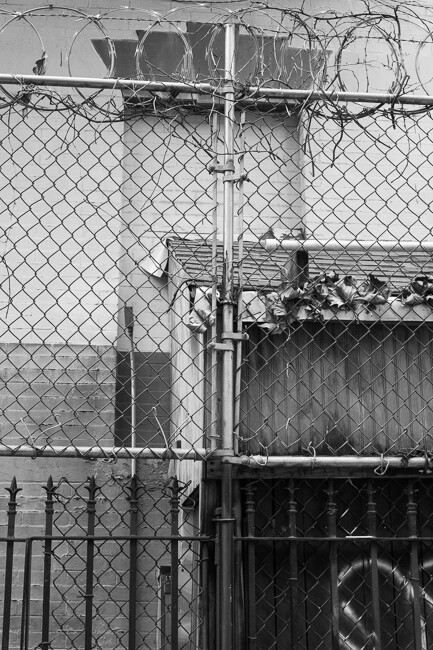
Fence, East Village, NYC.

Fence, East Village, NYC.

googletag.cmd.push(function() {
tablet_slots.push( googletag.defineSlot( “/1005424/_dPSv4_tab-all-article-bottom_(300×250)”, [300, 250], “pb-ad-78623” ).addService( googletag.pubads() ) ); } );

googletag.cmd.push(function() {
mobile_slots.push( googletag.defineSlot( “/1005424/_dPSv4_mob-all-article-bottom_(300×250)”, [300, 250], “pb-ad-78158” ).addService( googletag.pubads() ) ); } );

The post 7 Street Photography Rules That Should Be Broken by James Maher appeared first on Digital Photography School.


Digital Photography School

 
Comments Off on 7 Street Photography Rules That Should Be Broken

Posted in Photography


10 Reasons You Should be on Ello

28 Jun

10 Reasons You Should be on Ello

1. Because you are a leader not a follower. Because you pave the way. You are a trailblazer. You are like Lewis and Clark, like Henry Ford, like Jackie Robinson. Ride Sally Ride. You skate where the puck is going, not where it’s been. You do not stick around Europe for the Bubonic Plague. You hop on a boat and sail away. Far away. You’re like a pirate, or better yet, a pilgrim, albeit a very thirsty pilgrim who likes whiskey and is also much nicer to your American Indian friends.

Who cares that your mother and your aunt and that guy from 2nd grade or the mailroom guy at work are not on Ello. You are, and when they finally get there you will be able to brag about being there first.

2. Because ads suck. Are you tired of seeing those creepy ads that follow you around the internet? Yeah, you know the ones. You weren’t even going to buy the bikini you were just checking out the site for “artistic inspiration” and the next thing you know there it sticks for six months on your Facebook page, popping up each time you visit unless you uninstall and reinstall your browser. I don’t want to buy a BMW. I don’t want to go to Arby’s. I don’t want 40% off at Banana Republic. I don’t want to accidently click on a photo only to discover it’s a “sponsored post” from Dos Equis. Ads suck. Not only does Ello not have ads today, as a public benefit corporation they never will.

Earlier this week what were top Facebook and Twitter execs pushing at Cannes Lions? Yep, you guessed it, how to advertise at you even more.

Oh and that includes Instagram too. Things are about to get much, much worse there.

What was Paul Budnitz, co-founder of Ello talking about during Cannes Lions? How to be a good husband and father.

3. Because your life is not an algorithm. Are you tired of Facebook burying your posts and hiding them from your friends? You shouldn’t have to pay to sponsor your own posts to your own friends. Tired of missing important updates from the people that you care about or having to navigate complex settings just to try to see what you want to see?

You are not a machine or a robot so why should your social network treat you like one — even though robots are super cool and you might like them, or movies or dreams about them, it doesn’t mean you are one.

Take back control over Facebook’s secret algorithm and maintain your friends in two simple buckets, friends/noise. Oh and don’t be too noisy. :)

4. Because everyone is a photographer and our photos deserve to be seen large. Bottom line, photos look better, bigger. Photos look better when they are the size that you upload them as, not compressed and miniturized and mixed in with a bunch of ads and game invites and dumb memes and other clutter.

Your photos matter. Your art matters. Everyone is an artist and everyone should care about their art. You tell me, which site shows your photos better?

5. Because variety is the spice of life. Tired of seeing the same posts by the same people over and over and over again on the Facebook algorithm? Why not make some new friends? Some of the most creative people in the universe are publishing some truly epic art on Ello right now, while you are reading this post.

Tired of Facebook just recycling content from the same 15 people over and over again in your feed? Come to Ello and discover something fresh, something new, something inspiring. Do you like to travel? Check out Ello Travel. Do you like photography? Check out Ello Photography. Do you like food? Check out Ello cooking. Truly fine community curated content.

Integrate yourself in some new verticals and open up your world a little bit.

6. Because life should not have to be SFW. Humans are amazing creatures and the human body is a beautiful thing. Breastfeeding is natural. There’s nothing wrong with boobs. Ello will never censor or remove fine art celebrating the human body. In fact, Ello itself curates a super interesting feed of NSFW content.

Facebook and Google won’t let you host or view the naked human body. Don’t worry though, if you are one of the more modest types there is a very easy setting on Ello to filter out any NSFW content from your Ello experience. The difference is that on Ello *you* choose what you want to see or not see.

7. Because Ello is a super positive community. Tired of seeing hate and abuse on Twitter? Tired of seeing pointless arguments about politics and name calling on Facebook? Ello is one of the friendliest places on the web right now. The community is empowered. You are not a cog in a machine or fuel for the advertising furnace, you are part of a bigger social movement where people are committed and care about making Ello a welcoming place for all.

People on Ello take this responsibility seriously and you will find some beautiful, generous people who want to build you up not tear you down. Abuse and hate has been non-existent on Ello. As Ello gets larger, undoubtedly some of this may creep in, but Ello has a strong blocking tool and a serious commitment to fighting internet harassment and abuse.

8. Because the people who run Ello day in and day out care. One of the things you will find at Ello is that the folks running the show are not just nameless, faceless individuals. The people behind Ello are some of the most passionate, committed, thoughtful people dedicated to personal expression and social empowerment on the web.

Who are the people behind Ello? They are publicly listed and I’d encourage you to check them out and learn a little bit more about who is running the most exciting and growing community on the web right now. The people who run Ello are accessible and care about what you think about your community. They themselves are as big a part of the community as any of us and contribute beautiful art and work every single day.

9. Because the iOS app is awesome! Have you tried the new Ello iPhone app? It rocks (don’t worry Android users, an Android app is in the works too). The new Ello iOS app is elegant and beautiful, just like the web version. More on the Ello iOS app here.

10. Because the web is a new virtual museum and Ello has the best art. You will find some of the best art being produced today on Ello. Not only will you find artists and photographers posting their own work, but you will find thoughtful curators also sharing and properly crediting amazing art all over the world.

You can find me on Ello here. Stop by and say hi and lets be friends. :)


Thomas Hawk Digital Connection

 
Comments Off on 10 Reasons You Should be on Ello

Posted in Photography