RSS
 

Posts Tagged ‘shot’

Hot Rod Flame for Flame – How the Shot was Made

02 Oct

In this article, see how the shot below was conceptualized, shot and put together and finished in post-processing.

Flame for flame Hot Rod Flame for Flame - How the Shot was Made

The idea

It all begun with the first picture I did of the customer’s hot rod. He wanted a print on his wall (about 2×3 meters). So, I used my large format camera, a Linhof Master Techika, with sheet film. We did a large scan of the negative and the huge print of that scan.

Hot Rod Flame for Flame - How the Shot was Made

This huge print from a 4×5 negative looks great even from up close.

Then the customer painted two other cars in the same style as the hot rod.

Hot Rod Flame for Flame - How the Shot was Made

Cool cars with pin striped flames.

He called and asked me to do a group shot and if I had any ideas how to do it. I thought about it a while and came up with the idea of light painting fire in the background, but I wanted to light the cars perfectly. I also had a reflection of the fire and the cars in my mind.

Safety first

We found a huge asphalt place, where we were far away from anything flammable and we could use water on the ground for the reflection. But before I go into detail, I want to tell you about the safety part. Safety was the most important part of this shoot and it took a lot of time to plan everything.

Safety Hot Rod Flame for Flame - How the Shot was Made

Always be careful with fire.

Here is a safety checklist for you:

  • You must get a permission to shoot at the selected location.
  • Everybody should wear cotton shirts and jeans – these materials can be extinguished easily in case of fire.
  • Get a fireproof suit for your assistant (ask your fire department).
  • Talk with your fire department before the shoot, they have lots of knowledge about fire safety. Also find out if you need a fire permit.
  • Have enough people on the set (one who carries the fire wick and one who kills the fire).
  • Have a fire extinguisher onsite and know how to use it (also get a fire blanket).
  • Gas tanks of old cars are mostly leaky, and at warmer temperatures they vaporize gas. So be sure to have enough distance between the cars and the fire – talk to car mechanic before the shoot about the risks.
  • Wet sheets and lots of extra water.
  • If it is too windy cancel the shoot – it’s difficult to control fire in windy conditions.

How the shot was done

Setup - Hot Rod Flame for Flame - How the Shot was Made

This is how the setup looked.

I arranged the cars hours before sunset and set my camera on a tripod. In order to get a better idea of the outcome, I shot tethered to my laptop. After everything was in place, I started shooting the cars while the strobe was moved all around the cars. With all these different shots, I could get a reflection free exposure of all cars in post-production.

Color

Here you can see all the single exposures.

After this was done we poured about 200 litres of water on the ground to make the reflection. Again I took multiple exposures of the reflection with the strobe.

Reflection

Same procedure again.

The fire

After I did a separate shot of the lights, I was waiting for blue hour to do the fire light painting. For that we used a 3-meter-long wick (a Kevlar wick is the one you want to buy) mounted on a long metal stick. We soaked the wick with lamp oil, in a metal pot (use one that you can cover with a lid if it catches fire) far away from the place where we fired it up.

Then I started with a long exposure (using a cable release on my camera) while one assistant walked behind the cars with the huge fire wick. At the end, the second one killed the fire with the wet sheets. As you can imagine, this is a very time critical task to get everything done during blue hour.

Fire

This is how the fire painting looked.

Gear used:

  • Canon EOS 5D MK III
  • Canon EF 35mm 1.4 L USM
  • Canon Timer Release TC-80N3
  • Linhof tripod and ballhead
  • Hensel Expert D 1000 Strobe
  • Hensel Grand 90 Softbox
  • Hensel Power Max L mobile power generator
  • Hensel aluminum tripod

Post-processing

I’m a long-time Photoshop user, but changed to Affinity Photo since my CS6 license was only valid on Windows and not on my new Mac. First it was a try, but now I do everything in Affinity Photo. I just love it – even the iPad app, that could also open my 1.2 gig hot rod file.

Step by step:

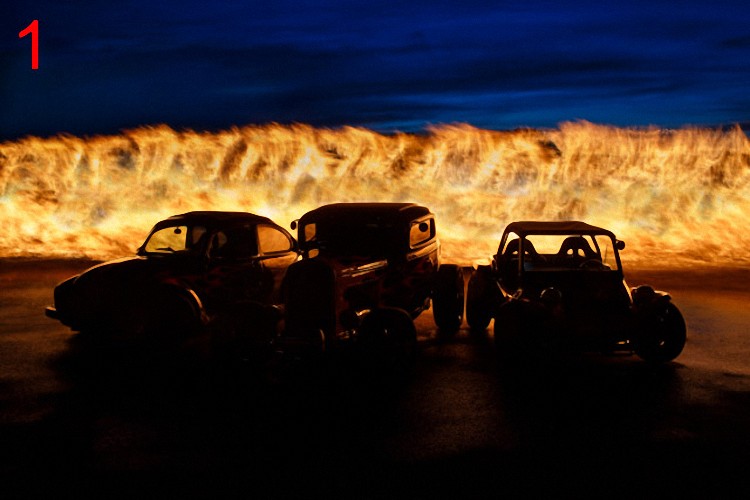
I used the fire painting image as the background (1 below). Then I put all the other layers above using layer masks and painted everything in one by one.
1

First the headlights (2) then the cars starting with the Dune Buggy (3,4,5) to the Hot Rod (6-7) and at the end VW Beetle (8,9).

2

3

4

5

6

7

8

9

Now I put a layer mask above all the cars, deleted some of the parts that were too shiny and painted flame reflections from the background back in (10). At the end, I painted the reflections into the picture to make everything complete (11).

10

11

As you can imagine there were lots of layers to work with and in total I worked 11 hours (including preparation and shooting) on this one photograph.

Affinity2

Every layer with its own layer mask.

Final image

Not everyone will have the resources, skills or ability to do a shot like this. Please remember, do not attempt this without advise from safety professionals.

But I hope you agree that all the time and effort that went into this shot is worth it.

Flame for flame hotrodm


The post Hot Rod Flame for Flame – How the Shot was Made by Markus Hofstaetter appeared first on Digital Photography School.


Digital Photography School

 
Comments Off on Hot Rod Flame for Flame – How the Shot was Made

Posted in Photography


Ohio photographer shot by police officer who mistook camera for gun

05 Sep

New Carlisle News photojournalist Andy Grimm was shot by Sheriff’s Deputy Jake Shaw on Monday after the officer mistook Grimm’s camera and tripod for a gun, according to the news organization.

Per New Carlisle News—a local news organization in New Carlisle, Ohio—and Grimm’s statements about the incident, Grimm had left the company’s office around 10PM to photograph lightning. At some point after this, Grimm witnessed a traffic stop being performed by Shaw, which he decided to photograph. Grimm says he pulled his vehicle into the parking lot of a restaurant near the traffic stop, where he began setting up his tripod and camera “in full view of the deputy.”

Despite this, Grimm said, “I turned around towards the cars and then ‘pop, pop,'” referencing the gunfire he heard before being shot in the side.

The photographer underwent surgery and is expected to recover. Grimm states that he knows the deputy who shot him and that he doesn’t want him to lose his job; however, he says Shaw failed to give him any sort of warning before opening fire. New Carlisle News says that the Ohio Bureau of Criminal Investigation is now looking into the incident.

Articles: Digital Photography Review (dpreview.com)

 
Comments Off on Ohio photographer shot by police officer who mistook camera for gun

Posted in Uncategorized


Photographers face three felonies after climbing bridge for cityscape shot

01 Sep
Benjamin Franklin Bridge at night by Jeffrey Phillips Freeman

Breaking the law to get the perfect shot can have serious legal consequences, a harsh reality currently facing photographers Martin J. Romero-Clark and Andrew Lillibridge, who were arrested after climbing onto the Ben Franklin Bridge in Philadelphia.

According to local news site Philly.com, police received an alert at 12:50AM on July 25th about a potential jumper on top of the bridge; this prompted a response from the Philadelphia Police marine units, port authority police, and the Philadelphia Fire Department. Upon arriving at the scene, authorities reportedly discovered the two photographers with camera gear. By the time the two were arrested at 1:20AM, the incident had drawn 36 firefighters, eight port authority officers, and seven port authority rescuers.

Statements from authorities to local news indicate that the photographers’ climb onto the bridge had tripped security alarms and was captured on security cameras. In addition, the bridge had to be shut down for 103 minutes.

In a statement to Philly.com, Delaware River Port Authority CEO John Hanson said the two had worn black clothing and climbed the bridge on a wet night, putting both themselves and everyone on the ground at risk. “They could have fallen, they could have been injured in the process of apprehending them, and they put the heroic men and women of our police department and the Philadelphia Fire Department at risk,” Hanson said. “We’re going to prosecute them to the fullest extent of the law. I am not amused, and I am very angry.”

The pair now face two third-degree felonies, one fourth-degree felony, and their photography equipment has been confiscated.

Articles: Digital Photography Review (dpreview.com)

 
Comments Off on Photographers face three felonies after climbing bridge for cityscape shot

Posted in Uncategorized


This iconic still life photo was shot at f/240… for 6 hours!

20 Aug

Editor’s Note: The video contains a fine art nude print that is spoken about starting at 7:50 and appears in the background throughout most of the video from that point on. Potentially NSFW.


What’s the smallest aperture you’ve ever used? F22? Maybe the max you’ll find on some large format lenses: F64? When iconic photographer Edward Weston needed more depth of field to capture his famous still life Pepper No. 30, F64 wasn’t nearly enough. He shot it at F240, using only natural light and exposing the shot for 4-6 hours!

This curious piece of photo trivia came up during the latest episode of Marc Silber’s show Advancing Your Photography, in which he visits Weston’s house and speaks to Weston’s grandson Kim about the legendary photographer’s work and technique.

Edward Weston’s famous ‘Pepper #30’ was shot at f/240, with an exposure time of between 4 and 6 hours using all natural light. Photo: Edward Weson, screenshot from video.

Silber and the younger Weston touch on several of the renowned photographer’s best known photographs, and finish the episode with a teaser from inside Weston’s darkroom. To hear about these techniques in more detail and see more of Weston’s work and home, click play up top.

Articles: Digital Photography Review (dpreview.com)

 
Comments Off on This iconic still life photo was shot at f/240… for 6 hours!

Posted in Uncategorized


This crazy fire-and-water wedding portrait was shot in a single exposure

06 Aug

Photographer Markus Hofstaetter doesn’t shy away from challenging projects. Inspired by a previous fire-background hot-rod photo shoot he did, Hofstaetter had the idea to try this same technique with a portrait. There would just be one key difference: this one would be a single exposure.

A photo shoot like this is all about safety, and Hofstaetter did everything he could to ensure his subjects, assistants, and the backyard stayed nice and unburnt.

He got himself a heat-proof suit from the Muckendorf-Wipfing fire department, moistened the entire backyard, cut away stray branches to ensure he had enough room, had damp sheets at the ready, and actually built a little pond in his backyard. That last part did keep the couple a bit safer, but it was actually all about getting a killer reflection in the final photograph.

You can see how the photo shoot came together in the behind the scenes photos and video below:

$ (document).ready(function() { SampleGalleryV2({“containerId”:”embeddedSampleGallery_3170715563″,”galleryId”:”3170715563″,”isEmbeddedWidget”:true,”standalone”:false,”selectedImageIndex”:0,”startInCommentsView”:false,”isMobile”:false}) });

Once it came time to shoot the actual photo, he used a Canon 5D Mark IV and 35mm lens set to F22. The full exposure was 4.4 seconds long. The fire background was made by dipping a 6-foot-long Kevlar wick into one liter of lamp oil, hanging it on an aluminum stick, and setting it ablaze.

The exposure lasted as long as it took for the fire to cross the frame, with a nice burst from two Hensel strobes to light the couple.

The final photograph took 4 or 5 tries, as you can see from the BTS video above, but in the end Hofstaetter managed to capture the memorable portrait he was after:

The photo has made its way around the Internet over the past week, but something people don’t know is that Hofstaetter’s initial plan was to capture the shot on both digital and large format film (his specialty).

“You see there also a large format camera (Linhof Master Technika) in one photo,” he tells DPReview. “I wanted to shoot film too, but it was too stressful to handle both cameras, because I had to light the fire too. Plus, I couldn’t get the analog camera in a good position with the lenses I had available… next time I’ll try to shoot it on film too, and maybe get a wider angle lens for the Linhof.”

To see more of Hofstaetter’s work, head over to his website, follow him on Instagram, or follow along on his blog as he continues to experiment with all sorts of crazy ideas.


All photos © Markus Hofstaetter and used with permission.

Articles: Digital Photography Review (dpreview.com)

 
Comments Off on This crazy fire-and-water wedding portrait was shot in a single exposure

Posted in Uncategorized


This is the first photo of a total solar eclipse ever taken, shot in 1851

01 Aug
The first successfully captured photograph of a total solar eclipse, this daguerreotype was shot on July 28, 1851, by Prussian photographer Johann Julius Friedrich Berkowski.

Here’s a little history lesson to help you pass the time between now and the next total solar eclipse on August 21st. The photograph above, a daguerreotype captured almost exactly 166 years ago, is the first successfully-captured photograph of a total solar eclipse.

The photo was captured by master daguerreotypist Johann Julius Friedrich Berkowski, a Prussian photographer who was commissioned by the Royal Prussian Observatory at Königsberg to do what nobody else had managed up until that point: capture an appropriately-exposed photograph of a total solar eclipse.

Up until that point, every photograph taken had been over or under-exposed, and/or didn’t capture sufficient contrast between the bright corona and the obscuring disk of the moon.

According to a paper in the journal Acta Historica Astronomiae, the photograph was captured using a small refracting telescope attached to the hour drive of the 15.8-cm Fraunhofer heliometer. Berkowski began exposing the image shortly after totality, and the final daguerreotype took 84-seconds to capture.

To learn more about this photograph, click here. And if you want to learn how to capture the August 21st eclipse for yourself (and why you should maybe put the camera down for this one…) check out our own eclipse how-to.

How to photograph the August eclipse, and why you probably shouldn’t try.

Articles: Digital Photography Review (dpreview.com)

 
Comments Off on This is the first photo of a total solar eclipse ever taken, shot in 1851

Posted in Uncategorized


This Nat Geo cover was shot with a 10-year-old DSLR and an iPhone flashlight

24 Jul
European astronaut Paolo Nespoli sitting in a Soyuz launch module simulator, illuminated by a single iPhone flashlight. Photo © Alessandro Barteletti.

Photographer Alessandro Barteletti has spent the last year creating a photo essay for National Geographic, in which he tells the story of 60-year-old European astronaut Paolo Nespoli. The project has taken him all over the world with Paolo, but it’s the photo above that stuck with him, and that Nat Geo in fact picked for the cover of the July issue of National Geographic Italia.

For this project, Barteletti received access to the training centers in Europe, the US, and Russia, trailing Paolo and capturing photos honoring the astronaut as the first 60-year-old ever to be enrolled in a 6-month-long mission.

Behind the scenes with Barteletti, shooting Paolo Nespoli for National Geographic. Photo © Alessandro Vona

The memorable cover photo was captured in Star City, Russia, while Paolo sat inside the Soyuz launch module simulator.

“I came into the Soyuz with my Nikon D3 and a wide angle lens, ready to shoot Paolo when, suddenly, something unbelievable happened: all lights off, everything was dark and from the outside they started knocking on the door telling me I had only one minute left,” Barteletti tells DPReview. “I didn’t know what to do: that was the perfect setting for THE PHOTO, probably one of the best ones ever. Outside I had some led lights but if I had come out the module, they wouldn’t have let me come in once again.”

Paolo agreed that leaving the module wasn’t an option, and so they tried to come up with some way to capture the shot in the next 60 seconds… with no professional lighting anywhere in sight.

“I had an idea, one of those crazy ideas that only come to you when you are desperate,” says Barteletti. “I took my iPhone—the only electronic device I had with me—I turned on the torch, and I put it between two panels behind the astronaut.”

As it turns out, his idea worked perfectly. “The module was so small, less than 2 meters of diameter, that the torch was enough to properly light the setting,” he told us. “I had only the time for two landscape shots and two portrait ones, just a few seconds before I was literally obliged to leave the module.”

In the end, Barteletti was right: it was THE PHOTO. National Geographic chose this shot for the cover. Barteletti still can’t quite believe they chose a photo “shot with a ten-year-old Nikon D3 and lit with an iPhone torch.”

To learn more about Alessandro or see more of his work, visit his website by clicking here.

Articles: Digital Photography Review (dpreview.com)

 
Comments Off on This Nat Geo cover was shot with a 10-year-old DSLR and an iPhone flashlight

Posted in Uncategorized


Video: Those ‘Shot on iPhone’ ads are not what they seem

02 Jul

Anybody who knows about the technique and gear involved in capturing great photos and video knows to look at those ‘shot on *insert smartphone here*’ ads with a bit of skepticism. Yes, they were technically shot on those phones, but many people don’t realize the amount of extra gear and software that goes into the final product.

There is a disclaimer at the end of these videos, of course, but it’s easy to miss or subconsciously ignore it when you’re hoping against hope that your iPhone 7 Plus will be the last camera you’ll ever need.

Have you noticed this disclaimer at the end of the ‘Shot on iPhone’ ads?

In this short video, YouTuber Marques Brownlee sheds a bit of light on the matter, sharing a little behind the scenes look at some of the really intense gear these commercials use, before diving into some more affordable options that can help get your smartphone video—shot on iPhone or otherwise—closer to those professional grade commercials.

Because while you’ll probably never use a rig this advanced:

It’s not unthinkable that you could buy yourself a DJI Osmo Mobile and some Moment lenses to help get your shaky hand-held attempts a little closer to the results you see in Apple and Samsung’s professional ads.

Just don’t beat yourself up if your first few tries don’t live up to this level of quality. We don’t know exactly what gear Apple used on its latest ‘Shot on iPhone’ commercials, but we’re betting it’s closer to the crazy rig you see above, than the pared down little stabilizer and smartphone lenses Brownlee touts in his video.

Articles: Digital Photography Review (dpreview.com)

 
Comments Off on Video: Those ‘Shot on iPhone’ ads are not what they seem

Posted in Uncategorized


Getting the shot: macro photos of paint and water that look like CGI

24 Jun

Vibrant colors of acrylic paint billow into clouds inside a water tank. © Photo by Alberto Seveso

Illustrator and photographer Alberto Seveso’s paint photography is out of this world. His images – macro photos of billowing clouds of color – look like they were generated by an animation program. But as he tells DPReview, it’s all very real.

The process itself, says Seveso, is quite easy: just pour varnish or acrylic colors into a water tank and take a burst of photos. Understanding exactly how to do that – what light you need, what works, and just as importantly, what doesn’t work – is the time-consuming part.

‘I spent a lot of time building all the stuff I use to shoot varnish into the water, and it’s still a work in progress,’ Seveso tells DPReview. ‘It’s very important to find the right light and, the hardest part, find the perfect mix between varnish and water and the way to pour this mix into the tank… not too fast not too slow.’

For his pictures, he uses either a Canon EOS 60D or Canon 7D Mark II with a Canon EF-S 60mm F2.8 macro lens attached. The tank is lit by either fluorescent light (personal projects) or higher quality tungsten Fresnel lights (for commercial assignments), two on either side of the tank, placed in front of either a black background or a softbox if he’s shooting on white.

You can see the setup for yourself in the BTS shots below:

$ (document).ready(function() { SampleGalleryV2({“containerId”:”embeddedSampleGallery_9818299609″,”galleryId”:”9818299609″,”isEmbeddedWidget”:true,”standalone”:false,”selectedImageIndex”:0,”startInCommentsView”:false,”isMobile”:false}) });

And here is a video Sony made to show off Seveso’s paint work (and sell some phones and tablets while they’re at it):

Seveso says he was inspired to create this kind of photography in 2009, when he saw ‘something similar but classic,’ probably ink drops in water.

‘I realized there was more to explore, different materials to mix, so I started to experiment with different kinds of liquid like acrylic colors, different types of oils, sparkling water, gels, metallic colors, ice, food coloring, and other things,’ he says. ‘Over the years, I’ve tried to develop a personal approach to this technique, developing the project in a very personal way and trying to focus on the details.’

Translation: macro photography.

These close-up, colorful photographs have become Seveso’s calling card. And what a gorgeous calling card they are.

$ (document).ready(function() { SampleGalleryV2({“containerId”:”embeddedSampleGallery_4295038061″,”galleryId”:”4295038061″,”isEmbeddedWidget”:true,”standalone”:false,”selectedImageIndex”:0,”startInCommentsView”:false,”isMobile”:false}) });

Before we let Alberto go, we asked him one more question. Does he have any advice or tips for people who would like to try this kind of paint photography for themselves?

His answer?

‘Practice,’ he told us emphatically. ‘It takes a lot of practice to understand the exact mix between liquids to get separate colors, details and color filaments – this is perhaps the hardest part.’

To see more of Alberto’s work, visit his website or follow him on Behance, Facebook, and Instagram.

Articles: Digital Photography Review (dpreview.com)

 
Comments Off on Getting the shot: macro photos of paint and water that look like CGI

Posted in Uncategorized


Latest “Shot on iPhone” commercial puts focus on iPhone video capabilities

08 Jun
After previously mostly concentrating on still imagery Apple’s latest iPhone commercial showcases the iPhones video mode by combining several clips that were shot by iPhone owners. There are nature scenes, including beaches, mountains, animals, insects, and ice floes, but also some scenes that feature human subjects.
The soundtrack draws a thematic link by using a recording of astronomer Carl Sagan reading an excerpt from Pale Blue Dot, warning about the fragility of human existence and the importance of protecting the Earth.
While the footage looks impressive it’s important to mention that a footnote at the end of the video says that “additional equipment and software” were used in some or all of the featured videos.

Articles: Digital Photography Review (dpreview.com)

 
Comments Off on Latest “Shot on iPhone” commercial puts focus on iPhone video capabilities

Posted in Uncategorized