RSS
 

Posts Tagged ‘shot’

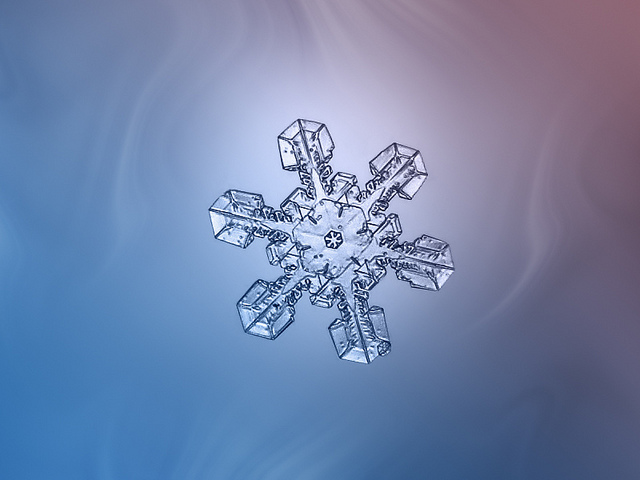
27 Amazing Macro Snowflake Images Shot with a DIY Camera Set Up

23 Dec

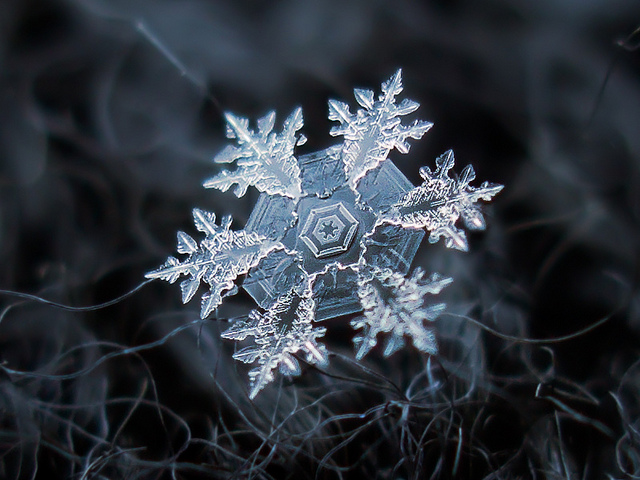
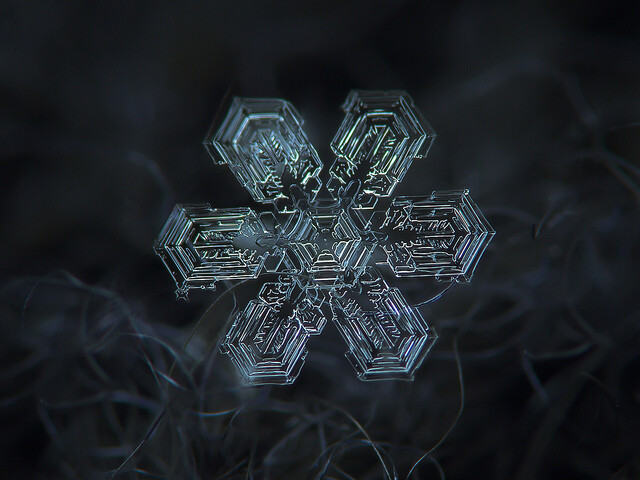
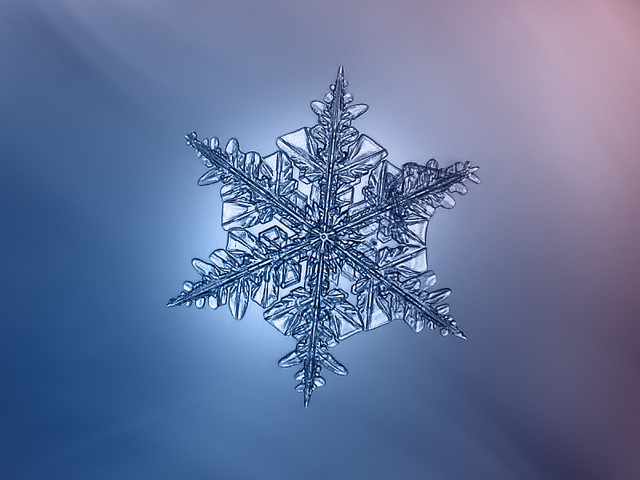
These amazing Snowflake images by photographer Alexey Kljatov have caught our eye in the last week.

By Alexey Kljatov

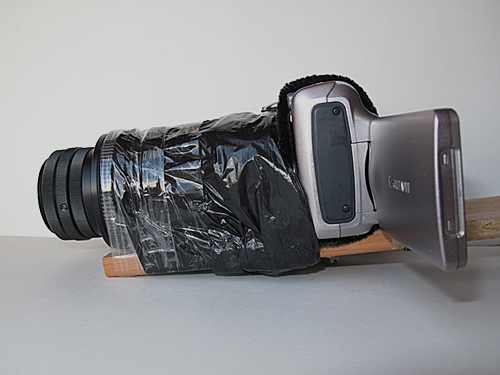
What particularly impressed us at dPS HQ was the way Alexey shoots the images using a system that is literally taped together components. He uses a Canon A650 (a point and shoot released back in 2007) with old 2nd hand Helios lens from an old Russian made camera.

11044822583_cf9b4bd45c_o

It’s quite remarkable that something so cobbled together takes such beautiful images but it illustrates just what can be achieved when you put your mind to it! Learn more about his method here.

Here are some more of his Snow Flake Images.

By Alexey Kljatov

By Alexey Kljatov

By Alexey Kljatov

By Alexey Kljatov

By Alexey Kljatov

By Alexey Kljatov

By Alexey Kljatov

By Alexey Kljatov

By Alexey Kljatov

By Alexey Kljatov

By Alexey Kljatov

By Alexey Kljatov

By Alexey Kljatov

By Alexey Kljatov

By Alexey Kljatov

By Alexey Kljatov

By Alexey Kljatov

By Alexey Kljatov

By Alexey Kljatov

By Alexey Kljatov

By Alexey Kljatov

By Alexey Kljatov

By Alexey Kljatov

By Alexey Kljatov

By Alexey Kljatov

By Alexey Kljatov

The post 27 Amazing Macro Snowflake Images Shot with a DIY Camera Set Up by Darren Rowse appeared first on Digital Photography School.


Digital Photography School

 
Comments Off on 27 Amazing Macro Snowflake Images Shot with a DIY Camera Set Up

Posted in Photography


Get our ‘Making the Shot’ Portraits eBook today for $7 only!

18 Dec

Portraits_coverOn the fifth day of Christmas dPS gave to me, the deal we know a lot of you have been waiting for …

Save 65% on our smash-hit eBook Portraits: Making The Shot

Snap up a copy here for just $ 7

Making The Shot is an amazing eBook that will help you say goodbye to dull and lifeless pictures of people forever. It’s Jam packed with 25 years of portrait photography perfection and we think it’s the best portrait photography eBook you’ll find …

And 10′s of thousands of our readers who’ve picked up a copy agree.

If people are what you’re looking at through your viewfinder, you do not want to miss this eBook at this never before offered price.

Now on one hand we’re really excited about sharing this deal – it’s the cheapest this brilliant portrait photography eBook has ever been.

… and we know you all love $ 7 eBooks!

But on the other hand we’re a little worried

… let’s hope our servers hold up!

Grab your copy of Making The Shot before the deal closes or our servers go into meltdown!

It is available right now for only $ 7 ($ 19.99RRP) for the next 24 hours only!

The post Get our ‘Making the Shot’ Portraits eBook today for $ 7 only! by Darren Rowse appeared first on Digital Photography School.


Digital Photography School

 
Comments Off on Get our ‘Making the Shot’ Portraits eBook today for $7 only!

Posted in Photography


Behind the Shot: Erez Marom walks us through his ‘Winter Paradise’

22 Oct

Winter_Paradise.jpg

In the latest “Behind the Shot” article, landscape photographer Erez Marom walks through how he got this Aurora Borealis image in the Mývatn district of northern Iceland. Marom talks about his equipment choice and exposure settings. He also gives a step-by-step look at his post-processing technique. Click through for the full article. 

News: Digital Photography Review (dpreview.com)

 
Comments Off on Behind the Shot: Erez Marom walks us through his ‘Winter Paradise’

Posted in Uncategorized


How I Shot My ‘Mini World’ Image

20 Oct

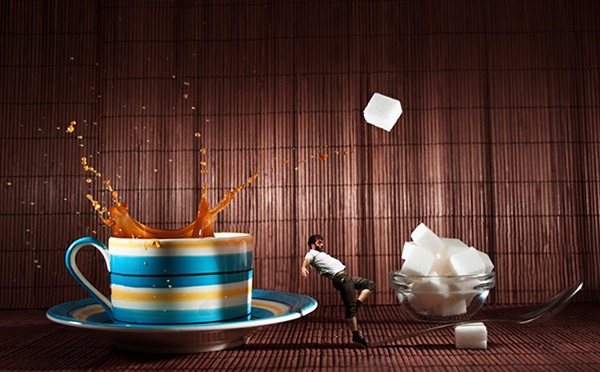
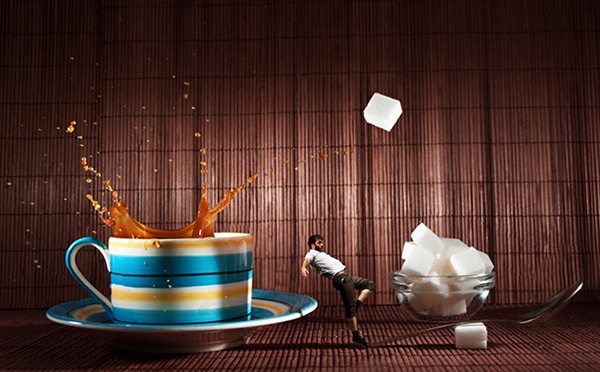
Over on our Facebook page this week we shared our recent ‘Small World‘ post featuring some of our readers shots of miniature figurines shot in larger scenes. On Facebook one of our readers – Dave Flynn – commented that he used to take these types of photos but now does something different. He shared a link to his Mini Worlds Gallery where he showed his different take on it. It includes this photo!

Mini World: Final Edit

I immediately shot Dave a message asking if he’d write up how he took it. Here’s what he sent in.

My name is Dave Flynn, I’m 45 years old and got into photography 3 years ago when I was made redundant from my career in retail. I’m completely self taught through reading magazines and watching online videos. I don’t have a particular field of interest and have a varied portfolio which can be seen at www.dflynnphotography.com and www.facebook.com/daveflynnphotography

In my bag

  • Nikon D90
  • Nikon 50mm 1.8D prime lens
  • Nikon 18-70mm DX 3.5 wide angle lens
  • Tamron 90mm Macro 2.8
  • Tamron 70-300mm Zoom f/4
  • I also have 2 speedlights and triggers.

For most of my creations I use the 50mm, 90mm and 18-70mm.

I will always try to use natural light where possible and have a roof terrace which is perfect for getting shots of the posed models and backgrounds.

On wet days, I use my bedside table which is next to a large window. I don’t have expensive equipment or studio lights, my editing is all done on my laptop so I am proof that you don’t need every photography related gadget or the latest kit to create amazing images. They key to all photography is the light. It’s the first thing you should think about when creating any image.

Inspiration just comes to me, I might see an item/person/scene and imagine a final image in my head then set out to create it. Photography for me is a great way to share what goes on in my brain and I hope you can get some inspiration from my thoughts.

ONE LUMP OR TWO: How I Shot It

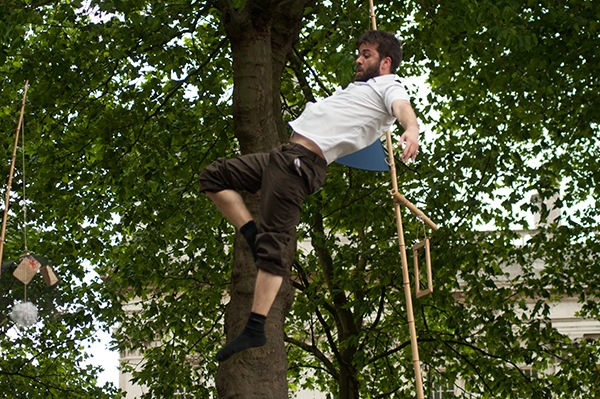
I’d been to a festival in London and got some shots of the various performances. The bearded man in the shot below is jumping on a trampoline for his act. Shot using my 70-300mm at f/5.6 @200mm, ISO 400 with a fast shutter. When I reviewed the images; this one stood out so I tried to think how to use him in a mini world. It was a few days later when I was making coffee and I got the idea. This is how I created it.

GW_-79.jpg

In photoshop I use layer masks to remove the model from the background. There are other methods like using the pen tool or quick selection tool but masks are my preferred method.

There are very good tutorials on youtube about using layer masks in photoshop.

SL.jpg

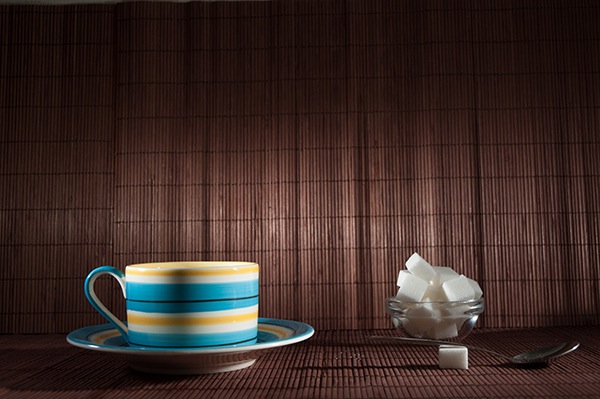
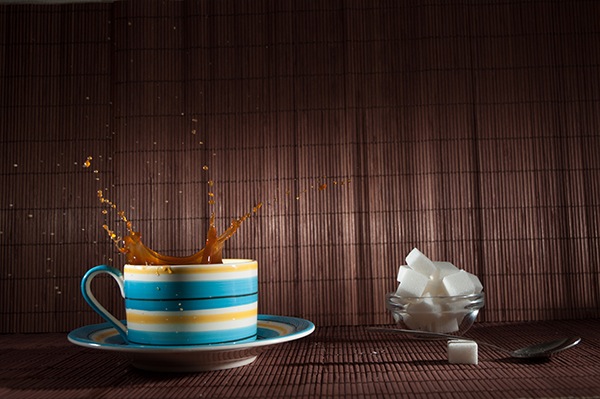
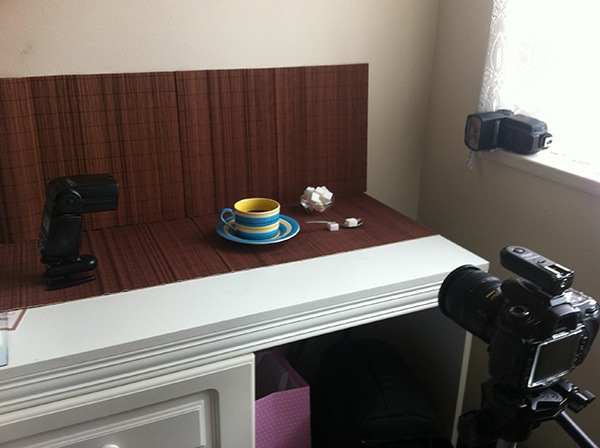
The scene is set for the background. I used 2 speedlights to balance the light. I think they were both set to 1/128 sec because I had natural light coming in the window too. I used my wide angle lens at 18mm with a shutter speed of 1/160 and an aperture of f/8.

SL-5.jpg

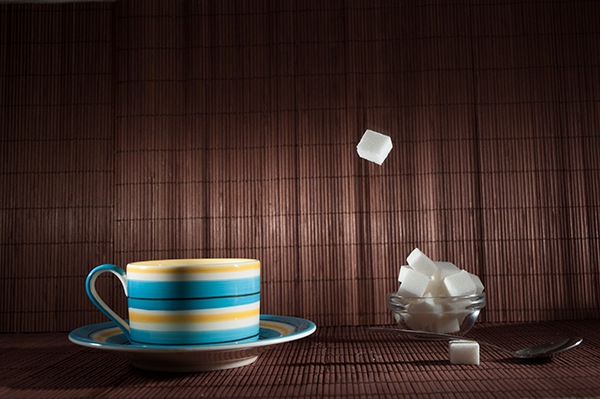
Next it was time to drop a sugar lump into the scene, remember the speedlights are set to freeze any motion in the image. It took a few attempts for me to get this shot to catch sugar cube where I wanted. Exactly the same settings were used.

SL-6.jpg

The same technique was used to catch the splash at just the right moment. This again took a few attempts ( and a lot of cleaning) to get the splash how I wanted.
photo.jpg

The ‘studio’ in my bedroom and the scene setup.

The final edit with some curve and level adjustments in photoshop.

one lump or 2 2nd Edit Final.jpg

Thanks to Dave for sharing this behind the scenes look at his shot. Check out more of his Mini Worlds here.

Post originally from: Digital Photography Tips.

Check out our more Photography Tips at Photography Tips for Beginners, Portrait Photography Tips and Wedding Photography Tips.

How I Shot My ‘Mini World’ Image

The post How I Shot My ‘Mini World’ Image by Darren Rowse appeared first on Digital Photography School.


Digital Photography School

 
Comments Off on How I Shot My ‘Mini World’ Image

Posted in Photography


Behind the Shot: Lost in Space

20 Sep

lost_01_final_image.jpg

In this article, nature photographer Erez Marom takes us through the complicated process he used to achieve his image ‘Lost in Space’. As well as equipment choice and location, Erez also explains in detail exactly how he went about adjusting and manipulating multiple images in software to create the final result. Click through for the full article. 

News: Digital Photography Review (dpreview.com)

 
Comments Off on Behind the Shot: Lost in Space

Posted in Uncategorized


How I Shot It: Deanne Fitzmaurice Shares the Story Behind the Shot

20 Sep

A post by Pulitzer Prize winning documentary photographer Deanne Fitzmaurice. Presenter in this week’s CreativeLIVE Photo Week
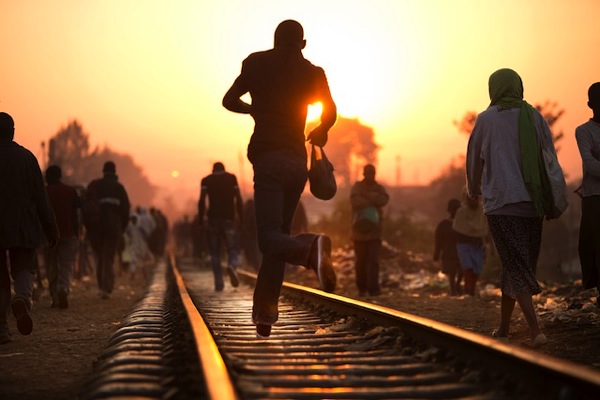
Kibera Tracks

So there I was, waiting in the quiet darkness that precedes Kibera’s beautiful sunrises, for the 12 disciples — our security team from a local tribal gang. They were the type of guys you want by your side and the definition of the guys you didn’t want to cross. Despite the high crime and desperation in Kibera, when any of those 12 guys were by my side, I felt safe and free to photograph as much as I wanted without having to look over my shoulder.

At the time of my visit, Kibera wasn’t just the largest slum in Kenya, it was, and as far as I know, still is, the largest slum in Africa. With two and a half weeks in the slum for our shoot, the crew and I had some time — which is really valuable in documentary photography work – time to research, time to talk to locals, time to scout locations, and time to return to promising locations. During our time observing the community, we discovered there was an exodus early in the morning, as many residents of Kibera left to go to work in local factories to earn meager wages.

Always thinking about strong storytelling visuals, we thought it was a good opportunity to get some footage and images of this mass daily evacuation. The early-rising Kiberans used the railroad tracks as a main thoroughfare, and there were little shops alongside the tracks and vendors serving food. We wanted to shoot at sunrise with the hope of catching that beautiful, golden light.

On this early morning, I was shooting both stills and motion, trying to capture the mood and the feel of this unique place. I knew that shortly after the sun came up at 6:45am, the local train was scheduled to come through. I always try to position myself and my camera where there are the best odds of making a good image.
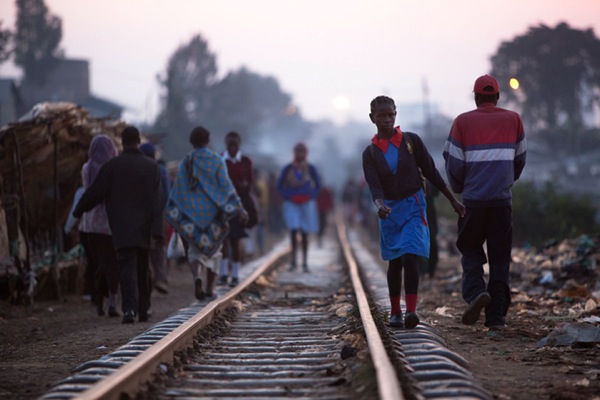
D3 8634

I started building the photograph in my head, working on the things I could control, and let everything else go to chance. I saw some vendors cooking some ugali, a cornmeal bread, causing smoke to rise from the cooking. I thought if I shot backlit, the smoke would help capture the mood of what I was seeing. I was also keenly aware that shooting into the sun can work either for you or against you.
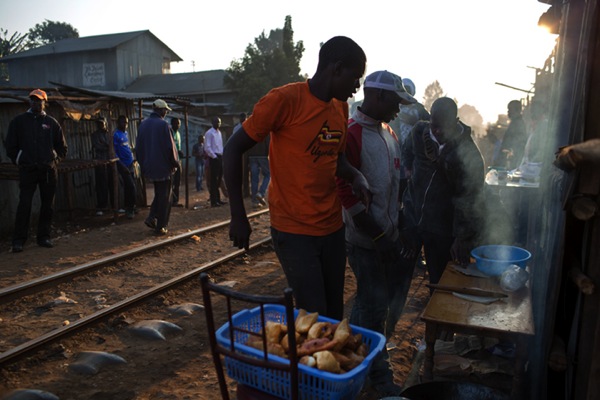
D3 8877

I moved in closer to where the smoke was rising so I had two contrasting elements, the sunrise and the smoke. I heard the train approaching and the masses of people started to rush to get off the tracks and onto the train.

My third element was the train. The only subject left to chance at this point was the people. I didn’t know where they would be or what they would be doing, but I knew I had all three other elements of the composition locked in. This is the fun part for me, in all of my work; when I build the composition and wait to see if I am going to get lucky.

My favourite was this image where three guys jumped up onto the train at the last minute as a starburst began to peek through. The smoke lends nice depth and layers to the photograph and the train was splattered with graffiti, adding a burst of color.
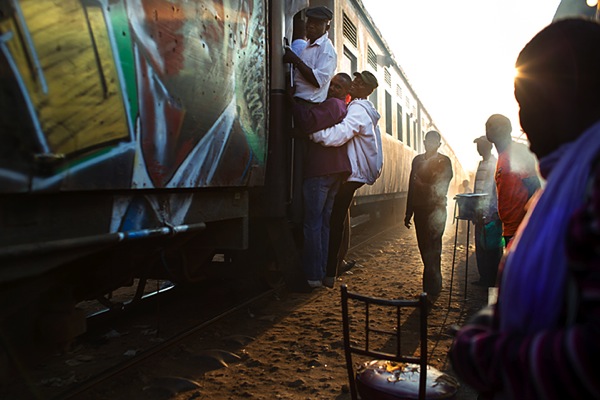
D3 8947

What Gear Did I Use?

I shot these photos with manual settings on a Canon 5D MKIII with a 35mm f1.4 shot at 1/500th at f2.8, ISO 200. I was carrying my equipment in a Think Tank Change Up convertible belt pack/shoulder/ bag and a Think Tank Shape shifter backpack. For the video I was using a Zacuto z-finder, a Zacuto Target rig and a 3 Legged Thing tripod.

To find out more about Deanne and her photography tips, catch her free course during creativeLIVE’s Photo Week

Deanne Fitzmaurice is a Pulitzer Prize winning documentary photographer and multimedia storyteller based in San Francisco, California. She is a regular contributor to Sports Illustrated and ESPN the Magazine, and has also been published in TIME, Newsweek, The Economist, Stern, and GEO. Deanne has also partnered with foundations and non-profits including NPR, The Bill and Melinda Gates Foundation, and the James Irvine Foundation.

Post originally from: Digital Photography Tips.

Check out our more Photography Tips at Photography Tips for Beginners, Portrait Photography Tips and Wedding Photography Tips.

How I Shot It: Deanne Fitzmaurice Shares the Story Behind the Shot


Digital Photography School
 
Comments Off on How I Shot It: Deanne Fitzmaurice Shares the Story Behind the Shot

Posted in Photography


How I Shot It: Food Photography

15 Sep

A post by freelance commercial and editorial photographer, food stylist & writer -Andrew Scrivani – one of the course presenters at next weeks Creative Live Photo Week.

8C5A4826

In food photography, most of the time, the art direction we receive is pretty straightforward. I like to start by discussing the color palette of the piece. The season of the year can certainly influence how I approach the shoot. A regional theme or ethnicity that needs to shine through the images may also drive the selection of the propping, table surfaces, linen, and extra food items that may appear on the set. These are the sort of discussions I have when shooting food photos that tell the story of a particular recipe, a certain ingredient, an event, or the style of a particular chef.

I have said in the past that food photography has two concurrent compositions. The first is the food itself. What the food is, where it comes from, and how it is prepared and plated is the first part of the equation. The other is the frame that you put that food in: propping, setting, and scene. The combination of these two should allow you tell the story that you intended to tell.

8C5A5179 1

Occasionally, I get asked to flex a little mental muscle and make food pictures that go above and beyond these traditional elements. The images I am focusing on here did not begin with a food story, so to speak. They started with an abstract concept, an idea of how to illustrate the crossroads between food and beauty. We needed to illustrate how certain foods are part of your “beauty tool kit” — like make-up brushes, tweezers, eyelash curlers, etc.

8C5A4879 1

The art director and I sat at a table with a pad and pencil and started to scribble notes and sketches on what we could do with pomegranates, tweezers, raw fish, makeup brushes, coconut water, edamame, eyelash curlers, and “grass fed” beef. Several of these came together in flashes and ‘aha’ moments as we paired a tweezer with an open pomegranate and placed the soy bean pod in an eyelash curler.

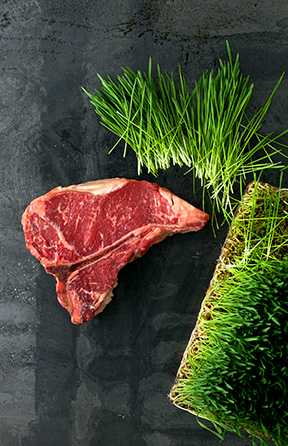
The fanned-out tails of the fish and the makeup brushes made for a natural juxtaposition that was really pleasing to the eye and avoided reminding you of a dead fish. We also felt really confident that we could show a beautiful Porterhouse on a bed of grass to underscore to its grass-fed origin.

IMG 4719

We hit a stumbling block with one of the items that was essential to the story but exceptionally hard to fit into our established theme. We had to show that coconut water was part of this “tool kit.” Coconut water, having no real color or texture, was difficult to pair with any of the beauty items. So, since we had maintained a consistency with the rest of the images by using a piece of hot-rolled steel as our table surface to give a little nod to the industrial notion of “tools” we felt that the thread was strong enough to not include an actual tool. The second part was trying to avoid shooting any packaging of a commercially available coconut water and not doing the obligatory “coconut-with-a-straw shot.”

8C5A5162

The final result was arrived upon in this shot where after draining off the water from a fresh coconut, I smashed the shell with a hammer and used the shards as design elements in an overhead shot. The idea here was to show a dramatic and striking composition that really hit home the idea that these foods, included in your beauty regimen, are powerful partners in looking and feeling your best.

The overall message here is that whether you are trying to tell an obvious story, or one that requires a little bit of imagination, every single visual detail should contribute to the story the photos convey. The reader shouldn’t have to read a single word to understand the story the photos are telling.

For more food photography tips, check out my blog and my upcoming creativeLIVE course during Photo Week which starts on Monday.

Photoweek logo

Andrew Scrivani is a New York based freelance commercial and editorial photographer, food stylist & writer. Andrew’s work has been seen in magazines and newspapers worldwide including, The New York Times, Eating Well Magazine, La Cucina Italiana, The Wall Street Journal and Newsweek. His work is also currently featured in international advertising campaigns by Red Lobster and Sargento Cheese.

Post originally from: Digital Photography Tips.

Check out our more Photography Tips at Photography Tips for Beginners, Portrait Photography Tips and Wedding Photography Tips.

How I Shot It: Food Photography


Digital Photography School

 
Comments Off on How I Shot It: Food Photography

Posted in Photography


Watch the trailer for ski movie shot with gyro-stabilized 4K rig

30 Aug

69914b43-ccc1-406f-8a46-b2c5e0d7d7a3.jpg

Back in April we posted about the GSS C520 – a five-axis gyro stabilized 4K cinema system being used by Teton Gravity Research to shoot a feature film about skiing. If the preview footage is any indication, it’ll be pretty intense, putting the 4K rig to work in some impressive locations. The trailer is available online now – click through to see the preview footage in all its high-definition glory. 

News: Digital Photography Review (dpreview.com)

 
Comments Off on Watch the trailer for ski movie shot with gyro-stabilized 4K rig

Posted in Uncategorized


Nearly deleted photo helps shot putter secure gold

23 Aug

shotput.png

Reuters photographer Kai Pfaffenbach found himself unexpectedly on the other side of the lens at the IAAF World Championship Men’s Shot Put Finals. His photo of Germany’s David Storl was used as evidence in a decision that overturned a ‘foul’ call and awarded the athlete a gold medal. When it was called into question whether Storl stepped outside of the ring in his attempt, Pfaffenbach discovered that his remote camera clearly showed Storl’s attempt to be fair. Click through for more.

News: Digital Photography Review (dpreview.com)

 
Comments Off on Nearly deleted photo helps shot putter secure gold

Posted in Uncategorized


Behind the Shot: Nautilus

10 Aug

Nautilus_0_final_image.jpg

In the latest of his series of ‘Behind the Shot’ articles, landscape photographer Erez Marom shows us how he got his stunning shot inside an icecave in Vatnajökull, the largest glacier in Iceland. As well as setup and equipment choice, Marom also gives us a detailed look at the post-processing required to achieve the final result. Click through for a link to the full article. 

News: Digital Photography Review (dpreview.com)

 
Comments Off on Behind the Shot: Nautilus

Posted in Uncategorized