Canon’s successor to the EOS 7D was a long time coming, but the 7D Mark II appears to have all the makings of a DSLR worth the wait. Offering a 20.2MP APS-C CMOS sensor, Dual Pixel AF with 65 phase-detect points and more robust weather-resistance, the 7D II is a formidable follow-up indeed. Our full review is well underway and we’ve just updated our first impressions with a detailed shooting experience. Read more
Tag: Shooting
-
Panasonic Lumix DMC-LX100 shooting experience published
We’ve just added more detail to our Panasonic Lumix DMC-LX100 First Impressions Review including a summary of our shooting experience. Read our updated preview of Panasonic’s latest enthusiast compact and find out how it fares in real-world shooting. Read more
-
Ghost Town: Shooting in Kolmanskop
Nature photographer Erez Marom captures a wide range of subjects, from macro shots of insects to some of the world’s most dramatic landscapes. In this article, he shares images from a very unusual location – the ghost town of Kolmanskop, in Namibia. Abandoned over fifty years ago, Kolmanskop was a diamond-mining town, and is currently being reclaimed by the desert. Click through to take a look at Erez Marom’s images and learn about his process
-
Shooting In Manual Mode: The Starter Kit [Infographic]
I was hanging out in one of my blogging groups the other day, and people were discussing things they wanted to do to improve their photography. One thing that popped up a few times was switching to manual mode, and how daunting that seemed. I am here to tell you that I thought the same thing until I actually went Continue Reading
The post Shooting In Manual Mode: The Starter Kit [Infographic] appeared first on Photodoto.
-
Beginner’s guide: shooting high-key at home
High-key lighting is a classic look for portraits or product photography that minimizes shadows and produces a bright, vibrant look. Although typically shot in the studio with lots of high-powered lights, it’s possible to produce a similar look at home using some fairly basic kit. In this article we’ll talk you through a simple backyard setup and some easy post-processing that will serve as a great introduction to high-key portraiture. Learn more
-
15 Inspiring Photographer Interviews to Make You Hungry for Shooting
Successful photographers become idols for newbies. It’s always interesting to see them in life, to take a glance behind the scenes, and hear their unique stories on how they got into photography. That’s the aim of the interviews. Each photography interview is a fascinating personal story of the photographer who shares his passion, tips, and advice on how to become Continue Reading
The post 15 Inspiring Photographer Interviews to Make You Hungry for Shooting appeared first on Photodoto.
-
Shooting Details to Tell a Visual Story

The bride’s most prized possession for the wedding day
A visual story, although no longer used as frequently in magazines or media, is a powerful way to give your viewer a taste of a
situation without having to be there. It’s also a great way to challenge yourself to produce a coherent body of work. A collection of images, or picture story, can be engrossing and tell a story far beyond what a single image could do.
Think back to a recent trip you took, a night out with your significant other, a favourite book or film. Try to describe it to an audience using only overarching themes. Thailand is hot and the people friendly. We went to see a movie. Lord of the Rings is about good and evil. These give your audience an idea of the content, but no clear idea of the details. The power of a story does not lie only in the bigger themes, or the “include-all” wide shot. In order to clearly convey your message, you often need small details that give your audience a glimpse into the building blocks of your story. The devil is in the details, as they say.
If your pictures aren’t good enough, you’re not close enough. – Robert Capa
Capa meant this in a couple of different ways: physically of course, but also emotionally. Both of these will help you shoot clear details to aid your viewer’s understanding.
Go Wide
In order to get closer, you don’t always need to zoom in. This will cut out distractions, but also give your viewer a sense that you’re not really close to your subject. Longer focal lengths necessitate being further from your subject. There is an intimacy that comes about by using wide-angle lenses and physically moving in very close. Just be careful of distortion.
The street surrounding this man was littered with his creations, but by getting in close with a wide lens, I was able to just show his current work.
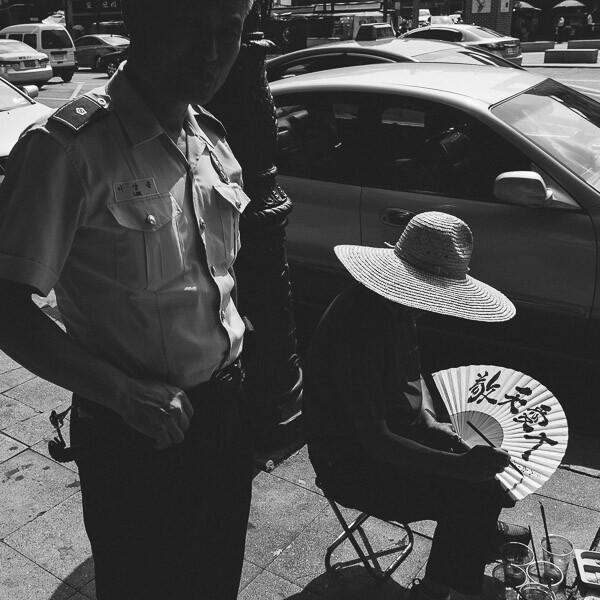
Street Calligrapher in Seoul
Feel
Being emotionally close can help you not only with being able to get physically close, but also give you a deeper understanding of your subject, and thus photograph details that are meaningful. If you are working with people, it will also help you gain trust. In the photograph below, it was important to gain the monk’s trust before asking him to take time out of his schedule to pose for a while. By watching and understanding him, the decision for which detail to shoot was obvious.
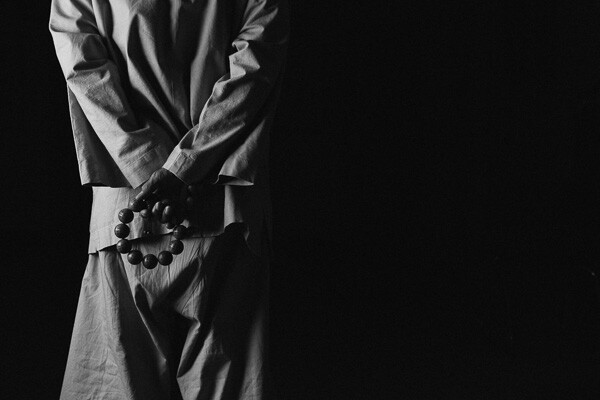
A Buddhist Monk with prayer beads
John Loengard, the picture editor at Life Magazine, always used to tell me, “If you want something to look interesting, don’t light all of it.” – Joe McNally
Loengard’s quote, by way of Joe McNally, gives us a very important concept that essentially tells us to shoot details. If, by not showing all of something we are making it more interesting, then details by their very nature are a strong starting point for interesting photographs.
Light
Light is a wonderful tool for showing only the details you want your viewer to see. Although our eyes are able to see a wide range of tones from light to dark, our cameras do not have that luxury, so you have to make creative decisions.
In the scene below there were multiple interpretations that could have been made. The exposure could have been based on the faces of the candle bearers, blowing out (photographically speaking) the candles to pure white. But the story I chose to tell was about the prayer-candles themselves, and knowing that the scene would fade to black very quickly around the candles made for a great detail shot of a very chaotic scene.
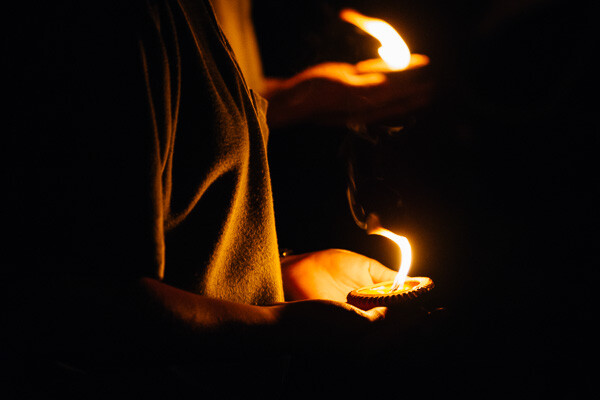
Choosing to expose for the brightest parts of the scene to show only the necessary details
This applies to lighting, and also to composition. The strongest stories we read are the ones that leave us with guess-work and hints to pique our interest. The same goes for photographs. If you show the entire subject, or the entire scene, you are giving your viewer the answers. If you want them to linger on your photo, fill it with hints, but not complete answers.
Focus
Depth of Field, or selective focus, is a great way to shoot important details. Your eyes are drawn to areas of sharp contrast (which could be light, or focus) before areas of low contrast. This means that you can use depth of field to very effectively direct your viewer’s eye to what you want them to look at.
While shooting this portrait of a young girl, I noticed that she was playing with her ribbon quite intently. This details speaks volumes about her that her mother will remember forever. Her hands will never be that small again, and that is an important reason to highlight them with a detail shot.
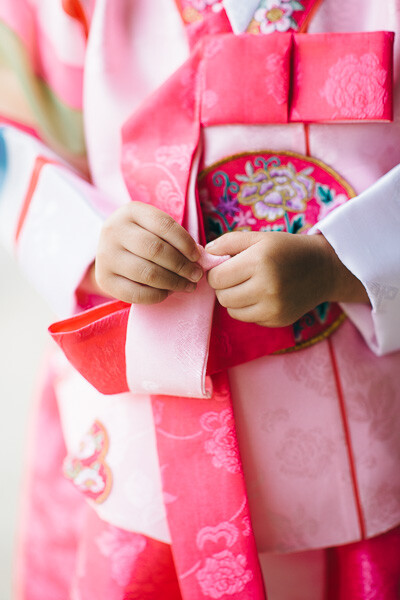
A young child’s hands holding the ribbon on her Hanbok
You can use light, subject distance, lens choice, emotion, depth of field, and so many other technical aspects to show details and give extra depth to a story, or at the very least provide you with another interesting way to look at your subject.
Set aside a few hours over the next couple of weeks to practice this. Choose a subject. That could be a person, a craft, a street in your town, a time of day, or whatever else you choose. The task here is to explore that subject. Shoot it from as many angles, and in as many ways as you can, with each and every frame trying to tell the story of your subject. Be sure to shoot as many details as you can using the techniques above. When you finish, take the time to look over these images and make a selection based on the ones that speak the most about your subject. The details will shine here, giving another dimension to the collection of images you have shot.
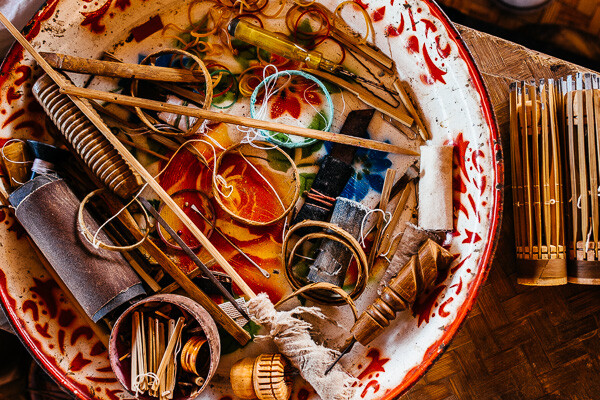
Tools at a Thai umbrella factory
Do you have any other tips for capturing details to tell a story? Please share in the comments below.
The post Shooting Details to Tell a Visual Story by Dylan Goldby appeared first on Digital Photography School.
-
With greater clarity: Nikon D810 Shooting Experience
The Nikon D810 represents a consolidation of its two predecessors, the D800 and D800E. The 36MP full frame DSLR lacks an anti-aliasing filter to make the absolute most of its high resolution sensor and provides a number of meaningful updates over the previous generation. After some extensive shooting in the field we’ve updated our First Impressions Review with a shooting experience. Read more
-
Shiny object: Leica T Shooting Experience
It’s not a surprise that Leica’s first autofocus mirrorless system camera is a thing of beauty – nor that it’s wildly expensive. The Leica T (Typ 701) uses a 16MP APS-C CMOS sensor, and its operation is almost entirely dependent on a couple of dials and a large touchscreen. It may be beautiful, but a camera can’t get by on its looks alone. See how it fared in our field testing. Read more
-
7 Tips for Shooting Alluring Photos of Your Girlfriend
What can I say…I’m a sucker for a pretty girl. Not so much the super-airbrushed models who look inhuman as much as real women in everyday situations, just being themselves. This is why I’ve often photographed the girl I was dating. At first though, I remember being to shy to ask. Too worried about offending her, making her feeling like Continue Reading
The post 7 Tips for Shooting Alluring Photos of Your Girlfriend appeared first on Photodoto.