We’ve been shooting with the Canon PowerShot G3 X for a few days now. Canon’s latest high-end compact offers a 20MP sensor and 24-6000mm equivalent zoom lens, with a touch-sensitive LCD screen and optional EVF. The G3 X occupies something of a niche in the long-zoom category, offering a longer lens than its 1-inch sensor competitors but without some of the extras, like a built-in viewfinder and 4K video. What’s it like to use? Read our overview to find out.
Tag: Shooting
-
Shooting Indoors in Ambient Light: Yoga Photo Session
Shooting indoors is always a challenge unless you have a professional lighting setup with you. The light is usually low, so it’s hard to get any kind of depth of field. Lightbulbs inside of lamps tend to glow orange, while overhead florescent lights show up on the greenish side, and aren’t very pretty. So what do you do? Let your Continue Reading
The post Shooting Indoors in Ambient Light: Yoga Photo Session appeared first on Photodoto.
-
Fujifilm X-T10 shooting experience is now live
Though it has much in common with the X-T1 in terms of image quality, starting with its 16MP X-Trans APS-C sensor and EXR Processor II, the X-T10 presents a very different shooting experience. We’ve updated our Fujifilm X-T10 first impressions with some thoughts on using the camera in the field. Read more
-
Tip-Top Tips for Shooting Fireworks

With the 4th of July fast approaching, you’re probably already searching for the best ways to shoot them ‘werks.
We’ve got you covered here with a few quick ‘n dirty tips and an excellent article covering more depth.
Quick Tips
- Prime Location: Scout out the best location for the show in advance – downwind of the fireworks and free of obstructions.
- Manual Focus: Your auto-focus is gonna have a rough time here, so don’t rely on it. Manually set your focus to infinity (or a bit closer for Canons.)
- Low ISO: You’ll want the blacks to remain black, so keep things at or under ISO 100.
- High Aperture: Wide aperture is key with fireworks, since they’re just made of burning embers. Shoot at f/8-f/16.
- Low Shutter Speed: Use bulb mode if you have it. If you’re bulb-less, go for the longest shutter speed you’ve got.
Check out even more tips in this article at Digital Photography School.
Photo by Micah Goff
© Erin for Photojojo, 2015. |
Permalink |
No comment |
Add to
del.icio.us
Post tags:
-
Shooting Stars

Summertime is prime time for astrophotography. Snapping shots of the milky way is tricky, but totally doable when armed with the right info and tools.
So, how about them tools and info, eh?
Tools:
- DSLR or even a decent point ‘n shoot.
- Tripod or any way to keep your camera rock steady.
- Compass. Try an app! (Apple/Android)
Info:
- Find a super dark area near you using this Dark Sky Finder.
- Try to go either when the moon is hiding (before it rises or after it sets) or during a New Moon.
- For a perfectly focused stars, don’t go over 30s shutter speed.
- For light streaking stars, shoot at 30s or higher.
- Use a remote shutter or set up a timer prior to each shot.
Even Moar Info:
Check out this write-up on astrophotography, it’s full of excellent tips and ideas.
Photo by Sarah & Colin’s Astrophotography
© Erin for Photojojo, 2015. |
Permalink |
No comment |
Add to
del.icio.us
Post tags:
-
Shooting Fast Moving Subjects – How to Stop the Blur
In this article you will see how to deal with fast moving objects. For me shooting action is the most fun you can have with your photography. You can freeze that instant split second that the human eye couldn’t even comprehend, and capture it in an image for all time.
1/6400, f/6.3. ISO 800
Last weekend I was lucky enough to shoot a bicycle charity event in the countryside. The sun was out, the birds were singing and there was enough distractions for me to completely leave my imagination at home.
As I was shooting fast moving road cyclists I had two lenses that I used. One which is the bread and butter lens of most photographers, the 70-200mm f/2.8. On a full frame body it has a good focal length that can capture subjects at a medium distances and the fast aperture allows for shooting in quite low light conditions. The second lens was a wide angle, for capturing some different looking shots. You don’t want to have a memory card with all the same style of shots, boring for you, and if this is for work, definitely not what the client wants to see.
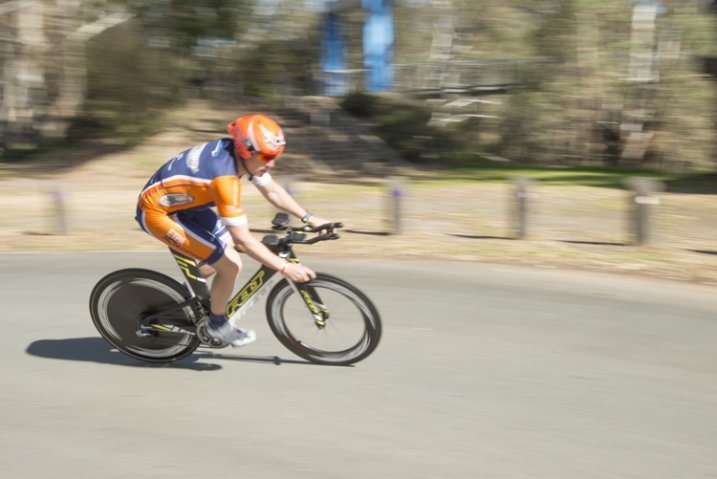
Shutter speed: 1/50th, f/16, ISO 200
Although I just listed pro lenses, honestly you can do this with any kit zoom lens, a 55-200mm variable aperture or a 70-300mm like the Nikon VR which is a great value for money zoom lens.
As with most shoots I make sure I get the classic shots that I KNOW I can nail first. For me this is frozen action, nice background, and the subject at approximately a 45 degree angle.
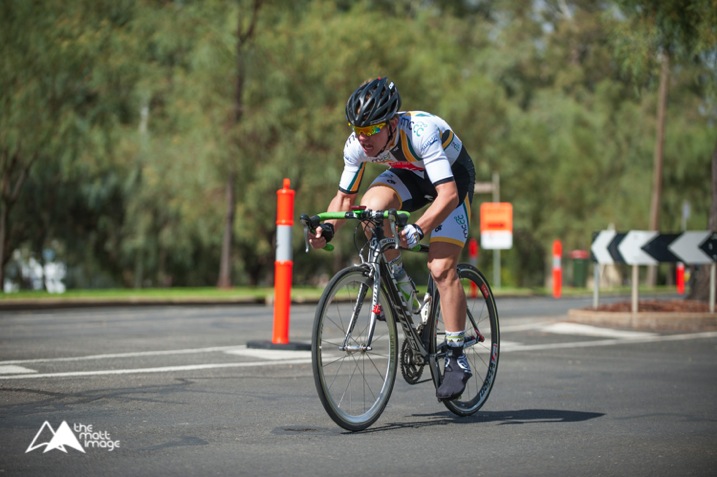
1/2500, f/3.2, ISO 200
As you can see in this image, it’s not mind blowing, however it has all the ingredients for a nice photograph that meets the criteria of what you are trying to capture. To create this type image, shoot with your zoom lens using the following settings as a rough starting point:
- Camera mode: Aperture Priority (Av in Canon, A in Nikon and most other brands)
- Aperture: As you want to freeze the action you need as much light entering the camera as possible, so choose a large aperture setting. With most kit lenses go down as low as possible, at this focal length that may be f/5.6.
- Shutter speed: No need to worry about this as the camera will adjust this automatically in this mode.
- ISO: If it is a sunny day like above, then ISO 100 or 200 is fine. However, if it is a little bit gloomy you may have to increase your ISO, I’ll talk about this in a minute.
- Focus: Set your camera for on Continuous or Servo focus depending on your brand. This means that while your shutter button is held halfway down, or your AF on button is pressed, the camera will continue to adjust its focus, which is what you need when tracking moving objects.
Your camera is now setup and ready to go. Get yourself in a position where the subject, in this case the cyclist, will be at approximately 45 degrees to you. Full side-on image and straight-on images can seem a bit odd unless it’s the style you are going for; at this angle you can see most of the rider and it’s more flattering.
Smoothly follow the rider with your camera; this might be easier in a crouch or if you have a monopod, utilize it. Once they are in a good position click off a shot or two. With any luck you have a nice photo of the rider, somewhat frozen in time.
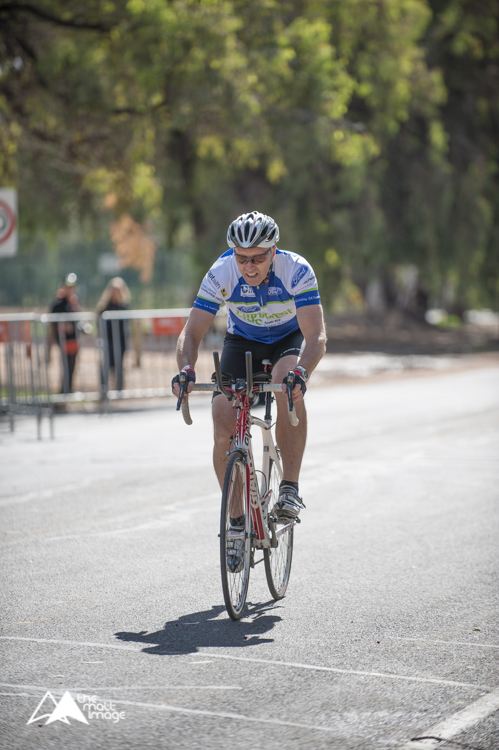
1/1600, f/3.2, ISO 200
It didn’t work? Okay, there are two main things that could trip you up here, firstly the shutter speed wasn’t fast enough and the rider is blurry (??? and secondly???). As you are using Aperture Priority (which means you set how much light is allowed in the camera and the camera adjusts the amount of time the shutter is open automatically) it’s possible that there just isn’t enough light. So the camera has slowed the shutter speed way down to let more light in to exposure your photo properly, which has caused blurring of the subject.
When looking through your viewfinder. check your shutter speed down the bottom. You should be aiming for at least around 1/500th of a second. If it is slower than that, it’s time to bump your ISO up to compensate. Your ISO is how sensitive your camera sensor is to light. As a general rule you always want to keep this as low as possible to guarantee grain and noise-free images. However, it is a tool to be used, and on modern DSLRs shooting at ISO 800 yields incredible results over the older generation digital.
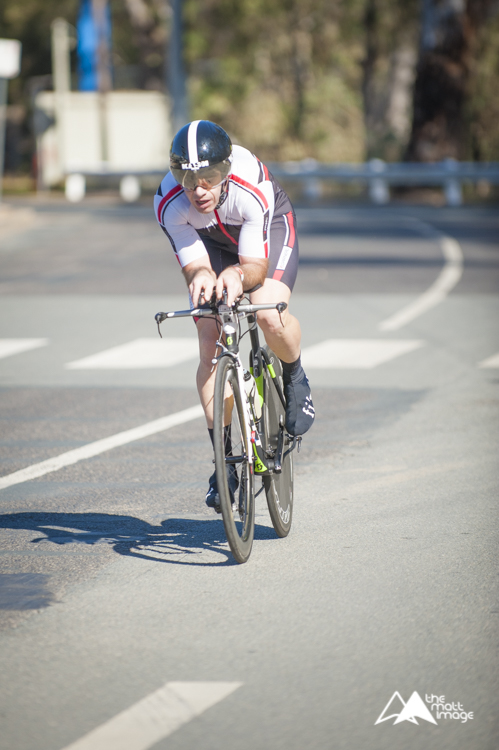
1/4000, f/3.2, ISO 400
Adjust your ISO up to 400 and try again. If you are still experiencing motion blur bump it up to 800. Unless it’s a very dark and gloomy day this should give you a crisp clear image with a fast shutter speed.
The next issue you might encounter is that the focus isn’t right. Maybe the rear wheel of the bike is in focus, but the riders face isn’t. Or even worse, the background is sharp and the rider is way out of focus. This is a simple fix.
All DSLRs give you the ability to change focus points, the square which the autofocus uses to target the focal point. Move this point to where the riders head will be in your frame. You may have to change your focus mode to Single Point Focus, as many cameras have the ability to change which focus point they use automatically, depending on the situation. You will have to consult your manual to find out where this is located in your menu system.
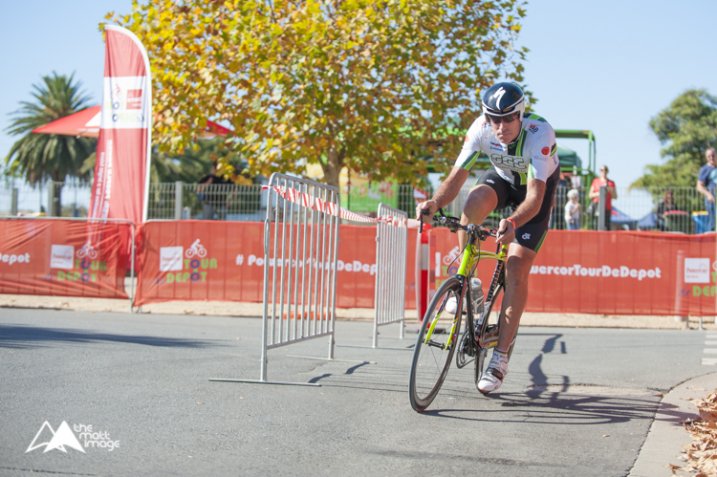
1/3200, f/3.5, ISO 400
Now when your rider is in frame, and you are focusing, it will focus on the rider’s face. Honestly, as long as their face is in focus the rest could be a blur, it doesn’t matter, faces are the most import thing in nearly all photos.
These guide lines should give you most of the info you need to shoot this type of photo. However, as with all photography, it’s trial and error to get things right and to get it looking the way YOU want.
Practice this week. Get your kids out on their bikes, go to the park and try to get some photos of dogs running around (this is fantastic practice for tracking subjects) or head down your local racetrack and take photos of cars, motorbikes or horses!
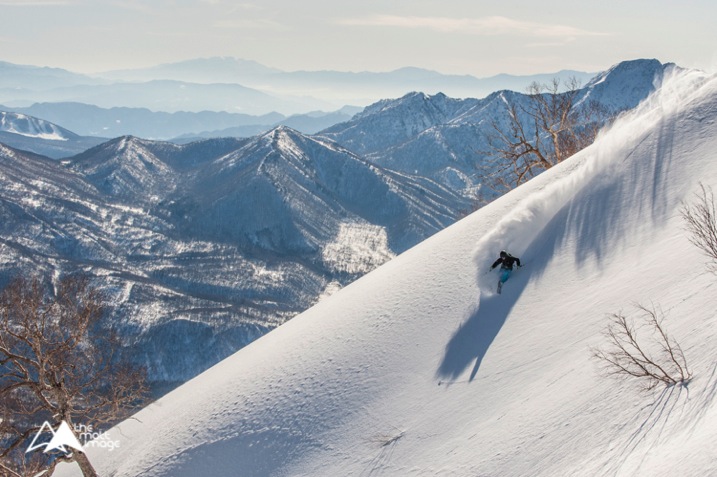
1/2500, f/7.1, ISO 500
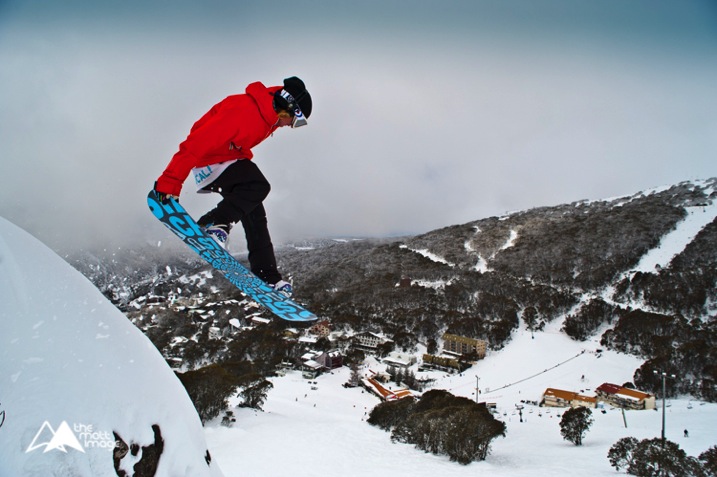
Once you get this dialled in. it can be moved to many other subjects and situations, the photos of a skier (above) and snowboarder (top of article) were shot using exactly the same technique.
Do not dismay if things aren’t working out straight away. A lot of learning photography is trial and error and practice. Any entry level, or higher DSLR setup, can do this. Learn your gear and practice, you will be surprised at the caliber of photos you can get from even the least expensive setup.
Thank you for reading, I hope this helps you on your photography quest this week. Please post up your photos and practice shots, if you have any questions I will try to answer them all and get you on the right track to photography perfection. Happy snapping!
googletag.cmd.push(function() {
tablet_slots.push( googletag.defineSlot( “/1005424/_dPSv4_tab-all-article-bottom_(300×250)”, [300, 250], “pb-ad-78623” ).addService( googletag.pubads() ) ); } );googletag.cmd.push(function() {
mobile_slots.push( googletag.defineSlot( “/1005424/_dPSv4_mob-all-article-bottom_(300×250)”, [300, 250], “pb-ad-78158” ).addService( googletag.pubads() ) ); } );The post Shooting Fast Moving Subjects – How to Stop the Blur by Matt Hull appeared first on Digital Photography School.
-
Canon EOS Rebel T6s/T6i First Impressions updated with shooting experience
We’d expect image quality from Canon’s EOS Rebel T6s and T6i (760D and 750D) to be very similar, and so far the 24.2MP APS-C DSLRs haven’t surprised us in our studio tests. The real differences between these two models is in the user experience, as the T6s provides advanced touches like a top-panel LCD and rear quick control dial for easier access to exposure settings. We delve into what it’s like using each of these cameras in our shooting experience. Read more
-
Winds of Change: Shooting changing landscapes
There are more people taking pictures now than ever before, and as a consequence, some of the world’s most beautiful views have been photographed to death. In this article, nature and landscape photographer Erez Marom explains the value of shooting ‘changing’ landscapes, which offer different perspectives every time you visit – or even from day to day, or minute to minute. Click through to read his article
-
RAW vs JPEG: Which is Better Shooting on DSLR?
The photography world is constantly rattled by many opinion clashes. Which is the better camera, which is the better photography style and even which format is better to save photos in. These and many more questions keep cropping up and seem like never ending. This discussion will help you in putting an end to at least one of such questions, Continue Reading
The post RAW vs JPEG: Which is Better Shooting on DSLR? appeared first on Photodoto.
-
7 Essential Tips for Shooting Portraits on Location
I have so many friends who have the good fortune to travel the world, but they always come home frustrated because they either try to take portraits in obvious places, standing on top of the landmark with thousands of people all around, or they don’t show the things that they found interesting or personal about where they were. So let’s Continue Reading
The post 7 Essential Tips for Shooting Portraits on Location appeared first on Photodoto.