RSS
 

Posts Tagged ‘REVIEW’

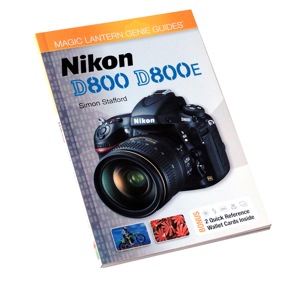
Magic Lantern Guide to Nikon D800/D800E Review

20 Jan

Guide Nikon D800  800ELike many books and movies, if you’ve read the book you’ll want to see the movie.

Similarly, if you own a Nikon D800/D800E you’ll want to read this guide book. Or even more significantly, if you’re thinking about buying one of these cameras, you will definitely want to read this book.

No doubt you’ve already read my review of the remarkable Nikon D800E camera.

Now, about the book ….

Unlike some guide books that I’ve read, this one is all meat and no potatoes, no embellishments, no guff about what a wonderful camera it is, classic lineage etc.

There is however a useful intro to explain the differences between the D800 and D800E models: the only difference being the structure of the filter array covering the image sensor.

Having spent many hours poring over the Nikon manual PDF when reviewing the D800E I wish that I had seen this Magic Lantern guide first!

You get an idea of the book’s helpful approach from the first diagrammatic, explaining the camera controls: clearly laid out, using an image of the camera’s top, sides and rear. Along with explanatory text, the camera pictures and text are close by, so you are not forced (as in the Nikon manual) to thumb through hundreds of pages.

I have rarely found the manufacturer’s original manual to be 100 per cent useful so it’s gratifying to dip into a sample of this book and see how it treats an otherwise mundane function:

‘Mirror up: Locking the reflex mirror into its raised position helps to reduce the vibrations that can often occur, particularly at slow shutter speeds … once the mirror is raised, it is not possible to compose via the viewfinder, and TTL exposure metering and autofocus will not be possible.’

Although the book totals only 128 pages, there is a heap of info within them, although some may find the small six point sans serif type a bit hard to read; it gets even worse when you get to the index at the back of the book where the text shrinks to 5 point type. To be hyper critical, the pictures are also a little on the small side.

But … the info is simply written and leaves no detail unclear. Another extract: ‘Spot metering: This metering pattern is highly specific, as it covers a circle approximately 0.16 inch (4 mm) in diameter.’

For good measure there are helpful paras on peripherals such as memory cards and batteries as well as outlines on the camera’s file formats, JPEG, RAW and TIFF.

An area often skimped in makers’ manuals is the camera’s movie modes; this book answers this criticism by opening the whole subject, clarifying many topics such as shooting stills mid-movie as well as what operational info is displayed in Live View when video recording is under way.

Useful ‘freebies’ are the six quick reference cards tucked into the book’s front and rear covers, carrying concise info on auto focus, setting ISO, flash ranges, sync speeds etc. Slipped into your pocket these would be enormously helpful on a shooting safari where carrying the whole book would be a problem.

Overall, I wish that one brave manufacturer should step out of line and supply a manual such as this with the original camera … and not the pitiful publications normally tucked into the box.

On the other hand, I do feel that the type size in Simon Stafford’s book is far too minuscule. I realise larger type would call for a bigger book or more pages, leading to an increased purchase cost but it would make the book far more accessible and useful.

Details of Magic Lantern Guide to Nikon D800/D800E

Author: S Stafford.
Publisher: Pixiq.
Distributor: Capricorn Link.
Length: 128 pages.
ISBN 978 1 4547 0401 0.
Price: Get a price on Magic Lantern Guide to Nikon D800/D800E

Post originally from: Digital Photography Tips.

Check out our more Photography Tips at Photography Tips for Beginners, Portrait Photography Tips and Wedding Photography Tips.

Magic Lantern Guide to Nikon D800/D800E Review

Digital Photography School

 
Comments Off on Magic Lantern Guide to Nikon D800/D800E Review
Posted in Photography


Two Minute Review: Canon EF 100mm f/2.8 USM Macro Lens

18 Jan

Photographer Alex Bitar heaps praise on Canon’s 100mm macro lens. Visit Alex online at www.alexbitar.com (c) 2012 Green Hill Camera http Produced by Kozak Films www.kozakfilms.com
Video Rating: 4 / 5


Canon EOS-1D X Review !

18 Jan

The Ultimate EOS. Canon has brought the best of the EOS-1D Series of digital cameras into one phenomenal model: the new flagship of the EOS line, the EOS-1D X*. Its full-frame 18.1 Megapixel CMOS sensor and all-new Dual DIGIC 5+ Image Processors deliver high quality image capture at up to 12 fps (14 fps in Super High Speed Mode) and a powerful ISO range of 100 – 51200 (up to 204800 in H2 mode) provides sharp, low-noise images even in the dimmest low-light conditions. An all-new, 61-Point High-Density Reticular AF and 100000-pixel RGB Metering Sensor that uses a dedicated DIGIC 4 Image Processor, makes the EOS-1D X reach new levels of focus speed and accuracy delivering advanced tracking even for the most challenging shooting situations. Taken all together, the EOS-1D X’s improved HD video capture, numerous connectivity options, combination of processing power and durable construction, including shutter durability tested to 400000 cycles, make it the ultimate EOS. canon nikon 1ds 1d 5d II mark III IV d7000 d300 d3 d3s d3x d800 d700 t2i t3i t1i 60d 50d 30d 20d full frame 35mm first look review flagship pro professional beauty hands on preview cnet dpreview canonrumors 2012


getitdigital review: Battle of the Inexpensive 70-300mm lenses- HD Video Samples

17 Jan

getitdigital review: This is the full review video portion of a review which can be found here: getitdigital.wordpress.com We tested the Nikon AF Zoom-NIKKOR 70-300mm f/4-5.6G and the Tamron AF70-300mm F/4-5.6 Di LD 1:2 Macro lenses using a Nikon D300s. You can get great delas on all sorts of camera gear at http:getitdigital.com.
Video Rating: 4 / 5


Sony Alpha SLT-A99 REVIEW

17 Jan

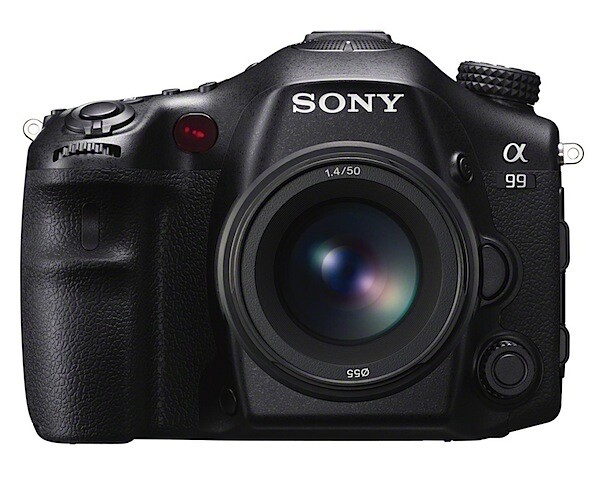
Sony Alpha SLT-A99 front.jpg

After a run of compact digicams it sure was a change of scenery to grasp this major one for review.

However, I was surprised at how easily I fell into its working modes. Am I getting more camera-wise or is the Alpha SLT-A99 more user-friendly?

I suspect the latter because, when you run your eyes over the exterior control points everything seems to be where you would expect it, clearly labelled and easy to use.

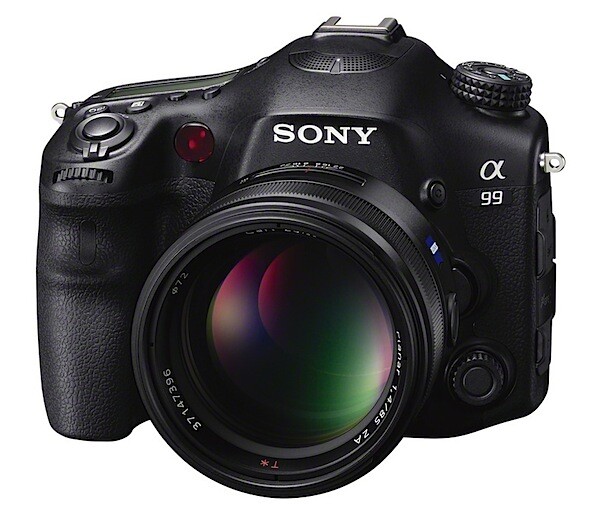
Sony Alpha SLT-A99 1.jpg

Sony Alpha SLT-A99 rear.jpg

Sony Alpha SLT-A99 Features

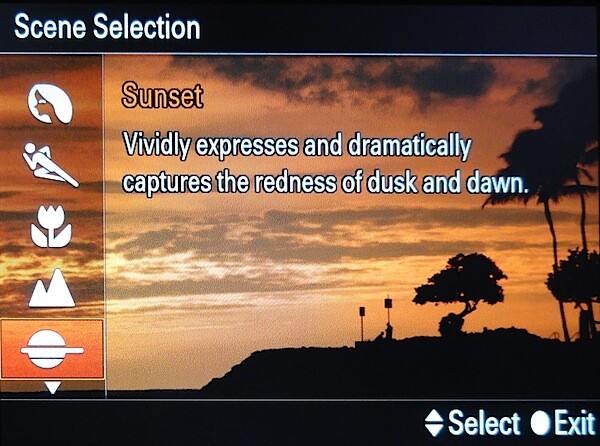
At left on top is the mode dial with selection points for auto exposure, PASM, memory recall, scene selection (portrait, sports, sunset etc), sweep panorama, continuous shooting and movie recording options.

Scene selection.jpg

To the right of the top deck is the power lever, shutter button, exposure compensation, front control dial, exposure compensation, ISO setting, white balance and an LCD display.

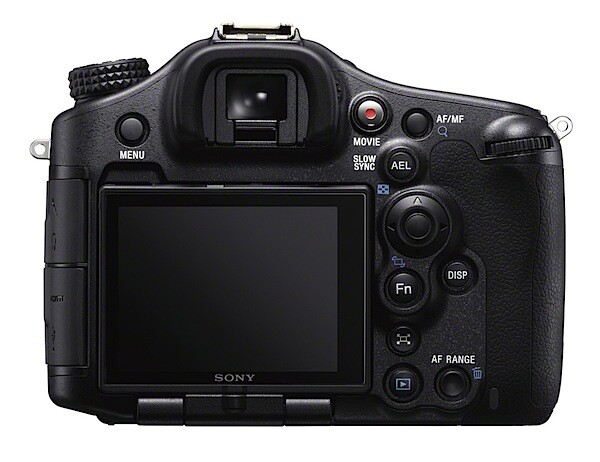
Rear: the familiar red movie record button, exposure lock, multi selector lever, Function button, display selector, focus magnifier, menu etc.

Menu.jpg

All of this means, once you’re familiar with the camera’s control layout, you need rarely delve in to the LCD finder menu.

Sure, the camera’s heavy and bulky. It does have, after all, a full frame sensor. With the Carl Zeiss Vario-Sonnar f2.8/24-70mm lens the kit weighed in at 1.8kg. Not your average snapshot camera!

This is of course Sony’s first translucent mirror camera to have a full-frame 35mm CMOS sensor, measuring 35.8×23.8mm.

Fishermen.jpg

If you came in late, here’s a quick rundown of the SLT (Single Lens Translucent) feature: SLT stands for “Single Lens Translucent”, using a translucent mirror that allows roughly two thirds of the incoming light (the photo) to pass directly through it and onto the sensor; at the same time a smaller amount, approximately a third is reflected up to the camera’s phase detection autofocus (AF) sensor.

The mirror does not flip up as in an SLR, but stays in place; this reduces the time to take a photo, and provides fast, full-time phase detection AF.

The benefits include no mirror blackout, so no blackout when the shot is taken and faster shooting speeds … in this case up to 10 fps, depending on frame size (half or full frame).

The negatives include the fact that the finder view is electronic and while, of excellent quality, is comparatively dim and the view quality does not compare with an optical prism finder. Also, there is a light loss to the CMOS, about a third of an f stop.

Windsurfer 1.jpg

Yachts 3.jpg

The body is made from high rigidity magnesium alloy panels. The SLT-A99 is also described as ‘the world’s first DSLR with professional movie recording capabilities’, which neatly puts it up against Canon’s much-acclaimed (by video shooters) EOS 5D Mark III.

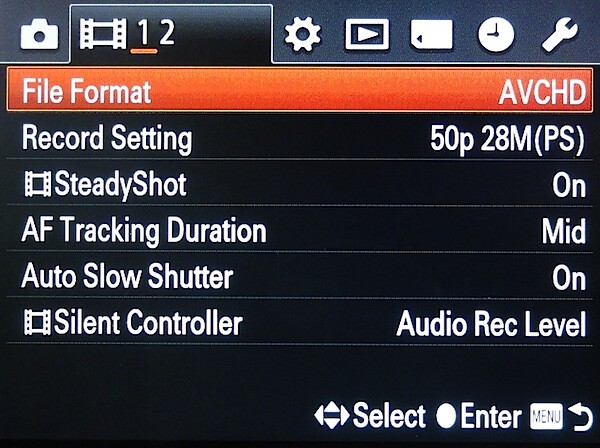
The maximum image size is 6000×4000 pixels, or as a 46x34cm print. Movies can be recored as Full HD 1920×1080 pixels in either AVCHD or MPEG 4.

Movie makers will appreciate a new feature that allows silent adjustment of exposure compensation, ISO sensitivity and metering methods, shutter speed, aperture and audio record levels during Full HD video capture.

I found that the video system works quite well with AF and auto exposure, monitoring the scene continuously; but you will notice it sometimes fail to track AF correctly. You can’t shoot stills while capturing video.

The auto focus system relies on a 19-point AF system with 11 cross sensors, complemented by a multi-point focal plane phase-detection AF sensor. Helping with moving subjects, this is complemented by a 102-point multi-point focal plane phase-detection AF sensor that senses subjects crossing the focal plane.

This new AF control helps by allowing users to set the distance range recognised by the AF system and is explained by Sony as the situation where you can focus on distant sports action, even if you shoot through a nearby wire mesh fence.

Out of focus.jpg

In focus.jpg

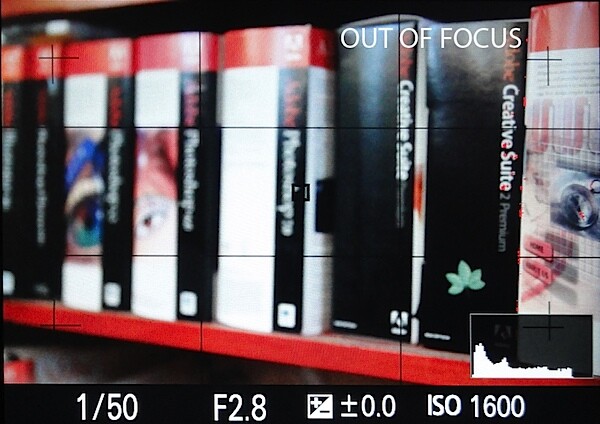
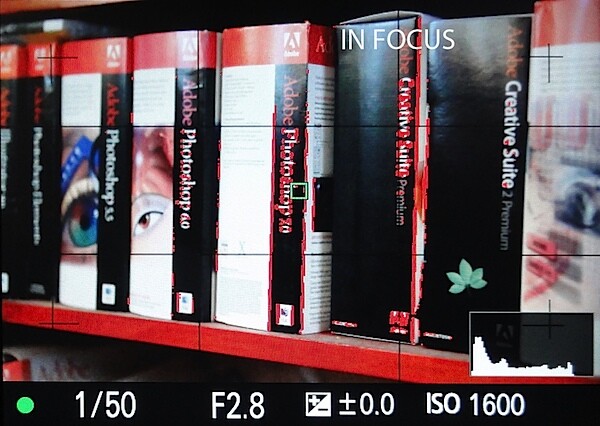
One feature that caught my eye is the manual focus mode, switchable on the left side (viewable from behind) of the lens barrel. If focus is out, the screen view is of course, out of focus; if in focus the sharp areas of the subject are outlined in a bright colour: the default hue is red. No excuses any more!

Appreciated by stills and video shooters, the LCD screen tilts 140 degrees upward and 180 degrees downward, then rotates 180 degrees clockwise and 90 degrees counter-clockwise. It is the only full frame DSLR with a vari-angle screen.

There are two card slots for either the SD series or the Memory Stick Pro Duo range. You can record the same image on one only or both cards simultaneously. Other options include writing JPEGs to one and RAW images to the other; another is to record stills to one card and movies to the other.

There is no onboard flash but there are still concessions to the less-skilled photographers who may embrace the SLT-A99: picture effect has an arsenal of renderings (toy camera look, pop colour, retro etc); smile shutter; auto portrait framing that crops face shots, saves the latter and the uncropped version.

Sony Alpha SLT-A99 ISO Tests

Sony SLT-A99 ISO50.jpg

Sony SLT-A99 ISO200.jpg

Sony SLT-A99 ISO400.jpg

Sony SLT-A99 ISO800.jpg

Sony SLT-A99 ISO1600.jpg

Sony SLT-A99 ISO3200.jpg

Sony SLT-A99 ISO6400.jpg

Sony SLT-A99 ISO12800.jpg

Sony SLT-A99 ISO25600.jpg
All the way up to ISO 12800, the images appeared to be very useable with only a slight increase in noise at the latter level. By ISO 25600 you would expect the house to fall down but, while the presence noise is obviously higher the only objectionable factor to me is a slight loss of sharpness.

Sony Alpha SLT-A99 Verdict

Quality: razor sharp, fully saturated colour. Exceptional.

Why you’d buy the Sony Alpha SLT-A99: excellent control layout; full frame quality; high speed continuous shooting; excellent video quality; rugged build; vari-angle LCD; GPS feature; in body stabiliser widens range of lenses.useable

Why you wouldn’t: too heavy.

A top performer from Sony.

Sony Alpha SLT-A99 Specifications

Image Sensor: 24.3 million effective pixels.
Metering: Multi segment, centre-weighted, spot.
Lens Mount: Sony A-mount, Konica-Minolta AF mount.
Exposure Modes: iAuto, Superior Auto, Program AE, shutter and aperture priority, manual.
Effective Sensor Size: 35.8×23.8mm CMOS.
35 SLR Lens Factor: 1x.
Shutter Speed (stills): 30 to 1/8000 second and Bulb. Flash sync: 1/250 sec.
Continuous Shooting: 8 or 10 fps.
Memory: SD/SDHC/SDXC, Memory Stick Pro Duo/Pro-HG Duo cards.
Image Sizes (pixels): Stills: 6000×4000 to 2640×1488.
Movies: 1920×1080 (60, 24fps), 1440×1080 (30 fps), 640×424 (29.97fps).
Viewfinder: Turret electronic plus 7.6cm LCD screen (1,229,000 pixels).
File Formats: JPEG, RAW (Sony ARW), JPEG+RAW, MPEG4, AVCHD.
Colour Space: sRGB, Adobe RGB.
ISO Sensitivity: Auto, 100 to 25,600.
Interface: USB 2.0, HDMI mini, remote.
Power: Rechargeable lithium ion battery, DC input.
Dimensions: 147x111x78 WHDmm.
Weight: 812 g (inc battery).
Price: Get a price on the Sony SLTA99V Alpha SLT-A99 Body Only.

Post originally from: Digital Photography Tips.

Check out our more Photography Tips at Photography Tips for Beginners, Portrait Photography Tips and Wedding Photography Tips.

Sony Alpha SLT-A99 REVIEW


Digital Photography School

 
Comments Off on Sony Alpha SLT-A99 REVIEW

Posted in Photography


NIKON D5100 REVIEW WITH NIKON 18-70mm LENS by G’s Spot

17 Jan

A quick review of the nikon d5100 with pros and cons with the 18-70mm lens as opposed to the kit lens 18-55mm.
Video Rating: 4 / 5


Connect: Nokia Lumia 920 review

17 Jan

nokia.JPG

The Lumia 920 is Nokia’s current flagship smartphone and the second phone graced with the Finnish manufacturer’s PureView branding. Unfortunately this is not the same, large-sensor ‘PureView’ concept as the 808′ but a fast F2.0 lens, optical image stabilization and true multi-aspect-ratio support still make the Lumia 920, at least on paper, look like a very promising connected imaging device. Peter Ferenczi has tested the phone for Connect, click through to see how he got on.

News: Digital Photography Review (dpreview.com)

 
Comments Off on Connect: Nokia Lumia 920 review

Posted in Uncategorized


Nikon SB-700 Review

16 Jan

I been waiting to do this video review of this SB-700 speedlight, but I could just never get the words out of my mouth right.. so I decided to make a notes so in case if I got lost I can refer to my notes to keep the video going. Yeah I know its not the best review out there.. but its something! visualcave.com Social Networks & Websites Blog & Portfolio: nickerwin.com Twitter twitter.com Google Plus: gplus.to Facebook: facebook.com Flickr: flickr.com Last.fm: last.fm


Nikon D5000 Review (HD)

16 Jan

Hi guys ! Many of you have requested me to do a Nikon D5000 review. So here it is, This video is available in HD. Please subscribe !
Video Rating: 0 / 5

AMAZON UK SPECIAL LINK www.amazon.co.uk Product Description Multifunction Wireless Type: Wireless remote control & wireless flash trigger & wireless studio trigger 3 in 1 with 3 receivers. Pixel TF-362 Pawn operate on 2.4ghz, have a range of 100 metres and a sync speed of 1/320 seconds. They can also act as a wireless remote control with the supplied cable and come with a 1/8″ mono microphone plug cord and a 1/8″ to 1/4″ mono adapter for use with studio lights. Transmitter compatible with Nikon D1 D1x D1H, D2X D2xs D2H D2Hx, D3 D3x D3S, D700, D300, D300s, D200, D80, D70s, D70, D3100, D3000, D90, D5000, D7000. Receiver compatible with Nikon SB-900, SB-800, SB-600, SB-400 flashgun. Included items:TF-362 transmitter x 1, TF-362 receiver x 3, AAA battery 6 x pcs, CR-2032 Battery 1 x pc (installed in the transmitter), Connection Cable for Nikon x 9, 2.5mm to 3.5mm Cable x 3pc, 3.5mm to 6.35mm adapter x 3pc, Instruction manual x 1.

 
Comments Off on Nikon D5000 Review (HD)

Posted in Nikon Videos


Sony 18-200mm f3.5-6.3 LE Lens Review

16 Jan

A variant of the original 18-200mm for the E-mount, I take a quick look at the differences of both 18-200mm lenses as well as its performance You can follow me on: Facebook – on.fb.me Twitter – bit.ly Blog – bit.ly
Video Rating: 4 / 5

Light – is one of the most impotent aspects of photography. Every photographer should know how to see light and how to use it. In this lesson we will be talking about light and its characteristics. A lot of examples for better visualization and understanding. Music: Kevin MacLeod. (Licensed under Creative Commons “Attribution 3.0”)
Video Rating: 4 / 5