RSS
 

Posts Tagged ‘quick’

A quick look at the Canon PowerShot G1 X Mark II

12 Feb

g1x-ii.png

One of the most exciting cameras released today is Canon’s PowerShot G1 X Mark II, which retains the 1.5-inch-type sensor from its predecessor and adds a faster processor, longer and brighter lens, tilting LCD, dual control rings, and much more. We’ve put together a short article that covers the most interesting new features on the G1 X II. Have a look.

News: Digital Photography Review (dpreview.com)

 
Comments Off on A quick look at the Canon PowerShot G1 X Mark II

Posted in Uncategorized


A quick look at the Canon PowerShot G1 X Mark II

12 Feb

g1x-ii.png

One of the most exciting cameras released today is Canon’s PowerShot G1 X Mark II, which retains the 1.5-inch-type sensor from its predecessor and adds a faster processor, longer and brighter lens, tilting LCD, dual control rings, and much more. We’ve put together a short article that covers the most interesting new features on the G1 X II. Have a look.

News: Digital Photography Review (dpreview.com)

 
Comments Off on A quick look at the Canon PowerShot G1 X Mark II

Posted in Uncategorized


Getting to grips with the GH4: a quick summary

07 Feb

GH4.png

We were visited recently by Panasonic product experts and got some time to handle Panasonic’s latest still/video hybrid camera – the Lumix DMC-GH4. We’ve dug through its feature set to get a feel for what it offers and have summarized what’s new and improved. And, although it’s the 4K-capability that will grab all the initial attention, there’s also plenty for 1080p shooters and even still photographers to take notice of. Click through to read more…

News: Digital Photography Review (dpreview.com)

 
Comments Off on Getting to grips with the GH4: a quick summary

Posted in Uncategorized


Lens reviews update: a quick look at the Nikon 18-140mm f/3.5-5.6 VR

22 Oct

lensreview-thingsmall1.png

DxOMark has recently tested the Nikon AF-S DX Nikkor 18-140mm f/3.5-5.6G ED VR, which in some markets will be sold as a ‘kit’ zoom with the latest D5300 SLR. As part of our ongoing collaboration, we’ve added the test data to our lens widget, so you can compare it with Nikon’s other current DX standard zooms. We’ve included test data on both the D7000 and D7100 – the latter should be a good indicator of its performance on the D5300. Click through for the data and analysis. 

News: Digital Photography Review (dpreview.com)

 
Comments Off on Lens reviews update: a quick look at the Nikon 18-140mm f/3.5-5.6 VR

Posted in Uncategorized


4 Quick Tips to Notice the Supporting Cast of Your Landscape Scene

22 Aug

Recently I took a stroll through my photo archives as a way of bench-marking my progress as a photographer and something dawned on me – I’ve begun to overcome a very troublesome disorder for photographers known as Single Subject Blindness.

Single Subject Blindness

Have You Ever…

Come home from photographing something spectacular only to have ever photograph you upload be of that one spectacular subject? I mean there’s nothing wrong with this problem – after all you are still getting a photograph of one spectacular subject, but could you have gotten more? Done something else? Seen the scene differently?

So when you think back to some of your recent photo adventures – Have you ever photographed a dramatic sunset and walked away with photographs of only the sunset? Have you ever hiked deep into a forest to photograph a waterfall to walk away with only photographs of the waterfall itself? This is what I’m calling single subject blindness and it is something I’d like to mention today and talk about how I avoid it.

Thin Ice

There’s Nothing Wrong With Main Characters – But They Aren’t The Full Story

I do want to mention that there’s nothing wrong with capturing the main characters of your scene, the sunset, the waterfall, the expansive mountain range etc, but I do think that if that’s all you’re photographing when you go out on a shoot you’re missing a big part of the scene around you – the supporting cast!

I’ve done this myself for many years – I’ll get caught up in a scene and return to my computer to see what I’ve captured only to find every photo looks the same. Lately I’ve begun to catch myself doing it in the field and I’ve found a couple of ways to break the habit.

It’s not easy though – The thing is just like in the movies, a great book, or a dramatic play the main characters draw your attention, and keep it. The supporting cast is there to move the story along, but not necessarily be the story – however, they can make for very compelling and interesting subjects when isolated and taken separately. So while we can still photograph our main subjects I think it’s also important to find ways to steer our focus from the obvious subjects to those which are more subtle.

So How Do You Steer Your Focus?

There’s no denying that it’s hard to ignore the main character of your photo shoot – after all many times it’s the reason where there in the first place. If you want to have a chance to photograph the supporting cast of your scene you have to find the strength to divert your focus, even if only for a moment, from that main event. Here are four quick tips that I use to get myself noticing the smaller details of a scene – if you can think of more tricks leave them in the comments below!

Supporting Cast

4 Quick Tips to Notice the Supporting Cast of Your Scene

  1. Step back – It’s no secret that stepping back from you camera from time to time can be a huge benefit in improving your photography. It can help you see the entire scene as a whole, it can help you see different compositions of the subject you’re photograph, and yes it can even allow you to find and isolate the supporting cast of your scene which you might have otherwise missed with your eye glued to the viewfinder. 
  2. Close Your Eyes – Take a minute or two and close your eyes. I love doing this when I’m in the middle of no where, sometimes I’ll even spin myself in a couple circles and really try to disorientate myself (make sure you can find your way home before you try this though). The reason this works is because it causes you to really focus in on your location when you open your eyes to find your bearings. You’ll have a new view of your surroundings and this will help you see something that you didn’t notice before.
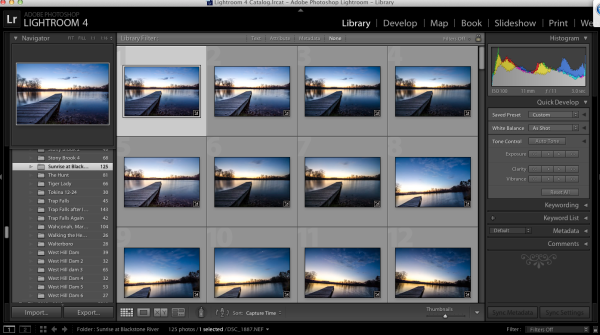
  3. Don’t Get Caught Up – I once woke up an hour before dawn in the middle of winter after a snow storm and drove to a frozen lake to photograph sunrise. I took nearly 150 shots during the 45 minutes I was there and ended up with one photograph – the one of the dock above. Of the photographs I took 95% of them looked exactly like the one above. I was cold, tired and very disappointed I didn’t make an effort to photograph other subjects during that shoot, but realized it wasn’t that I didn’t make an effort it was simply that I was caught up in photographing one subject instead of diverting my attention to other smaller details in the scene before me.
  4. Set an Alarm – If you know you’ll have a problem with number three try setting a timer. Allow yourself only a predetermined amount of time to get the shot you want from your main subject, and then once that time is up, spend the rest of your shoot looking for interesting supporting characters. This tip works wonders and it has a two fold effect – one due to the time crunch to capture the shot of your main subject you’ll find yourself working harder to get the shot you want in as short amount of time as possible, two it gets you looking for other interesting details in the scene you’re photographing.

Have You Ever Been Afflicted With Single Subject Blindness? What have You Done to Fix It?

I’d love to hear your own take on this and what you’ve done to avoid the problem in the comments below!

Post originally from: Digital Photography Tips.

Check out our more Photography Tips at Photography Tips for Beginners, Portrait Photography Tips and Wedding Photography Tips.

4 Quick Tips to Notice the Supporting Cast of Your Landscape Scene


Digital Photography School

 
Comments Off on 4 Quick Tips to Notice the Supporting Cast of Your Landscape Scene

Posted in Photography


Just posted: OMG Life Autographer Quick Review

02 Aug

autographer-news.jpg

Just posted: Our quick review of the Autographer from OMG Life. Billed as the ‘world’s first intelligent wearable camera’, it’s designed to take pictures automatically triggered by the output from five built-in sensors. The camera has a super wideangle lens with a 136° angle of view, a 5MP CMOS sensor, and 8GB of built-in memory for image storage. It also has Bluetooth for connection to a smartphone. It’s certainly intriguing, but how well does it work?

News: Digital Photography Review (dpreview.com)

 
Comments Off on Just posted: OMG Life Autographer Quick Review

Posted in Uncategorized


2 August, 2013 – Fuji X-M1 Quick Look

02 Aug

Fuji continues to try and fill all of the available compact system camera market niches, this time at the low end with the Fujifilm X-M1. My Quick Look Review and some thoughts on the marketplace is now online.


"Having been to Antarctica with Michael and Kevin, I would say after having traveled the world and shot nearly my entire life as an exhibiting photographer,  it was one of my highlights in my life and I talk about it, all the time.  The images and experience of seeing something visionary and nearly extinct from the world, to see and experience the wildlife and scenery that does not fear humans is amazing.  The images I shot there won me two Smithsonian awards and nearly 18 other international awards". – Tim Wolcott

 Find Out More Now
These Expeditions Will Sell Out Quickly. They Always Do


The Luminous Landscape – What’s New

 
Comments Off on 2 August, 2013 – Fuji X-M1 Quick Look

Posted in News


Manfrotto creates Arca-Swiss compatible ‘Top Lock’ quick release

25 Jul

toplock.png

Manfrotto has announced a ‘Top Lock’ quick release system for its tripod heads that’s compatible with standard Arca Swiss-type plates. It uses a clamp design that allows the camera to dropped in from above rather than slid in from the side, and three bubble levels to help keep the camera straight. The Top Lock release is available as an add-on adapter, or pre-installed on the company’s top-end 054, 055, 056 and 468MG ball heads.

News: Digital Photography Review (dpreview.com)

 
Comments Off on Manfrotto creates Arca-Swiss compatible ‘Top Lock’ quick release

Posted in Uncategorized


4 Quick Tips For Getting The Most Out of Lightroom Presets

25 Jul
Image created with Daylight to Sunset preset

Image created with Daylight to Sunset preset

This post was written to coincide with my latest deal over at the DPS sister site – Snapndeals. Over the years I’ve created and stockpiled tons of presets in Lightroom, just for personal use. I finally made them available to the public earlier this year at the request of many of my blog readers and the feedback has been amazing! The collection on Snapndeals includes all of the presets I have released (80 total in 7 different groups) and they are all, of course, fully customizable. I put a ton of work into these and I really think you will love them!

So Lightroom presets are something I’ve become really obsessed with. I use them with pretty much 100% of my family photos and about 70-80% of my other images. Sometimes it’s just one click and I can take an image from it’s RAW state to a completely post processed and finished image. Other times I can apply a preset and be about 80-90% finished. From there it’s just a few minor adjustments to get the image looking great but the total time saved by adding the preset is still incredibly valuable. So here’s a few tips for using my new JamesB Lightroom Presets to help your workflow and create amazing images. Let’s go!

1) Spend Some Quality Time Familiarizing Yourself With The Presets

I’ve found that using presets becomes more efficient the more you use them. If you use them rarely, you aren’t very familiar with the presets you own. Therefore, when it comes time to use one you have to wade through them all to find the right one which can take a lot of time (especially with a collection of 80 presets like this one). When you use presets regularly you memorize where each one is, you know where your favorite presets are and how to get to them fast, you know which presets will work better for certain images. When you get into this mindset, your workflow in Lightroom really becomes optimized. And who among us doesn’t need more time on our hands?

I broke the presets into 7 different groups and each group has presets that were specifically designed for different genres/styles of photography. That doesn’t mean you can’t use a portrait preset on a landscape image, I’ve done that several times. But more often that not, I use travel presets for travel images. Portrait presets for portrait images.

2) Create A New Folder For Your Absolute Favorite Presets

Screen Shot 2013-06-21 at 10.10.11 AMOver time, you’ll discover that there are certain presets that you use quite often. Feel free to create a new folder in your presets catalog and the drag your favorites into that one. A few of my favorites are Day At The Zoo and Bright and Sunny from my “Family Lifestyle” set, B&W Film Grain and B&W High Contrast from my “Monochrome” set, Sweet Pea Vintage in my “Nostalgia Film” set and Rome in my “Travel” set.

Creating a new folder in the presets panel is easy, although not very intuitive if you haven’t done it before. Clicking the + mark at the top right won’t do it, that’s just for creating new presets. You have to hover over your presets and right click, choose New Folder and then give the folder a name. Then it’s as easy as dragging the presets from one folder to another.

3) Don’t Be Afraid To Fine Tune

The Develop module can be pretty intimidating to those who haven’t used it before. There are a LOT of options over there. A lot of ways to make a photo look great, and a lot of ways to make a photo look terrible! When you add a preset, you’ll be able to see the changes that it made over on the right side of Lightroom. If the photo doesn’t look just how you were hoping, go over and play around with the sliders a bit to get it just where you want it. The truth is, there’s no preset out there that will work perfectly for every photo, so most of the time you will have to make slight adjustments.

4) Create Your Own!

Once you’ve used presets for a while, you will start to get more and more comfortable tweaking and fine tuning them to your taste. The more comfortable you get, the more you will start using certain looks time and time again. Feel free to use some of my presets as a base or a starting point. Then add to it, change it up, tear it down and rebuild it, then create new preset that’s all your own. I do this quite often and not only is it a great learning experience, to see how much work goes in to creating a great preset, it’s also a lot of fun!

Be sure to grab a set of the presets for yourself, I promise you’ll love them!

A Few Samples Of Images Created Using My Presets

_MG_2302 1DS_3478 1DS_5603 1DS_6004 Death_Valley_Cactus-X3


Post originally from: Digital Photography Tips.

Check out our more Photography Tips at Photography Tips for Beginners, Portrait Photography Tips and Wedding Photography Tips.

4 Quick Tips For Getting The Most Out of Lightroom Presets


Digital Photography School

 
Comments Off on 4 Quick Tips For Getting The Most Out of Lightroom Presets

Posted in Photography


Quick Hands-On: $100 “Polaroid” PL135 Bare-Bulb Flash

06 Jun

Has the venerable Sunpak 120J bare bulb flash been reincarnated? By a world-famous company, no less?

Well, no. Not exactly. It's no Sunpak 120J (doesn't have the extra stop of power) and, strictly speaking, it's not really a Polaroid flash per se. Keep reading for the bare facts (rimshot!) on the Polaroid PL-135.

Read more »
Strobist

 
Comments Off on Quick Hands-On: $100 “Polaroid” PL135 Bare-Bulb Flash

Posted in Photography