Tag: quick

  • 50 Brilliant Photo Sites of Professional Photographers & 1 Quick Way To Launch Your Own

    Are you a successful photographer? Or are you a beginner who just started the way to fame? Modern world requires new rules and these days you just can not be a famous photographer without personal online portfolio. But why is it so important? The point is that most clients believe only what they see. And your photo portfolio is the Continue Reading

    The post 50 Brilliant Photo Sites of Professional Photographers & 1 Quick Way To Launch Your Own appeared first on Photodoto.


    Photodoto

  • 5 Quick Ways to Improve your Beach Photography

    According to NOAA, over 50% of the American population live within 50 miles of a coastline.  Which means more than half of us are only a day-trip away from the beach.  For photographers, this presents a ton of great photo ops. Living half a mile from one of the top-rated beaches in the country myself, I’ve spent plenty of time Continue Reading

    The post 5 Quick Ways to Improve your Beach Photography appeared first on Photodoto.


    Photodoto

  • Quick Tip: Importing to Lightroom Made Easier

    Introduction

    This tutorial is from the Lightroom 4 Workshop Collection. Including 27 hours of A to Z Lightroom 4 education and the industry standard Lightroom 4 Preset System. DPS users can get 10% off by using the DPS10 coupon code upon checkout. Click the link above to learn more/purchase.

    Overview

    In this tutorial, we will give you a quick tip when importing image into Lightroom that will eliminate the need to search around for import and destination folders.

    Step 1. Create Your Catalog

    If you don’t already have a Lightroom catalog created, then let’s go ahead and create one now. Simply open Lightroom and go to File -> New Catalog.
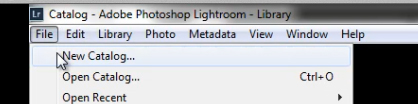
    file-new-catalog

    Give your Catalog a descriptive name and a destination folder of your choice. Remember to keep your naming conventions consistent to have an efficient and organized workflow. Our naming convention is as follows:

    YEAR.MONTH.DAY – NAMES PHOTOGRAPHY TYPE

    So, for this example we have the following:

    2013.02.11 – Cesar and Ashley Engagement which is typed into the File name location shown in the image below.
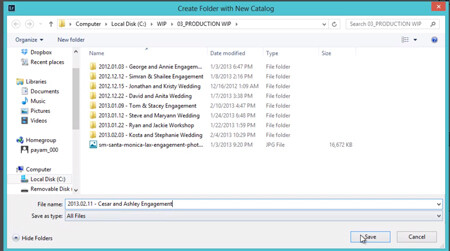
    name-catalog

    After you hit “Save”, Lightroom will close and re-open with the New Catalog which is ready for images to be imported.

    Step 2. Creating the “Folders”

    We will be directly importing the images into a folder on the left-side Panels called “Folders.” But, first we have to create a folder for the images to be imported into. On the Folders Panel, simply click the “+” icon to create a new folder as shown below.
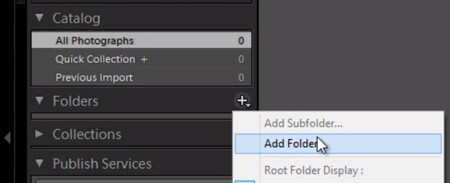
    add-folder

    Now, select the same folder where we saved our catalog to create the folder where we want to place the original images. We do this to ensure that the images always move with the catalog if the catalog is ever transferred.
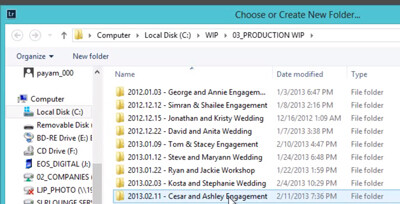
    select-folder-engagement

    To create new Folder for your original images, right-click within the Folder content area and select “New Folder”. Remember, we are doing this all from the “Add Folder” dialogue in Lightroom, not in the Operating System.
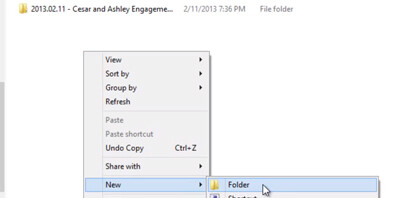
    new-folder-engagement

    Type in “00_Originals” or the name of your choice for the Folder to contain your original images. Again, keep your naming conventions consistent for better organization. Then click “Select Folder”.
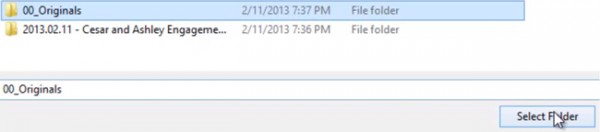
    create-00-originals

    Step 3. Importing Directly to Folders

    Now that we have our folder created. We have two options to import. Option number 1 is to Right-click on the Folder that shows up under the Folders Panel and select “Import to this Folder” as shown below.
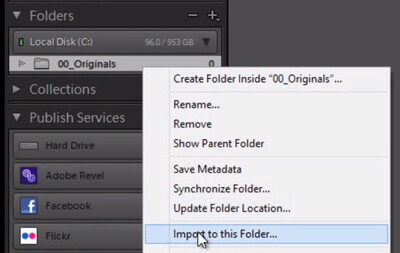
    right-click-import

    This will pull up our Import Dialogue and automatically set the destination to the “00_Originals” Folder without having to manually select our destination as we normally would.

    Workflow Tip: Apply a Workflow Preset on Import

    Before you begin the Import process, we always select an import preset that is most applicable to the type of images being imported. In our studio, we generally use the “Extra Soft Color” Preset for portrait sessions from the Lightroom 4 Preset System by SLR Lounge as shown below.
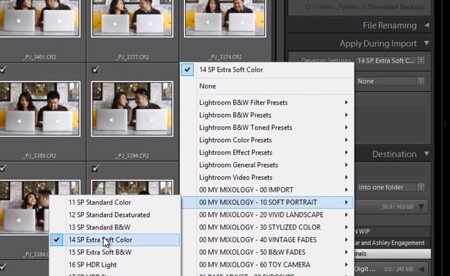
    import-with-preset

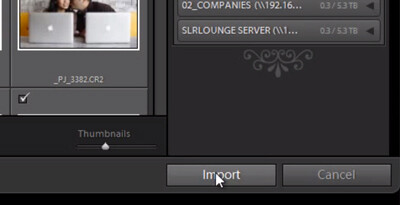
    When you are finished, select “Import” located on the bottom-right in Lightroom.
    FINAL-select-import

    And that’s it! Hopefully this little quick tip on importing will help you to import images just a bit more efficiently.

    Learn More with the Lightroom 4 Workshop Collection!

    This was a sample tutorial from the Lightroom 4 Workshop Collection. A collection of nearly 30 hours of video education teaching everything from Lightroom basics to advanced raw processing techniques.

    The LR4 Workshop Collection also includes the critically acclaimed Lightroom 4 Preset System which is designed to enable users to achieve virtually any look and effect within 3-5 simple clicks. From basic color correction, vintage fades, black & white effects, tilt-shift effects, faux HDR, retouching, detail enhancing, and so much more. Click the links above to learn more.

    Post originally from: Digital Photography Tips.

    Check out our more Photography Tips at Photography Tips for Beginners, Portrait Photography Tips and Wedding Photography Tips.

    Quick Tip: Importing to Lightroom Made Easier


    Digital Photography School
  • Shoot Like Henri Cartier-Bresson: A Quick Guide To Becoming An Amazing Photojournalist

    “Most of my pictures are grounded in people. I look for the unguarded moment, the essential soul peeking out, experience etched on a person’s face. I try to convey what it is like to be that person, a person caught in a broader landscape that I guess you’d call the human condition.” It’s by Steve McCurry, whom I didn’t know Continue Reading

    The post Shoot Like Henri Cartier-Bresson: A Quick Guide To Becoming An Amazing Photojournalist appeared first on Photodoto.


    Photodoto

  • 5 Quick Tips for Awesome Shadow Photography Images

    Shadow photography is a simple, yet effective way to create stunning images of just about any subject. All you need to get started in shadow photography is a light source and a subject who casts a shadow – that’s it! If you are interested in trying out shadow photography, here are some tips to get you started: 1. Look down, Continue Reading

    The post 5 Quick Tips for Awesome Shadow Photography Images appeared first on Photodoto.


    Photodoto

  • 2012 Mazda MX-5 Miata Special Edition & 2012 Mini Cooper S Roadster – WINDING ROAD Quick Drive

    This week, we take out the 2012 Mazda MX-5 Special Edition and the 2012 Mini Cooper S Roadster out for some top-down fun. You can read our comparison test on these two here: www.windingroad.com www.windingroad.com www.facebook.com www.facebook.com
    Video Rating: 4 / 5

  • 5 Quick Tips for Coastal Photography

    There’s nothing like a great coastline to get me excited about photography. Whether it be unmarked sand dunes, sea grasses blowing in the sea breeze, rugged outcrops of rocks and cliff faces or a beach scene complete with all the color of families on their day at the beach – coasts can present photographers with some great opportunities.

    Here’s 5 tips for your next coastal photography outing!

    1. Look for Reflections

    Image by midlander1231

    Any time you’re shooting around bodies of water you should be aware of the potential for enhancing your image with reflections. This is particularly relevant when shooting at sunrise or sunset where your images can be brightened and have interest added to them by reflecting those pretty pinks and oranges in the water before you.

    2. Focus in on Details

    Image by Max xx

    What often grabs your attention most on coastal shoots is the grandeur of the landscape – so it’s easy to overlook what might be at your feet as you’re lining up your shot. The coast is full of smaller opportunities for amazing shots – whether it be sea shells on the waters edge, the footprints of an animal in the sand, small wild flowers growing in the dunes or patterns in rock formations. Take the time to look around you at the detail of what surrounds you. Oh… and don’t forget your macro lens!

    3. Add Foreground Interest

    Image by Kyle Kruchok

    When shooting seascape shots its very easy to end up with images that contain few focal points of interest (ie: shots that are half sky and half sand). One way to add interest to these shots is to look for opportunities in the foreground of your shots. If you’re able to place something interesting in the foreground (perhaps some interesting rock pools) you’ll lead the eye into the image. When doing this test shooting from different heights – sometimes getting down quite low and will add more interest to the shot while sometimes a higher vantaage point might work better. Also remember that if you want the foreground and background to be in focus that you’ll want to shoot with small aperture (high f numbers).

    4. Slow things Down

    Image by Matthew Stewart

    Another way to add interest and atmosphere to seascape shots is to slow your shutter speed down so that blur any part of the image that is moving. In this way you might get a misty looking sea that captures the movement of waves or a furry carpet of swaying sea grasses. Of course to do this you’ll want to shoot with a tripod to make sure your camera is perfectly still.

    5. Horizons

    Image by Garry

    Two last tips when it comes to horizons. Firstly – make sure they’re horizontal with the framing of your image. There’s nothing like a horizon that slopes unnaturally down at one edge of the frame to make those looking at your shot a little sea sick. If you’re going to break this ‘rule’ – break it well and make it an obviously intentional thing. Secondly – the convention is to avoid placing your horizon in the middle of your frame but rather to position it nearer one of the thirdway points (depending upon whether there’s more interest in the sky or foreground of the shot). Of course ‘rules’ are made to be broken but for balanced shots keep these in mind.

    Post originally from: Digital Photography Tips.

    Check out our more Photography Tips at Photography Tips for Beginners, Portrait Photography Tips and Wedding Photography Tips.

    5 Quick Tips for Coastal Photography


    Digital Photography School

  • Exposure Compensation – Quick Shots 06

    How do you use exposure compensation? In this video Gavin Hoey www.gavtrain.com explains how exposure compensation can be used to over ride a cameras metering when shooting a subject that has a very dark or very bright background. For more information check out my blog at gavtrain.blogspot.com Facebook http
    Video Rating: 4 / 5

  • Canon 60D EOS Overview and Quick Start Guide

    www.CityBlender.com Canon 60D EOS Overview and Quick Start Guide Join our Los Angeles Meetup at http
    Video Rating: 4 / 5

    Sarah Palin the REAL story: starring Obama Girl. Click here to subscribe! www.youtube.com Writer/Producer: Rusty Ward Director: Tom Small MORE BARELY: Follow us on Twitter www.twitter.com www.twitter.com Check out our websites www.barelypolitical.com http Friend us on Facebook & Myspace www.facebook.com www.myspace.com Leave us a voicemail 1-(646)-827-2202 Watch Amber’s channel www.youtube.com —

  • Tutorial #6 – Classic Sun Rays Through the Woods Effect in Photoshop [Quick & Easy – Step by Step]

    Thanks for the support on the previous tutorials. This is a tutorial showing you how to achieve a powerful sun rays through the trees effect. I add a ‘sun’ to an image and add a few rays from it breaking through the trees. Hope you enjoyed, please rate, comment and subscribe. Let me know what you want to see! Music ‘Take ‘Em On’ by OfficialRandolph: www.youtube.com-user-OfficialRandolph
    Video Rating: 3 / 5