RSS
 

Posts Tagged ‘Professional’

Concept To Creation: How Professional Photographers Do It

16 Jul

Examples of Concept to Creation from Working Fashion Photographers


Hey FashionPhotographyBlog.com readers.


Thanks for joining us on our “Concept to Creation” series where we walk you through the process of taking an idea into an image. If you were with us last time, we discussed how to turn your inspiration into a concept. Today, we’re going to dive a little further. I’ll help you out with some examples of how working fashion editorial photographers pull their inspiration and translating them into concepts.


Miles Aldridge for Vogue Italia:

Sure, there is a concept in the styling: spring time flowy dresses. There’s continuity between the images because of the bold use of color. But anyone that knows Miles Aldridge’s work knows that’s his style. What ties all these images together? Cats! Without the cats, none of the images would appear to be from the same editorial.

miles-aldridge-vogue-italia-cat-story

miles-aldridge-vogue-italia-cat-story

miles-aldridge-vogue-italia-cat-story

Mert & Marcus for W Magazine:

All the images are shot in the same room. A room that has been flooded. Bingo! There’s your concept.

Mert-&-Marcus-for-W-Magazine

Mert-&-Marcus-for-W-Magazine

Knowing that these guys often pull inspiration from artwork, I wouldn’t be surprised if they were inspired by Pre-Raphaeliate “Ophelia” paintings. I especially wouldn’t be surprised if a big piece of their inspiration came from photographer Gregory Crewdson’s interpretation of these Ophelia images.

ophelia-by-john-everett-millais

Ophelia by John Everett Millais

Ophelia-by-Gregory-Crewdson

Ophelia by Gregory Crewdson


Granted, these examples are more on the extreme end of the spectrum. However, I think it drives the idea across. These images aren’t united because of what the model is wearing. They’re not united because of a dominant color (although, it helps). They’re united because of an idea which brings them together. It takes them out of the real world and brings them into a fantasy land.


This is extremely hard to do on a limited budget. That’s okay! No one is expecting someone with no budget to pull off a shoot like the ones pictured above. Just because you don’t have funds doesn’t mean you cant create a concept on a low/no budget that ties everything together.


Melissa Rodwell for Kurv Magazine:


Not something that would require an extravagant budget like the images pictured above. However, they’re all united in their lighting, clothing, hair, makeup, location and way in which they’re shot. Melissa brings you into this whimsical, etherial world with a simple concept. White.


I know, I know, I’ve said it shouldn’t just be a color that holds your images together. But In these images, it works! Melissa brings you beyond the color white and creates a fantasy world out of it.


melissa-rodwell-kurv-magazinemelissa-rodwell-kurv-magazine

Concept – crucial to binding your images together. You’ll find that any high end magazine only published editorials that has a concept holding the story together.


Hope you all enjoyed the examples of working fashion photographers and their thought processes behind turning inspiration into concepts. Stay tuned because next time, we’ll be discussing the difference between editorial and campaign shoots and how these relate to your shoot concepts.

Until then –


Alana


IMAGE SOURCE:


Feature image: Mert & Marcus for W Magazine

Images 1-3: Miles Aldridge for Vogue Italia

Images 4 & 5: Mert & Marcus for W Magazine

Image 6: John Everett Millais

Image 7: Gregory Crewdson

Images 8-10: Melissa Rodwell for Kurv Magazine


Fashion Photography Blog

 
Comments Off on Concept To Creation: How Professional Photographers Do It

Posted in Uncategorized


Concept To Creation: How Professional Photographers Do It

15 Jul

Examples of Concept to Creation from Working Fashion Photographers


Hey FashionPhotographyBlog.com readers.


Thanks for joining us on our “Concept to Creation” series where we walk you through the process of taking an idea into an image. If you were with us last time, we discussed how to turn your inspiration into a concept. Today, we’re going to dive a little further. I’ll help you out with some examples of how working fashion editorial photographers pull their inspiration and translating them into concepts.


Miles Aldridge for Vogue Italia:

Sure, there is a concept in the styling: spring time flowy dresses. There’s continuity between the images because of the bold use of color. But anyone that knows Miles Aldridge’s work knows that’s his style. What ties all these images together? Cats! Without the cats, none of the images would appear to be from the same editorial.

miles-aldridge-vogue-italia-cat-story

miles-aldridge-vogue-italia-cat-story

miles-aldridge-vogue-italia-cat-story

Mert & Marcus for W Magazine:

All the images are shot in the same room. A room that has been flooded. Bingo! There’s your concept.

Mert-&-Marcus-for-W-Magazine

Mert-&-Marcus-for-W-Magazine

Knowing that these guys often pull inspiration from artwork, I wouldn’t be surprised if they were inspired by Pre-Raphaeliate “Ophelia” paintings. I especially wouldn’t be surprised if a big piece of their inspiration came from photographer Gregory Crewdson’s interpretation of these Ophelia images.

ophelia-by-john-everett-millais

Ophelia by John Everett Millais

Ophelia-by-Gregory-Crewdson

Ophelia by Gregory Crewdson


Granted, these examples are more on the extreme end of the spectrum. However, I think it drives the idea across. These images aren’t united because of what the model is wearing. They’re not united because of a dominant color (although, it helps). They’re united because of an idea which brings them together. It takes them out of the real world and brings them into a fantasy land.


This is extremely hard to do on a limited budget. That’s okay! No one is expecting someone with no budget to pull off a shoot like the ones pictured above. Just because you don’t have funds doesn’t mean you cant create a concept on a low/no budget that ties everything together.


Melissa Rodwell for Kurv Magazine:


Not something that would require an extravagant budget like the images pictured above. However, they’re all united in their lighting, clothing, hair, makeup, location and way in which they’re shot. Melissa brings you into this whimsical, etherial world with a simple concept. White.


I know, I know, I’ve said it shouldn’t just be a color that holds your images together. But In these images, it works! Melissa brings you beyond the color white and creates a fantasy world out of it.


melissa-rodwell-kurv-magazinemelissa-rodwell-kurv-magazine

Concept – crucial to binding your images together. You’ll find that any high end magazine only published editorials that has a concept holding the story together.


Hope you all enjoyed the examples of working fashion photographers and their thought processes behind turning inspiration into concepts. Stay tuned because next time, we’ll be discussing the difference between editorial and campaign shoots and how these relate to your shoot concepts.

Until then –


Alana


IMAGE SOURCE:


Feature image: Mert & Marcus for W Magazine

Images 1-3: Miles Aldridge for Vogue Italia

Images 4 & 5: Mert & Marcus for W Magazine

Image 6: John Everett Millais

Image 7: Gregory Crewdson

Images 8-10: Melissa Rodwell for Kurv Magazine


Fashion Photography Blog

 
Comments Off on Concept To Creation: How Professional Photographers Do It

Posted in Uncategorized


The Top Shared Professional Pictures On Social Media in 2013

24 Mar

It’s nice to get paid for an image but if you can’t get paid for an image, you can at least get praised for it. Through social media, that’s easy. Build a following, put up a great picture and watch those likes, shares, views and comments flood in.

Of course, for some photographers, accounts and timelines that’s easier than for others. These are some of the most popular images that were passed around on social media. Expect to see some quality, some surprises… and a few groans.

Facebook

fbgmc

Photography: Graham McGeorge

Like many social media platforms, Facebook doesn’t make it easy to track down the most shared or viewed images uploaded to the site. Although the company’s billion-plus users upload around 350 million photos every day, there’s no way to pull out the picture that did the best. And the site also uses a range of different stats to measure popularity: likes, comments and shares all indicate that people appreciated the shot.

This image of a camouflaged owl by Graham McGeorge wins in all categories. Placed on the National Geographic timeline in July, it’s since picked up more than 212,000 likes, around 60,000 shares and over 10,000 comments.

Those stats though were probably boosted by the post that came with it. National Geographic invited followers to help them to caption the photo, a bit of audience participation that is likely to have helped bring in comments and distribute the image around the site.

Graham McGeorge is a professional photographer, but you don’t have to be a professional to win those kinds of plaudits on Facebook, even on National Geographic.

gunjansinha

Photography: Gunjan Sinha

This image of a shelf cloud in the Canadian prairies was photographed by Gunjan Sinha. It generated more than 175,000 likes, over 51,000 shares and more than 6,200 comments. It was submitted as part of National Geographic’s Your Shot program.

Twitter

Move away from Facebook towards Twitter and the most popular images get a bit more celebrity. Not all of them though are poor quality. This shot of Lea Michele and Cory Monteith posted shortly after his death received nearly 400,000 retweets and favorites.


coreymontheith

Photo from Lea Michele

It could be a selfie but judging by the reflection in Lea Michele’s sunglasses, it appears to have been taken by someone else. And judging by the quality of the portrait, that someone knew what he was doing.

Instagram

That isn’t true of the most popular image on Instagram. The shot that won the popularity prize on Facebook’s billion-dollar picture property in 2013 was… a picture of Justin Bieber with “Uncle” Will Smith. More than 1.5 million people liked that picture. Fewer, surely, liked the hat.

smithandbieber

A long way behind but shot by a professional — a professional Instagram photographer no less — is this nature shot by Michael O’Neal. A former art director, O’Neal has more than half a million followers on Instagram and is a member of Tinker Mobile, a collective of Instagrammers used by brands to promote their products.

His shot of trees and mist picked up more than 17,000 likes. Not Justin Bieber, but not bad.

moneil

Photography: Michael O’Neal

Pinterest

According to research from Curulate, pictures that do best on Pinterest have multiple colors, particularly reds, little white space and if they include people, they shouldn’t show faces. Those are the kinds of images that are most likely to appeal to the women who use the site and share pictures of fashion, accessories and home décor.

But those aren’t the only photos to win popularity on Pinterest. This image of The Caves Resort in Jamaica outdid many of the most popular fashion images to win nearly 6,000 pins and 540 likes.

caves
Pinned from escapenormal.com.

500px

500px is thankfully free of celebrities and while few of its users are professionals, many of the images they produce are professional quality. This shot by Laszlo Folgerts of pedestrians crossing a damp road is reminiscent of Cartier-Bresson… or would be if Cartier-Bresson had picked up about 11,500 views on 500px.


500px


Flickr

Identifying the most popular images on Flickr isn’t easy either but this landscape photograph by Mark Littlejohn, a landscape photographer in Scotland, has to be one of the most successful. It’s picked up more than 6,600 views and over 300 likes.


flickr

Success on social media can be seen in the numbers but those figures are never just about the quality of the image. They also show the quality of the photographer’s networking. That may sound unfair but what’s true on social media is also true in business.


Photopreneur – Make Money Selling Your Photos

 
Comments Off on The Top Shared Professional Pictures On Social Media in 2013

Posted in Equipment


Canon launches a pair of new large format printers aimed at the professional market

09 Mar
The Canon imageProGraf Pro-4000

Canon has announced it will introduce two new large format printers for professional photographers as part of its imagePrograf Pro series. The Pro-2000 and Pro-4000 both use 12-color Lucia pigment ink systems and produce either 24in or 44in prints. With their black bodies and ‘accentuated red line’ the printers are designed to link visually with the Canon EOS range of cameras to emphasise that they are intended for photo-quality printing and made to get the most out of EOS files.

A transparent Chroma Optimiser ‘ink’ is used alongside the colors that Canon says improves ‘print performance on gloss papers’ – which means it evens out the finish between the inks and the paper so the inks don’t stand out.

The printers are due to arrive in the middle of the year priced $ 5995 for the Pro-4000 and $ 2995 for the Pro-2000.

For more information visit the Canon website.


Press release:

Canon launches new imagePROGRAF PRO series for unmatched image quality and productivity

Canon Europe, world leader in imaging solutions, today announced a new range of imagePROGRAF PRO large format professional inkjet printers. The new imagePROGRAF PRO-2000 and imagePROGRAF PRO-4000 are designed to bring stunning image quality to professional photographers and fine art applications, while the new imagePROGRAF PRO-4000S and imagePROGRAF PRO-6000S deliver fast and reliable printing to high-volume print service providers that require photo quality prints such as posters, banners and canvas.

Superior image quality for professional users
The 12-colour PRO-2000 and PRO-4000 enable the full clarity and texture of photographs taken with a Canon EOS camera to be perfectly reproduced. Thanks to Canon’s unique input-output technology and Crystal-fidelity feature, photos look as accurate printed as when they were captured. Available in two sizes (24” and 44”) the PRO-2000 and PRO-4000 feature an attractive black design with an accentuated red line, denoting the link with Canon EOS digital cameras. The new devices use newly developed LUCIA PRO pigment ink to meet the demands of the most critical photographers and graphic artists, as well as transparent Chroma Optimiser ink to improve print performance on gloss paper.
Mathew Faulkner, European Marketing Manager for Wide Format Group, Canon Europe says “At Canon, we understand the importance of fine detail and precise colours to professional users. Images shot on even mid-range cameras can be very high resolution, and with the ability of today’s image editing software, this demands a highly accurate and colour-consistent output. The powerful technology of the new PRO-2000 and PRO-4000 models, not only provide incredible image reproduction, but the small footprint makes them ideal for any office, studio or design department.”

Unbeatable efficiency for print service providers
Also available in two sizes, (44” and 60”), the PRO-4000S and PRO-6000S boast an ergonomic compact design, which is ideal for time and space-pressed print operations in graphic arts, advertising and creative sectors. With a powerful L-COA PRO engine capable of processing large volumes of high-res images and data with ease, the new devices enable poster-quality printing at twice the speed of current imagePROGRAF 8 colour models. Full connectivity and Wi-Fi functionality ensures optimum productivity for busy environments.

Mathew Faulkner continues, “Whether for PSPs or in-house print departments in retailers or educational facilities, the trend towards more operational efficiency and on-demand printing is undeniable. There is a growing requirement not only for high quality imaging, but for ease of use and efficient media handling, as well as high-speed and uninterrupted printing to support high-volume output. These fundamental tools require a powerful and dependable large format printer. The PRO-4000S and PRO-6000S deliver speed, accuracy and colour vibrancy, making them ideal for both print-for-pay and print-for-use environments.”
The new devices feature Canon’s unique dual roll technology to support continuous paper feeding and take-up of printed output, while direct printing from a USB memory stick enables fast and easy prints. The imagePROGRAF PRO series is further improved by the new precision 1.28” wide print head and high-capacity ink tanks for fast, uninterrupted printing.

The new imagePROGRAF series will be available across Europe from the middle of 2016. To see the new imagePROGRAF PRO series in action, visit Canon at FESPA Digital 2016 from March 8-11, Stand F100-F120

Articles: Digital Photography Review (dpreview.com)

 
Comments Off on Canon launches a pair of new large format printers aimed at the professional market

Posted in Uncategorized


Budget Lenses Roundup for Aspiring Professional Photographers

08 Mar

A little while back, I went over a handful of DSLR camera options for anyone who is looking to get started with professional photography. Since I discussed camera bodies, the next step is deciding on some lenses. And since we’re still trying to find some good options on a beginner’s budget, the lenses we go over are all on the Continue Reading

The post Budget Lenses Roundup for Aspiring Professional Photographers appeared first on Photodoto.


Photodoto

 
Comments Off on Budget Lenses Roundup for Aspiring Professional Photographers

Posted in Photography


Review of the Vü Professional Filter System

21 Feb

Filters are wonderful little tools that help modify the light coming through your camera lenses, and alter what is recorded onto the sensor or film, whichever the case may be. Different filter types exist for varying purposes; polarizing filters deepen sky color and remove glare and reflections from shiny surfaces, a UV filter screens out ultraviolet light and adds a protective surface over the camera lens, while a graduated neutral density (GND) filter allows you to expose a foreground properly while avoiding a bright, blown-out sky.

The Vü filter system represents the higher-tier of camera accessories in this segment of hardware, and I was fortunate enough to have a couple of weeks using them.

VU_Layout_wLogo

Image courtesy of Vü Filters

Upon opening the complete set of the company’s filters, the first thing I noticed was the quality and attractiveness of the packaging. All of the boxes were constructed of very sturdy material, clearly marked, and conveyed a great sense of style.

The set I received consisted of several filters and accessories, including a filter holder, drop-in filters, and lens adapters for the lenses I specified when ordering (in this case, a Canon EF-S 50mm f/1.8, and Canon EF-S 24mm f/2.8 STM). As my time was limited, I restricted my use to the screw-on Circular polarizing Filter ($ 59-126 depending on filter size)), the 10-stop Neutral Density (ND) Filter ($ 144) and Drop-in Filter Holder ($ 150).

If you’re looking for a quick, overall thought on the system, it’s generally good. The filters are high-quality and are very well constructed.

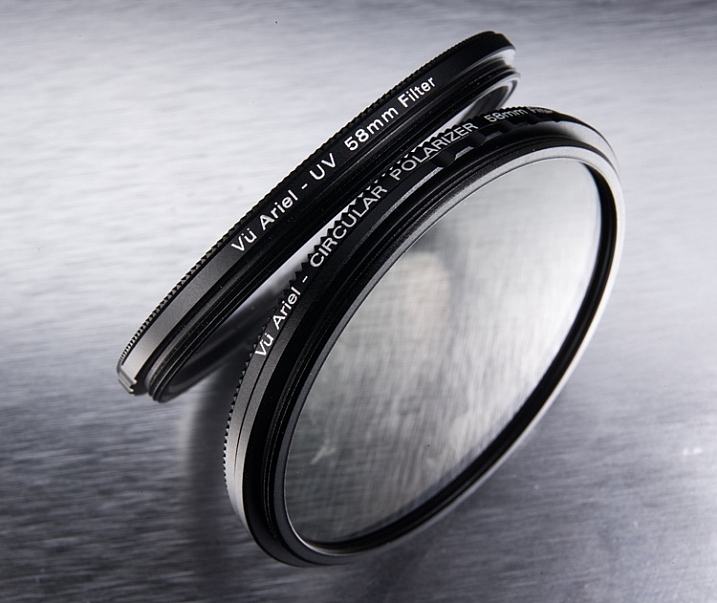
Circular Polarizing Filter

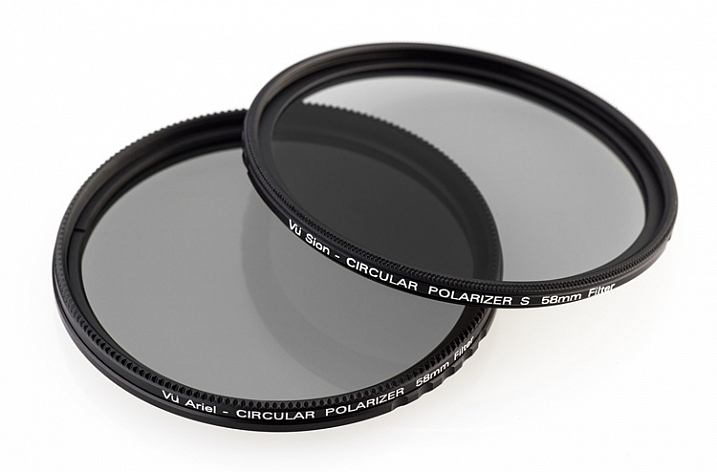
Vu_CPOL_Group_Left

Image Courtesy of Vü Filters

The circular polarizing filter did just what I expected. It darkened the desired areas in my photo, removed any extra shininess from the image, and generally smoothed the photo over, giving it a look that is hard to discern or describe, but which definitely exists.

The circular polarizer tends to smooth out rough points, darkens skies, and removes some of the reflective properties of shiny surfaces.

The circular polarizer tends to smooth out rough points, darkens skies, and removes some of the reflective properties of shiny surfaces.

Using this filter was the easiest, as it only required I that connect it to the step-down adapter for my particular lens size, and then screw that assembly onto the lens itself.

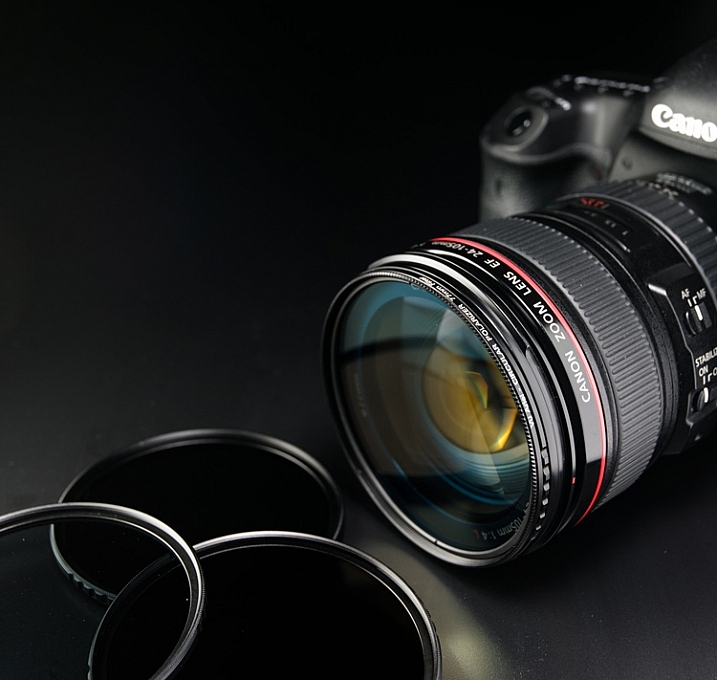
Ariel_Lens_01

Image courtesy of Vü Filters

As with all polarizing filters, this one works best when light is coming from the right angle, in this case, about 45 degrees. Using it when light is directly in front of, or behind you, won’t yield much or any of an effect on your image.

Again, the polarizer helped darken this sky a bit more to where I wanted it to be.

Again, the polarizer helped darken this sky a bit more, to where I wanted it.

10-Stop Neutral Density Filter

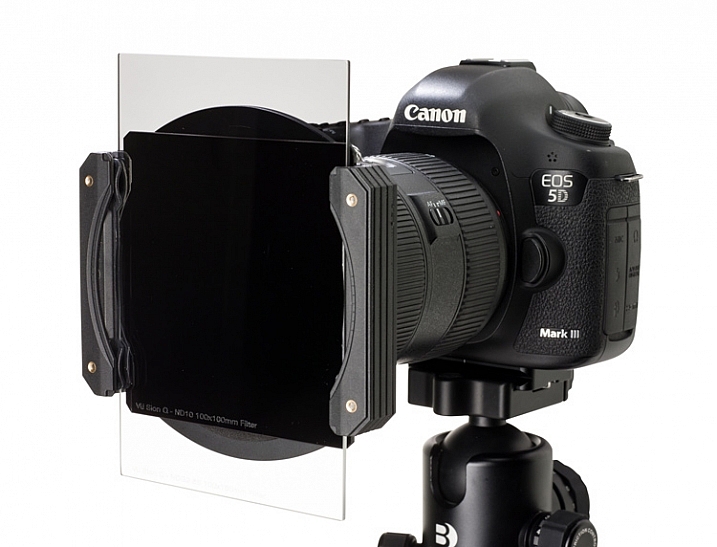
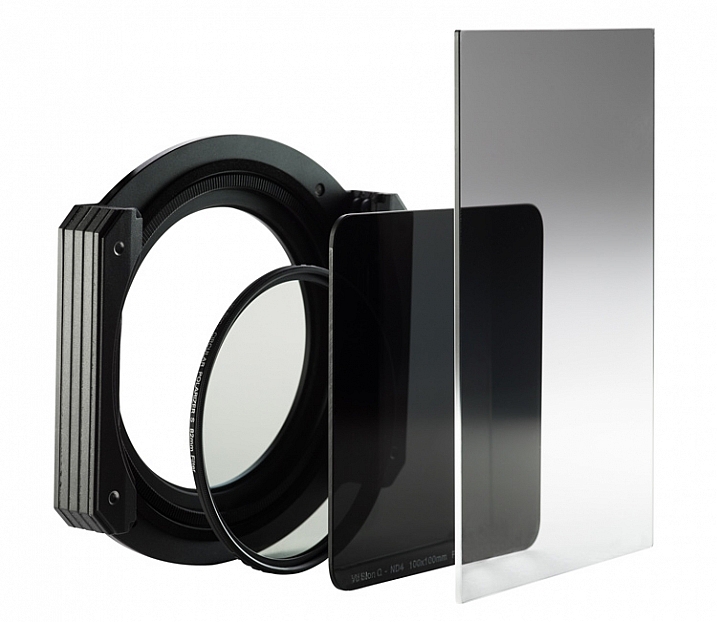
VFH100_CanonFront_CPOL_NDGrad

Image courtesy of Vü Filters showing the filter holder, 10-stop ND, and Graduated drop-in filters mounted on a Canon lens.

I was most excited to try the 10-stop neutral density filter. The purpose of this filter is to reduce the amount of light coming through the lens. As you might imagine, this particular filter reduces that amount by 10 stops of light, which is quite a bit. The beauty of it, is that you can use a much slower shutter speed in daylight, and capture long exposure images when it would normally be impossible.

I tried this myself using the Vü 10-stop ND filter, and was extremely happy with the results. I was able to capture the ebb and flow of the ocean waters at our nearby beach, well after the sun had risen. With the filter, 25 and 30 second exposures were possible, which produced shots that I would never have thought possible.

The 10-stop neutral density filter allows you to take long-exposure shots when there is plenty of light available.

The 10-stop neutral density filter allows you to take long exposure shots when there is still plenty of light available.

The Vü ND filter fortunately does not suffer from common ailments of other dark, lower quality filters, such as color shifting near the corners of the lens. Tones remain faithful and consistent across the entire image.

To me, that’s the grand measure of the usefulness of this system; shots that would have been impossible, or extremely difficult to create, can now be accomplished using these types of accessories. As a photographer, it opens up a multitude of ideas and situation I can now explore.

Drawbacks of the system

Of course, everything can’t be roses, and I did have a couple of complaints about the Vü system.

First and foremost, as wonderfully performing and artfully constructed as the system is, I’m afraid that some novices may get a bit lost figuring out how to use them, creating a barrier to entry that could easily be avoided.

The boxes of filters, and bags of adapters, come devoid of any instructions, inside or out. An advanced user that has experience with different filter systems will figure it out rather quickly, but someone who lacks this experience will likely fuddle around until they eventually understand how everything fits together.

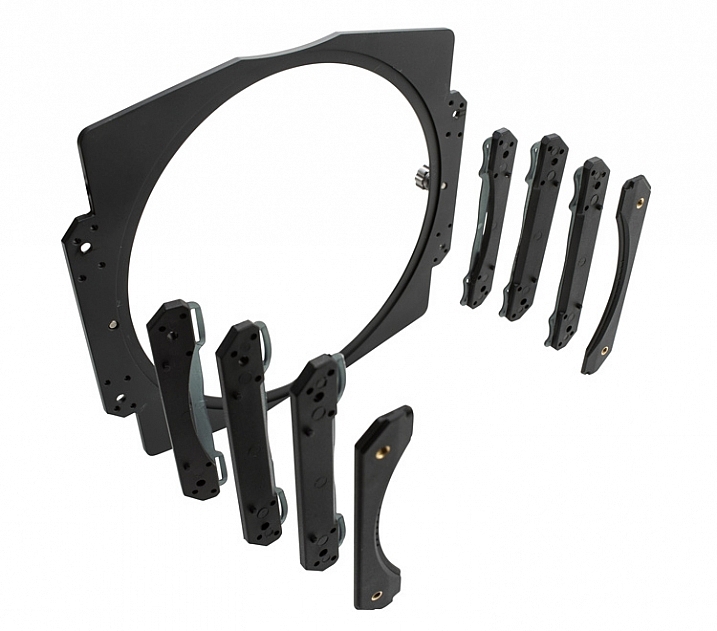
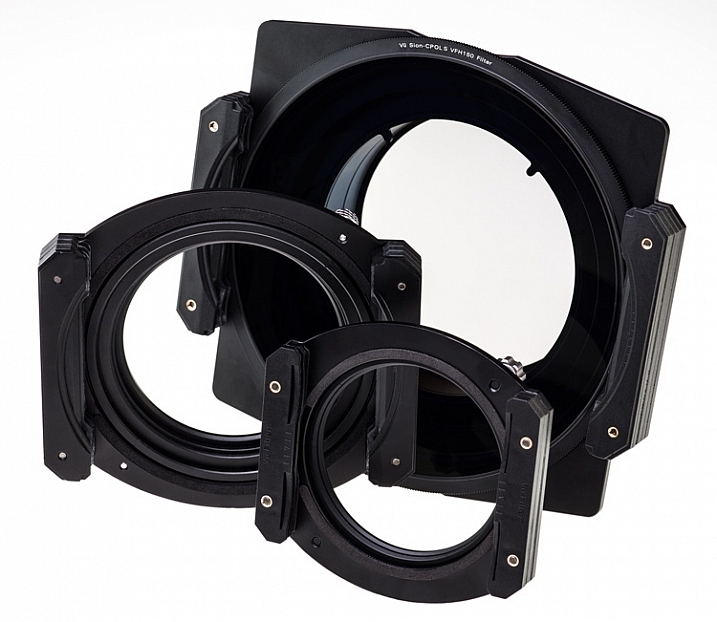
VFH150_Parts Vu_FilterHolder_Group_02

As an example, attaching the 10-stop ND filter to my camera’s lens (a Canon 60D with the Canon EF-S 24mm 2.8 STM) was a bit of a chore. The large metal filter holder was required, since this particular filter is the drop-in type, meaning the filter is a large square piece of thick glass. The filter slides vertically into the holder attachment, which is then attached to the lens via an adapter ring, suited for your lens’s filter size.

Another example of long-exposures at daytime with the neutral density filter.

Another example of long-exposures at daytime with the neutral density filter.

It took several tries to get this right, and in the end was no small feat. I wasn’t positive after I was done that I had attached it correctly, but it functioned without any issues, so I’m assuming I did. A simple set of instructions for each piece would negate this problem altogether in my opinion.

The Vü website gives details and information about the products themselves, but I couldn’t find a support section where a user could quickly fetch instructions.

VFH100_FilterGroup

Once you figure out how to attach the product to your camera, and put them together, the filters and holder feel very solid and well constructed. Several sizes of adapter rings are available, to ensure the filters will fit almost any lens, and additional accessories for the system are also available. The holder, as I mentioned before, is large and a bit unwieldy, and using it without a tripod would be difficult.

My contact at the company was very helpful and knowledgable, and made sure everything got to me as quickly as possible.

Editor’s note: the video below was provided by the supplier when we discussed this issue with them. This should help solve the problem.

Summary

At the end of the day, regardless of any assembly difficulties I might have experienced, I found the filters very attractive from several standpoints. The filters were obviously made with the serious photographer in mind, and didn’t skimp on materials, strength, or quality.

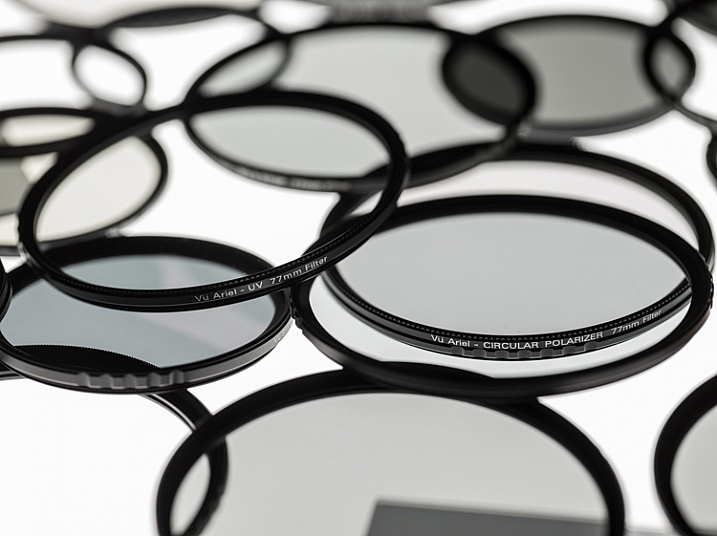
VU_TableTop_06 Ariel_Hero_f32

Pricing is, in my opinion, below what you would expect for this level of craftsmanship. Ordering their whole line would be expensive, but picking and choosing individual filters within the system, would prove affordable for most photographers.

Most importantly, the filters themselves work fabulously, and produce very good images. Some in the industry still consider filters to be a degradation to image quality, but after seeing the images these filters can produce, I slide off the fence into the more positive side of the field, and would use these accessories in all of my work.

Have you given Vü filters a try? Sound off below and tell us your experience!

Learn more about Vü filters, including the full product line, and you can purchase them online at Amazon.

googletag.cmd.push(function() {
tablet_slots.push( googletag.defineSlot( “/1005424/_dPSv4_tab-all-article-bottom_(300×250)”, [300, 250], “pb-ad-78623” ).addService( googletag.pubads() ) ); } );

googletag.cmd.push(function() {
mobile_slots.push( googletag.defineSlot( “/1005424/_dPSv4_mob-all-article-bottom_(300×250)”, [300, 250], “pb-ad-78158” ).addService( googletag.pubads() ) ); } );

The post Review of the Vü Professional Filter System by Tim Gilbreath appeared first on Digital Photography School.


Digital Photography School

 
Comments Off on Review of the Vü Professional Filter System

Posted in Photography


Sphericam 2 professional fully spherical camera records 4K/60 fps videos

13 Feb

$ (document).ready(function() { SampleGalleryV2({“containerId”:”embeddedSampleGallery_7236055564″,”galleryId”:”7236055564″,”isEmbeddedWidget”:true,”standalone”:false,”selectedImageIndex”:0,”startInCommentsView”:false,”isMobile”:false}) });

The folks at Sphericam are back with a second generation model of their unique angular camera. The Sphericam 2 is, according to the company, the first fully spherical pro-grade 360-degree camera that records 4K footage at 60 fps. The resulting videos can be used in VR applications, as well as on platforms that support 360-degree content like YouTube and Spinnable.

Unlike other spherical cameras, Sphericam features angular sides comprising a geometric design made from anodized aluminum. These ‘faces’ allow the camera to be placed flat on a surface, and also house things like lenses, mounting points, and buttons. Sphericam 2 has six cameras, each using a sensor with global shutter and synchronized to fire within 50 microseconds of each other.

Footage is available as 60 fps raw/unstitched and as 30 fps stitched panoramic videos. Capturing in 30 fps allows the video to be stitched in real time; a live streaming function is currently in development. Content, meanwhile, is recorded at up to 1.2 Gbps to an internal microSD card. The camera supports use of up to six MicroSD cards at once by way of a removable module adding up to a total maximum storage capacity of 768GB, or about 85 minute of footage.

The camera has two power options: a non-removable rechargeable battery for up to 90 minutes of operation, and a USB-C port for continuous operation when plugged in. Finally, Sphericam features a total of 8 mounting points, each a standard threaded 1/4-20 offering, for use with various third-party mounting accessories. 

Sphericam 2 is available for preorder from Sphericam for $ 2499; shipping is estimated to start 10 to 12 weeks after ordering.

Via: Sphericam

Articles: Digital Photography Review (dpreview.com)

 
Comments Off on Sphericam 2 professional fully spherical camera records 4K/60 fps videos

Posted in Uncategorized


5 of the Best Prosumer DSLRs for Budding Professional Photographers

20 Jan

Photography’s popularity is always growing. And photography’s accessibility is also growing as camera technology simultaneously advances and becomes more affordable. So it’s no big leap of faith to figure that more people are looking to photography as a means of generating income. However, even though camera technology is becoming more affordable, DSLRs still aren’t cheap. Professional-level DSLRs typically start off Continue Reading

The post 5 of the Best Prosumer DSLRs for Budding Professional Photographers appeared first on Photodoto.


Photodoto

 
Comments Off on 5 of the Best Prosumer DSLRs for Budding Professional Photographers

Posted in Photography


Nikon fills in the blanks on professional grade D5 DSLR

06 Jan

$ (document).ready(function() { SampleGalleryV2({“targetContainerClass”:”sampleGalleryImageViewerContainer”,”galleryId”:”2689685510″,”isEmbeddedWidget”:true,”selectedImageIndex”:0,”startInCommentsView”:false,”isMobile”:false}) });

Nikon has formally announced its D5 professional DSLR, a 20.8MP full frame capable of shooting at up to 12fps with AF and 14fps without. The camera features an all-new autofocus module with 153 points, 99 of which are cross-type, sensitive to both horizontal and vertical detail. The RGB metering sensor has also been doubled in resolution: up from a 91,000-pixel to a 180,000-pixel sensor. This should ensure more accurate metering and better precision in object tracking with continuous AF. It’s also Nikon’s first DSLR to be capable of 4K video capture and its first high-end camera to include a touchscreen. 

The D5 is based around a new processor, which Nikon is referring to as EXPEED 5. It will offer a conventional ISO range stretching from 100 to 102,400, with low settings down to ISO 50 and extended high ISOs of up to 3,280,000. According to Nikon, the higher ISOs benefit from improved light transmission of the color filter array to get more light to the sensor. A 3.2″ 2.36K dot XGA LCD with touchscreen functionality is included. Unfortunately, it doesn’t offer direct access to AF point selection with your thumb in OVF shooting like the D500 or D5500.

The upgrade to the AF system is significant: combined with Nikon’s industry leading object tracking (‘3D tracking’), we’d expect phenomenal ability of this camera to follow your subject and keep it in focus no matter where it moves to within the frame. Whether you’re shooting sports, weddings, or candid portraiture, the higher density of points should provide higher precision in tracking your subjects with pinpoint accuracy, an area in which Nikon already leads the industry. More cross-type points means better AF performance in tough lighting situations with challenging subjects, such as in low light or backlit scenarios. Freelance sports photographer Matthias Hangst is already claiming that ‘the D5 has the best AF system. Tracking of erratic moves is brilliant.’ 

Freelance sports photographer Matthias Hangst claims that AF object tracking performance of the D5 is brilliant, able to track erratically moving subjects in even challenging light, such as the backlit scenario pictured here.

The AF module also includes its own dedicated processor, presumably to deal with the vast information coming from the 153 AF points and 180K-pixel RGB metering sensor for tracking. Combining this AF prowess with minimal mirror blackout times during continuous bursts should translate to enhanced ability to follow moving subjects at high frame rates – which Nikon correctly emphasizes is difficult to do with mirrorless cameras. 

Low light sensitivity of the AF points have also been improved: the central point is sensitive down to -4 EV, with all other points sensitive to -3 EV. These ratings would suggest the D5 is the leader in low light focus ability at this time. Nikon hasn’t made any claims yet about increased focus precision with faster lenses (a la Canon), though. 

Nikon is emphasizing the 4K video capabilities of this camera, and while it includes options such as flat picture profile, Nikon has given no details yet of whether the camera has support tools such as focus peaking or zebra highlight warnings. 4K is recorded using the H.264 codec, but no bitrate information is provided as of yet. Historically, Nikon cameras have had low bitrates in video, yielding somewhat hard-to-grade footage.

We’ll be publishing more detailed analysis of the D5 and the co-announced D500 soon, and for more information, see the press release below.

Jump to:

  • Press release
  • Specs

Press Release:

In Addition to the D5, Nikon Releases Imaging Accessories Including Powerful New SB-5000 Speedlight and WT-6A Wireless Transmitter

LAS VEGAS, NV (January 5, 2016) – Today, Nikon Inc. announced the latest in the acclaimed series of flagship FX-format professional DSLR cameras, the Nikon D5. Far surpassing mere evolution, the D5 boasts a myriad of powerful new imaging innovations, including a Nikon-developed 20.8-megapixel CMOS sensor, an all-new 153-point AF system, 4K UHD video capture and EXPEED 5 image processing to give photographers the best balance of performance, precision and low-light ability. Nikon has also announced additional products, including the WT-6A Wireless Transmitter and the exciting new SB-5000 Speedlight, Nikon’s first radio frequency (RF) controlled flash.

“The D5 doesn’t simply get the shot that others might miss– it helps get the shot that others just simply cannot,” said Masahiro Horie, Director of Marketing and Planning, Nikon Inc. “With these new products, it becomes evident that photographers who choose Nikon cameras and NIKKOR lenses are equipped with an unrivaled system to surpass even the most demanding imaging expectations.”

The Nikon D5 once again redefines what a DSLR is capable of capturing, and is engineered with the ideal balance of resolution, low-light ability, system speed and processing power. The resulting camera body is truly worthy of the flagship moniker, giving professional photographers and multimedia content creators an indispensable tool to make their creative vision a reality with superior image quality. The D5 introduces many technological firsts for Nikon and offers many new features that share a common goal: to get the shot, no matter what.

New Features Include:

  • Astounding Low-Light Performance – The Nikon D5 offers an unprecedented native ISO range, from 100 to 102,400, reinforcing the D-series reputation as the leader of low-light image capture. A veritable new world of shooting opportunities awaits, as advancements in noise reduction and processing help capture low-noise images with fantastic fidelity that were previously impossible. The D5 tames the shadows, whether shooting a newlywed couple’s candle-lit first dance or sports with minimal lighting. The D5 also realizes unprecedented image quality in the high-sensitivity range between ISO 3200 and 12800 — the range favored by sports photographers. In addition, the D5 affords the ability to use higher shutter speeds with minimal illumination, letting photographers capture stunning images that are sharper, clearer and more colorful than ever before. As an added benefit, the next generation autofocus system performs in near darkness, acquiring focus in as little as EV-4 illumination. For extreme low-light ability, the ISO range is expandable from 50 (Lo-1) to a staggering ISO 3,280,000 (Hi-5), offering near-night vision capability that’s well beyond the visibility of the human eye. This extreme sensitivity is a benefit to photojournalists as well as for surveillance and security applications, letting users get shots others cannot see without a flash. This vast ISO range is also available to those capturing 4K UHD video, opening up new possibilities for multimedia and spot-news capture.
  • Exhilarating Image Quality – The Nikon D5 delivers on the promise of stunning image quality with the adoption of a new, Nikon-developed 20.8-megapixel FX-format CMOS sensor. The camera is designed to achieve the optimized balance between the large full-frame sensor size, resolution and the new EXPEED 5 image processing engine. Users can be confident that images will have enhanced sharpness and clarity, faithful skin tones and the unequaled dynamic range that Nikon pros have come to love. EXPEED 5 also helps to enhance noise reduction, letting photographers take full advantage of the D5’s immense ISO range. When paired with legendary NIKKOR optics, the D5 is truly a tool to help photographers capture the sharpest images possible with astounding clarity and radiant colors.
  • Powerful Performance – Nikon’s EXPEED 5 engine also serves to dramatically enhance camera performance, delivering low noise, high-speed image processing and offers the additional processing power needed for 4K UHD video. For professional sports and wildlife photographers, the D5 is capable of capturing images at 12 frames-per-second (fps) with full AE and AF, helping to ensure that the decisive moment is caught in crystal clarity and absolute sharpness. Users can also shoot at up to 14 fps with fixed focus and exposure and the mirror locked up, ideal for remote capture. Because the action won’t take a break, the extended buffer lets users shoot for up to 200 frames of 14-bit lossless RAW/NEF files + JPG fine*. The new processor is also 25% more efficient with up to 3780 shots per charge.
  • Fast Acquisition, with Precision – An exciting addition to the D5 is an all-new AF system with Nikon’s first dedicated AF processor. The Multi-CAM 20K AF sensor module offers superior AF performance with 153 AF points, including 99 cross-type sensors – triple the AF points from Nikon’s previous flagship, the D4S. Of these 153 points, 55 AF points/35 cross-type points are selectable by photographers to quickly and easily frame any shot. The system is configurable in 153, 72 and 25-point coverage when used with Continuous AF, allowing for stellar AF tracking performance of even the most rapidly moving subjects throughout the frame. Fifteen of the AF points are also functional up to f/8, further aiding those who require extreme telephoto capabilities, including wildlife photographers. This all-new AF system is coupled with a new 180K pixel RGB metering system and Advanced Scene Recognition System, helping to achieve optimally balanced exposures and accurate white balance in even the most challenging light. 
  • Rugged Reliability and Unsurpassed Usability – Downtime is never an option, so professionals need a camera that is going to be reliable and augment a demanding workflow. The Nikon D5 delivers with rugged construction and robust weather sealing, coupled with a familiar yet enhanced Nikon interface. A new 3.2” 2359K dot XGA LCD adds touchscreen functionality, allowing the user to easily pinch, zoom, swipe and scrub in playback, and also enter text faster than ever before. Being the champion of low-light, it is only natural that additional buttons and dials illuminate for enhanced visibility, while two additional Function buttons have been added for increased customization. The camera also features a Quick Release Mode setting for rapid access to release mode settings. Additionally, a new shutter and mirror sequencing mechanism nearly eliminates blackout time and mirror slap for bright, consistent views during high-speed shooting– realizing truly confident tracking of fast, erratically moving subjects that were previously difficult to achieve. The D5’s shutter itself is tested to 400K actuations for maximum durability. When paired with the WR-R10 wireless remote controller (transceiver) and WR-A10 Wireless Remote Adapter, the D5 is also able to interface with Nikon’s newest Speedlight, the RF controlled SB-5000, for new possibilities in lighting control. **
  • Rapid and Flexible Workflow – Further enhancing speed, the D5 is able to utilize the superior read and write speed of XQD memory cards, which are up to 35% faster than CF cards. To appeal to a wide variety of photographers, the D5 will be available in two versions; with either dual XQD card slots or with dual CF card capability. For maximum efficiency the camera is also capable of shooting smaller RAW Size S or M file types (12-bit, uncompressed), for greater flexibility when transferring batches of files from the field, while retaining image integrity. Photographers can also use the built in 1000 Base-T 400MBps Ethernet connection for image transfer, with speeds up to 1.5x faster than D4S.
  • Multimedia Powerhouse with 4K/UHD Video – The Nikon D5 is the first Nikon DSLR capable of capturing 4K UHD video (3840×2160 at 30p), letting users create stunning ultra-high definition video with beautiful clarity and color. Multimedia content creators can also use the D5 to create 4K time-lapse videos in-camera using the Time-lapse Movie function, and can create 8-megapixel still images from frame grabs. A great addition to any production environment, the D5 includes all of the most popular pro-level features of the Nikon D810, including Full HD 1080p video at a variety of frame rates, uncompressed HDMI out, simultaneous live view and headphone/microphone connections. Additionally, the D5 adds a feature to smooth exposure transitions using the Auto ISO function as well as exposure compensation to create natural-looking exposure transitions in video.

New Radio Controlled SB-5000 Speedlight: Lighting with No Limits

The Nikon D5 is optimized to work with the newest flagship Speedlight, the SB-5000, illuminating new possibilities in creative lighting. A first for Nikon, the flash operates via radio frequency and will operate without a direct line of sight for a range of up to approx. 98 feet (30 meters). This new-found flexibility lets photographers place lights in different rooms, around corners and work seamlessly in bright ambient light with maximum efficiency. When paired with the WR-R10 and the D5 or the D500, this Speedlight can control up to six groups (A-F) or 18 Speedlights for truly advanced wireless lighting. It is also possible to perform Advanced Wireless Lighting using either radio-controlled (up to three groups) and/or optical-controlled units (up to three groups) by simply attaching a conventional, optical-control Nikon Speedlight or the SU-800 Commander (as a master or commander unit) and a WR-R10 (as a commander) onto the D5.

The new smaller SB-5000 Speedlight also has a radically new design that includes its own internal cooling system, which prevents overheating of the flash panel from consecutive firings. As a result, the SB-5000 can fire consecutively for longer than conventional models, without flash cool-down time between bursts, and can fire up to 120 continuous shots at 5 second intervals. Controls have also been streamlined and refined, with the addition of an “i” button for access to frequently used settings. The design also integrates versatile bounce ability, with the flash head capable of tilting down to -7° or up to 90°, and rotate horizontally 180° to the left and right. 

New WT-6A Wireless Transmitter

Nikon has also announced the WT-6A Wireless Transmitter for use with the D5. An ideal solution for professional image transfer, the WT-6A can transfer with speeds of up to 130 mbps wirelessly and supports the fast IEEE802.11ac standard. The connectivity distance has been extended to approximately 656 ft. and can be used to transfer images to an FTP server or to a computer. When in HTTP mode, the unit can be used to operate camera controls, begin Live View shooting or start/stop HD video recording.

Price and Availability:

The Nikon D5 DSLR will be available in March for a suggested retail price (SRP) of $ 6,499.95***. The Nikon SB-5000 AF Speedlight will be available in March for the SRP of $ 599.95. The WT-6A Wireless Transmitter will also be available in March, with the SRP of $ 749.95. For more information on these new Nikon products, please visit www.nikonusa.com.

About Nikon

Nikon, At the Heart of the Image™. Nikon Inc. is a world leader in digital imaging, precision optics and photo imaging technology; globally recognized for setting new standards in product design and performance for an award-winning array of equipment that enables users to tell their stories through amazing photos and videos. Nikon Inc. distributes consumer and professional digital SLR cameras, NIKKOR optics, Speedlights and system accessories; Nikon COOLPIX® compact digital cameras; 35mm film SLR cameras; Nikon software products and Nikon sports and recreational optics as well as the Nikon 1 compact interchangeable lens camera system. Nikon Corporation, the parent company of Nikon Inc., recently announced the production of 95 million NIKKOR lenses in 2015, creating a new milestone in Nikon’s heritage of superior optics. For more information, dial (800) NIKON-US or visit http://www.nikonusa.com, which links all levels of photographers to the Web’s most comprehensive photo learning and sharing communities. Connect with Nikon and other photographers on Facebook, Google+, Twitter, YouTube, Instagram, Vimeo and Flickr.

 *When using approved XQD cards.
 **Wireless Remote Controller WR-R10 and WR Adapter WR-A10 (both available separately) required. WR-R10 firmware must be updated to enable support for radio-controlled Advanced Wireless Lighting (see Nikon’s website).
 ***SRP (Suggested Retail Price) listed only as a suggestion. Actual prices are set by dealers and are subject to change at any time.


Nikon D5 specifications

Price
MSRP $ 6499
Body type
Body type Large SLR
Body material Magnesium alloy
Sensor
Max resolution 5588 x 3712
Image ratio w:h 1:1, 5:4, 4:3, 3:2
Effective pixels 21 megapixels
Sensor photo detectors 21 megapixels
Sensor size Full frame (35.9 x 23.9 mm)
Sensor type CMOS
Processor EXPEED 5
Color space sRGB, Adobe RGB
Color filter array Primary color filter
Image
ISO Auto, 100-102400 (expandable to 50-3280000)
White balance presets 12
Custom white balance Yes (6 slots)
Image stabilization No
Uncompressed format RAW
JPEG quality levels Fine, normal, basic
File format
  • JPEG (Exif v2.3)
  • Raw (NEF, 12 or 14 bit, lossless compressed, compressed, uncompressed)
Optics & Focus
Autofocus
  • Contrast Detect (sensor)
  • Phase Detect
  • Multi-area
  • Center
  • Selective single-point
  • Tracking
  • Single
  • Continuous
  • Touch
  • Face Detection
  • Live View
Autofocus assist lamp No
Number of focus points 153
Lens mount Nikon F
Focal length multiplier 1×
Screen / viewfinder
Articulated LCD Fixed
Screen size 3.2
Screen dots 2,359,000
Touch screen Yes
Screen type TFT LCD
Live view Yes
Viewfinder type Optical (tunnel)
Viewfinder coverage 100%
Viewfinder magnification 0.72×
Photography features
Minimum shutter speed 30 sec
Maximum shutter speed 1/8000 sec
Exposure modes
  • Program
  • Aperture priority
  • Shutter priority
  • Manual
Scene modes
  • Single-frame
  • Continuous low
  • Continuous high
  • Mirror-up
Built-in flash No
External flash Yes (via hot shoe and flash sync port)
Flash X sync speed 1/250 sec
Drive modes
  • Single-frame
  • Continuous low
  • Continuous high
  • Mirror-up
  • Quiet shutter
  • Self-timer
Continuous drive 14.0 fps
Self-timer Yes (2, 5, 10, 20 secs)
Metering modes
  • Multi
  • Center-weighted
  • Highlight-weighted
  • Spot
Exposure compensation ±5 (at 1/3 EV, 2/3 EV, 1 EV steps)
AE Bracketing ±5 (2, 3, 5, 7 frames at 1/3 EV, 2/3 EV, 1 EV steps)
WB Bracketing Yes
Videography features
Resolutions 3840 x 2160 (30p/25p/24p), 1920 x 1080 (60p/50p/30p/25p/24p), 1280 x 720 (60p/50p)
Format MPEG-4, H.264
Videography notes 1.5X crop mode with DX lenses
Microphone Stereo
Speaker Mono
Storage
Storage types Dual CompactFlash or dual XQD
Connectivity
USB USB 3.0 (5 GBit/sec)
HDMI Yes (mini-HDMI)
Microphone port Yes
Headphone port Yes
Wireless Optional
Wireless notes Requires WT-5A or WT-6A
Remote control Yes (wired, wireless, smartphone)
Physical
Environmentally sealed Yes
Battery Battery Pack
Battery description EN-EL18a lithium-ion battery & charger
Weight (inc. batteries) 1415 g (3.12 lb / 49.91 oz)
Dimensions 160 x 459 x 92 mm (6.3 x 18.07 x 3.62)
Other features
Orientation sensor Yes
Timelapse recording Yes
GPS Optional
GPS notes GP-1A

Articles: Digital Photography Review (dpreview.com)

 
Comments Off on Nikon fills in the blanks on professional grade D5 DSLR

Posted in Uncategorized


Professional school and sports photography programming added to WPPI 2016 schedule

05 Nov

Emerald Expositions, the company that owns PhotoPlus Expo and the WPPI Wedding and Portrait Photography Conference, announced today the formation of a new association – the Professional School & Sports Photographers Association. The group will exist under the company’s Photo+ umbrella, alongside properties that include PPE, WPPI, PDN and Rangefinder magazine. Read more

Articles: Digital Photography Review (dpreview.com)

 
Comments Off on Professional school and sports photography programming added to WPPI 2016 schedule

Posted in Uncategorized