Ricoh has announced a new wide-angle prime for its Pentax 645D/645Z medium format digital bodies. This lens’ name is a mouthful: HD PENTAX-D FA645 35mm F3.5 AL [IF]. The top-line specs are that it acts as a 27.5mm (in 35mm terms) on a digital 645 body, has a minimum focus distance of 0.3m, giving a maximum magnification ratio of 0.25x. Read more
Tag: Prime
-
2015 Roundups: Fixed Prime Lens Cameras
The Fixed Prime Lens Camera category is our smallest roundup of 2015 but also one of our most interesting. Cameras in this category range quite a bit, from the affordable, to the jaw-dropping expensive. If you prefer to zoom with your feet, instead of your lens, then this is the roundup for you. Read on
-
7 Tips to Help When You’re Stuck with Only a Prime Lens
As a photographer you must have flip-flopped back and forth between prime and zoom lenses. “Should I choose a prime today, or a zoom for its advantages?” If you have not done this for a purchase, you must at least have read the numerous articles which weigh the pros and cons of each. But what about when you are stuck with a lens that is not ideal for an event? For the sake of discussion and for this learning opportunity, let’s choose the 50mm prime lens, which is one of the most popular and affordable primes, and is made for every camera body known to man.
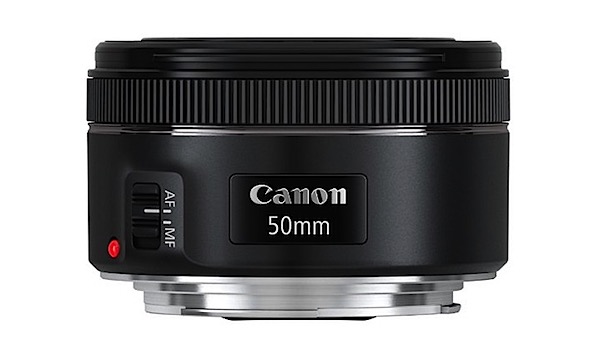
If something comes up that is unexpected, that’s a good thing! Not ideal if you don’t have a long enough zoom or wide enough lens, BUT it could be worse. What if you didn’t even have your camera at all? So stay upbeat and realize with some ingenuity you can overcome the confines of being stuck with a prime lens.
As a personal note: This tutorial was inspired by a real event in Guatemala. I had chosen my 50mm for a walk-around lens as it is light, and I wasn’t expecting much as I went out to get a cup of coffee. Well, with a caffeine buzz I climbed a hill, and at the top an ancient Mayan ritual of sacrifice was being conducted for the dead. Maintaining cultural sensitivity I knew that it would be totally inappropriate to get my lens in their face. It was pertinent to maintain my distance for respect.
1. Use shallow depth of field
Prime lenses are known for being sharp, especially when you close down your f-stop. Yet when you are confined, or have limitations about how close you can get, or how agressive you can come across as a photographer, using your lens creatively is important. Thus, you may sacrifice some sharpness, add a little chromatic aberration (CA), etc., but you will also get a different style of shot from a lens that inherently has focal length limitations. Go for bokeh.
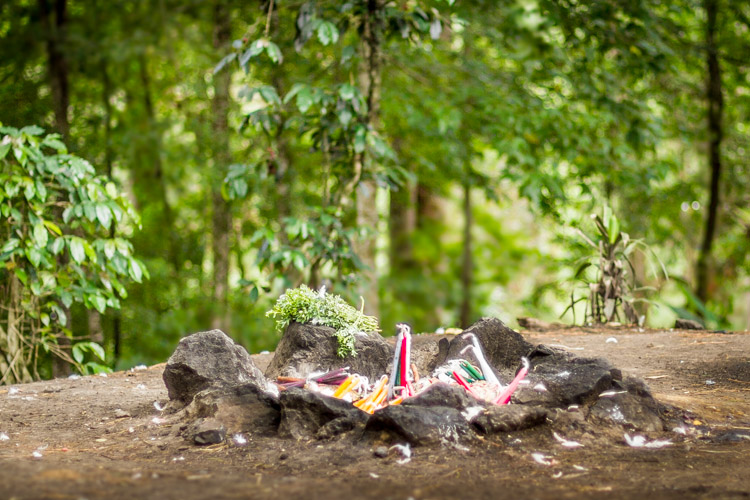
2. Panorama for wider angles
Use panorama techniques to combine images later in post-processing. If you can’t get a wide angle view, make one. Yes the feeling of the final composition will not be exactly the same as a true wide angle, as your foreground and background compression will be greater, but you will be able to give a cinematic effect. Combining images is an easy way to encompass more into your scene when you are limited by your focal length.
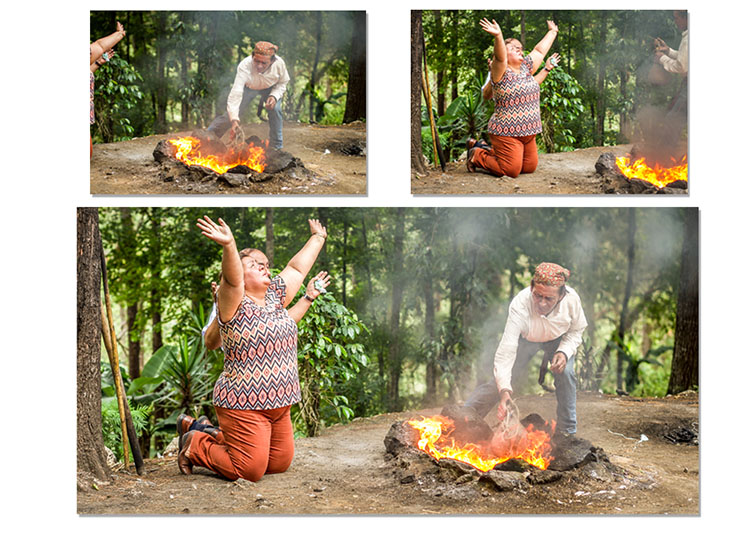
These two images were combined to show the whole event of the shaman and the fire along with the family members.
3. Shoot with the intention of cropping
Be conscious that cropping is available to you in post-processing. Don’t worry if a hand creeps into your frame, or there is a plastic bottle in the corner. If you consciously shoot for a crop to be performed later you can zoom-in on something specific. This again gives you flexibility and diversity. If you combine this with a shallow depth of field (suggestion number one) you will find that you can achieve a telephoto effect.
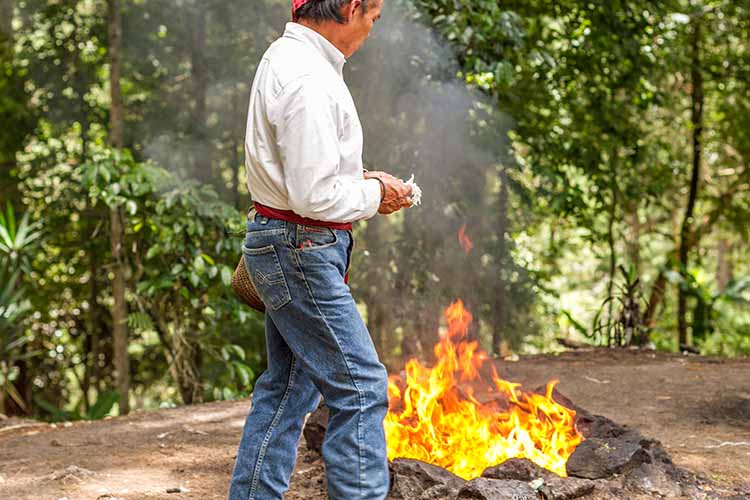
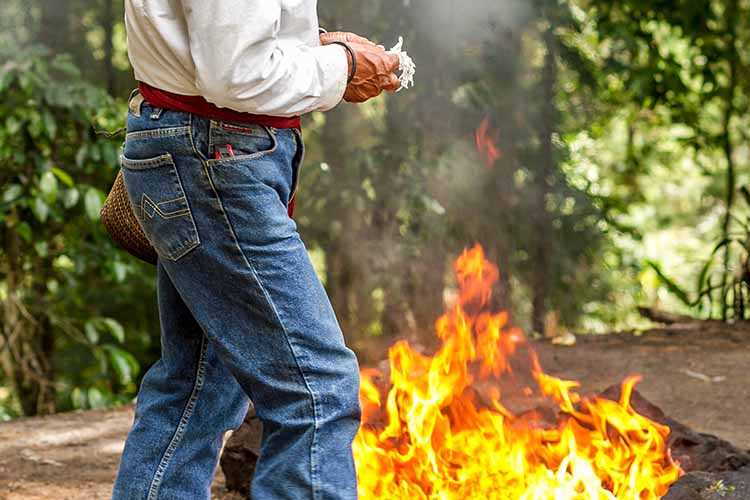
This image was shot for a crop, so cutting off the top of the head is not a problem if you know you will crop in closer in post-processing.
4. B-roll footage
Get photos of activities, reactions, or environmental surroundings which will add to the narrative of the event. If you can’t get any closer, and you have pushed your boundaries of being discreet, then look up, down, and turn around. In film (movies), these are generally called B-roll shots, which helps to transition from one camera angle to another, while also telling the story.
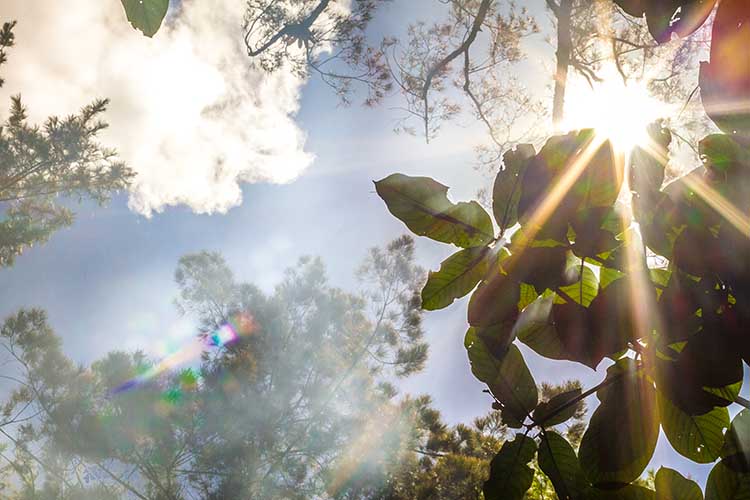
The smoke rising up, into the sun, amongst the trees, gives a feeling of the environment around the ceremony.
5. Frame your subject with something in the foreground
Use a leaf, a stone or even another person to cut into the frame, which will both highlight your subject, by leading your eye to what you want the viewer to look at, and it will also create layers in the photograph. Layers add a sense of style and depth to your photography. Trying to use different techniques to create different perspective styles will really improve the overall quality of the group of photos you finally decide to keep.
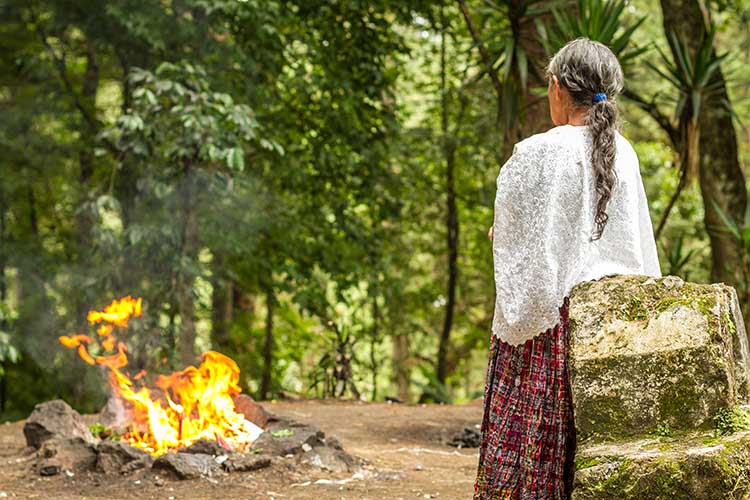
The gravestone, then the grandmother, and finally the fire give layers to the photograph.
6. Use both horizontal and vertical photographs
Again this is about creating diversity in a final product. So turn the camera sideways and you definitely have a different style going for you. Some people get stuck in horizontal mode, or in vertical mode. This is a great opportunity to make a change of pace. When your eye sees a photo it follows a pattern, generally starting in the top left corner then moving, left to right (just as you read) looking for areas of light, contrast, lines, color and patterns. A vertical photo will automatically create a different reading experience to the photo. Or why not crop them into a square even?
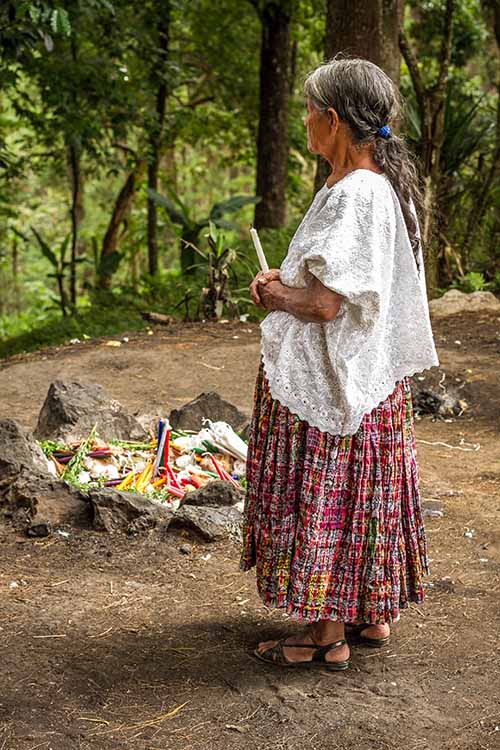
A simple vertical photo changes the pattern during your final composition. Think both horizontally and vertically.
7. Just enjoy the event
See the event not only through your camera, but also with your own eyes. Experience the event, and it will not only give you great memories, but will allow you to feel the mood as well. Understanding the event will give you insight into what out-of-the-box shot may really highlight the event.
Summary
The general idea is to work with what you have, don’t lament what you left at home. If you do, you might just start lugging around simply too much gear to enjoy yourself. Think of how to diversify your perspectives. By confining yourself (in this instance, when confines are placed upon you) there is great opportunity to use your most advantageous feature… your creative brain!
For most people, photography is a hobby turned passion, and enjoying photography should really be priority one. Photography is always a game of tradeoffs, which can be simply exemplified by the basic lesson of the exposure triangle. By gaining one thing you lose another. So begin gaining something even when you are stuck with just a prime lens.
Maybe we could say, you are challenged to be better at what you love!
googletag.cmd.push(function() {
tablet_slots.push( googletag.defineSlot( “/1005424/_dPSv4_tab-all-article-bottom_(300×250)”, [300, 250], “pb-ad-78623” ).addService( googletag.pubads() ) ); } );googletag.cmd.push(function() {
mobile_slots.push( googletag.defineSlot( “/1005424/_dPSv4_mob-all-article-bottom_(300×250)”, [300, 250], “pb-ad-78158” ).addService( googletag.pubads() ) ); } );The post 7 Tips to Help When You’re Stuck with Only a Prime Lens by Branson Quenzer appeared first on Digital Photography School.
-
Amazon releases more details of ‘Prime Day’ event on July 15th
To mark 20 years since it opened its (virtual) doors, Amazon is planning a ‘Prime Day’ next week, on July 15th. Billed as a ‘global shopping event’, Prime Day will feature more deals than Black Friday for Prime members, including more than 60 deals from top camera brands. Click through for more details
-
Panasonic introduces Lumix G 30mm macro and new 42.5mm portrait prime
Panasonic has announced two new additions to its Micro Four Thirds lens lineup, a 30mm F2.8 macro and 42.5mm F1.7 portrait lens. The company had previously hinted that the 30mm was in the works, and as promised it offers Mega O.I.S stabilization along with 240 fps drive AF. The 42.5mm F1.7 isn’t quite as fast (or presumably as expensive) as the existing Leica Nocticron 42.5mm F1.2. Both lenses will be available in May. Read more
-
Writer’s Favorites – 35mm Prime Lens

When I was 15, I was diagnosed with Attention Deficit Disorder. While it has gotten much better with age, when I was younger the slightest stimuli would grab my attention. It was a tough job to keep me focused on a single task (it still is if you ask my wife).
Why am I telling you this and what does this have to do with my favorite lens / focal length? I’m telling you because over the years simplifying things has become very important to me and for my photography, and this has manifested itself into a love of the simple 35mm prime lens. I much prefer the simplicity of sticking with a single focal length, as long as a situation allows for it.
When I say 35mm prime, I am referring to the 35mm focal length, so it would be a 35mm lens on a full frame, around a 23mm lens on a cropped APS-C sensor, and around a 17mm lens on a micro four thirds camera.
Lightweight
 35mm lenses are light and non-intimidating, which is a huge advantage for daily use. For this reason, I prefer lenses that are a little slower, such as a 35mm f/2 instead of a 35mm f/1.4, because the f/2 lenses are usually significantly smaller than their faster counterparts. I rarely feel the need to use f/1.4, particularly since most newer digital cameras can shoot very well at high ISOs.
The Freedom of a Prime Lens
Using a single focal length is a great way to simplify your photography and to make it more consistent. The constraint can slow you down and help you think more critically about perspective and framing. It can help you grow as a photographer. In addition, 35mm is just wide enough without being too wide. It will not overly distort a scene, but it will allow you to capture a wide scene from a close distance.
Fuji X100s + 23mm (35mm equivalent)

Fujifilm X100S with 23mm F2 Lens (35mm equivalent).
Currently, my favorite 35mm lens is actually a camera, the Fuji X100S, which has a fixed 23mm (35mm equivalent) f/2 lens that is not removable. I use this small camera as a daily complement to my DSLR system and am now able to carry a high quality camera with me everywhere, no matter what I am doing. Because the lens was built specifically for the Fuji X100S, it is a spectacular combination and the image quality is very comparable with my high-end DSLR in a much lighter camera body.
A 35mm can be used for a variety of situations. It is not perfect for every situation, but you can use it for street photography, landscapes, travel photography, portraiture, and even architecture. Here are my favorite ways to use the 35mm focal length.
Street Photography

The 35mm focal length is one that has been used by many street photographers over the years and there is a reason that so many do. The focal length makes it easy to show an entire scene, to combine a person and a background, or to combine multiple subjects within the same frame from a close distance. It is wide enough for you to show a large area of background while still focusing on a main subject at a close and intimate distance.
Portraiture

A 35mm can even be used for portraiture. It is not your typical lens for a tight headshot, where an 85mm to 120mm is ideal. However, the 35mm excels at producing wonderful environmental portraits from a little further away, where both the person and elements of the background are prominent. It is wide enough to include a lot of the surroundings, but not too wide to significantly distort the subject’s features.
Architecture

This focal length is not ideal for zooming into building details at far distances, however it is a great focal length for capturing buildings. The constraint can almost turn into an advantage as you begin to photograph buildings in ways that you might not otherwise. I do not recommend only a 35mm for architectural photography, but a 35mm can be a big asset much of the time.
Urban Landscapes

The focal length is wide enough to include a scene with a lot of depth and a lot of interest, while not being too wide as to significantly distort the features of the scene.
Travel Photography

Have you ever given your wife a black eye by swinging around a tripod that was attached to your backpack at 5am, while getting out of a taxi at the airport for a vacation to Mexico with her extended family? Here is how I used to pack for vacations. I no longer pack like this for vacations.
So for these reasons the 35mm is my favorite lens. Do you use it? What is your fave and why?
googletag.cmd.push(function() {
tablet_slots.push( googletag.defineSlot( “/1005424/_dPSv4_tab-all-article-bottom_(300×250)”, [300, 250], “pb-ad-78623” ).addService( googletag.pubads() ) ); } );googletag.cmd.push(function() {
mobile_slots.push( googletag.defineSlot( “/1005424/_dPSv4_mob-all-article-bottom_(300×250)”, [300, 250], “pb-ad-78158” ).addService( googletag.pubads() ) ); } );The post Writer’s Favorites – 35mm Prime Lens by James Maher appeared first on Digital Photography School.
-
Amazon launches Prime Photos with unlimited storage for Prime members
Amazon has launched a new photo storage service called Prime Photos, and is offering Prime subscribers unlimited cloud storage for their images at no extra cost. Photos can be uploaded to Amazon’s Cloud Drive with iOS or Android apps or the Cloud Drive website. Read more
-
Why Prime Lenses are Better Than Zooms
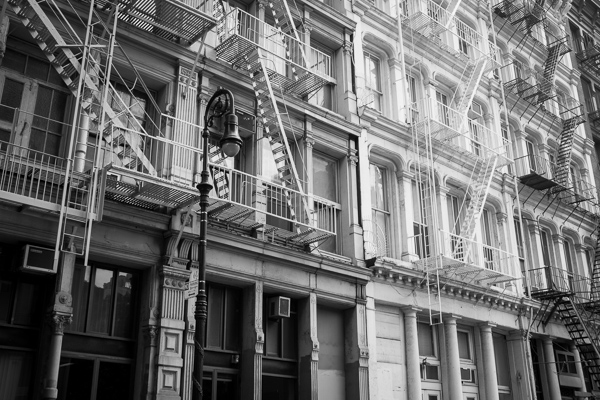
35mm – SoHo Fire Escapes, NYC
How heavy is your camera?
If you have an SLR with a zoom lens attached, the answer is pretty damn heavy. A large SLR body, such as a Canon or Nikon with a 24-105mm lens attached feels like a tank; forget the 70-200mm.
Of course there are many situations when using a zoom lens is ideal. However, I’m hoping to try and convince you to ditch the zoom lens for a prime.
But what if I need the zoom? What if I don’t have the perfect focal length? – I have heard those questions more times than I can count. A wise photographer once told me that you will get the same amount of good shots no matter what lens and camera you use; they will just be different. Zoom lenses can be just as limiting as prime lenses, and prime lenses can be much more freeing than zoom lenses.
By walking out the door with a single prime lens, you are limiting yourself. There are certain shots that you will not be able to capture, that is a fact. However, the benefits can far outweigh that single negative. Prime lenses cause you to take more time to compose your shot, since will you need to zoom with your feet. This can make you think more critically about your composition. A prime lens will free you up to focus on the subjects in the range that the prime lens works best at. You will become much better at finding things within that range and your work will be more consistent because of these limitations. A prime lens makes you think in a certain way, since it is tougher to use. The limitation ends up being an advantage in the long run.
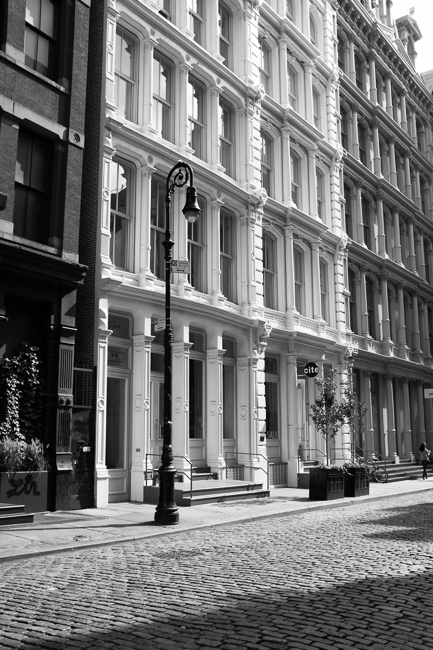
35mm – Cast Iron Building, SoHo NYC
Think about how many famous photographers throughout history used prime lenses.
Prime lenses are lighter. They make your camera more fun to take out. You don’t need a heavy camera bag and you will be able to walk further, explore more, and capture more images. You will have a bounce in your step that you didn’t before. You will be able to bring your camera with you on a daily basis. That will more than make up for missing out on a few shots that a zoom lens could capture. Photography will become more fun! It will become more of an element of your everyday life, versus something that takes planning to do.
After awhile you will learn to see specifically in that focal length, and this is where things really click. It will almost feel like the camera isn’t there. You will be faster and more intuitive as a photographer. This is all because you ditched the zoom in favor of the more limited prime lens.
Oh, and did I mention that prime lenses are cheaper than zooms? Any money that you will spend purchasing a new prime lens will be saved in medical bills from your neck and back eventually giving out from the weight of that gigantic zoom lens that you use now.
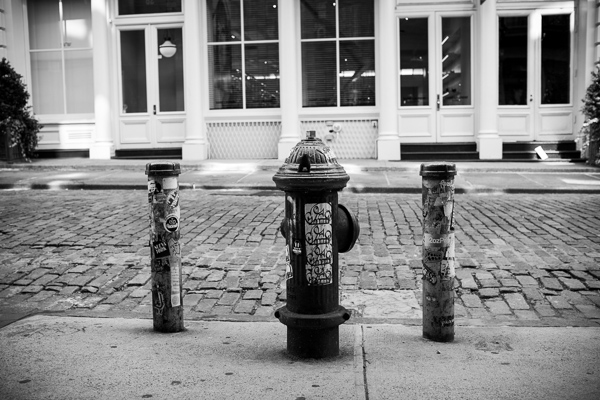
35mm – Fire Hydrant, SoHo NYC
So what focal length should you choose? I prefer a 35mm lens (on a full frame). It is just wide enough to work well anywhere but not too wide. Other common focal lengths are 28mm, 50mm, and 85mm (which is a fantastic focal length for portraits). Rent a few lenses and try them to see what you like best.
After a few days of using a prime you may realize that the real limitation was with your zoom lens.
The post Why Prime Lenses are Better Than Zooms by James Maher appeared first on Digital Photography School.
-
1 September, 2014 – Sigma DP2 Quattro – Not Ready For Prime Time

As the digital photography age matures we are all waiting for the newest big thing. So far this year there hasn’t been anything really big. Many camera makers are upgrading their present camera models without showing any real new innovation. However, there is one company that is bold to say the least and not only introduced a radically different looking camera but also put a Foveon chip inside it. Sigma, recently introduced the Sigma DP2 Quattro. We had the chance to try this camera out. Our review Not Ready For Prime Time will show where we think Sigma and Foveon missed the mark. Some may not agree, read on and see what you think.
You have to love a Photokina year. The next few weeks are going to be crazy with a large number of anticipated announcements as well as hopefully some big surprises. Both Michael and Kevin will be at Photokina this year and you can expect daily updates on the latest from the show floor. More on this over the next two weeks.
-
Mitakon Speedmaster 50mm F0.95 is an ultra-fast prime for Sony Alpha 7

The Mitakon Speedmaster 50mm F0.95 is an ultra-fast prime for Sony E mount cameras, with manual focus and a clickless manual aperture mechanism. It offers full frame coverage, meaning it will work on the Alpha 7, 7R and 7S triplets, opening up intriguing low light options on the latter in particular. It will also work on APS-C E-mount models, offering a 75mm equivalent short telephoto angle of view. The lens is made in China by Shenyang Optical Electronics Ltd, and is available for pre-order now for $ 799. Learn more