RSS
 

Posts Tagged ‘Prime’

Ultimate travel kit – Thailand with Olympus’ E-M1 II & 25mm prime lens

26 Jan

Introduction

ISO 200, 1/4000 sec, F2.

When I travel, I always bring a dedicated camera with me. My preferred form of ‘travel photography,’ at least when taking pictures for myself, is to document my experiences and create a visual diary. I like to travel as light as I can while still being able to come back with results of decent quality (though a personal trip to Iceland with a D810 was a notable exception to the notion of traveling light).

So, what would I bring for a planned personal trip to Thailand? My D700’s are solid but a bit bulky, and I’m not entirely sure how my original X100 would stand up to high humidity, beaches and possibly a rain shower or two (understatement of the year, as I’ll get to in a bit). I considered the Nikon D500 or the Pentax K-3 II, but both are also fairly bulky, though I was still hoping to end up with a camera that had a larger sensor than the waterproof Nikon AW1.

My constant companion, based on a combination of size, speed and durability.

Luckily, Olympus has been kind enough to allow us an extended loan on our OM-D E-M1 Mark II for continued testing, particularly in anticipation of future firmware updates. I also decided on just a single lens for the whole trip; the Olympus 25mm F1.2 Pro.

It was settled, then. An informal travel experience with a Micro Four Thirds camera and a fixed, 50mm-equivalent lens to document the trip of a lifetime. What could possibly go wrong?

Full disclosure: This was a personal trip paid for entirely by myself. The choice to bring along an Olympus E-M1 II and lens was mine alone. I do wish to express gratitude to Olympus for allowing DPReview to hold on to our E-M1 II review sample, as well as my fellow staffers at DPReview for allowing me to borrow it for this trip.

All images processed and cropped to taste in a beta version of Adobe Camera Raw unless otherwise noted.

Living with your choices

When I told photo-nerd friends that I was going to Thailand with only an E-M1 II, they thought that was awesome. When I told them that I was going with only a 50mm equivalent lens, a sort of shade passed over their faces; a mixture of interest, bemusement and pity.

Wat Pho is also known as the Temple of the Reclining Buddha, which measures 15 meters high and 46 meters long and resides in a confined space. This made using my 50mm equivalent lens…challenging. Straight out of camera JPEG cropped slightly to taste. ISO 400, 1/125 sec, F1.2.

Despite being primarily a prime-lens shooter, I do not shoot the 50mm focal length very often. Yes, it was the de-facto ‘kit lens’ for entry level film SLRs of yore, but after discovering how much I preferred prime lenses to zooms, I gravitated toward the 35mm focal length years ago and haven’t wavered much since.

As anyone who shoots mostly prime lenses knows, familiarity with a focal length often allows you to ‘see’ pictures that will work before the camera is even to your eye. Given my unfamiliarity with the 50mm focal length, I found myself working a lot harder on my compositions than I anticipated.

I found that for general photography in Thailand, including landscapes and basic ‘I was here’ images, 50mm was difficult to adjust to. ISO 200, 1/1250 sec, F4.

What worked and what didn’t

To state the exceedingly obvious, there are times to experiment with new gear and times to stick with what’s familiar. It wasn’t long into our time in Bangkok that I began to second-guess my decision to bring this single lens.

Sometimes, the 50mm field of view was an asset, allowing me some more working distance than I was used to. Other times, it was constricting. ISO 200, 1/200 sec, F2.8.

Bangkok is a busy, bustling metropolis with a sea of activity surrounding you at all times, whether you are in the back alley of a flower market or anxiously waiting for a seat at Thip Samai for some of the best pad thai you’ll ever eat. In this sense, the camera and lens combination was perfect. The E-M1 II is one of the most responsive mirrorless cameras out there, and the autofocus on the 25mm F1.2 lens is swift and accurate – all of this ensuring that the camera was ready to capture a moment when I was.

Spongebob says, ‘Buy me. You know you want to.’ ISO 200, 1/200 sec, F2.8.

The problem was in developing my ability to ‘see’ an image with the 50mm focal length, as I would often swing the camera around, only to realize that I really needed to take a few steps back. I was finding it difficult to capture single images with both a strong subject as well as a sense of context, which I generally find much easier with the 35mm focal length. 

But as we made our way from Bangkok to the Krabi province in southern Thailand, I had other things to worry about than my framing and compositions.

Until next time, Bangkok. ISO 200, 1/2500 sec, F5.6.

The rain

Shortly into our time in the Krabi province, southern Thailand was ravaged by unseasonably strong rain and winds (the rainy season is supposed to end in November). The result was large-scale flooding affecting around 700,000 people and resulting in dozens of lives lost.

The beginning of the storms roll in to Koh Phi Phi. 1/100 sec, ISO 6400, F4.

The worst of the weather was to the east of us, as we experienced stormy conditions but largely less severe flooding. It wasn’t until much of the rain had subsided that we had realized the gravity and impact of the situation; we had simply been attempting to make the best of our trip, as did the countless tourists that surrounded us.

Rain begins to fall on tourists and locals on Koh Phi Phi. ISO 640, 1/125 sec, F1.2.

I bring this up so as to make clear that as I go on with this piece, it is with respect and acknowledgment of the scale of the human impact we were lucky enough to have avoided the worst of.

Though the rains did their part to keep me from taking as many photographs as I would have otherwise, the E-M1 II’s purportedly extreme weather sealing meant that I was comfortable having the camera with me much of the time. So while I was taking fewer photographs, the point is that I was still taking them.

Flooding continued in the town of Krabi even after rains had ceased, forced multiple reroutings of traffic on and off Route 4 to the airport. ISO 1250, 1/125 sec, F1.2.

Growth and challenges

The final region we visited in Thailand was Chiang Mai, in which we planned a visit to the Elephant Nature Park. Here, all elephants in residence are rescues and not subject to rides, tricks or shows. Instead, visitors are able to experience an elephant’s life in a more natural, simple and tranquil setting.

As far as the relative simplicity of shooting with only a 50mm equivalent lens throughout my trip, it ended up being a positive experience despite my earlier hesitations. While my images weren’t exactly how I had envisioned them, I found that wasn’t a bad thing. Most importantly, I struggled a bit and found some enjoyment in the challenge of shooting different subject matter with a different selection of gear than I’m accustomed to. It might sound strange to challenge one’s self on a ‘vacation,’ but I guess I’m a bit weird like that.

Forcing myself to work with the 50mm focal length was a challenge that often forced me to see scenes in front of me a little differently than I would with a wider lens. ISO 200, 1/1000 sec, F2.

To be sure, there are other solutions out there I could have chosen for this journey, but I was more than pleased with the Olympus E-M1 II. It offered an good balance of size, ergonomics, speed, weather resistance and image quality. It would have been nice in some dimmer scenes to have a larger sensor with lower noise levels, and I didn’t particularly have a use for the ultra-high burst rates the Olympus is capable of. But as a travel camera for this particular journey, the camera performed admirably. Maybe next time I’ll even take a zoom lens.

ISO 200, F8, 1/3200 sec.

Samples Gallery

All images were shot in Raw + JPEG with a 3:2 crop as personal preference. Many of the edited Raws were differently cropped, and were produced using a beta version of Adobe Camera Raw. Please do not reproduce any of these images on a website or any newsletter / magazine without prior permission (see our copyright page).

We make the originals available for private users to download to their own machines for personal examination or printing (in conjunction with this review), we do so in good faith, please don’t abuse it. Unless otherwise noted images taken with no particular settings at full resolution.

$ (document).ready(function() { SampleGalleryV2({“containerId”:”embeddedSampleGallery_4976169775″,”galleryId”:”4976169775″,”isEmbeddedWidget”:true,”standalone”:false,”selectedImageIndex”:0,”startInCommentsView”:false,”isMobile”:false}) });
Articles: Digital Photography Review (dpreview.com)

 
Comments Off on Ultimate travel kit – Thailand with Olympus’ E-M1 II & 25mm prime lens

Posted in Uncategorized


Have your say: Best prime lens of 2016

09 Dec

Have your say: Best prime lens of 2016

It’s a great time to be a photographer. Based on reader interest and preferences, we’ve rounded up a total of twelve prime lenses that were released in 2016 for your consideration in this poll. They run the gamut in terms of lens mount, focal length, maximum aperture, and of course, use case. 

Which of these prime lenses is most exciting to you? Which do you already have, or are looking to add, to your particular kit? Let us know by casting your vote in the poll at the end of the slideshow. For now, let’s dig in and take a look at this year’s contenders. 

Please note that for the sake of a manageable list, we have excluded some of the more exotic manual focus primes from the likes of Zeiss, and several third-party MF options (Samyang/Rokinon etc). If you feel that a particular lens of this kind deserves consideration, feel free to leave a comment.

Canon EF-M 28mm F3.5 Macro IS STM

The announcement of Canon’s EOS M5 was largely welcome news, but came with a side of grumbling – the Canon EF-M lens lineup is still, for many, sorely lacking. This 28mm F3.5 Macro is looking to address that somewhat. Offering an equivalent focal length of 45mm, this lens won’t offer you much in the way of working distance, but with a 1.2x magnification super-macro mode and built-in LED lights, the EF-M 28mm Macro is a unique offering in the marketplace and comes with an affordable MSRP to boot.

Does this lens have you looking closer at the Canon M system more closely than before? Has the 1.2x magnification made a difference to your macro photography? Let us know by casting your vote for it in the poll.

See full specifications, user reviews and more

Fujifilm XF 23mm F2 R WR

Fujifilm’s ever-growing lens lineup continues to impress us, and the XF 23mm F2 R WR is no exception. The company’s existing 23mm F1.4 is quite good, but also quite large and makes no mention of weather resistance – two aspects this newer design is meant to address. You lose a stop of light, but you also gain a noticeable speed boost when it comes to continuous autofocus (and you can save a few pennies with this model, too). Lastly, for X-Pro users, the barrel design is intended to keep the lens from intruding too far into the hybrid viewfinder when used in ‘optical’ mode.

Is this the game-changing 35mm equivalent lens you’ve been waiting for? Let us know by casting your vote in the poll at the end of the slideshow.

See full specifications, user reviews and more

Nikon PC Nikkor 19mm F4E ED

This one’s been a long time coming. Nikon’s line of PC lenses, which stands for ‘perspective control,’ is all about offering tilt and shift capabilities for those that need it. As an example, it allows for correction of converging vertical lines if you’re photographing a tall building and must point your camera slightly up, and it also allows more control over your depth of field by allowing you to adjust the actual plane of focus. While this lens still isn’t as wide as Canon’s TS-E 17mm lens, it does offer Nikon users a focal length usefully wider than the existing 24mm PC lens – but being a specialized tool, it comes with a hefty price tag.

Is this lens enough to satisfy your needs for wide-angle tilt-shift photography? Does it allow you to get significant images you just couldn’t get before? Let us know by casting your vote in the poll at the end of the slideshow.

See full specifications, user reviews and more

Nikon AF-S 105mm F1.4 E ED

Few lenses have created as much of a stir around the DPReview offices as Nikon’s 105mm F1.4 E ED when it was announced. As the first ever 105mm lens with this wide of an aperture, it’s a much-needed update (though some might argue, not a replacement) for Nikon’s older 105mm and 135mm F2 DC (defocus control) designs, which date back to the ’90s. It’s quite well-built, comes with some weather sealing and has been shown to have staggeringly good optics, even wide open. 

Has Nikon created the ultimate bokeh-licious portrait lens? Let us know if this lens takes the cake by casting your vote in the poll at the end of the slideshow.

See full specifications, user reviews and more

Olympus M.Zuiko Digital ED 25mm F1.2

This lens is perhaps most significant in that it’s the first Olympus prime lens to carry the ‘Pro’ designation. Along with tank-like build quality, the ‘Pro’ label is a reliable indicator of overall optical quality, including sharpness and smooth out-of-focus character. That it’s also insanely fast to focus doesn’t hurt, either. It costs a pretty penny, but the 25mm F1.2 is one of our favorite pairings with Olympus’ new E-M1 Mark II. For those that want the fastest lens for their Micro 4/3 system that is also the toughest, it stands alone.

Is the 25mm F1.2 Pro the lens you’ve been waiting for within the Micro 4/3 universe? Let us know by casting your vote in the poll at the end of the slideshow.

See full specifications, user reviews and more

Olympus M.Zuiko Digital 300mm F4 IS Pro

The Olympus M.Zuiko Digital 300mm F4 IS Pro is one of only two Olympus lenses at the time of this writing to offer built-in image stabilization – this is because most Olympus bodies already offer impressive in-body image stabilization, but with their newer models, these image stabilized lenses can work in tandem with the existing stabilizer to offer up to a claimed 6.5 stops of hand-holdability. Our favorite part? This is a figure Olympus says is limited by the rotation of the Earth. In any case, this 300mm lens is sharp wide-open, built like a tank, incredibly fast to focus and we’ve been able to get reliably sharp shots with shutter speeds as slow as 1/15 of a second when paired with the E-M1 II. No, that isn’t a typo.

Has the Olympus 300mm F4 Pro changed the way you shoot Micro Four Thirds? Let us know by casting your vote in the poll at the end of the slideshow.

See full specifications, user reviews and more

Panasonic Lumix G Leica DG Summilux 12mm F1.4 ASPH

In addition to having the longest name in this group, this Panaleica 12mm F1.4 has the distinction of being the fastest wide-angle autofocus lens in the Micro Four Thirds universe. And with ‘Leica’ in the name, you’re going to pay for it – but for those heavily invested in the system, it’s worth it (and it’s weather-sealed, at least). I’s great for some subject isolation at wide apertures and also for shooting in available light, but it also produces gorgeous sunstars, and predictably, is very sharp.

Has this lens become your go-to for available light Micro Four Thirds shooting? Let us know by casting your vote in the poll at the end of the slideshow.

See full specifications, user reviews and more

Sigma 30mm F1.4 DC DN | C (E-Mount / M43 Mount)

Sigma has been on a roll over the past several years, with its revamped Art, Contemporary and Sports lineups. With the 30mm F1.4 Contemporary, they’ve continued this roll, offering absolutely excellent performance on Sony’s E-Mount (and for a fraction of the price of any first-party competitor), and above average performance on Micro Four Thirds. The length of the lens might look a little awkward on smaller bodies, but the lightweight build ensures a good balance without feeling cheap at all.

Is this the fast, standard prime you’ve been waiting for? Let us know by casting your vote in the poll at the end of the slideshow.

See full specifications, user reviews and more

Sigma 85mm F1.4 DG HSM Art

The Sigma 85mm F1.4 Art is, unquestionably, a beast – but appropriately, it offers beastly optical performance as well. It’s a bargain compared to first-party equivalents, and though (as always) you’ll want to watch out for copy variation, it’ll give those more expensive competitors a run for their money when used wide open. If you’re in the market for a fast-aperture lens for reportage or some shallow depth-of-field for portrait isolation, the Sigma 85mm Art deserves a look.

Are you a Sigma Art convert? Did you save a ton of money over first-party options by picking one up for yourself? Let us know if this prime lens is your pick for the best of 2016 by casting your vote in the poll at the end of the slideshow.

See full specifications, user reviews and more

Sony FE 85mm F1.4 GM

The Sony FE 85mm F1.4 GM continues 2016’s tradition of ‘bigger and better.’ It’s not quite the behemoth that is the Sigma 85mm F1.4 Art, but it’s close – and for good reason. Sony has said that it’s designed the G Master lenses, including the 85mm, to ‘last forever’ – they’re over-engineered when it comes to sharpness, and rely on optical corrections for characteristics like lateral chromatic aberration, as opposed to relying on software. The rounded aperture blades provide circular out-of-focus highlights even as you stop down, and the lens offers environmental sealing as well.

Are you an E-mount shooter that’s finally found your perfect portrait lens? Let us know by casting your vote for the Sony FE 85mm F1.4 GM in the poll at the end of the slideshow.

See full specifications, user reviews and more

Tamron SP 85mm F1.8 Di VC USD

Noticing a pattern yet? This is the third 85mm lens in a row in this category, but it does plenty to differentiate itself from its Sigma and Sony counterparts. First, yes, the Tamron does offer a slower maximum aperture. It makes up for that somewhat, though, by being the only stabilized 85mm prime lens on the market. It’s fully weather-sealed, something that is universal to Tamron’s SP line, and universally absent from Sigma’s Art line. It’s also the smallest of this year’s newly announced 85mm lenses, and impressively sharp wide-open.

Has Tamron’s 85mm F1.8 VC tempted you away from other first-and-third party lens options? Let us know by casting your vote for it in the poll at the end of the slideshow.

See full specifications, user reviews and more

Tamron SP 90mm F2.8 Di VC USD 1:1 Macro

Tamron has been making 90mm F2.8 macro lenses for decades, but its latest redesign is more than just slapping the same old optical formula into a shiny new design. They’ve added their trademark Vibration Compensation technology as well as increasing the speed of autofocus. A new fluorine coating on the front element will repel dust, water and fingerprints more effectively, and as with all members of Tamron’s revamped SP line, is fully dust-and-moisture sealed. Not everyone needs a macro lens, but the Tamron has also proven to be a solid portrait lens as well.

Did you update to the new SP Macro from an older Tamron model, or even a first-party macro lens? Let us know by casting your vote in the poll on the next slide.

See full specifications, user reviews and more

Vote now!

.


Have your say

$ (document).ready(function() { Poll({“pollId”:”3280338150″,”openForVoting”:true,”mainElementId”:”poll0″,”slot”:null,”isSingleChoicePoll”:false,”minNumberOfChoices”:1,”maxNumberOfChoices”:3}); })

Have Your Say: Best Prime Lens of 2016
Your answers
1. Required
2. Optional
3. Optional
You need to login to vote

Canon EF-M 28mm F3.5 Macro

Fujifilm XF 23mm F2

Nikon PC Nikkor 19mm F4E

Nikon AF-S Nikkor 105mm F1.4E

Olympus M.Zuiko 25mm F1.2 Pro

Olympus M.Zuiko 300mm F4 Pro

Panasonic Leica DG Summilux 12mm F1.4

Sigma 30mm F1.4 C

Sigma 85mm F1.4 Art

Sony FE 85mm F1.4 GM

Tamron SP 85mm F1.8

Tamron SP 90mm F2.8

Voting is easy – you pick your favorite products by dragging and dropping. You can pick up to three, and rank them in order of priority.

Poll Rules:

  1. This poll is meant to be a bit of fun. It’s not sponsored, promoted or paid for in any way and DPReview staff don’t care how you vote, so please don’t start a flame-war in the comments. I.e., please don’t be a troll.
  2. It’s fine to vote for products that you haven’t used (some aren’t yet shipping, after all) but please don’t vote purely just to sandbag another product or brand. I.e., please don’t be a troll.
  3. Please only vote once, from a single account. Creating and voting from multiple accounts for a community poll of no consequence is a waste of everyone’s time. See points 1 and 2, above, about not being a troll.

Articles: Digital Photography Review (dpreview.com)

 
Comments Off on Have your say: Best prime lens of 2016

Posted in Uncategorized


ExoLens offers Zeiss-branded accessory lenses for iPhone 7, adds ‘Prime’ lens line

06 Oct

ExoLens has announced that it will sell its Zeiss-branded accessory lenses for iPhone 7, and has also introduced a second product line. Calling its existing lineup of lenses with Zeiss optics the ‘Pro’ line, it emphasizes their high quality construction while adding the ‘Prime’ line for ‘artistic expression and non-technical social sharing.’ ExoLens does not mention support for the iPhone 7 Plus and its dual camera modules.

Three Pro lenses are offered: the Wide, Telephoto and Macro-Zooms first introduced in January. Each will come with an ExoLens Edge machined aluminum mount, as well as a key ring loop. Launching for iPhone 7, 6/6 Plus and 6s/6s Plus in December, the wide-angle and telephoto kits will also sell for $ 199.99 and $ 249.99, respectively.

Following the launch of these two kits, ExoLens will release the Pro Macro-Zoom Lens in January for $ 199.99 bundled with the lens mount bracket. This kit will include the Zeiss Vario-Proxar 40-80 T macro-zoom lens for taking photos of items that measure between 3cm and 12cm. 

The Pro macro lens kit will be joined by Telephoto 2x, Wide-Angle 0.6x, and Super Wide-Angle/Macro combo lenses in the PRIME range, all of which launch in the first quarter of 2017; prices for the Prime kits haven’t been released yet.

Press release:

ExoLens® Introduces PRO and PRIME Ranges of Professional Accessory Lenses for the iPhone 7

The new lines offer photographers a range of exceptional mobile lenses that are made for a wide variety of usage scenarios, from professional landscape and portrait imagery to selfies used by social sharers.

Itasca, IL – October 5, 2016 – ExoLens®, accessory brand dedicated to elevating the mobile photography category, announces the launch of the ExoLens PRO and PRIME ranges. Each line is designed for a specific consumer, which allows everyone from the novice to the professional to join the mobile photography movement. Leading the collection, is the ExoLens® PRO line for the iPhone 7, which feature Optics by market leading brand, ZEISS, to offer truly professional-grade mobile lenses to photographers, artists and journalists to seriously step up your mobile photography game.

“We are very excited to launch the high-performance ranges of PRO and PRIME iPhone lenses,” says John Fellowes, Chief Executive Officer of Fellowes Brands, which acquired ExoLens in 2014. “The new product lines signify an expanded brand strategy for ExoLens, which will now reach mobile photographers of all levels.”

First to market will be the ExoLens PRO Wide-Angle and Telephoto Kits for iPhone 7. These kits will bring the aspherical lens technology previously reserved for high-end DSLR lenses, straight to your iPhone as a compact mobile accessory lens. With more than 170 years of experience engineering professional optics, ZEISS has gained unrivaled trust among professional photographers and cinematographers in the industry. The series of high-performance lenses is a new breed of mobile photography optics that will allow the massive community of iPhone photographers and videographers to tell a deeper story with gold-standard gear. All PRO Kits come with the new machined aluminum ExoLens Edge mount, which features an integrated cold shoe accessory mount (compatible with accessories such as external video light) and key ring loop.

The ExoLens PRO Wide-Angle Kit with Optics by ZEISS features a ZEISS Mutar™ 0.6x Asph T* Wide-Angle lens, which provides virtually no distortion and exceptional edge-to-edge contrast, resulting in an image quality that is unmatched by any other iPhone accessory lens. This Kit helps professionals capture expansive scenery and immerse viewers with frame filling detail, while expanding the frame of the iPhone to see the world in a beautiful new perspective. The ExoLens PRO Wide-Angle Kit with Optics by ZEISS will be available for iPhone 6/6s, iPhone 6 Plus/6s Plus, and iPhone 7 in December for $ 199.99.

The ExoLens PRO Telephoto Kit with Optics by ZEISS features a ZEISS Mutar™ 2.0x Asph T* Telephoto lens. The Kit offers photographers a narrow depth of field to add a beautiful bokeh to the background while focusing attention on the subject. The focal length of the telephoto allows the contours of the face to appear more natural and closer to real life, and is ideal for street photography, portraits or capturing events. The Telephoto Kit will be available for iPhone 6/6s, iPhone 6 Plus/6s Plus, and iPhone 7 in December for $ 249.99.

ExoLens PRO Macro-Zoom Kit with Optics by ZEISS features the ZEISS Vario-Proxar 40-80 T* macro-zoom lens. The ZEISS Vario-Proxar 40-80 T* macro-zoom lens has a variable focal length of 40 to 80 millimeters. “In combination with the optics of the smartphone camera, turning the ring does not result in an increase or reduction of the field of view,” Product Developer Vladan Blahnik from ZEISS explains. “Instead, the ring functions much like a manual focus with which different planes can be set. If photographers want to shoot objects that are three to five centimeters away, they turn the ring to the right as far as it will go, and to the left for objects that are five to eight centimeters away.” This allows users to capture objects measuring three to twelve centimeters filling the complete field of view and capture astonishing details beyond what is visible to the human eye to put you impossibly close to the subject. The PRO Macro-Zoom Kit will be available for iPhone 6/6s, iPhone 6 Plus/6s Plus, and iPhone 7 in January for $ 199.99.

The ExoLens PRIME product line allows for artistic expression and non-technical social sharing to step up your iPhone photography and videography game. They are intended for the photographer looking to create unique, artistic and candid snapshots. The lenses offered for PRIME Kits are the Wide Angle 0.6X, the Telephoto 2X and the Super Wide-Angle/Macro Combo.. The PRIME product line will be available starting Q1 2017.

Articles: Digital Photography Review (dpreview.com)

 
Comments Off on ExoLens offers Zeiss-branded accessory lenses for iPhone 7, adds ‘Prime’ lens line

Posted in Uncategorized


Nikon introduces ultra-fast AF-S 105mm F1.4E ED prime lens

27 Jul

$ (document).ready(function() { SampleGalleryV2({“containerId”:”embeddedSampleGallery_8415058717″,”galleryId”:”8415058717″,”isEmbeddedWidget”:true,”standalone”:false,”selectedImageIndex”:0,”startInCommentsView”:false,”isMobile”:false}) });

Nikon has unveiled the AF-S Nikkor 105mm F1.4E ED, the fastest full-frame lens of its kind with autofocus. Resistant to dust and moisture, the lens uses 14 elements in 9 groups, including 3 ED elements, along with Nano Crystal and fluorine coatings. The lens has 9 rounded aperture blades, and the aperture is electronically controlled, which keeps exposure consistent while shooting high-speed bursts. As you might expect, this is a heavy lens, weighing in at 985g/2.1lbs.

The 105mm F1.4 is expected to ship in late August with a $ 2,199.95 MSRP.

Press release:

GLAMOROUS GLASS: NIKON CELEBRATES 100 MILLION NIKKOR MILESTONE AND THE INTRODUCTION OF THE AF-S NIKKOR 105mm f/1.4E ED LENS

MELVILLE, N.Y. (July 27, 2016 AT 12:01 A.M. EDT) – Today, Nikon Inc. is celebrating a momentous NIKKOR production milestone as well as the announcement of the AF-S NIKKOR 105mm f/1.4E ED, a premium lens for the most discerning photographers. This luxurious new medium-telephoto lens is engineered to help create flattering images with gorgeous bokeh, while delivering impressive sharpness and beautiful color rendition. As a testament to a lasting legacy of high-caliber lenses, Nikon has also announced that NIKKOR lens production has reached the landmark achievement of 100 million units produced worldwide.

“Surpassing the 100 million lenses produced milestone is a great honor and a testament to the photographers who both love and rely on NIKKOR glass to get the job done,” said Kosuke Kawaura, Director of Marketing and Planning, Nikon Inc. “The AF-S NIKKOR 105mm f/1.4E ED represents the embodiment of the NIKKOR line of high-quality lenses, giving photographers a robust, well-balanced lens that provides intense sharpness, astounding image quality and background bokeh that is sure to be a favorite among portrait photographers.”

Captivating Image Quality
The AF-S NIKKOR 105mm f/1.4E ED is a fast, full-frame (FX-format), medium-telephoto prime lens and is the world’s first1 to strike the impeccable balance of 105mm focal length and large f/1.4 aperture for a truly outstanding optic. This new NIKKOR lens is ideal for professional and advanced enthusiast photographers, especially those capturing portraiture, from in-studio fashion to a golden hour engagement session on the beach. These users will love the precise sharpness from this fantastic glass, which provides a flattering compression to subjects with a sensational, sultry bokeh. Beyond the gorgeous image quality lies stellar resolving power, especially when used with Nikon DSLRs such as D5, D810 or D750.

The 105mm f/1.4E is a fast lens with endearing character, providing stellar optical performance, even in the peripherals. Sharp rendering is attained for shooting distant subjects throughout the aperture range – from maximum aperture to being stopped down by several stops. Gradual alteration from the focal plane helps render subjects in high-fidelity with a natural depth, giving colorful portraits and landscapes that little bit of extra “pop” to help create a truly distinct image. The AF-S NIKKOR 105mm f/1.4 is also an excellent choice for low-light photography, as its large maximum aperture allows photographers to shoot at the fastest possible shutter speeds. Additionally, this lens can reproduce point light sources faithfully without sagittal coma flare, even on the edges of the frame.

Masterful Lens Construction
Decades of precision, knowledge and experience are put forth into every NIKKOR lens, and the AF-S NIKKOR 105mm f/1.4E ED is an exceptional example of brilliant craftsmanship and Nikon technologies merging. Packed with the latest advanced optical innovations, the 105mm f/1.4 features Nikon’s electromagnetic aperture control technology for consistent exposures, even during high speed continuous shooting.2

On the outside, solid build quality is well-balanced for all-day shooting, while the lens is sealed and gasketed to resist dust and moisture. Additional Fluorine coatings are used on the front and rear elements, so that smudges, dirt or moisture are easily removed. Inside the lens, the optical formula consists of 14 elements in nine groups, which include three ED glass elements. A 9-blade diaphragm further helps to create a circular, pleasing out of focus area. The lens also features Nikon’s Nano Crystal Coat technology to significantly reduce instances of ghosting and flare.

The new AF-S NIKKOR 105mm f/1.4E ED joins other NIKKOR f/1.4 lenses in the Gold Ring Series, which include only premium primes with Nano Crystal Coat and pro-grade build quality. These other lenses include the AF-S NIKKOR 24mm f/1.4G, AF-S NIKKOR 35mm f/1.4G, AF-S NIKKOR 58mm f/1.4G, AF-S NIKKOR 85mm f/1.4G.

A Landmark in the NIKKOR Legacy
Nikon is also pleased to announce that the total production of NIKKOR lenses for Nikon interchangeable lens cameras reached the landmark 100 million milestone in mid-July 2016.

With a robust line-up of high-quality lenses for all types of photographers, the NIKKOR name has become synonymous with a rich history of superior lenses. Nikon continues to introduce new NIKKOR lenses that further optical technology, utilizing cutting-edge techniques and knowledge from experience cultivated over its long history. Such revolutionary advancements include Nano Crystal Coat, which acts as a powerful anti-reflection coating, and significantly reduces instances of ghosting and flare. More recently, NIKKOR lens technologies such as the use of Phase Fresnel (PF) and Fluorite elements have helped to create smaller and lighter lenses with superb balance and handling. Many NIKKOR lenses now also feature a Fluorine coat that helps repel a variety of contaminants such as dust, dirt, water, oils and grease. The introduction of an electromagnetic diaphragm has also helped to create lenses that provide consistently crisp exposures, even during high-speed shooting.

Pricing and Availability
The AF-S NIKKOR 105MM f/1.4E ED will be available in late August for a suggested retail price (SRP) of $ 2,199.953. For more information on Nikon’s latest products including their newest NIKKOR lenses, please visit www.nikonusa.com.

1: Among AF lenses for digital SLRs compatible with FX-format image sensor; as of July 27, 2016; statement based on Nikon research

2: The lens incorporates an electromagnetic diaphragm mechanism. The following cameras are compatible with this lens: D5, D4 series, D3 series, Df, D810, D810A, D800 series, D750, D700, D610, D600, D500, D300 series, D7200, D7100, D7000, D5500, D5300, D5200, D5100, D5000, D3300, D3200, D3100, Nikon 1 J1, J2, J3, J4 with FT-1, Nikon 1 V1, V2, V3 with FT-1, Nikon 1 S1, S2 with FT-1 

3: SRP (Suggested Retail Price) listed only as a suggestion. Actual prices are set by dealers and are subject to change at any time.

Nikon AF-S Nikkor 105mm F1.4E ED specifications

Principal specifications
Lens type Prime lens
Max Format size 35mm FF
Focal length 105 mm
Image stabilization No
Lens mount Nikon F (FX)
Aperture
Maximum aperture F1.4
Minimum aperture F16
Aperture ring No
Number of diaphragm blades 9
Aperture notes Rounded blades
Optics
Elements 14
Groups 9
Special elements / coatings Three ED elements + Nano Crystal and fluorine coatings
Focus
Minimum focus 1.00 m (39.37)
Maximum magnification 0.13×
Autofocus Yes
Motor type Ring-type ultrasonic
Full time manual Yes
Focus method Internal
Distance scale Yes
DoF scale No
Focus distance limiter No
Physical
Weight 985 g (2.17 lb)
Diameter 95 mm (3.72)
Length 106 mm (4.17)
Sealing Yes
Filter thread 82.0 mm
Tripod collar No

Articles: Digital Photography Review (dpreview.com)

 
Comments Off on Nikon introduces ultra-fast AF-S 105mm F1.4E ED prime lens

Posted in Uncategorized


Sony announces FE 50mm F1.4 ZA prime lens

11 Jul

$ (document).ready(function() { SampleGalleryV2({“containerId”:”embeddedSampleGallery_0676890121″,”galleryId”:”0676890121″,”isEmbeddedWidget”:true,”standalone”:false,”selectedImageIndex”:0,”startInCommentsView”:false,”isMobile”:false}) });

Sony has announced its new Planar T* FE 50mm F1.4 ZA lens. This full-frame fast prime features an 11-blade aperture for circular out-of-focus highlights even as you stop down, ‘Advanced Aspheric’ and ED lens elements and Zeiss’ T* coating. Sony says that the lens’ Planar design minimizes distortion. 

The lens is similar in construction to the FE 35mm F1.4. It’s weather-sealed and uses Sony’s Super Sonic Wave Motor for quick and quiet autofocus. A clicked aperture ring can be de-clicked if desired for smooth aperture control in video.

At a recent shooting event in San Diego, we had a chance to go hands with this fast prime (view our gallery here). Despite being a bit heavy, the lens handles beautifully. We were very impressed by sharpness: subjects placed far off-center remained sharp even wide open, despite the 42MP Sony a7R II sensor resolution. Indeed, MTF curves indicate an impressive 60% response is maintained across the frame wide open even at 40 line pairs / mm. Our initial shots also indicate that axial chromatic aberration (green and purple fringing) are very well controlled, and bokeh appears very smooth, both of which add to this lens’ appeal over options like the Sony FE 55mm F1.8 ZA.

The FE 50mm F1.4 ZA lens will be available this month at a price of $ 1500.

Sony Planar T* FE 50mm F1.4 ZA specifications

Principal specifications
Lens type Prime lens
Max Format size 35mm FF
Image stabilisation No
Lens mount Sony FE
Aperture
Aperture ring Yes
Number of diaphragm blades 11
Optics
Elements 12
Groups 9
Special elements / coatings 2 aspherical + 1 ED element + Zeiss T* coating
Focus
Minimum focus 0.45 m (17.72)
Maximum magnification 0.15×
Autofocus Yes
Motor type Ring-type ultrasonic
Full time manual Yes
Focus method Internal
Distance scale No
DoF scale No
Physical
Weight 778 g (1.72 lb)
Diameter 84 mm (3.29)
Length 108 mm (4.25)
Sealing Yes
Colour Black
Filter thread 72.0 mm
Hood supplied Yes
Hood product code ALC-SH143

Press Release:

Sony Releases Full-Frame FE 50mm F1.4 ZA Prime Lens

A quintessential wide-aperture 50mm “normal” lens, the new ZEISS® Planar F1.4 offers high resolution, high-contrast and overall exceptional performance

SAN DIEGO, July 11, 2016 – Sony Electronics, a worldwide leader in digital imaging and the world’s largest image sensor manufacturer, has today introduced a new full-frame lens for their E-mount camera system, the Planar T* FE 50mm F1.4 ZA (model SEL50F14Z).

This 50mm prime lens features a large F1.4 maximum aperture that offers impressive contrast and outstanding resolution that are hallmarks of the ZEISS® brand. It produces these consistently strong qualities throughout the entirety of the frame – from center to corner – and at all aperture settings, even while shooting wide open at F1.4. The cutting edge optical structure includes high-precision AA (Advanced Aspherical) and ED (Extra-low Dispersion) glass elements that reduce spherical and chromatic aberration, as well as a ZEISS® T* Coating that minimizes flare and ghosting creating the classic ZEISS® clarity. Additionally, its Planar design ensures minimal distortion.

The large F1.4 maximum aperture of the FE 50mm F1.4ZA lens provides a level of brightness and speed that are advantageous for dimly lit indoor shots, night scenes, and portraits, while its 11-bladed circular aperture allows for stunning “bokeh”, or background defocus, in images. The lens also features an aperture ring with an adjustable ON/OFF switch, an AF/MF focus mode switch, and a dust and moisture resistant design¹, further increasing its functionality.

The new lens is also equipped with a ring drive SSM (Super Sonic wave Motor) system, which allows it to efficiently lock focus with speed, precision and in near silence, making it particularly useful for shooting movies.

Pricing and Availability – FE 50mm F1.4 ZA Lens

The new FE 50mm F1.4 ZA lens will ship this July for a retail price of $ 1,500 US and $ 1,950 CA. The new FE interchangeable lens will be sold at a variety of Sony authorized dealers throughout North America.

Articles: Digital Photography Review (dpreview.com)

 
Comments Off on Sony announces FE 50mm F1.4 ZA prime lens

Posted in Uncategorized


How Two Weeks in the Wilderness with One Prime Lens Restored My Love for Photography

27 May

If you have read a few of my previous pieces here on the Digital Photography School like “5 Uncomfortable Truths about Photography“, or “How Making Horrible Photos Will Lead to More Keepers“, you’ll know that I have a much greater respect for learning, effort, and practice than I have for the latest and greatest gear. Good photography does not rely on equipment or rules.

But what happens if you lose your will to produce? What happens when the desire to make images simply slips away?

It happened to me last year, I just stopped wanting to make images. For most of the summer, my busiest and usually most productive season, I had no desire to shoot. Out of habit I still carried a camera on the wilderness trips I guide, and on personal trips across Alaska, but the images I made were few and lackluster. Now, a year later, I cringe to look through those, at the missed opportunities.

I broke out of the funk, but not the way I expected. Tired of carrying along gear I wasn’t using, for the final trip of my summer season, a 17 day pack-rafting trip in the Arctic National Wildlife Refuge, I carried only a camera body and one single 24mm f/2.8 prime lens.

AK-ANWR-Katakturuk-Canning-Packraft-1085-88

It wasn’t a creative decision, I took that combo because it was the best way to make my kit as light possible and still get the quality I wanted, and the lens and camera fit easily in a small holster style case that I carried, attached to the chest straps of my pack.

Toward the end of August my two clients and I flew from Fairbanks, Alaska north toward the Arctic National Wildlife Refuge. We passed little ranges of mountains in the interior, above the Yukon Flats, and over the rugged high peaks of the Brooks Range. Just to the north of the mountains on the arctic coastal plain of the refuge, the pilot descended, picked the unmarked strip out of the landscape, and settled the oversize wheels of the bush plane down onto the autumn tundra.

Within a few minutes of landing, we’d unloaded our heavy packs and the pilot was rocketing down the grass and into the air. He was the last person we’d see for more than two weeks.

The first 10 days of the trip were dedicating to hiking, though the mileage was such that we could take a day or two off periodically, which was good, because when the first snow storms of autumn hit a week into the trip, we were in no mood to walk.

AK-ANWR-Katakturuk-Canning-Packraft-1085-102

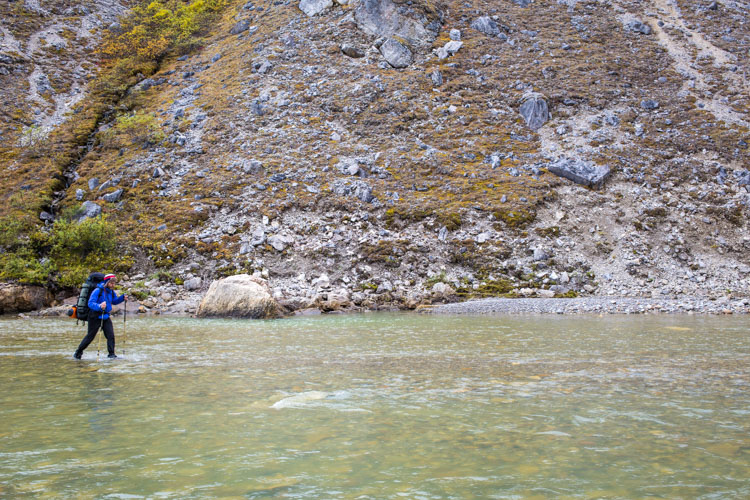
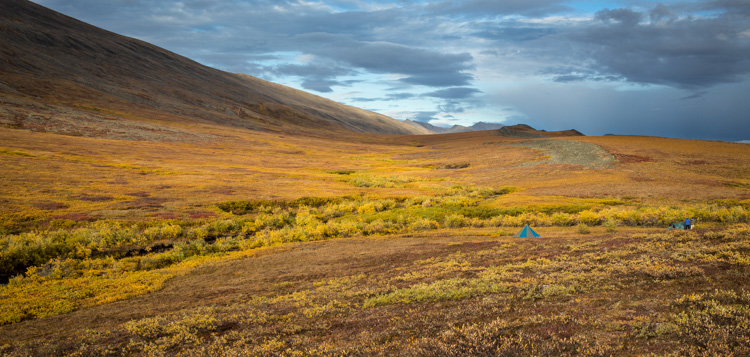
The route carried us through a narrow gap in the mountains cut by a small river. We walked through that gap on a cold, windy day when low clouds obscured the tops of the mountains. We had to criss-cross the river, and our feet were constantly soggy. But the willows along the creek and the small patches of tundra were bright with autumn colors, and a much-needed distraction from the cold.

Once on that first day, just once, I was stopped in my tracks by a scene that had to be photographed. I’d made photos earlier in the trip, but they’d been snapshots. This was a scene that inspired me; a rare thing.

The simple camera and lens setup removed much of the tedious decision making. There was no easy compositional escape in the form of a zoom lens, rather I had to move about to make the scene come together. I worked within the restraints of the lens (which were numerous), and it was utterly liberating.

AK-ANWR-Katakturuk-Canning-Packraft-1085-135

I gave the image five whole minutes before the chill forced us on, and for the first time all summer, five minutes wasn’t enough.

The following day, we woke to clouds, shredded by the previous day’s winds, and big patches of blue shone through, bright and optimistic. We hiked over a low pass, and watched a Grizzly sow and two young cubs graze in a sedge meadow a quarter mile and two hundred vertical feet below. My little lens didn’t have a prayer of making anything more than a token image of the brown specks on the tundra below. Instead I peered down through binoculars as the bears dug up sedges and combed berries from the bushes with their teeth.

AK-ANWR-Katakturuk-Canning-Packraft-1085-277

On the sixth day, the storm hit. We were camped on a meadow of soft, dry tundra above a small creek when the winds shifted from a pleasing breeze from the east, to a howling gale from the west. It happened in moments, the speed of the weather change taking me completely by surprise. Rain, then pelletized snow arrived, followed by a genuine snow storm in the night. For two solid days we were battered by the strongest winds and most intense storm I’ve ever experienced in the Brooks Range. Just keeping our tents standing was a constant battle.

AK-ANWR-Katakturuk-Canning-Packraft-1085-582

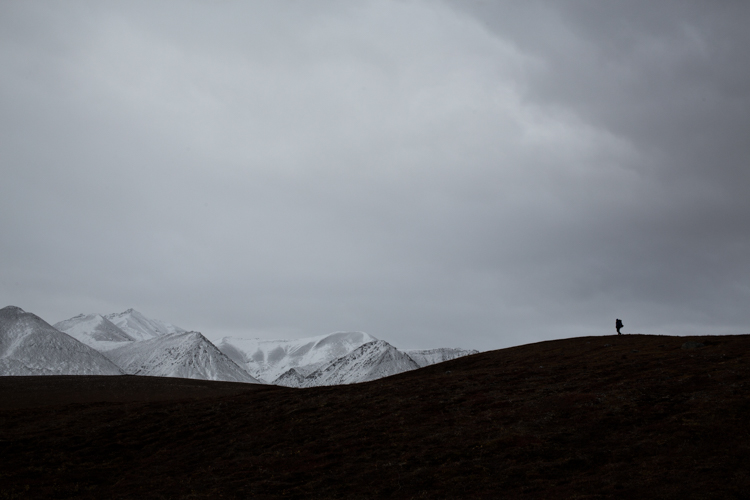
Yet in that time, my clients and I managed a few excursions away from camp. We climbed up to a low ridge where the full brunt of the west wind hit us hard. There, we leaned into the gale and watched the falling snow tear across the tundra.

It wasn’t a photogenic scene, at least not by traditional standards, and yet I made images because I wanted to. Creativity, quite suddenly, brightened up like a cartoon bulb over my head.

AK-ANWR-Katakturuk-Canning-Packraft-1085-504

On the third morning, before I even opened my eyes, I knew the storm had passed. My tent wasn’t shuddering in the wind, and when I did lift my eyelids, I could see the day was too bright to be dominated by clouds.

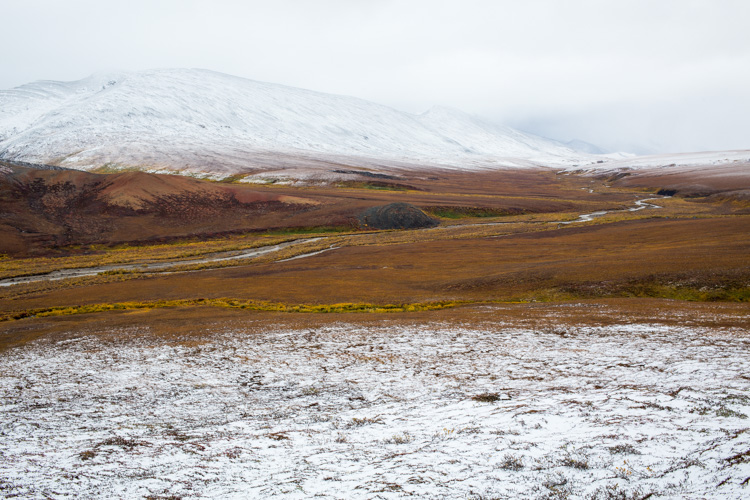
Emerging from my tent, I saw that fresh snow cloaked the mountains and dusted the tundra around our camp, but blue dominated the sky above. I went for my camera and spent a happy hour making images as the drenched tents and rain gear steamed in the rising sun.

AK-ANWR-Katakturuk-Canning-Packraft-1085-556

Two days later we reached the river and our cache of food and boating gear that had been waiting for us. In those two final days before we traded in our hiking boots for pack-rafts, I think I made more images than I had in the previous three months combined. I couldn’t get enough of it.

AK-ANWR-Katakturuk-Canning-Packraft-1085-384

The 50 miles of paddling stole some of my photographic productivity. (It’s hard to paddle a small bouncing raft through swift, splashing water while taking photos). Nonetheless, as we descended the river out of the mountains and onto the coastal plain, my renewed love for photography stuck with me. Even when another storm hit and we were pinned down for two more days, even when the snow fell in heavy wet flakes, and when the wind tore the autumn colors from the vegetation and shifted the landscape from red and yellow to brown.

AK-ANWR-Katakturuk-Canning-Packraft-1085-643

Our final camp lay where the river met its coastal delta. Caribou criss-crossed the plain in small bands, and migrant birds were congregating in the many lakes. My little lens was no match for the distant wildlife, but it didn’t matter. I’d rediscovered photography, which meant that I was more aware of my surroundings, and the images that lay in it, than I had been for some time. Even if I didn’t have the right equipment to capture some of the photos I found, I recorded them mentally in sharp detail. As it turns out, those mental images are just as rewarding as the ones glowing on my computer screen.

Paging through the images from the trip, I see an interesting evolution. The first images are mostly snapshots, but as time passed, and my inspiration picked up steam, the images become more purposeful, more composed… better, even.

Conclusion

Purposefully restricting yourself can be a great tool to boost creativity. It’s a little like playing charades: using limited tools to effectively get your message across. It can be fun, and a bit frustrating. It forces your mind outside its comfortable box, and into a place where creativity is far more important than gear. When, and if, you return to your diverse array of lenses and cameras, you will no longer take all those compositional possibilities for granted.

If you are stuck in a rut, or just want to try something new, give up your zooms for a couple of weeks, only shoot black and white, use your camera exclusively in manual mode, or shoot some film. After, share your experiences in the comments below, I’d love to hear what happens.

googletag.cmd.push(function() {
tablet_slots.push( googletag.defineSlot( “/1005424/_dPSv4_tab-all-article-bottom_(300×250)”, [300, 250], “pb-ad-78623” ).addService( googletag.pubads() ) ); } );

googletag.cmd.push(function() {
mobile_slots.push( googletag.defineSlot( “/1005424/_dPSv4_mob-all-article-bottom_(300×250)”, [300, 250], “pb-ad-78158” ).addService( googletag.pubads() ) ); } );

The post How Two Weeks in the Wilderness with One Prime Lens Restored My Love for Photography by David Shaw appeared first on Digital Photography School.


Digital Photography School

 
Comments Off on How Two Weeks in the Wilderness with One Prime Lens Restored My Love for Photography

Posted in Photography


2016 Roundups: Fixed Prime Lens Cameras

25 May

The fixed lens camera market may be a bit niche, but it’s here that you’ll find some of the best cameras you can buy. Sensors ranging from APS-C to full-frame are designed to match their lenses, which cover ranges from 28-75mm equiv., so image quality is top-notch. 

This segment includes both pocketable models without viewfinders to ‘best worn over your shoulder’ cameras with unique or ultra-high-resolution EVFs. There’s a gigantic spread in pricing, as well. The Fujifilm X70 and Ricoh GR II can be had for under $ 700, while the Leica Q sells for nearly $ 4500.

For those who want to zoom with their feet,  here are the fixed-lens cameras we think are worth a look:

  • Fujifilm X70
  • Fujifilm X100T
  • Leica Q (Typ 116)
  • Ricoh GR II
  • Sigma dp Quattro series
  • Sony Cyber-shot DSC-RX1R II

Articles: Digital Photography Review (dpreview.com)

 
Comments Off on 2016 Roundups: Fixed Prime Lens Cameras

Posted in Uncategorized


Prime time: Sigma 30mm F1.4 DC DN | C full-production sample gallery

20 Apr

We had our first opportunity to shoot with the Sigma 30mm F1.4 Contemporary at CP+, spending some time with a pre-production lens taking in Japan’s freshly snow-coated landscapes. With a full-production lens in hand and good weather in the air, we’ve put the Sigma 30mm through its paces a little closer to home. Designed for Micro Four Thirds and Sony E-mount cameras, the featherweight prime is at home on Sony’s a6300 and a6000. Take a look at what this combo can do.

Articles: Digital Photography Review (dpreview.com)

 
Comments Off on Prime time: Sigma 30mm F1.4 DC DN | C full-production sample gallery

Posted in Uncategorized


Pros and Cons of Photographing Dogs with a Prime Lens

05 Apr

DPS article 6

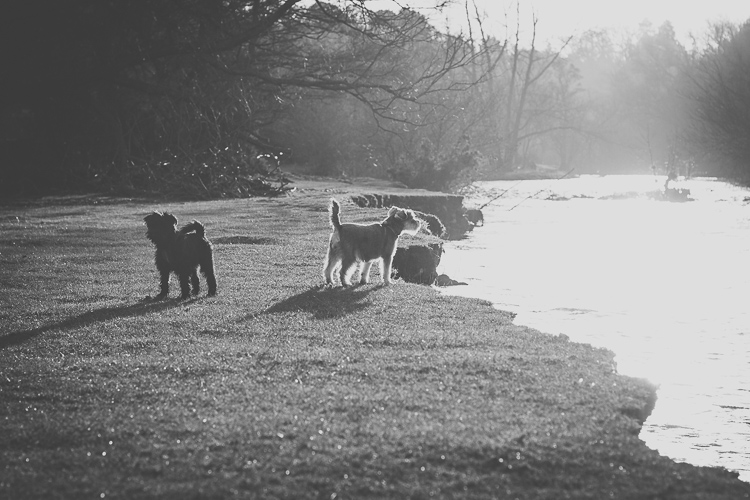
Dogs, by their very nature, are excitable creatures. Of course, they like nothing more than being outside and running around, chasing sticks, balls, and other dogs. All this can’t be conducive to prime lens photography, right? You want a good zoom lens for a job like this, surely? Well, not me. I love shooting my pet portrait sessions with my trusty Canon f/1.4 50mm prime, and I’m going to go through what I consider to be the advantages of doing so, and how best to overcome the disadvantages.

Pros – or advantages

Prime lenses are as quick as the dogs they’re snapping!

We’ll start with the obvious benefit of shooting with a prime lens – speed. The wider maximum aperture allows for faster shutter speeds, which means that you can freeze your sprinting pooch in action and get pin sharp images as they run (below).

DPS article 9
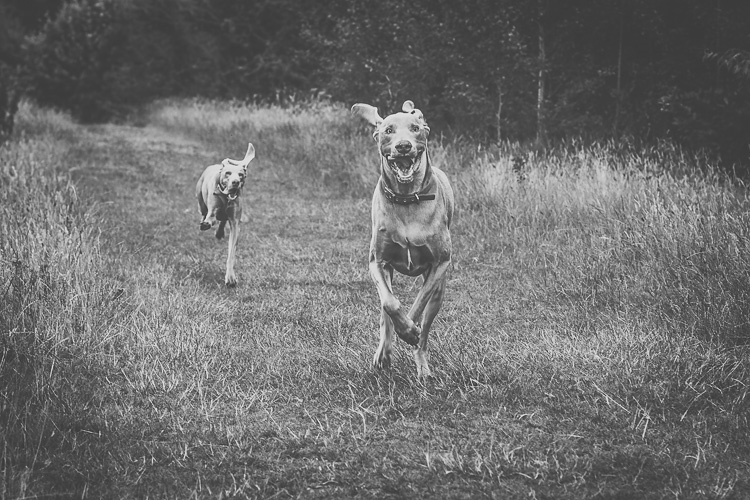
These two Weimaraners were sprinting full pace towards me. Fortunately my shutter speed was fast enough to freeze their movements in full flight.

Let’s not forget that the light conditions aren’t always going to be favourable. On dull, overcast, days you’ll be thankful for that extra couple of stops, rather than having to boost the ISO and bring noise into the equation.

Bearing this in mind, it’s also important to remember that as you’re widening your aperture to improve your shutter speed, you’re also narrowing your depth of field, so it’s about striking the right balance for the situation.

Image quality and sharpness

Another well-known advantage of shooting with a prime lens is the image quality. Prime lenses are much more simple than zoom lenses in terms of the components that make them, and the mechanisms that operate them. All in all, it’s widely acknowledged that prime lenses consistently offer an extremely high level of image quality.

DPS article 1

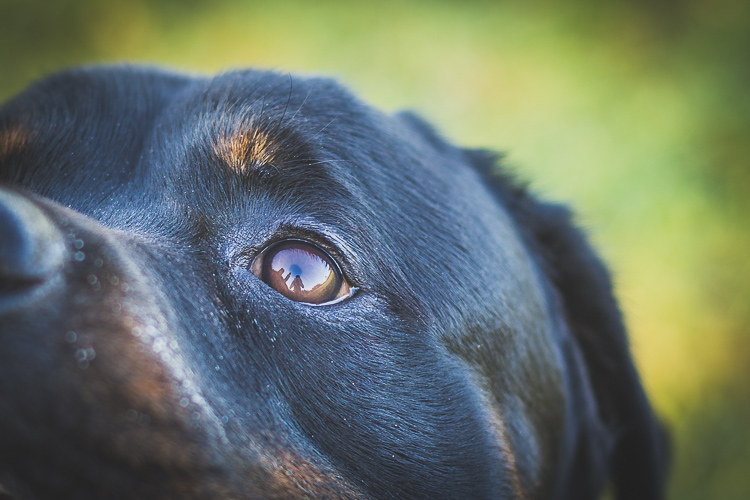
Sharper images are going to be a positive thing in any situation, but when you’re editing your images and you can zoom in to see all the details in the fur of your subject, and the glint in their eye, then you will really appreciate that image reliability.

You’re forced to focus on composition

This is an interesting one, and certainly an argument that crops up time and time again when talking about the benefits of prime lenses. If you only use zoom lenses, there can often be a level of complacency that sets in, especially if you’re relatively new to photography.

DPS article 4
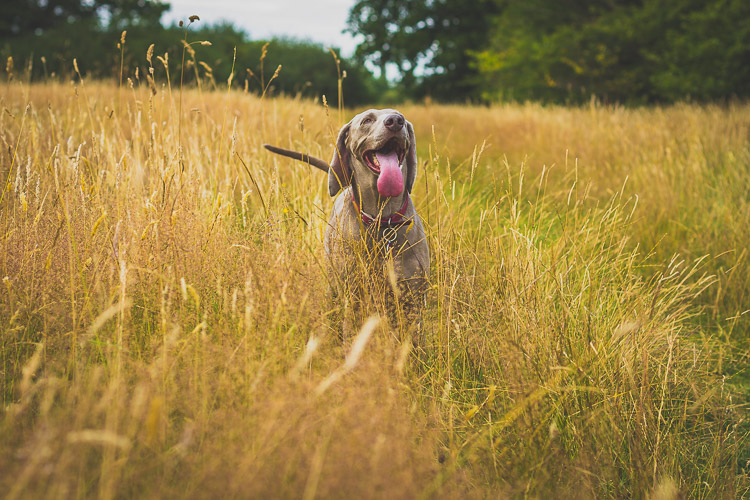
caption: If I’d been using a zoom lens on this shoot there’s a good chance I would have zoomed in for a tighter composition, with the subject in the middle of the shot. With that option unavailable to me I was able to think about it, and ended up giving the subject plenty of room on the right to run into, improving the overall composition of this image.

When you’re using a lens with a fixed focal length, you have no choice other than to move around with your subject. You’ll be constantly looking for different angles and opportunities, and eventually you will find yourself in the perfect position, one that you may never have found yourself in, if you weren’t using a prime lens.

Narrow depth of field

If you want to make the pictures of your dogs stand out, then a really tight depth of field is a great way to go about it. A prime lens will allow you to open your aperture to f/1.4 or wider, and really blur out that background, making your subjects pop.

The real benefit of this when you’re taking pictures of dogs is that, unlike human subjects, most of the time you’re not going to get the opportunity to place your dog in position with the ideal background. When you’re photographing dogs, more often than not you’re going to have to work with what you’ve got, and having the ability to blur out background distractions is a huge advantage.

DPS article 3

caption: I was at f/1.4 here, which allowed me to focus on the subjects mouth and nose, while completely throwing everything is the background out of focus.

Cons – or disadvantages

Having subjects that can move faster than you

So you’re out with your dog, and he’s running around at full pace for the best part of an hour. Trying to photograph a subject that is constantly moving around can be very tiring, and when you’re looking at your images and seeing a large percentage that will be unusable, it can be a little discouraging.

Something you need to be prepared for when taking pictures of dogs, is that you’re going to have a higher amount of rejects than usual. Unfortunately, this is the nature of pet photography. However, if you learn to embrace this, then you can get some really rewarding shots. Make sure you set your camera to high speed continuous burst mode, set your focus point over the necessary area on your subject, and fire away. Yes, you’re probably going to throw away 75-80% of them, but the ones you keep are going to be well worth it.

DPS article 8

Difficulty positioning yourself

You may find that one of the most daunting aspects of dog photography is knowing where to position yourself. You don’t have the option to zoom in, so where you are physically positioned is vital to getting the shot.

In order to limit the amount of opportunities you miss, you need to think a couple of steps ahead at all times. Where are your subjects likely to run next? If they’re going to head over there, then where will you need to be to get the best shot? Should you try to get higher than your subject, or should you prepare to get low in order to get down to their level? These are all questions that you should always ask yourself.

DPS article 7

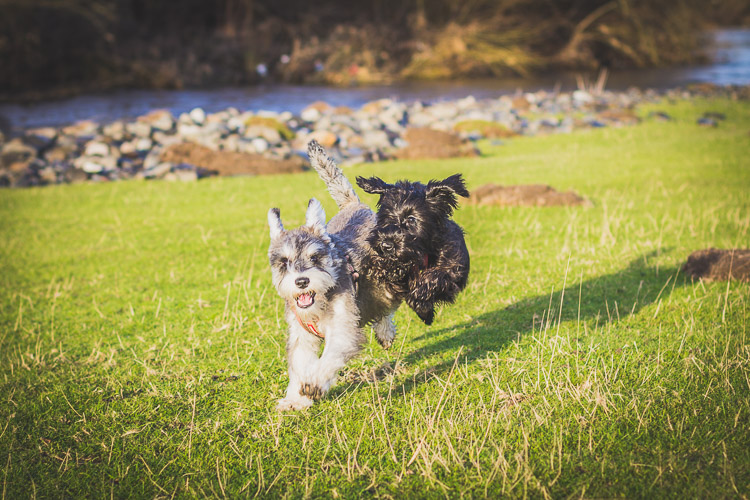
caption: These two Schnauzers were bundles of fun, but they never stopped moving. I constantly had to guess where they would be next. Often you’ll get it wrong, but sometimes you’ll get it right and nail the shot.

If you’re doing a pet portrait session then you could stand relatively close to the owner, ask them to throw a stick or ball (or pretend to). While the dogs are running away, get into position, and be ready for when they inevitably run back towards you.

Remember, your subject is likely to always be moving, so set your focus mode to AI Servo for Canon cameras, or AF-C for Nikon. These focussing modes are designed to continuously adjust focus on moving subjects to ensure that you have the best chance of nailing each shot.

DPS article 5

You end up too far away and have to crop heavily in post-processing

You don’t always need to get a close crop of your subject to end up with a great image. It’s fantastic when you can see their expressions close-up, or the actions of their body and legs as they run, but sometimes a picture of the dog playing in the distance, with a picturesque backdrop of an open field or wooded area, may be the perfect way to portray the scene.

DPS article 10

caption: Not zooming in on this shot allowed me to capture a greater sense of the atmosphere in this winters morning portrait session.

In summary

Hopefully this is enough to persuade anyone with an interest in pet photography to give prime lenses a try. You can pick up a nifty fifty prime for the fraction of the price of a decent zoom lens, and you’ll have real fun getting the most out of it. At the very least, you’re guaranteed an excellent workout!

DPS article 2

Do you photograph dogs or pets? Have you ever tried using a prime lens? Please share your results, thoughts and comments below.

googletag.cmd.push(function() {
tablet_slots.push( googletag.defineSlot( “/1005424/_dPSv4_tab-all-article-bottom_(300×250)”, [300, 250], “pb-ad-78623” ).addService( googletag.pubads() ) ); } );

googletag.cmd.push(function() {
mobile_slots.push( googletag.defineSlot( “/1005424/_dPSv4_mob-all-article-bottom_(300×250)”, [300, 250], “pb-ad-78158” ).addService( googletag.pubads() ) ); } );

The post Pros and Cons of Photographing Dogs with a Prime Lens by Ben Hughes appeared first on Digital Photography School.


Digital Photography School

 
Comments Off on Pros and Cons of Photographing Dogs with a Prime Lens

Posted in Photography


CP+ 2016: Hands-on with Tamron’s new SP prime lenses

26 Feb

CP+ 2016: Hands-on with Tamron’s new SP prime lenses

Tamron is showing off two brand new lenses at CP+ this year – the SP 85mm F1.8 Di VC USD (shown here) and SP 90mm F2.8 Di VC USD 1:1 Macro. The ‘SP’ in the model names stands for ‘Super Performance’ – a designation that Tamron reserves for its high-end optics. We headed to the Tamron booth today and got our hands on the new lenses, and Tamron’s upcoming TAP-in Console.

CP+ 2016: Hands-on with Tamron’s new SP prime lenses

First up is the SP 85mm F1.8 Di VC USD, which slots right alongside the previously-announced 35mm and 45mm F1.8 primes that Tamron released last year. Like those lenses it is relatively compact, but feels extremely solid and has a nice weight to it, balancing well on a Canon EOS 5D Mark III (provided by Tamron to get a feel for the how the lens handles). 

It’s worth noting the Nikon version of this lens uses an electromagnetic aperture control, rather than the traditional aperture lever.

CP+ 2016: Hands-on with Tamron’s new SP prime lenses

The 85mm features LD (low dispersion) and XLD (extra low dispersion) elements to reduce flare and ghosting and a fluorine coating on the front element to keep moisture and fingerprints at bay. Nine aperture blades ensure circular out-of-focus highlights. MTF (theoretical) curves suggest outstanding resolution and contrast. The VC system offers up to 3.5 stops of shake reduction (tested to CIPA standards) and its ring-type ultrasonic motor provides fast and near-silent autofocus when we tested this pre-production sample.

CP+ 2016: Hands-on with Tamron’s new SP prime lenses

It’s hard to see in this photo, but the lens mount of the new 85mm and 90mm SP primes is protected by a rubber gasket, to protect against dust and moisture incursion into the lens throat. Expected to be available in April in Canon and Nikon mount versions, a Sony A-mount version will follow later. Pricing is still TBC. 

CP+ 2016: Hands-on with Tamron’s new SP prime lenses

Next up is the SP 90mm F2.8 Di VC USD 1:1 Macro, which offers true macro 1:1 reproduction at a focusing distance of 13.9cm/5.5in. A 9-blade aperture ensures circular out-of-focus highlights. Tamron has been making a 90mm macro lens of some or other kind for a very very long time, and all of them have been extremely well-regarded. Our first impressions of the new 90mm are that in terms of handling, this might be the best yet. 

CP+ 2016: Hands-on with Tamron’s new SP prime lenses

Like the other recently-announced SP primes, build quality is very high, and just in terms of aesthetics, the new 90mm looks great. It seems that Tamron has been looking over its shoulder at Sigma’s ‘Art’ range and this is no bad thing. Like those lenses, all of Tamron’s new SP primes look more expensive than they are. The 90mm macro will be available next month for a very reasonable $ 649.

Again, we’ve only handled a pre-production sample but just from first impressions we’re excited to get it into our studio as soon as possible. 

CP+ 2016: Hands-on with Tamron’s new SP prime lenses

Tamron’s new ‘TAP-in Console’ is also distinctly Sigma-esque. (An early engineering sample is shown here). Available for Nikon and Canon-mount versions of the SP 85mm F1.8, SP 90mm F2.8 Macro, SP 45mm F1.8, SP 35mm F1.8 lenses (the older 35mm and 45mm primes will need updating at a Tamron service center) the TAP-in Console will allow users to calibrate their lenses for precise AF, at either end of a zoom and at three different subject distance ranges (near, mid, far), as well as adjust VC performance parameters. 

CP+ 2016: Hands-on with Tamron’s new SP prime lenses

Projected to be available next month, Tamron has not yet announced pricing information for the TAP-in console but after seeing coming to appreciate the value of Sigma’s dock, we’re very pleased to see this kind of solution being introduced by another manufacturer. Canon and Nikon take note…

Articles: Digital Photography Review (dpreview.com)

 
Comments Off on CP+ 2016: Hands-on with Tamron’s new SP prime lenses

Posted in Uncategorized