RSS
 

Posts Tagged ‘Photography’

Center Field – 9 Acceptable Ways For Breaking Rule of Thirds in Photography

22 Nov

When starting, most photographers tend to shoot all subjects center-frame. As they learn more about photography and composition, they learn that centering a subject is not appealing and that they must follow the ‘Rule of Thirds’ to have a good composition. What if I suggest breaking Rule of Thirds?

The Rule of Thirds

The Rule of Thirds is taking a frame and dividing it into three equal sections both horizontally and vertically, creating a rectangular ‘tic-tac-toe’ box. Framing a subject so that it falls on one of the four intersecting points of that box can sometimes make an image more appealing to a viewer engaging with it.

2 - Breaking Rule of Thirds in Photography

Implementing the Rule of Thirds.

While you may not perfectly frame your subject to fall within one of those four points, if your subject falls on one of the four internal lines within the box, in most cases, it still gives a better appeal than a centered image.

When It’s a Good Idea to Center Your Subject

1. Centering as a Compositional Tool

Placing your subject dead-center can work to your benefit if the subject still tends to comply with the Rule of Thirds guideline. Such as, when more than one point of focus falls on more than one line within that ‘Rule of Thirds’ box as shown in the image below.

The sets of pillars fall on one of the two vertical lines in the frame according to the Rule of Thirds even though the entire image is centered.

2. Place Focus on Your Main Subject

Sometimes when there is a busy foreground or background, placing your subject dead-center helps to draw the viewer’s attention to it. While the image below shows much texture, centering the stool brings focus to it.

4- Breaking Rule of Thirds in Photography

Bring better focus to a subject by centering.

3. Emphasize Symmetry

You may sometimes run into a subject that has a symmetrical value to it. The item could include columns at a building’s entrance, a person’s face or something with repetitional characteristics. Centering the subject, in this case, allows the viewer to relax because the order in the image makes sense.

5- Breaking Rule of Thirds in Photography

This nonsymmetrical image is not as appealing as the image below.

In the next image, there is a sense of order due to the equal number of pillars to the right and left of the fountain, producing symmetry.

6 - Breaking Rule of Thirds in Photography

This image represents symmetry.

4. Draw the Viewer’s Eye Inward

One of the most common goals for a photographer is to draw a viewer’s attention into the image instead of out of it. Straight roadways, paths, or sidewalks are great examples that keep your viewer’s attention within the frame – by drawing the eye inward.

The hall and chandeliers are centered taking the eye inward into the photo.

5. Create a Sense of Size and Space

Centering a subject can often showcase its size, especially when surrounded by people, buildings or other objects that serve as a comparison. Such as in the image below.

8 - Breaking Rule of Thirds in Photography

Centering a subject can sometimes emphasize the size of a subject.

Centering a subject can also give a sense of space. A good example is when there is water or cityscape in the foreground of an image and a clear sky in an upper part of the image. See an example below.

9 - Breaking Rule of Thirds in Photography

Centering the Eiffel Tower in this image works to show a sense of space.

6. Square Image Format

A great way to justify centering an image is when you use the square image format. A square has all equal sides in length, so placing a subject dead-center works well. I also like it because, in most cases, it’s an equal distance from the subject to all edges of the sides.

Centering the Eiffel Tower in this image works to show a sense of space.

7. Shooting With Shallow Depth of Field

When you open up your aperture and shoot with shallow depth of field around your subject, it creates a more three-dimensional feel, adding depth to your image. In this case, centering your subject works because it washes out distraction around your subject, as in the image below.

11 - Breaking Rule of Thirds in Photography

Shooting with a shallow depth of field.

8. Overcoming Location Difficulties

Sometimes the location of a fixed subject makes it difficult to capture a stunning shot. During these times try to get creative, as I did in the image of the clock at Grand Central Terminal in New York City below. I could’ve taken that shot from any number of directions or angles. However, for a better shot, I centered it at an angle that included the American flag in the background.

12 - Breaking Rule of Thirds in Photography

Center a subject to overcome location difficulties.

9. Simplicity

You know the saying, ‘less is more?’ While placing a subject off-center adds tension to an image, placing a subject dead center can give a calm and orderly feeling. In addition, placing your subject in a central position is like opening a book to its story. You are making it the most important element in the image. A natural environment, a natural face – it’s an open book. What is your subject’s story that you are introducing to your viewers?

13 - Breaking Rule of Thirds in Photography

Simplicity

Tying It Altogether…

Some ‘rules’ are meant to be broken. The Rule of Thirds is not the only way to guarantee a good composition. As long as you understand why you’re breaking the rules and foregoing guidelines with a specific intention, your images can be as compelling subject-centered as with your subject off-center.

The post Center Field – 9 Acceptable Ways For Breaking Rule of Thirds in Photography appeared first on Digital Photography School.


Digital Photography School

 
Comments Off on Center Field – 9 Acceptable Ways For Breaking Rule of Thirds in Photography

Posted in Photography


How to Apply Compositional Theory to Still Life Photography

21 Nov

The so-called ‘rules of composition’ aren’t so much rules as guiding principles.

Rules of Composition for Still Life Photography-Darina Kopcok-DPS

Why? Because not every compositional tool works for every image. Art is subjective, and what works well for one image may not work so well for another.

That being said, good photography involves not only technical skill but also choosing the right composition.

It’s especially true in still life photography, where composition can really make or break an image. So here are some tips on how you can apply these compositional ‘rules’ to your still life photography.

Rules of Composition for Still Life Photography-Darina Kopcok-Dps

The Golden Ratio

If you’re new to photography, you may have not heard of the ‘Golden Ratio’ (also known as the ‘Divine Proportion,’ the ‘Golden Mean,’ and the ‘Greek Letter ?’).

Don’t worry if you haven’t heard of them. While artists and architects have been using this principle for hundreds (if not thousands) of years, I was well into my stint at photography school before I’d even heard about it.

It’s a mathematical expression that can describe a wide variety of phenomena found in nature. But when it’s used in art, the results are harmonious and aesthetically pleasant compositions.

You can find the Golden Ratio everywhere – from the works of Michelangelo to the great Egyptian pyramids to a nautilus shell. It’s also found in the human face and body, and even in our DNA.

Rule of Thirds Grid

Most photographers are familiar with the ‘Rule of Thirds.’ This compositional guideline divides an image into nine equal sections using two horizontal and two vertical lines, just like a tic-tac-toe board. The important elements in the scene should fall along these lines or at the points where they intersect.

Rule of Thirds

The rule of thirds works well for images such as landscapes but can be limiting for still life photography. The resulting images often feel awkward or unbalanced.

The Phi Grid

The ‘Phi Grid’ uses a similar concept but is much more powerful than the Rule of Thirds. Its center lines are closer together and express the Golden Ratio of 1:1:618.

Phi Grid

The Phi Grid is one expression of the Golden Ratio.

Rules of Composition for Still Life Photography-Darina Kopcok-DPS

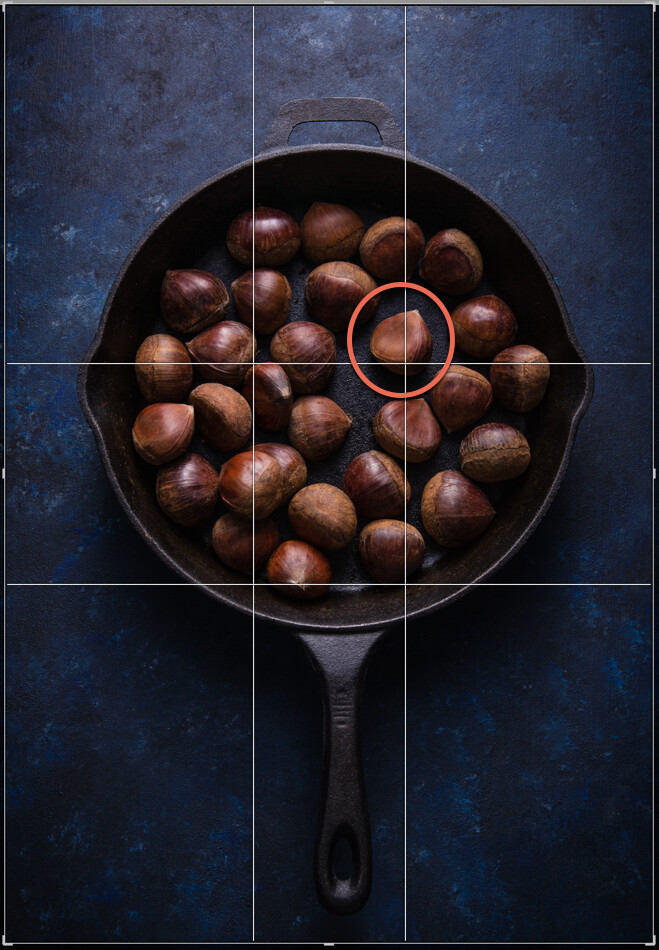
This image uses the Phi Grid. Notice how the chestnut in the focal point is placed differently to the others, drawing the eye.

Fibonacci Spiral

Another expression of the Golden Ratio is the Fibonacci Spiral, which exhibits the same numerical pattern that makes up the Golden Ratio.

You can use this numerical pattern to draw a series of squares. If you draw an arc from one corner to the opposite corner in each square starting from the smallest square, you’ll end up with the Fibonacci Spiral.

This is a guiding principle you can use in your still life photography. By setting your subjects along a curve rather than a straight line you create flow and movement, and help guide the viewer’s eye through the image. It works particularly well in overhead shots that have several elements in the frame.

You can flip or turn the spiral so long as your focal point falls in the smallest part of the spiral. Other important elements should be placed along the curve.

Fibonnaci Spiral

Golden Triangle

Using triangles is a powerful way to create tension in a still life image, and retain the attention of the eye within the frame.

Here’s an image that expresses this principle.

Rules of Composition for Still Life Photography-Darina Kopcok-DPS

Notice the diagonal line going from one corner to the opposite, and the lines meeting that diagonal from the other corners? Where the lines meet are your points of interest, which you should use to place your focal point and divide your frame.

While horizontal and vertical lines suggest stability, triangles add a sense of flow and movement.

You can compose your image to imply triangles, rather than being strict about composing them exactly this way.

Other Helpful Principles

Rule of Odds

In still life photography, having an odd number of elements in a frame is more visually interesting than having an even number of elements.

Odd numbers create harmony, balance and a resting point for the eyes, whereas even numbers compete with each other and can divide our attention.

Aim to have three or five elements in your image. You can have more, but the mind has trouble registering higher numbers meaning your photograph will not have the same effect. If you do have more, put them into groups of odd numbers wherever possible.

Rules of Composition for Still Life Photography-Darina Kopcok-DPS

Odd numbers create tension

Negative Space

Positive space is the area your subjects take up.

Negative space is the empty area where the eye can rest.

Negative space can provide the feeling of movement, and emphasize your subject. Without any space for the eye to rest, a picture can feel chaotic or claustrophobic.

You see negatives space a lot in magazines or product packaging, where it’s used for text placement.

Rules of Composition for Still Life Photography-Darina Kopcok-DPS

Color

You may not think of color as a compositional tool. But it’s actually a very important one. It evokes emotion and creates the mood of the photograph.

Cool and dark colors such as navy blue and black recede, while light and warm colors such as yellow bring objects forward.

Color combinations can be monochromatic, or any of those found on the color wheel.

One of the most powerful combinations is complementary colors (i.e. colors that are directly opposite each other on the color wheel). Blue and yellow is one such combination, which you see a lot in food photography.

Take into account the color of the background or surface you’re shooting on. Colors that are too bright can detract from your subject. Make sure your background matches the mood you’re trying to create and works harmoniously with your chosen elements.

Rules of Composition for Still Life Photography-Darina Kopcok-DPS

Complementary colors make your images pop

In Conclusion

It can take years for a photographer to learn to shoot intuitively using compositional principles. Visualizing your focal point on a Phi Grid is one thing, but visualizing the Fibonacci Spiral while you’re shooting may be more difficult.

Thankfully, with still life photography, you can tether your camera to your computer or use its Live View function to estimate where your subject and focal point should fall.

Editing software such as Lightroom and Photoshop can help you place the various elements in your frame with overlays of compositional guides. You can shoot wider than you need for the final result and crop in post-processing.

The more you implement these compositional guidelines and work with them in post the more you’ll internalize them, which can only improve your still life photography.

The post How to Apply Compositional Theory to Still Life Photography appeared first on Digital Photography School.


Digital Photography School

 
Comments Off on How to Apply Compositional Theory to Still Life Photography

Posted in Photography


Top Tips for Editing Music Photography

21 Nov

So in my last article, we looked at how you can get to shoot live music. Hopefully, some of you will have used that article as the motivation to actually get out there and shoot. Great! If you haven’t, what are you waiting for?

This time, I want to write based on a comment I received about how to edit music photography, with some top tips to get your music editing to rock god standard. There is no right or wrong way to edit photos. You have your style of editing, and I have mine, so when looking at this if you think ‘I prefer more contrast’ then simply add more contrast.

I use Capture One Pro editing software. I know a huge percentage of you use Lightroom, but in reality, things are very similar. The buttons are in different places, but they do the same thing. What I want to do with this article is give you some pointers, rather than an exact step-by-step guide. Like all good recipes, you need to adjust for your oven and how spicy you like your food. With that said, let’s get cooking.

Speed

The thrill of a gig fades, for the fans, for the bands and for the publications that put the images out there. While speed is not super important when editing for small bands, I would always advise you to get your editing done as soon as possible. That way if you are delivering images to the band, they will still be hyped about the show and seeing your amazing photos will make them even more excited.

When I am editing for a publication, the idea is to get the images out as soon as possible. Therefore my editing technique is designed with speed as a factor.  For portfolio images, or ones you love, by all means, go into Photoshop and remove things, touch up the skin, etc., But in general, this is not required.

This tight deadline means you have to sometimes decide against removing the distracting lights or fire exit sign. It is much quicker to do now that Capture One, Lightroom, et al. have these features built-in. However, be warned, you can still easily get caught up in this process.

Many of you may be starting out, so you can spend time finessing the details a little more. There are many great tutorials on DPS about Photoshop and more advanced editing techniques, so make sure you read up on them if this is something you want to do.

Editing Starts in Camera When Shooting

I can’t stress this enough. The tendency to overshoot is strong! In a digital age, we can shoot and delete so quickly that we get carried away. The thrill of being at an event shooting live music can add to this, as you want to get THE shot. However, try to restrain yourself a bit. Every image you shoot is something you have to go back to and edit, so bear this in mind. That said, I have been guilty and when a singer is bursting around the stage, shooting at the camera’s max FPS is something that can help you get that great shot.

Metadata (AKA the Boring Habit That is Good to Get Into Early)

Metadata is the information that is attached to your file. It includes camera settings etc., but when you shoot for organizations or stock agencies, you need to include metadata within your images. It is best to get into this habit early.

Make your contact information into a preset, so it can be added easily on import to save time. The first data you need to add is the content field, which contains the following sections:

Headline

Description

Category

The ‘Headline’ is simple. Put the name of the band performing live at XYZ Venue. If you have a shot of the lead singer, then add that information. For example, on this image, the Headline is ‘Diet Cig. Live at The Rescue Rooms Nottingham. Dot to Dot 2015.’

With the description following as ‘Alex Luciano of the New York band, Diet Cig play at Nottingham’s Rescue Rooms as part of the Dot To Dot Festival.’

I saved the most important until last – ‘Keywords.’ You use Keywords for image searches within your catalog, or within a picture library or publication where you have submitted the image. For example, on this shot, the image includes keywords such as ‘Fender Guitars’ and ‘Vans.’ It’s amazing how many times people ask for a musician playing a specific guitar brand, or playing in a particular brand. So make it easy on yourself and use keywords to find them. I think the weirdest request I had was for artists performing in slippers. Unfortunately, I have none in my catalog. However, this goes to show how keywording in all the details, may come in handy.

Start this process early. Otherwise, before you know it, you’ve shot so many gigs without it that the thought of adding metadata to so many images means you don’t do it at all. Get into the habit, and it is painless. Leave it until later, and you won’t do it. Trust me! My first year of shooting live music has no metadata to this day!

Culling Images

You now need to narrow it down to a reasonable set of images to edit. I recommend around 10 to 15 max. You have to be ruthless in this selection process! When choosing shots, you may need to focus on minute details (and sometimes even perceived differences) to narrow it down. The key here is to be ruthless. Just like a holiday slideshow from your relatives – no matter how fantastic you think they are, nobody wants to see all 128 shots of a band that are in focus and well exposed. You want a small set of images that capture the intensity of being there. That way, they have much more impact. You will wow people rather than have them thinking ‘isn’t this shot just the same as the last one?’

This is what a typical image out-of-camera will look like. The color is out, there are some exposure issues, but this is a great starting point.

White Balance / Color Correction

White Balance and Color correction are the hardest part. You find so many variations of color at a concert that getting a realistic skin tone may be impossible. In this case, you can either embrace the colors or go to black and white. It comes down to your eye, and you may have to compromise.

As the screenshots show below, in mixed light, this can be quite extreme because your cameras’ white balance can miss by quite a way. Regarding camera setting, I leave the white balance on auto. Lighting changes so much in a concert situation, that even guessing what mode to set it to is not practical. Leave it in auto. Let the camera do its best, and then (and I hate to use this term) fix it in post.

This is where you choose if you want it in black and white. Sometimes you have a great shot, but the color is beyond fixing (red light is killer, and for some reason, lighting guys love red!). So the only option is black and white. Now as I said in my last article when doing this for media outlets, black and white is generally a no-go, but for personal work (and even portfolio) there is nothing wrong with black and white. I love the look.

The other option is to go with the color and let it be part of the atmosphere of the photo. I have a shot of Ian Brown from the Stone Roses (whom I idolized as a youngster) looking through his tambourine and straight down the lens. The lighting meant that I would never be able to get natural skin tones, so I embraced the color and edited it with that in mind.

Alex Luciano of the New York band Diet Cig

Colour balance makes this image much better, but there is still work to do.

Exposure

Once you have your color set, you can begin to work on exposure. Similar to any other editing you do, but the main difference is how much you use the ‘recover highlights’ and ‘shadows sliders.’ Concert lighting is usually high contrast, especially if you have the background lights in the shot. Using the recovery sliders can help here. Background lights are generally the only time I do a bit of retouching. If I have a fantastic photo with a distracting background light, I quickly remove it. This is the beauty of only having ten images to edit rather than 75. You can spend a little more time with each image, even when you are on a tight turnaround. Another tip here is to lower the saturation to help take the edge of hard colors. You can also work with individual colors too, which helps.

For the image we are working with here, I reduced exposure by just under 1-stop and recovered the highlights. I also added a little clarity & contrast to the image for more punch.

Levels/Curves

For my final tweaks, I use ‘curves.’ You can also use ‘levels,’ but this is down your preference. Whichever you use, it is a case of working with each color channel to create a more balanced final color. Tweak the contrast until you are happy.

With the image we are using here, I tweaked the ‘mid-tones’ a little. I adjusted each of the red and green channels, making subtle changes (subtlety is key here) to get a better balance of color in the image.

Crop

If needed, you can crop the image. I’m not going to bore you with how to, but it is just something to keep in mind. Remember, a little crop can remove things like fire exit signs a lot quicker than Photoshopping them out.

Final Tweak

I always like to add a small vignette to my images. Usually very subtle, but I just like the way it draws attention to the subject. I think sometimes it is more a force of habit rather than necessary. Again, this is up to you.

Last Check

Walk away from your monitor for a couple of minutes. Grab a drink, or go to the bathroom. The key is to get away from the screen for a couple of minutes. You can easily push things like contrast too far without realizing. So take 2-minutes away then come back and check if you are happy.

The final image that went to the publication.

Copy, Paste, Tweak, Repeat.

When editing more images from the same show, the starting point is always copying and pasting the settings form the image you already edited. Generally, this gives you a great starting point. However, the lighting for the first song and the third song are not always the same, so you may have to start from scratch. As with anything, the more you do, the easier it becomes. 

Black and White

The color version of this show just wasn’t working for me, but I loved the energy, so decided to go black and white.

Finally, let’s go through black and white. I always follow the same process as for color photos as above. It helps me to know if a photo works best in black and white or color. With this image, I couldn’t get the color right. To me, it lacked something, but I loved the energy. So, I decided to try black and white instead.

When converting to black and white, I always start with a preset because I find ‘Capture One’ has some great ones. The preset is used to get the image close to what I want and then I tweak to my taste. Using black and white is a savior for when the light is mostly red. Red can make for some amazing black and white photos. However, when you know you have to deliver in color, it’s great that the sound of the music drowns out your swearing at the lighting technicians!

Black & White made this image pop, and a quick crop removed the distracting photographer to create this final image.


I hope you found this article helpful. Unfortunately, there is no preset or magic bullet to offer, as all lighting situations are different. However, I hope you found this article helpful for editing music photography images of your own. 

As always, pop any comments below and I will do my best to answer.

The post Top Tips for Editing Music Photography appeared first on Digital Photography School.


Digital Photography School

 
Comments Off on Top Tips for Editing Music Photography

Posted in Photography


Some Kansas City hotspots ban photography over growing disruptions

20 Nov

A number of Kansas City metro hotspots are putting up “No Trespassing” signs that specifically state ‘No Photographers,’ according to local FOX affiliate WDAF. The restrictions were prompted by ‘a few bad apples’ who would set up props for photoshoots in lobbies, doorways, and places that block traffic, the report states.

Both commercial and Instagram photography is reportedly disrupting certain iconic regions and businesses in Kansas City. Brett Judson, owner of local business Coven KC, explained to WDAF, ‘Besides setting up their fake house in our lobby, in our front door, they will block all the traffic under the 12th Street bridge to get that, like, beautiful family photo or a wedding photo.’

Some local photographers are speaking up about the issue, stating a minority of individuals are giving the entire profession a bad name. One such photographer is Marsha Baylor, who will join colleagues in cleaning up litter in some of Kansas City’s hotspots to help make the point.

‘They’re not the norm,’ Baylor told the local news station. ‘We are the norm. We are the people that step up and say, “This is not OK. This is not how the majority of us run our businesses.'”

Kansas City currently requires photographers to get a permit when shooting in parks if the sessions will ‘impact others and/or the environment,’ which includes using ‘lots of props/equipment,’ according to city parks’ website. A city spokesperson speaking to WDAF pointed out that there are no laws restricting photographers from shooting while on public property, but that doing so on private property with posted signs can be a trespassing issue.

In addition, Missouri Department of Conservation spokesman Bill Graham stated that the agency is working on a new policy that will impact commercial photography and videography in all of the region’s conservation areas.

Articles: Digital Photography Review (dpreview.com)

 
Comments Off on Some Kansas City hotspots ban photography over growing disruptions

Posted in Uncategorized


How To Easily Improve Your Street Photography Portraits

20 Nov

Planning and being intentional about your street photography portraits will affect the quality of your pictures. Have a clear idea of what you want to achieve. Think about what you need to do and where you need to be. Consider the time of day and how the light is. When will you most likely see a lot of people out and about?

The more purposeful you are about your street photography and what you want to achieve, the more you will build your own style.

Learn How To Easily Improve Your Street Photography Portraits Happy Market Porter in Chiang Mai

© Kevin Landwer-Johan

Snapping or Anticipating

Grabbing the action as it happens requires a tight combination of skill and good luck. Anticipating potential action before it happens can often mean you get more consistently good photographs. Either approach is a matter of personal taste and style.

I prefer to find a location where I’m comfortable, not in anyone’s way and not in the hot sun. Somewhere that gives me a good angle to capture the action as it happens.

Having a good knowledge of the location helps a lot. Being aware of the flow of life in any particular place will help you anticipate when you might get the best photos.

Learn How To Easily Improve Your Street Photography Portraits Market Shopping With Dad In Chiang Mai, Thailand © Kevin Landwer-Johan

© Kevin Landwer-Johan

Traveling often brings you to different and unfamiliar places. Learning to stop and observe before you photograph will give you a useful sense of the place.

In your own neighborhood, you should be more familiar with the pace of life and the feel of the streets. But it still doesn’t hurt to pause and pay attention. Look at what’s happening and see the patterns and repetitions.

Learn How To Easily Improve Your Street Photography Portraits Street Shave © Kevin Landwer-Johan

© Kevin Landwer-Johan

Find a balance between planning and spontaneity. Be ready. Over-planning can kill the natural feel. You don’t want to be creating overly contrived street photos. We’ve all seen too many of them.

Set Your Camera Subconsciously

Knowing your camera, especially its basic operations, is vital to capturing the decisive moments. It takes frequent and focused practice. If you rarely use your camera it’s harder to work with it fluidly.

Choose settings you’re comfortable with. Aperture priority is often popular because with street portraits there’s likely to be some movement. In aperture priority mode you can set your shutter speed so it’s fast enough to avoid motion blur.

When making portraits in the streets you generally have no control over the lighting. You need to choose appropriate locations where the light is good when you can. If you see someone you want to photograph and the light isn’t good, you’ll need to make some creative choices.

Aperture priority or any of the auto modes may allow you to make pictures more quickly. The downside is you’re restricted to whatever exposure the camera chooses unless you use exposure compensation. But this can slow you down as you may not have compensation applied when you most need it.

Learn How To Easily Improve Your Street Photography Portraits Buying Fruit © Kevin Landwer-Johan

© Kevin Landwer-Johan

Learning manual mode allows you to have tighter control of your exposures, and to know at a glance exactly what settings you’re working with. Yes, it takes more practice. But unless you practice you’ll never know the advantages you have when you’re in control. If you’re happy using an auto mode, stick with it and enjoy yourself.

Whatever mode you use, be confident with it. Being able to use your camera without having to focus on it allows you to participate more in your environment, which is particularly important when you’re making portraits.

To Connect or Not To Connect

I often like to connect and engage with the people I photograph in the streets. Whether you connect or not is a personal choice. But it can make a meaningful difference in the style of portraits you create.

Learn How To Easily Improve Your Street Photography Portraits Vendors Enjoying Their Portrait Being Made © Kevin Landwer-Johan

© Kevin Landwer-Johan

This couple sells eggs at their stall at a local rural market not far from our house. I hadn’t been to this market before and found it fascinating. Out of the thousands of people there, I seemed to be the only Caucasian. It wasn’t a tourist spot, and the locals obviously didn’t encounter foreigners often.

My intention was to photograph them. I started by photographing their trays and bags of eggs. While doing so I paid attention to their comfort level. If they seemed awkward with my presence I wouldn’t have talked with them. But they were happy and relaxed, so I asked if I could make their portrait. They gave me a positive response.

In other circumstances, it’s best to just stand back and let life go on. Interrupting the flow can prevent you from getting natural images. I never hide my camera. I’m constantly looking to see whether the people I photograph are uncomfortable with my presence. Being in northern Thailand I find this approach is important. People here are generally very polite and I think it’s important to show respect.

Learn How To Easily Improve Your Street Photography Portraits Life Goes On © Kevin Landwer-Johan

© Kevin Landwer-Johan

Cultures and the nature of people vary from country to country. Even in the same country, the characteristics of people can be vastly different. For example, people in Bangkok tend to be less friendly and relaxed. Wherever you’re making street portraits, it’s important to have a feel for the location and the vibe of the people.

Sometimes it’s best to boldly get in people’s faces. In other locations with other people, this could land you in trouble. Read situations carefully and adjust the way you do things to suit.

If you choose to approach people and engage with them, be aware that your manner will influence them. Greeting someone with a smile and showing interest in them and what they’re doing usually brings a positive response. Even if they decline to have their portrait made, you can stills enjoy some conversation.

Being confident with your camera when you do engage with someone means you can give your attention to them and not so much to your camera.

Learn How To Easily Improve Your Street Photography Portraits Samlor in Chiang Mai, Thailand © Kevin Landwer-Johan

© Kevin Landwer-Johan

Practice Your Method Consistently

Method is important. Find your groove and stick with it. If you try something only once, you’ll never master it. If you frequently change methods it will take a long time to build your skills and style.

Find the camera settings and lens you enjoy the most and use them. Pick locations you’re comfortable with and revisit them often. Get a feel for what happens there and how to photograph it. Go there when the light and activity are positive for you.

Connect or not. Try both ways, even if you’re uncomfortable to connect with strangers. I used to be petrified too. Working as a newspaper photographer I had to push myself beyond my comfort zone. And that made me a better photographer.

Learn How To Easily Improve Your Street Photography Portraits Happy Kid © Kevin Landwer-Johan

© Kevin Landwer-Johan

Repeating the same method of making street portraits will help you get a feel for your favorite way of working. Find your groove, but don’t get stuck in a rut. When you’re not enjoying it as much anymore it’s time to change before your creativity stagnates.

Try This

Choose your location and time of day you’re most likely to make some street portraits.

Learn How To Easily Improve Your Street Photography Portraits Happy Kid © Kevin Landwer-Johan

© Kevin Landwer-Johan

Visit this place five or ten times and make at least five portraits when you don’t engage with your subjects. Then do it again, only this time make at least five portraits when you do engage. You may be uncomfortable when you start. But if you persevere you may just find that you love the experience and make some great portraits.

The post How To Easily Improve Your Street Photography Portraits appeared first on Digital Photography School.


Digital Photography School

 
Comments Off on How To Easily Improve Your Street Photography Portraits

Posted in Photography


One Light Set-Up For Food Photography

19 Nov

One Light Set Up Food Photography-Darina Kopcok-DPS

When it comes to food photography, the natural light look is highly sought after.

However, it’s difficult to create consistency with natural light because the sun is always moving.

Most pro food photographers use artificial light to really take control of their lighting.

Using artificial lighting doesn’t have to be complicated, though.

Unless you’re doing some types of advertising or food product photography, you can get away with using just one light.

One light is ideal for shooting food for blogs, restaurants, and the editorials you see in popular foodie magazines. You can easily mimic window light, with one set of shadows on your food.

One Light Set Up Food Photography-Darina Kopcok-DPS

Types of Artificial Light

You can choose from several types of artificial light sources.

The most common approach is to use a strobe like a mono head, which is a self-contained flash unit.

If you’re shooting advertising or product, you need to get to high number F-stops like F/22 to achieve the sharpness required without getting lens diffraction that usually goes along with it.

For these types of shoots, you will need a lot of watt power and most likely you will need to rent powerful battery packs.

However, for editorial type shoots, all you need is a 500-watt strobe. You can even use a speedlight with the right modifier.

Some food photographers like to use a constant light, like an LED light panel, so they can see where the shadows are falling before they press the shutter.

One Light Set Up Food Photography-Darina kopcok-DPS

Before You Shoot

Before you shoot, you should think about what you want your final image to look like.

Do you want the light to look soft and airy, or are you looking for deep shadows and striking contrast?

Do you want your light to be soft or hard?

The more contrast you have between light and dark, the more dramatic your image will be.

Your subject will often dictate the style you choose. For example, ice cream has the connotation of summer and is usually brightly colored, thus soft light or a bright and bold look makes sense.

Whether you choose soft light or hard light, your light source should be diffused to give you a nice blur in the gradations where the light and dark meet.

One Light Set-Up For Food Photography-Darina Kopcok-DPS

Types of Lighting Styles

Side Lighting

One Light Set Up Food Photography-Darina Kopcok-DPS

Imagine the face of a clock.

If you picture your light placed at 9:00, this is side lighting.

It can also be placed at 3:00.

However, in the Western world, we read from left to right. Our eyes first gravitate to the brightest part of an image, so it makes sense for our light to be coming from our left-hand side.

This is not a hard-and-fast rule. Each side will affect how the light looks in your photograph, depending on your composition.

The next time you shoot, try taking a picture with your light positioned at 9:00, and then move your light to take a shot at 3:00. Notice the difference in your final result.

Side lighting is a good approach for a lot of food photography, as it works well for most set-ups.

Place a large softbox close to your table. The bigger your light source, the softer the light will be. Soft light is a desirable look in food photography.

Place a reflector or bounce card opposite to the light to bounce some of it back into your scene. Move it closer or farther away, depending on how much shadow you want. Even when shooting white or bright scenes, you still want some shadows to add dimension.

One Light Set Up Food Photography-Darina Kopcok-DPS

Side lighting

Backlighting

http://www.sylights.com/lighting-diagrams/editor-Darina Kopcok-DPS

Backlighting is when you position your light behind your food, at 12:00.

This is a great choice for beverages and soups, as it adds a sheen and highlights texture and the liquid properties of food.

It can be very flattering to food, but it can also be challenging to work with because your image might be too bright and blown out at the back and too dark on the front. Or it can just look too washed out, which is what happens when you shoot with too much light.

You can also end up with too much reflection on the top of the food.

Backlighting also emphasizes drastic color contrasts that can be difficult to balance.

So be aware of these challenges when choosing to use backlighting.

One Light Set Up Food Photography-Darina Kopcok-DPS

Backlighting emphasizes texture


Side Backlighting

http://www.sylights.com/lighting-diagrams/editor

This is a combination of the two previously mentioned lighting styles, when your light is placed at 10:00 or 11:00.

With this style, you get the best of best worlds; the surface shine of backlighting without the risk of overexposure at the back of the photo. You also don’t have to reflect as much light onto the front of the food because the light is coming from an angle.

The reflector is opposite your light source.

The key is to play around with the height of the light relative to your scene, depending on how you want your shadows to fall.

One Light Set Up Food Photography

Side Backlighting

Other Lighting Styles

At this point, it bears mentioning that there are a couple of lighting styles that don’t work for food photography.

Front lighting is often used in portraiture, but it looks terrible on food. It can cast unwanted shadows and your images will look flat and lack dimension.

Lighting from overhead also creates flat images.

Lighting Modifiers and Tools

The most commonly used modifier in food photography is the softbox. The larger, the better.

However, the most used modifier in my own arsenal is a dish reflector with a 20 or 30-degree honeycomb grid.

A honeycomb grid cuts off the light and narrows it, which creates stunning contrasts in food photography.

You also need a large diffuser when working with artificial light. If you’re using a strobe or a speedlight the explosion of light won’t fall off as quickly as it does with natural light, and will give you hard shadows if not diffused, which is usually not ideal.

Also, you’ll need something to bounce and absorb light.

You can buy a 5-in-1 reflector kit, which will have diffusion material as well as a silver reflector to brighten the food and a gold reflector to add warmth.

Alternatively, you can use black or white foam core. White will brighten your scene, while black will absorb the light. I use black in my dark and moody food photography to create deep shadows.

One Light Set Up Food Photography-Darina Kopcok-DPS

My Go-To Lighting Set-Up

I mentioned that I use a dish reflector with a honeycomb grid for my food photography.

You may be wondering what results you can get from shooting that way, but all of the images in this article were shots using this set-up.

The key to success in using this modifier is to have a large diffuser placed at the edge of your table and put the light one to two meters away, depending on how much light you need on your set.

This set-up will mimic window light beautifully because the diffuser actually becomes the light source, not the strobe. The bigger the diffuser the better, so as to keep unwanted light from spilling over the set. My diffuser is 150×200 cm/59x 79 inches!

One Light Set Up Food Photography-Darina Kopcok-DPS


In Conclusion

If you’re just starting to shoot with artificial light for food photography, focus on using side lighting until you feel more comfortable tackling backlighting.

With a bit of practice and some tweaks, you’ll finesse your set-ups to work best with your style of food photography.

Share with us in the comments below your food photography images and any other tips you may have.

The post One Light Set-Up For Food Photography appeared first on Digital Photography School.


Digital Photography School

 
Comments Off on One Light Set-Up For Food Photography

Posted in Photography


How To Stimulate Your Photography by Learning From the Best

18 Nov

Henri Cartier-Bresson said that “Your first ten thousand photographs are your worst.” Every successful creative spends boundless time, thought, and concentrated effort pursuing their passion. You can accelerate your photography education by learning from accomplished artists. One way to stimulate your photography is by reading quotes from not only photographers but creative people who express themselves in any medium.

I find stimulus from musicians, painter, authors, sculptors, and others. By reading the words of outstanding visionary artists, you can draw from the depth of their experience.

How To Stimulate Your Photography by Learning From the Best Thinking © Kevin Landwer-Johan

© Kevin Landwer-Johan

Whether you are coming to grips with camera settings when you are just starting out or seeking deeper motivation, if you’re already confident with your camera, you will do well to learn from those with more experience than yourself or your peers.

Be Part of an Ongoing Conversation

“I’m in the middle of a long conversation with my audience, it’ll be a lifelong journey for both of us by the time we’re done.” Bruce Springsteen (rock musician, author)

How To Stimulate Your Photography by Learning From the Best Portrait © Kevin Landwer-Johan

© Kevin Landwer-Johan

Photography is a communicative tool. Your style choice may be fine art or street photography. You may be interested in creating documentary photographs. Whatever your choice of style and subject, approach it as an ongoing conversation. Not just talking, but also listening.

Your best photographs express your feelings. They convey something of who you are. The best conversations are two-sided. Participate with your audience and listen to their feedback.

If you’ve never seen Springsteen perform live, find some of his concert clips on Youtube. He is a master in audience participation. He draws energy from his audience and is driven to return that energy in his performances.

How To Stimulate Your Photography by Learning From the Best Conversation © Kevin Landwer-Johan

© Kevin Landwer-Johan

It’s easier for rock stars to do this than photographers. Find people to give you feedback. Become part of other photographers creative conversations by sharing your feelings about their photography. You will grow together.

Work With the Raw Materials

“What makes photography a strange invention is that its primary raw materials are light and time.” John Berger (art critic, novelist, painter and poet)

Having a good grasp of the basics for anything you want to learn is the start of your journey towards success. Photography is all about light and time. Understanding the role that these two raw materials play in photography will make your journey more exciting and absorbing.

Throughout history, some of the greatest minds have devoted themselves to the understanding of time and light. As a photographer, you need to constantly consider these two raw materials of your craft. Not in such a deep way as to invent time travel, but at least in how they relate to the story you are telling with your photographs.

How To Stimulate Your Photography by Learning From the Best Light and Time © Kevin Landwer-Johan

© Kevin Landwer-Johan

“Embrace light. Admire it. Love it. However, above all, know light. Know it for all you are worth, and you will know the key to photography.” George Eastman (founder of Kodak)

Practice Always

“Photography is the simplest thing in the world, but it is incredibly complicated to make it work.” Martin Parr (photographer)

Commitment over time makes a huge impact on your achievements. Photography is actually quite simple, but to make a truly great photograph in our lifetime will probably elude most of us. This should not stop you putting in the effort because there is always an element of luck. Unless you are practiced and prepared, when luck happens, you may miss it.

How To Stimulate Your Photography by Learning From the Best Cart Racer © Kevin Landwer-Johan

© Kevin Landwer-Johan

Whatever you like to photograph, work on it. Not once a month, or even once a week. Make a point of taking at least one photo a day and learning, or improving one technique. Focus on a few topics you love and make projects of them. You will see your progress more readily if you do.

On Portraiture

Be more than a person with a camera when you are making portraits. Engage in dialogue. This way your subject becomes an integral part of your photography conversation, and not just a ‘sitter’ for a head shot.

“Who sees the human face correctly: The photographer, the mirror, or the painter?” Pablo Picasso (painter, sculptor, printmaker, ceramicist, stage designer, poet, and playwright)

How To Stimulate Your Photography by Learning From the Best Portraiture © Kevin Landwer-Johan

© Kevin Landwer-Johan

You could argue that some of the faces Picasso painted are barely recognizable as people. He expressed himself like no other person before him. Study him and read his quotes. You can learn from a master who was one of the most influential creatives in history.

Portraiture is probably the most common photography subject (even if you exclude selfies.) There is nothing complicated about choosing to photograph a person, but the complexities in making an outstanding portrait are many.

“A portrait is not made in the camera but on either side of it.” Edward Steichen (photographer, painter, and art gallery and museum curator)

On Street Photography

“It’s easy to penetrate someone’s privacy. People are glad you’re there to see them, cos no one’s paying attention.” Bruce Davidson (photographer)

How To Stimulate Your Photography by Learning From the Best Street Photography © Kevin Landwer-Johan

© Kevin Landwer-Johan

Our perceptions of street photography are as varied as the number of photographers who engage in it. Bringing yourself to step out into the world, record it as you see it, and then share the photographic conversations you have, is challenging for many people.

Jumping into the shoes of experience will ease this pain. Guys like Bruce Davidson have been approaching strangers ‘cold’ for decades. Use the voice of this experience to guide you and motivate you.

Street photography is popular. There are a lot of new photographers producing some wonderful work. These pictures can do a certain amount to inspire, but there is no depth of experience to really lean on.

How To Stimulate Your Photography by Learning From the Best Street Portrait © Kevin Landwer-Johan

© Kevin Landwer-Johan

On Documentary Photography

“I’m not an artist. An artist makes an object. Me, it’s not an object, I work in history, I’m a storyteller.” Sebastiao Salgado (photographer)

Our photographs can change the world. Photographs can change us. As a young guy with a camera, seeing photos and reading articles with quotes from the greats like Henri Cartier-Bresson, Sebastiao Salgado, Dorothea Lange, and other accomplished documentary photographers inspired me. These are the things that drove me.

How To Stimulate Your Photography by Learning From the Best Documentary Photography © Kevin Landwer-Johan

© Kevin Landwer-Johan

Before the internet, we shared photos differently, being mostly restricted to printed pictures. Inspiration happened in the pages of books and magazines and sometimes on art gallery walls. Carefully curated bodies of work published in Time, Life, and National Geographic, accompanied by well-written, carefully edited articles, provided a richness difficult to find on Instagram or other social media platforms.

If you feel strongly about something, photograph it. Make it an ongoing project. Let it span months or even years. But do not rely on only yourself. Look to those who have gone before you. Listen to their music, read their books, and study their photographs. Bring them into your creative conversation so that you stimulate your photography.

“Photography takes an instant of our time, altering life by holding it still.” Dorothea Lange (photographer)

The post How To Stimulate Your Photography by Learning From the Best appeared first on Digital Photography School.


Digital Photography School

 
Comments Off on How To Stimulate Your Photography by Learning From the Best

Posted in Photography


Weekly Photography Challenge – Doorways

17 Nov

This week’s photography topic for our weekly challenge is DOORWAYS!

Doorways – Beechworth Mayday Hills Asylum Victoria by Caz Nowaczyk

I’m a big fan of photographing doorways. There is so much mystery behind them. They are an opening to other possibilities and secret worlds…

Post a picture of a doorway, or peering through one.

Beechworth Mayday Hills Asylum Victoria by Caz Nowaczyk

Check out some of the articles below that give you tips on finding and shooting doorway pictures.

Architecture: Photographing Exterior Details

Photographing Buildings [Composition Tips]

You may like to try adding some black and white or split-tone effects to your image:

How to Create Silky Split Toned Black and White Photos Using Luminosity Masks

Photography Weekly Challenge – Doorways

Simply upload your shot into the comment field (look for the little camera icon in the Disqus comments section) and they’ll be embedded for us all to see. Or if you’d prefer, upload them to your favorite photo-sharing site and leave the link to them. Show me your best images in this week’s challenge!

Share in the dPS Facebook Group

You can also share your images in the dPS Facebook group as the challenge is posted there each week as well.

If you tag your photos on Flickr, Instagram, Twitter or other sites – tag them as #DPSDOORWAYS to help others find them. Linking back to this page might also help others know what you’re doing so that they can share in the fun.

The post Weekly Photography Challenge – Doorways appeared first on Digital Photography School.


Digital Photography School

 
Comments Off on Weekly Photography Challenge – Doorways

Posted in Photography


Skylum partners with EyeEm to launch global photography scholarship

16 Nov

Software company Skylum and mobile image sharing community EyeEm have teamed up and launched a global photography scholarship that is open to anyone interested in photography. Skylum Software will be supporting 10 artists on the EyeEm platform with $ 10,000 to help them focus on their photography.

In addition the selected photographers will be able to create editing presets for the Skylum Luminar software. The presets will be available to purchase on the Luminar marketplace as part of a special collection. Revenue from preset sales will be shared 1/3 with the artists.

Skylum CEO Alex Tsepko said: “Our focus has always been to provide artists with the best photo enhancement tools, and collaborating with a creative community like EyeEm to empower next generation of creatives is just a natural fit”.

If you want to apply for the scholarship you’ll need an EyeEm acccount, have an impressive portfolio, and convince the decision makers that your work is standing out. Submissions are open from now until December 2. You’ll find more information and the submission form on the EyeEm website.

Articles: Digital Photography Review (dpreview.com)

 
Comments Off on Skylum partners with EyeEm to launch global photography scholarship

Posted in Uncategorized


How to Make Easy and Affordable DIY Food Photography Backdrops

16 Nov

In this helpful video by Joanie Simon of The Bite Shot, she explains how to do DIY Food Photography Backdrops that are both affordable and easy. Costing you less than US$ 30 per backdrop!

??

Before beginning, please be sure to use your spray paints outdoors and always paint in a well-ventilated area.

Things you will need:

  1. Laminated plywood
  2. Paint scraper/palette knife
  3. Joint Compound (used for drywalling)
  4. Oil-based spray paint
  5. Chalky finish acrylic paint
  6. Acrylic or oil-based metallic spray paint.

When you pick out your paint, ensure that you choose paint that has a matte finish to stop glare and reflection.

Stick to colors that are subtle so that your food is the star. For example, browns, topes, cool greys, mossy green, and robins blue.

Step 1:

Use the scraper/palette knife to apply the Joint Compound to the board. Allow it to be organic and textural. Explore cross-hatching and mixed textures for different boards.

Let it sit for a few minutes and drag the palette knife across the applied compound to flatten it a bit while still leaving interesting grooves and patterns.

Let it dry overnight (24hrs).

Step 2:

Apply your darker peak-through color first (oil based spray paint). There is no need to apply full coverage as the other colors will be overlayed.

Step 3:

Next, brush on your chalky finish paint. You can use a short blending brush. Brush, stipple, use circular motions to blend over the previous color so that the peak through color still shows through.

If you put too much on, you can use a damp cloth to wipe the acrylic paint back off.

Step 4:

Take your colored spray paint and just spray sections from a distance to give light coverage for extra tone and texture.

Step 5:

Spray a little water onto your board and spray your oil-based metallic paint over it. The paint won’t adhere to the areas of water. Wait ten minutes for the paint to dry and once it is dry, wipe the water off. You are let with a really cool effect.

Step 6:

Take your other boards and play around with these techniques using your different tones and textures.

Step 7:

Apply a matte finish spray to your boards to protect the surface. 2-3 coats will do the trick.

Please share with us any of your DIY food photography backdrops in the comments below.


You may also find the following helpful for your food photography:

Food Photography – An Introduction

5 Tips to Seriously Improve Your Food Photography Techniques

Are You Making These Five Food Photography Mistakes?

Household Items to Bring to Your Next Food Photography Shoot

The Secret to Finding the Hero Angle in Food Photography

The post How to Make Easy and Affordable DIY Food Photography Backdrops appeared first on Digital Photography School.


Digital Photography School

 
Comments Off on How to Make Easy and Affordable DIY Food Photography Backdrops

Posted in Photography