RSS
 

Posts Tagged ‘Photography’

Winners of the ViewBug Landscape Photography Contest

07 May

The wait is FINALLY over!!! The Winners of the ViewBug Landscape Photography Contest Are…

Grand Jury Winner

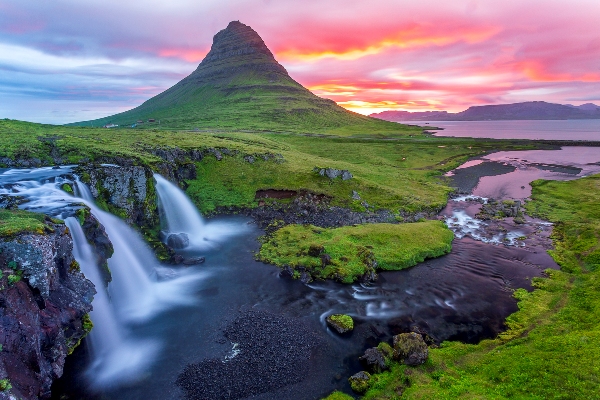
Grand Jury Winner – Church Mountain Falls

A BIG thank you to everyone who entered our recent Landscape Photo competition. The winners receive Year Long PRO Subscriptions from our friends at ViewBug.

ViewBug LogoThe response was amazing with THOUSANDS of entries. The response was so great that the team at ViewBug wants to invite ALL of the Digital Photography School readers to register for a free basic membership to ViewBug. Start participating in all theViewBug photography contests now! To register now, click HERE.

But first – here are the winners of the competition, and an extra special thank you to Guest Judge, professional photographer, Chris Burkard:

  • Grand Jury Winner “Church Mountain Falls – Redux” by Scott Don Schikowski
  • Runner Up “Dune Rise” by Tra Rader
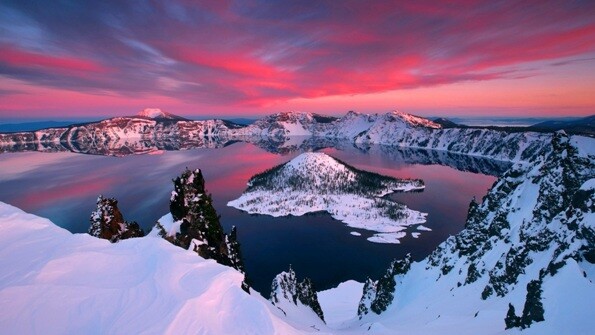
  • Runner Up “Crater Lake Winter” by Lugji Photography
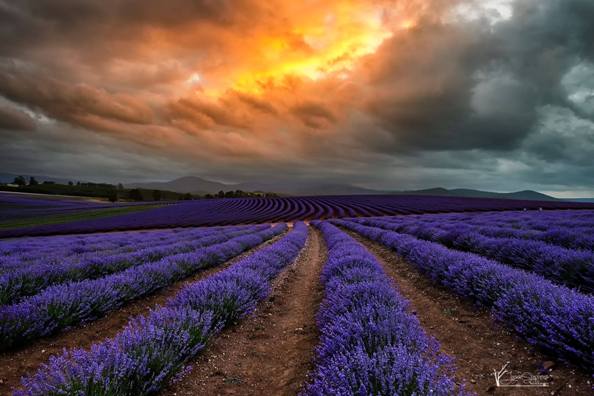
  • People’s Choice Winner “Lavender Delight” by Jason L. Stephens

And now, the Winning Photographs!

Grand Jury Winner – Church Mountain Falls

Grand Jury Winner

Runner Up – Dune Rise

Runner Up 1 Tra

Runner Up – Crater Lake Winter

Runner Up 2 Lugji

People’s Choice Winner – Lavender Delight

People s Choice

Thanks again to everyone for entering and to ViewBug for sponsoring this competition. Don’t forget to sign-up for your complimentary basic membership here.

The post Winners of the ViewBug Landscape Photography Contest by Darlene Hildebrandt appeared first on Digital Photography School.


Digital Photography School

 
Comments Off on Winners of the ViewBug Landscape Photography Contest

Posted in Photography


FlashQ: The little cube for flash photography

07 May

20140330022436-PB05_640b.jpg

An IndieGoGo project called FlashQ seeks to make wireless flash triggers small in size and stylish to look at. The FlashQ is a 2.4Ghz wireless trigger and receiver system that mounts to a camera’s hotshoe and a flash’s hotshoe adapter. The compact device is aimed at owners of mirrorless cameras and other small camera bodies. Learn more

News: Digital Photography Review (dpreview.com)

 
Comments Off on FlashQ: The little cube for flash photography

Posted in Uncategorized


How to do Great Photography Even When Your Surroundings are Boring

07 May
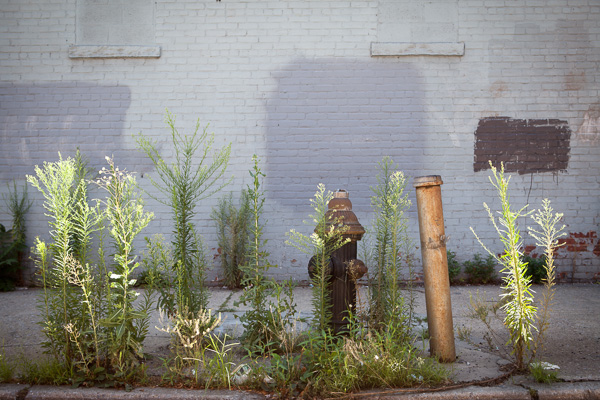
Gowanus Fire Hydrant

Gowanus Fire Hydrant

I have always been fascinated with great photography taken in areas that people might commonly refer to as ‘boring.’

I use the word boring because that is the specific word I most often see used as an excuse for people having trouble with their photography. Someone will say, “I wish I lived somewhere more interesting and beautiful”or “I can’t do interesting work where I live. It’s too boring.”. Can you relate to that?

What these people don’t realize is that what might seem boring and routine to them could seem fascinating to others, and by dismissing where they live they do not even give themselves a chance to try and photograph it in an interesting way.  They take themselves out of the game before they even start.

When someone uses the word boring, I tend to think that they mean quiet and not traditionally picturesque, or maybe there are not many people around and the ones that are around seem uninteresting.  These are not reasons that you cannot take an interesting photo. In fact, these topics all sound fascinating to me. Use these aspects to your advantage and figure out ways to make them interesting, photogenic, and appealing. Also, keep in mind that often the people that seem the least interesting, actually tend to be the most interesting.

Here are some tips to capture interesting photos in ‘boring’ places, and I hope after you read this article you will never use the word boring again.
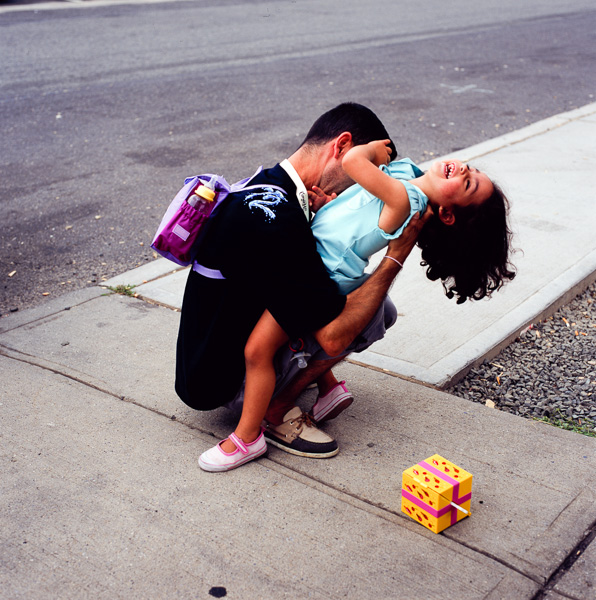
Capture images of people you come across in everyday situations

Capture people that you come across in everyday situations

Take a camera with you on everyday excursions

Many people have the habit of only taking their camera out when there is supposed to be a picturesque moment. Maybe it’s a sunset, or to the park, or on a trip. This is a tough way to shoot because you already have the images you want to capture in your mind before you take them.

The goal here is to not stop yourself from taking images before you even start. The more ‘boring’ you think the place is, the more you should bring out your camera. Go into a situation with the mindset that you are going to figure out how to take an interesting photo no matter what happens.

Try to create interesting images in the course of your everyday life. Photograph your neighborhood. It could be at the gas station, at a roadside diner, in a supermarket, in a parking lot, or stopping on a quiet street corner at dusk. For me, this is the true fun of photography. It’s a way of helping you see aspects of your everyday world in an unique way.

Remember, if you have a DSLR that is too heavy to carry around frequently, there are alternatives. The most important one is the cellphone in your pocket. Cellphone cameras have come a long way, and while they are not close to the quality of a camera, you can still make good prints out of them. The most important reason for using a cellphone is that you are training your eye by using them when you otherwise wouldn’t take a camera with you.

Some other alternatives are to purchase a smaller prime lens or a pancake lens to lighten your DSLR for everyday use, or purchasing a mirrorless or micro 4/3rds camera. I personally love the Fuji X100s.

Dancer in Pharmacy

Dancer in Pharmacy. Taken with iPhone 4S.

Find beauty in the mundane

This is the most important point. Try to go beyond the safe photo. Capture something that you find interesting even though many people might not choose to put it on their walls. Don’t be afraid if other people hate it. That’s often a good sign. It only matters if you like it.

Focus on details and use everyday elements to make an image interesting. You don’t have to have a mountain, a stream, or a sunset in your photo to make it interesting. A brick wall, a parking cone, a street sign, or a bare building can all be beautiful when captured in the right way. Capture people that you come across over the course of your everyday routine. These can be the most interesting images since you will already know the subject well.

Aim to capture subtle images as part of your work. Subtle images might not jump out at a viewer right away, but they will stick with them. These images will make someone think and will become more interesting to the viewer over time as they wonder about them. Subtle images can be very powerful when done correctly.
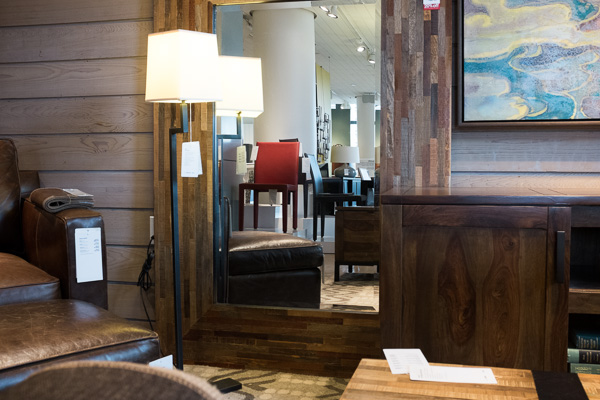
Red Chair, Crate and Barrel

Red Chair, Crate and Barrel

To be honest, the jury is out on what I think about this image above, and I think it will have to age before I figure it out.  But I had to try it.  It might look completely normal and banal, especially if you live in the U.S., but it takes on a different meaning when you compare it to this image taken by William Eggleston in 1984.  The ‘boringness’, the browns and muted tones become the point of this image.

Tell a story

Pretend you have a viewer that knows nothing about where you are from. Maybe you live in a quiet corner of suburbia, where all the houses look the same, or maybe you’re in the middle of a rural area.

Your photos should tell the viewer what it is like to be there. Think about it as though you are talking to the viewer through your images. Use your images to tell the stories that surround you, no matter how big or small.
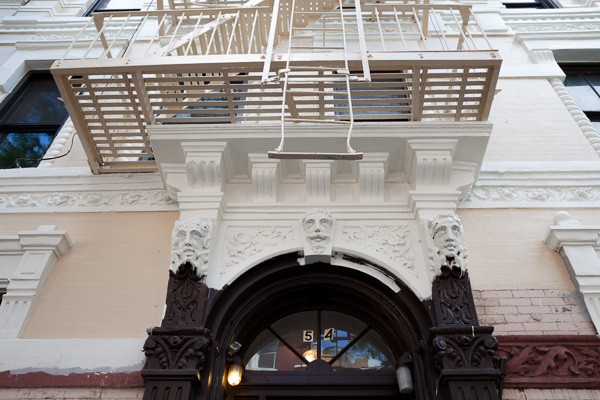
Gentrification

Gentrification

I have walked past this building with my camera every couple of days for almost seven years.  Then, one day there was an interesting image.

Experiment

It is a hard process to learn to photograph this way and you will undoubtedly take many bad photos during the learning process. You will have a hard time figuring out what is good and even asking for feedback might confuse you further. I don’t know about you, but that sounds like fun to me.

Find a friend or two or a fellow photographer that you trust and show them your images over time. Let them grow with your work while you do. This will become invaluable feedback down the road and help you talk out your work with them.

The only constant in this process is that it takes time to succeed and to figure out what you are doing and what you are photographing. There is no roadmap for doing this type of work.
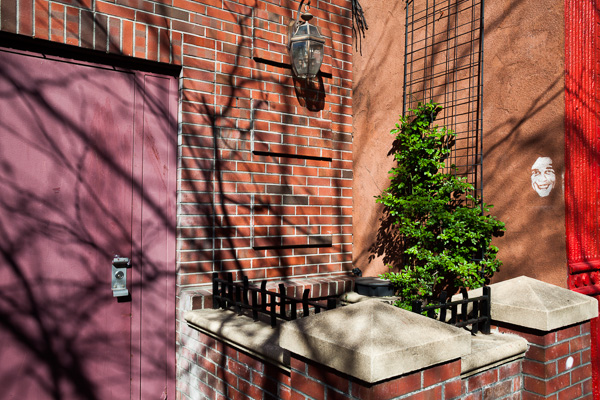
White Face

White Face

Don’t take your area or lifestyle for granted

Just because something does not seem interesting to you, does not mean it is not interesting. The way you do things and your environment are both vastly different from the rest of the world. Keep that in mind. Capture intimate aspects of your world for others and they will find those photographs fascinating, even if they might feel routine or normal to you.

Great photographers can do great photography anywhere, however it sometimes can take a little inspiration to get the wheels turning. The most important thing is to walk out the door frequently. If you think you are not going to capture any interesting images then you are not going to walk out the door.

Take a long walk, anywhere, at anytime, and challenge yourself to capture an interesting image.
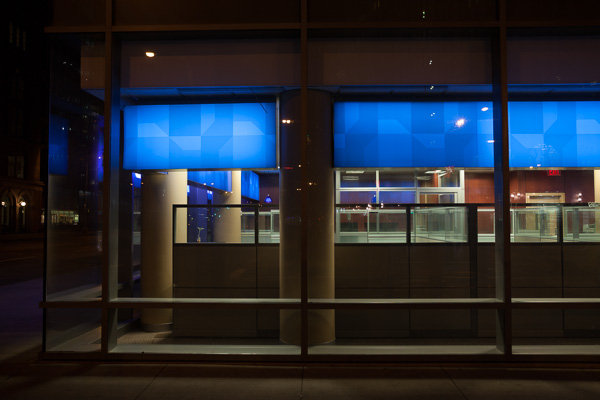
A Plant Grows, Chase Bank

Plant, Chase Bank

Further viewing

For further viewing, I highly suggest exploring the work of Williams Eggleston, Lee Friedlander, and Stephen Shore.  They are photographic masters who have spent much of their time photographing in this way.
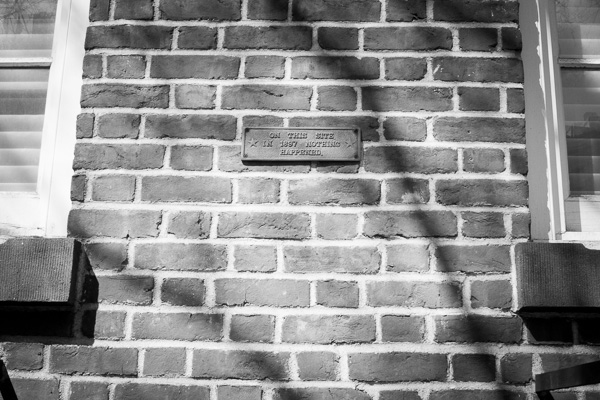
On This Site in 1897 Nothing Happened

On This Site in 1897 Nothing Happened

The post How to do Great Photography Even When Your Surroundings are Boring by James Maher appeared first on Digital Photography School.


Digital Photography School
 
Comments Off on How to do Great Photography Even When Your Surroundings are Boring

Posted in Photography


8 Steps to Create Mouth Watering Food Photography

07 May

On sale now at SnapnDeals for a limited time at 50% off Photographing Food 8 eBook Bundle by Taylor Mathis. Get it now if you want more great food photography tips.

Have you ever tried taking a picture of food and it just didn’t look as good as the dish tasted? Don’t worry, you aren’t alone. Taking pictures of food requires a different mindset and approach than what you would use in your portrait or landscape photography. Here are 8 steps you can take that will help you create mouthwatering food images.

Step 1. Choose one light source

Mathis photographing food 8 steps tip 1

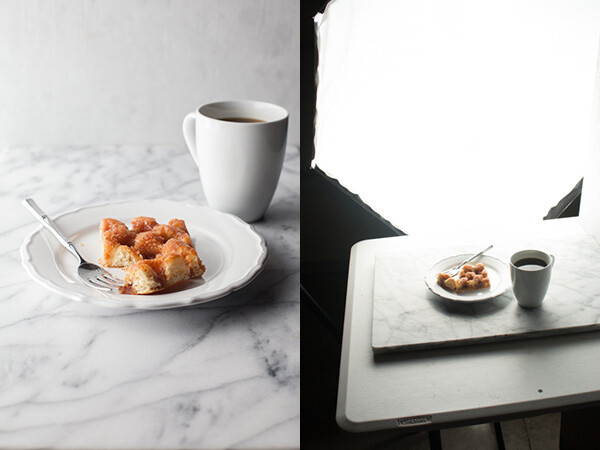
I know what you may be thinking. The more lights the better, right? Adding lights in portrait photography does give you ability to shape and light the face in beautiful ways, but when shooting food, one large diffused light source will yield amazing results!

This doesn’t mean you need to spend a ton of money to get started. All you need is a window. You can use a window where you live or if you are shooting on location, try a large restaurant window.

Step 2. Embrace food’s color

Mathis photographing food 8 steps tip 2

Food comes in a wide range or colors and textures. From your dark leafy greens, vibrant orange carrots, or pale purple shallots, you can have a rainbow of colors in front of you at meal time. Embrace this color with your prop selection and food styling. If you are lost on where to begin, look for inspiration in an artist’s color wheel! A color combination that I like is matching blue accessories with yellow or orange foods.

Step 3. Know when to use artificial light

Mathis photographing food 8 steps tip 3

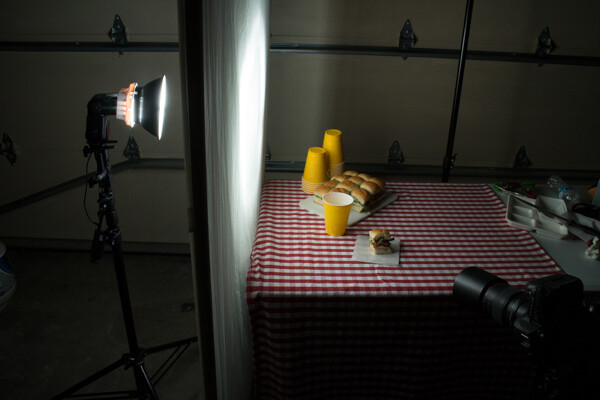
I love using natural daylight in my food photography, but there are times when I need an artificial solution. A tungsten lamp or a small compact flash make great options for shooting your food at night. The key is to use a large diffusion source to create a beautiful, soft light that will fall over your set. I like to modify my light with umbrellas, soft boxes, or a large diffusion scrim.

Step 4. Get creative with the ingredients

Mathis photographing food 8 steps tip 4

Don’t overlook the ingredients and head straight for the shots of the main meal. With an ingredient shot you can create an interesting story that begins the journey to the final plated dish. For fruits and vegetables, I like to create visually interesting arrangements shot from an overhead angle. This is the type of shot that any camera can do, even just one on your cell phone. If you have a macro lens, take advantage of your close-up ability to shoot spices and ingredients with interesting textures. Close-up shots of these shapes and textures will bring an interesting and new perspective of food to your viewers.

Step 5. Think about final use

Mathis_photographing_food_8_steps_tip_5_new_crop

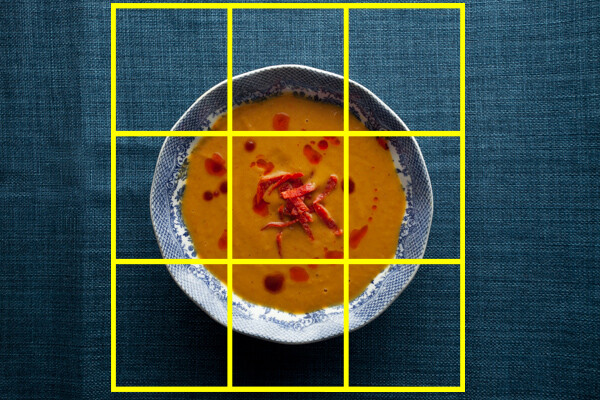
Your food image will commonly be cropped to a different size for its final use. It could be a square for use in a restaurant menu or a narrow rectangle that will fit on the side of a package. It doesn’t do you or the client any good if you create a beautiful image, but half the dish is cropped out when it comes time for printing. When shooting, you want to know what this final crop will be so that you can ensure that all the essential parts of the dish make it into the shot.

Step 6. Taking your food on location

Mathis photographing food 8 steps tip 6b

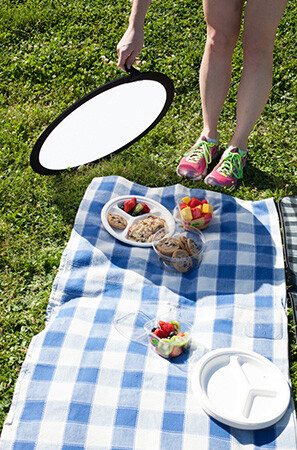
Taking your food shots out of the kitchen, and on location, will allow you to create images with beautiful outdoor scenic backgrounds. Whether it is a trip to the farm to capture fruits and vegetables ripe and ready to pick, or creating an outdoor entertaining event, an on location shot is one where weather may become a concern. There isn’t much you can do about rain cancelling a shoot, but you do have control over the harsh light from a bright and sunny day. When shooting outdoors, I always bring a collapsible diffuser with me. Placing this between my subject and the sun diffuses any harsh light that may be on my set. I am left with a soft evenly lit set on which I can create mouthwatering food images.

Step 7. Vary your background

Mathis photographing food 8 steps tip 7

What you shoot your food on top of will have a huge impact on the final photo. There are millions of options from which to choose. You can use anything from painted wood to cloth to stone. My favorite place to find backgrounds is at my local hardware store. There are thousands of potential backgrounds there. If you are feeling creative, you can stain and paint wooden boards to create a truly custom shooting surface. If you want a background that doesn’t require any customization, try painted ceramic or stone tiles. The large tiles, like you would use in a bathroom floor, are a sturdy surface with a ton of variety. Changing out your background to a new one, might just be the thing needed to create a more interesting food shot.

Step 8. Modify Your Light

Mathis photographing food 8 steps tip 8

A large soft diffused light is my go to for any food shot, but sometimes the shot may require a little bit more. Through blocking with black foam board, reflecting with white foam board, bouncing your light source or adjusting its height and placement, you can fine tune your lighting to create the mood and scene you desire. If you find yourself consistently using the same set-up, try switching things up. Using a different sized soft box or even a large white bed sheet can have a great impact on your final shot.

If you have felt intimidated or struggled with taking pictures of food, I hope these steps will help. If you want to take your food photography to the next level, give photographing FOOD issues 1-8 a try!

On sale now at SnapnDeals for a limited time at 50% off Photographing Food 8 eBook Bundle by Taylor Mathis. Get it now if you want more great food photography tips.

The post 8 Steps to Create Mouth Watering Food Photography by Taylor Mathis appeared first on Digital Photography School.


Digital Photography School

 
Comments Off on 8 Steps to Create Mouth Watering Food Photography

Posted in Photography


Foldio: A Pop-Up Photography Studio

05 May

Extra photos for bloggers: 1, 2, 3

You’ve got dreams of your very own photo studio – gleaming white walls, perfectly placed lights and windows overlooking the Manhattan skyline.

The Foldio is a dream come true! It’s a pop-up photo studio, complete with built-in lighting, small enough to take anywhere you want.

Foldio and its LEDs give you a bright evenly lit space for all kinds of photography projects – product photos for Etsy, stop-motion gifs, even pet portraits (of rodents or small reptiles).

Sturdy magnets hold your white walls in place, while clips make it easy to swap out backdrops.

When your shoot is through, fold it up and tote it anywhere. From Manhattan, NYC to Manhattan, Kansas and points beyond.

Pack Up Your Own Foldio Light Studio
$ 55 at the Photojojo Shop


© laurel for Photojojo, 2014. |
Permalink |
No comment |
Add to
del.icio.us

Post tags:


Photojojo

 
Comments Off on Foldio: A Pop-Up Photography Studio

Posted in Equipment


Versatility – Your Guide to Shooting Great Travel Photography

05 May

Professional travel photographers realize that the key to their business is versatility: to be able to shoot all styles of photography, and to consistently capture great shots even under very trying conditions. To be a strong assignment photographer you must identify your weakness and then work on it.

Instead of concentrating on what you shoot well why not break out of your comfort zone and try something more challenging? Some of the most experienced photographers from The WideAngle network give us their insights into a few of the specialized fields of travel photography.

DPS1 DALE MORRIS

Image by Dale Morris

PHOTOGRAPHING WILDLIFE

British born wildlife photographer Dale Morris has built a reputation as one of the most widely published photographers in South Africa. His background as a trained naturalist allows him to capture aspects of the natural world that many photographers would miss.

I’m a firm follower of the philosophy that wildlife photography is not only about getting a great image but equally about taking time out to observe, and more importantly, really enjoy the experience of being in the company of wild animals. It helps to understand that every animal stands at the center of its own concentric set of invisible circles and if something unusual (a photographer for example) steps across the outermost boundary, the animal will react (usually by becoming more alert to your presence). Move across the next circle in the set too soon and an imaginary alarm is triggered. You are now running the risk of eliciting a flight or fight response. An animal’s rear end vanishing post-haste over the horizon rarely makes for a good photo, nor does a trampled and gored camera. Move slowly and in a non-threatening manner. The secret to wildlife photography is patience, empathy, awe and a true appreciation for your subject matter.

SHOOTING MOVEMENT

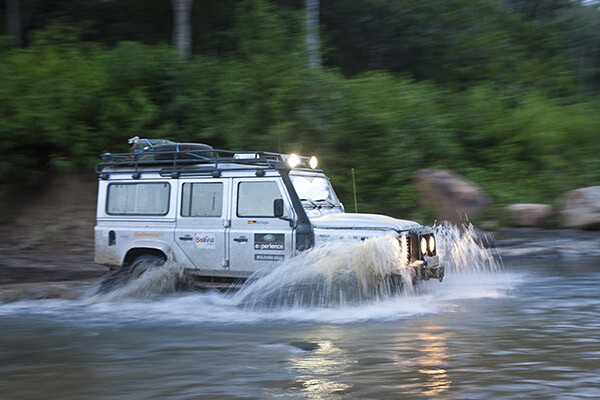
Craig Pusey is a dedicated motoring and expedition photographer, who’s never scared to go the extra mile for a shot. You might see him scaling an Indonesian volcano or lying face down in an Andean stream just to get the perfect angle.

DPS2 CRAIG PUSEY

Image by Craig Pusey

The perfect panning shot takes practice. For people and animals moving perpendicular to you, aim to keep your shutter speed between 1/15th and 1/90th of a second to get a bit of blur. For faster things, like cars or galloping horses, set a speed of between 1/60th to 1/125th. Try to focus just ahead of the moving object and if you have the opportunity shoot a trial pan before your subject even arrives. (This will check exposure and focus but also make sure that no obstacles are going to get in the way of your pan…it also limbers you up!).

It’s best to start with a higher shutter-speed and then work down, but it’s also dependant on distance from you to the subject. The farther away, the lower your shutter speed will need to be to show the effect of panning. With practice you can shoot slower, and will be better be able to judge the object’s speed.

SHOOTING ARCHITECTURE

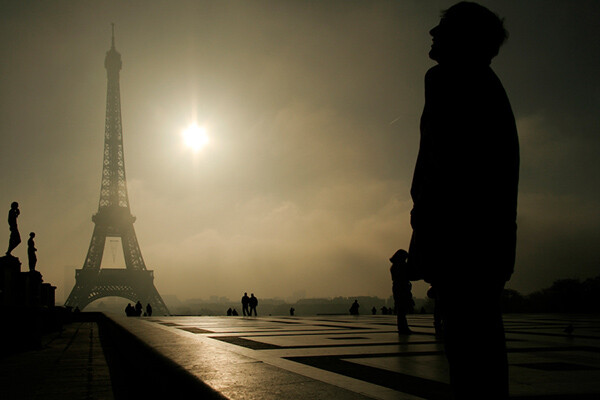
Laurence Garçon is an experienced Parisian artist, publisher and assignment photographer. She has travelled widely but has retained an unshakeable love affair with her hometown and is recognized as one of the city’s most visionary photographers.

DPS3 Laurence Garcon Misty Morning

Image by Laurence Garçon

Firstly, be aware of the highlights. Play with the speed and the aperture of your camera to avoid over-exposing sunlit walls, etc. Secondly, try to frame a composition that will best display the building. Be prepared to wait a while for something to happen (a passer-by, a vehicle): this could be the element that will be capture the soul of the quarter. Be aware that, in some countries you may need specific permission to photograph some particular buildings (especially airports, military buildings, ministries, embassies, sometimes even bridges). If you plan to publish your photograph of a single (isolated) contemporary building, try to always mention the name of the architect.

PHOTOGRAPHING INDIGENOUS PEOPLE

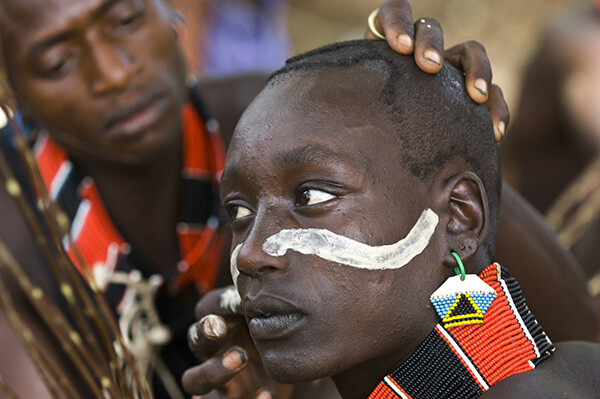
Axel Fassio left his home in Italy to travel the world (everywhere from Antarctica to Iceland) on assignments. In 2013 he won a first prize at PX3 Prix de la Photograhie Awards in Paris and a 3rd at the International Photographic Awards. He’s currently based in Nairobi.

DPS4 Axel Fassio

Image by Axel Fassio

Ideally, if time allows you should approach a community without a camera and hangout a bit, getting to know the elders and playing with the children. The last thing you would want to do is have to rush to take pictures. Resulting images would lack of spontaneity. A few hours are enough to create a basic ‘relationship’ within the community and the resulting images will benefit hugely.

If your time is limited, always contact the elders and ask permission to take photos. A money arrangement is common when time is tight but it’s not desirable. Negotiating to pay for each images tends only to produce aggressiveness among the people, bad memories for you and usually this shows in the shots.

Longer zoom lenses can be used to “steal” candid portraits and a wide-angle held at waist level often has the effect of bringing the viewer more intimately into the scene. It is always better to avoid clearly aiming at a person unless he/she is very comfortable and is agreeable to being photographed. In this case, a medium-length zoom is perfect for portraits.

DPS5 Wylie Maercklein

Image by Wylie Maercklein

SHOOTING PORTRAITS

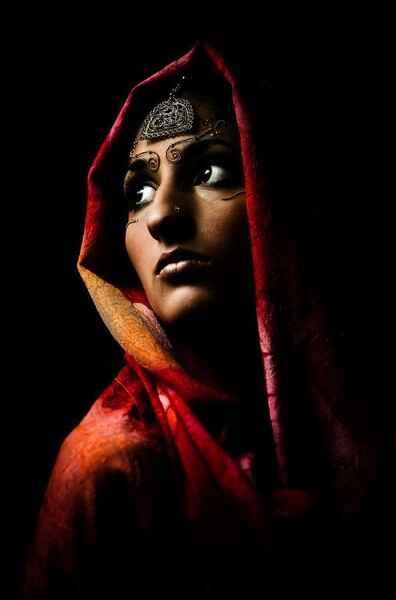
Wylie Maercklein is an experienced Texas-based photographer and videographer with a specific talent for powerful portraits.

Portraits are similar to other action shots to me, in that you’re just waiting for the right moment. With a group, that moment is something larger – an externalized emotion. An action. With an individual portrait, it’s an internalized thing – it’s the moment when their defences drop just a little and you see something living behind their eyes.

LOW LIGHT AND NIGHT PHOTOGRAPHY

British photographer Jonathan Perugia has built a reputation as one of the most prodigiously published assignment photographers in the business. In addition to his freelance work he leads photography holidays with Authentic Adventures.

I love the way cities look after sunset, so I shoot a lot in low light. If you want to really explore this kind of photography, then adding a fast prime lens to your collection (if you use a DSLR) is invaluable. I use the Canon 50mm f/1.4, which is pretty good value. Another invaluable bit of kit is a tripod. Go for something as sturdy, but as light, as you can afford. Carbon fibre is ideal. Try to avoid anything flimsy. There are some good mini tripod options too, with bendy legs that will hook around a handrail at a push. Generally I avoid using flash, so I’m often at high ISOs. I recommend testing or researching your camera to see how high it will go without too much noise.

DPS6 Jonathan Perugia

Image by Jonathan Perugia

For cityscapes, the best time to shoot is the period after sunset but before dark, when there is still colour in the sky. On a clear night you can get fantastic electric blue skies with all the city lights illuminated. Note that the brighter electric lights will start to blow out as the sky gets darker, so you may want to choose your frame accordingly. If there are no bright lights in the shot, you can use longer shutter speeds to get colour out of a sky that appears dark to the naked eye. Cloudy skies reflect street lights and can look quite surreal. This is the perfect time to do classic long exposure traffic shots with streams of light from the car lights. Smaller apertures give points of light a kind of starburst effect that looks more natural than starburst filters. You’ll notice that you can start shooting into doorways, shops, windows that wouldn’t work in daylight when the light outside is much brighter than inside.

Experiment and enjoy the different effects and colour casts you get after dark – even ‘painting with light’ with long shutter speeds and no tripod. Look for pools of light from street lamps, windows, street stalls.

SHOOTING LOCAL CEREMONIES

Ingetje Tadros is a Dutch-born photographer who emigrated to Western Australia. She spends much of each year on assignment in various parts of Asia.

DPS7 Ingetje Tadros

Image by Ingetje Tadros

While shooting ceremonies pay close attention to your choice of lens. Personally I like the 35mm prime as I like to be close and look for little moments. But, I also find it important that people feel comfortable with my presence and you need to be aware of personal space. When rituals are taking place it’s important to be aware what the rules are and specifically to know where you should and shouldn’t stand. Take your time and don’t just go in snapping. Try to limit use of flash to an absolute minimum as you should be as unobtrusive as possible.

Do you have any tips on versatility? How do you approach travel photography? Please share in the comments below.

The post Versatility – Your Guide to Shooting Great Travel Photography by Mark Eveleigh appeared first on Digital Photography School.


Digital Photography School

 
Comments Off on Versatility – Your Guide to Shooting Great Travel Photography

Posted in Photography


Winners of the 2014 Sony World Photography Awards, part 2

04 May

130413539122035000_1_Sara-Lewkowicz_USA_1st-Place_-Contemporary-Issues_Professional-Competition-2014_600x400.JPG

The World Photography Organization has announced the winners of its 14 Professional categories. American photographer Sara Naomi Lewkowicz was named as 2014’s L’Iris d’Or/Sony World Photography Awards Photographer of the Year. Selected from 140,000 entries from 166 countries, Lewkowicz’s story is a a stark and intimate look at domestic violence. See gallery of winners

News: Digital Photography Review (dpreview.com)

 
Comments Off on Winners of the 2014 Sony World Photography Awards, part 2

Posted in Uncategorized


Time-Lapse Photography Equipment Guide to Getting Started

04 May

Currently for a limited time only get the Stage R Versatile Motion Control for Timelapse and Film and get FREE eBook – on now at SnapnDeals!

“Never forget that all the great photographs in history were made with more primitive camera equipment than you currently own.” – Brooks Jensen

No doubt that first time you said “Hey, wouldn’t it be fun to dabble in DSLR photography? You know, just as a hobby.” Your financial counsellors, or your spouse for that matter, broke out in budget busting hives.

There probably isn’t a more gear focused group of enthusiasts out there, but don’t worry, taking that step into time-lapse photography doesn’t require much gear to begin – and the extra gear that can really take your time-lapse to the next level is more affordable and easier to use than ever before.

Whether you are a brand new time-lapse photographer or an experienced shooter looking to unleash full creativity with time-lapse motion control, this article will provide a launch pad for your next steps into one of the most emotionally connecting, and at the same time freeing, creative photographic endeavours.

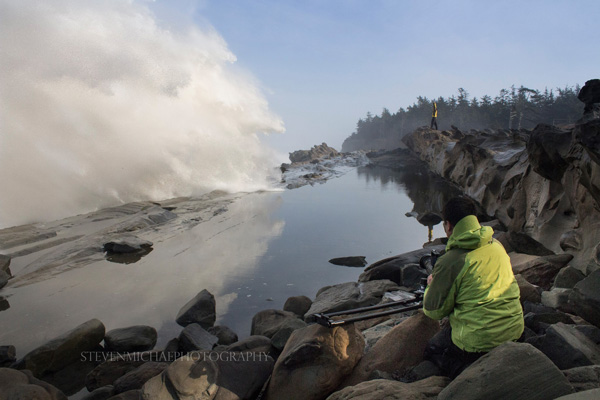
Steven Michael Photography 600

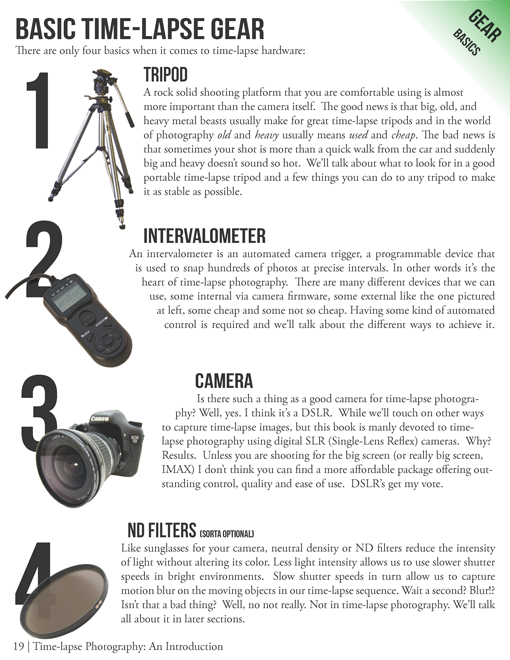
Your minimum gear checklist for time-lapse photography

Chances are good if you’re already a DSLR shooter you almost have everything you need to get started. These four things are essential.

  1. A tripod
  2. An intervalometer
  3. A Camera
  4. An ND filter

timelapse-gear.png

A closer look at a good time-lapse support system

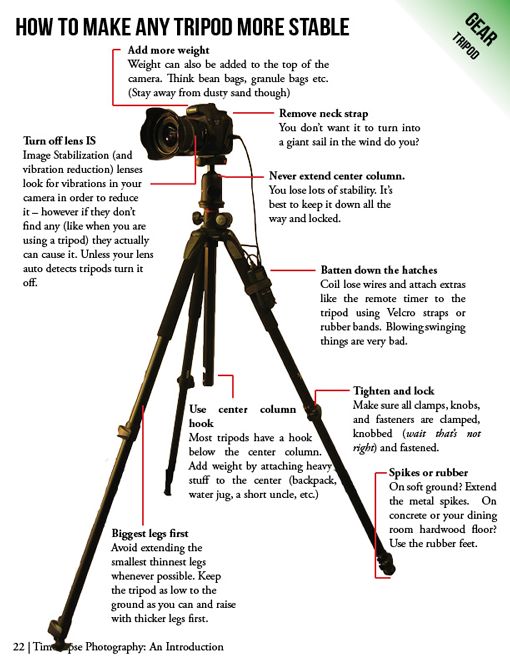
Rock solid stability (or precise controlled movement) is just about the most important and most essential component for good time-lapse photography. Keep in mind a good tripod that meets your needs will outlast several cameras so consider budgeting a little more time and possibly cash to this category.

  • Consider the materials used – weight and strength
  • Check the load weight – avoid sagging and flexing
  • Height – eye level without using the centre column
  • The right tripod head for your work – ball heads versus pan and tilt

timelapse-tripods.png

Unleashing your creativity with advanced time-lapse equipment

Time-lapse photography is benefiting from a dramatic flow of new ideas. The level of innovation, especially over the last few years, is incredible. Not only are we quickly fixing problems that have plagued photographers for years, but advanced camera controls and processing tools that used to be cost prohibitive, are now becoming affordable for the most basic hobbyist.

Advanced camera exposure control

The Timelapse+ can operate as a universal intervalometer for nearly any camera that supports a remote shutter release, and IR remote, or USB tethering. Bulb-ramping is its claim to fame. The Timelapse+ can perform keyframe-based, guided, or fully automatic bulb ramping – and for cameras supported by USB control, the Timelapse+ can also seamlessly integrate ISO control to smoothly ramp across a wide exposure range, making the “holy-grail” transition from day-to-night or night-to-day easier to achieve. Extended and long-exposure HDR sequences are also made easy with the Timelapse+.

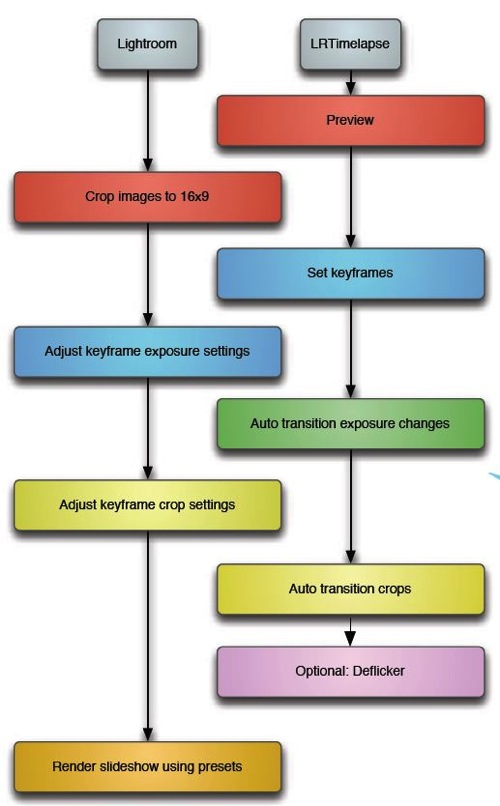
Simple and powerful advanced time-lapse sequence rendering with LRTimelapse:

In a nutshell LRTimelapse takes changes and corrections you make in Lightroom and then smoothly applies them throughout the entire time-lapse sequence. By altering either the first and last image, or several images throughout the sequence, LRTimelapse can quickly fade the changes we need to only the parts we want. Deflickering can also easily be accomplished in the exact same way by flattening out big exposure jumps.

Here’s a simple workflow for editing timelapse images and rendering a movie using Adobe Lightroom and LRTimelapse.

Lrtimelapseworkflow

Advanced motion control

The last few years have shown incredible advances in the field of manual and controlled camera movement, so much so that the
average photographer can now afford motion control devices that were once only available to big budget productions. We’re talking precise, rugged and lightweight panning (left and right), tilting (up and down), and dolly movements with simple controls, such as a smartphone app, that make setup easy and intuitive. Control over motion and time combined with an interesting subject can produce what I believe to be an awesome trifecta of emotion eliciting imagery – some of the most engaging and lasting photography you’ve seen.

Yosemite HD II, an incredible example of time-lapse and motion:

Dolly motion shots can add multiple points of interest by highlighting components of a scene’s unchanging foreground and the larger time-altered background. The movement shots in the wave video move the camera along the jagged rocks, while the waves are slowed in the background. Some of the most popular time-lapse clips feature this kind of extreme moving contrast in many shots too. By moving the camera slowly from left to right on a horizontal track, or flipping the track system almost vertically to instead change the elevation of the camera, we can highlight stationary foreground objects in incredible ways.

The next two axes of movement can be accomplished by camera rotation – aptly named a motorized panning and tilting head. Then combining panning and tilting on a camera slider to achieve 2, or 3 axis of movement simultaneously can dramatically elevate the interest level in a shot.

zion 3axis motion control

2 axis motion control

Do you think advanced time-lapse work should be left to the pros?

Eric Warren of Matadornetwork.com posed a related question:

“Pros are the guys you call when you want to put a time-lapse in your car commercial. And while we tend to put pros up on a pedestal, they are often bogged down by their clients’ needs. Most commercial advertising doesn’t push the envelope of an art form.

That job often falls to the independent artists, building their own equipment, and often not [caring] about whether their work is going to sell. Not that I want to be too demanding here, but I want to see something mind-blowing. Either something I’ve never seen before or something familiar, shown in a new way (one thing time-lapse excels at.) ….

Consider this a call to all you independent filmmakers out there ready to push the limits of one of the most striking visual art forms.”

Time-lapse has a way of slowing the world for the photographer while at the same time accelerating it for everyone else. Shooting time-lapse alters the way you think, it challenges your view of the world and teaches you things about our world you can bring back and share with everybody else.

Get out and start shooting. Render some footage and break some rules. Most importantly know that you are not alone. The time-lapse community is more connected today than ever before. You have friends all over the world ready to help you get the shots you imagine.

Currently for a limited time only get the Stage R Versatile Motion Control for Timelapse and Film and get FREE eBook – on now at SnapnDeals!

The post Time-Lapse Photography Equipment Guide to Getting Started by Ryan Chylinski appeared first on Digital Photography School.


Digital Photography School

 
Comments Off on Time-Lapse Photography Equipment Guide to Getting Started

Posted in Photography


Weekly Photography Challenge – Cityscapes

03 May

Earlier today I shared a set of images of cityscapes. That’s designed to inspire you, make you say “wow” and want to get out there and photograph your city.

This week I’d like to challenge you to photograph close to home. If you live in a city, you’re all set! If you’re in the country or smaller town, you just need to get more creative or take a short drive.

You’ll notice that many of the cityscape images in the collection are shot at night. That’s when the city and the lights really come to life and dance for the camera. Find the best location and angle to photograph your cityscape. Try looking up at the buildings, or getting up high on a rooftop or balcony and looking down. Change up your perspective to create something different and striking.

Maybe try some black and white photography or even some HDR of the city skyline. Go capture the same scene at different times of day including: sunset, the blue hour (twilight), and after dark. Shoot wide and get the whole vista, and try some closer up and focus in on details. Here are a few images to give you more ideas:

By joiseyshowaa

By Chris Smith

By Christopher

By Pedro Szekely

By Justin Brown

By jesuscm

By Paolo Margari

By Pedro Szekely

By Justin Brown

By ZeroOne

By Nathan Congleton

By Shawn Hoke

By David Yu

Share your cityscape photos!

Simply upload your shot into the comment field (look for the little camera icon in the Disqus comments section as pictured below) and they’ll get embedded for us all to see or if you’d prefer upload them to your favourite photo sharing site and leave the link to them.

The post Weekly Photography Challenge – Cityscapes by Darlene Hildebrandt appeared first on Digital Photography School.


Digital Photography School

 
Comments Off on Weekly Photography Challenge – Cityscapes

Posted in Photography


40 Inspiring Save-the-Date Photography Examples to Amaze Your Friends

30 Apr

With so many adorable and romantic Save-the-Date announcement photos floating around Facebook and Pinterest these days, it could be a challenge to create something new. Save the date is the first correspondence with your guests, and it serves more functions than just letting them know about the date and location. It sets the tone of the whole wedding, giving the Continue Reading

The post 40 Inspiring Save-the-Date Photography Examples to Amaze Your Friends appeared first on Photodoto.


Photodoto

 
Comments Off on 40 Inspiring Save-the-Date Photography Examples to Amaze Your Friends

Posted in Photography