RSS
 

Posts Tagged ‘Photography’

3 Simple Photography Tips for Parents – How to Take Better Pictures of Your Kids

15 Nov

One of the most frequently asked questions I receive as a writer here at Digital Photography School is, “How do I take better pictures of my kids?”. There’s just something about becoming a parent that helps you understand exactly how fleeting childhood is, as well as how important it is to capture it. Whether you’re using a pro-level DSLR camera, a point-and-shoot, or your phone’s camera, here are a few quick and easy tips that will help you take your momtography or dadtography to the next level and take better pictures of your kids.

3 Simple Photography Tips for Parents - How to Take Better Pictures of Your Kids

1. Emotion Trumps Perfection

It’s never a bad idea to learn about the technical aspects of photography. But when it comes to photographing your own kids, the truth is that the photos you’ll treasure the most are the ones that capture genuine emotion. When you pull your camera out, don’t just look for the perfect smiles. Look for genuine expression and emotion, which tends to happen most often when your kids don’t realize you’re watching them.

Similarly, when you’re culling images, don’t automatically trash every image with soft focus or strange cropping. Sometimes, those technically imperfect photos may capture genuine emotion so perfectly that it would be a shame to delete them just because they’re not perfect. You may not want to blow those imperfect images up onto a giant canvas, but definitely keep them for your own records!

3 Simple Photography Tips for Parents - How to Take Better Pictures of Your Kids

Let go of perfection

Technically speaking, there are a few things about the above image that I don’t like. I wish I hadn’t cropped off some of one daughter’s fingers, and I wish the other daughter was in focus. I was super tempted to delete this photo right away because it’s not quite up to my standards. However, every time I look at this image it makes me smile to see the absolute joy on their faces. I remember their excitement at seeing the cherry blossoms covering the ground like snow, scooping them up by the handful, and throwing them up into the air while laughing and squealing with delight.

As family and friends flip through photo albums, they don’t comment on the other image I took that day of the girls standing perfectly still while looking at the camera and smiling, they comment on this photo. They mention how happy the girls look, and how much they love this photo. This image is beloved not because it’s technically sound, but because emotion always trumps perfection when it comes to photography.

3 Simple Photography Tips for Parents - How to Take Better Pictures of Your Kids

2. Find Beauty in the Ordinary

When it comes to photographing your kids, don’t wait for the moments when everyone is perfectly dressed in coordinating outfits at golden hour. Those moments are beautiful, but they’re few and far between. Instead, look for ways to capture the beauty in the ordinary everyday moments.

Snap a photo of your kids reading a bedtime story every once in awhile. Take a quick snapshot of their messy faces after spaghetti night. Capture the mismatched crazy outfits that they put together when they dress themselves. Quietly sneak out your camera as they’re practicing writing their name at the kitchen table.

3 Simple Photography Tips for Parents - How to Take Better Pictures of Your Kids

Life isn’t always perfectly styled, it’s messy and full of mundane, repetitive moments. It’s really tempting to wait to pick up your camera until your house is cleaner, or the kids are dressed in something that isn’t stained, or until the flowers in the backyard have bloomed. Don’t wait.

Take the opportunity to photograph your kids just as they are right at this moment, and see if you can’t find some beauty in the ordinary.

3 Simple Photography Tips for Parents - How to Take Better Pictures of Your Kids

3. Capture What Your Kids Love

At any given point in time, your kids are likely to have at least one thing that they’re absolutely obsessed with. It may be a stuffed dinosaur, their favorite book, a hat that they want to wear every single day or a best friend.

Regardless of what their current favorite thing is, taking photos of your childen with the things that they absolutely love is a really sweet way to remember them at the different stages of their lives.

3 Simple Photography Tips for Parents - How to Take Better Pictures of Your Kids

Chances are that in a year or two, your child will move on to a new favorite thing. You’ll forget all about that stuffed dinosaur or favorite blanket much more quickly than you’d probably think. It’s fun for both you and them to be able to look back and say “Remember when you used to….”

3 Simple Photography Tips for Parents - How to Take Better Pictures of Your Kids

Bonus Tip: Get the Photos Off Your Computer!

How many of us are guilty of taking hundreds of photos of our kids, maybe uploading a few to social media, and then letting them hang out on our hard drives in perpetuity? In all honesty, one of the most important parts of photographing your kids is to actually print the photos you take of your kids.

There are so many great resources out there now, whether you want to send prints off to a professional lab or print a photo book right from your Instagram feed, there truly is something for everyone. You don’t have to do it all, but just pick something, and get those images off your computer and into your lives!

3 Simple Photography Tips for Parents - How to Take Better Pictures of Your Kids

Do you have any non-technical tips that you’d share with moms and dads just trying to take great photos of their kids? If so, please chime in below in the comments.

The post 3 Simple Photography Tips for Parents – How to Take Better Pictures of Your Kids by Meredith Clark appeared first on Digital Photography School.


Digital Photography School

 
Comments Off on 3 Simple Photography Tips for Parents – How to Take Better Pictures of Your Kids

Posted in Photography


5 Street Photography Project Ideas During the Fall

15 Nov

Street Photography is seen as a snapshot competition where only a single picture matters the most. This can be fun and teaches you a lot about photography and yourself. You need to put everything in that single shot that tells a story and looks good at the same time. Yet all your pictures might be disconnected over time and it Continue Reading

The post 5 Street Photography Project Ideas During the Fall appeared first on Photodoto.


Photodoto

 
Comments Off on 5 Street Photography Project Ideas During the Fall

Posted in Photography


Why You are not in the Photography Business – You are in the People Business

14 Nov

I did photos for a high school senior recently who remarked that many of her friends were having their class pictures taken by one of the teachers at school. We chatted about this as I snapped away with my full-frame Nikon D750 and accompanying 70-200mm f/2.8 lens, a setup that delivers good results but often gets quite heavy and cumbersome after a long photo session.

As we walked around and continued to take pictures, she told me how much her friends liked the teacher’s photos. She said how happy they were with the results while assuring me that she was enjoying our photo session in the park.

I casually asked if she knew what kind of camera the teacher was using, and her response surprised me. Although in hindsight, I suppose I should have seen it coming a mile away. “Oh, he’s got one of those new iPhones with portrait mode,” she replied as my shoulder cramped up just a bit under the weight of my camera gear.

This story illustrates a painful truth about those of us in the photography business; we can’t think of ourselves as just photographers anymore.

Longtime photography veterans have known this for years. But for people like me who are relatively new to photography or those just starting to get serious, there are a few things we need to keep in mind if we want to pursue our hobby and eventually use it to put food on our tables or gear on our shelves.

You are not in the Photography Business - You are in the People Business

You’re in the People Business

As Liam Neeson might say, you have a very particular set of skills as a photographer. You understand lighting and composition. You know how to choose good locations, you get how colors work, and you might be proficient with off-camera flashes and external light meters. Photoshop is your domain and you know Lightroom like the back of your hand.

You probably have a decent amount of gear in your collection, built up over the years thanks to hard work, saving, and honing your craft. The thing is, your clients don’t care about any of that. They aren’t going to be impressed with your Creative Cloud membership or the fact that you have the newest full-frame camera on pre-order from B&H.

What they want are good photos. You and your skill set and gear (and your high price tag) are competing with mobile phones that in the eyes of your client can make awesome photos. So what option do you think your potential clients are going to go with when it’s time to sign on the dotted line? As technology gets more advanced and the line between professional photographer and rank amateur becomes ever blurrier with the increasing capability of mobile phones, you have to do something to differentiate yourself.

Differentiate yourself

There’s a line in the movie Office Space where the manager of a kitschy all-American restaurant is trying to explain why one of his servers needs to wear what he calls “pieces of flair” on her outfit. In a moment of biting condescension, the manager explains that “People can get a cheeseburger anywhere, okay? They come to Chotchkie’s for the atmosphere and the attitude.”

It might seem silly, but as time marches on we photographers have to adopt the same type of work ethic if we want to survive, pick up new clients, and keep existing ones coming back time after time. Photography, whether we like it or not, has been commoditized to the point that anyone can do it and get pretty decent results. So we have to ask ourselves, what do we bring to the table that would make clients want to use our services if what they want, like the cheeseburger example, is available pretty much anywhere?

Focus on the experience

The answer to this lies in the same movie quote. We have to stop thinking of ourselves as photographers first and make our craft one of fun, excitement, engagement, and ultimately create an experience that our clients will remember.

Advertisers have known this for decades. When you see commercials for cars, clothes, or vacation getaways the focus is rarely on the items being sold but the experiences and emotions those brands attempt to create. You can’t rely on years of training or expensive gear to sell yourself as a photographer.

Instead, you have to work hard to create experiences your clients will remember for years to come and also share with others. Whether you photograph weddings, kids, families, high school seniors, or work with clients to take pictures of real estate, products, or promotional materials, you have to make the whole experience something they will appreciate, enjoy, and remember.

Get personal

This might sound complicated but it’s not all that hard to do, and it often involves many simple things. For example, take time to get to know your clients and call them by their first names. If you’re saying things like, “Hey you over there with the red jacket, I need you to scoot over to your left just a bit” that person isn’t going to care how sharp your photos are or that you shot with a really expensive lens! Instead, he will be wondering why he didn’t just pay the neighbor kid $ 50 to shoot pictures with the Canon Rebel camera that he got on sale at Target last week.

Talk with your clients, have fun with them, play with the kids, and ask for their input. Even if you don’t use the shots, they will at least feel like their contributions were valued. And whatever happens, don’t bark out orders like you’re at a military academy.

Make it fun – keep it light

You might be stressed after hours of shooting a wedding, but don’t let your clients see that. Smile, ask people politely to do what you need, but also don’t be afraid to take charge and direct the shoot the way you want it. People appreciate leadership and professionalism, but you can have that without being rude and obnoxious.

Just like in the movie example, people can get photos from anyone nowadays. But they come to you for the fun, excitement, enjoyable attitude, and all the other intangible elements that come together to create a photo session to remember.

Recommendations go a long way

When my wife and I moved from one part of the country to another, several years ago, we had to figure out all sorts of ways to integrate into our new city; where to buy a house, where to shop for groceries, what church to attend, and even mundane decisions like where to get our car repaired when it broke down. I looked through the Yellow Pages phone book (remember those?) and saw page after page of advertisements for mechanics who were Fast, Efficient, Cheap, Highly Trained, Professionally Certified, and The Best in Town. We were so overwhelmed with choices that we just asked around. Several of our friends recommended a particular place that we still go for all our auto repairs, eight years later.

When we talked to our friends about which shop to use, can you guess what they said about the one we ended up choosing? I’ll give you a hint, it had almost nothing to do with the quality of their work. Any auto shop can replace an alternator or change brake pads, but the reason so many people recommended that one particular shop had everything to do with the friendliness, attentiveness, and respectfulness of the staff.

Perception shapes quality

The hard truth of the matter for those of us involved in any type of service industry such as photography is that there is no objective plumb line by which our clients can consistently gauge quality. Just like choosing an auto repair shop, your clients or potential clients would probably be happy getting their pictures taken by any number of professional or amateur photographers in your area.

How they perceive the quality of the final result won’t necessarily be judged by the sharpness of the images, the intricacies of the editing, or the price of the gear used to take said photos. Instead, they will think about the whole experience of getting their pictures taken and use that as a measuring stick by which to judge the quality of the images. It seems strange and perhaps frustrating to those of us who have spent years or decades honing our craft.

But there’s no getting around the fact that the way in which people judge quality is highly influenced by their perception of the experience.

Research proves it

The concept of consumer perception and its role in shaping quality has been studied by researchers for decades. In 1992 J. Joseph Cronin, Jr. and Steven A. Taylor published a paper in the Journal of Marketing in which they concluded that among other things;

  • “Service quality is an antecedent of consumer satisfaction”
  • “Consumer satisfaction has a significant effect on purchase intentions”
  • “Service quality has less effect on purchase intentions than does consumer satisfaction”

The implications of this and other similar research for photographers is profound! Basically, if your clients had a good time at your photography session and were pleased with your service, they will view your photos as higher quality.

Good experience = they will like you = happy clients

So what can you, the humble photographer, do about all this? How can you deliver high-quality results to clients who might be perfectly happy with any other photographer or mobile-phone-wielding teenager in the area?

Differentiate yourself not by the quality of your photos but by the experience you offer. In doing so, your clients will perceive their pictures as sharper, more expressive, and just plain better than others. This is true even if your photos aren’t actually as good on a technical level – which is a real kick in the head for photographers who have amassed years of knowledge, experience, and gear.

Think of the many times you have seen photos that friends and family have posted on social media or sent out in Christmas cards to which your reaction was one of shock and horror. The lighting is all wrong! The background is so distracting! Aunt Ginny is out of focus! Nevertheless, the pictures are seen by the clients as high-quality because they enjoyed the experience as a whole and received an outstanding degree of service. Photographers who can do that are the ones getting likes, shares, recommendations, and bookings.

Improving Customer Experience

In an interview with NPR, Tony Hseih, the founder of the online shoe retailer Zappos, described his approach to selling shoes which, ironically, had nothing at all to do with shoes. He said that as his company grew, “A big turning point was really deciding we wanted to build our brand to be about the very best customer service and customer experience.”

He really meant it, and if you visit Zappos you won’t see shoes and handbags that are cheaper than other retailers. They don’t even try to compete on price at all but by offering the best service of any clothing retailer in the market today.

Walker Information, a company that studies business marketing and consumer habits, recently released a study that predicted customer experience as being the single most important way for brands to differentiate themselves by the year 2020. And that, I would argue, is the silver lining to the clouds that can easily darken a photographer’s horizon these days.

I honestly wasn’t a huge fan of this image and I think some of the others I delivered to my client were superior. But the mother was thrilled with it because I had her sprinkle leaves on her daughter while I shot photos. She had fun doing it, and as a result, viewed the final image as high-quality even though there are others that I think are probably better. My client was happy with the picture and that’s what ultimately matters.

Customer service is king

Photography has been available to everyone ever since Kodak invented the Brownie camera in 1900, but never have cameras been so powerful, ubiquitous, or easy to use as they are now. With such a crowded marketplace in which almost anyone can take high-quality photos, (even if you might not think they can hold a candle to your high-res, ultra-sharp, professional-style shots) you have to do something to stand out from the crowd and give people a reason to hire you.

That differentiating factor is the complete customer service experience. From the moment you make the first contact with potential clients, to the photography session, to the communication afterward, and even the way in which you deliver photos all matter. (You’re not handing clients a CD-ROM with watermarked JPG files, are you?)

The trump card you have up your sleeve is that you can do the best of both worlds. You have all the skills that make you a highly capable photographer and you likely have a growing collection of cameras, lenses, and software to help you achieve outstanding results. In addition to that, you can also provide a fantastic all-encompassing photography experience that your clients will remember for years while also recommending you to their friends and family.

I actually see the onset of mobile phones and computational photography as an opportunity, not a threat, and a way for me to show others how my work really does stand out.

Conclusion

I started this article by mentioning a photo session for a high school senior. After I delivered her final edited pictures, what really stuck in my mind was how she and her parents talked about the experience as a whole. Her parents told me how much fun she had and expressed appreciation that I was able to bring their normally camera-shy daughter out of her shell a bit to get some gorgeous images of their daughter that they don’t normally see.

I say this to illustrate a point about the core lesson of this whole article. You are in the photography business, but in today’s world, you can no longer afford to be just a photographer. You have to be so much more.

You have to create memorable experiences for your clients, allow them to elevate the quality of your work because of those experiences, and be attentive to their needs throughout the photography process. Even though this might take a bit of work, the results will pay off in the long run and people will see with their own eyes, and hear from their friends, about why your work is a cut above the rest.

The post Why You are not in the Photography Business – You are in the People Business by Simon Ringsmuth appeared first on Digital Photography School.


Digital Photography School

 
Comments Off on Why You are not in the Photography Business – You are in the People Business

Posted in Photography


5 Tips for Mastering Shadows in Your Photography

14 Nov

Walking into a dimly lit room can be a photographer’s worse nightmare. Dark walls, low lighting, and weird shadows are enough to give even the calmest photographer a case of anxiety. Does this sound familiar? It did to me when I was first starting out and claimed to be a natural light photographer.

Because let’s face it, I did not know how to use my flash and more importantly did not know how to read light. Yes, I said that right. As a photographer, you not only see light but also need to learn the art of reading light – the type of light, the quality of light and also how the light will affect your final image.

The more I started to photograph people and places, the more I realized that but finding light among the shadows wasn’t really that scary or daunting.

How to Embrace Shadows in Your Photography

Master the shadows

Imagine for a moment the confidence you would feel if you can walk into any indoor lighting situation and think to yourself, “Yes, I got this”. And I don’t mean using your off-camera flash or strobes to light up the whole scene like the fourth of July fireworks display. I mean using only available light to create some magical photos.

Now don’t get me wrong, I still love images taken in natural light as they feel really light, airy, and inviting to me. But shooting in a low-key style, embracing shadows to create some dramatic portraits is just as fun and exciting.

For the past few years, I have felt a little limited in my photography in terms of only photographing in bright, open, natural light conditions. Living in Chicago, our summers are quite short and fall is usually a mix of rain, thunderstorms and more rain. I learned very quickly that I needed to get out of my comfort zone and figure out how to photograph indoors and do it confidently and creatively.

A less I quickly learned is that shadows play such an important role in shaping light, setting the mood, rendering depth, and creating drama. In the absence of floor-to-ceiling multi-windowed, light-filled rooms to photograph in, embracing shadows may be the perfect solution for unleashing your creativity.

#1 Gear choices

Dark and Moody Lifestyle Portraits - How to Embrace Shadows in Your Photography

If you have a choice between prime and zoom lenses, choose the former. Primes are generally considered fast lenses with an aperture of f/1.8 or larger and allow what light there is to reach the camera’s sensor. My Canon 50mm f/1.2 is on my camera 80% of the time I am photographing indoors.

Make sure to also meter appropriately. I use spot metering most of the time and have my center spot set to the brightest area on my subject’s face/skin. This, in itself, will help to get a dramatically lit image. It will expose the highlights properly and allow the rest of the scene to have shadows for a range of tones.

Ensure you expose properly as well. If the capture is underexposed, attempting to correct it in post-processing only adds noise. In general, I tend to overexposure my photos by at least 1/3 stop no matter where I am photographing. I have found that this allows me to minimize noise and retain as much detail as possible in the shadows.

My White Balance is set to Auto. You can choose to set White Balance via the custom Kelvin function so that it can cut down processing time later. I find that being in Auto works really well in most cases and I am okay with minor adjustments in post-processing if required. Learn to embrace a bit of noise by increasing the ISO especially if the room is really dark.

Dark and Moody Lifestye Portraits in Shadows - How to Embrace Shadows in Your Photography

#2 Single light source

A single light source such as a small window or open door can work wonders for your image. When you are working with dark spaces and limited light, you’ll be surprised how little light you actually need.

If you have north-facing windows, they tend to bring in a softer and more directional light as opposed to east or west facing. Those tend to bring strong light depending on where the sun is in the sky at the time you are photographing.

Dark and Moody Wedding Portraits in Shadows - 5 Tips for Mastering Shadows in Your Photography

Backlight magic.

Dark and Moody Wedding Portraits in Shadows - 5 Tips for Mastering Shadows in Your Photography

The bride is facing the window and her profile is evenly lit. But the dark drapes behind her render the background almost black – I quite love the drama of light and dark happening in this photo – achieved by just placing the subject in a specific spot.

#3 Direction and quality of light

Both the direction and the quality of light play significant roles in the mood of an image. So understanding the variety, nature, and use of each will help you make informed decisions about how to achieve your end goal.

Hard, focused light tends to amp up the overall drama of the image, emphasizing texture and detail, and producing contrasty shadows with sharp, defined edges. Soft, diffused light gives shadows soft, feathered edges that recede gently (dither away), making it flattering and versatile for human subjects for the way it minimizes texture and detail (i.e., flaws).

The angle and direction of the light you choose depend on your shooting style and your intent for the image or session. Typically, I do not position the subject facing the light source because it gives a flat, one-dimensional look to the subject’s features. I prefer lighting my subjects from the side for the depth and dimension the shadows give the subject’s features and the rest of the frame.

Backlighting the subject has its uses, particularly if your intent is to somewhat abstract the subject to get an airy, dreamlike feel.

Dark and Moody Wedding Portraits in Shadows - 5 Tips for Mastering Shadows in Your Photography

On the left, the bride is facing the window straight on, so the light on her face is even and soft. On the right, the bride is facing the window but at a 45-degree angle. So her portrait is a mix of more dramatic light as well as darker shadows.

#4 Mathematics in photography

The mathematical law of the Inverse Square describes how the illumination from a light source diminishes over distances.

Imagine the beam of a spotlight as it widens and grows dimmer in the distance. Now center a subject in the beam close to spotlight itself and the light will be harsh. But if you move the subject in a straight line to stand about 6 feet from the light, how much less light is hitting the subject them? With the distance doubled, the light hitting the subject is diminished by three quarters.

In a real-world context, let’s say you’ve got a background to work with and maybe a surface to bounce light into the scene. Plus all kinds of diffusers and filters to modify the light source, and a choice of where to place the subject in relation to the background and the light source as well as placing yourself and the camera.

Generally, you can add drama to the image by positioning your subject close to the light source and away from the background. The light will illuminate the subject and everything behind her will dwindle into shadow. That’s a quick and easy way to create a dark background in-camera. Conversely, placing the subject further from the light source and closer to the background will create a more evenly lit scene with a more gradual shift between light and shadow (the background will be lighter as well).

Dark and Moody Wedding Portraits in Shadows - 5 Tips for Mastering Shadows in Your Photography

On the left, the bride is farther away from the light source and hence she is more in the shadows as compared to the image on the right where she is facing the window light and is closer to the light source. So more of her face is being illuminated with the light coming from the window.

#5 Modify or mold your light source

If you find yourself with an over-abundance of natural/available light, using modifiers is an easy way to control the amount and intensity of the lighting on your subject.

Sheer curtains and blinds can be used to reduce or diffuse light, making it softer and subtler. You can decrease the size of the light source to increase shadows and increase drama with the use of blackout curtains or by partially shutting doors. Remember, the more light you let in, the less intense the shadows.

I hope these examples motivate you to look differently at shadows. There are no photography monsters hiding in them! They are, in fact, quite useful in adding some drama and interest in your photographs.

The post 5 Tips for Mastering Shadows in Your Photography by Karthika Gupta appeared first on Digital Photography School.


Digital Photography School

 
Comments Off on 5 Tips for Mastering Shadows in Your Photography

Posted in Photography


What is Pareidolia and how to use it in Your Photography

13 Nov

What is Pareidolia and how to use it in Your Photography

Introduction

Do you often see faces in inanimate objects? Maybe an old man in a fluffy cloud or a toothy grin smiling back at you from the rear of a car? Most people have never heard of pareidolia but almost everyone has experienced it. Pareidolia is a physiological phenomenon where the mind perceives an image or sound where none actually exist. Although it can cause people to see Jesus on a flour tortilla or form dynamic pictures in the inkblots of Rorschach test, one of the most common symptoms of pareidolia is seeing faces in inanimate objects.

What is Pareidolia and how to use it in Your Photography

As per Meriam-Webster.

A photo of a very smiley cheese grater. Sometimes episodes of pareidolia crop up at the most unexpected of times, in unexpected places.

What is Pareidolia?

One famous example of Pareidolia the many faces of the Moon. In the Northern Hemisphere, a common Western perception of the moon is its apparent facial features. Dubbed the “Man on the Moon”, the figure’s eyes are formed by Mare Imbrium and Mare Serenitatis. The Man on the Moon’s nose is Sinus Aestuum and its wide open mouth is Mare Nubium and Mare Cognitum.

Another European tradition sees the figure of a man etched into the moon’s surface, carrying a sack on his back. While many stories from Asian folklore and Aztec mythology recognize the presence of a Moon rabbit.

Another space-related pareidolia event came about when a satellite photo of a mesa formation on Mars was dubbed the “Face on Mars”. The face was cited as evidence of extraterrestrial habitation on the planet. It turned out to be a natural rock formation.

But not every incidence of pareidolia happens out in space. Rock or tree formations may come to mimic facial features through weather and erosion. On a smaller scale, cars are often said to have “faces”, constructed from the two headlights which take on the appearance of eyes. Often anything that includes a few circles and a line as a mouth can register as a face to the human eye.

What is Pareidolia and how to use it in Your Photography

A cute little face formed by holes in a traffic bollard

What is Pareidolia and how to use it in Your Photography

The windows of an old house form an eerily familiar face.

What causes pareidolia?

Researchers have a few theories as to why pareidolia occurs. Part of it could be due to our evolutionary heritage, a sensitivity to detecting faces for safety. While it has also been suggested that pareidolia is a consequence of the brain’s information processing system.

Constantly sifting through random lines, shapes, surfaces, and colors, the brain tries to pair input with memories stored in our long-term retention of knowledge. This results in ambiguous visual information being interpreted as something we can understand more easily.

What is Pareidolia and how to use it in Your Photography

Pareidolia and photography

Ever catch your mind wondering, making out faces and shapes in inanimate objects? While you are off daydreaming, your mind continues to work hard at understanding its host’s surroundings. This is a great way to relax and allow inspiration to come to you naturally.

Watching figures in clouds drift overhead isn’t just peaceful, its a reflection on the inner workings of your own creativity. Many artists have harnessed pareidolia as a form of inspiration and insight. Leonardo da Vinci described pareidolia as a device for painters, writing that;

“If you look at any walls spotted with various stains or with a mixture of different kinds of stones, if you are about to invent some scene you will be able to see in it a resemblance to various different landscapes adorned with mountains, rivers, rocks, trees, plains, wide valleys and various groups of hills. You’ll also be able to see diverse combats and figures in quick movement, and strange expressions of faces and outlandish costumes and an infinite number of things which you can then reduce into separate and well-conceived forms”.

What is Pareidolia and how to use it in Your Photography

As photographers, we often pursue beauty in subjects that go unseen to the casual eye. So it’s not unusual for us to encounter pareidolia on a day-to-day basis. But although shadows in the night and weird rock formations can look a little creepy, pareidolia gives us a great opportunity to harness the phenomena to create psychologically engaging and even humorous bodies of work.

Faces in objects can be extremely evocative for a viewer. It’s almost like holding up a mirror to our own interpretations of a space. Addressing a phenomenon that bridges the gap between the known and the ambiguous adds personality to an image. The shared experience of pareidolia is also a great discussion topic.

Having people gather around an image to discuss and compare what they see creates an energy and a connection with the image and those viewing it. Discussing and comparing what different viewers see in an object creates energetic conversation and a greater bond with a photographic image as well as other viewers.

Do you see faces?

These kinds of personal ties to an image create lasting experiences. So what about you? Do you experience pareidolia? How has it impacted your photographic practice? I’d love to see your findings in the comments section below!

What is Pareidolia and how to use it in Your Photography

What is Pareidolia and how to use it in Your Photography

What is Pareidolia and how to use it in Your Photography

A cute little pair of eyes and an elongated mouth on my iPhone casing.

What is Pareidolia and how to use it in Your Photography

While cooking I looked at this cross-section of an onion and saw the face of a frog staring back at me!

The post What is Pareidolia and how to use it in Your Photography by Megan Kennedy appeared first on Digital Photography School.


Digital Photography School

 
Comments Off on What is Pareidolia and how to use it in Your Photography

Posted in Photography


Weekly Photography Challenge – Hit the Streets

11 Nov

Street photography is an interesting genre of photography. In some ways it sees quite simple – all you need is a camera lens and your own two feet to do it. Yet in other ways, it can be quite hard and complicated.

  • How can you keep moving subjects in sharp focus?
  • Do you even want to do that?
  • How do you approach people to photograph them?
  • What if you get in trouble?
  • Do you need a model or another kind of release?

Trinidad, Cuba – bought some meringues from this lovely man just so I could take his photo.

Weekly Photography Challenge – Street Photography

If this is something you’ve struggled with, here are some dPS articles to help you out.

  • 7 Steps to Improve Your Closeup Candid Street Photography
  • How to Plan a Street Photography Shoot When Traveling
  • How to Tell a Story With Your Street Photography
  • The Ultimate Guide to Street Photography
  • Tutorial – Easy Camera Settings for Street Photography
  • 7 Tips for Overcoming Nerves When Doing Street Photography
  • A Simple Way to Conquer Your Fear of Street Photography
  • 10 Non-Technical Ways to Improve Your Street Photography

Two key tips I will give you myself are – find good light and shoot there AND find a good or interesting background and wait for a subject to enter your frame.

Be patient!

Here I saw this amazing late afternoon light on the stairs. So I waited for someone to descend and enter the light.

I was attracted by the symmetry of the arched windows but wanted someone to walk past between them. So I fired this frame when the two kids were walking through the scene and got a bonus silhouette in the foreground – which adds even more depth to the image. I waited about 5 minutes for this shot to happen.

Shadows make for dramatic photos. Find them and use them in your images,

Simply upload your shot into the comment field (look for the little camera icon in the Disqus comments section) and they’ll get embedded for us all to see or if you’d prefer, upload them to your favorite photo-sharing site and leave the link to them. Show me your best images in this week’s challenge. Sometimes it takes a while for an image to appear so be patient and try not to post the same image twice.

Share in the dPS Facebook Group

You can also share your images on the dPS Facebook group as the challenge is posted there each week as well.

The post Weekly Photography Challenge – Hit the Streets by Darlene Hildebrandt appeared first on Digital Photography School.


Digital Photography School

 
Comments Off on Weekly Photography Challenge – Hit the Streets

Posted in Photography


Video Tutorials – Tips for Better Street Photography

10 Nov

Street photography is a great way to get out taking pictures, even in your own city. There is always something interesting you can find doing this kind of photography. Here are some videos to help you out with your street photography and taking better photos.

Street Photography for Beginners

In this video, Josh Katz gives some very practical tips on doing street photography including camera settings, and how to find good subjects. Even if you’re not new to street photography there are some good nuggets in here – give it a watch.

10 Simple Street Photography Tips

Here is a video from a photographer from Mumbai, India. You’ll see that his images may be more exotic than your locale, but the 10 tips are applicable wherever you live.

Now it’s your turn to get out there and do some shooting. Both videos mentioned the same tip – that photography is about experimenting, trying things and just doing it.

Happy shooting.

The post Video Tutorials – Tips for Better Street Photography by Darlene Hildebrandt appeared first on Digital Photography School.


Digital Photography School

 
Comments Off on Video Tutorials – Tips for Better Street Photography

Posted in Photography


dPS Ultimate Guide to Nature and Outdoor Photography

08 Nov

Introduction

High on a ridge in the Brooks Range of Northern Alaska, I had an epiphany. It had to do with photography, sort of. Really, it had to do with the world in which we live. You see, I was climbing this steep slope on a little-forgotten drainage in the western portion Gates of the Arctic National Park. There was no sign that anyone had been this way before, and really, there was no reason that anyone would have.

When I eventually topped out on the ridge, late on an August evening, the sun still shining from the northern sky, I found a pillar of stone.
Ultimate guide outdoor nature photography 01

The rock stood 15 or 20 feet high, a narrow obelisk that looked as though it had been planted, or perhaps grown from the earth itself. It hadn’t of course. The stone had been pushed into its delicate position by the constant slow shift of the thawing and freezing ground below.

It struck me, in that moment next to the standing stone, that I was about to be the first person to photograph these rocks. Ever.

In one fell swoop; I realized exactly what it is about photography that I love. It’s seeing things in a way that others have not. Seeing things for the first time. Not just stones on a wild mountaintop, but viewing frequently photographed scenes in a new way. The most photographed landscapes still hold potential for novelty. And creating that novelty in images is one of the great pleasures of the art of outdoor photography.

Ultimate guide outdoor nature photography 02

And here is the rub; good outdoor photography is about creating new images, not just copying what has already been done. If there is one message in this article to remember, that’s it.

A Note on Ethics

Below, you’ll find many of the tips I’ve learned over the years as an outdoor pro; landscape techniques, macro tips, and an introduction to wildlife photography. From exposure to composition, I’ll cover a lot. But one thing I want to note first, and it’s probably the most important thing I’ll mention is this:

Do No Harm!

Ultimate guide outdoor nature photography 03

Outdoor photography is extremely popular. We landscape and wildlife photographers travel across the planet to make images, and our presence is having an impact on the places we visit. It’s our job to ensure that our actions do not damage the resources we photograph.

Here are some guidelines:

Respect other users: What we are doing is no more important than the activities of others. Be respectful of other photographers and non-photographers alike. In some parts of the world, photographers are becoming disliked because of our actions. We cannot allow this to happen. Be kind to others. Your long lens does not give you the right to be a jerk.

Don’t harass wildlife: I once watched a pair of photographers, quite literally, chase a herd of caribou around the edge of a lake in the Alaska Range. The best images of wildlife are natural images, not shots of caribou fleeing across the landscape. If your presence or actions are impacting the behavior of the animals, it’s time to back off.

Note: it may also be dangerous! Animals like elk and moose may look harmless but can do a lot of damage. Likewise, too many tourists have gotten too close to bears (with no barrier) and then if the bear attacks a human it could be put down. Don’t endanger yourself or the animals – keep a safe distance.

Ultimate guide outdoor nature photography 04

Follow the rules: Most of the refuges, parks, and other lands we photograph have rules in place for a reason. As photographers break those for the sake of an image, it hurts the reputation and possible future access for all of us. Know the regulations and follow them.

Leave no trace: The next visitor to your location should have no idea you were they before them.
Landscape Photography

Above, I related the story of finding the bizarre standing stone in Alaska’s Brooks Range. Those kinds of photography opportunities are by far my favorite. I love shooting someplace where few if any others have been or photographed.

But mostly, I like the way a piece of dramatic topography under beautiful light looks. I like how it appears to my eye, and I like how it looks through the viewfinder of a camera. When I manage to make an image that brings back all those feelings of the experience, and when I can relive those moments of outdoor beauty over and over again, then I feel very successful indeed.

Ultimate guide outdoor nature photography 05

Equipment

Landscape photography does not need to be equipment heavy. On many excursions, I may carry only a single camera equipped with a wide-angle zoom lens. But when I really want to work a scene, or my sole mission is to make images, then I’ll carry a few more things. Here is my camera equipment list, and some notes on each item:

  • Full frame DSLR: Though not vital, the full frame sensor is useful for taking advantage of wide-angle opportunities.
  • Wide-Angle Zoom: The 17-40mm f/4 and 16-35mm f/2.8 are probably my most-used lenses for landscape photography.
  • Mid-Range Telephoto Zoom: Like the 70-200mm f/2.8. I like the way this lens and those of similar focal length can isolate parts of the landscape.
  • A Compact or Mirrorless Camera: In my case, this is a Panasonic Lumix GX85. This is a great second camera and when I’m traveling light, it’s my only camera.
  • Wide-Angle, and Mid-Range Zoom Lenses for the Mirrorless Camera: To cover similar focal lengths as my full-frame DSLR (minus the extremely wide, sadly).
  • Tripod: Rarely do I leave this behind.
  • Polarizing Filter: Great for removing glare and reflections.
  • Variable Neutral Density Filter: For long exposure work, a neutral density filter is great. The variable filters allow you to adjust the amount of light coming through into the camera.

Throw in a bag or backpack to carry it all, and this kit will cover about every landscape opportunity you might encounter. While I’m sure each landscape photographer has their own suggestions, additions, or subtractions, these are my necessities.

See an article I wrote recently for another approach to taking less: How to Find More Creativity Through Using Less Gear. Also read: How to Decide What Gear to Pack for a Wilderness Trip.

Composition and Exposure

I always have a difficult time writing about composition and exposure because this is where art becomes a part of the photographic process. Sure, there is a “proper” exposure, in which the highlights aren’t blown out and the shadows retain detail, but a world in which every image was “properly” exposed would be a very boring place.

Ultimate guide outdoor nature photography 06

Instead of what is right, it’s better to understand how your settings will impact your image. Then you can decide for yourself what is best for your situation.

Shutter Speed

The speed of your shutter indicates how long your sensor is exposed to the light coming from your scene. A fast shutter speed will halt motion, while a long one will blur moving objects.

In landscape photography, you may want to freeze the motion of a splashing river or leaves blowing in the wind. Or you may prefer them to blur, providing a sense of that motion. The important thing is to understand how your shutter speed choice will either blur or freeze the subject, so you don’t end up in that dreaded (but all too frequent) in-between.

Ultimate guide outdoor nature photography 07

Aperture

Your aperture plays two roles. It controls how much light is allowed into the camera, and it controls the depth of field.

At a wide aperture, say f/2.8, your lens will allow a lot of light to enter the camera, meaning you can use a faster shutter speed (see above), but it also means you have less depth of field (DOF). Which is to say, that only a narrow portion of your image, from front to back, will be in focus.

A small aperture like f/16 will mean that a longer shutter speed is required to attain the exposure you want, but more of your image will be in focus.

Ultimate guide outdoor nature photography 08

If you want to isolate your subject from your background or foreground then a wide aperture will help you achieve that. However, if you want your image sharp from the foreground to the background, then you need to select a narrow aperture.

Ultimate guide outdoor nature photography 09

Most lenses are sharpest a stop or two down from wide open, so for maximum overall sharpness, consider an aperture around f/8 to f/11.

ISO

The ISO controls the apparent sensitivity of your sensor to light (I say “apparent” because for a bunch of technical reasons that I really don’t care about, raising the ISO doesn’t actually increase the actual sensitivity, just how the camera’s algorithms report the light in the final image – blah, blah, blah). So, in practice, increasing your ISO will allow you to use shorter shutter speeds at higher apertures. Got that?

Ultimate guide outdoor nature photography 10

The drawback is that using a high ISO also tends to create digital noise. However, cameras are getting exceedingly good at controlling noise. With my current equipment, I regularly shoot at ISO 3200, 6400, and occasionally higher without a second thought.

Coming Together – The Exposure Triangle

Those three factors (shutter speed, aperture, and ISO) control the brightness, depth of field, and sharpness of your image. They interact with one another, and you can’t change one without adjusting at least one of the others. If you aren’t familiar with how each of these settings impacts the final shot, then go out and spend a few hours experimenting so you understand the exposure triangle.

Exercise:

Spend an hour shooting in Manual Mode. Adjust the ISO, aperture, and shutter speed. Assess how each change impacts the final image. Did it get brighter? Darker? Sharper? Did moving subjects blur or freeze?

Composition

Ultimate guide outdoor nature photography 14

The Classic

The classic landscape shot entails an interesting foreground object that leads your eye back to a dramatic background. It’s classic because it works. But it’s also a formula that is very easy to get wrong.

Ultimate guide outdoor nature photography 12

In a simplistic form, a landscape image is composed of a combination of lines, layers, and planes. A line can be a visual element, like the trunk of a tree or a winding stream, or it can be implied, in a way that two interrelated elements cause your eye to move back and forth. Either way, lines are the viewer’s path through the frame.

Ultimate guide outdoor nature photography 13

Layers are elements that occur through the depth of the image. These can be any element in the image, grass stems, trees, rocks, rivers, mountains, etc. But they stand alone in successive layers, each a bit further back in the image.

Ultimate guide outdoor nature photography 15

Finally, planes are elements that provide a clear sense of depth. Say, a road disappearing into the horizon, or a river winding away up a mountain valley.

Ultimate guide outdoor nature photography 16

The ways these things interact are what cause an image to be pleasing to the eye, or to fail. In a classic composition, the foreground element and the dramatic background are tied together through these elements and interact in some way. Perhaps this is color, form, juxtaposition, or some other aspect of interest to the viewer.

All these aspects of an image become a pleasurable maze for photographers. With practice, you will begin to understand how to make them relate to one another in a pleasing way.

Landscape Details

Any natural view will have a number of interesting elements held within such as; a flower, a stone, a shadow, splashing water, or distant peaks. A long lens will allow you isolate those details from the surrounding clutter.

I use this technique often with mid-range telephoto lenses. Think of this technique as simplifying an image down to its most fascinating component.

Ultimate guide outdoor nature photography 17

Ultimate guide outdoor nature photography 18

A Note on Focal Length

The focal length of your lens will impact the depth of field of your image. The longer your lens, the shallower your depth of field will be. This makes it very difficult, if not impossible to keep an image sharp from foreground through the background when using a long lens.

That’s why isolating distant details is a great use of a telephoto lens. Compositions with no foreground generally won’t suffer from the compressed depth of field.

Ultimate guide outdoor nature photography 19

With the use of a wide-angle lens, on the other hand, it is much easier to attain a deep depth of field. An aperture that is a stop or two lower will often bring an entire image from foreground to background into focus.

Ultimate guide outdoor nature photography 20

Exercise:

Starting with a mid-range telephoto like a 70-200mm or similar lens, focus on the details of a landscape. Make some photos of these details, moving around to see how the light changes with your angle. Experiment with each.

Once you are comfortable with the details before you, change to a wide-angle and see if you can find pleasing compositions that incorporate the details you just photographed, but also include the surroundings. As you back up to a wide-angle view, think about the lines, planes, and layers within the image and how they interact. Is the result pleasing or chaotic? What can you do to improve it?

Macro Photography: The World Up Close

Through the 100mm f/2.8 macro lens this bright green beetle looked monstrous and surprisingly beautiful. The iridescent carapace practically glittered in the soft light of the overcast day, while the purple highlights of the antennae and around the eyes stood out from the leaf background.

Ultimate guide outdoor nature photography 21

It was a rainy day in the rainforest of southeast Mexico, and my fieldwork had been called off due to the weather. I spent my rare morning off gathering some of the many insects that had congregated overnight on the porch, and a menagerie of beetles, spiders, and katydids now sat beneath upturned jars on the windowsill next to me. One by one, I placed them on a clean green background of a Heliconia leaf and made images.

Ultimate guide outdoor nature photography 22

Ultimate guide outdoor nature photography 23

Equipment

Close-up and macro photography is a specialized discipline, requiring a suite of its own equipment including lenses, flashes, tripod heads, and more. For photographers that specialize in this type of photography, it is a serious investment.
Fortunately, there are a few shortcuts, which can save you from investing hundreds or thousands in macro-specific equipment.

Lenses

Macro lenses allow for a very close focusing distance and are usually equipped with some moderate magnification. 50mm, 100mm, 150mm, and even 200mm are common focal lengths of macro lenses. They tend to be fast, usually around f/2.8 and are pricey pieces of glass.

If you have the budget for it, by all means, invest in a high-end macro lens, but for those of us with more limited funds here are two alternatives:

Extension Tubes

These are exactly what they sound like, simple tubes that go between your camera and the lens. Extension tubes increase the distance between the lens and your sensor allowing a closer minimum focus (but preventing the lens from focusing on distant objects). When applied to a good quality lens, some amazing images are possible.

Lens Reversal

Have you ever turned a pair of binoculars around backward and used them as a magnifying glass? If so, this is the exact same principle.

You take an old, manual lens (focus and aperture), standard or wide-angle lens (never a telephoto), buy a cheap adapter that allows you to attach the front of the lens to your camera, and you get an instant macro. For fifty bucks at a used camera store you can often find a suitable lens, and for another $ 10 or $ 15, you can buy an adapter from Amazon that fits the filter threads on the front of the lens and allows you to click it into your camera. Bingo! Reverse-lens macro created!

Ultimate guide outdoor nature photography 24

Lights

Embrace natural light if you are just starting out in macro photography. Find a place with bright, diffused light, and start there. Once you have a strong grasp on working up close, you may choose to add artificial light.

From ring lights to external flashes, many macro photographers will use artificial light to cleanly illuminate their tiny subjects with studio-like lighting. If you have a flash, and either a remote cable or wireless triggers, you probably have what you need to get started.

Start off by attaching your flash near, or directly onto your lens, so the light falls just a few inches in front of the glass. Shadows are emphasized up close, so you want to minimize the distance between the flash and your lens.

Tripod Heads

A very useful accessory is the macro tripod head. These allow you to move your camera forward and backward very smoothly and precisely without having to adjust the tripod. With a simple twist of a knob, you can slide your camera forward or backward a couple of inches (or millimeters).

In the narrow depth of field world of macro photography, this allows you to focus by changing the camera position rather than the focus on the lens. If you get serious about this kind of photography, it is probably a worthwhile investment.

Read Equipment for Macro Photography – Video Tips.

Beginning Macro Field Techniques

Ultimate guide outdoor nature photography 25

The easiest place to begin with macro photography is a subject that doesn’t move around much, like flowers. Starting with fast-moving insects will be a very frustrating way to learn the process.

Start out in soft, natural daylight, and forget the flashes for now. Choose a cloudy day, or pick a subject you can easily move into a shady spot. Direct sunlight, just as in human portraiture, is often too harsh and contrasty, resulting in burnt-out highlights or blacked out shadows. Once you’ve figured out the process under steady, natural light, you can integrate flash.

Composition

Macro lenses, reversed lenses, and extension tubes all share one common feature: an extremely narrow depth of field. Even with the aperture stopped down, the amount of the image in focus will be measured in millimeters. Because of this limitation, you need to choose your focal point very carefully, it will, after all, be the only thing in focus on your image.

Ultimate guide outdoor nature photography 26

Many times I’ve made images of small subjects only to find out later find later that my focal point was off. By all means, compose creatively, but make sure the important part of your image is in focus. For insects or other small creatures, that almost always means the eye. For flowers, you’ll likely want to focus on the stamens and pistils. Be aware, and focus carefully.

Note on Post-Processing Macro Images

While a full post-processing tutorial of macro photography is outside the scope of this article, be aware there are focus-stacking techniques. Think of this like HDR for depth of field.

In essence, you create a series of images in which you steadily move the focus point through the scene so you end up with a series of photos, each with a different slice in focus. Focus stacking then brings those all together into a single image providing otherwise unattainable depth of field. There are more resources available online about this technique if you’d like to learn more.

Read A Beginner’s Guide to Focus Stacking.

Wildlife Photography

More than any other discipline of outdoor photography, wildlife is the place where we as photographers need to be responsible, cautious, and respectful. Earlier, I related the story of watching a group of photographers chase a herd of caribou.

I dearly wish that had been the only occasion I’ve had to see wildlife photographers acting stupidly, but sadly, my list goes on: a photographer purposely flushing flocks of Sandhill cranes at a wildlife refuge to get flight shots, the abuse of call-back recordings of song-birds which results in nest failures, dangerously close approaches to bears and moose, and on and on.

Ultimate guide outdoor nature photography 27

I just can’t write about wildlife photography without saying this: Good wildlife photography is a game of patience. You cannot make shortcuts by chasing, flushing, baiting, or otherwise harassing your subject and expect to get decent images. So please, please, three times, please! Take the time required to make the image, it will be easier on the wildlife, and I promise your results will be far, far superior.

Equipment

Though lovely images of animals can, and have been, made with every focal length (some of my favorite images are wide-angles), most wildlife photography involves long lenses. My most frequently used lenses for wildlife photography are Canon’s 500mm f4L (often with a 1.4x teleconverter), 100-400mm zoom, and the 70-200mm f/2.8. None of those are cheap, though.

Fortunately, there are a growing number of alternatives on the market. Brands like Tamron and Sigma have introduced big telephotos that, although still pricey, come in way under the prices offered by Canon and Nikon. A year or two ago, out of curiosity, I rented Sigma’s 150-600mm Sport lens and was extremely impressed.

Ultimate guide outdoor nature photography 28

Come to think of it, I strongly recommend you try lenses out before you buy them. Renting is a great, and reasonably priced, option to try out a variety of lenses. Or, if you don’t shoot wildlife often, you can rent a high-end piece of glass for a single trip, without having to dole out thousands on your own lens.

Anyway, back to equipment, here is my wildlife kit:

  • DSLR (or 2)
  • 500mm f/4 lens
  • 100-400mm lens
  • 70-200mm lens
  • 1.4x teleconverter
  • A sturdy carbon-fiber tripod with a gimbal head

Ultimate guide outdoor nature photography 29

Techniques

There is a saying in photography: “If your image isn’t good enough, you aren’t close enough.” This is nonsense. However, getting close to animals, either physically, or by using a long lens, is often the easiest way to create a compelling image. There are many exceptions (see composition below), but proximity does help.

Ultimate guide outdoor nature photography 30

Getting close requires patience. If you approach an animal on foot, your subject will almost always feel threatened and move away. Humans, after all, are predators, and for most species, nothing good happens from getting close to a predator. That leaves a few options.

Go where the animals are accustomed to people

At many wildlife refuges, back gardens, national parks, etc., the animals are used to seeing people or vehicles and will allow you to get much closer (you still need to be cautious particularly around large, or dangerous animals). In such areas, cars can make a great mobile photography blind.

Animals are also often familiar with people around popular trail systems and will pay little attention to passing walkers. You can use these areas to your advantage.

Ultimate guide outdoor nature photography 31

Ultimate guide outdoor nature photography 32

Use a blind

Many wildlife refuges are equipped with photography blinds where you are hidden from view of the wildlife. These are great, pre-established places to shoot. You may even consider building your own backyard blind for photographing your local birds and other wildlife.

Camouflage

I have a sheet of camo fabric that I’ve cut holes into for my camera lens. I sit on the ground, or a low stool, and throw this over my head and tripod. This portable blind serves well, as long as I have the patience to stay still for extended periods of time. It keeps my form obscured, and animals more willing to approach.

Patience

Most of the above techniques also require patience, but simply waiting for the right opportunity is the most straightforward approach to wildlife photography. Find a promising location with good light, and simply wait to see what happens. I bet most of my best images of wild animals have been made this way.

Ultimate guide outdoor nature photography 33

Exposure

I strive for the “proper” exposure in the field. Which, means (if I’m honest) that I leave it up to the camera. Capturing the action, the expression, posture, and the setting are the most important parts of wildlife photography.

I can fiddle with brightness later in the post-processing, but not if I didn’t capture the image from the start. So I recommend, particularly as a beginner, that you do what I do and let your camera do most of the work.

Ultimate guide outdoor nature photography 34

My settings under most conditions with a long lens are something like this: Shutter priority (see below for more on this), ISO 800 (or so), and auto everything else. If for some reason the images aren’t coming out how I want them, I’ll adjust things around, but this is my standard starting point.

Shutter Speed

As with any moving subject, you may opt to strive for sharpness, freezing the motion of the animal, or you may be aiming for a more creative motion blur. I often mix it up, shifting from sharp to blur in just a few seconds. This is why I shoot wildlife primarily in Shutter Priority mode, so I can make that change easily on the fly.

During a recent shoot of a migrating caribou herd, my workshop participants and I had a couple of thousand animals pass by in a single file line. I was constantly changing the shutter speed to get different effects as the caribou trotted past 25 yards away.

I ended up with a huge variety of shots, from crazy blurs to tack-sharp detail. Variety is important.

Ultimate guide outdoor nature photography 35

Ultimate guide outdoor nature photography 36

Composition

Get low! Next time you see a wildlife image that you like, take a look at the position from which it was made. I’ll bet you that the perspective is low, probably at eye level of the subject or below. When I’m photographing birds or small mammals, I’ll often lay flat out on my stomach.

Ultimate guide outdoor nature photography 37

Humans see the world most often from a standing position; it’s how we are accustomed to viewing things. Photos from that perspective, looking down on our subject, aren’t any different than how we normally see the world. In other words, boring.

When you drop down, however, you are now seeing the world in an atypical, and therefore far more interesting way. So get low!

Ultimate guide outdoor nature photography 38

Portraits

The simplest of images is the portrait, with a clean background and a sharp subject. Often these will be under flattering front-light. Many wildlife photographers strive for this type of image, and this type of image alone.

The secret to success in wildlife portraiture is getting close to your subject, and having a setting where the animal can be cleanly separated from its background. A large aperture, like f/4, will help blur the background cleanly. Overcast, soft light or front light is ideal.

Ultimate guide outdoor nature photography 39

Action and Motion

No doubt, a good, clean portrait of a wild animal is a lovely thing and a pleasure to make, but after a time, I find the formulaic view of wildlife rather boring. I like to see behavior, action, and motion in images. These tell a better story, and to me at least, are far more compelling. These kinds of images also require a lot more time in the field.

Let’s face it; wild animals spend a lot of time just chilling out. Birds perch for extended periods bears sleep or graze, and big cats climb trees and lounge. Action is uncommon, which means you have to spend a lot of time waiting for it.

Ultimate guide outdoor nature photography 40

I was photographing at a famous bear-watching spot in Alaska a number of years ago. It was early in the season and the salmon had not yet arrived, but there were bears about, waiting for the fish. I was standing on a viewing platform, watching a single, young Brown Bear standing below a waterfall. There were no fish, and I got the impression he was as bored as I was.

Tourists and other photographers arrived around me, watched for a few moments, took a photo, and then ambled off after a few minutes with nothing happening. I waited.

After more than an hour, another bear appeared down the river and waded up toward the falls. It was of similar age, and size, they might have even been siblings that had been separated for a time. But when the second bear appeared, the bored demeanor of the first changed completely. He grew alert, staring at the intruding bear. Then, almost without warning, the first bear charged the second, throwing sprays of river water into the air as it splashed. The second stood its ground and for a few brief seconds, the two fought. They swatted each other with powerful blows and snapped jaws down on shoulders. It was over in 20 seconds, but I was breathless. No damage had been done to either bear and afterward, the two actually stood side by side, rather companionably, for a long while as they waited for salmon to arrive.

Ultimate guide outdoor nature photography 41

In those 20 seconds, I captured a series of images missed by dozens of photographers who had come and gone, unwilling to be patient.

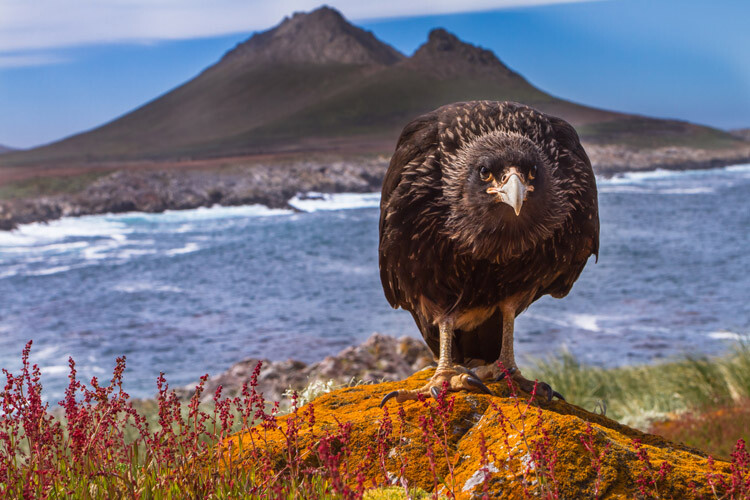
Wide Angles

When you have a cooperative or curious subject, few techniques will yield a more compelling result than getting close, and low, with a wide-angle lens. A few years ago, when I was guiding on an expedition cruise through the Southern Ocean and Antarctica, I had several such opportunities.

In the Falkland Islands, a curious Striated Caracara hopped up to have a look at me, while on South Georgia I had a great encounter with a South Polar Skua. The images I made of these two birds are some of my favorites of that journey and perhaps some of my favorite wildlife images.

Ultimate guide outdoor nature photography 42

Wide angles show off not only your subject but also the surroundings and can be extremely effective story-telling images.

The drawback, of course, is that such opportunities are rare indeed. You’ve got to have your subject very close, and that takes time and effort while being prepared when the right opportunity arrives.
Ultimate guide outdoor nature photography 43

To maximize your chances, keep a second camera with a wide-angle lens (heck, even your phone will work) available while out shooting. That way, when a critter draws close and the opportunity for these unique images arrives, you won’t have to fumble with swapping lenses.

Conclusion

As I wrote this lengthy piece on outdoor photography, I felt I could have gone on and on about every single aspect of this discipline. There is just so much to know, and to learn; so many subjects to study, understand, and practice.

Ultimate guide outdoor nature photography 44

It is daunting, but outdoor photography is as much about the journey as anything else. I love making images that work, don’t get me wrong, but I love even more the process of being outside. I love the way a camera makes me more aware of the play of light, and the movement of animals across a landscape.

Photography can be a tool toward a better understanding of the world, but we have to use our cameras with respect and caution. Be mindful of your actions, be careful of our impact, and make beautiful photos. Along the way, you may find your experiences, rather than the final images, to be the most rewarding part. Now go explore.

The post dPS Ultimate Guide to Nature and Outdoor Photography by David Shaw appeared first on Digital Photography School.


Digital Photography School

 
Comments Off on dPS Ultimate Guide to Nature and Outdoor Photography

Posted in Photography


9 of the Best Apps to Help You Do Awesome Mobile Phone Photography

05 Nov

They say the best camera is the one that you have with you. Even though I love my digital SLR, quite frequently, I shoot with my smartphone. This is why mobile phone photography is so popular.

There is a collection of stunning oak trees near where I live. Each time I go there, the trees look different based on the weather and time of year. Did I need an expensive $ 5,000 camera to get these pictures? No, because I know some tricks for shooting with my smartphone.

9 of the Best Apps to Help You Do Awesome Phone Photography

For these types of images, it doesn’t matter what type of camera you have. If you’ve got a camera, the inspiration, and the time, you can create some great images with your smartphone. Great images come from a good eye and a basic knowledge of composition and light. If you practice with these elements, you can take awesome pictures with any device even if it’s a phone camera. In this article, I will give you some of my favorite apps that will inspire you to have some fun with the camera that is always with you.

Is the era of the compact camera coming to a close?

9 of the Best Apps to Help You Do Awesome Mobile Phone Photography

Either people shoot with their smartphones or they use an advanced digital SLR.  There’s not much in between. Why is this happening?

For the general public, smartphones have more capacity and are easier to use than the current lower-end point and shoot cameras on the market. People are getting better results with less effort. When someone asks for a recommendation on a camera and they only have a couple hundred dollars to spend, I usually recommend that they use their cellphone.

As a photography educator, I find my iPhone to be easier to use and more consistent across multiple models. Some Android models work differently and don’t have the same capabilities as other phones. Some apps don’t work on all Androids, so please take that into account when trying out the apps mentioned in this article.

Smartphone-workshop 9 of the Best Apps to Help You Do Awesome Mobile Phone Photography

The current compact cameras are more menu-driven than most people can handle. And if their photography skills are not up to snuff, it is hard to get past the automatic modes on those cameras. I have had clients in my classes with these lower-end compact cameras where the manual modes do not work at all. These little gadgets are almost as complicated as the advanced digital SLRs, but without the quality results. The only things that are of benefit are their size and price point, but even then it means a smaller lens, a smaller sensor and diminished results.

Smartphone photography

I discovered smartphone photography after attending a professional photographic trade show. I took a little seminar on an app called Hipstamatic for iPhone and I was hooked. I was no longer a photo snob! All of a sudden, I realized I could create stunning photos in moments that would take hours in Photoshop.

Over the next year or so, I shot thousands of pictures on my smartphone and I got really familiar with the ins and outs of this type of photography.

San Simeon Hipstamatic - 9 of the Best Apps to Help You Do Awesome Mobile Phone Photography

I also realized this was the future of social media and photography for the general public. You could create little masterpieces that were appreciated online. They were not high resolution and the use of these images was limited, but that works just fine for most people. As a photographer, you don’t want to post images that can be stolen and easily used somewhere else, so the smartphone low-resolution image size is perfect.

I knew then there was a huge future in this art form for the general public. I continued to research new apps, reading everything I could and staying updated. Here are some of my favorite apps for mobile phone photography.

Shooting apps

Camera+Camera+ for IOS

This app allows you to control separate focus and exposure points, one of the secrets to good mobile phone photography. You can also use additional features such as selective focus, exposure compensation, and exposure lock. I use Camera+ on every picture I take.

Unfortunately, Camera+ is not available for Android.

Big Sur-iPhone  9 of the Best Apps to Help You Do Awesome Mobile Phone Photography

ProshotProShot – for IOS and Android

This app has all of the auto, program and manual modes that Camera+ has and is available for both IOS and Android (as well as Windows phones). With ProShot you have full manual control over exposure, ISO, and shutter speed. The most important aspect here is the ability to separate focus and exposure like you can with the Camera+ app.

My go-to editing app

Snapseed

Snapseed

This app is a must for both IOS and Android users! Snapseed is a go-to app for processing photos. It has such an easy interface, that you can make it part of your normal workflow and literally do your editing in seconds when taking a shot with your mobile phone. There are so many options in this app, but my favorite is the selective contrast and exposure settings. It allows you to go into the image and change exposure, contrast, and saturation in specific parts of your picture. Other settings such as grunge, HDR and Retroux let you create a variety of special effects.

Snapseed is available for both iPhone and Android.

Graphic Apps

wordswagWordswag – for IOS and Android

Are you looking for a simple text app where you can create text overlay or a watermark? Wordswag will help you create professional looking graphics like this in just seconds!

wordswag 9 of the Best Apps to Help You Do Awesome Mobile Phone Photography

Retro Apps

HipstamaticHipstamatic –  for IOS

This app allows you to select “film” and “lenses” in the “classic mode” before you shoot to create the perfect effect. Hipstamatic also added a modern interface with the ability to change your “lenses” and “filters” after you have taken the shot. Find one combination you like to create your own shooting style.

Hipstamatic - 9 of the Best Apps to Help You Do Awesome Mobile Phone Photography

Retro Camera – for Android

Retro

With Retro Camera you can take Hipstamatic-style images with five cameras, five sets of vintage vignetting, film scratch and cross-processing options.

Creative art apps

 Prisma – for IOS and Android

Prisma

Here’s a fun app that will turn your images into works of art in seconds. Lots of different options to create in this app. Each option in Prisma is preset and instant with very little custom editing needed.

9 of the Best Apps to Help You Do Awesome Mobile Phone Photography

Diana

 Diana – for IOS and Android

This app is an easy way to create double-exposure images in seconds. You can create images by selecting specific photos to combine, or you can randomly let Diana select for you. It works better if you have a vision in mind before working with this app, but sometimes a random selection works as well!

Diana app - 9 of the Best Apps to Help You Do Awesome Mobile Phone Photography

Waterlogue – for IOS and Windows 10 devices

Waterlogue

Create beautiful watercolor style images with Waterlogue. Select from a number of different styles to create your own masterpiece!

waterlogue

Conclusion

The beautiful thing about photography with the smartphone is that it expands your creativity and can even help with your Digital SLR photography. You can use more than one app to create even more customized effects. Take each image through a series of apps before getting the final look you want. You never know where you’re going to end up, and you might just like that.

What are your favorite Smartphone apps? Has it changed the way you shoot with your Digital SLR? Which of these apps is going to become a regular part of your smartphone photography workflow?

The post 9 of the Best Apps to Help You Do Awesome Mobile Phone Photography by Holly Higbee-Jansen appeared first on Digital Photography School.


Digital Photography School

 
Comments Off on 9 of the Best Apps to Help You Do Awesome Mobile Phone Photography

Posted in Photography


Weekly Photography Challenge – Play with Your Food

04 Nov

Your mother may have told  you not to play with your food, but this week you have our permission.

Shot I did in New Orleans – very famous coffee and donuts.

I recently shared some video tutorials with food photography tips – check those out if you need help.

Here are some other dPS articles on the topic if you want more tips and ideas:

  • 4 Tips for Beginners to Food Photography
  • The Secret to Finding the Hero Angle in Food Photography
  • 8 Tips for Food Photography Newbies
  • How to Take Cool Food Photos in Your Refrigerator
  • Household Items to Bring to Your Next Food Photography Shoot
  • 5 Tips for More Professional-Looking Food Photography
  • 5 Tips That Will Make Your Food Photos Stand out from the Crowd
  • Using Focus Creatively with Food Photography

I used to do food photography commercially – a long, long, time ago! Here are some of my tips:

Don’t forget your fruit and veggies – even still in the tree or on the vine.

Food in its raw form including still on the tree works!

Not quite on the tree. I added the hands here to add interest and show scale, as well as the inside of this nut.

Add a human element or photograph the preparation of the food as well as the finished product.

The making of the iced coffee.

Add a human element for interest. Yes I did drink it and yes it was amazing!

Get the light right. The most common placement or direction of light with food photography is to have the light actually coming from behind the food. It makes it look shiny and more appetizing that way. Like this Colombian ajiaco soup.

Play with angles, light, and composition. Don’t just take one shot.

I wanted to show how full the table was here so I used this overhead angle. This is shot I did for a hotel in Nicaragua showcasing the breakfast they serve.

I took a lower camera angle here to show the setting of where the breakfast is served.

Here I added the human element and motion with the juice pour.

Now it’s your turn!

Weekly Photography Challenge – Food

Simply upload your shot into the comment field (look for the little camera icon in the Disqus comments section) and they’ll get embedded for us all to see or if you’d prefer, upload them to your favorite photo-sharing site and leave the link to them. Show me your best images in this week’s challenge. Sometimes it takes a while for an image to appear so be patient and try not to post the same image twice.

Share in the dPS Facebook Group

You can also share your images on the dPS Facebook group as the challenge is posted there each week as well.

The post Weekly Photography Challenge – Play with Your Food by Darlene Hildebrandt appeared first on Digital Photography School.


Digital Photography School

 
Comments Off on Weekly Photography Challenge – Play with Your Food

Posted in Photography