RSS
 

Posts Tagged ‘Photographers’

6 Powerful Reasons Why All Photographers Need Facebook Pages

04 Mar

Why Photographers Need A Facebook PageHi there everyone,


It’s Ed a.k.a Edrenalin here, editor of FashionPhotographyBlog.com, bringing you insights from the inside.


I’m constantly intrigued when I discover that out of the numerous photography businesses I’ve helped, the majority of them do not have a Facebook page for their business. Sure, these photographers had a personal Facebook profile, however, when it came to having a dedicated page for their photography, this was non-existent. I see this over and over again, and I can tell you that they are missing out on a great marketing tool in their business tool belts.


However, I have to insert a disclaimer here, in that not every business will benefit from having a Facebook page for their business. It really depends on what kind of clients you are after for your business. For those of you who are looking for clients to make contact with you to book you then a Facebook page would be an ideal platform for you. If not, you can still create a Facebook page but there may be other social media platforms that may be more relevant to your market.


Top 6 reasons why you need a Facebook Page for your business (even if you don’t have a photography business yet).


1. It’s free as long as you are connected on Facebook with a personal account. It won’t cost you anything to create a Facebook business page and it’s pretty quick and easy to set up so give it a go, you have nothing to lose.


2. Having a recognisable authority website such a Facebook, talking about your website provides bonus points for SEO. Not all social media accounts pass on “SEO link juice” these days (the reason for this is to prevent online scammers from abusing these social media platforms) however having a Facebook page is a great way to increase the visibility of your photography business, on Facebook and Google searches.


3. Not only can people see friends that they know like and interact with your page, they can read the reviews and the feedback that people leave in the comments, to work out if you are a reputable photography business or not. People trust what their friends say more than what what you say. It’s one thing for you to talk about how great you are with your photography business, but it’s another when they hear it (or read it) from people they know, trust or relate to.  


4. Potential clients who want to send a message to you on your website for an enquiry or booking might want to first know how quickly will you reply back to them (and whether you are still in business or on holiday). They may check out your Facebook page, since Facebook is one of the largest social media platforms in the world, and see what you are currently up to, and check up on your most recent posts.


5. It allows your target audience to discover your photography business outside your website. By having a Facebook page you have another web property with a sizeable audience that potential clients can find out about you and your photography, even if they don’t know what the web address of your photography website is (or even if you don’t have one yet).


6. And here is one of the most important reasons – If you don’t have a Facebook page yet, you can guarantee that your competitors already do and they are communicating with your potential clients before you get the chance to. This is the reality in today’s competitive marketplace and a lot of photographers are losing potential business because they haven’t jumped on board Facebook yet and join the conversation.


So if you are hesitating or been thinking about starting a Facebook page for a long time but haven’t done so yet, I recommend that you do so right away for the reasons stated in this article. Do not worry if it doesn’t look perfect the first time. Remember that progress is better than perfection, and you can always close the page down or make edits to it later if it’s not to your satisfaction.


Do you like this article? Want to read more articles like this? Then please SHARE this article on social media. If you have any comments or questions please feel free to put them in the comment section below. 


Fashion Photography Blog

 
Comments Off on 6 Powerful Reasons Why All Photographers Need Facebook Pages

Posted in Uncategorized


5 Killer Reasons Why Photographers Need Social Media

01 Mar

fashion-photography-blog-social-media-for-photographers

Hey there everyone,


This is Ed a.k.a Edrenalin, the editor of FashionPhotographyBlog.com, here to bring you insights from the inside.


After all of my client’s photography businesses I’ve helped improve, one thing is common across each and everyone one of them, they wanted to have a presence online and they wanted to be on social media. That’s understandable since that’s where all the major businesses across every industry is moving towards. However, when I asked them why they wanted to be on social media and what they wanted social media to do for them, they couldn’t answer the question. At the end of the day, they felt that they needed to be on social media because everyone else told them they had to.


So how can you work towards your social media objectives if you don’t know what they are in the first place? Don’t despair though, because if you are thinking similarly in this way, then you are not alone. It is a common misconception amongst photographers and creatives based on the encounters that I’ve come across. I’m going to share with you what I share with them to help clear up the reasons why you should consider incorporating social media in your own marketing strategies for your photography business.


Top 5 reasons why photographers need social media today


1. Social media accounts proves that there is a real person behind the photography business and that you didn’t just “open shop” yesterday. The accounts establish that the business has history and participates in dialogue and that you are active online.


2. Google now is starting to incorporate social signals from your social media accounts as a factor in their SEO algorithms to determine the relevancy and engagement of your website when deciding to show your website on the search results pages. The weight social signals has in this algorithm is unknown and is locked away in the unbreakable vaults of Google however, I can confirm that it is now a factor.


3. Your target audience can see social proof based on what others are saying about your photography business in your social media accounts such as in your comments and reviews section.


4. Potential business partners and magazine editors, might want to see how engaged are your followers. If they do business with you or publish your work, then you publish the news on your social media accounts, they might want to know how many people following you would actually know about it and get eyeballs to their brand.


5. Not everyone will know your website address, before they know about your business. With social media you are able to engage with your target audience in other social networks and hang out where they hang out. Here’s a question, how many people visit your website every day? and now how many people visit Facebook every day? which is the greater number?


The concept behind social media marketing is that you are participating in discussions with communities of these larger social networks, “borrow” them from these established networks and introduce them to your photography business.  


If there is one thing that you can do to improve your business this year, is to get onto social media for your business to increase the online presence for you.


Do you like this article? Want to read more articles like this? Then please SHARE this article on social media. If you have any comments or questions please feel free to put them in the comment section below. 


Fashion Photography Blog

 
Comments Off on 5 Killer Reasons Why Photographers Need Social Media

Posted in Uncategorized


CP+ 2016: Fujifilm gets new X-Pro2 and X70 into photographers’ hands

28 Feb

CP+ 2016: Fujifilm gets new X-Pro2 and X70 into photographers’ hands

Fujifilm didn’t announce any new products at CP+ this year, but the show is the first chance that a lot of Japanese enthusiast photographers have had to get their hands on the X-Pro2 and X70, which were unveiled last month.

CP+ 2016: Fujifilm gets new X-Pro2 and X70 into photographers’ hands

In an effort to get cameras into photographers’ hands, Fujifilm is running a rental service at this year’s show, where prospective X-series users can hire gear while they’re attending the show. 

CP+ 2016: Fujifilm gets new X-Pro2 and X70 into photographers’ hands

Here’s the camera that a lot of people at the booth have come to see – the 24MP X-Pro2. The long-awaited replacement for the X-Pro1 brings a higher resolution sensor, upgraded processor and significantly revamped autofocus system. 

CP+ 2016: Fujifilm gets new X-Pro2 and X70 into photographers’ hands

Ergonomically, the X-Pro2 is very similar to its predecessor but in terms of performance, it’s a totally different beast. The snappier processor, revamped ergonomics and higher-resolution viewfinder all make a welcome difference to the camera’s operation. 

CP+ 2016: Fujifilm gets new X-Pro2 and X70 into photographers’ hands

Less obvious are the changes that Fujifilm has made under the hood. The X-Pro2 is weather-sealed and – Fujifilm claims – more able to withstand punishment than its predecessor. This is what happens to an X-Pro2 after it has been aged in a simulated (i.e. sped up) process which appears to have involved rather a lot of sandpaper. Even with paint missing from pretty much all of its edges, the camera remained operational (we’re told). 

CP+ 2016: Fujifilm gets new X-Pro2 and X70 into photographers’ hands

Apologies for the poor quality photograph, but this camera is an early mockup of an ‘X-Pro1 S’, which ultimately became the X-Pro2. Cameras often go through several design changes during the course of their development but it’s unusual to be able to see any of the rejected versions. The X-Pro1 S is a little boxier, and a little more ‘classic’ looking than the eventual X-Pro2.

CP+ 2016: Fujifilm gets new X-Pro2 and X70 into photographers’ hands

And slimmer, too. Although of course it’s impossible to say whether the camera would have stayed quite so skinny by the time it entered production. We’re pretty sure that this prototype doesn’t actually contain any working electronics. 

CP+ 2016: Fujifilm gets new X-Pro2 and X70 into photographers’ hands

Again, sorry about the poor quality of this image, but if you look carefully at this exploded view of the X-Pro2 you’ll see various yellow lines around the body shell on the left of the picture. These are gaskets for weather-sealing. 

CP+ 2016: Fujifilm gets new X-Pro2 and X70 into photographers’ hands

Fujfiilm is really pushing the X-Pro2 at CP+, and has even created a gallery space showcasing images from its newest X-series camera. We must say, these prints (which are mostly around 20 inches in size) look great. 

CP+ 2016: Fujifilm gets new X-Pro2 and X70 into photographers’ hands

Let’s not forget about the X-70 though, Fujifilm’s new APS-C format compact camera. Essentially the X70 takes the imaging components from the X100T, and puts them into a smaller, more compact body. Gone is the X100T’s hybrid viewfinder (an optical one – shown here – can be added if you like) but new is a 28mm equivalent F2.8 lens. 

CP+ 2016: Fujifilm gets new X-Pro2 and X70 into photographers’ hands

The X70’s rear screen can tilt outwards, and up for shooting from low and high angles (and self portraits if you’re so inclined). It’s touch-sensitive, which allows for direct placement of AF point by touch, and quick swiping through images in review mode.

CP+ 2016: Fujifilm gets new X-Pro2 and X70 into photographers’ hands

A major booth at CP+ just wouldn’t be complete without some scantily-clad ladies to take pictures of, and Fujifilm has even created a nice little garden for them to stand in. How kind. 

CP+ 2016: Fujifilm gets new X-Pro2 and X70 into photographers’ hands

Meanwhile, photographers use Fujifilm’s new 100-400mm telezoom to snap overhead portraits of the ladies in their garden. . 

CP+ 2016: Fujifilm gets new X-Pro2 and X70 into photographers’ hands

Fujifilm isn’t focused completely on digital technology of course. The company still makes (and sells a lot of) instant film cameras. Instax had a prominent and very colorful corner of the Fujifilm booth at this year’s show.

CP+ 2016: Fujifilm gets new X-Pro2 and X70 into photographers’ hands

It looks like Rishi has found his favorite color – what’s yours?

Articles: Digital Photography Review (dpreview.com)

 
Comments Off on CP+ 2016: Fujifilm gets new X-Pro2 and X70 into photographers’ hands

Posted in Uncategorized


7 Common Mistakes That Newbie Street Photographers Make

26 Feb

Over the last few years I have worked with enough budding new street photography enthusiasts, to notice a common thread of early mistakes that many of them make. A lot of these are very simple tendencies and changes, that can make a vast difference to the final output. It’s for this reason that I try to teach these 7 tips from the very start. Follow along so you can avoid the seven common mistakes that newbie street photographers make:

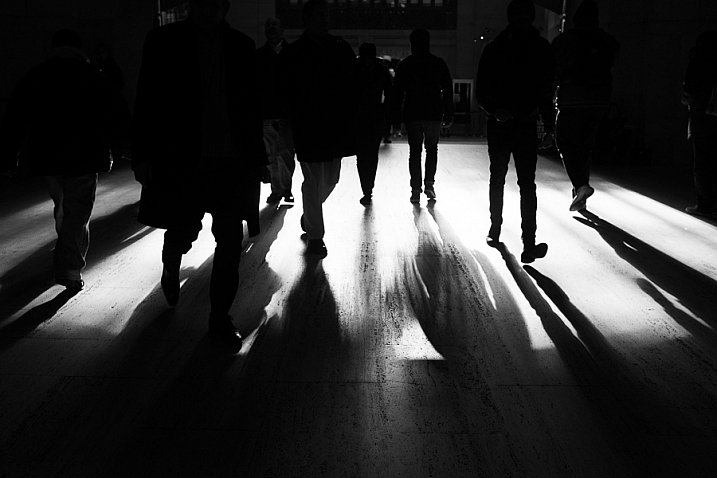
Grand Central, NYC Street Photography

Grand Central, NYC.

1. Thinking too much while shooting

If you are reading this article, you are on the right back. You should read about photography to teach yourself, and study the work of great photographers. However, when you are out there, in the process of shooting, try to not over-think things too much. There are so many tips and tricks, and you may worry a lot about capturing bad images, but that can all get in the way sometimes.

Instead of worrying about the results, get lost in the process. You can assess your results during the editing phase. When you are out there shooting, have fun. Explore, take your time, relax, and just watch everything go by. This is a type of photography that you really have to enjoy to do well, and the best part about it is that you can go out and do it nearly anywhere and at any time. You can do it in 10 minute spurts, or during your lunch hour. You can even do it with your iPhone if you don’t have your camera. The more fun you have with the process of being out there, getting lost, and exploring, the more dedicated you will become, and the better street photographer you will become.

2. Traveling too heavy

There are many great videos of the old masters shooting street photography. You know what is the one common thread between many of them? It’s that they had manageable sized cameras, that they could easily take anywhere, and they more often than not they used small prime lenses. You can certainly shoot street with an SLR, and do it very well. There are top photographers that do just that, but at the same time are you really going to want to carry that tank of a camera around on a daily basis? That’s the big advantage of a smaller camera, and the technology is catching up quickly with the large bodies. A small Fuji camera, or a Ricoh, will do wonders, and you can even get an older used version for much cheaper than the new ones. There are many iPhone street shooters as well.

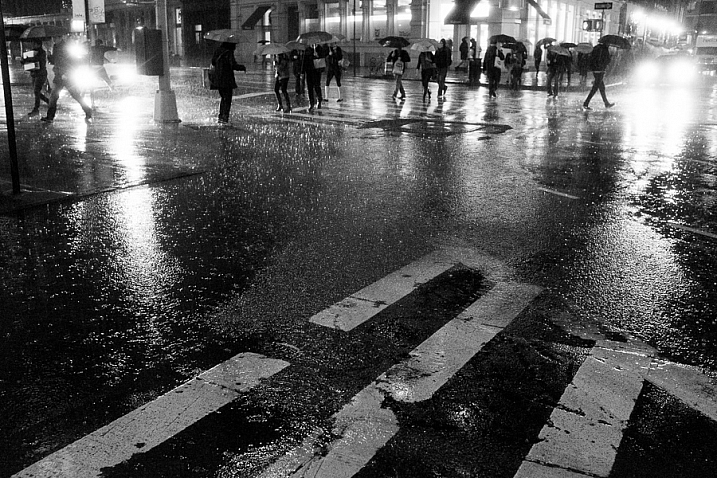
Astor Place, NYC Street Photography

Astor Place, NYC.

Likewise, you do not need a big bag of lenses and filters. If you haven’t tried it, I can’t stress enough, how freeing going out for a day with a single small camera body, and a single prime lens, can make you feel. Leave the rest behind. Yes, you will miss out on that 200mm zoomed shot of the water tower, but you will come back in the long run, with so many more good photos, and you will have a lot of fun doing it.

3. Trying to get somewhere too quickly

We’re all in a rush these days, running from place to place. Luckily, that is one of the worst ways to do street photography. To do street photography well, you need to slow down, and take your time. You can’t always be in a rush. Look around, and wait for things to happen. Wait with your camera, and let the subjects come to you. The slower you go, the more aware you will be of your surroundings, and the more able you will be to capture those extraordinary fleeting moments. Use photography as a way to break out of the rushed lifestyle, and to get lost and slow down for awhile.

4. Not standing in the middle of the action

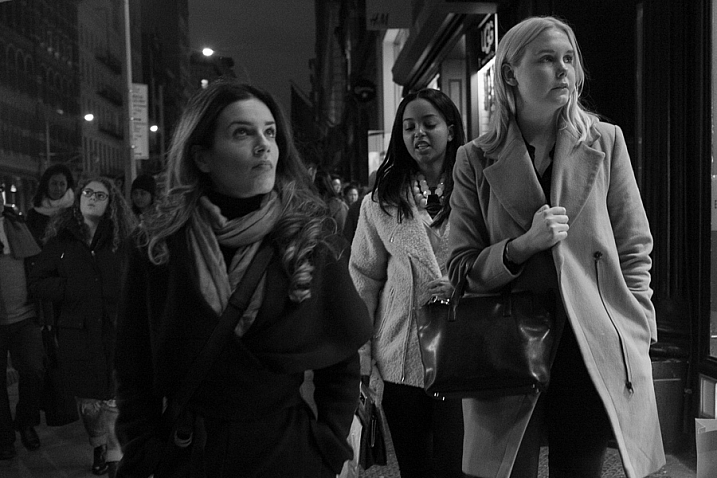
Broadway, SoHo, New York Street Photography

Broadway, SoHo, NYC.

It is so easy to get intimidated when you are first learning. Many people start by photographing from a distance, and they never really push themselves to get right in the middle of what’s happening. Carry your camera proudly, put a smile on your face, and get involved in the action. Get in the middle of the street.

You might notice that if you are standing too far away and shooting, then people will actually think you are up to no good. But, if you are directly in the middle of the action, people will walk right by thinking that you are doing nothing wrong. Sometimes you’ll even blend in more being in the middle. How could you possibly be doing something wrong if you are right there in the middle? Nobody that obvious would be doing anything bad, but that photographer creeping around over there in the corner, just has to be a stalker. Stop and wait right in the middle of an area where things are happening, and just let everything happen around you. Engulf yourself in the experience.

5. Not putting the camera to your eye enough

I hip shoot a decent portion of the time, particularly when things are happening incredibly fast, but I also try to look through the viewfinder as often as possible. A lot of new photographers only hip shoot, and it quickly becomes a crutch. After a while, they become even more afraid to put the camera to their eye, than when they started. Force yourself to get comfortable shooting through the viewfinder. Just stand in a busy place, with the camera to your eye for a while, until you feel comfortable. After that you can add in the hip shooting. There will be situations where a hip shot is beneficial, but you will get better shots, and better framing, when you look through the viewfinder. Take pride in seeing it all coming together, and capturing that split second moment where it does.

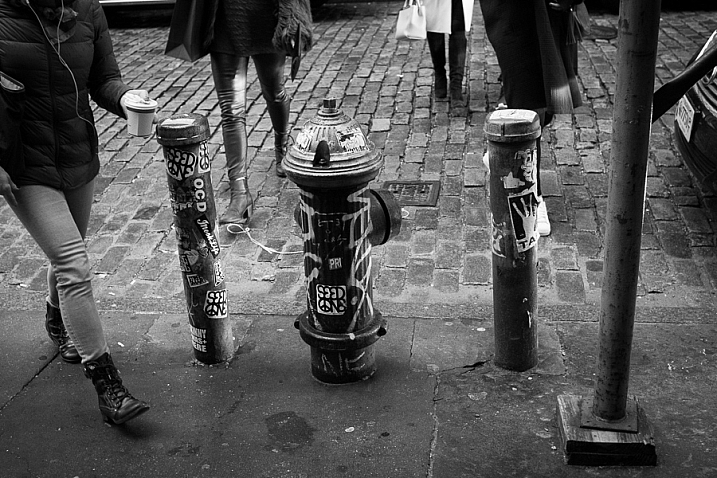
Fire Hydrant, SoHo, NYC

SoHo, NYC.

A tip that helps with this, is to not take the camera away from your eye right after you take a shot of someone. It’s a natural habit to remove the camera from your eye briefly when you take an image. Instead, get in position, and wait for a person to be in the right spot, Then, take the image, but continue to keep the camera to your eye as they walk through the scene and past you, as if they got in your way and you are trying to photograph what is behind them. This trick works incredibly well in areas with quite a few people walking around.

6. Rapid firing with the camera

Turn the machine gun setting on the camera off. A lot of people think that if they take 10 photos of the same scene, they will be guaranteed to get a good one. Where’s the art in that? I actually find that holding down the shutter button, and taking a stream of shots, is a way to guarantee that you will screw up the shot. You need to be able to visualize what you are getting. See the moment as it happens, then capture the elements as they all fall into place. That only takes one shot. Then, as a scene further develops, you can take more, but see the moment and grab it. If you miss it, and you will miss some, there’s always next time. Let go of the fear of missing a shot.

In addition, with rapid fire you will end up taking 10 times the number the photos, over the course of the day. How are you going to find the perfect moment in all of that? Nobody has the time, or the hard drive space. With less, and more purposeful photographs, comes a much more enjoyable editing session.

7. Under and over-editing

East Village, New York Street Photography

East Village, NYC.

A lot of new street photographers will both under, and over-edit their photos. What I mean is that they will show too many photos, and they will over-process them. Be ruthless with narrowing your photos down to the best ones. You want people to actually give your work attention, and if you show too many photographs at one time, they will tune out. By showing too many photos you are relying on the viewer to do the editing in their heads about what they like. That’s not fair to them, do that work yourself. Spend that extra time organizing. Use a starring system to give your photographs ratings and make sure that there are not too many five star images. Spend the time after each shoot to narrow it down to just the cream of the crop. If you don’t do this consistently, you will allow your archive to pile up into an unorganized mess.

When you do the actual editing to your photos, keep a light touch. You can, and should fix the exposure, blacks and whites, vignettes, color temperature or black and white tones, contrast, and all that other good stuff. However, a lot of new street photographers go way too far. Part of the extraordinary nature of street photography is that it was actually captured in the real world. It was not made up. If your photos are too edited, and lose that real feeling to them, it kills the thing that makes them special.

Are you guilty of any of these mistakes? How have you overcome them? Do you have any others you’d like to share? Please do so in the comments below.

googletag.cmd.push(function() {
tablet_slots.push( googletag.defineSlot( “/1005424/_dPSv4_tab-all-article-bottom_(300×250)”, [300, 250], “pb-ad-78623” ).addService( googletag.pubads() ) ); } );

googletag.cmd.push(function() {
mobile_slots.push( googletag.defineSlot( “/1005424/_dPSv4_mob-all-article-bottom_(300×250)”, [300, 250], “pb-ad-78158” ).addService( googletag.pubads() ) ); } );

The post 7 Common Mistakes That Newbie Street Photographers Make by James Maher appeared first on Digital Photography School.


Digital Photography School

 
Comments Off on 7 Common Mistakes That Newbie Street Photographers Make

Posted in Photography


PhotoPills: The Photographer’s Swiss Army Knife

20 Feb

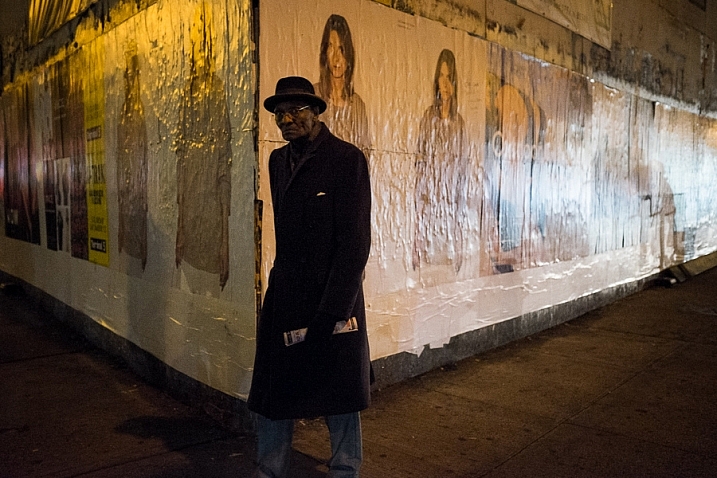
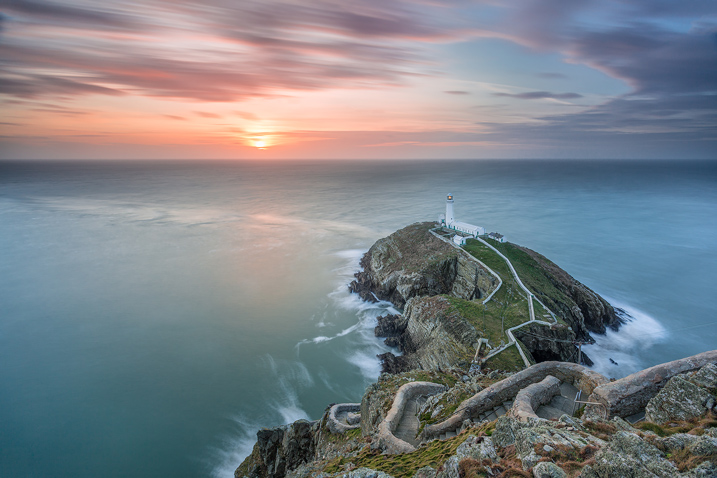
It’s 6pm, it’s cold, and the sun is on its way to set. The tripod is placed, the composition is done – now I just have to wait for the big show that Mother Nature puts on every day to happen again. The sky is threatening, but with a little luck, the sun will pierce the clouds to pass above the lighthouse in front of me.

Image 1

If I think about the first time I went out with the tripod on my shoulder, it makes me smile. I knew more or less where to go, I had no idea of the exact time at which the sun would set, nor where. Failure was inevitable!

Years have passed since then, and many things have changed. But the biggest and decisive one is in my hands right now: PhotoPills – photo planning app.

What is PhotoPills?

PhotoPills is like having a Swiss Army Knife for all photography matters in your pocket, at your service. Whether you’re a seasoned photographer, or someone who’s barely touched a camera, PhotoPills has you covered. You have a question, you get the answer.

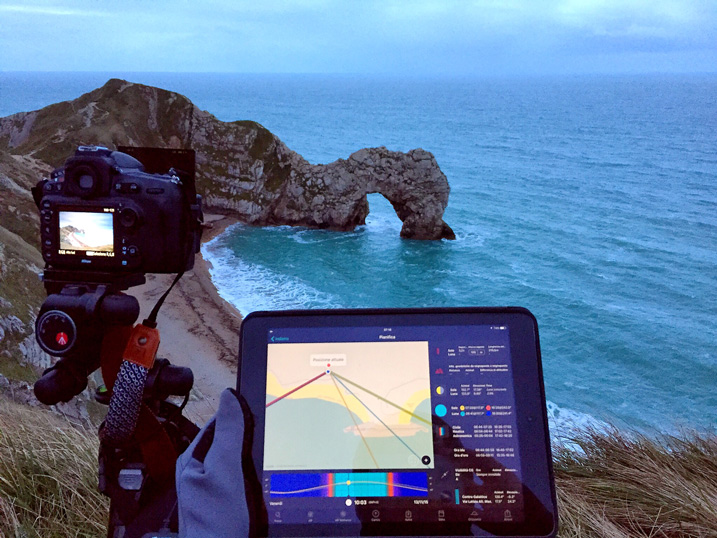
Image 2

Using PhotoPills at Durdle Door (UK)

Beginners will love it. I see it in every single workshop I run. There, in the field, before deciding the frame and the shooting spot, people enjoy using the Augmented Reality views, to easily track the position and the path of the Sun, the Moon, and the Milky Way. It’s the simplest way to understand what’s going to happen next.

On the other hand, on a more advanced level, being able to plan your shots directly on a map, even the Milky Way shots, saves a ton of time. PhotoPills’ Planner is so well designed, that you can quickly figure out the perfect shooting spot, date, and time for any scene you imagine.

Image 3

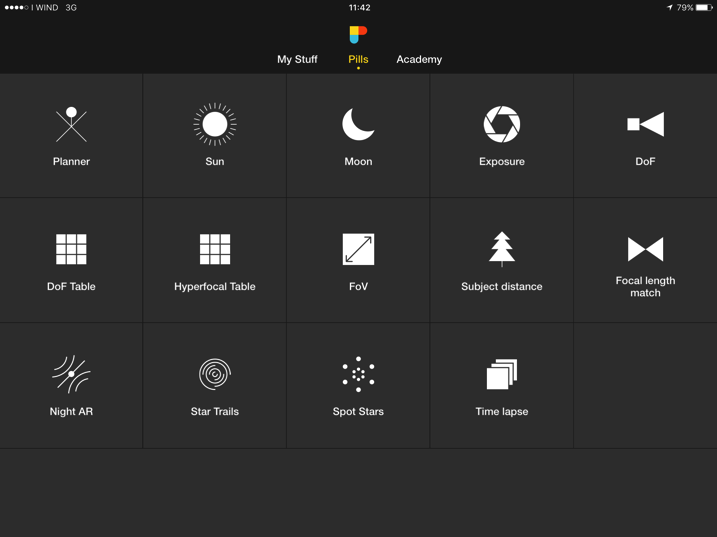
PhotoPills screen menu

Everything starts from a clean and user friendly interface.

You can choose between three menus, simply through a swipe to the right or left at the top of the interface. After choosing your camera, the map type, and other settings in “My Stuff” menu, you can enter the main section called “Pills” where you have the access to all the available modules.

The possibilities are almost endless, and in this article, I’ll do my best to describe some of the things you can do with this app. Are you ready?

Widgets

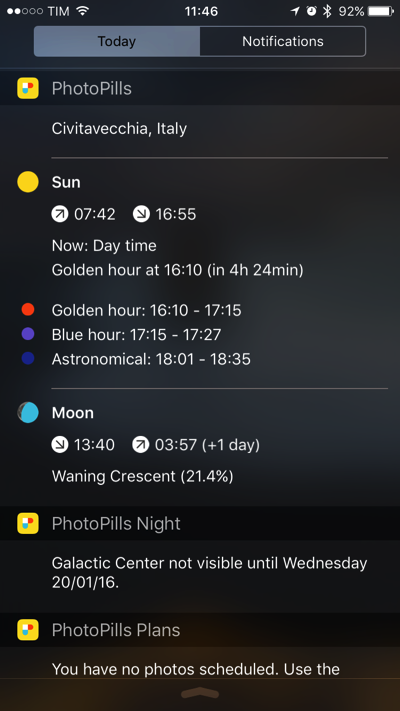
Imagine that you’re going to bed (at home, or anywhere in the world) and want to know at what time the sun will rise tomorrow, when the golden hour starts, or when the Moon will rise, or what about the the galactic center visibility times?

The first thing that I love in this App, is that all you have to do is to pull down from the top of the screen and enable the three PhotoPills widgets in the notification center. If you do so, you’ll have all the key light, sun, moon and Milky Way information in just one swipe. Also, you’ll have access to the five upcoming photo plans you’ve saved using the Planner.

Image 4

I love using the widgets when I’m traveling, since it’s so easy to have everything I need on one single screen. A cool feature is that it works offline too. As it happens with the Augmented Reality views, PhotoPills doesn’t need an internet connection to give you all the key data you need.

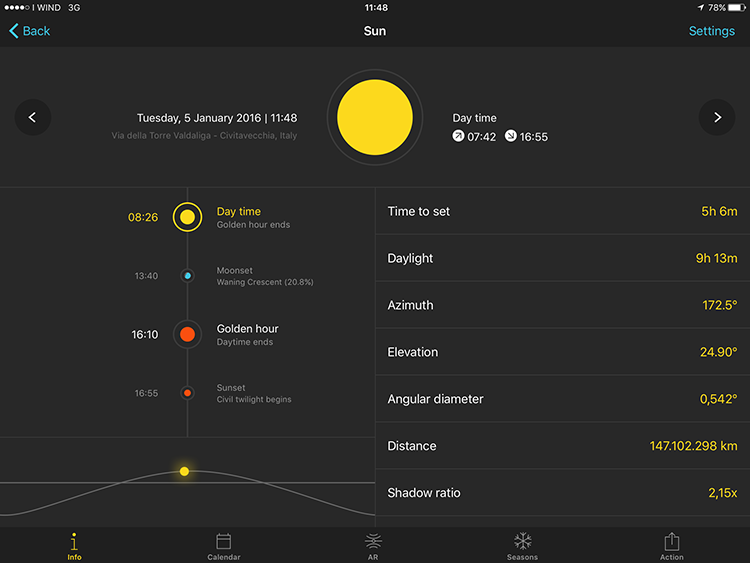
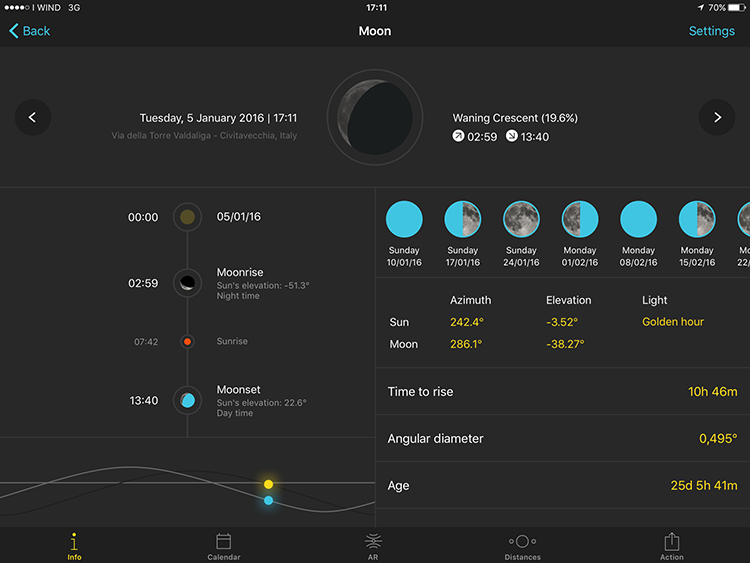
But that is not all, in the case you want to have all this information (and much more) for a different location or date, just use the new Sun and Moon Pills. So easy, and so nice to have everything together. I really hope that an Apple Watch version will be implemented soon too.

Image 5A

Sun Pill

Image 5B

Moon Pill

Augmented Reality

In a landscape image, composition is more than fundamental. How many times have you arrived at your shooting location, and wondered where the sun would set? For me, every time – but before using PhotoPills, I was never able to have a precise answer.

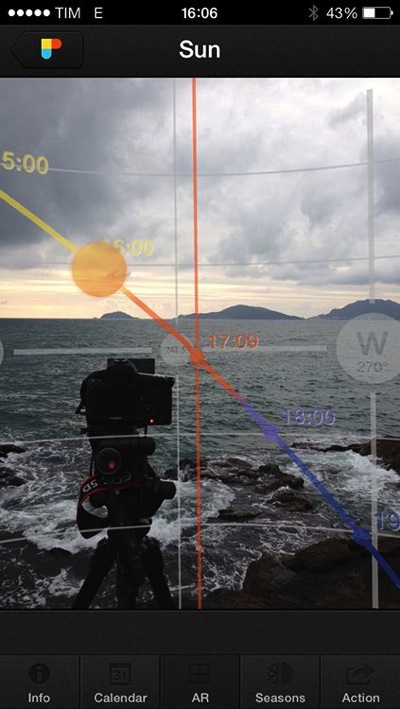
The Augmented Reality (AR) module included in the App, makes things so easy. Just point your phone at a subject, and use the AR tools available within the Sun, Moon and Night AR pills to see where the Sun, the Moon or the Milky Way will be in the image.

Image 6

Sun AR in action

Besides, and this is particularly clever, you can change the time to see how everything evolves, just by scrolling on the screen with your finger.

The application is also useful for all the star hunters out there – with the Night AR view it is easy to plan star trails shots. For example, if you’re planning to shoot a circumpolar, the Night AR view will also help you locate the North Star (Polaris). And, if you live in the southern hemisphere, PhotoPills will give you the position of the south celestial pole, right where you need to frame.

Image 7 1

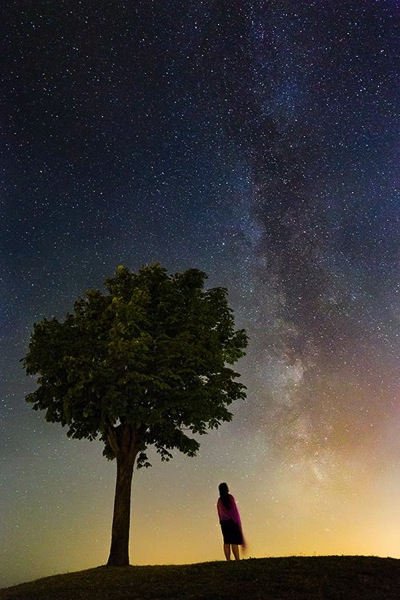
A Milky Way shot planned using Night Augmented Reality

Planner

If the Augmented Reality tools are my students’ favorites, I simply love the Planner. I use it to plan every shoot.

Image 8

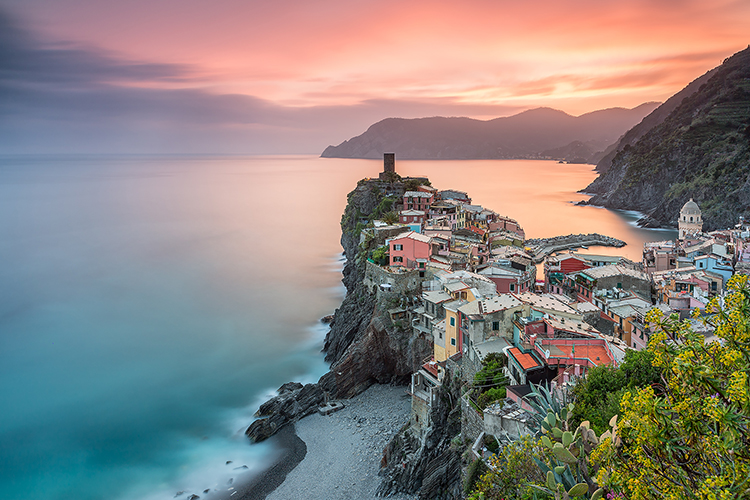
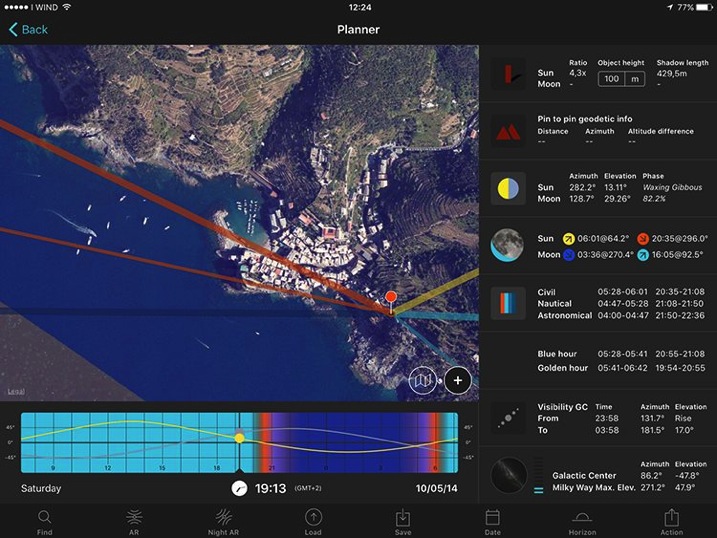
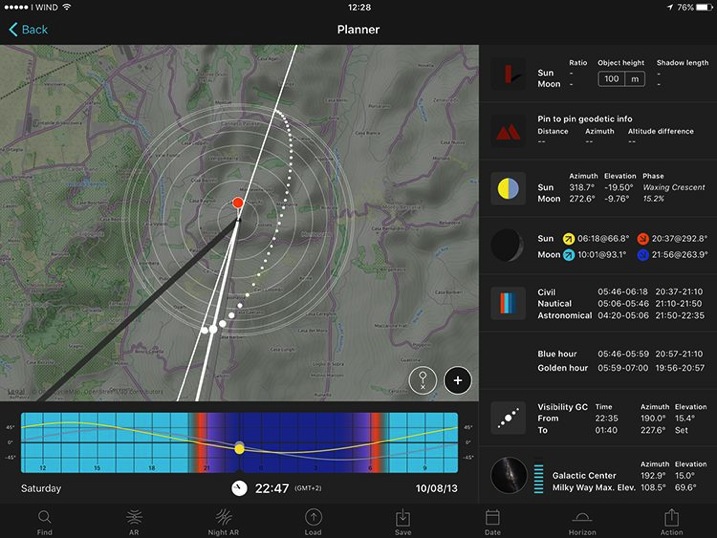
No matter if it’s a sunset in Vernazza (above), a moonrise in Iceland, or the Milky Way in Yosemite National park, the PhotoPills Planner helps me find the right time, for the alignments I’m looking to happen. It’s my imagination’s best ally.

Image 9A

Planning Pill for Vernazza shot above

Image 9B

Planning Pill for Milky Way shot above

A lovely feature, is that once I’ve figure out the shooting spot and shooting time, I can save the plan in my To-Do list of planned photos. Then, every time I have an idea, I plan it and save it in my list. This way, I make sure not to miss any of my favourite shots.

Location Scouting

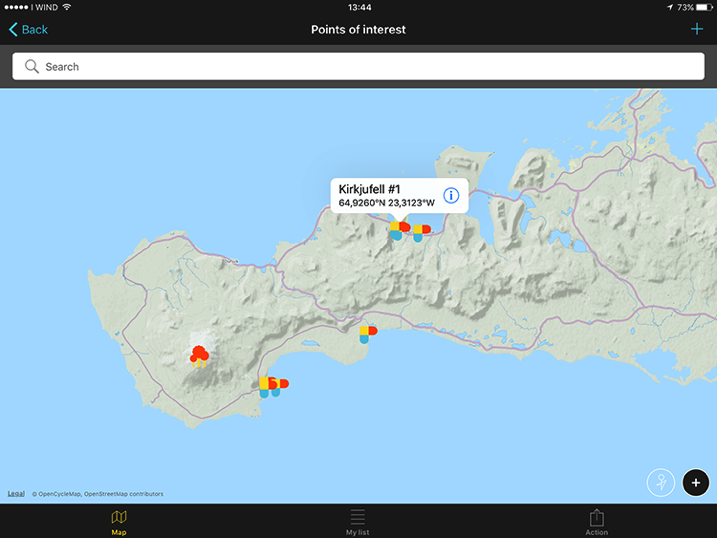
We’re all exploring new locations all the time, looking for new possibilities, and to be able to store the most valuable places in our own database is just a must. So, every time I find a place I’d like to remember and study for a possible shot, I use PhotoPills to save it as a Point of Interest.

Another useful feature is that I can upload to PhotoPills all my .kmz files, so I can bring with me all the plans already made with Google Earth!

Image 10

Point of Interest visualized on map

Calculations

Knowing the shooting time and spot is obviously the first step, but you also need to make many more decisions before pressing the shutter – this is where PhotoPills is brilliant.

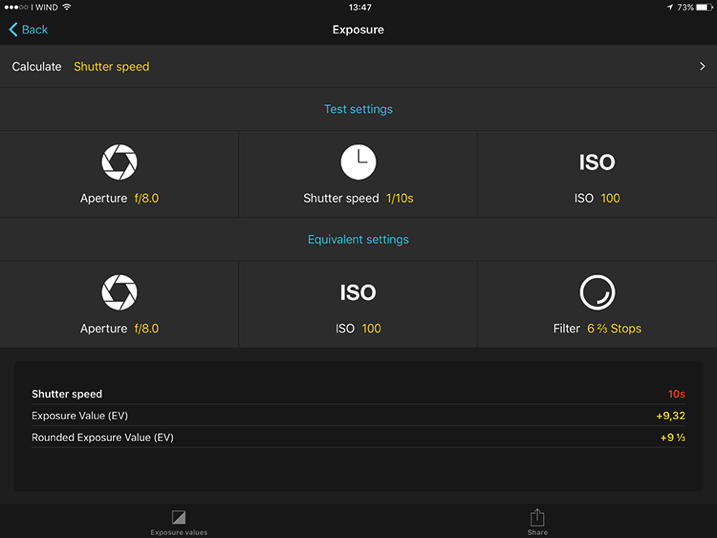
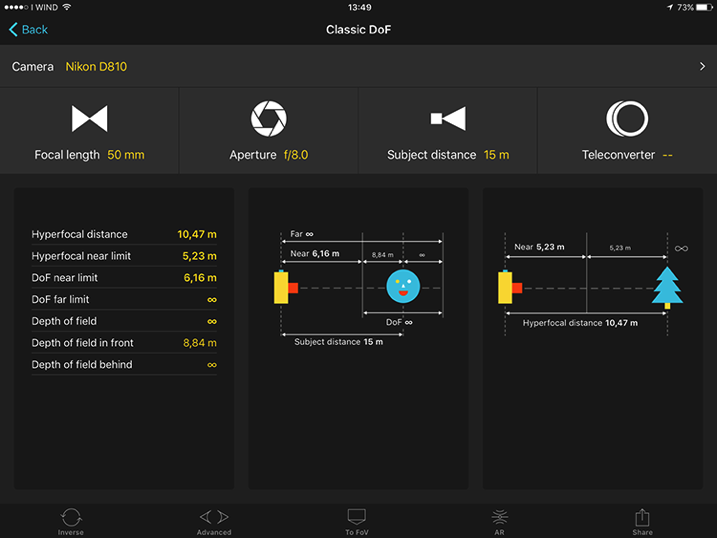
These are just four of the numerous calculators I use to figure out the settings I need:

Image 11A

Long Exposure calculator

Long Exposure calculator: You already know, my favorite one! With this module I’m able to calculate the exact exposure time when using ND and GND filters. By the way, PhotoPills has the only Long Exposure calculator that allows you to convert the shutter speed for non-standard f-stop reductions.

Spot Stars calculator: When shooting the Milky Way, it helps determine the maximum exposure time that allows me to capture the stars as big bright spots. The longer the exposure time, the more light is collected by the camera sensor, and the brighter the stars will appear in the image. If I go beyond this exposure time, stars will begin to appear as trails in the image, which is something I want to avoid at all costs.

Time lapse calculator: If you’re doing time lapse photography, this calculator will save you lots of time. Just set the frames per second (24fps), the duration of the event you’re shooting (example 6 hours), the desired clip length (30 seconds) and the image size (4Mb) to get the shooting interval (30 seconds), the number of photos (720) and the total memory usage of the SD card (2.81Gb). I used to need 15 minutes to figure out all those numbers, before I started using PhotoPills.

Depth of Field calculator: I use it to calculate the distance where to focus, to maximize depth of field (hyper focal distance). This becomes very useful in my night shots, since I want everything in focus, from the foreground to the stars. I simply calculate the hyperfocal distance and then I make sure to focus my lens at a slightly longer distance. This assures me that I’ll have the stars in sharp focus.

Image 12

DoF Calculator

Conclusions

PhotoPills is definitely a must have for (but not only) landscape photographers. The features are many and well-maintained, and the difficulties that you can encounter at the beginning, can quickly be overcome thanks to the Academy (a virtual university of PhotoPills where you can follow video tutorials, and read insights on each function of the application to really turn our ideas into real images).

The price of $ 9.99 in the App Store is higher than average, but is ridiculous compared to the large amount of features and practical uses, as PhotoPills replaces much of the paid, and free apps, in one go.

It must be mentioned that PhotoPills is currently available only for iPhone and iPad, but the Android version has been announced to launch in 2016.

After many months of use, now I cannot imagine a photographic adventure without this application. Once you fall into the Imagine-Plan-Shoot creative loop, you won’t be able to stop pushing your imagination, and this will lead you to discover a new world of possibilities.

Definitely, give it a try!

Pros:

  • Clean and friendly user interface
  • Many different tools in a single application
  • Cached maps for offline use
  • Possibility to import POI from .kmz files
  • Localized languages
  • Tons of tutorials

To be considered:

  • Android version still in development (release expected in 2016)

Do you use PhotoPills or another photography planning app? Please share your experiences and tips in the comments below.

googletag.cmd.push(function() {
tablet_slots.push( googletag.defineSlot( “/1005424/_dPSv4_tab-all-article-bottom_(300×250)”, [300, 250], “pb-ad-78623” ).addService( googletag.pubads() ) ); } );

googletag.cmd.push(function() {
mobile_slots.push( googletag.defineSlot( “/1005424/_dPSv4_mob-all-article-bottom_(300×250)”, [300, 250], “pb-ad-78158” ).addService( googletag.pubads() ) ); } );

The post PhotoPills: The Photographer’s Swiss Army Knife by Francesco Gola appeared first on Digital Photography School.


Digital Photography School

 
Comments Off on PhotoPills: The Photographer’s Swiss Army Knife

Posted in Photography


11 Premium & Free Resources for Photographers (Bundles, eBooks, Courses)

19 Feb

How do I start my own photography business? How can I improve my shooting skills? What do I need to edit images faster? There’s no lack of information to answer these and other questions photographers may face. But then again, choosing the right eBook, email course, or Lightroom preset collection from an overwhelming amount of available resources may be quite Continue Reading

The post 11 Premium & Free Resources for Photographers (Bundles, eBooks, Courses) appeared first on Photodoto.


Photodoto

 
Comments Off on 11 Premium & Free Resources for Photographers (Bundles, eBooks, Courses)

Posted in Photography


5 Must-Have Lenses for Wedding Photographers and Why

16 Feb

Have you ever wondered which lenses are in a wedding photographer’s bag? There is a plethora of choice when it comes to lenses, and lens companies come up with new products all the time. Many photographers are attracted to these bright and shiny things and end up with a mammoth collection of lenses, many of which hardly see the light of day. If you have to pare back to the absolute necessities, and are allowed five lenses in your wedding photography bag, these are the ones that I would recommend. I have been a professional wedding photographer for seven years now, and deciding on these five took some time, and serious consideration over the course of my career.

They are:

  1. The 70-200mm f/2.8
  2. The 24-70mm f/2.8
  3. The 85mm prime
  4. The 35mm prime
  5. A macro lens (105mm or 60mm for Nikon, 100mm or 60mm for Canon)

Let’s look at each individually to see why.

5-must-have-lenses-wedding-photographer_0001

#1 – 70-200mm f/2.8

It’s big, bulky and heavy but I wouldn’t do a wedding without this lens. The 70-200 f/2.8 is my workhorse when it comes to weddings. It is a versatile lens that gives you amazing sharpness at all focal lengths. The bokeh is beautiful, especially at 200mm, even with a stopped down aperture due to the compression caused by the long focal length.

This lens makes a wedding photographer invisible. You don’t have to be so close to people’s faces; you can capture candid expressions and serendipitous moments from a fair distance away. This lens is especially useful during the ceremony, where you would rather be far away and out of sight, or hidden behind a wall or door. It allows you to capture the exchange of rings, vows, and kiss discreetly.

5-must-have-lenses-wedding-photographer

If you require a longer zoom while being at the same fair distance, you can choose to photograph in DX mode (if you shoot full frame and your camera offers this option) on your camera, and the lens will give you 1.5x distance more, making 200mm into a neat 300mm zoom. If you do this, make sure that you have enough pixels for the crop, in case you feel the need to straighten or change your composition in post-processing.

For example, of you are shooting with a 12MP camera such as the old Nikon D700 on FX mode, when you convert to DX mode the camera becomes a 5MP camera, which is below the minimum amount of pixels you can have – 6MP – to be able to enlarge prints to a decent size. If you have to crop in post-processing, this will not give you enough pixels to be able to safely do so without compromising print output sizes.

5-must-have-lenses-wedding-photographer

However, if you are photographing with a Nikon D810 in DX mode, your image goes from 36MP to 15.3MP but still leaves you enough wiggle room for minimal, and sensible cropping if necessary. If you use this functionality, don’t forget that when photographing in DX mode on a full frame camera, or when using a DX lens, the camera only uses the center of the sensor. So if you forget to compose accordingly in camera, you will get a nasty surprise after you have taken the image: cut off heads and limbs, and badly cropped compositions are some examples. When using DX lenses, the rest of the unused sensor area is blacked out but when using FX lenses in DX mode, this is not the default and you would still see the entire full-frame sensor if you don’t change your settings.

5-must-have-lenses-wedding-photographer

The 70-200mm is an excellent focal length for flattering portraits. When photographing at 200mm, I typically stop down to around f/4 or f/5.6 at a shutter speed of 1/200-1/400th, and the sharpness of the image is stunning against a creamy bokeh background. This lens also has a built-in lens collar you can use to steady it when hand holding, or attaching it to a tripod stand. Without a tripod, you can steady yourself as much as possible by leaning against something immovable like a wall, or on a stable surface such as a table, or keeping your arms pinned against something sturdy to reduce camera shake, especially when using this lens for portrait work at the longer end of the focal length.

5-must-have-lenses-wedding-photographer

5-must-have-lenses-wedding-photographer_0033

You can now get a f/4 version of this zoom lens (for Nikon, Canon has always had one) at a vastly cheaper price compared to the f/2.8. I personally do not have the f/4 version but if you’re on a budget, and you don’t mind not having the option to photograph at a wider aperture, then I see no reason why you should not get the f/4. It is lighter and smaller, understandably so because it has less glass elements compared to its more expensive counterpart, and may not only suit the budget better, but also lessens the bulk you have to carry at a wedding.

5-must-have-lenses-wedding-photographer

5-must-have-lenses-wedding-photographer

#2 – 24-70mm f/2.8

The 24-70mm f/2.8 offers the focal length versatility needed when you are photographing on the go, which is what wedding photographers need for most of the day. You can use this lens to capture wider location scenes, candid photos of people, guests arriving, people milling and chatting while waiting for the ceremony to start or during the wedding breakfast, some decorations and details, the first dance, and the leaving photos, to cite just a few.

5-must-have-lenses-wedding-photographer

5-must-have-lenses-wedding-photographer

I use this lens for photos that do not require close portrait work, although it can definitely be used as one. The 50-70mm range will yield pleasing results, like the image directly below. However, my preference is to use prime lenses for portraits. The 24-70mm lens sees a whole lot of action during the wedding day, and is definitely my other workhorse for capturing people, wider shots, and behind-the-scenes.

5-must-have-lenses-wedding-photographer

5-must-have-lenses-wedding-photographer

Many photographers include a much wider lens for location photographs such as the 14-24mm f/2.8. While I would love to add this lens to my arsenal, this is not an absolute necessity, in my opinion. With the 24-70mm, you can photograph location scenes wide enough – but should you need to capture a wider scene, you could photograph a few images and stitch them together in Photoshop as a panorama. This is easy enough to do by making sure the exposure setting for the series of shots are the same, and you stand on a fixed point, inching your way across the panorama. You can do the same for a photograph of all the guests too. These would be the only times I would need an ultra wide angle lens for a wedding, hence I cannot just yet justify adding it to the list of must-haves.

5-must-have-lenses-wedding-photographer

5-must-have-lenses-wedding-photographer

#3 – 85mm prime

This is my all-time favorite lens, and the one I use for portraits of the bride and groom, bridesmaids and groomsmen, individual guests or small groups, and the list goes on. As a fixed lens, this requires more work on your part – you have to zoom in and out with your feet. But, the extra effort is worth it – the portraits are cleaner, the backgrounds are creamier, and it is a fabulous lens in very low light conditions.

5-must-have-lenses-wedding-photographer

The best thing I love about this lens is that it is tack sharp from the sweet spot on. Accurate, light sensitive, great results on skin, this is my go-to lens, and it never leaves my bag. Being a prime lens, the 85mm is fast, small, and extremely reliable.

5-must-have-lenses-wedding-photographer

I have photographed an entire wedding of a relative (as a guest) using only this lens. I was asked on the day if I could cover the wedding and I agreed, with only the D700 and 85mm combination in hand, which I carry with me most times for personal snapshots, and photos of my family. The photos from that wedding are published in one of the UK’s top wedding blogs: proof that you can photograph a wedding with what you have, given that you know your gear well enough.

5-must-have-lenses-wedding-photographer

The 85mm for Nikon comes in either an f/1.8 ($ 479 USD) or f/1.4 version ($ 1595 USD), with a huge price difference between the two, due to the glass elements and optics (Canon also has an f/1.2 available, it’s $ 1999 USD). However, many photographers are divided between which lens is better. I have the f/1.8, and it has always performed marvellously for me. The f/1.4 has been on my lens list forever, and while I could buy it as the 85mm is on my necessity list, I have held off given that I have never felt the need to upgrade.

5-must-have-lenses-wedding-photographer

#4 – 35mm

One of my early serious lens investments was this amazing 35mm f/1.4. If there is a lens I can always rely on, it’s this one. This is an ultra versatile lens that you can use to photograph the bride getting ready – the time when wedding photographers are usually under pressure to capture everything from location, the myriad of accessories, details, candid shots, the dress, the natural interactions between the bride and her loved ones, and group portraits – in a very short amount of time and more often than not, in small spaces like cramped hotel rooms. It is also perfect for photographing wider scenes, and you get images without the exaggerated distortions that you get with the 24mm.

5-must-have-lenses-wedding-photographer

5-must-have-lenses-wedding-photographer

This lens is super fast and sharp, and has yet to fail me. With this lens you can get close, with 0.3m (11.7″) minimum focusing distance – very handy when you are in in a crowded space. As if that weren’t enough, this lens opens up to f/1.4 which can let you photograph in extremely low light, especially if you are so pressed for time and space to use off-camera flashes. Even though the 35mm focal length is already covered by the 24-70mm, the difference between f/1.4 and f/2.8, in its ability to allow more light in (two more stops of 4x the light), cannot be underestimated.

5-must-have-lenses-wedding-photographer

5-must-have-lenses-wedding-photographer

The 35mm also comes in f/1.8, a DX lens you can purchase inexpensively (under $ 200). You may wonder why the astronomical difference in price compared to the professional f/1.4 counterpart. First of all, you cannot use the DX lens on a full frame camera without losing pixels, and without the 35mm focal lens becoming a 52.5mm, which can be very limiting in tight spaces. Secondly, the 35mm view is close enough to what the eye naturally sees which people say is around 40mm in loose terms, and I like that view. As a wedding photographer, it allows you to capture images that gives the viewer the impression that they could have been there, seeing the same view themselves. This is an important element in any wedding photography, specifically that with a documentary style, in my opinion.

5-must-have-lenses-wedding-photographer

If you ever get to physically hold each lens in your hands at the same time, the enormous price difference won’t even be in question. The f/1.4 is considerably heavier, and much bigger than the pocket-sized f/1.8. But, don’t be fooled by appearances. The f/1.8 is also an outstanding lens with exceptional performance in its own right, and for crop sensor cameras may be more than sufficient, and is most definitely easy on the budget.
5-must-have-lenses-wedding-photographer

5-must-have-lenses-wedding-photographer

If you already have the 50mm and your budget is constrained, then the 50mm could replace 35mm on this list. It is also an incredible lens. Although the 50mm doesn’t give you as much room to maneuver in smaller spaces as the 35mm, the bokeh on the 50mm is stunning and it’s impressively sharp too, which is one of the top benefits of prime lenses. Like the 35mm, the 50mm is also available in f/1.8, f/1.4, and for Canon f/1.2.  The price difference is meagre between the f/1.8 and the f/1.4, then it jumps up to a whopping figure with the f/1.2.

5-must-have-lenses-wedding-photographer

5-must-have-lenses-wedding-photographer

#5 – 105mm (100mm) or 60mm macro lens

A macro lens is a must for you as wedding photographer, if you want to capture amazing images of rings in close detail. You can also use this lens for photographing jewellery and other accessories when the bride is getting ready. If the bride’s dress is adorned with jewels, the macro lens would also be ideal to photograph the details. In addition, macro lenses are also great to use for portraits if you do not require an aperture wider than f/2.8. This makes it a versatile lens to carry around, especially the 60mm which looks and feels minuscule compared to the 105mm (100mm for Canon). Both lenses can also stop down to f/32, which is handy, especially when photographing location landscapes in extremely bright sunlight.

5-must-have-lenses-wedding-photographer

5-must-have-lenses-wedding-photographer

Some photographers use the 105mm as a close substitute for the 70-200mm, if the latter is just too out of reach.  You can use the 105mm in DX mode which gives you 157.5mm, long enough to enable you to still be very inconspicuous at a wedding. It is also smaller and lighter, and opens up to f/2.8, as well as doubles up as a macro lens.

5-must-have-lenses-wedding-photographer

5-must-have-lenses-wedding-photographer

Do you have other must-have lenses in your wedding camera bag? Please share them here below.

googletag.cmd.push(function() {
tablet_slots.push( googletag.defineSlot( “/1005424/_dPSv4_tab-all-article-bottom_(300×250)”, [300, 250], “pb-ad-78623” ).addService( googletag.pubads() ) ); } );

googletag.cmd.push(function() {
mobile_slots.push( googletag.defineSlot( “/1005424/_dPSv4_mob-all-article-bottom_(300×250)”, [300, 250], “pb-ad-78158” ).addService( googletag.pubads() ) ); } );

The post 5 Must-Have Lenses for Wedding Photographers and Why by Lily Sawyer appeared first on Digital Photography School.


Digital Photography School

 
Comments Off on 5 Must-Have Lenses for Wedding Photographers and Why

Posted in Photography


Better together: A photographer’s trip to Southeast Asia with a limbless man

31 Jan

$ (document).ready(function() { SampleGalleryV2({“containerId”:”embeddedSampleGallery_8749851343″,”galleryId”:”8749851343″,”isEmbeddedWidget”:true,”selectedImageIndex”:0,”startInCommentsView”:false,”isMobile”:false}) });

‘If I Can…’ is the motto Chris Koch lives by. Born without arms and legs, the Canadian travels as a motivational speaker, challenging his audiences to live their lives to their greatest potential and push beyond difficulties. Portrait and wedding photographer Anna Tenne happened to meet Chris before he gave a presentation in her town of Coonabarabran, Australia. When Chris mentioned to her it was a lifelong goal to visit Southeast Asia, a spark ignited and eventually inspired the two fast friends to pack their bags and head for Thailand.

Tenne’s aim was to help Chris spread his message while she photographed the journey. But what she didn’t expect, as she tells Resource Travel, was how much the trip would teach and inspire her. Chris’ contagious smile is evident in her photos, and the positive impact he has on the people he meets is plain to see. Take a look at some of her photos here and head to Resource Travel to read the full story.

Articles: Digital Photography Review (dpreview.com)

 
Comments Off on Better together: A photographer’s trip to Southeast Asia with a limbless man

Posted in Uncategorized


An Introduction to Street Photography for New Photographers

21 Jan

You may have seen a lot of candid photography all over the Internet and wondered, what is it all about? If you’ve never tried it before, or only have a bit of experience, I am going to lay out a roadmap to help you get started and improve your street photography.
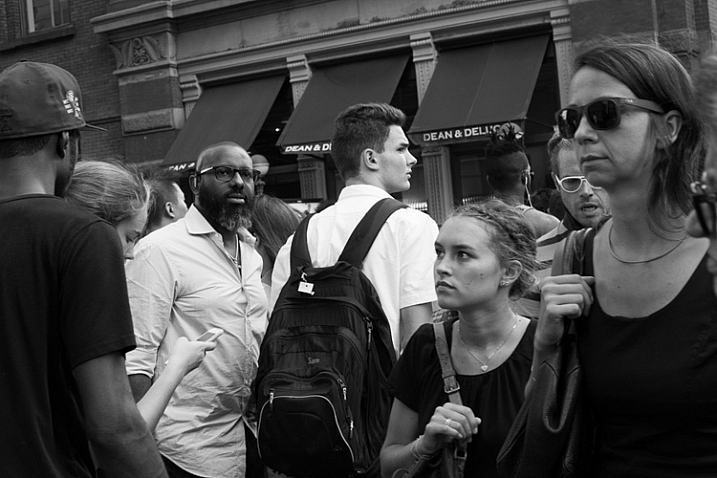
Street Corner, SoHo, NYC.

Street Corner, SoHo, NYC.

Street photography is the art of capturing life, culture, and humanity, in a candid manner. It is fascinating because a small percentage of photographers seem to be naturally drawn to it. Even before hearing about the phrase street photography, which can be a clunky term anyway, there are many photographers who prefer to point their cameras in the direction of culture and people that they’ve never met before, over mountains, sunsets, and landscapes.

However, if you haven’t done it before, street photography can be very intimidating to actually pull off. It’s one thing to admire it from afar, but it’s another to get in there and get your hands dirty. I promise though, that it’s a ton of fun and is a very rewarding art form to practice.

Here is list of my favorite tips to get you off and running.

1. Just do it
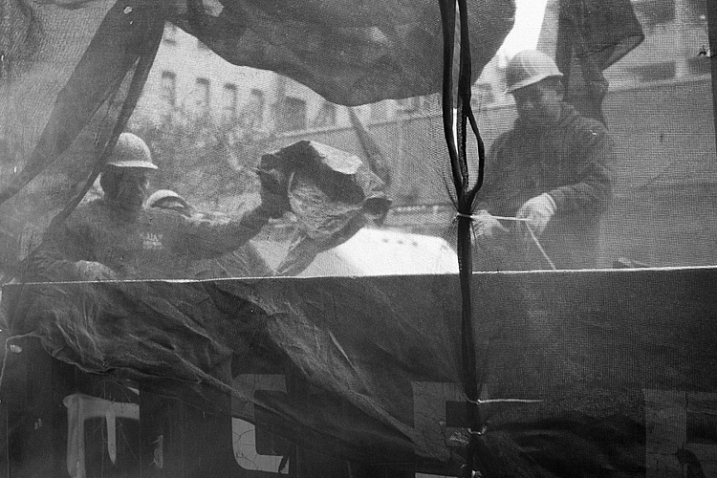
Construction Workers, Lower East Side, NYC.

Construction Workers, Lower East Side, NYC.

You can have all the tips in the world to get started. I can explain all of the techniques that I have learned from others and found so helpful over the years, and I will cover them here, but nothing beats pure, unbridled enjoyment and enthusiasm. No matter how much you learn, nothing beats the experience gained by being out there.

Street photography is one of the most difficult forms of photography, because it is so unplanned. A world of content is out there for you, and it is your job to go find it. You must develop your own visual language, to be able to see interesting moments, then to figure out how to capture them all in a quick, spontaneous instant. This takes regular practice. I’ve been doing street photography for nearly 15 years, and any time I take a month off (usually in the depressing February winter in New York), I feel very rusty when I grab the camera again.

Put in the hours, experience trumps everything. Enjoy the feeling of being out there, because it’s necessary to love it, to be able to put in the time to be successful.

2. Technical skills

Here are a few of the technical skills that are most important for street photography. I try to have my camera set up in a way so that I almost forget it’s there. So, it’s just me, and what I am seeing, and the camera doesn’t get in the way.
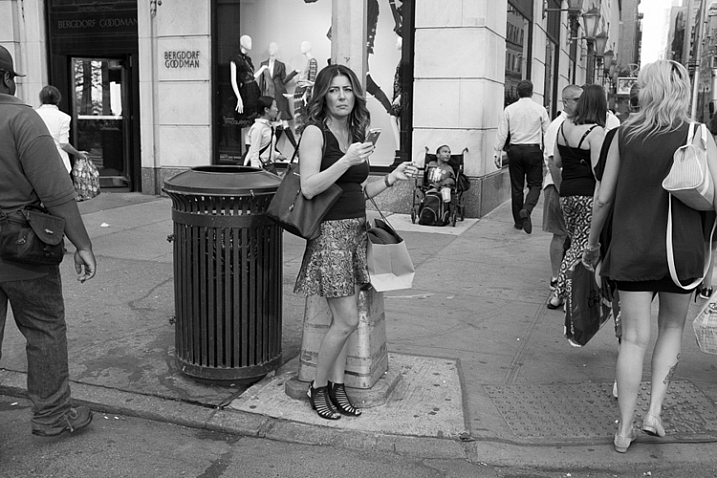
Bergdorf Goodman, 5th Avenue, NYC.

Bergdorf Goodman, 5th Avenue, NYC.

There are many different ways to set up your camera, but I prefer to shoot in Shutter Priority mode with a shutter speed around 1/250th of a second. That is a good minimum, to make sure you can freeze the motion of your subjects. In dimmer light, you can go to 1/160th and even 1/125th and still be okay. In strong sunlight you can go all the way up to 1/400th or 1/500th, but 1/250th is the number to keep in mind (as a good starting point).

Raise your ISO. There is no reason to go below ISO 400 for street photography, and I suggest staying between ISO 800 and 3200 when you’re not in bright sunlight. The reason is because, if you want to shoot at 1/250th, and you also want to use as small an aperture as possible, then something has to give, and that is the ISO.

You might be asking why it’s good to use a small aperture for street photography. That’s a creative choice of course, and sometimes the light is so low that you must shoot with as wide an aperture as possible. There are street photographers that prefer the look of a shallow depth of field for all their work. However, there are a few reasons why I believe a small aperture, and a lot of DOF is preferable. Because of the spontaneity, you never know where your subject is going to be, or if you are going to have multiple subjects at different depths. In addition, if you happen to miss the focus a bit, your subject will still be sharp if you are using a larger DOF. Finally, context is important. You are capturing culture, and surroundings are a part of the story. Do you really want to blur the surroundings away? The environment is a major part of street photography.
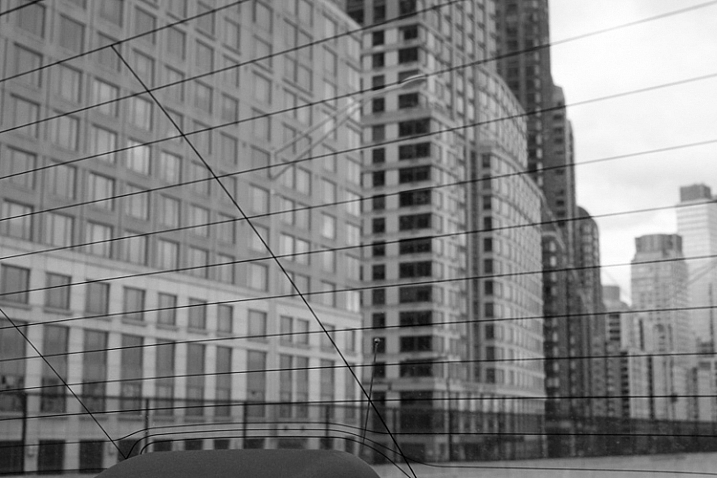
Greene Street, SoHo, NYC.

Greene Street, SoHo, NYC.

While a prime lens is not necessary, it can be very important for street photography, for a few reasons. First of all, zoom lenses are heavy and large. A small, light prime makes your camera a pleasure to carry around, and it looks much less imposing to your subjects. In addition, it can be a big advantage to get used to using a single focal length. You will start to learn how your camera sees, in a faster, and more intuitive way. I can’t overstate the previous sentence. When I wrote about forgetting that the camera is there, a prime lens is very important for this.

I prefer to use wide-angle primes, with 35mm and 50mm being my favorite. I like the wide-angle view because it will make you get closer to your subjects. In addition, the viewpoint will allow your foreground subjects to be more prominent and larger in the frame, while still being able to fit in more of the background, since it will be proportionally smaller. It’s a great look. If you are using a cropped camera, remember that a 35mm lens might not actually be a true 35mm view because of the crop factor, so try one that is the equivalent of a 35mm view.

3. Take photos for yourself

It is certainly important to see other people’s viewpoints and to pay attention to the images that they like, but I want you to focus on photographing for yourself. Capture an image that you love, first and foremost, and don’t worry if other people don’t get it. Street photography is still a niche genre, compared to other photography forms such as landscape, and because of that there are a lot of people that aren’t used to it.

Take weird images, take personal images, take ugly images, and take risks with what you capture. Be creative and have a good time. The more your images become a reflection of your voice and what you like, the better your work will be.
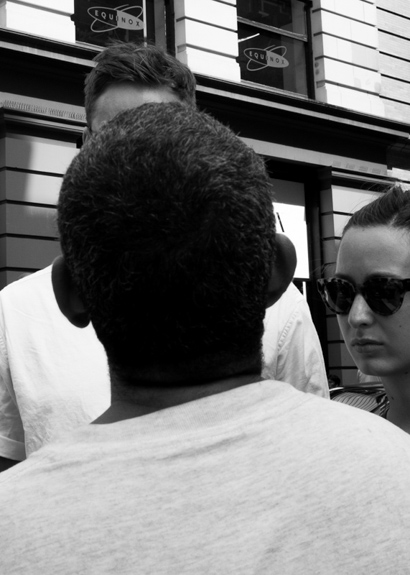
Panhandler, Broadway, NYC.

Panhandler, Broadway, NYC.


4. Shoot in a variety of locations and show us your area

A busy street corner in New York is usually the first place that comes to mind when people think about street photography, as it should be. New York has such a diversity of content, and that’s the reason why it’s one of the great meccas for street photography, but it is also only a very small part of the entire street photography world.

Street photography can, and should, be done anywhere. It can be done indoors, in coffee shops, at events, along country roads, or in small towns – you name it. Street photography is about culture and life. It is an idea, and a feeling. It doesn’t even need to have people in the images, just the hint of people.

The more you are able to capture images in the course of your daily life, the better you will become at it. Your images will be more personal and unique. For this reason, I suggest considering eventually trying a smaller camera, such as a Fuji X100T, a micro 4/3rds or mirrorless camera, or even a mobile phone camera, for the times where you don’t feel like bringing your large SLR. These cameras make it fun to capture images on a daily basis. You might bring one of these smaller cameras on a trip to the corner store, whereas a larger SLR would be more cumbersome for that situations.

5. Pick a location and wait there
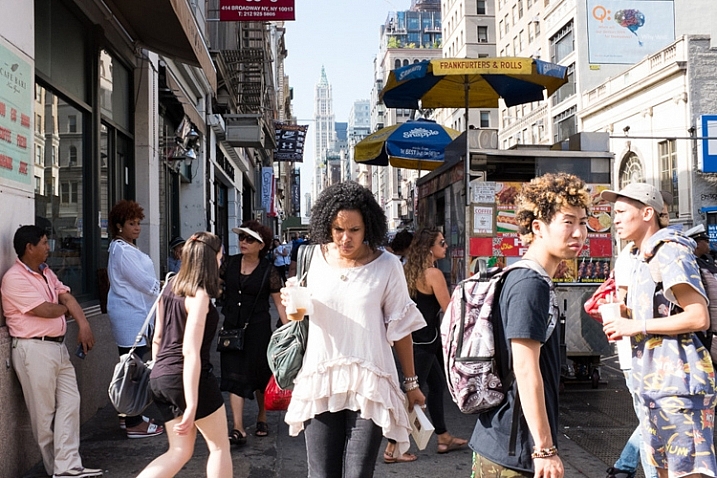
Canal Street, NYC.

Canal Street, NYC.

It can be intimidating to photograph people candidly. I still feel pretty intimidated, depending on the situation. To offset this, one of my favorite techniques is to pick a location, and just hang out there for awhile. Find a spot where you think an interesting moment could happen, and then wait for it to unfold.

By waiting and not walking, you will spend more time looking around and watching, as opposed to moving. Then, when that moment happens, you will already be in position, and ready with your camera to capture it. Also, your subjects will be entering your space, instead of you encroaching on their space. If you are walking down a street and see someone that you want to photograph, it’s much tougher to get in their space, and still take a good candid photograph. By stopping and letting them come to you, not only will you be ready with your camera, but you can make it look like you are just photographing the surrounding area and they happened to enter your scene.

Go back to the same locations, over and over again at different times, and in different light. The more you get used to a location, the more you can anticipate what will happen there, and the more comfortable you will become photographing in the area. Also, people will start to get used to you being there.

Of course you should still walk around, but I prefer to break up long walks, with periods of waiting in good locations.

6. My favorite trick
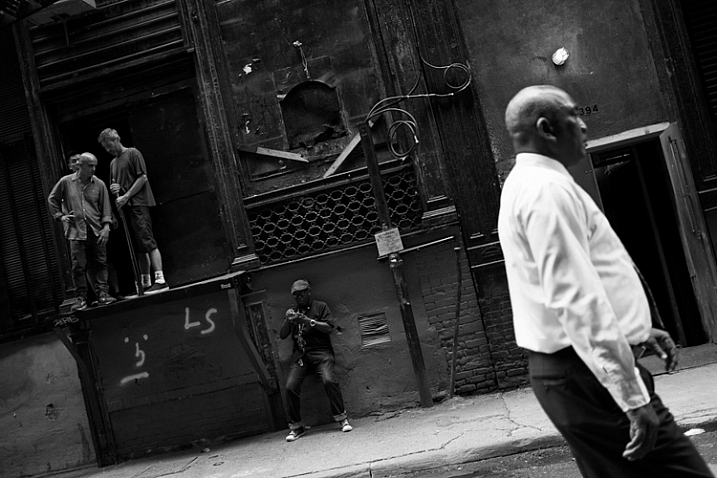
Cortlandt Alley, NYC.

Cortlandt Alley, NYC.

A natural reaction after you take a photo is to immediately take your camera away from your eye briefly. Take a picture and see. This is the number one thing that will tip someone off that you’ve taken their photograph. We don’t want to be too sneaky and creepy, but we also don’t want every person we’ve photographed to know, and stop us to figure out what we’re doing. That’s just tedious.

Whenever I capture an image of someone, I try not to remove the camera from my eye. I leave it there as they walk through the scene, as if I was trying to photograph the background and they got in the way. If you watch other photographers do this, you will see that sometimes the subjects will first think, “Hey did that person take my photo”, they will look back, and when they see the photographer with the camera still at their eye they will likely keep going, thinking that they were just in the way.

The flip side to this is when you are in an empty area, instead of a busy one. It is tougher to do this trick when there are only a couple people around, so what I will do in these situations is to aim up above, or to the side of the person, like I am photographing a building or a nice background. I will pretend to take an image or two, and then at the last second I will move the camera so that they are in the scene, in the right composition. I will quickly take the picture and remove the camera from my eye. When done right, it looks like you photographed the area above or next to them.

7. Don’t be too creepy
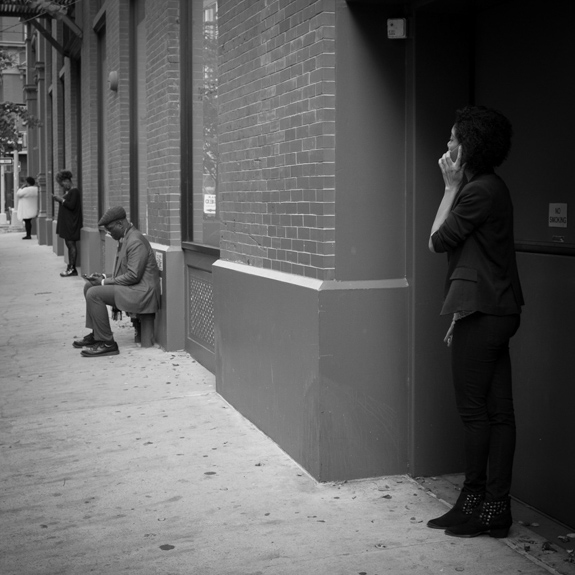
Cellphones, Nolita, NYC.

Cellphones, Nolita, NYC.

When I teach people street photography for the first time, there are inevitably those who will take five or six, or even twelve photos of one person. If you see a scene improving while you are photographing it, of course you should continue to capture the scene, but taking five or six candid photos of a person can get down right uncomfortable.

What we are doing, in my opinion, is a good thing. We are capturing and immortalizing culture and people. We do this because we like people, and unfortunately even when done as respectfully as possible, it is still a little bit creepy. We just have to accept that this is a worthy endeavor that offsets the slight creep factor. However, when you go to full on creep, it just gets uncomfortable for everyone. You don’t need to capture seven photos of a person. You don’t need to point your camera at a person for 30 seconds straight, while still pretending that you are not photographing them. If you want to do that, go up to them and ask for a portrait instead.

Take an image or two, then stop and reassess. If you see the scene developing further, put your camera down for a second. Act like you’re looking around for a way to capture the background, or pretend to play with your camera, and let the scene develop. Then, take another picture or two as it does. Just try not to point your camera at one person for too long.

8. Smile and carry a business card
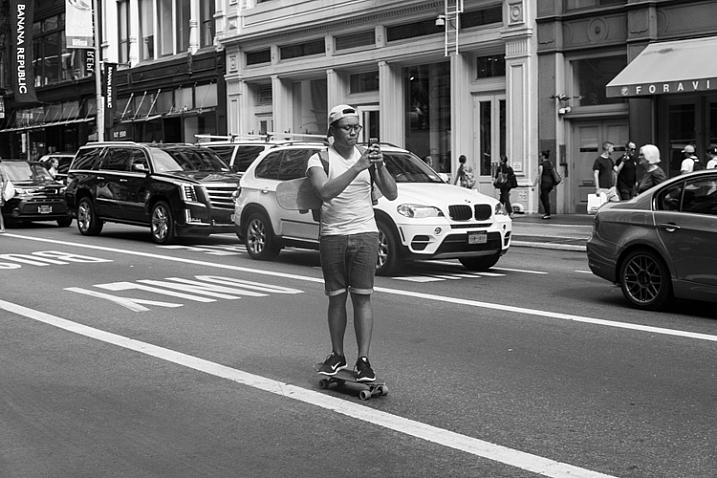
Skateboarder, Broadway, NYC.

Skateboarder, Broadway, NYC.

The more confident you act, the less people will notice you and care. If you look at master street photographers who have done this for a long time, many of them look almost invisible out there. This is not because they are necessarily sneakier, it’s because they carry themselves like they belong. They seem comfortable. When people see someone comfortably photographing in an area, they instinctively think that person belongs there. When they see someone who looks uncomfortable, like they are sneaking around, they will instinctively think they are are up to no good.

Whenever someone stops me and asks if I took their photo, I smile, say yes, and tell them that I’m a photographer doing a cultural project capturing daily life, and I thought they looked fabulous and had to capture them as part of the project (flattery goes a long way). I tell them I didn’t mean to make them uncomfortable, but it was just how I had to go about capturing the images. I carry cards to show them that I am a legitimate photographer and tell them to email me and I will send them the photo. After this, if they still seem very uncomfortable, I will offer to delete it. I’ve only ever had to delete two photos after a couple people asked me nicely. I’ve never had a bad interaction.

Of course, that doesn’t mean that others haven’t. Some photographers have certainly had bad interactions. You should make sure to pick the people that you photograph wisely, perhaps staying away from capturing someone that looks like they had a terrible day, or someone that looks angry or disturbed. Those are the situations where you are more apt to get yourself in trouble. Street smarts are important.

9. Capture images without people
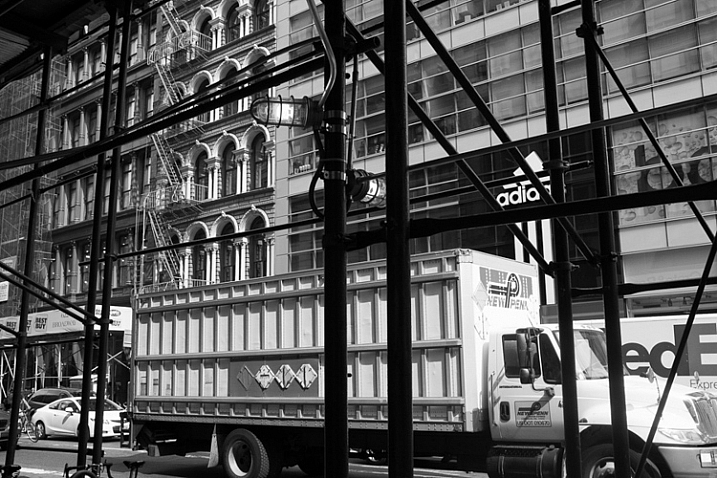
Scaffolding, Broadway, NYC.

Scaffolding, Broadway, NYC.

Usually the first thing that comes to mind when street photography is mentioned, is an image of an interesting looking person, walking down the street. That is a part of street photography, but there is so much more to it.

Capture environmental images in ways that still have the feeling of a traditional street photograph. Show culture and people in ways other than just capturing them directly. Figure out how to show stories, capture ideas, and foster feeling and mood in an image. Photograph in locations where others may not think to take pictures.

10. Capture expressions

One of the skills that all the great photographers have is their ability to capture expressions. This applies as much to street photographers, as it does to portrait ones. Look to capture people’s emotions. Do they look happy, sad, pensive, or angry? I always try to look at my subject’s eyes, and wait for them to give a look that exposes something going on in their head. Usually that look doesn’t come, but when it does, I’m ready for it. This is one of the most difficult things to both notice and capture, and it comes with experience. Try hard to notice it.
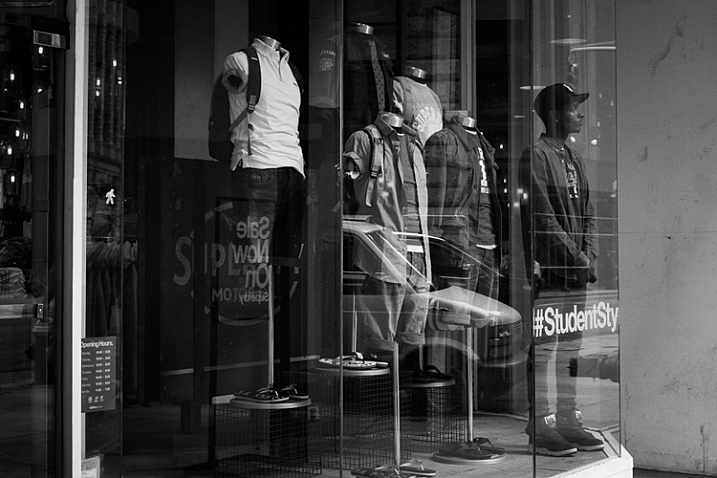
Student, Broadway, NYC.

Student, Broadway, NYC.

11. Edit and sequence your photos

Editing is just as important for your success as a photographer, as going out and shooting. Download and learn Lightroom, and learn to organize your photos well. I mark my best photos with three and five stars, to choose the decent and best photos from the day. Spend a lot of time reviewing, and narrowing down your photos, to the best of the best.

Start grouping your photos together. Learn which images work together, and figure out the reasons why. What are you trying to say and show? Can a sequence of your images create an interesting narrative? Use collections in Lightroom to group images together, without actually moving their location on the computer. Over time, you will start to identify themes, and ideas in your work, and it will help you figure out which images are your best. It will also help you know where you need to improve.

You will find that doing this will quickly help you improve when you are out shooting. The more time you spend organizing and thinking about your work, the more in-tune you will be to notice images that fit in, when you are out shooting. This is a way to help develop your voice in your photography.

12. Look at the work of other photographers

Spend a lot of time exploring the work of other photographers. This will both train your eye, and give you inspiration. It will quickly become a humbling experience. As a photographer, you don’t need to reinvent the wheel. So much has been done before, by photographers who spent decades doing it. What you need to figure out, is how to give your images a personal and modern take.

Look at both modern photographers, and go through lists of the old masters. Look at work done on busy street corners, and in quiet towns. Take it all in, then figure out what you relate to most, and build on that in your work.

13. Perfection is overrated
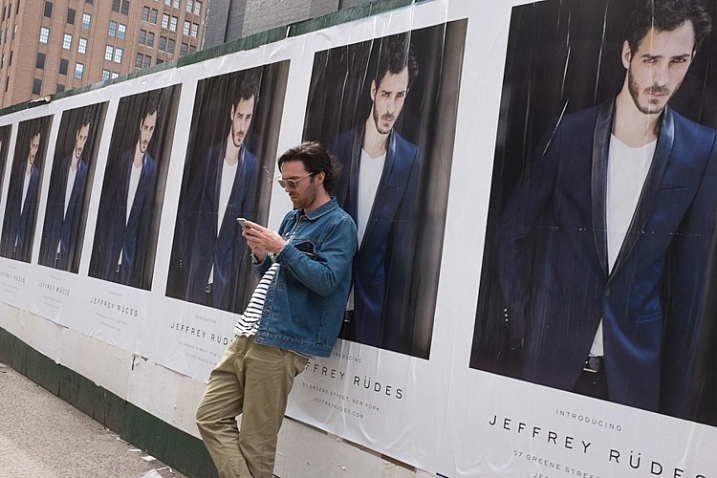
Greene Street, SoHo, NYC.

Greene Street, SoHo, NYC.

As a photographer, you need to become technically proficient with the camera. You need to learn to take sharp photos, that are well composed. You need to learn to see the light well. It is absolutely necessary for your growth. This is similar to a painter learning the fundamentals, before eventually gaining their voice, and going off in their own direction.

Once you have done this, is when you start to see that perfection in an image can sometimes be overrated. Your images don’t all have to be perfectly sharp, or perfectly composed. Sometimes a technical mistake will ruin a photo, but other times it may make it. Each image is completely different, and will work for completely different reasons. It is obvious when an image is ruined technically because a photographer didn’t know what they were doing, whereas it is different when it is just due to the situation presented to the photographer. If you take a look at the work of Garry Winogrand, so many of his images were slightly off-kilter. These days photographers might have decided to straightened them up a bit in Lightroom, but when you look at Winogrand’s work all together, that slight off-kilter look adds a sense of realness and spontaneity, and actually improves many of the images. The lack of perfection seems to make them better.

Have fun. Think of street photography like jazz and go a little off-kilter. Improvise and experiment. Just figure out how to find and capture, interesting and intimate moments.

googletag.cmd.push(function() {
tablet_slots.push( googletag.defineSlot( “/1005424/_dPSv4_tab-all-article-bottom_(300×250)”, [300, 250], “pb-ad-78623” ).addService( googletag.pubads() ) ); } );

googletag.cmd.push(function() {
mobile_slots.push( googletag.defineSlot( “/1005424/_dPSv4_mob-all-article-bottom_(300×250)”, [300, 250], “pb-ad-78158” ).addService( googletag.pubads() ) ); } );

The post An Introduction to Street Photography for New Photographers by James Maher appeared first on Digital Photography School.


Digital Photography School

 
Comments Off on An Introduction to Street Photography for New Photographers
Posted in Photography


5 of the Best Prosumer DSLRs for Budding Professional Photographers

20 Jan

Photography’s popularity is always growing. And photography’s accessibility is also growing as camera technology simultaneously advances and becomes more affordable. So it’s no big leap of faith to figure that more people are looking to photography as a means of generating income. However, even though camera technology is becoming more affordable, DSLRs still aren’t cheap. Professional-level DSLRs typically start off Continue Reading

The post 5 of the Best Prosumer DSLRs for Budding Professional Photographers appeared first on Photodoto.


Photodoto

 
Comments Off on 5 of the Best Prosumer DSLRs for Budding Professional Photographers

Posted in Photography