Swiss lighting manufacturer bronocolor has announced the Siros 400 L and 800 L, a pair of battery-powered studio heads. Both models use an interchangeable lithium-ion cell that the company says is powerful enough to provide 440 full-power bursts from a single charge in the 400L, and 200 in the 800L. The cells recharge from flat in 75 minutes.
The new heads use the same modifiers as the current Siros range, and the 25-watt LED modeling light matches the color temperature of the bulbs used in the company’s mains-powered heads. The Siros 800 L has a maximum output of 800 joules, while the smaller 400 L head manages half of that. Both can produce flash durations as short as 1/19,000sec, and both can be controlled via Wi-Fi and the broncolor bronControl app for iOS and Android devices. To help the user identify which light is being adjusted from the app, it is possible to color code each head using the LEDs built into the body of the head’s housing.
These new Siros L heads can only be powered via their batteries, which fit inside the head rather than acting as external packs connected by a cable. Spare batteries will cost £215 plus tax. The heads will be available sooner than the press release states.
broncolor presents its new compact device – battery-powered studio quality
With the Siros 800 L, we have succeeded in producing one of the most powerful compact devices currently available on the market. The Siros 800 L is, like the somewhat smaller version, the Siros 400 L, a true genius in offering discerning photographers optimum lighting both indoors and outdoors.
Siros L – optimum lighting, compact and mobile The Siros L is broncolor’s new battery-powered compact device, which provides ambitious professional photographers with the opportunity to enjoy the perfect lighting, be this in a mobile form in the studio, or for external shots – offering both very fast, and also long, flash durations.
The device has the most up-to-date lithium ion batteries – thanks to this, the device can achieve 440 flashes at full power; and the lower the power, even more flashes are available. The battery-pack can be used over a very wide temperature range from -10° to 60°C (14° to 140°F). Once its power has been used up, it can be completely recharged in only 75 minutes, allowing just two batteries to be switched and recharged during a shoot if there is a power supply available.
The Siros L uses the Swiss manufacturer’s ECTC technology, which has already been used in the well-known Scoro and Move generators – thus, Siros L has flash durations of up to 1/19’000 s (t0.5) and, of course, a guaranteed constant colour temperature over the entire control range.
All the Siros L’s functions are easily and remotely controlled by the “bronControl” app, which establishes its own WiFi network; this then allows the control of several devices by means of a smartphone or tablet. In order to ensure that the photographer knows which device he is currently addressing, the devices all have different LED colour codes – this ensures that the Siros L is easy to use, both indoors and outdoors.
Thanks to its compact size and battery-operation, the Siros L is absolutely ideal for outdoor use. It can, of course, also be used in the studio where it can be easily integrated into existing broncolor studio equipment.
The 25-watt LED modules offer a bright modelling light with a colour temperature of 3000 K, matching the colour temperature of the halogen modelling lamps of the Siros mains powered units.
In addition to the 800 J version for photographers who refuse to compromise in respect of power, there is the Siros 400 L version which is somewhat smaller and lighter and thus offers about 50% of the energy of its bigger brother.
The Siros L can be used with the entire broncolor light-shaper range. Many light-shapers, such as softboxes, open reflectors and especially Paras, are parabolic and can only guarantee an optimum light output and quality if the light source is placed as close as possible to the focal point in the interior of the reflector. This is why, with the Siros L, broncolor has deliberately opted for an external flash tube, providing perfect lighting.
The Siros L will be available in shops from 1st July 2016. Would you like to know more? Please visit broncolor’s website at www.broncolor.com
Virtual reality is an immersive experience that involves multiple senses, and, most importantly, responds to the intentional interaction of the viewer. From the earliest days of synchronized film and sound playback, the illusion of being in a different place or time, and generating an emotional response to the experience, has been the goal of most modern communication and entertainment mediums.
In VR, this illusion is referred to as ‘presence,’ where not only the sights and sounds (and other sensory input) are believable, but the ‘show’ itself reacts to the participant’s actions in a plausible way.
It isn’t hard to imagine how different the experience of browsing through a gallery of images can be when they are not just thumbnails on a tight grid, but rather ‘virtually’ hung by the artist in a spacious VR room that mimics a physical gallery space. VR video adds the active immersion of being in the middle of a busy plaza, or riding inside a rally car during a nighttime ice race. The opportunities to share even simple, daily events become less about what was in the frame at the time, and more about what the whole location felt like.
VR differs from flat, 2D photos by requiring at least a seamless 360-degree view, and eventually full freedom of 3D motion.
Semantics
First, let’s get some semantics out of the way. ‘Virtual reality,’ or VR, has generally been applied to 3D computer-generated graphics. There are some who say that anything that starts with a camera pointed at the real world is not VR. This ignores some of the history of VR (see below), as well as the coincidence that interactive panoramic images and videos on the web are displayed as textures on the inside of a 3D cube (or sphere, in some cases). There are also ways to create realistic 3D data from photographs, and from spherical panoramas in particular, both of which currently offer greater realism than 3D graphics created without the aid of photography.
While we could separate photography from 3D graphics by dogmatically referring to 360 x 180-degree images as ‘spherical panoramas,’ and try to demarcate 2D/3D hybrid technologies as ‘not photography,’ this would be unfair. Therefore, this article will still refer to VR as both an immersive experience, and something that a camera can capture.
This primer will touch on the various technologies and companies involved in VR, but the underlying theme is on how conventional photography and cinematography influence VR, and how VR will influenced them in return.
The term ‘virtual reality’ was originally coined (in French) by Antonin Artaud in his 1938 essays on the nature of theatrical performances, so it’s rather fitting that the first functional VR experience, Sensorama, was conceived and patented (in 1957) by cinematographer Morton Heilig. In 1961, Heilig also patented a head-mounted, stereoscopic display system. While these inventions relied on pre-recorded films with very limited interaction, they introduced the concept of a viewer being immersed in a different environment; including the sights, sounds, smells and even windspeed of the environment being represented.
Though the entirely analog Sensorama never really took off, the concept of immersion was a core aim for early computer-generated 3D graphics. Most pioneering modern VR development was focused on military and aerospace training, where it is much safer, easier, and ultimately cheaper, to teach someone how to react to difficult situations in a virtual environment. The first 3D VR displays showed only glowing wireframes against a black screen (a la Battlezone), while the physical surroundings mimicked a real cockpit or driver’s seat, complete with hydraulics to pitch the cabin during the experience.
In the 1980’s and early 90’s, the increasing visual fidelity of real-time computer graphics (driven both by industrial and entertainment uses) promised more realistic virtual environments, and the first wave of hype for consumer VR built up, entering popular culture with arcade entertainment like the Virtuality systems, and creative works like Neuromancer and The Lawnmower Man.
Recent times
Once this wave of hype broke on the shores of limited computing power, minimal content, and vaporware consumer displays (anyone remember SegaVR?), the relevant technology continued to advance in a consistent, but much quieter, fashion. Real-time 3D computer graphics progressed from plasticky representations on expensive workstations, to the increasing visual realism of PC and console games. In 1994, Apple introduced QuickTime VR as a very simple, portable way to display panoramic content with the freedom to look around, and this extension of QuickTime quickly became known for real estate ‘virtual tours’ and other early forms of photography-based VR on a computer.
Loading…
This content requires HTML5 with CSS3 3D Transforms or WebGL.
//
HTML5 static 360 VR sample – click this link for the VR headset version. (Made with Pano2VR)
In 2003, Linden Labs created Second Life, an entirely virtual ‘social world’ in which users could interact using human-looking avatars within an entirely synthetic, and user expandable, 3D world. Connecting people via the internet was not new, nor did Second Life initially support VR headsets with stereoscopic rendering, but this remains a good example of a successful shared ‘virtual reality’, in the original theatrical sense.
The 2007 introduction of Google Street View democratized the idea of spherical panoramic imagery (360 x 180 degrees of coverage) to immerse a viewer in various locations in the real world. This blending of photographic content with geographic data has broadened consumer acceptance of photographic VR, while the 2014 introduction of Google Cardboard (an inexpensive way to turn a modern smartphone into a VR headset) allows this vast amount of panoramic data to be viewed in a more natural, immersive way.
The new hype of modern VR
Recent advancements in consumer electronics have reinvigorated virtual reality and given it new vigor, as well as inspiring new generations of researchers, entrepreneurs, and content creators. The ever-increasing computing power and screen resolutions of smartphones, combined with their built-in gyroscopes and accelerometers (useful for head tracking), have made these ubiquitous devices almost ideal for repurposing as a viewer for VR games, images, and video.
Combining a phone with the simple mechanics of a Google Cardboard-type viewer, VR photos, apps and games (as well as New York Times articles) means that VR content can be appreciated by a wider audience.
Google Cardboard – a $ 15 immersive display for anyone to try out.
Prior to Cardboard, most attempts at making a smartphone into a viewing platform were limited to stereographic toys, without enough software and hardware polish to make it a good experience. Samsung changed this by partnering with Oculus to produce the (currently $ 99) Gear VR headset, which is more than just a pair of lenses and a phone holder. Gear VR has its own accelerometers and gyroscope, as well as a USB connected control-pad, while Oculus provides a content store and software to enhance the experience. All of this pushes accessibility up from the bottom.
The same technology from smartphones has driven down the component cost of higher-end systems for virtual reality and augmented reality (AR), leading to consumer-level, dedicated, head-mounted displays like the Oculus Rift and HTC Vive, and extensions to game consoles like Playstation VR. While the initial adoption of these systems may be mainly with hard-core gamers and technophiles, the experiences and content being developed for these systems can be more ambitious and immersive, which in turn will draw more users to the hardware. The VR ecosystem is spreading rapidly, and spherical VR photos and videos are frequently the first experience most consumers will have.
Follow the money
Recent years have seen explosive growth in terms of business investments into VR, from the display systems (Facebook buying Oculus for $ 2 billion in 2014), to content creation (Nikon and Samsung have recently announced consumer 360 cameras, and Ricoh is on v.3 of theirs), while various VR startups raised over $ 658 million in funding just in the past year. The established games industry has already spent millions of dollars preparing for the 3D VR gaming revolution, which many analysts now say is no longer an ‘if’ proposition, but rather a ‘when.’
Consulting and auditing firm Deloitte has predicted that the VR market (for content and devices) will hit $ 1 billion in sales during 2016 alone. Meanwhile, the games and VR consulting firm Digi-Capital goes even further to say that by 2020, the virtual reality and augmented reality markets will be worth around $ 120 billion. These market predictions are not based on advances in research labs and high-end applications, but rather from the groundswell of video game and mobile technology, along with increasingly diverse content.
As Alexandre Jenny, the Senior Director of Immersive Media at GoPro, puts it; “We are no longer wondering ‘will VR change the world,’ we are in the stage of ‘how will VR change the world?’ VR is certainly the best way to give someone an immersive experience, and that fact is really disruptive in many industries.”
Commercial applications
Aside from research and purely artistic uses of VR (both of which have a long and fruitful history), there are numerous commercial applications for virtual reality, and many more are being developed as the tech progresses. Below are just a few examples.
$ (document).ready(function() { SampleGalleryV2({“containerId”:”embeddedSampleGallery_1396140511″,”galleryId”:”1396140511″,”isEmbeddedWidget”:true,”standalone”:false,”selectedImageIndex”:0,”startInCommentsView”:false,”isMobile”:false}) }); Articles: Digital Photography Review (dpreview.com)
Comments Off on Primer: What is VR, and why should photographers care?
I found these videos on the Adorama TV channel and thought this is a great idea to learn how photographers work.
Wallace vs Hoey : Small Studio Challenge
In these two videos Mark Wallace and Gavin Hoey go head to head in a small studio challenge to see what they can do with the same gear, in the same small space, with the same model – in 20 minutes or less. Let’s see what they each come up with.
Mark goes first:
Then it’s Gavin’s turn:
Which final image do you prefer? What did you learn by watching how they each approach the subject and make decisions? What would you have done?
Cooperative of Photography (COOPH) has introduced the Field Jacket, designed for photographers and made from a fully waterproof Swiss cotton fabric called EtaProof. The jacket features both inner and outer pockets for carrying photography gear, a quick-access smartphone pocket, and a small loop near the collar to fix a cable (from headphones or a microphone) in place.
The jacket’s material was first used to make overalls for WWII British Hurricane pilots, according to COOPH, offering a mixture of comfort and protection against hypothermia by blocking out water. Used to make COOPH’s Field Jacket, the fabric helps keep both photographers and their stowed gear dry without constricting movement or getting too warm.
The Field Jacket is available in Black and sizes ‘small’ to ‘xx-large’ for €398. COOPH currently ships only within Europe, though some US distribution is becoming available.
If you’re like me, you love Mother’s Day, don’t you? We love it not only for a chance to greet our dearest women (or accept greetings if you’re a Mom), but merely for a reminder of what really matters in life. Every Mother’s Day is another chance for us to see that life is not about the number of figures Continue Reading
The post 20 Awesome Mother’s Day Gifts for Photographers appeared first on Photodoto.
It’s OK to make mistakes. In fact, our experience is all about making mistakes and learning certain lessons out of them. So by listing these silly mistakes most photographers have probably made at least once, we’re by no means scoffing at anyone. Our goal is to draw your attention to some issues you can easily avoid if you approach your Continue Reading
The post 10 Silly Mistakes Photographers Make appeared first on Photodoto.
The New York Public Library has launched a new online tool called Photographers’ Identities Catalog (PIC), an interactive map with biographical data on more than 115,000 photographers, as well as photography dealers, studios and manufacturers. Users are able to filter the data based on several categories, such as region and format, to search for results throughout the entire history of photography.
Each PIC result appears as a colored-coded dot on an interactive globe, and each dot marks a specific individual or entity. Biographical data on photographers includes name, nationality, any relevant locations or dates, and the source of the NYPL’s data. Information on businesses includes addresses and years of operation. In addition to filters, users can zoom in on a specific region to explore its results.
Because of the wide variety of filters, users can perform very specific searches. As one example presented by the NYPL, someone can locate female photographers who worked with specific studios in certain countries. The library advises that some data could be incorrect, however, and those who spot an error can report it for correction. Historians and scholars with relevant data are encouraged to contact the NYPL to help expand the catalog, as well.
What could convince a California native to leave the state’s famously beautiful coasts and sunshine behind? For photographer and Resource Travel editor Michael Bonocore, a visit to Idaho’s pristine wilderness and towering mountains was enough. He recently spent some time traveling and photographing the state, from bustling Boise to the untouched powder of the Selkirk Mountains.
The photographic opportunities were so rich and the possibilities for outdoor adventure so abundant, Bonocore decided to make a full-time move to the Gem State. See some of his photos here and read the full account of his trip on Resource Travel.
Besides the camera, there are a lot of accessories, tools and gadgets that photographers choose to carry with them to help them get the job done.
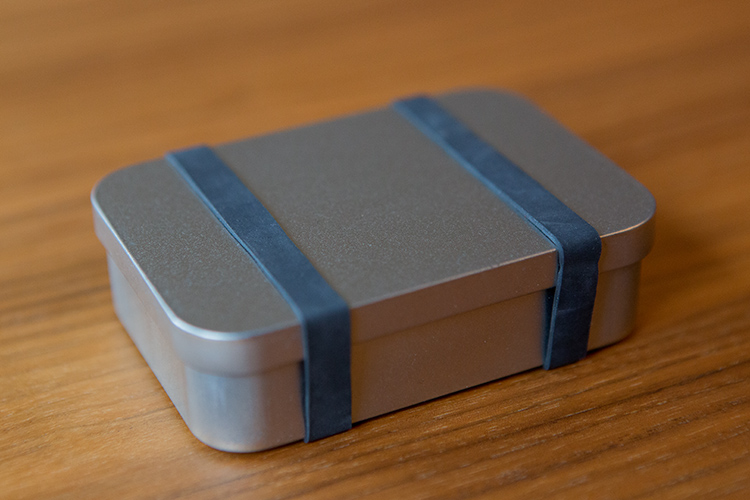
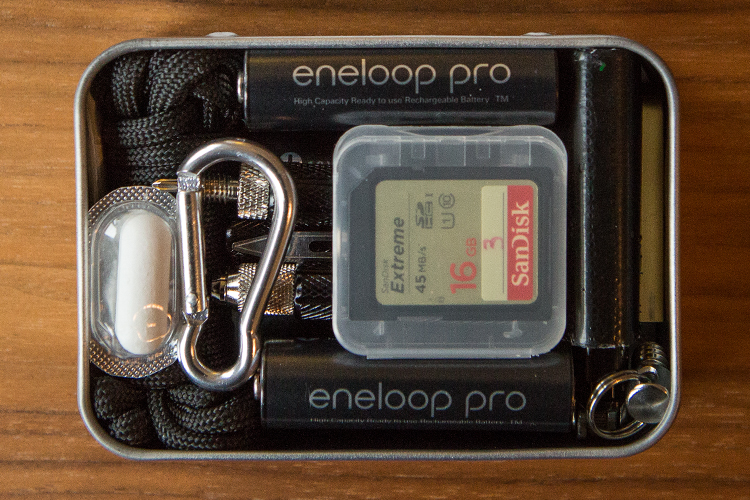
Over the years as a professional photographer, there is a lot of stuff I have added to my camera bag that are really useful in those “what if” situations I get along the way, so I decided to put them all together inside a small tin box, and use it as an everyday carry.
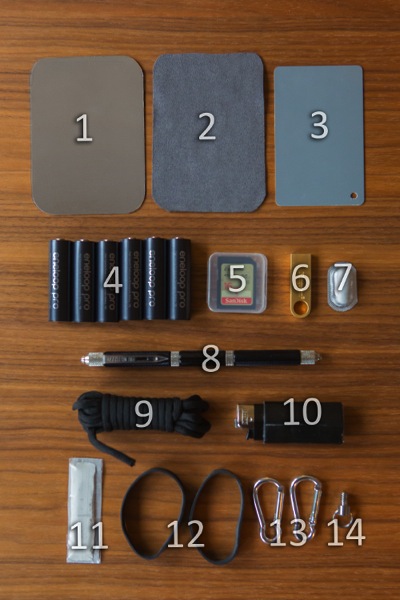
This is not meant to be a survival kit to use in an end of the world scenario, but rather a go-to tools, that helps me out when I face some problems along the way in my photography work. Here is what’s inside:
Silver/white card
Soft cloth
gray card
Eneloop pro AA batteries
Sandisk SD card
Kingston DTSE9 silver pen drive
Ibuprofen tablet
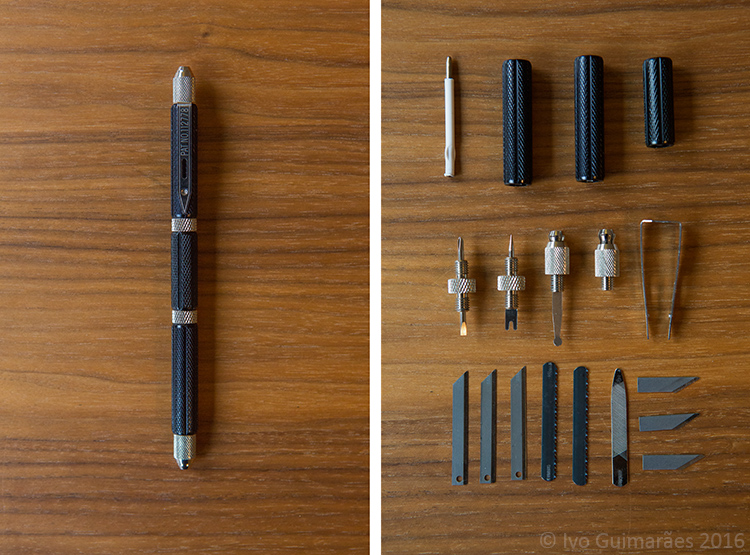
12-in-1 multi-tool pen
Paracord
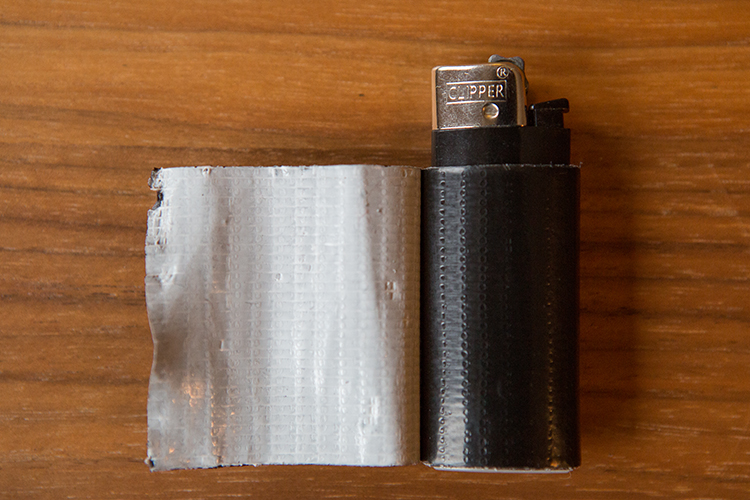
Clipper lighter with gorilla tape
Blu-Tack Reusable Adhesive
Elastic bands
Aluminum small carabiners
1/4” thread screw with ring
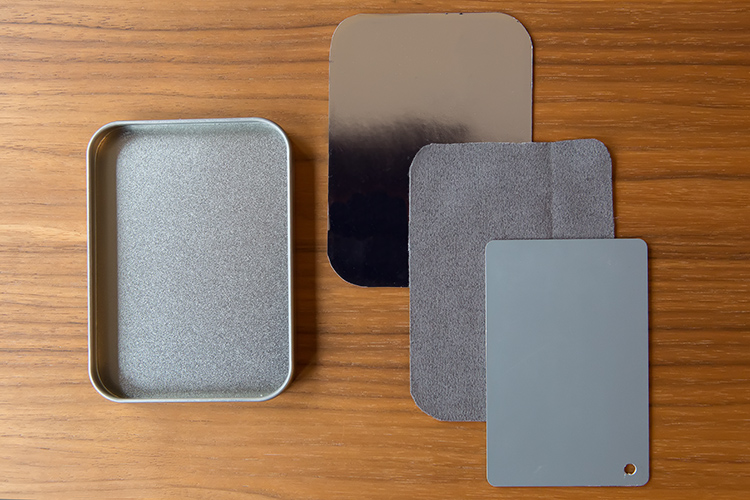
Tucked inside the lid of the box I carry a silver/white card that I use as a reflector for macro photography, or as a bounce card for the flash, a soft cloth that I use to clean the camera lens, and a gray card that I use as reference for color correcting.
The other things fit inside the box like a puzzle. It’s a snug fit, so there is no rattling, or damage on anything due to bouncing around.
The Eneloop pro AA batteries are probably the best choice available for photography equipment, because they are high energy, and are advertised as being able to retain 90% of their charge after 6 months, and 70% after 5 years, when stored at 20 degrees Celsius (68F).
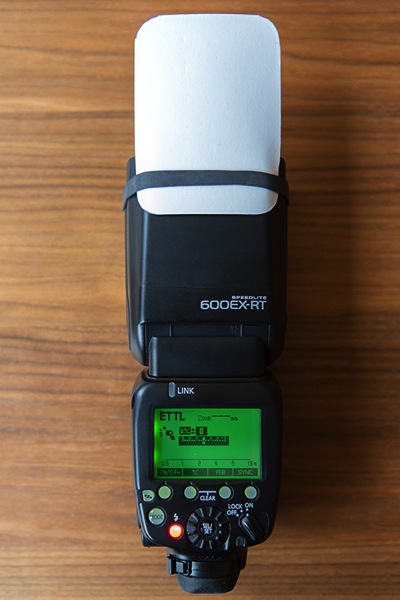
It might look strange that I carry six batteries, when most pieces of equipment use 4 batteries. But, I use these as a backup for my Canon 600EX-RT flash and the ST-R3-EX transmitter, or I might need them for the battery grip I use on my Canon 5DIII, which holds 6 AAs, instead of the LP-E6 batteries.
The Sandisk SD card works along with the batteries as a last resort, because even though I carry backup batteries and cards in my camera bag, it is good to have a backup of the backup inside my tin box, in case something goes wrong.
The Kingston pen drive is a handy device to have around, as it doesn’t take up much space in the box, and can help out with backing up, or transferring files.
The Ibuprofen pill is something I carry with me all the time, because there is nothing worse thing than having to photograph with a headache, or some kind of pain.
The 12-in-1 multi-tool pen was given to me by a friend many years ago, and I carry it everywhere ever since. It looks like a regular pen, but when you open it there are blades, saws, files, tweezers, and screwdrivers that are really useful in many situations.
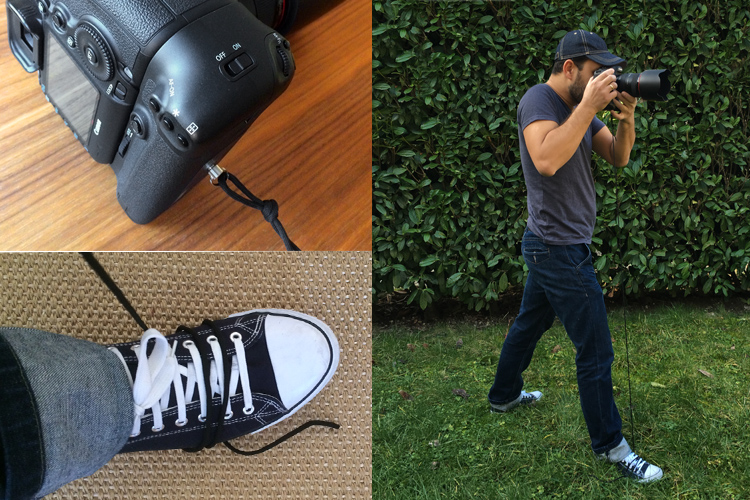
The paracord is another very useful thing to have around. I use it often along with the 1/4” thread screw to make a string tripod. It works as a stabilizer when you put tension on the string, wrapped around your foot on one end, and the other end tied to the 1/4” thread screw on the bottom of the camera (see below)
The clipper lighter is useful for special effects I might want to create with fire, and works great as a wrap-around base, for the gorilla tape I always bring along.
Gorilla tape has saved me more times than I would like to admit, and besides that, I’m an 80s kid, so I grew up watching MacGyver fixing everything with duct tape.
Blu-tack is a reusable, putty-like, pressure-sensitive adhesive, that I use a lot when I photograph food and need to keep things in place.
The elastic bands are useful to keep the box closed, and I also use them to hold accessories on my flash like bounce cards or color gels.
Finally, the carabiners, that I use mostly to attach things to my camera bag, or to hold a sand bag on the tripod.
I also use my trusty Leatherman Wave Multi-Tool a lot when I have to deal with nuts and bolts, but the fact is that it’s big, heavy, and is not something I can carry all the time.
So, this might seem like just a tin box with useless stuff inside, but the fact is that it helps me a lot to know I have this stuff with me, in case I need it.
What about you, what non-photographic things do you carry with you when you go out to photograph?
A little while back, I went over a handful of DSLR camera options for anyone who is looking to get started with professional photography. Since I discussed camera bodies, the next step is deciding on some lenses. And since we’re still trying to find some good options on a beginner’s budget, the lenses we go over are all on the Continue Reading
The post Budget Lenses Roundup for Aspiring Professional Photographers appeared first on Photodoto.



You must be logged in to post a comment.