RSS
 

Posts Tagged ‘Photo’

When to Stop Being a Photographer and Start Being a Photo Editor

03 Sep

At some point, every photo shoot comes to an end.  Every portrait session, cookbook shoot, family vacation, ad campaign, college graduation, wedding, and photo essay eventually gets to the point when it’s time to put the camera down and see what you’ve got.  Congratulations–  You’ve just become a photo editor.  To be clear, I’m not talking about correction or manipulation in Lightroom, Photoshop or any of the other image editing software packages available.  I’m talking about the task of sitting down with the 367 images that you’ve just downloaded and being able to look at your own work with an objective, critical eye, and whittle them down to your best work.  Truthfully, this is one of those benchmark qualities that defines the term “professional photographer.”  Some people define the term based on the gear, while others base it on whether you are paid for your photography (and if so, how much).  For me, I define it in large part based on the photographer’s ability to at least temporarily sever their emotional tie to the work and realize that they shouldn’t be uploading ten images of the same sunset to their Flickr or 500px accounts simply because the angle is ever so slightly different in each.

I first learned this lesson several years ago when I started out as a second shooter for a high-end wedding photographer.  I showed up at the studio one Monday morning after a big weekend wedding, all excited to help with The Culling.  The preliminary critique the night of the wedding had been very positive, so I was feeling good.  Until we started going through the images.  “You’re deleting THAT one?  Seriously?  Wait a minute– what was wrong with THAT one!?!”  By the time we were done I was seriously questioning my new career choice.  My boss tried explaining that when the bride started going through the proofs she was going to get overwhelmed (and not in the good way) by having so many similar photos, that picking her favorites and placing an order would be an insurmountable task.  There wasn’t enough that was different about them.

As much as I didn’t want to admit it, he was right.  I hate it when that happens.

The bottom line was that the bride really didn’t need five 3/4 portraits with varying degrees of tilt when two– MAYBE three– would more than suffice.  The point of the lesson was learning to edit yourself by thinking like a client.  It’s a lesson I’ve tried carrying with me on every assignment since.  Think about it like this– have you ever had to sit through a three-hour marathon session of being forced to look at each and every photo your best friend took on their summer vacation?  Of course you have.  We’ve all been there.  How much better would it have been if they had edited themselves down to their twenty best?  See where I’m going with this?

This was a Lightroom import from last week while I was shooting the last four dishes of the thirty I’d been commissioned to shoot for an upcoming cookbook.  I seriously overshot this one.  The screen capture only shows 24 of the 39 frames I shot of a sandwich.  Thirty-nine frames of a sandwich!  Not only do I not want the client to have to go through that many images to select the one that will go in the book, I don’t want them knowing that it took me 39 frames to take a picture of a sandwich!  Knowing how to edit yourself is crucial.  Unfortunately, not enough photographers learn how to do it well.
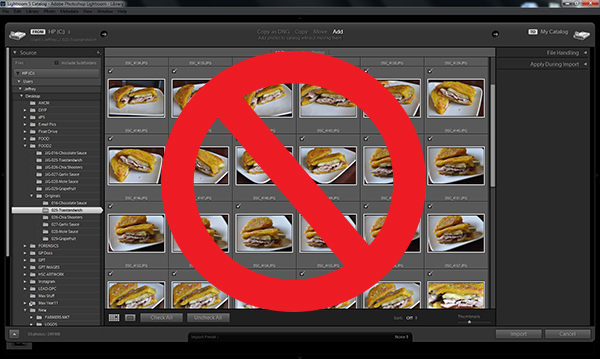
Editing-001-copy

The rule of thumb here is not to only show your best.  It’s to show the best of your best.  If I’ve taken 100 photos, chances are that maybe 50 go in the “selects” folder.  Of those 50, maybe 30 are really good.  Keep cutting your numbers in half as you move from “really good” to “THAT’S what I’m talking about!”  If I’m your client, I’ve already spent considerable time and money in hiring you.  I know you’re good.  Show me just how good you are by not wasting my time and showing me your best.  As soon as you can take your own emotions out of the equation you’ll be thinking like a photo editor and will be much better prepared to present only your best work, whether the client is a bride, a band, or a book publisher.  (As a side note, the same advice applies to entering photography competitions.  Think like the judge, not the photographer).

I see some you nodding your heads, but some of you are still skeptical.  “I got up at 3:00 in the morning to get to the location and set up just in time to see the sun come up over the crest of the mountain…”  Stop right there.  Rule #1 of critique with my photography students is “No talking once your photo is up on the screen.  The old cliche that every picture tells a story is true, but you need to let the picture tell it.  I don’t care about how difficult it was to get the shot or that you were happy/depressed/angry/indifferent when you took it.  While the result always matters,  you can’t necessarily say the same for the back story.  Save the stories for when you write your book some day.  For now, the work needs to speak for itself.

Learning to edit yourself pays dividends across the board.  If you are a professional photographer, your clients will appreciate both your quality and professionalism.  Professionals, hobbyists, and enthusiasts can not only get better at selecting the cream of the crop, but can also eventually start mentally editing themselves before they even push a shutter button.  Digital has made it easier than ever to walk away from a shoot with several hundred images.  That’s great, I suppose, but why create so much extra work for yourself?  Learn to think like a photo editor and all that extra work goes away.


Post originally from: Digital Photography Tips.

Check out our more Photography Tips at Photography Tips for Beginners, Portrait Photography Tips and Wedding Photography Tips.

When to Stop Being a Photographer and Start Being a Photo Editor


Digital Photography School

 
Comments Off on When to Stop Being a Photographer and Start Being a Photo Editor

Posted in Photography


15-Year Photo Project: Construction of a 150-Year Bridge

27 Aug

[ By WebUrbanist in Architecture & Public & Institutional. ]

joseph blum bridge photo

A photography project well over a decade in the making, these images by Joseph Blum show the human side and vast scale of construction behind the world’s largest self-anchored suspension bridge, slated to open this Labor Day Weekend in San Francisco and built to last for one hundred and fifty years.

blum bay bridge

Blum has a 25-year professional background in construction that informs his work but also gives him credibility with workers, enabling him to take close up and personal shots on site. He routinely braved dangerous heights with camera in hand, given remarkable behind-the-scenes access that in turn required extensive gear and safety precautions.

blum bridge above below

In the following interview with WebUrbanist, Joseph Blum goes into detail about his intentions, approach and what he learned about construction, photography and himself through this long and epic photographic journey.

blum bay construction workers

Notably, almost (if not every) image in the resulting series has a human element. “My intention on this job  and in all of my work is to document and honor the human labor involved in the project,” Blum explains. In this case, he “attempted to photograph the construction labor processes insofar as it was possible from the perspective of the workers actually doing the work” in order ” to show how they take the engineers’ plans and drawings and transform them into living structures of steel and concrete.”

blum san francisco series

Then there is the time frame of the project itself, spanning over a decade during which time there has been a massive shift from traditional film toward digital photography. Blum walks us through the timeline and his own transitions: “When I began this project I was shooting black and white film exclusively and did not believe that would ever change. During the course of the project digital photography burst on to the scene and became ever more sophisticated. I began shooting digital on the job as a supplement, but over time I began to rely upon it more and more.” Eventually, he started “to understand that in photography what is most important is the image and whether it is captured on black and white or color film or digitally is secondary.”

blum bridge construction detail

But the learning process also went beyond technical choices: “I also learned a great deal more about bridge construction and the work processes of the various trades.” Blum ended up “hanging out with the work groups for extended periods of time, forming relationships with the workers, getting to understand how they organized their work and their work relationships,” which in turn “increased my understanding of how this kind of labor is accomplished and also allowed me get images that no one else could.”

blum interview building detail

On a personal level, perhaps this photographer also found a secret to longevity in those high-flying spans overlooking the city: “Although the years went by and I got older, I felt that the project kept me young. photographing the bridge in the middle of the beautiful San Francisco bay required me to carry a substantial photo bag, to do a great deal of walking and climbing in all kinds of weather and i found that every single day that i went out to shoot was invigorating and energizing.” For more information about his work and exhibitions, as well as more images, click here to visit Joseph Blum’s website.

Share on Facebook


[ By WebUrbanist in Architecture & Public & Institutional. ]

[ WebUrbanist | Archives | Galleries | Privacy | TOS ]


WebUrbanist

 
Comments Off on 15-Year Photo Project: Construction of a 150-Year Bridge

Posted in Creativity


Facebook introduces shared photo albums

27 Aug

facebook-trans.png

Facebook has started rolling out shared photo albums to select users of their social networking website. Currently, photo albums are limited to the user that created it. Shared albums will allow users to create a gallery that can be used by as many as 50 friends, each of whom can upload up to 200 photos. You can learn more about shared photo albums and when you can try it for yourself on our sister site, Connect.

News: Digital Photography Review (dpreview.com)

 
Comments Off on Facebook introduces shared photo albums

Posted in Uncategorized


Win An Amazing “Canon PowerShot SX50 HS” & Other Photo Goodies

24 Aug

Take part in the rocking giveaway by our friends at MacPhun. You have a chance to win Canon PowerShot SX50 HS. There are also some sweet prizes for runner-ups, like Casetagrams and Bluelounge postal bags. The nicest thing about it is that there are no restrictions, except for the one – love Photography like we do. The Giveaway finishes in Continue Reading

The post Win An Amazing “Canon PowerShot SX50 HS” & Other Photo Goodies appeared first on Photodoto.


Photodoto

 
Comments Off on Win An Amazing “Canon PowerShot SX50 HS” & Other Photo Goodies

Posted in Photography


Bubble of Fear: Surreal Photo Series Highlights Fukushima

23 Aug

[ By Steph in Art & Photography & Video. ]

Surreal Photos of Nuclear Fukushima 1

A gas mask hangs in a red box mounted to a tree in an otherwise peaceful forest, a jarring reminder that all is not well in Fukushima. French photographers Carlos Ayesta and Guillame Bression (collaborating as Trois 8) present ‘Bad Dreams?’, a series of photographs calling attention to the eerie continued desolation of the Fukushima Daiichi power plant and surrounding areas that were contaminated with radiation following the earthquake, tsunami and nuclear disaster of 2011.

Surreal Photos Nuclear Fukushima 2

The duo photographed local residents beside plastic-wrapped swing sets, and enclosed within bubbles in front of supermarkets in evacuated towns. Many of these areas are still inaccessible due to the contamination, and even those that aren’t off-limits are quiet and still, as residents fear even low levels of radiation poisoning.

Surreal Photos Fukushima 4

As the photographers point out, the border between the dead zones and the areas that are technically ‘safe’ is blurred and subjective, with locals required to set their own limits. “This gray threat becomes the fertile soil of our imagination and our fears. Fears that could become even more harmful than the radiation itself.”

Surreal Photos Nuclear Fukushima 3

Each photograph depicts an area within these ‘blurred lines,’ including a lake in the mountains filled with ‘safe’ water that parents won’t allow their children to drink, and a forest where officials have been unable to draw distinctions between areas that are contaminated and those that aren’t. ‘The man in the bubble before the dead forest’ shows a forest that died because it was flooded with salt water for months after the tsunami. See the whole series at Trois8.fr.

Share on Facebook


[ By Steph in Art & Photography & Video. ]

[ WebUrbanist | Archives | Galleries | Privacy | TOS ]


WebUrbanist

 
Comments Off on Bubble of Fear: Surreal Photo Series Highlights Fukushima

Posted in Creativity


Bubble of Fear: Surreal Photo Series Highlights Fukushima

23 Aug

[ By Steph in Art & Photography & Video. ]

Surreal Photos of Nuclear Fukushima 1

A gas mask hangs in a red box mounted to a tree in an otherwise peaceful forest, a jarring reminder that all is not well in Fukushima. French photographers Carlos Ayesta and Guillame Bression (collaborating as Trois 8) present ‘Bad Dreams?’, a series of photographs calling attention to the eerie continued desolation of the Fukushima Daiichi power plant and surrounding areas that were contaminated with radiation following the earthquake, tsunami and nuclear disaster of 2011.

Surreal Photos Nuclear Fukushima 2

The duo photographed local residents beside plastic-wrapped swing sets, and enclosed within bubbles in front of supermarkets in evacuated towns. Many of these areas are still inaccessible due to the contamination, and even those that aren’t off-limits are quiet and still, as residents fear even low levels of radiation poisoning.

Surreal Photos Fukushima 4

As the photographers point out, the border between the dead zones and the areas that are technically ‘safe’ is blurred and subjective, with locals required to set their own limits. “This gray threat becomes the fertile soil of our imagination and our fears. Fears that could become even more harmful than the radiation itself.”

Surreal Photos Nuclear Fukushima 3

Each photograph depicts an area within these ‘blurred lines,’ including a lake in the mountains filled with ‘safe’ water that parents won’t allow their children to drink, and a forest where officials have been unable to draw distinctions between areas that are contaminated and those that aren’t. ‘The man in the bubble before the dead forest’ shows a forest that died because it was flooded with salt water for months after the tsunami. See the whole series at Trois8.fr.

Share on Facebook


[ By Steph in Art & Photography & Video. ]

[ WebUrbanist | Archives | Galleries | Privacy | TOS ]


WebUrbanist

 
Comments Off on Bubble of Fear: Surreal Photo Series Highlights Fukushima

Posted in Creativity


Nearly deleted photo helps shot putter secure gold

23 Aug

shotput.png

Reuters photographer Kai Pfaffenbach found himself unexpectedly on the other side of the lens at the IAAF World Championship Men’s Shot Put Finals. His photo of Germany’s David Storl was used as evidence in a decision that overturned a ‘foul’ call and awarded the athlete a gold medal. When it was called into question whether Storl stepped outside of the ring in his attempt, Pfaffenbach discovered that his remote camera clearly showed Storl’s attempt to be fair. Click through for more.

News: Digital Photography Review (dpreview.com)

 
Comments Off on Nearly deleted photo helps shot putter secure gold

Posted in Uncategorized


Artist Rolf Sachs’ photo series inspired by train travel, embraces blur

21 Aug

sachs_3.jpg

Anyone who’s traveled by train has seen the landscape outside of their car moving by in a blur. While most of us turn our attention back to our reading material and mobile devices, artist Rolf Sachs’ finds inspiration. His photo series, called ‘Camera in Motion,’ aims to capture the effect of the blurred landscapes outside of his train traveling between Switzerland and Italy. The resulting images walk a line between landscape photography and surrealist art. Click through to see some of his work.

News: Digital Photography Review (dpreview.com)

 
Comments Off on Artist Rolf Sachs’ photo series inspired by train travel, embraces blur

Posted in Uncategorized


4 Scenes in 1 Photo: Illusion You Have to See to Disbelieve

17 Aug

[ By WebUrbanist in Art & Photography & Video. ]

4 scenes in 1

Without proof, it makes for a tough sell – what looks like four photographs arranged into a square is indeed a single shot, meticulously staged, as only accompanying images and videos will convince.

4 scenes 1 shot revealed

Bela Borsodi created and photographed the scene for use as an album cover. And while it is still hard to trick your mind into seeing the reality of the overlap, there are subtle cues – certain objects that span multiple quadrants and lead the eye between them. The animation below shows the stages of setup and construction in a kind of stop-motion animation format.

4 scenes detailed view

About the artist: “Bela Borsodi was born in Vienna 1966. After studying graphic design and fine art he started to work as a photographer. In 1992 Bela moved to New York and in 1999 he focused on still life photography, which is still the main direction of his work. Bela lives and works in New York.” He has worked for editorial clients including The New York Times and Wired Magazine and advertising clients including Hermes, Puma, Nike and Freitag.

Share on Facebook


[ By WebUrbanist in Art & Photography & Video. ]

[ WebUrbanist | Archives | Galleries | Privacy | TOS ]


WebUrbanist

 
Comments Off on 4 Scenes in 1 Photo: Illusion You Have to See to Disbelieve

Posted in Creativity


Lowepro introduces Photo Sport Shoulder bag in two sizes

14 Aug

logo_lowepro.jpg

Lowepro has announced the Photo Sport Shoulder bag, in two sizes for both DSLR and mirrorless ILC camera kits. The Photo Sport Shoulder 18L is designed to fit a ‘pro DSLR without grip’ and a standard zoom lens, with a second small lens and room for accessories, including a 10″ tablet computer. The smaller Photo Sport Shoulder 12L is designed for an interchangeable lens camera with two lenses, and similar capacity for accessories – including a 10″ tablet – as its bigger companion. Both bags are available now for $ 84.99 and $ 74.99 respectively.

News: Digital Photography Review (dpreview.com)

 
Comments Off on Lowepro introduces Photo Sport Shoulder bag in two sizes

Posted in Uncategorized