RSS
 

Posts Tagged ‘Parks’

Skywalking Stockholm: Bridged Green-Roof Parks to Span Downtown

23 Dec

[ By WebUrbanist in Architecture & Cities & Urbanism. ]

stockholm building connected parks

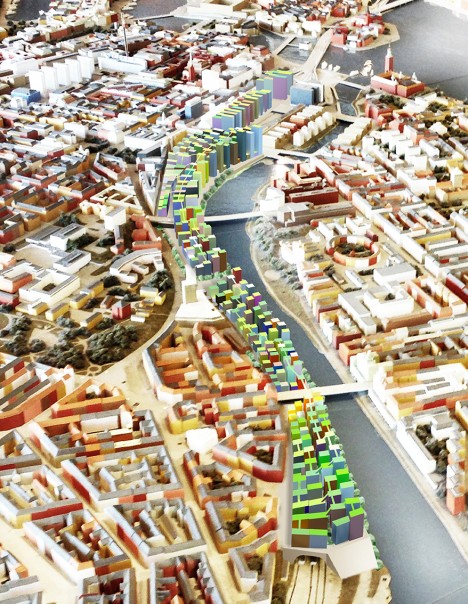
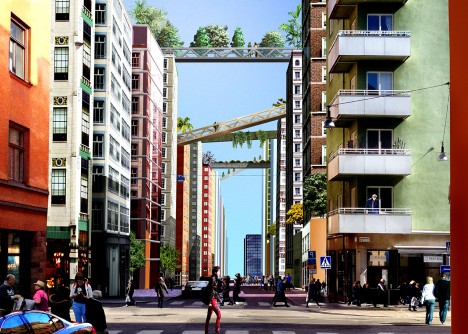
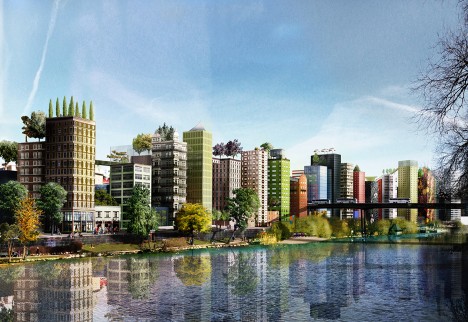
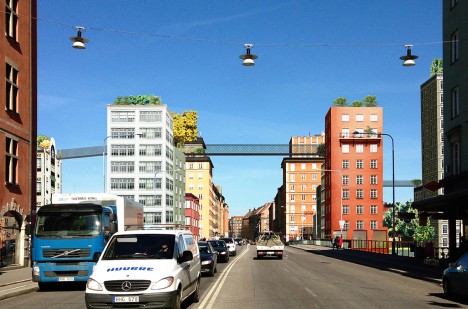
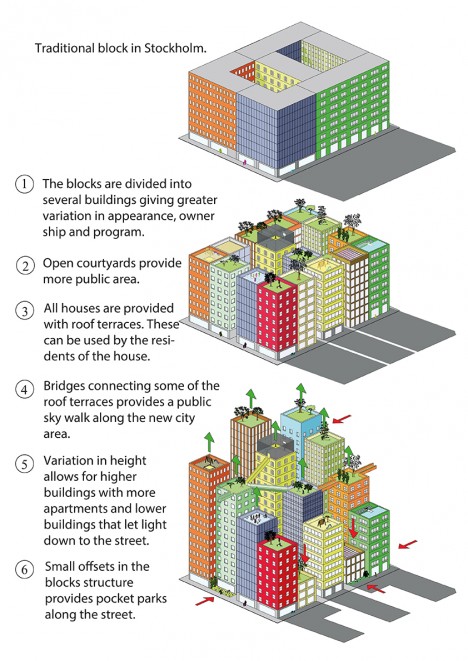
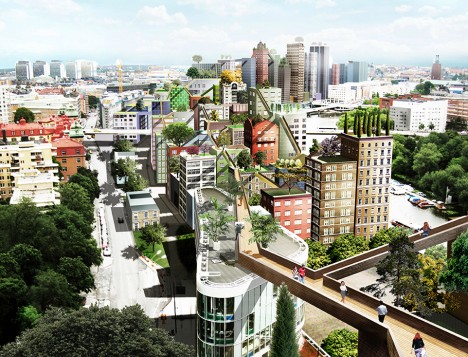
Fusing height, light, density and greenery with regional vernacular architecture, this ambitious urban Sky Walk plan aims to turn the tops of downtown buildings into a extensive series of connected green-roof parks connected by aerial walkways.

stockholm sky walk

Anders Berensson Architects was commissioned to develop a design that would accommodate Stockholm’s growing population and associated housing needs, but their solution goes above and beyond conventional urban planning, literally and otherwise.

stockholm downtown core paths

Their proposal takes advantage of existing infrastructure and tightly-packed buildings, creating green community spaces essentially out of thin air, all while respecting zoning regulations and building codes dictating heights and usages.

stockholm elevated greenery

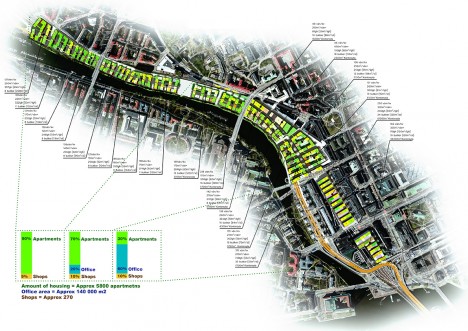
The heights of new buildings in the scheme would be tuned to the aspirations of the aerial component, aimed to facilitate the desired connections across streets and between blocks, ultimately creating a long meandering walkway along the city’s riverfront.

stockholm downtown master plan

Views and light orientations are also taken into consideration, with residential units aimed as much as possible with natural daylight in mind.

stockholm urban aerial walkways

The thin profiles of the perforated-metal Sky Walk structures will minimize shading from these components as well.

stockholm vertical green roofs

From the architects: “The design makes larger parts of the area accessible to the public since both courtyards and roof terraces is crossed by public paths. The sky walk on the roof terraces will be one of the longest parks in Stockholm with best view in town. The new city area will host about approximately 5800 apartments, 8000 work places and about 300 shops.”

Share on Facebook


[ By WebUrbanist in Architecture & Cities & Urbanism. ]

[ WebUrbanist | Archives | Galleries | Privacy | TOS ]


WebUrbanist

 
Comments Off on Skywalking Stockholm: Bridged Green-Roof Parks to Span Downtown

Posted in Creativity


Social Climbers: 7 Vertical Trailer Parks for Mobile Urbanites

09 Dec

[ By WebUrbanist in Architecture & Houses & Residential. ]

trailer house theater set

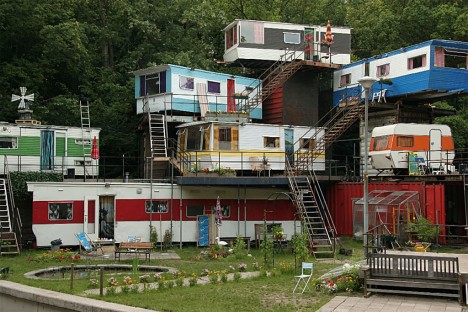
Addressing the combined challenges of mobility and density, this series of design solutions (both conceptual and actual) turn trailer living into a vertical endeavor. While the image above was alas only a stage set for a theatrical production, there are real-world examples of this approach dating back decades.

mobile-home-towers

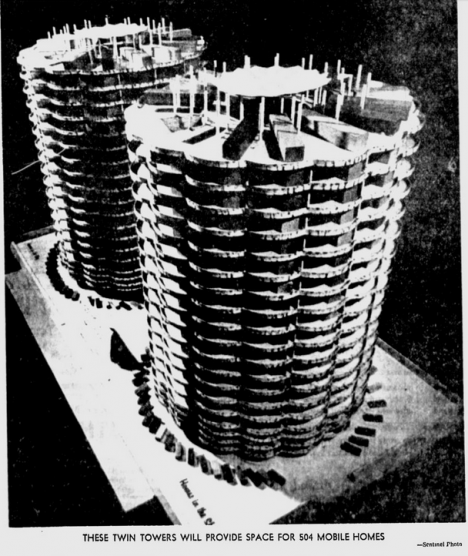
Industrialist, developer and mobile housing pioneer Elmer Frey pitched an incredible project in the early 1960s: a set of spiraling skyscrapers designed to house roadworthy mobile homes. The 20-story structures would house over 500 homes each with parking below and restaurants and community spaces above. While this grand vision never came to pass, Frey did not give up so easily.

trailer array multistory structure

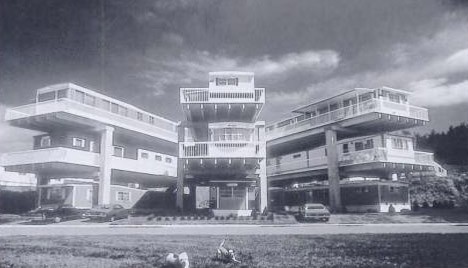
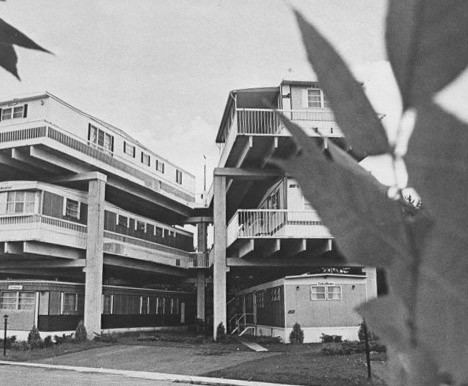
Instead, he approach the problem at a smaller scale, hoping to win support for his bigger ambitions. Built near the Twin Cities of Minneapolis and St. Paul in Minnesota, the SkyRise Terrace was controversial from the time it was constructed.

vertical trailer park

The site provided frameworks for stacking conventional mobile homes, arrayed in an arc around a central shared space. Problems with plumbing and fear of tornados contributed to the deconstruction of this complex a few years after its creation.

mobile home stack fail

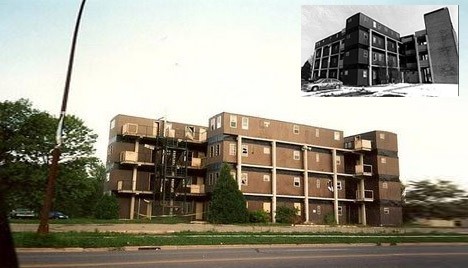
In nearby Mankato, the Valley View Apartments complex used similar design principles to create an equally-unappealing set of stacked mobile homes framed by concrete supports. Deemed ugly by critics locally and around the country, this complex also was eventually demolished, but was still not the end of trailer-stacking history.

Next Page – Click Below to Read More:
Social Climbers 7 Vertical Trailer Parks For Mobile Urbanites

Share on Facebook


[ By WebUrbanist in Architecture & Houses & Residential. ]

[ WebUrbanist | Archives | Galleries | Privacy | TOS ]


WebUrbanist

 
Comments Off on Social Climbers: 7 Vertical Trailer Parks for Mobile Urbanites

Posted in Creativity


Gone Fur Good: 10 Abandoned Petting Zoos & Game Parks

16 Aug

[ By Steve in Abandoned Places & Architecture. ]

abandoned-petting-zoo-1a
Generations of adults cherish childhood memories of these now-abandoned petting zoos. As for the animals fed & petted there, maybe they remember, too…

abandoned-petting-zoo-1c

White Pines Deer Park near Oregon, Illinois is remembered fondly by several generations of kids who enjoyed feeding the 200-odd deer kept in a spacious enclosure. “It’s excellent,” stated 8-year-old T.J. Turner in the summer of 1992. “Deer come right up to you. Outside you never get to pet them or see them.” Inside too, nowadays.

abandoned-petting-zoo-1b

abandoned-petting-zoo-1d

Flickr user BillsExplorations visited what remains of White Pines Deer Park in February of 2013, about two decades after the park closed in the mid-1990’s. Though it adjoins White Pines Forest State Park (an Illinois Nature Preserve since 2001), Bill didn’t see any deer roaming about – blame it on carelessly disposed-of Polaroid film waste.

Gotta Flat

abandoned-petting-zoo-2

Flickr user Quinn Dombrowski (quinn.anya) brings us this curious “Flat Petting Zoo”… says they sell furs there. Better not tell PETA or Elaine Benes.

Benson’s Hedges

abandoned-petting-zoo-3b

abandoned-petting-zoo-3d

Benson’s Wild Animal Farm in Hudson, New Hampshire, opened in 1926 and closed in 1987 following a decades-long decline. In 2009, the town of Hudson acquired the property and it’s gradually being redeveloped as a public park and nature area sans petting zoo.

abandoned-petting-zoo-3a

abandoned-petting-zoo-3c

Some of the much-deteriorated old buildings including the Old Lady in the Shoe’s house are to be restored though non-native plants, animals and animal-petters are no longer welcome.

Next Page – Click Below to Read More:
Gone Fur Good 10 Abandoned Petting Zoos Game Parks

Share on Facebook


[ By Steve in Abandoned Places & Architecture. ]

[ WebUrbanist | Archives | Galleries | Privacy | TOS ]


WebUrbanist

 
Comments Off on Gone Fur Good: 10 Abandoned Petting Zoos & Game Parks

Posted in Creativity


Flip for This: 12 Crazy and Creative Skate Ramps & Parks

18 May

[ By Steph in Architecture & Cities & Urbanism. ]

skate ramp grand canyon

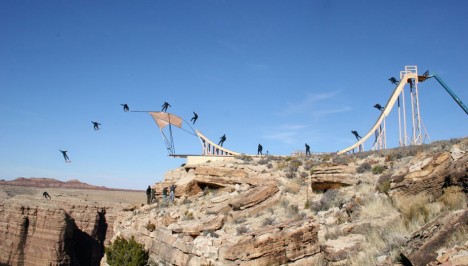
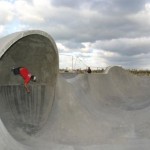
Glide you way through a multi-story dedicated skate park, a glow-in-the-dark bowl, an old subway tunnel under London, a floating ramp on Lake Tahoe or even a ramp that goes right off the edge of the Grand Canyon. These 12 skate parks and ramps, from California to Dubai, offer some of the world’s most amazing places to practice your tricks – places that are legal, anyway.

World’s First Multi-Story Skate Park
skate parks multistory 2

skate parks multistory 1

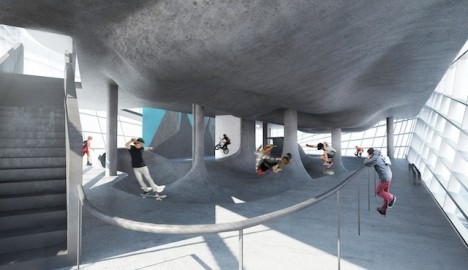
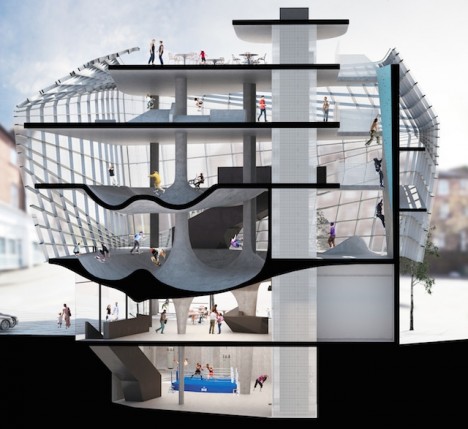
Many a skater has eyeballed the surfaces of a spiraling parking garage and wished they were curvier. Soon, a quiet seaside town in Britain will be home to the world’s first multi-story structure devoted to exactly this activity: the Folkestone Sports Park by architecture firm Guy Holloway. The world’s first facility of its kind, Folkestone will feature three entire floors for skaters as well as a climbing wall, underground boxing ring, cafe, training room, youth room and first aid center.

Skate Park Doubles as a Working Sundial
skate park sundial

skate park sundial 2

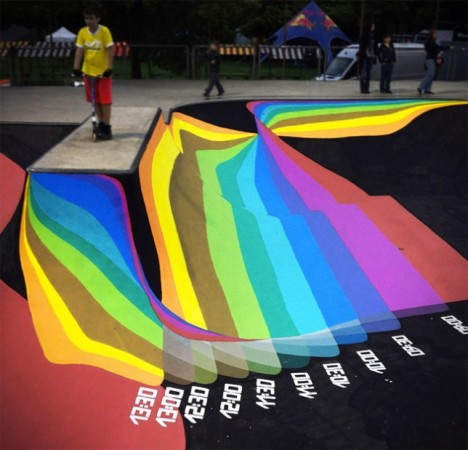
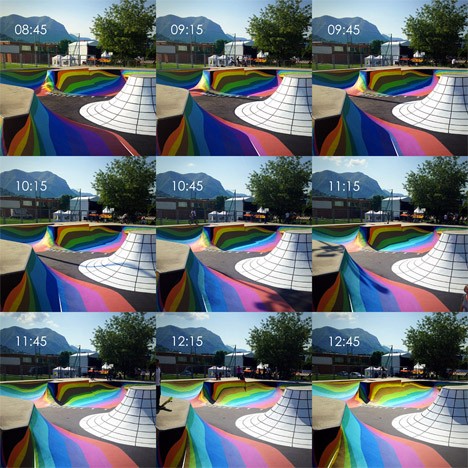
You don’t have to glance at a watch or phone to figure out what time it is when you’re skating at this park in Lugano, Switzerland. Brightly painted markings on the concrete of the bowl will tell you according to the sun and shadows. Designed by Moscow group Zuk Club, this park is one big rainbow-hued sun dial.

Abandoned Tunnel Turned Subterranean Skate Park
skate park tunnel london

skate park london 2

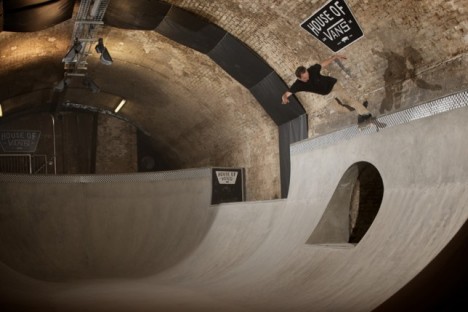
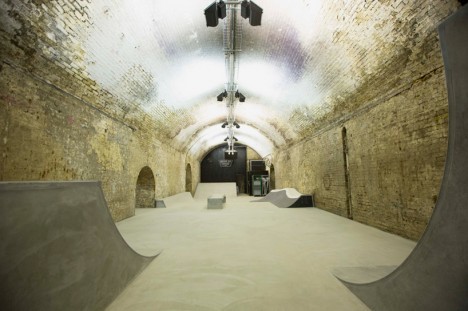
London’s famous Old Vic Tunnels under the Waterloo Station are home to the city’s first subterranean skate park, a cultural complex taking up 32,000 square feet. House of Vans offers a pool-style bowl, street section and mini ramp as well as a music venue, bar, theater, cafe, artist studios and gallery space.

Sink or Skate: Floating Ramp Design

skate parks floating ramp 2

skate parks floating ramp

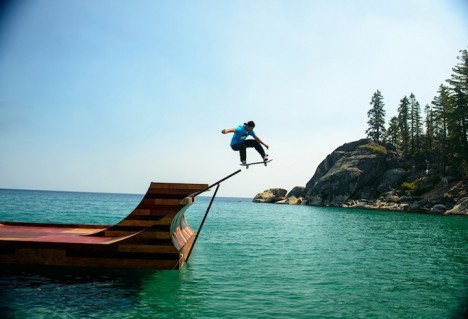
This sculptural wooden ramp took up residence right on the surface of sparkling Lake Tahoe as a promo for the California tourism industry. Built by skateboarding pro Bob Burnquist with the assistance of art director Jerry Blohm, the structure features a half pipe, quarter pipe and 45-degree ramp and weighs an amazing 7,300 pounds. Bob had a wet-suited snorkeler waiting in the waters nearby to retrieve his board anytime it went over the edge.

Next Page – Click Below to Read More:
Flip For This 12 Crazy And Creative Skate Ramps Parks

Share on Facebook


[ By Steph in Architecture & Cities & Urbanism. ]

[ WebUrbanist | Archives | Galleries | Privacy | TOS ]


WebUrbanist

 
Comments Off on Flip for This: 12 Crazy and Creative Skate Ramps & Parks

Posted in Creativity


Death Valley: One of America’s Worst National Parks?

22 Mar
An ages old mesquite tree looking up at one of the darkest rated night skies in America.

An ages old mesquite tree looking up at one of the darkest rated night skies in America.

I recently came across an article by Bill Fink on Yahoo titled “Our Tax Dollars Pay for What? The Nation’s Worst National Parks.” In all fairness, there are some pretty lame national parks and monuments, I’m not going to argue that. Certainly a few of them ended up on this list as expected. But when I got to number five on the list and saw Death Valley National Park, I was astonished.

Fink writes in the brief article that the best way to simulate a visit to Death Valley is to “heat a pan full of sand to about 200 degrees, then pour it on your head,” and that “when it’s not hot [in Death Valley] it’s bitterly cold, so at least you get some variety in your misery.”

I’ve been to Death Valley National Park five times now. Twice on photography trips and three times to lead workshops through the park. All three workshops in Death Valley sold out in less than 24 hours. So either I (and my students) have terrible taste in beauty or Bill Fink doesn’t know what he’s talking about. In fact, after reading through his brief writeup a few times, I’d wager that Bill hasn’t even been to the park. If that’s true, it just goes to show how far we’ve come from true journalism in today’s age of click bait articles.

Death Valley is, in my opinion, one of the absolute best national parks in the country. Here’s a few ways to make certain you agree after your next visit:

Visit the park between January and March

The second time I visited Death Valley was in early September back in 2013. The reported temperate at Stovepipe Wells was right around 118 degrees fahrenheit (47.8c). We knew it was going to be hot in the park, but we didn’t know it would be that hot. We were after some Milky Way images and figured we’d give it a go. Since it was still daylight, we decided to hike out into the Mesquite Flat Sand Dunes where the temperatures were around 10 degrees higher (128f or 53c) because of all the reflective sand.

I had a Camelback on to stay hydrated but if I didn’t continuously drink out of it, the water that gets stuck in the tube would get piping hot. Suffice it to say, the last thing you want to do when you’re experiencing the highest temperatures you’ve could ever imagine is to drink it a mouth full of piping hot water. It was, in a word, miserable.

As sunset approached, we decided to head to Badwater Basin. There, temperatures had cooled down to a much more manageable 113f (45c). The crazy thing is, the temperature didn’t drop as the sun set and darkness approached. It was pitch black outside and my tripod was too hot to touch and my Canon 1Ds Mark III was flashing warnings at me saying it was overheating. Yes, Canon’s flagship (at the time) pro level camera made to endure the harshest elements couldn’t handle the heat.
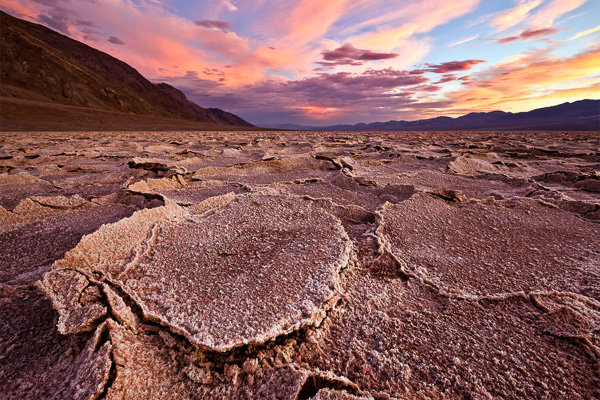
Badwater Basin at a scorching 113?F.

Badwater Basin at a scorching 113f (45c).

You may be thinking at this time that Bill Fink was pretty spot on, and if that had been my only visit to the park, I might be inclined to agree. If you want to enjoy everything Death Valley has to offer, you shouldn’t go when the temperatures are unbearable. The average high/low temps in fahrenheit in January for Death Valley are 67/40 (19.4/4.4C), February is 73/46 (22.8/8C)and March is 82/55 (28/13C). Anything past that and you’re looking at possible highs in the 90s and 100s. All three workshops I’ve done in the park have occurred during these months and they all had absolutely beautiful weather.

Rent a Jeep from Farabee’s

Much of what Death Valley has to offer isn’t accessible with the Ford Fiesta you rented in Vegas. Places like Racetrack Playa, Eureka Sand Dunes and Titus Canyon simply can’t (and shouldn’t) be reached without a good 4×4 vehicle. I’ve been to Racetrack Playa three times now. Once in a VW Toureg, once in a Chevy Tahoe and once in a Jeep from Farabee’s. The Toureg is a great SUV but it wasn’t 4-wheel drive. We got to the playa without any problems, but on the way out we busted something in the transmission and had to limp back to Vegas for three days while we waiting to get the car repaired. The second trip, with the Tahoe, resulted in a flat tire on the way in at Teakettle Junction. I think it goes without saying that the rest of the drive in, as well as the drive out was pretty nerve racking, considering our only spare tire had already been used.

The third trip (and my most recent), I finally decided to rent Jeeps for our workshop group from Farabee’s Jeep Rentals in Furnace Creek. We had to rent three because we had nine students and two instructors so we got two 4-door Jeeps and one 2-door. Getting out to Racetrack Playa in the Jeeps was like a dream. Sure, the road was still rough and unforgiving, but the Jeeps handled it without a problem. They also include coolers in the back full of ice cold water and a radio beacon in case you run into trouble, which will send them to your location immediately.
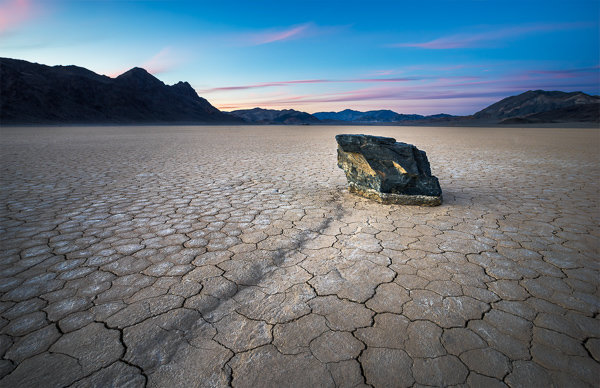
A "sailing stone" at the Racetrack Playa.

A “sailing stone” at the Racetrack Playa.

Parking lots are for tourists – don’t be a tourist

Two of the most incredible places in Death Valley are the Mesquite Flat Sand Dunes and Badwater Basin. Both have large parking lots that can be totally full at any given time and both locations can be pristine or totally useless depending on the recent weather conditions in the park. When the winds calm down for days or weeks on end, the sand dunes get covered in foot prints quickly and become totally un-photogenic. The salt plates at Badwater Basin are always changing and depend on rain to get back to their pristine condition with white salt and low, thin borders. As the plates dry and time goes on, the salt turns brown and the edges rise until they become totally unrecognizable.

The best thing to do at the Mesquite Sand Dunes is to park about a half mile before or after the parking lot on the side of Highway 190. Then, just hike out to the dunes from there. You’ll be free of nearly 90% of all foot traffic and will have mostly untouched dunes at your disposal. Just be smart and do your very best to tread lightly. Only walk were you have to and try not to trample the most beautiful dunes.

If the salt patterns at Badwater Basin look terrible from lack of rain, head over to West Side Road. You’ll actually drive right past this road on the way to the Badwater Parking lot, but most people just keep driving because it just looks like a dirt road. Drive about half mile or so down this road and you’ll have a great chance at finding some incredible patterns here. Just keep in mind that Badwater Basin is always changing and this information could be totally reversed during your visit.
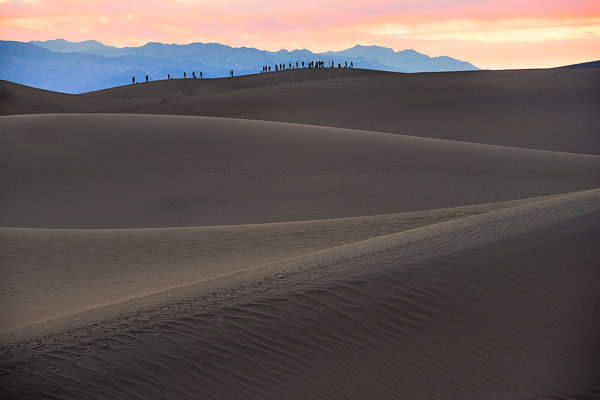
From our location at sunrise (looking toward the parking area) we could see the circus or photographers already underway at sunrise.

From our location at sunrise (looking toward the parking area) we could see the circus or photographers already underway at sunrise.

Scout during the day – shoot at the edges

Blue skies are the norm in Death Valley. So don’t be surprised if you don’t see much in the way of clouds on your trip. I’ve actually lucked out quite a bit during my visits to the park and have experienced some incredible conditions. All that aside, don’t go photographing this place in broad daylight thinking that you’re going to come out with a bunch of keepers. This is the same with any landscape photography, all over the world. If you want to experience this park in all its glory, you need to capture it at sunrise, sunset or at night.
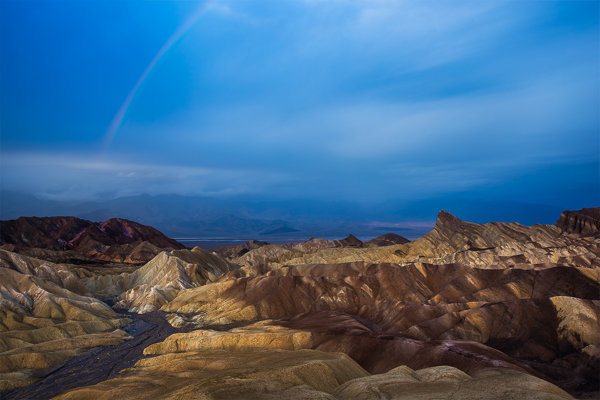
Zabriskie Point at dawn as storms move through the park.

Zabriskie Point at dawn as storms move through the park.

Conclusion

Death Valley is one of the most magnificent, diverse and photogenic national parks in America (USA). You just have to know how to do it right. You can either listen to some editor on Yahoo who just threw a list together (probably) without even going to the places in the article. Or you can listen to the throngs of photographers who visit the park each and every year, including ones like me who keep coming back again and again.

What do you think? Should Death Valley have made this list of worst national parks? Let’s talk in the comments below!

googletag.cmd.push(function() {
tablet_slots.push( googletag.defineSlot( “/1005424/_dPSv4_tab-all-article-bottom_(300×250)”, [300, 250], “pb-ad-78623” ).addService( googletag.pubads() ) ); } );

googletag.cmd.push(function() {
mobile_slots.push( googletag.defineSlot( “/1005424/_dPSv4_mob-all-article-bottom_(300×250)”, [300, 250], “pb-ad-78158” ).addService( googletag.pubads() ) ); } );

The post Death Valley: One of America’s Worst National Parks? by James Brandon appeared first on Digital Photography School.


Digital Photography School
 
Comments Off on Death Valley: One of America’s Worst National Parks?
Posted in Photography


Permanent Parklets: São Paulo Turns Street Parking to Parks

16 Jul

[ By WebUrbanist in Architecture & Cities & Urbanism. ]

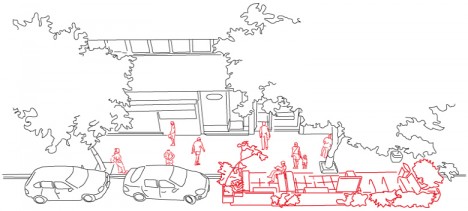
parklet drawing design detail

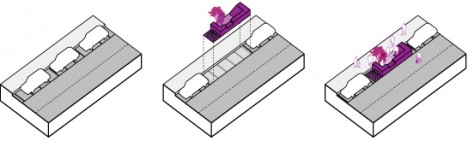
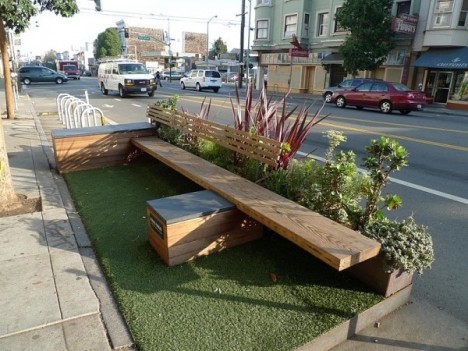
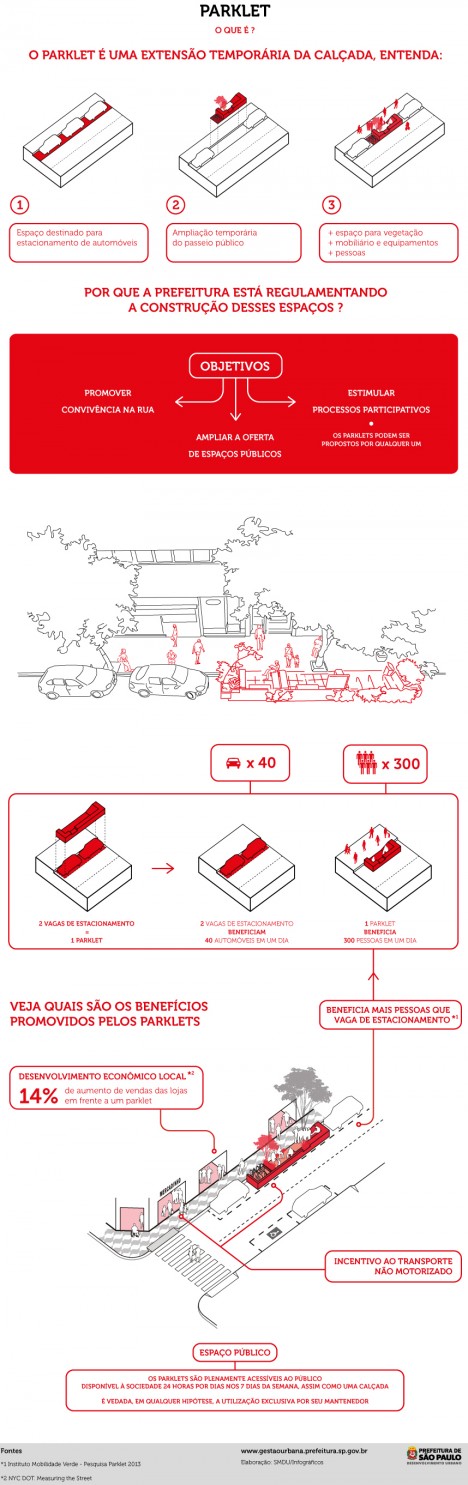
In a bold bid to change its urban landscape for good, Brazil’s biggest city has given a green light to citizen proposals to transform car parking spots into perpetual park spaces.

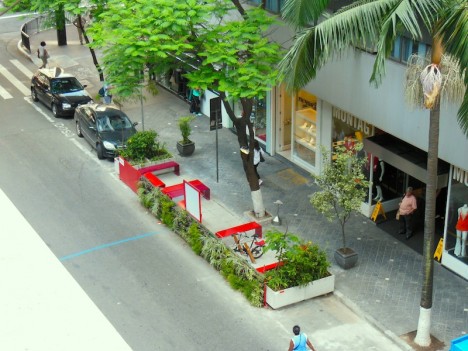
sao paulo permanent parklet

sao paulo mini park

Cities around the world have sanctioned micro-parks on a limited basis (often for temporary use during environmental days and green festivals), but this legislation makes the provision a permanent mandate for São Paulo.

parklet simple axon drawing

parklet construction guide diagrams

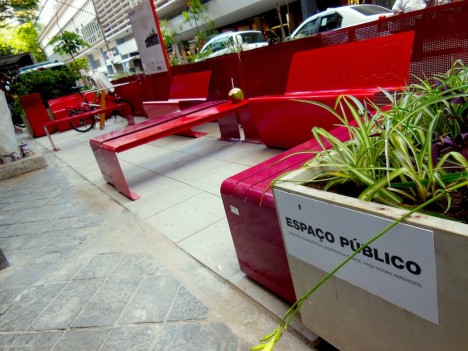
sao paulo tiny parks

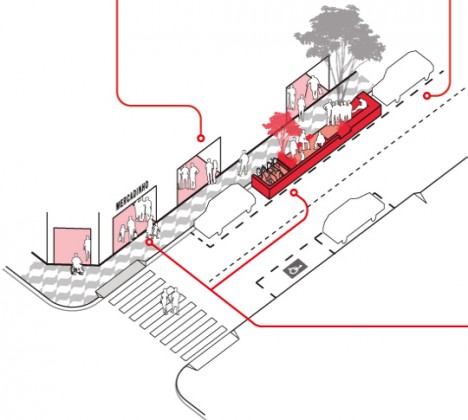
The law comes with style and usage guides but a broad mandate, allowing for a potentially huge variety of programmatic functions starting with but not limited to open seating and leisure space.


parklet multi use spaces

sao paulo parklet example

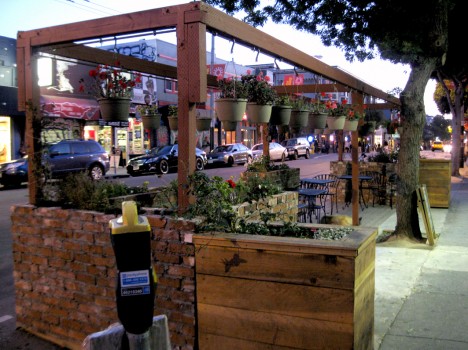
Other possibilities include: small commercial vendors under tents or in shipping containers, public pools and restrooms, recycling receptacle centers and bike sharing racks. The argument, in part, is that the public gains a great deal of additional benefit from open space, which can be shared, over parking spaces that are used only by a few individuals at a time (and even then indirectly).

parklet space infographic images

Suzi Bolognese of SB Design Studio summarizes the shift: “The parklets programme fits in perfectly with São Paulo’s attempts to promote a friendlier pedestrian environment, and involves replacing a parking space or two with a new public area. Parklets can incorporate benches, chairs, tables, trees, and bike racks for the public to use and enjoy. São Paulo has loved parklets so much it has integrated them into city planning policy. Now as a result of Decree No. 55,405, São Paulo has rules for the creation and maintenance of parklets, the first Latin American public policy on the issue.”

Share on Facebook


[ By WebUrbanist in Architecture & Cities & Urbanism. ]

[ WebUrbanist | Archives | Galleries | Privacy | TOS ]


WebUrbanist

 
Comments Off on Permanent Parklets: São Paulo Turns Street Parking to Parks

Posted in Creativity


Pop-Up Parks: Brackets Turn Scaffolding into Furniture

25 Feb

[ By Steph in Design & Furniture & Decor. ]

Softwalks Pop Up Scaffolding Park 1

Scaffolding is ugly, and steals valuable sidewalk space from city residents – but with a simple kit of parts that fit onto the frame with brackets, it transforms into an instant pop-up park. The Kit of Parts by Softwalks includes fold-up chairs, planters, counters, light reflectors and decorative screens that snap right onto scaffolding to create impromptu public spaces that encourage congregation and conversation.

Softwalks Pop Up Scaffolding Park 3

Softwalks Pop Up Scaffolding Park 2

Inspired by the interaction with urban environments that’s fostered by sidewalk cafes and by the sturdiness and ubiquity of scaffolding (or ‘sidewalk sheds’), the designers came up with a few essential components that make for a comfortable resting place. Leaving scaffolding up for long periods of time can have a negative effect on businesses, communities and sidewalk culture, and Softwalks saw an opportunity to change that.

Softwalks Pop Up Scaffolding Park 4

The pop-up park kit can’t be ordered by just anyone, and there’s a reason for that: the designers don’t want people potentially interfering with active construction sites in a dangerous way. But lots of scaffolding is ‘passive.’ The Softwalks team found that in New York City, when businesses fail the mandatory 5-year facade inspection, they sometimes leave scaffolding up for a long time to avoid having to do expensive repairs. In one case, scaffolding remained in place for 12 years.

Softwalks Pop Up Scaffolding Park 5

The design team identified an ideal site to install the parts for the pilot project, ensuring that there was plenty of room for pedestrians, and plan to make the kit available to cities for use at special events, street festivals and for temporary installations.


Share on Facebook


[ By Steph in Design & Furniture & Decor. ]

[ WebUrbanist | Archives | Galleries | Privacy | TOS ]


WebUrbanist

 
Comments Off on Pop-Up Parks: Brackets Turn Scaffolding into Furniture

Posted in Creativity


Compare present day ‘retakes’ of U.S. National Parks to 1930’s originals

28 Jan

Screen_Shot_2014-01-24_at_4.00.26_PM.png

The past and present collided when the National Parks Service recreated a number of 1930’s panoramic photos of fire lookouts, this time with modern photographic technology. The results are viewable in an interactive format that’s helping the NPS study the changing landscape of U.S. National Parks. Learn more

News: Digital Photography Review (dpreview.com)

 
Comments Off on Compare present day ‘retakes’ of U.S. National Parks to 1930’s originals

Posted in Uncategorized


Leisure in the Sky: 13 Elevated Railway + Rooftop Parks

02 Sep

[ By Steph in Architecture & Cities & Urbanism. ]

Elevated Parks Main

In cities where highways and high-rises have taken up virtually every square foot of real estate there is to be had, lush parks, pedestrian walkways and bike paths can be hard to come by. That’s why, in many cities, supporters of public green space are starting to look up, and they’re reclaiming and rehabilitating abandoned infrastructure in the process. New York City’s The High Line has inspired cities across the world to consider disused railways and viaducts as elevated parks, and rooftop recreation spots are increasing in popularity, too.

The High Line, New York City

Elevated Parks High Line NYC

A rail track that was decommissioned in 1980, standing in disrepair as an eyesore for decades, is now one of New York City’s most popular attractions after its transformation into an elevated park. The High Line is a one-mile section of the former New York Central Railroad spur called The West Side, running along the lower west side of Manhattan, offering views of the city and the Hudson River along with walkways, naturalist plantings, and spots to rest. Its revitalization has spurred development in neighborhoods that lie alongside it.

Namba Parks, Osaka

Elevated Parks Osaka

Eight levels of sloping parks full of trees, cliffs, boulders, lawns, streams, waterfalls and outdoor terraces gradually wind up the rooftop of a lifestyle center adjacent to a 30-story tower in Osaka, Japan. Namba Parks provides greenery and recreation space in a city full of concrete, where nature can be difficult to access. Spaces carved from this rooftop space down to the bottom level of the building create artificial ‘canyons’ for natural lighting.

Promenade Plantee, Paris

Elevated Parks Paris

Promenade Plantee is the elevated park that started it all, predating the High Line by nearly twenty years. It was built along Paris’ elevated Viaduct des Arts, which supported the Vincennes Railway from 1859 to 1969. The arcades under the viaduct were converted into art galleries and artisan workshops.

QueensWay Park on the Long Island Railroad, New York

Elevated Parks Queensway

The QueensWay project has been a controversial proposal, because although additional public green space would be a great thing for the residents of the Queens borough of New York City, many people feel that restoring the rail line to underserved areas would be even more beneficial. Nonetheless, the plan is moving forward, with a 3.5-mile section of decommissioned railway set to become a park.

Next Page:
Leisure In The Sky 13 Railway Rooftop Parks

Share on Facebook


[ By Steph in Architecture & Cities & Urbanism. ]

[ WebUrbanist | Archives | Galleries | Privacy | TOS ]


WebUrbanist

 
Comments Off on Leisure in the Sky: 13 Elevated Railway + Rooftop Parks

Posted in Creativity


Car Parks or Works of Art: 14 Exemplary Parking Facilities

28 Aug

[ By Steph in Architecture & Public & Institutional. ]

Parking Architecture Main

Most parking facilities are eyesores, designed with function in mind without paying heed to context or aesthetics. But in some cases, parking garages can be so innovative, high-tech, bright and – yes – even beautiful, that they’re notable works of architecture in and of themselves.

Detroit’s Michigan Theater

Parking Lots Detroit Theater

Parking Lots Detroit Theater 2

Built in 1926 alongside the connected 13-story Michigan Building office tower, the 4,000-seat Michigan Theater was once the jewel of Detroit, described as the world’s finest theater. But by the mid-1960s, it closed, partially due to a lack of parking – ironic, given its ultimate usage. The theater has continued to decay, but its beautiful shell remains intact as a three-level, 160-space parking deck.

72DP, Sydney

Parking Architecture 72DP

An extensive, colorful geometric mural decorates an underground car park in Sydney, Australia by architects Marsh Cashman Koolloos (MCK.) “The objective of the project was to breathe new life into the space which, having been rendered in concrete with little inlet of natural light, felt quite dark and heavy. Working closely with the owners, who possess a keen design sensibility, it was decided that the mural would cover all surfaces in a blanket of bright color. There was also a request that the larger wall surfaces be left blank with an eye towards potentially introducing additional, individually commissioned works at a future date. nevertheless it was vital that the installation feel and function as a complete work in its own right.”

Parkhaus Engelenschanze, Stuttgart, Germany

Parking Architecture Parkhaus

This light-filled parking garage totally gets rid of that creepy enclosed feeling that many of these structures can foster. The Parkhaus Engelenschanze features an all-glass exterior, and its inner courtyard even has a waterfall, a creek and curtains made of reclaimed glass.

The VW Tower, Wolfsburg, Germany

Parking Architecture VW Tower

Two towering silos are used to store vehicles at Volkswagen’s production facility and Autostadt visitor attraction in Germany. Reaching 48 meters (157 feet) into the air, the towers contain up to eight hundred cars lifted into position by rotating mechanical arms.

Ballet Valet, Miami

Parking Architecture Ballet Valet

You might not expect a parking garage to be among a city’s most impressive architecture, but in Miami’s case, the Ballet Valet really does stand out. Completed in 1996 by Arquitectona, the garage in Miami’s Art Deco district  is covered in grid-patterned fiberglass that serves as a terrace for climbing greenery. The garage sparked a trend in the city for well-designed parking facilities.

Next Page:
Car Parks Or Works Of Art 14 Exemplary Parking Facilities

Share on Facebook


[ By Steph in Architecture & Public & Institutional. ]

[ WebUrbanist | Archives | Galleries | Privacy | TOS ]


WebUrbanist

 
Comments Off on Car Parks or Works of Art: 14 Exemplary Parking Facilities

Posted in Creativity