Meet a couple from East Texas who have combined their interest in birds and love of travel, along with a mastery of photography, to capture the fleeting flight of the hummingbird. Discover more about Texas wildlife at www.tpwd.state.tx.us
Meet a couple from East Texas who have combined their interest in birds and love of travel, along with a mastery of photography, to capture the fleeting flight of the hummingbird. Discover more about Texas wildlife at www.tpwd.state.tx.us
You’ve seen them.
The beautiful pictures, often repeats of other beautiful pictures. Here, let me give you an example.

This is Mesa Arch in Canyonlands National Park, Utah. You may have seen this type of shot before or one much like it. Some people wait until the sun is blocked by the arch and the underside of the arch is glowing red, as in this picture.
Calm. Serene. You can almost hear the light breeze and the whisper of time held still.
Now let me show you what is missing in this frame on that day.

And
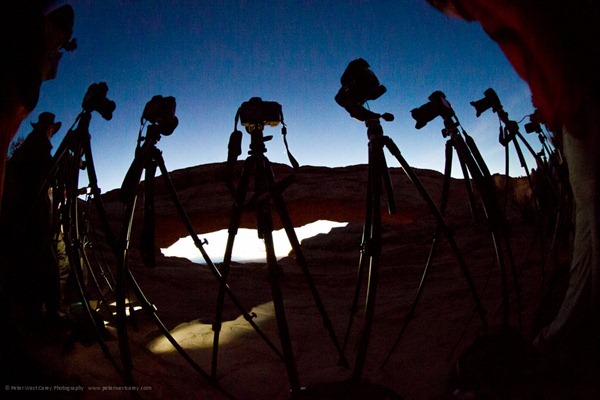
This is the reality behind the lens and something not often mentioned.
For this shoot, I was meeting up with fellow photographer Michael Riffle who has been to this location before. He said we needed to meet early….real early. “How early?” I asked. With a sunrise at 7:30, he guessed about 5:30am. That should get us to the park and in position around 6:30am.
Evidently that was not early enough.
We were bested by two workshop groups who had arrived even earlier. I took up a position to the far right while Michael managed to use his charm to gain front row access, but not as close as he had planned. In all, there were over 17 people shooting the arch that day, the crowd getting ruckus when one gentleman decided to walk on top and pose for his workshop group. This brought yells to get off and threats that his act was illegal (for reference sake, we asked a park ranger at the trailhead and were told it is not illegal to walk the arch. “It’s not a very smart thing to do, though.” Were his words).
The atmosphere is not what the illusion of the first image portrays, but that’s ok, because that’s photography. An illusion of what really was, malleable any way we, as artists, please.
Now, let’s contrast that experience with our shoot the next morning in neighboring Arches National Park. It was my idea to head to Delicate Arch for sunrise. This icon is so popular, it even adorns most license plates in Utah.
First, a shot of the classic arch.

You may notice this is not the normal shot people take. That shot is near sunset when the face is lit up. We decided to go early for a different view of the classic and it paid off as this is the crowd we faced:

No one. For an hour and a half we set up, tested, shot and waited. After an hour and a half, one person showed up for about 20 minutes and then left.
In my book, it doesn’t get any better than that. I’ve been to this location at sunset and so had Michael. We exchanged horror stories of tourists being tourists and exploring the arch, much to the consternation of the multiple photographers lined up (to the right in the image above) to get their copy of a classic. I didn’t want to spend half a day trying to edit out tourists (yes, I am one of them too) who, “got in my shot!”
This is a shot of such crowds by Matt Leher on Flickr.

The valley view just off the road in Yosemite Valley. Old Faithful. Mt. Rushmore.
The list goes on and on. Classic shots that leave behind the reality of a crowded scene to get a classic shot.
Crowds are not bad nor evil. I’m not saying you shouldn’t get those classic shots. They are beautiful and help people gain interest in our National Parks.
I want you to be aware; when you plan that ultimate shoot to capture a well worn icon for your own portfolio, realize you may have company.
On the other hand, we spoke with a local Utah photographer who visits Mesa Arch often and he pointed out winter is a great time to shoot and crowds are usually less. But he also said it can’t be predicted as he has been there in bad weather, expecting to have the place to himself, only to find a crowd. The flipside also being true.
Despite the crowds I have found at popular shooting locations, I have always enjoyed the experience. Sure, my expectations of a deserted vista were dashed, but once I dropped that expectation and the disappointment that came with it, my mood and shooting improved.
Good luck! And good shooting!
Post originally from: Digital Photography Tips.
Check out our more Photography Tips at Photography Tips for Beginners, Portrait Photography Tips and Wedding Photography Tips.
The Reality Of Shooting In National Parks

 |
“Ansel Adams In The National Parks Photographs of From America’s Wild Places” has just been released today (10.18.10) and I was quite fortunate to receive an early preview of the book. Unlike “Ansel Adams in Color” a book I just purchased, “Ansel Adams In The National Parks” only contains the iconic black and white prints that Adams’ is best known for. This latest release of Adam’s work is also a refreshing read in contrast to recent controversies swirling over a find of lost glass slides that have been purported to be Adams’.
“Ansel Adams In The National Parks” excels in that Andrea G. Stillman, the books’ editor, has pulled not just amazing photographs from the Adam’s archive, but also his writing & correspondence that breath life into an otherwise historical photo anthology. As one would expect viewing the artistic images and reproductions of his finely crafted prints is nothing less than inspirational. What separates this book from his others are the great anecdotes and quotes that bring Ansel Adams down from the pedestal so many of us keep him on to a mere human with family, everyday challenges and a variety of relationships spanning the average to celebrity. Especially fascinating was being able to read these anecdotes in relation to select images featured in the book adding an entirely new dimension to his photographs.
What I found most interesting as a landscape photographer was the inclusion of several image sets at the end of the book. These image sets reveal the seconds in relation to some of Ansel Adams most iconic photos. This provides a great opportunity to catch a glimpse of what Ansel Adams saw, photographed and selected as he reviewed his work.
Will every photograph in “Ansel Adams In The National Parks” be new or as high impact as Moon and Half Dome? No, but you will certainly see work that sheds light on a journey of life, art and creation. This book has made a great addition to my library and is one I’ll be viewing often.
A photograph is made, not taken. – Ansel Adams
Recommended blog reading: The Subtlety of Greatness and Today’s Loss of Appreciation
Technorati Tags: Photography, Fine Art, National Park, review, book, Ansel Adams
This book was provided gratis by the Hachette Book Group
.gif)
Copyright Jim M. Goldstein, All Rights Reserved
Review: Ansel Adams In The National Parks