RSS
 

Posts Tagged ‘Panasonic’

Panasonic announces Leica DG Nocticron 42.5mm F1.2 (again)

01 Aug

new_panasonic_nocticron_news.png

Alongside the enthusiast-oriented DMC-GX7, Panasonic has announced the Leica DG Nocticron 42.5mm F1.2 – the fastest autofocus lens ever created for the Micro Four Thirds system. If you’re getting a sense of deja vu that’s because Panasonic actually announced this lens already (sort of) at last year’s Photokina tradeshow in Cologne, Germany. But what was then a dummy lens behind glass now appears to be a real product, albeit one without any firm availability date or pricing information. 

News: Digital Photography Review (dpreview.com)

 
Comments Off on Panasonic announces Leica DG Nocticron 42.5mm F1.2 (again)

Posted in Uncategorized


Panasonic reveals Lumix DMC-GX7 enthusiast mirrorless camera

01 Aug

GX7s_front.png

Panasonic has announced the Lumix DMC-GX7 – the follow-up to the DMC-GX1 – which is its first mirrorless interchangeable lens camera to include in-body image stabilization. This 16MP, rangefinder-style camera also includes a high-resolution, widescreen EVF that can be tilted upwards 90 degrees. Panasonic claims that their newly designed Live MOS sensor improves both detail and color saturation by 10%. Other features of note include a tilting LCD, a ‘silent shooting’ mode, focus peaking, 1080/60p videos, and Wi-Fi with NFC capability. 

News: Digital Photography Review (dpreview.com)

 
Comments Off on Panasonic reveals Lumix DMC-GX7 enthusiast mirrorless camera

Posted in Uncategorized


Panasonic Lumix DMC-GX7 First Impressions Review

01 Aug

previewstory.jpg

Prior to its announcement today, we had the opportunity to use Panasonic’s new high-end Lumix DMC-GX7 mirrorless interchangeable lens camera. As well as a redesigned 16MP Live MOS sensor, the GX7 features a tilting camcorder-style EVF, a tiltable rear LCD screen and a silent mode designed to capture full-resolution still images without the mechanical shutter. Click through for our hands-on first impressions review. 

News: Digital Photography Review (dpreview.com)

 
Comments Off on Panasonic Lumix DMC-GX7 First Impressions Review

Posted in Uncategorized


Panasonic Lumix DMC-LF1 Review

18 Jul

Panasonic Lumix DMC-LF1 Review.jpg

Over the years I’ve owned a number of digicams just like this one and each has been damned useful. Pop in the pocket. Pull it out. Shoot. And enjoy.

However, in the last 2-3 years they have become really fearsome beasts with tech specs that ring with power.

Not only can these more recent arrivals shoot big, big stills but some have enormous zoom ranges and all can shoot Full HD video.

So who needs a DSLR or a MILC?

This little number from Panasonic is a good example of shooting power but with a certain finesse.
Panasonic Lumix DMC-LF1 BACK.jpg

Panasonic Lumix DMC-LF1 TOP.jpg

Panasonic Lumix DMC-LF1 Features

The lens in particular screams quality: an f2 Leica DC Vario-Summicron 7.1x zoom that equates to a 35 SLR optic of 28-200mm range. The only downer is that you cannot enjoy the full f2 all the way through the zoom range; it soon shrinks to f5.9. But it does mean you can enjoy limited focus effects at the f2 aperture.

Bokeh.JPG

This shot was made at full wide on the zoom and at f2. Notice the limited depth of field.

However, it would be easy to miss the standout feature of this diminutive picture maker: beside the large 7.6cm LCD screen at the camera’s rear, there is also an electronic screen tucked away on the camera’s left top corner (as viewed from the rear). This will win many hearts!

The LF1 offers Wi-Fi connectivity so that users can connect the camera to their smart phone or tablet with one touch to share an image. You can also use a smart phone or tablet as a remote shutter with a monitor.

The CMOS captures a maximum image size of 4000×3000 pixels, enough to make a 34x25cm print.

Video can be shot in either AVCHD or MEG4 formats at Full HD 1920×1080 pixel quality. You can shoot stills mid video recording at a reduced size. If you shoot in AVCHD the maximum recording time is 29 minutes and 59 seconds.
Menu.jpg

Scene modes.jpg

Creative Control.jpg

The control layout is very straightforward:

Top deck has the viewfinder mentioned earlier, with dioptric adjustment; then there’s the mode dial with positions for intelligent auto, PASM, two custom modes, panorama shooting, scene modes (16 in all) and creative control with 11 settings, including retro, old days, high and low key etc.

Pano 6.JPG

Panoramas can be shot laterally and vertically left to right, right to left, up or down and stitched in-camera. With the creative panorama function you can apply filter effects of retro, expressive, high or low key etc. The camera does not shoot horizontally panned panos with the camera held vertically, unlike some other cameras … notably Sony’s.

Next to the mode dial is the shutter button set within the lever for zooming; the power switch is at the extreme right end.

Rear: at the extreme left is the button to switch from rear screen to turret viewfinder; next is the WiFi button.

Beneath it is the video record button, shielded from accidental triggering by a protective slice of leatherette; adjacent is the Function and replay buttons.

Lower is the four way control dial with positions for macro shooting, exposure compensation, flash options and continuous/self timer. The menu button is central.

Lower still is a button for display options and one for trash.

Overall, a good layout but one that is badly let down by all the identifying text being too small, printed in off-white and almost impossible to read in dim light. Why not white text?
Composition Guide.jpg

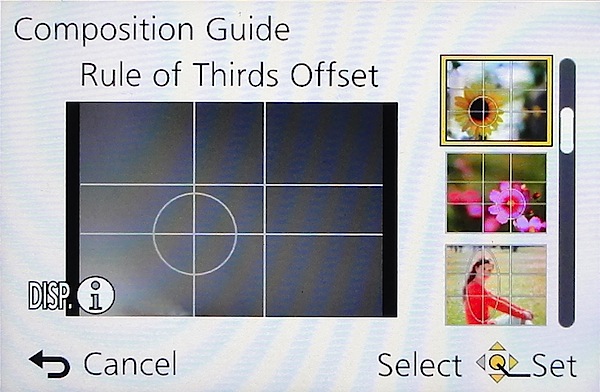
Tap the Function button and you gain access to a rather novel aid: a Composition Guide that makes it easy to shoot a photo with good composition, by choosing from a range of on screen examples: Rule of Thirds Offset, Diagonal Lines, Tunnel etc. A big help for those beset with poor visual acumen. It’s unlikely to prevent cut off heads or feet … but at least your shots will be visually balanced!

Distortion

No distortion evident at either the wide or tele ends of the zoom.

Start Up

In two seconds from startup you can shoot the first shot; follow-ons nearly as fast as you can hit the button.

Panasonic Lumix DMC-LF1 ISO Tests

Panasonic Lumix DMC-LF1 ISO 80.JPG

Panasonic Lumix DMC-LF1 ISO 400.JPG

Panasonic Lumix DMC-LF1 ISO 800.JPG

Panasonic Lumix DMC-LF1 ISO 1600.JPG

Panasonic Lumix DMC-LF1 ISO 3200.JPG

Panasonic Lumix DMC-LF1 ISO 6400.JPG

Panasonic Lumix DMC-LF1 ISO 12800.JPG

Only at ISO 3200 did noise become apparent. At ISO 6400 overall quality declined while noise increased and odd artefacts appeared. Useable? Maybe.

At ISO 12800 the shot was unusable.
Marina.JPG

(insert Marina)

Panasonic Lumix DMC-LF1 Review Verdict

Quality: average.
Why you’d buy it: small, sufficient zoom range for most purposes; shoot RAW files.
Why you wouldn’t: LCD screen is not vari-angle.

A great little number for easy, high quality photography. Available in silver or black.

Panasonic Lumix DMC-LF1 Specifications

Image Sensor: 12.1 million effective pixels.
Metering: Multi zone, centre-weighted, spot.
Lens: Leica DC Vario-Summicron f2.0-5.9/6.0-42.8mm (28-200mm as 35 SLR equivalent).
Exposure Modes: Auto, Program AE, shutter and aperture priority, manual.
Sensor Size: 15mm CMOS.
Shutter Speed (stills): 60 to 1/4000 second.
Continuous Shooting: 10 fps.
Memory: SD/SDHC/SDXC plus 87MB internal memory.
Image Sizes (pixels): Stills: 4000×3000 to 640×360.
Movies: 1920×1080, 1280×720, 1440×1080 and 640×480.
Viewfinder: 7.6cm LCD screen (920,000 pixels).
File Formats: JPEG, RAW, JPEG+RAW, MPO (3D), AVCHD, MPEG4.
Colour Space: sRGB, Adobe RGB.
ISO Sensitivity: Auto, 80 to 12800 (with boost).
Interface: USB 2.0, HDMI mini, WiFi.
Power: Rechargeable lithium ion battery, DC input.
Dimensions: 103x62x28 WHDmm.
Weight: 192 g (inc battery).
Price: Get a price on the Panasonic Lumix DMC-LF1 12 MP Digital Camera (White) or Panasonic Lumix DMC-LF (Black).

Post originally from: Digital Photography Tips.

Check out our more Photography Tips at Photography Tips for Beginners, Portrait Photography Tips and Wedding Photography Tips.

Panasonic Lumix DMC-LF1 Review


Digital Photography School

 
Comments Off on Panasonic Lumix DMC-LF1 Review

Posted in Photography


Panasonic launches Lumix DMC-XS3 slimline zoom compact

18 Jul

XS3_news.png

Panasonic has announced the Lumix DMC-XS3, a budget zoom compact camera that’s just 14mm thick. It sports an optically-stabilised wideangle 5x zoom lens (24-120mm equivalent), a 14.1MP 1/2.3″ High Sensitivity MOS sensor, and can record Full HD video in MP4 format. It includes a range of Creative Filters which can be applied either during or after shooting, and can also be used when shooting panoramas. The XS3 appears to be a Europe-only release, and will be available in September at a price of £119.

News: Digital Photography Review (dpreview.com)

 
Comments Off on Panasonic launches Lumix DMC-XS3 slimline zoom compact

Posted in Uncategorized


Panasonic announces Lumix DMC-FZ70 with 60x optical zoom

18 Jul

FZ70_front.png

Panasonic has announced the Lumix DMC-FZ70, a 16MP compact superzoom with a 60x optical zoom that more than doubles the zoom reach of its 24x FZ60 predecessor. Spanning the equivalent of 20-1200mm, the FZ70’s zoom lens has a maximum aperture range of F2.8-5.9 and is claimed to be both the longest and widest in its class. The FZ70 effectively replaces the FZ60, but the constant-F2.8 Lumix DMC-FZ200 remains in the lineup.

News: Digital Photography Review (dpreview.com)

 
Comments Off on Panasonic announces Lumix DMC-FZ70 with 60x optical zoom

Posted in Uncategorized


Just Posted: Panasonic Lumix DMC-TS5 Review

13 Jul

thisisart.jpg

We’ve just posted our review of the Panasonic Lumix DMX-TS5/FT5. In the latest of our series of reviews of this year’s crop of waterproof tough compacts we’ve put the TS5 through our usual studio and real-world tests to get a feel for how well it performs. On paper, the 16MP TS5 is one of the best specified cameras of its type, offering built-in GPS, Wi-Fi and NFC (near field communication) inside a tough body and Leica-branded lens. Does it live up to expectations? Read our review to find out.

News: Digital Photography Review (dpreview.com)

 
Comments Off on Just Posted: Panasonic Lumix DMC-TS5 Review

Posted in Uncategorized


Panasonic releases firmware updates for Lumix GH3 and G5

09 Jul

shared:download-button.png

Panasonic has released firmware updates for its Lumix DMC-GH3 and DMC-G5 mirrorless cameras. Version 1.2 for the GH3 adds a ‘Low light focus’ mode that works down to -3 EV, a ‘Silent Mode’, and an ‘Exposure Compensation Reset’ function. Meanwhile version 1.1 for the G5 only corrects wording of the Motion Picture menu on cameras sold in PAL broadcast regions, and therefore isn’t required by US owners. Click through for download links.

News: Digital Photography Review (dpreview.com)

 
Comments Off on Panasonic releases firmware updates for Lumix GH3 and G5

Posted in Uncategorized


Panasonic announces revised Lumix G 20mm F1.7 II ASPH lens

27 Jun

20-1p7-ii-black-520.png

Panasonic has announced the Lumix G 20mm F1.7 II ASPH, a revised version of its classic fast pancake lens for Micro Four Thirds. The H-HS020A, as Panasonic likes to call it, features a metallic exterior and slightly reduced weight, and will come in a choice of silver or black finishes. The optical design appears to be unchanged, with 7 elements in 5 groups including 2 aspheric elements; not a bad thing as its predecessor is one of our favourite lenses. The 20mm F1.7 II will be available from 29th July at an RRP of £349 (US pricing and availability has not been confirmed).

News: Digital Photography Review (dpreview.com)

 
Comments Off on Panasonic announces revised Lumix G 20mm F1.7 II ASPH lens

Posted in Uncategorized


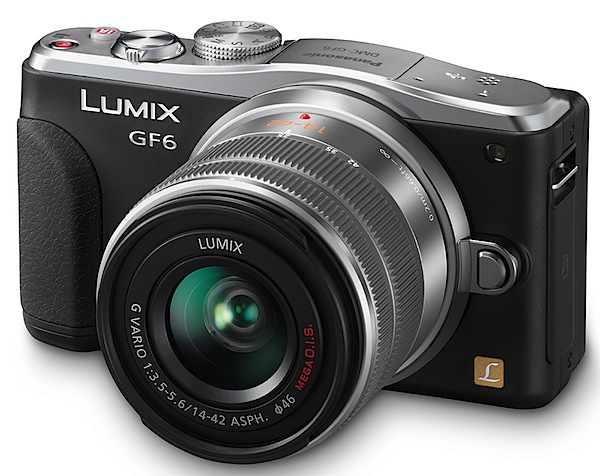
Panasonic Lumix DMC-GF6 Review

25 Jun

Panasonic Lumix DMC-GF6 Review.jpg

The advance of mirrorless interchangeable lens cameras is still a developing tale.

The GF6 is a good example of where we’re at, but don’t think for one moment that what the camera offers is indicative of what a MILC camera should offer.
Panasonic Lumix DMC-GF6 top.jpg

Panasonic Lumix DMC-GF6 back.jpg

Panasonic Lumix DMC-GF6 side.jpg

The beauty of this style of camera is that it’s small, with access to a range of lenses that are similarly compact in size. It can be used as a point-and-shoot, it’s pocketable (with lens removed) and equipped with a sufficient number of controls that most people will cotton on to.

One price you pay with the GF6 is that there is no turret viewfinder, a big help in bright ambient light, nor is there access to an optional finder. There is however, a vari-angle touch screen LCD that tilts vertically through an approximate 180 degrees arc.

The CMOS captures a maximum image size of 4592×3448 pixels, leading to a 39x29cm print.

Video can be shot in AVCHD or MPEG4 formats, up to Full HD 1920×1080 pixels resolution. And you can shoot stills during a video recording.

Panasonic Lumix DMC-GF6 Features

At first sight, the camera is attractive. A soft chrome top deck and the rest in black.

Controls

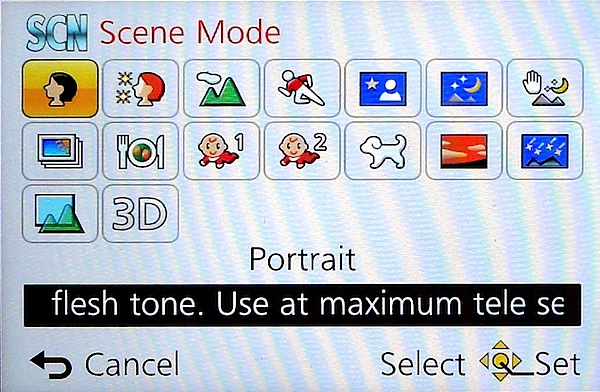
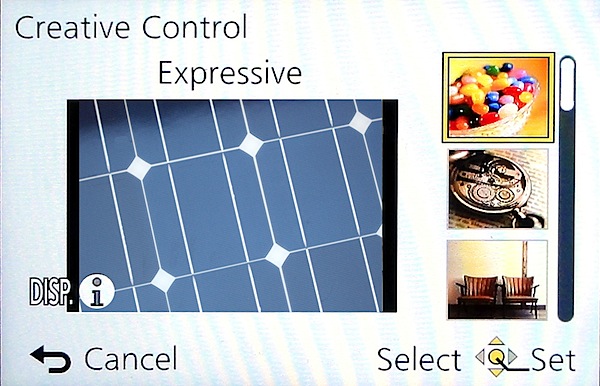
Top deck: at left is a button to activate the flash cell; just right of the latter is the mode dial holding positions for auto, PASM, ‘creative’ video; two custom settings; panorama shooting; scene modes (23 in all) and a creative control mode that takes you into a magic world of 19 shooting styles that include a retro look, high and low key effects, mono, cross processing etc.
Scene modes.jpg

Creative control.jpg

If you get the feeling, from the scene modes and creative control effects in the GF6, that this is a dabbler’s camera … you’d be right! The more expert may scoff at this situation but, if it helps photographers to get more out of their camera, I’m all for it.

Moving further to the right you see the shutter button, on/off button, direct access to the intelligent auto mode and the video record button.

One annoyance: the video record button is only mills away from the iAuto button … too easy to hit the latter when you really wanted to activate the former. Far better to have placed the video button on an edge as most other camera do.

The camera’s rear is fairly simple in layout: replay; screen display options; four way control dial offering exposure variation, AF modes, white balance options, single/continuous shooting and self timer. Central is the menu/set button.

Beneath the control dial is a quick access menu button and a Function button.
My main gripe with this arrangement is that the control dial has four positions (AWB, etc) but each of these is identified by tiny white text on a silver background. Impossible to see!
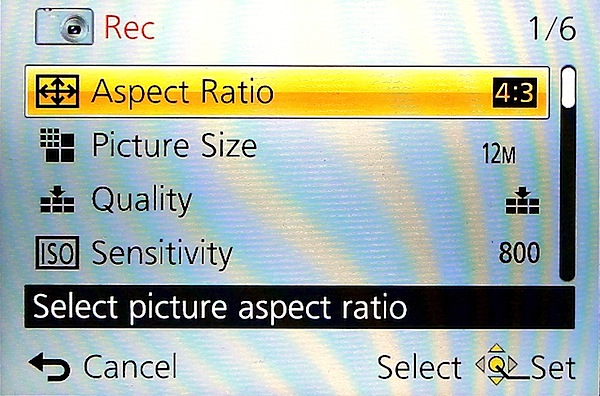
Menu 1.jpg

The menus are clearly laid out.

But there are some novel aspects to this camera that are unique: one is the stop motion feature. You can set the camera to shoot images at predetermined intervals or fire them off manually.
Buddha.JPG

Pots 1.JPG

Cinema 2.JPG

There is easy wireless connectivity via Wi-Fi with compliant smart phones and tablets that lets you monitor the camera’s view from a smartphone and set zoom, focus, shutter release, shutter speed, aperture and exposure compensation.

With High Dynamic Range, the camera merges three shots with differing exposure levels into a single picture; this will help with subjects of an extreme bright to dark brightness range.

The Instant Transfer feature allows data to be transferred automatically to the device whenever the shutter is fired. You can also do this via the touch screen.

ISO Tests

Panasonic Lumix DMC-GF6 ISO 160.JPG

Panasonic Lumix DMC-GF6 ISO 400.JPG

Panasonic Lumix DMC-GF6 ISO 800.JPG

Panasonic Lumix DMC-GF6 ISO 1600.JPG

Panasonic Lumix DMC-GF6 ISO 3200.JPG

Panasonic Lumix DMC-GF6 ISO 6400.JPG

Panasonic Lumix DMC-GF6 ISO 12800.JPG

Only at ISO 6400 did noise begin to intrude. At ISO 25600 the noise was much higher but resolution held up surprisingly well.

Panasonic Lumix DMC-GF6 Review Verdict

Quality: above average with precise colour rendering and fine resolution.

Why buy the Panasonic Lumix DMC-GF6: budget level entrée into the world of interchangeable lens photography.

Why not by the Panasonic Lumix DMC-GF6: no viewfinder.

In other respects I found the camera to be quite spiffy and easy to use. If you’re keen to dip your toe into interchangeable lens photography, want to post process RAW files, shoot decent video etc … this one’s for you!

The beauty of the GF6 is that you can get around the various modes with great ease. Not too challenging.

Panasonic Lumix DMC-GF6 Specifications

Image Sensor: 16 million effective pixels.
Metering: Multiple, centre-weighted and spot.
Effective Sensor Size: Four thirds 17.3×13.0mm CMOS.
Lens Factor: 2x.
Compatible lenses: Micro Four Thirds.
Exposure Modes: Auto, Program AE, shutter and aperture priority, manual.
Shutter Speed: 60 to 1/4000 second; flash sync 1/160 sec.
Burst Speed: 4.2 fps.
Memory: SD/SDHC/SDXC cards.
Image Sizes (pixels): 4592×3448 to 1712×1712. Movies: 1920×1080, 1280x720p, 640×480.
Viewfinder: 7.6cm LCD screen (1,040,000 pixels).
File Formats: JPEG, RAW, JPEG+RAW, AVCHD/MPEG4, MPO (3D).
Colour Space: Adobe RGB, sRGB.
ISO Sensitivity: Auto, 160 to 12800 (25,600 with boost).
Interface: USB 2.0, AV, HDMI mini, WiFi, DC input.
Power: Rechargeable lithium ion battery, AC adaptor.
Dimensions: 111x65x38 WHDmm.
Weight: Approx. 323 (inc battery).
Price: Get a price on the Panasonic DMC-GF6 16MP Mirrorless Compact System Camera with Lens Kit at Amazon.

Post originally from: Digital Photography Tips.

Check out our more Photography Tips at Photography Tips for Beginners, Portrait Photography Tips and Wedding Photography Tips.

Panasonic Lumix DMC-GF6 Review


Digital Photography School

 
Comments Off on Panasonic Lumix DMC-GF6 Review

Posted in Photography