RSS
 

Posts Tagged ‘made’

Sibling Spaces: Modular Rooms Made for Brother & Sister

09 Jul

[ By WebUrbanist in Design & Fixtures & Interiors. ]

modular kids room moscow

For getting things done: a static, serious and refined work space is shared by the siblings. For everything else: there is a playful flexibility to be found in movable modules, hanging hammocks, cozy nooks and hidden ladders.

modular room upstairs hammock

Designed by Ruetemple for a family in Moscow, Russia, this children-centric interior balances the need for serious engagement with studies and self-determination outside of school-related activity (plus perhaps lessons in sharing and diplomacy all around).

modular multi level rooms

On the main level, across from the work zone with its ergonomic chairs and built-in shelves, is a three-piece system of modular parts – set apart visually via the use of darker wood.

modular bedroom layout box

The constituent elements can be spun and situated on demand, turned into a hangout space, living room or bedroom (or whatever else the kids can come up with, for that matter).

modular brother sister interior

Upstairs under a slanted roof are nooks for sleeping, reading and storage that can be made into more private bedrooms, again allowing freedom for self-determination in terms of sleeping arrangements.

modular childrens room office

The hammock is naturally a permeable mesh, and allows light to pass from one level to the next while also making use of what would otherwise be lost potential floor space.

Share on Facebook


[ By WebUrbanist in Design & Fixtures & Interiors. ]

[ WebUrbanist | Archives | Galleries | Privacy | TOS ]


WebUrbanist

 
Comments Off on Sibling Spaces: Modular Rooms Made for Brother & Sister

Posted in Creativity


LEGO House: Experience Center Made of Interlocking Blocks

27 Jun

[ By WebUrbanist in Architecture & Offices & Commercial. ]

lego block building rendering

Fans wanting to fully experience the world of LEGO are sure to marvel at this newly-revealed hometown headquarters – the whole complex is being build up like a giant stack of interlocked bricks.

lego big hometown headquarters

Designed by BIG (Bjarke Ingels Group) and set to be built in Billund, Denmark, the structure will have displays, cafes and shops surrounded by a public square.

lego building aerial model

Between interior and exterior areas, the completed project will have close to 10,000 square meters of programmed and open space, and its creators anticipate 250,000 annual visitors.

lego experience center interior

lego building at night

The building will showcase past, present and near-future LEGO designs, but also artwork made from LEGOs and other cultural phenomena beyond its original uses.

Share on Facebook


[ By WebUrbanist in Architecture & Offices & Commercial. ]

[ WebUrbanist | Archives | Galleries | Privacy | TOS ]


WebUrbanist

 
Comments Off on LEGO House: Experience Center Made of Interlocking Blocks

Posted in Creativity


Type Face: Monumental Figurative Sculptures Made of Text

25 Jun

[ By Steph in Art & Sculpture & Craft. ]

Jaume Plensa Typeface Sculptures 1

Giant human figures made of jumbled steel letters loom over public spaces in a series of monumental typographic sculptures by artist Jaume Plensa. The contemplative seated figures seem to watch over the landscapes and city squares where they have been installed around the world, from London to Rio de Janeiro.

Jaume Plensa Typeface Sculptures 3

(images via: chris huggins, jaume plensa)

Jaume Plensa Typographic Sculpture 2

(images via: terry madeley)

The text seems to wrap around invisible human forms, looking at times as if it is incomplete. Plensa’s work is not just thought-provoking, it is about thought itself and how words can shape our world and the way we interact with it.

Jaume Plensa Typeface Sculptures 4

(images via: terry madeley, jw sherman, anders sandberg)

Plensa has borrowed paragraphs from biblical texts, classic literature like Dante’s Divine Comedy, and poetry by William Blake. Stand beneath or inside one of these massive sculptures and you likely won’t be able to read much of the text – but that’s not the point.

Jaume Plensa Typeface Sculptures 5

Jaume Plensa Typeface Sculptures 6

(images via: tim green, lorraine 1 + 2, liza31337)

Conceptual dualities, like the play between negative and positive space, are intended to stimulate intellectual engagement, connecting the sculptures with the viewers on an intuitive level. The pieces often include ‘doorways’ so viewers can interact with the work, temporarily becoming a part of it.

Share on Facebook


[ By Steph in Art & Sculpture & Craft. ]

[ WebUrbanist | Archives | Galleries | Privacy | TOS ]


WebUrbanist

 
Comments Off on Type Face: Monumental Figurative Sculptures Made of Text

Posted in Creativity


Living Architecture: Evolving Pavilion Made by Silk Worms

06 Jun

[ By Steph in Art & Sculpture & Craft. ]

Silk Worm Pavilion 1

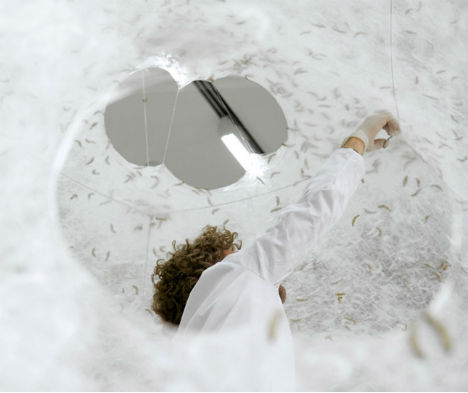
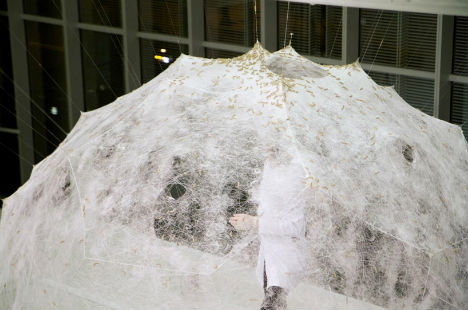
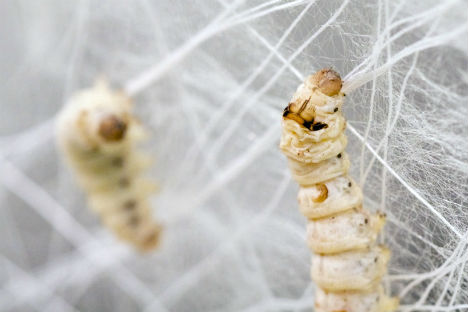
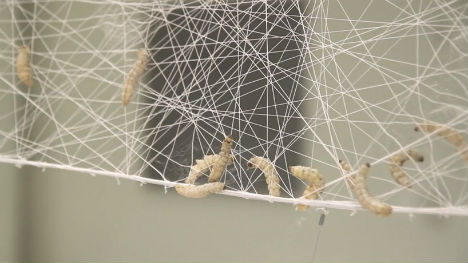
Growing and transforming like a living organism, the Silk Pavilion created by the MIT Media Lab is a collaboration between digital and biological fabrication. The basis of the pavilion is a network of silk threads made by a CNC machine, which has become a cloud-like structure with the addition of natural netting from the dozens of silk worms that squirm all over its surfaces.

Silk Worm Pavilion 2

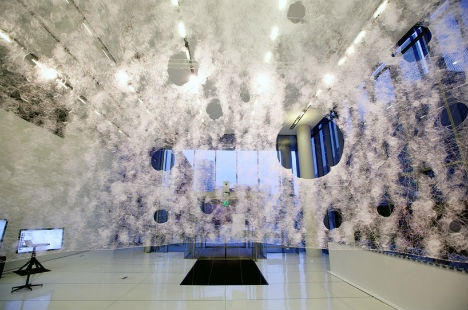
Twenty-six polygonal panels with silk thread stretched between them form a sort of scaffolding that enables the silk worms to work their magic of naturally produced architecture. The geometry of the base structure was created using an algorithm that routes a single continuous thread across the open sections to provide varying degrees of density.

Silk Worm Pavilion 3

The silkworms were deployed as a biological ‘printer’ to create the secondary structure. If the sculpture, which is installed at MIT, were allowed to remain in place indefinitely, the moths could produce 1.5 million eggs with the potential of constructing up to 250 additional pavilions.

Silk Worm Pavilion 4

“Affected by spatial and environmental conditions including geometrical density as well as variation in natural light and heat, the silkworms were found to migrate to darker and denser areas. Desired light effects informed variations in material organization across the surface area of the structure. A season-specific sun path diagram mapping solar trajectories in space dictated the location, size and density of apertures within the structure in order to lock-in rays of natural light entering the pavilion from South and East elevations.”

Silk Worm Pavilion 5

“The central oculus is located against the East elevation and may be used as a sun-clock. Parallel basic research explored the use of silkworms as entities that can “compute” material organization based on external performance criteria. Specifically, we explored the formation of non-woven fiber structures generated by the silkworms as a computational schema for determining shape and material optimization of fiber-based surface structures.”

via design boom

Share on Facebook


[ By Steph in Art & Sculpture & Craft. ]

[ WebUrbanist | Archives | Galleries | Privacy | TOS ]


WebUrbanist

 
Comments Off on Living Architecture: Evolving Pavilion Made by Silk Worms

Posted in Creativity


Thinker Thing: 3D-Printed Object Made Using Brain Waves

31 May

[ By Steph in Gadgets & Geekery & Technology. ]

3D Printed with the Brain 1

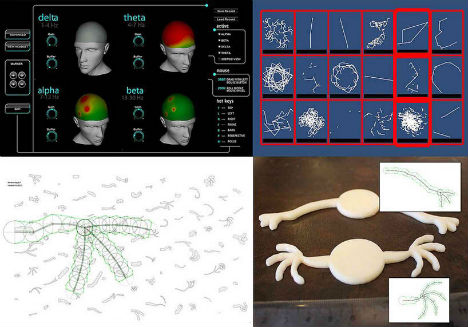
Small electrical impulses detected by a brain-computer headset produce strange and amazing 3D printed objects in a new project by George Laskowsky of Thinker Thing.  The Emotiv EPOC headset analyzes brain patterns and uses it to understand the wearer’s emotional response to certain features in visual stimuli; in this way, the wearer is able to ‘grow’ a three-dimensional model with their mind.

Laskowsky successfully created the first real physical object made with brain patterns in May, and set out to fund the project on IndieGoGo. Thinker Thing will take the invention to Chile, where children will use the technology to create fantastical creatures, which will be exhibited in a gallery.

3D Printed with the Brain 2

How is it possible to create an object with the mind? “We use your brain patterns to evolve a 3D model from a genetic seed, which can then be made real with a standard 3D printer. The DNA seed defines the start point of an evolutionary chain for the object. Dinosaurs are very diverse, for example, but they can be traced back to a single common dna ancestor. We create this first DNA definition as the first building block from which all future objects evolve.The DNA of the object is then mutated over each generation, and how well that new mutations does, whether it lives or dies, is determined by the mind.”

3D Printed with the Brain 4

“We are all born creative, our brain begins like an open field and can make connections in many directions, it is only later we become stuck in the ruts and troughs of the paths that our mind constantly treads, paths so deep we are sometimes unable to see that there is still an open field around us. Mistaking skill (a learned ability) with creative imagination is like believing walking in a deeper rut gives you greater freedom of movement across the field.”

3D Printed with the Brain 3

Learn more at IndieGoGo.

Share on Facebook


[ By Steph in Gadgets & Geekery & Technology. ]

[ WebUrbanist | Archives | Galleries | Privacy | TOS ]


WebUrbanist

 
Comments Off on Thinker Thing: 3D-Printed Object Made Using Brain Waves

Posted in Creativity


Creepy Portraits Made Using DNA from Gum & Smokes

09 May

[ By Steph in Conceptual & Futuristic & Technology. ]

DNA Portraits 1

The chewed gum, fingernail clippings and cigarette butts you leave behind in public places could say a lot more about you than you’d like to imagine. Artist Heather Dewey-Hagborg makes this abundantly clear with her series, ‘Stranger Visions’, which reproduces people’s faces using DNA extracted from such forensic evidence collected in New York City and Brooklyn.

DNA Portraits 2

Dewey-Hagborg is a PhD student studying electronic arts at Rensselaer Polytechnic Institute in Troy, New York. After extracting the DNA from her samples, she focuses on specific genomic regions, sequences them and then enters the data into a computer program, which produces a model of the face of the person who tossed that item onto the ground.

DNA Portraits 3

From those models, Dewey-Hagborg produces sculptures of the faces using a 3D printer. These life-sized portraits, which look similar to death masks, hang on gallery walls, often beside wooden boxes holding the original samples and showing photographs of where they were found.

DNA Portraits 4

The artist learned about DNA extraction from a course in molecular biology at Genspace, a do-it-yourself biology lab in Brooklyn where she does some of her work. She uses standard DNA extraction kits ordered online to analyze the DNA. The results are shockingly detailed; a mask of her own face made using the same technique shows just how accurate the results can be. However, there’s no way to tell age from DNA, so the computer produces a 25-year-old version of the person. Learn more about the process at Smithsonian.

Share on Facebook


[ By Steph in Conceptual & Futuristic & Technology. ]

[ WebUrbanist | Archives | Galleries | Privacy | TOS ]


WebUrbanist

 
Comments Off on Creepy Portraits Made Using DNA from Gum & Smokes

Posted in Creativity


Exotic Green Getaway: Lush Villa Made of Local Materials

05 Apr

[ By Steph in Boutique & Art Hotels & Global. ]

Alila Villas Eco Travel 1

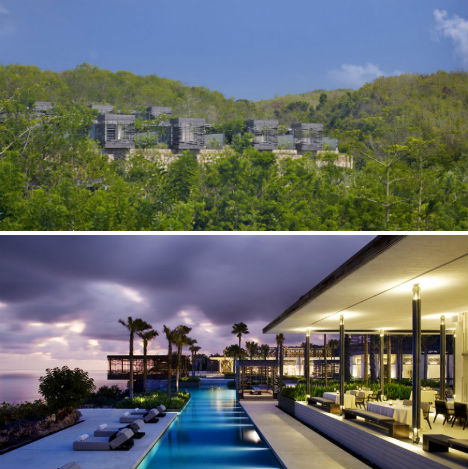
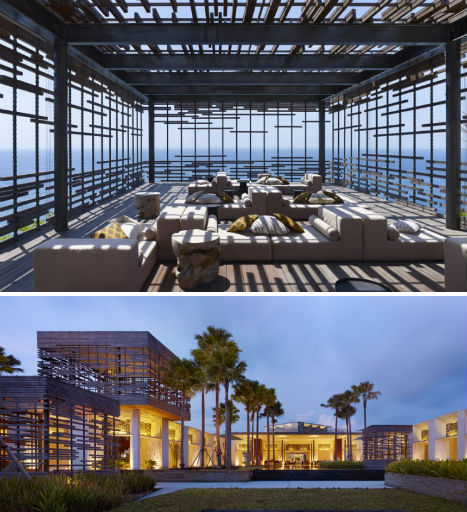
Merging traditional Balinese visual flair with the openness of modern architecture, Alila Villas Uluwatu is a picturesque resort with individual villas connected by bridges over sparkling expanses of water. The hotel is set on a gently sloping hillside, and eschews typical high, pointed Bali-style roofs in order to maintain a democratic view of the sea. Made of locally sourced materials, the hotel and villa development aims to balance environmental responsibility with a sense of luxury.

Alila Villas Eco Travel 5

Alila Villas Eco Travel 2

Located in Uluwatu on the Bukit Peninsula of Bali, Alila Villas has 50 hotel suites and 35 residential villas.  Rather than standing out in stark relief against the natural setting, like many other self-consciously tropical resorts in the area, Alila Villas follows the natural contours of the land.  The terraced, low-pitched roof of the main structure was made of Balinese volcanic pumice rock that can support the growth of ferns and other vegetation, mimicking the look of local hillside farms.

Alila Villas Eco Travel 4

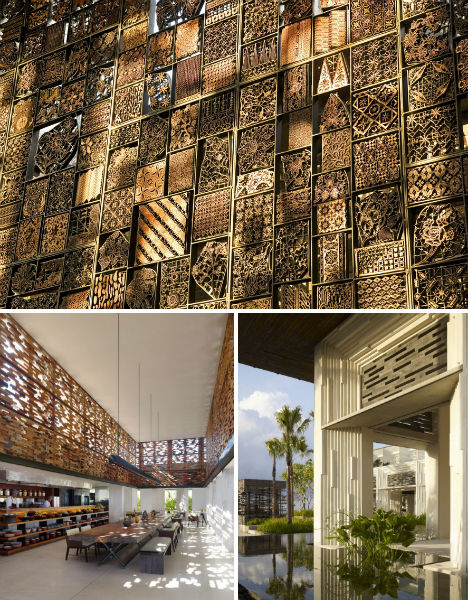
Each of the hotel rooms faces the gardens, which are full of reflecting pools and native plants, making them feel as if they extend into the outdoor spaces. The villas are glass structures encased in slatted wood, which screens the sun and provides a bit of privacy. Each has its own pool with a cabana overlooking the ocean.

Alila Villas Eco Travel 3

The stone walls of the resort came directly from the site itself, and all other materials were sourced from either Bali or the neighboring island of Java. Sustainable materials, careful preservation of vegetation, rainwater collection, a greywater recycling system and large roof overhangs that provide natural cooling come together for an eco-friendly getaway that honors the local culture and history.

Share on Facebook


[ By Steph in Boutique & Art Hotels & Global. ]

[ WebUrbanist | Archives | Galleries | Privacy | TOS ]


WebUrbanist

 
Comments Off on Exotic Green Getaway: Lush Villa Made of Local Materials

Posted in Creativity


DEAL: Phil Steele’s ‘Lightroom Made Easy’ Course at 33% Off

15 Mar

NewImageThe new deal over on SnapnDeals this week is one I know many dPS readers are going to enjoy – it’s 30% off Phil Steele’s Lightroom Made Easy Course – that’s just $ 33 (normally $ 47).

Phil’s videos have made regular appearances here on dPS and are always really popular and this course contains 24 videos with hours of great instruction on using Lightroom (it covers both Lightroom 3 and Lightroom 4).

If you’re new to Lightroom or feel overwhelmed by it – this course is for you!

Here’s what you’ll learn in the course:

Create Stunning Images

Make your photos “pop” like the shots you see in magazines.

Get More Done in less time

Dramatically increase your photography output—zipping through photo processing tasks in minutes that used to take hours or days.

Protect Your Copyrights

Automatically embed hidden data in your photos to protect your images from theft or misuse—and to guarantee you get paid.

Never Lose Another Photo

Get your photos organized—whether you have one hundred or 100,000—so that you’ll never lose another image again.

Retouch Portraits Like a Pro

Quickly and subtly retouch portraits to remove imperfections, enhance beauty, and keep clients coming back.

Create Instant Web Galleries

Display your photos for clients or the public in impressive, customized galleries on your own web site—with just a few clicks.

Remove Flaws and Defects

Remove unwanted objects, blemishes, or unsightly sensor dust from photos.

Share Photos Easily

Instantly upload your edited photos to social sharing sites like Flickr, Facebook, Picasa, and more.

Attract Search Engines

Tag your photos with keywords to lure Internet search engines and boost your sales.

Make Beautiful Slideshows

Quickly create stunning slideshows, with music, for friends, clients, or presentations.

Find the Right Photo When You Need It

Use ratings, labels, categories, keywords, and names to make it easy to always find your best shots, or those most suited to a particular job or client.

Do It All From One Easy Place

Easily handle your entire photography workflow all from one place, quickly and efficiently. Use my secret ninja tricks and techniques to boost your productivity even more!

This course is normally $ 47.00 USD but for the next 12 days Phil is offering it for just $ 33 along with a couple of great bonus videos.

Get full details and pick up your copy here.

Post originally from: Digital Photography Tips.

Check out our more Photography Tips at Photography Tips for Beginners, Portrait Photography Tips and Wedding Photography Tips.

DEAL: Phil Steele’s ‘Lightroom Made Easy’ Course at 33% Off


Digital Photography School

 
Comments Off on DEAL: Phil Steele’s ‘Lightroom Made Easy’ Course at 33% Off

Posted in Photography


Quick Tip: Importing to Lightroom Made Easier

07 Mar

Introduction

This tutorial is from the Lightroom 4 Workshop Collection. Including 27 hours of A to Z Lightroom 4 education and the industry standard Lightroom 4 Preset System. DPS users can get 10% off by using the DPS10 coupon code upon checkout. Click the link above to learn more/purchase.

Overview

In this tutorial, we will give you a quick tip when importing image into Lightroom that will eliminate the need to search around for import and destination folders.

Step 1. Create Your Catalog

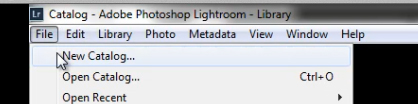
If you don’t already have a Lightroom catalog created, then let’s go ahead and create one now. Simply open Lightroom and go to File -> New Catalog.
file-new-catalog

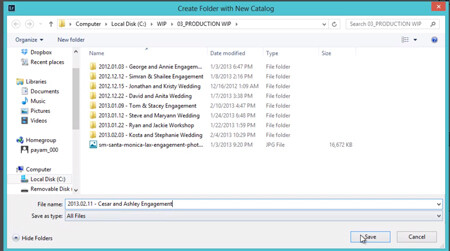
Give your Catalog a descriptive name and a destination folder of your choice. Remember to keep your naming conventions consistent to have an efficient and organized workflow. Our naming convention is as follows:

YEAR.MONTH.DAY – NAMES PHOTOGRAPHY TYPE

So, for this example we have the following:

2013.02.11 – Cesar and Ashley Engagement which is typed into the File name location shown in the image below.
name-catalog

After you hit “Save”, Lightroom will close and re-open with the New Catalog which is ready for images to be imported.

Step 2. Creating the “Folders”

We will be directly importing the images into a folder on the left-side Panels called “Folders.” But, first we have to create a folder for the images to be imported into. On the Folders Panel, simply click the “+” icon to create a new folder as shown below.
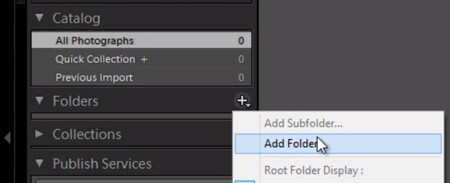
add-folder

Now, select the same folder where we saved our catalog to create the folder where we want to place the original images. We do this to ensure that the images always move with the catalog if the catalog is ever transferred.
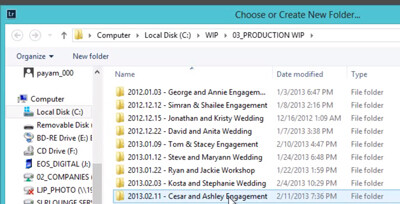
select-folder-engagement

To create new Folder for your original images, right-click within the Folder content area and select “New Folder”. Remember, we are doing this all from the “Add Folder” dialogue in Lightroom, not in the Operating System.
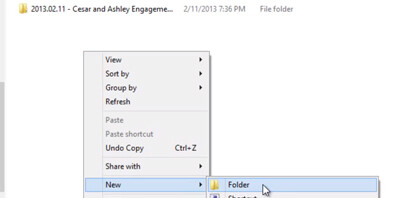
new-folder-engagement

Type in “00_Originals” or the name of your choice for the Folder to contain your original images. Again, keep your naming conventions consistent for better organization. Then click “Select Folder”.
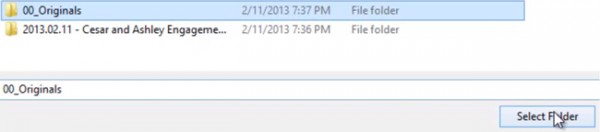
create-00-originals

Step 3. Importing Directly to Folders

Now that we have our folder created. We have two options to import. Option number 1 is to Right-click on the Folder that shows up under the Folders Panel and select “Import to this Folder” as shown below.
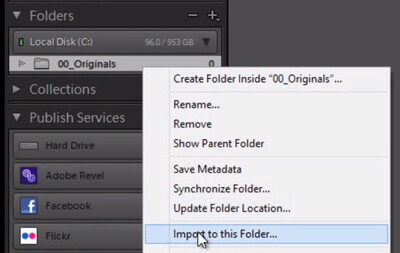
right-click-import

This will pull up our Import Dialogue and automatically set the destination to the “00_Originals” Folder without having to manually select our destination as we normally would.

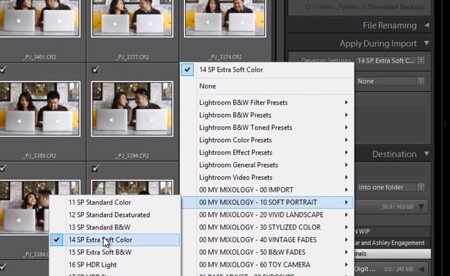
Workflow Tip: Apply a Workflow Preset on Import

Before you begin the Import process, we always select an import preset that is most applicable to the type of images being imported. In our studio, we generally use the “Extra Soft Color” Preset for portrait sessions from the Lightroom 4 Preset System by SLR Lounge as shown below.
import-with-preset

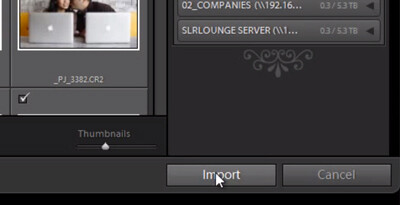
When you are finished, select “Import” located on the bottom-right in Lightroom.
FINAL-select-import

And that’s it! Hopefully this little quick tip on importing will help you to import images just a bit more efficiently.

Learn More with the Lightroom 4 Workshop Collection!

This was a sample tutorial from the Lightroom 4 Workshop Collection. A collection of nearly 30 hours of video education teaching everything from Lightroom basics to advanced raw processing techniques.

The LR4 Workshop Collection also includes the critically acclaimed Lightroom 4 Preset System which is designed to enable users to achieve virtually any look and effect within 3-5 simple clicks. From basic color correction, vintage fades, black & white effects, tilt-shift effects, faux HDR, retouching, detail enhancing, and so much more. Click the links above to learn more.

Post originally from: Digital Photography Tips.

Check out our more Photography Tips at Photography Tips for Beginners, Portrait Photography Tips and Wedding Photography Tips.

Quick Tip: Importing to Lightroom Made Easier


Digital Photography School

 
Comments Off on Quick Tip: Importing to Lightroom Made Easier

Posted in Photography


Invisible Apparel: Material-Free Dresses Made of Light

04 Feb

[ By WebUrbanist in Art & Photography & Video. ]

light art dress

Combining light art photography and high fashion, these show-stopping, runway-worthy gowns are invisible until completed, and manufactured without physical material.

light art dresses photography

Atton Conrad sets the models in pitch-black rooms, then writes with lights around them, resulting in a flowing and ephemeral slow-captured creation that is only visible after each shot is finished.

light art designer apparel

Conrad has worked extensively in both of the fields found intersecting here, as a veteran photographer and light artist alike. “London born, Belfast bred and originally set for a career in science, the inherited genes from an artist father & actress mother prevailed. He made for the bright lights of his birth city to persue his love of photography.” He was, as it were, drawn to the light – limelight, spotlight, and lighting itself.

light art runway models

light art costume design

Of his work, he says that “it started with light trails, but grew far beyond that, as i developed my methodology and custom designed ‘light brushes’ I realised that the techniques could give me incredibly fine control over light and texture, to an unique almost hyperreal result. I have always been known for my classic lighting, and still take great pleasure in it, but this took it a completely fresh direction.”

Share on Facebook


[ By WebUrbanist in Art & Photography & Video. ]

[ WebUrbanist | Archives | Galleries | Privacy | TOS ]


WebUrbanist

 
Comments Off on Invisible Apparel: Material-Free Dresses Made of Light

Posted in Creativity