RSS
 

Posts Tagged ‘Lenses’

Phase One introduces second XF feature update and pair of Schneider Kreuznach lenses

17 Mar

The Phase One XF camera system received a significant update today, with improvements to its autofocus system and user interface along with additional shooting tools such as focus stacking and HDR. Two new ‘Blue Ring’ lenses have also been added, along with an update to the company’s Capture One software.

The update provides Phase One’s medium-format XF system with tools to help automate focus stacking and time-lapse capture, as well as a self timer and automated HDR bracketing. The system’s HoneyBee Autofocus Platform also gets an update, claiming increased accuracy in low light, better acquisition in low contrast scenes and ‘improved hand held success.’

In terms of hardware, the Schneider Kreuznach 110mm LS F2.8 and 240mm LS F4.5 join the system, manufactured ‘to Phase One’s highest standards’ with metal lens hoods and milled aluminum AF/MF selector rings.

Capture One Pro 9.1 gets an update geared mostly toward fashion and still life work, with new workflow and image editing tools, including tools to correct uneven skin tone.

The XF system firmware update is free and available now from Phase One. The Schneider Kreuznach 110mm LS F2.8 will cost $ 5390/£4490; the 240mm LS F4.5 will cost $ 6490/£5690.


Press release:

Phase One Releases XF Camera System Feature Update #2 

Adding New XF Tools, Lenses & Software

COPENHAGEN, March. 17, 2016 – Phase One, the world’s leading medium format camera system provider, today released a major XF Camera System update.  With new tools, hardware, and software solutions Phase One continues to help top photographers create incredible images. The Ultimate Camera System continues to improve.

Feature Update #2 includes the addition of two new ‘Blue Ring’ lenses, along with the release of Capture One Pro 9.1, an update to the software used by 8 out 10 of the world’s best photographers (see today’s related software announcement).

The Phase One XF Camera System stands out against all other camera systems in terms of its performance and philosophy. The XF Camera System offers unprecedented long-term value thanks to its emphasis on modular firmware implementation and integrated, modular hardware designs, all of which permit continual feature enhancements. 

Phase One’s XF Camera System Update #2 introduces: 

Integrated Sequence photography: 

— Focus Stack Tool provides automated camera focus control throughout a sequence of captured images; ?

— Time-lapse Tool offers automated capture sequence at user set intervals;

— HDR Sequence Tool enables an automated bracketing sequence with unique metadata tags for Capture One integration; 

— Self Timer Delay provides a quick and easy, fully customizable timer option from one half to sixty seconds. ?

Additional updates to the XF Camera System: 

— HoneyBee Autofocus Platform update: Improvements have been made to increase accuracy in low light conditions, improve focus in various low contrast scenarios, and to provide improved hand held success;

— New OneTouch UI: Improved design and integration for intuitive, seamless operation on or off the XF Camera System;

Phase One Adds Two new members to its “Blue Ring” Lens family: ?

— New Schneider Kreuznach 110mm LS f/2.8; a technical masterpiece and an artistic vision. The 110mm offers a ‘normal’ focal length view in stunning technical precision.

— New Schneider Kreuznach 240mm LS f/4.5; the essential Telephoto lens. The 240mm is a must for any lens lineup, offering the definitive telephoto look for any shot.

The new lenses feature a metal focusing ring and AF/MF selector ring of precision milled aluminum, as well as a metal lens hood with anti-skid rubber edging. The lenses are manufactured to Phase One’s highest standards, including improved quality assurance measures and tighter tolerances for better, more reliable lens performance. 

For all the details, please go to: www.phaseone.com/XF-Platform-Update or book a demo on: www.phaseone.com/demo 

Phase One Releases Capture One 9.1 with improved XF camera system integration ?   

Capture One 9 continues to grow alongside the XF Camera System.  The new tools available within the XF are well integrated to Capture One 9.1, providing excellent workflow advantages with proprietary image sequence tags.  For all the details, please see today’s related press release, “Phase One Releases Capture One Pro 9.1 for Photographers”

Availability and Pricing 

Firmware for the XF Camera System Feature Update #2 is free and available for download here: http://www.phaseone.com/Download/Camera-Firmware

New Schneider Kreuznach leaf shutter lenses are available through Phase One photography partners worldwide: www.phaseone.com/partners?

Prices for Schneider Kreuznach 110mm LS f/2.8 — 4.490 EUR / 5.390 USD Prices for Schneider Kreuznach 240mm LS f/4.5 IF – 5.690 EUR / 6.490 USD 

Optimized for use with the XF Camera System, Capture One is free when used with Phase One hardware. Capture One 9.1. is free for all current owners of Capture One 9. Owners of Capture One 7 and 8 can upgrade to Capture One 9.1 for 99 USD / 99 EUR.

Phase One Releases Capture One Pro 9.1

Boosting Workflow Performance for Pro Photographers

COPENHAGEN, March 17, 2016 — Phase One, the world’s leading medium format camera system and professional imaging software provider today released Capture One Pro 9.1. Focus for this release has been the fashion and still life photographer segment, with special attention to the demands of fast-paced work environments.  

Known by professionals for its excellent tethering abilities, color management, and intuitive, user-definable, interface, Capture One Pro is used by photographers that demand exceptional image quality.

Capture One Pro 9.1 builds on the design objectives for greater quality, power and precision introduced last year with version 9.0 — adding workflow accelerators and providing a superior integrated workflow. 

Capture One Pro 9.1 is free to existing 9 users. To see the Capture One Pro 9.1 feature set in action, visit: www.phaseone.com/nineone

Capture One Pro 9.1 highlights include:

New Workflow Tools

— ‘Copy from last’ has been re-designed for rotation, allowing for easier workflow when doing overhead shots; 

— ‘Copy from last’ has been re-designed to allow the inclusion of metadata, making shot-to-shot application of copyright and other metadata easier and more intuitive; 

— Rotatable Live View — live view can be orientated for still life work with next captures mirroring the live view orientation; 

— Improved Shortcuts — a number of extra shortcuts are added to aid the professional workflow – reset counters, layer controls, and “select by…” are added to help in all areas of the workflow. 

New Image Editing Tools

— New Skin Tone Uniformity Tool for saturation and lightness;

— New Color Editor Tools — the Color Editor Skin Tone Tool adds uniformity sliders for saturation and lightness, helping to correct for uneven skin tones.

Asset management tools

— Export/Output keyword restrictions — control and limit the keyword libraries output to final file;

— Sequence tool management for the XF Camera System (with Feature Update #2) — Images captured via the XF’s new Focus Stack, HDR Sequence and Time-lapse Tools are automatically tagged and can be automated in to collections easily  

“Capture One Pro 9.1 is about quality of life improvements for working photographers,” said James Johnson, Phase One Software Product Manager. “We’ve been listening to our core user base and made some valuable additions to the application, designed ultimately to help with efficiency. In the ever increasingly competitive marketplace, production value is all about better workflow and less work.” 

Articles: Digital Photography Review (dpreview.com)

 
Comments Off on Phase One introduces second XF feature update and pair of Schneider Kreuznach lenses

Posted in Uncategorized


Wide Angle Versus Telephoto Lenses for Beautiful Landscape Photography

12 Mar

WILLCK 1 SNEFFELS

An easy assumption to make, when shooting landscapes, is use a wide angle lens. After all, most landscape photographers favor wide angle lenses for a reason, they naturally give you the widest view and allow you to get the full landscape into the frame, from the foreground to the horizon. They have the widest depth of field, so you get the whole landscape in focus too. Their distortion enlarges objects in the foreground, letting you show off close-up details. The same distortion also emphasizes leading lines, enhancing your composition, and giving your image a more dynamic feel. But when you default to wide angle, you miss many hidden opportunities offered by telephoto lenses.

Field of View: The Whole and its Parts

This is the most basic difference between the two lens types: wide lenses give you a wide view, telephoto lenses give you a narrow view. And while landscapes look great in their entirety, it’s a good habit to take a moment and look for details. These are beautiful elements of the landscape that might get shrunken, or ignored in the expanse of a wide-angle image. This is where your telephoto lens comes in. Its narrow field of view is perfect for trimming off the extra elements, and focusing right on small, beautiful scenes like the curve of a mountain, a reflection in a far-off pond, or the silhouette of a tree.

WILLCK 2 YOSEMITE

In the two images above, you can see this in action. They were both taken from Olmstead point in Yosemite National Park, one with a wide angle lens and the other with a telephoto. In the first image, the wide angle shows off the total landscape. It includes both sides of the valley, the up-close textures of the rocks and the far off peak of Half Dome. In the second image, the telephoto lens brings the eye right up to the mountains, showing off their shapes and the details of the geology.

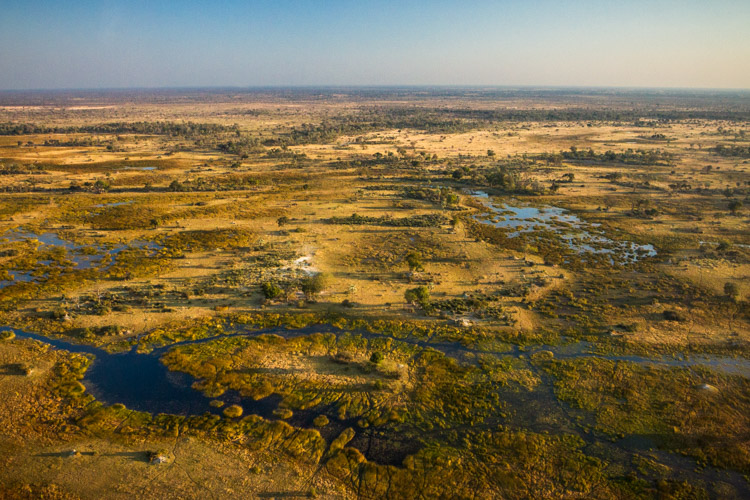
Another pair of images (below), shows this effect even more dramatically. The first image is not just wide-angle, but an aerial shot as well, taken from a small airplane over the Okavango Delta in Botswana. From this vantage point all of the individual elements of the landscape become incredibly small, and your eyes pay more attention to their arrangement than their individual shapes. In the second image, also from the Okavango area, but this time on the ground, a telephoto lens is used to draw attention to the beautiful curves of a single Acacia tree.

WILLCK 3 OKAVANGO wide

WILLCK 4 OKAVANGO tele

Depth of Field: Focusing the Eye

The second major difference between wide angle and telephoto lenses is the innate size of their depth of field. Put succinctly, the higher the focal length, the narrower the area of focus. In practice, this means that when shooting wide, it’s much easier for you to get everything in focus, from the grass at your feet to the ridge on the horizon. This is especially true when you’re trying to use your lens’s sharpest apertures (the so-called sweet spot). However, a narrower depth of field is much better for isolating your subject from the background, and this is where your telephoto lens comes into play. Try shooting a close-up detail at a low aperture, using the landscape as a nice creamy bokeh backdrop.

WILLCK 5 FLATTOPS

WILLCK 6 DENVER

The two images above are perfect examples of this effect. In the first image, the wide angle lens brings the whole landscape into focus, from the close-up sunflowers to the far-off mountains. In the second image, shooting with a telephoto blurs out the flowers and mountains in the background, turning them into a nice soft background for main sunflower.

Depth Compression: Playing with Size

It’s no secret that wide angle lenses expand the sense of depth in an image, by enlarging elements in the foreground and shrinking those in the back. This is great for creating images that make you feel like you could step right into the frame. On the flip-side, you run the risk of making towering, awesome mountains in the distance look like puny hills. Telephoto lenses, on the other hand, compress depth, causing objects near and far to appear more similar in size. A compressed sense of depth is great for abstracting a scene, and bringing out its graphical qualities. Colorful forest canopies, layered mountain ridges, and curving sand dunes, are all great subjects for this kind of shooting.

WILLCK 7 MICA

In the first of this pair above, notice how the wide angle lens exaggerates the size of the flowers in the foreground at the expense of the mountains in the background. The mountains are so tall that they’re shrouded in clouds, but the lens keeps them from looking quite as grand. But pull out a telephoto lens and you can zoom straight in on the mountain, showing off the contrast between the rugged outline of the peak and the soft wispy form of the cloud.

WILLCK 8 BIGBEND wide

WILLCK 9 BIGBEND tele

Here are two more images, both taken at the same location in Big Bend National Park, that show off this effect. In the first image, you can see that the wide angle lens increases the size of the plants and rocks in the foreground, while shrinking the large desert mountains in the background. In the second image, a telephoto lens flattens out the depth of the many desert ridges, calling attention to their graphic patterns and outlines.

Summary: Space Versus Object

Have a hard time remembering all these details? Here’s an easy way to summarize it with a simple idea:

Wide angle lenses show off space, telephotos show off objects.

The wide angle lens’s big field of view, ease of uniform focus, and depth-distorting abilities, are great at showing off big, expansive landscapes. However, they take focus away from individual elements within the landscape in favor of showing the whole. Telephoto lenses are naturally the opposite: they’re great at showing off the size, shape, and intricacy, of detail of individual elements within the landscape. But their narrow field of view, small depth of field, and depth-compressing qualities make it hard to capture the landscape as a whole.

WILLCK 10 WILLOW wide

You can analyze this pair of images to see exactly how all of these techniques work together. Starting with the photo above, you can see how the wide angle lens fits the whole landscape into the frame, from close-up rocks, to far off peaks and sky. Because of the lens’s large depth of field, the whole landscape is in acceptable focus as well. The lens’s depth distortion is readily apparent as well: the foreground rocks look very large, creating a pleasing sense of depth, and emphasizing the leading lines that draw the eye from the edges of the frame to the center. Overall, you get a very good sense of the space and the expansiveness of the valley.

WILLCK 11 WILLOW tele

This image was taken in the same place, but the use of a telephoto lens captures it in a very different way. The photo brings out a single element of the landscape – look closely and you can see this peak in the previous image on the top right – and allows the viewer to appreciate its subtle details. Because of the telephoto lens’s narrow depth of field, the sky is slightly out of focus while leaving the details of the peak itself perfectly sharp. And most of all, the compressed sense of depth flattens the image, showing off the rocky mass of the mountain, and calling attention to the beautiful curve of the ridge line. Overall, you get a great sense of the mountain as a solid object, rather than a bounded space.

When to shoot what?

The best way to know which lens to use is to get out there, look, and think. What part of the landscape are you most drawn to? Does the landscape’s expansiveness give it its character? Are there stunning details surrounded by less photogenic elements? Are you shooting spaces or objects?

WILLCK 12 ZODIAC

That said, my personal strategy is to just shoot both, because almost any landscape has enough beauty that just one type of lens isn’t enough to get to all of it.

What is your approach to landscape photography? Do you use a wide or telephoto more often? Please share your thoughts and landscape images in the comments below.

googletag.cmd.push(function() {
tablet_slots.push( googletag.defineSlot( “/1005424/_dPSv4_tab-all-article-bottom_(300×250)”, [300, 250], “pb-ad-78623” ).addService( googletag.pubads() ) ); } );

googletag.cmd.push(function() {
mobile_slots.push( googletag.defineSlot( “/1005424/_dPSv4_mob-all-article-bottom_(300×250)”, [300, 250], “pb-ad-78158” ).addService( googletag.pubads() ) ); } );

The post Wide Angle Versus Telephoto Lenses for Beautiful Landscape Photography by Will Crites-Krumm appeared first on Digital Photography School.


Digital Photography School

 
Comments Off on Wide Angle Versus Telephoto Lenses for Beautiful Landscape Photography

Posted in Photography


Budget Lenses Roundup for Aspiring Professional Photographers

08 Mar

A little while back, I went over a handful of DSLR camera options for anyone who is looking to get started with professional photography. Since I discussed camera bodies, the next step is deciding on some lenses. And since we’re still trying to find some good options on a beginner’s budget, the lenses we go over are all on the Continue Reading

The post Budget Lenses Roundup for Aspiring Professional Photographers appeared first on Photodoto.


Photodoto

 
Comments Off on Budget Lenses Roundup for Aspiring Professional Photographers

Posted in Photography


CP+ 2016: Sigma MC-11 adapter allows DSLR Sigma lenses full range of AF modes on Sony bodies

02 Mar

While photographing and filming our way through Sigma’s booth this year at CP+ 2016 in Yokohama, one rather understated product may have just stolen the show for a number of Sony shooters, as well as our Technical Editor Rishi Sanyal.

Put simply, the Sigma MC-11 adapter allows the use of Sigma-mount and Canon-mount Sigma lenses, such as the excellent Sigma Art 35mm F1.4, to be adapted to Sony bodies with no autofocus compromises whatsoever. That means Sigma is the first brand of DSLR lenses to support Eye AF and Lock-On AF modes on Sony cameras, as well as smooth phase-detection in video. What’s more, they work really well.

Don’t believe us? We didn’t believe it at first either. Watch the video and see for yourself why this is a huge step forward in realizing truly hybrid camera systems: where you can pair the best lens with the best camera body – for you – without severe compromises.

Pricing and availability of the Sigma MC-11 adapter has yet to be announced.

Articles: Digital Photography Review (dpreview.com)

 
Comments Off on CP+ 2016: Sigma MC-11 adapter allows DSLR Sigma lenses full range of AF modes on Sony bodies

Posted in Uncategorized


Tamrac Goblin gear pouches protect lenses, cameras and memory cards

01 Mar

Tamrac has a new line of Goblin gear pouches designed for individual lenses and cameras, as well as a couple larger accessory pouches for storing multiple items together. The product line includes half a dozen lens pouches, all with drawstring enclosures, three body pouches, two accessory pouches and one memory card wallet. 

The Goblin pouches feature ripstop nylon exteriors and quilted interiors. The lens pouches span bag models 0.3 to 2.4, with the smallest model (0.3) having an interior space of 6 x 8cm/2.25 x 3 in, and the largest (2.4) having an interior space measuring 12 x 21cm/4.75 x 8 in. The camera body pouches are similar, with the smallest model (0.4) offering 3 x 5.5 x 2 in/8 x 14 x 5 cm of interior space, and the largest model (1.4) offering 4.25 x 5 x 3.5 in/11 x 13 x 9 cm of interior space.

Unlike the lens and body pouches, the two accessory pouches, models 1.0 and 1.7, feature YKK zippers and mesh windows to offer a view of what’s in the bag while it’s closed. The Goblin line is rounded out with a memory card wallet with a micro mesh window and three difference size options, one that fits 6 SD cards, another that fits 4 Compact Flash cards, and a third option that fits all ten cards at once.

The Goblin line of pouches is available now through Tamrac’s website. Prices start at $ 12.95.

Via: Fstoppers

Articles: Digital Photography Review (dpreview.com)
 
Comments Off on Tamrac Goblin gear pouches protect lenses, cameras and memory cards

Posted in Uncategorized


CP+ 2016: A look inside the G Master lenses at the Sony booth

27 Feb

CP+ 2016: Sony stand report and G Master action

Earlier this year, Sony announced a trio of new lenses dubbed G Master, which include the Sony FE 24-70 F2.8 GM, the Sony FE 70-200 F2.8 GM and the Sony FE 85mm F1.4 GM. These three lenses helped to fill noticeable gaps near the higher end of Sony’s lens lineup.

And, no, we didn’t Photoshop in that gap in the lens lineup above just to make a point.

CP+ 2016: Sony stand report and G Master action

The G Master lenses are chock-full of new and advanced technologies meant to maximize image quality, autofocus speed and accuracy, durability, and bokeh. Let’s take a look inside…

CP+ 2016: Sony stand report and G Master action

Here’s the 24-70mm F2.8 GM lens cut in half. This lens comprises 18 elements in 13 groups, and features three aspherical elements, including an extreme aspherical (XA) element – more on that later. An ED (extra low dispersion) and Super ED glass element help minimize chromatic aberration while maintaining high resolution and bokeh characteristics. We believe it – our initial samples show very well-controlled chromatic aberration, and bordering on eye-popping sharpness even on a 42MP sensor, when shooting this lens wide open.

A 9-bladed aperture helps confer a circular shape to out-of-focus highlights, but it’s the autofocus system in this lens that most excites us. A Direct Drive SSM (super sonic wave motor) positions a relatively small group of focus elements accurately and quickly, and when we say quickly we mean with nearly unprecedented speed for this type of lens. We’ve become fans of Direct Drive SSM for AF ever since we saw the speed it confers in the FE 35mm F1.4. Focus, including continuous tracking, is nearly instantaneous on this 24-70 GM, which is fairly unexpected considering its counterparts in the DSLR arena. Focus is also both smooth and quiet, making it a great lens for video as well as stills.

CP+ 2016: Sony stand report and G Master action

The new XA (extreme aspherical) element is claimed to reduce aberration and deliver high resolution throughout the entire zoom and aperture range, across the entire frame. Sony claims to have achieved this via extremely high surface precision, maintained to within 0.01 micron tolerances. This should help reduce imperfections that can lead to onion-ring bokeh, typically an issue with aspherical lenses. 

And speaking of high precision, Sony claims to iterate their internal development of optical design by looking at actual lens MTF performance at 50 lines/mm. That doesn’t mean the lens only resolves to 50 lines/mm, it means that Sony’s threshold for acceptable performance in designing these lenses is quite high. Judging from the sharpness wide open on an a7R II, we’re inclined to believe it’s working for Sony.

CP+ 2016: Sony stand report and G Master action

Sony has also recently announced the FE 85mm F1.4 GM, shown here cut in half. This lens comprises 11 elements in 8 groups, and features a new XA (extreme aspherical) element as well as three ED (extra low dispersion) elements that help optimize both resolution and smooth transitions to out-of-focus areas. It’s also got a ‘Nano’ anti-reflective coating on its front element to reduce flare and ghosting, particularly useful for maintaining contrast in backlit portraits. 

The 85mm GM lens utilizes a ring drive SSM (super sonic wave motor) to drive the lens’ large, heavy focus group. In other words, this lens is much like some of its DSLR counterparts in terms in focusing speed – very fast, but not quite as fast – in our initial impressions – as Sony’s own Direct Drive SSM combined with a relatively small focusing group in the 24-70mm F2.8 GM. Two position sensors support accurate positioning of the focus elements, which should ensure accuracy of focus.

CP+ 2016: Sony stand report and G Master action

Particularly nice is the 11-blade circular aperture in the 85mm F1.4 (and 70-200mm F2.8) GM lenses. The more blades you have, the more circular the aperture remains even when stopped down significantly – especially with the curved blades typical of almost all lenses today. Most modern lenses have between 7 and 9 blades these days, with 9 blades being reserved more pro-level lenses. 11 takes it a step further and, indeed, the opening retains a circular, less polygonal shape as you stop down (here it is in action). This should ensure circular out-of-focus highlights and increased quality of bokeh, even at smaller apertures.

And why go from 9 to 11 blades, skipping 10? Odd numbers of aperture blades are generally better for their more favorable sunstar rendition, creating sunbursts with twice the number of rays as aperture blades when stopped down. Even-numbered designs only create sunbursts with as many rays as aperture blades, so while a 10-blade aperture would produce 10-ray stars, an 11-blade aperture would produce 22-blade stars. Of course, longer focal lengths and circular aperture designs are less prone to creating sunstars at all – and we have no idea if this was the actual thinking behind the choice – but it’s still nice to see the general trend toward odd numbers of aperture blades.

CP+ 2016: Sony stand report and G Master action

Pictured here is the new FE 70-200mm F2.8 GM OSS telephoto zoom lens Sony recently announced, cut in half of course. This lens, like the 24-70mm GM lens, features XA, Super ED, and ED glass elements to help achieve high resolution and desirable bokeh characteristics. It’s got 23 elements in 18 groups. A ‘Nano’ anti-reflective coating ensures reduced flare and ghosting. An additional fluorine coating to the front of the lens help keep it clean, and the lens is dust and moisture resistant.

OSS (Optical Steady Shot) is built into the lens, despite the availability of IBIS in a7-series cameras, because for longer focal lengths, it’s beneficial to do a certain amount of the stabilization in-lens, because of how much the sensor would have to move to compensate for even slight angular displacements. The two systems – OSS and IBIS – theoretically work together to provide even more effective stabilization than any one method might provide.

CP+ 2016: Sony stand report and G Master action

The autofocus system on the FE 70-200mm GM OSS is quite intriguing: it’s a floating focus system, which sees its debut in an ? lens. This floating system design contributes to its impressive minimum focusing distance of 0.96m, and also helps control aberrations that might otherwise be problematic when focusing at close distances. 

Pictured on the left is the more traditional ring-drive SSM motor that’s required to drive the large, heavy glass elements typical of this type of lens. The double linear motor of this system, pictured on the right, allows for effective ‘wobbling’ actuation (typically used in contrast-only AF), which is useful when shooting video. The entire focusing mechanism is also very quiet – and smooth – which ensures AF performance is optimized for both stills and video shooting. 

The 70-200mm F2.8 GM OSS lens also functions with Sony’s newly announced 1.4x and 2x teleconverters, which may somewhat make up for the lack of longer telephoto lenses (for the time being anyway).

CP+ 2016: Sony stand report and G Master action

Lifting our heads back up from the tech demos and turning our attention to other things (wait, where’d Rishi go?), we see that in typical trade-show form, Sony’s provided some subject matter for eager attendees to test the latest tech. But if you were to show up to CP+ hoping to capture some model mayhem using the new GM lenses, you’d have to make do with the 85mm F1.4 GM, the only new GM lens available in front of this display.

And don’t worry, if you’re already missing the lens-cut-in-half thing, you can get your fix when our Editor Barney returns with many more things cut in half later this week. Like nicely packed, and then cut in half (naturally) sandwiches.

CP+ 2016: Sony stand report and G Master action

At first glance, the 85mm F1.4 GM looks a little unwieldy on an a7-series camera, but in hand, the pair balance remarkably well. The lens has a pleasingly solid heft to it without feeling too front-heavy. At 820g, it’s significantly heavier than, say, Nikon’s counterpart (595g), but our initial impressions are that the sharpness wide open – even off-center – and lack of chromatic aberration might make the weight more than worth it.

CP+ 2016: Sony stand report and G Master action

Beyond the price of a CP+ admission ticket, there’s no charge to try out the new 85mm F1.4 GM – but to get one of your very own, you’ll need $ 1800 when it goes on sale in March. Also of note for video shooters is the ability to de-click the aperture dial for smoother operation.

CP+ 2016: Sony stand report and G Master action

Although you’re a little ways away from the real models, you can try out the FE 24-70mm F2.8 GM on some beleaguered Sony reps behind the counter. And though it appears a bit hefty on the smaller a7-series bodies, it balances well – particularly if you have a vertical grip attached. At 886g, it’s not unreasonably heavy, and the extra heft may be well worth it anyway – our preliminary impressions are that this is the sharpest 24-70mm zoom (particularly wide open) we’ve ever seen.

It will be available in March for $ 2200.

CP+ 2016: Sony stand report and G Master action

Last up is the FE 70-200mm F2.8 GM. As you can probably tell from this image, the lens itself isn’t overly large, but it’s definitely got some weight to it. At 1480g, it’s around the weight of Canon’s equivalent lens, which means you’ll really want a grip on an a7-series camera to balance the weight well. The FE 70-200mm F2.8 GM OSS will be available in March, and the price is still TBD.

Overall, the G Master lenses appear to be solid additions to Sony’s FE lens lineup, potentially addressing the need for professional-level lenses for the system. We’ve shot a few shots with these lenses on a 42MP a7R II, and it’s clear from the sharpness and chromatic aberration results, as well as AF speeds, that Sony is clearly targeting professionals, and high-end enthusiasts, with these lenses. And we expect them to compare favorably against even the best counterparts offered by the stalwarts in the industry. We’ll reserve judgement until we’ve had time to do more rigorous, side-by-side testing, but for the time being, it’s safe to say we’re very impressed.

Articles: Digital Photography Review (dpreview.com)

 
Comments Off on CP+ 2016: A look inside the G Master lenses at the Sony booth

Posted in Uncategorized


Video: Hands-on with Sony’s G Master lenses and the a6300 at CP+ 2016

27 Feb

There are lots of new products vying for attention at CP+ 2016, including Sony’s a6300 and new GM series lenses for its full-frame mirrorless cameras. And they are getting plenty of attention from show attendees, especially those eager to try out the FE 85mm F1.4 GM’s portrait capabilities. We took another look at the a6300 and the GM lenses on display at the buzzing Sony booth in Yokohama. 

Articles: Digital Photography Review (dpreview.com)

 
Comments Off on Video: Hands-on with Sony’s G Master lenses and the a6300 at CP+ 2016

Posted in Uncategorized


CP+ 2016: Hands-on with new Panasonic lenses and ZS100

26 Feb

CP+ 2016: Hands-on with new Panasonic lenses and ZS-100

At this year’s CP+ show in Yokohama, Japan, Panasonic unveiled the Lumix G Vario 12-60mm F3.5-5.6 ASPH Power O.I.S. lens. Featuring a splash and dustproof design, the 24-120mm equivalent zoom is designed to be a lightweight, versatile companion to Panasonic’s Micro Four Thirds cameras. 

CP+ 2016: Hands-on with new Panasonic lenses and ZS-100

The new 12-60mm is smaller and much lighter than we expected from the specification. Although it is weather-sealed and boasts 11 elements in 9 groups, it weighs a mere 210 g (0.46 lb).

CP+ 2016: Hands-on with new Panasonic lenses and ZS-100

The lens is constructed from polycarbonate, but the mount is metal. It’s hard to see in this image but there’s a rubber gasket around the lens throat which prevents dust and moisture from getting into the camera. 

CP+ 2016: Hands-on with new Panasonic lenses and ZS-100

This is an O.I.S lens, which means that it is optically stabilized. In combination with the in-body stabilization of the Lumix DMC-GX8 this means that it supports Panasonic’s Dual IS feature, which we’ve found offers very good performance across a wide range of focal lengths, but especially at long telephoto settings, where in-body stabilization alone can sometimes struggle.  

CP+ 2016: Hands-on with new Panasonic lenses and ZS-100

The Lumix G Vario 12-60mm F3.5-5.6 ASPH will be available in May for $ 499.99.

CP+ 2016: Hands-on with new Panasonic lenses and ZS-100

Announced before the show, CP+ was the first chance that most Panasonic users have had to play with the new Leica DG Vario-Elmar 100-400mm F4-6.3 telezoom. We got the chance to shoot with one recently and it certainly impressed us.

Covering a focal length range equivalent to 200-800mm when attached to a Micro Four Thirds body this powerful zoom appropriately features ‘Power’ optical image stabilization to keep things steady. It has has one aspherical, one UED, and two ‘regular’ ED elements, as well as a nine-bladed circular aperture. The minimum focus distance is 1.3m, with a magnification of 0.25x.  

The Leica DG Vario-Elmar 100-400 F4-6.3 will be available in early April at a price of $ 1799.99.

CP+ 2016: Hands-on with new Panasonic lenses and ZS-100

Also annouced before the show, here’s the new Panasonic Lumix DMC-ZS100 (known as the TZ100 in most regions outside of North America). It’s a compact travel zoom of the kind that Panasonic has historically been particularly good at, but unusually it features a 20 megapixel, 1″-type sensor. 

CP+ 2016: Hands-on with new Panasonic lenses and ZS-100

That 20MP sensor is paired with a 25-250mm equivalent F2.8-5.9 Leica DC lens which incorporates the company’s snappy Depth from Defocus autofocus technology. It offers a 3″ touchscreen LCD as well as a 1.04M-dot electronic viewfinder, Raw support, 10 fps continuous shooting (5 fps with AF) and Wi-Fi. 

CP+ 2016: Hands-on with new Panasonic lenses and ZS-100

On the video side of things the ZS-100 can record 4K/UHD video at 30p and 24p as well as 1080/60p clips. Panasonic’s unique 4K photo mode lets you grab high quality 8MP stills from 4K video.

CP+ 2016: Hands-on with new Panasonic lenses and ZS-100

A built-in EVF, 25-250mm equivalent lens and plenty of manual controls make the ZS-100 a very attractive camera for traveling, in theory. We’re expecting a reviewable camera very soon and we’ll be posting sample images as fast as we can. 

Articles: Digital Photography Review (dpreview.com)

 
Comments Off on CP+ 2016: Hands-on with new Panasonic lenses and ZS100

Posted in Uncategorized


CP+ 2016: Hands-on with Tamron’s new SP prime lenses

26 Feb

CP+ 2016: Hands-on with Tamron’s new SP prime lenses

Tamron is showing off two brand new lenses at CP+ this year – the SP 85mm F1.8 Di VC USD (shown here) and SP 90mm F2.8 Di VC USD 1:1 Macro. The ‘SP’ in the model names stands for ‘Super Performance’ – a designation that Tamron reserves for its high-end optics. We headed to the Tamron booth today and got our hands on the new lenses, and Tamron’s upcoming TAP-in Console.

CP+ 2016: Hands-on with Tamron’s new SP prime lenses

First up is the SP 85mm F1.8 Di VC USD, which slots right alongside the previously-announced 35mm and 45mm F1.8 primes that Tamron released last year. Like those lenses it is relatively compact, but feels extremely solid and has a nice weight to it, balancing well on a Canon EOS 5D Mark III (provided by Tamron to get a feel for the how the lens handles). 

It’s worth noting the Nikon version of this lens uses an electromagnetic aperture control, rather than the traditional aperture lever.

CP+ 2016: Hands-on with Tamron’s new SP prime lenses

The 85mm features LD (low dispersion) and XLD (extra low dispersion) elements to reduce flare and ghosting and a fluorine coating on the front element to keep moisture and fingerprints at bay. Nine aperture blades ensure circular out-of-focus highlights. MTF (theoretical) curves suggest outstanding resolution and contrast. The VC system offers up to 3.5 stops of shake reduction (tested to CIPA standards) and its ring-type ultrasonic motor provides fast and near-silent autofocus when we tested this pre-production sample.

CP+ 2016: Hands-on with Tamron’s new SP prime lenses

It’s hard to see in this photo, but the lens mount of the new 85mm and 90mm SP primes is protected by a rubber gasket, to protect against dust and moisture incursion into the lens throat. Expected to be available in April in Canon and Nikon mount versions, a Sony A-mount version will follow later. Pricing is still TBC. 

CP+ 2016: Hands-on with Tamron’s new SP prime lenses

Next up is the SP 90mm F2.8 Di VC USD 1:1 Macro, which offers true macro 1:1 reproduction at a focusing distance of 13.9cm/5.5in. A 9-blade aperture ensures circular out-of-focus highlights. Tamron has been making a 90mm macro lens of some or other kind for a very very long time, and all of them have been extremely well-regarded. Our first impressions of the new 90mm are that in terms of handling, this might be the best yet. 

CP+ 2016: Hands-on with Tamron’s new SP prime lenses

Like the other recently-announced SP primes, build quality is very high, and just in terms of aesthetics, the new 90mm looks great. It seems that Tamron has been looking over its shoulder at Sigma’s ‘Art’ range and this is no bad thing. Like those lenses, all of Tamron’s new SP primes look more expensive than they are. The 90mm macro will be available next month for a very reasonable $ 649.

Again, we’ve only handled a pre-production sample but just from first impressions we’re excited to get it into our studio as soon as possible. 

CP+ 2016: Hands-on with Tamron’s new SP prime lenses

Tamron’s new ‘TAP-in Console’ is also distinctly Sigma-esque. (An early engineering sample is shown here). Available for Nikon and Canon-mount versions of the SP 85mm F1.8, SP 90mm F2.8 Macro, SP 45mm F1.8, SP 35mm F1.8 lenses (the older 35mm and 45mm primes will need updating at a Tamron service center) the TAP-in Console will allow users to calibrate their lenses for precise AF, at either end of a zoom and at three different subject distance ranges (near, mid, far), as well as adjust VC performance parameters. 

CP+ 2016: Hands-on with Tamron’s new SP prime lenses

Projected to be available next month, Tamron has not yet announced pricing information for the TAP-in console but after seeing coming to appreciate the value of Sigma’s dock, we’re very pleased to see this kind of solution being introduced by another manufacturer. Canon and Nikon take note…

Articles: Digital Photography Review (dpreview.com)

 
Comments Off on CP+ 2016: Hands-on with Tamron’s new SP prime lenses

Posted in Uncategorized


CP+ 2016: Hands-on with new Sigma SD cameras and lenses

25 Feb

CP+ 2016: Firing up the Quattro – Hands-on with new Sigma SD cameras and lenses

Sigma announced several new products at CP+ 2016, including two new cameras. The interchangeable lens SD Quattro And SD Quattro H represent a new departure for the company in two senses – both are mirrorless cameras, and the ‘H’ features an APS-H format sensor. More conventional are a new 50-100mm F1.8 DC HSM Art zoom and 30mm F1.4 DC DN Contemporary prime for mirrorless cameras.

CP+ 2016: Firing up the Quattro – Hands-on with new Sigma SD cameras and lenses

Ergonomically, the new SD Quattro and Quattro H are far more conventional than the DP-series compact cameras in Sigma’s lineup. But both still handle very differently to most other mirrorless interchangeable lens cameras. They’re boxier, for one thing, with a distinctive body shape, and a viewfinder that’s much further to the right than the majority of DSLRs and EVF-equipped mirrorless models. 

The 2.3MP viewfinders in Sigma’s new cameras are sharp and detailed, although our preliminary impressions of the cameras’ hybrid autofocus systems aren’t terribly encouraging. We’re hoping that the slow, hesitant AF that we experienced is a symptom of these early, pre-production cameras because in most other respects the new models handle very well. 

CP+ 2016: Firing up the Quattro – Hands-on with new Sigma SD cameras and lenses

That being said, the cameras are comfortable to hold, and feel like ‘premium’ products, as we’d expect from Sigma at this point. This view highlights the unusually deep lens throat, which protrudes a good inch or so from the front of the main camera body. Here, we’ve attached a (Sigma mount, of course) 50mm F1.4 ‘Art’, and the total package handles (and balances) very well. 

Ergonomically, the SD Quattro and SD Quattro H are identical. The only difference is the size of their sensors. Sigma claims that the Foveon sensors inside the SD Quattro and SD Quattro H offer resolutions equivalent to 39 and 51MP respectively, in conventional Bayer terms. 

CP+ 2016: Firing up the Quattro – Hands-on with new Sigma SD cameras and lenses

The new cameras are being launched alongside a new flash – the EF-630. Compatible with ‘with most well-known digital SLR cameras’ (and the Sigma SD Quattro / H) the EF-630 has a guide number of 63, and the articulating head can zoom to cover focal lengths from 24-200mm. 

CP+ 2016: Firing up the Quattro – Hands-on with new Sigma SD cameras and lenses

We don’t normally get too excited by flashguns but the EF-630 is an unusually solid-feeling, well-made unit. As well as on-camera use it can also be triggered wirelessly.

CP+ 2016: Firing up the Quattro – Hands-on with new Sigma SD cameras and lenses

As well as a new flash, the SD also gets a new dedicated grip. The grip adds duplicated vertical controls and can incorporate two batteries. It also converts the SD Quattro’s unconventional body shape into a more traditional flat-sided form. Booooring…

CP+ 2016: Firing up the Quattro – Hands-on with new Sigma SD cameras and lenses

Not at all boring is the new 50-100mm F1.8 DC HSM Art, which provides a 75-150mm focal length range on the APS-C format DSLRs for which it’s designed. Offering a fast maximum aperture and standard ‘Art’-series construction quality the 50-100mm is solid, heavy and luxuriously engineered. 

CP+ 2016: Firing up the Quattro – Hands-on with new Sigma SD cameras and lenses

With enthusiast APS-C format DSLRs enjoying something of a resurgence in the past couple of years, we suspect there are a lot of Canon EOS 7D Mark II and prospective Nikon D500 owners who will be very excited by this lens. The 50-100mm features three FLD (F Low Dispersion) glass elements, one SLD (Special Low Dispersion) glass element, and one high-refractive index, high-dispersion glass element. We expect this lens to deliver great results and we’re keen to see how it performs. 

CP+ 2016: Firing up the Quattro – Hands-on with new Sigma SD cameras and lenses

At the other end of the size and weight scale is he 30mm F1.4 DC DN Contemporary. A small, lightweight prime for mirrorless cameras, the 30mm F1.4 is available in two versions – one for Micro Four Thirds (shown here) and another for Sigma’s APS-C mirrorless E-mount cameras. We were able to use both versions briefly at CP+ and we’re especially impressed by how fast the lens can focus. Eventually, we’d love to see Sigma make a version for full-frame mirrorless (you’ll get heavy vignetting if you put the E-mount version on an A7-series camera). 

The 30mm F1.4 will ship in mid-March at an MSRP of $ 339, while the 50-100mm F1.8 is expected in late April priced at $ 1099.

CP+ 2016: Firing up the Quattro – Hands-on with new Sigma SD cameras and lenses

Sigma’s final CP+ announcement was the Mount Converter MC-11, which lets you attach Sigma’s most recent lenses (in either Canon or Sigma mount) on full-frame or APS-C E-mount bodies. The MC-11 adapter is able to support phase detection AF with adapted lenses, and makes use of both camera and lens stabilization when present.

Effectively an own-brand version of Metabones Canon EF to FE adapters, the MC-11 (sort of) answers a long-standing complaint of Sony A7-series owners about the lack of full-frame Sigma lenses for their chosen platform. Pricing and availability has yet to be announced. 

Articles: Digital Photography Review (dpreview.com)

 
Comments Off on CP+ 2016: Hands-on with new Sigma SD cameras and lenses

Posted in Uncategorized