RSS
 

Posts Tagged ‘Lens’

Writer’s Favorite Lens – 70-200mm Zoom

14 Nov

What is the best lens for taking flattering portraits? ZOOM, ZOOM, ZOOM!

Zoom Main

Model credits left to right: Sherri Lee Bigs/Image courtesy Nine Network Australia, Nicole Di Silva/Foxtel, Jocelyn Idriss. All images copyright Gina Milicia

“I’ve learned that people will forget what you said, people will forget what you did, but people will never forget how you made them feel.” – Maya Angelou

My love affair with the zoom lens began in the late 80’s. I started my career as a portrait photographer using an entry level Nikon with an 80-200mm Sigma zoom lens. Back in the day “zoom lens” was code for paperweight or doorstop because they had the similar optics to a pair of cheap sunglasses and were about as sharp as a butter knife.

Zoom lenses were for amateurs, pros used prime lenses.

After I’d been shooting for a few years and could afford better gear, the zoom was shunned to the back of my kit. It only saw the light of day on the rare occasion I photographed a wedding or a corporate event. Then in 2004 I met and fell in love with the Canon 70-200mm zoom. I have to be honest here and tell you that it wasn’t love at first sight. I’d been burned before by zoom lenses that promised so much and yet delivered very little. But, it didn’t take much to convince me that this lens was different and completely revolutionized the way I worked.

The Good

Zoom Good 1 Zoom Good 2
Zoom Good 3

Model credit: Mimi Elashiry, John Scott Personal PR, Next Models Hair and Make-Up by Rachid

This is a typical way I might use the 70-200mm zoom in a portrait shoot. The first image is set up as full length shot at a focal length of 70mm, then I zoom in to create a three-quarter shot at 150mm, and again to create a tight headshot at 200mm.

Many of my clients suggest that I just shoot full length, and then they will crop to headshot or three-quarter in post-production.
This sounds great in theory, but there are two problems with cropping in this situation. First, you end up with less than twenty percent of the original file, which is a drastic reduction in quality, and reduces a 60MB file to approximately 10MB. Second, the lens compression factor at 70mm is very different than at 200mm.

Zoom Good 8

Model credit: Tommi Pitsas

Zoom Good 8A

A tight headshot at 200mm creates the most beautiful blur (or bokeh) in the background (top image of Tom) that is not as prominent if the image were photographed at full length and cropped (bottom image of Tom above).

I love working with a zoom lens when I’m taking portraits because it means I can set up my shot and create full length, three-quarter and tight head shots without having to move the camera. I can stay out of my model’s personal space, which can be intimidating or confronting, and keep the momentum of the shoot flowing.

Zoom Good 6

Zoom Good 7

Zoom Good 9

Model credits: Images Gina Milicia, Courtesy Nine-Network Australia

Being able to work this quickly is perfect for editorial and celebrity photo shoots, which are always fast paced and high pressure.

Zoom Good 4

Model credit: Boone Freund and Jocelyn Idriss. Try capturing this beautiful moment with a wide angle lens. The only way you could get close enough is if you were on the bike too!

The long zoom lens is also perfect for capturing intimate photos of couples or children, and even pets. I’m often shooting well back at 200mm, and this makes it much easier for my model to forget I am even taking their picture.

Zoom Good 5

Model credit: Jocelyn Idriss

The whole “look” and feel of a portrait can be radically changed by focal length choice. A focal length less then 50mm will distort facial features. Some photographers love this look and have successfully incorporated it into their shooting style.

I love to work with a focal length between 100mm and 200mm. Facial features are compressed slightly, which is flattering for portraits. I don’t like the way a wide focal length looks and it doesn’t suit my shooting style.

The Bad

The 70-200mm is a heavy lens to carry around all day long. The extra weight can make handheld shooting difficult. Its size and length also makes it stand out, making it incredibly difficult for you to shoot incognito, such as at an event or when taking street photos or travel pics. In these cases, I opt for my walk-around zoom, the 24-105mm Canon f/4, which is perfectly suited to these situations and is much lighter!

The other downside of shooting with a long lens is I’m often backed into corners or having to shoot through windows or doorways just to be able to get the shot. I’m constantly shooting with my back to the wall. Literally!

The Ugly

The most annoying part about working with zoom lenses is the zoom action is continually sucking dust onto my camera sensor. Unwanted dust means I need to get my sensor professionally cleaned more often which is an added cost, and extra down time I wouldn’t have if I stuck to prime lenses.

My Choice

70 200L

I work with the Canon 70-200mm IS F2.8 L series. It’s my workhorse, and I use it on 70-80% of my shoots. An average photo shoot for me will consist of approximately 2000-4000 frames, and I can’t think of another lens in my kit that would give me the consistency, ease, speed and high standard of the 70-200mmm.

If you are considering buying a zoom there are now many excellent ones on the market. The price drops significantly if you choose a slower lens (f/4 instead of f/2.8) and one without image stabilization, that is almost unnecessary these days because cameras can shoot at a much higher ISO. If your budget is tight, you might also consider buying second hand. Yes, zoom lenses are pricey, but remember your lenses should last you a minimum of 10 years if you look after them. I’ve had mine for 10 years now, and it’s outlasted three cameras. This fact alone makes the 70-200mm my most cost effective investment.

The other option you may like to consider is renting a long lens for a weekend. Prices are very reasonable.

It took me ten years of experimentation with different focal lengths before I found my happy place. Do you like to shoot long? Which lens do you think is the most flattering lens for portraits? I’d love to hear your thoughts.

The post Writer’s Favorite Lens – 70-200mm Zoom by Gina Milicia appeared first on Digital Photography School.


Digital Photography School

 
Comments Off on Writer’s Favorite Lens – 70-200mm Zoom

Posted in Photography


Writer’s Favorite Lens – the 50mm f/1.4 Lens

12 Nov
005

1/400, f/4.0, ISO 320

It’s easy to love the 50mm f/1.4 lens. It’s a jack-of-all-trades. It’s that best friend that never lets you down. It’s the cowboy of all the lenses; it can pretty much do anything you ask it to do. If I was forced to only keep one lens, I’d have to choose this one. I’d even go as far as to say that most of you probably have this lens, and if you don’t, you should.

Sometimes the 50mm f/1.4 doesn’t get appreciated as much as it deserves to be. It’s unassuming. It doesn’t look intimidating and professional on your camera. It doesn’t cost you an arm and a leg or your first-born child. It’s definitely not showy, and not really a lens that you’re going to brag about to your photographer friends. But man, when you need a lens that’s got your back, this is the one.

Before I go on, I want to clarify that I’m talking about my Nikon 50mm f/1.4 lens on a full frame body. If your camera is a cropped sensor, the 35mm f/1.4 lens will have similar results. You can also get the 50mm 1.8 lens for less money, but if you can spend a few extra dollars, get the sturdier, faster, 50mm f/1.4 (or even the 50mm f/1.2 if you’re a Canon user).

008

1/400, f/3.5, ISO 400

Convenient and Lightweight

The 50mm f/1.4 is great to take just about anywhere when you want to capture life around you. If you don’t want to lug around a bunch of heavy equipment, throw this lightweight gem on your camera, and go. Sure, there will be some shots that won’t be perfect with the 50mm, but you’re going to be able to get most of what you want. If you’re a smaller person like I am (5’3″ if I’m on my tiptoes), a little less weight can make a big difference if you’ve got a lot of walking around to do. I’ll admit that my arm gets really tired with the bigger lenses sometimes.

The freedom of smaller and lighter weight will allow you to move around more, without the restriction of maneuvering a big long lens, or pulling out a tripod. You can get it in and out of your camera bag easily, and keep it close to you, which will lessen the chance of gear getting stolen or broken.

You’ll be able to get up close if you need to, if you’re in a public place, or you can pull back a bit and get the whole scene. Your 50mm sees about the same as how things look to your eye in real life. So if you see something you want to capture, you just put the camera up, and there it is, pretty much how you just saw it. You don’t have to worry about everything being closer or farther away than you expect.

Ready for Anything

006

1/500, f/2.8, ISO 400

If your 50mm is on your camera most of the time, you’re ready to capture the unexpected. You won’t be stuck with a lens that absolutely won’t work for the situation. There are few situations that the 50mm can’t at least do a decent job. Sometimes you don’t have time to change to a different lens, because deer don’t come knocking at your front door very often, and they don’t stay for tea and cookies!

I’m not saying that you can’t ever use another lens, but the 50mm is a great lens to have on-the-ready.

Great at Capturing Details

001

1/1250, f/1.8, ISO 400 // 1/640, f/2.5, ISO 400

The 50mm lens is great to capture those details around you. Your feet make great zoomers, and you can easily move back to get more of the scene or closer to get those details in the shot. It feels like an extension of your eyes and brain, so taking photos becomes second nature.

Expert at Depth of Field and Bokeh

007

1/125, f/2.2, ISO 800

The 50mm f/1.4 offers awesome depth-of-field options. You can have just one small part in focus with the rest of the photo dropping away into creamy bokeh. You can also open that aperture all the way up to f/1.4 when you don’t have much light to work with. Those extra couple of f-stops can make a huge difference when every bit of light counts. If you’ve never owned a faster lens like this one (for example, if you’ve only been using the kit lens that comes with your camera), this will open up a whole new world to you!

Perfect for Portraits

009

1/1250, f/1.8, ISO 400

The 50mm can be a great portrait lens. Yes, there are lenses that might be better for portraits, but sometimes I really love the portraits I can make with my 50mm. You don’t have to get so close to your subject that you’re breathing on their face, but you don’t have to get so far away that you’re shouting instructions to them.

I find that sometimes the 50mm allows me to have the best connection to my subjects. I can touch their arm to move them into a better position, and talk to them and connect. Then I step back slightly and capture exactly what I just worked on, before I lose the connection and natural look we just achieved. Also, sometimes those big lenses can feel intimidating to your subject; the 50mm doesn’t look quite so scary.

Best All-Around Lens

004

1/320, f/2.0, ISO 800

You can also use your 50mm for other things besides people, of course (sometimes I do forget about that, because I’m kind of attached to photographing human beings). You can use the 50mm for still-life photos, scenery, and even some wildlife (especially if a deer comes right up to your house). There aren’t many things that the 50mm is useless for. It’s a great lens to have when you don’t know for sure what kind of photography you want to do, and you want to experiment for a little while.

Essential for Indoor Shooting

003

1/100, f/3.2, ISO 800

The 50mm is almost essential if you want to shoot indoors. If you want to read more ideas on using this lens indoors with natural light, go check out Tips For Great Indoor Portraits Using Natural Light. I love that I can maneuver in almost any space, even small homes, and still get everything I want in the photo. It’s also great if you don’t have tons of natural light available indoors, and you don’t want to use additional lighting and flash equipment.

002

1/250, f/4.0, ISO 400

The 50mm f/1.4 is so versatile that you can capture a family with their beautiful surroundings, or you can capture the most intimate close-up detail. It’s so easy to carry around that you won’t dread taking it along with you on your adventures. It’s so intuitive that you will feel like your heart is making photos, and your brain doesn’t have to work as hard. It’s so inexpensive that most photographers can add it to their collection.

Are you in love with your 50mm lens? Share in the comments why or why not. I’d love to hear what you think.

The post Writer’s Favorite Lens – the 50mm f/1.4 Lens by Melinda Smith appeared first on Digital Photography School.


Digital Photography School

 
Comments Off on Writer’s Favorite Lens – the 50mm f/1.4 Lens

Posted in Photography


Writer’s Favorite Lens – the Tamron 18-270mm

09 Nov

Darren recently suggested that the dPS writers to contribute to a semi-regular series featuring our favorite lenses, and I knew, hands down, which lens I wanted to feature: my daily workhorse, the Tamron 18-270mm lens. All photographs in this article, with the exception of the lens itself were taken with the Tamron 18-270mm.

church, fall, autumn, architecture, framing, fall leaves, Tamron18-270mm

Introducing the Tamron 18-270mm

The full name of this lens is the Tamron 18-270mm f/3.5-6.3 Di II VC PZD lens. It is a great all-in-one zoom lens and covers a wide-range of photography situations. Vibration control (VC) allows you to handhold at slower shutter speeds, and the proprietary piezodrive autofocus is quiet and fairly fast. Tamron makes versions of this lens compatible with Canon, Nikon, and Sony camera bodies. While some may argue that this lens is a “jack-of-all-trades but master of none,” I would contend that the Tamron is a perfect fit for the photographer looking to get a lot of use out of a single lens.

camera lens, tamron, tamron18-270, all-in-one zoom, zoom lens, photography

Ideal Uses for the Tamron 18-270mm

The Tamron 18-270mm is a perfect lens for travel photography and for the photographer-on-the-go who does not want to spend time constantly switching lenses or hauling large amounts of gear. In a single lens, you have the capability of shooting everything from wide angle, to 50mm, to a pretty substantial zoom.

When I made the decision to upgrade and replace my two kit lenses (the Canon 18-55mm and 55-250mm), I knew that I wanted a lens or lenses that would cover a similar range of photography situations and offer an improvement in image quality. I was also preparing for some extensive traveling (including backpacking) and did not have an endless budget, so both weight and cost were important considerations.

hiking, backpacking, Badlands, tent, camping, travel photography, Tamron18-270mm

At 450 g (0.99 lbs) this is not a light lens, but it compares favorably to other long zoom lenses, such as the Canon 55-250mm I was replacing (390 g or 0.86 lbs), the Canon 24-105mm (525 g or 1.16 lbs), or the Canon 70-300mm (630 g or 1.39 lbs). After a long day of hiking and photographing, you will know that you have been carrying your camera around, but you would be hard-pressed to find another lens for a DSLR that will give you this range and flexibility that is any lighter.

Price-wise, the Tamron is a steal. This lens retails today for around $ 450 USD, and its newly-released upgrade, the Tamron 16-300 f/3.5-6.3 Di II VC PZD Macro currently retails for $ 599 USD, after rebate. This is a great value for a quality lens for those who lack unlimited funds to spend on multi-thousand dollar lenses.

Advantages of All-in-One Zooms

The main advantage of an all-in-one zoom lens, like the Tamron, is the flexibility. You can go from shooting a wide-open landscape shot to a close-up zoom of an individual bird in the flick of a wrist. These two photographs at Mammoth Hot Springs were taken just moments apart, at the two extremes of the Tamron’s range. If look carefully in the middle left of the wide view, you can just make out the bird. You will no longer have the excuse of “not having the right lens” if you miss a prime photographic opportunity.

Yellowstone, Mammoth Hot Springs, landscape, photography, National Park, wide angle, Tamron18-270mm

Yellowstone, Mammoth Hot Springs, landscape, photography, National Park, zoom lens, Tamron18-270mm, bird, wildlife

Never having to change lenses also keeps my camera and sensor cleaner, my reaction speed faster, and my backpack and purse emptier. I rarely travel around with a full camera bag, since I can slip an extra battery or a few filters into a pocket or my purse. In fact, I can easily stow the entire camera, with the Tamron lens attached, in my fairly-small purse without incident (though I usually use a neoprene wrap around it).

Tamron18-270mm

The Tamron 18-270mm lens is a great lens for you if you do not want to specialize or you want to shoot a wide range of subjects and situations. You can go from shooting close-ups in the mornings, to architecture at midday, to your child’s soccer game in the afternoon, and still have the same lens on for shooting a few shots of the moon before bed.

closeup, macro, bee, bumblebee, Tamron18-270mm

architecture, theater, blackandwhite, Tamron18-270mm

moon, full moon, eclipse, night photography, astrophotography, Tamron18-270mm

The main downside to an all-in-one zoom is that you have a range of aperture values across the different focal lengths. With the Tamron 18-270mm, I can shoot as wide as f/3.5 at 18mm but only have f/6.3 at 270mm. Prime lenses offer much wider aperture values. As a workaround, backing up and using the longer focal lengths still allow you to capture decent blur and bokeh.

If you want a zoom or all-in-one zoom lens with a wider aperture value across the whole range, you need to be prepared to shell out significantly more money (say, a cool $ 2199 USD for the Canon EF 70-200mm f/2.8L IS II USM or $ 1450 for the version without image stabilization).

Why I Love the Tamron 18-270mm

In the end, your favorite lens comes down to what you want to shoot and how much you can afford. For me, the Tamron 18-270mm was an excellent choice to satisfy my wide-ranging photographic interests on a limited budget. The majority of photographs that I take, including those for my articles here on dPS, have been shot using my trusty Tamron 18-270mm lens. With this single lens, I am ready for nearly any photographic opportunity that comes my way.

6 month old, newborn photography, infant, baby, mother and child, mom, Tamron18-270mm, portrait

What will you shoot? What’s your favorite lens?

The post Writer’s Favorite Lens – the Tamron 18-270mm by Katie McEnaney appeared first on Digital Photography School.


Digital Photography School

 
Comments Off on Writer’s Favorite Lens – the Tamron 18-270mm

Posted in Photography


Manfrotto introduces new lens filter lineup

08 Nov

Manfrotto has introduced new lens filters, with UV, Circular Polarizer and Protective versions available. Offered in up to three flavors – Essential, Advanced and Professional – each filter offers anti-reflective and water repellent coatings. The filters are only available online with prices ranging from $ 24.99-169.99. Read more

Articles: Digital Photography Review (dpreview.com)

 
Comments Off on Manfrotto introduces new lens filter lineup

Posted in Uncategorized


The Canon EF 8-15mm f/4L Fisheye USM, My New Favorite Wide Angle Canon L Series Lens

30 Oct

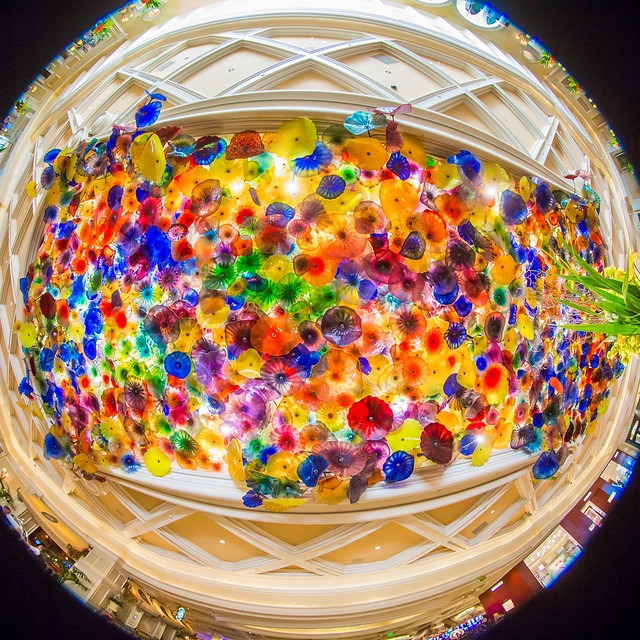
My Friend Chihuly Says Hi

I almost didn’t purchase the Canon EF 8-15mm f/4L Fisheye USM lens. I remember a conversation when I bought it a few years back on Google+ with my good pal Gordon Laing where I was really debating buying it. It was in pre production and I had an order in with B&H but it hadn’t shipped yet. At around $ 1,400 the lens felt expensive for what I worried might be an oddball lens, a lens useful for making a few high impact fisheye shots but not good for much else.

I’m happy to say that I did buy the EF 8-15mm fisheye lens and that I couldn’t be more happy about that decision.

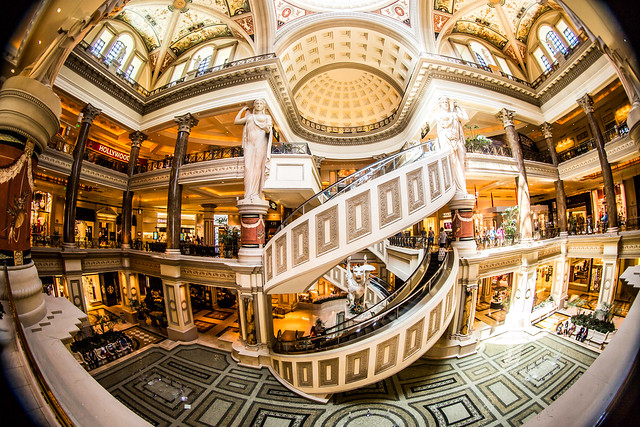
My main dilemma with the EF 8-15mm fisheye was that I already owned the excellent EF 24mm f/1.4 lens and EF 14mm f/2.8 lens, and so I felt like I had the whole wide angle world covered. Now I find that I use this lens at 15mm much more than either my EF 24mm f/1.4 lens and EF 14mm f/2.8 lens and get what feels to me to be a remarkable more normal non fishy looking wide angle shot. Yes, you can tell it came from a fisheye lens at 15mm, but barely and I love the slightest degree of distortion I get there artistically speaking.

Welcome to Caesars

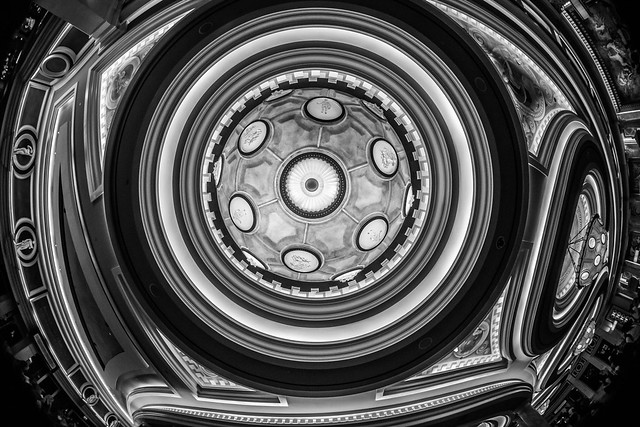
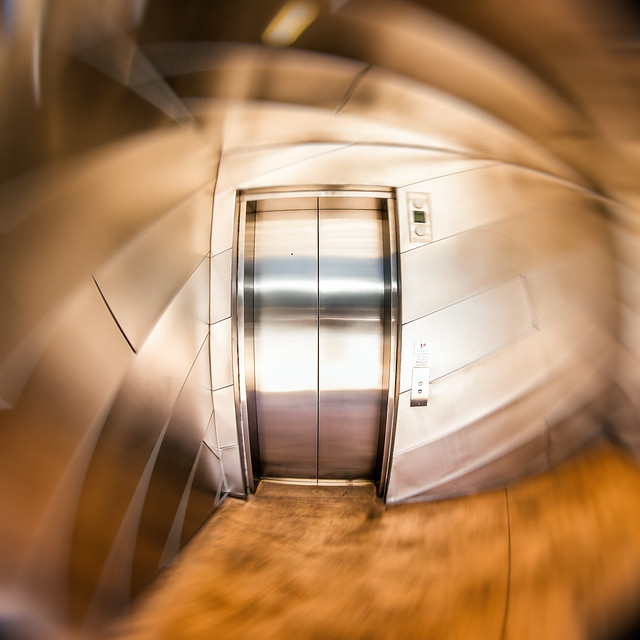
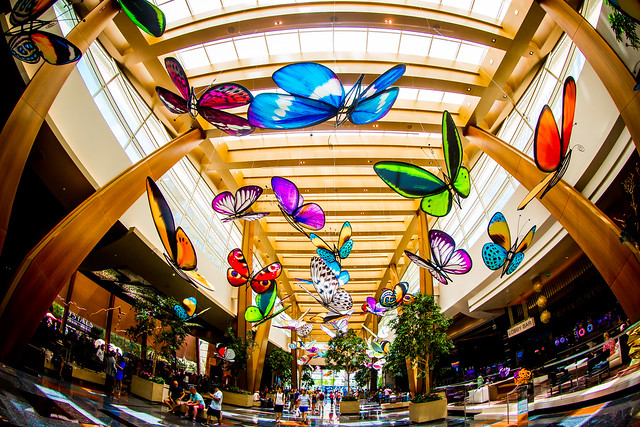
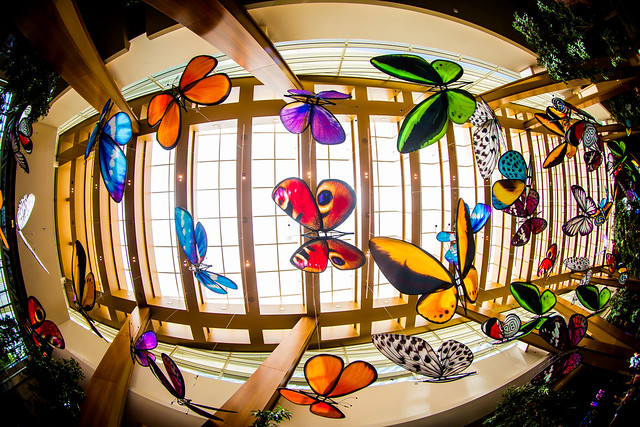
Of course I have way more fun shooting this lens at 8mm and have found that beyond traditional fisheye subjects, this lens has opened up a whole new world to me when it comes to shooting more abstractly — especially with architecture. I find these days my EF 14mm lens stays in my bag and instead I put on my EF 8-15mm fisheye lens for almost every ceiling photo I take.

I find this lens gets me my highest impact shots. Shots that make you go wow and make people notice.

Underground

On a full frame lens this lens gives you a perfect circle at 8mm. I love the square crop format and frequently shoot it at 8mm and then crop square afterwards.

The lens is super sharp and great if you want to get the entire ceiling of Chihuly’s amazing sculpture at the Bellagio like in the photo with this post.

While it’s not the best portrait lens, it can be fun to use as well with photographing people in new and creative ways (like this version of the human eye that I used it on).

As a reminder, my analysis of my Canon gear is being done in partnership with Canon and I am receiving compensation for this work with them.

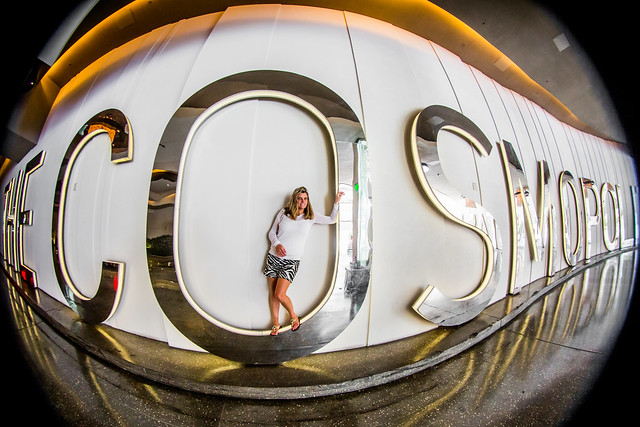
Meet You at the Cosmopolitan

You Give Your Hand to Me

If You Can Find Her

Your Love is My Favorite Color

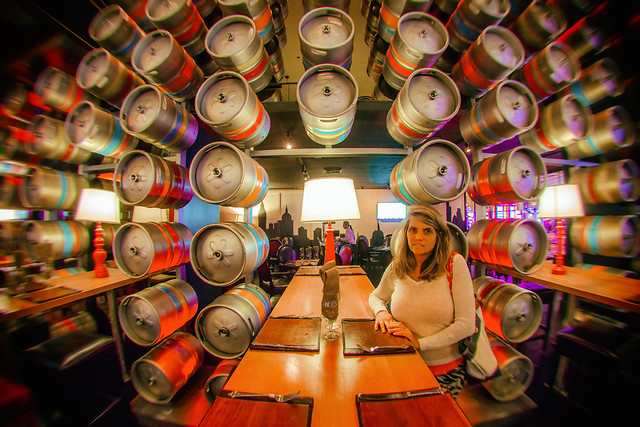
Time for a Beer?

Your Love is My Favorite Color

Penchant


Thomas Hawk Digital Connection

 
Comments Off on The Canon EF 8-15mm f/4L Fisheye USM, My New Favorite Wide Angle Canon L Series Lens

Posted in Photography


Canon introduces new $78K 50-1000mm cine lens

28 Oct

Canon has taken the wraps off its new 50-1000mm CN20x 50 IAS H E1/P1 cinema lens, expanding its cine-servo offerings with what the maker says is the first-ever lens boasting a combined 20x magnification, integrated 1.5x extender, and a removable servo drive. The lens is targeted specifically at nature and sports television productions, as evidenced by its far from enthusiast-friendly $ 78K price-tag. Click through for more details

Articles: Digital Photography Review (dpreview.com)

 
Comments Off on Canon introduces new $78K 50-1000mm cine lens

Posted in Uncategorized


The Canon EF 50mm f/1.2 L USM lens — One of the Fastest Canon Primes You Can Buy

28 Oct

Sunrises Are Best in Las Vegas

It doesn’t get any more bokeh than f/1.2.

The first thing you notice when you hold the EF 50mm f/1.2L USM lens for the first time is how significant the weight of this lens is over the less expensive EF 50mm f/1.4 USM lens or EF 50mm f/1.8 II lens(both also excellent 50mms lenses). You can feel the quality as you weigh it in your hand. A big, solid, piece of glass allows this super fast f/1.2L lens to get the shallowest depth of field possible.

If you are going to be shooting in the darkest of environments, this is the lens for you. I use this lens a lot at night time parties or indoor events, where getting closer than you need with the EF 135mm lens is not a problem. I use this lens to take amazing photographs of paintings in museums and other places where you want a near perfect technical image at closer range. It’s a wonderful portrait lens of course.

Verbena

I like to take this lens with me if I’m going out to dinner at a restaurant or out for cocktails as it does a remarkable job at capturing food/cocktails in low light. As an aside, the cocktail in this post that I photographed with it is called the verbena and is a secret drink off the menu at the Cosmopolitan Chandelier bar in Las Vegas. The cocktail contains an edible flower called a Szechuan button that you chew before drinking the cocktail. It actually alters your tastebuds and feels like an explosion of pop rocks in your mouth as your entire mouth goes numb. As you sip your cocktail after chewing the flower you taste it in a whole different way. I’d definitely recommend checking it out at the Cosmopolitan on your next trip to Vegas.


Back to photography, the only drawback of this lens is the price. You do pay up a bit for quality here. It’s not that this lens is not worth the money (a little over $ 1,500), it is, it’s just that the EF 50mm f/1.4 USM lens is such a fantastic value when you compare the two (at around $ 400). While I like this lens much more than my EF 50mm f/1.4, if you are on more of a budget, you may find that the EF 50mm f/1.4 lens is the better 50mm lens for you to buy. On the other hand, if you really must own the best at 50mm lens, this is it.

Sit Over There

It should be noted that at f/1.2 this is currently the fastest (lowest aperture) lens in production by Canon but that it shares this distinction with the EF 85mm f/1.2 USM lens, another excellent Canon portrait lens that I do not own yet, but that is on my list to consider soon.

There is another f/1.0 lens that Canon made, but that lens is no longer in production that I’ve never tried.

As a reminder, my analysis of my Canon gear is being done in partnership with Canon and I am receiving compensation for this work with them. More on Canon prime lenses here.

I'll Hold You

Through the Years

Through the Years

I Felt This Way Before

Just Wait and See

Turn Me On

A Reminder to Myself


Thomas Hawk Digital Connection

 
Comments Off on The Canon EF 50mm f/1.2 L USM lens — One of the Fastest Canon Primes You Can Buy

Posted in Photography


An Introduction to DSLR Photography, the Canon EOS 70D and EF-S 18-135mm f/3.5-5.6 IS STM Lens

26 Oct

Just Wait Until Midnight

The very first Canon DSLR I ever purchased, about a decade ago, was the Canon EOS 10D. The very first Canon lens I bought was the EF 28-135mm f/3.5-5.6 IS USM zoom lens.

While my photography has advanced considerably over the past decade, this was an excellent starter set up for me. It was a decent DSLR for me (for the time) with a lens, which gave me a very wide range. Ultimately I upgraded bodies and got into more expensive Canon L series prime lenses, but this early set up gave me an opportunity to really experiment and try to figure out if this was a pursuit that I was going to invest more time and energy into.

About the same time I bought my original EOS 10D and EF 28-135mm lens I also purchased a set of Ping golf clubs. I thought golf was going to be something that I’d end up being interested in. I paid too much for what at the time were top of the line clubs. Unfortunately, I never did take up golf seriously and I have a very expensive set of unused Ping golf clubs that sit in my basement today. Maybe someday one of my children will take up golf.

The point of that story is, that if you are starting out with digital photography, you need something that is solid and good enough to take awesome photos, without investing $ 10,000 into your new hobby. This is why I suggest the EOS 70D and EF-S 18-135mm STM lens as an entry point for people starting out. The EOS 70D is one of Canon’s most popular DSLRs, but it’s much cheaper than the primary body I use, my EOS 5D Mark III. Although I do encourage people to use prime lenses, most people starting out don’t want to buy 5 different prime lenses with 5 different focal distances — that can get very expensive quickly.

The EF-S 18-135mm lens is a strong, high quality lens that you can use with the EOS 70D and shoot everything from wide angle landscapes, to telephoto shots of your kid’s baseball game or school play. With just a bit more range than my first EF 28-135mm lens, it’s a great way to start out. Although I don’t personally shoot a lot of DSLR video, many people do and it’s nice to have such high quality video as another option with this set up.

The photos in this post were all taken with this camera and this lens on my recent trip to Las Vegas.

A Joy You Could Not Measure

Through the Years

Because the EOS 70D is a cropped sensor, this lens actually has even more reach than a 135mm lens on a full frame. A cropped sensor is 1.6x times smaller than a full frame sensor — full frame sensors are the same size as traditional 35mm cameras.

Practically speaking, what you see when you look through a camera with a cropped sensor at 50mm would be equivalent to what you would see at 80mm on a camera with a full frame sensor. For this reason, if you are shooting sports or wildlife or other subject matter where you want longer reach, the cropped sensor delivers more reach.

Full frame sensors, in my opinion, do better in low light and at high iso settings and are preferable, but they are also more expensive and might not be as necessary for someone starting out.

Sunrises Are Best in Las Vegas

One of the fun things that I like doing with a zoom is zooming while my shutter is open on a long exposure shot. This creates an interesting double exposure zoom sort of effect that I use in some of my photographs. The disadvantage of this zoom is that it is not as fast (low aperture number) as some of the prime lenses.

If you end up starting with this sort of a combo, you might also want to consider the excellent value you get from a Canon EF 50mm f/1.8 II or EF 50mm f/1.4 USM prime lenses. Both of these lenses represent excellent value and are some of the least expensive prime lenses you can buy. You’ll have no problem using the EF-S 18-135mm lens during the day, but at night, or in a much lower light situation, you’ll appreciate being able to put on a faster 50mm prime lens that will work better in less light.

For many photographers the EOS 70D is all the camera you will ever need. Some of the best photographers I know are content to shoot with this body and never upgrade from here. To see some of the best work done with this camera body, check out these photos on Flickr all taken with the EOS 70D. Because this camera will be enough for some folks, I think this is a good place to start.

I personally use my EOS 70D as a second camera — a good backup to use in case something goes wrong with my EOS 5D Mark III and a camera I can keep at my office in case I feel like taking a break during the day and walking around town and shooting. I think it works especially well for street photography given the range you can get with the EF-S 18-135mm lens.

As your passion for photography grows though you will want to consider upgrading to a Canon EOS 5D Mark III and some of the prime lenses that I will review in some upcoming blog posts.

As a reminder, my analysis of my Canon gear is being done in partnership with Canon and I am receiving compensation for this work with them.

Better Lines

Boulevard Poolside

Lay Out

Just Wait and See

A Joy You Could Not Measure

A Joy You Could Not Measure

Through the Years

Through the Years


Thomas Hawk Digital Connection

 
Comments Off on An Introduction to DSLR Photography, the Canon EOS 70D and EF-S 18-135mm f/3.5-5.6 IS STM Lens

Posted in Photography


My Favorite Lens of All, the Sharp, Smooth, Feel of the Canon EF 135mm f/2L USM

26 Oct

One Last Hand

For those of you who know me or follow my work, you probably already know about my love affair with the Canon EF 135mm f/2L USM telephoto lens. Simply put, this is my favorite lens I have ever used in my life. It’s also the lens I use for probably 70% of the photographs which I produce. This is a workhorse lens and I believe it is the sharpest lens that Canon makes. If I could only own a single Canon prime lens, this would be it.

Bet Red

Professional grade Canon L series lenses are not cheap. Canon’s L series represent their top of the line optics. They are what almost all Canon professional photographers shoot with. That said, I think the EF 135mm f/2L USM is one of the best values as far as Canon L series lenses go. The lens costs a little over $ 1,000 and is amongst the most economical L series lenses you can buy.

I probably shoot this lens at f/2 the majority of the time. This gives you a super clean point of focus, with the beautiful out of focus bokeh away from your primary point of interest. For those low light shallow depth of field photos, it does not get better than this lens in my opinion. The portraits you can make with this lens are beautiful — sharp as tack but with the subtle bokeh around the edges that a lens like this can produce.

Two Hearts Can't Be Wrong

The autofocus on this lens is the most responsive of any lens I’ve ever used. It autofocuses so lightning fast and allows you to quickly lock in on the action that you want to see. It’s a very quiet and very smooth feel when you hit your focal point perfectly on the mark.

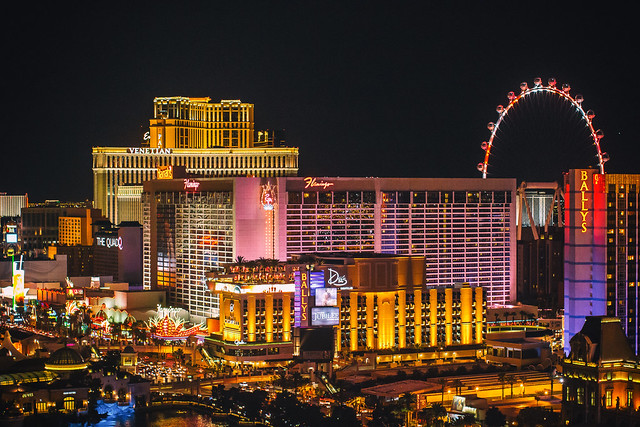
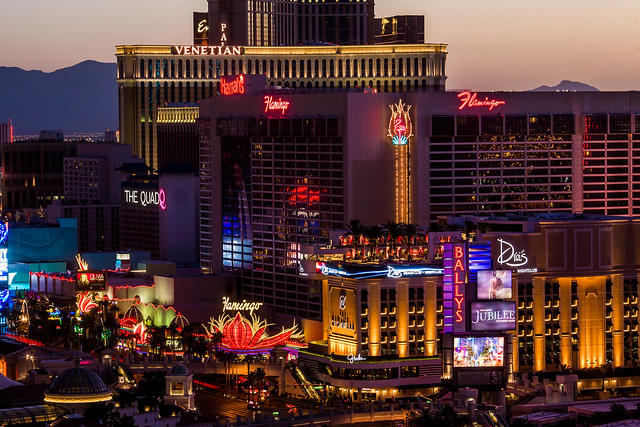
The photos in this blog post were all taken on my recent trip to Vegas with this lens. I cannot recommend this lens strongly enough. An example of why I like this lens so much can be seen in the first photo in this post. Forget about it as it appears in this post, click here to see it in full high res glory. Look at how sharp the details are on that photo. Notice the individual neon tubes as visible in the Harrahs and Flamingo signs. I took this photo from the balcony of the Cosmopolitan of Las Vegas, a great distance away. The 135mm EF f/2L USM gave me the distance I needed to shoot down with such clarity on the neon signs in the photo.

The photo of the roulette wheel and the mannequin in the post show how great the bokeh and depth of field is around an isolated focus point. This is another of my favorite characteristics of this lens. Shooting portraits at f/2 on this lens feels just perfect to me.

In addition to portraits, this lens is great for street photography, sports, concerts, abstracts, and so many other types of photography.

As a reminder, my analysis of my Canon gear is being done in partnership with Canon and I am receiving compensation for this work with them. More on Canon telephoto lenses here.

Teardrop

I'll Take Two

Seeing Red


Thomas Hawk Digital Connection

 
Comments Off on My Favorite Lens of All, the Sharp, Smooth, Feel of the Canon EF 135mm f/2L USM

Posted in Photography


Canon patents lens designs with variable and glass elements

26 Oct

It’s not uncommon for a company to patent technologies that might be incorporated into products at some point, though the company might not have any plans to use it in the immediate future. Such a business move appears to be the case with a recent Canon patent, which details the use of variable lens elements in combination with traditional glass elements. Read more

Articles: Digital Photography Review (dpreview.com)

 
Comments Off on Canon patents lens designs with variable and glass elements

Posted in Uncategorized