In late 2015, many (if not most) consumers are likely to shop based on price and capability, rather than according to whether a certain model contains a mirror or not. In this category, you’ll find both mirrorless and DSLR cameras that are highly capable under a variety of shooting situations, offer built-in high-spec viewfinders – either optical and electronic – and a bevy of external controls. Read more
Tag: Lens
-
2015 Roundup: Interchangeable Lens Cameras $500-800
The $ 500-800 category (based on US MSRP) features quite a few strong offerings, some of which should satisfy first-time camera buyers with easy-to-use interfaces and point-and-shot style functionality. Others are aimed more at seasoned enthusiasts, offering direct manual controls and high-end features. Read more
-
Comparing a 24mm Versus 50mm Lens for Photographing People
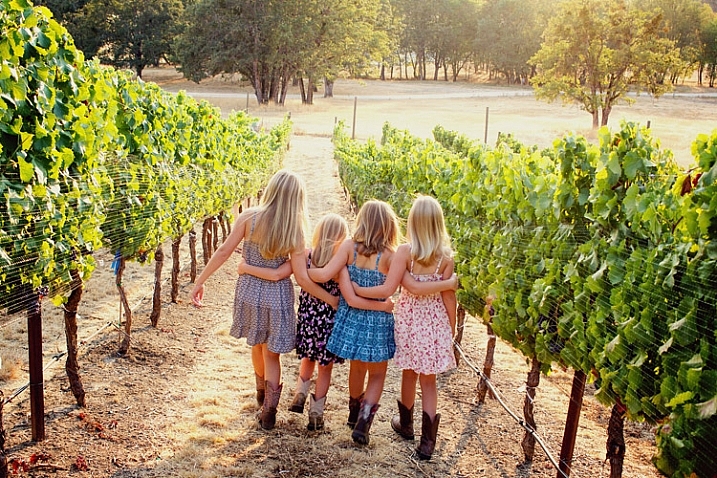
Image taken with Canon 60D and Canon 24mm EF-S lens.
A number of dPS readers have recently been asking about the Canon 24mm EF-S pancake lens, and how it compares to a 50mm lenses for photographing people. Both are great options, given the price point, but they do have slightly different strengths when it comes to people photography. In this article, I’ll show you several different images of the same model, location, and posing, photographed with both a 24mm and a 50mm lens. This will provide a good visual of the difference between the two lenses, as well as give you insight as to when you might want to reach for each one.

Image taken with Canon 60D and 50mm lens.
For continuity, all images in this post were taken with a Canon 60D, and either the Canon 24mm f/2.8 or the Canon 50mm f/1.8 lenses. The 60D is an APS-C sensor (cropped sensor) camera, so first you need to multiply the focal length of each of your lenses by 1.6x in order to determine the functioning focal length of them on this camera (if you use Nikon it may be 1.5x, check your manual). So on a cropped sensor camera, the 24mm lens functions roughly as a 38mm lens, and the 50mm lens functions as an 80mm lens. In other words, the 50mm lens is great for head-and-shoulders portraits, while the 24mm lens is great for photographing people in the context of their surroundings. In the above example, you can see that the 50mm lens provided a tight shot of these two sisters, with a blurred background that keeps all the attention on their faces.
However, the context for this session is also important, in that it took place at a family vineyard, and the clients wanted to be sure that the grapes were also visible in the background of some of the images. As you can see above, the grapes really weren’t visible in the portrait taken with the 50mm lens, nor would closing down the aperture really give the perspective of the vineyard that my clients were looking for. So, after taking a few portraits with the 50mm, I switched over to my 24mm lens in order to capture a few wider shots.

Image taken with Canon 60D and Canon 24mm EF-S lens.
Same girls, same exact location, very similar pose. The only real difference here is that with the switch to the 24mm lens, you can see more of the girls and the the area around them. In some instances, you may want to minimize the area around your subject, in which case the 24mm lens would not be ideal. However, in this case it allowed for the images that highlighted both the girls and the vineyard, which was what the clients were after.
Bonus tip: Photographing sibling sets with a 24mm lens also allows you to see the height differences between siblings more easily with the wider angle shot, which is something that a lot of parents really enjoy.
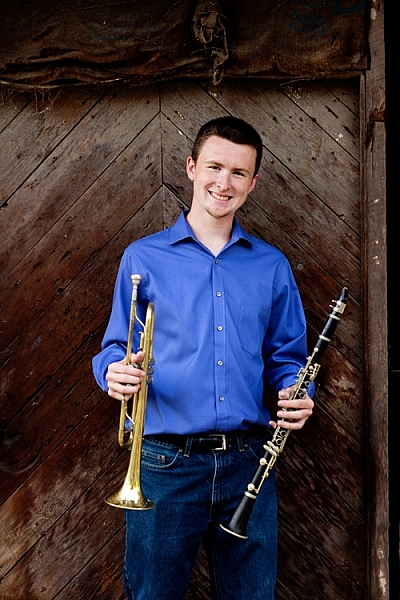
Image taken with Canon 60D and 50mm lens.
Another thing to consider, besides the contents of the background in your images, is the coloring of the background. In the image above, the deep colored wood background brings a moodiness to the image that could be appropriate for a musician. However, the interesting thing is that the overall feeling of the image changes quite a bit when you look at it from the 24mm angle of view.
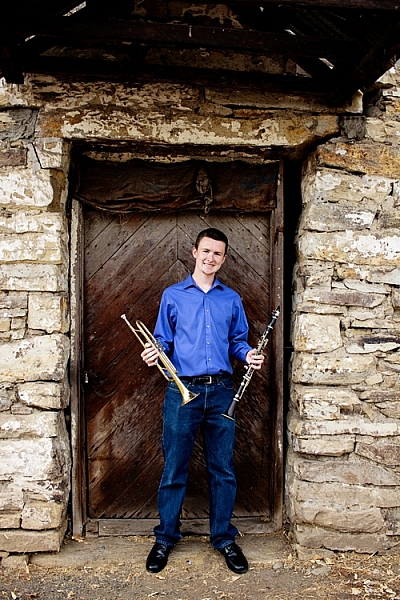
Image taken with Canon 60D and 24mm EF-S lens.
The second image, though in the same location, feels a lot less moody and dramatic than the first. The lighter stonework around the door brings a sense of balance to the image that just wouldn’t be achieved as well with the 50mm lens in this location. In my experience, this balance is especially important when it comes to converting images to black and white.
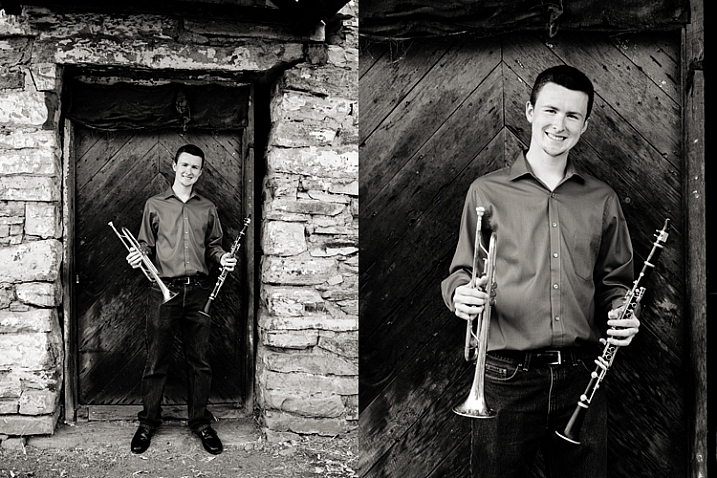
As you can see in the left image, the lighter stonework, around the darker door, serves as a frame for the subject, and naturally draws your eye in towards him. In addition, the increased contrast and texture provide some of the key ingredients for black and white images, which makes the image more aesthetically pleasing than the image on the right.
Overall, while there may be instances in which the content or coloring of your background may cause you to reach for one of these two lenses over the other, I’m very much in favor of using both of them whenever possible. Here’s a quick example from my own life to explain why both are so great for their own reasons. I recently photographed my girls in their Halloween costumes. I started with the 50mm lens because it’s my favorite.

Image taken with Canon 60D and 50mm lens.
I love this image of both girls (above) – the 50mm lens really lets you see their faces and expressions well, and the bokeh of the 50mm f/1.8 helped soften the literal construction site in the background of the image. However, the closer crop also means that only a small portion of their costumes were visible.
So, I switched over to my 24mm lens to take a full-length photo (below) of my little monkey and my lion as well. Now, I can really see them from head to toe. I can see the little fake feet of the monkey costume that freaked my youngest daughter out so much that she begged her sister to switch costumes with her. I can see the height difference between the two of them. I can see the black flats that my oldest daughter is so proud of, and wears to any event that she deems remotely “fancy”. Those are all things that I want to look back on, and remember. I love both images for different reasons, and am so happy to have them both, thanks to my trusty 24mm and 50mm lenses.
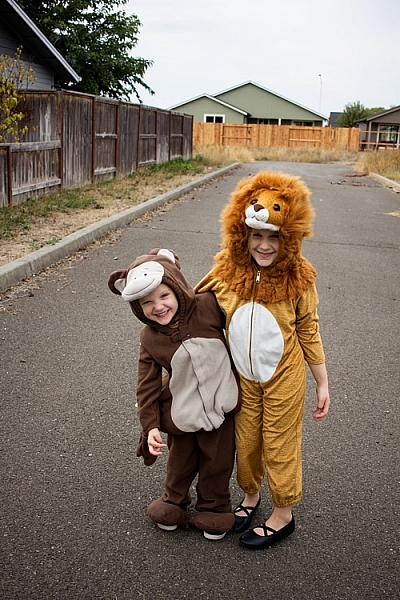
Image taken with Canon 60D and 24mm EF-S lens
I hope this has given you a good idea of how these two focal lengths compare when photographing people.
Have you tried the Canon 24mm EF-S lens? How do you use it? Do you have a nifty-fifty and do you use it for people photography? Which is your favorite? Please share your comments and images below.
googletag.cmd.push(function() {
tablet_slots.push( googletag.defineSlot( “/1005424/_dPSv4_tab-all-article-bottom_(300×250)”, [300, 250], “pb-ad-78623” ).addService( googletag.pubads() ) ); } );googletag.cmd.push(function() {
mobile_slots.push( googletag.defineSlot( “/1005424/_dPSv4_mob-all-article-bottom_(300×250)”, [300, 250], “pb-ad-78158” ).addService( googletag.pubads() ) ); } );The post Comparing a 24mm Versus 50mm Lens for Photographing People by Meredith Clark appeared first on Digital Photography School.
-
dPS Writer’s Favorite Lens: Rokinon 14mm f2.8
“What do you mean it’s a manual lens?”
That is usually the first response I receive when I tell people about one of the favorite lenses I keep in my bag: The Rokinon 14mm f/2.8. I understand their confusion. I never dreamed that I would succumb to the seeming devolution of using fully manual lenses.
Allow me to attempt to dispel the myth that manual focus/aperture lenses are difficult, and ungainly in the field. In mere months the Rokinon 14mm f/2.8 has quickly became a workhorse of my photo arsenal – let me tell you why. Grab a tissue, because it is a love story.
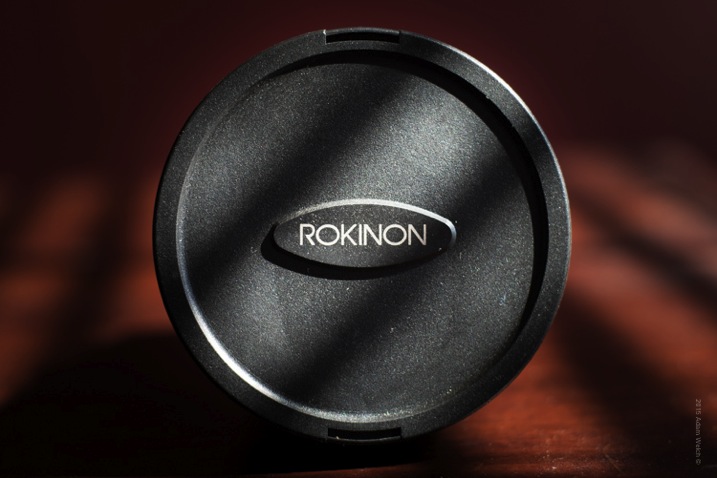
When I say that the Rokinon is a fully manual lens, what I mean is that there is no autofocus, and that the aperture must also be selected manually, using an aperture ring. This is a sticking point for most photographers, who have only used fully automated lenses. Personally, I have used fully manual legacy lenses for years, and have come to love the tangible control they require while I’m shooting. I really feel connected to the experience, more than I do when using an autofocusing lens.
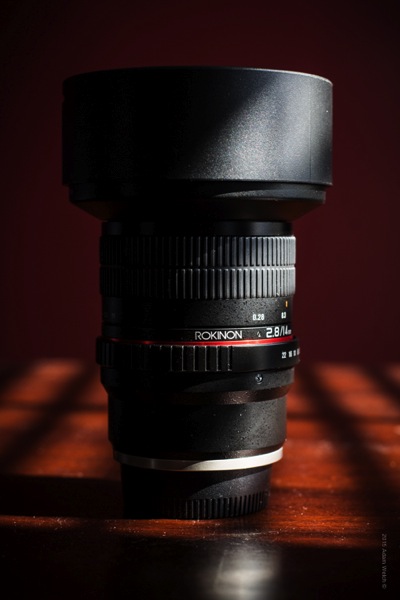
I will still admit, however, that a fully manual lens is not always ideal for every situation. So what type of photography suits the Rokinon best? The reason I purchased this lens in the first place was because I needed a fast, wide-angle lens, that can function as a main piece of glass for my astrophotography work. I find myself aiming my camera toward the sky more and more, so I really needed a quality lens that could serve as my go-to for most, if not all, of my nightscapes.
The wide-angle view, and relatively large aperture of f/2.8, makes the Rokinon ready-made for night photography, but of course, it is also a great tool for ultra-wide landscape shots. Some may find the 14mm focal length to be just a little too wide for a general purpose landscape lens, but it is most definitely capable of filling the role.
The most incredible quality about the Rokinon 14mm f/2.8 is just that, its quality. For the price, I can honestly say I have never encountered such a well-made lens, that produces tack sharp results throughout its aperture range. My initial test shots surpassed any expectations I could have hoped for from such a budget lens. Reading comments and testimonials from other users of the lens really left me with a healthy dose of, it’s too good to be true, doubt lingering in my mind.
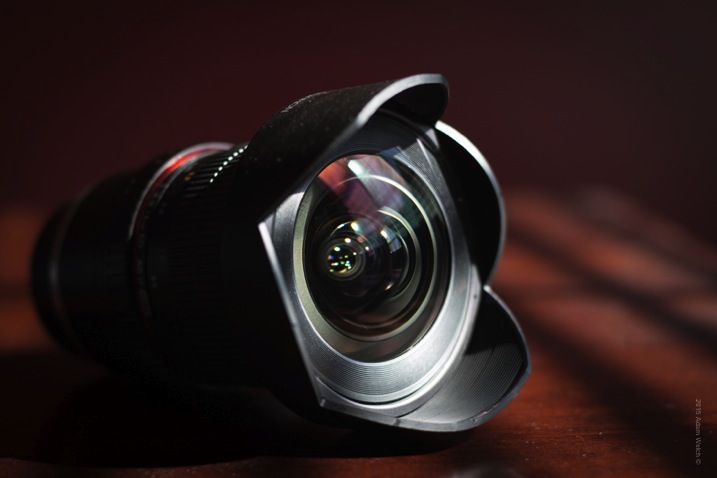
The quality of the build, and the subsequent image sharpness, are virtually on par with lenses which cost literally ten times as much as the Rokinon. I’m not suggesting that a lens with an average cost of $ 324 will be exactly the same as a lens costing $ 1,300 – but the gap between price and performance is, for lack of a better word, incredible. The aperture ring is comfortable to use, and produces a click at each f/stop, marking that is solidly satisfying.
Something that I really like about the Rokinon is the focusing ring. I has a very long travel when acquiring focus; meaning that adjusting occurs relatively slowly. This allows you to achieve tack sharp focus while shooting with the lens wide open at f/2.8, and makes honing in on stars very easy without over or under focusing.

A common point of discussion concerning the Rokinon, in regard to its suitability for night photography, is the extreme low occurrence of “coma” when imaging the stars. Coma refers to an optical phenomena called “comatic aberration” (not to be confused with chromatic aberration). Coma is the distortion of small points of light when the light rays enter the lens at sharp angles, which makes small points of light, such as stars, appear to look like comets with small tails. Coma is amplified by imperfections in the lens geometry itself, or in the lens elements, and usually gets worse the further you move from the center of the lens. Yet strangely enough, the Rokinon excels in low coma aberrations, even to the point of OUTPERFORMING higher priced lenses of the same focal length and aperture ranges.
The Rokinon 14mm f/2.8 lens is one that I have grown to love in a relatively short time. The majority of my work revolves around landscapes, and shooting at wide-angles, often in low light. The Rokinon fills the requirements of my shooting needs, and then some.

The full manual functionality of the lens could be odd if are not used to shooting that way, but for me I find it in no way slows me down, or hinders the quality of my images – in fact quite the opposite. The build quality, sharpness, low-light performance, and low coma are bundled together at a price that hovers in the $ 320 USD end of the pool.
In my opinion, if you are looking for a great landscape and astrophotography lens, or if you’re just wanting to get creative with wide angles, look no further than the Rokinon 14mm f/2.8.
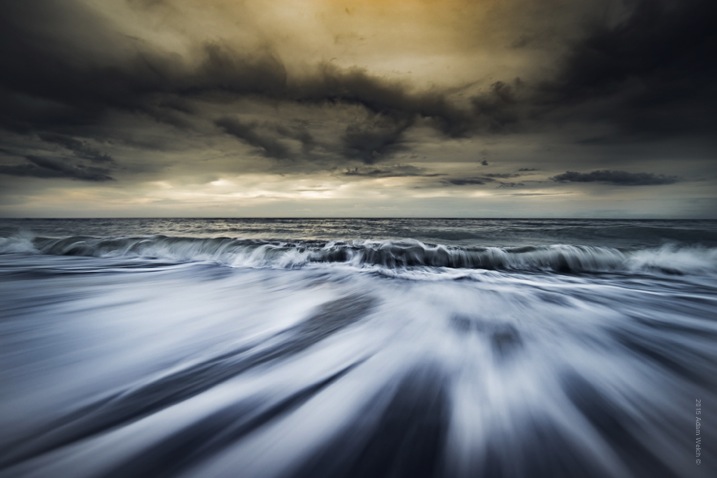
What you’ve all been waiting for…here are some images shot using the Rokinon 14mm f/2.8! All images shot with a Sony A7r and processed using Adobe Lightroom CC.


googletag.cmd.push(function() {
tablet_slots.push( googletag.defineSlot( “/1005424/_dPSv4_tab-all-article-bottom_(300×250)”, [300, 250], “pb-ad-78623” ).addService( googletag.pubads() ) ); } );googletag.cmd.push(function() {
mobile_slots.push( googletag.defineSlot( “/1005424/_dPSv4_mob-all-article-bottom_(300×250)”, [300, 250], “pb-ad-78158” ).addService( googletag.pubads() ) ); } );The post dPS Writer’s Favorite Lens: Rokinon 14mm f2.8 by Adam Welch appeared first on Digital Photography School.
-
2015 Roundups: Fixed Prime Lens Cameras
The Fixed Prime Lens Camera category is our smallest roundup of 2015 but also one of our most interesting. Cameras in this category range quite a bit, from the affordable, to the jaw-dropping expensive. If you prefer to zoom with your feet, instead of your lens, then this is the roundup for you. Read on
-
Macro stick-on lens brings close-up capability to smartphones
Most smartphone cameras seriously struggle when it comes to macro photography. A number of accessory macro attachment lenses are available, but many of them are device-specific and bulky enough to discourage carrying every day. Now the makers of the 150x Micro Phone Lens microscope attachment have come up with an ultra-portable and very affordable solution compatible with virtually all smartphone cameras – a stick-on macro lens. Read more
-
2015 Roundup: Interchangeable Lens Cameras under $500
Interchangeable lens cameras come in all kinds of different shapes, sizes and prices, from the very reasonable to the eye-wateringly expensive. The under $ 500 category is a place most first-time ILC buyers will likely find themselves. If you’re considering a sub-$ 500 ILC, you might be stepping up from a compact, or perhaps even your smartphone. Whatever the reason, there are plenty of excellent options for under $ 500 that should satisfy the needs of many. Find out our best bets for the category. Read more
-
An oldie but a goodie – why the Tamron 28-200mm lens is my favorite
Probably the easiest question that I’m asked is, what is my favorite lens? Despite owning a sizeable collection of lenses for my Pentax K-7, the very first lens I ever bought, a Tamron 28-200mm was, and still is, my favorite lens.
I’m basically a street photographer, but I dabble in landscapes and animals from time to time. When traveling, and shooting on the streets, I carry one camera mounted with one lens, and seldom anything else. I remove the lens cap at the beginning of the day, and put it back on at night when I’ve finished shooting. To me, continually putting a lens cap on and taking it off takes too much time, if I want to be able to react to situations and shoot quickly. As for my lens, because I hold my camera in my right hand for eight or more hours a day, I need a robust lens that is up to anything that I can throw at it. The 28-200mm has seldom let me down.

Why it doesn’t matter that this lens is not stabilized
I’m not sure exactly when I bought this lens, but Tamron discontinued it in around 2001 – so let’s say it is probably a good 12-15 years old. At this age, it of course, predates the concept of affordable image stabilized cameras. (Cue plug for Pentax!). One benefit of shooting with Pentax cameras is that Pentax put image stabilization in the camera, and not the lenses. So this extends the longevity of older lenses – instead of trading up all your lenses – all you need to do is to change the camera body.
This lens has been mounted to a Pentax K-1000 film camera, a Pentax *ist DS, the Pentax K-10D and, more recently, the Pentax K-7. Counting images in my Lightroom catalog shows that this lens has captured over 66,000 images of the 84,000 (78.6%) in my current catalog.
From a (relatively) wide angle to telephoto in a single lens
What I like about this lens is its range. At 28mm it will shoot fairly wide, so I can capture an entire scene with it. At 200mm I can get in nice, and close and it’s still easy enough to handhold, even at small apertures where the shutter speed is quite slow. I also own a 300mm zoom lens and I find that it works great where there is plenty of light, but as soon as I start using small apertures, or shooting in poor light, the extra focal length on the lens really doesn’t get used, or I get soft images because I just can’t hold the camera steady enough. Basically, carrying a 300mm zoom on my camera, means I am carrying extra weight in the lens that I simply don’t and can’t use.
Why weight and size are important
The Tamron 28-200mm is lightweight at 12.5oz (354g), small for a zoom lens, and is only three inches tall. This makes it a little more discrete than some other lenses for street photography. Although since I am tall and have bright red hair, discretion isn’t something I value particularly highly.
I balance the weight of the lens with a battery grip, which carries a spare battery and a second set of controls. This grip helps me to hold the camera sideways to shot in portrait mode comfortably. It also balances the weight of the lens so the camera actually stands upright on a table, and despite the extra weight of the grip, it’s actually easier to carry for long periods of time.
The 28-200mm can be locked down for travelling, and when unlocked, it requires only a small rotation to go from 28mm all the way to 200mm. When it’s in its fully zoomed position it holds the zoom firmly, freeing me to use both hands to steady the camera. The aperture range for the lens starts at 3.8-5.6 (depending on how far you are zoomed) so there’s plenty of opportunity to capture images with a shallow depth of field, even at full zoom of 200mm.
Alternative lenses
If there are times when I look beyond the 28-200mm for another lens it’s generally one that matches a specific circumstance, such as shooting in very low light. In those situations my 50mm f/1.4 is a good second choice lens. I also love my 17 mm fisheye for those occasional times when the scene can benefit from more creative composition.
However, the 28-200mm is my everyday lens. It is permanently affixed to my camera, and has been for 10 years or more. It’s a great all-round lens, and it’s also a sound and robust lens for use in situations that are not always particularly camera friendly. I’ve shot it in all sorts of weather including freezing cold, rain, and snow. The camera and lens have been jammed in backpacks and hand carried on buses, trams, trains and boats, both large and small. It’s been used in dusty conditions in central Australia, and has weathered the humidity of the tropics. It’s also been licked by a curious giraffe, and more than one lemur has mistaken it for a toy.
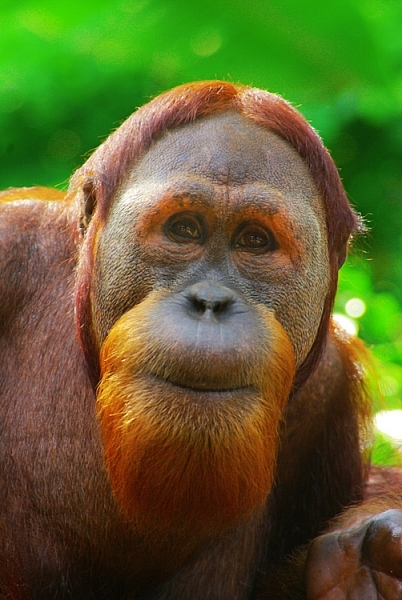
Why this lens works for me
This lens lets me do the two things I love – travel and shoot. I prefer to walk rather than drive, and I generally travel alone because, let’s face it, photographers make really bad travel companions. So, if I am in a foreign city, on foot by myself, I don’t want to be carrying a camera bag full of kit. I want to be comfortable, and that means not carrying a lot of bulky stuff. I want to be able to walk five or ten miles one day, and get up and do the same thing the next day, and feel good about what I am doing. This lens lets me do just that and, in my book, that’s a real plus.
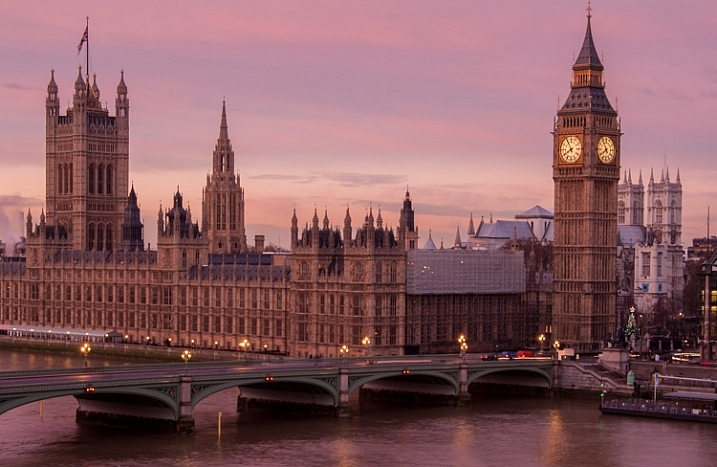
Familiarity breeds speed and comfort
While I like to play with new lenses as much as the next photographer, there’s something to be said for a lens that you’ve used for so long. It’s easy to underestimate the relationship between a photographer and a lens they know so well. Because I’ve used this lens so consistently, for so long, when I pick it up I know instinctively the zoom I’ll need for the scene in front of me. It has become an extension of my body, and my familiarity with it allows me to shoot faster, with confidence, and that helps me to get the shot that I want. If I lost this particular lens I’d not only be very sad, but I’d also be out shopping for its replacement the very next day.
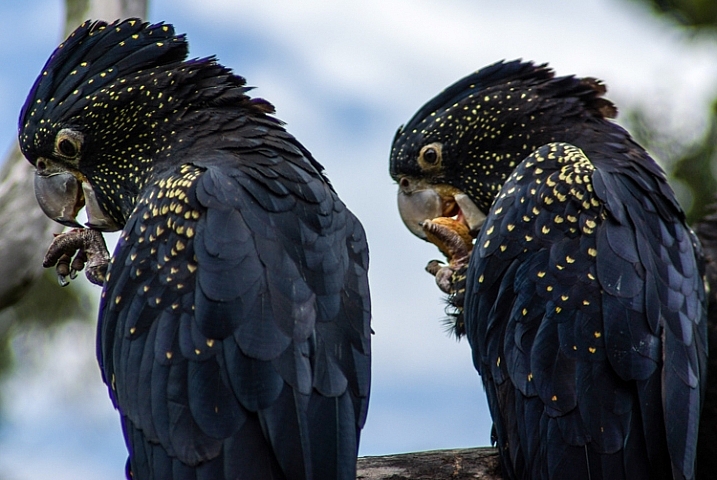
Could I buy a better lens? Yes! Of course. I could easily buy a really good lens, with better optics, which would shoot faster and sharper. But when it comes to weighing the comparative value of a round the world plane ticket and a really good (for this read expensive) lens – I’ll take the ticket and opt for the cheaper lens.
So, if you don’t have a large budget for lenses, and you want a good sound all-purpose lens, then spending a couple hundred dollars on a lens with a range like this one, to me, is a really smart investment.
Tech Specs:
- Tamron AF 28-200mm F3.8-5.6 XR Aspherical IF
- Minimum focus distance: 19″/49cm
- Weight: 12.5oz/354g
- Length: 3″/76mm
- Maximum aperture: 3.8 – 5.6
- Minimum aperture: 22
- Current Replacement Cost: around $ 199

Rome – laundry – captured with a 28-200 tamron lens
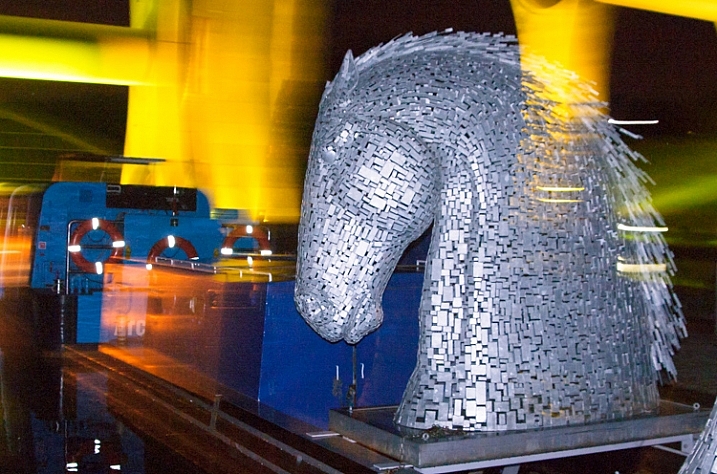
Kelpies, Falkirk Scotland shot with a Tamron 28-200 lens
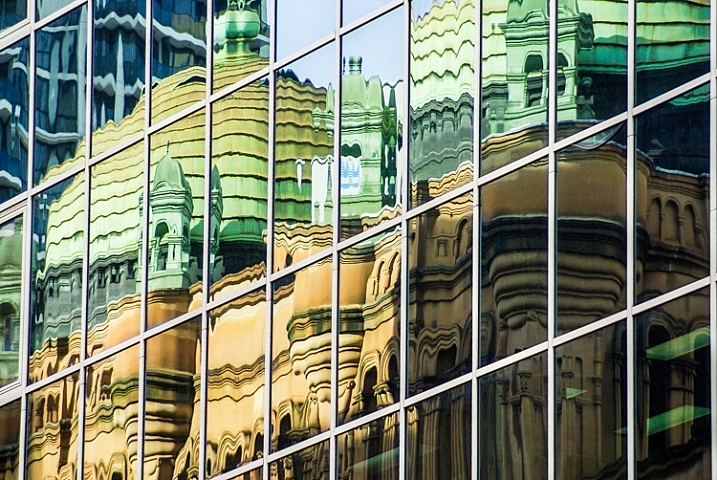
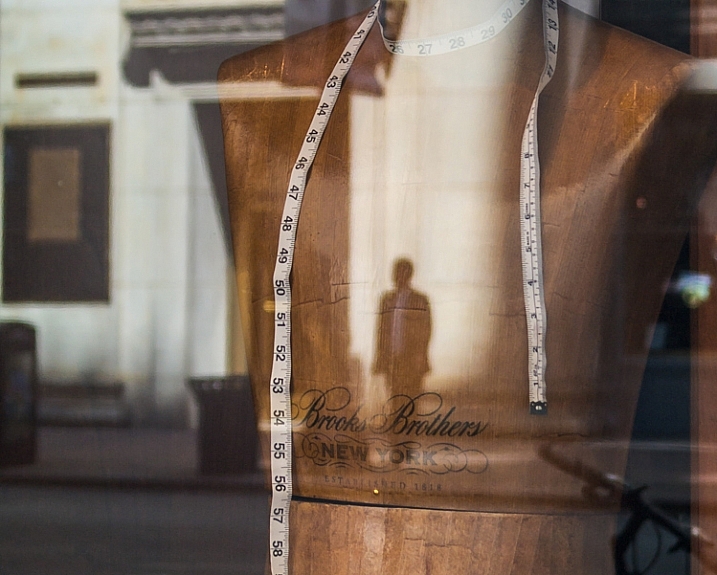
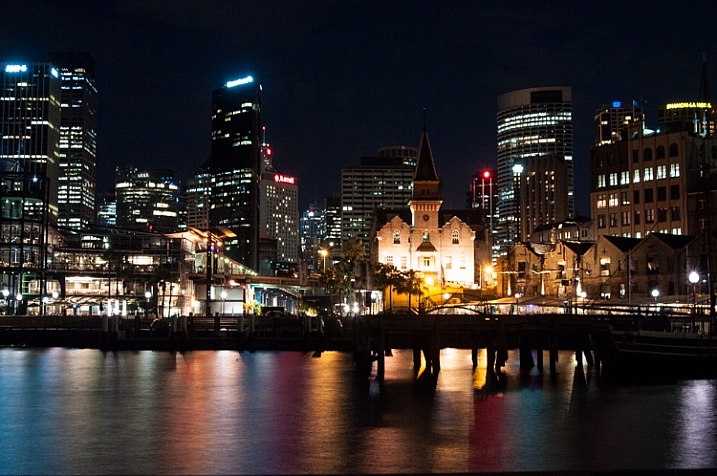
Queen Vic Building Sydney reflection – shot with a Tamron 28-200
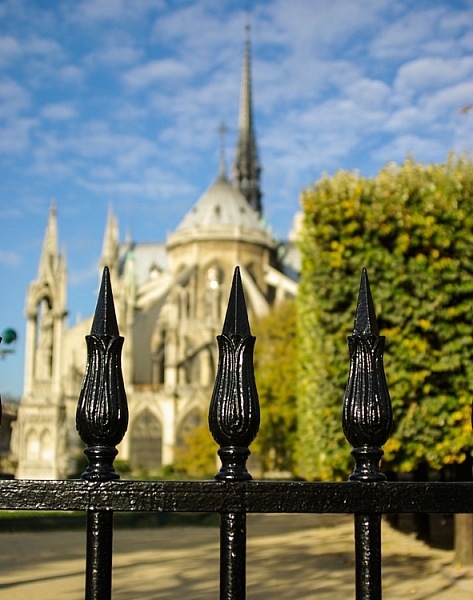
Notre Dame Paris shot with a Tamron 28-200 lens
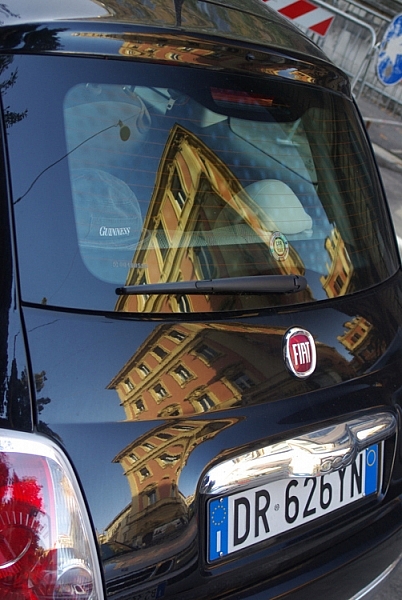
Rome reflection shot with a Tamron 28-200 lens
googletag.cmd.push(function() {
tablet_slots.push( googletag.defineSlot( “/1005424/_dPSv4_tab-all-article-bottom_(300×250)”, [300, 250], “pb-ad-78623” ).addService( googletag.pubads() ) ); } );googletag.cmd.push(function() {
mobile_slots.push( googletag.defineSlot( “/1005424/_dPSv4_mob-all-article-bottom_(300×250)”, [300, 250], “pb-ad-78158” ).addService( googletag.pubads() ) ); } );The post An oldie but a goodie – why the Tamron 28-200mm lens is my favorite by Helen Bradley appeared first on Digital Photography School.
-
M & M: Leica SL Typ 601 real-world gallery updated with M-series lens samples
The Leica SL Typ 601 is the German manufacturer’s first foray into the full-frame mirrorless world, offering a 24MP CMOS sensor in a weather-sealed, milled-aluminum body. Three SL lenses have been introduced for the system, but an M-mount adapter opens up a number of possibilities for the camera. We took advantage of some limited time to shoot with the SL and the Summilux-M 35mm F1.4 ASPH and 50mm F1.4 – see what the combination looks like. Read more
-
Fujifilm brings weather-sealed 35mm F2 lens, 1.4x teleconverter to X-mount
Fujifilm has added another lens to its X-mount, this one being a low-cost Fujinon XF 35mm F2 prime. This compact lens features a nearly silent internal AF system, 9-blade circular aperture, 2 ED elements, and is sealed against moisture and dust. Also announced is a 1.4x teleconverter, which is currently only compatible with the XF 50-140mm F2.8 zoom. It will, however, be compatible with future lenses, including the XF 100-400mm super telephoto lens expected next year. Read more.
