RSS
 

Posts Tagged ‘Lens’

Meike iPhone lens adapter case takes ring light and Sony QX1

18 Jun

$ (document).ready(function() { SampleGalleryV2({“containerId”:”embeddedSampleGallery_5756523953″,”galleryId”:”5756523953″,”isEmbeddedWidget”:true,”standalone”:false,”selectedImageIndex”:0,”startInCommentsView”:false,”isMobile”:false}) });

Hong Kong accessory manufacturer Meike has introduced a new case for the Apple iPhone 6/6s that accepts three accessory lenses and offers a mount for a ring light and Sony’s ILCE-QX1 E-mount ‘lens-style camera’. The MK-H6S PRO comes with a hand grip that has a Bluetooth-enabled shutter release button to deliver a more camera-like experience for mobile phone photographers.

The kit includes three lenses – a 0.65x wide-angle adapter, a 180° fisheye and a 2.5x macro lens – that screw into a mount over the device’s built-in camera. A larger mounting ring in the middle of the case accepts an optional ring light with built-in mirror for selfies. The same ring is also compatible with Sony’s 20MP APS-C QX1 adapter so users will be able to fit Sony E lenses to the device, preview the image on the phone’s screen and control capture via the grip’s shutter release.

The Meike MK-H6S PRO will cost £45/$ 65. For more information visit the Meike website.

Articles: Digital Photography Review (dpreview.com)

 
Comments Off on Meike iPhone lens adapter case takes ring light and Sony QX1

Posted in Uncategorized


Rare 1964 NASA 1000mm F4.5 super telephoto lens to be auctioned

17 Jun

A one-of-a-kind Birns and Sawyer Omnitar 1000mm f/4.5 lens commissioned by NASA in 1964 will soon be available to purchase through RR Auction. The lens is owned by Jim Headley, who introduced it to the public via Shutterbug. According to Headley, the lens weighs 70lbs / 32kg and measures 4ft / 1.2m in length by 10in / 25cm in diameter.

The super telephoto lens was built by Astra in Germany, and was acquired by Headley through a close friend after that friend closed down his camera store. Headly says on his website that he adapted the lens to work with a Canon EOS 40D, ‘effectively making this a 1600mm f:4.5 lens with the digital crop.’ The lens still features a pair of NASA identification tags, as well as a ‘trash can-sized’ lens shade. 

Headley plans to part with the giant lens, telling Shutterbug that it will be sold through an auction this fall by RR Auction in New Hampshire. Interested potential buyers can contact Jonathan Siefken at (603) 732-4280 for additional details.

Articles: Digital Photography Review (dpreview.com)

 
Comments Off on Rare 1964 NASA 1000mm F4.5 super telephoto lens to be auctioned

Posted in Uncategorized


2016 Roundup: Semi-Pro Interchangeable Lens Cameras

13 Jun

Within this category, which is made up of cameras costing $ 2000 or more (body-only, and based on MSRP in the US), you’ll find some of the fiercest competitors the camera industry has to offer. This includes cameras with 50 or more megapixels geared perfectly for studio shooters, 4K-capable cameras for serious film makers, and all-rounders that can easily split their time between pro-level still shooting and high-end video capture.

All of the cameras in this price range use full-frame sensors. And while most of them are DSLRs, there are also several mirrorless options as well. Simply put, there is something here to satisfy just about everyone who is willing to pony up the requisite funds. Read through to see what makes this segment so cutthroat, and what innovations are driving this tier forwards at a remarkable pace. 

The models covered in this roundup are:

  • Canon EOS 5D Mark III
  • Canon EOS 5DS / 5DS R
  • Leica SL
  • Nikon Df
  • Nikon D750
  • Nikon D810
  • Sony Alpha a7R II
  • Sony Alpha a7S
  • Sony Alpha a7S II

Note: We purposely excluded the Canon EOS 1DX II, Nikon D5 and Pentax 645Z from this roundup as we feel the capabilities of both cameras put them in a class of their own, which we’ll cover in an additional roundup.

Articles: Digital Photography Review (dpreview.com)

 
Comments Off on 2016 Roundup: Semi-Pro Interchangeable Lens Cameras

Posted in Uncategorized


2016 Roundup: $1200-2000 part 2: Full-Frame Interchangeable Lens Cameras

09 Jun

For those wanting to step up from entry-level to midrange ILCs, there are many things to consider, including the choice between a DSLR or mirrorless camera, what sensor size suits you best, how important video is to you, and of course the lens system.

While full-frame cameras typically offer superior low light image quality and more control over depth-of-field, crop-sensor cameras are extremely capable in their own right – and (usually) more compact and less costly.

We’ve split the $ 1200-2000 ILC marketplace into two segments – full-frame sensor cameras (discussed in this roundup) and crop-sensor (APS-C/Four Thirds) covered here.

This group of full-frame cameras is split right down the middle, with three DSLRs and three mirrorless models. Sony is, by far, the major player in the full-frame mirrorless market, with most of the other manufacturers sticking with DSLRs.

Here are the cameras we’ll cover in this enthusiast full-frame roundup: 

  • Canon EOS 6D
  • Nikon D610
  • Pentax K-1
  • Sony Alpha a7
  • Sony Alpha a7 II
  • Sony Alpha a7R

Articles: Digital Photography Review (dpreview.com)

 
Comments Off on 2016 Roundup: $1200-2000 part 2: Full-Frame Interchangeable Lens Cameras

Posted in Uncategorized


Affordable reach: Ricoh announces Pentax 55-300mm F4.5-6.3 lens

09 Jun

$ (document).ready(function() { SampleGalleryV2({“containerId”:”embeddedSampleGallery_5380945682″,”galleryId”:”5380945682″,”isEmbeddedWidget”:true,”standalone”:false,”selectedImageIndex”:0,”startInCommentsView”:false,”isMobile”:false}) });

Ricoh Imaging has announced the HD Pentax-DA 55-300mm F4.5-6.3 ED PLM WR RE lens. The new version builds in some new features and sheds some weight compared to the company’s previous 55-300mm F4-5.8 ED WR lens, but at the expense of a slightly smaller maximum aperture range.

Namely, this new lens features a pulse motor (PLM) and adopts a ‘rear-focus’ system – both of these changes result in faster autofocus acquisition times (8.3x at wide angle and 1.7x at telephoto), as well as quieter overall autofocus performance when compared to its predecessor. Ricoh also claims that, when the lens is mounted on the new K-70 DSLR, a new autofocus algorithm ensures greater precision and faster operation with dimly lit subjects.

The lens is 10% lighter than the old 55-300mm, is fully weather-sealed and focuses down to 0.95m/3.1ft Rounding out the key specs and changes is an electromagnetic diaphragm control system, which, according to Ricoh, will provide smoother aperture control during video recording.

The HD Pentax-DA 55-300mm F4.5-6.3 ED PLM WR RE lens will retail for $ 399.95/£399.99 when it becomes available – Ricoh will make an availability announcement in July.


Press release:

Ricoh Imaging announces compact, lightweight and weather-resistant HD PENTAX-DA 55-300mm F4.5-6.3ED PLM WR RE lens

Advanced-design telephoto zoom lens delivers high-speed, quiet autofocus and outstanding optical performance in an extremely portable package

DENVER, Colo. June 8, 2016 – Ricoh Imaging Americas Corporation today announced the
HD PENTAX-DA 55-300mm F4.5-6.3ED PLM WR RE lens. Designed for use with PENTAX K-mount digital single-lens reflex (SLR) cameras, this new, weather-resistant 5.5X telephoto zoom lens provides enhanced autofocus (AF) and outstanding optical performance in a compact and lightweight package.

The lens provides effective focal lengths between 84.5mm and 460mm when mounted on a PENTAX APS-C format digital SLR, including the new PENTAX K-70 announced today (see separate news release). Its design enables quiet, high-speed AF operation in still-image shooting, as well as smooth and quiet AF tracking operation during video recording, with minimal mechanical noise created by focus and aperture shifts.

PENTAX HD (high-definition) coated optics deliver sharp, bright, high-contrast images free of flare and ghosting. The HD PENTAX-DA 55-300mm F4.5-6.3ED PLM WR RE lens offers a minimum focusing distance of 37.4 inches (0.95 meters) to further expand the range of photographic applications. With a fully retractable design, the lens measures only 3.5 inches (89 millimeters) long when retracted, and weighs less than one pound (442 grams), making it easy to carry around, even for casual shooting.

Fully weather-sealed, this lens is a durable and dependable companion for outdoor shooting—even in rain, snow or other wet conditions—when used with any of the many weather-resistant PENTAX DSLRs, such as the new K-70.

| Pricing and Availability |

Availability of the HD PENTAX-DA 55-300mm F4.5-6.3ED PLM WR RE lens will be announced in early July. When available, it can be purchased at www.ricohimaging.com for $ 399.95, as well as at Ricoh Imaging-authorized retail outlets throughout North America.

Main Features

1. High-speed AF operation

With the adoption of a rear-focus system, the lens is almost 10 percent lighter than the PENTAX’s previous 55-300m lens—the HD PENTAX-DA 55-300mm F4-5.8ED WR. By driving this focusing lens using a pulse motor (PLM), which is directly linked to a lead screw, this zoom lens also operates faster — approximately 8.3 times at its wide-angle end and approximately 1.7 times at its telephoto end —and quieter than its predecessor. When mounted on the new PENTAX K-70 digital SLR camera body (also announced today), it assures smoother, faster AF operation with dimly lit subjects, thanks to an improved AF algorithm that exchanges AF data between the camera body and the lens with greater precision. Operability of its power-assisted focus system during manual-focus operation has also been improved. Since its distance ring is designed to accurately detect the angle of rotation and swiftly react to a change of angle, this zoom lens can shift its focusing lens smoothly in response to distance ring operation.

2. Quiet AF operation and electromagnetic diaphragm control, perfect for video recording

This is the first K-mount lens to feature an electromagnetic diaphragm control system.* When mounted on the new PENTAX K-70 digital SLR or other compatible camera body, it assures smooth, high-precision aperture control during video recording. This state-of-the-art system shifts the aperture setting automatically and smoothly to result in more natural, true-to-life videos, even when the brightness level of the subject changes drastically, such as a live theater performance or a sunlight- streaked forest scene, or with active subjects such as athletes and animals. Coupled with the PLM mechanism, the system also assures smooth AF tracking operation and exposure control, while minimizing the intrusion of focus- and aperture-shift noises during video recording.

* NOTE: This lens’ KAF4 mount is compatible with an electromagnetic diaphragm control system. In order to use this lens, the camera’s firmware must be upgraded to the latest version (except for the PENTAX K-70). Cameras compatible with this system are: K-1, K-3 II, K-S2 and K-S1. If this lens is mounted on a camera without proper firmware upgrade, its diaphragm control mechanism becomes inactive, making it impossible to obtain correct exposure.

3. High-quality images, with a minimum focusing distance of 37.4 inches (0.95 meters)

With focal lengths from 84.5mm to 460mm (in the 35mm format), this telephoto zoom lens provides approximately 5.5-times zoom coverage from medium- to super-telephoto ranges. Its 14-element, 11- group optics include an ED (Extra-low Dispersion) optical element to effectively minimize spherical and chromatic aberrations, while delivering high-resolution, finely detailed images with rich contrast from the image’s center to its edges and minimal color bleeding at any focal length setting. In addition to a short minimal focusing distance of 0.95 meters, made possible by the rear-focus system, the lens barrel has also been designed to be free of extension during AF operation.

4. Compact telephoto zoom lens

Thanks to its retractable structure, the lens is only 3.5 inches (89 millimeters) long and weighs less than one pound (442 grams).

5. Weather-resistant construction

The lens features dependable, weather-resistant construction with 11 sealed parts to effectively prevent the intrusion of water into the lens interior. When paired with a weather-resistant PENTAX digital SLR camera body, the result is a durable, dependable digital imaging system that performs superbly in demanding shooting settings.

6. HD Coating to optimize image description

The lens is treated with high-grade, multi-layer HD (high definition) Coating. Compared with conventional multi-layer coatings, this PENTAX-original coating assures higher light transmittance and less reflection to deliver bright, high-contrast images free of flare and ghost images, even under demanding lighting conditions.

7. Other features

?Quick-Shift Focus System allows the user to instantly switch to manual-focus operation, even when the camera’s AF system is in operation.

?SP (Super Protect) Coating applied to the front surface of the lens to effectively repel water and grease.

?Rounded diaphragm with nine blades to produce a smooth, beautiful bokeh (defocus) effect. Designs and specifications are subject to change without notice.

Pentax 55-300mm F4.5-6.3 ED PLM WR RE lens specifications

Principal specifications
Lens type Zoom lens
Max Format size APS-C / DX
Focal length 55–300 mm
Image stabilisation No
Lens mount Pentax KAF3
Aperture
Maximum aperture F4.5–6.3
Minimum aperture F22–32
Aperture ring No
Number of diaphragm blades 9
Aperture notes Rounded blades
Optics
Elements 14
Groups 11
Special elements / coatings ED elements + HD and SP coatings
Focus
Minimum focus 0.95 m (37.4)
Maximum magnification 0.3×
Autofocus Yes
Motor type Stepper motor
Full time manual Yes
Focus method Extending front
Distance scale No
DoF scale No
Focus distance limiter No
Physical
Weight 471 g (1.04 lb)
Diameter 77 mm (3.01)
Length 89 mm (3.5)
Sealing Yes
Colour Black
Zoom method Rotary (extending)
Power zoom No
Filter thread 58.0 mm
Hood supplied Yes
Hood product code PH-RBK58
Tripod collar No

Articles: Digital Photography Review (dpreview.com)

 
Comments Off on Affordable reach: Ricoh announces Pentax 55-300mm F4.5-6.3 lens

Posted in Uncategorized


2016 Roundup: $1200-2000 Crop-Sensor Interchangeable Lens Cameras

08 Jun

For those wanting to step up from entry-level to midrange ILCs, there are many things to consider, including the choice between a DSLR or mirrorless camera, what sensor size suits you best, how important video is to you, and of course the lens system. 

While full-frame cameras typically offer superior low light image quality and more control over depth-of-field, crop-sensor cameras are extremely capable in their own right – and (usually) more compact and less costly.  

We’ve split the $ 1200-2000 ILC marketplace into two segments – cropped sensor cameras (which you’ll find in this roundup) and full-frame options (coming soon). 

There’s a lot of variety in this group of crop-sensor cameras. Two of them are DSLRs and five are mirrorless. While most use APS-C sensors, the Olympus PEN-F and Panasonic Lumix DMC-GH4 use smaller Four Thirds sensors. Some of these cameras are aimed toward still shooters, while others are more video-centric.

Here are the competitors in this crop-sensor round-up:

  • Canon EOS 7D Mark II
  • Fujifilm X-Pro2
  • Fujifilm X-T1
  • Leica T (typ 701)
  • Nikon D500
  • Olympus PEN-F
  • Panasonic Lumix DMC-GH4

Articles: Digital Photography Review (dpreview.com)

 
Comments Off on 2016 Roundup: $1200-2000 Crop-Sensor Interchangeable Lens Cameras

Posted in Uncategorized


Vitrima lens aims to bring low-cost 3D video capture to GoPro action cameras

01 Jun

$ (document).ready(function() { SampleGalleryV2({“containerId”:”embeddedSampleGallery_0450741422″,”galleryId”:”0450741422″,”isEmbeddedWidget”:true,”standalone”:false,”selectedImageIndex”:0,”startInCommentsView”:false,”isMobile”:false}) });

Looking to bring more excitement to your POV snowboarding videos? A new case called Vitrima is in the works, which would enable GoPro action cameras to record 3D video. The lens attachment uses mirrors to deliver two images to the GoPro camera’s own lens. The resulting resulting stereoscopic videos appear to be 3D when viewed through a VR viewer like Google Cardboard or the Gear VR.

The Vitrima lens is waterproof and will ship already attached to a standard GoPro camera housing, and can also be used with various mounts. Because the lens is simply composed of carefully arranged mirrors, it works out of the box without any software. Though the resulting videos won’t feature 3D audio, the lens – which will cost $ 50 when the product launches – presents a low-cost way for someone to record 3D videos without purchasing a dedicated 3D camera like the $ 799 Vuze VR camera.

The website lists Vitrima as ‘launching soon.’

Articles: Digital Photography Review (dpreview.com)

 
Comments Off on Vitrima lens aims to bring low-cost 3D video capture to GoPro action cameras

Posted in Uncategorized


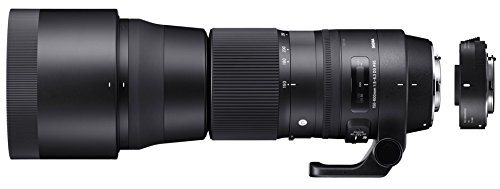
Review of the Sigma 150-600mm Contemporary Lens Plus TC-1401 Teleconverter Bundle

31 May

One of my favorite subjects to photograph is wildlife, so when asked to review the Sigma 150-600mm lens, I was excited about the opportunity to see how its results compared to my Tamron 150-600mm.

Sigma 150-600mm

In addition, Sigma recently began offering a bundle for their 150-600mm with a 1.4x teleconverter. Since I shoot mainly with a Nikon D750 full frame, the lens bundled with a 1.4x TC interested me very much. The 1.4x TC makes the 600mm, an 840mm on a full frame camera, so in theory this allows my full frame camera to shoot wildlife with nearly the same zoom factor as a crop sensor. (Nikon crop sensors are 1.5 and Canon, 1.6)

There are two things to consider when looking at a new lens:

  1. First is its ease of use
  2. Second is the quality of its optics.

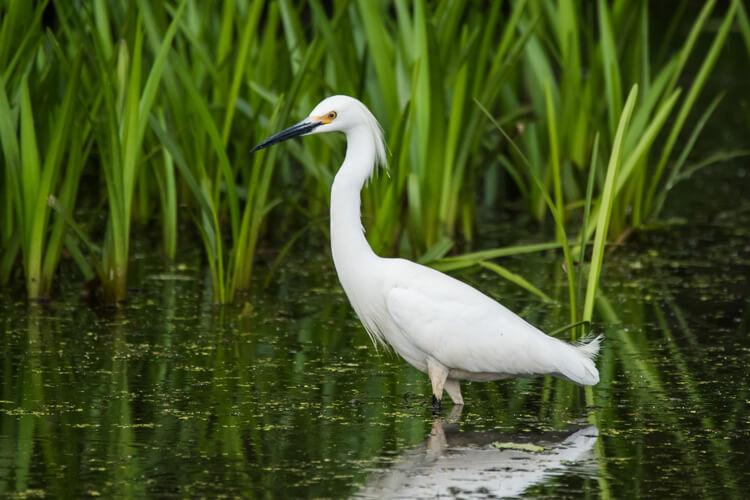
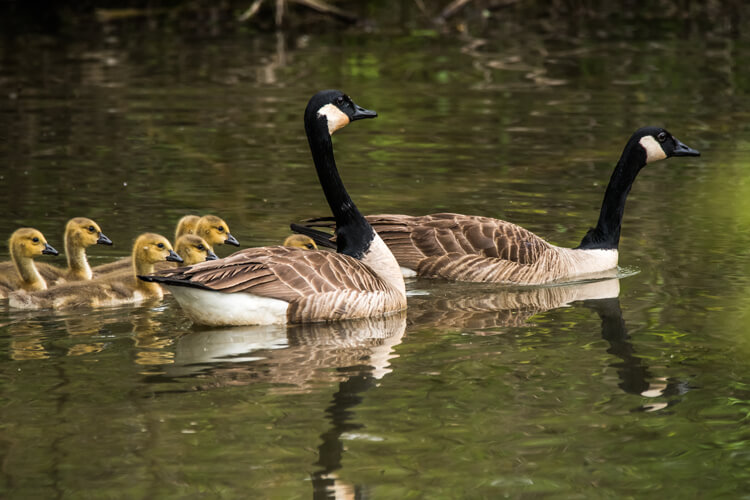
In this article I’ll be applying both of these considerations as I review Sigma’s new bundle, and make comparisons between the Sigma and Tamron lenses. All images in this article were captured with the Sigma 150-600mm with the 1.4x TC.

sigma-150-600-4

Focusing

The Tamron features a larger, thicker focusing ring than the Sigma, which makes it easier to manually focus the lens. As for the Sigma, it has an extra setting on the autofocus switch for manual override (MO) which combines autofocus with an option to manually focus. I did not notice any major difference in the focusing responsiveness between the two lenses. Both did a fair job when grabbing focus, though neither lens is going to focus as quickly as a much more costly 600mm prime lens. The minimum focusing distance on the Tamron is just slightly less than the Sigma – not a game changer, but nevertheless a plus for the Tamron.

Focus Limiter switch

While both lenses have a focus limiter switch, with settings between Full and 10m (Sigma) or 15m (Tamron) to infinity, the Sigma features a third option on the limiter switch for 10m to 2.8m. In my testing, this third option proved very useful and was easy to locate and use, in order to focus on closer objects much quicker.

Customization

A feature the Sigma lens offers that the Tamron does not is an extra customization switch, which provides for an optional USB docking station (purchased separately). This allows a photographer to create two customized setting for OS (Optical Stabilization), AF, and focus-distance limits, and can also be used to download firmware updates directly to the lens.

sigma-150-600-5

Zoom Lock

Both the Tamron and the Sigma have a locking switch to prevent zoom creep at 150mm. However, the Sigma can also lock at several other focal settings, and what is even better, a quick twist of the zoom ring will unlock the it, without having to fumble around to find the switch. (In some cases this might be the difference between capturing and missing a killer shot!)

I found that my Tamron lens crept more than the Sigma, but this could be caused by the fact that it is an older lens with more use. Still, the lock switch on the Sigma is a great feature, especially since one can “soft lock” at many focal lengths.

Image Stabilization

Both lenses have their own image stabilization systems: Tamron’s VC (Vibration Compensation) and Sigma’s OS (Optical Stabilization). The Tamron has a simple on and off for the VC, while the Sigma has two settings: #1 is the standard setting for normal lens movement, and setting #2 is used for hand-held panning on a vertical plane, which will correct for up and down movement in subjects, such as birds in flight.

sigma-150-600-3

Zoom Ring

The zoom ring on the Sigma turns counter clock-wise, which is no big deal for Canon shooters. But for Nikon users, this is opposite from the normal zoom rotation on most Nikon lenses. It’s not a big deal, but does take some getting used to.

Tripod Collar

Both lens come standard with a tripod collar, but the foot on the Sigma collar is much smaller than the Tamron’s. This is only a minor problem, but I found a solution for it. I added a 5 inch quick release plate to the foot, which makes a great handle to carry the Sigma lens, as well as a plate to connect to a tripod.

sigma-150-600-1

Image Quality

Here is where the comparison gets tougher, as both lenses are much sharper at the shorter focal lengths, and both are softer at the longer focal lengths. Both are sharper when stopped down to f/8 or f/9, than wide open. In my opinion, the difference in image quality between the two is negligible. There is no clear winner here, both having areas where they are slightly better than the other.

The addition of the 1.4x TC to the Sigma when stopped down, doesn’t seem to affect the image quality. The Sigma seems to have a clear advantage when it comes to chromatic aberration (CA), and even using the 1.4x TC there was noticeably less fringing in high contrast areas, when compared to the Tamron. Of course, CA is very easily corrected in Camera RAW or Lightroom when shooting in RAW.

sigma-150-600-7

sigma-150-600-6

Warranty

The advantage for warranty goes to Tamron, which offers a 6 year one, compared to 4 years with the Sigma. Still, in my opinion, both lenses are well constructed, and I am not convinced how much of an advantage that is, as most warranty issues show up early on.

1.4x Teleconverter

Adding the bundle of the 1.4x TC, and the 150-600mm Sigma can get your full frame camera back in the field when it comes to wildlife photography. While adding the teleconverter seems to slow the autofocus a bit, I shot with this bundle on both my crop sensor and full frame sensor cameras, and I believe the autofocus was more responsive on the full frame.

NOTE: Before purchasing the 1.4x TC, make sure the camera will autofocus at f/8. Many entry model DSLRs will not autofocus above f/5.6, so while this bundle may fit those cameras, manual focus will be necessary. Other models may only autofocus on the center focus point, and still others may have a limited number of focus points with the 1.4x TC.

Adding the 1.4x TC did seem to give a softer image when the lens was extended to 600mm (840mm), but if you stop down to f/10 to f/11 the images are nearly as sharp as at 600mm without the TC. Of course, stopping down means either using a slower shutter speed or a higher ISO, which may add some blur or noise to an image. I did find that the OS on the Sigma did a nice job of reducing camera shake, when hand holding at slower shutter speeds.

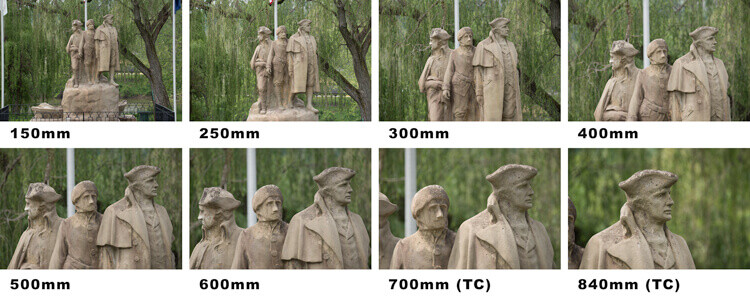
The above images show the range and extra reach of the Sigma 150-600mm with the last 2 images having the 1.4 TC added for an extra 240mm of reach.

The above images show the range and extra reach of the Sigma 150-600mm with the last two images having the 1.4x TC added for an extra 240mm of reach.

Tips

The rule of thumb when shooting with long focal lengths is to set the shutter speed equal to, or greater than the focal length, so remember that when by adding the 1.4x TC to a 600mm, one is now shooting at 840mm on a full frame, and 1260 mm on a crop sensor. For sharp images, a shutter speed over 1/1000th of a second is a must.

When carrying your camera with a large lens such as these 150-600mm lenses, it’s best to hold them by the lens rather than your camera. These lenses weigh much more than your camera and can put a lot of stress on the lens mount if carried by the camera. Likewise, when mounting on a tripod, always use the tripod collar to reduce stress on your camera’s lens mount (it is better balanced using the collar and won’t be front heavy).

Conclusion

Both the Tamron and Sigma lenses are well designed, and for the price range are great equipment investments. As mentioned earlier, I feel the image quality compared very closely. The Sigma does offer some useful extra features, out-weighing the issues of the smaller focusing ring and the counter-clockwise turning of the zoom ring for a Nikon shooter.

If you currently have a Tamron it may not be worth making a switch. But with the addition of the 1.4x TC, the Sigma bundle offers a great setup for full frame cameras, as well as crop sensors for some extra reach. So if you are looking for some extra reach (and we all are) the addition of the 1.4 TC to the Sigma may be a game changer. It was for me!

As a result of my review of the Sigma bundle for this article, I sold my Tamron 150-600mm, and purchased the Sigma 150-600mm bundled with the 1.4 TC, to extend the usage of my full frame Nikon D750, especially for photographing wildlife.

googletag.cmd.push(function() {
tablet_slots.push( googletag.defineSlot( “/1005424/_dPSv4_tab-all-article-bottom_(300×250)”, [300, 250], “pb-ad-78623” ).addService( googletag.pubads() ) ); } );

googletag.cmd.push(function() {
mobile_slots.push( googletag.defineSlot( “/1005424/_dPSv4_mob-all-article-bottom_(300×250)”, [300, 250], “pb-ad-78158” ).addService( googletag.pubads() ) ); } );

The post Review of the Sigma 150-600mm Contemporary Lens Plus TC-1401 Teleconverter Bundle by Bruce Wunderlich appeared first on Digital Photography School.


Digital Photography School

 
Comments Off on Review of the Sigma 150-600mm Contemporary Lens Plus TC-1401 Teleconverter Bundle

Posted in Photography


How Two Weeks in the Wilderness with One Prime Lens Restored My Love for Photography

27 May

If you have read a few of my previous pieces here on the Digital Photography School like “5 Uncomfortable Truths about Photography“, or “How Making Horrible Photos Will Lead to More Keepers“, you’ll know that I have a much greater respect for learning, effort, and practice than I have for the latest and greatest gear. Good photography does not rely on equipment or rules.

But what happens if you lose your will to produce? What happens when the desire to make images simply slips away?

It happened to me last year, I just stopped wanting to make images. For most of the summer, my busiest and usually most productive season, I had no desire to shoot. Out of habit I still carried a camera on the wilderness trips I guide, and on personal trips across Alaska, but the images I made were few and lackluster. Now, a year later, I cringe to look through those, at the missed opportunities.

I broke out of the funk, but not the way I expected. Tired of carrying along gear I wasn’t using, for the final trip of my summer season, a 17 day pack-rafting trip in the Arctic National Wildlife Refuge, I carried only a camera body and one single 24mm f/2.8 prime lens.

AK-ANWR-Katakturuk-Canning-Packraft-1085-88

It wasn’t a creative decision, I took that combo because it was the best way to make my kit as light possible and still get the quality I wanted, and the lens and camera fit easily in a small holster style case that I carried, attached to the chest straps of my pack.

Toward the end of August my two clients and I flew from Fairbanks, Alaska north toward the Arctic National Wildlife Refuge. We passed little ranges of mountains in the interior, above the Yukon Flats, and over the rugged high peaks of the Brooks Range. Just to the north of the mountains on the arctic coastal plain of the refuge, the pilot descended, picked the unmarked strip out of the landscape, and settled the oversize wheels of the bush plane down onto the autumn tundra.

Within a few minutes of landing, we’d unloaded our heavy packs and the pilot was rocketing down the grass and into the air. He was the last person we’d see for more than two weeks.

The first 10 days of the trip were dedicating to hiking, though the mileage was such that we could take a day or two off periodically, which was good, because when the first snow storms of autumn hit a week into the trip, we were in no mood to walk.
AK-ANWR-Katakturuk-Canning-Packraft-1085-102

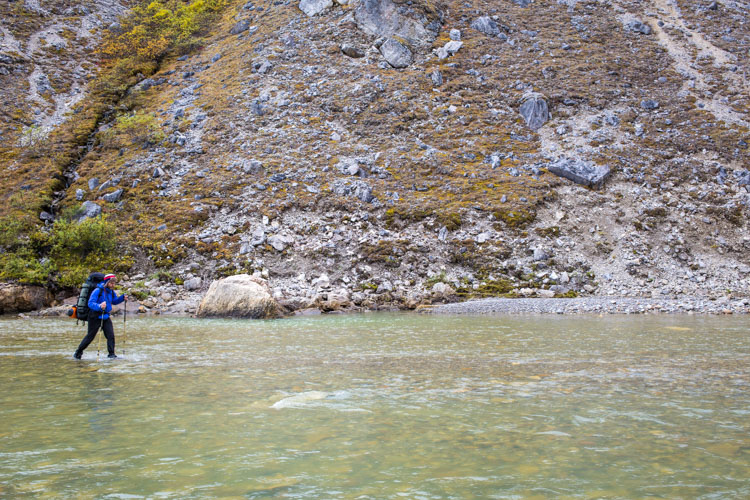
The route carried us through a narrow gap in the mountains cut by a small river. We walked through that gap on a cold, windy day when low clouds obscured the tops of the mountains. We had to criss-cross the river, and our feet were constantly soggy. But the willows along the creek and the small patches of tundra were bright with autumn colors, and a much-needed distraction from the cold.

Once on that first day, just once, I was stopped in my tracks by a scene that had to be photographed. I’d made photos earlier in the trip, but they’d been snapshots. This was a scene that inspired me; a rare thing.

The simple camera and lens setup removed much of the tedious decision making. There was no easy compositional escape in the form of a zoom lens, rather I had to move about to make the scene come together. I worked within the restraints of the lens (which were numerous), and it was utterly liberating.

AK-ANWR-Katakturuk-Canning-Packraft-1085-135

I gave the image five whole minutes before the chill forced us on, and for the first time all summer, five minutes wasn’t enough.

The following day, we woke to clouds, shredded by the previous day’s winds, and big patches of blue shone through, bright and optimistic. We hiked over a low pass, and watched a Grizzly sow and two young cubs graze in a sedge meadow a quarter mile and two hundred vertical feet below. My little lens didn’t have a prayer of making anything more than a token image of the brown specks on the tundra below. Instead I peered down through binoculars as the bears dug up sedges and combed berries from the bushes with their teeth.

AK-ANWR-Katakturuk-Canning-Packraft-1085-277

On the sixth day, the storm hit. We were camped on a meadow of soft, dry tundra above a small creek when the winds shifted from a pleasing breeze from the east, to a howling gale from the west. It happened in moments, the speed of the weather change taking me completely by surprise. Rain, then pelletized snow arrived, followed by a genuine snow storm in the night. For two solid days we were battered by the strongest winds and most intense storm I’ve ever experienced in the Brooks Range. Just keeping our tents standing was a constant battle.
AK-ANWR-Katakturuk-Canning-Packraft-1085-582

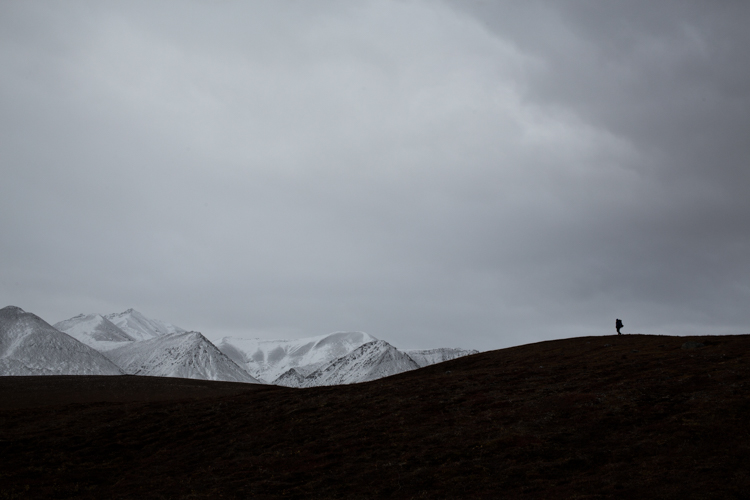
Yet in that time, my clients and I managed a few excursions away from camp. We climbed up to a low ridge where the full brunt of the west wind hit us hard. There, we leaned into the gale and watched the falling snow tear across the tundra.

It wasn’t a photogenic scene, at least not by traditional standards, and yet I made images because I wanted to. Creativity, quite suddenly, brightened up like a cartoon bulb over my head.
AK-ANWR-Katakturuk-Canning-Packraft-1085-504

On the third morning, before I even opened my eyes, I knew the storm had passed. My tent wasn’t shuddering in the wind, and when I did lift my eyelids, I could see the day was too bright to be dominated by clouds.

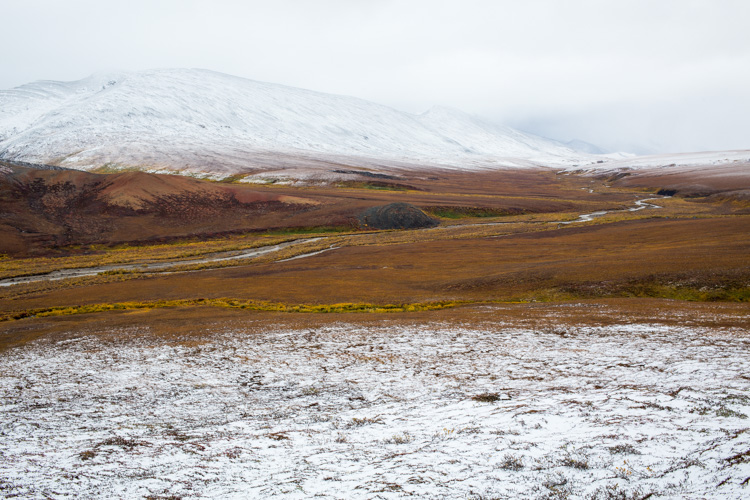
Emerging from my tent, I saw that fresh snow cloaked the mountains and dusted the tundra around our camp, but blue dominated the sky above. I went for my camera and spent a happy hour making images as the drenched tents and rain gear steamed in the rising sun.

AK-ANWR-Katakturuk-Canning-Packraft-1085-556

Two days later we reached the river and our cache of food and boating gear that had been waiting for us. In those two final days before we traded in our hiking boots for pack-rafts, I think I made more images than I had in the previous three months combined. I couldn’t get enough of it.

AK-ANWR-Katakturuk-Canning-Packraft-1085-384

The 50 miles of paddling stole some of my photographic productivity. (It’s hard to paddle a small bouncing raft through swift, splashing water while taking photos). Nonetheless, as we descended the river out of the mountains and onto the coastal plain, my renewed love for photography stuck with me. Even when another storm hit and we were pinned down for two more days, even when the snow fell in heavy wet flakes, and when the wind tore the autumn colors from the vegetation and shifted the landscape from red and yellow to brown.

AK-ANWR-Katakturuk-Canning-Packraft-1085-643

Our final camp lay where the river met its coastal delta. Caribou criss-crossed the plain in small bands, and migrant birds were congregating in the many lakes. My little lens was no match for the distant wildlife, but it didn’t matter. I’d rediscovered photography, which meant that I was more aware of my surroundings, and the images that lay in it, than I had been for some time. Even if I didn’t have the right equipment to capture some of the photos I found, I recorded them mentally in sharp detail. As it turns out, those mental images are just as rewarding as the ones glowing on my computer screen.

Paging through the images from the trip, I see an interesting evolution. The first images are mostly snapshots, but as time passed, and my inspiration picked up steam, the images become more purposeful, more composed… better, even.

Conclusion

Purposefully restricting yourself can be a great tool to boost creativity. It’s a little like playing charades: using limited tools to effectively get your message across. It can be fun, and a bit frustrating. It forces your mind outside its comfortable box, and into a place where creativity is far more important than gear. When, and if, you return to your diverse array of lenses and cameras, you will no longer take all those compositional possibilities for granted.

If you are stuck in a rut, or just want to try something new, give up your zooms for a couple of weeks, only shoot black and white, use your camera exclusively in manual mode, or shoot some film. After, share your experiences in the comments below, I’d love to hear what happens.

googletag.cmd.push(function() {
tablet_slots.push( googletag.defineSlot( “/1005424/_dPSv4_tab-all-article-bottom_(300×250)”, [300, 250], “pb-ad-78623” ).addService( googletag.pubads() ) ); } );

googletag.cmd.push(function() {
mobile_slots.push( googletag.defineSlot( “/1005424/_dPSv4_mob-all-article-bottom_(300×250)”, [300, 250], “pb-ad-78158” ).addService( googletag.pubads() ) ); } );

The post How Two Weeks in the Wilderness with One Prime Lens Restored My Love for Photography by David Shaw appeared first on Digital Photography School.


Digital Photography School

 
Comments Off on How Two Weeks in the Wilderness with One Prime Lens Restored My Love for Photography

Posted in Photography


Lens shootout: Sony RX10 III destroys the competition

26 May

When the RX10 III was revealed as the ‘top secret’ Sony product launch in San Francisco earlier this year, I felt a bit cynical. ‘Another RX10, Sony? Really?’ I cried, along with a few bored commenters. ‘The last one is hardly a year old!’

Then I saw some telephoto sample images and was immediately impressed, wondering if I had been underestimating the 1″ bridge camera segment. Then Barney described the RX10 III to me as ‘magic’, which is high praise indeed and warranted further investigation. Which is exactly what we’ve done, below. Note that our results here are only indicative of the one copy of each camera we have on hand, some of which appear to be slightly decentered.

The Shootout

Starting at the wide end, which is around 25mm for all the cameras tested, we see in the center of the image (where our RX10 II appears to perform as expected) improvements over the RX10 II aren’t incredibly pronounced. Other areas$ (document).ready(function() { $ (“#imageComparisonLink2506”).click(function() { ImageComparisonWidgetLink(2506); }); }) of the scene show the advantage of the RX10 III, especially when it is stopped down from its maximum aperture of F2.4 to F2.8$ (document).ready(function() { $ (“#imageComparisonLink2507”).click(function() { ImageComparisonWidgetLink(2507); }); }). Its performance is definitely a step up from the Panasonic FZ1000$ (document).ready(function() { $ (“#imageComparisonLink2510”).click(function() { ImageComparisonWidgetLink(2510); }); }), and is miles ahead of the Canon G3 X$ (document).ready(function() { $ (“#imageComparisonLink2511”).click(function() { ImageComparisonWidgetLink(2511); }); }).

Where crazy zoom lenses like these typically struggle is in the extremes$ (document).ready(function() { $ (“#imageComparisonLink2513”).click(function() { ImageComparisonWidgetLink(2513); }); }) of the frame, with neither the RX10 III or the FZ1000 being an exception. The sharpness fall-off is less severe$ (document).ready(function() { $ (“#imageComparisonLink2515”).click(function() { ImageComparisonWidgetLink(2515); }); }) with the RX10 III, though, and all in all, the RX10 III is the best performer on the wide end.

$ (document).ready(function() { ImageComparisonWidget({“containerId”:”reviewImageComparisonWidget-45535897″,”widgetId”:359,”initialStateId”:null}) })

Moving on to 400mm$ (document).ready(function() { $ (“#imageComparisonLink2517”).click(function() { ImageComparisonWidgetLink(2517); }); }), the maximum focal length for the Panasonic FZ1000, we see a similar amount of detail between the Panasonic and Sony near the center of the image. Sharpness and resolution change for both throughout the frame, with the Sony showing a slightly iffy left side$ (document).ready(function() { $ (“#imageComparisonLink2523”).click(function() { ImageComparisonWidgetLink(2523); }); }), and a better right side$ (document).ready(function() { $ (“#imageComparisonLink2524”).click(function() { ImageComparisonWidgetLink(2524); }); }). Through most of the scene the two are practically neck and neck, with the G3 X turning in comparable performance as well, but let’s not forget the Sony and Canon still have more zoom range to go. 

The RX10 III’s 24-600mm lens isn’t only useful for distant details.

The real reason people consider bridge cameras is for the reach, and Sony extended the RX10 III’s reach by a full 400mm over the RX10 II. That means it now offers the same amount of reach as the G3 X’s 600mm$ (document).ready(function() { $ (“#imageComparisonLink2516″).click(function() { ImageComparisonWidgetLink(2516); }); }) equivalent maximum focal length. The RX10 III’s lens is clearly sharper, but it has another thing going for it: its faster maximum aperture helps it combat diffraction. Remember that F4 and F5.6 on 1”-type cameras are equivalent to F11 and F15, respectively. Both cameras are limited by atmospheric distortion at these focal lengths (hence the drop to ‘print’ resolution in the previous comparison link), but it’s clear that the RX10 III exceeds the G3 X’s performance, while offering just as much zoom versatility. The Canon PowerShot G3 X’s trump card has been trumped.

Even at 600mm (equiv), the Sony Cyber-shot RX10 III’s lens delivers sharp results.

In all, it seems the RX10 III does offer a bit more than similar 1″ bridge cameras from other manufacturers. It exceeds, or at least matches, the competition with respect to zoom range, while offering sharper images, and brighter apertures than all but Sony’s own RX10 II. Importantly, sharpness performance appears to be maintained throughout the zoom range, from wide to tele, which cannot be said for any of the other cameras in this test. Feel free to explore through these images and post your own findings below.

Things to Consider

As you look at the comparison widget, bear in mind that It appears our copy of the RX10 II appears to be slightly decentered$ (document).ready(function() { $ (“#imageComparisonLink2509”).click(function() { ImageComparisonWidgetLink(2509); }); }). This isn’t really noticeable in normal shooting but it’s obvious in a controlled test like this. 

The second caveat to these results is the weather. Light varied over the course of the test, and had darkened so much that the Panasonic, the final camera tested, needed 2/3rds more exposure to produce a comparable image. All the exposures were processed in ACR with default sharpness and the ‘Adobe Standard’ profile used across the board.

We’ll be adding the RX10 III to our standard database of studio test images very soon – watch this space!

Articles: Digital Photography Review (dpreview.com)

 
Comments Off on Lens shootout: Sony RX10 III destroys the competition

Posted in Uncategorized