RSS
 

Posts Tagged ‘Lens’

Nikon introduces ultra-fast AF-S 105mm F1.4E ED prime lens

27 Jul

$ (document).ready(function() { SampleGalleryV2({“containerId”:”embeddedSampleGallery_8415058717″,”galleryId”:”8415058717″,”isEmbeddedWidget”:true,”standalone”:false,”selectedImageIndex”:0,”startInCommentsView”:false,”isMobile”:false}) });

Nikon has unveiled the AF-S Nikkor 105mm F1.4E ED, the fastest full-frame lens of its kind with autofocus. Resistant to dust and moisture, the lens uses 14 elements in 9 groups, including 3 ED elements, along with Nano Crystal and fluorine coatings. The lens has 9 rounded aperture blades, and the aperture is electronically controlled, which keeps exposure consistent while shooting high-speed bursts. As you might expect, this is a heavy lens, weighing in at 985g/2.1lbs.

The 105mm F1.4 is expected to ship in late August with a $ 2,199.95 MSRP.

Press release:

GLAMOROUS GLASS: NIKON CELEBRATES 100 MILLION NIKKOR MILESTONE AND THE INTRODUCTION OF THE AF-S NIKKOR 105mm f/1.4E ED LENS

MELVILLE, N.Y. (July 27, 2016 AT 12:01 A.M. EDT) – Today, Nikon Inc. is celebrating a momentous NIKKOR production milestone as well as the announcement of the AF-S NIKKOR 105mm f/1.4E ED, a premium lens for the most discerning photographers. This luxurious new medium-telephoto lens is engineered to help create flattering images with gorgeous bokeh, while delivering impressive sharpness and beautiful color rendition. As a testament to a lasting legacy of high-caliber lenses, Nikon has also announced that NIKKOR lens production has reached the landmark achievement of 100 million units produced worldwide.

“Surpassing the 100 million lenses produced milestone is a great honor and a testament to the photographers who both love and rely on NIKKOR glass to get the job done,” said Kosuke Kawaura, Director of Marketing and Planning, Nikon Inc. “The AF-S NIKKOR 105mm f/1.4E ED represents the embodiment of the NIKKOR line of high-quality lenses, giving photographers a robust, well-balanced lens that provides intense sharpness, astounding image quality and background bokeh that is sure to be a favorite among portrait photographers.”

Captivating Image Quality
The AF-S NIKKOR 105mm f/1.4E ED is a fast, full-frame (FX-format), medium-telephoto prime lens and is the world’s first1 to strike the impeccable balance of 105mm focal length and large f/1.4 aperture for a truly outstanding optic. This new NIKKOR lens is ideal for professional and advanced enthusiast photographers, especially those capturing portraiture, from in-studio fashion to a golden hour engagement session on the beach. These users will love the precise sharpness from this fantastic glass, which provides a flattering compression to subjects with a sensational, sultry bokeh. Beyond the gorgeous image quality lies stellar resolving power, especially when used with Nikon DSLRs such as D5, D810 or D750.

The 105mm f/1.4E is a fast lens with endearing character, providing stellar optical performance, even in the peripherals. Sharp rendering is attained for shooting distant subjects throughout the aperture range – from maximum aperture to being stopped down by several stops. Gradual alteration from the focal plane helps render subjects in high-fidelity with a natural depth, giving colorful portraits and landscapes that little bit of extra “pop” to help create a truly distinct image. The AF-S NIKKOR 105mm f/1.4 is also an excellent choice for low-light photography, as its large maximum aperture allows photographers to shoot at the fastest possible shutter speeds. Additionally, this lens can reproduce point light sources faithfully without sagittal coma flare, even on the edges of the frame.

Masterful Lens Construction
Decades of precision, knowledge and experience are put forth into every NIKKOR lens, and the AF-S NIKKOR 105mm f/1.4E ED is an exceptional example of brilliant craftsmanship and Nikon technologies merging. Packed with the latest advanced optical innovations, the 105mm f/1.4 features Nikon’s electromagnetic aperture control technology for consistent exposures, even during high speed continuous shooting.2

On the outside, solid build quality is well-balanced for all-day shooting, while the lens is sealed and gasketed to resist dust and moisture. Additional Fluorine coatings are used on the front and rear elements, so that smudges, dirt or moisture are easily removed. Inside the lens, the optical formula consists of 14 elements in nine groups, which include three ED glass elements. A 9-blade diaphragm further helps to create a circular, pleasing out of focus area. The lens also features Nikon’s Nano Crystal Coat technology to significantly reduce instances of ghosting and flare.

The new AF-S NIKKOR 105mm f/1.4E ED joins other NIKKOR f/1.4 lenses in the Gold Ring Series, which include only premium primes with Nano Crystal Coat and pro-grade build quality. These other lenses include the AF-S NIKKOR 24mm f/1.4G, AF-S NIKKOR 35mm f/1.4G, AF-S NIKKOR 58mm f/1.4G, AF-S NIKKOR 85mm f/1.4G.

A Landmark in the NIKKOR Legacy
Nikon is also pleased to announce that the total production of NIKKOR lenses for Nikon interchangeable lens cameras reached the landmark 100 million milestone in mid-July 2016.

With a robust line-up of high-quality lenses for all types of photographers, the NIKKOR name has become synonymous with a rich history of superior lenses. Nikon continues to introduce new NIKKOR lenses that further optical technology, utilizing cutting-edge techniques and knowledge from experience cultivated over its long history. Such revolutionary advancements include Nano Crystal Coat, which acts as a powerful anti-reflection coating, and significantly reduces instances of ghosting and flare. More recently, NIKKOR lens technologies such as the use of Phase Fresnel (PF) and Fluorite elements have helped to create smaller and lighter lenses with superb balance and handling. Many NIKKOR lenses now also feature a Fluorine coat that helps repel a variety of contaminants such as dust, dirt, water, oils and grease. The introduction of an electromagnetic diaphragm has also helped to create lenses that provide consistently crisp exposures, even during high-speed shooting.

Pricing and Availability
The AF-S NIKKOR 105MM f/1.4E ED will be available in late August for a suggested retail price (SRP) of $ 2,199.953. For more information on Nikon’s latest products including their newest NIKKOR lenses, please visit www.nikonusa.com.

1: Among AF lenses for digital SLRs compatible with FX-format image sensor; as of July 27, 2016; statement based on Nikon research

2: The lens incorporates an electromagnetic diaphragm mechanism. The following cameras are compatible with this lens: D5, D4 series, D3 series, Df, D810, D810A, D800 series, D750, D700, D610, D600, D500, D300 series, D7200, D7100, D7000, D5500, D5300, D5200, D5100, D5000, D3300, D3200, D3100, Nikon 1 J1, J2, J3, J4 with FT-1, Nikon 1 V1, V2, V3 with FT-1, Nikon 1 S1, S2 with FT-1 

3: SRP (Suggested Retail Price) listed only as a suggestion. Actual prices are set by dealers and are subject to change at any time.

Nikon AF-S Nikkor 105mm F1.4E ED specifications

Principal specifications
Lens type Prime lens
Max Format size 35mm FF
Focal length 105 mm
Image stabilization No
Lens mount Nikon F (FX)
Aperture
Maximum aperture F1.4
Minimum aperture F16
Aperture ring No
Number of diaphragm blades 9
Aperture notes Rounded blades
Optics
Elements 14
Groups 9
Special elements / coatings Three ED elements + Nano Crystal and fluorine coatings
Focus
Minimum focus 1.00 m (39.37)
Maximum magnification 0.13×
Autofocus Yes
Motor type Ring-type ultrasonic
Full time manual Yes
Focus method Internal
Distance scale Yes
DoF scale No
Focus distance limiter No
Physical
Weight 985 g (2.17 lb)
Diameter 95 mm (3.72)
Length 106 mm (4.17)
Sealing Yes
Filter thread 82.0 mm
Tripod collar No

Articles: Digital Photography Review (dpreview.com)

 
Comments Off on Nikon introduces ultra-fast AF-S 105mm F1.4E ED prime lens

Posted in Uncategorized


Venus Optics to launch ‘world’s widest F2.8 rectilinear lens’

26 Jul

Chinese optical manufacturer Anhui ChangGeng Optical Technology Company Limited, or Venus Optics, is preparing to introduce a 12mm lens that it claims will be the world’s widest F2.8 lens with fully corrected distortion. Going under the Laowa brand name the lens will be called Laowa 12mm F2.8 Zero-D and will be officially announced on July 30th via a Kickstarter campaign.

Venus Optics says that the lens has almost no distortion, hence the ‘Zero-D’ in the name, and has loaned a test unit to a blogger Nicky Bay who has a preview with images on his website. The lens will be manual focus only, will feature an aperture range of F2.8 to F22 and is due to have a seven-bladed iris with clicking stops. The company is also said to be launching a Magic Shift adapter, according to Bay, that allows +/-10mm of shift while converting the lens to a 17mm focal length. The converter will be for Sony E-mount users only.

Specification published on the Laowa Facebook page.

Of course, this isn’t the world’s first rectilinear 12mm with a fast aperture, as F2 and F1.4 12mm lenses exist for the Micro Four Thirds system, and there are Zeiss F2.8 and F2 Samyang 12mm lenses for APS-C sensors, but this lens is designed for full-frame cameras.

The lens, which will be made in Canon EF, Nikon F, Sony A, Sony E and Pentax K mounts, is expected to retail at $ 949, but supporters of the Kickstarter campaign will be able to get one from $ 649. The Magic Shift will cost $ 300 and a square filter adapter will be $ 50.

For more information on Venus Optics see the company website. 

Articles: Digital Photography Review (dpreview.com)

 
Comments Off on Venus Optics to launch ‘world’s widest F2.8 rectilinear lens’

Posted in Uncategorized


Samyang introduces XEEN 135mm T2.2, first ‘summer blockbuster’ lens

19 Jul

Samyang is making good on its promise of a new lens every week for five weeks, kicking things off with a XEEN 135mm T2.2 cinema lens. It slots into the company’s relatively new lineup as the longest lens in the range.

Like its siblings, the XEEN 135 is offered with interchangeable mount fittings for PL, Canon EF, Nikon F, Sony E and Micro Four Thirds bodies. Its manual focus only and uses an 11-blade aperture. No price is given, but XEEN series lenses have averaged around $ 2500 each.

Articles: Digital Photography Review (dpreview.com)

 
Comments Off on Samyang introduces XEEN 135mm T2.2, first ‘summer blockbuster’ lens

Posted in Uncategorized


Samyang teases ‘summer blockbuster’ lens announcements

16 Jul

Korean lens manufacturer Samyang has announced that it intends to enjoy a summer of new lenses in what it is calling a ‘Samyang Blockbuster’, starting on Monday 18th July and running until 15th August.

The ‘5 NEW Samyang Lenses will be released on every Monday for the next five weeks’ promotion was placed on the company Facebook page with no clues about what those lenses will be. There is some ambiguity, too, around whether Samyang intends to release five lenses a week for five weeks – making 25 in total – or (probably more likely given the accompanying graphic, above) one lens per week, for five weeks. 

Samyang makes lenses for still and movie photographers, with a relatively new ‘Xeen’ range of dedicated large-scale cine lenses. Autofocus is also quite new for Samyang lenses, with only one lens (AF 50/1.4 FE) available and one more in the pipeline (AF 14/2.8 FE) – both of which are designed for the Sony fully frame FE mount.

For more information see the Samyang website, and the promotion on the company’s Facebook page.

Articles: Digital Photography Review (dpreview.com)

 
Comments Off on Samyang teases ‘summer blockbuster’ lens announcements

Posted in Uncategorized


Sony 35mm FE lens firmware update improves manual focus reliability

15 Jul

Sony has issued firmware updates for its 35mm full-frame primes which claim to improve focus point reliability when using manual focus for long periods of time. The new firmware is offered for the FE 35mm F1.4 ZA and FE 35mm F2.8 ZA Zeiss-branded lenses.

Articles: Digital Photography Review (dpreview.com)

 
Comments Off on Sony 35mm FE lens firmware update improves manual focus reliability

Posted in Uncategorized


Sony announces FE 50mm F1.4 ZA prime lens

11 Jul

$ (document).ready(function() { SampleGalleryV2({“containerId”:”embeddedSampleGallery_0676890121″,”galleryId”:”0676890121″,”isEmbeddedWidget”:true,”standalone”:false,”selectedImageIndex”:0,”startInCommentsView”:false,”isMobile”:false}) });

Sony has announced its new Planar T* FE 50mm F1.4 ZA lens. This full-frame fast prime features an 11-blade aperture for circular out-of-focus highlights even as you stop down, ‘Advanced Aspheric’ and ED lens elements and Zeiss’ T* coating. Sony says that the lens’ Planar design minimizes distortion. 

The lens is similar in construction to the FE 35mm F1.4. It’s weather-sealed and uses Sony’s Super Sonic Wave Motor for quick and quiet autofocus. A clicked aperture ring can be de-clicked if desired for smooth aperture control in video.

At a recent shooting event in San Diego, we had a chance to go hands with this fast prime (view our gallery here). Despite being a bit heavy, the lens handles beautifully. We were very impressed by sharpness: subjects placed far off-center remained sharp even wide open, despite the 42MP Sony a7R II sensor resolution. Indeed, MTF curves indicate an impressive 60% response is maintained across the frame wide open even at 40 line pairs / mm. Our initial shots also indicate that axial chromatic aberration (green and purple fringing) are very well controlled, and bokeh appears very smooth, both of which add to this lens’ appeal over options like the Sony FE 55mm F1.8 ZA.

The FE 50mm F1.4 ZA lens will be available this month at a price of $ 1500.

Sony Planar T* FE 50mm F1.4 ZA specifications

Principal specifications
Lens type Prime lens
Max Format size 35mm FF
Image stabilisation No
Lens mount Sony FE
Aperture
Aperture ring Yes
Number of diaphragm blades 11
Optics
Elements 12
Groups 9
Special elements / coatings 2 aspherical + 1 ED element + Zeiss T* coating
Focus
Minimum focus 0.45 m (17.72)
Maximum magnification 0.15×
Autofocus Yes
Motor type Ring-type ultrasonic
Full time manual Yes
Focus method Internal
Distance scale No
DoF scale No
Physical
Weight 778 g (1.72 lb)
Diameter 84 mm (3.29)
Length 108 mm (4.25)
Sealing Yes
Colour Black
Filter thread 72.0 mm
Hood supplied Yes
Hood product code ALC-SH143

Press Release:

Sony Releases Full-Frame FE 50mm F1.4 ZA Prime Lens

A quintessential wide-aperture 50mm “normal” lens, the new ZEISS® Planar F1.4 offers high resolution, high-contrast and overall exceptional performance

SAN DIEGO, July 11, 2016 – Sony Electronics, a worldwide leader in digital imaging and the world’s largest image sensor manufacturer, has today introduced a new full-frame lens for their E-mount camera system, the Planar T* FE 50mm F1.4 ZA (model SEL50F14Z).

This 50mm prime lens features a large F1.4 maximum aperture that offers impressive contrast and outstanding resolution that are hallmarks of the ZEISS® brand. It produces these consistently strong qualities throughout the entirety of the frame – from center to corner – and at all aperture settings, even while shooting wide open at F1.4. The cutting edge optical structure includes high-precision AA (Advanced Aspherical) and ED (Extra-low Dispersion) glass elements that reduce spherical and chromatic aberration, as well as a ZEISS® T* Coating that minimizes flare and ghosting creating the classic ZEISS® clarity. Additionally, its Planar design ensures minimal distortion.

The large F1.4 maximum aperture of the FE 50mm F1.4ZA lens provides a level of brightness and speed that are advantageous for dimly lit indoor shots, night scenes, and portraits, while its 11-bladed circular aperture allows for stunning “bokeh”, or background defocus, in images. The lens also features an aperture ring with an adjustable ON/OFF switch, an AF/MF focus mode switch, and a dust and moisture resistant design¹, further increasing its functionality.

The new lens is also equipped with a ring drive SSM (Super Sonic wave Motor) system, which allows it to efficiently lock focus with speed, precision and in near silence, making it particularly useful for shooting movies.

Pricing and Availability – FE 50mm F1.4 ZA Lens

The new FE 50mm F1.4 ZA lens will ship this July for a retail price of $ 1,500 US and $ 1,950 CA. The new FE interchangeable lens will be sold at a variety of Sony authorized dealers throughout North America.

Articles: Digital Photography Review (dpreview.com)

 
Comments Off on Sony announces FE 50mm F1.4 ZA prime lens

Posted in Uncategorized


Fujifilm to update X-Pro2 firmware, releases new lens roadmap

07 Jul

Fujifilm has announced new firmware for its X-Pro2 mirrorless camera which, most notably, updates the autofocus algorithm to be in-line with the just-announced X-T2. The company promises better AF speed and accuracy, but notes that the use case-based system on the X-T2 will not be available on the X-Pro2.

The firmware update also improves parallax correction when using the OVF and adds support for the new EF-X500 external flash. 

X-Pro2 owners will be able to get their hands on the new firmware this October.

Along with the new firmware, Fuji has also refreshed its X-mount lens roadmap (shown below), adding three new XF lenses: 23mm F2 R WR, 50mm F2 R WR and 80mm F2.8 R LM OIS WR Macro. The 23mm will be shipping this year, while the other two will arrive in 2017.

One lens that was removed is the 120mm F2.8 R Macro, which has been replaced with the aforementioned 80mm Macro. Fuji states that this is ‘to meet the market demand for compact and lightweight lenses.’

Press release:

FUJIFILM ANNOUNCES NEW FIRMWARE UPDATE FOR THE X-PRO2 AND UPDATED XF LENS ROADMAP

Valhalla, N.Y., July 7, 2016 – As a leader in advanced digital camera technology and outstanding image quality, FUJIFILM North America Corporation today announced a new Firmware Update Version 2.0 for the FUJIFILM X-Pro2 that includes improvements to the autofocus system, compatibility with the new FUJIFILM EF-X500 flash, new power management options and a more accurate and easier-to-use Optical Viewfinder.

Firmware Update V.2.0 Key Features:

  1. The new autofocus algorithm* (found in the new FUJIFILM X-T2) produces faster and more accurate autofocus.
    * Excludes the new AF-C Custom Settings functions.
  1. Compatibility with the new hot-shoe mount FUJIFILM EF-X500 flash. The camera will now support high-speed flash sync and multi-flash lighting.
  2. AUTO POWER OFF will now have 15 second, 30 second, and 1 minute options, allowing more customizable power management.
  3. The parallax correction function will be improved to provide a more accurate and easier-to-use Optical Viewfinder.

Availability

The new firmware will be available for download in October 2016. 

Updated XF Lens Roadmap

Also announced is an updated roadmap for developing interchangeable lenses for the X Series line of mirrorless digital cameras. The latest roadmap adds three new lenses: the compact, lightweight and stylish semi-wide angle lens XF23mmF2 R WR, the compact mid-telephoto lens XF50mmF2 R WR and the mid-telephoto 1:1 macro lens XF80mmF2.8 R LM OIS WR Macro. The expanded 25-lens lineup covers extensive angles of view from ultra-wide angle to ultra-telephoto, and will now expand the macro category to further enhance photographic versatility.

Changes from the previous roadmap released in February 2015

The XF120mmF2.8 R Macro lens, listed in the previous roadmap, has been replaced with the XF80mmF2.8 R LM OIS WR to meet the market demand for compact and lightweight lenses. To support our customers who were expecting a telephoto macro lens, this new lens is compatible with the existing teleconverters to extend its reach into the telephoto range.

Articles: Digital Photography Review (dpreview.com)

 
Comments Off on Fujifilm to update X-Pro2 firmware, releases new lens roadmap

Posted in Uncategorized


Sony delays 70-200mm GM lens until September

30 Jun

Sony has said that the FE 70-200mm F2.8 GM OSS lens for its E-mount cameras is to be delayed until September. When the lens was announced in February this year the company expected to be delivering the tele-zoom to stores this month. No reason is given for the delay, but the statement thanks users for their patronage and apologies for the inconvenience.

Along with the zoom the company will also push back the release of the two tele-converters that are supposed to go with it – the SEL14TC 1.4x converter and the SEL20TC 2x converter.

The FE 70-200mm F2.8 GM OSS is part of a new G Master range of lenses designed with the company’s full frame a7 series of cameras in mind – though they are also compatible with the APS-C models. Other GM lenses announced along with the 70-200mm F2.8 are the FE 24-70mm F2.8 GM and the FE 85mm F1.4 GM.

For more information see the Sony website.

Articles: Digital Photography Review (dpreview.com)

 
Comments Off on Sony delays 70-200mm GM lens until September

Posted in Uncategorized


All about that lens: Sony Cyber-shot RX10 III review

21 Jun

Introduction

The Sony DSC-RX10 III is an enthusiast-oriented bridge camera with a 24-600mm equivalent F2.4-4 lens and 20MP 1″-type stacked CMOS sensor. That sensor and the BIONZ X image processor are shared with the RX10 II and Sony RX100 IV, and offer great dynamic range and high ISO performance as well as 4K video and a range of high-speed video capture modes.

The RX-series has always been designed as much for video shooting as well as stills shooting in mind, and the RX10 III doesn’t change that. The real story of the RX10 III lies within its massive zoom lens. The RX10 III may look similar to the RX10 II when you look at them individually, but once you see them together, it’s immediately apparent just how much Sony tweaked the design of the III to accommodate the threefold increase in zoom power. The body and grip are ‘chunkier,’ and the weight has increased as well. Overall, the two are more siblings than twins.

Key Features

  • 20MP 1″-type stacked CMOS sensor
  • 24-600mm equivalent F2.4-4 Zeiss Vario-Sonnar T* lens
  • Bionz X processor
  • 4K video capture
  • Ultra slow-motion video capture
  • Tilting screen and high-resolution OLED electronic viewfinder with 2.35m dots
Straight-out-of-camera JPEG, cropped to taste. 124mm equivalent | F4 | 1/3200 sec | ISO 100. Photo by Carey Rose

There will be those people that buy the RX10 III straight away, simply because it zooms more than x camera. But it’s worth asking yourself if you really need 600mm of reach – because if you aren’t really sure you do, then you probably don’t. But as you’ll see later on, the RX10 III’s lens is so good that it might be worth it to you even if you only use the extreme reach occasionally.

Let’s also put that ‘extreme reach’ into some perspective here. The RX10 III’s 600mm zoom might seem to pale in comparison to a Nikon Coolpix P900, which packs a 24-2000mm zoom – but puts it in front of a much smaller sensor. The Sony and the Canon PowerShot G3 X attempt to strike a balance between image quality and size with their 1″-type sensors, and the image quality compared to smaller sensor solutions speaks for itself. Larger sensor = more light = better quality.

Straight-out-of-camera JPEG. 41mm equivalent | F5 | 1/1000 sec | ISO 100. Photo by Jeff Keller

Now, whether or not you want to use all this reach will vary greatly depending on the types of photography you enjoy. But it’s worth noting that long telephoto focal lengths, just like very short (wide angle) focal lengths, can take some practice to get good photographs with. Just because you can zoom closer in to an object doesn’t necessarily coincide with an increase in the quality of your photos or the video clips you capture.

With all that out of the way, let’s look a little closer at what this lens can do.

600mm

The RX10 III’s lens zooms in so far it’s almost amusing. It takes between three and four seconds for the lens to rack through the full zoom range. It also takes noticeably longer for all that glass to extend for power up than either the Panasonic FZ1000, which has less reach, and Canon G3 X, which has a much more compact lens at the expense of a slower maximum aperture.

Shooting at 600mm equivalent can offer up some interesting compositional choices, while the available 20MP make additional cropping a viable option if you could’ve used even more reach. But check out that heat haze, even early in the day! Processed and cropped to taste from Raw. 600mm equivalent | F4 | 1/1000 sec | ISO 250. Photo by Carey Rose

So while the lens makes the camera a little slow to start up and adds some bulk, in use it is very sharp throughout the zoom range, irrespective of distance to your subject (atmospheric conditions notwithstanding). Before using the RX10 III, I simply wouldn’t have thought images from a 1″-sensor superzoom camera could look this detailed. This model commands a $ 300 MSRP premium over the RX10 II, but in this case, it seems you get what you pay for.

The 72cm focus distance at maximum zoom won’t get you true super macro photos, but you’ll probably find that it focuses close enough. The lens also renders bokeh very nicely. Processed to taste from Raw. 600mm equivalent | F4 | 1/1000 sec | ISO 320. Photo by Carey Rose

Key features compared

  Sony RX10 II Sony RX10 III Panasonic FZ1000
MSRP $ 1199 $ 1499 $ 899
Sensor 20MP 1″-type stacked CMOS 20MP 1″-type stacked CMOS 20MP 1″-type CMOS
ISO range (native) 100-12800 100-12800 125-12800
Lens (35mm equivalent) 24-200mm F2.8 24-600mm F2.4-4 25-400mm F2.8-4
Built-in ND filter Yes No No
Min. focus distance 3cm 3cm 3cm
AF system Contrast detect Contrast detect Contrast detect
AF points 25-pt 25-pt 49-pt
EVF resolution 2.36m-dot 2.36m-dot 2.36m-dot
LCD 3″ 1.23M-dot tilting 3″ 1.23M-dot tilting 3″ 921k-dot fully articulated
Burst rate 14 fps 14 fps 12 fps
Video 4K/30p 4K/30p 4K/30p
Wi-Fi Yes, with NFC Yes, with NFC Yes
Battery life (CIPA) 400 shots 420 shots 360 shots
Weather sealing Yes Yes No
Dimensions 129 x 88 x 102mm 133 x 94 x 127mm 137 x 99 x 131mm
Weight 813 g 1051 g 831 g

As you can see, besides the lens and a modest increase in both size and battery life, the RX10 III is all but identical on the inside to the RX10 II. The older, less expensive Panasonic FZ1000 loses out in a few areas like battery life and weather sealing, but it is still a competitive machine in many ways (so long as you don’t need 600mm, that is).

While Sony touts the RX10 III’s lens as having a 9-bladed aperture for better out-of-focus renderings (compared to 7 blades on the Mark II), it lacks the built-in ND filter that was present on the previous model. This was especially helpful for shooting video under bright daylight. Of course, since the front of the lens is threaded, you can always add your own ND, but having the option at the press of a button would be a lot more convenient.

Because of the large-ish AF area the RX10 III defaults to, it will sometimes miss focus very slightly. Here, it backfocused onto the singer’s high-contrast hair instead of her face. But I’d have no problem using this for web publishing. Processed and cropped to taste from Raw. 600mm equivalent | F4 | 1/320 sec | ISO 6400. Photo by Carey Rose

Beyond that omission, the RX10 III offers all that made the RX10 II such a compelling camera. The sensor offers great performance, the 4K and high frame rate video is detailed and of good quality, and the body is weather-sealed. But unfortunately, the fact that the RX10 III shares so much with its predecessor also means that you get the standard Sony UI woes as well as a contrast detection-only autofocus system that works fine for static subjects, but struggles with low contrast subjects and at telephoto distances, where phase-detection would help the camera minimize hunting.

If you’re not shooting fast action all the time, the RX10 III has a lot of potential as a family vacation camera, an all-in-one photo and video solution for a journalist in a tightly staffed newsroom, or documentary photography where you can’t necessarily get close to your subject.

So without repeating everything that we’ve already covered on the RX10 II, let’s look chiefly at how the RX10 III differentiates itself by virtue of its optics.

Processed and cropped to taste from Raw. 375mm equivalent | F5.6 | 1/100 sec | ISO 200. Photo by Carey Rose

Sony RX10 III overview video

In case you missed it (or prefer video), here’s an overview video we produced at the launch of the RX10 III back in March, 2016.

Articles: Digital Photography Review (dpreview.com)

 
Comments Off on All about that lens: Sony Cyber-shot RX10 III review

Posted in Uncategorized


8 Things to Consider Before You Buy Your Next Lens

19 Jun
How to buy a camera lens

Prime lenses are best for creating portraits like this one, taken with the aperture set to f/1.2 to blur the background.

Are you thinking of buying a new lens for your camera? Stop, and read this article first.

One of the hardest things to achieve when buying new camera gear is clarity. Why do you need a new lens, how much should you spend, and where does it fit into the big picture of your gear acquisition? Once you are clear on these points, it makes the process of deciding which lens (or lenses) to buy next much easier.

Let’s look at eight things to consider before you buy that new lens:

1. Budget – how much do you have to spend?

Everybody’s budget is different, and the amount of money you have to spend determines which lenses come into consideration. But, no matter what your budget, hold that figure in mind while you read this article. You may see things in a different light afterward.

My approach is to own as few, good quality lenses as possible. In other words – don’t over buy. Keep the big picture in mind. What lenses would you eventually like to own for your camera? How does your next purchase fit into this plan? Ideally, you should have a good idea of which lenses you need, and then you can plan accordingly.

This type of thinking can lead to a big shift in what lenses you decide to buy. For example, a few years ago I became frustrated with the size and weight of my Canon system. I was also thinking ahead to some travel plans I had coming up, and realized it was important to keep my kit as lightweight as possible (hand luggage allowances are very low and strictly enforced in New Zealand airports). That led to the decision to switch to the Fujifilm X-Series system. I now have the lightweight kit required for traveling.

2. APS-C or Full-frame?

Most manufacturers offer both APS-C and full-frame cameras in their ranges. But this makes buying lenses even more confusing.

Let’s say you own an APS-C camera. But at the back of your mind you think you might one day buy a full-frame body. That raises the question – do you buy a lens that works on APS-C bodies only (the advantage being that it is probably smaller and lighter than a lens that would fit a full-frame camera) or one that fits a full-frame body as well (which will probably be larger and more expensive)?

Tricky question to answer, isn’t it? And that’s not even taking into account the difference that sensor makes to the lens’s angle of view.

Ideally, you should decide when you buy your first camera body whether it should be APS-C or full-frame, then stick to the same sensor size in the future. It greatly simplifies the lens buying process, and eliminates a lot of confusion.

How to buy a camera lens

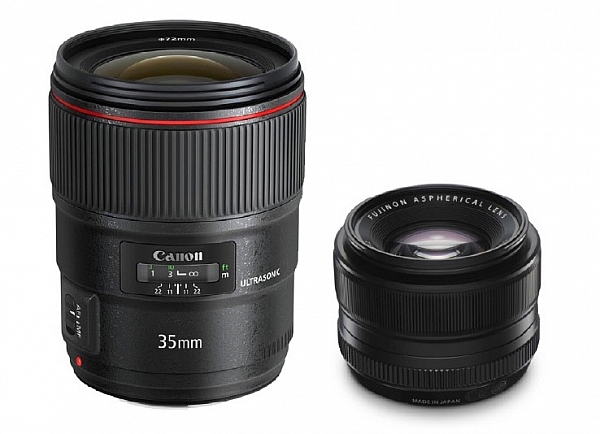
What do these two lenses have in common? They are both 35mm f/1.4 lenses. The Canon one (left) is much bigger than the Fujifilm lens (right) because it is made to fit a full-frame camera. This is a good example of how sensor size, affects lens size.

3. Don’t fall into the focal length trap

The focal length trap is the belief that you need zoom lenses that cover every conceivable focal length. For example, if you start off with an 18-55mm kit lens, then buy a telephoto zoom, you might feel that you need one that starts from 55mm so that you don’t miss out on any focal lengths in between.

This simply is not true. The next point explains the way you should be thinking about lenses.

4. What subjects are you going to photograph?

Continuing with the 18-55mm kit lens example, you may find yourself considering the following second lenses: a 50mm prime as a portrait lens (giving you the benefit of high quality imaging and wide apertures), or a macro lens for taking close-up photos of insects and flowers, or wide-angle zoom for landscape photography, or a super-telephoto for wildlife and sports photography.

The key point here is that lens choice is related to subject. The subject always comes first. Once you know what you are going to photograph, you can choose the best lens (or lenses) for the job. Focal length is a secondary consideration.

In other words, don’t buy a lens because you think you should own it, buy it because you actually need it.

How to buy a camera lens

5. Should you buy a zoom or a prime lens?

The benefit of zoom lenses is convenience. If you are a wedding photographer it is much easier to zoom from a wide-angle to a telephoto when you need to, than it is to change lenses. If you are a landscape photographer it is easier to use a wide-angle zoom to frame the scene precisely, than it is to change prime lenses (or it may not be possible to stand where you need to get the shot).

The benefits of prime lenses are image quality and wider apertures. Compare an 18-55mm kit lens (typical maximum aperture f/5.6) with a 50mm prime with maximum aperture of f/1.4. There’s a four stop difference 16 times more light) between f/1.4 and f5.6, which helps you take photos with blurred backgrounds, and also to shoot in low light conditions, without raising the ISO too much. That’s why a 50mm prime is a better portrait lens than the 18-55mm kit lens (taking us back to the point about lens choice being driven by subject, not focal length).

Some photographers prefer primes, others zooms – thinking about your priorities will help you decide which is best for you.

For example, if you are a landscape photographer who always shoots at f/8, f/11, or f/16 then the wider apertures that prime lenses have are of little use to you, and a zoom may be a better choice.

How to buy a camera lens

Action photos require a telephoto lens and a camera with a good autofocus system capable of tracking moving subjects. A zoom will help you frame the subject accurately.

6. Don’t forget about weight and size

Think about the weight and size of your lenses carefully. After all, you are the one who is going to be carrying them around.

But there is another thing you should also think about when it comes to size, and that is filters. You can save a lot of money on filters by buying smaller lenses. If you’re curious to see how much, do a search for circular polarizing filters and compare the prices of the same filter in 58mm and 77mm sizes. If you need to buy a lot of filters (landscape photographers take note) then you can potentially save hundreds of dollars by buying a smaller (the diameter of the lens or filter size is also smaller) lens.

How to buy a camera lens

Wide-angle zooms are ideal for landscape photos and will help you take photos like this. Bear in mind that smaller lenses also require smaller (and less expensive) filters.

7. Build quality, weather proofing and autofocus

Most manufacturers have inexpensive, middle range, and expensive or high end lenses. Inexpensive lenses may seem like a bargain at the time, but they won’t be built as well as more expensive ones, and they may also have inferior (i.e. slower and noisier) autofocus motors.

At the other end of the scale expensive lenses tend to be built well, use good quality autofocus lenses (i.e. faster and quicker) and may also be weatherproofed (important if you take photos in bad weather or dusty conditions).

Bear these points in mind when considering a lens. Don’t forget to ask how well the lens is built, whether it is weatherproofed, and the speed and quality of the autofocus motor.

How to buy a camera lens

Wide-angle lenses are also helpful for taking photos indoors, where you may not have space to move back to use a longer focal length.

8. Brand name or third party?

You can often save money by buying a third-party lens for your camera, but in my opinion it is best to buy a lens made by your camera’s manufacturer whenever possible. Unless you have a specific reason to buy a third-party lens (usually because the type of lens you need isn’t made by your camera’s manufacturer) then stick with OEM (Original Equipment Manufacturer) lenses. They hold their value better, and autofocus performance is usually superior.

Editor’s note: for a good discussion on that topic, head to: Brand Name Versus Third-Party Photography Gear: Which is better?

How to buy a camera lens

If street and candid photography is your thing, then consider buying smaller lenses to help you take photos like this, without being noticed.

9. Image Stabilization*

An Image Stabilizer is a motor inside the lens, that moves the elements in a way that compensates for the movement created by camera shake. It is given different names by different manufacturers (Nikon, for example, calls it Vibration Reduction). It helps you take photos in low light, using lower ISO settings or smaller apertures, than would otherwise be possible. Lenses with Image Stabilization cost more than their non-stabilized counterparts, so think carefully about whether or not you need it, before paying the extra money.

* Some manufacturers, like Sony and Pentax, build Image Stabilization into the camera body, not the lenses.

Hopefully these points will help you decide which lens to buy next for your camera. If you have any questions about lenses let us know in the comments and I will do my best to answer.


Mastering Lenses

If you want to know more about buying and using lenses then please check out my ebook Mastering Lenses: A Photographer’s Guide to Creating Beautiful Photos With Any Lens.

googletag.cmd.push(function() {
tablet_slots.push( googletag.defineSlot( “/1005424/_dPSv4_tab-all-article-bottom_(300×250)”, [300, 250], “pb-ad-78623” ).addService( googletag.pubads() ) ); } );

googletag.cmd.push(function() {
mobile_slots.push( googletag.defineSlot( “/1005424/_dPSv4_mob-all-article-bottom_(300×250)”, [300, 250], “pb-ad-78158” ).addService( googletag.pubads() ) ); } );

The post 8 Things to Consider Before You Buy Your Next Lens by Andrew S. Gibson appeared first on Digital Photography School.


Digital Photography School

 
Comments Off on 8 Things to Consider Before You Buy Your Next Lens

Posted in Photography