RSS
 

Posts Tagged ‘Landscape’

Playing With Fire: Steel Wool Spinning in the Landscape

19 Nov
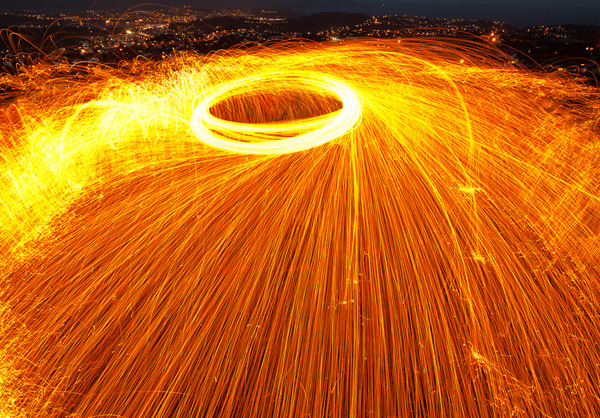
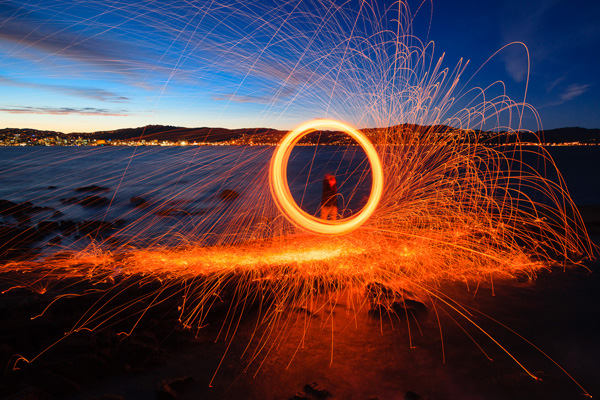
Focal length 21mm, shutter speed 15 seconds.

Focal length 21mm, shutter speed 15 seconds.

If you’ve been following my articles no doubt you have tried painting with light or using a wide-angle lens for landscape photography. You may have found some interesting ways to exploit the colour contrast between blue and orange and are definitely aware of the magical quality of the light during twilight.

Today’s technique brings all these elements together in a way that creates beautiful, dramatic and unusual images. It’s called steel wool spinning. The photos may look complicated but in reality it is easy to try out if you have the right equipment, a willing partner and pay attention to safety.

Here’s what you need:

  • Steel wool (you can get this from hardware stores, the finer grades are best).
  • A stainless steel whisk and a length of strong cord to tie it to.
  • Protective clothing, fire extinguisher and safety goggles. Burning steel wool is potentially dangerous. Don’t underestimate the potential danger – this article summarises the precautions you need to take. We are not responsible if you get burnt or set something alight.
  • A willing helper. You can use your camera’s self-timer and spin the steel wool yourself, but getting somebody to do it for you is much easier.
  • A dramatic location. One that looks good when viewed through a wide-angle lens. Also one where people are unlikely to suddenly walk into the immediate area and be hit by flying sparks, or with anything that is likely to catch alight.
  • Calm weather. The less wind the better.
  • A camera with a manual mode, a cable release or remote (the self-timer will do in a pinch), good tripod, wide-angle lens, UV filter and lens hood. Live View is also useful.

How to do it

Steel wool spinning really is very simple. Simply stuff the steel wool inside the whisk (I use masking tape to hold it in place), set it alight with the cigarette lighter, and get your helper to whirl it around in a circular motion. The burning sparks of steel wool fly out and fall to the ground, creating bright orange trails of light.
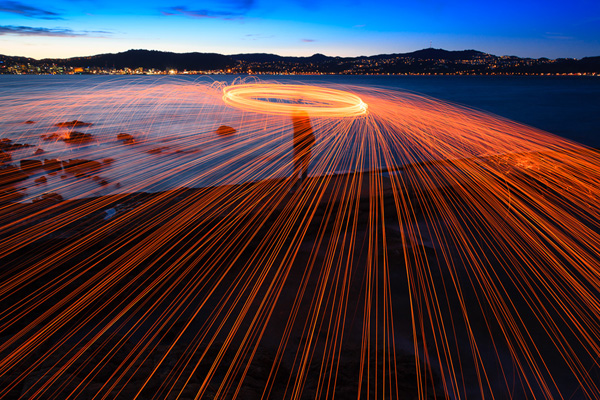
Steel wool spinning

Focal length 21mm, shutter speed 15 seconds. Here, my helper span the whisk in a circle around her head.
 

Steel wool spinning

Focal length 19mm, shutter speed 15 seconds. My helper span the whisk in a circle in front of her, creating a different shape.


Put your camera on a tripod, and set your exposure using manual mode. Aim for a shutter speed of around eight to 15 seconds – there’s no harm in underexposing the background for dramatic effect (I find the steel wool burns for about ten seconds). You’ll need to be shooting at twilight, otherwise it will be too bright. The sparks won’t show up in daylight.

If you shoot while there’s still a little light left you the sky will have a nice deep blue colour. Some people use this technique at night and combine it with painting with light (using either torchlight or portable flash) to build up an image or to capture star trails.
Steel wool spinning

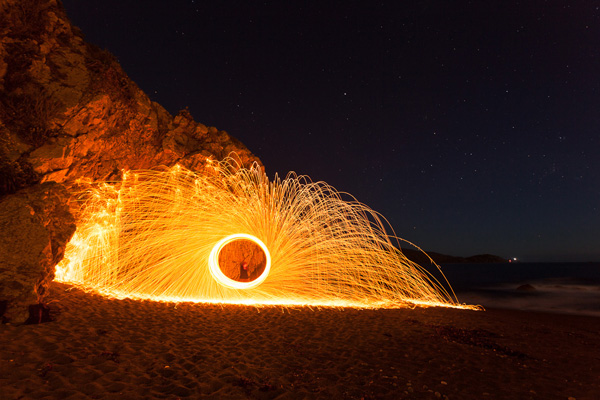
Focal length 17mm, shutter speed 30 seconds. This photo was taken after the light had faded from the sky. The 30 second shutter speed was required to capture the stars. Note that it doesn’t matter if the steel wool burns for less than the 30 second shutter speed. The idea of using a longer shutter speed is to reveal detail in the background. If I had used a shutter speed of 15 seconds, the burning steel wool would look the same (as it burns for around 10 seconds) but the background would be darker.
 

Steel wool spinning

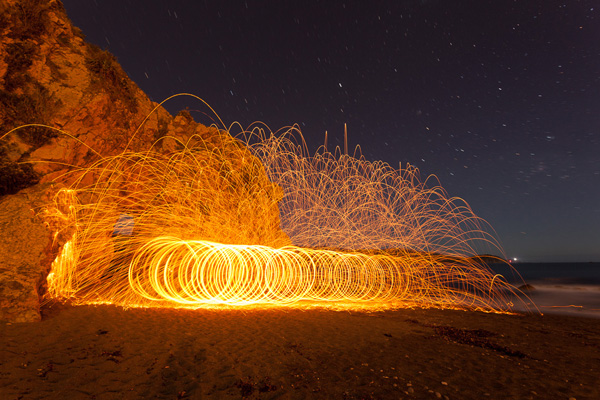
Focal length 17mm, shutter speed 215 seconds. The longer shutter speed has captured the movement of the stars. I asked my helper to spin the whisk in a circle as she walked along the beach, creating a different pattern.


Live View (if your camera has it) helps with focusing, as it may be too dark for you to focus on your subject properly. On my camera, there is enough detail in Live View to focus manually, even when it is too dark to see anything through the viewfinder. Set your camera to manual focus, focus on the person doing the steel wool spinning, and use a small aperture (f8-16) to compensate for any focusing errors. As this is a kind of landscape photo you’ll no doubt want the entire scene in focus anyway.

Shoot Raw so you can make fine adjustments to colour temperature and exposure in post-processing. In the meantime, set white balance to daylight – that will help the camera record the colours accurately.

If you’re using a wide-angle lens (recommended for the dramatic perspective) then move as close as you can to the arc of the burning sparks of steel wool for a strong composition. It is wise to wear clothing that covers as much skin as possible, plus a hat and safety goggles, in case one of those sparks lands on you. You should also use a UV filter to protect the front element of your lens from burning sparks.

Steel wool spinning inspiration

Take a look at these links for some more inspiration:

Flick Steel Wool Spinning group

Steel wool spinning at 500px

Raining Fire Photography (article)

Hopefully this article has inspired you to give steel wool spinning a try. Ultimately, it’s another form of painting with light – the light from the burning steel wool illuminates the landscape in a new and interesting way.

Have fun.

Mastering Photography
Mastering Photography ebook by Andrew S Gibson

My ebook Mastering Photography: A Beginner’s Guide to Using Digital Cameras introduces you to photography and helps you make the most out of your digital cameras. It covers concepts such as lighting and composition as well as the camera settings you need to master manual mode and take photos like the ones in this article.

Post originally from: Digital Photography Tips.

Check out our more Photography Tips at Photography Tips for Beginners, Portrait Photography Tips and Wedding Photography Tips.

Playing With Fire: Steel Wool Spinning in the Landscape

The post Playing With Fire: Steel Wool Spinning in the Landscape by Andrew Gibson appeared first on Digital Photography School.
Digital Photography School

 
Comments Off on Playing With Fire: Steel Wool Spinning in the Landscape

Posted in Photography


18 November, 2013 – Introduction to Landscape Astrophotography

18 Nov

In our latest tutorial, An Introduction to Landscape Astrophotography, Adam Woodworth describes many of the tools and methods that he uses to create fine art landscape astrophotographs.  He focuses on capturing photos of the Milky Way with minimal star movement. 


You can win an all-expenses paid photographic expedition to Antarctica, along with air fare from anywhere in the world. The value of this prize is $ 15,000.

The Luminous Landscape wants you to try any of our more than 60 training or travel videos and our new free video player. Each purchase is an entry, and an annual subscription that includes all previous as well as new videos counts as six entries. The winner of a free lifetime subscription is also chosen from each month’s entries.

Find Out More


The Luminous Landscape – What’s New

 
Comments Off on 18 November, 2013 – Introduction to Landscape Astrophotography

Posted in News


8 Ways to Prepare for an Awesome Landscape Photography Session

13 Nov

What is your photographic specialty?  Do you even consider yourself to have one?  The answer to these questions might depend on whether or not you’re a professional photographer or do it for the enjoyment of the hobby. It’s a commonly known rule amongst professionals that you can usually maximize your success by concentrating in one or two specific disciplines or styles, whether it be Continue Reading

The post 8 Ways to Prepare for an Awesome Landscape Photography Session appeared first on Photodoto.


Photodoto

 
Comments Off on 8 Ways to Prepare for an Awesome Landscape Photography Session

Posted in Photography


Wide-angle Lenses and the Landscape

02 Nov

Wide-angle lenses and the landscape

If there was ever a subject and a lens made for each other, then it is the wide-angle lens and the landscape.

Wide-angle lenses are ideal for landscape photography:

  • They have more depth of field at any given aperture setting and camera to subject distance than telephotos. It is simple to stop down and obtain front to back sharpness.
  • The perspective of the wide-angle lens draws the viewer into the image and adds a sense of depth by making the horizon seem further away than it really is. You can see the effect in this landscape taken with a zoom lens set to a focal length of 26mm:

Wide-angle lenses and the landscape

Telephoto lenses, by contrast, increase the sense of distance between the viewer and the photo. They are lenses of isolation that you use to pick out an element of the landscape, as in this photo taken with an 85mm lens:

Wide-angle lenses and the landscape

Wide-angles are lenses of inclusion that you use to capture a larger slice of the scene.

Bruce Percy’s article A Gift takes an interesting perspective on this topic.

What is a wide-angle lens?

There is no precise definition of a wide-angle lens, but it includes focal lengths of up to around 40mm on a full-frame camera, 25mm on an APS-C camera and 20mm on a micro-four thirds camera. The definition is hazy because some zoom lenses cover a focal length range from wide-angle at one end to telephoto at the other. It is difficult to pinpoint where one ends and the other begins.

Prime or zoom?

There are pros and cons of both, so let’s look at each in turn.

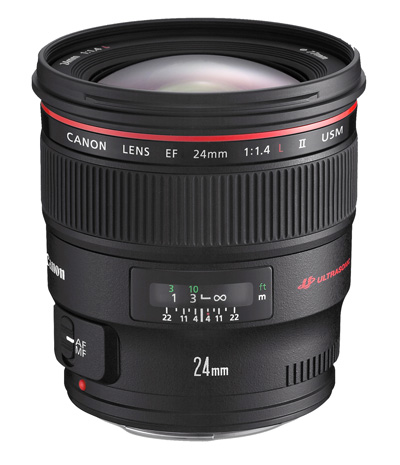
Canon EF 24mm f1.4 wide-angle lens

The biggest advantages of prime lenses are that you get excellent value for money in terms of image quality. They are great for photographers on a budget. An inexpensive prime gives you great image quality, and you would have to spend much more on a zoom lens to get one that gives the same image quality throughout the focal length range.

Another benefit of prime lenses is that they have wider maximum apertures than zooms. While this may not be much of a benefit in landscape photography, when you often need to stop down to f11 or f16, it may come in useful if you are shooting images hand-held in dim light.

Prime lenses are often lighter than zoom lenses. This is a generalisation only; for example, a wide-angle prime lens with a maximum aperture of f1.4 may be larger and heavier than a zoom that covers the equivalent focal length.

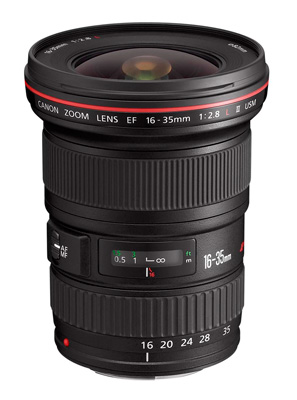
Canon EF 16-35mm f2.8L wide-angle lens

The biggest benefit of zoom lenses is the rather obvious one of having several focal lengths available. This comes in useful in landscape photography because there are times when you are unable to move closer to (or even further away) from your subject. If you are standing on the edge of a cliff, for example, then it is not physically possible to move forwards. The advantage of a zoom lens in this situation is that it enables you to frame the landscape precisely. That’s what happened in this photo. I used a 17-40mm lens set to 28mm to frame this image:

Wide-angle lenses and the landscape

Getting the most out of a wide-angle lens

Here are some tips for getting the most out of your wide-angle lens:

Wide-angle lenses and the landscape

1. Include some foreground interest.

Look for something interesting to place in the first third of your photo. This gives the viewer something to look at.

Wide-angle lenses and the landscape

2. Move in close to the subject.

It depends on exactly what you are photographing, but see what happens when you move closer to your subject with a wide-angle lens. Remember that wide-angle lenses make distant objects appear smaller, and if you are not careful you may end up with everything in the frame too distant to be of interest.

Perhaps what I’m really saying is that you should decide what is your main subject in the photo. In a landscape that may be something like a tree, a rock or even a person in the landscape. Once you have decided on the subject, see if moving closer makes the image stronger.

But: don’t move too close, don’t be afraid of including negative space to improve the image. It’s a subjective thing, and your eye for how close to the subject to get will improve with practice.

Wide-angle lenses and the landscape

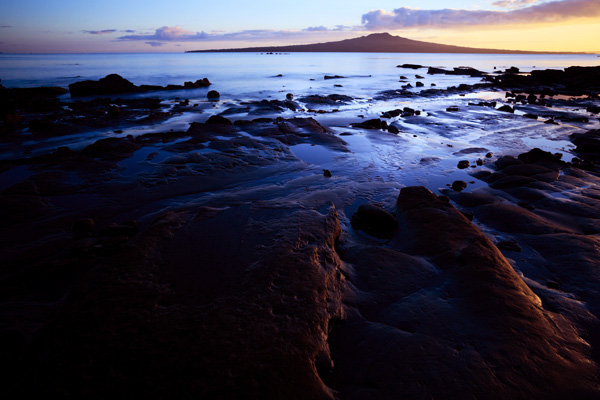
3. Use leading lines and patterns to create a sense of movement. The viewer’s eyes will follow the lines through the image. This creates a sense of movement and depth. Do you see how the rocks in the foreground in the above image create lines that point towards the distant volcano?

Understanding Lenses: Part I – A guide to Canon wide-angle and kit lenses

Understanding Lenses ebook

If you liked this article then take a look at my ebook, Understanding Lenses: Part I – A guide to Canon wide-angle and kit lenses. It is a complete guide to wide-angle and kit lenses for the Canon EOS camera system, showing you how to use them and how to decide which lens to buy.

Post originally from: Digital Photography Tips.

Check out our more Photography Tips at Photography Tips for Beginners, Portrait Photography Tips and Wedding Photography Tips.

Wide-angle Lenses and the Landscape

The post Wide-angle Lenses and the Landscape by Andrew Gibson appeared first on Digital Photography School.

Digital Photography School

 
Comments Off on Wide-angle Lenses and the Landscape

Posted in Photography


Polarizing and Neutral Density Filters: Essentials for Landscape Photography

24 Oct

In landscape photography, just as in portraits, fashion, products, or any other subject matter, accurate color capture is crucial. What makes it so much more difficult with landscapes, however, is the wider disparity in dynamic range, not only between foreground and background elements, but primarily between the upper and lower halves of the frame– between the earth and the sky. If you are into shooting landscapes, overcoming this hurdle will require you to have one of two filters (if not both) in your arsenal, even if you don’t use filters in any of your other photography.

Polarizing Filter

Polarizing filters– sometimes called the secret weapon of professional landscape photographers– create richer, more vivid colors. The filter pulls double duty by (1) cutting down on reflections from bright surfaces like water and rocks, and (2) adding rich blues to skies by darkening them and increasing the color and tonal saturation throughout the frame. Polarizing filters are most effective when shooting at a 90-degree angle to the sun. It will therefore be least effective when the sun is either in front of or behind you. Polarizing filters will also enhance clouds, but you have you to be careful with your lens choice. Just like you can overdo it in post production, it’s quite possible to overdo it in-camera if you use a polarizing filter on a super-wide-angle lens. The result will be uneven shades of blue in an over-saturated sky.

Without a polarizing filter

Without a polarizing filter

With a polarizing filter

With a polarizing filter

Neutral Density Filter

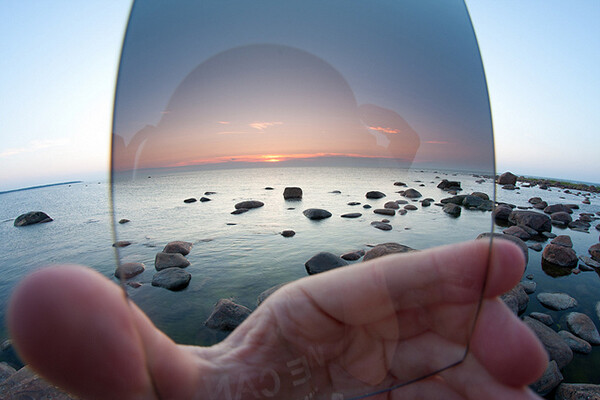
Neutral density gradient filters help balance the exposure between the ground and sky to capture a range of exposure that the camera cannot possibly handle on its own. If you expose for the ground, you’ll get a gray or white washed-out sky. Exposing for those awesome blues and soft, billowy clouds, on the other hand, will make the ground so dark you’ll lose much of the detail you set out to capture in the first place.

A wide view of a hand-held graduated neutral density filter illustrates how valuable it is to capturing accurate colors in landscape photography.

A wide view of a hand-held graduated neutral density filter illustrates how valuable it is in capturing accurate colors in landscape photography.

The filter itself is dark at the top, completely clear at the bottom, and essentially shades of gray in between. Available in two varieties, the circular version attaches to the front of the lens like any other traditional filter. The other type is a square or rectangular filter that you hand-hold in front of your lens. Both work the same way, darkening the sky to avoid blowouts, while leaving the ground untouched and unfiltered. It’s a seamless transition that ensures proper exposure throughout the frame– making sure you get vibrant, saturated, and (most importantly) accurate colors in all of your landscape shots.

Neutral Density Photo Credit: Flickr Creative Commons User Kain Kalju.

Post originally from: Digital Photography Tips.

Check out our more Photography Tips at Photography Tips for Beginners, Portrait Photography Tips and Wedding Photography Tips.

Polarizing and Neutral Density Filters: Essentials for Landscape Photography

The post Polarizing and Neutral Density Filters: Essentials for Landscape Photography by Jeff Guyer appeared first on Digital Photography School.

Digital Photography School

 
Comments Off on Polarizing and Neutral Density Filters: Essentials for Landscape Photography

Posted in Photography


Intentional Camera Movement and the Landscape

17 Oct

Intentional Camera Movement

An interesting thing about digital photography is that it has led to the rise in use of techniques that are more difficult to carry out with film cameras. It’s all down to the ability to view your images on the camera’s LCD screen after you have taken them. It’s a simple feature, but one that has made a profound change to the way some photographers work.

Regardless of what you may read about ‘chimping’, the LCD screen lets you see if your technique is working, and make adjustments on the spot if necessary. It’s one of the reasons that professionals don’t use polaroids to check their lighting setups any more. It also makes techniques like long exposure photography much easier – what was once something that was just done occasionally by landscape photographers has turned into a new genre.

Another technique that has gained in popularity is that of introducing intentional camera movement (also known as ICM on photo sharing sites like Flickr) into the image. Panning, one way of doing that, has been around for decades. But recently some adventurous photographers have started pushing intentional camera movement in new and interesting directions.

ICM photographers

If you’re not familiar with the intentional camera movement technique, then I recommend that you take the time to look at the work of some photographers that are proficient with the technique. One of the best known is Chris Friel – an artist turned photographer who pushes the boundaries of what is possible with intentional camera movement (you can read my interview with him here). Doug Chinnery is another.

Intentional camera movement fascinates me because it is a method that can create some beautiful, ethereal images. When it works, it works beautifully. Yet when it doesn’t, it just looks like camera shake. Some people will say all intentional camera movement photos are just a form of camera shake. Ignore them if you want to try it out – like many areas of photography it’s a subjective call and not everybody will like it.

Like long exposure photography, the idea behind intentional camera movement is to use a slow shutter speed to introduce blur into the photo. The difference is that with long exposure photography you use a tripod so that part of the image remains sharp. With intentional camera movement, you deliberately move the camera during the exposure so that everything is rendered as a blur.

Getting started

Intentional camera movement is carried out with a hand-held camera. It works with shutter speeds from around 1/4 second to four seconds in length.

Intentional Camera Movement

Get started by finding a landscape that lends itself to intentional camera movement. You can get the idea by looking at the work of the photographers mentioned earlier. Coastal scenes tend to work well. If you are inland try looking for forests, lakes or rivers. Whatever scene you are working with, search for something that is relatively simple and has some strong graphic shapes (that’s why seascapes, like the one above, work so well). The best time to try these techniques is at dusk. The light is beautiful and the low light means that it’s easy to obtain the slow shutter speeds required.

Intentional Camera Movement

There are two basic types of movement you can use. The first is panning – moving the camera from one side to the other in a more or less straight line. It works well for photos like this one, which I took on the beach after sunset.

Intentional Camera Movement

The other type of movement is more of a random movement. Jiggle the camera around slightly during the exposure and see what happens. This is where keeping the composition simple helps, as it means the subject is still recognisable even when blurred.

If the exposure is long enough (say around four seconds) you could try holding the camera relatively still during the first three seconds, then moving it for the last part. This can produce some interesting results.

Experiment

The key is to experiment, and to keep looking at the results on your camera’s screen. This shows you how well your technique worked, and you can adjust accordingly. You may find that you need a shorter shutter speed (or a longer one). Or that a different type of movement produces different results. Keep looking and adjusting as you go along and hopefully the results will improve.

Be prepared to create plenty of images that just don’t work. That’s okay – they are just stepping stones along the way to creating something special. It’s fine if you take a hundred photos and get just one good result – the random nature of intentional camera movement means you are always going to create images that just don’t work.

How do you know whether you got a good intentional camera movement image? That’s an excellent question. These types of photo are highly subjective. If you like it, and you created a moody image that evokes the atmosphere of the location you’re in, then I think that’s a success. Your eye for what makes a good intentional camera movement image will improve the more you use the technique.

Mastering Photography

Intentional Camera Movement

My ebook Mastering Photography: A Beginner’s Guide to Using Digital Cameras introduces you to photography and helps you make the most out of your digital cameras. It covers concepts such as lighting and composition as well as the camera settings you need to master intentional camera movement photography and take photos like the ones in this article.

Post originally from: Digital Photography Tips.

Check out our more Photography Tips at Photography Tips for Beginners, Portrait Photography Tips and Wedding Photography Tips.

Intentional Camera Movement and the Landscape

The post Intentional Camera Movement and the Landscape by Andrew Gibson appeared first on Digital Photography School.

Digital Photography School

 
Comments Off on Intentional Camera Movement and the Landscape

Posted in Photography


How To Prepare For Successful Landscape Shoots [Before You Head Out]

11 Oct

One of the simplest ways to capture great photographs is to prepare yourself for success before you head out the door. I’ve used this process of preparing for shoots for the last few years and it’s worked great for me – I’d love to hear what else people are doing to prepare for their own shoots in the comments below.

How To Prepare For Successful Landscape Shoots: The Day Before

Virtually Scout the Location

How To Prepare For Successful Landscape Shoots

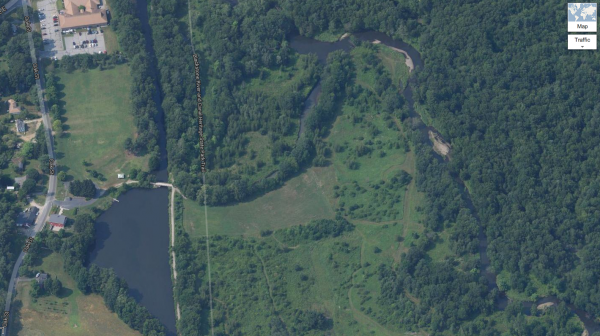
Usually the night before a shoot I will open up Google Earth, Maps and/or various other apps to scout the location for things like parking spots, water features, sun angles and whatever else might be of interest to me for that particular shoot.

It can be helpful to look through Flickr or another location based photography service to get an idea of what other photographers have found interesting before your visit.

Charge Up

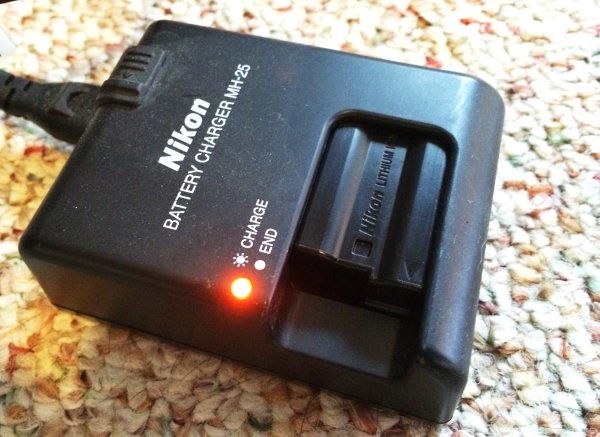
It should go without saying, but make sure you’re camera is fully charged before you go to sleep. The last thing you want is to be ready to head out the door and find out your camera’s got one bar of battery life left in it. On the same note make sure your SD/CF cards are empty and packed as well – that’s a mistake you’ll only make once.

How To Prepare For Successful Landscape Shoots

This step doesn’t just include the camera though – you should make sure that your own body is fully charged as well. Have a good sized dinner and get to bed early, eat a healthy breakfast and pack snacks to take with you. If there’s one thing that will ruin your photos faster than anything it’s an empty belly – you’ll start to get frustrated easy, you’ll care less about what you’re doing, and ultimately you will make mistakes which is the last thing we want to do when we’ve gone through all the effort to get to this location in the first place.

How To Prepare For Successful Landscape Shoots: Before You Leave

Check the Weather Report

How To Prepare For Successful Landscape Shoots

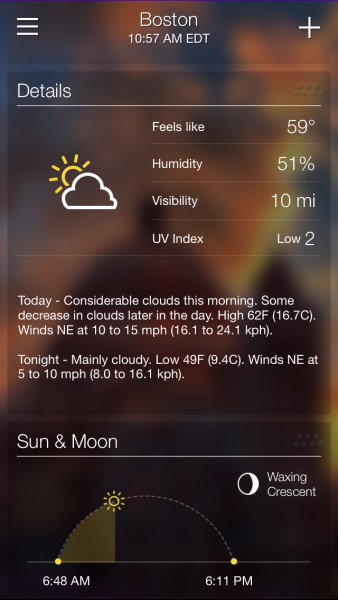
It’s easy to take for granted, but it’s important to get a weather report for the day and area you’re heading before you leave the house. If you’re planning to hike a mountain know that it will be chillier the higher you go and just because the weather is fair in your backyard doesn’t mean that it’s the same at your location of interest.

Dress Accordingly

How To Prepare For Successful Landscape Shoots

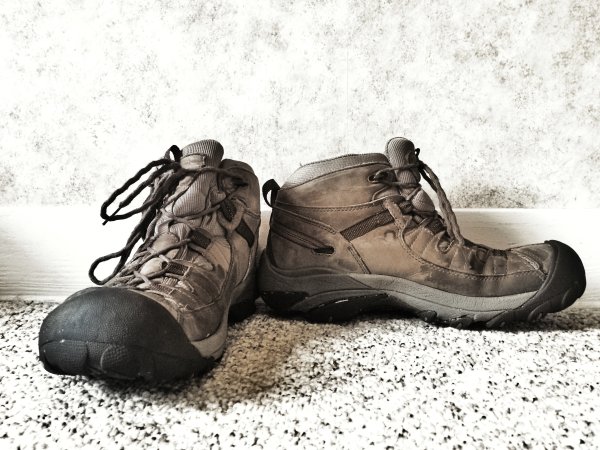
Hiking boots are a must if you want to get into locations off-the-beaten path, but you can do fine in comfortable sneakers if you’re not planning traverse any serious terrain. That said you should plan to wear comfortable and breathable clothing – jeans and cotton shirts are rarely a good option as they don’t keep you warm and if they get wet they will take forever to dry.

How To Prepare For Successful Landscape Shoots: On Scene

Arrive Early

I can’t stress this enough! The last thing you want to do is show up as the sun is setting or after it has risen. If you arrive early you can set up the camera and capture many different locations with the light that you have.

How To Prepare For Successful Landscape Shoots

As the light changes you may want to revisit your previous locations or continue looking for new ones, but as long as you’ve gotten there early, you should end up with a bunch of shots to process when you return home.

Take Your Time

Rushing around will not allow your mind to think properly. When you rush your shots the odds are increased that you’ll get home to find out that you left your ISO at some unusable number or your aperture was at f/2.8 when it was supposed to be at f/11.

How To Prepare For Successful Landscape Shoots

Take each shot as seriously as the last one you took and make the adjustments that are needed to get the best image out of the scene before you. Sometimes I find it helpful to even simply get up and walk away from the camera and give myself a break. Of course, when I do that, I still end up taking photographs with my phone, but those are more  for fun than anything else.

Returning Home

Processing the Results

After all is captured and you’ve safely made it back to your house it’s time to process your what you’ve recorded. This part is truly up to you and your creative style, but here is my workflow as a basis point.

How To Prepare For Successful Landscape Shoots

I will start with import the RAW files into Lightroom and going through to clean out the ones I absolutely don’t see any use for. I’ll then make my selections of the ones that are first on the list to get process and do just that. On occasion I will do more processing and clean up in Photoshop, but with how powerful Lightroom has gotten over the last couple iterations of the software I’ve seen less and less need to do so. If you’re curious you can also watch me edit select photos every week on my Let’s Edit series.

To get even more information on landscape photography check out this amazing DPS eBook on the entire process.

Post originally from: Digital Photography Tips.

Check out our more Photography Tips at Photography Tips for Beginners, Portrait Photography Tips and Wedding Photography Tips.

How To Prepare For Successful Landscape Shoots [Before You Head Out]

The post How To Prepare For Successful Landscape Shoots [Before You Head Out] by John Davenport appeared first on Digital Photography School.


Digital Photography School

 
Comments Off on How To Prepare For Successful Landscape Shoots [Before You Head Out]

Posted in Photography


The Surreal Landscape: Long Exposure Photography

09 Oct

Long exposure photography

It seems to me that we live in a world orientated to a digital generation demanding instant gratification. This extends to photography, encouraged by the prevalence of camera phones and Instagram type apps. How many photographers, when they come across a beautiful scene, just stop and snap a photo with a camera phone and then move on?

Long exposure photography is different. It demands patience, an appreciation of beautiful light and a deep understanding of composition. It is as much about the mind-set of the photographer as it is about the subject. It’s not brash or flashy – you rarely see long exposure photographers use techniques such as high dynamic range (HDR) photography or adding texture layers.

What is long exposure photography? There is no precise definition. I think of it as involving shutter speeds of ten seconds or longer, but I’m sure some photographers will be thinking in terms of shutter speeds of a minute or more. But the aim is the same – to create beautiful and surreal images by leaving the shutter open long enough to record anything that moves within the landscape, such as water, as a blur.

That’s why most long exposure photography tends to take place along the coast. The sea creates an interesting subject, helped by natural features such as rocks and islands, and man-made ones like piers and jetties.

Painting with light is also a form of long exposure photography.

Long exposure photography

Contemplation and the landscape

You may be wondering what one does while waiting for the camera to take a photo when the shutter speed is longer than a minute.

The answer is that long exposure photography is a naturally contemplative pastime. While waiting, take some time to enjoy the beautiful location you are in. Breathe and enjoy the smell of the air. Listen to the sounds. Watch the light as it fades away. This meditative approach will help you notice things an instant gratification seeker will miss.

Getting started

Interested? How then, do you get started? One of the nice things about long exposure photography is that the basic requirements are not extensive:

  • A camera that lets you take control of the exposure settings and has a Bulb setting so that you can use shutter speeds longer than 30 seconds.
  • A tripod and a good ball-and-socket head. Beware of inexpensive models – they may be too flimsy to support your camera properly during long exposures. A good aluminium or carbon-fibre tripod is required.
  • A cable release or remote release so that you can activate the shutter without touching the camera.

Filters

A polarising filter is useful for eliminating reflections from shiny surfaces, such as a concrete jetty made wet by sea water. It also blocks between one and two stops of light, helping you obtain longer shutter speeds.

Some photographers use neutral density (ND) filters, but they are not essential. You can get started without them by turning up late in the day and taking photos as the sun sets. During twilight you can obtain shutter speeds of thirty seconds or later by setting a low ISO and a narrow aperture.

The benefit of neutral density filters is that they extend the period of time during which you can use long exposures. They come in various strengths; three, four, nine and ten stop ND filters are the most common. Nine and ten stop ND filters are designed to enable long exposure photography during the middle of the day – you won’t need them if you are shooting at dusk.

Learn more about neutral density filters.

Long exposure photography

Noise reduction

Shoot in Raw and turn off the long exposure noise reduction setting. The software you use to process your Raw files will take care of noise reduction for you.

Resources

Here are some more resources that will help:

BW Vision

Slices of Silence

Interviews with long exposure photographers

Long Exposure Photography: 15 Stunning Examples

Eight Tips for Long Exposure Photography

Photo Tutorial – Long Exposure Photography

Final thoughts

That’s a lot to take in, so don’t forget the most important thing of all – to go out and take some photos. It takes a while to get the hang of long exposure photography, so don’t be discouraged if your first attempts aren’t as polished as you would like. It takes time to master the techniques and develop the eye for graphical composition required for successful long exposure photography.

Mastering Photography

My ebook Mastering Photography: A Beginner’s Guide to Using Digital Cameras introduces you to photography and helps you make the most out of your digital cameras. It covers concepts such as lighting and composition as well as the camera settings you need to master long exposure photography and take photos like the ones in this article.

Long exposure photography

Post originally from: Digital Photography Tips.

Check out our more Photography Tips at Photography Tips for Beginners, Portrait Photography Tips and Wedding Photography Tips.

The Surreal Landscape: Long Exposure Photography

The post The Surreal Landscape: Long Exposure Photography by Andrew Gibson appeared first on Digital Photography School.

Digital Photography School

 
Comments Off on The Surreal Landscape: Long Exposure Photography

Posted in Photography


Views Across the Landscape [Book Review]

06 Oct

NewImageAgain, another large format book, sized precisely to best show off the subject matter.

As befits this subject, the pictures get priority and so they should … text takes the back seat but not to a demeaning degree.

Author Peter Watson is a self-taught photographer and has authored five other books, all to do with landscape photography. In his view ‘recent developments in digital technology have simplified landscape photography.’ Perhaps this could have been better said as the arrival of digital photography has simplified landscape photography.

How so? Well, for one thing the burden of establishing, equipping and operating a darkroom has gone, along with the bane of keeping chemicals fresh, enlargers clean and dust free and the pain of long hours of operation, mostly at night. In nearly all forms of photography today, software is king!

Photographers now have total control over the process, right from concept through to the tap on the shutter and on to the final print. Never before has the photographer had complete control.

While we can now enjoy enormous control post exposure there are still limits to what can be achieved and many a trap may lay in waiting for the unwary. What may emerge after software processing can only be as good as the original material: RIRO or Rubbish In Rubbish Out!

Landscapes are a demanding subject. You have no control over the subject, none over the lighting of it, its placement or orientation. Watson’s attitude is that it is sanguine to adopt techniques that require minimal post exposure adjustment; as he says ‘post processing should be considered the icing on the cake, not the main recipe.’

The book begins by suggesting research methods for prospective subjects, location hunting, the ‘right equipment’ and accessories such as tripods and pan heads, filters … even down to the right clothing for the location.

The chapter headings show the way:

  • Equipment
  • Technique
  • Light in the Landscape
  • Composition and Design
  • Taking a Closer Look
  • Landscape Locations

In terms of equipment the book is realistic: beware of buying and using a digital camera with a ‘kit lens’ included in the purchase price; they are all built with a smaller maximum aperture and mostly offer lower resolution than fixed focal length primes lenses.

There is some basic info on lens apertures and shutter speeds, understanding histograms, the use of filters, etc.

Then, to my mind, some of the most important elements in successful and satisfying landscape photography are outlined: finding the best viewpoints and using light.

With the former, location recces using Google Earth lets you ‘fly’ to anywhere in the world, check out sample photos of the area in question and even scout a shooting position. The message is search for a shooting spot by discovering one with a useful foreground.

With the latter, light can impart mood, atmosphere, tranquility, harmony etc. Visit the location at different times of the day and year. Notice its angle, colour, strength and distribution.

In scanning the book I was struck at how the author/photographer used light to lift the quality of his landscape images. If the same images had been shot at different times of the day or at times when the light was a less powerful element those pictures would not have ‘worked’.

There are four pages of pictures and text on how to use mist in photographing the landscape: a fine balance is essential; too much landscape will diminish it; too little will leave you wondering what you’re looking at. Balance is crucial.

IMHO the book’s purchase is worth it for the value of the pictures alone!

Author: P Watson.
Publisher: Ammonite Press.
Length: 192 pages.
Size: 25x25x12mm.
ISBN 978 1 90770 884 8. Price: Get a price on Views Across the Landscape

Post originally from: Digital Photography Tips.

Check out our more Photography Tips at Photography Tips for Beginners, Portrait Photography Tips and Wedding Photography Tips.

Views Across the Landscape [Book Review]

The post Views Across the Landscape [Book Review] appeared first on Digital Photography School.

Digital Photography School

 
Comments Off on Views Across the Landscape [Book Review]

Posted in Photography


Painting with Light in the Landscape

27 Sep

Painting with light

Most of the articles I’ve written about light so far have explored the use of natural light. Painting with light in the landscape takes that idea further by mixing artificial light, provided by the photographer, with the ambient light to create surreal and dramatic images.

Painting with light is an effective technique because it works with two ideas that, when combined, become very powerful:

  • Painting with light usually takes place at dusk. The main reason for this is entirely practical. You use either a torch or a portable flash to paint with light, and they are not bright enough to use during the day. The light is very beautiful during twilight, so this turns out to be a benefit.
  • Painting with light uses two colours that work very well together – orange and blue. Now, you may use coloured gels to paint with other colours, but these should still be colours like red, green and yellow that contrast nicely with the natural blue colour of the light you get at twilight.

The tools

Let’s take a look at the tools you can use to paint with light. First is my favourite, a hand-held rechargeable lantern that I bought from a local hardware store (just like this one). It’s powerful – the light has a strength of one million candlepower (you can buy models with two or five million candlepower). It wasn’t expensive, and also comes in useful to keep around the house or in the car. It has a tungsten bulb.

Using the lantern is easy. First, you need a spectacular landscape.

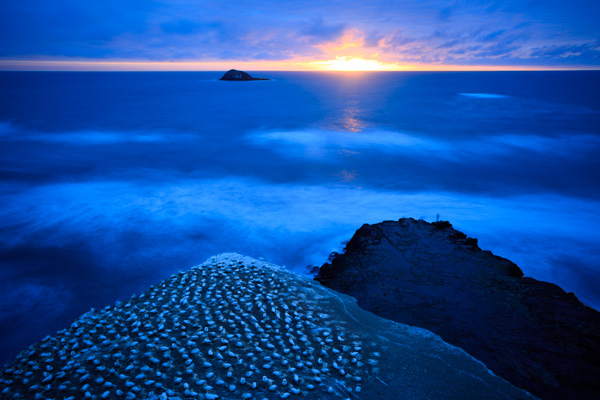
For example, these cliffs at Muriwai, a beach near Auckland in New Zealand, are a dramatic scene:

Painting with light

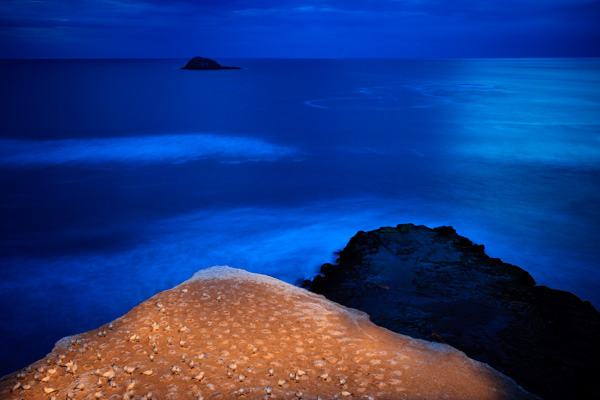
I was curious to see what happened if I used the lantern to paint the cliffs with light. I returned another evening to try it, here’s the result:

Painting with light

The technique itself is quite simple. Turn the lantern on, point it at the scene you want to paint, then gently move the lantern so the light from its beam covers the surface of the subject. You do this while the camera’s shutter is open.

You’ll need a shutter speed that gives you enough time to paint the subject, so you’re looking at at least ten seconds. Thirty seconds is easier (hence the need for low light). Don’t use neutral density filters to obtain these shutter speeds, as they also block the light from the lantern. You need to wait until the ambient light is low enough to obtain these shutter speeds through a combination of low ISO and small aperture (such as f11 and f16, but preferably not f22 as diffusion will soften the image).

The crucial aspect is timing. Try it too early, when the light is bright, and the light from the torch won’t be strong enough to overpower the daylight. Leave it too late and it will be too dark. The sky will be black, and you won’t have any background detail.

What you’re looking for is the sweet spot between these two extremes. When the light is low enough to give you a shutter speed of around 30 seconds, and the light from the torch balances with the ambient light, and it is still light enough to get good background detail.

The best way of finding the sweet spot is to test it out. Put your camera on a tripod, decide how you will compose the image and then wait for the light to fade. Take a test shot when the light is low enough for a shutter speed of ten seconds or so. Then look at the result on your camera’s screen.

Does the ambient light overpower the light from the torch? Then you need to wait until it gets darker. Did you cover the subject evenly with the torch light? This may take several attempts to get right. Hopefully, the moment that you figure out how to paint the subject with light will coincide with the moment the ambient light and torch light balance each other perfectly.

When you find the sweet spot, keep going until the ambient light fades away. You can decide which image you prefer when you view the results on the computer.

Painting with light

This is a photo taken earlier. You can see that it’s too early to work yet – the light from the lantern is overpowered by the ambient light. It also needs more work to get the coverage right.

Using portable flash

Another way to paint with light is to use portable flash. Using a lantern is simple, and a good way to get started. But if you’d like to take up the challenge, portable flash gives you some interesting options. Here’s why:

  • You can use portable flash to fire multiple bursts of light at the subject, building up the exposure over time.
  • You can use coloured gels to give light of different colours.
  • You can shoot at night, rather than at dusk, using portable flash to fire multiple bursts of light, building up an exposure over time. You can use multiple flashes, or the same flash with different coloured gels, to do so. There are lots of good examples here at Troy Paiva’s Lost America website.

The essence of the technique is again simple. Switch your flash unit to manual, and use the highest powered setting (1:1). Work out your composition in advance, preferably while there is still enough light to see. Wait until the light gets low, then start using your flash to illuminate the subject.

If you are going to be in the frame yourself, make sure you are wearing black clothes. Don’t stand still – keep moving so that you don’t register in the frame. Keep your body between the flash unit and the camera so that the light from the flash head itself doesn’t appear in the frame, just the light that illuminates the subject. Keep checking the camera’s LCD screen to see how the images are coming out, and adjust your technique accordingly.

Here’s a photo I created using a portable flash unit fitted with an orange gel (CTO – Colour Temperature Orange) to imitate the look of a tungsten bulb.

Painting with light

Mastering Photography

Painting with light

My ebook Mastering Photography: A Beginner’s Guide to Using Digital Cameras introduces you to digital photography and helps you make the most out of your digital cameras. It covers concepts such as lighting and composition as well as the camera settings you need to master to take photos like the ones in this article.

Post originally from: Digital Photography Tips.

Check out our more Photography Tips at Photography Tips for Beginners, Portrait Photography Tips and Wedding Photography Tips.

Painting with Light in the Landscape


Digital Photography School

 
Comments Off on Painting with Light in the Landscape

Posted in Photography