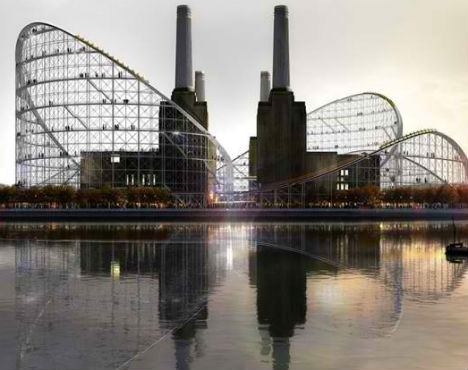
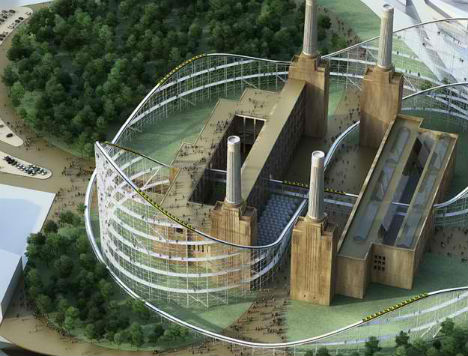
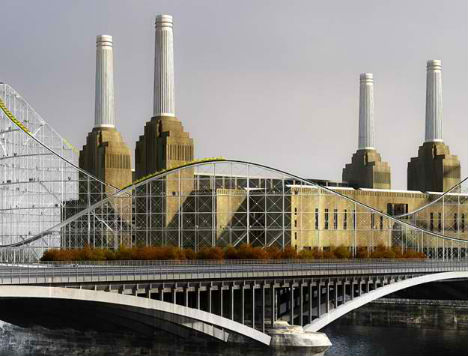
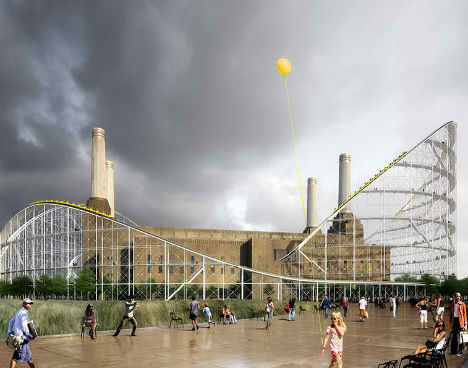
An abandoned power station that has been an iconic part of London’s skyline since 1933 is transformed into a playground and museum in the “Architectural Ride London” proposal by Atelier Zündel Cristea. The concept makes use of the Battersea Power Station, which was decommissioned in 1983, preserving its history while making it both an educational and recreational attraction.
The former coal-fired power station (which has been featured in a number of films and music videos) is notable for its original Art Deco interior fittings and decor, but throughout the thirty years of its abandonment, its condition has deteriorated severely. Former owners considered making the station an indoor theme park in the 1987, and work began on converting the site, but lack of funding brought the project to a halt.
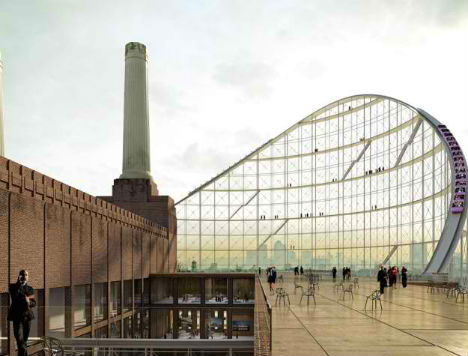
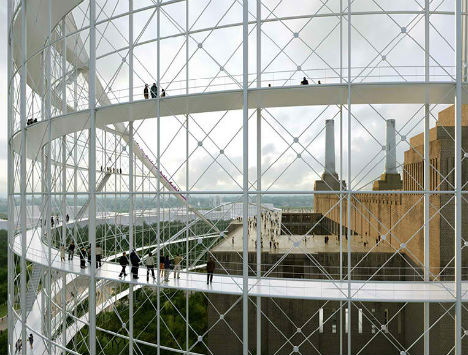
The new proposal revives this idea, making it even more grand with a roller coaster that winds around the building itself, making it the center of attention during the ride. Paths created by the scaffolding-like support of the roller coaster offer opportunities for walking tours. The design took first prize in the ArchTriumph Museum of Architecture competition.
“Our project puts the power station on centre stage, the structure itself enhancing the site through its impressive scale, its architecture, and its unique brick material. Our created pathway links together a number of spaces for discovery: the square in front of the museum, clearings, footpaths outside and above and inside, footpaths traversing courtyards and exhibition rooms. The angles and perspectives created by the rail’s pathway, through the movement within and outside of the structure, place visitors in a position where they can perceive simultaneously the container and its contents, the work and nature. They come to participate in several simultaneous experiences: enjoying the displayed works, being moved by the beauty of the structure and the city: river, park, buildings.”
Your iPhone can be a bit of a scaredy-cat. It just can’t seem to get up the courage to join you on your kayaking expeditions! Until now…
The Optrix iPhone Adventure Suit will give your iPhone 5 the boldness it needs to transform into a go-anywhere action cam.
In this suit your iPhone will be able to withstand a 15 foot drop and snap photos safely, 15 feet underwater. It even has a built-in wide-angle lens, so your now-courageous cam can capture more of the action than ever before.
Combine it with the Super Sucker to give it an extra boost of bravery. This mount uses industrial strength suction to hold onto a car, kayak, surfboard, just about anything!
“Ha ha ha!” What’s that? Oh, just your phone laughing at danger.
The Optrix iPhone Adventure Suit
$ 130 at the Photojojo Store
Tweet it!
Share
Related posts:
The iPhone Scuba Suit Takes Your Phoneography To New Depths Warm summer months are upon us, which means you’ll adopt…
The Polaroid iPhone Decal: Turn Your Phone into a OneStep! Your iPhone4 is the Swiss army knife of the mobile…
The iPhone Rangefinder Adds a Shutter, Viewfinder, and Tripod Mount to Your iPhone Fifty years ago, photogs were all about the rangefinders. They’re…
If you were to pick a themed wedding, it wouldn’t be lightsabers and Ewoks. It’d be photo-themed.
But this is no Vegas drive-through wedding. This is a glassy classy operation.
There are lots of ways to weave your favorite things into your wedding, but this DIY lens bouquet holder our pal Amber Phillips made stood out as a super original way to include your love of photography.
She’s sharing her how-to, and you don’t even have to be getting married to get in on it! You can turn your lens into a vase, planter, or a pencil-holder.
Make a Lens Bouquet Holder
p.s. Our buddies at Nations Photo Lab have 1/2 off all prints 8×10 and smaller right now. Hurry though, it ends at midnight EST!
Why It’s Cool:
Maybe you have a broken, old lens you haven’t been able to use, or maybe your local camera shop has a bin of scratched lenses that you eye every time you visit.
Whether you’re having a wedding or not, you can repurpose that lens, and that saves one more from ending up in the dump while beautifying your home all at the same time.
This project shows you how to safely hollow out your lens, so you can fill it with flowers, pencils, plants, a pile of plastic dinosaurs, or whatever else you might have around.
Ingredients:
A broken lens
A hammer
Pliers
Any kind of knife
Floral foam (a 4″ x 4″ chunk does fine)
Gorilla glue or hot glue
Safety glasses
Work gloves
STEP 1: How a Broken Lens Got Its Groove Back
Where does one pick up a broken lens? It’s as easy as searching “broken lens” on eBay.
Your local camera shop might have unusable lenses for sale, and you might also find some at garage sales or swap meets.
There are a ton of old lenses out there that are just too scratched to be used. Once you have your lens, you’re ready to start breaking it down …
Step 2: Remove the Glass
First, lay down cardboard or bubble wrap to protect your work surface. You’ll be removing the glass from the lens by hammering it.
Put on your safety glasses. We don’t recommend you touch the broken glass with your hands, but for extra precaution, put on work gloves. Or a robo-glove. Either works.
You might notice there are multiple layers of glass inside. Start breaking through the first layer of glass by hammering.
TIP: Breaking this glass is harder than you would think. The layers can be pretty thick. Be careful and watch for “bounce-back” with your hammer hand.
Use your pliers to pull out any glass that you wouldn’t want to touch with your hands.
Once you are through the first layer of glass, take a look at the lens depth and figure out if you want to go further. If so, keep on hammering.
Step 3: Cut the Foam
Once you’ve reached the depth you need, bust out your floral foam.
Take a look inside the lens, and eyeball what size you would need to cut down the foam so it fits in snug at the bottom.
Use a knife to cut it down to size.
Step 4: Glue the Foam
With a dab of glue, attach the foam into the bottom of your lens.
This’ll make sure the flowers don’t fall out while you’re holding the bouquet throughout the day.
Step 5: Arrange Your Bouquet
Once the foam is glued inside, you can start arranging your bouquet!
If you’re feeling shy about arranging your own flowers, take it to your florist, and they’ll be able to make something stunning for you.
Step 6: Put It to Use
Now what? Get married!
After you set up some chairs and get an officiant and all that.
Enjoy your day with your photo-geek bouquet, and play a prank on your photographer. What do you mean? Your lens *isn’t* supposed to have flowers in it?
Take it further
Make yours a planter. Check out our DIY!
Skip the foam, and turn your lens into a desk companion/pencil holder!
If you’re not in a DIY mood, Lens Mugs are super realistic faux lenses you can use instead.
Amber Phillips is a photographer and crafter based in Talladega, Alabama. Besides photography, she absolutely loves Doctor Who.
Related posts:
Printable, Foldable, DIY Lens Hoods, Fitted For Your Lens. Free! Paul Mutton doesn’t want you to spend twenty bucks on…
Freelensing! Turn any Lens into a Tilt-Shift or Macro ~Reach 290,000 photo fans A great philosopher once told us,…
How to Turn a Flatbed Scanner into a Handheld Camera for Spooky Photos! Extra photos for bloggers: 1, 2, 3 Pumpkins, witches and…
Luxi is a diffusion dome accessory that aims to turns your smartphone into an affordable incident light meter. The accessory is currently gaining traction via a Kickstarter campaign, is designed to work as an incident light meter by measuring the light for an entire scene, rather than just reflected light. Luxi is expected to retail for $ 24.95, and its developers claim the accessory will work with existing light meter apps. See the Luxi in action at connect.dpreview.com.
A project at the Massachusetts Institute of Technology has embedded advanced processing functions into an image processor for mobile devices. The chip includes features such as ‘real-time’ HDR processing and sophisticated bilateral noise reduction at a hardware level – making the process more energy efficient than running it as software, and making the chip more appropriate for battery-limited mobile devices. The work was funded by iPhone manufacturer Foxconn and a prototype chip, fabricated by the Taiwan Semiconductor Manufacturing Company, is now being tested.
[ By WebUrbanist in Gaming & Computing & Technology. ]
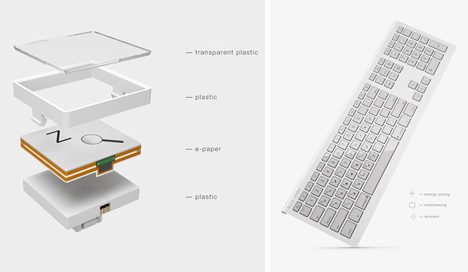
Electronic ink is energy efficient and easy on the eyes, so why not adapt it to the keyboard? It is, after all, one of the few components of everyday technology that still has printed type in a screen-dominated world.
Designed by Maxim Mezentsev & Aleksander Suhih the E-inkey keyboard for Pixel Studio (p1x.ru), the concept is simple: e-ink key displays that can shift to gaming keys, shortcuts or program-specific icons smoothly on demand, just like turning the digital page in your favorite e-book reader.
There is already a working precursor to this, and it is more than a prototype – the Optimus Maximus keyboard has configuration software for full customization (letters, images, icons, colors), but uses power-sapping and heavy-touch OLED technology (making it harder to go wireless or even push buttons).
While this is not yet in production, the specs give some hope that it might make its way to Kickstarter or an equivalent soon – it definitely falls under the “please take my money!” category for tech geeks and design professionals alike.
[ By WebUrbanist in Gaming & Computing & Technology. ]
[ By Steph in Architecture & Offices & Commercial. ]
An incredible abandoned cement factory, covered with ivy and partially in ruins, has been transformed into a massive office complex that preserves both the original architectural integrity of the structures and honors the factory’s period of disuse. Architect Ricardo Bofill discovered the property in Spain in 1973 and claimed it for the head office of his firm, Taller de Arquitectura.
When the property was discovered, it was full of staircases to nowhere, exposed pipes and half-fallen structures. The industrial complex consisted of over 30 silos, subterranean galleries and machine rooms. The transformation of the space started with knocking down some of the unsalvageable structures, which left behind curious concrete forms that give the impression of a modern abstract sculpture park.
The eight silos that remained became the offices, archives, a library, a projection room, a lab for architectural models and sleeping spaces. A massive space known as ‘The Cathedral’ hosts exhibitions, concerts and other cultural functions.
While the interior spaces have been cleaned up, much of the machinery has been left behind, and the grounds have been restored to a balance between intentional landscape design and the chaos of greenery that proliferates when buildings are not maintained.
[ By Steph in Architecture & Offices & Commercial. ]
[ By Marc in Architecture & Houses & Residential. ]
Churches are some of society’s most stylistically beautiful buildings. A large amount of building design comes down to functionality and affordability, so churches, built for a spiritual purpose rather than a materialistic one, tend to include elements that highlight beauty and detail. When these churches grow old, or are purchased, they can then be renovated into amazing houses that uniquely introduce religious elements into a pedestrian environment.
The Church of Living
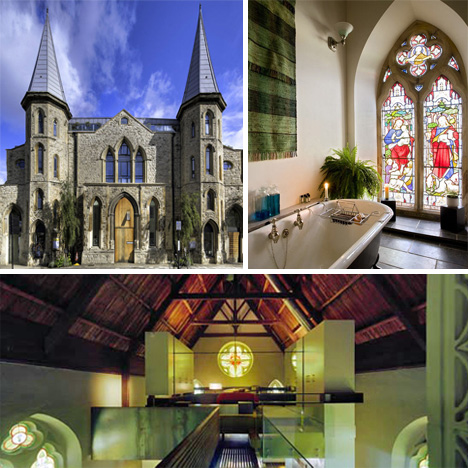
The Church of Living is a transformed structure, from church to residence, carefully designed by Zecc architecture in the Netherlands. This firm is no stranger to church conversions, and their design chops are shown to full affect in this example from Utrecht. White walls and modern appliances and motifs maintained the atmosphere of the church, while making it a home worth living in. The small old church touches that remain are what keep this building anchored. For example, the chandelier in the ultra modern bathroom is the perfect example of an old touch balancing out a very modern renovation.
WG Architects, Brisbane
Willis Greenhalgh Architects, known better as WG Architects, transformed this Brisbane church into a gorgeous home full of light. Built in 1867, this is a heritage site, and thus required a very delicate renovation. The unique elements of an old style church were maintained, while contemporary elements were introduced to bring the church house “up to speed.”
Westbourne Grove Church
This imposing building, Westbourne Grove Church, was transformed into a modern home with a 2 floor renovation by London-based DOS Architects; the steps taken to complete the process are presented visually on their site here. Design site Abduzeedo provides additional background information about the history of the church, which despite seeming ancient, was built with a Victorian style in 1953. The design team decided to go highly modern in the interior, which contrasts nicely with the old-style stone outside.
Glenlyon Church
Multiplicity is the two person team of designer Sioux Clark and architect Tim O’Sullivan. Bedecked with awards (for good reason) they hold tightly to their commitment of “creating spaces that are intrinsically beautiful, highly useable, readily enjoyable and environmentally friendly.” Their 2004 conversion of the Glenlyon church into a livable residence pulls out all of the design stops, as it required that they literally create a 2nd story out of thin air. Utilizing glass and the many gorgeous windows, they were able to highly increase the usable space, while keeping the structure in the middle from making it seem too crowded.
[ By Marc in Architecture & Houses & Residential. ]
While wearable, mountable cameras such as the GoPro have been the choice for capturing action-oriented stills and video, some camera phone cases enable users to achieve similar results safely from their smartphone – at a fraction of the cost. With the high-megapixel cameras and HD video recording capabilities of today’s advanced mobile devices, such accessories are becoming very viable options for extreme sports and action mobile photography. We look at three such products today on connect.dpreview.com.
[ By Marc in Architecture & Houses & Residential. ]
Churches are some of society’s most stylistically beautiful buildings. A large amount of building design comes down to functionality and affordability, so churches, built for a spiritual purpose rather than a materialistic one, tend to include elements that highlight beauty and detail. When these churches grow old, or are purchased, they can then be renovated into amazing houses that uniquely introduce religious elements into a pedestrian environment.
The Church of Living
The Church of Living is a transformed structure, from church to residence, carefully designed by Zecc architecture in the Netherlands. This firm is no stranger to church conversions, and their design chops are shown to full affect in this example from Utrecht. White walls and modern appliances and motifs maintained the atmosphere of the church, while making it a home worth living in. The small old church touches that remain are what keep this building anchored. For example, the chandelier in the ultra modern bathroom is the perfect example of an old touch balancing out a very modern renovation.
WG Architects, Brisbane
Willis Greenhalgh Architects, known better as WG Architects, transformed this Brisbane church into a gorgeous home full of light. Built in 1867, this is a heritage site, and thus required a very delicate renovation. The unique elements of an old style church were maintained, while contemporary elements were introduced to bring the church house “up to speed.”
Westbourne Grove Church
This imposing building, Westbourne Grove Church, was transformed into a modern home with a 2 floor renovation by London-based DOS Architects; the steps taken to complete the process are presented visually on their site here. Design site Abduzeedo provides additional background information about the history of the church, which despite seeming ancient, was built with a Victorian style in 1953. The design team decided to go highly modern in the interior, which contrasts nicely with the old-style stone outside.
Glenlyon Church
Multiplicity is the two person team of designer Sioux Clark and architect Tim O’Sullivan. Bedecked with awards (for good reason) they hold tightly to their commitment of “creating spaces that are intrinsically beautiful, highly useable, readily enjoyable and environmentally friendly.” Their 2004 conversion of the Glenlyon church into a livable residence pulls out all of the design stops, as it required that they literally create a 2nd story out of thin air. Utilizing glass and the many gorgeous windows, they were able to highly increase the usable space, while keeping the structure in the middle from making it seem too crowded.
Next Page: Church Bells To Doorbells 8 Churches Turned Into Homes
Want More? Click for Great Related Content on WebUrbanist:
Modern Religion: 13 Contemporary Churches & Chapels
Unlike the intricate spires and scrolls of traditional churches, these modern church designs focus on minimalism to enhance the beauty of natural light.
Click Here to Read More »»
Dream Designs: 10 Uncanny Ultramodern Homes
Modernism is style – ultramodernism is undefined, but for the purposes of this article is that amazing design approach which brings the future into the present.
Click Here to Read More »»
[ By Marc in Architecture & Houses & Residential. ]


 Maybe you have a broken, old lens you haven’t been able to use, or maybe your local camera shop has a bin of scratched lenses that you eye every time you visit.
 Where does one pick up a broken lens? It’s as easy as searching “broken lens” on eBay.
  First, lay down cardboard or bubble wrap to protect your work surface. You’ll be removing the glass from the lens by hammering it.
 Once you’ve reached the depth you need, bust out your floral foam.
 With a dab of glue, attach the foam into the bottom of your lens.
  Once the foam is glued inside, you can start arranging your bouquet!
 Now what? Get married!