RSS
 

Posts Tagged ‘into’

Photography Tutorial: Intro Into Exposure

27 Jun

Retro Photography Gear With Exposures

Intro to Photo: Part 2 – Exposure


Good morning, Fashion Photography Blog readers!  Welcome back to our brief intro to photography. Last post we talked about the camera basics. In this post we are going to going to talk about how to set up your exposure correctly. So let’s jump right in.


Setting Your Exposure


There are three main settings to be aware of prior to taking a photograph. Those settings are ISO, Aperture and Shutter Speed.


ISO – ISO, back in the days of film, was the measure of a film’s sensitivity to light. This system has been adopted by digital cameras and essentially works the same way it did with film. “Less sensitive” films require more light to make an exposure – The higher the ISO number, the more sensitive the film. So, what exactly does this mean?


Let’s say you want to shoot someone outside on a bright, sunny day. You would use a film (or set your digital camera) with an ISO of about 100. Because of the large quantities of light available to you, it’s not necessary to use a sensitive film.


If you’re trying to shoot someone in a room solely illuminated by candle light, you’re going to need film that is much more sensitive. For this situation I would suggest using something closer to ISO 1600. Films that are more sensitive are referred to as “fast films” whereas films that are less sensitive are referred to as “slow films.”


In the case of film, the more sensitive it is, the more grain you will see in the final image (this has to do with the chemistry of the film and something called “silver halides.”). With digital cameras, the higher the ISO, the more noise you will see in your final images. This has to do with the image sensor and how much heat it is giving off while capturing your image, among other things.


ISO Comparison Example

ISO Comparison – Same camera settings, only difference is the ISO


Aperture (f/stop) – Aperture is the size of the hole in the lens that controls the amount of light let in. The larger the f/stop # the smaller the opening in the lens.


Aperture F/Stop Diagram

Shutter Speed – Shutter speed is the other setting which controls how much light is let into the camera. This one is kind of self-explanatory, time works in fractions of a second.


You must understand the relationship between shutter speed and aperture in order to precisely control your exposure. The wider open your aperture, the faster your shutter speed to prevent overexposing your image. The smaller your aperture, the slower your shutter speed to prevent underexposing your image.


Think of it this way… Let’s pretend that your camera is a bucket and light is water. In order to fill your bucket with water, you have to control how much pours in at a time. The larger the opening (the wider open your lens is, i.e. f/2.0) the more water (light) will pour in. Therefore you must shut off the water relatively quickly (use a faster shutter speed, i.e. 1/250th) in order to prevent it from “overflowing” or overexposing your image. It works in the reverse as well… If you have a smaller opening (smaller aperture, i.e. f/22) you must let the light in for longer (use a longer shutter speed, ie 1/15th) in order to prevent an underexposed image.


Shutter Speed Diagram

(The numbers in this image have nothing to do with the number in the paragraph above)


Stops


Everything in photography is measured in stops. You should memorize these stops because you will need to recall them at a moments notice. Cameras and light meters often measure things in thirds of a stop for more precision, but this can be turned off.


The main stops for ISO:


(Least sensitive) 100, 200, 400, 800, 1600, 3200 (Most sensitive)


The main stops for aperture (f/stops):


(Largest opening) f/1.4, f/2.0, f/2.8, f/4, f/5.6, f/8, f/11, f/16, f/22, f/32, f/64 (Smallest opening)


The main stops for shutter speed:


(Longest) 2s, 1s, 1/2, 1/4, 1/8, 1/15, 1/30, 1/60, 1/125, 1/250, 1/500, 1/1000 (Shortest)


Stops either double or halve when opening up or stopping down. This is blatantly obvious with shutter speeds; it works the same with ISO and f/stops. F/8 allows in 1/2 the amount of light that f/5.6 allows in.


Stops work in relation to each other. If you have the combination for a perfect exposure but decide you want to use a more shallow depth of field or want a longer shutter speed for motion blur, you can easily achieve your desired effect without having to re-meter or anything.


This is something called equivalent exposures.


Equivalent Exposures Chart


Count the number of stops between your actual exposure and your desired exposure to figure out what is the new f/stop – shutter speed combination would be. I know this sounds confusing but I promise it’s quite simple.


Let’s say you are shooting at ISO 100 @ f/16 with a shutter of 1/15th of a second.. But you want a shallow depth of field and would rather shoot at f/4. Count the number of stops between the two and adjust your shutter speed accordingly.


The difference between f/4 and f/16 is 4 stops. In this scenario, you’re opening up your aperture, therefore letting in more light. So you must stop down (close) your shutter 4 stops to keep an equivalent exposure. 4 stops difference from 1/15 would be 1/250.


Your new, but equivalent exposure would be ISO 100 @ f/4 with a shutter speed of 1/250th of a second.


F Stops Versus Shutter Speeds Chart

I know this part gets a bit confusing.  Just stick it through and I promise we’ll get to the fun stuff soon.


Check back in tomorrow for Day 3 – Lenses.  (Or if you missed it, catch up on yesterday’s post, Part 1 – Cameras.)


In the meantime if you have any questions, just ask! Shoot me an email at alana@alanatylerslutsky.com.


Happy shooting!


Alana


Fashion Photography Blog

 
Comments Off on Photography Tutorial: Intro Into Exposure

Posted in Uncategorized


Photography Tutorial: Intro Into Cameras

26 Jun

SLR camera montage

INTRO TO PHOTO: PART 1 – CAMERAS


Hey FashionPhotographyBlog.com readers!  I’m Alana Tyler Slutsky, a NYC based fashion photographer.  For quite a while I had no one to turn to in order to seek advice and ask questions about photography.  From learning the basics to testing with models, I didn’t know what was right and what was wrong.  It’s this very reason that I’m so thankful for FPBlog’s editor, Ed, for giving me the opportunity to contribute.  I hope to shed some light on the subjects I found difficult to understand and give all you readers some much needed help that I didn’t have in the beginning.


Now that FashionPhotographyBlog.com is back up and running, what better way to say “we’re back!” than by dishing out all of the information that everyone asks for when starting in fashion photography?!  Check in weekly for information posts on a range of topics from cameras and lighting, to retouching, to producing a fashion photo shoot!


Now that that’s out of the way… Let’s get to the good stuff!  Over the next three days, we’ll be breaking down the building blocks of photography.


I know that this is going to be one of those pretty generic posts that goes over the basics but I feel obligated to write it… After all, this is a blog that caters to all levels and we were all once new and unsure before.


So, here goes nothing… A brief intro to photo and how cameras work.


(Hey, maybe you experienced folks will pick up a thing or two. If not, use this as a refresher!)


Types of Cameras


There are many different types of cameras out there in the world. What the majority of photographers use is a SLR – a single lens reflex camera. (Digital SLR cameras are referred to as D-SLR cameras.).

SLR cameras use a lens and a mirror to reflect what is seen via the lens into the viewfinder. Essentially, what you see in the viewfinder is what you get.


How a SLR camera works diagram

How an SLR camera works – The mirror lifts up to reveal the film or shutter

The most common type of camera body that is used is a 35mm camera. 35mm camera bodies are designed to use, you guessed it, 35mm film. The cameras that you most of you use and own are digital 35mm cameras.


Pentax K1000 Camera

Pentax K1000 – My favorite!

While 35mm cameras are popular among professionals, it’s not uncommon to find a pro using a “medium format” camera. These cameras, in the days of film, were used with specific film which was larger in format, thus yielding a larger negative. So why is this important today? Digital medium format cameras have larger sensors, which allow them to have more megapixels. While megapixel count isn’t always that important, it helps to have the most megapixels you possibly can when shooting something that will be displayed in a relatively large format – such as a billboard. We’ll get more into this in a bit. The most common brands of medium format cameras are Hasselblad, Mamiya and Phase One.


Hasselblad 501 Camera

Hasselblad 501 – A film medium format camera which can be outfitted with a digital back

Film Size Comparison Diagram

645, 6×6 & 6×7 films are all forms of medium format film.

Be sure to check back tomorrow for Day 2 – Exposure.


If you have any questions, feel free to shoot me an email at alana@alanatylerslutsky.com.


Happy shooting!

Alana


PHOTO SOURCE:

Feature Image & Photo 1: www.arts.tau.ac.il
Photo 2, 3, 4, 5: Alana Tyler Slutsky


Fashion Photography Blog

 
Comments Off on Photography Tutorial: Intro Into Cameras

Posted in Uncategorized


Air Stylus turns your iPad into a graphics tablet

22 Jun

airstylus.jpg

Avatron, the developer of Air Display, has today released a new iPad app. Air Stylus extends your computer screen to your iPad display and, in combination with a pressure-sensitive pen, turns the latter into a graphics tablet that works with a range of imaging applications including Adobe Photoshop and Apple’s Aperture. Read more

News: Digital Photography Review (dpreview.com)

 
Comments Off on Air Stylus turns your iPad into a graphics tablet

Posted in Uncategorized


Step into Edgar Martins’ Time Machine

20 Jun

01-Caldeirao-Water-Tower.jpg

Edgar Martins is drawn to documenting off-limits places. This was part of the appeal for him in a project titled ‘The Time Machine,’ in which he gained access to hydro-electric power plants in Portugal, the country where he was born. Built between 1950 and ’70, these facilities were designed to accommodate dozens, even hundreds of employees working side-by-side with state-of-the-art technology. They’re now operated with only a handful of personnel and are largely disused. He answered a few questions for us about the project. See gallery

News: Digital Photography Review (dpreview.com)

 
Comments Off on Step into Edgar Martins’ Time Machine

Posted in Uncategorized


A GoPro Hero’s journey into a dishwasher

05 Jun

gopro.jpg

The inside of a dishwasher isn’t the most likely place you’d think of putting a rugged action camera, but that’s exactly what one GoPro Hero 3 owner has done. The camera, along with a couple of light sources and an assortment of dishes, made the trip through a full wash cycle. The resulting video is surprisingly entertaining. See video

News: Digital Photography Review (dpreview.com)

 
Comments Off on A GoPro Hero’s journey into a dishwasher

Posted in Uncategorized


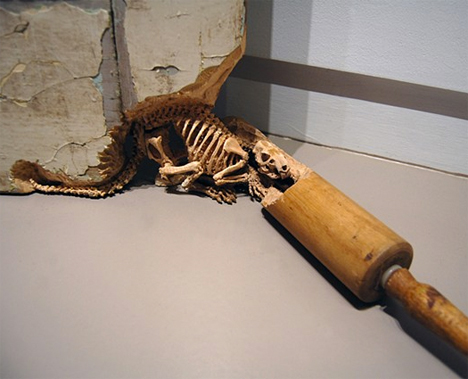
What Lies Beneath: Skeletons Carved into Everyday Objects

29 May

[ By Steph in Art & Sculpture & Craft. ]

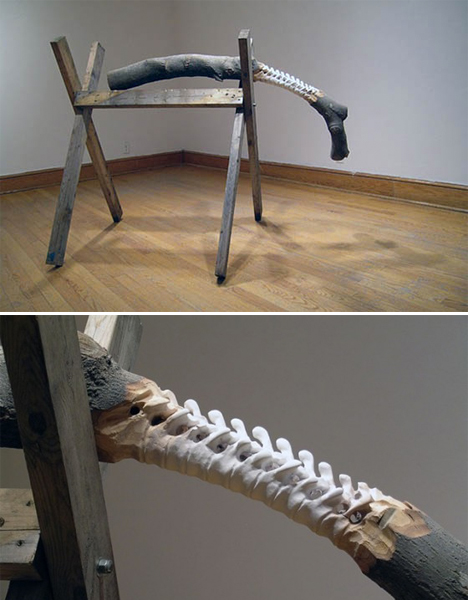
Maskull Lasserre 1

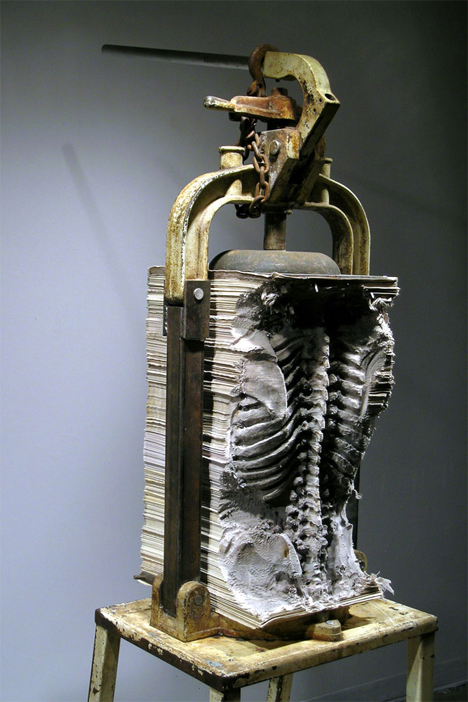
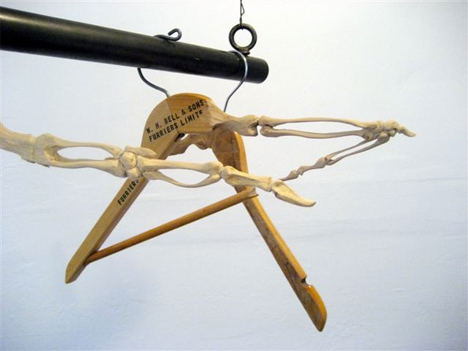
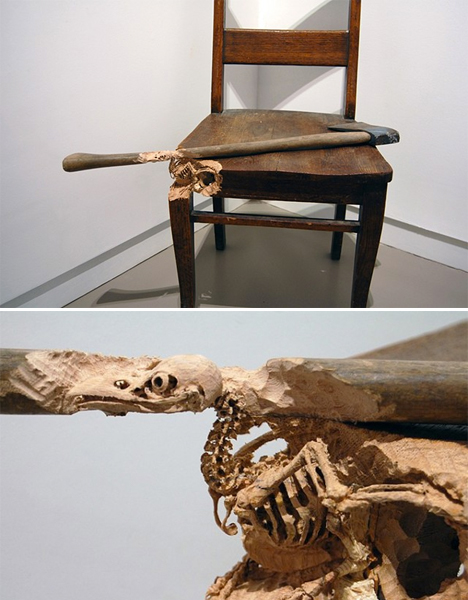
Creatures large and small seem to have eaten their way out of the confinement of everyday items like rolling pins, axes, pianos and chairs in the hands of Montreal-based artist Maskull Lasserre. Previously known for his incredible skulls carved into the pages of books, Lasserre now reveals unexpected life (and death) within wooden objects.

Maskull Lesserre 2

Lasserre has carved crow skeletons, vulture skulls, rats, beetles and even a human ear out of found objects, often stacking more than one item together to produce the illusion that the sculpture is emerging from the wood. According to his CV, Lasserre’s sculptures “explore the unexpected potential of the everyday and its associated structures of authority, class, and value.”

Maskull Lesserre 3

Maskull Lesserre 4

“Elements of nostalgia, allegory, humor and the macabre are incorporated into works that induce strangeness in the familiar, and provoke uncertainty in the expected.”

Maskull Lesserre 5

In a two-part video interview with Liana Voia, Lasserre explains “When the remnants of life are imposed on an object, and that’s true especially with the carving work that I do, it infers a past history or a previous life that had been lived, so again where people see my work as macabre, I often see it as hopeful, as the remnants of a life.”

Maskull Lasserre 6

“Despite the fact that the life has ended, at least that life had a beginning and middle as well, so often by imparting these bodily elements to inanimate objects it reclaims or reanimates them in a virtual way.”

Share on Facebook


[ By Steph in Art & Sculpture & Craft. ]

[ WebUrbanist | Archives | Galleries | Privacy | TOS ]


WebUrbanist

 
Comments Off on What Lies Beneath: Skeletons Carved into Everyday Objects

Posted in Creativity


Google+ now converts DSLR panoramas into Photo Spheres

16 May

photosphere.png

The Google Photo Sphere 360-degree panorama feature was introduced in November 2012. However, until now, viewing 360-degree panoramas not created with Google Camera or a compatible app was a slightly cumbersome process. Google has now changed that with an update to Google+. Learn more

News: Digital Photography Review (dpreview.com)

 
Comments Off on Google+ now converts DSLR panoramas into Photo Spheres

Posted in Uncategorized


Micro-Cycle: Hubless Bike Folds Down & Fits into Backpack

09 May

[ By WebUrbanist in Technology & Vintage & Retro. ]

folding bicycle prototype design

Few folding bikes can boast such compact proportions (even when fully collapsed) as this umbrella-sized wonder you can sling at your side or slide into your shoulder bag.

portable umbrella sized bike

The Sada Bike bends the basic assumptions of bicycle design, but not in the same fashion as small-bike solutions. Instead of reducing the size of essential elements, which creates an awkward riding experience, Sada trades a rigid chassis and support-providing spokes for a jointed lightweight frame and reinforced rims that require less material.

portable folding urban bike

Experienced engineers will note their solution is not without its own unsolved questions, including the impact of putting weight along the edges of empty (even if rigid) wheel frames.

portable compact backpack bicycloe

Still, it is a start – while their may be balance and durability issues yet to address, the concept calls into question the premises behind existing standard, miniature and foldable bikes and pushes the potential limits of urban portability.

folding bike subway shot

In critique of other existing approaches, Sada’s creators note: “They have a small frame and wheels at the expense of stability, for the sake of compactness and portability during transport. The minimum size of the frame, in fact, penalizes the rider position while driving and the small size of the wheels significantly are affected by variations in terrain. On the other hand, the traditional bicycles, avoid these problems, but the rigid chassis makes them inflexible during transport on public transport.”

Share on Facebook


[ By WebUrbanist in Technology & Vintage & Retro. ]

[ WebUrbanist | Archives | Galleries | Privacy | TOS ]


WebUrbanist

 
Comments Off on Micro-Cycle: Hubless Bike Folds Down & Fits into Backpack

Posted in Creativity


Putting Personality Into Your Pictures: A How-to Guide

05 May

What makes a great photograph? There a hundreds of fundamentals – from lighting to image structure, depth, color, personality and composition. Mastering the art of photography is what evokes emotions and makes people’s jaws drop when they see that image. Art is not what you see, but what you can make others see – Edgar Degas. Adding, revealing and capturing Continue Reading

The post Putting Personality Into Your Pictures: A How-to Guide appeared first on Photodoto.


Photodoto

 
Comments Off on Putting Personality Into Your Pictures: A How-to Guide

Posted in Photography


Rad Rides: Nuclear Power Plant Turned into Amusement Park

18 Apr

[ By WebUrbanist in Architecture & Offices & Commercial. ]

nuclear plant central swing

The iconic central cooling tower has been turned into a swing ride and climbing wall, but the re-purposed complex as a whole features over a dozen attractions including rides, restaurants, bars and hotels.

nuclear plant spinning carousel

nuclear plant rollercoaster ride

Wunderland Kalkar is set near Düsseldorf, Germany, the site of a nuclear power plant that never went live due to local protests and construction problems. The recognizably menacing centerpiece of its industrial landscape is no less noticeable for having been painted with a mountain-and-sky mural.

nuclear plant aerial view

Now that Germany is officially phasing out its use of nuclear energy, this solution (drawing in over a half-million annual visitors) may inspire other projects along similar lines.

nuclear plant park conversion

nuclear plant play space

In this case, billions in funding were ultimately scrapped and a developer was able to pick up the pieces for mere millions before turning a hefty profit through an unlikely conversion.

nuclear plant swing ride

Since the location’s transformation in 1995, visitors from around the country and the world have come to ride its wonderful merry-go-rounds and carousels. Some are drawn by its overt offerings, but many also feel the pull of experiencing a unique look into an what remains of an amazing abandoned nuclear compound.

Share on Facebook


[ By WebUrbanist in Architecture & Offices & Commercial. ]

[ WebUrbanist | Archives | Galleries | Privacy | TOS ]


WebUrbanist

 
Comments Off on Rad Rides: Nuclear Power Plant Turned into Amusement Park

Posted in Creativity