RSS
 

Posts Tagged ‘into’

Turn Your Phone into a Pro Grade Cam with 30x Zoom

13 Oct

You have a fondness for mash-ups: Girl Talk, golden doodles, waffle tacos!

Bring the best of two worlds together again with the new QX30 from Sony, a lens that’ll shoot DSLR quality pics and connect to your phone to give you the instant shareability of … well, your phone!

The newest of Sony’s QX family, the QX30 gives you 30x optical zoom (way better than your phone’s pixelly digital zoom) and is an entire camera on its own with a flash, memory card and video capabilities.

Use your phone as a viewfinder whether the lens is clipped onto the phone or detached for more uniquely angled shots.

The lens snaps pics and sends ‘em directly to your phone for instant editing and sharing of all your mashup experiments: roller blade tennis anyone?

Snap Up the QX30 or Its Big Brother QX100


© Britta for Photojojo, 2014. |
Permalink |
No comment |
Add to
del.icio.us

Post tags:


Photojojo

 
Comments Off on Turn Your Phone into a Pro Grade Cam with 30x Zoom

Posted in Equipment


A Quiet Collapse: Christopher Nunn’s ‘Falling Into the Day’

27 Sep

Christopher Nunn descirbes his photographic style as ‘quiet and simple.’ This rings true throughout his project, Falling into the Day, a look into the life of his friend David, an artist living with Alzheimer’s. Nunn answered some questions for us about his work – see a sample of images from ‘Falling into the Day’ and learn more about the project. Read more

Articles: Digital Photography Review (dpreview.com)

 
Comments Off on A Quiet Collapse: Christopher Nunn’s ‘Falling Into the Day’

Posted in Uncategorized


Ricoh surfs into action camera market with WG-M1

11 Sep

Ricoh is entering the choppy waters of the action camera market, which is currently dominated by GoPro. The company isn’t truly a newcomer into the rugged market, as it has been making rugged cameras for many years. The WG-M1 is a 14MP camera that can dive up to 10m underwater, be dropped from 2m, and function at temperatures as low as -10C – all without a housing. The WG-M1 sports a 14MP CMOS sensor, super-wide lens with a 160° field-of-view, 1.5″ LCD, 1080/30p video, and Wi-Fi. Naturally, mounts for nearly every purpose will be available.

Articles: Digital Photography Review (dpreview.com)

 
Comments Off on Ricoh surfs into action camera market with WG-M1

Posted in Uncategorized


Flexible Furniture: Mold this Seat into All Sorts of Shapes

07 Sep

[ By WebUrbanist in Design & Furniture & Decor. ]

the body modular seating

Sitting in a single position for long periods is not just uncomfortable but also a health hazard, but is the solution to be found in a single form or something more pliable and adaptable?

modular chair lying down

London designer Kirsi Enkovaara (images by Aava Anttinen) explores plasticity and comfort in this project titled The Body, a thesis work completed at the Royal College of Art.

the body chair design

The idea is in part to avoid presuppositions about ‘best ways’ to sit or lie down, letting a user bend and twist their furniture into shapes suitable for different activities and allowing for various positions of rest.

modular moldable furniture london

The structure itself is composed of canvass and filled with rice, giving it the right combination of flexibility and rigidity to support a person while also allowing it to be reshaped on demand.

modular seat design curve

From the designer: ‘The Body’ encourages a person to find their choice of sitting by discarding learned cultural norms. Trusting in their touch, movement and the feelings that arise in reaction to these in order to create the most comfortable way of sitting. The structure of ‘The Body’ is made from canvas and rice allowing it to be formed into reconfigurable rigid structures.

modular comfortable seat exploration

“The project started from an interest in emphasizing the psychology of sitting. When we are sitting or laying down we are less aware of our surroundings and in a more relaxed state. This is why the construction of the seat needed to reflect the qualities of human touch, the tactility and safety of which provides us with great comfort.” Many of her other works, both of art and design (or somewhere in between), likewise explore different relationships between ourselves and everyday objects.

Share on Facebook


[ By WebUrbanist in Design & Furniture & Decor. ]

[ WebUrbanist | Archives | Galleries | Privacy | TOS ]


WebUrbanist

 
Comments Off on Flexible Furniture: Mold this Seat into All Sorts of Shapes

Posted in Creativity


Urban Camo: Body Paint Blends Humans into City Backdrops

14 Aug

[ By Steph in Art & Drawing & Digital. ]

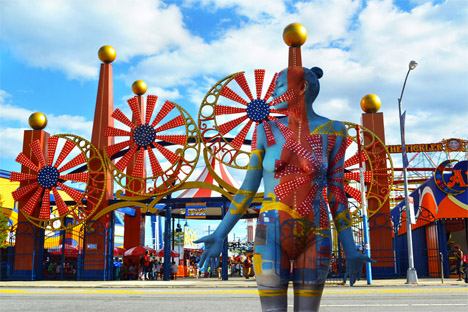
Urban Body Paint Camo 1

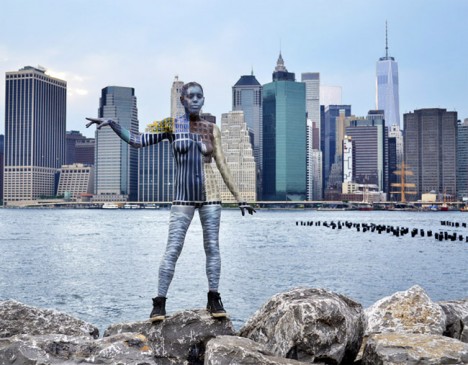
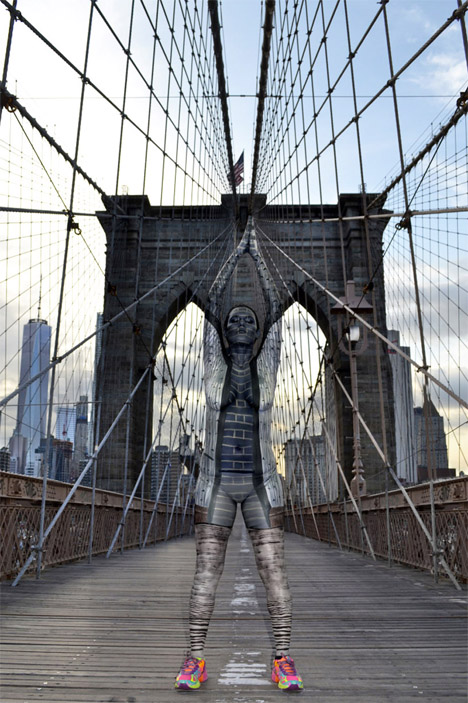
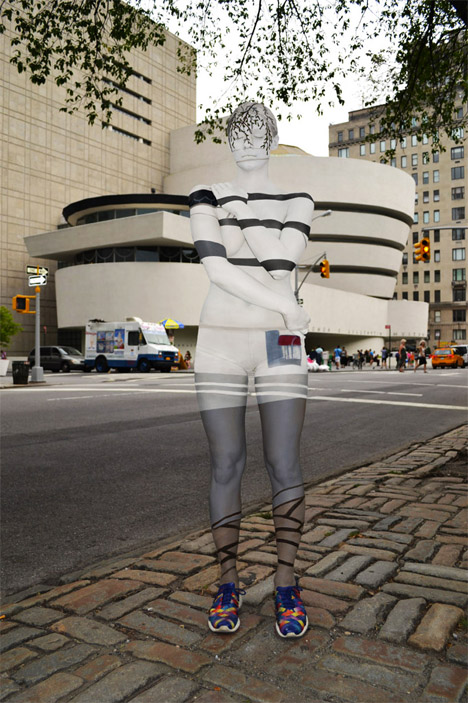
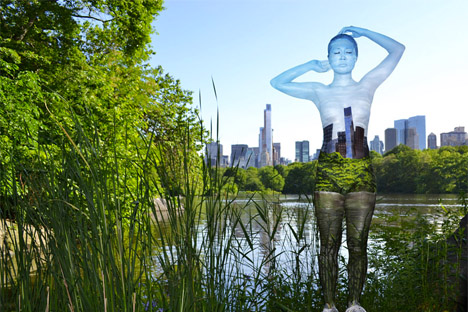
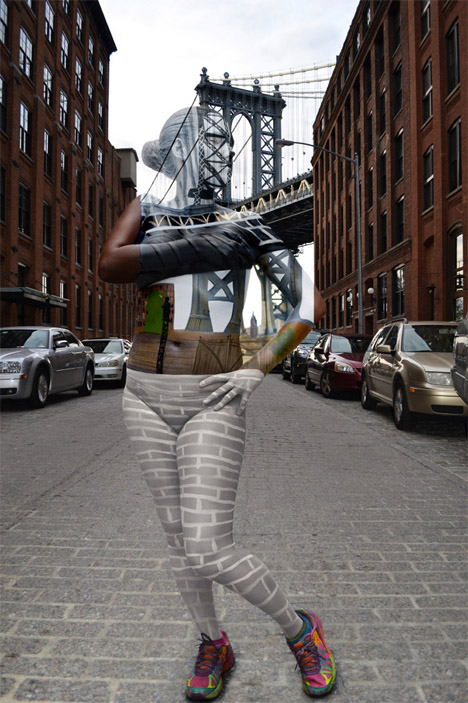
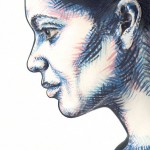
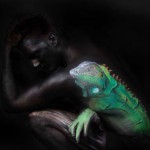
Human figures blend into iconic New York City scenes, from the Brooklyn Bridge to the Guggenheim Museum, in artist Trina Merry‘s tromp l’eoil urban camouflage works. Each subject is carefully posed against a backdrop and painted in place to virtually disappear.

Urban Body Paint Camo 2

Urban Body Paint Camo 3

The work is reminiscent of that of Liu Bolin, the Beijing-based artist known as the ‘Invisible Man,’ who spends hours studying his chosen locations and painting himself and other subjects. It’s also another amazing example of surreal and sometimes mind-bending works of art that use human bodies as canvas.

Urban Body Paint 4

Urban Body Paint 5

“My surface is living, breathing human beings making this a highly relevant & immediate medium,” says Merry. “The painting is temporary, like a Tibetan sand painting, beginning to change into another work as soon as I stop painting, changing texture & color.”

Urban Body Paint 6

“For this reason highly intentional photography has become an important part of documenting my work… likewise, I work with y human canvases on poses, creating new opportunities for line & Form. My work is sometimes experienced live as an installation, for example, at museums, or preserved through photographs as limited edition fine art prints.”

Share on Facebook


[ By Steph in Art & Drawing & Digital. ]

[ WebUrbanist | Archives | Galleries | Privacy | TOS ]


WebUrbanist

 
Comments Off on Urban Camo: Body Paint Blends Humans into City Backdrops

Posted in Creativity


LensRentals looks into the Canon EF 16-35 f/4 IS

08 Aug

The team over at LensRentals has been doing a lot of work recently, looking at the performance of Canon’s new EF 16-35mm f/4L IS USM wideangle zoom. They’re pretty impressed by the optical quality of the new lens, but being in the business of renting and repairing gear, they also wanted to know how well it would stand up to the rigors of daily use – and how easy it would be to work on. Click through to learn how the new EF 16-35mm f/4L IS USM compares mechanically.

Articles: Digital Photography Review (dpreview.com)

 
Comments Off on LensRentals looks into the Canon EF 16-35 f/4 IS

Posted in Uncategorized


Taking your DSLR into the Backcountry Safely

23 Jul

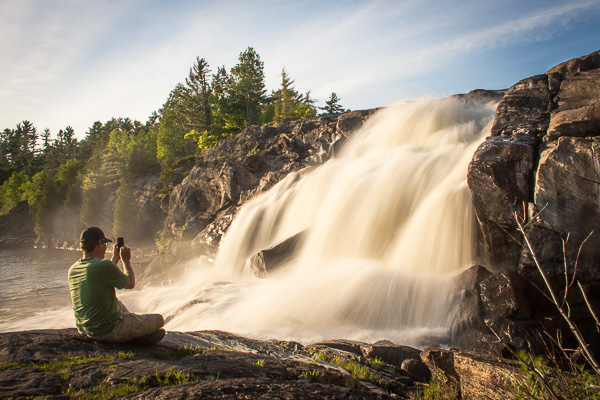
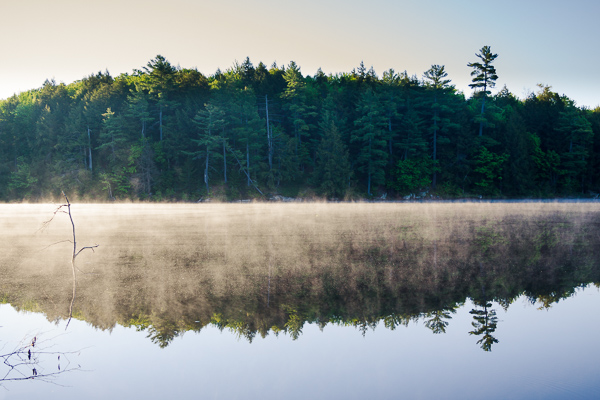
In the Northern Hemisphere summer is finally here and that means it’s the beginning of camping season. It’s time to haul out the tent, the propane stove, the canoe, the bug hat and the DSLR. You visit all these beautiful places, gain a sense of peace and respect for Mother Nature, then come home and wish you were still there. Having beautiful, sharp images of the brutal trail you faced, the noisy bird that woke you at dawn, or the incredible sunset you experienced can make the experience all the more rich. The added bonus is you have some fantastic images you can hang on the wall and gaze at as you plan your next trip.

Back country photography5

Taking a DSLR into the back country isn’t as costly or as expensive as you would think. You don’t need the super high end gear. Your DSLR is fairly rugged, it can handle rain, heat, a few bumps, water, dust, campfire smoke, etc. It’s not as breakable as you might think. Whether you are hiking or canoeing/kayaking, taking your gear into backcountry is easy. I’ve been taking my DSLR into the backwoods of Northern Ontario for years and have never regretted the decision. It’s taken practice, but through trial and error, you too can find a system that lets you take your DSLR into the woods. When packing for a backcountry trip remember to consider the following.

How will you pack and protect your gear but make it easily accessible?

OPTION 1: A hard case

These are easy to access, and when closed properly are airtight. Your camera and lenses will be completely safe using this method. They are easy to access on the trail, just lift the lid. Hard cases can be adapted to fit a camera and a lens by removing some of the foam padding from within. You customize the case to your gear. The drawback is the added weight you will have to lug and the cases are awkward. Picture yourself dragging a tired body, a backpack containing a tent, food, clothing and a suitcase like object through the bush. It’s not easy. But if you want the 100% protected guarantee then this type of case is for you.

OPTION 2: A dry bag

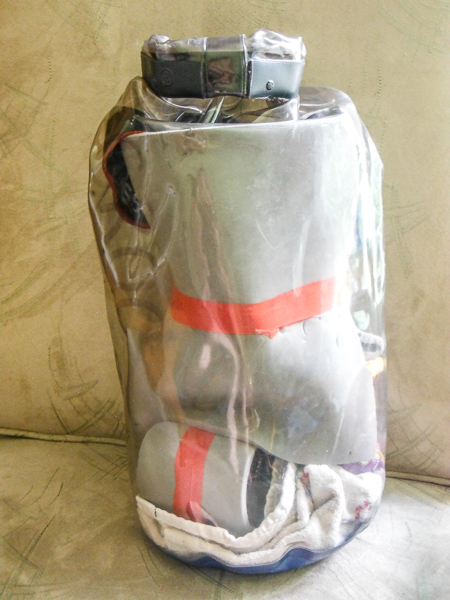
This method doesn’t guarantee complete protection. If you capsize in a canoe or drop the gear into a river, dry bags don’t promise watertight protection. However, a dry bag is easy to strap to the canoe or kayak and can be packed into a standard tripping pack quite easily. The dry bag keeps it safe from the elements. The handle at the top makes it easy to carry. The trick is to create a padding system within the dry bag. I use an old foam mattress to pad my gear.

Back country photography1

Back country photography7

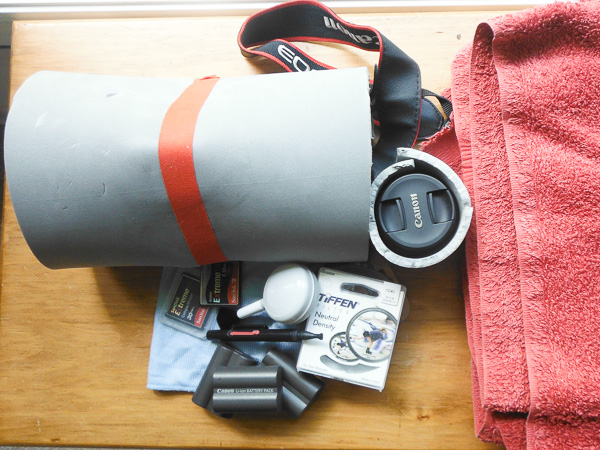
Basically, cut up the mattress to fit your camera and bag. You can wrap spare lenses in the same foam and place them in the bottom of the bag. Dry bags can be purchased in varying sizes so you don’t have to buy a new bag for each combination of gear. This method is the cheapest, it’s fairly accessible and it’s certainly the easiest to carry.

OPTION 3: A tripping pack designed for carrying camera gear

There are several tripping packs that are designed to carry your tent, clothes, food and camera gear. These are excellent at protecting your gear and are designed for just such an outing. The problem is they aren’t very waterproof. They do come with a rain cover, but let’s face it, the gear is ruined if you drop the bag in a lake. If you are just hiking, then this is a fantastic option, these bags are designed for this job.

The drawbacks come for those of us who are smaller in stature or female. Most of the overnight backpacking bags are huge and become difficult to carry, especially for women. Sometimes chest straps don’t sit where they should and can be very uncomfortable. Comfort on the trail is extremely important: you don’t want to be in agony. Whatever you choose, make sure the pack fits properly. The comfort factor is the key to an enjoyable hiking trip.

How far will you travel? Can you really carry all that gear?

Tripping in the back country is hard work. You have to carry everything you need. You want to make sure enjoy your trip. If you are crippled under the weight of carrying, or portaging your camera gear, it isn’t going to be fun. Pack light and smart. Try to limit yourself to a few lenses, a filter or two, a few batteries and memory cards.

Back country photography6

Make it a fun challenge, take along one lens. Do you really need your 85mm lens if your 70-200 range zoom will cover this focal length? Be frugal with what you carry. This will push you to be creative in the types of shots you take. Also, it’s important to take a tripod for super sharp shots. Investing in a lightweight model is a good idea. The lightweight versions are pricier but worth it.

Use Common Sense

If you are going on a trip and serious about taking some great photos then make sure you plan for it.

  1. Cut down the number of kilometres (miles) you cover in a day in order to build in some time for photography.
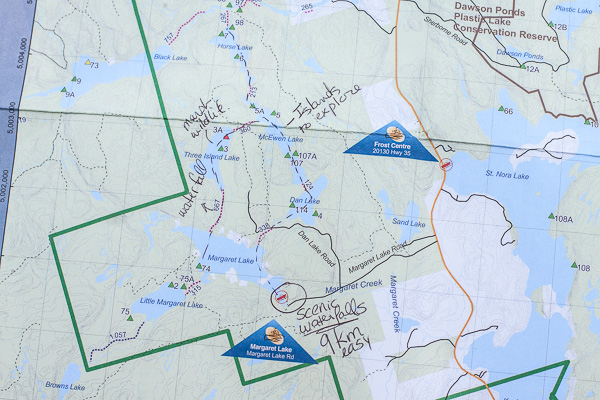
  2. Choose a route that has some beautiful photographic locations. Plan in advance and do your homework.Back country photography2
  3. If canoeing or kayaking plan a route that doesn’t contain huge multi-kilometre portages that will drain you of energy.
  4. Make sure you tie your camera gear to your canoe/kayak for added safety in the event you dump.
  5. Portage through challenging rapids to avoid soaking gear.
  6. If the weather is challenging, stay undercover. You can get moving tomorrow.
  7. Don’t take your gear out of its protective bag if the water is really rough, especially if you’re a novice paddler.
    Back country photography4

Finally, there’s one essential piece of gear that weighs almost nothing but you are guaranteed to regret it if you don’t take it. Always take a lens pen, and a couple of microfiber cloths, they are a must. Your gear will get dirty. Accept this fact now and simply remember to book your camera in for a thorough cleaning after you return. It will feel like a new camera afterwards, that’s a bonus.

It’s a little more work but it will be worth it. People will “oooh” and “ahhhh” at your photos, and who knows maybe you will inspire a friend to take same trip because they just have to visit the place they’ve seen in your photographs.
Back country photography3

The post Taking your DSLR into the Backcountry Safely by Erin Fitzgibbon appeared first on Digital Photography School.


Digital Photography School

 
Comments Off on Taking your DSLR into the Backcountry Safely

Posted in Photography


How To Upcycle Any Book Into A Photo Album

10 Jul
Extra photos for bloggers: 1, 2, 3

If a picture tells a thousand words, how many words would a book turned into a photo album tell?

Give your loose photos a new home by turning any old book into a rad new photo album.

Rewrite history (books) or be the hero in a graphic novel with a quick snip and a slide.

Hardback, paperback or horseback, we’ll show you how to turn any book into a photo album!

Learn How to Turn All Your Books Into Photo Albums

(…)
Read the rest of How To Upcycle Any Book Into A Photo Album (223 words)


© Erika for Photojojo, 2014. |
Permalink |
No comment |
Add to
del.icio.us

Post tags:


Photojojo

 
Comments Off on How To Upcycle Any Book Into A Photo Album

Posted in Equipment


Air Stylus turns your iPad into a graphics tablet

30 Jun

Avatron, the developer of Air Display, has today released a new iPad app. Air Stylus extends your computer screen to your iPad display and, in combination with a pressure-sensitive pen, turns the latter into a graphics tablet that works with a range of imaging applications including Adobe Photoshop and Apple’s Aperture. Read more

related news: Digital Photography Review (dpreview.com)

 
Comments Off on Air Stylus turns your iPad into a graphics tablet

Posted in Uncategorized


Photography Tutorial: Intro Into Lenses

28 Jun

Camera Lens Image
INTRO TO PHOTO: PART 3 – LENSES


Last day of Intro to Photo! Last time we talked about how to set up your exposure. Today, we are going to discussing the ins and outs of lenses.  Here comes the easy stuff!


Lenses


Lenses can be either zoom or prime.  Zoom lenses allow you to vary focal lengths (based on what is built into the lens) and – as the name says – zoom in and out of the frame.  Prime lenses are fixed.  This means that it has one focal length.  In order to “zoom in or out” with a prime lens, you must physically move closer or farther from the subject.  Prime lenses typically have a larger maximum aperture, making them “faster” than zoom lenses.


Lenses that have larger apertures are described as fast lenses because they have the ability to collect light faster.  However, lenses with smaller apertures have a greater depth of field.


Camera Lens Chart

Lenses fall into a few different categories:


A wide-angle lens widens the angle of view thus bringing more into focus.  A wide angle can also have a flattening effect.


– Super wide angle lenses are typically anything under 20mm

– Wide-angle lenses are from 21-35mm


A “normal” is a lens that most accurately portrays what a human eye will see.  With a 35mm camera, this is typically a 50mm lens.  Normal lenses fall into the category of standard lenses.


– Standard lenses range from 35-70mm


telephoto lens reduces the distance between objects in the photo, bringing the subject “closer” to the photographer.


– Medium telephoto lenses are considered portrait lenses. These range around 80-135mm

– Telephoto lenses are between 135-300mm

– Super telephoto lenses are anything over 300mm


Focal length is the distance in millimeters between the lens and the sensor when the camera is focused on a subject at infinity.  Lenses that are classified as “long” lenses have a larger focal length- these are telephoto lenses.


Each lens has its place. Standard lenses are great all around lenses but excel when used for documentary and street work.  Wide angle lenses are great for landscape and architecture whereas telephoto lenses work well with portraiture, sports and wildlife photography.


Be careful when selecting a portrait lens.  Different focal lengths can distort the face in different ways.  Wide angles tend to flatten out the face in an unattractive manner.  The optimal portrait lens depends on what camera you’re using (and if there is a crop factor) but you’re typically safe using a lens between 85-135mm long.  135mm lenses (or about that) are optimal when shooting head shots.


Focal Length Examples

How focal length distorts the face


Megapixels


People are far too concerned with megapixels when it comes to buying a new camera. Let me put this very clearly… MEGAPIXEL COUNT DOESN’T ALWAYS MATTER!  The only time megapixel count really matters is when you’re going to be shooting something which has to be blown up large scale, such as a billboard.


Don’t drive yourself crazy over it!  In the end, it really doesn’t matter that much.


Crop Factor


Most digital camera sensors are smaller than film.  An image created with a 35mm body but smaller sensor will end up cropping a bit of the image out, as compared to what would have been captured with a full sized 35mm film frame.  Hence the term “crop factor.”  This determines how much of the image is cropped out as compared to a “full frame” sensor (a digital sensor the same size as 35mm film).


Be conscious of your gear.  If your camera has a crop factor, it effects how you view the world through your lens.  Because the focal length is effected, a crop sensor zooms in a bit with every lens.  A 50mm lens is closer to a 70mm or 85mm lens.  Each camera model has a different crop factor.  Be sure to look if your camera has a crop factor and what it is.


To determine actual focal length, take the crop factor and multiply it by your lens’ focal length to determine the focal length you’re actually viewing.  (I.e. – If you’re using a 50mm lens on a camera with a crop factor of x1.6, you’re actually shooting at a focal length of 80mm.)


Ken Rockwell Image Taken With A Full-Frame Sensor

Taken with a full-frame sensor


Ken Rockwell Image Taken With A Camera With A x1.6 Crop Factor

Taken with a camera that has a x1.6 crop factor


Last but not least, just a few tips:


– Don’t trust LCD backs for exposure! Always meter when possible.  LCD’s don’t accurately depict the information recorded by your camera’s sensor.  Something that looks perfectly exposed according to your LCD can actually be an entire stop under or over exposed.  The only way to trust what you see on the back of your camera is to learn how to read histograms.

– Check out this article on how to read histograms: How to Use Histograms by Ken Rockwell

– It helps to turn on the “over exposure indicator.”  This feature will cause the whites on your LCD screen to blink when they’re blown out.  (When they contain no detail and are essentially just blobs of pure white.)

– And last but not least.. As boring and nerdy and tedious as it is.. READ YOUR CAMERA MANUAL!


If you’re just tuning in to today, be sure to check out Part 1 – Cameras and Part 2 – Exposure.


I know there was a lot thrown out over the past few days – hopefully you made it through okay!  If you have any questions, feel free to shoot me an email at alana@alanatylerslutsky.com.


Happy shooting!

Alana


PHOTO SOURCE:

Feature Image & Photo 1: www.timeslive.co.za

Photo 2, 3, 4, 5: Alana Tyler Slutsky


Fashion Photography Blog

 
Comments Off on Photography Tutorial: Intro Into Lenses

Posted in Uncategorized