RSS
 

Posts Tagged ‘into’

Quick Tips for Getting Into Stock Photography

01 Jun

Getting accepted as a stock photographer can be a difficult and frustrating process. Especially when your best photos get rejected by photo reviewers. After helping many photographers trying to become accepted as Shutterstock contributors, I have discovered how the process can instead become a fun and educational experience.
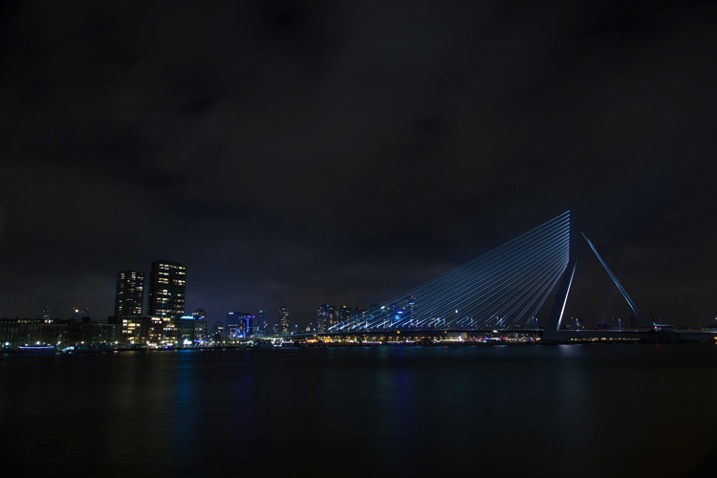
Stockphoto1

Why become a stock photographer?

Stockphoto3

Earning money on your digital photography work is a great way to earn an extra income. But it is often not the main motivation for why many people try to become contributors. Being accepted, and being able to call yourself a stock photographer, means something. Similar to how many people develop their skills so they one day can become a professional in their field, being able to call yourself a stock photographer will for many mean more than saying you’re a professional photographer.

When someone presents themselves as a professional photographer, people tend to have different views of what that means. Some associate a professional photographer with someone that makes high quality photos. Others may think of the person they hired to photograph their wedding. Or perhaps someone that has their photos sold in a gallery. Some may think a professional photographer is only someone that has a diploma, or someone that works full-time and earns their main income from their photography.

Being able to say you’re a stock photographer says something about the level you have reached. Why? Because the stock photography industry is well known for its high quality requirements.

Furthermore, the best part of being a stock photographer is knowing your work is being purchased, appreciated, and used all around the world. With modern tools like Google image Search, you can back trace and find were and how your most popular photos are being used.
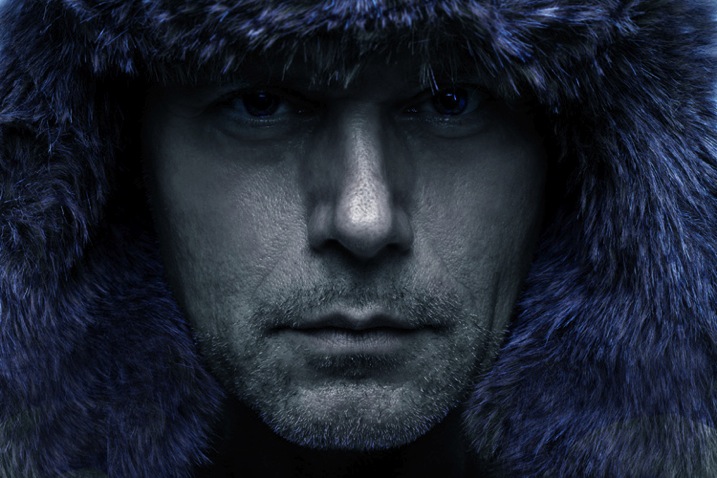
Stockphoto4

Are you qualified?

If you know how to make a manual exposure, get the focusing correct and have a good eye for correct white balance, you’re most likely qualified to become a stock photographer.

Expect to get rejected

It might take a few attempts. But once you’re accepted, as many existing stock photographers can testify, it made them an even better photographer. A rejection of your initial submission might feel like a disappointment at first. But take advantage of the feedback and suggestions provided. Your initial submission will most likely be more strictly evaluated than the general submissions you’ll make in the future after getting accepted.
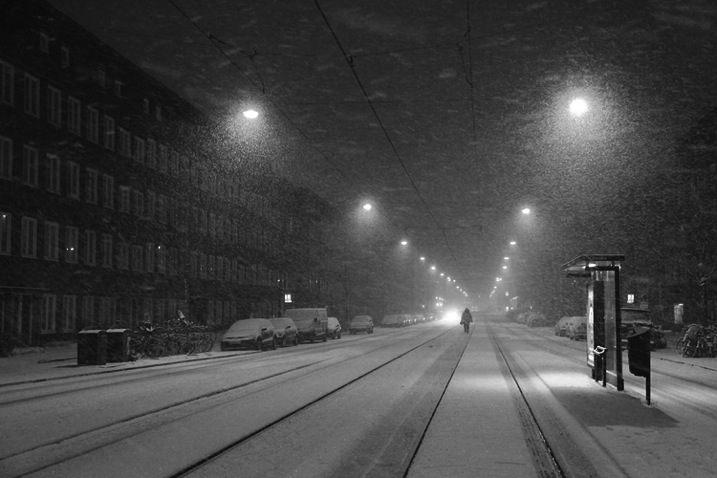
Stockphoto7

Find the motivation to learn

Try to see your first submission as a homework assignment for reading the stock agency’s submission guidelines. Like any course or workshop, your first homework assignment is not expected to be flawless. There will most likely be room for improvement. With this attitude, learning about stock photography can be an educational, fun, and even motivating experience.

The first batch of photos is the hardest

For example, when signing up to one of the most popular stock photography sites like Shutterstock, you are asked to submit 10 samples of your best work. Seven of these must pass the strict inspection of their reviewers. But if rejected, you’re provided with great feedback to help you improve your photography.

Stockphoto5

It gets easier after getting accepted

As any existing stock photographer can testify, your initial batch of submitted work is much more strictly evaluated than the general submissions you will make in the future after getting accepted.

You’re closer to getting accepted than you might think

A submission that is not approved is often not completely rejected either. Many rejected photos can have only one minor issue that can sometimes even be fixed with a little editing. Even though it may feel like your entire batch of submitted work was rejected, you might only be a few adjustments away from getting accepted.
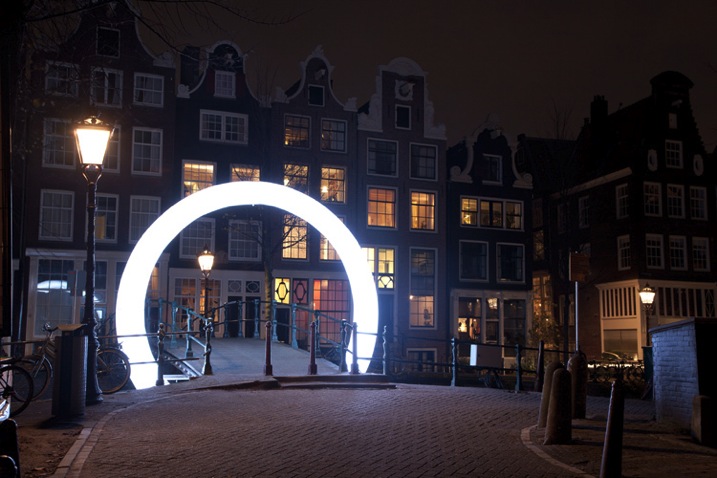
Stockphoto2

Try again. Many existing stock photographers did.

Many existing stock photographers did not get accepted on their first attempt. For every initial submission that is not approved, take good use of the feedback that is required. See it as a free portfolio review from experts in the field. Be inquisitive, study the material and try again!

googletag.cmd.push(function() {
tablet_slots.push( googletag.defineSlot( “/1005424/_dPSv4_tab-all-article-bottom_(300×250)”, [300, 250], “pb-ad-78623” ).addService( googletag.pubads() ) ); } );

googletag.cmd.push(function() {
mobile_slots.push( googletag.defineSlot( “/1005424/_dPSv4_mob-all-article-bottom_(300×250)”, [300, 250], “pb-ad-78158” ).addService( googletag.pubads() ) ); } );

The post Quick Tips for Getting Into Stock Photography by Kjell Leknes appeared first on Digital Photography School.


Digital Photography School

 
Comments Off on Quick Tips for Getting Into Stock Photography

Posted in Photography


Oh Snap: Clamping Steel Legs Turn Found Objects into Furniture

29 May

[ By WebUrbanist in Design & Furniture & Decor. ]

snap adjustable modular supports

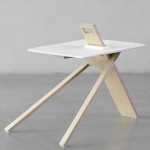
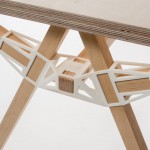
Converting almost anything you find into a household furnishing, from discarded doors and shelf boxes to dart boards, these clip-on supports can be added or removed in seconds.

snap steel clamp furniture

snap mechanism gif

snap furniture addition

Initially experimenting with cards, clips and coat hangers, a pair of Spanish design students in Barcelona, Maria Roca and Erika Biarnes (together: Be-Elastic), developed this system to be elegant, efficient, strong and flexible, combining slim steel supports with straightforward usability.

snap dart board table

snap plywood table above

The real challenge was to make something robust that could also be easily converted on demand. While other clamp-based furniture systems exist, this solution represents a more versatile and expressive aesthetic and a much faster method of assembly and disassembly.

snap simple coffee table

snap side table design

A set of four legs can support a few hundred pounds, making surface selection a more likely weight limitation than the capacity of the supports. As few as two units, however, can create a working piece of furniture, like a side or television table leaning against the wall. The units come in 16 color combinations (4 colors of cable and 4 colors of steel).

snap table design exhibit

The clamps can be attached to essentially anything less than a few inches thick, including recycled objects of various shapes and sizes: “SNAP is designed to fit all shapes and sizes: triangular, rectangular or irregular boards. You can also place the SNAPs wherever you like in corners, on the sides in a disorderly way, or wherever you’d like! It’s up to you.”

Share on Facebook


[ By WebUrbanist in Design & Furniture & Decor. ]

[ WebUrbanist | Archives | Galleries | Privacy | TOS ]


WebUrbanist

 
Comments Off on Oh Snap: Clamping Steel Legs Turn Found Objects into Furniture

Posted in Creativity


The week in review: Coming into focus

17 May

It was a week of lens announcements, sample galleries and updates to our existing content for one of the year’s most notable new cameras – the Canon EOS 5DS R. And if that wasn’t enough, we went and added a second installment of our series exploring the source of noise. Catch up on any photography news you may have missed over the busy week, here and elsewhere. Read more

Articles: Digital Photography Review (dpreview.com)

 
Comments Off on The week in review: Coming into focus

Posted in Uncategorized


Putting You Into Your Landscape Photography

28 Apr

Photographing the landscape is one of the oldest forms of photography, along with others like portrait and street photography. Since the advent of digital photography the possibilities of what can be done seem almost endless. It also means that photography has become more accessible, so with more people taking it up it is becoming harder to be original, and make your images your own. There are ways of creating landscapes that have your style, but it usually means throwing away a lot of what you first learn about photography.

Perhaps the only time a photographer is really free to do whatever they please is when they first begin, before they are told what they should or shouldn’t be doing.

Learning About Photography

However, that might be true, but it isn’t long before the beginner starts to learn what we all learn. We start wanting to know how to use the camera properly, and how to get the best out of it. So they might begin by doing a course to learn about aperture, shutter speed and ISO. No one is denying how important it is to learn about those things, and learning how to correctly expose an image is not something that anyone ever regrets.

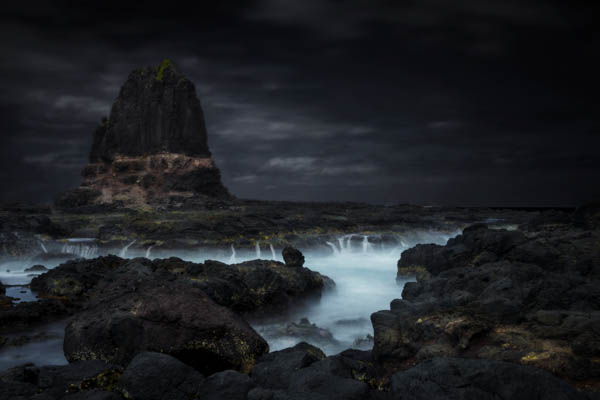
image1-cape-schanck-leannecole

Then there is composition and what is meant to make a good or perfect image. There is the rule of thirds – placing everything in that third, or on the third lines. You learn that when you are composing the image that the horizon should be on one of those thirds, or that the lone tree in the paddock or field should also be on one. Never put things in the middle of an image.

If you really get into it then you might learn about the golden ratio or the Fibonacci Spiral. This principle is about using a curve that determines where the subject should be placed for the perfect image; the spiral placement is very similar to the intersection of the third lines.

Then there is post-processing and again, there are rules about what is appropriate for landscape photography and what isn’t. Landscape photography is steeped in history and your photos should be true to what you see.

There are theories or rules that suggest you shouldn’t do any more processing to your images other than the very basic; that your images should represent the reality of what you saw. It is okay to fix exposure, horizon line, but you shouldn’t move pixels, like removing things from the image, or replace a sky.

No one is going to deny that learning all of that is wrong, and we should all learn it all. The next stop is working out if you are happy to follow the rules and do the same images that everyone else is doing.

The first thing you will find is that other people will start to criticize you. The tree is in the middle of the photo, or you shouldn’t have the horizon line in the middle. The one I get all the time is that I over process or my images are too dark.

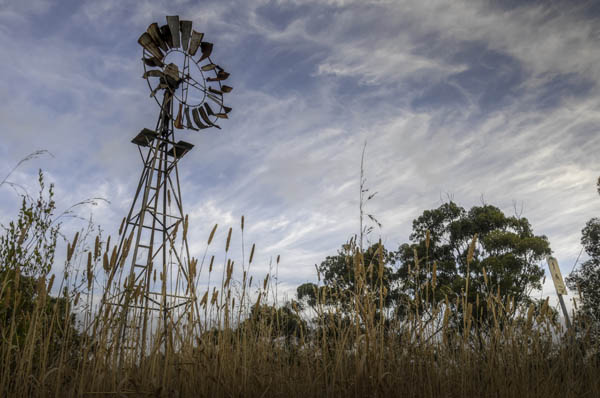
image2-inverleight-windmill-leannecole

My answer to that is: don’t listen.

Creating Your Own Style

There is a growing movement of photographers doing work that is not traditional and pushes the concept of landscape photography a whole lot more. It is where rules are broken, and new things are done that change what is considered traditional landscape photography.

Things like the rule of thirds are often forgotten, and you might see the subject placed firmly in the middle of the image. The horizon line may be in the middle of the image, cutting the image in half, as we’ve constantly been told is wrong and we shouldn’t do it.

How often do you get told that an image needs to be in focus, that if the subject isn’t sharp then you should delete the image? There are art photographers who take out of focus images and use them for art. Perhaps you shouldn’t go around taking a heap of photos that are out of focus, but sometimes the feeling or something else is just as important.

If we consider those things, then what does it mean for landscape photography, and how does it affect us? Perhaps it means that the world is your oyster and fine art is more about your interpretation of the world around you than the reality of it, then the possibilities of what you can do are endless. You can do whatever you like.

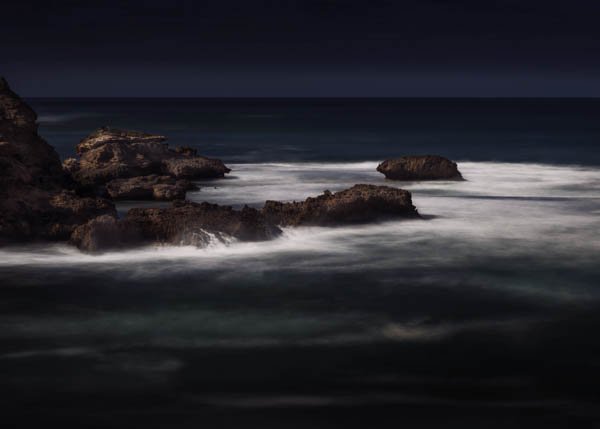
image3-flinders-blowhole-leannecole

Let’s look at what you can do, first out in the field and then back at home with post-processing.

Out in the Field

When you are out taking photos, look for odd angles. Think about how everyone else would take the image and see if you can come up with other ways to do it that are different. It isn’t always going to be possible, but it is a good practice to get into.

You could try using props in your images. I’ve heard of a couple of photographers that will place a person in their landscapes to help give it scale. You could do something like that, or start adding a prop of some sort that gives you a signature.

Photographing the same area time and time again can give you an edge too. You learn the area and discover things that people who rarely go there would find. Of course you have to also open your mind to the idea of finding new things. Try photographing the same thing over and over; see if you can find different ways of interpreting it.

It can help looking at what other photographers are doing to find styles you like. Study what they do. Work out what it is that you like about their work. I wouldn’t recommend copying them, but take some of it and use bits to help make your work your own.

An important thing to remember is that you don’t have to use photo editing to create images that are uniquely yours.

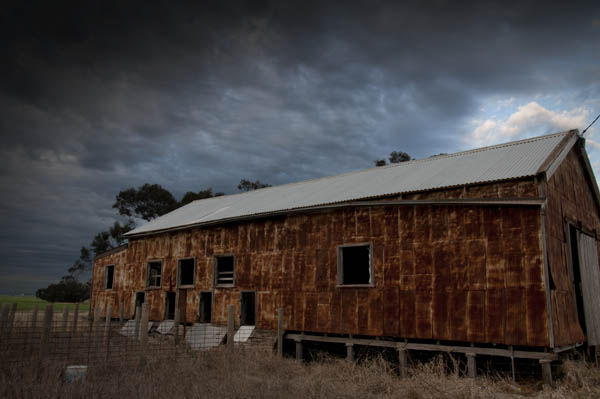
image4-woomelang-shearingshed-leannecole

Back in the Digital Darkroom

Once you get your images onto the computer, anything goes really. How far you take your images is completely up to you, but you also have to be prepared for heavy criticism from others. You are always free to ignore that – I do – but be polite about it.

You can do so many things in post-processing, such as selective focusing. Really make the viewer look where you want them to look. You can do this in many ways, with added blur or with lighting. It can be a strong technique; one that is used by painters all the time.

Selective saturation is a style that a few landscape photographers have started employing as well. You select areas of focus and give them a little more saturation, or you can desaturate the area around it. Make that area brighter or give it more vibrancy so it will stand out and attract attention, which is what you want.

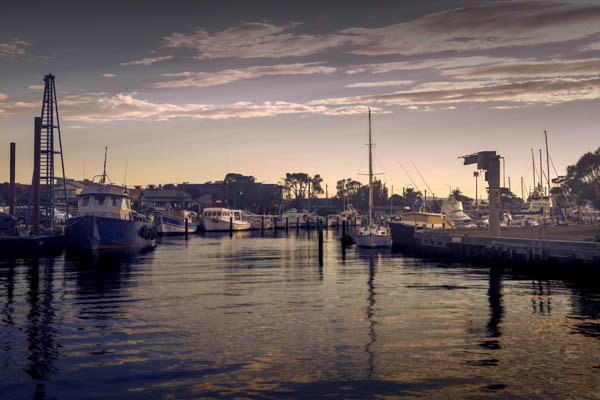
image5-mordialloc-marina-leannecole

Controlling the lighting is another technique that many use, myself included, meaning you take an image then try to find a way of completely changing the lighting so that the viewer can’t work out when it was taken.

Having an idea of what you want to achieve is also good, describing what you want people to see, or how you want your audience to view your work. Telling stories with your images is a great thing to do.

Again finding other photographers whose style you like is good too. Learn from them and see what you can do; it is encouraged in art schools all the time. Do what they do, but don’t pass it off as yours, find your own style, your own voice.

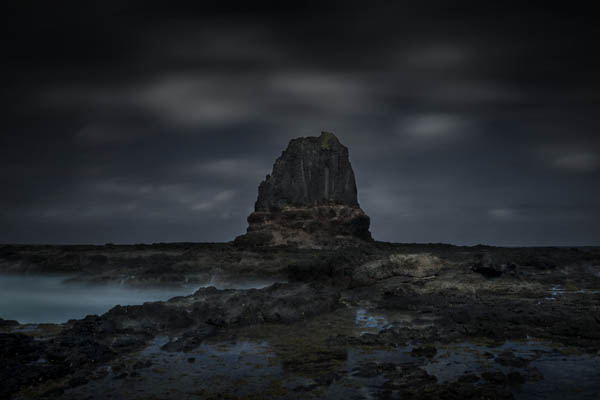
Through fine art landscapes you are showing an interpretation of the landscape around you, or wherever you take photos. The rules don’t always apply, but if you want to break them then do so in a way that will help you develop your own unique style.

Good luck.

image6-capes-schanck-leannecole

If you have any other comments or tips please share in the comments section below.

googletag.cmd.push(function() {
tablet_slots.push( googletag.defineSlot( “/1005424/_dPSv4_tab-all-article-bottom_(300×250)”, [300, 250], “pb-ad-78623” ).addService( googletag.pubads() ) ); } );

googletag.cmd.push(function() {
mobile_slots.push( googletag.defineSlot( “/1005424/_dPSv4_mob-all-article-bottom_(300×250)”, [300, 250], “pb-ad-78158” ).addService( googletag.pubads() ) ); } );

The post Putting You Into Your Landscape Photography by Leanne Cole appeared first on Digital Photography School.


Digital Photography School

 
Comments Off on Putting You Into Your Landscape Photography

Posted in Photography


3D Farming: Trees Grown into Fully Shaped & Formed Furniture

27 Apr

[ By WebUrbanist in Design & Furniture & Decor. ]

molded tree furniture design

Taking arborsculpture to new levels of efficiency and functionality, this furniture designer creates plastic molds in which his designs are grown without needing to be sawed and shaped after the fact, reducing waste and streamlining the production process. Light, soil and air are the equivalent of filament in this organic 3D printing analog, and even more directly: the molds can be 3D-printed as well.

molded organic furniture plants

While requiring careful planning and additional work upfront, taking young willow, oak, ash and sycamore trees and turning them as they grow into chairs, tables and lamps both shortens the construction cycle and eliminates the need to reconnect disparate pieces.

molded furniture forest field

molded plastic tree furniture

Founder of Full Grown in Derbyshire, England, Gavin Munro aims to challenge “the way we create products as well as how we see the items with which we surround ourselves, the Grown Furniture has an immediate tactile, visceral and organic appeal.”

growing tree furniture set

Gavin thinks of this process as a kind of “organic 3D printing that uses air, soil and sunshine as its source materials. After it’s grown into the shape we want, we continue to care for and nurture the tree, while it thickens and matures, before harvesting it in the Winter and then letting it season and dry. It’s then a matter of planing and finishing to show off the wood and grain inside.”

molded tree chair prototype_edited-1

The notion of shaping trees as they grow on a massive scale is not a novel one – similar techniques have long been employed in vineyards to maximize growth and optimize grape picking. Even the idea of growing fully-formed furniture is not new – artists and designers have long shaped living trees to create objects of use. As far back as Ancient Greece, chairs were ‘built’ by digging out chair-shaped holes and allowing them to fill with root structures before being ‘harvested’ from the ground.

molded plant lamp shape

Still, the scale and ambitions here are, however, much bigger – creating full crops of grown furniture, turning a one-off idea into a potentially mass-produced (but always unique) product line.

molded shaped table design

Each furniture piece takes a few years to grow and maintaining this ‘forest of furniture’ is nothing if not challenging: “I’m only making 50 or so pieces per year but for every 100 trees you grow there are a 1,000 branches you need to care for, and 10,000 shoots you have to prune at the right time.”

molded root grown chair

Still, the results are worth the effort in the mind of this maker: “They’re still growing now, but when harvested and finished we expect them to be not just fully functional and ergonomic but grown, grafted and fastened into one solid piece, [meaning] no joints that only ever loosen over time. These could last for centuries. We hope and trust that this will eventually become an improvement on current methods.”

Share on Facebook


[ By WebUrbanist in Design & Furniture & Decor. ]

[ WebUrbanist | Archives | Galleries | Privacy | TOS ]


WebUrbanist

 
Comments Off on 3D Farming: Trees Grown into Fully Shaped & Formed Furniture

Posted in Creativity


University of Texas crowdfunding project will release macro images into public domain

26 Mar

The University of Texas has initiated a new crowdfunding campaign that, if successful, will result in macro photos of insects being released into the public domain. The funding for the project will be used to support the students learning to use the imaging system, to improve the photography hardware, and to help pay for the Web hosting. Read more

Articles: Digital Photography Review (dpreview.com)

 
Comments Off on University of Texas crowdfunding project will release macro images into public domain

Posted in Uncategorized


Turn your DSLR Camera into a Wildlife Camera Trap

02 Mar

If you have an old DSLR camera lying around, you could be putting it to work as a camera trap for photographing wildlife.

What is a camera trap?

A camera trap is simply a camera that fires automatically when an animal is detected. All you need in order to turn your DSLR into a camera trap is a sensor that can detect animals, then trigger your camera. Once set up, a camera trap can be left for days or even weeks at a time. The longer you leave it, the greater your chances of capturing a shot of an elusive animal.

Camera trap 1

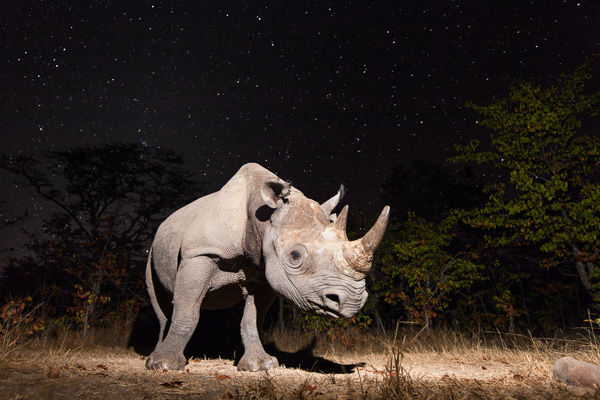
Black rhino at night in Zambia. A 30 second exposure time captured the stars. The rhino was illuminated by a flash at the start. I left my camera in the clearing for a week to capture this shot.

One of the main advantages of a camera trap is that you can take your time setting up off-camera flashes in order to achieve dramatically lit shots of nocturnal creatures. If you try to do this any other way, then the creature is likely to disappear well before you have finished setting up your lights!

As a result of these benefits, camera traps have become a key tool for wildlife photographers aiming to photograph shy and nocturnal animals.

So how do you set up a camera trap?

First, dig out that old DSLR that you don’t use any more. I mostly use a Canon EOS 1Ds Mark III. Camera traps can get much closer to animals than a human holding a camera, so you can use a wide-angle lens. My preferred lens is a 17-40mm f/4 lens.

Next, you need a way of detecting the animal and triggering your camera. If you are a handy, DIYer then you can do this by modifying a security device (I provide more information about how to do this on my website). The two most commonly used types of detector are beam-break and motion detectors.

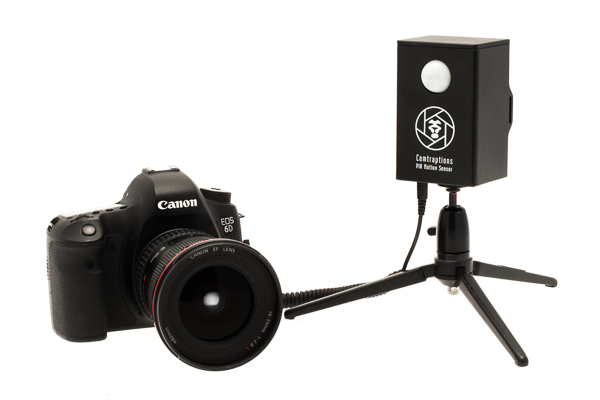
My preferred method of detecting animals is to use a Passive Infrared (PIR) motion sensor. This is similar to the sensor used on automatic patio security lights. I like these because they don’t consume much power, so they can remain on standby for a long period of time. They are also very easy to set up – you just point them at the trigger zone and wait for the animal to show up.

Camera trap 2

A PIR Motion Sensor plugs in to your camera’s shutter release socket

Now you have the camera and the trigger sorted, the next thing you need is a speedlight (flash), or two, so that you can capture nocturnal subjects.

I recommend setting up one or more off-camera flashes, connected to your camera with a TTL flash cord. It is important to get the flashes away from the camera itself because this will reduce redeye and make the shadows look more natural.

Camera trap 3

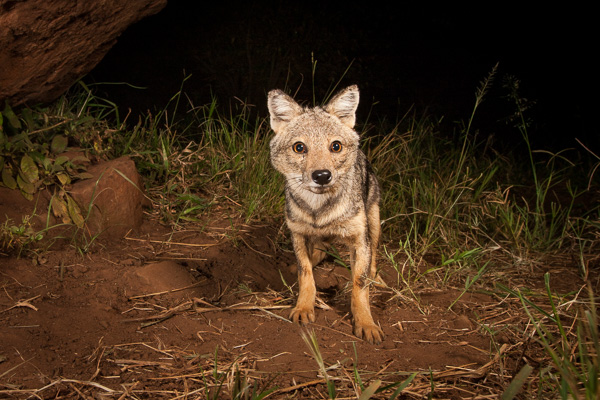
Side-striped Jackal, Kidepo Valley, Uganda. This is an example of a dual flash setup, with a primary light source on the right and a fill flash on the left.

I often just use one flash because I quite like dramatic shadows. However, sometimes, it is preferable to use a second flash to fill-in the shadows on the subject. If you want to get even fancier, you can also add more speedlights to illuminate the background.

Camera settings

The challenge with camera traps is that you don’t know when the animal will pass and therefore the camera and flashes need to be programmed so that the scene is attractively exposed in any lighting condition. Here are some general settings that I find work well in most situations.

Use manual focus and either low speed burst or single shot mode. Set the camera to aperture priority mode with a reasonably small aperture to provide a large depth of field. This means, if the animal isn’t quite in the right position, you should still get a sharp shot.

Camera trap 4

A hippo and a bat in Zambia. This was a lucky shot where the bat happened to be flying around the hippo. A small aperture ensured both animals were in focus.

Selecting aperture priority means that in darkness, the camera will select a long shutter speed. This means it will capture details in the background such as twilight colours in the sky, or even stars. However, if there is too much ambient light, then you may get ghosting when the animal moves. If ghosting is a problem for you then, limiting the shutter speed to one second or faster can help.

If I am using a single flash then I will leave it in TTL mode so the camera automatically determines the flash output based on its metering. For a multiple flash setup, it is usually easier to set the flash outputs manually. With manual flash output and your camera in Av mode, you may need to under-expose your camera (using exposure compensation) by a stop so that daylight images don’t blow-out.

Power considerations

If you plan to leave you camera trap set up for more than a night, then battery life will be an issue. Make sure your camera is set to power off and that it can be woken by the sensor. I also recommend turning off the image preview to conserve battery. Your camera should now be able to last for many days, assuming it isn’t firing the whole time.

Keeping your flashes powered is more challenging. Speedlights have a capacitor inside them which needs to be charged for the flash to fire. However, capacitors drain over time so flashes needs to constantly keep them topped up. If your flash isn’t set to sleep, then the batteries are likely to drain over the course of a single night. If your flashes are set to sleep then when you need them to fire, the capacitor may not have enough charge and so the flashes won’t be ready to fire immediately.

There are three ways to deal with these issues:

  1. Disable your flash’s sleep function – your flash will always be ready to fire but you will probably have to change the batteries every day, or power them with an external power supply.
  2. Use a flash that holds its charge well, even when sleeping. The best I know of is the Nikon SB-28, which can sleep for many days and still have enough charge in the capacitor to fire instantly.
  3. Set your camera to continuous drive mode and let your flashes sleep. The first and second shots may be black, but eventually your flashes will charge and fire.

If you are letting your flashes sleep, then you will need to connect them to your camera via a TTL cable. This allows your camera to wake the flashes. You will need long cords and a TTL splitter hub if you want to fire multiple speedlights.

Positioning your camera trap

Next you will need to find somewhere to set up your camera trap. The most productive places I have found are animal trails, particularly ones that cut through a difficult obstacle such as thick bush or a steep bank. I set my sensor up so that it covers a small section of the trail and then position the camera off to one side (so that it doesn’t block the animal’s path).

Camera trap 5

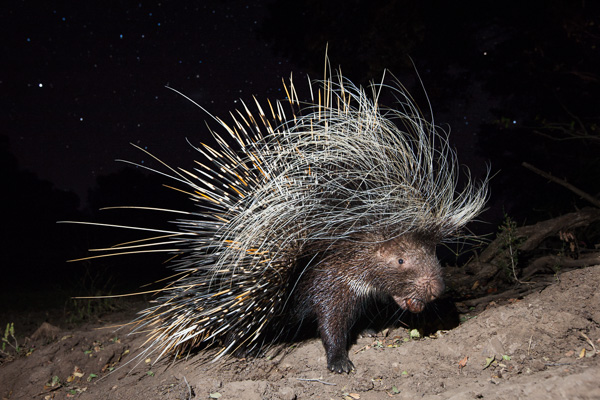
A porcupine photographed in Zambia. My camera was positioned next to an animal trail that lead up a steep bank. It captured many creatures including this porcupine.

The last thing to do is to camouflage, waterproof, and protect your equipment. Rain covers can be made from plastic sheeting. If you need protection from animals such as hyenas and lions then you will need to buy or build your own protective housing.

Once everything is set up, I recommend leaving your camera trap as long as possible in order to maximize the chances of getting results. You may just need to visit it from time to time to change batteries and check your settings.

I have created a series of videos that help illustrate the process of setting up a camera trap. You can watch the first video in this series below.

If you want more wildlife related tips and articles try these:

  • Writer’s Favorite Wildlife Lens – Tamron 150-600mm
  • Why Manual Exposure is Better for Winter Wildlife Photography
  • Nature and Wildlife Photography Tips for Beginners
  • Top 5 Tips for Wildlife Photography
  • Guide to Attracting Critters to Your Garden for Backyard Wildlife Photography

googletag.cmd.push(function() {
tablet_slots.push( googletag.defineSlot( “/1005424/_dPSv4_tab-all-article-bottom_(300×250)”, [300, 250], “pb-ad-78623” ).addService( googletag.pubads() ) ); } );

googletag.cmd.push(function() {
mobile_slots.push( googletag.defineSlot( “/1005424/_dPSv4_mob-all-article-bottom_(300×250)”, [300, 250], “pb-ad-78158” ).addService( googletag.pubads() ) ); } );

The post Turn your DSLR Camera into a Wildlife Camera Trap by William Burrard-Lucas appeared first on Digital Photography School.


Digital Photography School

 
Comments Off on Turn your DSLR Camera into a Wildlife Camera Trap

Posted in Photography


Gaza Strip Graffiti: Artist Banksy Tunnels Back Into Palestine

01 Mar

[ By WebUrbanist in Art & Street Art & Graffiti. ]
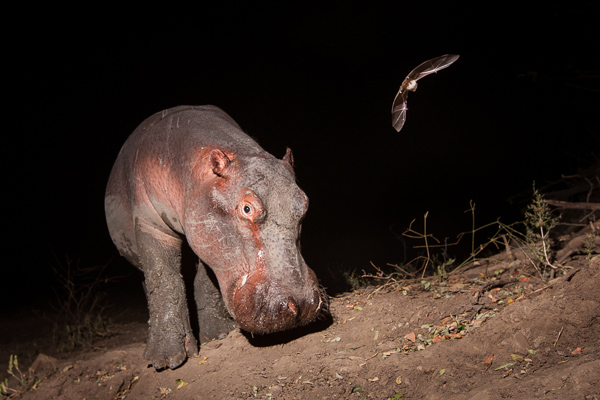
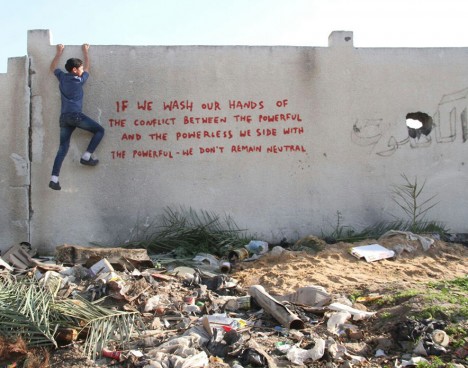
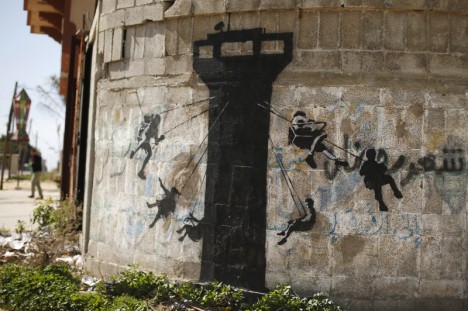
banksy gaza strip art

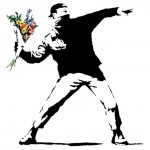
Well known for polarizing political artwork, the infamous street artist Banksy recently returned to the Middle East and filmed a short video about his new work while also commenting on the culture and conditions in a famously contentious place.

banksy gaza kitten graffiti

Regarding a cat mural created on this trip, he writes: “a local man came up and said ‘Please — what does this mean?’ I explained I wanted to highlight the destruction in Gaza by posting photos on my website — but on the internet people only look at pictures of kittens.”

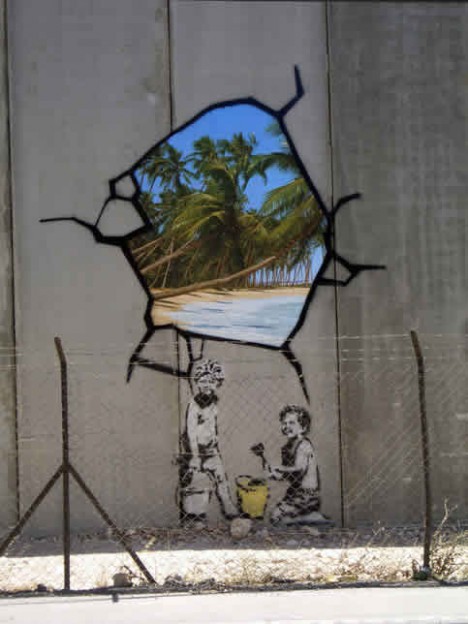
banksy gaza prison mural

His snark knows few boundaries, if any, and is sure to spark global debate on multiple fronts: “Gaza is often described as ‘the world’s largest open air prison’ because no-one is allowed to enter or leave. But that seems a bit unfair to prisons — they don’t have their electricity and drinking water cut off randomly almost every day.”

banksy wall mural palestine

The title of the video below, “Make this the year YOU discover a new destination,” framed as a sort of satirical low-budget travel ad, speaks volumes about his opinions and intentions in revisiting Palestine, where he has worked previously and along similar lines (mainly on dividing walls in the West Bank).

banksy palestine previous murals

Crossing into Gaza from the north generally requires Israeli permission, hence the tunnels as an alternative- there is no functioning airport, sea vessels are turned away by the blockade and land access is limited though possible through Egypt in the south. Some argue Banksy’s work is one-sided with regards to Israel and Palestine, ignoring the role of Hamas in the ongoing conflict that has rendered so much of Palestine into rubble, and this new series is sure to spark some serious conversations, arguments and debates.

Share on Facebook


[ By WebUrbanist in Art & Street Art & Graffiti. ]

[ WebUrbanist | Archives | Galleries | Privacy | TOS ]


WebUrbanist

 
Comments Off on Gaza Strip Graffiti: Artist Banksy Tunnels Back Into Palestine

Posted in Creativity


Into the woods: a video overview of the Olympus OM-D E-M5 II

20 Feb

We thought we’d try something a bit different for our video overview of the Olympus OM-D E-M5 II. Given that two of the major changes are improvements in its video features and stabilization, we thought we’d use the camera to shoot its own video and see how it behaves handheld. And, since the camera is environmentally sealed, we thought we’d venture beyond the office for a bit. See video

Articles: Digital Photography Review (dpreview.com)

 
Comments Off on Into the woods: a video overview of the Olympus OM-D E-M5 II

Posted in Uncategorized


Astropad turns iPad into drawing tablet for Mac

19 Feb

Two former Apple engineers have just launched Astropad, an app for Apple’s iPad and Mac computer that turns the former into a drawing tablet for the latter. It works with most styluses, and allows use of applications like Photoshop for image retouching and editing with more precision. Read more

Articles: Digital Photography Review (dpreview.com)

 
Comments Off on Astropad turns iPad into drawing tablet for Mac

Posted in Uncategorized