RSS
 

Posts Tagged ‘Images’

3 Ways to Improve Your Images With Composition

16 Aug

Along with lighting, subject, perspective, composition is one of the fundamental tools to creating better images. It’s one of the easier ones to begin applying to your own photography as well. Here are a few tips on improving your composition, with examples from a recent fitness photo shoot.

Rule of Thirds

You’ve probably heard this one beat to death, but the rule of thirds is one of the fundamental keys in creating stronger compositions. It involves dividing an image into nine equal grids at the thirds. By placing your subject on the line of a third, or at the intersection of two thirds you’re following your eyes’ natural focus. We find photographs with the subject on one of these thirds simply more pleasing.

Take the below image for example, where this woman is placed on the left third line with the focus of her head near the top left third as well. It creates a more pleasing composition and gives the eye plenty of space to wander in the frame.

RuleofThirds

The rule of thirds isn’t a hard and fast rule and it’s often broken to great success, but that’s a topic you can find in many other posts. It’s a great starting point though to create stronger compositions.

1. Second Point of Interest

Applying the rule of thirds, you can now try adding a second point of interest into your images. Adding a secondary point, whether it’s out of focus in the background or in focus with a deep aperture landscape, gives your image a natural viewing progression. Your eye starts at the first focal subject and then moves along to the second.  Not only does this create more interest in your image, it can help reinforce a theme or perspective.

In this fitness image, the woman tying her shoe and preparing for a run is the clear focus of the image. Introducing a second runner in the background now creates another place for the eye to follow through the image. At the same time the “running” theme has been reinforced. Additional factors in leading the eye are; her gaze into the open space of the image, and the leading lines of the banister and concrete blocks.

MDP_5148-Edit

2. Room for Copy Space

If you ever have aspirations to shoot for advertising agencies and many editorials, learning to leave room for copy space is a must. Copy space is the negative area in an image where a brand will place their tag line, logo or product/information. Generally you want this negative space to not be too busy, so that the copy pops out. The effect can be achieved often by using a shallow focus in your images, or by simple ensuring there is a space without too much “busy-ness” in it. A nice open sky often works great in this regard.

In this shot there’s some clear head space in front of the two runners that works great for copy. An important thing to keep in mind though if you do end up applying these principles for a client, is how the images will be placed in publication. Will they be on a poster or against a store wall? Or across the pages of a magazine? This particular image might not work well across a double page spread, as it places the subjects’ heads right where the crease would be. Against a store wall it would work just fine. These are important placement ideas to keep in mind with copy space.

MDP_5190-Edit

3. Bringing It All Together

When you bring all three of these compositional elements into mind you can create a great image that not only holds interest, but appeals to the creative people who hire photographers (always a big plus). The image below is an example when all three work together. The subject is at one of the third grid lines, there’s a secondary point of interest in the background and room has been left below for copy space. When you keep all three elements in mind you’ll be on your way to creating stronger compositions.

EveryDayRun2

Post originally from: Digital Photography Tips.

Check out our more Photography Tips at Photography Tips for Beginners, Portrait Photography Tips and Wedding Photography Tips.

3 Ways to Improve Your Images With Composition


Digital Photography School

 
Comments Off on 3 Ways to Improve Your Images With Composition

Posted in Photography


Panasonic Lumix DMC-FZ70 Sample Images

13 Aug

Screen_Shot_2013-08-12_at_5.07.02_PM.png

We’ve just posted a 39-image gallery of real-world samples shot on the Panasonic Lumix DMC-FZ70 zoom compact. Spanning the equivalent of 20-1200mm the FZ70’s lens is the largest zoom available in a consumer compact, and we’ve spent a few days testing it out in a variety of situations, to see what this new superzoom can do. Click through for a link to our gallery of real-world samples. 

News: Digital Photography Review (dpreview.com)

 
Comments Off on Panasonic Lumix DMC-FZ70 Sample Images

Posted in Uncategorized


5 Steps to Building More Powerful Images

10 Aug

A Guest Contribution by Dan Bailey

We photographers seem to have it easy. Whereas most artists spend anywhere from hours, to months to years to manufacture their creations, we can simply point, press and be done. However, that kind of convenience doesn’t necessarily translate into great imagery.

Shooting powerful photos that have lasting visual appeal requires more than just pointing and clicking; it takes applying some fundamental compositional methods that are designed to simplify your compositions and actively engage your viewers. Here are five steps that will help you strengthen the visual impact of your imagery.

1. Use Awesome Light

Photography is all about light, and it’s the first thing that will make or break the shot. Not matter what you’re shooting, any and every subject will look better in great light. When we think of good light, we often think of Magic Hour, or the stretches of time during sunrise and sunset. As a general rule, shooting during these times will usually give excellent results.

However, be open to shooting at other times of the day, or even using other lighting sources. Fog, diffused window light or a camera flash can all make for compelling illumination. If you become proficient at wrangling the light, you can create great photos under any conditions.

NFLD HIK 100A

2. Have an Identifiable Main Subject

First and foremost, your image should have have a main subject. Period. It needs to be about something. The most powerful photographs are built around a single element that serves as the focal point of the shot. As a photographer, your job is to draw your viewer into the frame, and if you don’t give them something to lock onto, their eyes will wander aimlessly around your picture trying to figure out what they’re supposed to see. If you don’t know what your picture is about, then your viewer won’t either and they’ll just move on.

DSC8929

3. Use Relationships to Tell the Story

A powerful photograph tells a story, which essentially means that it communicates some specific message or invokes an emotional response from the viewer. The best way to do build this story is to establish relationships between your main subject and the other elements inside the frame.

The job of these secondary elements is to compliment, reinforce or contrast the main subject in some way. An effective secondary subject can be as simple as a strong, out of focus background that gives a sense of place, or it can be two or three other things in the photo that give your subject something to play off of and help to establish the narrative of how your subject “fits” within the world of your frame.

Adding strong secondary elements to your photo also gives your viewer something else to explore as their eyes scan the image, and more importantly, it gives them something to think about. Anytime you activate your viewer’s brain, you’ve gone a long way towards creating a compelling image.

UTH 100

4. Create Tension Through Framing

Depending on how you place your subjects in the frame, you determine the experience by which your viewer scans and respond to what’s in your photograph. The human eyes and brain are hard wired to see and recognize patterns, colors and imperfections in the world; it’s how we evolved to identify our surroundings and spot things like food and danger.

By using a mix of hot and cool colors and by placing your subjects in seemingly random areas in the frame, you cause an inherent uneasiness in your viewers. Their eyes will scan your image, trying to find patterns and that may not exist, and so they’ll keep looking, tracking back and forth between your different subject elements, and darting across broad patches of negative space in order to make sense of the photo. By contrast, if your composition is too perfect, or too balanced, your viewer will quickly spot this nice, easy pattern and move on. That’s not what you want.

DSF0787

5. Don’t Show Everything

A common mistake with beginning photographers is to try and show too much. This leads to cluttered, boring images that do little to engage the viewer’s brain. As I said in number 2 above, in order to create a powerful photo, you need a main subject. However, I didn’t say that you had to show the whole thing.

Abbreviating your subjects can be a very powerful method towards creating a compelling shot. Especially if I they’re things that we’re all familiar with. If you only show part of a subject, you automatically activate your viewer’s imagination as they try to picture the rest in their mind. Photography is a two way street: You have creator and viewer, and if you bring your audience into the process, you invite them to become more connected to your shot.

Remember, good photography isn’t about perfectly reproducing your subject, it’s about creating a visual representation that communicates the ideas or emotions that you had about the scene right when you pressed the shutter.

DSC2259

Further Reading

Makingcover125For more creative photography tips, I invite you to check out my eBook Making The Image – A Conceptual Guide to Creating Stronger Images. I’ll even give you a special price! Use discount code DPS you can get eBook for 50% off.

Dan Bailey is a full time professional outdoor, adventure and travel photographer based in Alaska. When he’s not off exploring in the mountains, writing about photography, or flying his little yellow bush plane, he can sometimes be found lurking in the forums right here at DPS.

Check out his blog and find him on Facebook and Google+.

Post originally from: Digital Photography Tips.

Check out our more Photography Tips at Photography Tips for Beginners, Portrait Photography Tips and Wedding Photography Tips.

5 Steps to Building More Powerful Images


Digital Photography School

 
Comments Off on 5 Steps to Building More Powerful Images

Posted in Photography


3 Steps to Gorgeous Landscape Images

01 Aug

A Guest Contribution by Todd Sisson – author of our brand new Landscape Photography eBook (currently 33% off).

During the writing of Digital Photography School’s latest eBook, Living Landscapes, I was forced to do some heavy thinking about how I approach creative landscape composition in the field. At this juncture, it is important to note that I avoid heavy thinking at all costs. Thinking truly is the hardest work, especially when you are attempting to simplify a process that is almost instinctual to you.

However, my fear of hard thinking is eclipsed by my fear of Editorial wrath, so I set aside a day, dusted off a tantric chants CD and retired to my sweat-lodge teepee for some quality time with sub-conscious me. Thirteen hours later I emerged, 12 kg lighter and armed with two revelations, the first; I approach landscape composition as a three step process. The second; my sub-conscious is a freaky place that is best avoided in the future.

Luckily for you, it is the brief overview of the first revelation that I shall share with you here today; the three component steps to creating a successful landscape image:

  • Choose a subject
  • Find the right light
  • Create a composition

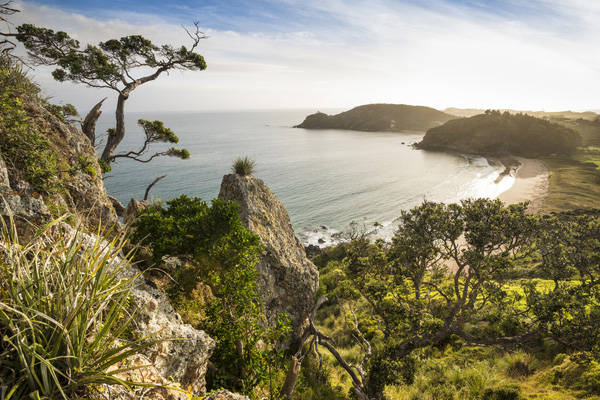
NZ NO Pataua South 4 1

Successful landscape images result from a combination of interesting subject matter, quality light and a strong composition. This particular image nicely illustrates the point that you don’t need towering mountain peaks, blazing sunsets and extraordinary foreground features to make a pleasing image.

Choosing a Great Subject

Not everything in nature is destined to make a great photo. It is our job as a photographer to sort the wheat from the chaff and identify subject matter that will translate beautifully into the two dimensional constraints of the photographic medium.

To my mind, the best landscape subjects convey visual themes such as ‘energy’, ‘grandeur’ and ‘tranquility’ to the viewer. Mountains, bodies of water and coastlines all make happy hunting grounds for photographers because, as viewers, we instinctively know how to interpret these scenes. We sub-consciously know that a snow covered mountain peak must be big, or that a wave crashing on rocks is imparting large amounts of energy, and we know, without thinking, that a reflection on a pond occurs only under calm conditions. In short, we can easily ‘read’ these types of photograph.

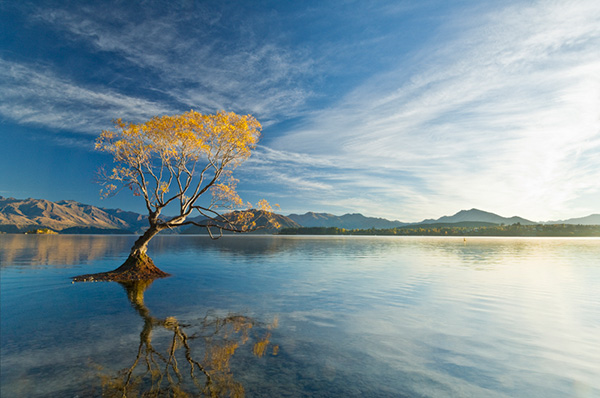
NZ WA Lake Wanaka Willow Reflection 01

The best photographic subjects communicate multiple visual themes and have a very broad appeal as a result. To me this scene speaks of tranquility (reflections), natural change (Fall color and the building cloud cover) and stoicism (the lone tree clinging to life on the outer limits of it’s natural environment). You may ‘read’ this scene quite differently depending upon your outlook on life – for example, a hardcore environmentalist may see no more than an introduced species of tree clogging a lake that has been flooded by unsustainable farming practices in the lake’s headwaters. Photography, and life for that matter, is a very subjective affair…

You don’t need to travel to Nepal (or New Zealand, for that matter, to find great photographic fodder. Sure, it is lot easier to make interesting landscape images when surrounded by Tolkien-esque mountains but subjects don’t need to be grand in scale to make great images, they just need to be visually interesting. Learn to seek form, patterns or color in a scene and you may well find a subject from which to create a landscape image.

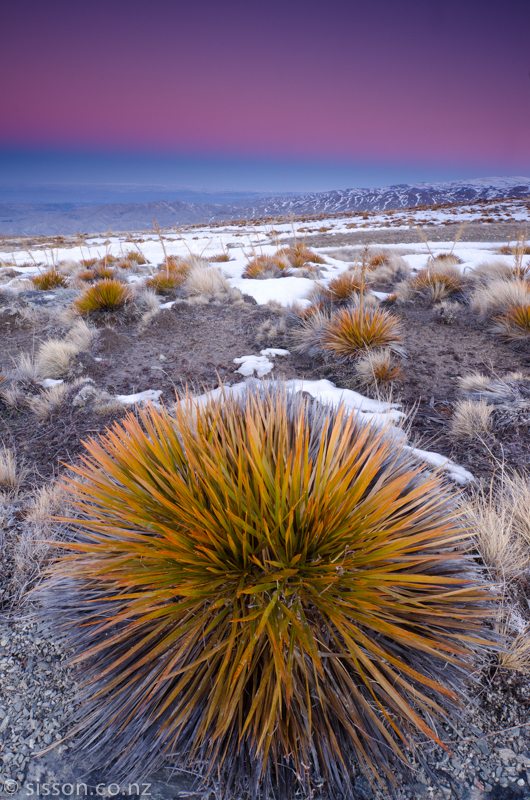
Sisson Wanaka 29

To me, this is a visually interesting image despite the absence of towering mountains, lightning bolts and grazing Unicorns. I was initially drawn by the beautiful evening pastels and the earth shadow (the blue line in the sky near the horizon) but I needed something to ‘anchor’ the shot. The strong geometric pattern and form of the Spaniard grass created a terrific foreground element for the composition. By getting low and getting close an ultrawide lens the grass gains ‘visual weight’ – compare it to the nearly identical grasses a couple of yards back.

Seek the Right Light

I would happily argue that great light is the single most important element in a successful landscape image. In fact, I dedicated a significant number of ePages in Living Landscapes to doing just that. Great light is truly transformative.

Fortunately, seeking great light doesn’t entail shooting only Ferrari-red sunsets. In fact, I will pull out the camera in almost any light if it complements a scene. The skill is learning to judge what constitutes the best possible lighting conditions for a given location – this is where you have to practice the art of observation and pre-visualization to judge how the sun will play out during the course of the day. I use digital tools to assist in this process, namely Focalware, which is a nifty little app that shows the arc of the sun and moon throughout the day with freakish accuracy.

Before after

Great light is transformative. In Living Landscapes I detail the many steps and decisions that led from the scouting shot on the left to several portfolio-grade images of this scene.

Create a Composition

Composition is where it all comes together artistically. You may have lined up an amazing subject and be blessed with a veritable pyrotechnics show in the sky but if you combine these in a dreary, sloppy and uninspiring composition all is wasted.

I personally divide landscape compositions into two broad (and absolutely unscientifically defined) categories;

  • Dynamic landscape compositions
  • Static landscape compositions

Dynamic compositions are the show ponies of the landscape photography world. They employ a suite of visual ploys to imbue an image with an almost 3-D feel and/or impart a sense of dynamic energy. Dynamic compositions used to be difficult to create in ye olde film days but the learning curve is vastly accelerated by the digital workflow and easy access to educational information such as this dPS blog post written by yours truly.

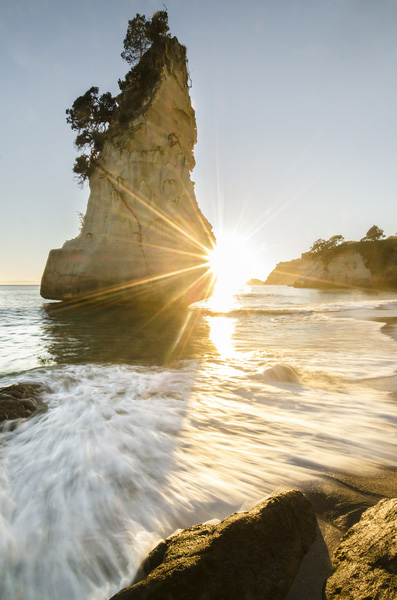
NZ CO cathedral cove 6

Show pony. Dynamic compositions employ techniques such as leading lines, motion blur and vivid colors to draw the viewer’s attention into the frame.

Static compositions subscribe to a more traditional photographic aesthetic and, I feel, are more faithful to the two-dimensional constraints of the art form – most of Ansel Adams’ images would be considered static as opposed to dynamic compositions. I have a personal preference for beautifully executed static compositions – probably because I am fairly ancient, in internet years at least…

Static compositions rely upon a more subtle repertoire of visual techniques to achieve a sense of drama. Successful static compositions use a combination of layers, contrast, texture, form, localized lighting and color to engage the viewer.

NZ WR Sunset Sheep

No place for show ponies. Static compositions such as this rely upon layers of visual interest, form and spot lighting to succeed.

Mixing it Up

It is important to note that there is no particular order for executing these three steps. I will often stumble across great light (always it seems when driving with a car full of tired & hungry kids ) and then have to find a subject and a composition to capitalize upon the situation. This is, of course, where strong craft and technical skills kick in – readers of Living Landscapes will know that I promote a policy of keeping it simple with regards to camera settings and technical considerations, this allows me to work fast and seek out compositions – even while being bombarded with requests for snacks from the back seat!

Todd & Sarah Sisson are full-time landscape photographers based in Central Otago New Zealand.

Their work can be found as fine art prints & canvas prints at www.sisson.co.nz  They can be found on Facebook, Google Plus and Twitter.

Post originally from: Digital Photography Tips.

Check out our more Photography Tips at Photography Tips for Beginners, Portrait Photography Tips and Wedding Photography Tips.

3 Steps to Gorgeous Landscape Images


Digital Photography School

 
Comments Off on 3 Steps to Gorgeous Landscape Images

Posted in Photography


Breathtaking images from Red Bull Illume 2013’s finalists

01 Aug

illume4.png

The finalists in the annual Red Bull Illume photo contest have been revealed, and action and extreme sports never looked so good. A total of 250 finalists have been announced with entries in 10 different categories. Come August 29th, a winner will be crowned from 50 finalists invited to the reveal in Hong Kong. Click through and take a look at some of these incredible contenders for the grand prize.

News: Digital Photography Review (dpreview.com)

 
Comments Off on Breathtaking images from Red Bull Illume 2013’s finalists

Posted in Uncategorized


Extra images added to Sony Cyber-shot RX1R Samples Gallery

24 Jul

Screen_Shot_2013-07-24_at_10.16.37_AM.png

We’ve just added several more photographs to our gallery of real-world samples from the new Sony Cyber-shot RX1R. The RX1R shares the same feature set as its forebear the RX1, but its 24MP full-frame CMOS sensor lacks an AA filter for additional sharpness. We’ve been impressed by the RX1R’s image quality as we work through our usual studio and real-world testing, and we’ve added more samples (both JPEG and converted Raw) to our gallery for you to take a look at. Click through for a link. 

News: Digital Photography Review (dpreview.com)

 
Comments Off on Extra images added to Sony Cyber-shot RX1R Samples Gallery

Posted in Uncategorized


Extra images added to Sony Cyber-shot RX1R Samples Gallery

24 Jul

Screen_Shot_2013-07-24_at_10.16.37_AM.png

We’ve just added several more photographs to our gallery of real-world samples from the new Sony Cyber-shot RX1R. The RX1R shares the same feature set as its forebear the RX1, but its 24MP full-frame CMOS sensor lacks an AA filter for additional sharpness. We’ve been impressed by the RX1R’s image quality as we work through our usual studio and real-world testing, and we’ve added more samples (both JPEG and converted Raw) to our gallery for you to take a look at. Click through for a link. 

News: Digital Photography Review (dpreview.com)

 
Comments Off on Extra images added to Sony Cyber-shot RX1R Samples Gallery

Posted in Uncategorized


Composing Dynamic Landscape Images

18 Jul

A Guest Post by Todd Sisson from www.sisson.co.nz.

As a landscape photographer I am constantly seeking that next X-factor shot – an image that leaps from the screen or page and demands the viewer’s attention – preferably attention of the favourable variety.

If you spend an hour or two on a photosharing site like Flickr viewing landscape images in un- curated groups you will note that a very small percentage of the total image population stands out from the crowd.

However, if you view a carefully curated collection of top-shelf landscape images you will probably start to notice some themes appearing. Certain visual cues and devices appear across multiple images – there will often be subtle commonalities between these attention hogging photos.

In many instances these images will possess the qualities of what I consider a dynamic landscape image.

What is a Dynamic Landscape Image?

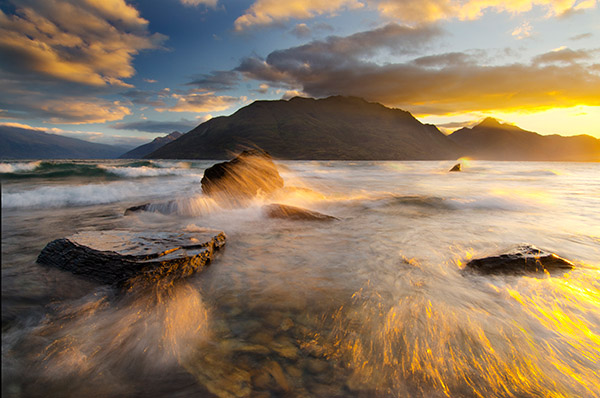
Summer Storm, Queenstown New Zealand. An example of a dynamic landscape image. To maximise the number of dynamic elements in this image I locked this composition off in the field and shot multiple images. The best of about five wave-action frames were then blended together to form the final image.

There is no dictionary entry that defines a Dynamic Landscape Image* – heck, there’s not even a Wikipedia entry – so it is a somewhat personal interpretation.

To my mind, a dynamic landscape image is one that in some way conveys the energy and scale of the natural world. Dynamic images also often seek to breach the confines of their 2D medium by inferring a sense of depth – many truly dynamic image have an almost 3D quality about them.

*As far as I am aware, the term Dynamic Landscape was first popularised by the late Galen Rowell – one of the most influential American landscape photographers of his generation. Rowell used the term to demarcate his work from the somewhat literal colour landscape photography that dominated the early 1970′s. Although he was certainly not the only photographer employing these principles in his work, he appears to have been an excellent self-promoter and the term is somewhat synonymous with his name.

Dynamic Composition

Composition is the backbone of all great photos – dynamic or otherwise – but it is essential in the creation of a truly strong landscape image.

I feel that the goal of a successful composition is to draw the eye into image and hold it there for as long as possible – which is seemingly, a maximum 15 milliseconds these days*. The following image is an example of an image that I feel achieves this objective.

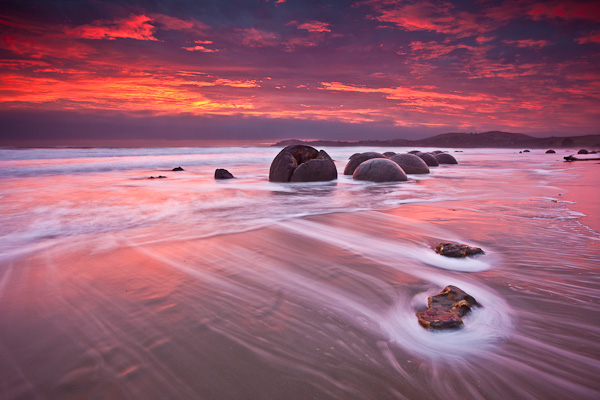
Sunrise Over The Moeraki Boulders, Otago New Zealand. Seascapes lend themselves to the creation of dynamic landscape images.

This image combines all of the elements that I feel comprise a Dynamic Landscape Image:

  • Leading or converging lines
  • Interesting perspective
  • Visually interesting foreground elements
  • Visually interesting mid-ground & background elements
  • Vivid colour or incredible light
  • Vision-locking tonal control
  • Suggestion of movement

It is important to note that not all dynamic landscape images possess all of these factors. In fact, it is depressingly rare to have it all come together in one moment. It must also be stated that what follows is not a recipe for creating great images. Photography can only be practised as an art when personal interpretation is injected into the process – only use this information as a guideline for evolving your own images.

So let’s have a very quick look at each of these Dynamic Landscape factors.

Leading Lines & Converging Lines

One of the simplest ways to draw a viewer’s attention into an image is to use converging or leading lines. Converging lines have been used by painters for centuries to create the illusion of depth within a 2 dimensional medium.

This is why photos of wharves, roads, and rivers make such successful photographic subjects. Although many consider such subjects to be cliches, I strongly council my workshop students to shoot them heavily to build an awareness of the power of a line in an image.

Leading lines not only draw attention into the image, they can also help to hold the eye within the confines of the image.

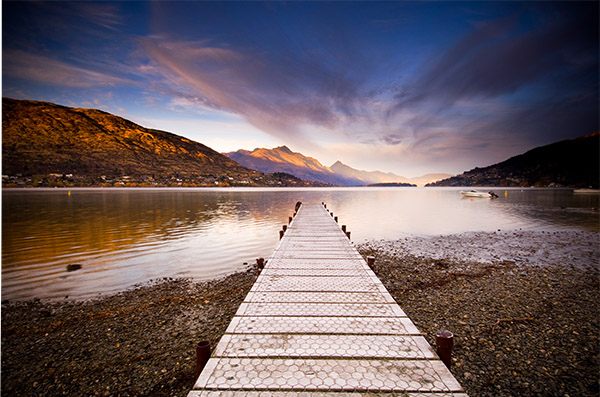
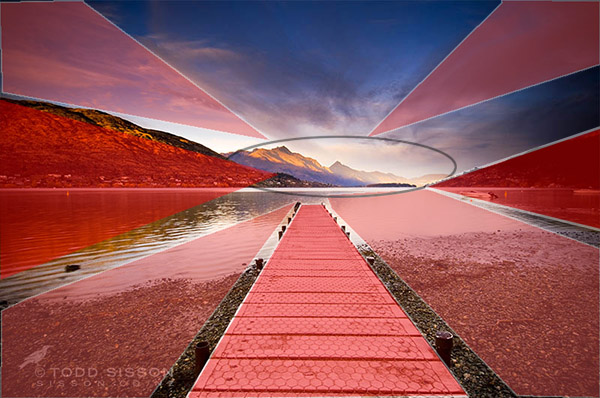
Check out the crudely overlaid wharf image below combines the strong converging lines of the wharf with secondary supporting lines in the water, hills and clouds.

Look for these lines whenever you are shooting – they are almost everywhere.

The Wharf at Frankton, Queenstown New Zealand. Shoot ‘cliched’ subjects like wharves and roads until it hurts a little. The pain is just your visual muscles growing stronger. Shooting man-made lines will teach you to look for more subtle lines in nature.

Although the wharf is the primary leading line device in this image there are a number of leading lines present in the water, hills and clouds. The darker reflected lines in the water help hold the eye in the central region of the frame.

Interesting Perspective

As a photographer you are an artist not a forensic documentarian. You get paid the mega-bucks and live the champagne lifestyle to show your audience something a little different – that is your raison d’être.

Hence I rarely find myself shooting at my natural standing position. For some reason, compositions seem to get more dynamic the closer you are to the ground/mud/ snow/ice-encrusted cow turd – it’s just the way it is.

This is especially apparent when using an ultra-wide lens. Subject matter becomes incredibly diminutive and interesting leading lines really lose their visual power when viewed from 5 or 6 feet high – so try getting uncomfortably close and low.

Aim high also. Look for ways to gain elevation to find that privileged viewpoint – I find that this often works really well when shooting telephoto lengths for some reason. Try scrambling up banks, standing on cars and sitting on your wife’s/husband’s shoulders (sans tripod) in an effort to find an interesting perspective.

Paddock Bay, Lake Wanaka New Zealand. Getting uncomfortably low in this instance dramatically altered the perceived form of the rock on the lower right of the frame. B y moving about I was able to create the satisfying impression of the rock 'interlocking' with the reflection. Note the strong leading line formed here also.

Foreground Elements

I believe that a dynamic image almost always possesses a strong foreground element, or elements, that complement the greater scene.

Take a sunset/sunrise for example. Sure, spectacular light makes for great images, but personally photos that contain nothing but vast expanses of super-saucy red clouds do little to engage me as a viewer.

The best dynamic images typically have a strong point of interest in the lower half, or foreground. This is your visual entree into an image. If your foreground element happens to include leading lines you are quite possibly onto the much vaunted money-shot.

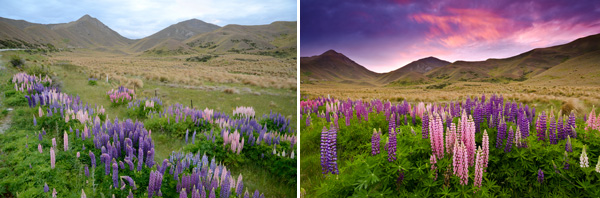
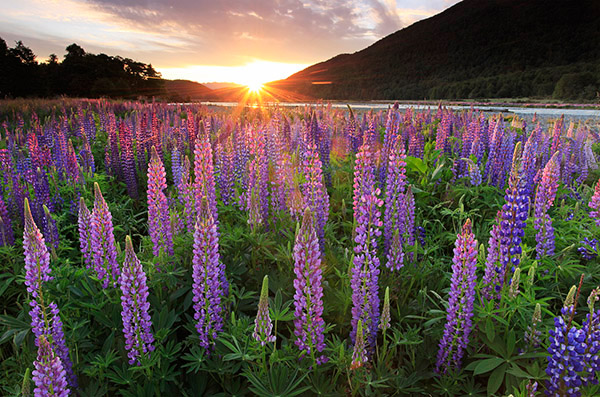
Lupin(e)s, Fiordland New Zealand. Yeah, this is cheating – foreground elements don’t come much easier than this. That aside, keen observers will note the subtle converging lines formed out of the lupin pattern. This was accentuated by deliberately placing a bloom in each corner and leaving a little empty space at the bottom of the frame. Sunstars make an exceptional background element (segues niftily to my next point)

Visually interesting Background Elements

I often compose back to front. Firstly I will find the subject of my image, say a spectacular sunset playing out on mountains, and then I will run around like a deranged prison escapee in search of a foreground element to complement the background.

It is very much a balancing act – defining who or what element gets to play the lead role in your composition. Ideally the background is where the eye should gravitate to and the foreground should pick up a gong for best supporting actor.

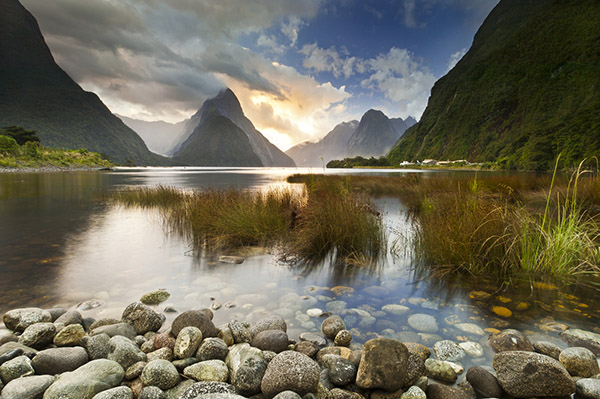
Milford Sound, Fiordland New Zealand. The star of this image is the dramatic light playing out in the clouds over the eye- catching form of Mitre Peak – the foreground & mid ground elements are critical supporting parts of the whole composition but don't hog the lime-light.

Unusually, I didn’t scramble to find a foreground element for this image – I staggered. Four minutes earlier I had been happily sleeping in the back of my truck – my alarm went off and I saw this – panic ensued….

Vivid Colour or Incredible Light

By now it should be obvious that I have some un-checked colour-dependancy issues. I love colour*, especially natural light shows. However, I feel that vivid colour needs to be kept in balance and be a part of the overall composition. Too often I see images that rely solely upon dollops of super- saturated colour.

For a dynamic landscape image to work, balance must prevail. Hence I attempt to avoid filling the frame with too much colour (yes, there is such a thing – see below).

*I am even partial to the American version – colour.

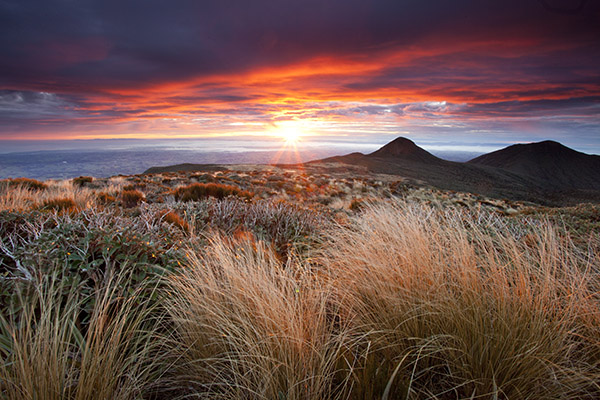
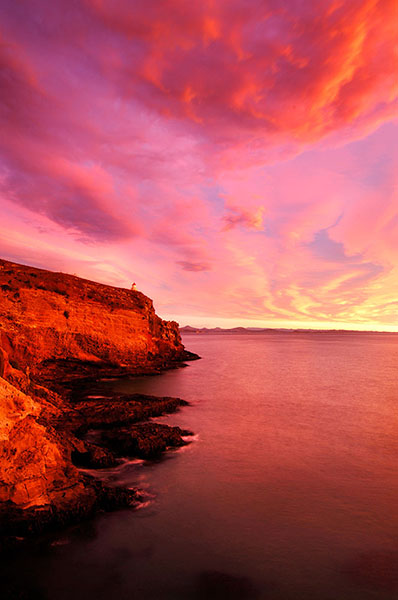
Sunrise from Mt Taranaki / Egmont, New Zealand. In this image the main act was the rapidly dissipating beams of sunrise goodness and the rich colour in the clouds. Lens choice and composition mean that the sunrise colour is just one component of the image. I often like to keep dark forms in my images (anathema to the HDR readers amongst you) as a counterpoint to the extreme lightness of a sunset/sunrise. I find the dark hills here quite mysterious in contrast to the sunstar and clouds.

Too much colour. This was one of the most intense sunrises that I have ever witnessed. I should have just sat and enjoyed it – this is just too much colour for my tastes – it looks un-realistic. This shot has actually been partially de-saturated in an effort to tame the colour.

Vision-locking Tonal Control

I am tempted to trademark this term – it sounds like a mind-control experiment deployed by shady branches of the US intelligence community.

Basically all I am referring to is the phenomenon of vignetting.

The eye is drawn towards lightness within an image, particularly near the centre of frame. Furthermore, the eye is restrained by darkness at the edges of the frame.

When employed deftly, the viewer’s eye is gently drawn into the image by lightness and held there by the darker edges of the image.

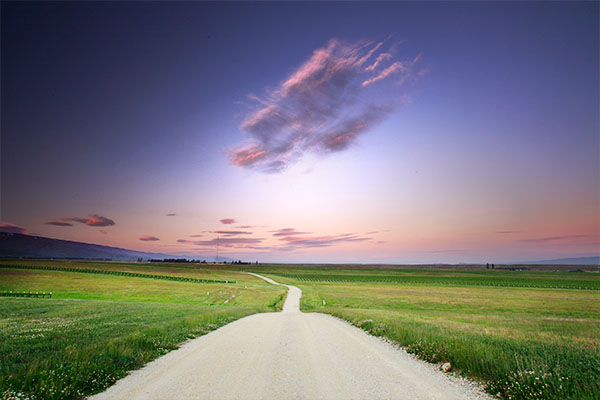
Look at all of the images above and you will see this technique in use. Often this happens in- camera just by virtue of the composition and through use of ND grad filters. However, I will often darken the top edge of an image in post and even add a subtle vignette as the last thing I do. Weird Cloud formation & Road to Nowhere. Alexandra New Zealand. In order to achieve vision-lock here I painted in a brighter layer near the central portion of the image. A little vignetting was added to further enhance the effect.

Suggested Motion

Suggested motion, by way of blur or frozen motion is not always an achievable, or desirable, element to utilise within an image – but it can add another layer of dynamism to a composition.

Don’t just get locked into shooting long exposures either – frozen, or partially-frozen motion can convey movement just as well as a long exposure in some circumstances (see the first image, Summer Storm, for an example of this).

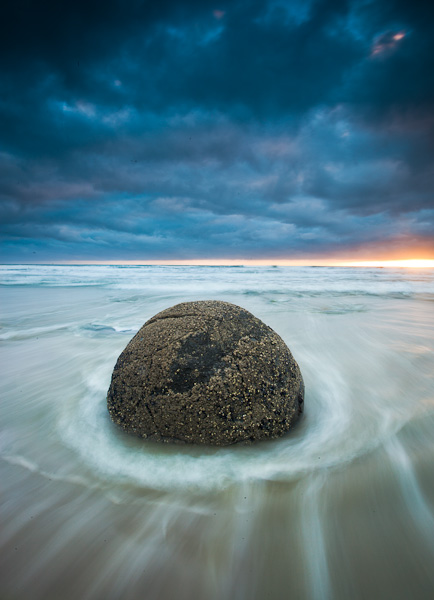
Moeraki Boulder, Otago New Zealand. Long Exposure motion blur creates a dynamic tension between the static boulder and the relentless sea. Note the other dynamic ingredients added to this image – interesting perspective, use of colour, vision-lock, foreground/background interest.

Can Dynamic Landscape Images be B&W?

Absolutely. There are many thousands of truly incredible B&W dynamic landscape images. No style renders texture and contrast better than B&W – at it’s best it is magnificent.

In order to compensate for their ‘lost’ colour Black & Whiters will often apply industrial grade quantities of Vision Locking Tonal Control (that’s why vignette sliders to go -100) and rely heavily upon strong graphical elements such as leading lines (you will find a lot of B&W photos of wharves and sewerage pipes heading out to sea).

I would show you an example of this, but I am mono-challenged. If you want to see B&W Dynamic landscapes at their best check out the work of Mitch Dobrowner & Hengki Koentjoro.

So Are All Good Landscape Images ‘Dynamic’?

Not at all. Stunning images can be made by avoiding almost all of the techniques that I have just espoused in this essay. Dynamic Landscape composition is just one style of landscape photography.

In fact, many of my favourite images by others are beautifully composed static, flat compositions. These ‘static’ images respectfully comply with the two dimensional constraints of the photographic medium and rely upon a separate set of visual devices in order to ‘succeed’.

If they will have me back here at DPS, these static landscapes will be the topic of my next blog post.

Todd & Sarah Sisson are full-time landscape photographers based in Central Otago New Zealand.

Their work can be found as fine art prints & canvas prints at www.sisson.co.nz Todd also offers private and group photographic tuition. They can be found on facebook, Google Plus and twitter.

Post originally from: Digital Photography Tips.

Check out our more Photography Tips at Photography Tips for Beginners, Portrait Photography Tips and Wedding Photography Tips.

Composing Dynamic Landscape Images


Digital Photography School

 
Comments Off on Composing Dynamic Landscape Images

Posted in Photography


Fine Art Painterly Images From Your Photos

01 Jul

A Guest Post by Alex Morrison

So, you’re thinking about unleashing your inner artist? Good for you! Old school photography can seem a bit limiting sometimes, with all those pesky rules – the rule of thirds, the rules of thumb, sunny 16 rule. Who needs rules! Your creative after all and we creatives are born to break the rules!

Fine art photography is one of those photographic genres that defies rules, bends and breaks them and in the process of doing so the photographer creates art. A bad out of focus image of a flower could become your masterpiece; a mediocre landscape can hang in a gallery! With a little know how, and a creative eye, fine art images are pretty easy to create.

In this article we’ll discover what fine art photographs are, how to develop your own artistic style, and a simple way to process your photos into art images.

But Is It Art?

So what’s the difference exactly, between a fine art image and any other kind of photography? Well, this is where a clear definition gets a little murky.

Here are some general parameters, so we can talk about fine art photography from a common perspective (excuse the pun). Art photography is printed, and hung. (Hopefully in a prominent place!). It can be used in decor, in homes and offices; or “art for art sake” in galleries and exhibitions. Fine art photos are usually presented and sold as limited editions.

Here’s a pretty clear definition I really like, from the Professional Photographers of Canada that covers most of the generally accepted requirements of a fine art image:

Fine art images may consist of unusual images, individual images or a series of images. The range of styles and treatments varies greatly, from the classic black and white scenes to more non-conventional images. In fact, conventional beauty, formal design and familiar subjects are often not components of fine art images and can include painterly effects, soft-focus, journalistic, snapshot type images, bizarre and erotic images and other unconventional approaches.

Fine art images are usually sold to individual collectors, museums and business clients. Photo Decor is usually the term used to designate a print hung to decorate a room, whether in a private home, an institution, a corporate boardroom, a gallery, etc.

All right, now that we know what we are talking about let’s find out about how to create these wondrous and unconventional images. For this discussion we’ll be devoting our exploration to painterly styles and effects – the coolest and easiest techniques to learn! Other fine art photography techniques will be discussed in future articles. So hang tough if your favourite style isn’t included here yet :-) And if you don’t like photographs that look like paintings don’t despair – this is only one way of so many ways you can create fine art photographs.

Finding Your Artistic Style

First, let’s look at classic fine art. I know this seems counter intuitive – how can we break the rules if we’re studying classics – didn’t they define the rules?! Well, yes, but…these historical styles and techniques give us powerful insight into the range of artistic expression that you can build on when considering painterly looks.

449px Flowers in a Crystal Vase Edouard Manet c1882Since I’m a big fan of Sir Isaac Newton’s “..on the shoulders of giants…1″ school of greatness, I believe you achieve success in anything by building on and learning from the achievements of others.

A great place to begin absorbing a fine art point of view is with the old classic paintings, from Goya to the Post-Impressionists, and all schools in between!

I adore works by Claude Monet, and much of my art photography style is of his influence (his picture to the right).

Not to be confused with Claude is Édouard Manet, whose use of colour in his still lifes also moves me deeply.

The great thing is you don’t even have to “study” these works, just look at them and notice the colours, the brush strokes, the compositions, the subject matter.

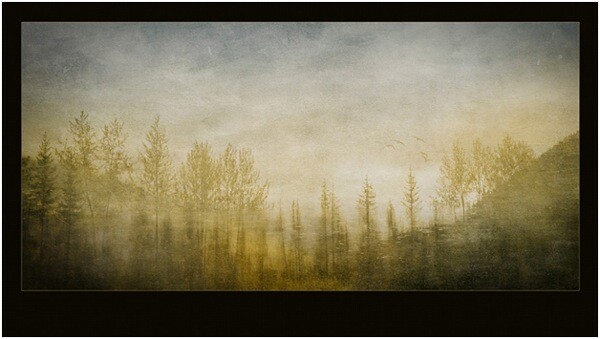
Are you inspired yet? Ok, here’s another artist for you to investigate, in case you want more examples than just flowers in vases! Look for works JMW Turner an 18th century water colour artist who changed landscape art forever.

He inspired this image of a reflection in a lake.
Rainforesttapestry

The Subject of Your Desires

If your aim is to sell your fine art images as decor, be sure that your subject matter is something most people would want in their homes or offices. Think about the context. Ugly doesn’t sell – no matter how artistically it is portrayed. But beauty generally does. Artistic treatments of flowers, landscapes, still lifes, abstracts and impressionistic figure studies are safe bets as subject matter. They seem to be almost universally accepted.

One of my most acclaimed art images – won several major awards – and one that everyone absolutely loves is “the Devils’ in the Details.” Someone loved it so much they bought it, but returned it to the gallery a week later because once they got it on the wall – it was just too freaky and disturbing!

Devilsinthedetails
?
If you plan on selling to collectors then usually any subject is fair game – some lesser known van Gogh paintings were of old shoes. Who knew!

But it’s YOUR creative interpretation and treatment of these subjects, whatever they may be, that creates the WOW factor. And it is here in your treatment and interpretation that you can break all the rules!

Viewing the works of artists who have gone before will expand your imagination and get your creative consciousness flowing for styles, subjects and different and unique ways to portray them. Once you have your image captured, you can then create a wild assortment of artistic and painterly effects in your post production processing…which is coming right up!

Creating Painterly Techniques in Post Production

One of the most flexible and fun ways to give your images a painterly fine art quality is to use overlays, underlays and textures, which you add in post production. As long as your favourite image editor supports layers and blending modes you’re good to go. If you get really expert you may even want to make your own textures and under/overlays to take full control of your final image. You’ll be rocking epic fine art photography.

Back in 2006 I was playing with a program called Corel Painter – it is a painting program where you can create all sorts of paint effects in a digital way. I had created an image in Painter using an oil paint “brush” and the texture and some subtle colours. Just our of curiosity I layered this image on top of a landscape and wow! the brush strokes came through in a most enchanting way – and so my own form of painterly fine art overlays were born! I use these a lot and make new ones as needed. But you don’t have to go to all that work – often using random images you have in your folders can be just as useful, as we will soon see.

Achieving a painterly affect in a photograph requires two main components in post production, usually a texture to emulate canvas, cloth, or some other base media; and at least one other texture or overlay to give it the image the look of something other than a straight-up photo – something like a painting! Depending on your initial image you may not have to use both these types of textures. In fact because there are no rules here you can stack multiple layers in a variety of combinations to achieve stunning images.

“Winter Garden” started out as this. A fine mess of dead and withered grasses in my garden in January!
?
Wintergardenbefore

And it was transformed to this, and went on to win several national and provincial awards for Fine Art photography:

Wintergardenafter
?

And now finally – How do I do this?

First, take a stroll around the Internet and look for free textures. Not textures of wooden boards and bricks though – look for cloth and fabric textures. Also look for textures of brush strokes or that have a very fine pattern like rust, old concrete. Other photos that are out of focus, or that have primarily one colour or pattern such as frost or rain drops on a window also work particularly well.

If you’re not inclined to go on a treasure hunt right now, I’ve created source files for you! Here are the files I used for Winter Garden, to get you started!

(downloads) (warning: this is an 18MB download and will give you a zip file with a PSD file and some JPGs).

The idea is to underlay and overlay these textures and images with your base image using blending modes and opacity to alter the way the textures interact with the base image. Ready to get started?

The Process of Post Processing

In Photoshop or your image editor, open your main photograph – your base image – in this case if you’re using my source files, Image 0852. Double click on the Background layer in the layers panel to make your Background layer editable. It will be called Layer 0. Set its blending mode to Soft light.

Then go to File>Place and select the image 0853.jpg. Stretch it to fit if needed. This will become Layer 1 Change the blending mode to Hard Light.

Duplicate this layer, and set the blending mode to Luminosity, and change the opacity to 20%. Flip the layer horizontally by going to Edit>Transform> Flip horizontal.

Almost there! Now place Image 0775, this is a photo of frost that I am using as a texture and colour overlay – stretch to fit if needed, and then set the blending mode to color, and opacity to 49%.

Now we’re going to create the UNDERLAYS! These are layers that we will add UNDER Layer 0. How exciting!

So… place image 0870, and drag the layer to be immediately under Layer 0. Set Layer 0 to Soft Light.

Set your underlay layer to 53% opacity.

And finally we will add our last underlay layer by placing the texture, Image 0809. Well add this in 2 places, but first place it as we have done with the others, and move it to be the bottom-most layer in your stack. It will be Normal and 100%.

Now duplicate this layer (CTRL J) and drag the copy to be the top-most layer in your stack. Set it to soft light and 42%.

At this point you should save your file as a layered image. What do you think? Quite painterly, no?

Want to adjust some more? Awesome! You can now play with these layers, the order, the opacities, the blending modes and even adjusting hue and saturation of individual layers to suit your own style and your interpretation of withered grasses in the winter. You can add other textures you may have on hand or that you’ve found online.

With a few simple images, some inspiration from the Masters, and your own imagination, free from rules and constraints, you’ll be making fine art images in no time!

Screenshot

Alex is a professional fine art and nature photographer, accredited by The Professional Photographers of Canada, and was Canadian Photographic Artist of the Year in 2009. In 2012 and 2011 she was selected Manitoba Photographic Artist of the Year. She teaches photography, runs workshops and online classes on fine art and nature photography, infrared photography and iphone photography. Her educational website with photography tips and tricks is at www.nature-photography-central.com. Her art photography portfolio is www.alexandra-morrison.com. Connect with Alex on Facebook, Pinterest and Google+.

Post originally from: Digital Photography Tips.

Check out our more Photography Tips at Photography Tips for Beginners, Portrait Photography Tips and Wedding Photography Tips.

Fine Art Painterly Images From Your Photos


Digital Photography School

 
Comments Off on Fine Art Painterly Images From Your Photos

Posted in Photography


Berlin Foto Festival features smartphone images in Berlinstagram exhibit

14 Jun

berlinstagram.png

The Berlin Foto Festival is again highlighting mobile photography at this year’s show. A new exhibition, Berlinstagram, features the work of Berlin smartphone photographer and prolific Instagrammer Michael Schulz. Schulz uses a smartphone to capture both the street scenes and architectural structure of Germany’s capital city. See more of his striking photos on connect.dpreview.com.

News: Digital Photography Review (dpreview.com)

 
Comments Off on Berlin Foto Festival features smartphone images in Berlinstagram exhibit

Posted in Uncategorized