RSS
 

Posts Tagged ‘Great’

How to Create Great Photos without Leaving Home

17 Feb

Photos home easy 01

So you want to take pictures; or do you want to be a photographer? I deal with a strikingly similar question every time I swing a golf club; I want to be a golfer, but with life events and time constraints the reality is I merely play golf. Fortunately, making a great photo doesn’t consume the amount of time 18 holes does and since you’re here reading this, it’s safe to say you want to be a photographer.

WHAT TO PHOTOGRAPH?

Portraits, landscapes, sports, oh my! As a new photographer it is incredibly tempting to photograph everything, and that’s a good thing as it will help you understand where your true passion lies. However, I am a firm believer that early success leads to more success.

Let me say that again – early success leads to more success.

As a new photographer there is no better feeling than capturing a truly excellent photo; and if you’re anything like me, time is very limited. Luckily with a simple understanding of light, your home is a great place to create stunning photos.

All of the photos in this article were shot in my home. I do not have a home studio, and as I mentioned earlier, I also have little spare time; but that’s ok because you don’t need either to make great photos. The photos of the tulip and baseball were shot with a cheap piece of white poster board and available light from a window.

USING WINDOW LIGHT

While there are no “essentials” to creating great photos with available light from a widow, I always use a tripod and would highly recommend one. However, if you do not have a tripod, you’ll need to raise the ISO to increase your shutter speed if you plan to hand-hold your camera. A generic rule of thumb is you’ll need a shutter speed of 1 divided by the focal length of your lens. For example, I used a 100mm lens for the tulip, and shot it at f/16 and an 8 second exposure. If I did not have a tripod, I would have had to increase the ISO (and realistically open the aperture as well) until I had a shutter speed of 1/100 (because I was using a 100mm lens) to keep the image sharp; but since I was making use of a tripod, an 8 second exposure was no problem.

There are endless opportunities for photography with available window light. Again, you could certainly hold your camera if you raised the ISO, but I would suggest the following as rough guidelines for photographing next to a window:

Photos home easy 02

  • Use a tripod, or raise your ISO until the shutter speed is 1 / the focal length of your lens
  • If using a tripod, set your ISO as low as possible
  • Set your camera to manual mode and the aperture to around f/11, then adjust the exposure via shutter speed from there

For a clean seamless background, such as the baseball photo here, grab a cheap piece or poster board from the school or office supply aisle at your favourite box store.

What do you do once you’re bored shooting next to the window, or want to learn something more? Stay at home of course!

WHAT’S NEXT? LEARN ABOUT LIGHT

There’s plenty of room to grow with your photography in the house. After all, what’s the underlying foundation of photography? Light! Even if you don’t have a flash you can still learn about lighting at home. Don’t have an off camera flash? No problem, I bet you have a flashlight! I created the photo of the kiwi fruit in a bathroom with the lights off and a flashlight lighting the fruit from behind.

Photos home easy 03

I would take a photo, look at it on the camera’s LCD, and then adjust the angle of light from there. So what if I spent an abnormal amount of time in a dark bathroom by myself, and got strange looks from my wife. I learned a lot about how the position of the light effects the look of the photo, and made a cool photo!

Bottom line, you don’t need a flash to learn lighting and take a great photo, all you need is a dark room (very dark, as in no light at all) and a flashlight.

Photos home easy 04

USING FLASH

So what about flash? I think using flash in photos is the key to creating photos that stand out from the rest. If you have a speedlite or other hot shoe flash, the best thing you can do to take your photography to the next level is learn to use it. After that, the next best thing you can do is take it off the camera when you use it. The photo of the little yellow guy smiling and the red silhouette of the golfer were both shot using off camera flash, and aside from a few tweaks in post processing, they look very close to what was produced in the camera with help from the flash. Once you understand about positioning and light fall off, you’ll be able to manipulate the light in such a way that creates great photos right in the camera.

Photos home easy 05

The point being here, and something you’ll learn either in due time, or right now as I tell you, all great photos have one thing in common: great light. Whether you use light from a window, a flash, or light from something as simple as a flashlight – there are numerous ways you can get great light right in the comfort of your own home.

To recap, here’s what I used in the photos:

  • Flower and baseball- window light, white poster board, and a tripod
  • Kiwi fruit- tripod and a flashlight
  • Golfer – single off camera speedlite with a red gel fired into a seamless paper
  • Little yellow smiling guy – white seamless paper, and a single off camera flash handheld above and to the left of the camera

Once you create one photo with great light at home, I guarantee you will be hooked! Best of luck to you, now go shoot!

The post How to Create Great Photos without Leaving Home by Brian Barthel appeared first on Digital Photography School.


Digital Photography School

 
Comments Off on How to Create Great Photos without Leaving Home

Posted in Photography


12-County Coalition: Building the Great Green Wall of Africa

26 Jan

[ By WebUrbanist in Global & Travel & Places. ]

green wall trees desert

The clock is ticking for the collaborative creation of a living green wall to span nearly 5,000 miles across the African continent, designed to slow or even stop the relentless spread of desertification. The scope of this unique organic building project is unprecedented, as is its urgency.

green wall project africa

China took over 1,000 years to construct their Great Wall, but scientists believe Africa may only have a few decades before the Sahara Desert engulfs more than two thirds of its arable land. Hence the Great Green Wall of the Sahara, set to stretch from coast to coast, west to east.

green wall planting example

The cooperation of the twelve contiguous African countries involved is as impressive as their challenge is daunting – participating nations include: Senegal, Mauritania, Mali, Burkina Faso, Niger, Nigeria, Chad, Sudan, Eritrea, Ethiopia, and Djibouti.

green wall small large

The idea to create a ‘green front’ to protect Africa is almost half a century old, but the plan began to be taken more seriously starting just over ten years ago. Since being ratified by participating countries, the program has raised billions of dollars in pledges from international organizations.

great green wall tree

From AtlasObscura: “Leaders point out that the Great Green Wall is about more than just protection from windblown sand. The project will bring thousands of jobs to impoverished communities, and has already transformed otherwise unusable land into gardens scattered with tree nurseries. The influx of tourists, scientists, and medical professionals has also brought attention and resources to a neglected region in which aid is scarce and doctors are not readily available to needy populations.”

Share on Facebook


[ By WebUrbanist in Global & Travel & Places. ]

[ WebUrbanist | Archives | Galleries | Privacy | TOS ]


WebUrbanist

 
Comments Off on 12-County Coalition: Building the Great Green Wall of Africa

Posted in Creativity


Reverse Lens Macro: How to use it as a Great Learning Tool

16 Jan

Reverse lens macro photography 03

Reverse Lens Macro: How to Use It as a Great Learning Tool

Yesterday one of my friends called me late and told me that he was going to buy a DSLR and asked me which one he should choose. As a friend, I knew that this was his first camera and he was in fact a complete stranger to the field of photography. I told him to buy a good compact camera in order to get used to the basic concepts of photography and to buy a DSLR only when he feels his equipment is limiting his creativity.

On the other hand are the people how have already bought an SLR, but get confused and overwhelmed by the level of control these cameras offer, and the sheer amount of effort they have to put in to make their photographs look beautiful. I write this article for those people who bought a DSLR, and are in distress seeing none of their photos looking as good as someone else’s.

Considering that you have bought a DLSR and are delving into some advanced levels of photography, let’s see how an interesting and fun technique known as reverse lens macro can teach you a great deal about your camera, light and in effect make the art of photography.

Reverse lens macro photography 01

The basic trio of photography

Before understanding reverse lens macro let’s take a look the basic trio that every photographer needs to know to take a well exposed shot:

  1. Shutter speedreverse-lens-macro-photography-02.jpg
  2. Aperture
  3. ISO

Shutter speed is in essence the duration for which light falls on the camera’s sensor, shown in most cameras as 1/250th or 1/30, lower the denominator, the longer the duration.

Aperture is the opening in the lens which controls the amount of light entering your camera and the area in your image which is in sharp focus (aka depth-of-field) usually shown as f/5.6 or f/7.1. The lower the number, the more light getting to the sensor, and smaller the area in focus.

ISO determines just how sensitive your camera’s sensor is to the light falling on it. ISO usually ranges from 50 to above 100,000 in number. Large numbers represent high sensitivity.

Macro and reverse lens macro

Macro photography is a beautiful way to capture subjects as it gives you a very different and up-close perspective of photography. What macro photography does is to help us see the small world around us in a big picture. What your lens in its normal state does is to make the big world around you small, so just think what it will do when used reverse mounted? Yes, make the small world even BIGGER. But the fact is that dedicated macro lenses cost a fortune which puts it out of the reach of many of us. Reverse lens macro technique allows you to get really close without having to lighten your wallet on expensive lenses.
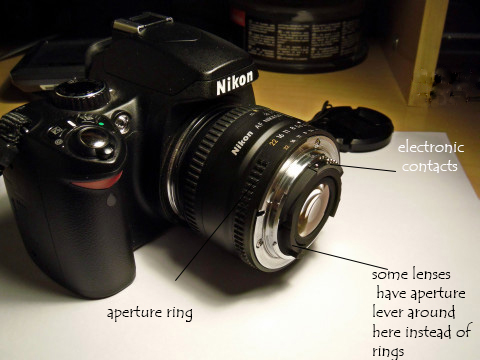
To take reverse lens macro shots, you have to reverse mount your kit lens (as depicted in the picture below).

Reverse lens macro photography 07

HOW DOES REVERSE MACRO TEACHES YOU ABOUT THE ART OF PHOTOGRAPHY?

Everything is a double-headed sword. So is reverse macro, though it allows us to get really close to your subject it also means you have less light at your disposal, a very tight frame, and a very narrow area which is in sharp focus (depth-of-field). Less light means you will have to adjust shutter speed, aperture and ISO to get good exposure and nice depth of field.

But the best part lies ahead, when you reverse mount your lens, the camera loses all the electronic means to communicate with the lens, so you will have to move your camera back and forth to get your focus right and you have to use the small lever on the back (now front) of the lens for controlling the aperture. An interesting point to be noted is that the actual focal length (55mm gets you closest to the subject for 18-55mm lens) of a lens in normal operation is also reversed, meaning that you can get closest to your subject when the lens is at its widest (18mm for the same lens). Now when you look through the viewfinder you will see the magic unfolding right in front of your eyes!

Reverse lens macro photography 06

Reverse lens macro photography 04

Suddenly your viewfinder becomes a visual textbook through which you will see all the subtle changes that aperture, shutter speed and ISO makes on your image and how subtle changes to these can bring amazing clarity and depth to your images. At first this may seem a difficult task because of the extreme stillness needed to take them successfully and clearly, but “practice makes perfect”, doesn’t it?

The interesting part being that you can apply the information you learn, when you use your camera normally. Obviously this can also be learned with time and effort but rest assured many get bored or disheartened because their photos are not looking good before they understand how to use the camera. Reverse macro, as mentioned earlier, magnifies the world beyond what our eye can see. It is because of this magnification that the effect the changes you make to (shutter speed, aperture, ISO) have on our image becomes more apparent than in “normal” use. When doing reverse macro I recommend not using a tripod because that way you will also learn to keep your hands steady (a boon when shooting in dim light).

Reverse lens macro photography 05

So because you get to see the magic of light unfold right in front of your eyes it registers quickly, and with practice becomes rather instinctive. This will startlingly improve the way you approach photography and ultimately your photos.

As Ansel Adams, a master of photography said “A Good photograph is knowing where to stand”. Understand where you stand now (as a photographer) and where you have to be standing to take photographs that exude beauty and share the emotion of the frame with the viewers.

Happy clicking!

The post Reverse Lens Macro: How to use it as a Great Learning Tool by Sharath Prakash appeared first on Digital Photography School.


Digital Photography School

 
Comments Off on Reverse Lens Macro: How to use it as a Great Learning Tool

Posted in Photography


Great Blight North: 7 Abandoned Wonders of Canada

09 Jan

[ By Steph in 7 Wonders Series & Global. ]

Abandoned Canada Main

Canada’s abandoned wonders include greying neoclassical banks in downtown Toronto, forgotten asylums, beautiful Beaux Arts hydro power stations and a ghost town so eerily well-preserved it feels like it’s still 1980. A nation this large in terms of land mass, with wide swaths of nearly unpopulated countryside, is bound to be full of interesting architecture left behind by the steady march of progress, and the Great White North certainly doesn’t disappoint.

Toronto’s Forgotten Neoclassical Banks, Ontario

Abandoned Canada Toronto Bank 2

Abandoned Canada Toronto Bank 1

Abandoned Canada Bank of Toronto 1

A historic landmark in downtown Toronto that has been sadly neglected, the bank at 205 Yonge Street boasts a beautiful neoclassical facade that has darkened to a gloomy gray over the past century. Built in 1905, the Bank of Toronto and adjacent Canadian Bank of Commerce seem starkly out of place in all their aged gothic dilapidation, surrounded by the glittering glass of more modern buildings. Both banks have been empty for some time. The Bank of Commerce has been vacant since 1986, while the Bank of Toronto was occupied by Heritage Toronto until roughly 2001. A jazz and blues venue called the Colonial Tavern once took up the space between them, but has since been demolished, the site turned to a mini-park. Developers recently purchased the property and supposedly intend to restore the Bank of Commerce as part of a hotel project, though the fate of its neighbor is still up in the air, and none of the plans are final. Blog Toronto’s Jonathan Castellino gained access to the interior of the Bank of Toronto in 2009.

Riverview Hospital, Vancouver, British Columbia

Abandoned Canada Riverview Hospital 1

Abandoned Canada Riverview Hospital 2

Abandoned Canada Riverview Hospital 3

Abandoned Canada Riverview Hospital 5

Chances are, you’ve seen this hospital before – many times. It has appeared in dozens of movies and television shows, including The X-Files, Battlestar Galactica, Psych, Caprica, Fringe, Halloween: Resurrection and even the Christmas movie Elf. It didn’t close until 2012, but many of its historic buildings were already abandoned by that time, and its decline has been swift. When the hospital opened in 1913 as ‘The Hospital for the Mind,’ it housed just 350 patients, but that population grew to 4,500 by the 1950s. Like so many other large mental health facilities, Riverview lost patients rapidly during the ’60s and ’70s as the approach to simply put mentally ill people ‘away’ for life came to be seen as inhumane. The interiors, as photographed by Shoes on Wires, are certainly horror-movie-creepy, with holes in the ceilings, furniture and fixtures strewn around, and moss growing all over the place.

Toronto Power Generating System, Ontario

Abandoned Canada Toronto Power Generating Station 1
Abandoned Canada Toronto Power Generating Station 3 Abandoned Canada Toronto Power Generation Station 2

Have you ever seen such a beautiful power station in your life? Built in 1903, this Beaux Arts hydro-electric power station was designed by Toronto architect E.J. Lennox to power the city of Toronto. It’s located on the banks of the Niagara River just upstream from Niagara Falls. It closed in 1974 and was designated a national historic site in 1983. Despite still being filled with industrial equipment, the inside looks like a palace, the rusting remains of turbines contrasting with intricately scrolled marble trim.

An urban explorer at Opacity.us, who took these photographs, writes “The Toronto Power Station looked like a massive stone crypt in the early light, standing majestic and alone beside the raging water… once inside the main generator hall, I started setting up my gear over an unassuming metal grate in the floor. Some debris on the grate fell through the square holes as I slid my backpack closer, perhaps a rock or rusty bolt; I snapped awake when I heard the ting at the bottom of the shaft – it was extremely delayed. Could it really be that deep?”

Canada Malting Plant, Montreal, Quebec

Abandoned Canada Malting Silos Toronto 1

Abandoned Canada Malting Silos Toronto 2

One of the last remaining sets of industrial silos in Toronto sits on the edge of the harbor, offering urban explorers who manage to gain access and ascend to its rooftops a stunning view of the skyline (including the city’s iconic CN Tower.) Built in 1928 to store malt for the Canada Malting Company, the complex includes stark modernist concrete towers housing 15 wooden silos. It was abandoned in 1980s but protected by the city due to its historic and architectural value, and officials have considered adapting it for all sorts of interesting new uses, from a museum to a theme park. Most of the secondary buildings have been demolished, but the silos still stand. The site Abandoned EU took photos of the progression of demolition from 2007 to 2010.

Next Page – Click Below to Read More:
Great Blight North 7 Abandoned Wonders Of Canada

Share on Facebook


[ By Steph in 7 Wonders Series & Global. ]

[ WebUrbanist | Archives | Galleries | Privacy | TOS ]


WebUrbanist

 
Comments Off on Great Blight North: 7 Abandoned Wonders of Canada

Posted in Creativity


All Our Great Photography Deals Available for One More Week

26 Dec

12 deals

Over the last 12 days we’ve presented you with daily deals on some photography training products.

The savings this year were bigger than we’ve ever done before and we’ve had some great feedback from readers thanking us for some great deals.

However…. amidst the many ‘thank you’ messages that we’ve had there have also been quite a few emails and messages from readers who missed a deal that they really wanted.

So, today we’re going to open up all deals featured over the last 12 days to give you one last chance!

Click here to get access to all 12 deals again:

So if there’s a deal you regret missing or you might have missed one of our emails or posts – you’re in luck!

Here are just a few of the most popular deals (in no particular order)

  1. Natural Light eBook, just $ 7 (one of our most popular eBooks ever)
  2. Going Pro eBook – 60% off! (for those of you looking to make money from your photography)
  3. Portraits: Making The Shot $ 7 (released this year)
  4. Living Landscapes $ 7 or an Amazing Outdoor Photography Bundle (our best selling eBook ever)
  5. Save 75% on ‘The Art of Black and White Photography’ course (Udemy’s most popular Photography Course)
  6. Kelby Training $ 40 off an annual subscription (a year’s training for a few cents per day)
  7. $ 10 Day – 10 dPS eBooks, yours for just $ 10 each! (these went like hotcakes yesterday)

… and there are still a whole lot of other deals with your name all over them!

You can browse through all the deals using the little circle numbers at the top of all the deal pages (or clicking the boxes at the bottom of each page).

If you have any trouble at all, or if there’s a deal you can’t find be sure to let us know – we don’t want you missing a deal!

All these will be available until 31st of December, after that they will be gone for good so get to it and grab yours today!.

The post All Our Great Photography Deals Available for One More Week by Darren Rowse appeared first on Digital Photography School.


Digital Photography School

 
Comments Off on All Our Great Photography Deals Available for One More Week

Posted in Photography


Great Ghost Cities: 7 Eerie Abandoned Wonders of China

20 Dec

[ By Steph in 7 Wonders Series & Global. ]

Abandoned China Main

An ancient city made of intricately carved stone sits silent at the bottom of a lake, a replica of Paris complete with an Eiffel Tower is eerily empty, and a city leveled by disaster has been cordoned off indefinitely as a memorial to those who were lost. China might just be home to more ghost cities than any other nation on earth, and most of them are of the modern variety, as the push for economic progress has led developers to get a bit ahead of themselves constructing vast communities, malls and amusement parks that never caught on with the public.

China’s Atlantis: Lost Underwater City

Abandoned China Underwater Lion City 1

Abandoned China Underwater Lion City 2

Roughly one hundred feet below the surface of Thousand Island Lake (Qiandao Lake) is one of the world’s most stunning submerged historical treasures: Lion City. This ancient city was built during the Eastern Han Dynasty (25-200 CE) and measures about 62 football fields. The city, which is complete with incredibly intricate relief sculptures all over the stone walls of its buildings, was intentionally flooded in the 1950s to create a dam. Evidently, authorities felt that attempting to preserve the city wasn’t worth the trouble. But now that it’s underwater, it has become a diving destination, and various tours have popped up allowing visitors to explore it. Some have even proposed building transparent floating tunnels and other new construction that could make it more accessible to everyone.

Paris of the East: Replica Ghost City

Abandoned China Paris Replica 2

Abandoned China Paris Replica 1

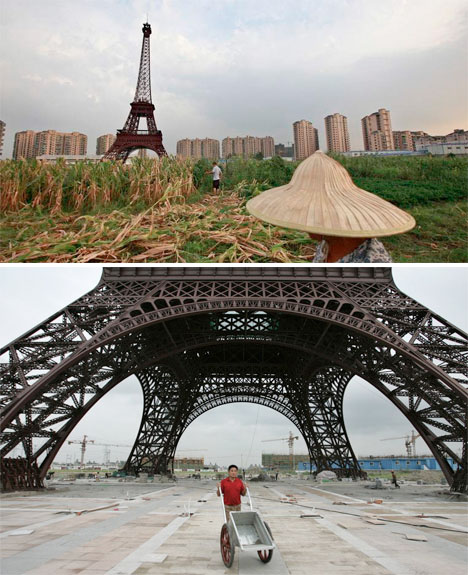
Paris is one of the world’s most vibrant cities, bustling with hundreds of thousands of people. At least, the one in France is. The meticulously built replica city in China – not so much. Tianducheng, in China’s Zhejiang district, was modeled after the real Paris, complete with a 354-foot replica of the Eiffel Tower as well as other landmarks. Intended to be a luxurious gated community that could house 100,000 and draw rural families into a centralized urban location, the city has been a ghost town since its construction in 2007. Only about 2,000 people moved there, and that small number seems to be dwindling by the day. But work is still in progress, and officials are hoping to get more people there before the whole complex is totally complete in 2015.

Ordos: A Modern Ghost Town

Abandoned China Ordos 1

Abandoned China Ordos 2

It seems as if the entire population of a large city simply vanished into thin air. In reality, they were never here in the first place. The Kangbashi New Area of Ordos is a planned community for one million people, envisioned as the Dubai of Northern China – but only about 20,000 people live there, and you’d never even guess there are that many residents based on the eerie photos of deserted streets and empty skyscrapers. It’s close to abundant natural resources and has plenty of public infrastructure, and economic woes aren’t actually a problem. The government just can’t seem to convince people to move here. Some of the architecture, like the Ordos Art Museum, is really quite stunning, and it’s strange to see it accumulating dust as it waits for visitors that might never come. City officials are still hoping that many of the 1.5 million residents of the old section of Ordos, located 15 miles away, will decide to make the move.

Beichuan: Left Behind After a Disaster

Abandoned China Beichuan Disaster City 2

Abandoned China Beichuan Disaster City 1

Imagine an entire city leveled by an earthquake, roped off and left to rot as a sad and rather dangerous tribute to all that was lost. It happened in Christchurch, New Zealand (sort of – they do plan to rebuild, and the process has already begun) and it happened in Beichuan, China. A deadly earthquake killed thousands of residents and displaced tens of thousands more, and the damage is so extensive that reconstructing it would require leveling almost all of the remaining buildings. So, it’s now basically a memorial park that you shouldn’t enter unless you’re keen to get trapped in the rubble and join the other victims.

Next Page – Click Below to Read More:
Ghost Cities Of China 7 Eerie Abandoned Wonders

Share on Facebook


[ By Steph in 7 Wonders Series & Global. ]

[ WebUrbanist | Archives | Galleries | Privacy | TOS ]


WebUrbanist

 
Comments Off on Great Ghost Cities: 7 Eerie Abandoned Wonders of China

Posted in Creativity


Great Ghost Cities of China: 7 Eerie Abandoned Wonders

19 Dec

[ By Steph in 7 Wonders Series & Global. ]

Abandoned China Main

An ancient city made of intricately carved stone sits silent at the bottom of a lake, a replica of Paris complete with an Eiffel Tower is eerily empty, and a city leveled by disaster has been cordoned off indefinitely as a memorial to those who were lost. China might just be home to more ghost cities than any other nation on earth, and most of them are of the modern variety, as the push for economic progress has led developers to get a bit ahead of themselves constructing vast communities, malls and amusement parks that never caught on with the public.

China’s Atlantis: Lost Underwater City

Abandoned China Underwater Lion City 1

Abandoned China Underwater Lion City 2

Roughly one hundred feet below the surface of Thousand Island Lake (Qiandao Lake) is one of the world’s most stunning submerged historical treasures: Lion City. This ancient city was built during the Eastern Han Dynasty (25-200 CE) and measures about 62 football fields. The city, which is complete with incredibly intricate relief sculptures all over the stone walls of its buildings, was intentionally flooded in the 1950s to create a dam. Evidently, authorities felt that attempting to preserve the city wasn’t worth the trouble. But now that it’s underwater, it has become a diving destination, and various tours have popped up allowing visitors to explore it. Some have even proposed building transparent floating tunnels and other new construction that could make it more accessible to everyone.

Paris of the East: Replica Ghost City

Abandoned China Paris Replica 2

Abandoned China Paris Replica 1

Paris is one of the world’s most vibrant cities, bustling with hundreds of thousands of people. At least, the one in France is. The meticulously built replica city in China – not so much. Tianducheng, in China’s Zhejiang district, was modeled after the real Paris, complete with a 354-foot replica of the Eiffel Tower as well as other landmarks. Intended to be a luxurious gated community that could house 100,000 and draw rural families into a centralized urban location, the city has been a ghost town since its construction in 2007. Only about 2,000 people moved there, and that small number seems to be dwindling by the day. But work is still in progress, and officials are hoping to get more people there before the whole complex is totally complete in 2015.

Ordos: A Modern Ghost Town

Abandoned China Ordos 1

Abandoned China Ordos 2

It seems as if the entire population of a large city simply vanished into thin air. In reality, they were never here in the first place. The Kangbashi New Area of Ordos is a planned community for one million people, envisioned as the Dubai of Northern China – but only about 20,000 people live there, and you’d never even guess there are that many residents based on the eerie photos of deserted streets and empty skyscrapers. It’s close to abundant natural resources and has plenty of public infrastructure, and economic woes aren’t actually a problem. The government just can’t seem to convince people to move here. Some of the architecture, like the Ordos Art Museum, is really quite stunning, and it’s strange to see it accumulating dust as it waits for visitors that might never come. City officials are still hoping that many of the 1.5 million residents of the old section of Ordos, located 15 miles away, will decide to make the move.

Beichuan: Left Behind After a Disaster

Abandoned China Beichuan Disaster City 2

Abandoned China Beichuan Disaster City 1

Imagine an entire city leveled by an earthquake, roped off and left to rot as a sad and rather dangerous tribute to all that was lost. It happened in Christchurch, New Zealand (sort of – they do plan to rebuild, and the process has already begun) and it happened in Beichuan, China. A deadly earthquake killed thousands of residents and displaced tens of thousands more, and the damage is so extensive that reconstructing it would require leveling almost all of the remaining buildings. So, it’s now basically a memorial park that you shouldn’t enter unless you’re keen to get trapped in the rubble and join the other victims.

Next Page – Click Below to Read More:
Ghost Cities Of China 7 Eerie Abandoned Wonders

Share on Facebook


[ By Steph in 7 Wonders Series & Global. ]

[ WebUrbanist | Archives | Galleries | Privacy | TOS ]


WebUrbanist

 
Comments Off on Great Ghost Cities of China: 7 Eerie Abandoned Wonders

Posted in Creativity


Want a Great Gift for a Photographer This Holiday Season? Get Them a Scottevest

29 Nov

Brother and Sister Bonding Time
Brother and Sister Bonding Time, by April Joy Gutel.

On Wednesday I spent the afternoon shooting the Oakland Museum of California with my sister April Joy Gutel (her photo of me above, thanks April). I always love shooting in museums and find myself inspired by the art even as I create new art in that sort of a space.

A lot of museums don’t allow photography, but the ones that do almost always disallow backpacks. Because I shoot mostly prime lenses, I need a lot of different lenses wherever I go.

On Wednesday I tried shooting in a museum in my new Scottevest for the first time. It worked great. I was able to pack an iPhone 5s, 4 different lenses (my 8-15 fisheye, 14mm, 24mm, 135mm), an extra battery and two CF cards easily into the vest. This was in addition to the Canon Mark 3 and 50mm lens on my camera. While I definitely felt the weight as I shot (those lenses are heavy), it felt much better than wearing a backpack. The lenses were also much more accessible to me as I didn’t have to take a backpack off to get to them. I simply unzipped the pocket and pulled out what I needed.

Even with this much gear, I still had lots of room to pack more stuff into the vest if I needed it.

The vest has sleeves that come on or off, in case you want to wear it as a jacket. It was very light weight and very comfortable to wear. It’s a great thing to have around for those times when you want more than just your camera, but don’t want to (or can’t) take your whole backpack set up with you.

You can check out photos I’ve taken at the Oakland Museum of California here.


Thomas Hawk Digital Connection

 
Comments Off on Want a Great Gift for a Photographer This Holiday Season? Get Them a Scottevest

Posted in Photography


How to Create Great Environmental Portraits

27 Oct

Interested in learning how to take better Environmental Portraits? If so, do yourself a favour and watch this video of a training session by photographer David Handschuh and what he has learned about the topic from the last 20 years of his doing environmental portraits.

Thanks to the team at BHPhoto for putting this video out there.

Further Reading on Environmental Portraits:

  • How to Create Portraits that Captivate and Intrigue
  • An Introduction to Environmental Portraits

Post originally from: Digital Photography Tips.

Check out our more Photography Tips at Photography Tips for Beginners, Portrait Photography Tips and Wedding Photography Tips.

How to Create Great Environmental Portraits

The post How to Create Great Environmental Portraits by Darren Rowse appeared first on Digital Photography School.

Digital Photography School

 
Comments Off on How to Create Great Environmental Portraits

Posted in Photography


Anticipating Great Images

24 Oct

A contribution by Dan Bailey – author of the eBook Zen Photographer (currently 13% off at SnapnDeals here).

What if you could predict the future? Wouldn’t that make you a much better photographer?

Think about it: Photography is largely about capturing the moment. Not just any moment, though. We’re talking that singular instant when light, expression, movement and environment all converge in one significant fraction of a second. That’s when the dirt’s flying, the action’s peaking and that ray of golden sunlight is turning your subject into a hero. If you knew exactly when that moment of truth was going to happen, you’d be a true camera master.

S308665

Of course, most of us don’t have psychic abilities, but we do possess a minor form of clairvoyance that allows us to see into the future. It’s called anticipation.

In photography, looking into the future involves imagining with high probability how the scene will play out in a time that’s later than “right now.” It’s seeing a convergence of light, moment and subject in your mind that might happen, and then working backwards to make it happen.

Most great images some form of of anticipation, whether it’s noticing how the light will hit your subject in a few minutes, paying attention to how your subject and background will look when lined up as a two-dimensional image, or recognizing when and where the height of action of expression might occur.

AK BIK DNL 00340

You may not be able to predict exactly how the future will play out, but by gauging the scene and all of the elements in your immediate surroundings, you can get a pretty good idea of what’s likely to happen, and in the world of image making, that’s as good as gold.

Once you have that information, you can then put yourself in the optimum location, direct your subjects as needed, and set your gear accordingly in order to nail the shot that you now have in your mind. This is active image making, and it’s almost always more effective than trying to grab a shot that’s already started to unfold.

Let’s say you’re shooting a trail runner. With one eye, you watch the runner follow a certain path through the landscape. With the other, you’re, you’re looking for something that might make for a compelling background, all the while, checking the position of the sun.

TRN AK 2372

When you see a potential convergence, you move to the ideal vantage point that will let you capture the scene in the most powerful way, figure out the technical details, such as lens choice, exposure mode, EV compensation, and then wait for the right moment. When the runner reaches the right spot, you press the shutter and nail the shot.

You didn’t just stand there and snap away, hoping for something good, though. That would be passive. You got the shot because you used your imagination and anticipated a potentially great image before it actually came together. You took an active part in the image making process. You looked. You imagined. You reacted, and maybe even sprinted with your backpack full of camera gear over rough terrain so that you could get to the right vantage point. Active image making.

I call this thinking and acting geometrically, and it’s a process that’s hard wired into our brains. We use these skills whenever we get behind the wheel of a car, or when navigating a stressful situation. In traffic, they keep you alive. In photography, they keep you tuned into all the elements of your scene.

So the next time you’re out shooting, look into the future. Imagine a great image, anticipate how your scene might play out, and then work geometrically and bring the shot to life.

For more creative insight like this, be sure and check out my brand new ebook, ZEN PHOTOGRAPHER: Turning Your Passion into Focus (13% off for the next few days at SnapnDeals).

Dan Bailey is a full time professional outdoor, adventure and travel photographer based in Alaska. When he’s not off exploring in the mountains, writing about photography, or flying his little yellow bush plane, he can sometimes be found lurking in the forums right here at DPS. Check out his blog and find him on Facebook and Google+.

Post originally from: Digital Photography Tips.

Check out our more Photography Tips at Photography Tips for Beginners, Portrait Photography Tips and Wedding Photography Tips.

Anticipating Great Images

The post Anticipating Great Images by Guest Contributor appeared first on Digital Photography School.

Digital Photography School

 
Comments Off on Anticipating Great Images

Posted in Photography