Mikey Schaefer is no stranger to the great outdoors. As a professional photographer who specializes in shooting in some of the most extreme environments on earth, he tests his body – and his gear – to the limits. In this field test we’re following Mikey on a sports lifestyle / editorial shoot with Canon’s EOS 5DS and 5DSR, near his home town in Oregon. Read more
Tag: Great
-
What Michelangelo and Other Great Artists Said About Photography
The words of the wise men can be a great source of motivation in the moments of creative or any other kind of personal crisis. While you probably got used to seeing quotes by renowned photographers in your Twitter or Facebook feed, have you ever wondered what great artists, such as Michelangelo, Salvador Dali, or Claude Monet could say about Continue Reading
The post What Michelangelo and Other Great Artists Said About Photography appeared first on Photodoto.
-
8 Tips to Help You Come Home with Great Travel Photos
In this article I will talk about travel photography and how you can take great images of everything when you travel. I’m not talking about camping out at sunrise with bags full of lenses and filters to take epic landscape photographs; I’m talking about taking really nice shots of EVERYTHING! The food, people, details and landscapes combined – and all without turning your holiday into a photo shoot. With some simple tips you can come home with an album full of memories that stretches beyond a few hero shots.
Editor’s Note: The following article is written to be a fun guide to different types of documentary style travel photography. The author was exploring Vietnam as a guest of Helloworld Australia and Insider Journeys. She considers herself a jack-of-all-trades, master of none in the photography world.
8 Tips for great travel photos
#1 Landscape photography

As much as I love waking up for a sunrise and utilizing all of the photography tools available to me to get a killer shot, sometimes I just want to take some snaps and have them be nice. When shooting landscapes during the day I look for vibrant colors, leading lines and simple compositions.
If you want to come home with a handful of nice landscape images from your holiday but you don’t want to spend all your time out in the field at the break of dawn then look for simple compositions, vibrant colors and leading lines. Using the most basic techniques like the Rule of Thirds (imagine your photo broken down into thirds both horizontally and vertically, and place points of interest on these third lines, for example the horizon) and the light that is available to you, it’s possible to come back with some keepers. Good examples can include the narrow laneways of old Dubai, the canals of Venice, the rivers of Alberta and the irrigation lines of the rice fields of Vietnam.
#2 Photographing the locals
I’m sure that you love to meet the locals from whichever exotic location you’re visiting, but find it can be intimidating to ask for a photo. The trick to photographing locals is to have your camera absolutely ready to go before you even ask. I’m talking the right lens, the right light, and the right settings. Photographing strangers often means you don’t have the benefit of multiple shots to get it just right. A great focal length for photographing people is 85mm, it’s very flattering and it also means you don’t have to be in people’s faces when you shoot. Shooting in the morning or late afternoon means you’ll have soft, consistent light, on your subjects’ faces, and f/2.8 is a great aperture for shallow depth of field. For handheld shooting keep your shutter speed above 1/200th to minimize camera shake.
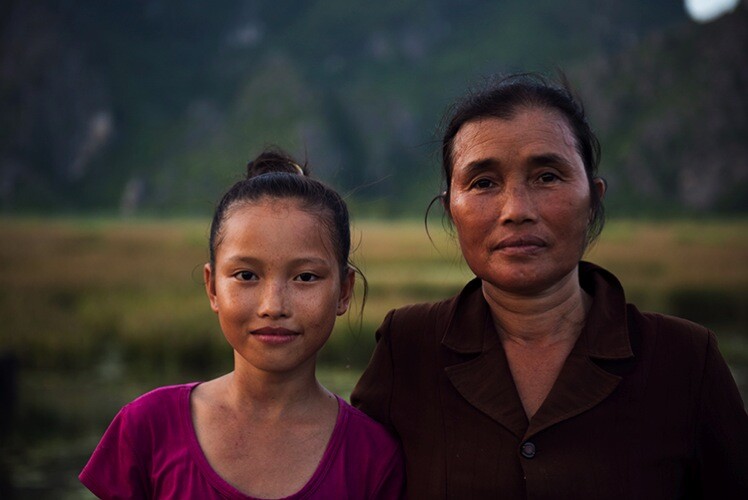
I desperately wanted to take a photo of a mother and daughter I had just watched rounding up their water buffalo in Ninh Binh, but I knew the chances of them speaking English were slim. I didn’t have my portrait lens with me so I made do with my 24-70 f/2.8 at 70mm, and I had it ready to go for the ambient light before I even asked. I snapped off three quick bursts and nabbed a keeper.
#3 Shoot the details
If you ever find yourself quietly admiring the small details of a new destination, then you might like to play around with isolating and photographing them. A great place to try your hand at detail shots is the local market. Using a shallow depth of field (f/2.8 – f/5.6) you can play around with photographing all manner of small details; the textures of a new fruit, a close-up of a flower, or even a line of colorful fabrics. Some photographers consider these filler shots but you might find they bring back wonderful detailed memories after time has passed.
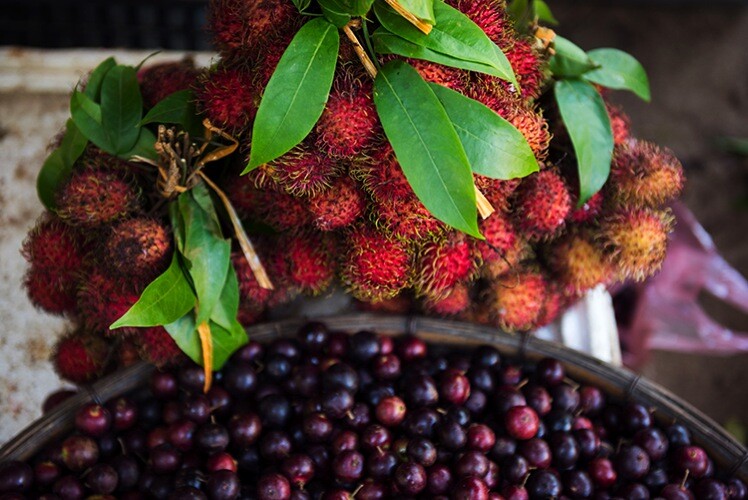
I personally love the small details of a new destination and often take my most favorite shots at bustling markets, or in the garden of a palace, instead of the palace itself. I always look for bright colors and new textures, then isolate what I love from a cluttered background by either zooming in or using shallow depth of field.
#4 Use juxtaposition
In a new destination you can’t help but notice that often things aren’t the same as they are at home, and sometimes a fun way of photographing that is through juxtaposition. This is when two very different things are shot close together of contrasting effect, for example ice cream with a steak, or a beautiful field of wildflowers with an urban factory in the middle. New locations can offer unlimited potential for photographing two things with juxtaposition together, that you might not see at home. Think new versus old, natural versus artificial, nature versus industry, etc.
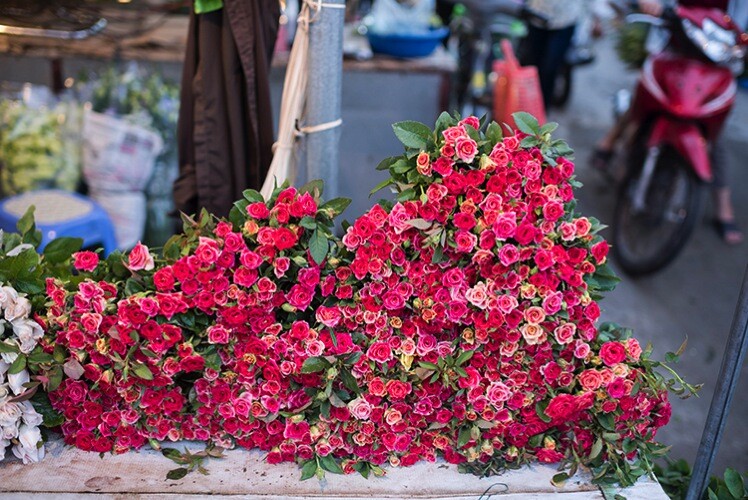
During an incredible morning exploring the Hanoi flower markets I enjoyed photographing the juxtaposition of the flowers besides the scooters, rubbish and chaos of Hanoi.
#5 Photograph animals
You might be fortunate on your travels to make some furry friends. This is often the case in South East Asia where cats and dogs roam the streets freely, and the smart ones know how to get a scrap of food or a cuddle. Photographing animals can be tricky at the best of times, let alone photographing animals that you don’t know very well. The first thing to remember if you want to increase your chances of getting a clean shot is to have a fast shutter speed, 1/1000th is ideal. Animals also benefit exceptionally well from having a sharp focus on their eyes, so a single focus point trained on the eye closest to you will work wonders. Other than that it’s really a matter of a little patience to capture a personality trait, or cute moment.

I don’t consider this photo a triumph of photography, by any stretch of the imagination, but I thought this puppy was adorable. I was able to quickly shoot a sharp image of him looking goofy, with a fast shutter speed and shallow depth of field.
#6 Photograph your resort or accommodation
If you want to take a great photo of your resort to show off to friends and family you might quickly notice that resorts are usually quite populated. Rather than waiting for scores of people to move out of your way it’s possible to make them a part of your image without being the focus of your image and you can do this by using a distracting foreground. Rather than straight out taking a photo of the pool, garden, or communal area of your accommodation, scout around for a nice foreground such as a garden bed, a great path, grass or flowers or even a reflective puddle.
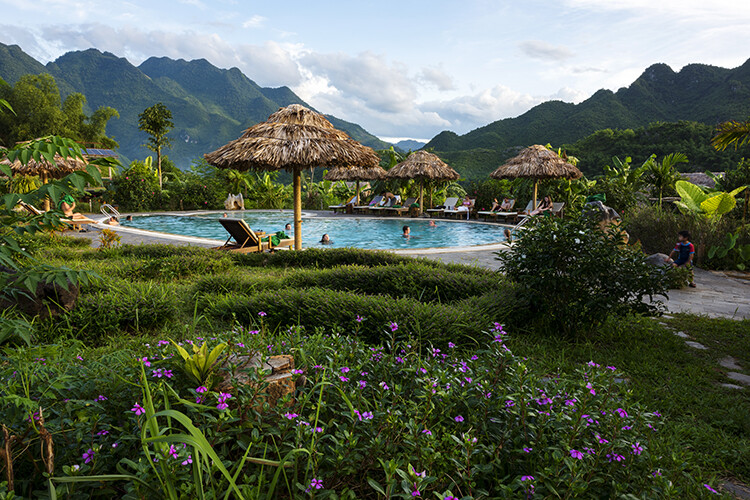
In Mai Chau I stayed at the stunning Eco lodge in Mai Chau valley, and I desperately wanted to photograph the pool, but hordes of swimmers weren’t going anywhere. After playing around with various compositions I realized that the flowers planted around the pool made a distracting foreground when I focused on them, but used a fairly wide depth of field using f/11.
#7 Food photography
If you are a foodie, and let’s face it aren’t we all these days, then you’re going to want to take photos of some of the delicacies that await you when you travel. Food photography can be very hard, or very easy, depending on what you are trying to achieve – but for holiday snaps you should K.I.S.S. (keep it simple silly).
The hottest food photography trend to hit the market these days is the flat lay, or simply photographing food from above. You can do this with a simple snapshot, or take a few minutes to improve your shot. Firstly a single focus point trained on a plate of food nearest to the middle is best. Unless you want to stand on a chair and lean precariously over the table the best way to get this shot is by holding your camera above the table facing straight down. A reasonable depth of field like f/5.6 will mean you’ll still get enough food in focus, even if you slightly miss your planned focus point. Taking a few minutes to arrange the food and utensils on the table can also pay off in the final shot.

I am a massive fan of the flat lay. I think it looks great in most instances, plus it has the added bonus of showing everything you’re eating and drinking in a single frame. In Vietnam we made a roadside stop and I enjoyed boiled eggs, sticky rice in a bamboo pipe, purple corn on the cob and fiery hot bird’s eye chilies. I loved all the broken eggshells on the dirt floor and worked them into my composition with a wider vantage point.
#8 Photograph your travel companions
I’ve saved the best for last, photographing your family, friends, or loved ones. I’m sure you love the simple gift of taking a nice photograph of your travel companion(s) in an exotic location, without making a major production out of it.
The best way to do this is by beating the crowds, just that. Wake up early and have the pool, beach, or street to yourself, and get the shot you want without the distraction of hordes of people. Take a minute to think about composition so that your subject is well framed by the location; use local props if you want to be a real tourist. Then it’s a matter of referring back to basic portraiture rules like flattering focal lengths and good light, a given if you make the effort to wake up early.
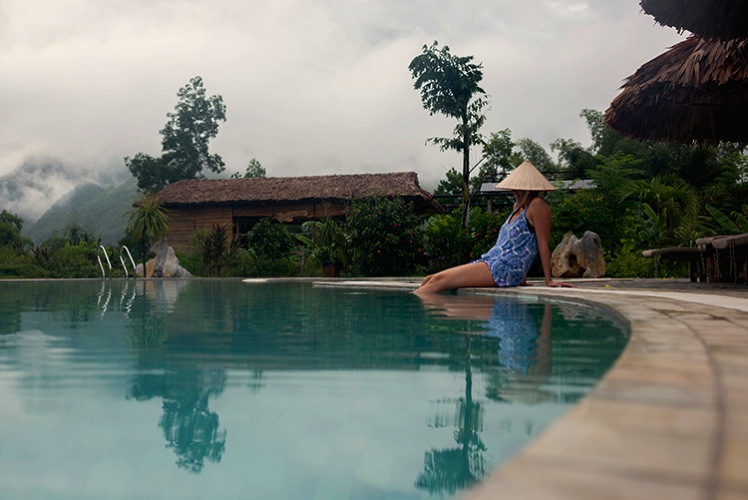
In Mai Chau I wanted a nice shot of my travel companion, Simone, and I wanted the scene to be noticeably Vietnamese. We borrowed a hat from the resort, and set an early alarm hoping for mist in the valley. We weren’t disappointed.
So there you have it: How to take great photos of just about anything while you’re traveling, without destroying your holiday to do it. Always keep a camera close at hand, and enjoy showing off the many aspects of a new destination through your own unique photography: people, landscapes, food, animals, details and all the special moments that pass you by.
googletag.cmd.push(function() {
tablet_slots.push( googletag.defineSlot( “/1005424/_dPSv4_tab-all-article-bottom_(300×250)”, [300, 250], “pb-ad-78623” ).addService( googletag.pubads() ) ); } );googletag.cmd.push(function() {
mobile_slots.push( googletag.defineSlot( “/1005424/_dPSv4_mob-all-article-bottom_(300×250)”, [300, 250], “pb-ad-78158” ).addService( googletag.pubads() ) ); } );The post 8 Tips to Help You Come Home with Great Travel Photos by Lauren Bath appeared first on Digital Photography School.
-
5 Tips to Take Your Landscape Photography from Good to Great
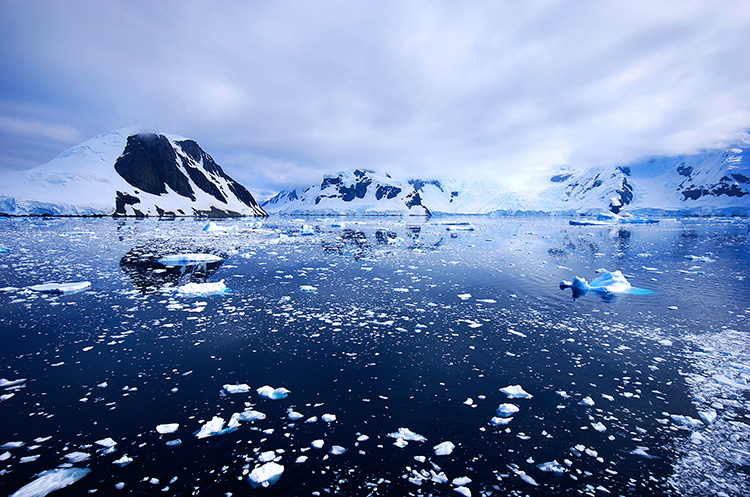
The beauty of the scenery in Antarctica
Landscape photography is one of the most favoured genres of photography. It also happens to be the one genre that is not easy to master. The reason is simple, to become really good at landscape photography, you need to spend hours trying to master it. Most photographers are not able to dedicate that amount of time, so it becomes frustrating. Many photographers end up being disappointed with their images, but there are few things that you can do to make sure you get better results, in a short space of time.
1. Foreground interest
This is a common tip, but one that makes a lot of sense. Having a subject in the foreground, anchors the image. It tells the viewer where to look first and once they have looked at that, their eye will explore the rest of the image.
You can place your foreground subject anywhere in the lower third of your image, but it might be a good idea to put it more to the left side of the frame. This is not a rule (I really don’t believe there are any rules in photography), but rather a suggestion. We read text from left to right, so if your foreground interest is on the left hand side, it makes it feel easy for the viewer to interact with the image. The foreground interest could be anything, a piece of driftwood, a rock, a tree, anything that works for the scene.

Foreground interest anchors a scene
2. Color in your scene
Your image will have inherent color based on the time of day and subject you are shooting. If you are shooting a forest, your scene might be predominantly green, if you are doing a seascape, there may be lots of blue because of the colour of the water.
Be aware of the colour in your scene and work with the opposite colors on the visual colour wheel. As an example, there are three primary colors that your camera sees, they are: Red, Green and Blue. The additive colors (opposite colors) are Cyan, Magenta and Yellow. To be clear, Cyan is the opposite color to Red, Magenta is the opposite to Green and Yellow is the opposite to blue. These opposing colors can work well in a scene, particularly yellow and blue.
Look at the colors in your scene and decide what you want to emphasize. To make sure you have great colours to work with, you will want to shoot during the golden hours and emphasize the warm colors.
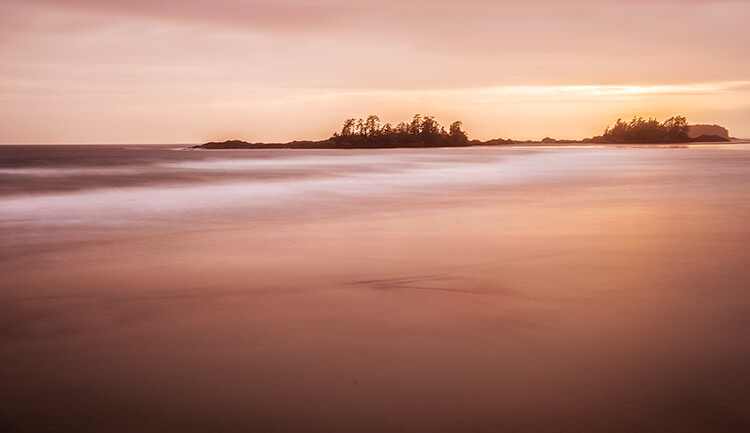
Rich colors will enhance the drama in your image
3. White Balance
When you are shooting landscapes, you will want to be shooting at golden hour, or the blue hour. These are the times of day when the light works really well for dramatic landscape shots. In the golden hours, the light will be warm tones of yellow, orange, or red. Check your white balance setting when you are shooting at this time. If your camera is set to Auto White Balance, it will cancel out much of the warm tones in your image as it tries to neutralize any color casts you may have in your scene.
If the golden hour light is really strong in your scene, Auto White Balance will make the scene look really bland and colorless. Try and shoot on Daylight White Balance instead. That way, the camera will be capturing the light as it truly is in the scene. You could even turn your white balance to cloudy or shade to enhance the warm tones even more. Use this settings as a creative tool, it can really make a good impact on your image.
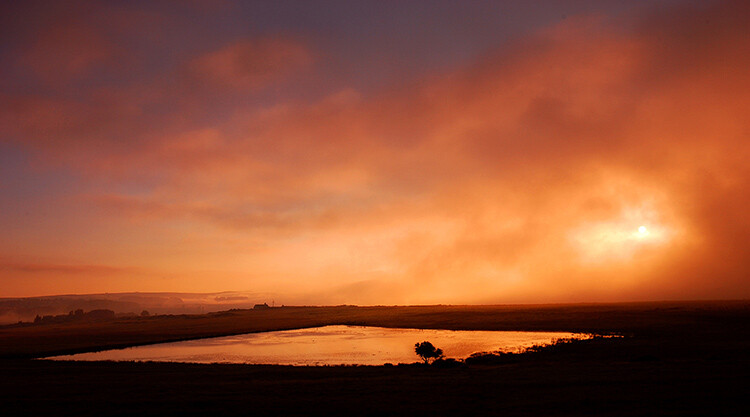
Use white balance creatively, this image was shot using the Shade preset.
4. Movement
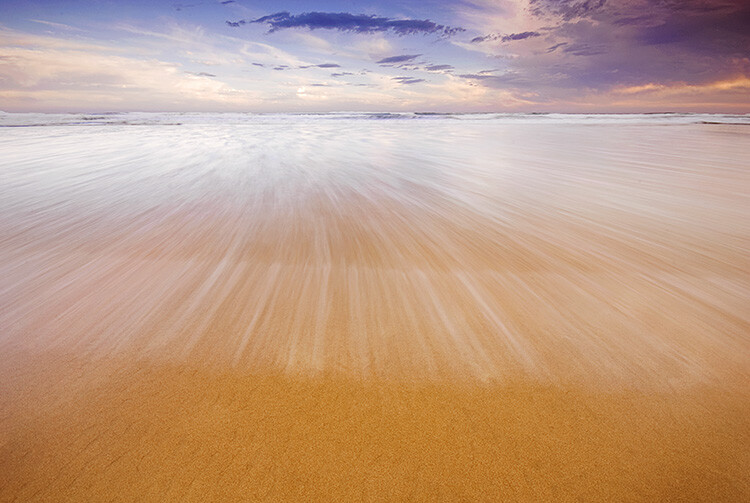
Some of the best landscape images have some form of movement in them. The movement can be caused by water, wind, or both. Subjects that work well with movement are rivers, waterfalls, seascapes and even stars. A long exposure image of the sea with water looking all silky and wispy is ethereal, and adds drama to the image. We don’t see this smooth silky water naturally with our eyes, it is only possible with the camera. The results are often very appealing, and it gives a serenity to the scene that is almost magical. You will need a tripod to get this right, you will also need to use a longer exposure of a few seconds. Timing is also important, particularly with seascapes. You may have to time the shot for when the water comes rushing over the rocks, or up the beach. That way, the image will be filled with silky streaks of water and it will look amazing.

5. Less is more
Landscape images become more dramatic if there is a very clear subject in them. If you are unsure about what should be included in your scene, ask yourself this question as you look around the scene, “Does that rock, tree, river, etc., add to the scene or not?” If you think it is not adding to your scene, remove it. Even if you are unsure, remove it and take a shot to see how the image looks. In many images, less is more. If you have less items in your scene, there is less to distract the eye, there is less that can make the scene confusing, so give it a try. Set up a shot, take a photo and then start minimizing the distracting elements.
Try these five tips and share your results in the comments below. Do you have any other tips to add?
googletag.cmd.push(function() {
tablet_slots.push( googletag.defineSlot( “/1005424/_dPSv4_tab-all-article-bottom_(300×250)”, [300, 250], “pb-ad-78623” ).addService( googletag.pubads() ) ); } );googletag.cmd.push(function() {
mobile_slots.push( googletag.defineSlot( “/1005424/_dPSv4_mob-all-article-bottom_(300×250)”, [300, 250], “pb-ad-78158” ).addService( googletag.pubads() ) ); } );The post 5 Tips to Take Your Landscape Photography from Good to Great by Barry J Brady appeared first on Digital Photography School.
-
Reading List: 7 Great Photography Books for Beginners
We like to think of ourselves here at Photodoto as a resource that beginning photographers can utilize to help them improve their photography and find new, interesting sources of inspiration. We even have our handy-dandy 7-day email course, which you can receive for free by entering your email in the box just to the right of this paragraph. But sometimes, Continue Reading
The post Reading List: 7 Great Photography Books for Beginners appeared first on Photodoto.
-
Early Morning Light: What’s so Great about It?
Let’s face it, getting up super early in the moring is horrid, any way you look at it. I hate it, the clients hate it, my assistants really hate it, and yet, more often than not, here I am, setting my alarm at 3 in the morning. Why? It’s the Light. Morning light is so gentle and beautiful. It just Continue Reading
The post Early Morning Light: What’s so Great about It? appeared first on Photodoto.
-
The Secret to Great Photography Portfolio
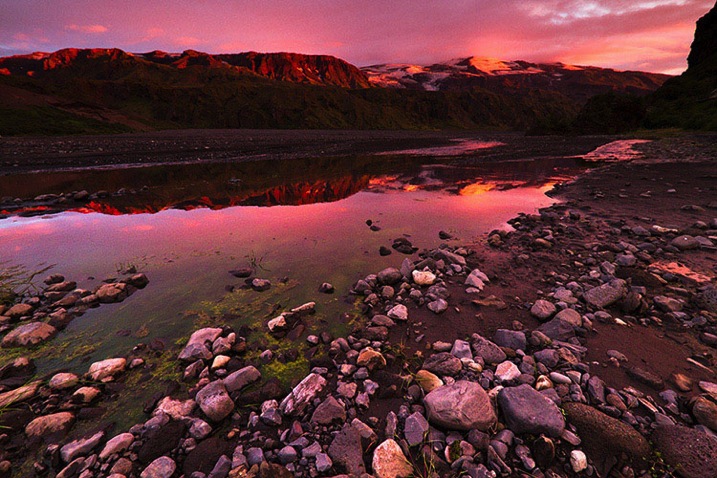
If you’ve been around the photography world for a short time, you probably have at least a basic grasp of the technical skills. You know how to manipulate depth of field with aperture, where to focus in a portrait, and how to compensate your exposure for extremes in shadows and highlights. Even knowing things like that, you’ve probably stumbled across some incredible portfolios or magazine spreads and asked, “How did they do that?” Or even “What’s their secret?”
The secret to a great photography portfolio is simple. It isn’t even a secret at all, although it’s not often talked about in photography communities. Simply put, the secret is:
Master the technical skills until they’re automatic, then go out and endlessly make photographs, a lot of photographs. Only a handful should ever be shown to anyone.
Photography is easy; at least the technical side. Yes, that’s a quite a contentious statement, but I’m not the one who said it. It was David Bailey being interviewed by Rankin and answering the question, “What makes a good photographer?” His answer was:
“You can learn to take pictures in three months. You can learn to draw in three months, but only technically. It’s where you go from there.”
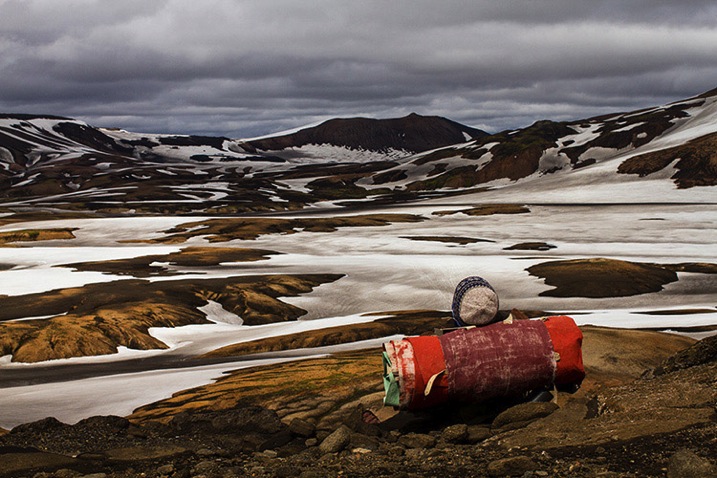
The critical point is that it’s not the technical skills that make good photography. They’re vital ingredients but it’s how they’re put together with your subject to create an end result that is most important.
Think of it like cake. If you’re digging in to a piece of cake and you actually notice any of the individual elements of eggs, flour, butter or sugar, something’s gone horribly wrong in the baking process.
What comes after the technical skills?
There are two elements to consider when thinking about what to do next:
- First, creating a lot of images and showing only a few.
- Secondly, giving your subject comprehensive coverage.
Create many, show few
In an article, that I read a few years back, a National Geographic photographer said that they use to go through 1500 rolls of film to create a single set of 10 to 20 images for an article.
To translate that, assuming they used 120 film in a 6×9 medium format camera; that yields eight frames per roll of film. That’s 12,000 photographs. Also assume that those photographers would have bracketed one or two stops on either side. (Bracketing is the practice of taking a normally exposed photograph, then taking two more – generally one overexposed, one underexposed. This was useful in the days of transparency film which offered very little in terms of exposure latitude.) That brings the number to 4000. Finally, say 50% of those weren’t good enough to show the editor.
That leaves 2000 photographs that most people would probably be more than happy to have taken. The final spread used about a dozen of the very, very best or 0.6% of all of the images taken.
To apply this concept to your own portfolio, you have to learn how to be ruthless. If it isn’t your very best, scrap it. It can be hard work, especially considering the emotional connections we, as photographers, have with our work, but if you can learn to turn that off then your portfolio will be better for it.
Comprehensive coverage
Back to dissecting National Geographic, my favourite article is one that covers the glamorous topic of caffeine. This one is a large spread and is made up of 23 photos.
Breaking it down: nine images are environmental portraits, six are classical reportage, six are still-lifes, and two are landscapes.
The set of photos also covers five countries and five US cities; all within 23 photos.
To cover every possible aspect associated with caffeine, the photographer for that piece documented several facets of the human element of the topic, from production workers, to scientists in labs, as well as the consumers. The landscape images in the article showed the environmental impact of caffeine.
Hopefully you’re starting to see what comprehensive means in this context. Of course, very few people have the kind of resources to approach a subject so thoroughly, but if you take the extra time to consider and follow through on other possible aspects of your subject matter, you may be surprised with the results.
Icing on the cake
To return to the cake metaphor: when you’re at a bakery, you only see the shop floor, with the well presented finished products. You don’t see the chefs slogging through hours of batter and hot ovens. You don’t see the logistics of bringing chefs and ingredients together in the right place. You just see cake.
Hopefully, you now have a little more insight on what may have gone on behind the scenes, albeit a simplified interpretation, when you look at a photo that you admire, and what steps you can take to push yourself in that direction.
Just remember: get the technical skills mastered and out of the way, then go wild.
googletag.cmd.push(function() {
tablet_slots.push( googletag.defineSlot( “/1005424/_dPSv4_tab-all-article-bottom_(300×250)”, [300, 250], “pb-ad-78623” ).addService( googletag.pubads() ) ); } );googletag.cmd.push(function() {
mobile_slots.push( googletag.defineSlot( “/1005424/_dPSv4_mob-all-article-bottom_(300×250)”, [300, 250], “pb-ad-78158” ).addService( googletag.pubads() ) ); } );The post The Secret to Great Photography Portfolio by John McIntire appeared first on Digital Photography School.
-
13 Great Subjects for Urban Night Photography
The great thing about night photography is that subjects that appear commonplace during the day take on a new, interesting appearance at night. Urban scenes are lit (or not lit) at night in fundamentally different ways that our eyes are not used to. The long exposure times required in night photography allow you to use different techniques to capture the scenes in creative and often dramatic ways. Plus you aren’t beholden to the sun’s rays and the changing daytime light.
Nevertheless, you may struggle with finding good subjects when you do have opportunities to get out and shoot at night. Further, you may not know what subjects lend themselves to great photographs at night, or overlook great scenes and subjects in your own city. Therefore, this article is designed to help you pick out some good subjects that might be right around the corner.
Obviously, the point here is not to limit your subject matter, but rather to show you things that might be nearby next time you are stumped for ideas. I hope you’ll use these subjects as starting points for your own thinking, and the go well beyond the ideas presented here.
1. Reflections

St. Paul’s Cathedral, London (Shutter speed: 1.3 seconds; Aperture f/8; ISO: 200).
Most cities have plenty of modern office buildings made of glass and steel. These are often not particularly photogenic subjects in themselves, but the glass and steel provide great opportunities for capturing reflections of anything nearby. At night, the glass can appear particularly reflective. The bright lights of the city at night will show up clearly in the glass of nearby buildings. The next time you are downtown, keep an eye out for reflections in those glass buildings.
Of course, water presents a great opportunity for capturing reflections as well. A very slow shutter speed will remove any ripples from the water and make the reflection show up more clearly. Using a slow shutter speed will not usually be a problem at night because your camera will be struggling to capture more light to achieve a proper exposure, but if it is just add a mild neutral density filter to your lens.
Keep in mind that the water with the reflection doesn’t have to be a lake or a river (although those often work great); sometimes just a puddle will do.
2. Streaking Lights
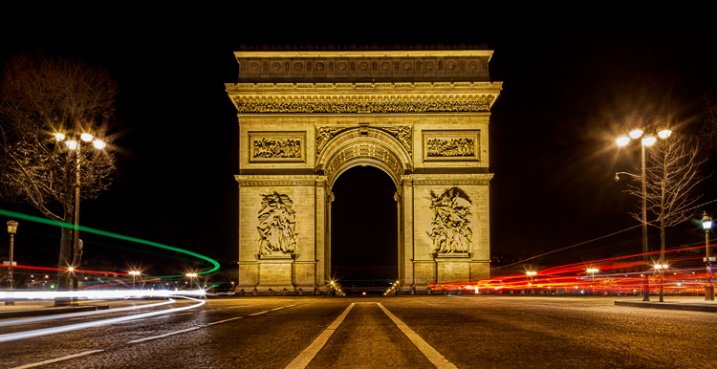
Arc de Triomphe, Paris (Shutter speed: 30 seconds; Aperture f/22; ISO: 50).
Streaking headlights and taillights from passing vehicles are a great way to deal with the problem of traffic in your picture, and as a bonus, it adds a sense of movement to your scene.
To include streaking lights, start by using a slow shutter speed. You will typically set a shutter speed of at least 15 seconds to allow enough time for the vehicles to move through your frame. Set a mid-range aperture (around f/8) and a low ISO (100) to accommodate the long shutter speed, then adjust from there depending on conditions. After that, just wait until traffic is about to enter your frame and trip the shutter. The shutter will stay open during the time the traffic moves through the frame and only the headlights and taillights of the passing vehicles will show up in your picture.
Where should you go to find good places for streaking lights? That depends. If you just want the streaking lights to accentuate a picture of something else, then you can go anywhere. If you want the streaking lights to be the cneterpiece of the photo, however, you will need to find a place where you can overlook a highway or major street. Bridges and overpasses work great for this. In addition, parking garages that are next to a highway can work great as well (if you can access them).
3. Skylines

Midtown Manhattan, taken from Roosevelt Island (Shutter speed: 10 seconds; Aperture f/8; ISO 100).
Skyline shots nearly always look great at night. In every city, the buildings will be lit, and will contrast against the black sky. Further, you don’t have to worry about a lot of things that cause problems during the day. For example, there will be no glare from front-lit buildings, or shadows from backlit buildings. For the most part, cloud conditions do not matter.
The key is to find a good vantage point. If your city has a river or bay your can shoot across, those make great spots. Another good choice is a high spot overlooking the skyline (look for overpasses of highways leading into downtown). Make liberal use of Google Maps’ street view to find good vantage points.
4. Monuments

The Alamo, San Antonio, Texas (Shutter speed: 13 seconds; Aperture f/16; ISO: 100).
The best part about photographing monuments at night is that they are usually well-lit. Further, the night provides a different perspective on a monument that might otherwise be commonplace.
The worst part about monuments is that, even at night, they can attract a lot of people. The long exposures required at night can help you eliminate them though. By using an extremely long shutter speed (over 30 seconds, so you will need to use Bulb mode), any people that happen to walk through your view will not show up in the final picture. Of course, if the people happen to stop walking and stand around in your frame, they will show up and you will have to use the Clone Stamp tool in Photoshop later to get rid of them.
Remember that many times the lights of monuments are not kept on all night. They seem to go out around midnight.
5. Fireworks

St. Louis, Missouri (Shutter speed: 6 seconds; Aperture f/3.5; ISO: 100).
It doesn’t have to be the 4th of July or some major celebration to find a fireworks display. Many cities and towns now have fireworks displays on a regular basis as a means to draw people to local business. For example, the picture above of fireworks over St. Louis was taken on a random weekend. In addition, I live near a lake in Texas that has fireworks every weekend during the summer. See if you can find a fireworks display near you.
The key to capturing fireworks displays is to use the right shutter speed, and time the explosions. A shutter speed of around 10-15 seconds seems to work the best. That provides enough time for the fireworks to fully explode, but is not so long that the fireworks don’t show up well. Trigger the shutter when you see the dot of the firework going up. That way your picture will capture the explosion from beginning to end. After a while, you’ll develop a feel for when things are about to happen based on the rhythm of the fireworks show and you can trigger the shutter then.
6. Individual Buildings

Building in downtown Dallas, Texas (Shutter speed: 13 seconds; Aperture f/16; ISO: 200).
Don’t overlook shots of individual buildings. I know . . . it sounds boring. If you photographed an individual building during the day, you would end up with something really uninteresting. But you’ll be surprised at how certain buildings look at night, be on the lookout for ones with interesting lights. There is no better way to find them than to just pound the pavement.
Don’t look just for brightly-lit buildings either. Industrial buildings and scenes have great shapes and textures to them, often better than anything modern. While you might not want to be trolling around in an abandoned factory, there are plenty of historical public structures or working factories you can photograph from the street.
7. Streetlights

Gates and streetlamps between Green Park and Buckingham Palace, London (Shutter speed: 1.3 seconds; Aperture f/8; ISO: 800).
If you can find a row of streetlights, it will often make a great subject. It can also be a great way to accentuate a picture of something else.
Sometimes you will want to create a starburst effect to the lights. To do that, stop down your aperture to a very small setting, somewhere in the range of f/16 – f/22. The lights will appear to twinkle in the result.
8. Carnivals

State Fair, Dallas, Texas (Shutter speed: 10 seconds; Aperture f/22; ISO: 100).
Carnivals are all about bright lights, vibrant colors, and movement. As such, they can be great places for the prepared night photographer.
Carnivals don’t happen every day, so you’ll need to plan ahead. Most metropolitan areas have publications listing all upcoming events. If nothing else, you can check a guidebook for your city.
Once you are there, set your exposure so that your shutter speed is in the range of 8-15 seconds. That will capture the movement of the carnival in your shot. This will usually allow you to use a low ISO to keep noise under control and a moderate aperture so that you will have a sufficient depth of field.
9. Museums

The Louvre, Paris (Shutter speed: 1/8 second; Aperture f/4; ISO: 3200) Note: these settings were used because I was forced to hand hold this shot.
Museums are places that cities want to show off. As a result, most museums present dramatic facades, and are well lit at night. They are an easy way to find a good subject for night photography.
In addition, you will not have to search for museums. All museums will be listed in every guidebook or tourism website for your city. There are often several museums to choose from. Just find the most attractive one and check it out.
Once you get there, the key to success is composition. Start with the obvious frontal shot, and then work the scene from there, trying out different angles and perspectives.
10. Neon

Times Square, New York (Shutter speed: 3 exposures at .6, 1/6, and 2.5 seconds; Aperture f/16; ISO: 100).
Flashing signs are everywhere, and can be easily overlooked. Next time you are out, make a point to include the signs in your picture.
11. Overlooks and Views
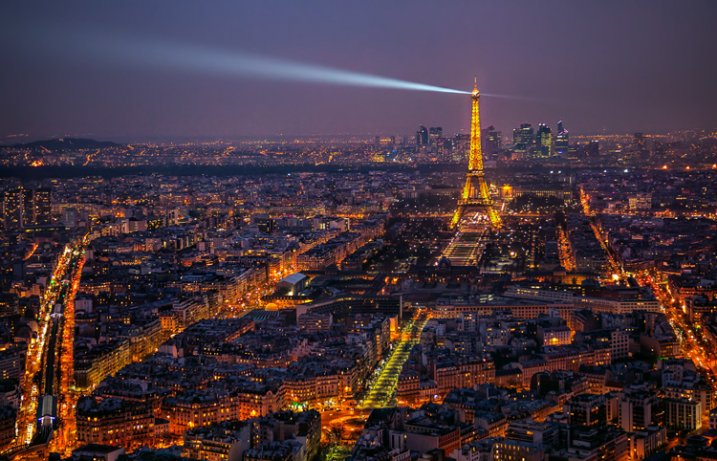
Paris at Night, Taken from the Montparnasse Tower (Shutter speed: 1/4 second; Aperture f/4; ISO: 800).
A good view can present a great opportunity for photography at any time, and nighttime is no exception. Be careful though – a great view does not necessarily make a great picture. The key to success often lies in the foreground. Make sure there is something of interest in the foreground draw your viewer into the great view.
Finding a great view can be difficult. This is particularly true at night, since often the parks or towers from which you capture the view are closed. The best way I have found to find great views is to use guidebooks for your city. Sometimes the guidebook will actually have a section on the best views. If that doesn’t work, take a look at the map on 500px to see what views others have found.
12. Bridges

Golden Gate Bridge from Marin Headlands, San Francisco (Shutter speed: 4 seconds; Aperture f/9; ISO: 800).
When in doubt, find a bridge to photograph at night. While your city may not have the Brooklyn Bridge or the Golden Gate Bridge, I can almost guarantee you that it will have a bridge, and that it will be well lit at night. Almost every city is built on a river or a bay, meaning there will be bridges. They are always lit.
The key is to find the best vantage point to view the bridge. In your quest to find this, there is no greater tool than the street view function of Google maps. Using Google maps, find the main bridge(s) of your city and then, at either end, virtually walk around using street view. Be sure you find a place to park as well, as this is often tricky around bridges.
Take special notice of the water under the bridge. There will be two effects related to the water. First, the long exposure time will smooth out the water. In rivers it will sometimes show a smooth current. Second, the lights from the bridge will often create reflections in the water. As such, if you can maneuver to use the water as your foreground, you may be rewarded.
When photographing a bridge, don’t overlook the passing traffic. You might be able to incorporate streaking lights from the cars as an element of the shot. As mentioned above, make sure you time the exposure right so that you start it right as traffic is about to enter the frame.
13. Fountains

Fountain in Trafalgar Square, London (Shutter speed: 13 seconds; Aperture f/10; ISO: 100).
Many central plazas and squares are centered around a fountain, and these are usually brightly lit at night. They are great places to start when looking to photograph a city a night. What’s more, photographing at night works to your advantage when you find such a fountain. The slow shutter speeds that are required by the low-light scene allow the water to flow while your shutter is open. This makes the water appear smooth.
Start with a low to mid-range ISO (100-400) and a moderate aperture (around f/8). Start with these settings, then adjust your shutter speed to get the correct exposure ought to result in a sufficiently slow shutter speed to create the smooth, flowing water you want.
Conclusion
Night takes up roughly half of each day. Further, it is often easier to get out and shoot at night because most of our work and family obligations take place during the daylight hours. So get out and shoot in your town. Even if you do not live in a major city – many moderate-sized metro areas have most, if not all, of the same subject matter.
When you do start planning night photography, you’ll be surprised how many of the subjects above are near you. It just takes a little effort and advance thought. So check out the available subjects nearby and get after it.
googletag.cmd.push(function() {
tablet_slots.push( googletag.defineSlot( “/1005424/_dPSv4_tab-all-article-bottom_(300×250)”, [300, 250], “pb-ad-78623” ).addService( googletag.pubads() ) ); } );googletag.cmd.push(function() {
mobile_slots.push( googletag.defineSlot( “/1005424/_dPSv4_mob-all-article-bottom_(300×250)”, [300, 250], “pb-ad-78158” ).addService( googletag.pubads() ) ); } );The post 13 Great Subjects for Urban Night Photography by Jim Hamel appeared first on Digital Photography School.
-
The Essence of a Great Portrait
If you find portrait photography difficult, then you’re not alone. Interacting with another person at the same time as using a complex camera, and combining the two activities to make a pleasing image isn’t easy. There’s a lot to think about, even if you’re already familiar with your camera and have put in some good preparation time.
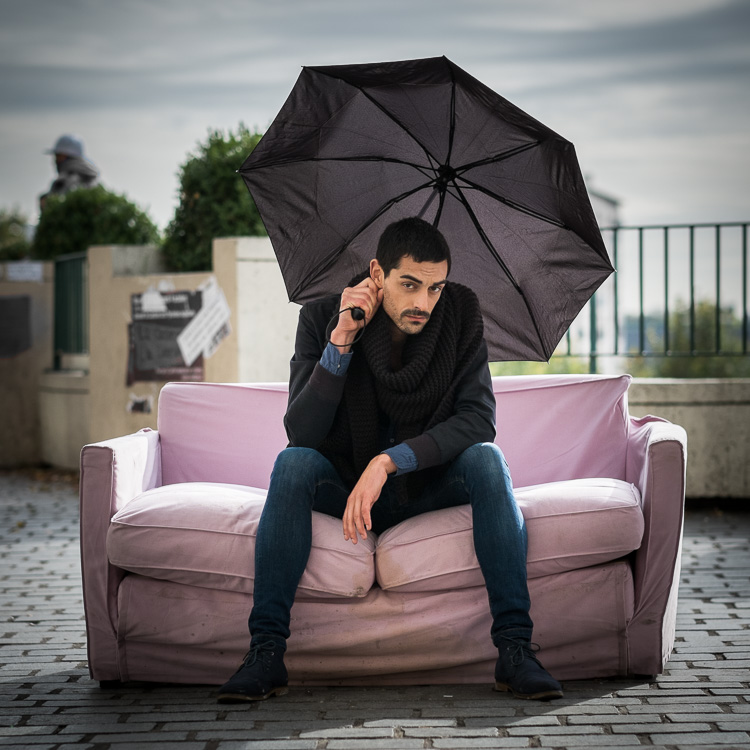
Aside from the lighting, the background, the composition, the pose and the expression, there is also the question of what even makes a pleasing image. Will the subject like the way they look, which is their best side, is their hair perfect, what’s the best angle to shoot from for their particular shape of face? Your subject might have other things to do, a meeting to go to or kids that need to be picked up from school. Landscapes usually tend to be more patient models.
A great portrait isn’t all about making somebody look beautiful though. You could photograph the most immaculate, styled, posed model in a wonderful location in beautiful light, but it wouldn’t necessarily make a good portrait if it doesn’t tell the viewer anything. People aren’t perfect, and a portrait should be more about leading towards an element of truth, more about the person being photographed.
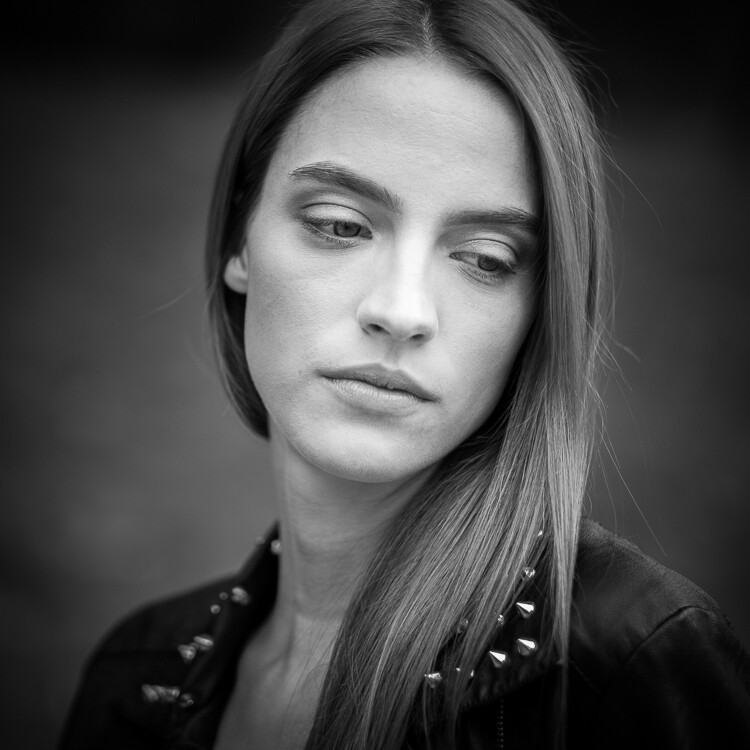
As photographers, we are in some ways, freed by our limitations. We can only only capture moments, glimpses. A single expression can never tell the whole story of a person in all their complexity, so we are free from the obligation of trying to do so. But it can hint at who a person is in reality. It can suggest a story, and it’s those subtle hints and suggestions that can make a portrait more intriguing.
It can help if you know the person, or at least a little about them. It helps not only in thinking about what you might want to show in the photograph, but also in your interaction with them. If you know something about their interests, their views, their hobbies, what’s going on in their lives at the moment, you’re more likely to be able to understand their perspective. You might aim to help them relax, or discuss a passion of theirs that might stir an emotion that animates their features.
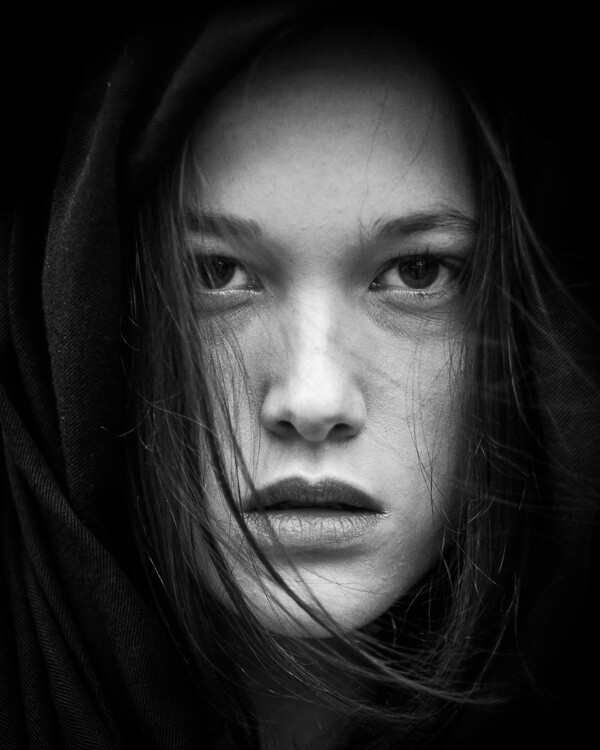
Here are three other exercises you can try:
1. Use your camera screen rather than the viewfinder. Sometimes the camera inevitably gets in the way. Holding a box in front of your face isn’t the best way to interact with someone, so try a different way. Keep the camera ready, glance at the screen for composition, but watch your subject and their expressions and reactions, watch for the moment you want to capture.
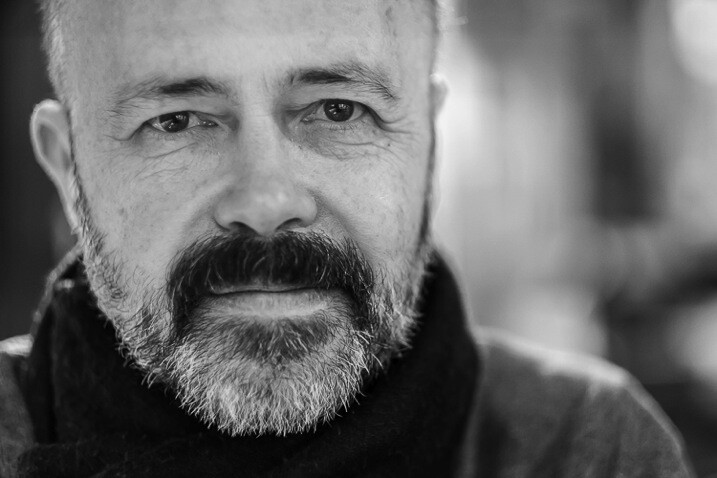
2. Distract your subject. Not many people are immediately comfortable being photographed. It’s difficult to ignore a camera being pointed at you, so sometimes a distraction can help. You could try providing another point of focus, suggesting something else to look at or think about. A prop can work well too, especially if it’s in keeping with the portrait. An object of some sort to take attention away from the camera.
3. Wait. Sometimes we try too hard to make something happen, and instead of going searching we have to let it come to us. Wait for a few moments and see what happens. Something will change,a pose, an expression, and you might be more pleased with the results.
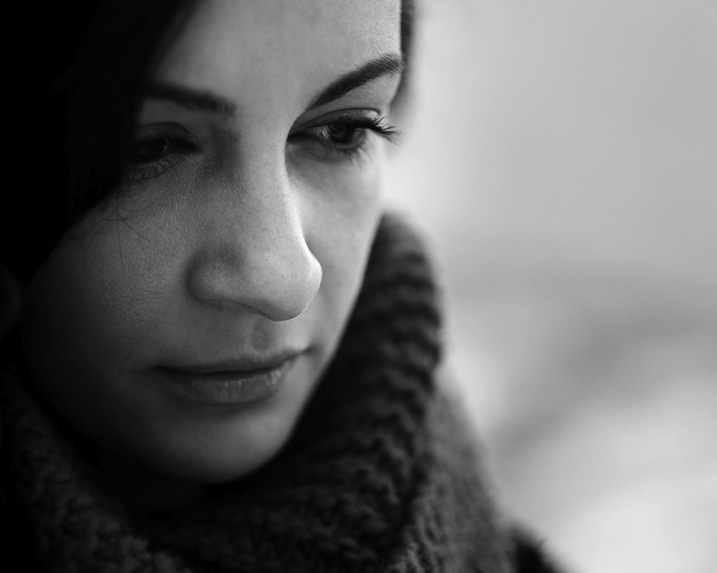
There is no formula for a great portrait, other than patience, practice, determination, and probably a slice of good fortune too. But there are also a whole lot of very good, honest, storytelling, memorable and joyful portraits to be made along the way. Remember that you’re making a portrait of a person, and people have imperfections. Some of the greatest portraits have even looked awkward or uncomfortable; not to attempt to demean or embarrass, but to be real. People that program electronic drum machines include tiny imperfections in the rhythms they create because they sound more natural, more pleasing to the ear, more like real drummers. You might try to make the perfect portrait but it’s likely that it’s exactly the imperfections that might make it great.
googletag.cmd.push(function() {
tablet_slots.push( googletag.defineSlot( “/1005424/_dPSv4_tab-all-article-bottom_(300×250)”, [300, 250], “pb-ad-78623” ).addService( googletag.pubads() ) ); } );googletag.cmd.push(function() {
mobile_slots.push( googletag.defineSlot( “/1005424/_dPSv4_mob-all-article-bottom_(300×250)”, [300, 250], “pb-ad-78158” ).addService( googletag.pubads() ) ); } );The post The Essence of a Great Portrait by Alastair Arthur appeared first on Digital Photography School.
-
Become a Composition Master with This Great Guide: 60% Off Today Only
Deal #2 in our massive Mid Year Sale has just gone live – and it’s a goodie!

Today only you get 60% off Photography Concentrate’s Incredibly Important Composition Skills.
For the next 24 hours and only $ 19.98 (an exclusive dPS price), you’ll get:
- A comprehensive 225-page ebook — filled with everything you need to know to come away with a deep understanding of composition and the practical know-how to put it to good use
- 7 bonus videos — looking at examples of theories and techniques and how they influence the look and feel of each photograph, to bring all the concepts covered together
- A printable pocket field guide — with the most essential composition information laid out, for you to print out, fold up and slip in your camera bag
Check out the video on the Photography Concentrate site to meet Lauren, the author of this tutorial, and learn more about how Incredibly Important Composition Skills will totally transform your photography!
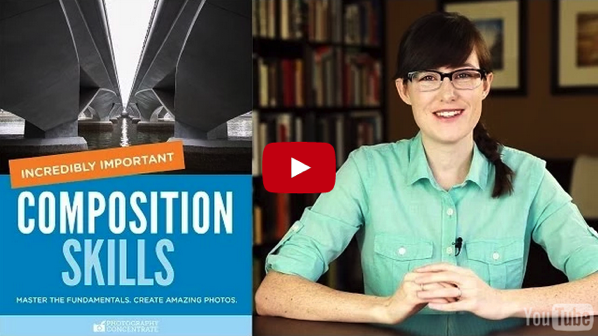
This deal is an unbelievable amount of value.
Especially because building your composition skills is one of the fastest and most lasting ways to transform the quality of your images.
You see, people view images in predictable ways. And when you discover these patterns, you can use them to your advantage to create photographs that best communicate your desired message.
So are you ready to become a master in composition and gain real skills that you’ll use in every single shot you take?
Head to Photography Concentrate to snap up this amazing deal!
No Risk: Your Satisfaction is Guaranteed
Your satisfaction with this deal is guaranteed. For a full 60 Days, and if you don’t feel like you have stronger composition skills you’ll get 100% of your money back with no questions asked.
googletag.cmd.push(function() {
tablet_slots.push( googletag.defineSlot( “/1005424/_dPSv4_tab-all-article-bottom_(300×250)”, [300, 250], “pb-ad-78623” ).addService( googletag.pubads() ) ); } );googletag.cmd.push(function() {
mobile_slots.push( googletag.defineSlot( “/1005424/_dPSv4_mob-all-article-bottom_(300×250)”, [300, 250], “pb-ad-78158” ).addService( googletag.pubads() ) ); } );The post Become a Composition Master with This Great Guide: 60% Off Today Only by Darren Rowse appeared first on Digital Photography School.