RSS
 

Posts Tagged ‘gear’

Gear breakdown: Behind the scenes with Chase Jarvis

20 Mar

Screen_Shot_2014-03-19_at_11.40.03_AM.png

Chase Jarvis has posted another show-and-tell video about the core gear he carries with him on shoots. In this video, you can see bag upon bag of photo and video gear sitting on industrial shelving in the background. Rather than going through every piece of equipment he owns, Jarvis presents his essential camera gear, the stuff he takes with him on every shoot. See video

News: Digital Photography Review (dpreview.com)

 
Comments Off on Gear breakdown: Behind the scenes with Chase Jarvis

Posted in Uncategorized


Readers’ Choice: Best Gear of 2013 Awards

03 Feb

awardsrosette.jpg

Before Christmas, we asked you to vote for your favorite cameras and lenses in five categories. We announced the category winners earlier this year and created a final poll to find what – in your opinion – was the single standout product of 2013. Click through for a reminder of the category winners and to find out which of the winning products was your choice for 2013 product of the year!

News: Digital Photography Review (dpreview.com)

 
Comments Off on Readers’ Choice: Best Gear of 2013 Awards

Posted in Uncategorized


2013 Gear in Review

03 Feb

On a whim I decided to look back on my collective work in 2013 and see what gear I used most. Historically I’ve avoided doing this as my gear bag is never very deep. This past year though I took advantage of some perks at BorrowLenses.com where I could experiment with a variety of gear, gear that under normal circumstances would be too costly to buy. So what gear did I fall back on using more and more?

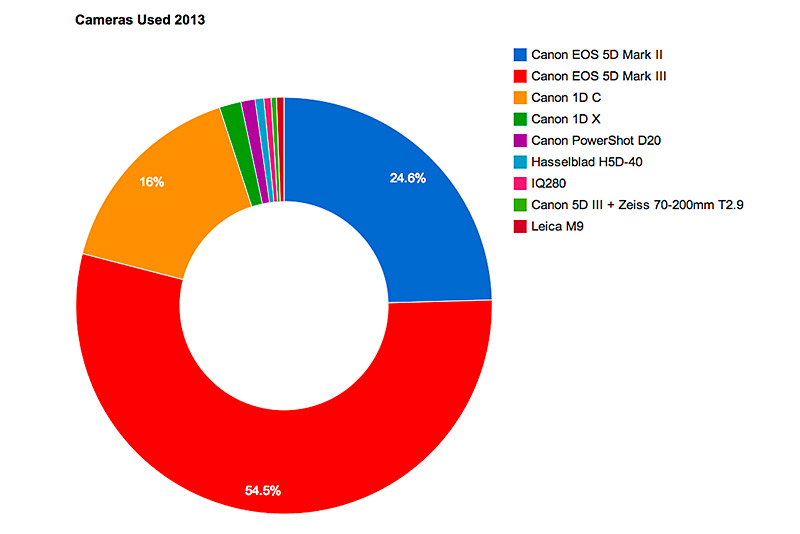
Here are the camera bodies I used through out 2013:

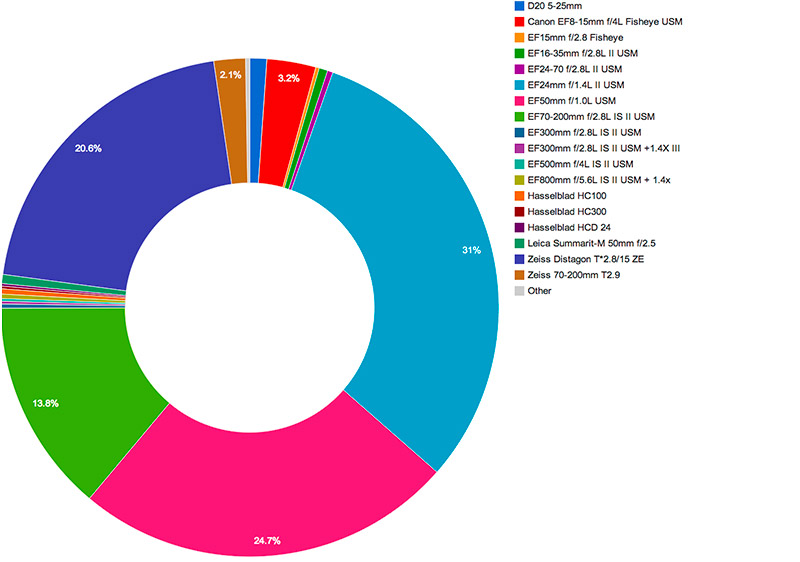
Here are the lenses I used through out 2013:

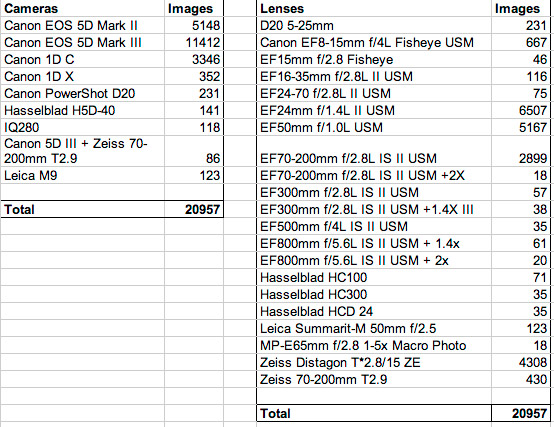
Here are the hard numbers for both lenses and cameras use in 2013:


What It All Means

I shot a lot of timelapse sequences this year hence the high image count, but I still took the time to take some meaningful still photos. Not to mention I also took the time to enjoy family photography with a waterproof Canon D20 point and shoot.  Clearly I’m a Canon shooter, but I’m not necessarily in love with only Canon lenses. Over the course of the year I’ve come increasingly fond of the Zeiss Distagon f/2.8 15mm lens due to its overall sharpness, minimal distortion in the corners and it’s predictable hard stop for infinite. If I didn’t have access to the lens I’d buy it, but if buying it is not in your budget either then it’s well worth renting the Zeiss 15mm at BorrowLenses.com. The Canon 5D III (which I rent multiple units of per shoot) has become my workhorse camera, but I still own the 5D Mark II. You’ll likely see a trend where I used fast lenses the most (f/1.0 and f/1.4) and this is because I’ve been working on an astrolandscape project where I need to capture a lot of light while minimizing exposure times.  The Canon 24mm f/1.4 has been a great lens to use as it is both fast and well suited to a classical landscape look. My Canon 50mm f/1.0 continues to be my go to fun lens both for family, travel and even an occasional astrolandscape photograph. I tried my hand at some more exotic equipment including the Leica M9 rangefinder and Hasselblad medium format cameras. I was not a fan of the M9 mostly because the sensor is not well suited to low light photography creating super noisy images. The Hasselblad 4HX + IQ280 back was an exotic combination I’d love to revisit using, but will have to wait for a specific project. The combination of broad dynamic range and high resolution opened my eyes to a completely different realm of photographic possibilities.  The brief glimpse into the world of exotic photography equipment was fun, but I’m still most productive and financially solvent in the 35mm DSLR world. We’ll have to see what comes of my gear use in 2014.

Copyright Jim M. Goldstein, All Rights Reserved

2013 Gear in Review

The post 2013 Gear in Review appeared first on JMG-Galleries – Landscape, Nature & Travel Photography.


Related Stories

  • 2013 Gear in Review – Enclosure
  • FLight Pollution
  • FLight Pollution – Enclosure
Feed Ads by FeedBlitz
powered by ad choices


JMG-Galleries

 
Comments Off on 2013 Gear in Review

Posted in Equipment


Essential Gear for the Landscape Photographer

03 Feb

Essential gear landscape photographer 06

A great landscape photo can capture the imagination and inspire the soul. It brings a static scene to life and reminds us why we’re drawn to nature’s cathedrals. And while you can clearly envision the kind of picture you’d like to make of your favorite vista, what may not be as clear is the gear that is essential to taking a great landscape photograph. So, let’s talk about that.

My list of essential gear for the landscape photographer . . .

What is the must-have equipment for capturing awesome landscape photos?

Camera body

We’ll begin with your camera body. Any camera will do for making a shot to share on Facebook. But to elevate your landscape game to the next level, it is essential to use a camera body that allows you to get off Auto and start shooting in Aperture Priority.

One of the keys to a great landscape photo is having tack sharp focus throughout your depth of field. In other words, everything from the leaf in the foreground to the distant mountain range should be in clear focus. To achieve this, you need to shoot at a focal ratio offering great depth of field. Shooting in aperture priority allows you to choose the right focal ratio for the scene. Something in the range of f/8 to f/16 should produce images with good depth of field and crisp focus throughout.

Another setting you’ll be able to select in Aperture Priority is ISO. This is the sensitivity of your camera’s sensor to light. Shooting with a low ISO delivers cleaner images having less noise or graininess. For better landscapes, try to shoot as close to your camera’s base ISO (100 or 200) as possible.

The combination of a large focal ratio (f/8 or higher) and a low ISO (100 or 200) means longer exposures will be needed to make a good image. If you shoot landscapes at midday when the sun is high in the sky, there is more than enough ambient light to make a good image with very short exposures. But truly dramatic landscapes, the kind you’re after, are typically captured in very different lighting conditions.

Essential gear landscape photographer 02

Many great landscape photos are taken during the golden hour; that all-too-brief window of time at sunrise or sunset when dramatic lighting paints the scene. Cloudy skies also add an element of drama which can transform a so-so view into a stunning image. Under such conditions, the available light is much lower and this creates the need for our next piece of essential kit: a photographic tripod.

Tripod

A tripod provides a stable platform for your digital camera. It allows you to take the time to carefully compose a shot and then lock down your camera in that position. Since you’ll be shooting in low light conditions, using a large focal ratio and low ISO, the length of the exposure needed to capture the scene will be fairly long. Too long to steadily handhold the camera. Mounting your camera on a tripod will keep it steady during very long exposures that record amazing detail.

Essential gear landscape photographer 05

Lenses

Of course, one of the most important pieces of equipment for a photographer is the lens through which a scene is captured. For landscape photography, your most versatile lens will be a wide angle. These are short focal length lenses that deliver wide, true fields of view. That wide field of view allows greater flexibility in composing a shot encompassing the full grandeur of a landscape. I recommend a minimum focal length of 12mm for APS-C bodies (cropped sensor) and 18mm for full-frame cameras.

Fortunately for your wallet, this does not need to be a fast lens which are designed to have focal ratios of f/2.8 or faster. They are consider fast because their large apertures collect enough light to keep exposures brief, even in low light conditions. Large apertures demand a large front lens element, which comes at a steep price. And while the performance can be well worth the investment, many photographers simply don’t have room in their budgets for such a purchase. Since you’ll be shooting at f/8 or greater, a lens with a maximum focal ratio of f/4 should more than meet your needs.

Essential gear landscape photographer 04

Filters

Let’s talk briefly about filters. They can be a great tool for the landscape photographer. Among the most useful are graduated neutral density (GND) filters and variable polarizing filters. However, as useful as filters can be, I don’t consider them essential gear. In the right lighting, filters are unnecessary. In situations where a GND filter would be of use, it’s often possible to compensate for significant differences in brightness in your photo editing software of choice. In short, filters are useful but not absolutely necessary.

Essential gear landscape photographer 01

Yourself

The last piece of essential gear we’ll discuss is, you. Your eye for composition is the most important asset in your photographer’s tool kit. Your ability to recognize good light is essential. If you look at a scene and your inner voice is saying, “Ooh, that’s cool,” that’s a good sign the lighting is outstanding. Listen to that inner voice, stop and compose a shot.

Walk around the scene. Look for a foreground element to include in the composition. One of the biggest challenges of landscape photography is conveying a sense of scale. Including a foreground element helps immensely. A bush, leaf, rock or person provides a sense of scale for the rest of the image. It also helps simplify the scene, making the resulting image more approachable to the viewer.

Essential gear landscape photographer 03

Summary

With a keen eye for composition, a camera body allowing you to shoot in Aperture Priority, a solid tripod and a sharp wide angle lens, you can take your landscape photography to the next level. Your images will convey the magic you felt while standing amidst a grand scene. The resulting “oohs” and “aahs” will be the reward feeding your satisfaction as a landscape photographer.
Now, get out there and shoot some great landscapes!

The post Essential Gear for the Landscape Photographer by Bill Ferris appeared first on Digital Photography School.


Digital Photography School

 
Comments Off on Essential Gear for the Landscape Photographer

Posted in Photography


Best Gear of 2013: The results are in!

03 Jan

pollresults.jpg

The results are in! Before Christmas, we asked you to vote for your favorite gear in five categories. Best lens, best DSLR / SLT, best fixed-lens compact camera, best mirrorless interchangeable lens camera and best enthusiast zoom compact. Now, with almost 30,000 votes cast since December 18th the results are in! Click through to take a look at the category winners and runners-up.

News: Digital Photography Review (dpreview.com)

 
Comments Off on Best Gear of 2013: The results are in!

Posted in Uncategorized


All about Gear [Best of dPS 2013]

28 Dec

Everyone loves to talk about it. No one wants to admit it. So let’s geek out for a minute and look at some of the top articles and reviews on cameras and gear from 2013 as our summer series continues.

portrait-gear-essentials-12

Top 16 articles about gear in no particular order:

  1. 5 Pieces of Photography Gear to Consider as Your First Upgrade
  2. Achieving a ‘Big’ Look with little Gear | Using What You Have
  3. Portrait Gear Essentials – by dPS eBook author Gina Milicia
  4. Keeping Your Gear Safe While Shooting In The Rain
  5. How To Keep Camera Gear Safe While Traveling
  6. Surf Photography for Beginners – Equipment, Techniques and Tips
  7. Refurbished Camera Equipment: As Good as New if not Better
  8. 5 Kinds of Photography Equipment That Waste Your Money
  9. How to Buy a Digital Camera – A 9 Step Guide
  10. How to Choose a DSLR Camera
  11. Digital Camera Modes
  12. Should you buy a DSLR or Point and Shoot Digital Camera?
  13. How to Hold a Camera
  14. Full Frame Sensor vs Crop Sensor – Which is Right For You?
  15. Why a 50mm lens is your new best friend
  16. a dPS ebook, Photo Nuts and Gear

The post All about Gear [Best of dPS 2013] by Darlene Hildebrandt appeared first on Digital Photography School.


Digital Photography School

 
Comments Off on All about Gear [Best of dPS 2013]

Posted in Photography


Have your say: Best gear of 2013

23 Dec

Screen_Shot_2013-12-22_at_3.40.54_PM.jpg

A great many new products were released this year, and we’ve published in-depth content on plenty of them, full reviews of many and we’ve got plenty of opinions on all of them. This is your chance to have your day – which was the best gear of 2013? Click through to see our five readers’ polls, and cast your vote!

News: Digital Photography Review (dpreview.com)

 
Comments Off on Have your say: Best gear of 2013

Posted in Uncategorized


Tips to Protect your Gear in Harsh Weather Conditions

18 Dec

Do you live in a cold and snowy climate? Are you planning a trip to a desert or a tropical island? Although adverse weather or harsh environments can yield some of the best images, those situations can also play havoc with your camera gear if you don’t plan accordingly. Here are some simple steps to help you shoot without ruining your equipment.

Tips to Protect your Gear

Rain
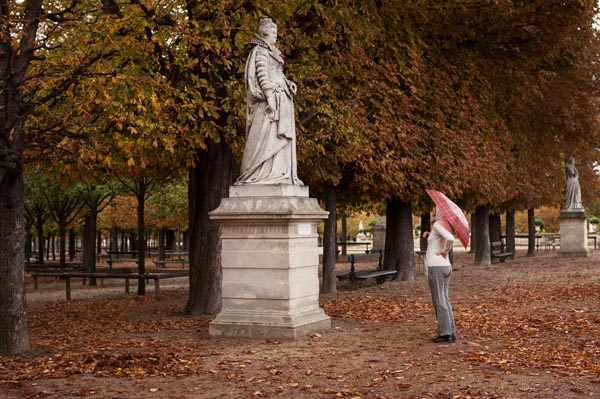
I love photographing in the rain. Of all adverse weather conditions, rain is one of the easiest to deal with to protect your camera. ©Valérie Jardin

I love photographing in the rain. Of all adverse weather conditions, rain is one of the easiest to deal with in regards to protecting your camera. ©Valérie Jardin

Don’t let a rainy day stop you from making amazing photographs. Just protect your camera, and yourself, and get out there! Although some of the most expensive DSLRs and lenses are weather sealed and can be used in the rain without protection, most cannot. The good news is that they can easily be fitted inside a rain sleeve specifically designed to keep them dry on rainy days. Rain sleeves will cost from a few dollars for a clear plastic model, to $ 30+ for a more durable water proof material. The more expensive rain sleeves come is different sizes to fit your lens. Note that they work best when you use a lens hood.

It’s harder to find rain protection for smaller camera systems. A makeshift cover with a shower cap or a freezer bag will usually do the trick. Since I mostly shoot street photography with a mirrorless camera, I find that holding an umbrella is quite convenient if it’s not too windy. The camera is small and light, one hand to shoot is all you need!

Snow and cold

Again, what most would consider adverse weather makes for a photographer’s ideal playground. Heavy snow falls should be treated like rain and the same protection applies. Dealing with the cold, on the other hand, is a different story. When out in the cold, your camera doesn’t need any special protection as long as it stays dry. One of the biggest issues with shooting in cold weather is the moisture and condensation that can build up on your camera and lens when you go from cold, to the warmth of your home or car. Excessive moisture on your lenses can cause mold to form inside the lens, which will ruin it.

To prevent damage from condensation, here is what you need to do: Before you go back inside your house or car, make sure you seal your camera in an air-tight plastic bag. This will allow the camera to reach room temperature while the condensation builds on the outside of the bag, not on your precious gear.

Mirror lock-up can also happen in very cold temperatures when the lubricant that helps activate the moving parts freezes. Cameras can usually handle colder temperatures than stated in the manual, but be aware that this type of lock-up could happen if you end up in the arctic circle.

Another thing to worry about when the temperature dips, the battery will drain much faster. So, make sure you carry a spare or two that you keep in a pocket, as close to your body heat as possible. Smaller cameras don’t have as many moving parts, and no mirror freeze up to worry about, but their batteries will drain even faster, so be prepared for that.

Your camera needs some special attention in cold and wet conditions. ©Valérie Jardin

Don’t hibernate with your camera in cold weather. Just take some special steps to protect it and yourself! ©Valérie Jardin

Extreme humidity

Besides the obvious inconvenience of your lens fogging up as soon as you leave your air conditioned room and step into the hot and humid environment, humidity can also lead to mold. You can alleviate the fogging up of the lens by placing your gear in a sealed plastic bag and letting it slowly adjust to the change of temperature. Avoid changing lenses as much as possible and remember that zooming in and out will pump humidity inside. Favor prime lenses!

Keep sensitive equipment in sealed bags and keep small silica desiccant packets in your camera bag to absorb some of the moisture. Dry your hands before you change batteries or memory cards to prevent trapping moisture in the compartment.
Tropical environments bring a lot of great photo opportunities, just make sure the moisture doesn't get inside your camera! ©Valérie Jardin

Tropical environments bring a lot of great photo opportunities. Just make sure the moisture doesn’t get inside your camera! ©Valérie Jardin

Heat

Just like extreme cold, the opposite can also give you some gear trouble. Use common sense and avoid prolonged exposure to direct sunlight. Keep your camera cool, and in the shade when not in use. Cameras can overheat and this can cause damage to the internal components. You can use an empty cooler which will help keep your camera cool when you’re not using it. It’s also a good idea to carry one of those space blankets when you are out in the wild or extreme weather. You can use it to protect your camera from the sun as well.

Sand and dust

Have you ever been on a beach during a sand storm? I have! No matter what you do, sand will get everywhere! If you are going to be in an extremely dusty environment, I would highly recommend protecting the front element of your lens with a good quality filter. An occasional scratch from wiping some of the dust or sand off the front of your lens won’t hurt as much if it happens on the filter rather than the lens itself. Also, don’t set your camera bag on the sand! Camera bags are perfect sand traps.

Salt

If you shoot near the sea on a windy day, there will surely be some spray of salty water on your gear. Again, a UV filter will help protect the front element of your lens. Make sure your battery is full and your memory card is empty before you head out so that you avoid opening the battery or memory card compartment at all costs to prevent corrosion to form inside. It may not be a good time to change lens on the beach either.

Never leave home without them

A blower such as the Giottos Rocket blower. It’s such a small investment and one of the best accessories you can have in your camera bag at all times. I not only use it to blow any dust from the lens before I wipe it with a lens cloth. But I also blow the back of the lens before I put it on the camera to prevent dust from reaching the sensor. I also use it to blow air on the lens and camera before I wipe them clean.

Microfiber cloths. Keep one separate that you will use for the front of your lens only. Carry extras to wipe the dust or water from your lens and camera body. The key is to remove as must moisture or dust as quickly as possible.

Common sense when changing lenses

Avoid changing lenses in adverse weather. If you absolutely have to, follow these simple steps: Do it in your car if you can. If not, turn your back to the wind and be ready to do it quickly. Place the new lens on a clean, flat surface. Unscrew the back cover but leave it on. While shielding your camera from the elements with your body, put the camera upside down and quickly switch lenses. This should only take a second or two to minimize the amount of dust that will get to your sensor.

Protect yourself

Protecting your gear from extreme weather won’t do much good if you don’t make it back alive! Whether you are dealing with extreme cold or heat, don’t mess with extreme weather if you’re not prepared. No picture is worth risking your life for!

I hope you found some of those tips useful. Please share your own with the community in the comment section below.

More reading on this subject

  • How to protect your gear in extreme conditions
  • Storm jacket cameras cover – a review by Valérie Jardin
  • 7 digital camera predators and how to keep them at bay
  • Camera insurance – assure peace of mind


The post Tips to Protect your Gear in Harsh Weather Conditions by Valerie Jardin appeared first on Digital Photography School.


Digital Photography School

 
Comments Off on Tips to Protect your Gear in Harsh Weather Conditions

Posted in Photography


Without Reservation: A Recommended Gear List

18 Dec

This is something I get asked about a lot, and its inclusion on the site is far overdue. The following is a list of gear in which I have complete confidence, and would recommend wholeheartedly to any photographer.

The Without Reservation list will be kept up to date going forward, so these are all subject to change at some point in the future. But as of now, this is the go-to gear that I rely upon day in and day out.

Read more »
Strobist

 
Comments Off on Without Reservation: A Recommended Gear List

Posted in Photography


DPReview Gear of the Year Part 5: Canon Rebel SL1/100D

11 Dec

goty-SL1-50mm.jpg

A lot of equipment passes through our Seattle and London offices, everything from high-end cameras to inexpensive accessories. A lot of it gets reviewed, but we can’t cover everything. In this series of short articles, DPReview staff will be highlighting their personal standout products of the year. In part 5, Shawn Barnett talks about his personal favorite – the Canon Rebel SL1/100D.

News: Digital Photography Review (dpreview.com)

 
Comments Off on DPReview Gear of the Year Part 5: Canon Rebel SL1/100D

Posted in Uncategorized