RSS
 

Posts Tagged ‘Five’

The Ultimate Five Secrets to Better-Looking Photographs

05 Mar

All photographers want their snapshots to turn out extremely well. This means pictures that are sharp, aesthetically appealing and sure to impress. Of course, many photographers don’t consistently turn out this type of quality in their photographs. These days, so many people are also pressed for time that they don’t really have the time or patience to study the masters Continue Reading

The post The Ultimate Five Secrets to Better-Looking Photographs appeared first on Photodoto.


Photodoto

 
Comments Off on The Ultimate Five Secrets to Better-Looking Photographs

Posted in Photography


Win One of Five – Three Month Subscriptions from Skillfeed By Shutterstock!

21 Jan

Over the last few years here at dPS, we’ve run some very popular competitions, and this month will be no different! This month we are working with one of our newest partners – Skillfeed, By Shutterstock – to give away to lucky dPS readers, full access to their creative and technical Video Tutorials!

For this competition, Skillfeed is giving away FIVE prizes!

These five prizes are designed to be helpful for all levels of photography and post-production. Each will be won by a different dPS reader. Here’s what you could win:

Three month subscription to Skillfeed’s library of Creative and Technical Video Tutorials! A $ 57 Value!

There are loads of tutorials that you’ll get access to including:

201401211703.jpg

How to make a Pop Art portrait from a Photo in Photoshop Easy

201401211704.jpg

DSLR Digital Photography Course

How to Win

To win this competition you’ll need to:

  • Visit the above library of courses information pages and explore the multiple Video Tutorial offerings.
  • Leave a comment below and tell us which tutorials are of most interest to you WHY you’d like to learn these new skills. Please note: there is a limit of 1 entry per person.
  • Do this in the next 16 days and on Thursday, February 6, the team at Skillfeed will choose the best 5 answers and we will announce the winners in the following days.

The deadline for entries is Wednesday, February 5, 2014, Midnight PST. Entries placed after deadline will not be considered.

By ‘best’ – we’re looking for people who have an understanding of the Video Tutorials and how they will best suit their needs. So you’ll need to check out the tutorial pages to put yourself in the best position to win.

There’s no need to write essay length comments to win – but we’re looking to hear what you like about the video tutorials and how it would help your development as a photographer.

This competition is open to everyone around the world no matter where you live – but there is only one entry per person.

To enter – simply leave your comment below.

Disclaimer: Skillfeed is a paid partner of dPS.

The post Win One of Five – Three Month Subscriptions from Skillfeed By Shutterstock! by Darren Rowse appeared first on Digital Photography School.


Digital Photography School

 
Comments Off on Win One of Five – Three Month Subscriptions from Skillfeed By Shutterstock!

Posted in Photography


Fujifilm adds five lenses to X system roadmap, including fast zooms

06 Jan

shared:fujifilm_logo.png

CES 2014: Fujifilm has updated its X-system roadmap for 2014, adding five lenses to its list of upcoming releases. First up is an extended-range zoom, the XF 18-135mm F3.5-5.6 R OIS (28-200mm equivalent). Following this will be two fast zooms, the XF 16-55mm F2.8 R OIS standard zoom, and XF 50-140 F2.8 R OIS (24-83mm and 75-210mm equivalent respectively). All three feature aperture rings and optical stabilisation. They’ll be followed by a ‘high speed wide angle lens’ and ‘super telephoto zoom lens’ in late 2014 / early 2015. 

News: Digital Photography Review (dpreview.com)

 
Comments Off on Fujifilm adds five lenses to X system roadmap, including fast zooms

Posted in Uncategorized


Five Minutes to Realistic HDR using Lightroom and a 32-Bit Plugin

19 Dec

Easy Peazy HDR in Adobe Lightroom to make realistic HDR images!

HDR photography used to be time consuming, difficult to learn, and required expensive software. Recent new technology now allows anybody, even beginners, to make perfect HDR in less than 5 minutes – while eating a bowl of ice cream. It’s that easy!

Cuddeback_DSC5809_10_1132-bit-HDR-2

Using Adobe Lightroom for HDR

Just wait until you see how awesome this is!

The Perfect HDR Workflow takes place completely within Adobe Lightroom 4 or 5, a very robust, yet inexpensive, state of the art software. There is also an inexpensive plugin you will need. It’s made exclusively for Lightroom by the smart Photomatix people and is the secret sauce which makes this workflow possible and so elegant. It’s called “Merge to 32-bit HDR plugin” and is available for $ 29. They also have a trial version available so you can test it out first. These are the same people who make the world’s leading HDR tone mapping software, Photomatix Pro. So, take comfort, there’s no smoke & mirrors in this HDR workflow and you’ll be working with the best software available today. At the same time, your photography will now blow away 95% of the HDR images which are still being made using the old, harder to learn, HDR tone mapping process.

Notice, you don’t need to own Photoshop or endure the pain & suffering of learning how to use Photoshop to do this method! This, in itself, is huge and a welcome departure from the way HDR photography is typically done.

Advantages of 32-bit HDR Processing

The process I’m going to show you is technically called 32-bit HDR processing. The Perfect HDR Workflow is just my name for the particular workflow I designed with the beginning photographer in mind. My criteria was that total cost be under $ 150 US, which immediately rules out Photoshop in the workflow. Another requirement was that it be so easy that even a beginner can learn to make extraordinary HDR photos in minutes.

The advantages of the 32-bit process are:

  • It’s fast
  • It’s inexpensive
  • It yields realistic looking images
  • It’s very easy to learn

HDR doesn’t have to be complicated anymore. In fact, the Perfect HDR Workflow obliterates the complex technical barriers of making outstanding HDR which used to exist. Now, anybody with a digital camera and the desire can play a much bigger game when it comes to HDR photography, can do this!

Are you ready to see how it’s done?

Five Minutes to Perfect HDR

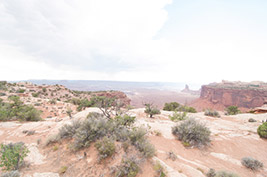
Here we go. Start with the three bracketed RAW images right out of the camera (you can download these for free if you want to follow along):

Easy realistic HDR in Lightroom

-2 shot at: ISO 200, F8, 1/1500

Easy realistic HDR in Lightroom

0 exposure shot at: ISO 200, F8, 1/350

Easy realistic HDR in Lightroom

+2 exposure shot at: ISO 200, F8, 1/90

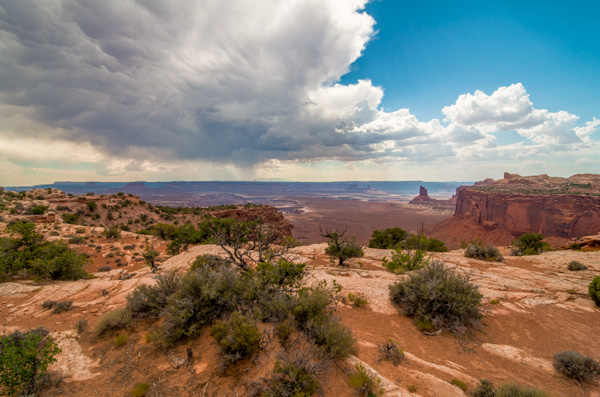
In less than 5 minutes you’ll end up with an HDR photo looking like this:

Cuddeback_DSC5809_10_1132-bit-HDR-2

Start your stopwatch:

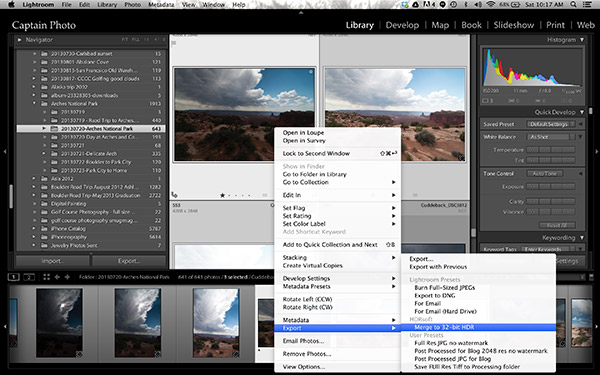
The first thing you want to do is create the 32-bit image. With the three RAW files selected in Lightroom, right click and in the dialog box which appears, select “Export>Merge to 32-bit HDR” as shown below.

Screen Shot 2013 11 23 at 10 17 57 AM

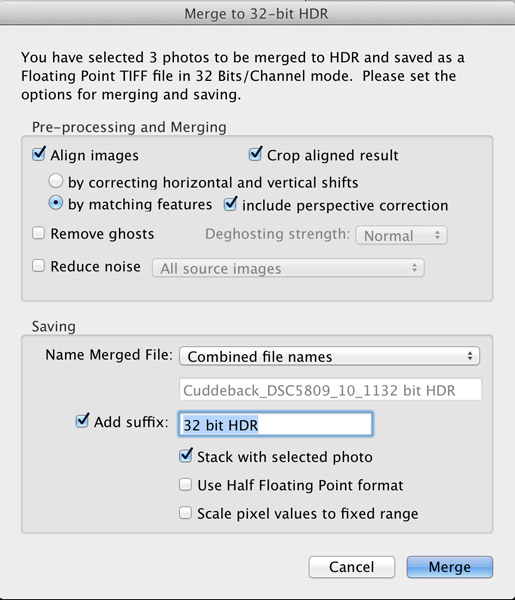
A new dialog box opens up where you choose your options for merging the RAW files (see image below). Always choose to “Align Images” and then one of the alignment options. If your three photos were taken handheld, select the alignment option “by matching features”. When you shoot on a tripod, you would chose the other option, “by correcting horizontal and vertical shifts”.

If there are moving objects in your scene such as: cars, people, clouds, trees, or anything else – select “Remove ghosts” and the software will usually do a great job of producing a non-blurry merged image, with no ghosts. For this landscape photo, nothing was moving so this option was not selected.

Noise reduction is usually necessary in HDR photography, however, I recommend not using the “Reduce noise” option which the plugin offers up. Instead, you are better off using the noise reduction built into Lightroom. So, leave that unchecked, as well.

Moving down to where you choose how the resulting 32-bit file is saved. I recommend simply combining the file names and adding a suffix like “32-bit HDR” so that, at a glance, you know that is the 32-bit file you want to work with in Lightroom.

The final dialog box selection you want to make is; “Stack with selected photo.” It’s so easy and elegant how this plugin makes your HDR workflow when this is selected. After the 32-bit file is created, the plugin automatically imports it right back into Lightroom and places it neatly next to the original RAW files. This keeps my OCD mind happy. Leave the final two options unselected then click the “Merge” button.

Here’s what the dialog box should look like

Screen Shot 2013 11 23 at 10 18 08 AM

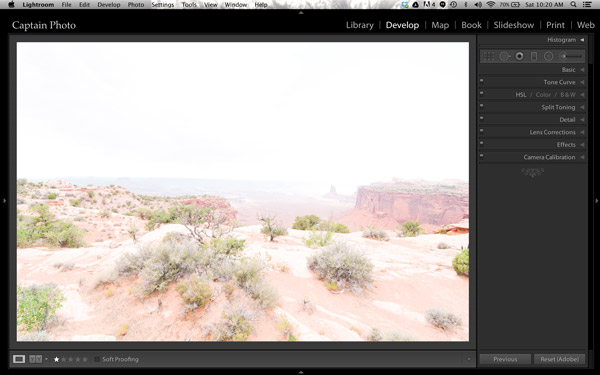
In a few seconds, your newly created 32-bit file appears in Lightroom and looks something like this:

Screen Shot 2013 11 23 at 10 20 14 AM

Okay, well that’s not too pretty! That’s because this is a 32-bit file which your computer monitor can’t correctly display. But Lightroom 4 or 5 can process it, so let’s do that.

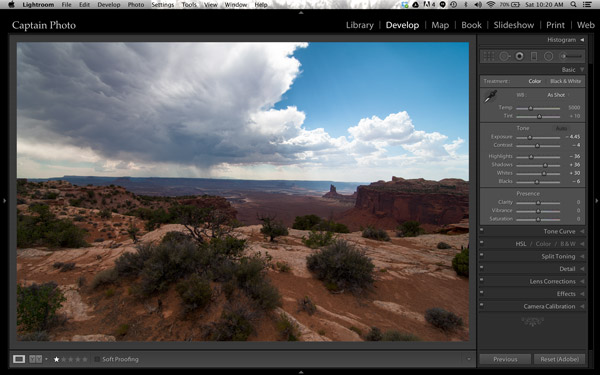
We’ll be working mostly in the Basic panel of the Develop module in Lightroom. The first step is to simply click the “Auto” button which gives you Lightroom’s best guess at the right setting for the image:

Screen Shot 2013 11 23 at 10 20 25 AM

It’s already looking much better. But let’s take it a step further!

Adding Your Artistic Touch

Now it’s time to add your personal artistic mark on your photo! At this point, you take over the processing manually to create an HDR image that is most pleasing to you. There are no right or wrong settings. However, my 5 minute process to Perfect HDR does follow some general guidelines so let me show you how this image evolved for me.

Working in the Basic panel, you first will reduce the “Highlights” (slide it left) and increase the “Shadows” (push it to the right) sliders until the image looks best to you. Then you might adjust the “Clarity” to a slight positive value, which adds local contrast between pixels. It makes the HDR photo “pop.” Please be careful not to push clarity too far right. My advice is to keep it below 30, for now anyway. Now let’s jump out of the Basic panel.

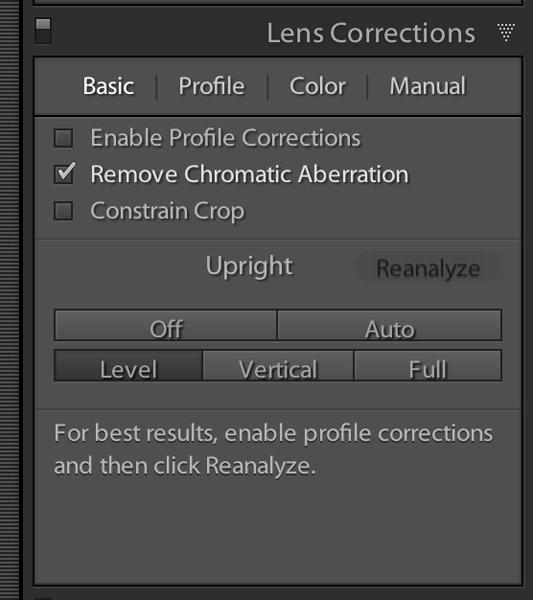
For just a couple of quick automatic adjustments, open up the “Lens Correction” panel. I recommend that you always check the box to “Remove chromatic aberration.” Also, you may want to straighten your horizon and/or vertical lines using the “Upright” adjustment tool. Here is what the “Lens correction” panel looks like when you make these simple adjustments:

Screen Shot 2013 11 23 at 10 24 24 AM

Now, go back to the Basic panel to finish. Set the white and black points as shown in the video below. The other sliders in the Basic panel can then be fine tuned to your taste and that’s it! Woooo Hooooo, done in less than 5 minutes! You’ve just made your first Perfect HDR photo! Send it to Mom and your friends and be ready to receive their adoration!

Watch The Full Perfect HDR Workflow Video

In the video below, I show the complete processing of this image including how to set the white and black points correctly. It’s easier to show some of the steps in a video, rather than try to describe it all in written form.

Try the Perfect HDR Workflow

If you want to give the Perfect HDR Workflow a try yourself right now, you can download my RAW files of this image for free. Get the free trial download of the merge to 32-bit plugin from the Photomatix website. The plugin you want is the last item on the page. Install the plugin with your copy of Lightroom 4 or 5. Then follow along to get the hang of the Perfect HDR Workflow and find out for yourself how easy this really is! If questions come up, I hang out on Google+ every day and you are welcome to circle & chat with me there or on my blog.

Become an HDR Wizard

Next time, in Easy Peazy HDR in Lightroom Part II, we’ll take this image further using the other panels of the Develop module in Lightroom. I think you’ll be amazed at the power and control you have using Lightroom to process your HDR photos. It’ll be like you’ve evolved into this unstoppable HDR Wizard!

The post Five Minutes to Realistic HDR using Lightroom and a 32-Bit Plugin by Keith Cuddeback appeared first on Digital Photography School.


Digital Photography School

 
Comments Off on Five Minutes to Realistic HDR using Lightroom and a 32-Bit Plugin

Posted in Photography


Samyang says five of its full frame lenses now available in Sony E mount

17 Dec

ts24-news.png

Samyang has announced that, as promised in October, five of its full frame lenses are now available in Sony E-mount, and are therefore the first third-party optics with native mounts for the Sony A7 and A7R. The lenses are the 14mm F2.8, 24mm F1.4, 24mm F3.5 tilt-and-shift, 35mm F1.4, and 85mm F1.4. All feature manual focus and aperture operation and, because they’re essentially SLR lenses with an adapter tube added, all are considerably more bulky than their Alpha mount counterparts. Click through for more information and images of the E-mount lenses.

News: Digital Photography Review (dpreview.com)

 
Comments Off on Samyang says five of its full frame lenses now available in Sony E mount

Posted in Uncategorized


Five Photography Bad Habits to Quit Today

05 Dec

We can find ourselves pretty wrapped up in photography bad habits or behaviours long before we realize that maybe we should be trying to find another way. Sometimes, you don’t even see them and, if you’re lucky, you’ll have a friend who can kindly point them out. So let’s take a look today and see if I can be the friend who says, “ahem…you’ve got toilet paper on your shoe.”

Five Photography Bad Habits to Quit Today

1. Hesitation

A habit you may find yourself in is hesitation. Hesitating too long in a situation can prevent you from getting that perfect shot. You may be hesitating for a couple different reasons:

Hesitating can mean the difference between catching or missing moments of emotion.

Hesitating can mean the difference between catching or missing moments of emotion.

Fear of what people think

You may be concerned about what people think. Are you feeling the urge to take a shot of your crying child? Those are completely valid moments that need to be captured from time to time. Or perhaps it’s a street shot of a perfect stranger and you hesitate just a split-second too long because you’re feeling vulnerable and on-stage.

One of the best street photography series I’ve ever seen is the Zack Arias #de_VICE series. Even just now looking for that link and scanning over the shots again…they give me goosebumps. Zack made the images with a Fuji x100 camera which has a 23mm fixed lens (this is equivalent to 35mm on a cropped sensor camera). So you know he had to get really super, uncomfortably close, to those strangers to get those shots. He didn’t hesitate. Uncomfortable moments are over in a split second, but these images last forever, have the potential to change lives and get conversations going which would never otherwise have happened. It’s because of Zack’s series that I think twice about pulling out my device at inappropriate times (like eating out with my family). Further reading: 7 steps to get over the fear of street photography and Photographers: Embrace the Awkward Moment

Not being ready

Not having your camera ready can make you hesitate. You may not have it up and ready in shooting position (Jasmine Star talks about that in this video) or you may not have your settings right. Set your camera for the situation so you’re ready to shoot, but if your surroundings are constantly changing, then you have a couple options.

  1. You can shoot in auto or a semi-manual mode. I personally love aperture mode. This means you set the aperture and the camera meters the light for your shutter speed. While shooting in full manual is always preferable, doing what you need in order to get your shot is paramount, so do what it takes in terms of your settings to prevent hesitation.
  2. Shooting in RAW also helps you have a wider range of options in post-production so you can recover poorly exposed shots.

Further reading: The Introvert Photographer (in this post I talk about my use of semi manual shooting modes).

2. ISO too low

A pretty nasty habit to kick can be using too low of an ISO setting. Many photographers say they did such-and-such because they “couldn’t take their ISO above 800″. The fear of using a high enough ISO can be pretty strong and lead you to get blurry shots from a shutter speed that is too slow, or even prevent you from trying to get a shot altogether. A few reasons you want to kick this habit today:

  • You may be surprised at how high you can actually push your camera. If you have a good ‘fast’ lens (one that handles a wide aperture), make every use you can of its capabilities. Then take your ISO as high as you need to get the shot.
  • Post editing software these days can minimize the noise resulting from extremely high ISO amazingly well.
  • Grain/noise isn’t totally bad. For some photographers, it’s actually desirable. Many of us actually add more grain. So if you have a high ISO shot that would look beautiful edited in B&W, try that out and visualize all that noise as beautiful grain.

Now, there’s this thing out there about how sensors in full frame cameras produce less noise. It was this idea that stopped me from taking my cropped sensor camera to the high ISO I often needed, because it wasn’t a full frame camera. But when I did get a full frame camera, I did some cropped sensor vs full frame ISO comparisons and was really surprised to find that there wasn’t a difference substantial enough to have warranted all my worries.

ISO 3200 and still nice and smooth

ISO 3200 and still nice and smooth

3. Pixel peeping

A great subject to talk about next is the bad habit of pixel peeping, because it may be one of the reasons you’re afraid of shooting at high ISO numbers. If you blow your shots up to 100% in your computer and cry, “Oh, the noise! THE NOISE!” then you may be a bonafide pixel peeper. Unless you’re printing those shots to fit on the side of a bus, there’s no need to analyze every single pixel. This is what I suggest for recovering pixel peepers:

  • Stop zooming to 100% (1:1 in Lightroom). Fill your screen when editing, but resist the urge to inspect at 100%. Keep your finished product in mind and stick to that as your frame of reference.
  • Find an image that makes you have a pixel peeping meltdown and do a test print. Print it quite large (like 16×24) and when it comes in, you may be pleasantly surprised at how great it looks.
  • If you’re taking shots for the web, then you have even more of a reason to chill out. Many unprintable shots can still look great online.

One of the reasons you may be blowing up your images in the first place is that this is what camera manufacturers do to show you how great their next model is and why you should buy it. Before embarking on heavy duty shooting of my own, I was shopping for gear and every time I looked at camera specs or reviews, they were filled with zoomed in portions of images. These images are used to say “look how awesome your next camera could be!” so naturally, we may feel that this is also the right way to be judging our photography. But please…quit this habit, because those images have nothing to do with photography and everything to do with cameras.

4. Luck shooting

Yes, I’m looking at you, Mr. and Mrs. Spray-and-Pray. We’ve all been guilty of switching off our brains and shooting like crazy, just hoping for something ‘good’ to be in there when we get home to our computers. Yes, you can physically create images this way. The same way you can plop a paint covered baby on a canvas and allow them to create ‘art’. The baby doesn’t know how he’s doing it and won’t be able to do it again. But hey, he did and that’s all that matters, right? Not exactly.

There are a few problems with this habit and so here’s why you want quit it today:

  • You won’t know how you got those shots
  • …so you won’t be able to recreate them. This isn’t as large a problem in personal shooting as it will be if you’re trying to charge for your services or start a business. Your clients will be depending on your ability to give them what you gave everyone else.
  • Part of your journey as an artist is harnessing something from within and bringing this out into the world. Photography can be one of the ways this happens, but unless what you have inside of you is to let out chaos, shooting like this isn’t a way to create.
  • When you spray and pray you can’t recreate the process. I’ve said this already (it’s that important) but another reason this isn’t good is that it isn’t honest. Harnessing your camera as a tool (as a painter does a paint brush) give you a powerful edge as an artist. You should be controlling your camera, not the other way around.

This habit isn’t too hard to kick once you acknowledge that you have it. Further reading: 5 ways to stop being a luck photographer and start taking pictures on purpose.

5. Editing everything

We can all be guilty of taking too many shots. That will change as you get further along in your journey. But one thing you can change today is the compulsion to actually edit every single shot. Here’s what you can do to kick that habit:

  • Cull your images. I do this in Lightroom. I keep my left finger on the ‘x’ key and my right on the ‘>’ key. I go along and hit ‘x’ for any shot that isn’t a keeper, then ‘>’ to move to the next image. I have far more of these rejects than I do keepers. After you’ve chosen them all, sort to show the rejects only, do a select all (control/command+A) and hit “delete”. This will give you the option to just remove your images from LR or delete them completely. I delete completely to save space.
  • After you cull, go through and do it again.
  • And then do it one more time. Now, you’ll have a good set of keepers to edit.
  • Trust me. Once you’ve gotten rid of those shots, they will no longer exist in your mind. When you focus on your keepers, the other ones no longer have a hold on you. I can say that there isn’t one single image I’ve culled away that I can remember. There are no regrets. I’m not mourning any lost images.

Of all the habits listed here, this one may be the hardest to quit. Deleting images always hurts a little. I get a twinge in my chest when I do it, but I know from experience that it’s completely necessary to give you a concentrated body of amazing work. You can do it!

Summary and comments

Think you can lick these five photography bad habits?  What other bad habits have you hooked? Surely, there are more than just five!

How do you banish them forever? Share your tips in the comments below.

Watch for a follow up article next week, with some GOOD habits that you will want to start doing right away.

Post originally from: Digital Photography Tips.

Check out our more Photography Tips at Photography Tips for Beginners, Portrait Photography Tips and Wedding Photography Tips.

Five Photography Bad Habits to Quit Today

The post Five Photography Bad Habits to Quit Today by Elizabeth Halford appeared first on Digital Photography School.


Digital Photography School

 
Comments Off on Five Photography Bad Habits to Quit Today

Posted in Photography


Five Photography Business Mistakes to Avoid

29 Nov

A guest article by Steve McConnell

Five photography business mistakes that cost me dearly and how you can avoid them

I’ve been toying with an idea of writing an article, in which I share some ideas on how to start a successful photography business. Every time I think about writing it, I realize that I wouldn’t know what to write. I just don’t think that the entrepreneurial journey for an aspiring photographer can be boiled down to a set of step-by-step tips which can fit neatly into a blog post on photography business mistakes

There are just too many variables (business nuances, possible changes of direction, personal problems, market issues, artistic visions, industry influences, technical developments)  which can be put together in an infinite amount of ways into a business strategy that may lead you to reach your goals.

However, I think that there’s a fairly universal set of potholes which are likely to derail your ambitions as a creative entrepreneur unless you steer the business ship neatly around them. It is with the aim of highlighting these potholes that I decided to write this article. I hope it enables you to put your dream together in your own unique way, while raising some red flags around things that may trip you up.

I think that it is much more useful to highlight some of the pitfalls that exist on this path, hopefully leaving you with the freedom to put your dream together in your own unique way, while raising some red flags around things that may trip you up.

Bit on my background

Let me give you some context. I started my family photography business almost two years ago. In the first year of operation I managed to grow it to a point where it became my part-time job. In this, my second year, I’ve grown it to a point where I’m working at it full-time, my fiancé works in it part-time, and I employ a part-time retoucher to help with editing.

We’re busy. However we’re far from being as stable and sure-footed as I’d like. Every dollar counts and every day a dozen priorities have to be juggled in a way that ensures the worker-bee stuff gets done and the bigger picture (no pun intended) ideas are considered, planned and executed.

photography-business-mistakes-1

What mistakes have I made that you will want to avoid?

Looking back at the business decisions I’ve made, there were some which helped us grow (niche marketing, focus on online channels, partnerships).  There were also some decisions I’ve made, which held us back significantly. These are the ones I’m going to share with you in hopes that you will avoid them on your photography journey.

Mistake #1 – listening to established photographers

This may be a contentious point. Let me qualify my words here – when I say “established pros”, I mean photographers who have been in the game for 10+ years, who were around in the film era and who most likely built their business by selling big prints, renting a studio and advertising in the Yellow Pages while promoting themselves through industry partnerships.

I’ve found it immensely difficult to get advice from these folks that is relevant and works in today’s business world. The few times I have taken on their advice and steered my business in the direction they suggested, I regretted it and had to reverse those decisions.

My take on it is that many established pros suffered a business downturn in the last few years. As a result, many turned to teaching. Thing is, their downturn happened mainly because their businesses were built on principles which expired.  Yet, they’re teaching those exact principles and strategies to the new generation of aspiring photographers.

I’m not saying that all established pros are not worth listening to, of course not. I’m saying that I personally should have used more discretion in evaluating their advice and rejected more of it, instead of trusting them based on the number of years they’ve been in the game.

Mistake #2 – taking too long to learn sales

A few months ago I finally admitted to myself  that I suck at face-to-face sales.

My background is in marketing, which has been helpful in creating branding and business strategies to bring customers to the websites and ensure they have a great experience there, hopefully leading to a sale. But this skill has also become a crutch, because I’ve become reliant on people making their purchase online. If a potential customer called with intent to ask questions (or, God forbid, challenged me on price), I’d collapse.

I decided it was time to get comfortable talking about prices and learn how to articulate my value proposition in a way which catches people’s attention. At the end of the article I’ll share some resources that helped me.

Learning sales was important because it helped me get comfortable with customers on the phone. It changed my perspective on who I am when I answer the phone – I went from being the guy who helpfully provides information about our prices to being the guy who engages potential customers in a dialogue which aims to deliver maximum possible value to them.

photography-business-mistakes-2

Mistake #3 – underestimating the importance of customer service

I started off with the mindset of “I’m an artist. I’m here to create photos. People hire me for my photographs, not for my phone manner or for a card I might send them for Christmas.” I believed that if I focused on producing great photography, that alone would ensure my customers were happy. I did hardly any follow-up before and after the shoots, and I did little else for my customers, except shooting.

I was inspired to change my opinion about on this when I bought a new Apple laptop. It was the smallest detail that flicked the switch for me – a little plastic tab which sits under the laptop and makes lifting it out of the box easy. I’m pretty sure if I bought another brand of computer, I’d have to either jam my fingers between the device and the box to pry it out or flip the whole thing upside down and let gravity do the work.

Not so with Apple. There was a distinct sense of being taken on a journey, even before the Mac was switched on. It made me realize that my customer’s photography journey with me, starts long before a shutter is pressed.

photography business mistakes to avoid

MacBook unboxing

I made it one of business priorities to design, and constantly improve our customers’ experience at every touchpoint with the business. I want people to feel like they’re immersed in a branded experience which begins the moment they arrive at the website and continues long after the photos are delivered. I’m paying attention to things such as:

  • Do they know how to get here?
  • Do they know where to park?
  • Do they get a thank you note?
  • How does the packaging of the USB stick (on which their photos are presented) look?
  • Do I surprise them with some unexpected previews, letting them know that their photos are almost ready?

I want them to feel like everything is being taken care for them and no matter what goes wrong, they don’t have to worry about it. 

Mistake #4 – forgetting about the winter slump

Our business had a nice surge of growth towards the end of last summer, and then it stopped. I’m not saying it just stopped growing. It literally all stopped. I forgot that people might not be as keen to be photographed in windy, chilly months as they are during the summer heat.

Being prepared for the winter slump will help you avoid a scenario in which the bottom falls out of your business and you have to hock camera (and maybe unessential body) parts on E-bay.

photography-business-mistakes-3

Mistake #5 – neglecting my friends

I’ve lived a fairly ascetic existence for the past two years. My focus has been quite single-mindedly on business. I’ve eliminated just about everything from my schedule which was not business related. I’ve hardly been out. I haven’t spent much money at all on clothes or fancy food. Working for weeks without a day off has been the norm.

It was a conscious decision and a necessary one, because I wanted to grow the business quickly. I was hungry for it and I knew that I’m the kind of person who isn’t very good at doing a number of things at once, so I couldn’t afford to be distracted. . This meant cutting ties with most of my catch-up friends (you know, the people you ‘know’, but in reality you really don’t) and not seeing some of my best friends for months and years at a time.

I don’t regret doing it, but I do regret not managing it better. For some people in my life that I do care about, I kind of fell off the radar. I was simply afraid of having a heartfelt conversation with them and telling them that I needed to disappear for a while because there’s something important I had to do.

photography-business-mistakes-4

In conclusion

I’m not entirely comfortable being in a position of dispensing advice because I don’t feel like I’ve fully cracked the code yet. In many ways, I’m living a dream I never thought possible. However, in the context of what’s possible as a creative entrepreneur, I’m still very much a beginner.

However, there are people in this world who have repeatedly created modern, lean businesses which are turning a healthy profit by creating amazing customer experiences. Let me conclude by sharing some resources that I’ve found invaluable:

Here are two resources which have helped me get comfortable on the phone with potential clients and increase my sales dramatically: S. Anthony Iannarino’s The Sales Blog and  Blake Discher’s Webinar On Negotiating.

  • Everything Google – Moz
  • Sales – S. Anthony Iannarino The Sales Blog
  • Strategy – Fred Destin Startup Lifecycle
  • Starting Small – Seth Godin’s Bootstrapper’s Bible
  • Business Models, Lessons From Silicon Valley – Dave McClure 
  • Kick Up The Bum: A Brief Guide To World Domination (and why that’s a good thing)

If you’re a photographer and have already set off on your entrepreneurial journey, I’d love to hear about the challenges you’ve run into.

  • Are you running out of time or money?
  • Are you not sure who your market is?
  • Not sure where to even start?

Those are normal issues to run into and are very much part of the journey. Please share the details in the comments below.

Editor’s note: of course the opinions expressed in this article of those of the author, based on his experience. If you have a differing opinion or addition tips to add please do so in the comments section below.


Steven McConnell is a Sydney-based entrepreneur and photographer. Together with his fiancee, he is behind two startups – Steven & Irene Photography and Arielle Careers. When he is not photographing, his focus is on empowering creatives to make a living by doing what they love. You can catch up with him on Google+.

Post originally from: Digital Photography Tips.

Check out our more Photography Tips at Photography Tips for Beginners, Portrait Photography Tips and Wedding Photography Tips.

Five Photography Business Mistakes to Avoid

The post Five Photography Business Mistakes to Avoid by Guest Contributor appeared first on Digital Photography School.


Digital Photography School

 
Comments Off on Five Photography Business Mistakes to Avoid

Posted in Photography


Win One of Five Photography Courses from New York Institute of Photography

17 Oct

FDPcoursephotoOver the last few years here at dPS, we’ve run very popular competitions with one of our partners – the New York Institute of Photography – to give away to lucky dPS readers some of their great photographic teaching.

Due to popular demand – we’re doing it again this week!

For this competition, NYIP is giving away FIVE prizes!

These five prizes are designed to be helpful for two different levels of photographers. Each will be won by a different dPS reader. Here’s what you could win:

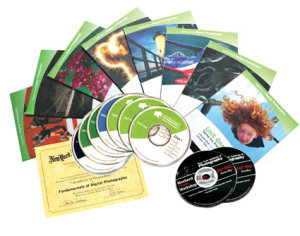
  1. Fundamentals of Digital Photography – worth $ 499
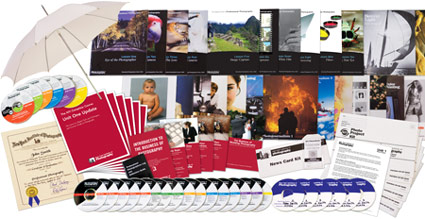
  2. Complete Course in Professional Photography – worth $ 1,499
  3. Photoshop for Photographers – Worth $ 1,499
  4. Complete Course in Video Making and Storytelling – Worth $ 1,499
  5. Marketing for Photographers – Worth $ 999

All courses include comprehensive and illustrated lesson books, CD Audio Guides, DVD Video Training, Photo Projects and Professional Evaluation and Personal Student Advisers.

NYIcoursephoto1

Learn a little more about how New York Institute of Photography works in this video:

How to Win

To win this competition you’ll need to:

  • Visit the above five course information pages and choose which of the courses suits your needs more. Choose one that you’d like to win.
  • Leave a comment below and tell us which one you’d like to win and WHY you’d like to participate in the course. Please note: there is a limit of 1 entry per person.
  • Do this in the next 8 days and on Thursday, October 24th, the team at NYIP will choose the best 5 answers and we will announce the winners in the following days.

The deadline for entries is Wednesday, October 23rd, Midnight PDT. Comments left after deadline will not be considered.

By ‘best’ – we’re looking for people who have an understanding of what the course offers and how it suits their needs. So you’ll need to check out the course pages to put yourself in the best position to win.

There’s no need to write essay length comments to win – but we’re looking to hear what you like about the course and how it would help your development as a photographer.

This competition is open to everyone around the world no matter where you live – but there is only one entry per person.

To enter – simply leave your comment below.

Disclaimer: NYIP is a paid partner of dPS.

Post originally from: Digital Photography Tips.

Check out our more Photography Tips at Photography Tips for Beginners, Portrait Photography Tips and Wedding Photography Tips.

Win One of Five Photography Courses from New York Institute of Photography

The post Win One of Five Photography Courses from New York Institute of Photography by Darren Rowse appeared first on Digital Photography School.


Digital Photography School

 
Comments Off on Win One of Five Photography Courses from New York Institute of Photography

Posted in Photography


Samyang announces five full frame E-mount lenses

16 Oct

samyang.png

Samyang has announced that it will be making five full frame lenses in E mount, which will be available within 2 months. The lenses are all based on existing designs, namely the 14mm f/2.8 ED AS IF UMC, 24mm f/1.4 ED AS IF UMC, 35mm f/1.4 AS UMC, 85mm f/1.4 AS IF UMC, and the T-S 24mm f/3.5 ED AS UMC tilt-and-shift. All feature manual focus and aperture operation too. As these are essentially SLR lenses with an adapter tube permanently fitted, they won’t offer any of the size advantages achievable by ‘native’ lenses.

News: Digital Photography Review (dpreview.com)

 
Comments Off on Samyang announces five full frame E-mount lenses

Posted in Uncategorized


Sony announces five full-frame E-mount ‘FE’ lenses, updates 70-200mm

16 Oct

SEL2470.png

Sony has announced no fewer than five ‘FE’ full frame E-mount lenses to accompany the A7 and A7R. First up is the FE 28-70mm F3.5-5.6 OSS, an image-stabilised ‘kit’ zoom for the A7. There are three premium lenses with Zeiss badges: the FE 55mm F1.8 ZA Carl Zeiss Sonnar T*, the FE 35mm F2.8 ZA Carl Zeiss Sonnar T*, and the FE 24-70mm F4 Carl Zeiss Vario Tessar T*. The fifth lens is a ‘G’ class telezoom, the FE 70-200mm F4 G OSS. Sony has also updated its Alpha-mount fast telezoom to make the 70-200mm F2.8G SSM II. 

News: Digital Photography Review (dpreview.com)

 
Comments Off on Sony announces five full-frame E-mount ‘FE’ lenses, updates 70-200mm

Posted in Uncategorized