Your First DSLR
For whatever the reason, you’re ready to buy your first DSLR. It could be that your point-and-shoot isn’t cutting it anymore in regards to features, speed, or image quality, or it could be that you’d like to turn photography into more than a rarely-touched hobby.

By Romain Ballez
DSLR (Digital Single Lens Reflex) cameras are what the vast majority of professional photographers use to get the job done. Unlike point-and-shoot camera models, which record light (and therefore an image) onto an electronic sensor directly, a DSLR uses a mirror to bounce the light from a scene through an internal system and into a viewfinder or an electronic sensor, in the case of an open shutter.
These cameras also allow for interchangeable lenses, giving you a wide array of options in regards to focal lengths and quality. There are, of course, advantages and disadvantages to DSLR systems, but at the end of the day, these cameras offer the features and quality required by advanced hobbyists and professionals.
What You’re Looking For
There’s no denying it, this is a big purchase for you. No, you’re not looking for a top-of-the-line, full-featured beast this go round; you need the best possible piece of equipment for a reasonable price. You need bang for your buck.
Whether photography is a passionate hobby or a hopeful profession of the future, you are in a learning phase, and need a camera that will compliment that objective well. While current-generation point-and-shoots can be great products, DSLR’s do have a few advantages.
Larger Sensors
As a rule, DSLRs have a larger photo-sensitive digital sensor, which usually translates to better image quality. Please note that this has nothing to do with megapixels or resolution, neither of which are, by themselves, indicators of image quality.
Interchangeable Lenses
While there are some point-and-shoot systems beginning to offer interchangeable lenses, by and large, DSLR’s have the market dominated in this area. Not only do the big camera companies have their own lenses, third-party companies such as Sigma and Tamron offer great selections as well. There is a lens out there for virtually every application you can imagine.

By János Csongor Kerekes
A Viewfinder
Instead of the usual LCD screen present in point-and-shoot cameras, DSLR’s collect light from the lens, direct it to the mirror, and through the viewfinder, giving you an almost exact representation of what is being captured on the sensor.
Advanced Features and Controls
Namely, manual controls. While point-and-shoots usually feature the ability to modify settings, DSLR’s are built from the ground up with manual control in mind. ISO ranges are higher with reflex cameras, and larger sensors combined with precise aperture controls allow for controlled depth of field in your photos.
Speed
DSLR’s are known for their faster shutter and system speeds, and in the world of photography, speed is usually a good thing.
There are countless brands of equipment, but as far as DSLR’s go, there are the big three – Canon, Nikon, and Sony.
Recently, Pentax has been gaining ground again, and there are more expensive offerings available from companies like Leica and Hasselblad. For our purposes, we’ll stick to the big three, as they are all known for offering outstanding entry-level cameras within their product lines, and can be relatively inexpensive.

By Elias Ruiz Monserrat
What to look for when buying that all-important first SLR camera?
Image Quality
Image quality is usually the most important requirement of a new camera for photographers, and it’s also one of the most subjective. The quality of the photos a camera produces is dependent on several factors, including sensor size, lens quality, and the optics of the camera itself.
Feature Set
While almost all DSLR’s have a common set of features (such as the ability to shoot manually), some brands and models have automated some features, while others have not, or do not have those features at all. Different cameras have varying usable ISO ranges, autofocus points, and resolution (in megapixels).
Design
Although usually not the first thing you think of with an entry-level camera, buying a model with a solid design is still important. Some less expensive cameras have all plastic housing, whereas others may use more heavy-duty materials such as metal; others still may be weatherproof to a certain degree.
Even at the price points we’re discussing, it’s a good idea to research that aspect of the prospective camera as well, and buy as solid a model as possible.

By Jung-nam Nam
Cost
We’re talking entry-level, for the scope of this article, so cost will be a factor. Obviously, the more money you’re able to spend, the more advanced system you can get. Keep in mind however, that often with entry-level models, differences between the cameras can come down to feature sets, with image quality staying more or less the same.
Remember that the quality of the lens you’ll be attaching to the camera is more of a determining factor in the quality of the photo.
Where to Buy
Luckily, you have several options in this area. Gone are the days where you could only buy a camera at your local Wolf Camera (and unfortunately, gone are the Wolf Camera stores, as well). Now there are virtually limitless retail outlets and sellers online, carrying every system and component a photographer could need. You can order your camera from your living room and have it delivered to your house a few short days later, without ever leaving home.
Amazon, B&H Photo, and Adorama are all large, respectable retailers you can shop with, and are among the most popular today.
The Contenders
Canon EOS Rebel T5i
The Canon Rebel series has a long-standing tradition on solid, quality cameras at a reasonable price. While I won’t start a brand war here, it’s well-known that most photographers end up settling on either Canon, or Nikon.
The Rebel series has come a long way from the days of the XS, and the latest generation of Rebel cameras are much closer to Canon’s midrange line than before, with better sensors, more features, and hardier construction.

Canon Rebel T5i
The T5i is an 18MP (megapixel) camera, with an ISO range of 100 – 12800 (expandable to 25600). It also features a 3 inch Vari-angle Touchscreen LCD, 9 AF (autofocus) cross points, 5 fps (frames per second) continuous shooting speed, and shutter speeds up to 1/4000 second.
As with most entry level systems, if you opt for the full kit, you’ll get the standard 18-55mm IS (image stabilization) zoom lens. While very good for learning novices, you’ll want to upgrade to a cheap prime such as the excellent Canon EF-S 50mm f/1.8 or something similar, as the cheaper build and documented chromatic aberration issues with the kit lens could leave you wanting a bit more. Note that this applies to all kit lenses on the entry-level cameras we’re discussing here.
Nowadays, as systems get more advanced, HD video recording is becoming more of a requirement, and the T5i delivers this as well. As of this writing, the T5i kit is selling for $ 649.99.
Nikon D3300
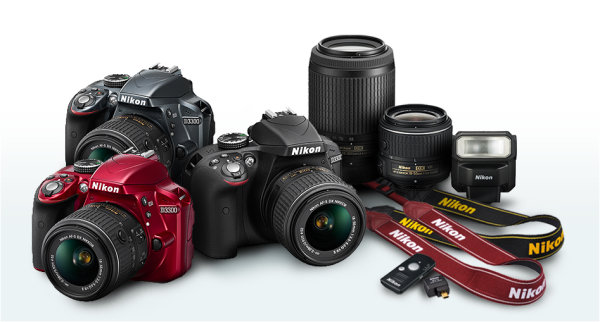
Image courtesy Nikon
Nikon upped their game with the D3300, equipping the camera with a generous 24 megapixels of resolution in a solid, compact, carbon fiber enhanced body. This model gives you, the budding photographer, an ISO range up to 12,800 (expandable up to 25,600), 11 autofocus points, and 5 frames per second of continuous shooting, along with a 3″ LCD screen that matches the Canon model.
Just as with the Canon T3i, the D3300 supports shutter speeds up to 1/4000th of a second and allows for 1080p HD video recording. Retailing around the $ 500 mark, the body and lens bundle includes the Nikkor 18-55mm 5.6 VR II lens, a relative equivalent to Canon’s 18-55mm kit lens.
Sony A58
Usually considered the third wheel of the big three, Sony is known more for their other forays into the electronics world than their digital cameras, but don’t let this fool you; they know how to make a good DSLR, and the SLT-A58 is a wonderful example of that.
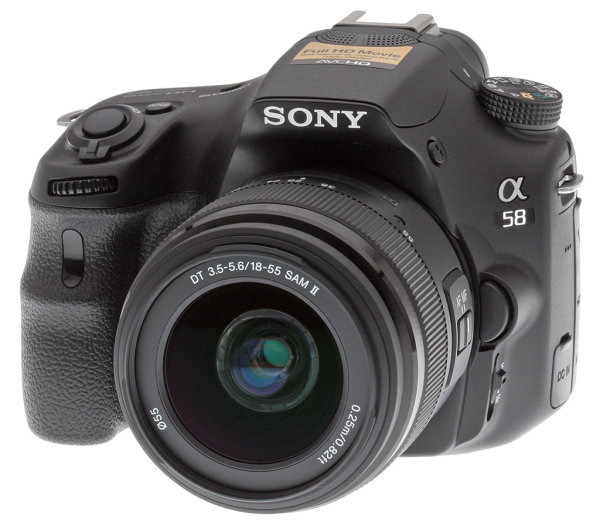
Image courtesy Sony
Dipping even lower in price and the lowest of all three at $ 450, the A58 gives you quite a bit for that price point. This 20.1 megapixel camera offers a respectable ISO range up to 16,000, and is expandable up to 25,600. Leading the pack, this model offers 15 autofocus points, but forces you to give up a little bit with the smallish 2.7″ LCD screen.
Battery life has been improved fairly drastically on the A58 in comparison to previous entries in the series, and for such a budget-friendly camera, it features a surprisingly big and bright viewfinder.
Conclusion
So which one is right for you? Any of these – or none of these. The answer lies in what you’re looking for, and what concessions you’re willing to make for the budget you have. All of these are excellent cameras, and were chosen because of what they offer for the price, but that doesn’t mean there aren’t other cameras that would serve the purpose just as well or even better.
The prices we’ve discussed all include a kit lens to get you started, but be aware, these are usually the lowest-end optics available, and you’ll want to upgrade as soon as possible to another piece of glass. Also, in most cases you have the option of buying the camera body only, and picking out your lenses separately, which reduces your upfront cost of the DSLR itself. There are literally hundreds of lenses to choose from; just ensure they will fit your camera’s mount before purchasing.
At the end of the day, you want a camera that will facilitate the learning process you’re going through, so choose a camera that assists in that purpose, without breaking the bank.
Bought Your First DSLR? Here’s How to Learn How to Use it!
Check out our Ultimate Guide to Learning How to Use Your First DSLR.
Also check out our Photography Tips for Beginners page for lots of great photography tutorials suitable for first time DSLR buyers.
googletag.cmd.push(function() {
mobile_slots.push( googletag.defineSlot( “/1005424/_dPSv4_mob-all-article-bottom_(300×250)”, [300, 250], “pb-ad-78158” ).addService( googletag.pubads() ) );
} );
The post Guide to Buying Your First DSLR by Tim Gilbreath appeared first on Digital Photography School.








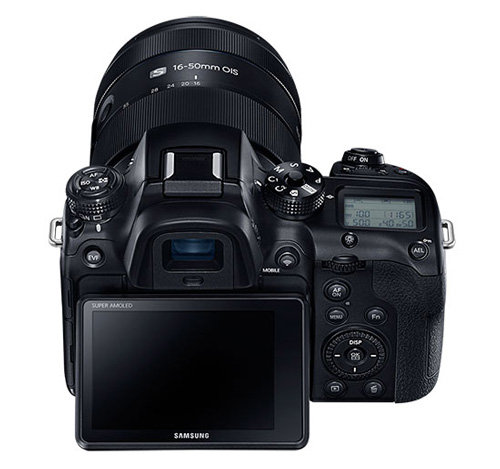
 Canon introduced the new 7D Mark II recently to a lot of fan fair and hype. But does it live up to all of that? Some of the things that are really exciting include: