RSS
 

Posts Tagged ‘film’

20×24 Studio will stop producing Polaroid 20 x 24 film next year

25 Jun
20 x 24 camera designed and built by Tracy Storer, Operator of Polaroid 20×24 Studio West

The Polaroid 20 x 24 is facing extinction as the last company producing the large-format instant film, 20×24 Studio, has announced plans to stop production at the end of 2017. 

The studio and its owner John Reuter originally purchased an original Polaroid 20 x 24 camera from Polaroid after it declared bankruptcy in 2008, as well as hundreds of cases of existing film for it. The company sought to keep the format alive by producing its own iteration of the cameras and film, but a lack of demand and other issues have forced it to abandon that dream.

In a statement posted on 20×24 Studio’s website, Mr. Reuter said:

“Our hope now is that we can work on some great projects with many of our legacy clients as well as new artists who have yet to experience the ultimate in instant analog image making. Our original business plan was for five years with the inventory purchased and for a variety of reasons we have not worked through the material. Instant film will not last forever and despite storing the film stock in cold storage and mixing the chemical reagent only as needed the studio projects that they can maintain the quality for two more years.”

Elaborating on this to the New York Times, Mr. Reuter said it would take a massive ‘multimillions’ investment to continue producing the film, something that isn’t feasible for the company given the relative lack of demand. As it stands, the camera itself costs $ 1750 to rent per day and each film exposure costs $ 125. Mr. Reuter anticipates the existing stock being used up by the time 20×24 Studio closes its doors next year.

Take a look below at the 20×24 camera in action as Douglas Doubler photographs ballet dancer Rachelle di Stasio. 

Via: New York Times

Articles: Digital Photography Review (dpreview.com)

 
Comments Off on 20×24 Studio will stop producing Polaroid 20 x 24 film next year

Posted in Uncategorized


Google teams with IMAX to create next-gen VR rigs for the film industry

21 May

At its I/O developer conference this week, Google announced a new partnership with IMAX to develop next-gen VR camera rigs for use in the film industry. These camera rigs will be different than Google’s previously unveiled GoPro VR rig, but will likewise utilize the company’s Jump virtual reality platform for post-processing. The cameras are being created in part with tech from Chinese company Yi Technology. Likewise, IMAX has announced plans to open VR experience spaces in six locations across the US.

The companies haven’t revealed any details about the planned cameras at this time, except that they will feature Jump integration. The announcement comes at a time when competing high-end VR cameras have made public debuts, including the 4K-capable $ 2500 Sphericam 2 and Nokia’s $ 60,000 OZO camera.

Via: Yahoo

Articles: Digital Photography Review (dpreview.com)

 
Comments Off on Google teams with IMAX to create next-gen VR rigs for the film industry

Posted in Uncategorized


Oh Snap! 15 Abandoned & Shuttered Fotomat Film Kiosks

09 May

[ By Steve in Abandoned Places & Architecture. ]

abandoned-fotomat-1a
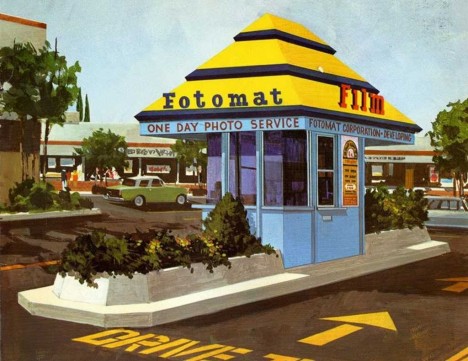
Rendered obsolete by technology, hundreds of abandoned Fotomat drive-thru photo development kiosks still stand in suburban shopping center parking lots.

abandoned-fotomat-1b

abandoned-fotomat-1c

Founded in the mid-1960s, Fotomat specialized in drive-thru, “One Day Photo Service”… that’s right kids, people once had to wait until the next day to see photos (presumably of dinosaurs) they took with their clunky analog cameras. By 1980, over four thousand yellow & blue, pyramid-roofed Fotomat kiosks were scattered across suburban parking lots from coast to coast. Built to last on cast-concrete berms, hundreds of abandoned and re-purposed Fotomat kiosks still stand, reminding us of better days and good times cast in Kodachrome.

Wooden It Be Nice

abandoned-fotomat-2a

abandoned-fotomat-2c

Fotomat Corporation sold out to Konica in 1986 – a timely move to be sure, considering the late-1980s advent of film processing minilabs that reduced photo development time from a day to just an hour. Now that’s progress! The subsequent introduction of digital cameras and then, camera-equipped smartphones were the final nails in Fotomat’s coffin.

abandoned-fotomat-2d

abandoned-fotomat-2b

While some Fotomat booths were re-purposed into key-cutting kiosks, coffee drive-thru’s and so on, others were reborn in wholly unexpected ways. Flickr user Patrick Cummins (collations) brings us this odd ex-Fotomat located in a shopping center parking lot in northern Toronto, Canada. The kiosk appears to have been made over as some sort of naturist art project before being abandoned for good.

Unloved In Lovington

abandoned-fotomat-3a

When you’re a Fotomac or Fotomate (as male and female staffers were cutely called) staffing a Fotomat kiosk in Lovington, New Mexico, your worst nightmare would be when the air conditioner conked out. At least one could compare miseries with whomever staffed that curious windmill booth in the near background. Flickr user Luis Capwell captured the poignant essence of this roofless abandoned Fotomat on March 5th of 2011.

A-Peeling

abandoned-fotomat-4a

abandoned-fotomat-4c

This faded & abandoned Fotomat kiosk in Dayton, Ohio lost its appeal long ago – even the OPEN/CLOSED sign has seen better days. “Yes, We’re Open”? No, you’re not.

abandoned-fotomat-4d

abandoned-fotomat-4e

A weathered coat of desultory grey/brown paint grudgingly reveals the booth’s original sky-blue walls through cracks encouraged by numerous bitter Ohio winters. Even the concrete is peeling. Flickr user Rob Anspach (Circa71) visited the decrepit former Fotomat at the Linden Shopping Center in April of 2009, if only to take photos – not leave them.

Forlorn & For Lease

abandoned-fotomat-5a

“The cute little hut with the big yellow roof”… now there’s a Kodak moment for ya! On August 21st of 2007, Flickr user Joe Balynas (muledriver) photo-documented the above ex-Fotomat (most recently, a drive-thru coffee shack) looking for a further reincarnation. The jumbo add-on fluorescent sign should help.

Next Page – Click Below to Read More:
Oh Snap 15 Abandoned Shuttered Fotomat Film Kiosks

Share on Facebook


[ By Steve in Abandoned Places & Architecture. ]

[ WebUrbanist | Archives | Galleries | Privacy | TOS ]


WebUrbanist

 
Comments Off on Oh Snap! 15 Abandoned & Shuttered Fotomat Film Kiosks

Posted in Creativity


Revisiting Film Photography After 10 Years: The Readjustment

28 Apr
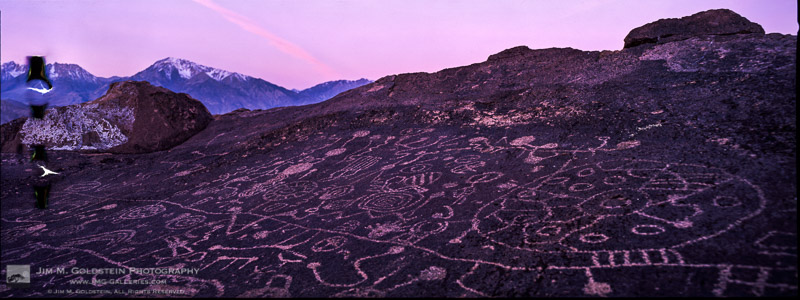
Early morning light illuminates Skyrock and the eastern Sierra Mountains

Early morning light illuminates Sky Rock and the eastern Sierra Mountains

This is the 1st of a 3 part series on my experience jumping back into film photography after a 10 year hiatus focusing purely on digital photography.

The Camera
10 years ago I vowed I’d never shoot film again. I enjoyed shooting film to a degree, but compared to digital it became unnecessarily onerous. Back in the day I was shooting 35mm and medium or large format photography was both imposing and expensive. As much as I said “never again” to film there was a 0.01% chance I might jump back in, but it would only happen if I ever landed a very special camera. In the late 90’s I always dreamed of owning Fuji 6×17 medium format film cameras. They were used by top landscape photographers and produced amazing panoramic photos. These cameras and their lenses are so good it’s one of the few film camera systems that have held their value the longest. Fast forward to 2013, I set up an eBay alert for GX617 cameras in the event the right camera at the right price surfaced. It only took a couple of years but earlier this year the right camera finally surfaced. I found someone selling a pristine Fuji GX617 with a 90mm lens (20mm equivalent for 35mm cameras) and 50 plus roles of 120 film. Even still it was a bit of a hit to my budget, but I finally took the plunge.


A photo posted by Jim Goldstein (@jimgoldstein) on

Fundamentals
This Fall when I decided to dedicate a trip to using my new 6×17 camera I started to wonder if I’d be able easily transition back to film photography. On one hand I didn’t want to waste any of the film I acquired (Fuji Velvia 50 & 100) and on the other I was concerned I’d take a hit to my pride feeling like a beginner again. As I dove in using the camera it became clear that my nerves were unwarranted in this area. A firm understanding of photography fundamentals will take you far no matter what system you use.

That said the Fuji Gx617 is very different than a modern DSLR and if there was anything that made me feel like a beginner again it was my lack of familiarity with how this camera functioned. The camera doesn’t have a mirrored viewfinder to preview your composition. Instead it has a dedicated viewfinder for each lens to approximate what will be exposed. The lenses are focused based on the approximate distance of your subject from the camera. Aperture is set manually with levers. A roll of 120 film produces 4 exposures and changing lenses mid-roll is not an option as it will expose the entire roll of film. Becoming reacquainted with manual photography versus relying on a variety of automatic systems we take for granted every day with 35mm DSLRs was quite eye opening.

Methodology
If any one thing tripped me up in my use of the Fuji GX617 it was establishing a routine to avoid basic mixups on selecting my camera settings. Even compared to my 35mm film SLR this was quit an adjustment. Film and digital SLRs enjoy a certain degree of automation where as a camera like the GX617 requires every setting to be made manually. After a couple slip ups I finally established a routine of composing my subject with the “external” viewfinder, check distance, set lens focus, using a light meter to determine exposure settings, set aperture, set shutter speed, and finally tripped the shutter via a cable release.

It all sounds logical, but being new to the camera it took some time to get this routine down. Distractions were plentiful so more than a few exposures were lost as a result of breaking from this routine. Sometimes the basic step of recomposing my next shot was enough for me to miss a basic setting adjustment. Complicating things further was retraining my brain to visualize how each focal length and aperture setting will translate to the medium format look versus 35mm. As an example 300mm on this system equates to 73.5mm on a 35mm system. Also depth of field is different for equivalent aperture settings.  The fun was in the discovery.

Intent & Purpose
One thing that I found incredibly refreshing while using the Fuji GX617 was how the manual settings helped me slow down and connect with my subject more. The manual operation of the camera granted me time to take in my surroundings, more thoroughly observer my subject and feel more connected with Nature.  I was far less prone to jump into a scene, rapidly setup & fire off shots and then bolt to the next location. The combination of camera adjustments taking time and only having 4 exposures to a roll put me in a mindset of wanting to get the most out of the location I was photographing. If I was going to use a precious frame of film and devote the time to set up I made sure that my image was going to not just expose correctly, but connect with viewers & myself. The end result was a much more thoughtful effort with less wasted time and film that produced higher quality results.

Continue on to Part 2 in this series – Revisiting Film Photography After 10 Years: Composing Through New Eyes

The post Revisiting Film Photography After 10 Years: The Readjustment appeared first on JMG-Galleries – Landscape, Nature & Travel Photography.


JMG-Galleries – Landscape, Nature & Travel Photography

 
Comments Off on Revisiting Film Photography After 10 Years: The Readjustment

Posted in Equipment


Revisiting Film Photography After 10 Years: Composing Through New Eyes

27 Apr
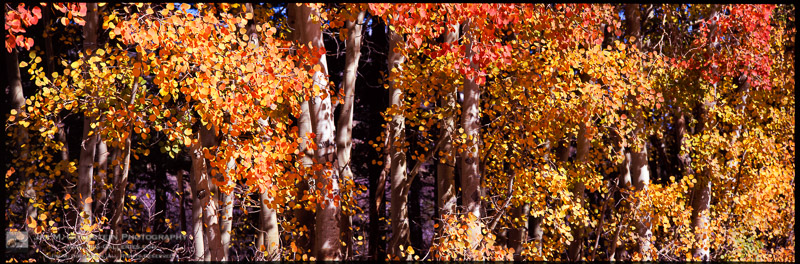
Aspen Tree Fall Color in the Eastern Sierras of California

Aspen Tree Fall Color in the Eastern Sierras of California

This is the 2nd of a 3 part series on my experience jumping back into film photography after a 10 year hiatus focusing purely on digital photography. You can start here at Revisiting Film Photography After 10 Years: The Readjustment if you missed it.

Mental Math & Visualization
As I’ve been shooting with the Fuji GX617 I’ve had to make a bit of a mind-shift in my approach. On one hand I have to account for slightly different mental calculations regarding how medium format focal distance, depth of field and vignetting might impact my composition. This is rooted with the fact that medium and 35mm formats follow the same mathematics, but the calculations for similar units (focal length, aperture, etc.) result in different visual aesthetics. 90mm focal distance on the GX617 equates to 20mm on a 35mm camera and a 300mm lens on the GX617 equates to ~70mm on a 35mm camera. f/8 on the GX617 is shallow for closer subjects while not so for most images on a 35mm camera. It’s an interesting adjustment, but frustrating if you forget or don’t fully make the right mental calculations as you’re taking photos. After all mistakes on film have a financial cost.

Volume versus Quality
Back in October when I took out the Fuji GX617 and the Canon 5DS R on a trip I found it notable how different my approach to shooting was with each camera. Unsurprisingly I shot less with the film camera and was much more generous in my shooting with my DSLR.  I spent a lot more time on my film shots to focus on correct exposure and composition. With 4 exposures to a roll I took greater care to work a scene by walking around, looking for different angles, check focus, check settings, double check settings and account for various lighting conditions before triggering the shutter. The net result was feeling more connected to the scene I was photographing.

My efforts with the DSLR were much quicker and as a result I took more photos. Shooting RAW affords you to work fast and loose. It was eye opening to see how fast and loose normal shooting has become for me. Jumping back to film made that all too clear. The digital format affords you the ability to:

  1. Salvage an image with +/- 2 stop latitude (potentially more if you use a newer digital camera)
  2. Have virtually no exposure (image count) limitation creating an “insurance” mentality where you take additional photos to account for lighting or weather variations or just to cover lazy technic
  3. Change ISO or lenses during a single composition on a DSLR in the event you realize your initial approach isn’t working


In the end the ratio of digital versus film photos taken on my trip was 1:20. For every film photo taken I took 20 digital photos, but that said I utilized my DSLR to experiment and photograph a much broader array of subjects. As for the photos I considered keepers and worth sharing the ratios broke down as follows:

  • 1 out of every 9 film photos taken was sharp enough and composed well enough to share and/or print.
  • 1 out of every 7 digital photos taken was sharp enough and composed well enough to share and/or print.


Seeing photos that didn’t work out on film were much more painful. Psychologically I felt more angst either because of lost opportunities or the cost associated with a blown roll of film. I’m not sure if my history of shooting film makes me more or less prone to take extra digital photos for insurance than the average photographer, but it certainly has an impact on my emotional state.

Emotive Photographs
Beyond concerns about technical proficiency and productivity I was most concerned about being able to capture images that deeply resonated with me. It’s one thing to say that I got 5 or 100 publishable photos and it’s another to state that they’re photos I think will resonate with others let alone me. Sharp photos, well composed photos, etc. don’t always equate to a great photo.  Images that resonate more deeply are not just about sharpness and composition, but atmosphere, artistic presentation and often “je ne sais quoi”. I’ve yet to compile stats for this as I’m still evaluating images from this trip, but if history is a guide the volume is always low.

The jump back into film has been interesting, fun and even anxiety provoking at times. Most of all it’s been eye opening in how I work, compose and think about photography in general.

Continue to Part 3 in this series – Revisiting Film Photography After 10 Years: Development & Post

The post Revisiting Film Photography After 10 Years: Composing Through New Eyes appeared first on JMG-Galleries – Landscape, Nature & Travel Photography.


JMG-Galleries – Landscape, Nature & Travel Photography

 
Comments Off on Revisiting Film Photography After 10 Years: Composing Through New Eyes

Posted in Equipment


Revisiting Film Photography After 10 Years: Development & Post

26 Apr
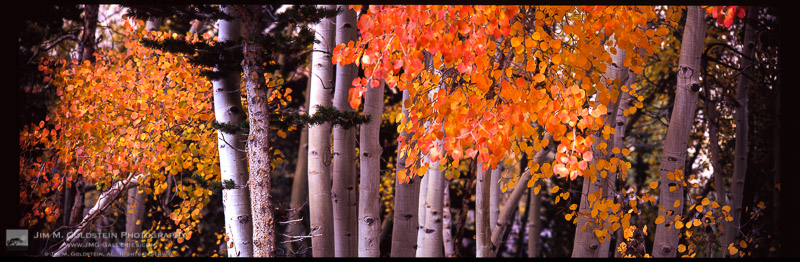
Brightly colored Aspen leaves cling to branches as Fall comes to an end in the Sierra Nevada mountains.

Brightly colored Aspen leaves cling to branches as Fall comes to an end in the Sierra Nevada mountains.

This is the 3rd of a 3 part series on my experience jumping back into film photography after a 10 year hiatus focusing purely on digital photography. You can start here at Revisiting Film Photography After 10 Years: The Readjustment if you missed it.

Withering Vine of Development vs Hipster Revival
These days you hear a lot about how film development has withered away to virtually nothing and I even wrote Film is Dead. No Really! back in 2009 . Depending where you are this may indeed be true. Long gone are the days of having easy access to development at a corner store. In that regard my post from 2009 still holds true. Luckily for me I live near San Francisco and the hipster revival of film has helped keep a few developers, like Light Waves Imaging, alive and kicking. Before finally going to Light Waves I did call around for other alternatives and the few mom and pop stores remaining ship their customers positive film to larger developers elsewhere in California. Rather than wait I opted to drive to Light Waves and pick up my film in 24-48 hours.

Pains of Review and Scanning
It took a while to get used to waiting to see the outcome of my Eastern Sierra shoot on film. It didn’t help that I had immediate access to images I took in parallel on a DSLR. This heightened my interest in seeing my film exposures because I wanted to see how the two formats compared. The last time I shot film side by side with a DSLR it was with an 8.5 megapixel sensor (1.3x crop) Canon 1D Mark II. On this trip I was shooting with a Canon 5DS R which utilizes a 50 megapixel sensor.

When the time came to pick up my film I brought my 5 year old son along and he had plenty of questions at the store counter as to what film was and why it was different than my digital camera. That in itself was a surreal experience as he has only seen digital photographs to this point. I had fun showing him how the images looked on the store light box, but it was still a fairly abstract concept for him to absorb. After spot checking a couple frames on each roll to see if there were any absolute failures (luckily there were not) we headed home. That evening I quickly learned that my old light box was missing a power cord and in a fit of impatience I started using my iPad as a light box. Considering this worked relatively well, but with a loop you see pixels behind your film and I found it distracting. I priced light boxes to buy, but opted to hold off and scanned each frame on my Epson V700 photo scanner.

Am I A Film Worthy Photographer?
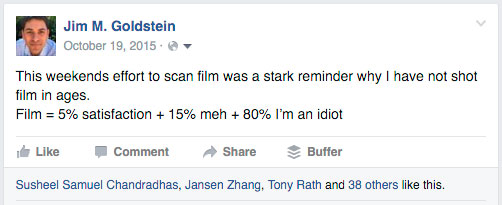
I have to admit I was nervous about jumping back into film after 10 years because I wasn’t sure how well I’d hold up to a very unforgiving format. You have a finite number of frames to expose, limited latitude in dynamic range, and a variety of ways to mess up an exposure. I wasn’t a bad film photographer back in the day, but I forgot how bad failed film images made me feel. It’s a miracle I stuck it out with photography. One of the nights I was scanning film I summed up my feelings about film photography on Facebook with the following update:

Film = 5% satisfaction + 15% meh + 80% I’m an idiot

Film = 5% satisfaction + 15% meh + 80% I’m an idiot

In the end I turned out to be a “worthy” film photographer. The stats turned out as follows:

  • 29% (13/45) are worthy of working further on (sharp, decent composition, etc.)
  • 11% (5/45) are likely worthy of sharing/printing from the 6×17.
  • 7% (3-4) are likely worthy of sharing from my pinhole camera.
    Note: Each roll of film was comprised of 4 exposures.

The numbers weren’t super impressive, but having >10% of my exposures being worthy of sharing and printing surpassed my expectations. Knowing that while using a new camera system for the first time I could get decently sharp exposures balanced the horrible dread I felt looking at each exposure where I didn’t advance the film properly, under/over exposed, mis-focused, and/or made poor composition choices.

Post-Production
One thing that remained universal 10 years on was how frustrating the results are from scanning film. Whether using a negative or flatbed scanner the resulting scan is soft and looks like a muted version of the film itself. One good thing about the downfall of film is that drum scans are much more reasonably priced. That said for my first time out, flatbed scans were good enough for sharing online.

Looking at my film to edit in Lightroom and Photoshop I felt as though I was transported back in my frustrated younger self 10 years earlier. Other than the interface of the software nothing had changed in the sense that I was color correcting, spotting and sharpening my scans. I found myself meticulously removing color casts with curves adjustments in Photoshop, spotting my image to remove dust spots created by dust on the scanner glass or film itself and trying to resurrect the sharpness of my image after being softened in the scanning process. It made me want to jump ship again to digital… until I saw how final 6×17 image came out.

One other thing that was surprisingly refreshing was once again enjoying the look of Fuji Velvia. In an age where presets are obsessed over as much if not more than cameras I liked seeing a defined look of a particular film. One could argue that the look of film is in itself a preset, but my point here is that it’s a distinct style I long missed seeing. No attempt at a recreated look via a digital preset compares.

Concluding Thoughts
Film photography is both an exhilarating and frustrating experience. Working with a film camera in the field was refreshing. Slowing down and taking in the scene while composing & setting up was incredibly refreshing. I instantly realized how much this had been missing from my digital shoots. On the other hand waiting for my film to be developed, taking a hit to my ego each time I viewed a failed exposure and dealing with the hassles of scanning & post-processing was enough to make me unconsciously start pulling out my hair. If I wasn’t so in love with the 6×17 format I’d likely revert back to shooting digital 35mm exclusively. Luckily for my remaining rolls of 120 film I’ll be taking them out again soon. I’ll keep plugging away with 6×17 film work over the next few years for select personal projects. Film lives after all.


The post Revisiting Film Photography After 10 Years: Development & Post appeared first on JMG-Galleries – Landscape, Nature & Travel Photography.


JMG-Galleries – Landscape, Nature & Travel Photography

 
Comments Off on Revisiting Film Photography After 10 Years: Development & Post

Posted in Equipment


Lytro poised to forever change filmmaking: debuts Cinema prototype and short film at NAB

21 Apr
Lytro debuted its Cinema prototype to an eager crowd at NAB 2016 in Las Vegas, NV.

Lytro greeted a packed showroom at NAB 2016 in Las Vegas, Nevada to demo its prototype Lytro Cinema camera and platform, as well as debut footage shot on the system. To say we’re impressed from what we saw would be an understatement: Lytro may be poised to change the face of cinema forever.

The short film ‘Life’, containing footage shot both on Lytro Cinema as well as an Arri Alexa, demonstrated some of the exciting applications of light field in video. Directed by Academy Award winner Robert Stromberg and shot by VRC Chief Imaging Scientist David Stump, ‘Life’ showcased the ability of light field to obviate green screens, allowing for extraction of backgrounds or other scene elements based off of depth information, and seamless integration of CGI elements into scenes. Lytro calls it ‘depth screening’, and the effect looked realistic to us.

‘Life’ showcased the ability of Lytro Cinema to essentially kill off the green screen

Just as exciting was the demonstration of a movable virtual camera in post: since the light field contains multiple perspectives, a movie-maker can add in camera movement at the editing stage, despite using a static camera to shoot. And we’re not talking about a simple pan left/right, up/down, or a simple Ken Burns effect… we’re talking about actual perspective shifts. Up, down, left, right, back and forth, even short dolly movements – all simulated by moving a virtual camera in post, not by actually having to move the camera on set. To see the effect, have a look at our interview with Ariel Braunstein of Lytro, where he presents a camera fly-through from a single Lytro Illum shot (3:39 – 4:05):

The Lytro Cinema is capable of capturing these multiple perspectives because of ‘sub-aperture imaging’. Head of Light Field Video Jon Karafin explains that the system is made of multiple lenses (we see what appears to be two separate openings in the photo below), and behind each lens, in front of the sensor, is a microlens array consisting of millions of small lenses similar to what traditional cameras have. The difference, though, is that there is a 6×6 pixel array underneath each microlens, meaning that any one XY position of those 36 pixels under one microlens, when combined with the same position pixel under all other microlenses, represents the scene as seen through one portion, or ‘sub-aperture’ of the lens. These 36 sub-aperture images essentially provide 36 different perspectives, which then allow for computational reconstruction of the image with all the benefits of light field.

The 36 different perspectives affords you some freedom of movement in moving a virtual camera in post, but it is of course limited, affected by considerations like lens, focal length, and subject distance. It’s not clear yet what that range of freedom is with the Cinema, but what we saw in the short film was impressive, something cinematographers will undoubtedly welcome in place of setting up motion rigs for small camera movements. Even from a consumer perspective, consider what auto-curation of user-generated content could do with tools like these. Think Animoto on steroids.

Front of the Lytro Cinema, on display at NAB 2016. We see two openings, though it’s not clear how many main imaging lenses exist in the prototype yet.

We’ve focused on depth screening and perspective shift, but let’s not forget all the other benefits light field brings. The multiple perspectives captured mean you can generate 3D images or video from every shot at any desired parallax disparity (3D filmmakers often have to choose their disparity on-set, only able to optimize for one set of viewing conditions). You can focus your image after the fact, which saves critical focus and focus approach (its cadence) for post.* Selective depth-of-field is also available in post: choose whether you want shallow, or extended, depth-of-field, or even transition from selective to extensive depth-of-field in your timeline. You can even isolate shallow or extended depth-of-field to different objects in the scene using focus spread: say F5.6 for a face to get it all in focus, but F0.3 for the rest of the scene.

Speaking of F0.3 (yes, you read that right), light field allows you to simulate faster (and smaller) apertures previous thought impossible in post, which in turn places fewer demands on lens design. That’s what allowed the Illum camera to house a 30-250mm equiv. F2.0 constant aperture lens in relatively small and lightweight body. You could open that aperture up to F1.0 in post, and at the demo of Cinema at NAB, Lytro impressed its audience with – we kid you not – F0.3 depth-of-field footage.

The sensor housing appears to be over a foot wide. That huge light field sensor gets you unreal f-stops down to F0.3

But all this doesn’t come without a cost: the Lytro Cinema appears massive, and rightfully so. A 6×6 pixel array underneath each microlens means there are 36 pixels for every 1 pixel on a traditional camera; so to maintain spatial resolution, you need to grow your sensor, and your total number of pixels. Which is exactly what Lytro did – the sensor housing appeared to our eyes to be over a foot in width, sporting a whopping 755 million total pixels. The optics aren’t small either. The total unit lives on rails on wheels, so forget hand-held footage – for now. Bear in mind though, the original technicolor cinematic camera invented back in 1932 appeared similarly gargantuan, and Lytro specifically mentioned that different versions of Cinema are planned, some smaller in size.

The Lytro Cinema is massive. The sensor is housed in the black box behind the orange strut, which appears to be at least a foot wide. It comes with its own traveling server to deal with the 300GB/s data rates. Processing takes place in the cloud where Google spools up thousands of CPUs to compute each thing you do, while you work with real-time proxies.

So what does 755MP get you? A lot of data, for starters. We spoke to Lytro some time back about this, and were told that the massive sensor requires a bandwidth of around 300GB/s. That means Lytro Cinema comes with its own server on-set to capture that data. But processing that data isn’t easy either – in fact, no mortal laptop or desktop need apply. Lytro is partnering with Google to send footage to the cloud, where thousands of CPUs crunch the data and provide you real-time proxies for editing. One major concern with Lytro’s previous cameras was the resolution trade-off: recording angular information means that spatial resolution is sacrificed. The Illum had a roughly 40MP sensor, yet yielded only roughly 5MP images, a roughly 10-fold resolution cost. With 755MP though, even a 10x resolution cost would yield 76MP – well above the requirements for 4K video.**

Thousands of CPUs on Google’s servers crunch the data and provide you real-time proxies for editing

Speculation aside, the 4K footage from the Lytro Cinema that was mixed with Arri Alexa footage to create the short ‘Life’, viewed from our seating position, appeared comparable to what one might expect from professional cinema capture. Importantly, the footage appeared virtually noise free – which one might expect of such a large sensor area. Since image data from many pixels are used for any final image pixel, a significant amount of noise averaging occurs – yielding a clean image, and a claimed 16 stops of dynamic range.

That’s incredibly impressive, given all the advantages light field brings. This may be the start of something incredibly transformative for the industry. After all, who wouldn’t want the option for F0.3 depth-of-field with perfect focus in post, adjustable shutter angle, compellingly real 3D imagery when paired with a light field display, and more? With increased capabilities for handling large data bandwidths, larger sensors, and more pixels, we think some form of light field will exist perhaps in most cameras of the future. Particularly when it comes to virtual reality capture, which Lytro also intends to disrupt with Immerge.

It’s impressive to witness how far Lytro has come in such a short while, and we can’t wait to see what’s next. For more information, visit Lytro Cinema.


* If it’s anything like the Illum, though, some level of focusing will still be required on set, as there are optimal planes of refocus-ability.

** We don’t know what the actual trade-off is for the current Lytro Cinema. It’s correlated to the number of pixels underneath each microlens, and effective resolution can change at different focal planes.

Articles: Digital Photography Review (dpreview.com)

 
Comments Off on Lytro poised to forever change filmmaking: debuts Cinema prototype and short film at NAB

Posted in Uncategorized


4 Things You Can Learn From Film and How to Apply Them to Your Digital Photography

15 Apr

Since the introduction of digital cameras, photography is becoming more and more popular amongst everyone. This is largely due to the fact digital has dramatically reduced the cost of taking photos, as they no longer required to be developed, and the recording media (SD or CF cards) can be reused. Another fantastic advantage of digital, is the instant replay it gives you of the photo just taken, giving you the option to correct any flaws in the image. This is something that could not be done with film, and each photo taken would cost money; regardless of how great it was, or was not.
Digital Film

Digital technology has come so far in the last several years that it is out-performing film on almost every level; for example, camera’s can now go up to ISO 3.2 million – an ASA (film equivalent to ISO) level that was never even considered during the films days.

But does this mean that film is useless, and has nothing to offer? Absolutely not. Regardless of whether film is making some sort of a resurgence or not, there are still many things that film can teach you about photography, that digital simply cannot. Here are some thing that shooting with film can teach you better than what digital capture can do:

1. SELF CONFIDENCE

With the immediacy of the feedback that digital cameras provide you, it is all too easy and tempting to continually check your camera’s LCD to see how your photo has turned out. This tendency to keep looking at the LCD is often referred to as chimping. You may chimp for various reasons, ranging from ensuring your photo is correctly exposed (the most common reason), in focus, or seeking self-gratification that you’ve done a good job.

Now, imagine you were photographing with film. You would not be able to see your photos straight away; you’d have to wait a week or even two! You would not be able to see if the photo was correctly exposed, or pat yourself on the back about getting a great frame – at least not right away!

Film taught photographers to read the light and tones within their environment, and to learn how to use their tools correctly. This built confidence within photographers to trust in their own abilities and decisions. It meant that photographers would worry less about receiving positive reassurance on the photo they’d just taken; they knew that they had exposed and focussed correctly and kept going. There was no ,”Hold on, I’ll just check to make sure your wedding dress is correctly exposed”, or “I missed that shot because I was checking my exposure.”
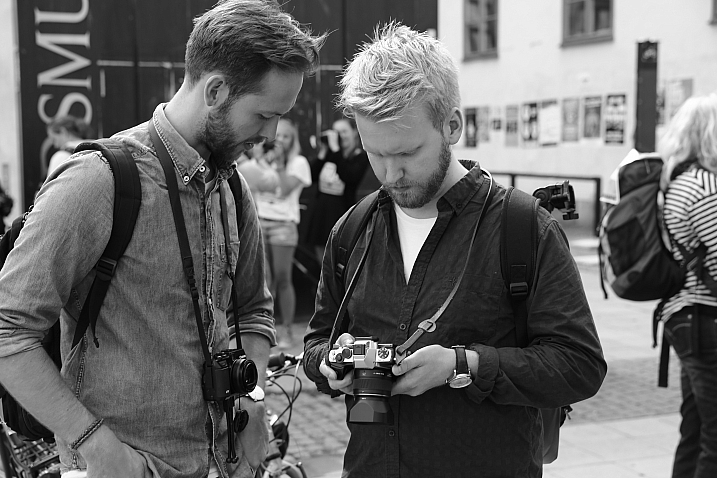
Fredrik Holmberg

By Fredrik Holmberg

So why is chimping a bad habit? Because it says that you are not that confident in your own abilities and judgement, and you need the constant reassurance that you are doing a good job. It results in you potentially missing a great opportunity for a photograph, as your attention has now shifted from your subject to your camera. Wedding, sport, and action photographers may miss a critical moment, a defining moment, if they are always looking at their screen. If you’re looking at your screen, you’re not ready for the moment and you most certainly are not taking photos.

For portrait photographers, taking your camera way from your eye breaks that connection between yourself and your subject. It also says that you’re more interested in the result than you are them.

Apply this to your digital photography

To increase your confidence in your own abilities, I challenge you to only look at your LCD once or twice the next time you’re out photographing. These times should really only be to help you achieve the exposure you wish. If the lighting conditions are consistent, there is no reason you should need to look at your LCD again.

2. PUSH YOURSELF MORE

All too often you may see an outstanding result on the back of your camera. You stop taking photos because you are convinced that it cannot be bettered; only to see your friend take a better image right next to you. The instant replay of your work on the back of your camera can often prevent you from pushing yourself just that little bit further, and getting that great shot. That instant replay didn’t exist on film cameras, so photographers didn’t know if they had “the shot” or not; they had to keep pushing themselves to ensure that they did get it.

Calvinnivlac

By calvinnivlac

If you’re tempted to keep looking at your screen, I’d encourage you to turn preview or replay to off in your camera menu. If you are still tempted to press play and have a sneaky peek, tape a little piece of paper or card over the screen so you cannot see the image.

Apply this to your digital photography

Do not be tempted to keep looking at your screen, and being satisfied with what you see after the first one or two frames. Keep going. Perhaps you could try different angles, settings, lighting etc., but you should always keep pushing a little further to get a better shot. Even if it is just three or four additional frames.

3. YOU THINK MORE

Taking a photo with digital cameras costs nothing; just the minuscule amount of electricity the camera needs to operate and a little bit of storage. Memory cards can hold thousands of photos – far more than the 36-exposure roll of film. But that limitation of 36 exposures can teach you something that digital cannot – discipline.

John Goode

By John Goode

Think about the last time you went out taking photos. How many did you come back with? I would bet that you might have hundreds of photos to go through, maybe even thousands. Now, divide that number by 36. That’s how many rolls of film you went through. When you have such a limited number of exposures until you have to change your roll (which takes a lot more time than switching memory cards, by the way), you don’t just take photos every time you see something you like. You look at the subject or scene and consider it more carefully. In doing this, you evaluate if it is indeed worth taking a photo of or not.

Apply this to your digital photography

Try shooting with a smaller memory card like 1gb, or even smaller if you can find some old cards. Limit yourself to 36 shots per day or per outing. Do not delete images as you go, only fill the card or your limit of shots and no more. It will help you be more intentional with your shooting. If you are always deleting images, that defeats the purpose of having a smaller card!

4. GREATER VARIETY IN YOUR WORK

Have you ever gone through photos that you’ve taken and realized that you took so many images of the same thing, with little or no difference between many of them? Do you find it boring going through your photos sometimes because there is such little variation in so many images? With film, each frame cost more money than digital, so photographers made each frame count.

Phil

By Phil

Apply this to your digital photography

Do you really need 10 photos of the same object, from the same angle? No, you don’t – those 10 frames are all the same, so therefore are really just one photo taken ten times. You can still have 10 photos of the same subject, but vary them; try different angles, focal length, exposures. Even try photographing it with a different lens (wide angle versus telephoto). Make each frame different to the next, and make each frame count. Not all the images will work out, but you will have much more variety in your work from the same number of subjects. It will also help you greatly in the future when deciding on what approach to take for your next subject.

Summary

So there you have it, some simple and practical things that shooting with film can teach you better than digital. If you have a film camera laying about collecting dust, why not pick it up, put a fresh roll of film in (extra points if you shoot on slide film) and start using it? It will be quite a strange sensation using a film camera and the the images you take may not be that fantastic to start. Should you stick with it, it will help you on your journey to improving you photography and in my experience, nothing is more satisfying that nailing a photo on film over digital.

googletag.cmd.push(function() {
tablet_slots.push( googletag.defineSlot( “/1005424/_dPSv4_tab-all-article-bottom_(300×250)”, [300, 250], “pb-ad-78623” ).addService( googletag.pubads() ) ); } );

googletag.cmd.push(function() {
mobile_slots.push( googletag.defineSlot( “/1005424/_dPSv4_mob-all-article-bottom_(300×250)”, [300, 250], “pb-ad-78158” ).addService( googletag.pubads() ) ); } );

The post 4 Things You Can Learn From Film and How to Apply Them to Your Digital Photography by Daniel Smith appeared first on Digital Photography School.


Digital Photography School

 
Comments Off on 4 Things You Can Learn From Film and How to Apply Them to Your Digital Photography

Posted in Photography


Impossible Project unveils I-1 instant camera for 600-type film

13 Apr

The Impossible Project has unveiled the I-1 instant camera, a revival of an analog classic. The I-1 prints photos using Impossible Project 600-type film, which was reverse-engineered from Polaroid’s now-discontinued 600-type offering. The camera includes digital control not found in the original Polaroid camera. Using a related iOS app, photographers can adjust shutter speed, aperture, flash and select one of several presets.

The Impossible Project’s CEO Oskar Smolokowski showcased the camera at Bloomberg’s design conference on Monday, revealing that the I-1 will be available starting May 10 for $ 299. The model is simple in design, but robust in overall features; the physical camera features an exposure dial, shutter button, focus selector, LED flash ring and square viewfinder. Power is delivered via an integrated battery that recharges with USB.

When paired with a related mobile app over Bluetooth, users can remotely capture images, creature multi-exposure photos, adjust capture settings, and creature ‘open-shutter’ pictures. The Impossible Project only lists an iOS app on its website at this time; it is unclear whether an Android app will be made available, as well. Interested photographers can sign up for updates on the Impossible Project’s I-1 web page.

Via: Bloomberg

Articles: Digital Photography Review (dpreview.com)

 
Comments Off on Impossible Project unveils I-1 instant camera for 600-type film

Posted in Uncategorized


Ilford Photo announces ordering program for unusual sizes of sheet film

01 Apr

UK film manufacturer Harman Technologies has announced that orders are being taken for unusual sheet and roll film sizes in its annual program for supplying low volume and custom-sized Ilford Photo materials for vintage and large format camera owners. Rather than making odd sizes on the chance that they will sell, the company uses it Ultra Large Format (ULF) program to collect orders from the public and institutions through specified retailers and sets aside time especially to produce film to fit old cameras.

The company offers these odd sizes in Ilford FP4 Plus, HP5 Plus and Delta 100 Professional black and white emulsions. Sheet materials as large as 20 x 24in. and as small as 2.25 x 3.25in. are on offer, as well as roll film in 46mm (127 film) and 70mm widths. Sheet sized film is also available in rolls for users to cut themselves, and can be ordered in widths of up to 20in (x 50ft). Some sizes have no minimum order volumes and can be ordered as a single box.

For information on which films and sizes are available, and through which retailers, see the Ilford Ultra Large Format information sheet (pdf). Orders must be placed by Friday 27th May 2016.


Press release:

ILFORD PHOTO ULF, CUSTOM & SPECIALIST FILM MANUFACTURE 2016

Buoyed by the fantastic response from the film photography community around the world, HARMAN technology Limited are delighted to be offering film photographers the opportunity to place orders for a range of specialist film products for the 11th consecutive year.

With the continued revival in film photography, it is vital to have film available for photographers using ultra large format alongside previously popular film formats for antique and collectable cameras.

By consolidating orders HARMAN technology can supply products that would not normally be viable to manufacture.

“This program enables us to further support the world of film photography that uses and values our conventional products” said Giles Branthwaite, Director of Sales and Marketing at Harman technology. “Through running the ULF program each year, we are able to satisfy the strong demand for specialist film formats. Whilst manufacture is not easy, we have been rewarded by increased demand year on year ensuring we will continue to address and care for this market.”

Films available for this year are ILFORD FP4 PLUS, HP5 PLUS, and DELTA 100 PROFESSIONAL. Not all films are available in all formats.

For a full list of the 2016 items and participating dealers visit:
http://www.ilfordphoto.com/ulf

The options available reflect what has been asked for over the past 10 years. HARMAN is happy to consider any other size suggestions but do not guarantee to make them available.
For sheet sizes an order for just one single box can be made, but for roll sizes this is not possible due to potentially excessive waste. Please see the minimums and multiples required next to the appropriate roll size.

Note:
Orders must be placed with the listed ULF reseller partners no later than Friday 27th May.

The UK factory will start to ship orders to Distributors during August and end users should check with the local ULF reseller for expected arrival dates.

Articles: Digital Photography Review (dpreview.com)

 
Comments Off on Ilford Photo announces ordering program for unusual sizes of sheet film

Posted in Uncategorized